





Boris Mann Raincity Studios http://www.raincitystudios.com http://bmannconsulting.com The 3 Stages of CMS
If I had a tag cloud… Bryght Raincity Vancouver tech evangelist Drupal open source hand waver beer XMPP social software Northern Voice
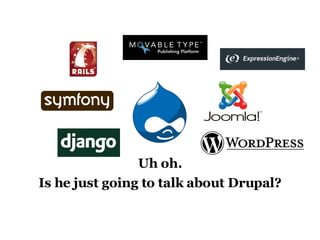
Uh oh. Is he just going to talk about Drupal?
But I’m not going to be a Dick
Uh oh. Is this one of  those  talks? (thinks the guy in the back) (be thankful: at the last minute,  I almost switched everything to  Comic Sans )
Oh, and if I don’t mention your favourite dynamic system, it’s because it sux. (actually, it’s all about interoperable systems, but that’s probably someone else’s presentation)
INTERACTIVE! (I’d like to keep asking you questions)
The 3 stages of dynamic systems. Ugh. Sounds like a thesis.
Do I need to convince you that “dynamic systems” are where we’re at? CMS, web apps, RSS feeds, etc. (there’s that pesky thing about dynamic being great for SEO, too)
So, here’s the think: every single “page” is becoming a dynamic system all by itself. (Insert hand waving)
Furthermore, implementing basic features (such as comments or forums, or a flexible array of RSS feeds, or a decent site search engine) is needlessly complex and difficult in Dreamweaver. … Because online journalism without such basic features is crippled. Dreamweaver Sux
This is the part where you tell me about “static” pages.
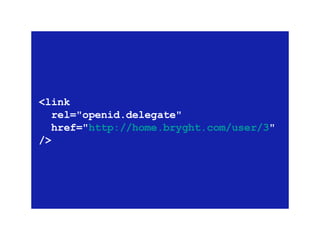
Now we’re going to build an OpenID server in just one “static” page.
<link    rel=&quot;openid.delegate&quot;   href=&quot; http://home.bryght.com/user/3 &quot; />
Bonus slide: Remember when your business model was updating individual pages? (We’re actually going to come  back to the business model thing)
ANYWAYS
The 3 stages Designing for dynamic systems Choosing open source Plugin mania Frameworks
frack There is SO much to talk about (Maybe we should just listen to Oberkirch’s presentation again)
The 3 Stages Simple content management dude, the client wants to edit their own content Beyond the blog calendars. and forums. better add a wiki, too Building web applications I’m pretty sure we need a custom function for that
Of course that’s too simplistic. There are stages within those. Upgrades. Redesigns. Budget. Level of technical expertise.
How many people use a version control system?
Web Applications At some point you wake up and realize you’re adding custom functionality to something that started as “just a website” Congratulations! You’ve got your very own web application! user profiles, personalization
4th Stage “Power of remixable data” (insert Brian Oberkirch’s presentation here)
Me == Oberkirch fanboy
RSS. APIs. Microformats. OpenID. OAuth. Attribute Exchange. (RDF and the Semantic Web…maybe)
Got any other names or labels for types of sites? Does your company slot a customer into a type?
Designing for Dynamic Systems The new site map Templates UGC sux (Note: presenter is not an actual designer)
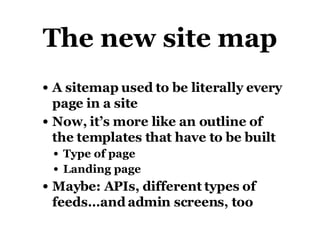
The new site map A sitemap used to be literally every page in a site Now, it’s more like an outline of the templates that have to be built Type of page Landing page Maybe: APIs, different types of feeds…and admin screens, too
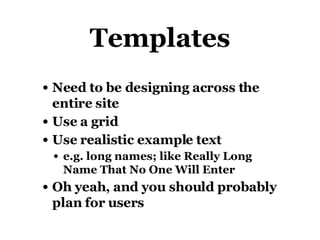
Templates Need to be designing across the entire site Use a grid Use realistic example text e.g. long names; like Really Long Name That No One Will Enter Oh yeah, and you should probably plan for users
UGC Sux Your design is finished, then.... comments! forum posts! italics, bold, break tags, and more
UGC Sux Less? Include styles for UGC Strip out / close tags Live preview Image resizing (crop / scale / placement)
Back to Templates.
Template LANGUAGE?! This is the ultimate Designer meet Developer CSS is programming! And then the developer was all, like, just learn this little code snippet…
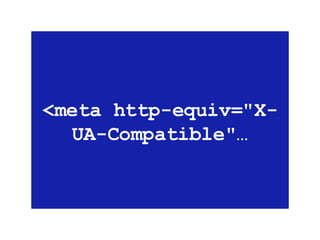
<meta http-equiv=&quot;X-UA-Compatible&quot;…
That was a cheap shot. But, MSFT made fun of my hair once
Push vs. pull is kind of interesting.
TEMPLATES. Whatever. They’re all painful. Suggestions? (I’m pretty sure any phrases involving XML and/or XSLT transforms is going to be painful)
Choosing Open Source Open source doesn’t mean free Become an expert Small local firms rolling their own
What’s your business model? It’s probably  not  selling bits What are you actually selling? It probably  is  process, expertise, design Maybe a side of services (but, like Josh said, hosting sux)
.NET open source? (Sharepoint, not so much, unfortunately. Plugins, maybe?)
Community  Return on Investment (ROI)
Why the  frack  is this guy talking about open source?
 
Three choices? Resell someone else’s code Use open source Roll your own (I know we’re in Vangroovy. But rolling your own is  not cool .)
A story about local web design dev firms.
Everybody else’s code sux! I’m building my own! I’m going to get $paid$ to code more stuff, too.
Wait…what’s your business model again?
Of course… …open source SUX. It’s badly documented, it’s unsupported, and it doesn’t work like it says on the box. (but at least you’ve got someone else to blame)
We’re all in this together.  Going open probably means more of the  open web  gets built more quickly.
Anyone got some business models to share? (it’s all about the icons and Facebook apps)
Plugins and Modules Virtually all systems have a way to extend the base Sweet! New functionality for free! Except… Installation, training, configuration Updates and security “Just one more tweak” to the design
We’re going to take an interlude to the base of the system you’re using.
Don’t hack the core.
Well, if you’re going to hack, make some patches.
Back to plugins… (They’re like hacking without the hack)
Build up a set of features / list of plugins that you know are good. Covet them. Don’t add to them.  Have a backup plan. (Like: this goes on the we  might  add  this in phase 1 list. Might.)
Of course, you can build your own. (Oooh! Maybe this is your business plan?)
Designers: make some mock ups.  If they’re pretty, developers will want to build it. (can you crowdsource your next website?)
Clients/Users: maybe you have the same pain as other people. Can you fund a common solution? Can you make an existing one suck less?
Developers: please don’t re-invent the wheel. (Except, sometimes, we need a  crazy one to do things differently)
Got any cool plugins to share?
Frameworks 100s (thousands?) of frameworks Rails (Ruby) Django (Python) Symfony (PHP) (Note: building from scratch is not an option) (No, really, it isn’t)
Where is it going to be deployed? PHP tends to run everywhere. (Tip: sneak PHP into enterprise  by deploying it on a Java stack)
Real programmers tend to love just about anything better than PHP. Except for Java.
Are there people locally that use your framework? (There are tons of TYPO3 users in Germany)
Don’t forget about libraries!
Yeah, I know the frameworks bit in here was short. Did you think I was going to start a flame war? Got something else to share?
Let’s wrap it up
The web is only going to get more dynamic.
All these things need to talk to each other.
Think about your business model.
And I didn’t even talk about internationalization. (the English web is a pretty small place)

3stages Wdn08 V3

  • 1.
    Boris Mann RaincityStudios http://www.raincitystudios.com http://bmannconsulting.com The 3 Stages of CMS
  • 2.
    If I hada tag cloud… Bryght Raincity Vancouver tech evangelist Drupal open source hand waver beer XMPP social software Northern Voice
  • 3.
    Uh oh. Ishe just going to talk about Drupal?
  • 4.
    But I’m notgoing to be a Dick
  • 5.
    Uh oh. Isthis one of those talks? (thinks the guy in the back) (be thankful: at the last minute, I almost switched everything to Comic Sans )
  • 6.
    Oh, and ifI don’t mention your favourite dynamic system, it’s because it sux. (actually, it’s all about interoperable systems, but that’s probably someone else’s presentation)
  • 7.
    INTERACTIVE! (I’d liketo keep asking you questions)
  • 8.
    The 3 stagesof dynamic systems. Ugh. Sounds like a thesis.
  • 9.
    Do I needto convince you that “dynamic systems” are where we’re at? CMS, web apps, RSS feeds, etc. (there’s that pesky thing about dynamic being great for SEO, too)
  • 10.
    So, here’s thethink: every single “page” is becoming a dynamic system all by itself. (Insert hand waving)
  • 11.
    Furthermore, implementing basicfeatures (such as comments or forums, or a flexible array of RSS feeds, or a decent site search engine) is needlessly complex and difficult in Dreamweaver. … Because online journalism without such basic features is crippled. Dreamweaver Sux
  • 12.
    This is thepart where you tell me about “static” pages.
  • 13.
    Now we’re goingto build an OpenID server in just one “static” page.
  • 14.
    <link rel=&quot;openid.delegate&quot; href=&quot; http://home.bryght.com/user/3 &quot; />
  • 15.
    Bonus slide: Rememberwhen your business model was updating individual pages? (We’re actually going to come back to the business model thing)
  • 16.
  • 17.
    The 3 stagesDesigning for dynamic systems Choosing open source Plugin mania Frameworks
  • 18.
    frack There isSO much to talk about (Maybe we should just listen to Oberkirch’s presentation again)
  • 19.
    The 3 StagesSimple content management dude, the client wants to edit their own content Beyond the blog calendars. and forums. better add a wiki, too Building web applications I’m pretty sure we need a custom function for that
  • 20.
    Of course that’stoo simplistic. There are stages within those. Upgrades. Redesigns. Budget. Level of technical expertise.
  • 21.
    How many peopleuse a version control system?
  • 22.
    Web Applications Atsome point you wake up and realize you’re adding custom functionality to something that started as “just a website” Congratulations! You’ve got your very own web application! user profiles, personalization
  • 23.
    4th Stage “Powerof remixable data” (insert Brian Oberkirch’s presentation here)
  • 24.
  • 25.
    RSS. APIs. Microformats.OpenID. OAuth. Attribute Exchange. (RDF and the Semantic Web…maybe)
  • 26.
    Got any othernames or labels for types of sites? Does your company slot a customer into a type?
  • 27.
    Designing for DynamicSystems The new site map Templates UGC sux (Note: presenter is not an actual designer)
  • 28.
    The new sitemap A sitemap used to be literally every page in a site Now, it’s more like an outline of the templates that have to be built Type of page Landing page Maybe: APIs, different types of feeds…and admin screens, too
  • 29.
    Templates Need tobe designing across the entire site Use a grid Use realistic example text e.g. long names; like Really Long Name That No One Will Enter Oh yeah, and you should probably plan for users
  • 30.
    UGC Sux Yourdesign is finished, then.... comments! forum posts! italics, bold, break tags, and more
  • 31.
    UGC Sux Less?Include styles for UGC Strip out / close tags Live preview Image resizing (crop / scale / placement)
  • 32.
  • 33.
    Template LANGUAGE?! Thisis the ultimate Designer meet Developer CSS is programming! And then the developer was all, like, just learn this little code snippet…
  • 34.
  • 35.
    That was acheap shot. But, MSFT made fun of my hair once
  • 36.
    Push vs. pullis kind of interesting.
  • 37.
    TEMPLATES. Whatever. They’reall painful. Suggestions? (I’m pretty sure any phrases involving XML and/or XSLT transforms is going to be painful)
  • 38.
    Choosing Open SourceOpen source doesn’t mean free Become an expert Small local firms rolling their own
  • 39.
    What’s your businessmodel? It’s probably not selling bits What are you actually selling? It probably is process, expertise, design Maybe a side of services (but, like Josh said, hosting sux)
  • 40.
    .NET open source?(Sharepoint, not so much, unfortunately. Plugins, maybe?)
  • 41.
    Community Returnon Investment (ROI)
  • 42.
    Why the frack is this guy talking about open source?
  • 43.
  • 44.
    Three choices? Resellsomeone else’s code Use open source Roll your own (I know we’re in Vangroovy. But rolling your own is not cool .)
  • 45.
    A story aboutlocal web design dev firms.
  • 46.
    Everybody else’s codesux! I’m building my own! I’m going to get $paid$ to code more stuff, too.
  • 47.
  • 48.
    Of course… …opensource SUX. It’s badly documented, it’s unsupported, and it doesn’t work like it says on the box. (but at least you’ve got someone else to blame)
  • 49.
    We’re all inthis together. Going open probably means more of the open web gets built more quickly.
  • 50.
    Anyone got somebusiness models to share? (it’s all about the icons and Facebook apps)
  • 51.
    Plugins and ModulesVirtually all systems have a way to extend the base Sweet! New functionality for free! Except… Installation, training, configuration Updates and security “Just one more tweak” to the design
  • 52.
    We’re going totake an interlude to the base of the system you’re using.
  • 53.
  • 54.
    Well, if you’regoing to hack, make some patches.
  • 55.
    Back to plugins…(They’re like hacking without the hack)
  • 56.
    Build up aset of features / list of plugins that you know are good. Covet them. Don’t add to them. Have a backup plan. (Like: this goes on the we might add this in phase 1 list. Might.)
  • 57.
    Of course, youcan build your own. (Oooh! Maybe this is your business plan?)
  • 58.
    Designers: make somemock ups. If they’re pretty, developers will want to build it. (can you crowdsource your next website?)
  • 59.
    Clients/Users: maybe youhave the same pain as other people. Can you fund a common solution? Can you make an existing one suck less?
  • 60.
    Developers: please don’tre-invent the wheel. (Except, sometimes, we need a crazy one to do things differently)
  • 61.
    Got any coolplugins to share?
  • 62.
    Frameworks 100s (thousands?)of frameworks Rails (Ruby) Django (Python) Symfony (PHP) (Note: building from scratch is not an option) (No, really, it isn’t)
  • 63.
    Where is itgoing to be deployed? PHP tends to run everywhere. (Tip: sneak PHP into enterprise by deploying it on a Java stack)
  • 64.
    Real programmers tendto love just about anything better than PHP. Except for Java.
  • 65.
    Are there peoplelocally that use your framework? (There are tons of TYPO3 users in Germany)
  • 66.
  • 67.
    Yeah, I knowthe frameworks bit in here was short. Did you think I was going to start a flame war? Got something else to share?
  • 68.
  • 69.
    The web isonly going to get more dynamic.
  • 70.
    All these thingsneed to talk to each other.
  • 71.
    Think about yourbusiness model.
  • 72.
    And I didn’teven talk about internationalization. (the English web is a pretty small place)