3D Screen Wall Technology for Immersive Advertising
1.
3D Screen WallTechnology for Immersive Advertising
The Evolution of Outdoor Advertising:
From Static Billboards to 3D Screen
Walls
From Flat to Immersive: How 3D LED Displays
Are Transforming Urban Landscapes
The world of outdoor ads has changed quite a bit over time. Back in the
day, people painted signs by hand or slapped on vinyl wraps for those big
billboards we all see. Now? We've got these fancy 3D LED displays with
super bright panels that actually give the illusion of depth through
something called parallax effect. Pretty cool stuff that works even when
the sun is shining bright. Cities such as Tokyo and Dubai have really
embraced this tech. Walk through any major transit station or shopping
area there and chances are good you'll spot one of these eye-catching
installations. According to the latest OOH Media Trends Report from 2023,
animated ads grab our attention about 2.3 times quicker than regular old
static billboards. What makes them so effective? They simulate holograms
right there in front of us without needing special glasses. Think about it
next time you're walking down a busy street - suddenly whole buildings
become giant interactive spaces where brands can tell their stories in
ways never possible before.
Why Modular Screen Walls Enable Scalable,
High-Impact 3D Installations
Modular screen walls break past what traditional billboards can do because
they work like puzzle pieces that just snap together. The individual panels
act on their own but still fit together nicely, so they can be placed almost
anywhere buildings have weird shapes or curves. Take a grid with about
400 pixels per inch for instance it wraps right around corners without
messing up how things look in three dimensions. What makes this setup
great is that installing these screens actually costs about 30 to maybe
2.
even 40 percentless than getting something made specifically for each
spot. Brands love this because they can test out different spots first
without breaking the bank, then expand wherever works best after seeing
what sticks.
Case Study: Times Square’s 3D Digital Billboards
and Their Influence on Brand Engagement
The hustle and bustle of New York's Times Square is the perfect stage for
seeing what 3D screen walls can really do when placed in busy spots. A
recent setup there combined super sharp 8K images with no need for
special glasses, and people just hung around looking at it way longer than
they did nearby regular screens according to Nielsen data from last year.
The numbers? About 73% more time spent watching. And get this - some
fancy depth effects like a waterfall flowing down the screen got over 12
million mentions on social media platforms in just two short weeks. What
these stats tell us is pretty clear though: those big 3D displays stick in
people's minds better because they blend right into the surroundings while
telling stories through moving visuals that grab attention.
How 3D Screen Wall Technology Works:
Engineering Immersive Visual
Experiences
Core Components: High-Resolution LED Panels
and Precision Calibration for Depth Perception
The building blocks of modern 3D screen walls are modular LED panels
that pack serious punch when it comes to visual quality. These displays
boast pixel densities over 10,000 nits and have those tiny submillimeter
pitches that make everything look so smooth on screen. Getting these
panels aligned properly is no small feat either. Manufacturers calibrate
them down to just 0.1mm differences between panels, which makes sure
the whole massive installation looks like one continuous 3D picture
instead of separate sections. What makes these screens really special
though is how they trick our brains into seeing depth. They work with
3.
something called binoculardisparity, basically the way our eyes naturally
see things from slightly different angles. No need for those bulky 3D
glasses or anything sticking out from the wall. And there's more tech
magic happening behind the scenes too. Sophisticated sensors track
where people stand in front of the display, then adjust what gets shown
so everyone sees that same immersive 3D effect whether they're standing
close or far away from the screen.
Software-Driven 3D Rendering and Real-Time
Content Synchronization
Modern graphics engines take flat 2D content and turn it into rich 3D
environments through techniques like parallax mapping and occlusion
modeling. These systems can hit impressive frame rates around 120fps,
making animations look smooth and natural instead of choppy. When it
comes to keeping everything synchronized across multiple display panels,
the system works hard to keep delays below 5 milliseconds. That's pretty
remarkable when installations stretch across hundreds of feet of space.
Smart perspective adjustments automatically respond to how many
people are watching at any given time. During busy periods, the visuals
expand to cover wider angles without losing their depth perception. As a
result, digital content seems to interact with real-world structures in ways
that feel completely integrated rather than just projected onto surfaces.
Overcoming Challenges: Viewing Angles,
Ambient Light, and Glasses-Free 3D Optimization
The latest generation of 3D screen walls can offer viewing angles of
around 160 degrees horizontally thanks to special lens layers that
gradually bend light. These screens create wider sweet spots where
people can enjoy the 3D effect without needing glasses. When it comes to
brightness, these displays hit impressive levels of about 5,000 nits which
means they stay clearly visible even when placed next to bright city lights
at night. The technology also includes smart dimming features that save
roughly 35 percent more power compared to regular LED setups. Special
software has been developed to get rid of those annoying gaps between
different display modules something that matters a lot for keeping the 3D
illusion intact outdoors. Engineers have made some pretty good progress
recently too, so now these screens can handle winds blowing at speeds of
4.
up to 65miles per hour. That makes them practical not just for mounting
on tall buildings but also for installation on moving vehicles and temporary
structures.
Benefits of Glasses-Free 3D Advertising
with Modular Screen Walls
Enhancing Brand Impact Through Hyper-
Realistic Motion and Depth Effects
Modular screen walls combine high-resolution LED panels with special
mapping software to create those amazing 3D visuals without needing any
glasses. Think about it: ads transform into actual spaces where products
seem to float right there in front of people, waterfalls spill over the sides
of screens as if they're really flowing somewhere. A recent study from
2023 on how effective immersive ads work showed something pretty
impressive too. When brands replicate realistic shadows and those subtle
movements we see when objects move past each other, viewers actually
engage with them about 86 percent more than regular flat ads. And this
kind of realism does something interesting for audiences. People
remember messages better because they feel connected emotionally to
what they're seeing. We've all had that experience where something sticks
in our minds just because it felt so real at the moment.
Boosting Consumer Recall and Dwell Time in
High-Traffic Environments
Crowded places such as train stations show something interesting when it
comes to advertising attention. The 3D screen walls there actually grab
people's focus for about two and a half times longer compared to regular
billboards. These screens work with dynamic layers and content that
reacts when someone walks past, which gets folks interacting without
planning it ahead. Take one real-world example from last year where a
soft drink company set up these interactive displays near a busy mall
entrance. They noticed their social media buzz went up around 60% give
or take after customers started posting short clips showing off those cool
3D effects. When people spend more time looking at these installations,
5.
they tend toremember the brands better too. But not everyone agrees on
how much impact this really has long term, since some studies suggest
other factors matter just as much for brand memory.
Data Insight: 73% Increase in Dwell Time at 3D
Billboard Locations (Nielsen 2023)
Looking at Nielsen's research from 2023 across twelve international
marketing efforts reveals something interesting about eye-catching
displays. When people saw those cool 3D installations without needing
special glasses, they stayed engaged for around 73% longer compared to
regular 2D versions. Plus, folks remembered these ads better too, with
recall rates jumping up by about 41% even three days later. Take one
example where an auto company set up this fancy curved modular screen
at a busy train station. People actually stopped for about 22 seconds on
average, which gives enough time to really take in all those detailed specs
about their latest models. What we're seeing here is pretty clear evidence
that when advertisers mix flexible setups with that awesome 3D effect, it
pays off big time in those high-value spots where brands want maximum
impact.
Creating Compelling Content for 3D
Screen Walls
Designing for Depth: Use of CGI and Dual-Angle
Footage in 3D Video Production
Good 3D content really stands out because of how it creates that sense of
space and depth. Artists working on these projects typically rely on
software such as Unreal Engine or Cinema 4D to craft environments where
objects appear to exist in multiple layers. They also employ techniques
involving two camera angles side by side, which works similarly to how
our eyes see things from different perspectives, giving viewers that
realistic 3D effect they expect. When dealing with modular display setups,
everything needs to be created at super high resolution between 4K and
8K so details stay sharp even when shown across several connected
screens. A recent report from Render Impact back in 2024 showed
6.
something interesting too– ads that used properly optimized three-
dimensional graphics got around 41 percent more attention compared to
regular flat content that had simply been converted over without proper
adjustments for depth perception.
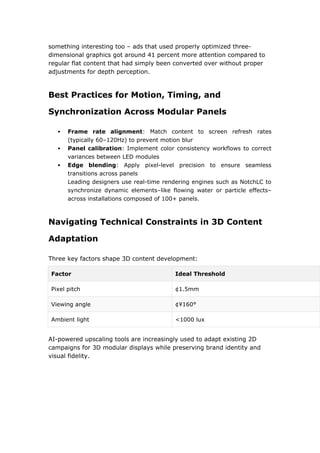
Best Practices for Motion, Timing, and
Synchronization Across Modular Panels
Frame rate alignment: Match content to screen refresh rates
(typically 60–120Hz) to prevent motion blur
Panel calibration: Implement color consistency workflows to correct
variances between LED modules
Edge blending: Apply pixel-level precision to ensure seamless
transitions across panels
Leading designers use real-time rendering engines such as NotchLC to
synchronize dynamic elements–like flowing water or particle effects–
across installations composed of 100+ panels.
Navigating Technical Constraints in 3D Content
Adaptation
Three key factors shape 3D content development:
Factor Ideal Threshold
Pixel pitch ¢1.5mm
Viewing angle ¢¥160°
Ambient light <1000 lux
AI-powered upscaling tools are increasingly used to adapt existing 2D
campaigns for 3D modular displays while preserving brand identity and
visual fidelity.
7.
Future Trends: AI,AR, and the
Integration of 3D Screen Walls in Smart
Cities
Interactive Advertising: Merging AI and
Augmented Reality with 3D LED Displays
When AI meets AR on those big 3D screen walls outside, it's changing how
people interact outdoors completely. The smart systems analyze all sorts
of live information like how many people are walking by, what the weather
looks like, and even what's trending on social media right now. They then
tweak what appears on the screens accordingly. We've seen this happen
in shopping districts where these modular displays show augmented
reality stuff over regular storefronts. Shoppers can basically test out
things without touching anything – imagine trying on different pairs of
sunglasses or seeing how shoes would look on their feet just by looking at
the screen. According to Nielsen research from last year, folks spend
about 40 percent longer looking at these interactive displays than they do
at normal advertisements. And when someone spends more time checking
something out, there's usually a better chance they'll actually buy
whatever product is being showcased.
Smart City Applications: Expanding 3D
Screen Walls Beyond Advertising into
Public Infrastructure
The 3D screen walls we see around cities aren't just fancy tech anymore
but becoming something much more useful for everyday life. Take Seoul
for instance where they've installed these cool glasses-free 3D displays
right next to subway stations. These screens actually help people figure
out when trains are coming by showing schedule info in animated layers
that pop out from the wall. When emergencies happen, the system gets
really smart too. It plays directional sounds while displaying multiple
layers of visual information all at once so folks know exactly which way to
go during evacuations. Looking ahead, many experts think these screens
8.
will start connectingwith environmental sensors throughout the city.
Imagine seeing live updates about pollution levels or traffic jams right
there on the same screens. This would turn what are now just big displays
into actual interactive tools that respond to what's happening in real-time
across urban areas.
Market Outlook: The Rise of Immersive
and Holographic Experiences by 2030
Market forecasts suggest the immersive tech sector could see annual
growth around 24.2% all the way through 2030, mainly because people
want more holograms and 3D screens popping up across smart cityscapes
according to Grand View Research from last year. As volumetric rendering
gets better and 5G networks roll out wider, we're starting to see life-sized
projections of sports stars or musicians appearing right there on stage
during concerts. Some businesses already testing these mixed reality
setups have noticed attendance jumps by nearly two thirds when they
combine physical events with those digital overlays. This points to
something bigger happening in how brands connect with audiences,
moving beyond flat screens into environments where sights, sounds, and
even smells work together to create memorable experiences.
If you're interested,Please click here to visit our product page:https://www.ecoleddisplay.com/