Retronym
Made By-
SiddhMistry
What is CNC machine and its working?
• CNC machining is the most widely used subtractive manufacturing technology. In CNC, material is
removed from a solid block using a variety of cutting tools to produce a part based on a CAD model.
Both metals and plastics can be machined with CNC.
• In CNC turning, the part is mounted on a rotating chuck and material is removed using stationary
cutting tools. This way parts with symmetry along their center axis can be manufactured. Turned parts
are typically produced faster (and at a lower cost) than milled parts.
1. Here is a summary of the steps followed to manufacture a part with CNC turning:
2. The G-code is first generated from the CAD model and a cylinder of stock material (blank) with
suitable diameter is loaded in the CNC machine.
3. The part starts rotating at high speed and a stationary cutting tool traces its profile, progressively
removing material until the designed geometry is created. Holes along the center axis can be
also manufactured, using center drills and internal cutting tools.
4. If the part needs to be flipped or moved, then the process is repeated. Otherwise, the part is cut
from the stock and it is ready for use or further post-processing.
What is 3D Printer?
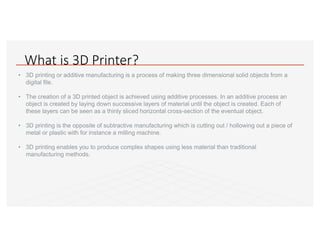
• 3D printing or additive manufacturing is a process of making three dimensional solid objects from a
digital file.
• The creation of a 3D printed object is achieved using additive processes. In an additive process an
object is created by laying down successive layers of material until the object is created. Each of
these layers can be seen as a thinly sliced horizontal cross-section of the eventual object.
• 3D printing is the opposite of subtractive manufacturing which is cutting out / hollowing out a piece of
metal or plastic with for instance a milling machine.
• 3D printing enables you to produce complex shapes using less material than traditional
manufacturing methods.
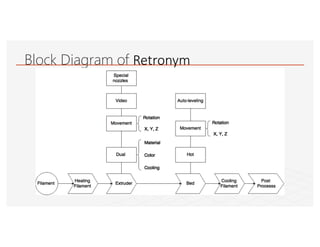
Block Diagram of Retronym
What is Arduino and its use?
• Arduino is an open-source electronics platform based on easy-to-use hardware and software. Arduino
boards are able to read inputs - light on a sensor, a finger on a button, or a Twitter message - and
turn it into an output - activating a motor, turning on an LED, publishing something online. You can tell
your board what to do by sending a set of instructions to the microcontroller on the board. To do so
you use the Arduino programming language (based on Wiring), and the Arduino Software (IDE),
based on Processing.
• Arduino uses a variant of the C language, and has a very robust integrated development environment
(IDE) which allows beginners with no experience with microcontrollers to download and execute
programs on the microcontroller. This is traditionally a difficult task for many earlier generation
microcontrollers, requiring special and costly programmer devices.
RAMPS 1.4
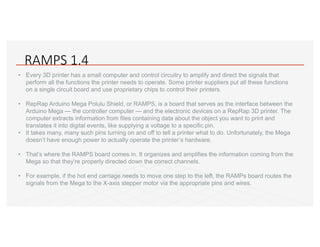
• Every 3D printer has a small computer and control circuitry to amplify and direct the signals that
perform all the functions the printer needs to operate. Some printer suppliers put all these functions
on a single circuit board and use proprietary chips to control their printers.
• RepRap Arduino Mega Polulu Shield, or RAMPS, is a board that serves as the interface between the
Arduino Mega — the controller computer — and the electronic devices on a RepRap 3D printer. The
computer extracts information from files containing data about the object you want to print and
translates it into digital events, like supplying a voltage to a specific pin.
• It takes many, many such pins turning on and off to tell a printer what to do. Unfortunately, the Mega
doesn’t have enough power to actually operate the printer’s hardware.
• That’s where the RAMPS board comes in. It organizes and amplifies the information coming from the
Mega so that they’re properly directed down the correct channels.
• For example, if the hot end carriage needs to move one step to the left, the RAMPs board routes the
signals from the Mega to the X-axis stepper motor via the appropriate pins and wires.
What is Marlin frameware?
• Marlin is an open source firmware for the RepRap family of replicating rapid prototypes — popularly
known as “3D printers.” It was derived from Sprinter and grbl, and became a standalone open source
project on August 12, 2011 with its Github release. Marlin is licensed under the GPLv3 and is free for
all applications.
• Features of Marlin
• Full-featured G-code with over 150 commands
• Complete G-code movement suite, including lines, arcs, and Bézier curves
• Smart motion system with look ahead, interrupt-based movement, linear acceleration
• Support for Cartesian, Delta, SCARA, and Core/H-Bot kinematics
• Closed-loop PID heater control with auto-tuning, thermal protection, safety cutoff
• Support for up to 5 extruders plus a heated print bed
• LCD Controller UI with more than 30 language translations
• Host-based and SD Card printing with auto start
• Bed Leveling Compensation — with or without a bed probe
• Linear Advance for pressure-based extrusion
• Support for Volumetric extrusion
• Support for mixing and multi-extruders (Cyclops, Chimera, Diamond)
• Support for Filament Runout/Width Sensors
• Print Job Timer and Print Counter
Start
Model
Processing
Parameter
Setting
Energy
Predictions
Optimal?
Environmental
Impact Assessment
Acceptable?
3D Printing
Process
Finish
Product Design
Product
Requirements
Energy
Models
Energy
Database
LCI
Database
Energy
Optimization
Quality Product
Satisfaction
Re-Design?
Product
Re-Design
Yes
Yes
Yes
Yes
No
No
No
No
Parts Used in Retronym
Electrical Components Required
•Arduino Mega 2560 x 01 Nos.
•Ramps 1.4 controller board x 01 Nos.
•Optical end stop switch x 03 Nos.
•NEMA 17 stepper motor x 05 Nos.
•PCB heat bed x 04 Nos.
•E3D v6 hot end x 01 Nos.
•A4988 stepper motor driver x 04 Nos.
•Power supply 12V/20A x 01 Nos.
Parts Used in Retronym
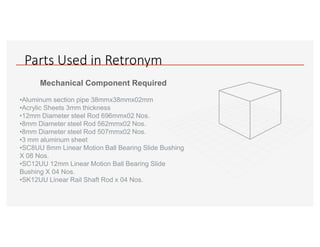
Mechanical Component Required
•Aluminum section pipe 38mmx38mmx02mm
•Acrylic Sheets 3mm thickness
•12mm Diameter steel Rod 696mmx02 Nos.
•8mm Diameter steel Rod 562mmx02 Nos.
•8mm Diameter steel Rod 507mmx02 Nos.
•3 mm aluminum sheet
•SC8UU 8mm Linear Motion Ball Bearing Slide Bushing
X 08 Nos.
•SC12UU 12mm Linear Motion Ball Bearing Slide
Bushing X 04 Nos.
•SK12UU Linear Rail Shaft Rod x 04 Nos.
Parts Used in Retronym
Mechanical Component Required
•SK8UU Linear Rail Shaft Rod x 04 Nos.
•Pedestal bearing 8mm KP08 x 02 Nos.
•T8 8mm Lead Screw with Nut 500 to 550mm x 02 Nos.
•stepper motor coupler 5mm to 8mm x 02 Nos.
•GT2 20 tooth flanged pulley for 5 mm shaft x 02 Nos.
•Nema17 Mounting Bracket x 02 Nos.
•Extruder x 01 Nos.
•1.75mm PLA Filament For 3D Printer x 01 Kg.
•Timing Belt for GT2 pulley x 04 meter.
No 3D Printer? No Problem!
Electrical Components Short Intro
• Ramps 1.4 controller board:
• it is used for generally for interfacing serval things like end
stop switch, stepper motor driver, heat bed, hot end etc with
Arduino.
• Optical end stop switch:
• it is one type of sensor switch, it has NO or NC (normally
open or normally closed ) switch are trigger when 3d printers
XYZ axis reaches to its end position.
• end stop switch is generally two types 1. optical type 2.
simple mechanical type. you can use whatever you want.
• NEMA 17 stepper motor:
• I used stepper motor which has 200 steps, in one revolution
1.8 degrees of each step
• Heat bed keep extruded plastic warm and prevent it from
warping.
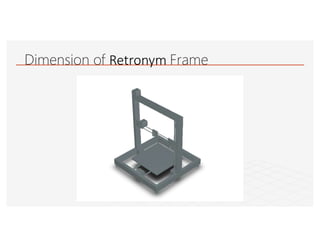
Dimension of Retronym Frame
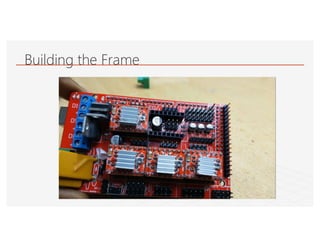
Building the Frame
Building the Frame
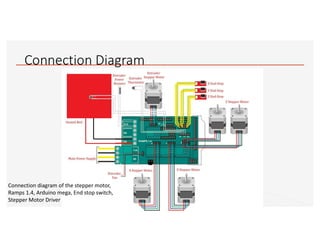
Connection Diagram
Connection diagram of the stepper motor,
Ramps 1.4, Arduino mega, End stop switch,
Stepper Motor Driver
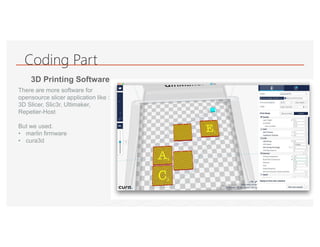
Coding Part
3D Printing Software
There are more software for
opensource slicer application like :
3D Slicer, Slic3r, Ultimaker,
Repetier-Host
But we used.
• marlin firmware
• cura3d
Reference
[1] Dongkeon Lee, Takashi Miyoshi, Yasuhiro Takaya and Taeho Ha, “3D Micro fabrication of Photosensitive
Resin Reinforced with Ceramic Nanoparticles Using LCD Microstreolithography”, Journal of Laser Micro/Nano
engineering Vol.1, No.2, 2006.
[2] Alexandru Pirjan, Dana-Mihaela Petrosanu, “The Impact of 3D Printing Technology on the society and
economy”, Journal of Information Systems and Operations Management, Volume 7, Dec 2013.
[3] Gabriel Gaala, Melissa Mendesa, Tiago P. de Almeida, “Simplified fabrication of integrated microfluidic
devices using fuseddeposition modeling 3D printing” Science Direct.
[4] Pshtiwan Shakor, Jay Sanjayan, Ali Nazari, Shami Nejadi, “Modified 3D printed powder to cement-based
material and mechanical properties of cement scaffold used in 3D printing”, Science Direct.
[5] Ruben Perez Mananes, Jose Rojo-Manaute, Pablo Gil, “3D Surgical printing and pre contoured plates for
acetabular fractures”, Journal of ELSEVIER 2016.
[6] Elizabeth Matias, Bharat Rao, “3d printing on its historical evolution and the implications for business”,
2015 Proceedings of PICMET: Management of the Technology Age.
[7] Frank van der Klift, Yoichiro Koga, Akira Todoroki, “3D Printing of Continuous Carbon Fibre Reinforced
Thermo-Plastic (CFRTP) Tensile Test Specimens”, Open Journal of Composite Materials, 2016, 6, 18- 27.
More questions about Retronym?
Thank you

3d printer

  • 1.
  • 2.
    What is CNCmachine and its working? • CNC machining is the most widely used subtractive manufacturing technology. In CNC, material is removed from a solid block using a variety of cutting tools to produce a part based on a CAD model. Both metals and plastics can be machined with CNC. • In CNC turning, the part is mounted on a rotating chuck and material is removed using stationary cutting tools. This way parts with symmetry along their center axis can be manufactured. Turned parts are typically produced faster (and at a lower cost) than milled parts. 1. Here is a summary of the steps followed to manufacture a part with CNC turning: 2. The G-code is first generated from the CAD model and a cylinder of stock material (blank) with suitable diameter is loaded in the CNC machine. 3. The part starts rotating at high speed and a stationary cutting tool traces its profile, progressively removing material until the designed geometry is created. Holes along the center axis can be also manufactured, using center drills and internal cutting tools. 4. If the part needs to be flipped or moved, then the process is repeated. Otherwise, the part is cut from the stock and it is ready for use or further post-processing.
  • 3.
    What is 3DPrinter? • 3D printing or additive manufacturing is a process of making three dimensional solid objects from a digital file. • The creation of a 3D printed object is achieved using additive processes. In an additive process an object is created by laying down successive layers of material until the object is created. Each of these layers can be seen as a thinly sliced horizontal cross-section of the eventual object. • 3D printing is the opposite of subtractive manufacturing which is cutting out / hollowing out a piece of metal or plastic with for instance a milling machine. • 3D printing enables you to produce complex shapes using less material than traditional manufacturing methods.
  • 4.
  • 5.
    What is Arduinoand its use? • Arduino is an open-source electronics platform based on easy-to-use hardware and software. Arduino boards are able to read inputs - light on a sensor, a finger on a button, or a Twitter message - and turn it into an output - activating a motor, turning on an LED, publishing something online. You can tell your board what to do by sending a set of instructions to the microcontroller on the board. To do so you use the Arduino programming language (based on Wiring), and the Arduino Software (IDE), based on Processing. • Arduino uses a variant of the C language, and has a very robust integrated development environment (IDE) which allows beginners with no experience with microcontrollers to download and execute programs on the microcontroller. This is traditionally a difficult task for many earlier generation microcontrollers, requiring special and costly programmer devices.
  • 6.
    RAMPS 1.4 • Every3D printer has a small computer and control circuitry to amplify and direct the signals that perform all the functions the printer needs to operate. Some printer suppliers put all these functions on a single circuit board and use proprietary chips to control their printers. • RepRap Arduino Mega Polulu Shield, or RAMPS, is a board that serves as the interface between the Arduino Mega — the controller computer — and the electronic devices on a RepRap 3D printer. The computer extracts information from files containing data about the object you want to print and translates it into digital events, like supplying a voltage to a specific pin. • It takes many, many such pins turning on and off to tell a printer what to do. Unfortunately, the Mega doesn’t have enough power to actually operate the printer’s hardware. • That’s where the RAMPS board comes in. It organizes and amplifies the information coming from the Mega so that they’re properly directed down the correct channels. • For example, if the hot end carriage needs to move one step to the left, the RAMPs board routes the signals from the Mega to the X-axis stepper motor via the appropriate pins and wires.
  • 7.
    What is Marlinframeware? • Marlin is an open source firmware for the RepRap family of replicating rapid prototypes — popularly known as “3D printers.” It was derived from Sprinter and grbl, and became a standalone open source project on August 12, 2011 with its Github release. Marlin is licensed under the GPLv3 and is free for all applications. • Features of Marlin • Full-featured G-code with over 150 commands • Complete G-code movement suite, including lines, arcs, and Bézier curves • Smart motion system with look ahead, interrupt-based movement, linear acceleration • Support for Cartesian, Delta, SCARA, and Core/H-Bot kinematics • Closed-loop PID heater control with auto-tuning, thermal protection, safety cutoff • Support for up to 5 extruders plus a heated print bed • LCD Controller UI with more than 30 language translations • Host-based and SD Card printing with auto start • Bed Leveling Compensation — with or without a bed probe • Linear Advance for pressure-based extrusion • Support for Volumetric extrusion • Support for mixing and multi-extruders (Cyclops, Chimera, Diamond) • Support for Filament Runout/Width Sensors • Print Job Timer and Print Counter
  • 8.
    Start Model Processing Parameter Setting Energy Predictions Optimal? Environmental Impact Assessment Acceptable? 3D Printing Process Finish ProductDesign Product Requirements Energy Models Energy Database LCI Database Energy Optimization Quality Product Satisfaction Re-Design? Product Re-Design Yes Yes Yes Yes No No No No
  • 9.
    Parts Used inRetronym Electrical Components Required •Arduino Mega 2560 x 01 Nos. •Ramps 1.4 controller board x 01 Nos. •Optical end stop switch x 03 Nos. •NEMA 17 stepper motor x 05 Nos. •PCB heat bed x 04 Nos. •E3D v6 hot end x 01 Nos. •A4988 stepper motor driver x 04 Nos. •Power supply 12V/20A x 01 Nos.
  • 10.
    Parts Used inRetronym Mechanical Component Required •Aluminum section pipe 38mmx38mmx02mm •Acrylic Sheets 3mm thickness •12mm Diameter steel Rod 696mmx02 Nos. •8mm Diameter steel Rod 562mmx02 Nos. •8mm Diameter steel Rod 507mmx02 Nos. •3 mm aluminum sheet •SC8UU 8mm Linear Motion Ball Bearing Slide Bushing X 08 Nos. •SC12UU 12mm Linear Motion Ball Bearing Slide Bushing X 04 Nos. •SK12UU Linear Rail Shaft Rod x 04 Nos.
  • 11.
    Parts Used inRetronym Mechanical Component Required •SK8UU Linear Rail Shaft Rod x 04 Nos. •Pedestal bearing 8mm KP08 x 02 Nos. •T8 8mm Lead Screw with Nut 500 to 550mm x 02 Nos. •stepper motor coupler 5mm to 8mm x 02 Nos. •GT2 20 tooth flanged pulley for 5 mm shaft x 02 Nos. •Nema17 Mounting Bracket x 02 Nos. •Extruder x 01 Nos. •1.75mm PLA Filament For 3D Printer x 01 Kg. •Timing Belt for GT2 pulley x 04 meter.
  • 12.
    No 3D Printer?No Problem! Electrical Components Short Intro • Ramps 1.4 controller board: • it is used for generally for interfacing serval things like end stop switch, stepper motor driver, heat bed, hot end etc with Arduino. • Optical end stop switch: • it is one type of sensor switch, it has NO or NC (normally open or normally closed ) switch are trigger when 3d printers XYZ axis reaches to its end position. • end stop switch is generally two types 1. optical type 2. simple mechanical type. you can use whatever you want. • NEMA 17 stepper motor: • I used stepper motor which has 200 steps, in one revolution 1.8 degrees of each step • Heat bed keep extruded plastic warm and prevent it from warping.
  • 13.
  • 14.
  • 15.
  • 16.
    Connection Diagram Connection diagramof the stepper motor, Ramps 1.4, Arduino mega, End stop switch, Stepper Motor Driver
  • 17.
    Coding Part 3D PrintingSoftware There are more software for opensource slicer application like : 3D Slicer, Slic3r, Ultimaker, Repetier-Host But we used. • marlin firmware • cura3d
  • 18.
    Reference [1] Dongkeon Lee,Takashi Miyoshi, Yasuhiro Takaya and Taeho Ha, “3D Micro fabrication of Photosensitive Resin Reinforced with Ceramic Nanoparticles Using LCD Microstreolithography”, Journal of Laser Micro/Nano engineering Vol.1, No.2, 2006. [2] Alexandru Pirjan, Dana-Mihaela Petrosanu, “The Impact of 3D Printing Technology on the society and economy”, Journal of Information Systems and Operations Management, Volume 7, Dec 2013. [3] Gabriel Gaala, Melissa Mendesa, Tiago P. de Almeida, “Simplified fabrication of integrated microfluidic devices using fuseddeposition modeling 3D printing” Science Direct. [4] Pshtiwan Shakor, Jay Sanjayan, Ali Nazari, Shami Nejadi, “Modified 3D printed powder to cement-based material and mechanical properties of cement scaffold used in 3D printing”, Science Direct. [5] Ruben Perez Mananes, Jose Rojo-Manaute, Pablo Gil, “3D Surgical printing and pre contoured plates for acetabular fractures”, Journal of ELSEVIER 2016. [6] Elizabeth Matias, Bharat Rao, “3d printing on its historical evolution and the implications for business”, 2015 Proceedings of PICMET: Management of the Technology Age. [7] Frank van der Klift, Yoichiro Koga, Akira Todoroki, “3D Printing of Continuous Carbon Fibre Reinforced Thermo-Plastic (CFRTP) Tensile Test Specimens”, Open Journal of Composite Materials, 2016, 6, 18- 27.
  • 19.
  • 20.