Going  Green  Edelman Washington, D.C DC Green Team  Edelman University Presentation March 11, 2008
Edelman Culture
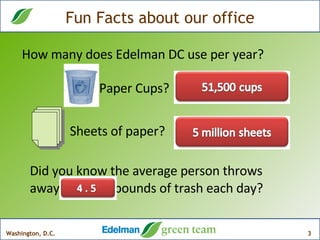
Fun Facts about our office How many does Edelman DC use per year? Paper Cups? Sheets of paper? Did you know the average person throws away _______ pounds of trash each day?
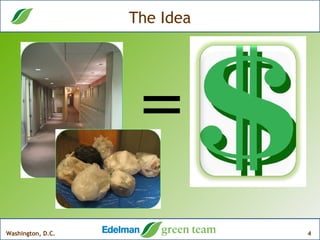
The Idea =
Across the Edelman Network Green Teams worldwide London successes New York’s upcoming launch Summer School “Green Taskforce” Global Environmental Business Manager Environmental Business Strategy
Reduce  the office’s environmental footprint Make  cost savings to our business  Increase  employees’ environmental awareness Engage  more people in Edelman’s “Living in Color” culture Share  best practice with other Edelman offices Increase  the company’s environmental profile to clients Provide  a healthier work environment – recruitment and retention tool Good to be Green: Green Team Goals
The Myths Nothing I do will make a difference.  It’s too difficult or disruptive to change my habits. People who make green choices look cheap and eccentric; I’m not a “tree-hugger”/activist.  It’s hypocritical to advocate and practice environmentally friendly behaviors in some, but not all, areas of my life.
Environmental Debates Climate Change / Global Warming U.S. Energy Policy: Present and Future International Policy: Kyoto Protocol Growing consumer culture
Terms to know Carbon Footprint:  the impact human activities have on the environment, measured  in terms of the amount of greenhouse gases produced Climate Change:  human-caused change due to rising carbon footprints ("climate variability" for other changes) CFL:  energy efficient  c ompact  f lorescent  l ight bulb  CO 2  :  carbon dioxide  Fossil fuels:  traditional nonrenewable energy sources such as petroleum, natural gas and coal = more than 80 percent of our current energy production Greenwash:  green + white wash, being intentionally misleading about environmental practices  or the benefits of a product or service. GHG:  Greenhouse gas, including carbon dioxide, water vapor, methane and ozone Global Warming : a specific type of climate change whereby temperatures are rising
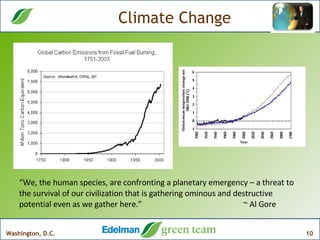
Climate Change “ We, the human species, are confronting a planetary emergency – a threat to the survival of our civilization that is gathering ominous and destructive potential even as we gather here.” ~ Al Gore
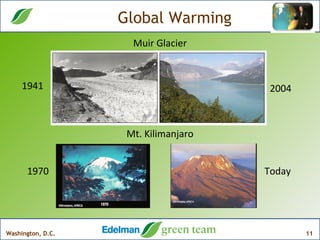
Global Warming 1970 Today 1941 2004 Muir Glacier Mt. Kilimanjaro
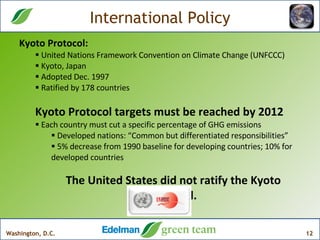
International Policy Kyoto Protocol: United Nations Framework Convention on Climate Change (UNFCCC)  Kyoto, Japan Adopted Dec. 1997 Ratified by 178 countries  Kyoto Protocol targets must be reached by 2012 Each country must cut a specific percentage of GHG emissions Developed nations: “Common but differentiated responsibilities” 5% decrease from 1990 baseline for developing countries; 10% for developed countries The United States did not ratify the Kyoto Protocol.
U.S. Energy Policy New Energy Bill Energy Independence and Security Act of 2007 Renewable Fuel Standard (RFS) CAFE standards Appliance and Equipment Efficiency Standards Lamp Efficiency Standards Industrial Efficiency Programs Commercial Building Initiative
Pending U.S. Energy Policy “ Cap and Trade”  Economic incentives program to control pollution The  cap  is a limit on total emissions by sector Carbon credits are based on a surplus or deficit of emissions over the set limit The entity may then  trade  their credits to avoid penalties/taxes Pending climate change legislation Lieberman-Warner  Bingaman-Specter
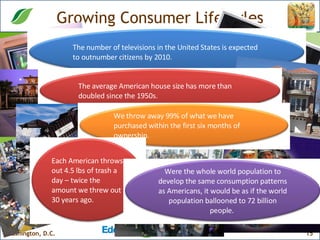
Growing Consumer Lifestyles The number of televisions in the United States is expected to outnumber citizens by 2010.  The average American house size has more than doubled since the 1950s. We throw away 99% of what we have purchased within the first six months of ownership. Each American throws out 4.5 lbs of trash a day – twice the amount we threw out 30 years ago. Were the whole world population to develop the same consumption patterns as Americans, it would be as if the world population ballooned to 72 billion people.
Interactive Exercise 1.  Every year nearly 900 million trees are cut down to provide raw materials for American paper and pulp mills. Our office alone uses  5 million sheets of paper each year. What can we do about it? 2.  The average person uses up to 183 gallons of water per day. It is estimated that an efficient household could save 31% of that, or 57 gallons per person per day. How can we reduce water usage at home? 3.  Energy use in the home has increased 16% from 1985 to 2002, costing money and using valuable resources. What can we do at home to curb our growing energy use and lower expensive utility bills?  4.  The U.S. service sector – which includes our industry – consumes more energy than any other commercial sector in the developed world (50% by 2030). How can we make our meetings, events and communications more sustainable?
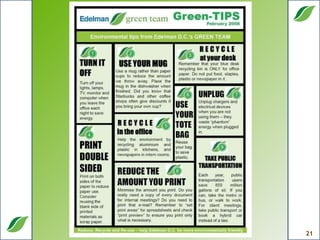
How can we reduce the amount of paper we use in the office? Think before you print – do you really need 14 copies for a meeting? Print double sided Check print previews  Always “set print area” before printing a spreadsheet Use blank sides of paper as scrap paper Rather than copying documents, scan and digitally share a pdf with your team or client when possible Encourage your teammates to print less
How can we reduce our water usage at home?   Turn off the water while you brush your teeth Take shorter showers. Showers use up to five gallons of water per minute and account for 1/5 of indoor water use Install water-saving devices in your toilet tank, faucet and showerhead Fix leaks Turn off the water while you shave Adjust lawn sprinklers to avoid “watering” hard surfaces Check weather reports before watering
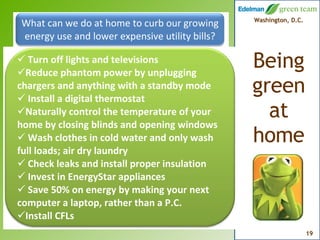
What can we do at home to curb our growing energy use and lower expensive utility bills? Turn off lights and televisions Reduce phantom power by unplugging chargers and anything with a standby mode Install a digital thermostat Naturally control the temperature of your home by closing blinds and opening windows Wash clothes in cold water and only wash full loads; air dry laundry Check leaks and install proper insulation Invest in EnergyStar appliances Save 50% on energy by making your next computer a laptop, rather than a P.C. Install CFLs
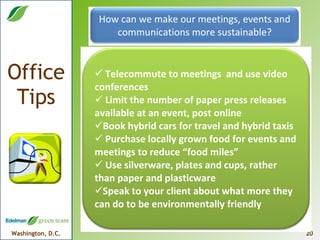
How can we make our meetings, events and communications more sustainable? Telecommute to meetings  and use video conferences Limit the number of paper press releases available at an event, post online Book hybrid cars for travel and hybrid taxis Purchase locally grown food for events and meetings to reduce “food miles” Use silverware, plates and cups, rather than paper and plasticware Speak to your client about what more they can do to be environmentally friendly
 
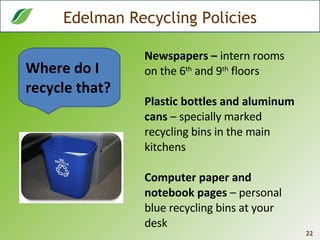
Edelman Recycling Policies Newspapers –  intern rooms on the 6 th  and 9 th  floors Plastic bottles and aluminum cans  – specially marked recycling bins in the main kitchens Computer paper and notebook pages  – personal blue recycling bins at your desk Where do I recycle that?
Please do not leave dishes in the sink. Hand-wash used mugs or  place them in the dishwasher .
Useful Web Sites and resources  www.eere.energy.gov/consumer  www.epa.gov  www.treehugger.com www.grist.com  www.idealbite.com www.edf.com  www.nrdc.org www.conservation.org www.audubon.org www.sierraclub.org
Questions?
Lauren Cole  [email_address] , x1798 Mary Teeter [email_address] , x7967  Green Team Contact Info

Green Edel-U

  • 1.
    Going Green Edelman Washington, D.C DC Green Team Edelman University Presentation March 11, 2008
  • 2.
  • 3.
    Fun Facts aboutour office How many does Edelman DC use per year? Paper Cups? Sheets of paper? Did you know the average person throws away _______ pounds of trash each day?
  • 4.
  • 5.
    Across the EdelmanNetwork Green Teams worldwide London successes New York’s upcoming launch Summer School “Green Taskforce” Global Environmental Business Manager Environmental Business Strategy
  • 6.
    Reduce theoffice’s environmental footprint Make cost savings to our business Increase employees’ environmental awareness Engage more people in Edelman’s “Living in Color” culture Share best practice with other Edelman offices Increase the company’s environmental profile to clients Provide a healthier work environment – recruitment and retention tool Good to be Green: Green Team Goals
  • 7.
    The Myths NothingI do will make a difference. It’s too difficult or disruptive to change my habits. People who make green choices look cheap and eccentric; I’m not a “tree-hugger”/activist. It’s hypocritical to advocate and practice environmentally friendly behaviors in some, but not all, areas of my life.
  • 8.
    Environmental Debates ClimateChange / Global Warming U.S. Energy Policy: Present and Future International Policy: Kyoto Protocol Growing consumer culture
  • 9.
    Terms to knowCarbon Footprint: the impact human activities have on the environment, measured in terms of the amount of greenhouse gases produced Climate Change: human-caused change due to rising carbon footprints ("climate variability" for other changes) CFL: energy efficient c ompact f lorescent l ight bulb CO 2 : carbon dioxide Fossil fuels: traditional nonrenewable energy sources such as petroleum, natural gas and coal = more than 80 percent of our current energy production Greenwash: green + white wash, being intentionally misleading about environmental practices or the benefits of a product or service. GHG: Greenhouse gas, including carbon dioxide, water vapor, methane and ozone Global Warming : a specific type of climate change whereby temperatures are rising
  • 10.
    Climate Change “We, the human species, are confronting a planetary emergency – a threat to the survival of our civilization that is gathering ominous and destructive potential even as we gather here.” ~ Al Gore
  • 11.
    Global Warming 1970Today 1941 2004 Muir Glacier Mt. Kilimanjaro
  • 12.
    International Policy KyotoProtocol: United Nations Framework Convention on Climate Change (UNFCCC) Kyoto, Japan Adopted Dec. 1997 Ratified by 178 countries Kyoto Protocol targets must be reached by 2012 Each country must cut a specific percentage of GHG emissions Developed nations: “Common but differentiated responsibilities” 5% decrease from 1990 baseline for developing countries; 10% for developed countries The United States did not ratify the Kyoto Protocol.
  • 13.
    U.S. Energy PolicyNew Energy Bill Energy Independence and Security Act of 2007 Renewable Fuel Standard (RFS) CAFE standards Appliance and Equipment Efficiency Standards Lamp Efficiency Standards Industrial Efficiency Programs Commercial Building Initiative
  • 14.
    Pending U.S. EnergyPolicy “ Cap and Trade” Economic incentives program to control pollution The cap is a limit on total emissions by sector Carbon credits are based on a surplus or deficit of emissions over the set limit The entity may then trade their credits to avoid penalties/taxes Pending climate change legislation Lieberman-Warner Bingaman-Specter
  • 15.
    Growing Consumer LifestylesThe number of televisions in the United States is expected to outnumber citizens by 2010. The average American house size has more than doubled since the 1950s. We throw away 99% of what we have purchased within the first six months of ownership. Each American throws out 4.5 lbs of trash a day – twice the amount we threw out 30 years ago. Were the whole world population to develop the same consumption patterns as Americans, it would be as if the world population ballooned to 72 billion people.
  • 16.
    Interactive Exercise 1. Every year nearly 900 million trees are cut down to provide raw materials for American paper and pulp mills. Our office alone uses 5 million sheets of paper each year. What can we do about it? 2. The average person uses up to 183 gallons of water per day. It is estimated that an efficient household could save 31% of that, or 57 gallons per person per day. How can we reduce water usage at home? 3. Energy use in the home has increased 16% from 1985 to 2002, costing money and using valuable resources. What can we do at home to curb our growing energy use and lower expensive utility bills? 4. The U.S. service sector – which includes our industry – consumes more energy than any other commercial sector in the developed world (50% by 2030). How can we make our meetings, events and communications more sustainable?
  • 17.
    How can wereduce the amount of paper we use in the office? Think before you print – do you really need 14 copies for a meeting? Print double sided Check print previews Always “set print area” before printing a spreadsheet Use blank sides of paper as scrap paper Rather than copying documents, scan and digitally share a pdf with your team or client when possible Encourage your teammates to print less
  • 18.
    How can wereduce our water usage at home? Turn off the water while you brush your teeth Take shorter showers. Showers use up to five gallons of water per minute and account for 1/5 of indoor water use Install water-saving devices in your toilet tank, faucet and showerhead Fix leaks Turn off the water while you shave Adjust lawn sprinklers to avoid “watering” hard surfaces Check weather reports before watering
  • 19.
    What can wedo at home to curb our growing energy use and lower expensive utility bills? Turn off lights and televisions Reduce phantom power by unplugging chargers and anything with a standby mode Install a digital thermostat Naturally control the temperature of your home by closing blinds and opening windows Wash clothes in cold water and only wash full loads; air dry laundry Check leaks and install proper insulation Invest in EnergyStar appliances Save 50% on energy by making your next computer a laptop, rather than a P.C. Install CFLs
  • 20.
    How can wemake our meetings, events and communications more sustainable? Telecommute to meetings and use video conferences Limit the number of paper press releases available at an event, post online Book hybrid cars for travel and hybrid taxis Purchase locally grown food for events and meetings to reduce “food miles” Use silverware, plates and cups, rather than paper and plasticware Speak to your client about what more they can do to be environmentally friendly
  • 21.
  • 22.
    Edelman Recycling PoliciesNewspapers – intern rooms on the 6 th and 9 th floors Plastic bottles and aluminum cans – specially marked recycling bins in the main kitchens Computer paper and notebook pages – personal blue recycling bins at your desk Where do I recycle that?
  • 23.
    Please do notleave dishes in the sink. Hand-wash used mugs or place them in the dishwasher .
  • 24.
    Useful Web Sitesand resources www.eere.energy.gov/consumer www.epa.gov www.treehugger.com www.grist.com www.idealbite.com www.edf.com www.nrdc.org www.conservation.org www.audubon.org www.sierraclub.org
  • 25.
  • 26.
    Lauren Cole [email_address] , x1798 Mary Teeter [email_address] , x7967 Green Team Contact Info