PRIMARY
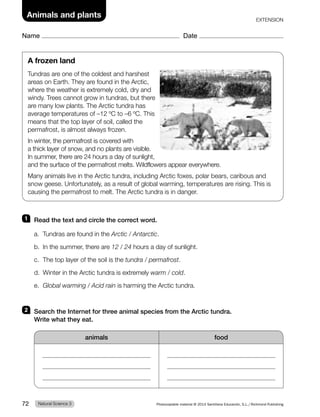
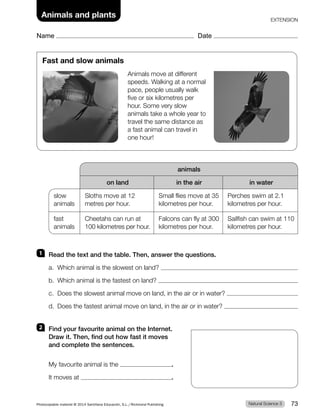
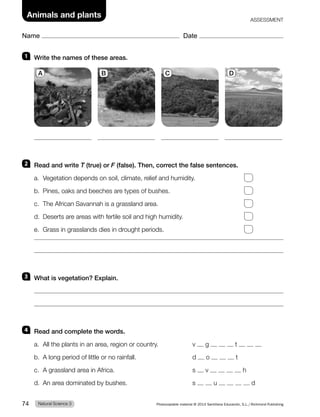
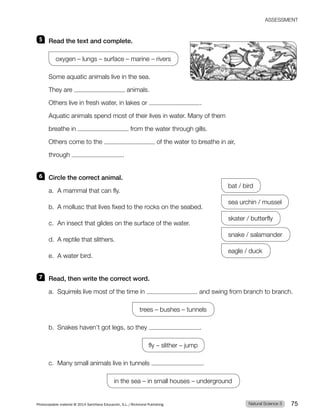
Natural
Science
TEACHER’S RESOURCE BOOK
Natural Science
TEACHER’S RESOURCE BOOK
PRIMARY
Natural Science 3 is a collective work, conceived,
designed and created by the Primary Education
department at Santillana, under the supervision
of Antonio Brandi Fernández.
WRITER
Carmen Gutiérrez
MANAGING EDITOR
Sheila Tourle
PROJECT EDITOR
Geona Edwards
EDITORS
Beatriz García Hipólito
M.ª Antonia Oliva Pérez-Andújar
PROOFREADING
Sheila Klaiber
Vassilia Katte
ILLUSTRATIONS
Juan Carlos Carmona, Mar Ferrero,
Carlos Gallego, Jose Luis Navarro,
El Ojo del Huracán, Jorge Salas,
José Santos, Carolina Temprado Battad
Natural
Science
TEACHER’S RESOURCE BOOK
PRIMARY
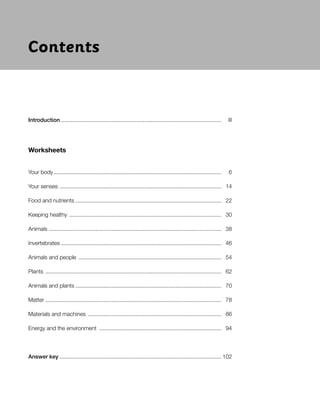
Introduction ...................................................................................................... III
Worksheets
Your body........................................................................................................... 6
Your senses ....................................................................................................... 14
Food and nutrients ............................................................................................. 22
Keeping healthy ................................................................................................. 30
Animals .............................................................................................................. 38
Invertebrates ...................................................................................................... 46
Animals and people ........................................................................................... 54
Plants ................................................................................................................ 62
Animals and plants ............................................................................................. 70
Matter ................................................................................................................ 78
Materials and machines ..................................................................................... 86
Energy and the environment .............................................................................. 94
Answer key ....................................................................................................... 102
Nombre Fecha
Contents
Introduction
Natural Science 3 Teacher’s Resource Book
provides a wide variety of photocopiable worksheets
designed to complement Natural Science 3
Student’s Book and Natural Science 3 Teacher’s
Book. It is divided into 12 topics in order to cover the
main concepts of both the National Curriculum and
the curriculum established by the Community
of Madrid.
These worksheets facilitate a flexible approach in the
classroom. Students in the same class can be given
different worksheets. Stronger students can expand
on the material learnt in class. Weaker students can
use the worksheets to revise. Alternatively, students
can work together with stronger peers to complete
the tasks. These worksheets can also be assigned
as homework.
There are four categories of worksheets:
Reinforcement, Extension, Assessment and tests,
and Investigate. Answer keys are provided at the
back of this book.
Worksheets
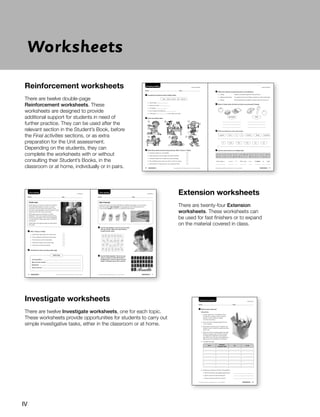
Reinforcement worksheets
There are twelve double-page
Reinforcement worksheets. These
worksheets are designed to provide
additional support for students in need of
further practice. They can be used after the
relevant section in the Student’s Book, before
the Final activities sections, or as extra
preparation for the Unit assessment.
Depending on the students, they can
complete the worksheets with or without
consulting their Student’s Books, in the
classroom or at home, individually or in pairs.
Name Date
Food and nutrients INVESTIGATE
1 Which foods contain fat?
Instructions
1. In pairs, select five or six different foods,
for example, an apple, chips, a banana,
biscuits, a carrot, bread or cheese.
Cut them into pieces.
2. Cut some brown wrapping paper into five
10 cm squares.
3. Rub a piece of each food on a square until
it leaves a mark. Label the squares and allow
them to dry.
4. When dry, hold the squares against the light.
If there is a greasy spot, the food contains
fat. Measure the diameter of each grease
spot with a ruler. The size of the grease spot
tells us how much fat there is in the food.
5. Complete the table.
food
diameter
of grease spot
fat no fat
6. Analyse your results and answer the questions.
a. Which food leaves the biggest grease spot?
b. Which is the food with the least fat?
c. Which is the food with the most fat?
Photocopiable material © 2014 Santillana Educación, S.L. / Richmond Publishing 29
Natural Science 3
1 Complete the sentences about healthy habits.
clean – sleep – posture – diet – exercise
a. Get enough .
b. Keep your body .
c. Do regular .
d. Eat a healthy and balanced .
e. Have good to look after your back.
2 Circle the healthy habits.
3 Read these sentences about doing exercise. Write T (true) or F (false).
a. Exercise makes you more flexible.
b. Team sports are not as healthy as individual sports.
c. Exercise makes your muscles and bones stronger.
d. By practising a team sport you learn to work in a group.
e. Swimming is not very good for your lungs and heart.
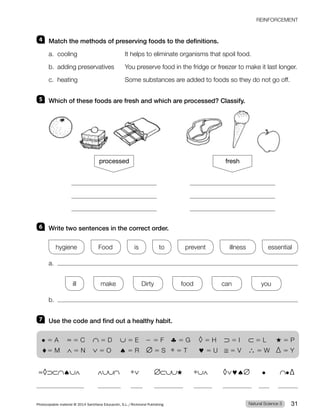
4 Match the methods of preserving foods to the definitions.
a. cooling It helps to eliminate organisms that spoil food.
b. adding preservatives You preserve food in the fridge or freezer to make it last longer.
c. heating Some substances are added to foods so they do not go off.
5 Which of these foods are fresh and which are processed? Classify.
fresh
processed
6 Write two sentences in the correct order.
hygiene Food is to prevent illness essential
a.
ill make Dirty food can you
b.
7 Use the code and find out a healthy habit.
t 5 A ≈ 5 C ∩ 5 D ∪ 5 E ∼ 5 F ♣ 5 G ◊ 5 H ⊃ 5 I ⊂ 5 L ★ 5 P
♦5 M ∧ 5 N ∨ 5 O ♠ 5 R ∅ 5 S ∗ 5 T ♥ 5 U ≅ 5 V ∴ 5 W ∆ 5 Y
≈◊⊃⊂∩♠∪∧ ∧∪∪∩ ∗∨ ∅⊂∪∪★ ∗∪∧ ◊∨♥♠∅ t ∩t∆
A B C
D E F
Natural Science 3
Natural Science 3
30 Photocopiable material © 2014 Santillana Educación, S.L./Richmond Publishing Photocopiable material © 2014 Santillana Educación, S.L./Richmond Publishing 31
Name Date
Keeping healthy REINFORCEMENT REINFORCEMENT
Name Date Name Date
Your senses Your senses EXTENSION
EXTENSION
Sign language
People with sight and hearing disabilities use different languages to communicate
with other people. Sign language is a language that many deaf people use to
communicate. Braille is a system of printing for blind people.
1 Use the sign alphabet. Learn to say your name
with your hands. Take turns with a partner
to spell out your name.
2 Use the Braille alphabet. Punch out your
name on a piece of card with the tip of
a ballpoint pen. Learn to read it with your
fingers. Exchange names with a partner.
Guide dogs
Guide dogs act as eyes for people who are blind.
They help blind people move from one place
to another. They can help a blind person cross
the road, avoid obstacles or go to the shops. Guide
dogs stay with their owners at all times.
Most guide dogs are Labradors or Golden
Retrievers. They receive special training starting
when they are puppies. Then, they are assigned
to a blind person. Guide dogs wear a harness to
do their job.
Guide dogs work approximately six years before
they retire.
1 Write T (true) or F (false).
a. Guide dogs help people who cannot see.
b. They sometimes leave their owners alone.
c. Their harness is just for decoration.
d. All breeds of dogs can be guide dogs.
e. They have a limited working life.
2 Complete the index card about guide dogs.
Job description:
Most common breeds:
Equipment:
Years of service:
Guide dogs
Photocopiable material © 2014 Santillana Educación, S.L. / Richmond Publishing Photocopiable material © 2014 Santillana Educación, S.L. / Richmond Publishing
16 17
Natural Science 3 Natural Science 3
Extension worksheets
There are twenty-four Extension
worksheets. These worksheets can
be used for fast finishers or to expand
on the material covered in class.
Investigate worksheets
There are twelve Investigate worksheets, one for each topic.
These worksheets provide opportunities for students to carry out
simple investigative tasks, either in the classroom or at home.
IV
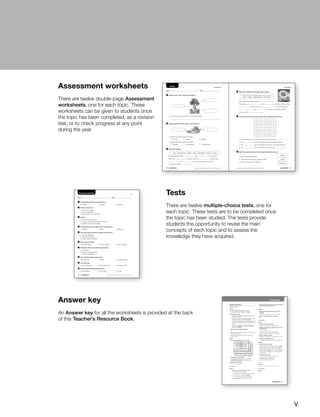
Tests
There are twelve multiple-choice tests, one for
each topic. These tests are to be completed once
the topic has been studied. The tests provide
students the opportunity to revise the main
concepts of each topic and to assess the
knowledge they have acquired.
Answer key
An Answer key for all the worksheets is provided at the back
of this Teacher’s Resource Book.
Assessment worksheets
There are twelve double-page Assessment
worksheets, one for each topic. These
worksheets can be given to students once
the topic has been completed, as a revision
test, or to check progress at any point
during the year.
Name Date
Food and nutrients TEST
1 Carbohydrates and fats are examples of…
a. proteins. b. nutrients. c. minerals.
2 Proteins are found in…
a. meat, fish and eggs.
b. fruit and vegetables.
c. bread, potatoes, rice and pasta.
3 Calcium…
a. is a very important protein.
b. makes up your bones and helps you to grow.
c. provides your body with energy.
4 A diet that gives you the right amount of nutrients is…
a. sufficient. b. active. c. balanced.
5 Your body obtains vitamins, minerals and fibre from…
a. fruit and vegetables.
b. meat, fish and pulses.
c. brown sugar, oil and butter.
6 Dairy products include…
a. bread and sugar. b. milk and yoghurt. c. bacon and eggs.
7 Wholegrain foods are healthier because they…
a. contain fibre.
b. are grown on special farms.
c. are made with healthy oils.
8 Your daily diet should include three…
a. pieces of fruit. b. snacks. c. processed foods.
9 You should eat…
a. three meals a day. b. four meals a day. c. five meals a day.
10 Experts think the Mediterranean diet is…
a. not traditional. b. very healthy. c. too oily.
Photocopiable material © 2014 Santillana Educación, S.L. / Richmond Publishing
28 Natural Science 3
Natural Science 3 113
Answer key
ANIMALS AND PLANTS
REINFORCEMENT
PAGE 70
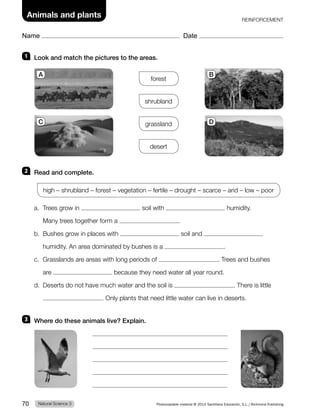
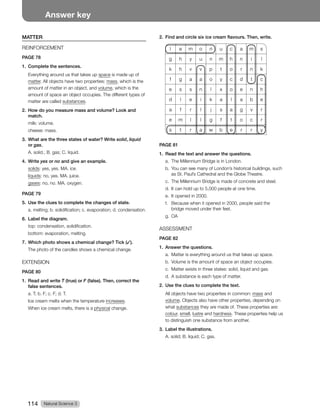
1. Look and match the pictures to the areas.
A. grassland; B. forest; C. desert; D. shrubland.
2. Read and complete.
a. Trees grow in fertile soil with high humidity. Many trees
together form a forest.
b. Bushes grow in places with poor soil and low humidity.
An area dominated by bushes is a shrubland.
c. Grasslands are areas with long periods of drought. Trees
and bushes are scarce because they need water all year
round.
d. Deserts do not have much water and the soil is arid.
There is little vegetation. Only plants that need little
water can live in deserts.
3. Where do these animals live? Explain.
MA
Seabirds spend most of their lives over the sea. They only
go to land to reproduce.
Squirrels live most of the time in trees and swing from
branch to branch.
PAGE 71
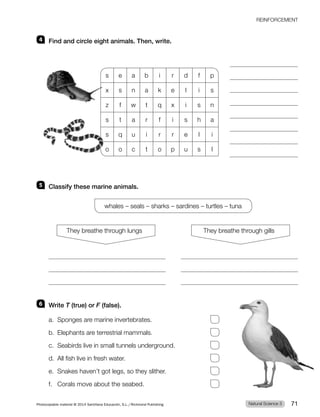
4. Find and circle eight animals. Then, write.
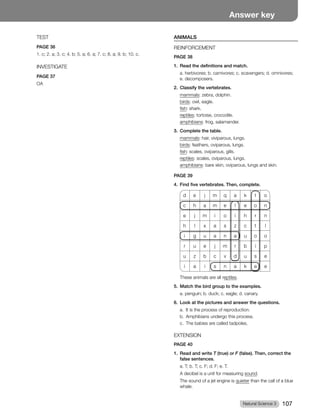
s e a b i r d f p
x s n a k e l i s
z f w t q x i s n
s t a r f i s h a
s q u i r r e l i
o o c t o p u s l
5. Classify these marine animals.
They breathe through lungs: whales, seals, turtles.
They breathe through gills: sharks, sardines, tuna.
6. Write T (true) or F (false).
a. T; b. T; c. F; d. F; e. T; f. F.
EXTENSION
PAGE 72
1. Read the text and circle the correct word.
a. Tundras are found in the Arctic.
b. In the summer, there are 24 hours a day of sunlight.
c. The top layer of the soil is the permafrost.
d. Winter in the Arctic tundra is extremely cold.
e. Global warming is harming the Arctic tundra.
2. Search the Internet for three animal species from the
Arctic tundra. Write what they eat.
OA
PAGE 73
1. Read the text and the table. Then, answer the
questions.
a. the sloth; b. the cheetah; c. on land; d. in the air.
2. Find your favourite animal on the Internet.
OA
ASSESSMENT
PAGE 74
1. Write the names of these areas.
A. desert; B. shrubland; C. forest; D grassland.
2. Read and write T (true) or F (false). Then, correct the
false sentences.
a. T; b. F; c. T; d. F; e. T.
Pines, oaks and beeches are types of trees.
Deserts are areas with arid soil and low humidity.
3. What is vegetation? Explain.
Vegetation is all the plants in an area, region or country.
4. Read and complete the words.
a. vegetation; b. drought; c. savannah; d. shrubland.
PAGE 75
5. Read the text and complete.
Some aquatic animals live in the sea. They are marine
animals. Others live in fresh water, in lakes or rivers.
Aquatic animals spend most of their lives in water. Many
of them breathe in oxygen from the water through gills.
Others come to the surface of the water to breathe in air,
through lungs.
6. Circle the correct animal.
a. bat; b. mussel; c. skater; d. snake; e. duck.
7. Read, then write the correct word.
a. trees; b. slither; c. underground.
TEST
PAGE 76
1. a; 2. b; 3. a; 4. b; 5. c; 6. b; 7. a; 8. a; 9. b; 10. a.
INVESTIGATE
PAGE 77
OA
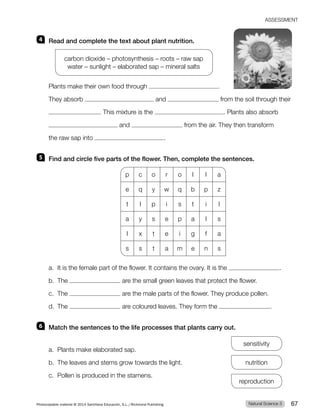
4 Read and complete the text about plant nutrition.
carbon dioxide – photosynthesis – roots – raw sap
water – sunlight – elaborated sap – mineral salts
Plants make their own food through .
They absorb and from the soil through their
. This mixture is the . Plants also absorb
and from the air. They then transform
the raw sap into .
5 Find and circle five parts of the flower. Then, complete the sentences.
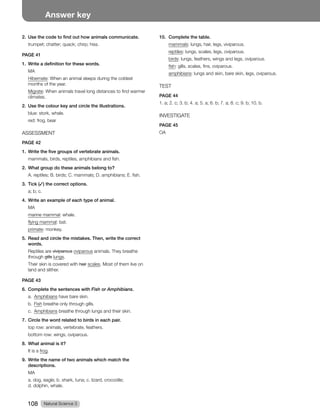
p c o r o l l a
e q y w q b p z
t l p i s t i l
a y s e p a l s
l x t e i g f a
s s t a m e n s
a. It is the female part of the flower. It contains the ovary. It is the .
b. The are the small green leaves that protect the flower.
c. The are the male parts of the flower. They produce pollen.
d. The are coloured leaves. They form the .
6 Match the sentences to the life processes that plants carry out.
a. Plants make elaborated sap.
b. The leaves and stems grow towards the light.
c. Pollen is produced in the stamens.
1 Label the plant. Then, answer the question.
t *TUIFTUFNPGUIJTQMBOUXPPEZPSIFSCBDFPVT YQMBJO
2 Label the parts of the leaf. Then, read and tick (✓).
a. Classify the leaf according to the edge.
smooth lobed jagged
b. Classify the leaf according to the shape.
palmate heart-shaped needle-shaped
3 Read and complete.
ferns – gymnosperms – rhizoids – seeds – angiosperms – flowers – mosses
Flowering plants produce with . The two main
groups are , like apple trees, and , like pine trees.
and are non-flowering plants. The roots
of mosses are called .
sensitivity
nutrition
reproduction
Natural Science 3
Natural Science 3
66 Photocopiable material © 2014 Santillana Educación, S.L./Richmond Publishing Photocopiable material © 2014 Santillana Educación, S.L./Richmond Publishing 67
Name Date
Plants ASSESSMENT
ASSESSMENT
V
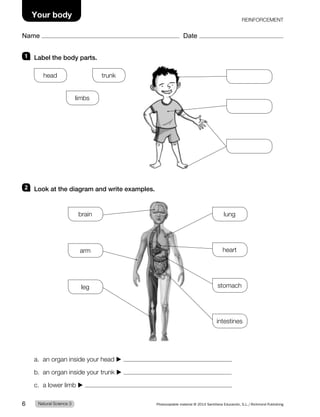
1 Label the body parts.
head trunk
limbs
2 Look at the diagram and write examples.
a. an organ inside your head ▶
b. an organ inside your trunk ▶
c. a lower limb ▶
stomach
leg
heart
lung
brain
intestines
arm
REINFORCEMENT
Natural Science 3
6 Photocopiable material © 2014 Santillana Educación, S.L./Richmond Publishing
Name Date
Your body
3 Write T (true) or F (false). Then, correct the false sentences.
a. We need energy and nutrients to live, and we get them from food.
b. Nutrition provides your body with electricity and nutrients.
c. The process of nutrition allows us to detect and respond to changes
in the environment.
d. Children look like their parents because they inherit their physical characteristics.
e. We use our senses to get information about the environment.
f. Melanin protects your body from water.
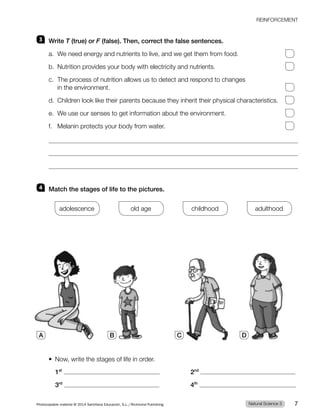
4 Match the stages of life to the pictures.
adolescence old age childhood adulthood
t /PX XSJUFUIFTUBHFTPGMJGFJOPSEFS
1st
2nd
3rd
4th
A B C D
REINFORCEMENT
Natural Science 3
Photocopiable material © 2014 Santillana Educación, S.L./Richmond Publishing 7
1 Read the text and complete the sentences.
a. Skin colour is controlled by .
b. The Sun harmful rays.
c. Skin colour depends on the of melanin.
d. Melanin the skin from the harmful rays of sunlight.
e. People with lighter skin have melanin.
2 Search the Internet or magazines for photos of three famous people with different skin
colour. Write their names and the continent they come from.
dark skin medium skin light skin
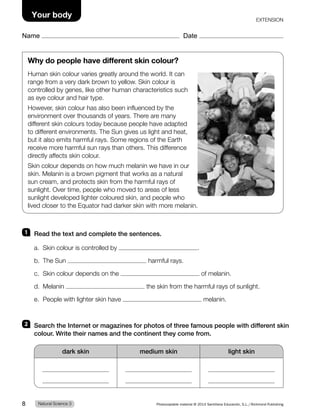
Why do people have different skin colour?
Human skin colour varies greatly around the world. It can
range from a very dark brown to yellow. Skin colour is
controlled by genes, like other human characteristics such
as eye colour and hair type.
However, skin colour has also been influenced by the
environment over thousands of years. There are many
different skin colours today because people have adapted
to different environments. The Sun gives us light and heat,
but it also emits harmful rays. Some regions of the Earth
receive more harmful sun rays than others. This difference
directly affects skin colour.
Skin colour depends on how much melanin we have in our
skin. Melanin is a brown pigment that works as a natural
sun cream, and protects skin from the harmful rays of
sunlight. Over time, people who moved to areas of less
sunlight developed lighter coloured skin, and people who
lived closer to the Equator had darker skin with more melanin.
Natural Science 3
8 Photocopiable material © 2014 Santillana Educación, S.L./Richmond Publishing
Your body
Name Date
EXTENSION
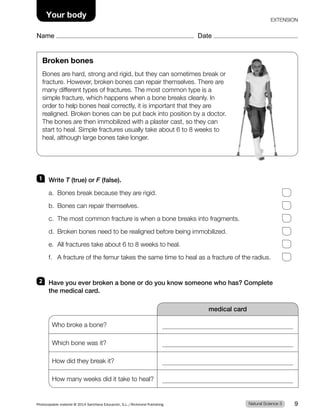
Broken bones
Bones are hard, strong and rigid, but they can sometimes break or
fracture. However, broken bones can repair themselves. There are
many different types of fractures. The most common type is a
simple fracture, which happens when a bone breaks cleanly. In
order to help bones heal correctly, it is important that they are
realigned. Broken bones can be put back into position by a doctor.
The bones are then immobilized with a plaster cast, so they can
start to heal. Simple fractures usually take about 6 to 8 weeks to
heal, although large bones take longer.
1 Write T (true) or F (false).
a. Bones break because they are rigid.
b. Bones can repair themselves.
c. The most common fracture is when a bone breaks into fragments.
d. Broken bones need to be realigned before being immobilized.
e. All fractures take about 6 to 8 weeks to heal.
f. A fracture of the femur takes the same time to heal as a fracture of the radius.
2 Have you ever broken a bone or do you know someone who has? Complete
the medical card.
medical card
Who broke a bone?
Which bone was it?
How did they break it?
How many weeks did it take to heal?
Natural Science 3
Photocopiable material © 2014 Santillana Educación, S.L./Richmond Publishing 9
Name Date
Your body EXTENSION
1 Classify the words.
forehead – hand – leg – abdomen – foot – arm – thorax – back – face
a. head ▶
b. trunk ▶
c. limbs ▶
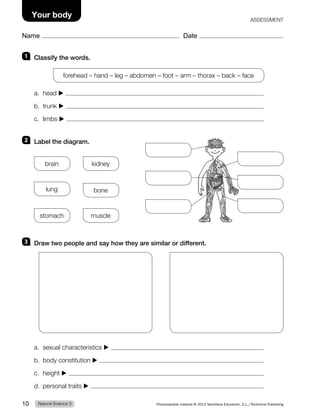
2 Label the diagram.
brain kidney
lung bone
stomach muscle
3 Draw two people and say how they are similar or different.
a. sexual characteristics ▶
b. body constitution ▶
c. height ▶
d. personal traits ▶
Natural Science 3
10 Photocopiable material © 2014 Santillana Educación, S.L./Richmond Publishing
Name Date
Your body ASSESSMENT
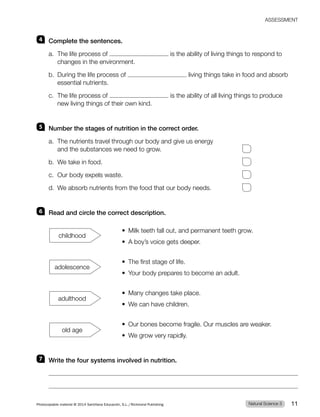
4 Complete the sentences.
a. The life process of is the ability of living things to respond to
changes in the environment.
b. During the life process of living things take in food and absorb
essential nutrients.
c. The life process of is the ability of all living things to produce
new living things of their own kind.
5 Number the stages of nutrition in the correct order.
a. The nutrients travel through our body and give us energy
and the substances we need to grow.
b. We take in food.
c. Our body expels waste.
d. We absorb nutrients from the food that our body needs.
6 Read and circle the correct description.
t .JMLUFFUIGBMMPVU BOEQFSNBOFOUUFFUIHSPX
t CPZTWPJDFHFUTEFFQFS
t 5IFGJSTUTUBHFPGMJGF
t :PVSCPEZQSFQBSFTUPCFDPNFBOBEVMU
t .BOZDIBOHFTUBLFQMBDF
t 8FDBOIBWFDIJMESFO
t 0VSCPOFTCFDPNFGSBHJMF0VSNVTDMFTBSFXFBLFS
t 8FHSPXWFSZSBQJEMZ
7 Write the four systems involved in nutrition.
adolescence
adulthood
old age
childhood
Natural Science 3
Photocopiable material © 2014 Santillana Educación, S.L./Richmond Publishing 11
4444./5
1 The main parts of the body are the head, the trunk and the…
a. thorax. b. limbs. c. thighs.
2 To move your body, your muscles work together with your…
a. bones. b. brain. c. lungs.
3 Melanin protects your body from…
a. cold air. b. sunlight. c. pain.
4 Personal traits include…
a. the colour of your eyes and hair.
b. your body constitution.
c. your height.
5 During the process of nutrition, we first take in food. Then, …
a. our body expels waste.
b. the nutrients travel through our body.
c. we absorb nutrients from the food.
6 Thanks to reproduction, …
a. we can have offspring.
b. our body can obtain nutrients.
c. our brain can respond to changes.
7 We respond to changes in the environment through…
a. nutrition. b. constitution. c. sensitivity.
8 Your milk teeth appear during…
a. adolescence. b. childhood. c. adulthood.
9 During adolescence, your…
a. body and mind change a lot.
b. body is fully-developed.
c. skin develops wrinkles.
10 Puberty is part of…
a. adulthood. b. old age. c. adolescence.
Natural Science 3
12 Photocopiable material © 2014 Santillana Educación, S.L./Richmond Publishing
Name Date
Your body TEST
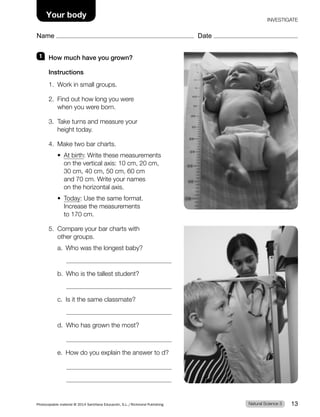
1 How much have you grown?
Instructions
1. Work in small groups.
2. Find out how long you were
when you were born.
3. Take turns and measure your
height today.
4. Make two bar charts.
t 
At birth: Write these measurements
on the vertical axis: 10 cm, 20 cm,
30 cm, 40 cm, 50 cm, 60 cm
and 70 cm. Write your names
on the horizontal axis.
t 
Today: Use the same format.
Increase the measurements
to 170 cm.
5. Compare your bar charts with
other groups.
a. Who was the longest baby?
b. Who is the tallest student?
c. Is it the same classmate?
d. Who has grown the most?
e. How do you explain the answer to d?
Natural Science 3
Photocopiable material © 2014 Santillana Educación, S.L./Richmond Publishing 13
Name Date
Your body INVESTIGATE
REINFORCEMENT
Name Date
Your senses
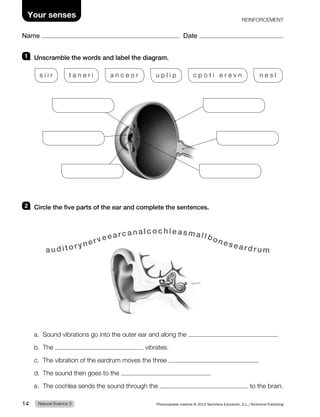
1 Unscramble the words and label the diagram.
s i i r t a n e r i a n c e o r u p l i p c p o t i e r e v n n e s l
2 Circle the five parts of the ear and complete the sentences.
auditorynerveearcanalc oc hl easmall boneseardrum
a. Sound vibrations go into the outer ear and along the .
b. The vibrates.
c. The vibration of the eardrum moves the three .
d. The sound then goes to the .
e. The cochlea sends the sound through the to the brain.
Natural Science 3
14 Photocopiable material © 2014 Santillana Educación, S.L./Richmond Publishing
REINFORCEMENT
3 Read and complete the table.
smell taste touch
The sense organ is…
It allows you to capture or identify…
4 Match the parts of the organs to their function.
a. taste buds captures light
b. epithelium capture flavours of food
c. touch receptors captures sound
d. retina distinguish hot or cold
e. cochlea captures smells
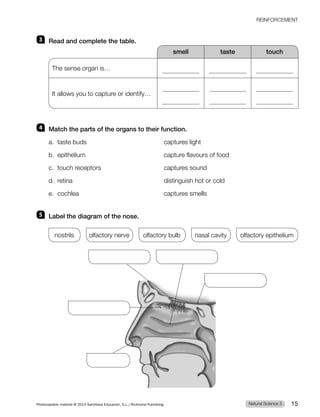
5 Label the diagram of the nose.
nostrils olfactory nerve olfactory bulb nasal cavity olfactory epithelium
Natural Science 3
Photocopiable material © 2014 Santillana Educación, S.L./Richmond Publishing 15
Name Date
Your senses EXTENSION
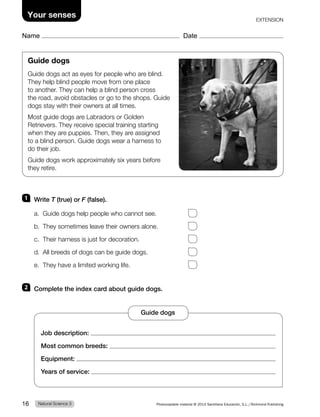
Guide dogs
Guide dogs act as eyes for people who are blind.
They help blind people move from one place
to another. They can help a blind person cross
the road, avoid obstacles or go to the shops. Guide
dogs stay with their owners at all times.
Most guide dogs are Labradors or Golden
Retrievers. They receive special training starting
when they are puppies. Then, they are assigned
to a blind person. Guide dogs wear a harness to
do their job.
Guide dogs work approximately six years before
they retire.
1 Write T (true) or F (false).
a. Guide dogs help people who cannot see.
b. They sometimes leave their owners alone.
c. Their harness is just for decoration.
d. All breeds of dogs can be guide dogs.
e. They have a limited working life.
2 Complete the index card about guide dogs.
Job description:
Most common breeds:
Equipment:
Years of service:
Guide dogs
Natural Science 3
16 Photocopiable material © 2014 Santillana Educación, S.L./Richmond Publishing
Name Date
Your senses EXTENSION
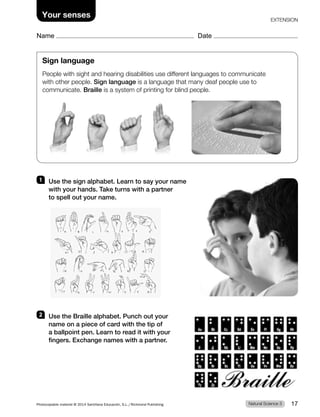
Sign language
People with sight and hearing disabilities use different languages to communicate
with other people. Sign language is a language that many deaf people use to
communicate. Braille is a system of printing for blind people.
1 Use the sign alphabet. Learn to say your name
with your hands. Take turns with a partner
to spell out your name.
2 Use the Braille alphabet. Punch out your
name on a piece of card with the tip of
a ballpoint pen. Learn to read it with your
fingers. Exchange names with a partner.
Natural Science 3
Photocopiable material © 2014 Santillana Educación, S.L./Richmond Publishing 17
Name Date
Your senses ASSESSMENT
1 Write the five sense organs.
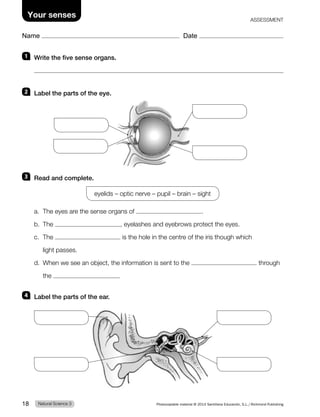
2 Label the parts of the eye.
3 Read and complete.
eyelids – optic nerve – pupil – brain – sight
a. The eyes are the sense organs of .
b. The , eyelashes and eyebrows protect the eyes.
c. The is the hole in the centre of the iris though which
light passes.
d. When we see an object, the information is sent to the through
the .
4 Label the parts of the ear.
Natural Science 3
18 Photocopiable material © 2014 Santillana Educación, S.L./Richmond Publishing
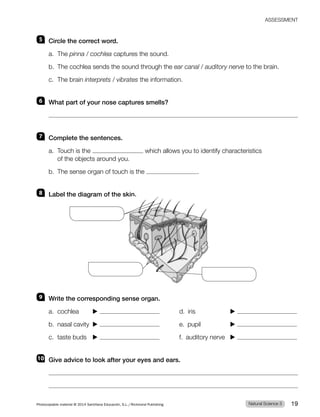
ASSESSMENT
5 Circle the correct word.
a. The pinna / cochlea captures the sound.
b. The cochlea sends the sound through the ear canal / auditory nerve to the brain.
c. The brain interprets / vibrates the information.
6 What part of your nose captures smells?
7 Complete the sentences.
a. Touch is the which allows you to identify characteristics
of the objects around you.
b. The sense organ of touch is the .
8 Label the diagram of the skin.
9 Write the corresponding sense organ.
a. cochlea ▶ d. iris ▶
b. nasal cavity ▶ e. pupil ▶
c. taste buds ▶ f. auditory nerve ▶
10 Give advice to look after your eyes and ears.
Natural Science 3
Photocopiable material © 2014 Santillana Educación, S.L./Richmond Publishing 19
Name Date
Your senses TEST
1 We can only see if there is…
a. light. b. sound. c. colour.
2 The eyes are…
a. connected to the brain by the auditory nerve.
b. protected by the eyelids, the eyelashes and the eyebrows.
c. made up of three parts.
3 The part of the ear that vibrates is the…
a. eardrum. b. cochlea. c. pinna.
4 The auditory nerve takes the information to the…
a. outer ear. b. inner ear. c. brain.
5 The sense organ of touch is…
a. the finger. b. the skin. c. hair.
6 The smell receptors are in the…
a. olfactory epithelium. b. olfactory bulb. c. nostrils.
7 Umami is…
a. the most important taste bud.
b. the fourth basic flavour.
c. a flavour found in strong cheeses.
8 You should not touch your eyes…
a. in strong sunlight.
b. in the swimming pool.
c. with dirty hands.
9 When using headphones, you should…
a. keep the volume low.
b. keep the volume high.
c. turn off the sound.
10 Doctors for children are called…
a. podiatrists. b. paediatricians. c. physicians.
Natural Science 3
20 Photocopiable material © 2014 Santillana Educación, S.L./Richmond Publishing
Name Date
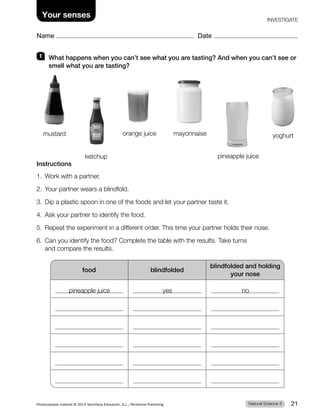
Your senses INVESTIGATE
1 What happens when you can’t see what you are tasting? And when you can’t see or
smell what you are tasting?
Instructions
1. Work with a partner.
2. Your partner wears a blindfold.
3. Dip a plastic spoon in one of the foods and let your partner taste it.
4. Ask your partner to identify the food.
5. Repeat the experiment in a different order. This time your partner holds their nose.
6. Can you identify the food? Complete the table with the results. Take turns
and compare the results.
food blindfolded
blindfolded and holding
your nose
mustard orange juice
pineapple juice
ketchup
mayonnaise yoghurt
pineapple juice yes no
Natural Science 3
Photocopiable material © 2014 Santillana Educación, S.L./Richmond Publishing 21
Name Date
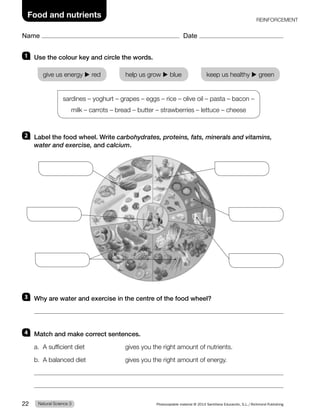
Food and nutrients REINFORCEMENT
1 Use the colour key and circle the words.
give us energy ▶ red help us grow ▶ blue keep us healthy ▶ green
sardines – yoghurt – grapes – eggs – rice – olive oil – pasta – bacon –
milk – carrots – bread – butter – strawberries – lettuce – cheese
2 Label the food wheel. Write carbohydrates, proteins, fats, minerals and vitamins,
water and exercise, and calcium.
3 Why are water and exercise in the centre of the food wheel?
4 Match and make correct sentences.
a. A sufficient diet gives you the right amount of nutrients.
b. A balanced diet gives you the right amount of energy.
Natural Science 3
22 Photocopiable material © 2014 Santillana Educación, S.L./Richmond Publishing
REINFORCEMENT
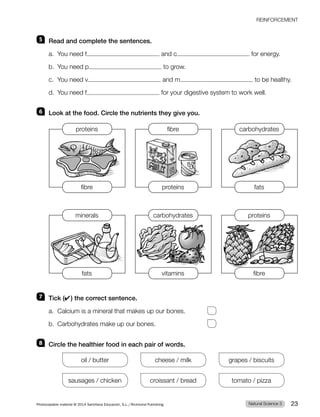
5 Read and complete the sentences.
a. You need f and c for energy.
b. You need p to grow.
c. You need v and m to be healthy.
d. You need f for your digestive system to work well.
6 Look at the food. Circle the nutrients they give you.
7 Tick (✔) the correct sentence.
a. Calcium is a mineral that makes up our bones.
b. Carbohydrates make up our bones.
8 Circle the healthier food in each pair of words.
oil / butter cheese / milk grapes / biscuits
sausages / chicken croissant / bread tomato / pizza
proteins
minerals
fibre
carbohydrates
carbohydrates
proteins
fibre
fats
proteins
vitamins
fats
fibre
Natural Science 3
Photocopiable material © 2014 Santillana Educación, S.L./Richmond Publishing 23
Name Date
Food and nutrients
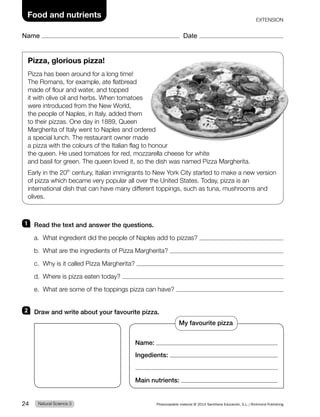
Pizza, glorious pizza!
Pizza has been around for a long time!
The Romans, for example, ate flatbread
made of flour and water, and topped
it with olive oil and herbs. When tomatoes
were introduced from the New World,
the people of Naples, in Italy, added them
to their pizzas. One day in 1889, Queen
Margherita of Italy went to Naples and ordered
a special lunch. The restaurant owner made
a pizza with the colours of the Italian flag to honour
the queen. He used tomatoes for red, mozzarella cheese for white
and basil for green. The queen loved it, so the dish was named Pizza Margherita.
Early in the 20th
century, Italian immigrants to New York City started to make a new version
of pizza which became very popular all over the United States. Today, pizza is an
international dish that can have many different toppings, such as tuna, mushrooms and
olives.
1 Read the text and answer the questions.
a. What ingredient did the people of Naples add to pizzas?
b. What are the ingredients of Pizza Margherita?
c. Why is it called Pizza Margherita?
d. Where is pizza eaten today?
e. What are some of the toppings pizza can have?
2 Draw and write about your favourite pizza.
Name:
Ingedients:
Main nutrients:
EXTENSION
My favourite pizza
Natural Science 3
24 Photocopiable material © 2014 Santillana Educación, S.L./Richmond Publishing
Name Date
Food and nutrients EXTENSION
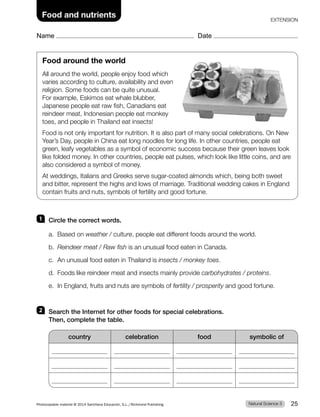
Food around the world
All around the world, people enjoy food which
varies according to culture, availability and even
religion. Some foods can be quite unusual.
For example, Eskimos eat whale blubber,
Japanese people eat raw fish, Canadians eat
reindeer meat, Indonesian people eat monkey
toes, and people in Thailand eat insects!
Food is not only important for nutrition. It is also part of many social celebrations. On New
Year’s Day, people in China eat long noodles for long life. In other countries, people eat
green, leafy vegetables as a symbol of economic success because their green leaves look
like folded money. In other countries, people eat pulses, which look like little coins, and are
also considered a symbol of money.
At weddings, Italians and Greeks serve sugar-coated almonds which, being both sweet
and bitter, represent the highs and lows of marriage. Traditional wedding cakes in England
contain fruits and nuts, symbols of fertility and good fortune.
1 Circle the correct words.
a. Based on weather / culture, people eat different foods around the world.
b. Reindeer meat / Raw fish is an unusual food eaten in Canada.
c. An unusual food eaten in Thailand is insects / monkey toes.
d. Foods like reindeer meat and insects mainly provide carbohydrates / proteins.
e. In England, fruits and nuts are symbols of fertility / prosperity and good fortune.
2 Search the Internet for other foods for special celebrations.
Then, complete the table.
country celebration food symbolic of
Natural Science 3
Photocopiable material © 2014 Santillana Educación, S.L./Richmond Publishing 25
Name Date
Food and nutrients ASSESSMENT
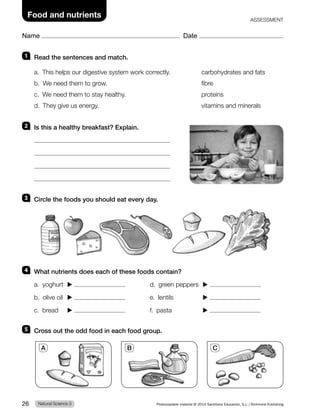
1 Read the sentences and match.
a. This helps our digestive system work correctly. carbohydrates and fats
b. We need them to grow. fibre
c. We need them to stay healthy. proteins
d. They give us energy. vitamins and minerals
2 Is this a healthy breakfast? Explain.
3 Circle the foods you should eat every day.
4 What nutrients does each of these foods contain?
a. yoghurt ▶ d. green peppers ▶
b. olive oil ▶ e. lentils ▶
c. bread ▶ f. pasta ▶
5 Cross out the odd food in each food group.
A B C
Natural Science 3
26 Photocopiable material © 2014 Santillana Educación, S.L./Richmond Publishing
ASSESSMENT
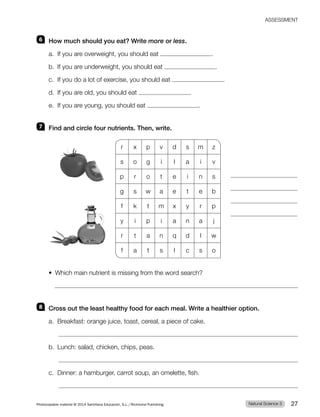
6 How much should you eat? Write more or less.
a. If you are overweight, you should eat .
b. If you are underweight, you should eat .
c. If you do a lot of exercise, you should eat .
d. If you are old, you should eat .
e. If you are young, you should eat .
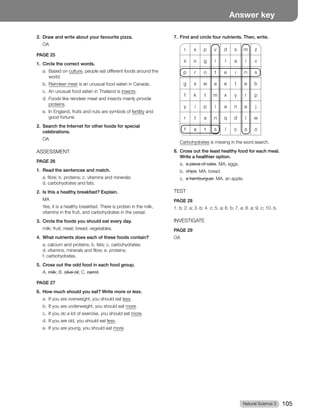
7 Find and circle four nutrients. Then, write.
r x p v d s m z
s o g i l a i v
p r o t e i n s
g s w a e t e b
f k t m x y r p
y i p i a n a j
r t a n q d l w
f a t s l c s o
t 8IJDINBJOOVUSJFOUJTNJTTJOHGSPNUIFXPSETFBSDI
8 Cross out the least healthy food for each meal. Write a healthier option.
a. Breakfast: orange juice, toast, cereal, a piece of cake.
b. Lunch: salad, chicken, chips, peas.
c. Dinner: a hamburger, carrot soup, an omelette, fish.
Natural Science 3
Photocopiable material © 2014 Santillana Educación, S.L./Richmond Publishing 27
Name Date
Food and nutrients TEST
1 Carbohydrates and fats are examples of…
a. proteins. b. nutrients. c. minerals.
2 Proteins are found in…
a. meat, fish and eggs.
b. fruit and vegetables.
c. bread, potatoes, rice and pasta.
3 Calcium…
a. is a very important protein.
b. makes up your bones and helps you to grow.
c. provides your body with energy.
4 A diet that gives you the right amount of nutrients is…
a. sufficient. b. active. c. balanced.
5 Your body obtains vitamins, minerals and fibre from…
a. fruit and vegetables.
b. meat, fish and pulses.
c. brown sugar, oil and butter.
6 Dairy products include…
a. bread and sugar. b. milk and yoghurt. c. bacon and eggs.
7 Wholegrain foods are healthier because they…
a. contain fibre.
b. are grown on special farms.
c. are made with healthy oils.
8 Your daily diet should include three…
a. pieces of fruit. b. snacks. c. processed foods.
9 You should eat…
a. three meals a day. b. four meals a day. c. five meals a day.
10 Experts think the Mediterranean diet is…
a. not traditional. b. very healthy. c. too oily.
Natural Science 3
28 Photocopiable material © 2014 Santillana Educación, S.L./Richmond Publishing
Name Date
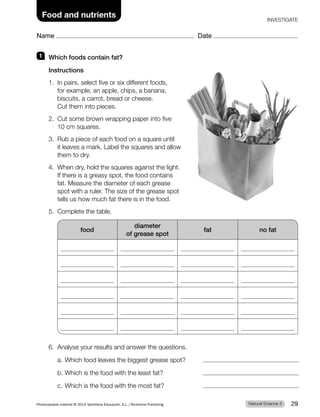
Food and nutrients INVESTIGATE
1 Which foods contain fat?
Instructions
1. In pairs, select five or six different foods,
for example, an apple, chips, a banana,
biscuits, a carrot, bread or cheese.
Cut them into pieces.
2. Cut some brown wrapping paper into five
10 cm squares.
3. Rub a piece of each food on a square until
it leaves a mark. Label the squares and allow
them to dry.
4. When dry, hold the squares against the light.
If there is a greasy spot, the food contains
fat. Measure the diameter of each grease
spot with a ruler. The size of the grease spot
tells us how much fat there is in the food.
5. Complete the table.
food
diameter
of grease spot
fat no fat
6. Analyse your results and answer the questions.
a. Which food leaves the biggest grease spot?
b. Which is the food with the least fat?
c. Which is the food with the most fat?
Natural Science 3
Photocopiable material © 2014 Santillana Educación, S.L./Richmond Publishing 29
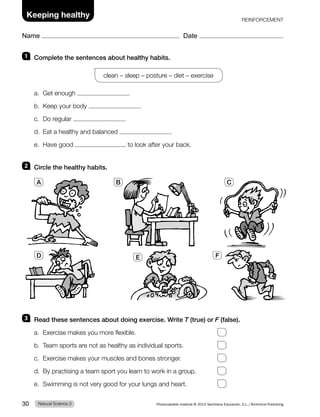
1 Complete the sentences about healthy habits.
clean – sleep – posture – diet – exercise
a. Get enough .
b. Keep your body .
c. Do regular .
d. Eat a healthy and balanced .
e. Have good to look after your back.
2 Circle the healthy habits.
3 Read these sentences about doing exercise. Write T (true) or F (false).
a. Exercise makes you more flexible.
b. Team sports are not as healthy as individual sports.
c. Exercise makes your muscles and bones stronger.
d. By practising a team sport you learn to work in a group.
e. Swimming is not very good for your lungs and heart.
A B C
D E F
Natural Science 3
30 Photocopiable material © 2014 Santillana Educación, S.L./Richmond Publishing
Name Date
Keeping healthy REINFORCEMENT
4 Match the methods of preserving foods to the definitions.
a. cooling It helps to eliminate organisms that spoil food.
b. adding preservatives You preserve food in the fridge or freezer to make it last longer.
c. heating Some substances are added to foods so they do not go off.
5 Which of these foods are fresh and which are processed? Classify.
fresh
processed
6 Write two sentences in the correct order.
hygiene Food is to prevent illness essential
a.
ill make Dirty food can you
b.
7 Use the code and find out a healthy habit.
t 5 A ≈ 5 C ∩ 5 D ∪ 5 E ∼ 5 F ♣ 5 G ◊ 5 H ⊃ 5 I ⊂ 5 L ★ 5 P
♦5 M ∧ 5 N ∨ 5 O ♠ 5 R ∅ 5 S ∗ 5 T ♥ 5 U ≅ 5 V ∴ 5 W ∆ 5 Y
≈◊⊃⊂∩♠∪∧ ∧∪∪∩ ∗∨ ∅⊂∪∪★ ∗∪∧ ◊∨♥♠∅ t ∩t∆
Natural Science 3
Photocopiable material © 2014 Santillana Educación, S.L./Richmond Publishing 31
REINFORCEMENT
1 Put the words in order to make sentences. Then, find and underline
these sentences in the text.
a. hours / to sleep / need / a night / ten / Children.
b. dreams / In one night, / four to seven / have / can / we.
c. always / We / our / do / dreams / not / remember.
2 Koalas sleep 22 hours a day! Search the Internet and find how many hours
your favourite animal sleeps.
3 Keep a dream journal for a week. Write your dreams and share them with your
classmates.
Sleeping and dreaming
Sleep is very important for keeping healthy.
When we sleep enough we can pay better
attention at school, be in a good mood and
solve problems more efficiently. Children
need to sleep ten hours a night.
Everybody dreams every night. In one
night, we can have four to seven dreams.
The things we dream about can be related
to our friends and family, our favourite TV
shows, or something we are happy or
worried about. We do not always remember our dreams. We forget most of our dreams
when we wake up.
Animals dream, too. Have you ever watched a dog while it is sleeping? Dogs move their
paws when they sleep like they are running.
Natural Science 3
32 Photocopiable material © 2014 Santillana Educación, S.L./Richmond Publishing
Keeping healthy
Name Date
EXTENSION
Visiting an art museum
One great option for a leisure activity
is visiting an art museum.
Art museums display paintings
and sculptures.
Most famous art museums are
located in big cities. The Prado
Museum is in Madrid. The Louvre
Museum is in Paris. The Tate
Gallery is in London. The Museum
of Modern Art is in New York.
Art museums look after their
paintings carefully because
they are of great historical
and cultural interest. Many
paintings are hundreds of years old.
Many people work in art museums. The director runs the art museum and is
in charge of all the employees. Art restorers repair damaged paintings so that they
are in perfect condition. Security guards protect the paintings which are displayed
in the museums.
1 Read the text and answer the questions.
a. What is an art museum?
b. Why do art museums look after their paintings?
c. What does an art restorer do?
d. What does a security guard do in an art museum?
e. Think of an art museum you have visited. What type of paintings did you see?
Natural Science 3
Photocopiable material © 2014 Santillana Educación, S.L./Richmond Publishing 33
Keeping healthy
Name Date
EXTENSION
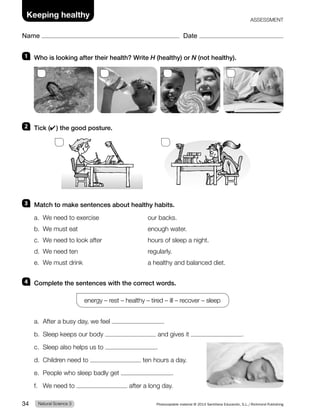
1 Who is looking after their health? Write H (healthy) or N (not healthy).
2 Tick (✔) the good posture.
3 Match to make sentences about healthy habits.
a. We need to exercise our backs.
b. We must eat enough water.
c. We need to look after hours of sleep a night.
d. We need ten regularly.
e. We must drink a healthy and balanced diet.
4 Complete the sentences with the correct words.
energy – rest – healthy – tired – ill – recover – sleep
a. After a busy day, we feel .
b. Sleep keeps our body and gives it .
c. Sleep also helps us to .
d. Children need to ten hours a day.
e. People who sleep badly get .
f. We need to after a long day.
Natural Science 3
34 Photocopiable material © 2014 Santillana Educación, S.L./Richmond Publishing
Name Date
Keeping healthy ASSESSMENT
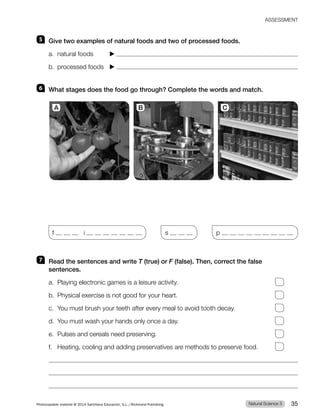
5 Give two examples of natural foods and two of processed foods.
a. natural foods ▶
b. processed foods ▶
6 What stages does the food go through? Complete the words and match.
f i s p
7 Read the sentences and write T (true) or F (false). Then, correct the false
sentences.
a. Playing electronic games is a leisure activity.
b. Physical exercise is not good for your heart.
c. You must brush your teeth after every meal to avoid tooth decay.
d. You must wash your hands only once a day.
e. Pulses and cereals need preserving.
f. Heating, cooling and adding preservatives are methods to preserve food.
A B C
Natural Science 3
Photocopiable material © 2014 Santillana Educación, S.L./Richmond Publishing 35
ASSESSMENT
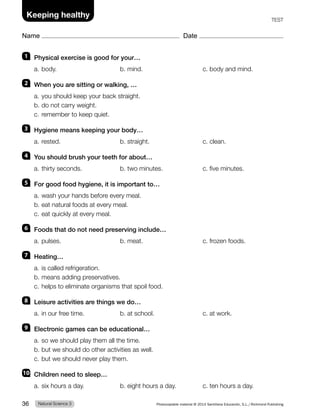
1 Physical exercise is good for your…
a. body. b. mind. c. body and mind.
2 When you are sitting or walking, …
a. you should keep your back straight.
b. do not carry weight.
c. remember to keep quiet.
3 Hygiene means keeping your body…
a. rested. b. straight. c. clean.
4 You should brush your teeth for about…
a. thirty seconds. b. two minutes. c. five minutes.
5 For good food hygiene, it is important to…
a. wash your hands before every meal.
b. eat natural foods at every meal.
c. eat quickly at every meal.
6 Foods that do not need preserving include…
a. pulses. b. meat. c. frozen foods.
7 Heating…
a. is called refrigeration.
b. means adding preservatives.
c. helps to eliminate organisms that spoil food.
8 Leisure activities are things we do…
a. in our free time. b. at school. c. at work.
9 Electronic games can be educational…
a. so we should play them all the time.
b. but we should do other activities as well.
c. but we should never play them.
10 Children need to sleep…
a. six hours a day. b. eight hours a day. c. ten hours a day.
Natural Science 3
36 Photocopiable material © 2014 Santillana Educación, S.L./Richmond Publishing
Name Date
Keeping healthy TEST
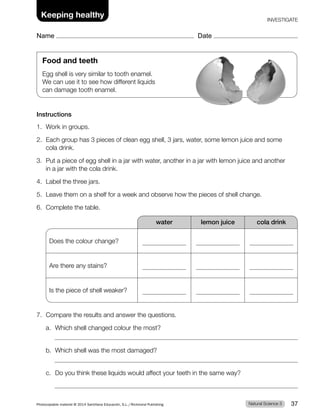
Food and teeth
Egg shell is very similar to tooth enamel.
We can use it to see how different liquids
can damage tooth enamel.
Instructions
1. Work in groups.
2. Each group has 3 pieces of clean egg shell, 3 jars, water, some lemon juice and some
cola drink.
3. Put a piece of egg shell in a jar with water, another in a jar with lemon juice and another
in a jar with the cola drink.
4. Label the three jars.
5. Leave them on a shelf for a week and observe how the pieces of shell change.
6. Complete the table.
water lemon juice cola drink
Does the colour change?
Are there any stains?
Is the piece of shell weaker?
7. Compare the results and answer the questions.
a. Which shell changed colour the most?
b. Which shell was the most damaged?
c. Do you think these liquids would affect your teeth in the same way?
Natural Science 3
Photocopiable material © 2014 Santillana Educación, S.L./Richmond Publishing 37
Name Date
Keeping healthy INVESTIGATE
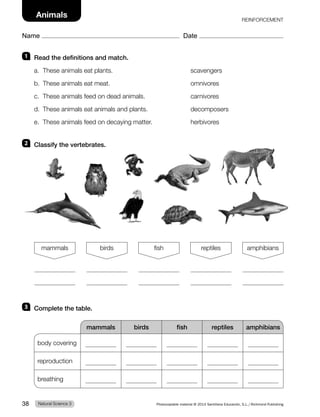
1 Read the definitions and match.
a. These animals eat plants. scavengers
b. These animals eat meat. omnivores
c. These animals feed on dead animals. carnivores
d. These animals eat animals and plants. decomposers
e. These animals feed on decaying matter. herbivores
2 Classify the vertebrates.
3 Complete the table.
mammals birds fish reptiles amphibians
body covering
reproduction
breathing
mammals birds fish reptiles amphibians
Natural Science 3
38 Photocopiable material © 2014 Santillana Educación, S.L./Richmond Publishing
Name Date
Animals REINFORCEMENT
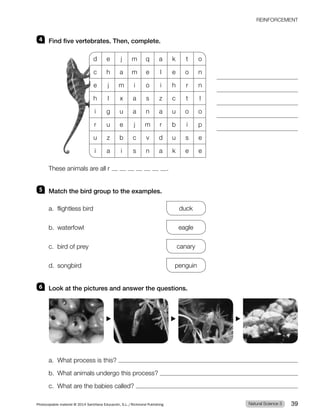
4 Find five vertebrates. Then, complete.
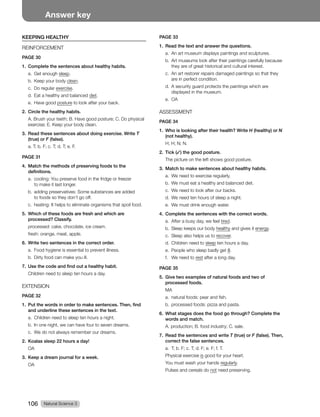
d e j m q a k t o
c h a m e l e o n
e j m i o i h r n
h l x a s z c t l
i g u a n a u o o
r u e j m r b i p
u z b c v d u s e
i a i s n a k e e
These animals are all r .
5 Match the bird group to the examples.
a. flightless bird duck
b. waterfowl eagle
c. bird of prey canary
d. songbird penguin
6 Look at the pictures and answer the questions.
a. What process is this?
b. What animals undergo this process?
c. What are the babies called?
▶ ▶ ▶
Natural Science 3
Photocopiable material © 2014 Santillana Educación, S.L./Richmond Publishing 39
REINFORCEMENT
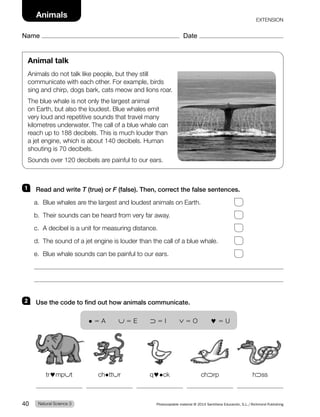
Animal talk
Animals do not talk like people, but they still
communicate with each other. For example, birds
sing and chirp, dogs bark, cats meow and lions roar.
The blue whale is not only the largest animal
on Earth, but also the loudest. Blue whales emit
very loud and repetitive sounds that travel many
kilometres underwater. The call of a blue whale can
reach up to 188 decibels. This is much louder than
a jet engine, which is about 140 decibels. Human
shouting is 70 decibels.
Sounds over 120 decibels are painful to our ears.
1 Read and write T (true) or F (false). Then, correct the false sentences.
a. Blue whales are the largest and loudest animals on Earth.
b. Their sounds can be heard from very far away.
c. A decibel is a unit for measuring distance.
d. The sound of a jet engine is louder than the call of a blue whale.
e. Blue whale sounds can be painful to our ears.
2 Use the code to find out how animals communicate.
t 5 A ∪ 5 E ⊃ 5 I ∨ 5 O ♥ 5 U
tr♥mp∪t chttt∪r q♥tck ch⊃rp h⊃ss
Natural Science 3
40 Photocopiable material © 2014 Santillana Educación, S.L./Richmond Publishing
Animals
Name Date
EXTENSION
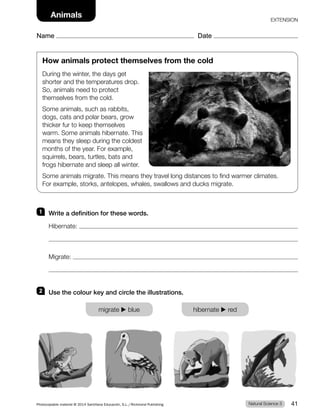
How animals protect themselves from the cold
During the winter, the days get
shorter and the temperatures drop.
So, animals need to protect
themselves from the cold.
Some animals, such as rabbits,
dogs, cats and polar bears, grow
thicker fur to keep themselves
warm. Some animals hibernate. This
means they sleep during the coldest
months of the year. For example,
squirrels, bears, turtles, bats and
frogs hibernate and sleep all winter.
Some animals migrate. This means they travel long distances to find warmer climates.
For example, storks, antelopes, whales, swallows and ducks migrate.
1 Write a definition for these words.
Hibernate:
Migrate:
2 Use the colour key and circle the illustrations.
migrate ▶ blue hibernate ▶ red
Natural Science 3
Photocopiable material © 2014 Santillana Educación, S.L./Richmond Publishing 41
Name Date
Animals
Name Date
EXTENSION
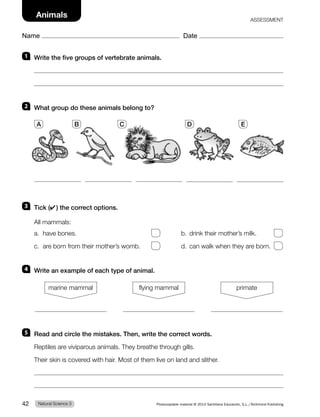
1 Write the five groups of vertebrate animals.
2 What group do these animals belong to?
3 Tick (✔) the correct options.
All mammals:
a. have bones. b. drink their mother’s milk.
c. are born from their mother’s womb. d. can walk when they are born.
4 Write an example of each type of animal.
marine mammal flying mammal primate
5 Read and circle the mistakes. Then, write the correct words.
Reptiles are viviparous animals. They breathe through gills.
Their skin is covered with hair. Most of them live on land and slither.
A B C D E
Natural Science 3
42 Photocopiable material © 2014 Santillana Educación, S.L./Richmond Publishing
Name Date
Animals ASSESSMENT
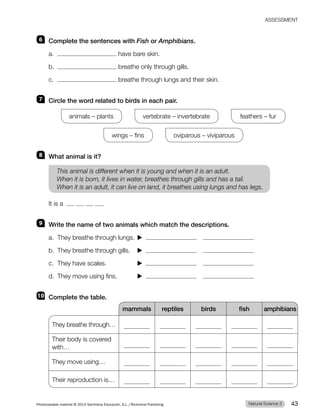
6 Complete the sentences with Fish or Amphibians.
a. have bare skin.
b. breathe only through gills.
c. breathe through lungs and their skin.
7 Circle the word related to birds in each pair.
animals – plants vertebrate – invertebrate feathers – fur
wings – fins oviparous – viviparous
8 What animal is it?
This animal is different when it is young and when it is an adult.
When it is born, it lives in water, breathes through gills and has a tail.
When it is an adult, it can live on land, it breathes using lungs and has legs.
It is a .
9 Write the name of two animals which match the descriptions.
a. They breathe through lungs. ▶
b. They breathe through gills. ▶
c. They have scales. ▶
d. They move using fins. ▶
10 Complete the table.
mammals reptiles birds fish amphibians
They breathe through…
Their body is covered
with…
They move using…
Their reproduction is…
Natural Science 3
Photocopiable material © 2014 Santillana Educación, S.L./Richmond Publishing 43
ASSESSMENT
1 Through the process of nutrition, animals obtain…
a. energy. b. information. c. offspring.
2 Animals that feed on dead animals are…
a. herbivores. b. vertebrates. c. scavengers.
3 Carnivores…
a. feed on decaying plant and animal matter.
b. eat other animals.
c. eat food of plant and animal origin.
4 According to their type of reproduction, animals can be…
a. oviparous or viviparous. b. mammals or birds. c. aquatic or terrestrial.
5 All vertebrates have…
a. a spinal column. b. legs. c. an exoskeleton.
6 Mammals are viviparous because…
a. they like milk.
b. they are born from their mother’s womb.
c. they breathe air through their lungs.
7 Dolphins and whales are…
a. cetaceans. b. fish. c. oviparous.
8 All birds are oviparous. This means that they…
a. can sing to communicate.
b. have got webbed feet.
c. are born from eggs.
9 Lizards, snakes, crocodiles and tortoises are…
a. invertebrates. b. reptiles. c. carnivores.
10 Fish are…
a. aquatic vertebrates that breathe through lungs.
b. aquatic vertebrates that breathe through gills.
c. aquatic invertebrates with bare skin.
Natural Science 3
44 Photocopiable material © 2014 Santillana Educación, S.L./Richmond Publishing
Name Date
Animals TEST
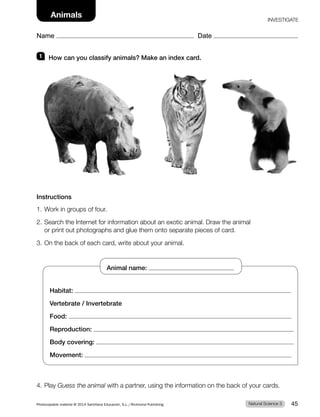
1 How can you classify animals? Make an index card.
Instructions
1. Work in groups of four.
2. Search the Internet for information about an exotic animal. Draw the animal
or print out photographs and glue them onto separate pieces of card.
3. On the back of each card, write about your animal.
4. Play Guess the animal with a partner, using the information on the back of your cards.
Habitat:
Vertebrate / Invertebrate
Food:
Reproduction:
Body covering:
Movement:
Animal name:
Natural Science 3
Photocopiable material © 2014 Santillana Educación, S.L./Richmond Publishing 45
Name Date
Animals
Name Date
INVESTIGATE
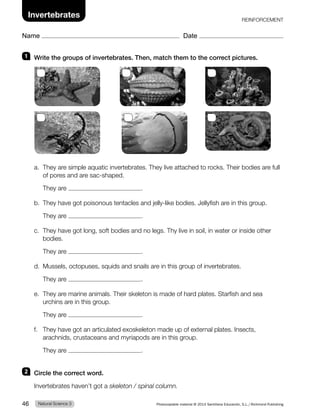
1 Write the groups of invertebrates. Then, match them to the correct pictures.
a. They are simple aquatic invertebrates. They live attached to rocks. Their bodies are full
of pores and are sac-shaped.
They are .
b. They have got poisonous tentacles and jelly-like bodies. Jellyfish are in this group.
They are .
c. They have got long, soft bodies and no legs. Thy live in soil, in water or inside other
bodies.
They are .
d. Mussels, octopuses, squids and snails are in this group of invertebrates.
They are .
e. They are marine animals. Their skeleton is made of hard plates. Starfish and sea
urchins are in this group.
They are .
f. They have got an articulated exoskeleton made up of external plates. Insects,
arachnids, crustaceans and myriapods are in this group.
They are .
2 Circle the correct word.
Invertebrates haven’t got a skeleton / spinal column.
REINFORCEMENT
Natural Science 3
46 Photocopiable material © 2014 Santillana Educación, S.L./Richmond Publishing
Name Date
Invertebrates
3 Circle the correct words.
a. Worms, insects and spiders are vertebrates / invertebrates.
b. Mussels have got shells / exoskeletons.
c. Crabs have got hard / soft exoskeletons.
d. Jellyfish and earthworms have got / haven’t got a hard covering.
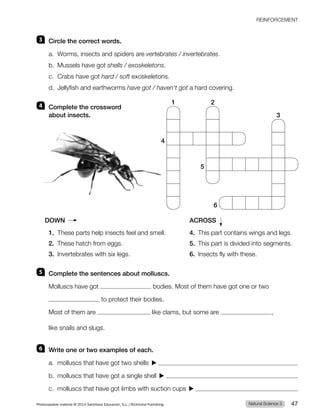
4 Complete the crossword
about insects.
DOWN ACROSS
1. These parts help insects feel and smell. 4. This part contains wings and legs.
2. These hatch from eggs. 5. This part is divided into segments.
3. Invertebrates with six legs. 6. Insects fly with these.
5 Complete the sentences about molluscs.
Molluscs have got bodies. Most of them have got one or two
to protect their bodies.
Most of them are , like clams, but some are ,
like snails and slugs.
6 Write one or two examples of each.
a. molluscs that have got two shells
b. molluscs that have got a single shell
c. molluscs that have got limbs with suction cups
1 2
3
4
5
6
REINFORCEMENT
Natural Science 3
Photocopiable material © 2014 Santillana Educación, S.L./Richmond Publishing 47
1 Unscramble the words and find some examples of cephalopods.
d s u i s q s h u c t i t l f e o t c p u o s e s
a. b. c.
2 Write T (true) or F (false). Then, correct the false sentences.
a. The octopus is one of the most intelligent invertebrates in the sea.
b. Cephalopod means head-legs.
c. Octopuses move by jet propulsion.
d. Octopuses have an excellent sense of hearing.
e. Octopuses have five tentacles.
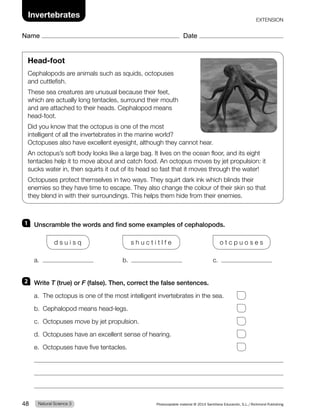
Head-foot
Cephalopods are animals such as squids, octopuses
and cuttlefish.
These sea creatures are unusual because their feet,
which are actually long tentacles, surround their mouth
and are attached to their heads. Cephalopod means
head-foot.
Did you know that the octopus is one of the most
intelligent of all the invertebrates in the marine world?
Octopuses also have excellent eyesight, although they cannot hear.
An octopus’s soft body looks like a large bag. It lives on the ocean floor, and its eight
tentacles help it to move about and catch food. An octopus moves by jet propulsion: it
sucks water in, then squirts it out of its head so fast that it moves through the water!
Octopuses protect themselves in two ways. They squirt dark ink which blinds their
enemies so they have time to escape. They also change the colour of their skin so that
they blend in with their surroundings. This helps them hide from their enemies.
Natural Science 3
48 Photocopiable material © 2014 Santillana Educación, S.L./Richmond Publishing
Invertebrates
Name Date
EXTENSION
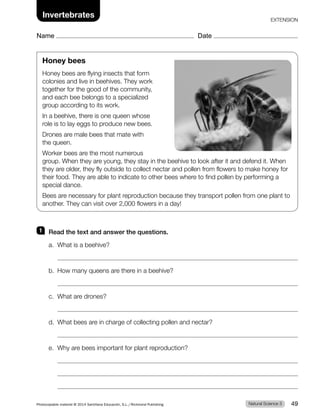
Honey bees
Honey bees are flying insects that form
colonies and live in beehives. They work
together for the good of the community,
and each bee belongs to a specialized
group according to its work.
In a beehive, there is one queen whose
role is to lay eggs to produce new bees.
Drones are male bees that mate with
the queen.
Worker bees are the most numerous
group. When they are young, they stay in the beehive to look after it and defend it. When
they are older, they fly outside to collect nectar and pollen from flowers to make honey for
their food. They are able to indicate to other bees where to find pollen by performing a
special dance.
Bees are necessary for plant reproduction because they transport pollen from one plant to
another. They can visit over 2,000 flowers in a day!
1 Read the text and answer the questions.
a. What is a beehive?
b. How many queens are there in a beehive?
c. What are drones?
d. What bees are in charge of collecting pollen and nectar?
e. Why are bees important for plant reproduction?
foto
abeja
Natural Science 3
Photocopiable material © 2014 Santillana Educación, S.L./Richmond Publishing 49
Invertebrates
Name Date
EXTENSION
1 What do all invertebrates have in common?
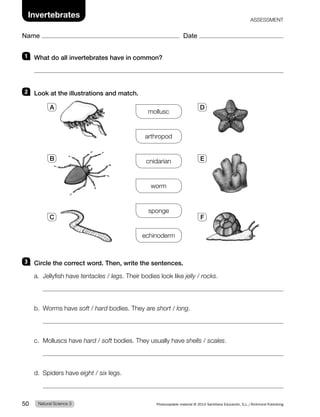
2 Look at the illustrations and match.
mollusc
arthropod
cnidarian
worm
sponge
echinoderm
3 Circle the correct word. Then, write the sentences.
a. Jellyfish have tentacles / legs. Their bodies look like jelly / rocks.
b. Worms have soft / hard bodies. They are short / long.
c. Molluscs have hard / soft bodies. They usually have shells / scales.
d. Spiders have eight / six legs.
A
B
C
D
E
F
Natural Science 3
50 Photocopiable material © 2014 Santillana Educación, S.L./Richmond Publishing
Name Date
Invertebrates ASSESSMENT
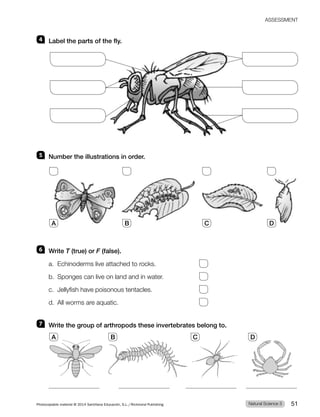
4 Label the parts of the fly.
5 Number the illustrations in order.
6 Write T (true) or F (false).
a. Echinoderms live attached to rocks.
b. Sponges can live on land and in water.
c. Jellyfish have poisonous tentacles.
d. All worms are aquatic.
7 Write the group of arthropods these invertebrates belong to.
A B C D
A B C D
Natural Science 3
Photocopiable material © 2014 Santillana Educación, S.L./Richmond Publishing 51
ASSESSMENT
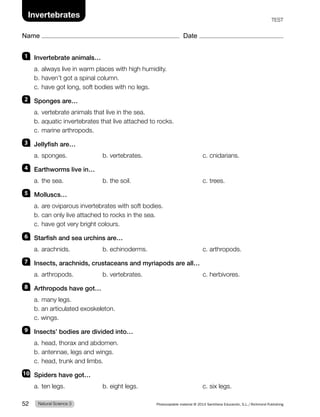
1 Invertebrate animals…
a. always live in warm places with high humidity.
b. haven’t got a spinal column.
c. have got long, soft bodies with no legs.
2 Sponges are…
a. vertebrate animals that live in the sea.
b. aquatic invertebrates that live attached to rocks.
c. marine arthropods.
3 Jellyfish are…
a. sponges. b. vertebrates. c. cnidarians.
4 Earthworms live in…
a. the sea. b. the soil. c. trees.
5 Molluscs…
a. are oviparous invertebrates with soft bodies.
b. can only live attached to rocks in the sea.
c. have got very bright colours.
6 Starfish and sea urchins are…
a. arachnids. b. echinoderms. c. arthropods.
7 Insects, arachnids, crustaceans and myriapods are all…
a. arthropods. b. vertebrates. c. herbivores.
8 Arthropods have got…
a. many legs.
b. an articulated exoskeleton.
c. wings.
9 Insects’ bodies are divided into…
a. head, thorax and abdomen.
b. antennae, legs and wings.
c. head, trunk and limbs.
10 Spiders have got…
a. ten legs. b. eight legs. c. six legs.
Natural Science 3
52 Photocopiable material © 2014 Santillana Educación, S.L./Richmond Publishing
Name Date
TEST
Invertebrates
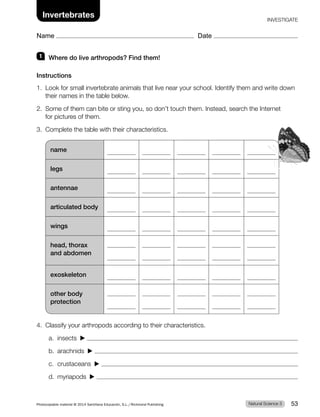
1 Where do live arthropods? Find them!
Instructions
1. Look for small invertebrate animals that live near your school. Identify them and write down
their names in the table below.
2. Some of them can bite or sting you, so don’t touch them. Instead, search the Internet
for pictures of them.
3. Complete the table with their characteristics.
name
legs
antennae
articulated body
wings
head, thorax
and abdomen
exoskeleton
other body
protection
4. Classify your arthropods according to their characteristics.
a. insects ▶
b. arachnids ▶
c. crustaceans ▶
d. myriapods ▶
Natural Science 3
Photocopiable material © 2014 Santillana Educación, S.L./Richmond Publishing 53
Invertebrates
Name Date
INVESTIGATE
Name Date
Animals and people REINFORCEMENT
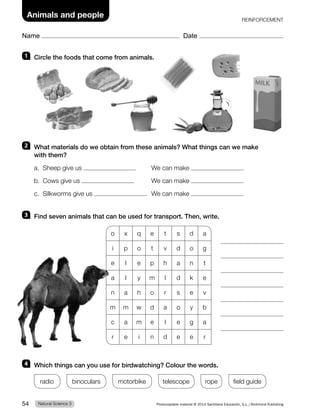
1 Circle the foods that come from animals.
2 What materials do we obtain from these animals? What things can we make
with them?
a. Sheep give us . We can make .
b. Cows give us . We can make .
c. Silkworms give us . We can make .
3 Find seven animals that can be used for transport. Then, write.
o x q e t s d a
i p o t v d o g
e l e p h a n t
a l y m l d k e
n a h o r s e v
m m w d a o y b
c a m e l e g a
r e i n d e e r
4 Which things can you use for birdwatching? Colour the words.
radio binoculars motorbike telescope rope field guide
Natural Science 3
54 Photocopiable material © 2014 Santillana Educación, S.L./Richmond Publishing
REINFORCEMENT
5 Complete the sentences.
extensive – raise – intensive – livestock
a. Farmers animals for their meat, milk, eggs or skins. This is
called farming.
b. In farming, animals live in the open and eat grass.
c. In farming, animals live fenced in and farmers feed them.
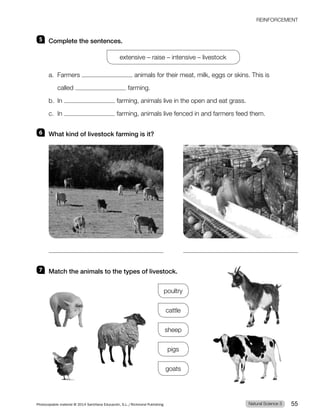
6 What kind of livestock farming is it?
7 Match the animals to the types of livestock.
poultry
cattle
sheep
pigs
goats
Natural Science 3
Photocopiable material © 2014 Santillana Educación, S.L./Richmond Publishing 55
Name Date
Animals and people
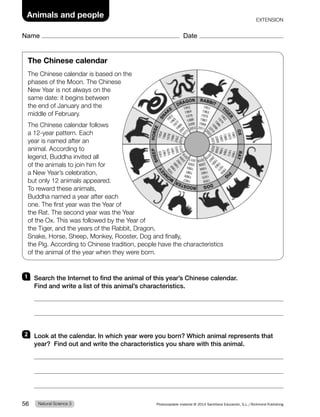
The Chinese calendar
The Chinese calendar is based on the
phases of the Moon. The Chinese
New Year is not always on the
same date: it begins between
the end of January and the
middle of February.
The Chinese calendar follows
a 12-year pattern. Each
year is named after an
animal. According to
legend, Buddha invited all
of the animals to join him for
a New Year’s celebration,
but only 12 animals appeared.
To reward these animals,
Buddha named a year after each
one. The first year was the Year of
the Rat. The second year was the Year
of the Ox. This was followed by the Year of
the Tiger, and the years of the Rabbit, Dragon,
Snake, Horse, Sheep, Monkey, Rooster, Dog and finally,
the Pig. According to Chinese tradition, people have the characteristics
of the animal of the year when they were born.
1 Search the Internet to find the animal of this year’s Chinese calendar.
Find and write a list of this animal’s characteristics.
2 Look at the calendar. In which year were you born? Which animal represents that
year? Find out and write the characteristics you share with this animal.
EXTENSION
Natural Science 3
56 Photocopiable material © 2014 Santillana Educación, S.L./Richmond Publishing
Name Date
Animals and people EXTENSION
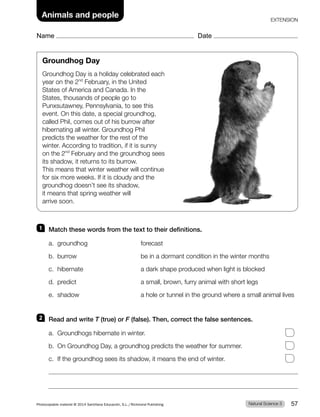
Groundhog Day
Groundhog Day is a holiday celebrated each
year on the 2nd
February, in the United
States of America and Canada. In the
States, thousands of people go to
Punxsutawney, Pennsylvania, to see this
event. On this date, a special groundhog,
called Phil, comes out of his burrow after
hibernating all winter. Groundhog Phil
predicts the weather for the rest of the
winter. According to tradition, if it is sunny
on the 2nd
February and the groundhog sees
its shadow, it returns to its burrow.
This means that winter weather will continue
for six more weeks. If it is cloudy and the
groundhog doesn’t see its shadow,
it means that spring weather will
arrive soon.
1 Match these words from the text to their definitions.
a. groundhog forecast
b. burrow be in a dormant condition in the winter months
c. hibernate a dark shape produced when light is blocked
d. predict a small, brown, furry animal with short legs
e. shadow a hole or tunnel in the ground where a small animal lives
2 Read and write T (true) or F (false). Then, correct the false sentences.
a. Groundhogs hibernate in winter.
b. On Groundhog Day, a groundhog predicts the weather for summer.
c. If the groundhog sees its shadow, it means the end of winter.
Natural Science 3
Photocopiable material © 2014 Santillana Educación, S.L./Richmond Publishing 57
Name Date
Animals and people ASSESSMENT
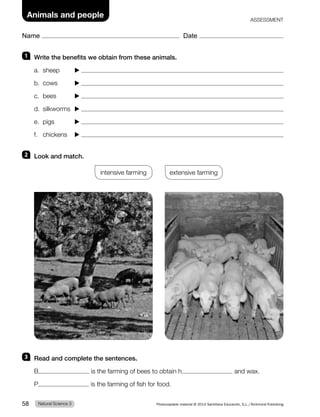
1 Write the benefits we obtain from these animals.
a. sheep
b. cows
c. bees
d. silkworms
e. pigs
f. chickens
2 Look and match.
intensive farming extensive farming
3 Read and complete the sentences.
B is the farming of bees to obtain h and wax.
P is the farming of fish for food.
Natural Science 3
58 Photocopiable material © 2014 Santillana Educación, S.L./Richmond Publishing
ASSESSMENT
4 Complete the sentences about sheep farming.
a. A male sheep is a: r .
b. A baby sheep is a: l .
c. A female sheep is a: e .
d. A person who takes care of
sheep is a: s .
e. S means to
cut off a sheep’s wool.
f. The place where sheep are kept
at night is a: p .
5 Read and write T (true) or F (false).
a. Leather is made by tanning animal skins.
b. Livestock farming means animal farming.
c. There are only two types of livestock farming: cattle and sheep.
d. Birdwatching is a hobby.
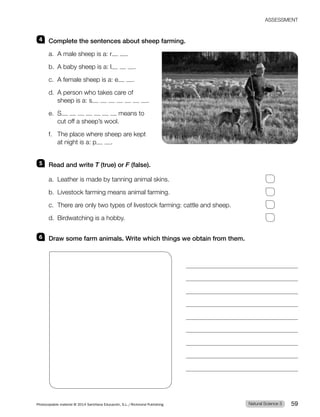
6 Draw some farm animals. Write which things we obtain from them.
Natural Science 3
Photocopiable material © 2014 Santillana Educación, S.L./Richmond Publishing 59
Name Date
Animals and people TEST
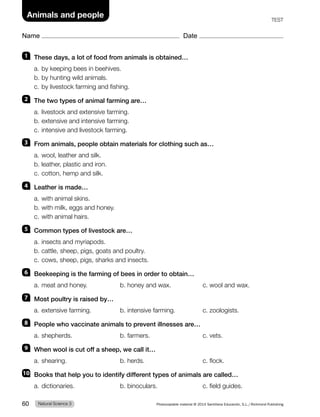
1 These days, a lot of food from animals is obtained…
a. by keeping bees in beehives.
b. by hunting wild animals.
c. by livestock farming and fishing.
2 The two types of animal farming are…
a. livestock and extensive farming.
b. extensive and intensive farming.
c. intensive and livestock farming.
3 From animals, people obtain materials for clothing such as…
a. wool, leather and silk.
b. leather, plastic and iron.
c. cotton, hemp and silk.
4 Leather is made…
a. with animal skins.
b. with milk, eggs and honey.
c. with animal hairs.
5 Common types of livestock are…
a. insects and myriapods.
b. cattle, sheep, pigs, goats and poultry.
c. cows, sheep, pigs, sharks and insects.
6 Beekeeping is the farming of bees in order to obtain…
a. meat and honey. b. honey and wax. c. wool and wax.
7 Most poultry is raised by…
a. extensive farming. b. intensive farming. c. zoologists.
8 People who vaccinate animals to prevent illnesses are…
a. shepherds. b. farmers. c. vets.
9 When wool is cut off a sheep, we call it…
a. shearing. b. herds. c. flock.
10 Books that help you to identify different types of animals are called…
a. dictionaries. b. binoculars. c. field guides.
Natural Science 3
60 Photocopiable material © 2014 Santillana Educación, S.L./Richmond Publishing
Name Date
Animals and people INVESTIGATE
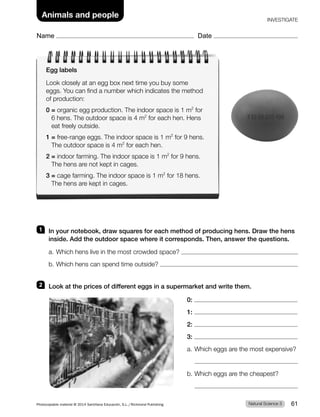
1 In your notebook, draw squares for each method of producing hens. Draw the hens
inside. Add the outdoor space where it corresponds. Then, answer the questions.
a. Which hens live in the most crowded space?
b. Which hens can spend time outside?
2 Look at the prices of different eggs in a supermarket and write them.
Egg labels
Look closely at an egg box next time you buy some
eggs. You can find a number which indicates the method
of production:
0 = organic egg production. The indoor space is 1 m2
for
6 hens. The outdoor space is 4 m2
for each hen. Hens
eat freely outside.
1 = free-range eggs. The indoor space is 1 m2
for 9 hens.
The outdoor space is 4 m2
for each hen.
2 = indoor farming. The indoor space is 1 m2
for 9 hens.
The hens are not kept in cages.
3 = cage farming. The indoor space is 1 m2
for 18 hens.
The hens are kept in cages.
0:
1:
2:
3:
a. Which eggs are the most expensive?
b. Which eggs are the cheapest?
Natural Science 3
Photocopiable material © 2014 Santillana Educación, S.L./Richmond Publishing 61
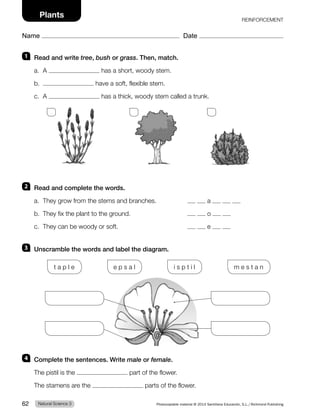
1 Read and write tree, bush or grass. Then, match.
a. A has a short, woody stem.
b. have a soft, flexible stem.
c. A has a thick, woody stem called a trunk.
2 Read and complete the words.
a. They grow from the stems and branches. a
b. They fix the plant to the ground. o
c. They can be woody or soft. e
3 Unscramble the words and label the diagram.
t a p l e e p s a l i s p t i l m e s t a n
4 Complete the sentences. Write male or female.
The pistil is the part of the flower.
The stamens are the parts of the flower.
REINFORCEMENT
Natural Science 3
62 Photocopiable material © 2014 Santillana Educación, S.L./Richmond Publishing
Name Date
Plants
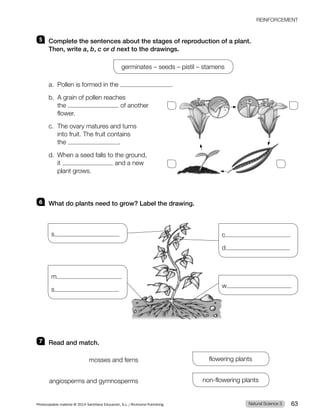
5 Complete the sentences about the stages of reproduction of a plant.
Then, write a, b, c or d next to the drawings.
germinates – seeds – pistil – stamens
a. Pollen is formed in the .
b. A grain of pollen reaches
the of another
flower.
c. The ovary matures and turns
into fruit. The fruit contains
the .
d. When a seed falls to the ground,
it and a new
plant grows.
6 What do plants need to grow? Label the drawing.
7 Read and match.
mosses and ferns flowering plants
angiosperms and gymnosperms non-flowering plants
c
d
m
s
w
s
REINFORCEMENT
Natural Science 3
Photocopiable material © 2014 Santillana Educación, S.L./Richmond Publishing 63
1 Read the text and answer the questions.
a. What are floral emblems?
b. What is the floral emblem of England?
c. Does your country have a floral emblem?
d. What flower would you like as the floral emblem of your region?
e. Describe your floral emblem.
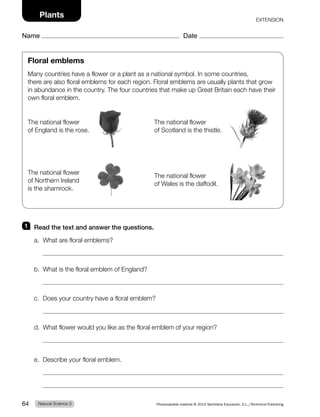
Floral emblems
Many countries have a flower or a plant as a national symbol. In some countries,
there are also floral emblems for each region. Floral emblems are usually plants that grow
in abundance in the country. The four countries that make up Great Britain each have their
own floral emblem.
The national flower
of England is the rose.
The national flower
of Northern Ireland
is the shamrock.
The national flower
of Scotland is the thistle.
The national flower
of Wales is the daffodil.
Natural Science 3
64 Photocopiable material © 2014 Santillana Educación, S.L./Richmond Publishing
Plants
Name Date
EXTENSION
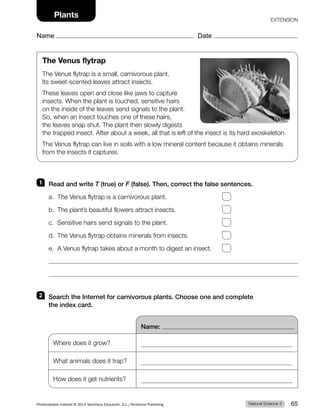
The Venus flytrap
The Venus flytrap is a small, carnivorous plant.
Its sweet-scented leaves attract insects.
These leaves open and close like jaws to capture
insects. When the plant is touched, sensitive hairs
on the inside of the leaves send signals to the plant.
So, when an insect touches one of these hairs,
the leaves snap shut. The plant then slowly digests
the trapped insect. After about a week, all that is left of the insect is its hard exoskeleton.
The Venus flytrap can live in soils with a low mineral content because it obtains minerals
from the insects it captures.
1 Read and write T (true) or F (false). Then, correct the false sentences.
a. The Venus flytrap is a carnivorous plant.
b. The plant’s beautiful flowers attract insects.
c. Sensitive hairs send signals to the plant.
d. The Venus flytrap obtains minerals from insects.
e. A Venus flytrap takes about a month to digest an insect.
2 Search the Internet for carnivorous plants. Choose one and complete
the index card.
Name:
Where does it grow?
What animals does it trap?
How does it get nutrients?
Natural Science 3
Photocopiable material © 2014 Santillana Educación, S.L./Richmond Publishing 65
Name Date
Plants EXTENSION
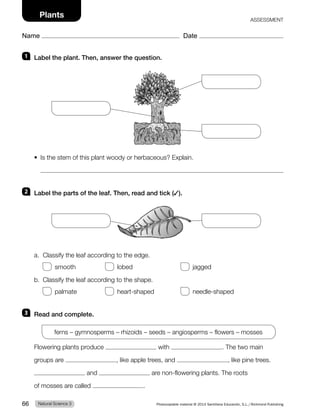
1 Label the plant. Then, answer the question.
t *TUIFTUFNPGUIJTQMBOUXPPEZPSIFSCBDFPVT YQMBJO

2 Label the parts of the leaf. Then, read and tick (✓).
B $MBTTJGZUIFMFBGBDDPSEJOHUPUIFFEHF
 TNPPUI  MPCFE  KBHHFE
C $MBTTJGZUIFMFBGBDDPSEJOHUPUIFTIBQF
 QBMNBUF  IFBSUTIBQFE  OFFEMFTIBQFE
3 Read and complete.
GFSOToHZNOPTQFSNToSIJ[PJEToTFFEToBOHJPTQFSNToGMPXFSToNPTTFT
'MPXFSJOHQMBOUTQSPEVDF XJUI 5IFUXPNBJO
HSPVQTBSF MJLFBQQMFUSFFT BOE MJLFQJOFUSFFT
BOE BSFOPOGMPXFSJOHQMBOUT5IFSPPUT
PGNPTTFTBSFDBMMFE 
/BUVSBM4DJFODF
66 Photocopiable material © 2014 Santillana Educación, S.L./Richmond Publishing
Name Date
Plants 4444./5
4 Read and complete the text about plant nutrition.
carbon dioxide – photosynthesis – roots – raw sap
water – sunlight – elaborated sap – mineral salts
Plants make their own food through .
They absorb and from the soil through their
. This mixture is the . Plants also absorb
and from the air. They then transform
the raw sap into .
5 Find and circle five parts of the flower. Then, complete the sentences.
p c o r o l l a
e q y w q b p z
t l p i s t i l
a y s e p a l s
l x t e i g f a
s s t a m e n s
a. It is the female part of the flower. It contains the ovary. It is the .
b. The are the small green leaves that protect the flower.
c. The are the male parts of the flower. They produce pollen.
d. The are coloured leaves. They form the .
6 Match the sentences to the life processes that plants carry out.
a. Plants make elaborated sap.
b. The leaves and stems grow towards the light.
c. Pollen is produced in the stamens.
sensitivity
nutrition
reproduction
Natural Science 3
Photocopiable material © 2014 Santillana Educación, S.L./Richmond Publishing 67
ASSESSMENT
1 The main parts of a plant are…
a. the roots, the leaves and the pistil.
b. the roots, the stems and the branches.
c. the roots, the leaves and the stem.
2 Herbaceous stems are…
a. soft and flexible. b. hard and rigid. c. hard and flexible.
3 Leaves are classified according to their…
a. colour. b. shape and edge. c. size.
4 Gymnosperms…
a. are non-flowering plants.
b. do not produce fruits.
c. do not produce seeds.
5 The female part of a plant is…
a. the corolla. b. the calyx. c. the pistil.
6 Plants respond to changes in the environment because they have…
a. roots. b. sensitivity. c. stamens.
7 The process by which plants make their own food is called…
a. respiration. b. photosynthesis. c. transpiration.
8 There are two main groups of flowering plants…
a. angiosperms and gymnosperms.
b. mosses and gymnosperms.
c. angiosperms and ferns.
9 Angiosperms usually have beautiful flowers and…
a. produce fruit with seeds inside.
b. seeds grouped together in cones.
c. have leaves all year round.
10 Non-flowering plants have rhizoids which…
a. fix the plant to the soil.
b. feed the plant.
c. produce the seeds.
Natural Science 3
68 Photocopiable material © 2014 Santillana Educación, S.L./Richmond Publishing
Name Date
Plants TEST
1 What do plants need to grow?
Instructions
1. Work in groups of four. Each group
has four small plants, a paper bag,
a transparent plastic bag and water.
2. Label the plants as follows: 1. no water;
2. no light; 3. no air; 4. control plant.
3. Place the paper bag over plant
number 2, so it doesn’t receive
any light.
4. Place the plastic bag over plant
number 3, so it doesn’t get any air.
5. Put the plants on a window sill
and water them regularly, except
for plant number 1. Make sure the
control plant has air, light and water.
6. Observe the growth of the plants over the next four weeks and record your
observations. Complete the table.
week plant 1 plant 2 plant 3 plant 4
1
2
3
4
7. Compare your results and answer the questions.
a. Did all the plants grow the same?
b. Which plant was the healthiest?
c. Which plant was the least healthy?
Natural Science 3
Photocopiable material © 2014 Santillana Educación, S.L./Richmond Publishing 69
Name Date
Plants INVESTIGATE
1 Look and match the pictures to the areas.
forest
shrubland
grassland
desert
2 Read and complete.
high – shrubland – forest – vegetation – fertile – drought – scarce – arid – low – poor
a. Trees grow in soil with humidity.
Many trees together form a .
b. Bushes grow in places with soil and
humidity. An area dominated by bushes is a .
c. Grasslands are areas with long periods of . Trees and bushes
are because they need water all year round.
d. Deserts do not have much water and the soil is . There is little
. Only plants that need little water can live in deserts.
3 Where do these animals live? Explain.
A B
C D
REINFORCEMENT
Natural Science 3
70 Photocopiable material © 2014 Santillana Educación, S.L./Richmond Publishing
Name Date
Animals and plants
4 Find and circle eight animals. Then, write.
s e a b i r d f p
x s n a k e l i s
z f w t q x i s n
s t a r f i s h a
s q u i r r e l i
o o c t o p u s l
5 Classify these marine animals.
whales – seals – sharks – sardines – turtles – tuna
They breathe through lungs They breathe through gills
6 Write T (true) or F (false).
a. Sponges are marine invertebrates.
b. Elephants are terrestrial mammals.
c. Seabirds live in small tunnels underground.
d. All fish live in fresh water.
e. Snakes haven’t got legs, so they slither.
f. Corals move about the seabed.
REINFORCEMENT
Natural Science 3
Photocopiable material © 2014 Santillana Educación, S.L./Richmond Publishing 71
1 Read the text and circle the correct word.
a. Tundras are found in the Arctic / Antarctic.
b. In the summer, there are 12 / 24 hours a day of sunlight.
c. The top layer of the soil is the tundra / permafrost.
d. Winter in the Arctic tundra is extremely warm / cold.
e. Global warming / Acid rain is harming the Arctic tundra.
2 Search the Internet for three animal species from the Arctic tundra.
Write what they eat.
animals food
A frozen land
Tundras are one of the coldest and harshest
areas on Earth. They are found in the Arctic,
where the weather is extremely cold, dry and
windy. Trees cannot grow in tundras, but there
are many low plants. The Arctic tundra has
average temperatures of –12 ºC to –6 ºC. This
means that the top layer of soil, called the
permafrost, is almost always frozen.
In winter, the permafrost is covered with
a thick layer of snow, and no plants are visible.
In summer, there are 24 hours a day of sunlight,
and the surface of the permafrost melts. Wildflowers appear everywhere.
Many animals live in the Arctic tundra, including Arctic foxes, polar bears, caribous and
snow geese. Unfortunately, as a result of global warming, temperatures are rising. This is
causing the permafrost to melt. The Arctic tundra is in danger.
Natural Science 3
72 Photocopiable material © 2014 Santillana Educación, S.L./Richmond Publishing
Animals and plants
Name Date
EXTENSION
Fast and slow animals
Animals move at different
speeds. Walking at a normal
pace, people usually walk
five or six kilometres per
hour. Some very slow
animals take a whole year to
travel the same distance as
a fast animal can travel in
one hour!
animals
on land in the air in water
slow
animals
Sloths move at 12
metres per hour.
Small flies move at 35
kilometres per hour.
Perches swim at 2.1
kilometres per hour.
fast
animals
Cheetahs can run at
100 kilometres per hour.
Falcons can fly at 300
kilometres per hour.
Sailfish can swim at 110
kilometres per hour.
1 Read the text and the table. Then, answer the questions.
a. Which animal is the slowest on land?
b. Which animal is the fastest on land?
c. Does the slowest animal move on land, in the air or in water?
d. Does the fastest animal move on land, in the air or in water?
2 Find your favourite animal on the Internet.
Draw it. Then, find out how fast it moves
and complete the sentences.
My favourite animal is the .
It moves at .
Natural Science 3
Photocopiable material © 2014 Santillana Educación, S.L./Richmond Publishing 73
Name Date
EXTENSION
Animals and plants
1 Write the names of these areas.
2 Read and write T (true) or F (false). Then, correct the false sentences.
a. Vegetation depends on soil, climate, relief and humidity.
b. Pines, oaks and beeches are types of bushes.
c. The African Savannah is a grassland area.
d. Deserts are areas with fertile soil and high humidity.
e. Grass in grasslands dies in drought periods.
3 What is vegetation? Explain.
4 Read and complete the words.
a. All the plants in an area, region or country. v g t
b. A long period of little or no rainfall. d o t
c. A grassland area in Africa. s v h
d. An area dominated by bushes. s u d
A B C D
Natural Science 3
74 Photocopiable material © 2014 Santillana Educación, S.L./Richmond Publishing
Name Date
Animals and plants ASSESSMENT
5 Read the text and complete.
oxygen – lungs – surface – marine – rivers
Some aquatic animals live in the sea.
They are animals.
Others live in fresh water, in lakes or .
Aquatic animals spend most of their lives in water. Many of them
breathe in from the water through gills.
Others come to the of the water to breathe in air,
through .
6 Circle the correct animal.
a. A mammal that can fly.
bat / bird
b. A mollusc that lives fixed to the rocks on the seabed.
sea urchin / mussel
c. An insect that glides on the surface of the water.
skater / butterfly
d. A reptile that slithers.
snake / salamander
e. A water bird.
eagle / duck
7 Read, then write the correct word.
a. Squirrels live most of the time in and swing from branch to branch.
trees – bushes – tunnels
b. Snakes haven’t got legs, so they .
fly – slither – jump
c. Many small animals live in tunnels .
in the sea – in small houses – underground
Natural Science 3
Photocopiable material © 2014 Santillana Educación, S.L./Richmond Publishing 75
ASSESSMENT
1 Vegetation is…
a. all the plants that live in an area, region or country.
b. all the plants and animals that live in an area.
c. the flowers that grow on trees.
2 Many trees growing together make up a…
a. grass area. b. forest. c. desert.
3 We obtain honey and wax from…
a. bees. b. spiders. c. sheep.
4 Shrublands are areas…
a. with long periods of drought where forests cannot grow.
b. dominated by bushes.
c. dominated by cactuses.
5 African savannahs are…
a. deserts. b. forests. c. grasslands.
6 A desert is…
a. an area where there is a lot of sand.
b. an area with arid soil and little water.
c. a kind of vegetation.
7 Corals live in…
a. the sea. b. fresh water. c. either the sea or fresh water.
8 Marine mammals, like dolphins or whales, …
a. must come up to the surface to breathe.
b. don’t need to breathe air from the surface.
c. breathe through gills.
9 Terrestrial animals…
a. do not need water. b. live on land. c. have wings to walk about.
10 A bat is a…
a. flying mammal. b. seabird. c. slithering reptile.
Natural Science 3
76 Photocopiable material © 2014 Santillana Educación, S.L./Richmond Publishing
Name Date
Animals and plants TEST
1 Which animals and plants share the same area?
Instructions
1. Work in groups.
2. Choose one of these areas: shrubland, desert, grassland or forest.
3. Search the Internet for plants and animals that live in your habitat. Find out what
they eat and how they reproduce. Print out or draw pictures.
4. Make a poster with your pictures. Write the names of the animals, what they eat
(carnivore, herbivore or omnivore) and how they reproduce (oviparous or viviparous).
5. Show your poster to your classmates and tell them about your favourite animal
or plant.
Natural Science 3
Photocopiable material © 2014 Santillana Educación, S.L./Richmond Publishing 77
Name Date
INVESTIGATE
Animals and plants
REINFORCEMENT
Name Date
Matter
1 Complete the sentences.
space – volume – matter – substances – mass
Everything around us that takes up is made up of .
All objects have two properties: , which is the amount of matter in an
object, and , which is the amount of space an object occupies. The
different types of matter are called .
2 How do you measure mass and volume? Look and match.
mass
volume
3 What are the three states of water? Write solid, liquid or gas.
4 Write yes or no and give an example.
fixed shape fixed volume example
solids
liquids
gases
A B C
Natural Science 3
78 Photocopiable material © 2014 Santillana Educación, S.L./Richmond Publishing
REINFORCEMENT
5 Use the clues to complete the changes of state.
a. Ice changes into liquid water. t n
b. Liquid water changes into ice. l f a i
c. Liquid water changes into water vapour. v o t
d. Water vapour changes into liquid water. n e a o
6 Label the diagram.
water vapour water ice
7 Which photo shows a chemical change? Tick (✓).
Natural Science 3
Photocopiable material © 2014 Santillana Educación, S.L./Richmond Publishing 79
Name Date
Matter EXTENSION
Lovely ice cream!
What happens to ice cream in very hot weather? You have to
eat it quickly before it melts!
Ice cream is made with frozen milk, that’s why it is solid. When
you take it out of the freezer, it begins to melt and turns into a
liquid. The flavour, though, remains the same.
When frozen ice cream melts and becomes liquid, it goes
through a physical change of state.
But the ice cream flavour does not change. It still tastes wonderful!
1 Read and write T (true) or F (false). Then, correct the false sentences.
a. Ice cream is solid because it is made of frozen milk.
b. Ice cream melts when the temperature decreases.
c. When ice cream melts, there is a chemical change.
d. When ice cream melts, its flavour does not change.
2 Find and circle six ice cream flavours. Then, write.
l e m o n u c a m s
g h y u n m h n i l
k h v v p t o r n k
f g a a o y c d t c
e s s n l x o e n h
d l e i k a l a b e
a f r l j s a g v r
e m l l g f t o c r
s t r a w b e r r y
Natural Science 3
80 Photocopiable material © 2014 Santillana Educación, S.L./Richmond Publishing
Name Date
Matter EXTENSION
The Wobbly Bridge
The Millennium Bridge in London is a
very popular tourist destination. It is
a pedestrian bridge, so cars cannot
cross it. When you are standing
on the bridge, you can see many
of London’s historical buildings, such
as St. Paul’s Cathedral and the Globe
Theatre. The bridge also appears in films,
such as Harry Potter and the Half-Blood
Prince and many Bollywood films.
The Millennium Bridge is made of concrete and steel, so it is very strong. It can
hold up to 5,000 people at one time. But when it opened in 2000, people said
the bridge moved under their feet! This problem was corrected, but even today,
people still call it ‘The Wobbly Bridge’.
1 Read the text and answer the questions.
a. Where is the Millennium Bridge?
b. What can you see when you are standing on the bridge?
c. What is it made of?
d. How many people can it hold at one time?
e. When was the bridge opened for the first time?
f. Why do people call it ‘The Wobbly Bridge’?
g. Can you name a popular bridge in your country?
Natural Science 3
Photocopiable material © 2014 Santillana Educación, S.L./Richmond Publishing 81
Name Date
Matter ASSESSMENT
1 Answer the questions.
a. What is matter?
b. What is volume?
c. What are the three states of matter?
d. What is a substance?
2 Use the clues to complete the text.
All objects have two properties in common: m
and v . Objects also have other properties,
depending on what s they are made of.
These properties are: c , s , l
and h . These properties help us to distinguish
one substance from another.
3 Label the illustrations.
liquid gas solid
A B C
Natural Science 3
82 Photocopiable material © 2014 Santillana Educación, S.L./Richmond Publishing
ASSESSMENT
4 Write T (true) and F (false). Then, correct the false sentences.
a. Solids have a fixed shape and a fixed volume.
b. Liquids do not have a fixed shape nor a fixed volume.
c. Gases have a fixed volume, but the shape can vary because
they adopt the shape of the container they are in.
5 Read and cross out the wrong words.
a. Chemical changes / Physical changes are when substances change into
different substances.
b. Contraction / Combustion is a physical change.
c. Matter / A mixture is when two or more substances are mixed together.
6 What physical change takes place? Write mixture, change of shape, change of size
or change of state.
a. You pour sugar in milk and stir it.
b. You fold a paper and make a paper boat.
c. You heat the air inside a balloon and it expands.
d. You heat water and it turns to vapour.
7 Complete the chart with solidification, condensation, melting and evaporation.
solid liquid gas
Natural Science 3
Photocopiable material © 2014 Santillana Educación, S.L./Richmond Publishing 83
Name Date
Matter TEST
1 Everything around us that takes up space is made up of…
a. wood. b. matter. c. water.
2 Each type of matter is…
a. air. b. an object. c. a substance.
3 The amount of matter in objects is called…
a. mass. b. volume. c. density.
4 Volume is measured in…
a. kilogrammes. b. centimetres. c. litres.
5 Gases…
a. have a fixed shape and a fixed volume.
b. have a fixed volume, but their shape can change.
c. do not have a fixed shape nor a fixed volume.
6 There are two types of changes in matter…
a. condensation and solidification.
b. physical and chemical changes.
c. mixtures and evaporation.
7 Contraction is…
a. combustion. b. a physical change. c. a chemical change.
8 When the temperature of an object increases…
a. it gets bigger. This is called expansion.
b. it gets smaller. This is called contraction.
c. it gets bigger. This is called contraction.
9 Melting is…
a. when a gas is cooled and changes into a liquid.
b. when a solid is heated and changes into a liquid.
c. when a liquid is cooled and changes into a solid.
10 When a substance changes into another different substance it is called…
a. chemical change. b. expansion. c. physical change.
Natural Science 3
84 Photocopiable material © 2014 Santillana Educación, S.L./Richmond Publishing
Name Date
Matter INVESTIGATE
1 Does air really take up space? Try two experiments.
Instructions
Work with a partner. Do the following easy experiments.
You need a tank or large bowl of water, a dry sponge and an empty plastic bottle.
Experiment A
Squeeze a dry sponge inside a tank
or bowl of water. What do you see?
Complete the table.
Experiment B
Put an empty plastic bottle sideways
inside a tank or bowl of water. What
do you see? Complete the table.
first minute after a few minutes
Experiment A
Experiment B
Natural Science 3
Photocopiable material © 2014 Santillana Educación, S.L./Richmond Publishing 85
REINFORCEMENT
Name Date
Materials and machines
1 Classify the materials.
natural materials man-made materials
2 Tick (✔) the materials that come from animals.
wool hemp leather wood silk cotton
3 Read and match.
a. Hemp
b. Wood
is used to make furniture.
c. Cotton
is used to make fabrics.
4 Complete the stages involved in making paper.
belt – pulp – impurities – wood – spools
a. is broken up into small pieces.
b. The pieces are mixed with other substances to make .
c. The pulp is filtered to get rid of .
d. The paper pulp is spread onto a moving .
e. The final product is wound onto .
pottery
leather
wood
granite
paper
glass
Natural Science 3
86 Photocopiable material © 2014 Santillana Educación, S.L./Richmond Publishing
REINFORCEMENT
5 How do these machines work?
Use the key and circle.
energy from electricity ▶ red
energy from people ▶ blue
6 Choose two machines from Activity 5. Explain what they are used for.
a. We use to .
b. to .
7 Classify these machines.
simple machines compound machines
8 Complete the crossword about simple machines.
ACROSS
1. A ramp (two words).
DOWN
2. A rigid bar.
3. A solid disk that turns on an axle.
4. A wheel with a rope around it.
pliers fan telephone pulley
3 4
2
1
Natural Science 3
Photocopiable material © 2014 Santillana Educación, S.L./Richmond Publishing 87
Name Date
Materials and machines EXTENSION
The wheel
The wheel is one of the most important inventions of all
time. It changed our means of transport forever.
The wheel is a simple machine that was invented over
5,000 years ago. It consists of a disk that turns on an
axle. The first wheels were simple disks made of solid
wood. Wheels with spokes were invented over 1,000
years later.
Later, wheels were made of metal. This allowed heavy
objects to be moved from one place to another.
After that, metal wheels were covered with rubber
and cork. These wheels are still used today because
they are so light and resilient.
1 Circle the illustration of the oldest wheel. Then, answer the question.
t 8IZEPZPVUIJOLUIJTJTUIFPMEFTUXIFFM
2 Think about life before the invention of the wheel. How do you think people moved
heavy objects?
A B C D
Natural Science 3
88 Photocopiable material © 2014 Santillana Educación, S.L./Richmond Publishing
Name Date
EXTENSION
Where does paper come from?
Paper was invented in China over 2,000
years ago.
Originally, paper was made of pulp produced
by boiling cloth and old fishing nets!
Nowadays, paper is made of pulp from wood.
Large plantations of trees are grown. The trees
are cut down, then chopped into small wood
chips. These chips are soaked in water and
chemicals to form wood pulp.
The pulp is bleached to remove tree bark and sap. Next, the pulp is drained
and squeezed to remove all the excess water, then placed in huge drying machines.
The pulp is then attached to spools and placed in cutting machines.
Today, lots of different paper products are made from recycled paper. Using recycled
paper to make new paper has less impact on the environment, and is better for
the planet.
Recycled paper is used for everything from paper plates to toilet paper!
1 Read and write True or False.
a. Paper was invented 2,000 years ago in India.
b. Originally, the pulp used to make paper came from boiled cloth.
c. These days the pulp is made of wood chips soaked in water
and chemicals.
d. The pulp is cleaned with bleach to remove sap and bark.
e. Recycled paper is only used to make toilet paper.
2 Search the Internet. How is paper recycled? Write three or four sentences
describing the process.
Materials and machines
Natural Science 3
Photocopiable material © 2014 Santillana Educación, S.L./Richmond Publishing 89
Name Date
Materials and machines ASSESSMENT
1 Name the materials used to make these objects. Then, write N (natural)
or M (man-made) next to each material.
2 Write the raw materials.
a. paper ▶
b. iron ▶
c. plastic ▶
3 Write T (true) or F (false).
a. A pulley makes it difficult to lift heavy objects.
b. A ramp is an inclined plane.
c. A lever is a bar which rests on a pivot point.
d. A wheel rotates around a pivot point.
e. A pulley rotates around an axle.
4 Name one invention for each category. Then, write what energy it uses.
invention energy
transport
communication
cleaning the house
Natural Science 3
90 Photocopiable material © 2014 Santillana Educación, S.L./Richmond Publishing
ASSESSMENT
5 Complete the sentences.
energy – communicate – time – effort – people
a. Machines save us and .
b. A telephone is a machine that lets us .
c. All machines need to work.
d. Scissors need energy from to work.
6 Write what type of energy these machines use.
7 Complete the text.
operating – handle bar – complex – levers – people – gear
A bicycle is a machine because it is made up of many
parts. It has got two wheels, a
that helps steer the bicycle, and two pedals that act as .
The pedals turn a that moves a chain. The chain connects the
pedals to the back wheel. The bicycle needs energy from to work.
A B
C D
Natural Science 3
Photocopiable material © 2014 Santillana Educación, S.L./Richmond Publishing 91
Name Date
Materials and machines TEST
1 Natural materials…
a. come from animals, plants and minerals.
b. are manufactured from other materials.
c. are very hard and resistant.
2 Paper, glass and plastic are…
a. man-made materials. b. natural materials. c. chemical materials.
3 The raw material used to make paper is…
a. petroleum. b. wood. c. leather.
4 Wool, leather and silk are examples of materials that come from…
a. animals. b. plants. c. minerals.
5 Machines…
a. help us to save time and energy and make our work easier.
b. are objects that we can see in museums.
c. are only used for transport.
6 A car is a complex machine because…
a. it needs petrol to function.
b. it is made up of many operating parts.
c. it is used to travel.
7 A pulley is…
a. a complex machine. b. a simple machine. c. not a machine.
8 An inclined plane might be used to…
a. enter a building in a wheelchair.
b. transport products over long distances.
c. apply force when cracking a nut.
9 In order to work, all machines need…
a. electricity. b. energy. c. a motor.
10 The printing press, the plane or the watermill are examples of…
a. means of transport. b. gears. c. inventions.
Natural Science 3
92 Photocopiable material © 2014 Santillana Educación, S.L./Richmond Publishing
Name Date
INVESTIGATE
1 What simple and complex machines do you use in everyday life?
Instructions
1. Work in groups of four to make a poster.
2. Use magazines and catalogues to find
pictures of simple and complex machines
used in everyday life. Cut the pictures out
and sort them into two piles: simple and
complex machines.
3. Divide a piece of card into two sections.
Write two titles: Simple machines and
Complex machines. Glue the pictures
on the corresponding section and label
them.
4. Next to each picture, write the energy
source each machine needs to work.
5. Once the poster is finished, complete
the table. You can also add other
machines which do not appear on
your poster.
machines I use in everyday life
simple machines complex machines
6. Analyse your table and draw conclusions.
t*NBJOMZVTFsimple / complex machines in everyday life.
t*NBJOMZVTFNBDIJOFTUIBUOFFEhuman energy / electricity / petrol to work.
7. Compare your conclusions with your group.
Materials and machines
Natural Science 3
Photocopiable material © 2014 Santillana Educación, S.L./Richmond Publishing 93
REINFORCEMENT
Name Date
Energy and the environment
1 Complete the crossword about forms of energy.
5
1
6
2
3
4
2 Circle six energy sources and classify them.
s u n p e t r o l e u m w i n d n a t u r a l g a s c o a l w a t e r
renewable energy sources non-renewable energy sources
3 Complete the sentences.
a. In a toaster, energy transforms into energy.
b. In a light bulb, energy transforms into energy.
c. In a torch, energy transforms into energy.
ACROSS
1. Energy that makes
a computer work.
2. Energy produced
by a radiator.
3. Energy in a pizza.
4. Energy inside uranium.
DOWN
5. Energy in a ball that
is falling.
6. Energy from a lamp.
Natural Science 3
94 Photocopiable material © 2014 Santillana Educación, S.L./Richmond Publishing
REINFORCEMENT
4 How do we know these things have got energy? Write an example for each.
a. the wind
b. a football player
5 Read and correct this sentence.
Wind, water and sunlight are energy sources. They will run out soon!
6 What fossil fuels are they? Read and answer.
a. We use it in cars and to make plastics.
b. It is a rock. We get it from mines.
c. It goes to houses and factories along pipes.
7 Read and match.
a. They use fossil fuels. thermal power plants
b. They use energy from the Sun. hydroelectric power plants
c. They use mechanical energy from the wind. solar power plants
d. They use mechanical energy from water. wind farms
8 Look at the photos and describe the environmental problem.
Natural Science 3
Photocopiable material © 2014 Santillana Educación, S.L./Richmond Publishing 95
Name Date
Energy and the environment
EXTENSION
1 Read the text and answer the questions.
a. In what century was the steam engine invented?
b. Who invented the steam engine?
c. What was the steam engine used for?
2 Explain how the steam engine works. What kind of energy does water vapour
have?
The steam engine
The 18th
century was a crucial time in the
search for more sources of energy.
In the 18th
century, societies were very
complex. People needed a lot of energy,
but they did not have many machines that
could make energy easier to use. At the
end of the 18th
century, James Watt, a
Scottish inventor, invented the steam
engine.
This machine used energy from
water vapour that was produced
by burning coal. Energy from water vapour could move a wheel at a steady rhythm.
The steam engine was used in many different ways. For example, it was used in factories,
in mines and for means of transport, especially trains.
Thanks to James Watt’s steam engine and other great inventions, large factories
were built, and many people found jobs in these factories. This period of history is called
the Industrial Revolution.
Natural Science 3
96 Photocopiable material © 2014 Santillana Educación, S.L./Richmond Publishing
Name Date
Energy and the environment
EXTENSION
1 Read the text and answer the questions.
a. What energy do windmills use to work?
b. What were windmills used for?
c. What kind of energy does the wind have? Tick (✓).
mechanical chemical thermal
d. Think of modern wind farms. How are modern wind turbines similar to the
old windmills?
e. Are modern wind farms used to grind grain? What are they used for?
Windmills in Don Quixote
Do you know Don Quixote de la
Mancha? Then, you probably know
the scene in which Don Quixote
attacks windmills because he thinks
they are terrifying, evil giants.
But what are the windmills that Don Quixote
fights, in reality? They are huge machines
that use the energy from wind to grind
grains of wheat and make flour.
The wind turns the big sails that are on the
outside of the building. These move a series
of gears that turn a grinding stone that crushes the grains of wheat.
These windmills are not used anymore for grinding, but you can still see some
of them if you go to La Mancha.
Natural Science 3
Photocopiable material © 2014 Santillana Educación, S.L./Richmond Publishing 97
Name Date
Energy and the environment
ASSESSMENT
1 What is energy? Define in your own words.
2 Complete the forms of energy.
a. m
b. c
c. t
d. e
e. n
f. l
3 What type of energy have they got?
a. fuel d. wind
b. uranium e. water
c. sunlight f. fire
4 Write the energy transformations in each object.
A B C
5 Write the names of the power plants.
A B C
Natural Science 3
98 Photocopiable material © 2014 Santillana Educación, S.L./Richmond Publishing
ASSESSMENT
6 Classify the types of energy sources. Then, answer the questions.
coal – sunlight – wind – petroleum – uranium – water
renewable energy sources non-renewable energy sources
a. What is the difference between renewable and non-renewable energy sources?
b. Are fossil fuels renewable or non-renewable? Explain.
7 Match the type of power station to its source of energy.
thermal power station wind
hydroelectric power station water
wind farm uranium
nuclear power station fossil fuels
8 Write three different ways to save energy.
Natural Science 3
Photocopiable material © 2014 Santillana Educación, S.L./Richmond Publishing 99
Name Date
Energy and the environment
TEST
1 Something has got energy when…
a. it can make something move or change position.
b. it is very bright.
c. It is very heavy and takes up a lot of space.
2 The wind has got…
a. mechanical energy. b. light energy. c. chemical energy.
3 Food contains…
a. light energy. b. chemical energy. c. electrical energy.
4 In a lamp, …
a. mechanical energy transforms into thermal energy.
b. electrical energy transforms into light energy.
c. electrical energy transforms into chemical energy.
5 Renewable energy sources…
a. will never run out.
b. are found in underground mines.
c. are running out very quickly.
6 Coal is…
a. renewable. b. non-renewable. c. a pure substance.
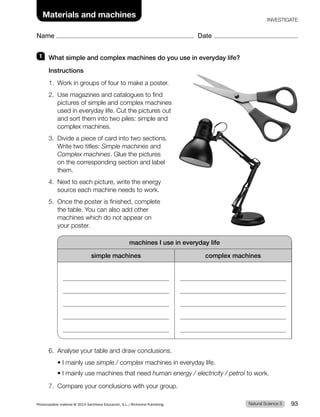
7 Energy from the Sun and the wind is…
a. renewable. b. non-renewable. c. impossible to store.
8 In hydroelectric power plants, …
a. they use energy from the wind to produce electricity.
b. they use energy from water to produce electricity.
c. they use energy from the Sun to produce electricity.
9 The accumulation of harmful substances and waste products is called…
a. the environment. b. global warming. c. pollution.
10 To reduce waste we should…
a. practise the three ‘Rs’. b. use a lot of water. c. use plastic bags.
Natural Science 3
100 Photocopiable material © 2014 Santillana Educación, S.L./Richmond Publishing
Name Date
Energy and the environment
INVESTIGATE
1 What do you do at home to reduce, reuse and recycle? Write.
a. We reduce by using less .
b. We reuse .
c. We recycle .
2 How do you recycle?
To make recycling easier, we have to separate
our rubbish into different containers. For example,
plastic goes in one container and cardboard goes
in another. How many different containers are there
where you live? Draw and colour.
plastic bag
cardboard box
The three 'Rs'
The three ‘Rs’ are reduce, reuse and recycle. They
help us take care of the Earth and its limited resources.
Reducing what we use means using fewer natural
resources and less energy.
Reusing things twice or many times means less waste.
Recycling converts used items back into raw materials to make
new products. This preserves our natural resources and reduces waste.
Natural Science 3
Photocopiable material © 2014 Santillana Educación, S.L./Richmond Publishing 101
Natural Science 3
102
Answer key
YOUR BODY
REINFORCEMENT
PAGE 6
1. Label the body parts.
top to bottom: head, trunk, limbs.
2. Look at the diagram and write examples.
Model answer (MA)
a. brain; b. heart; c. leg.
PAGE 7
3. Write T (true) or F (false). Then, correct the false
sentences.
a. T; b. F; c. F; d. T; e. T; f. F.
Nutrition provides your body with energy and nutrients.
The process of sensitivity allows us to detect and respond
to changes in the environment.
Melanin protects your body from the harmful rays of
sunlight.
4. Match the stages of life to the pictures.
A. adolescence; B. childhood; C. old age; D. adulthood.
t 
st
childhood; 2nd
adolescence; 3rd
adulthood;
4th
old age.
EXTENSION
PAGE 8
1. Read the text and complete the sentences.
a. Skin colour is controlled by genes.
b. The Sun emits harmful rays.
c. Skin colour depends on the amount of melanin.
d. Melanin protects the skin from the harmful rays of
sunlight.
e. People with lighter skin have less melanin.
2. Search the Internet or magazines for photos of three
famous people with different skin colour.
Open answer (OA)
PAGE 9
1. Write T (true) or F (false).
a. T; b. T; c. F; d. T; e. F; f. F.
2. Have you ever broken a bone or do you know someone
who has?
MA
My friend Ana.
Her humerus.
She fell.
It took two months.
ASSESSMENT
PAGE 10
1. Classify the words.
a. head: forehead, face.
b. trunk: abdomen, thorax, back.
c. limbs: hand, leg, foot, arm.
2. Label the diagram.
left column: brain, stomach, muscle.
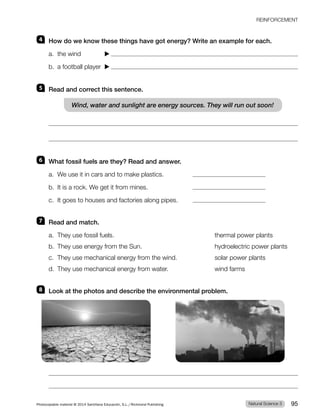
right column: lung, kidney, bone.
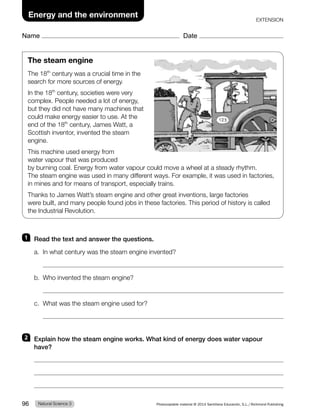
3. Draw two people and say how they are similar or
different.
OA
PAGE 11
4. Complete the sentences.
a. The life process of sensitivity is the ability of living things
to respond to changes in the environment.
b. During the life process of nutrition living things take in
food and absorb essential nutrients.
c. The life process of reproduction is the ability of all living
things to produce new living things of their own kind.
5. Number the stages of nutrition in the correct order.
order: b, d, a, c.
6. Read and circle the correct description.
childhood: Milk teeth fall out, and permanent teeth grow.
adolescence: Your body prepares to become an adult.
adulthood: We can have children.
old age: Our bones become fragile. Our muscles are
weaker.
7. Write the four systems involved in nutrition.
digestive system, respiratory system, circulatory system
and excretory system.
TEST
PAGE 12
CBCBDBDCBD
INVESTIGATE
PAGE 13
OA
Natural Science 3 103
Answer key
YOUR SENSES
REINFORCEMENT
PAGE 14
1. Unscramble the words and label the diagram.
left column: iris, cornea, pupil.
right column: retina, optic nerve, lens.
2. Circle the five parts of the ear and complete the
sentences.
auditory nerve, ear canal, cochlea, small bones, eardrum.
a. Sound vibrations go into the outer ear and along
the ear canal.
b. The eardrum vibrates.
c. The vibration of the eardrum moves the three
small bones.
d. The sound then goes to the cochlea.
e. The cochlea sends the sound through the auditory nerve
to the brain.
PAGE 15
3. Read and complete the table.
smell: The sense organ is the nose. It allows you to capture
or identify smells.
taste: The sense organ is the tongue. It allows you to
capture or identify flavours.
touch: The sense organ is the skin. It allows you to capture
or identify different characteristics of objects.
4. Match the parts of the organs to their function.
a. taste buds: capture flavours of food.
b. epithelium: captures smells.
c. touch receptors: distinguish hot or cold.
d. retina: captures light.
e. cochlea: captures sound.
5. Label the diagram of the nose.
clockwise, starting top left: olfactory bulb, nasal cavity,
olfactory nerve, nostrils, olfactory epithelium.
EXTENSION
PAGE 16
1. Write T (true) or F (false).
a. T; b. F; c. F; d. F; e. T.
2. Complete the index card about guide dogs.
Job description: To help people move from place to place.
Most common breeds: Labradors and Golden Retrievers.
Equipment: Harness.
Years of service: Approximately six.
PAGE 17
1. Use the sign alphabet.
OA
2. Use the Braille alphabet.
OA
ASSESSMENT
PAGE 18
1. Write the five sense organs.
eyes, ears, skin, nose and tongue.
2. Label the parts of the eye.
left column: cornea, pupil.
right column: optic nerve, retina.
3. Read and complete.
a. The eyes are the sense organs of sight.
b. The eyelids, eyelashes and eyebrows protect the eyes.
c. The pupil is the hole in the centre of the iris through
which light passes.
d. When we see an object, the information is sent to the
brain through the optic nerve.
4. Label the parts of the ear.
left column: pinna, eardrum.
right column: auditory nerve, cochlea.
PAGE 19
5. Circle the correct word.
a. The pinna captures the sound.
b. The cochlea sends the sound through the auditory nerve
to the brain.
c. The brain interprets the information.
6. What part of your nose captures smells?
Smell receptors in the olfactory epithelium capture smells.
7. Complete the sentences.
a. Touch is the sense which allows you to identify
characteristics of the objects around you.
b. The sense organ of touch is the skin.
8. Label the diagram of the skin.
left column: hairs, touch receptors.
right: nerve.
9. Write the corresponding sense organ.
a. ear; b. nose; c. tongue; d. eye; e. eye; f. ear.
10. Give advice to look after your eyes and ears.
MA
Make sure there is enough light when you read or study
and don’t look directly at the Sun.
Wash your ears daily, and don’t put objects in your ears.
Natural Science 3
104
Answer key
TEST
PAGE 20
1. a; 2. b; 3. a; 4. c; 5. b; 6. a; 7. b; 8. c; 9. a; 10. b.
INVESTIGATE
PAGE 21
OA
FOOD AND NUTRIENTS
REINFORCEMENT
PAGE 22
1. Use the colour key and circle the words.
red: rice, olive oil, pasta, bacon, bread, butter, cheese.
blue: sardines, yoghurt, eggs, milk.
green: grapes, carrots, strawberries, lettuce.
2. Label the food wheel. Write carbohydrates, proteins,
fats, minerals and vitamins, water and exercise, and
calcium.
left column: carbohydrates, water and exercise, minerals
and vitamins.
right column: fats, proteins, calcium.
3. Why are water and exercise in the centre of the food
wheel?
They are in the centre because they are essential for good
health.
4. Match and make correct sentences.
a. A sufficient diet gives you the right amount of energy.
b. A balanced diet gives you the right amount of nutrients.
PAGE 23
5. Read and complete the sentences.
a. You need fats and carbohydrates for energy.
b. You need proteins to grow.
c. You need vitamins and minerals to be healthy.
d. You need fibre for your digestive system to work well.
6. Look at the food. Circle the nutrients they give you.
top row: proteins, proteins, carbohydrates.
bottom row: fats, vitamins, fibre.
7. Tick (✓) the correct sentence.
a. Calcium is a mineral that makes up our bones.
8. Circle the healthier food in each pair of words.
top row: oil, milk, grapes.
bottom row: chicken, bread, tomato.
EXTENSION
PAGE 24
1. Read the text and answer the questions.
a. The people of Naples added tomatoes to pizzas.
b. The ingredients of Pizza Margherita are tomatoes,
mozzarella cheese and basil.
c. It is called Pizza Margherita because Queen Margherita
of Italy loved it.
d. Today pizza is eaten all over the world.
e. Pizza can have many different toppings including tuna,
mushrooms and olives.
Natural Science 3 105
Answer key
2. Draw and write about your favourite pizza.
OA
PAGE 25
1. Circle the correct words.
a. Based on culture, people eat different foods around the
world.
b. Reindeer meat is an unusual food eaten in Canada.
c. An unusual food eaten in Thailand is insects.
d. Foods like reindeer meat and insects mainly provide
proteins.
e. In England, fruits and nuts are symbols of fertility and
good fortune.
2. Search the Internet for other foods for special
celebrations.
OA
ASSESSMENT
PAGE 26
1. Read the sentences and match.
a. fibre; b. proteins; c. vitamins and minerals;
d. carbohydrates and fats.
2. Is this a healthy breakfast? Explain.
MA
Yes, it is a healthy breakfast. There is protein in the milk,
vitamins in the fruit, and carbohydrates in the cereal.
3. Circle the foods you should eat every day.
milk; fruit; meat; bread; vegetables.
4. What nutrients does each of these foods contain?
a. calcium and proteins; b. fats; c. carbohydrates;
d. vitamins, minerals and fibre; e. proteins;
f. carbohydrates.
5. Cross out the odd food in each food group.
A. milk; B. olive oil; C. carrot.
PAGE 27
6. How much should you eat? Write more or less.
a. If you are overweight, you should eat less.
b. If you are underweight, you should eat more.
c. If you do a lot of exercise, you should eat more.
d. If you are old, you should eat less.
e. If you are young, you should eat more.
7. Find and circle four nutrients. Then, write.
r x p v d s m z
s o g i l a i v
p r o t e i n s
g s w a e t e b
f k t m x y r p
y i p i a n a j
r t a n q d l w
f a t s l c s o
Carbohydrates is missing in the word search.
8. Cross out the least healthy food for each meal.
Write a healthier option.
a. a piece of cake. MA. eggs.
b. chips. MA. bread.
c. a hamburguer. MA. an apple.
TEST
PAGE 28
1. b; 2. a; 3. b; 4. c; 5. a; 6. b; 7. a; 8. a; 9. c; 10. b.
INVESTIGATE
PAGE 29
OA
Natural Science 3
106
Answer key
KEEPING HEALTHY
REINFORCEMENT
PAGE 30
1. Complete the sentences about healthy habits.
a. Get enough sleep.
b. Keep your body clean.
c. Do regular exercise.
d. Eat a healthy and balanced diet.
e. Have good posture to look after your back.
2. Circle the healthy habits.
A. Brush your teeth; B. Have good posture; C. Do physical
exercise; E. Keep your body clean.
3. Read these sentences about doing exercise. Write T
(true) or F (false).
a. T; b. F; c. T; d. T; e. F.
PAGE 31
4. Match the methods of preserving foods to the
definitions.
a. cooling: You preserve food in the fridge or freezer
to make it last longer.
b. adding preservatives: Some substances are added
to foods so they don’t go off.
c. heating: It helps to eliminate organisms that spoil food.
5. Which of these foods are fresh and which are
processed? Classify.
processed: cake, chocolate, ice cream.
fresh: orange, meat, apple.
6. Write two sentences in the correct order.
a. Food hygiene is essential to prevent illness.
b. Dirty food can make you ill.
7. Use the code and find out a healthy habit.
Children need to sleep ten hours a day.
EXTENSION
PAGE 32
1. Put the words in order to make sentences. Then, find
and underline these sentences in the text.
a. Children need to sleep ten hours a night.
b. In one night, we can have four to seven dreams.
c. We do not always remember our dreams.
2. Koalas sleep 22 hours a day!
OA
3. Keep a dream journal for a week.
OA
PAGE 33
1. Read the text and answer the questions.
a. An art museum displays paintings and sculptures.
b. Art museums look after their paintings carefully because
they are of great historical and cultural interest.
c. An art restorer repairs damaged paintings so that they
are in perfect condition.
d. A security guard protects the paintings which are
displayed in the museum.
e. OA
ASSESSMENT
PAGE 34
1. Who is looking after their health? Write H (healthy) or N
(not healthy).
H; H; N; N.
2. Tick (✓) the good posture.
The picture on the left shows good posture.
3. Match to make sentences about healthy habits.
a. We need to exercise regularly.
b. We must eat a healthy and balanced diet.
c. We need to look after our backs.
d. We need ten hours of sleep a night.
e. We must drink enough water.
4. Complete the sentences with the correct words.
a. After a busy day, we feel tired.
b. Sleep keeps our body healthy and gives it energy.
c. Sleep also helps us to recover.
d. Children need to sleep ten hours a day.
e. People who sleep badly get ill.
f. We need to rest after a long day.
PAGE 35
5. Give two examples of natural foods and two of
processed foods.
MA
a. natural foods: pear and fish.
b. processed foods: pizza and pasta.
6. What stages does the food go through? Complete the
words and match.
A. production; B. food industry; C. sale.
7. Read the sentences and write T (true) or F (false). Then,
correct the false sentences.
a. T; b. F; c. T; d. F; e. F; f. T.
Physical exercise is good for your heart.
You must wash your hands regularly.
Pulses and cereals do not need preserving.
Natural Science 3 107
Answer key
TEST
PAGE 36
1. c; 2. a; 3. c; 4. b; 5. a; 6. a; 7. c; 8. a; 9. b; 10. c.
INVESTIGATE
PAGE 37
OA
ANIMALS
REINFORCEMENT
PAGE 38
1. Read the definitions and match.
a. herbivores; b. carnivores; c. scavengers; d. omnivores;
e. decomposers.
2. Classify the vertebrates.
mammals: zebra, dolphin.
birds: owl, eagle.
fish: shark.
reptiles: tortoise, crocodile.
amphibians: frog, salamander.
3. Complete the table.
mammals: hair, viviparous, lungs.
birds: feathers, oviparous, lungs.
fish: scales, oviparous, gills.
reptiles: scales, oviparous, lungs.
amphibians: bare skin, oviparous, lungs and skin.
PAGE 39
4. Find five vertebrates. Then, complete.
d e j m q a k t o
c h a m e l e o n
e j m i o i h r n
h l x a s z c t l
i g u a n a u o o
r u e j m r b i p
u z b c v d u s e
i a i s n a k e e
These animals are all reptiles.
5. Match the bird group to the examples.
a. penguin; b. duck; c. eagle; d. canary.
6. Look at the pictures and answer the questions.
a. It is the process of reproduction.
b. Amphibians undergo this process.
c. The babies are called tadpoles.
EXTENSION
PAGE 40
1. Read and write T (true) or F (false). Then, correct the
false sentences.
a. T; b. T; c. F; d. F; e. T.
A decibel is a unit for measuring sound.
The sound of a jet engine is quieter than the call of a blue
whale.
Natural Science 3
108
Answer key
2. Use the code to find out how animals communicate.
trumpet; chatter; quack; chirp; hiss.
PAGE 41
1. Write a definition for these words.
MA
Hibernate: When an animal sleeps during the coldest
months of the year.
Migrate: When animals travel long distances to find warmer
climates.
2. Use the colour key and circle the illustrations.
blue: stork, whale.
red: frog, bear
ASSESSMENT
PAGE 42
1. Write the five groups of vertebrate animals.
mammals, birds, reptiles, amphibians and fish.
2. What group do these animals belong to?
A. reptiles; B. birds; C. mammals; D. amphibians; E. fish.
3. Tick (✓) the correct options.
a; b; c.
4. Write an example of each type of animal.
MA
marine mammal: whale.
flying mammal: bat.
primate: monkey.
5. Read and circle the mistakes. Then, write the correct
words.
Reptiles are viviparous oviparous animals. They breathe
through gills lungs.
Their skin is covered with hair scales. Most of them live on
land and slither.
PAGE 43
6. Complete the sentences with Fish or Amphibians.
a. Amphibians have bare skin.
b. Fish breathe only through gills.
c. Amphibians breathe through lungs and their skin.
7. Circle the word related to birds in each pair.
top row: animals, vertebrate, feathers.
bottom row: wings, oviparous.
8. What animal is it?
It is a frog.
9. Write the name of two animals which match the
descriptions.
MA
a. dog, eagle; b. shark, tuna; c. lizard, crocodile;
d. dolphin, whale.
10. Complete the table.
mammals: lungs, hair, legs, viviparous.
reptiles: lungs, scales, legs, oviparous.
birds: lungs, feathers, wings and legs, oviparous.
fish: gills, scales, fins, oviparous.
amphibians: lungs and skin, bare skin, legs, oviparous.
TEST
PAGE 44
1. a; 2. c; 3. b; 4. a; 5. a; 6. b; 7. a; 8. c; 9. b; 10. b.
INVESTIGATE
PAGE 45
OA
Natural Science 3 109
Answer key
INVERTEBRATES
REINFORCEMENT
PAGE 46
1. Write the groups of invertebrates. Then, match them to
the correct pictures.
top: e, d, a.
bottom: f, b, c.
a. They are sponges.
b. They are cnidarians.
c. They are worms.
d. They are molluscs.
e. They are echinoderms.
f. They are arthropods.
2. Circle the correct word.
Invertebrates haven’t got a spinal column.
PAGE 47
3. Circle the correct words.
a. Worms, insects and spiders are invertebrates.
b. Mussels have got shells.
c. Crabs have got hard exoskeletons.
d. Jellyfish and earthworms haven’t got a hard covering.
4. Complete the crossword about insects.
1. antennae; 2. larvae; 3. insects; 4. thorax; 5. abdomen;
6. wings.
5. Complete the sentences about molluscs.
Molluscs have got soft bodies. Most of them have got one
or two shells to protect their bodies.
Most of them are aquatic, like clams, but some are
terrestrial, like snails and slugs.
6. Write two examples of each.
MA
a. mussels and clams.
b. snails.
c. octopuses and squids.
EXTENSION
PAGE 48
1. Unscramble the words and find some examples
of cephalopods.
a. squids; b. cuttlefish; c. octopuses.
2. Write T (true) or F (false). Then, correct the false
sentences.
a. T; b. F; c. T; d. F; e. F.
Cephalopod means head-foot.
Octopuses cannot hear.
Octopuses have eight tentacles.
PAGE 49
1. Read the text and answer the questions.
a. A beehive is where honey bees live.
b. There is one queen.
c. Drones are male bees.
d. When worker bees are old, they fly outside to collect
nectar and pollen.
e. Because they transport pollen from one plant to another.
ASSESSMENT
PAGE 50
1. What do all invertebrates have in common?
Invertebrates haven’t got a spinal column.
2. Look at the illustrations and match.
A. cnidarian; B. arthropod; C. worm; D. echinoderm;
E. sponge; F. mollusc.
3. Circle the correct word. Then, write the sentences.
a. Jellyfish have tentacles. Their bodies look like jelly.
b. Worms have soft bodies. They are long.
c. Molluscs have soft bodies. They usually have shells.
d. Spiders have eight legs.
PAGE 51
4. Label the parts of the fly.
left column: thorax, antennae, head.
right column: wings, abdomen, legs.
5. Number the illustrations in order.
A. 4; B. 2; C. 1; D. 3.
6. Write T (true) or F (false).
a. F; b. F; c. T; d. F.
7. Write the group of arthropods these invertebrates
belong to.
A. insects; B. myriapods; C. arachnids; D. crustaceans.
TEST
PAGE 52
1. b; 2. b; 3. c; 4. b; 5. a; 6. b; 7. a; 8. b; 9. a; 10. b.
INVESTIGATE
PAGE 53
OA
Natural Science 3
110
Answer key
ANIMALS AND PEOPLE
REINFORCEMENT
PAGE 54
1. Circle the foods that come from animals.
eggs, sausages, cheese, meat, honey, milk.
2. What materials do we obtain from these animals? What
things can we make with them?
a. Sheep give us wool. MA. We can make clothes.
b. Cows give us leather. MA. We can make shoes.
c. Silkworms give us silk. MA. We can make scarves.
3. Find seven animals that can be used for transport.
Then, write.
o x q e t s d a
i p o t v d o g
e l e p h a n t
a l y m l d k e
n a h o r s e v
m m w d a o y b
c a m e l e g a
r e i n d e e r
4. Which things can you use for birdwatching? Colour
the words.
binoculars, telescope, field guide.
PAGE 55
5. Complete the sentences.
a. Farmers raise animals for their meat, milk, eggs or skins.
This is called livestock farming.
b. In extensive farming, animals live in the open and eat
grass.
c. In intensive farming, animals lived fenced in and farmers
feed them.
6. What kind of livestock farming is it?
extensive farming; intensive farming.
7. Match the animals to the types of livestock.
poultry: chicken; cattle: cow; sheep: sheep; pigs: pig;
goats; goat.
EXTENSION
PAGE 56
1. Search the Internet to find the animal of this year’s
Chinese calendar.
OA
2. Look at the calendar. In which year were you born?
OA
PAGE 57
1. Match these words from the text to their definitions.
a. groundhog: a small, brown, furry animal with short legs.
b. burrow: a hole or tunnel in the ground where a small
animal lives.
c. hibernate: be in a dormant condition in the winter
months.
d. predict: forecast.
e. shadow: a dark shape produced when light is blocked.
2. Read and write T (true) or F (false). Then, correct the
false sentences.
a. T; b. F; c. F.
On Groundhog Day, a groundhog predicts the weather for
the rest of winter.
If the groundhog sees its shadow, it means the winter
weather will continue.
ASSESSMENT
PAGE 58
1. Write the benefits we obtain from these animals.
a. sheep: wool, meat.
b. cows: leather, milk, meat, cheese.
c. bees: honey, wax.
d. silkworms: silk.
e. pigs: meat.
f. chickens: eggs, poultry.
2. Look and match.
extensive farming; intensive farming.
3. Read and complete the sentences.
a. Beekeeping is the farming of bees to obtain honey and
wax.
b. Pisciculture is the farming of fish for food.
PAGE 59
4. Complete the sentences about sheep farming.
a. A male sheep is a: ram.
b. A baby sheep is a: lamb.
c. A female sheep is a: ewe.
d. A person who takes care of sheep is a: shepherd.
e. Shearing means to cut off a sheep’s wool.
f. The place where sheep are kept at night is a: pen.
5. Read and write T (true) or F (false).
a. T; b. T; c. F; d. T.
6. Draw some farm animals. Write things which we obtain
from them.
OA
Natural Science 3 111
Answer key
TEST
PAGE 60
1. c; 2. b; 3. a; 4. a; 5. b; 6. b; 7. b; 8. c; 9. a; 10. c.
INVESTIGATE
PAGE 61
1. Draw squares for each method of producing hens.
Draw the hens inside. Add the outdoor space where it
corresponds. Then, answer the questions.
a. The hens in group 3 live in the most crowded space.
b. The hens in groups 0 and 1 can spend time outside.
2. Look at the prices of the eggs in a supermarket and
write them.
OA
PLANTS
REINFORCEMENT
PAGE 62
1. Read and write tree, bush or grass. Then, match.
a. A bush has a short, woody stem.
b. Grasses have a soft, flexible stem.
c. A tree has a thick, woody stem called a trunk.
b; c; a.
2. Read and complete the words.
a. leaves; b. roots; c. stems.
3. Unscramble the words and label the diagram.
left column: stamen, sepal.
right column: petal, pistil.
4. Complete the sentences. Write male or female.
The pistil is the female part of the flower.
The stamens are the male parts of the flower.
PAGE 63
5. Complete the sentences about the stages of
reproduction of a plant. Then, write a, b, c and d next
to the drawings.
a. Pollen is formed in the stamens.
b. A grain of pollen reaches the pistil of another flower.
c. The ovary matures and turns into fruit. The fruit contains
the seeds.
d. When a seed falls to the ground, it germinates and a
new plant grows.
left column: a, d.
right column: b, c.
6. What do plants need to grow? Label the drawing.
left column: sunlight, mineral salts.
right column: carbon dioxide, water.
7. Read and match.
mosses and ferns: non-flowering plants.
angiosperms and gymnosperms: flowering plants.
EXTENSION
PAGE 64
1. Read the text and answer the questions.
a. Floral emblems are usually plants that grow in
abundance in the country.
b. The floral emblem of England is the rose.
c. OA
d. OA
e. OA
Natural Science 3
112
Answer key
PAGE 65
1. Read and write T (true) or F (false). Then, correct the
false sentences.
a. T; b. F; c. T; d. T; e. F.
The plant’s sweet-scented leaves attract insects.
A Venus flytrap takes about a week to digest an insect.
2. Search the Internet for carnivorous plants. Choose one
and complete the index card.
OA
ASSESSMENT
PAGE 66
1. Label the plant. Then, answer the question.
left column: stem.
right column: leaves, roots.
t 
5IFTUFNJTXPPEZ5SFFTIBWFBXPPEZTUFNDBMMFE
a trunk.
2. Label the parts of the leaf. Then, read and tick (✓).
left: leaf blade.
right: petiole.
a. smooth; b. heart-shaped.
3. Read and complete.
Flowering plants produce flowers with seeds. The two
main groups are angiosperms, like apple trees, and
gymnosperms, like pine trees. Mosses and ferns are not
non-flowering plants. The roots of mosses are called
rhizoids.
PAGE 67
4. Read and complete the text about plant nutrition.
Plants make their own food through photosynthesis. They
absorb water and mineral salts from the soil through their
roots. This mixture is the raw sap. Plants also absorb
sunlight and carbon dioxide from the air. They then
transform the raw sap into elaborated sap.
5. Find and circle five parts of a flower. Then, complete
the sentences.
p c o r o l l a
e q y w q b p z
t l p i s t i l
a y s e p a l s
l x t e i g f a
s s t a m e n s
a. It is the female part of the flower. It contains the ovary. It
is the pistil.
b. The sepals are the small green leaves that protect the
flower.
c. The stamens are the male parts of the flower. They
produce pollen.
d. The petals are coloured leaves. They form the corolla.
6. Match the sentences to the life processes that plants
carry out.
a. nutrition; b. sensitivity; c. reproduction.
TEST
PAGE 68
1. c; 2. a; 3. b; 4. b; 5. c; 6. b; 7. b; 8. a; 9. a; 10. a.
INVESTIGATE
PAGE 69
OA
Natural Science 3 113
Answer key
ANIMALS AND PLANTS
REINFORCEMENT
PAGE 70
1. Look and match the pictures to the areas.
A. grassland; B. forest; C. desert; D. shrubland.
2. Read and complete.
a. Trees grow in fertile soil with high humidity. Many trees
together form a forest.
b. Bushes grow in places with poor soil and low humidity.
An area dominated by bushes is a shrubland.
c. Grasslands are areas with long periods of drought. Trees
and bushes are scarce because they need water all year
round.
d. Deserts do not have much water and the soil is arid.
There is little vegetation. Only plants that need little
water can live in deserts.
3. Where do these animals live? Explain.
MA
Seabirds spend most of their lives over the sea. They only
go to land to reproduce.
Squirrels live most of the time in trees and swing from
branch to branch.
PAGE 71
4. Find and circle eight animals. Then, write.
s e a b i r d f p
x s n a k e l i s
z f w t q x i s n
s t a r f i s h a
s q u i r r e l i
o o c t o p u s l
5. Classify these marine animals.
They breathe through lungs: whales, seals, turtles.
They breathe through gills: sharks, sardines, tuna.
6. Write T (true) or F (false).
a. T; b. T; c. F; d. F; e. T; f. F.
EXTENSION
PAGE 72
1. Read the text and circle the correct word.
a. Tundras are found in the Arctic.
b. In the summer, there are 24 hours a day of sunlight.
c. The top layer of the soil is the permafrost.
d. Winter in the Arctic tundra is extremely cold.
e. Global warming is harming the Arctic tundra.
2. Search the Internet for three animal species from the
Arctic tundra. Write what they eat.
OA
PAGE 73
1. Read the text and the table. Then, answer the
questions.
a. the sloth; b. the cheetah; c. on land; d. in the air.
2. Find your favourite animal on the Internet.
OA
ASSESSMENT
PAGE 74
1. Write the names of these areas.
A. desert; B. shrubland; C. forest; D grassland.
2. Read and write T (true) or F (false). Then, correct the
false sentences.
a. T; b. F; c. T; d. F; e. T.
Pines, oaks and beeches are types of trees.
Deserts are areas with arid soil and low humidity.
3. What is vegetation? Explain.
Vegetation is all the plants in an area, region or country.
4. Read and complete the words.
a. vegetation; b. drought; c. savannah; d. shrubland.
PAGE 75
5. Read the text and complete.
Some aquatic animals live in the sea. They are marine
animals. Others live in fresh water, in lakes or rivers.
Aquatic animals spend most of their lives in water. Many
of them breathe in oxygen from the water through gills.
Others come to the surface of the water to breathe in air,
through lungs.
6. Circle the correct animal.
a. bat; b. mussel; c. skater; d. snake; e. duck.
7. Read, then write the correct word.
a. trees; b. slither; c. underground.
TEST
PAGE 76
1. a; 2. b; 3. a; 4. b; 5. c; 6. b; 7. a; 8. a; 9. b; 10. a.
INVESTIGATE
PAGE 77
OA
Natural Science 3
114
Answer key
MATTER
REINFORCEMENT
PAGE 78
1. Complete the sentences.
Everything around us that takes up space is made up of
matter. All objects have two properties: mass, which is the
amount of matter in an object, and volume, which is the
amount of space an object occupies. The different types of
matter are called substances.
2. How do you measure mass and volume? Look and
match.
milk: volume.
cheese: mass.
3. What are the three states of water? Write solid, liquid
or gas.
A. solid.; B. gas; C. liquid.
4. Write yes or no and give an example.
solids: yes, yes. MA. ice.
liquids: no, yes. MA. juice.
gases: no, no. MA. oxygen.
PAGE 79
5. Use the clues to complete the changes of state.
a. melting; b. solidification; c. evaporation; d. condensation.
6. Label the diagram.
top: condensation, solidification.
bottom: evaporation, melting.
7. Which photo shows a chemical change? Tick (✓).
The photo of the candles shows a chemical change.
EXTENSION
PAGE 80
1. Read and write T (true) or F (false). Then, correct the
false sentences.
a. T; b. F; c. F; d. T.
Ice cream melts when the temperature increases.
When ice cream melts, there is a physical change.
2. Find and circle six ice cream flavours. Then, write.
l e m o n u c a m s
g h y u n m h n i l
k h v v p t o r n k
f g a a o y c d t c
e s s n l x o e n h
d l e i k a l a b e
a f r l j s a g v r
e m l l g f t o c r
s t r a w b e r r y
PAGE 81
1. Read the text and answer the questions.
a. The Millennium Bridge is in London.
b. You can see many of London’s historical buildings, such
as St. Paul’s Cathedral and the Globe Theatre.
c. The Millennium Bridge is made of concrete and steel.
d. It can hold up to 5,000 people at one time.
e. It opened in 2000.
f. Because when it opened in 2000, people said the
bridge moved under their feet.
g. OA
ASSESSMENT
PAGE 82
1. Answer the questions.
a. Matter is everything around us that takes up space.
b. Volume is the amount of space an object occupies.
c. Matter exists in three states: solid, liquid and gas.
d. A substance is each type of matter.
2. Use the clues to complete the text.
All objects have two properties in common: mass and
volume. Objects also have other properties, depending on
what substances they are made of. These properties are:
colour, smell, lustre and hardness. These properties help us
to distinguish one substance from another.
3. Label the illustrations.
A. solid; B. liquid; C. gas.
Natural Science 3 115
Answer key
PAGE 83
4. Write T (true) and F (false). Then, correct the false
sentences.
a. T; b. F; c. F.
Liquids have a fixed volume, but their shape can change.
Gases do not have a fixed shape nor a fixed volume.
5. Read and cross out the wrong words.
a. Chemical changes / Physical changes are when
substances change into different substances.
b. Contraction / Combustion is a physical change.
c. Matter / A mixture is when two or more substances are
mixed together.
6. What physical change takes place? Write mixture,
change of shape, change of size or change of state.
a. mixture; b. change of shape; c. change of size;
d. change of state.
7. Complete the chart with solidification, condensation,
melting and evaporation.
top: melting, evaporation.
bottom: solidification, condensation.
TEST
PAGE 84
1. b; 2. c; 3. a; 4. c; 5. c; 6. b; 7. b; 8. a; 9. b; 10. a.
INVESTIGATE
PAGE 85
OA
MATERIALS AND MACHINES
REINFORCEMENT
PAGE 86
1. Classify the materials.
natural materials: granite, wood, leather.
man-made materials: paper, glass, pottery.
2. Tick (✓) the materials that come from animals.
wool, leather, silk.
3. Read and match.
a. Hemp is used to make fabrics.
b. Wood is used to make furniture.
c. Cotton is used to make fabrics.
4. Complete the stages involved in making paper.
a. Wood is broken up into small pieces.
b. The pieces are mixed with other substances to make
pulp.
c. The pulp is filtered to get rid of impurities.
d. The paper pulp is spread onto a moving belt.
e. The final product is wound onto spools.
PAGE 87
5. How do these machines work? Use the key and circle.
red: hi-fi, fan, computer.
blue: scissors, stapler, pencil sharpener.
6. Choose two machines from Activity 5. Explain what
they are used for.
a. MA. We use scissors to cut things.
b. MA. We use a computer to communicate and to work.
7. Classify these machines.
simple machines: pliers, pulley.
compound machines: fan, telephone.
8. Complete the crossword about simple machines.
1. inclined plane; 2. lever; 3. wheel; 4. pulley.
EXTENSION
PAGE 88
1. Circle the illustration of the oldest wheel. Then, answer
the question.
C.
t 
.*UIJOLJUJTUIFPMEFTUXIFFMCFDBVTFXIFFMTXJUI
spokes and wheels made of metal were invented later.
2. Think about life before the invention of the wheel. How
do you think people moved heavy objects?
MA. People used animals to transport heavy objects.
PAGE 89
1. Read and write True or False.
a. False; b. True; c. True; d. True; e. False.
Natural Science 3
116
Answer key
2. Search the Internet. How is paper recycled? Write three
or four sentences describing the process.
OA
ASSESSMENT
PAGE 90
1. Name the materials used to make these objects.
Then, write N (natural) or M (man-made) next to each
material.
top row: plastic (M), leather (N).
bottom row: wool (N), wood (N), rubber (M), glass (M).
2. Write the raw materials.
a. paper: wood; b. iron: minerals; c. plastic: petroleum.
3. Write T (true) or F (false).
a. F; b. T; c. T; d. F; e. T.
4. Name one invention for each category. Then, write
what energy it uses.
MA
invention: bicycle, radio, vacuum cleaner.
energy: human, electrical, electrical.
PAGE 91
5. Complete the sentences.
a. Machines save us time and effort.
b. A telephone is a machine that lets us communicate.
c. All machines need energy to work.
d. Scissors need energy from people to work.
6. Write what type of energy these machines use.
A. energy from people; B. electrical energy;
C. energy from fuel; D. energy from wind.
7. Complete the text.
A bicycle is a complex machine because it is made up
of many operating parts. It has got two wheels, a handle
bar that helps steer the bicycle, and two pedals that act
as levers. The pedals turn a gear that moves a chain.
The chain connects the pedals to the back wheel.
The bicycle needs energy from people to work.
TEST
PAGE 92
1. a; 2. a; 3. b; 4. a; 5. a; 6. b; 7. b; 8. a; 9. b; 10. c.
INVESTIGATE
PAGE 93
OA
ENERGY AND THE ENVIRONMENT
REINFORCEMENT
PAGE 94
1. Complete the crossword about forms of energy.
1. electrical; 2. thermal; 3. chemical; 4. nuclear;
5. mechanical; 6. light.
2. Circle six energy sources and classify them.
sun, petroleum, wind, natural gas, coal, water.
renewable energy sources: sun, wind, water.
non-renewable energy sources: petroleum, natural gas,
coal.
3. Complete the sentences.
a. In a toaster, electrical energy transforms into thermal
energy.
b. In a light bulb, electrical energy transforms into light
energy.
c. In a torch, chemical energy transforms into light energy.
PAGE 95
4. How do we know these things have got energy? Write
an example for each.
MA
a. the wind: It can move the sails of a windsurf.
b. a football player: He/She can run around and kick a ball.
5. Read and correct this sentence.
Wind, water and sunlight are renewable energy sources.
They will never run out!
6. What fossil fuels are they? Read and answer.
a. petroleum; b. coal; c. natural gas.
7. Read and match.
a. thermal power plants; b. solar power plants;
c. wind farms; d. hydroelectric power plants.
8. Look at the photos and describe the environmental
problem.
MA
Pollution is the accumulation of harmful substances and
waste products in soil, water and air. These harmful
substances cause many problems: harmful smoke from
cars and factories, dirty soil and water, and global warming.
EXTENSION
PAGE 96
1. Read the text and answer the questions.
a. The steam engine was invented in the 18th
century.
b. James Watt invented the steam engine.
c. The steam engine was used in many different ways.
For example, it was used in factories, in mines and for
means of transport, especially trains.
Natural Science 3 117
Answer key
2. Explain how the steam engine works. What kind of
energy does water vapour have?
Water vapour is produced by burning coal to heat water to
extremely high temperatures. The energy from the water
vapour moves the wheel at a steady rhythm.
Water vapour has thermal energy.
PAGE 97
1. Read the text and answer the questions.
a. Windmills use energy from wind to work.
b. Windmills were used to grind grains of wheat and make
flour.
c. mechanical.
d. Modern windmills still have big sails.
e. No, modern wind farms aren’t used to grind grain. They
are used to generate electricity.
ASSESSMENT
PAGE 98
1. What is energy? Define in your own words.
MA
Energy is something that has the power to move or change
the position of something else.
2. Complete the forms of energy.
a. mechanical; b. chemical; c. thermal; d. electrical;
e. nuclear; f. light.
3. What type of energy have they got?
a. chemical; b. nuclear; c. light; d. mechanical;
e. mechanical; f. thermal.
4. Write energy transformations in each object.
A. chemical into mechanical; B. electrical into light;
C. electrical into mechanical.
5. Write the names of the power plants.
A. solar power plant; B. hydroelectric power plant;
C. wind farm.
PAGE 99
6. Classify the types of energy sources. Then, answer the
questions.
renewable energy sources: sunlight, wind, water.
non-renewable energy sources: coal, petroleum, uranium.
a. Renewable energy sources will never run out but
non-renewable energy sources will.
b. Fossil fuels are non-renewable because they will run out
one day.
7. Match the type of power station to its source of energy.
thermal power station: fossil fuels.
hydroelectric power station: water.
wind farm: wind.
nuclear power station: uranium.
8. Write three different ways to save energy.
MA
Switch the tap off while brushing your teeth.
Use public transport.
Control the temperature of the heating and the air
conditioning.
TEST
PAGE 100
1. a; 2. a; 3. b; 4. b; 5. a; 6. b; 7. a; 8. b; 9. c; 10. a.
INVESTIGATE
PAGE 101
OA
© 2014 by Santillana Educación, S. L. / Richmond Publishing
Avda. de los Artesanos, 6 Tres Cantos. 28760 Madrid
Richmond Publishing is an imprint
of Santillana Educación, S. L.
Printed in Spain
CP: 607227
Richmond Publishing
58 St Aldates
Oxford OX1 ST
United Kingdom
All rights reserved. No part of this work may be reproduced, stored in retrieval system or transmitted in any
form, electronic, mechanical, photocopying or otherwise without the prior permission in writing of the copyright
holders. Any infraction of the rights mentioned would be considered a violation of the intellectual property
(Article 270 of the Penal Code). If you need to photocopy or scan any fragment of this work, contact CEDRO
(Centro Español de Derechos Reprográficos, www.cedro.org).
Art director: José Crespo
Design coordinator: Rosa Marín
Design team:
Cover design: Estudio Pep Carrió
Cover photograph: Leila Méndez
Design development coordinator: Javier Tejeda
Design development: Raúl de Andrés and Jorge Gómez Tobar
Technical director: Ángel García Encinar
Technical coordinators: Marisa Valbuena
Layout: Eva Hernández and Pedro Valencia
Art coordination: Carlos Aguilera
Photo research: Nieves Marinas and Marina de León-Sotelo
Photographs: I. Codina; J. C. Muñoz; J. Jaime; J. Lucas; P. Esgueva; R. Manent; S. Cid; S. Padura;
X. S. Lobato; A. G. E. FOTOSTOCK/Gemena communication, JUNIORS BILDARCHIV, BSIP/B. Boissonnet;
DIGITALVISION; GARCÍA-PELAYO/Juancho; GETTY IMAGES SALES SPAIN/THINKSTOCK, Photos.com Plus;
HIGHRES PRESS STOCK/AbleStock.com; I. PREYSLER; ISTOCKPHOTO/Getty Images Sales Spain,
Natalia Bolshan, Eyematrix; MELBA AGENCY; PHOTODISC; MATTON-BILD; SERIDEC PHOTOIMAGENES CD;
ARCHIVO SANTILLANA.

391606120-deberes-Science-3-Primaria.pdf

  • 1.
  • 2.
  • 3.
    Natural Science 3is a collective work, conceived, designed and created by the Primary Education department at Santillana, under the supervision of Antonio Brandi Fernández. WRITER Carmen Gutiérrez MANAGING EDITOR Sheila Tourle PROJECT EDITOR Geona Edwards EDITORS Beatriz García Hipólito M.ª Antonia Oliva Pérez-Andújar PROOFREADING Sheila Klaiber Vassilia Katte ILLUSTRATIONS Juan Carlos Carmona, Mar Ferrero, Carlos Gallego, Jose Luis Navarro, El Ojo del Huracán, Jorge Salas, José Santos, Carolina Temprado Battad Natural Science TEACHER’S RESOURCE BOOK PRIMARY
  • 4.
    Introduction ...................................................................................................... III Worksheets Yourbody........................................................................................................... 6 Your senses ....................................................................................................... 14 Food and nutrients ............................................................................................. 22 Keeping healthy ................................................................................................. 30 Animals .............................................................................................................. 38 Invertebrates ...................................................................................................... 46 Animals and people ........................................................................................... 54 Plants ................................................................................................................ 62 Animals and plants ............................................................................................. 70 Matter ................................................................................................................ 78 Materials and machines ..................................................................................... 86 Energy and the environment .............................................................................. 94 Answer key ....................................................................................................... 102 Nombre Fecha Contents
  • 5.
    Introduction Natural Science 3Teacher’s Resource Book provides a wide variety of photocopiable worksheets designed to complement Natural Science 3 Student’s Book and Natural Science 3 Teacher’s Book. It is divided into 12 topics in order to cover the main concepts of both the National Curriculum and the curriculum established by the Community of Madrid. These worksheets facilitate a flexible approach in the classroom. Students in the same class can be given different worksheets. Stronger students can expand on the material learnt in class. Weaker students can use the worksheets to revise. Alternatively, students can work together with stronger peers to complete the tasks. These worksheets can also be assigned as homework. There are four categories of worksheets: Reinforcement, Extension, Assessment and tests, and Investigate. Answer keys are provided at the back of this book.
  • 6.
    Worksheets Reinforcement worksheets There aretwelve double-page Reinforcement worksheets. These worksheets are designed to provide additional support for students in need of further practice. They can be used after the relevant section in the Student’s Book, before the Final activities sections, or as extra preparation for the Unit assessment. Depending on the students, they can complete the worksheets with or without consulting their Student’s Books, in the classroom or at home, individually or in pairs. Name Date Food and nutrients INVESTIGATE 1 Which foods contain fat? Instructions 1. In pairs, select five or six different foods, for example, an apple, chips, a banana, biscuits, a carrot, bread or cheese. Cut them into pieces. 2. Cut some brown wrapping paper into five 10 cm squares. 3. Rub a piece of each food on a square until it leaves a mark. Label the squares and allow them to dry. 4. When dry, hold the squares against the light. If there is a greasy spot, the food contains fat. Measure the diameter of each grease spot with a ruler. The size of the grease spot tells us how much fat there is in the food. 5. Complete the table. food diameter of grease spot fat no fat 6. Analyse your results and answer the questions. a. Which food leaves the biggest grease spot? b. Which is the food with the least fat? c. Which is the food with the most fat? Photocopiable material © 2014 Santillana Educación, S.L. / Richmond Publishing 29 Natural Science 3 1 Complete the sentences about healthy habits. clean – sleep – posture – diet – exercise a. Get enough . b. Keep your body . c. Do regular . d. Eat a healthy and balanced . e. Have good to look after your back. 2 Circle the healthy habits. 3 Read these sentences about doing exercise. Write T (true) or F (false). a. Exercise makes you more flexible. b. Team sports are not as healthy as individual sports. c. Exercise makes your muscles and bones stronger. d. By practising a team sport you learn to work in a group. e. Swimming is not very good for your lungs and heart. 4 Match the methods of preserving foods to the definitions. a. cooling It helps to eliminate organisms that spoil food. b. adding preservatives You preserve food in the fridge or freezer to make it last longer. c. heating Some substances are added to foods so they do not go off. 5 Which of these foods are fresh and which are processed? Classify. fresh processed 6 Write two sentences in the correct order. hygiene Food is to prevent illness essential a. ill make Dirty food can you b. 7 Use the code and find out a healthy habit. t 5 A ≈ 5 C ∩ 5 D ∪ 5 E ∼ 5 F ♣ 5 G ◊ 5 H ⊃ 5 I ⊂ 5 L ★ 5 P ♦5 M ∧ 5 N ∨ 5 O ♠ 5 R ∅ 5 S ∗ 5 T ♥ 5 U ≅ 5 V ∴ 5 W ∆ 5 Y ≈◊⊃⊂∩♠∪∧ ∧∪∪∩ ∗∨ ∅⊂∪∪★ ∗∪∧ ◊∨♥♠∅ t ∩t∆ A B C D E F Natural Science 3 Natural Science 3 30 Photocopiable material © 2014 Santillana Educación, S.L./Richmond Publishing Photocopiable material © 2014 Santillana Educación, S.L./Richmond Publishing 31 Name Date Keeping healthy REINFORCEMENT REINFORCEMENT Name Date Name Date Your senses Your senses EXTENSION EXTENSION Sign language People with sight and hearing disabilities use different languages to communicate with other people. Sign language is a language that many deaf people use to communicate. Braille is a system of printing for blind people. 1 Use the sign alphabet. Learn to say your name with your hands. Take turns with a partner to spell out your name. 2 Use the Braille alphabet. Punch out your name on a piece of card with the tip of a ballpoint pen. Learn to read it with your fingers. Exchange names with a partner. Guide dogs Guide dogs act as eyes for people who are blind. They help blind people move from one place to another. They can help a blind person cross the road, avoid obstacles or go to the shops. Guide dogs stay with their owners at all times. Most guide dogs are Labradors or Golden Retrievers. They receive special training starting when they are puppies. Then, they are assigned to a blind person. Guide dogs wear a harness to do their job. Guide dogs work approximately six years before they retire. 1 Write T (true) or F (false). a. Guide dogs help people who cannot see. b. They sometimes leave their owners alone. c. Their harness is just for decoration. d. All breeds of dogs can be guide dogs. e. They have a limited working life. 2 Complete the index card about guide dogs. Job description: Most common breeds: Equipment: Years of service: Guide dogs Photocopiable material © 2014 Santillana Educación, S.L. / Richmond Publishing Photocopiable material © 2014 Santillana Educación, S.L. / Richmond Publishing 16 17 Natural Science 3 Natural Science 3 Extension worksheets There are twenty-four Extension worksheets. These worksheets can be used for fast finishers or to expand on the material covered in class. Investigate worksheets There are twelve Investigate worksheets, one for each topic. These worksheets provide opportunities for students to carry out simple investigative tasks, either in the classroom or at home. IV
  • 7.
    Tests There are twelvemultiple-choice tests, one for each topic. These tests are to be completed once the topic has been studied. The tests provide students the opportunity to revise the main concepts of each topic and to assess the knowledge they have acquired. Answer key An Answer key for all the worksheets is provided at the back of this Teacher’s Resource Book. Assessment worksheets There are twelve double-page Assessment worksheets, one for each topic. These worksheets can be given to students once the topic has been completed, as a revision test, or to check progress at any point during the year. Name Date Food and nutrients TEST 1 Carbohydrates and fats are examples of… a. proteins. b. nutrients. c. minerals. 2 Proteins are found in… a. meat, fish and eggs. b. fruit and vegetables. c. bread, potatoes, rice and pasta. 3 Calcium… a. is a very important protein. b. makes up your bones and helps you to grow. c. provides your body with energy. 4 A diet that gives you the right amount of nutrients is… a. sufficient. b. active. c. balanced. 5 Your body obtains vitamins, minerals and fibre from… a. fruit and vegetables. b. meat, fish and pulses. c. brown sugar, oil and butter. 6 Dairy products include… a. bread and sugar. b. milk and yoghurt. c. bacon and eggs. 7 Wholegrain foods are healthier because they… a. contain fibre. b. are grown on special farms. c. are made with healthy oils. 8 Your daily diet should include three… a. pieces of fruit. b. snacks. c. processed foods. 9 You should eat… a. three meals a day. b. four meals a day. c. five meals a day. 10 Experts think the Mediterranean diet is… a. not traditional. b. very healthy. c. too oily. Photocopiable material © 2014 Santillana Educación, S.L. / Richmond Publishing 28 Natural Science 3 Natural Science 3 113 Answer key ANIMALS AND PLANTS REINFORCEMENT PAGE 70 1. Look and match the pictures to the areas. A. grassland; B. forest; C. desert; D. shrubland. 2. Read and complete. a. Trees grow in fertile soil with high humidity. Many trees together form a forest. b. Bushes grow in places with poor soil and low humidity. An area dominated by bushes is a shrubland. c. Grasslands are areas with long periods of drought. Trees and bushes are scarce because they need water all year round. d. Deserts do not have much water and the soil is arid. There is little vegetation. Only plants that need little water can live in deserts. 3. Where do these animals live? Explain. MA Seabirds spend most of their lives over the sea. They only go to land to reproduce. Squirrels live most of the time in trees and swing from branch to branch. PAGE 71 4. Find and circle eight animals. Then, write. s e a b i r d f p x s n a k e l i s z f w t q x i s n s t a r f i s h a s q u i r r e l i o o c t o p u s l 5. Classify these marine animals. They breathe through lungs: whales, seals, turtles. They breathe through gills: sharks, sardines, tuna. 6. Write T (true) or F (false). a. T; b. T; c. F; d. F; e. T; f. F. EXTENSION PAGE 72 1. Read the text and circle the correct word. a. Tundras are found in the Arctic. b. In the summer, there are 24 hours a day of sunlight. c. The top layer of the soil is the permafrost. d. Winter in the Arctic tundra is extremely cold. e. Global warming is harming the Arctic tundra. 2. Search the Internet for three animal species from the Arctic tundra. Write what they eat. OA PAGE 73 1. Read the text and the table. Then, answer the questions. a. the sloth; b. the cheetah; c. on land; d. in the air. 2. Find your favourite animal on the Internet. OA ASSESSMENT PAGE 74 1. Write the names of these areas. A. desert; B. shrubland; C. forest; D grassland. 2. Read and write T (true) or F (false). Then, correct the false sentences. a. T; b. F; c. T; d. F; e. T. Pines, oaks and beeches are types of trees. Deserts are areas with arid soil and low humidity. 3. What is vegetation? Explain. Vegetation is all the plants in an area, region or country. 4. Read and complete the words. a. vegetation; b. drought; c. savannah; d. shrubland. PAGE 75 5. Read the text and complete. Some aquatic animals live in the sea. They are marine animals. Others live in fresh water, in lakes or rivers. Aquatic animals spend most of their lives in water. Many of them breathe in oxygen from the water through gills. Others come to the surface of the water to breathe in air, through lungs. 6. Circle the correct animal. a. bat; b. mussel; c. skater; d. snake; e. duck. 7. Read, then write the correct word. a. trees; b. slither; c. underground. TEST PAGE 76 1. a; 2. b; 3. a; 4. b; 5. c; 6. b; 7. a; 8. a; 9. b; 10. a. INVESTIGATE PAGE 77 OA 4 Read and complete the text about plant nutrition. carbon dioxide – photosynthesis – roots – raw sap water – sunlight – elaborated sap – mineral salts Plants make their own food through . They absorb and from the soil through their . This mixture is the . Plants also absorb and from the air. They then transform the raw sap into . 5 Find and circle five parts of the flower. Then, complete the sentences. p c o r o l l a e q y w q b p z t l p i s t i l a y s e p a l s l x t e i g f a s s t a m e n s a. It is the female part of the flower. It contains the ovary. It is the . b. The are the small green leaves that protect the flower. c. The are the male parts of the flower. They produce pollen. d. The are coloured leaves. They form the . 6 Match the sentences to the life processes that plants carry out. a. Plants make elaborated sap. b. The leaves and stems grow towards the light. c. Pollen is produced in the stamens. 1 Label the plant. Then, answer the question. t *TUIFTUFNPGUIJTQMBOUXPPEZPSIFSCBDFPVT YQMBJO 2 Label the parts of the leaf. Then, read and tick (✓). a. Classify the leaf according to the edge. smooth lobed jagged b. Classify the leaf according to the shape. palmate heart-shaped needle-shaped 3 Read and complete. ferns – gymnosperms – rhizoids – seeds – angiosperms – flowers – mosses Flowering plants produce with . The two main groups are , like apple trees, and , like pine trees. and are non-flowering plants. The roots of mosses are called . sensitivity nutrition reproduction Natural Science 3 Natural Science 3 66 Photocopiable material © 2014 Santillana Educación, S.L./Richmond Publishing Photocopiable material © 2014 Santillana Educación, S.L./Richmond Publishing 67 Name Date Plants ASSESSMENT ASSESSMENT V
  • 8.
    1 Label thebody parts. head trunk limbs 2 Look at the diagram and write examples. a. an organ inside your head ▶ b. an organ inside your trunk ▶ c. a lower limb ▶ stomach leg heart lung brain intestines arm REINFORCEMENT Natural Science 3 6 Photocopiable material © 2014 Santillana Educación, S.L./Richmond Publishing Name Date Your body
  • 9.
    3 Write T(true) or F (false). Then, correct the false sentences. a. We need energy and nutrients to live, and we get them from food. b. Nutrition provides your body with electricity and nutrients. c. The process of nutrition allows us to detect and respond to changes in the environment. d. Children look like their parents because they inherit their physical characteristics. e. We use our senses to get information about the environment. f. Melanin protects your body from water. 4 Match the stages of life to the pictures. adolescence old age childhood adulthood t /PX XSJUFUIFTUBHFTPGMJGFJOPSEFS 1st 2nd 3rd 4th A B C D REINFORCEMENT Natural Science 3 Photocopiable material © 2014 Santillana Educación, S.L./Richmond Publishing 7
  • 10.
    1 Read thetext and complete the sentences. a. Skin colour is controlled by . b. The Sun harmful rays. c. Skin colour depends on the of melanin. d. Melanin the skin from the harmful rays of sunlight. e. People with lighter skin have melanin. 2 Search the Internet or magazines for photos of three famous people with different skin colour. Write their names and the continent they come from. dark skin medium skin light skin Why do people have different skin colour? Human skin colour varies greatly around the world. It can range from a very dark brown to yellow. Skin colour is controlled by genes, like other human characteristics such as eye colour and hair type. However, skin colour has also been influenced by the environment over thousands of years. There are many different skin colours today because people have adapted to different environments. The Sun gives us light and heat, but it also emits harmful rays. Some regions of the Earth receive more harmful sun rays than others. This difference directly affects skin colour. Skin colour depends on how much melanin we have in our skin. Melanin is a brown pigment that works as a natural sun cream, and protects skin from the harmful rays of sunlight. Over time, people who moved to areas of less sunlight developed lighter coloured skin, and people who lived closer to the Equator had darker skin with more melanin. Natural Science 3 8 Photocopiable material © 2014 Santillana Educación, S.L./Richmond Publishing Your body Name Date EXTENSION
  • 11.
    Broken bones Bones arehard, strong and rigid, but they can sometimes break or fracture. However, broken bones can repair themselves. There are many different types of fractures. The most common type is a simple fracture, which happens when a bone breaks cleanly. In order to help bones heal correctly, it is important that they are realigned. Broken bones can be put back into position by a doctor. The bones are then immobilized with a plaster cast, so they can start to heal. Simple fractures usually take about 6 to 8 weeks to heal, although large bones take longer. 1 Write T (true) or F (false). a. Bones break because they are rigid. b. Bones can repair themselves. c. The most common fracture is when a bone breaks into fragments. d. Broken bones need to be realigned before being immobilized. e. All fractures take about 6 to 8 weeks to heal. f. A fracture of the femur takes the same time to heal as a fracture of the radius. 2 Have you ever broken a bone or do you know someone who has? Complete the medical card. medical card Who broke a bone? Which bone was it? How did they break it? How many weeks did it take to heal? Natural Science 3 Photocopiable material © 2014 Santillana Educación, S.L./Richmond Publishing 9 Name Date Your body EXTENSION
  • 12.
    1 Classify thewords. forehead – hand – leg – abdomen – foot – arm – thorax – back – face a. head ▶ b. trunk ▶ c. limbs ▶ 2 Label the diagram. brain kidney lung bone stomach muscle 3 Draw two people and say how they are similar or different. a. sexual characteristics ▶ b. body constitution ▶ c. height ▶ d. personal traits ▶ Natural Science 3 10 Photocopiable material © 2014 Santillana Educación, S.L./Richmond Publishing Name Date Your body ASSESSMENT
  • 13.
    4 Complete thesentences. a. The life process of is the ability of living things to respond to changes in the environment. b. During the life process of living things take in food and absorb essential nutrients. c. The life process of is the ability of all living things to produce new living things of their own kind. 5 Number the stages of nutrition in the correct order. a. The nutrients travel through our body and give us energy and the substances we need to grow. b. We take in food. c. Our body expels waste. d. We absorb nutrients from the food that our body needs. 6 Read and circle the correct description. t .JMLUFFUIGBMMPVU BOEQFSNBOFOUUFFUIHSPX t CPZTWPJDFHFUTEFFQFS t 5IFGJSTUTUBHFPGMJGF t :PVSCPEZQSFQBSFTUPCFDPNFBOBEVMU t .BOZDIBOHFTUBLFQMBDF t 8FDBOIBWFDIJMESFO t 0VSCPOFTCFDPNFGSBHJMF0VSNVTDMFTBSFXFBLFS t 8FHSPXWFSZSBQJEMZ 7 Write the four systems involved in nutrition. adolescence adulthood old age childhood Natural Science 3 Photocopiable material © 2014 Santillana Educación, S.L./Richmond Publishing 11 4444./5
  • 14.
    1 The mainparts of the body are the head, the trunk and the… a. thorax. b. limbs. c. thighs. 2 To move your body, your muscles work together with your… a. bones. b. brain. c. lungs. 3 Melanin protects your body from… a. cold air. b. sunlight. c. pain. 4 Personal traits include… a. the colour of your eyes and hair. b. your body constitution. c. your height. 5 During the process of nutrition, we first take in food. Then, … a. our body expels waste. b. the nutrients travel through our body. c. we absorb nutrients from the food. 6 Thanks to reproduction, … a. we can have offspring. b. our body can obtain nutrients. c. our brain can respond to changes. 7 We respond to changes in the environment through… a. nutrition. b. constitution. c. sensitivity. 8 Your milk teeth appear during… a. adolescence. b. childhood. c. adulthood. 9 During adolescence, your… a. body and mind change a lot. b. body is fully-developed. c. skin develops wrinkles. 10 Puberty is part of… a. adulthood. b. old age. c. adolescence. Natural Science 3 12 Photocopiable material © 2014 Santillana Educación, S.L./Richmond Publishing Name Date Your body TEST
  • 15.
    1 How muchhave you grown? Instructions 1. Work in small groups. 2. Find out how long you were when you were born. 3. Take turns and measure your height today. 4. Make two bar charts. t At birth: Write these measurements on the vertical axis: 10 cm, 20 cm, 30 cm, 40 cm, 50 cm, 60 cm and 70 cm. Write your names on the horizontal axis. t Today: Use the same format. Increase the measurements to 170 cm. 5. Compare your bar charts with other groups. a. Who was the longest baby? b. Who is the tallest student? c. Is it the same classmate? d. Who has grown the most? e. How do you explain the answer to d? Natural Science 3 Photocopiable material © 2014 Santillana Educación, S.L./Richmond Publishing 13 Name Date Your body INVESTIGATE
  • 16.
    REINFORCEMENT Name Date Your senses 1Unscramble the words and label the diagram. s i i r t a n e r i a n c e o r u p l i p c p o t i e r e v n n e s l 2 Circle the five parts of the ear and complete the sentences. auditorynerveearcanalc oc hl easmall boneseardrum a. Sound vibrations go into the outer ear and along the . b. The vibrates. c. The vibration of the eardrum moves the three . d. The sound then goes to the . e. The cochlea sends the sound through the to the brain. Natural Science 3 14 Photocopiable material © 2014 Santillana Educación, S.L./Richmond Publishing
  • 17.
    REINFORCEMENT 3 Read andcomplete the table. smell taste touch The sense organ is… It allows you to capture or identify… 4 Match the parts of the organs to their function. a. taste buds captures light b. epithelium capture flavours of food c. touch receptors captures sound d. retina distinguish hot or cold e. cochlea captures smells 5 Label the diagram of the nose. nostrils olfactory nerve olfactory bulb nasal cavity olfactory epithelium Natural Science 3 Photocopiable material © 2014 Santillana Educación, S.L./Richmond Publishing 15
  • 18.
    Name Date Your sensesEXTENSION Guide dogs Guide dogs act as eyes for people who are blind. They help blind people move from one place to another. They can help a blind person cross the road, avoid obstacles or go to the shops. Guide dogs stay with their owners at all times. Most guide dogs are Labradors or Golden Retrievers. They receive special training starting when they are puppies. Then, they are assigned to a blind person. Guide dogs wear a harness to do their job. Guide dogs work approximately six years before they retire. 1 Write T (true) or F (false). a. Guide dogs help people who cannot see. b. They sometimes leave their owners alone. c. Their harness is just for decoration. d. All breeds of dogs can be guide dogs. e. They have a limited working life. 2 Complete the index card about guide dogs. Job description: Most common breeds: Equipment: Years of service: Guide dogs Natural Science 3 16 Photocopiable material © 2014 Santillana Educación, S.L./Richmond Publishing
  • 19.
    Name Date Your sensesEXTENSION Sign language People with sight and hearing disabilities use different languages to communicate with other people. Sign language is a language that many deaf people use to communicate. Braille is a system of printing for blind people. 1 Use the sign alphabet. Learn to say your name with your hands. Take turns with a partner to spell out your name. 2 Use the Braille alphabet. Punch out your name on a piece of card with the tip of a ballpoint pen. Learn to read it with your fingers. Exchange names with a partner. Natural Science 3 Photocopiable material © 2014 Santillana Educación, S.L./Richmond Publishing 17
  • 20.
    Name Date Your sensesASSESSMENT 1 Write the five sense organs. 2 Label the parts of the eye. 3 Read and complete. eyelids – optic nerve – pupil – brain – sight a. The eyes are the sense organs of . b. The , eyelashes and eyebrows protect the eyes. c. The is the hole in the centre of the iris though which light passes. d. When we see an object, the information is sent to the through the . 4 Label the parts of the ear. Natural Science 3 18 Photocopiable material © 2014 Santillana Educación, S.L./Richmond Publishing
  • 21.
    ASSESSMENT 5 Circle thecorrect word. a. The pinna / cochlea captures the sound. b. The cochlea sends the sound through the ear canal / auditory nerve to the brain. c. The brain interprets / vibrates the information. 6 What part of your nose captures smells? 7 Complete the sentences. a. Touch is the which allows you to identify characteristics of the objects around you. b. The sense organ of touch is the . 8 Label the diagram of the skin. 9 Write the corresponding sense organ. a. cochlea ▶ d. iris ▶ b. nasal cavity ▶ e. pupil ▶ c. taste buds ▶ f. auditory nerve ▶ 10 Give advice to look after your eyes and ears. Natural Science 3 Photocopiable material © 2014 Santillana Educación, S.L./Richmond Publishing 19
  • 22.
    Name Date Your sensesTEST 1 We can only see if there is… a. light. b. sound. c. colour. 2 The eyes are… a. connected to the brain by the auditory nerve. b. protected by the eyelids, the eyelashes and the eyebrows. c. made up of three parts. 3 The part of the ear that vibrates is the… a. eardrum. b. cochlea. c. pinna. 4 The auditory nerve takes the information to the… a. outer ear. b. inner ear. c. brain. 5 The sense organ of touch is… a. the finger. b. the skin. c. hair. 6 The smell receptors are in the… a. olfactory epithelium. b. olfactory bulb. c. nostrils. 7 Umami is… a. the most important taste bud. b. the fourth basic flavour. c. a flavour found in strong cheeses. 8 You should not touch your eyes… a. in strong sunlight. b. in the swimming pool. c. with dirty hands. 9 When using headphones, you should… a. keep the volume low. b. keep the volume high. c. turn off the sound. 10 Doctors for children are called… a. podiatrists. b. paediatricians. c. physicians. Natural Science 3 20 Photocopiable material © 2014 Santillana Educación, S.L./Richmond Publishing
  • 23.
    Name Date Your sensesINVESTIGATE 1 What happens when you can’t see what you are tasting? And when you can’t see or smell what you are tasting? Instructions 1. Work with a partner. 2. Your partner wears a blindfold. 3. Dip a plastic spoon in one of the foods and let your partner taste it. 4. Ask your partner to identify the food. 5. Repeat the experiment in a different order. This time your partner holds their nose. 6. Can you identify the food? Complete the table with the results. Take turns and compare the results. food blindfolded blindfolded and holding your nose mustard orange juice pineapple juice ketchup mayonnaise yoghurt pineapple juice yes no Natural Science 3 Photocopiable material © 2014 Santillana Educación, S.L./Richmond Publishing 21
  • 24.
    Name Date Food andnutrients REINFORCEMENT 1 Use the colour key and circle the words. give us energy ▶ red help us grow ▶ blue keep us healthy ▶ green sardines – yoghurt – grapes – eggs – rice – olive oil – pasta – bacon – milk – carrots – bread – butter – strawberries – lettuce – cheese 2 Label the food wheel. Write carbohydrates, proteins, fats, minerals and vitamins, water and exercise, and calcium. 3 Why are water and exercise in the centre of the food wheel? 4 Match and make correct sentences. a. A sufficient diet gives you the right amount of nutrients. b. A balanced diet gives you the right amount of energy. Natural Science 3 22 Photocopiable material © 2014 Santillana Educación, S.L./Richmond Publishing
  • 25.
    REINFORCEMENT 5 Read andcomplete the sentences. a. You need f and c for energy. b. You need p to grow. c. You need v and m to be healthy. d. You need f for your digestive system to work well. 6 Look at the food. Circle the nutrients they give you. 7 Tick (✔) the correct sentence. a. Calcium is a mineral that makes up our bones. b. Carbohydrates make up our bones. 8 Circle the healthier food in each pair of words. oil / butter cheese / milk grapes / biscuits sausages / chicken croissant / bread tomato / pizza proteins minerals fibre carbohydrates carbohydrates proteins fibre fats proteins vitamins fats fibre Natural Science 3 Photocopiable material © 2014 Santillana Educación, S.L./Richmond Publishing 23
  • 26.
    Name Date Food andnutrients Pizza, glorious pizza! Pizza has been around for a long time! The Romans, for example, ate flatbread made of flour and water, and topped it with olive oil and herbs. When tomatoes were introduced from the New World, the people of Naples, in Italy, added them to their pizzas. One day in 1889, Queen Margherita of Italy went to Naples and ordered a special lunch. The restaurant owner made a pizza with the colours of the Italian flag to honour the queen. He used tomatoes for red, mozzarella cheese for white and basil for green. The queen loved it, so the dish was named Pizza Margherita. Early in the 20th century, Italian immigrants to New York City started to make a new version of pizza which became very popular all over the United States. Today, pizza is an international dish that can have many different toppings, such as tuna, mushrooms and olives. 1 Read the text and answer the questions. a. What ingredient did the people of Naples add to pizzas? b. What are the ingredients of Pizza Margherita? c. Why is it called Pizza Margherita? d. Where is pizza eaten today? e. What are some of the toppings pizza can have? 2 Draw and write about your favourite pizza. Name: Ingedients: Main nutrients: EXTENSION My favourite pizza Natural Science 3 24 Photocopiable material © 2014 Santillana Educación, S.L./Richmond Publishing
  • 27.
    Name Date Food andnutrients EXTENSION Food around the world All around the world, people enjoy food which varies according to culture, availability and even religion. Some foods can be quite unusual. For example, Eskimos eat whale blubber, Japanese people eat raw fish, Canadians eat reindeer meat, Indonesian people eat monkey toes, and people in Thailand eat insects! Food is not only important for nutrition. It is also part of many social celebrations. On New Year’s Day, people in China eat long noodles for long life. In other countries, people eat green, leafy vegetables as a symbol of economic success because their green leaves look like folded money. In other countries, people eat pulses, which look like little coins, and are also considered a symbol of money. At weddings, Italians and Greeks serve sugar-coated almonds which, being both sweet and bitter, represent the highs and lows of marriage. Traditional wedding cakes in England contain fruits and nuts, symbols of fertility and good fortune. 1 Circle the correct words. a. Based on weather / culture, people eat different foods around the world. b. Reindeer meat / Raw fish is an unusual food eaten in Canada. c. An unusual food eaten in Thailand is insects / monkey toes. d. Foods like reindeer meat and insects mainly provide carbohydrates / proteins. e. In England, fruits and nuts are symbols of fertility / prosperity and good fortune. 2 Search the Internet for other foods for special celebrations. Then, complete the table. country celebration food symbolic of Natural Science 3 Photocopiable material © 2014 Santillana Educación, S.L./Richmond Publishing 25
  • 28.
    Name Date Food andnutrients ASSESSMENT 1 Read the sentences and match. a. This helps our digestive system work correctly. carbohydrates and fats b. We need them to grow. fibre c. We need them to stay healthy. proteins d. They give us energy. vitamins and minerals 2 Is this a healthy breakfast? Explain. 3 Circle the foods you should eat every day. 4 What nutrients does each of these foods contain? a. yoghurt ▶ d. green peppers ▶ b. olive oil ▶ e. lentils ▶ c. bread ▶ f. pasta ▶ 5 Cross out the odd food in each food group. A B C Natural Science 3 26 Photocopiable material © 2014 Santillana Educación, S.L./Richmond Publishing
  • 29.
    ASSESSMENT 6 How muchshould you eat? Write more or less. a. If you are overweight, you should eat . b. If you are underweight, you should eat . c. If you do a lot of exercise, you should eat . d. If you are old, you should eat . e. If you are young, you should eat . 7 Find and circle four nutrients. Then, write. r x p v d s m z s o g i l a i v p r o t e i n s g s w a e t e b f k t m x y r p y i p i a n a j r t a n q d l w f a t s l c s o t 8IJDINBJOOVUSJFOUJTNJTTJOHGSPNUIFXPSETFBSDI 8 Cross out the least healthy food for each meal. Write a healthier option. a. Breakfast: orange juice, toast, cereal, a piece of cake. b. Lunch: salad, chicken, chips, peas. c. Dinner: a hamburger, carrot soup, an omelette, fish. Natural Science 3 Photocopiable material © 2014 Santillana Educación, S.L./Richmond Publishing 27
  • 30.
    Name Date Food andnutrients TEST 1 Carbohydrates and fats are examples of… a. proteins. b. nutrients. c. minerals. 2 Proteins are found in… a. meat, fish and eggs. b. fruit and vegetables. c. bread, potatoes, rice and pasta. 3 Calcium… a. is a very important protein. b. makes up your bones and helps you to grow. c. provides your body with energy. 4 A diet that gives you the right amount of nutrients is… a. sufficient. b. active. c. balanced. 5 Your body obtains vitamins, minerals and fibre from… a. fruit and vegetables. b. meat, fish and pulses. c. brown sugar, oil and butter. 6 Dairy products include… a. bread and sugar. b. milk and yoghurt. c. bacon and eggs. 7 Wholegrain foods are healthier because they… a. contain fibre. b. are grown on special farms. c. are made with healthy oils. 8 Your daily diet should include three… a. pieces of fruit. b. snacks. c. processed foods. 9 You should eat… a. three meals a day. b. four meals a day. c. five meals a day. 10 Experts think the Mediterranean diet is… a. not traditional. b. very healthy. c. too oily. Natural Science 3 28 Photocopiable material © 2014 Santillana Educación, S.L./Richmond Publishing
  • 31.
    Name Date Food andnutrients INVESTIGATE 1 Which foods contain fat? Instructions 1. In pairs, select five or six different foods, for example, an apple, chips, a banana, biscuits, a carrot, bread or cheese. Cut them into pieces. 2. Cut some brown wrapping paper into five 10 cm squares. 3. Rub a piece of each food on a square until it leaves a mark. Label the squares and allow them to dry. 4. When dry, hold the squares against the light. If there is a greasy spot, the food contains fat. Measure the diameter of each grease spot with a ruler. The size of the grease spot tells us how much fat there is in the food. 5. Complete the table. food diameter of grease spot fat no fat 6. Analyse your results and answer the questions. a. Which food leaves the biggest grease spot? b. Which is the food with the least fat? c. Which is the food with the most fat? Natural Science 3 Photocopiable material © 2014 Santillana Educación, S.L./Richmond Publishing 29
  • 32.
    1 Complete thesentences about healthy habits. clean – sleep – posture – diet – exercise a. Get enough . b. Keep your body . c. Do regular . d. Eat a healthy and balanced . e. Have good to look after your back. 2 Circle the healthy habits. 3 Read these sentences about doing exercise. Write T (true) or F (false). a. Exercise makes you more flexible. b. Team sports are not as healthy as individual sports. c. Exercise makes your muscles and bones stronger. d. By practising a team sport you learn to work in a group. e. Swimming is not very good for your lungs and heart. A B C D E F Natural Science 3 30 Photocopiable material © 2014 Santillana Educación, S.L./Richmond Publishing Name Date Keeping healthy REINFORCEMENT
  • 33.
    4 Match themethods of preserving foods to the definitions. a. cooling It helps to eliminate organisms that spoil food. b. adding preservatives You preserve food in the fridge or freezer to make it last longer. c. heating Some substances are added to foods so they do not go off. 5 Which of these foods are fresh and which are processed? Classify. fresh processed 6 Write two sentences in the correct order. hygiene Food is to prevent illness essential a. ill make Dirty food can you b. 7 Use the code and find out a healthy habit. t 5 A ≈ 5 C ∩ 5 D ∪ 5 E ∼ 5 F ♣ 5 G ◊ 5 H ⊃ 5 I ⊂ 5 L ★ 5 P ♦5 M ∧ 5 N ∨ 5 O ♠ 5 R ∅ 5 S ∗ 5 T ♥ 5 U ≅ 5 V ∴ 5 W ∆ 5 Y ≈◊⊃⊂∩♠∪∧ ∧∪∪∩ ∗∨ ∅⊂∪∪★ ∗∪∧ ◊∨♥♠∅ t ∩t∆ Natural Science 3 Photocopiable material © 2014 Santillana Educación, S.L./Richmond Publishing 31 REINFORCEMENT
  • 34.
    1 Put thewords in order to make sentences. Then, find and underline these sentences in the text. a. hours / to sleep / need / a night / ten / Children. b. dreams / In one night, / four to seven / have / can / we. c. always / We / our / do / dreams / not / remember. 2 Koalas sleep 22 hours a day! Search the Internet and find how many hours your favourite animal sleeps. 3 Keep a dream journal for a week. Write your dreams and share them with your classmates. Sleeping and dreaming Sleep is very important for keeping healthy. When we sleep enough we can pay better attention at school, be in a good mood and solve problems more efficiently. Children need to sleep ten hours a night. Everybody dreams every night. In one night, we can have four to seven dreams. The things we dream about can be related to our friends and family, our favourite TV shows, or something we are happy or worried about. We do not always remember our dreams. We forget most of our dreams when we wake up. Animals dream, too. Have you ever watched a dog while it is sleeping? Dogs move their paws when they sleep like they are running. Natural Science 3 32 Photocopiable material © 2014 Santillana Educación, S.L./Richmond Publishing Keeping healthy Name Date EXTENSION
  • 35.
    Visiting an artmuseum One great option for a leisure activity is visiting an art museum. Art museums display paintings and sculptures. Most famous art museums are located in big cities. The Prado Museum is in Madrid. The Louvre Museum is in Paris. The Tate Gallery is in London. The Museum of Modern Art is in New York. Art museums look after their paintings carefully because they are of great historical and cultural interest. Many paintings are hundreds of years old. Many people work in art museums. The director runs the art museum and is in charge of all the employees. Art restorers repair damaged paintings so that they are in perfect condition. Security guards protect the paintings which are displayed in the museums. 1 Read the text and answer the questions. a. What is an art museum? b. Why do art museums look after their paintings? c. What does an art restorer do? d. What does a security guard do in an art museum? e. Think of an art museum you have visited. What type of paintings did you see? Natural Science 3 Photocopiable material © 2014 Santillana Educación, S.L./Richmond Publishing 33 Keeping healthy Name Date EXTENSION
  • 36.
    1 Who islooking after their health? Write H (healthy) or N (not healthy). 2 Tick (✔) the good posture. 3 Match to make sentences about healthy habits. a. We need to exercise our backs. b. We must eat enough water. c. We need to look after hours of sleep a night. d. We need ten regularly. e. We must drink a healthy and balanced diet. 4 Complete the sentences with the correct words. energy – rest – healthy – tired – ill – recover – sleep a. After a busy day, we feel . b. Sleep keeps our body and gives it . c. Sleep also helps us to . d. Children need to ten hours a day. e. People who sleep badly get . f. We need to after a long day. Natural Science 3 34 Photocopiable material © 2014 Santillana Educación, S.L./Richmond Publishing Name Date Keeping healthy ASSESSMENT
  • 37.
    5 Give twoexamples of natural foods and two of processed foods. a. natural foods ▶ b. processed foods ▶ 6 What stages does the food go through? Complete the words and match. f i s p 7 Read the sentences and write T (true) or F (false). Then, correct the false sentences. a. Playing electronic games is a leisure activity. b. Physical exercise is not good for your heart. c. You must brush your teeth after every meal to avoid tooth decay. d. You must wash your hands only once a day. e. Pulses and cereals need preserving. f. Heating, cooling and adding preservatives are methods to preserve food. A B C Natural Science 3 Photocopiable material © 2014 Santillana Educación, S.L./Richmond Publishing 35 ASSESSMENT
  • 38.
    1 Physical exerciseis good for your… a. body. b. mind. c. body and mind. 2 When you are sitting or walking, … a. you should keep your back straight. b. do not carry weight. c. remember to keep quiet. 3 Hygiene means keeping your body… a. rested. b. straight. c. clean. 4 You should brush your teeth for about… a. thirty seconds. b. two minutes. c. five minutes. 5 For good food hygiene, it is important to… a. wash your hands before every meal. b. eat natural foods at every meal. c. eat quickly at every meal. 6 Foods that do not need preserving include… a. pulses. b. meat. c. frozen foods. 7 Heating… a. is called refrigeration. b. means adding preservatives. c. helps to eliminate organisms that spoil food. 8 Leisure activities are things we do… a. in our free time. b. at school. c. at work. 9 Electronic games can be educational… a. so we should play them all the time. b. but we should do other activities as well. c. but we should never play them. 10 Children need to sleep… a. six hours a day. b. eight hours a day. c. ten hours a day. Natural Science 3 36 Photocopiable material © 2014 Santillana Educación, S.L./Richmond Publishing Name Date Keeping healthy TEST
  • 39.
    Food and teeth Eggshell is very similar to tooth enamel. We can use it to see how different liquids can damage tooth enamel. Instructions 1. Work in groups. 2. Each group has 3 pieces of clean egg shell, 3 jars, water, some lemon juice and some cola drink. 3. Put a piece of egg shell in a jar with water, another in a jar with lemon juice and another in a jar with the cola drink. 4. Label the three jars. 5. Leave them on a shelf for a week and observe how the pieces of shell change. 6. Complete the table. water lemon juice cola drink Does the colour change? Are there any stains? Is the piece of shell weaker? 7. Compare the results and answer the questions. a. Which shell changed colour the most? b. Which shell was the most damaged? c. Do you think these liquids would affect your teeth in the same way? Natural Science 3 Photocopiable material © 2014 Santillana Educación, S.L./Richmond Publishing 37 Name Date Keeping healthy INVESTIGATE
  • 40.
    1 Read thedefinitions and match. a. These animals eat plants. scavengers b. These animals eat meat. omnivores c. These animals feed on dead animals. carnivores d. These animals eat animals and plants. decomposers e. These animals feed on decaying matter. herbivores 2 Classify the vertebrates. 3 Complete the table. mammals birds fish reptiles amphibians body covering reproduction breathing mammals birds fish reptiles amphibians Natural Science 3 38 Photocopiable material © 2014 Santillana Educación, S.L./Richmond Publishing Name Date Animals REINFORCEMENT
  • 41.
    4 Find fivevertebrates. Then, complete. d e j m q a k t o c h a m e l e o n e j m i o i h r n h l x a s z c t l i g u a n a u o o r u e j m r b i p u z b c v d u s e i a i s n a k e e These animals are all r . 5 Match the bird group to the examples. a. flightless bird duck b. waterfowl eagle c. bird of prey canary d. songbird penguin 6 Look at the pictures and answer the questions. a. What process is this? b. What animals undergo this process? c. What are the babies called? ▶ ▶ ▶ Natural Science 3 Photocopiable material © 2014 Santillana Educación, S.L./Richmond Publishing 39 REINFORCEMENT
  • 42.
    Animal talk Animals donot talk like people, but they still communicate with each other. For example, birds sing and chirp, dogs bark, cats meow and lions roar. The blue whale is not only the largest animal on Earth, but also the loudest. Blue whales emit very loud and repetitive sounds that travel many kilometres underwater. The call of a blue whale can reach up to 188 decibels. This is much louder than a jet engine, which is about 140 decibels. Human shouting is 70 decibels. Sounds over 120 decibels are painful to our ears. 1 Read and write T (true) or F (false). Then, correct the false sentences. a. Blue whales are the largest and loudest animals on Earth. b. Their sounds can be heard from very far away. c. A decibel is a unit for measuring distance. d. The sound of a jet engine is louder than the call of a blue whale. e. Blue whale sounds can be painful to our ears. 2 Use the code to find out how animals communicate. t 5 A ∪ 5 E ⊃ 5 I ∨ 5 O ♥ 5 U tr♥mp∪t chttt∪r q♥tck ch⊃rp h⊃ss Natural Science 3 40 Photocopiable material © 2014 Santillana Educación, S.L./Richmond Publishing Animals Name Date EXTENSION
  • 43.
    How animals protectthemselves from the cold During the winter, the days get shorter and the temperatures drop. So, animals need to protect themselves from the cold. Some animals, such as rabbits, dogs, cats and polar bears, grow thicker fur to keep themselves warm. Some animals hibernate. This means they sleep during the coldest months of the year. For example, squirrels, bears, turtles, bats and frogs hibernate and sleep all winter. Some animals migrate. This means they travel long distances to find warmer climates. For example, storks, antelopes, whales, swallows and ducks migrate. 1 Write a definition for these words. Hibernate: Migrate: 2 Use the colour key and circle the illustrations. migrate ▶ blue hibernate ▶ red Natural Science 3 Photocopiable material © 2014 Santillana Educación, S.L./Richmond Publishing 41 Name Date Animals Name Date EXTENSION
  • 44.
    1 Write thefive groups of vertebrate animals. 2 What group do these animals belong to? 3 Tick (✔) the correct options. All mammals: a. have bones. b. drink their mother’s milk. c. are born from their mother’s womb. d. can walk when they are born. 4 Write an example of each type of animal. marine mammal flying mammal primate 5 Read and circle the mistakes. Then, write the correct words. Reptiles are viviparous animals. They breathe through gills. Their skin is covered with hair. Most of them live on land and slither. A B C D E Natural Science 3 42 Photocopiable material © 2014 Santillana Educación, S.L./Richmond Publishing Name Date Animals ASSESSMENT
  • 45.
    6 Complete thesentences with Fish or Amphibians. a. have bare skin. b. breathe only through gills. c. breathe through lungs and their skin. 7 Circle the word related to birds in each pair. animals – plants vertebrate – invertebrate feathers – fur wings – fins oviparous – viviparous 8 What animal is it? This animal is different when it is young and when it is an adult. When it is born, it lives in water, breathes through gills and has a tail. When it is an adult, it can live on land, it breathes using lungs and has legs. It is a . 9 Write the name of two animals which match the descriptions. a. They breathe through lungs. ▶ b. They breathe through gills. ▶ c. They have scales. ▶ d. They move using fins. ▶ 10 Complete the table. mammals reptiles birds fish amphibians They breathe through… Their body is covered with… They move using… Their reproduction is… Natural Science 3 Photocopiable material © 2014 Santillana Educación, S.L./Richmond Publishing 43 ASSESSMENT
  • 46.
    1 Through theprocess of nutrition, animals obtain… a. energy. b. information. c. offspring. 2 Animals that feed on dead animals are… a. herbivores. b. vertebrates. c. scavengers. 3 Carnivores… a. feed on decaying plant and animal matter. b. eat other animals. c. eat food of plant and animal origin. 4 According to their type of reproduction, animals can be… a. oviparous or viviparous. b. mammals or birds. c. aquatic or terrestrial. 5 All vertebrates have… a. a spinal column. b. legs. c. an exoskeleton. 6 Mammals are viviparous because… a. they like milk. b. they are born from their mother’s womb. c. they breathe air through their lungs. 7 Dolphins and whales are… a. cetaceans. b. fish. c. oviparous. 8 All birds are oviparous. This means that they… a. can sing to communicate. b. have got webbed feet. c. are born from eggs. 9 Lizards, snakes, crocodiles and tortoises are… a. invertebrates. b. reptiles. c. carnivores. 10 Fish are… a. aquatic vertebrates that breathe through lungs. b. aquatic vertebrates that breathe through gills. c. aquatic invertebrates with bare skin. Natural Science 3 44 Photocopiable material © 2014 Santillana Educación, S.L./Richmond Publishing Name Date Animals TEST
  • 47.
    1 How canyou classify animals? Make an index card. Instructions 1. Work in groups of four. 2. Search the Internet for information about an exotic animal. Draw the animal or print out photographs and glue them onto separate pieces of card. 3. On the back of each card, write about your animal. 4. Play Guess the animal with a partner, using the information on the back of your cards. Habitat: Vertebrate / Invertebrate Food: Reproduction: Body covering: Movement: Animal name: Natural Science 3 Photocopiable material © 2014 Santillana Educación, S.L./Richmond Publishing 45 Name Date Animals Name Date INVESTIGATE
  • 48.
    1 Write thegroups of invertebrates. Then, match them to the correct pictures. a. They are simple aquatic invertebrates. They live attached to rocks. Their bodies are full of pores and are sac-shaped. They are . b. They have got poisonous tentacles and jelly-like bodies. Jellyfish are in this group. They are . c. They have got long, soft bodies and no legs. Thy live in soil, in water or inside other bodies. They are . d. Mussels, octopuses, squids and snails are in this group of invertebrates. They are . e. They are marine animals. Their skeleton is made of hard plates. Starfish and sea urchins are in this group. They are . f. They have got an articulated exoskeleton made up of external plates. Insects, arachnids, crustaceans and myriapods are in this group. They are . 2 Circle the correct word. Invertebrates haven’t got a skeleton / spinal column. REINFORCEMENT Natural Science 3 46 Photocopiable material © 2014 Santillana Educación, S.L./Richmond Publishing Name Date Invertebrates
  • 49.
    3 Circle thecorrect words. a. Worms, insects and spiders are vertebrates / invertebrates. b. Mussels have got shells / exoskeletons. c. Crabs have got hard / soft exoskeletons. d. Jellyfish and earthworms have got / haven’t got a hard covering. 4 Complete the crossword about insects. DOWN ACROSS 1. These parts help insects feel and smell. 4. This part contains wings and legs. 2. These hatch from eggs. 5. This part is divided into segments. 3. Invertebrates with six legs. 6. Insects fly with these. 5 Complete the sentences about molluscs. Molluscs have got bodies. Most of them have got one or two to protect their bodies. Most of them are , like clams, but some are , like snails and slugs. 6 Write one or two examples of each. a. molluscs that have got two shells b. molluscs that have got a single shell c. molluscs that have got limbs with suction cups 1 2 3 4 5 6 REINFORCEMENT Natural Science 3 Photocopiable material © 2014 Santillana Educación, S.L./Richmond Publishing 47
  • 50.
    1 Unscramble thewords and find some examples of cephalopods. d s u i s q s h u c t i t l f e o t c p u o s e s a. b. c. 2 Write T (true) or F (false). Then, correct the false sentences. a. The octopus is one of the most intelligent invertebrates in the sea. b. Cephalopod means head-legs. c. Octopuses move by jet propulsion. d. Octopuses have an excellent sense of hearing. e. Octopuses have five tentacles. Head-foot Cephalopods are animals such as squids, octopuses and cuttlefish. These sea creatures are unusual because their feet, which are actually long tentacles, surround their mouth and are attached to their heads. Cephalopod means head-foot. Did you know that the octopus is one of the most intelligent of all the invertebrates in the marine world? Octopuses also have excellent eyesight, although they cannot hear. An octopus’s soft body looks like a large bag. It lives on the ocean floor, and its eight tentacles help it to move about and catch food. An octopus moves by jet propulsion: it sucks water in, then squirts it out of its head so fast that it moves through the water! Octopuses protect themselves in two ways. They squirt dark ink which blinds their enemies so they have time to escape. They also change the colour of their skin so that they blend in with their surroundings. This helps them hide from their enemies. Natural Science 3 48 Photocopiable material © 2014 Santillana Educación, S.L./Richmond Publishing Invertebrates Name Date EXTENSION
  • 51.
    Honey bees Honey beesare flying insects that form colonies and live in beehives. They work together for the good of the community, and each bee belongs to a specialized group according to its work. In a beehive, there is one queen whose role is to lay eggs to produce new bees. Drones are male bees that mate with the queen. Worker bees are the most numerous group. When they are young, they stay in the beehive to look after it and defend it. When they are older, they fly outside to collect nectar and pollen from flowers to make honey for their food. They are able to indicate to other bees where to find pollen by performing a special dance. Bees are necessary for plant reproduction because they transport pollen from one plant to another. They can visit over 2,000 flowers in a day! 1 Read the text and answer the questions. a. What is a beehive? b. How many queens are there in a beehive? c. What are drones? d. What bees are in charge of collecting pollen and nectar? e. Why are bees important for plant reproduction? foto abeja Natural Science 3 Photocopiable material © 2014 Santillana Educación, S.L./Richmond Publishing 49 Invertebrates Name Date EXTENSION
  • 52.
    1 What doall invertebrates have in common? 2 Look at the illustrations and match. mollusc arthropod cnidarian worm sponge echinoderm 3 Circle the correct word. Then, write the sentences. a. Jellyfish have tentacles / legs. Their bodies look like jelly / rocks. b. Worms have soft / hard bodies. They are short / long. c. Molluscs have hard / soft bodies. They usually have shells / scales. d. Spiders have eight / six legs. A B C D E F Natural Science 3 50 Photocopiable material © 2014 Santillana Educación, S.L./Richmond Publishing Name Date Invertebrates ASSESSMENT
  • 53.
    4 Label theparts of the fly. 5 Number the illustrations in order. 6 Write T (true) or F (false). a. Echinoderms live attached to rocks. b. Sponges can live on land and in water. c. Jellyfish have poisonous tentacles. d. All worms are aquatic. 7 Write the group of arthropods these invertebrates belong to. A B C D A B C D Natural Science 3 Photocopiable material © 2014 Santillana Educación, S.L./Richmond Publishing 51 ASSESSMENT
  • 54.
    1 Invertebrate animals… a.always live in warm places with high humidity. b. haven’t got a spinal column. c. have got long, soft bodies with no legs. 2 Sponges are… a. vertebrate animals that live in the sea. b. aquatic invertebrates that live attached to rocks. c. marine arthropods. 3 Jellyfish are… a. sponges. b. vertebrates. c. cnidarians. 4 Earthworms live in… a. the sea. b. the soil. c. trees. 5 Molluscs… a. are oviparous invertebrates with soft bodies. b. can only live attached to rocks in the sea. c. have got very bright colours. 6 Starfish and sea urchins are… a. arachnids. b. echinoderms. c. arthropods. 7 Insects, arachnids, crustaceans and myriapods are all… a. arthropods. b. vertebrates. c. herbivores. 8 Arthropods have got… a. many legs. b. an articulated exoskeleton. c. wings. 9 Insects’ bodies are divided into… a. head, thorax and abdomen. b. antennae, legs and wings. c. head, trunk and limbs. 10 Spiders have got… a. ten legs. b. eight legs. c. six legs. Natural Science 3 52 Photocopiable material © 2014 Santillana Educación, S.L./Richmond Publishing Name Date TEST Invertebrates
  • 55.
    1 Where dolive arthropods? Find them! Instructions 1. Look for small invertebrate animals that live near your school. Identify them and write down their names in the table below. 2. Some of them can bite or sting you, so don’t touch them. Instead, search the Internet for pictures of them. 3. Complete the table with their characteristics. name legs antennae articulated body wings head, thorax and abdomen exoskeleton other body protection 4. Classify your arthropods according to their characteristics. a. insects ▶ b. arachnids ▶ c. crustaceans ▶ d. myriapods ▶ Natural Science 3 Photocopiable material © 2014 Santillana Educación, S.L./Richmond Publishing 53 Invertebrates Name Date INVESTIGATE
  • 56.
    Name Date Animals andpeople REINFORCEMENT 1 Circle the foods that come from animals. 2 What materials do we obtain from these animals? What things can we make with them? a. Sheep give us . We can make . b. Cows give us . We can make . c. Silkworms give us . We can make . 3 Find seven animals that can be used for transport. Then, write. o x q e t s d a i p o t v d o g e l e p h a n t a l y m l d k e n a h o r s e v m m w d a o y b c a m e l e g a r e i n d e e r 4 Which things can you use for birdwatching? Colour the words. radio binoculars motorbike telescope rope field guide Natural Science 3 54 Photocopiable material © 2014 Santillana Educación, S.L./Richmond Publishing
  • 57.
    REINFORCEMENT 5 Complete thesentences. extensive – raise – intensive – livestock a. Farmers animals for their meat, milk, eggs or skins. This is called farming. b. In farming, animals live in the open and eat grass. c. In farming, animals live fenced in and farmers feed them. 6 What kind of livestock farming is it? 7 Match the animals to the types of livestock. poultry cattle sheep pigs goats Natural Science 3 Photocopiable material © 2014 Santillana Educación, S.L./Richmond Publishing 55
  • 58.
    Name Date Animals andpeople The Chinese calendar The Chinese calendar is based on the phases of the Moon. The Chinese New Year is not always on the same date: it begins between the end of January and the middle of February. The Chinese calendar follows a 12-year pattern. Each year is named after an animal. According to legend, Buddha invited all of the animals to join him for a New Year’s celebration, but only 12 animals appeared. To reward these animals, Buddha named a year after each one. The first year was the Year of the Rat. The second year was the Year of the Ox. This was followed by the Year of the Tiger, and the years of the Rabbit, Dragon, Snake, Horse, Sheep, Monkey, Rooster, Dog and finally, the Pig. According to Chinese tradition, people have the characteristics of the animal of the year when they were born. 1 Search the Internet to find the animal of this year’s Chinese calendar. Find and write a list of this animal’s characteristics. 2 Look at the calendar. In which year were you born? Which animal represents that year? Find out and write the characteristics you share with this animal. EXTENSION Natural Science 3 56 Photocopiable material © 2014 Santillana Educación, S.L./Richmond Publishing
  • 59.
    Name Date Animals andpeople EXTENSION Groundhog Day Groundhog Day is a holiday celebrated each year on the 2nd February, in the United States of America and Canada. In the States, thousands of people go to Punxsutawney, Pennsylvania, to see this event. On this date, a special groundhog, called Phil, comes out of his burrow after hibernating all winter. Groundhog Phil predicts the weather for the rest of the winter. According to tradition, if it is sunny on the 2nd February and the groundhog sees its shadow, it returns to its burrow. This means that winter weather will continue for six more weeks. If it is cloudy and the groundhog doesn’t see its shadow, it means that spring weather will arrive soon. 1 Match these words from the text to their definitions. a. groundhog forecast b. burrow be in a dormant condition in the winter months c. hibernate a dark shape produced when light is blocked d. predict a small, brown, furry animal with short legs e. shadow a hole or tunnel in the ground where a small animal lives 2 Read and write T (true) or F (false). Then, correct the false sentences. a. Groundhogs hibernate in winter. b. On Groundhog Day, a groundhog predicts the weather for summer. c. If the groundhog sees its shadow, it means the end of winter. Natural Science 3 Photocopiable material © 2014 Santillana Educación, S.L./Richmond Publishing 57
  • 60.
    Name Date Animals andpeople ASSESSMENT 1 Write the benefits we obtain from these animals. a. sheep b. cows c. bees d. silkworms e. pigs f. chickens 2 Look and match. intensive farming extensive farming 3 Read and complete the sentences. B is the farming of bees to obtain h and wax. P is the farming of fish for food. Natural Science 3 58 Photocopiable material © 2014 Santillana Educación, S.L./Richmond Publishing
  • 61.
    ASSESSMENT 4 Complete thesentences about sheep farming. a. A male sheep is a: r . b. A baby sheep is a: l . c. A female sheep is a: e . d. A person who takes care of sheep is a: s . e. S means to cut off a sheep’s wool. f. The place where sheep are kept at night is a: p . 5 Read and write T (true) or F (false). a. Leather is made by tanning animal skins. b. Livestock farming means animal farming. c. There are only two types of livestock farming: cattle and sheep. d. Birdwatching is a hobby. 6 Draw some farm animals. Write which things we obtain from them. Natural Science 3 Photocopiable material © 2014 Santillana Educación, S.L./Richmond Publishing 59
  • 62.
    Name Date Animals andpeople TEST 1 These days, a lot of food from animals is obtained… a. by keeping bees in beehives. b. by hunting wild animals. c. by livestock farming and fishing. 2 The two types of animal farming are… a. livestock and extensive farming. b. extensive and intensive farming. c. intensive and livestock farming. 3 From animals, people obtain materials for clothing such as… a. wool, leather and silk. b. leather, plastic and iron. c. cotton, hemp and silk. 4 Leather is made… a. with animal skins. b. with milk, eggs and honey. c. with animal hairs. 5 Common types of livestock are… a. insects and myriapods. b. cattle, sheep, pigs, goats and poultry. c. cows, sheep, pigs, sharks and insects. 6 Beekeeping is the farming of bees in order to obtain… a. meat and honey. b. honey and wax. c. wool and wax. 7 Most poultry is raised by… a. extensive farming. b. intensive farming. c. zoologists. 8 People who vaccinate animals to prevent illnesses are… a. shepherds. b. farmers. c. vets. 9 When wool is cut off a sheep, we call it… a. shearing. b. herds. c. flock. 10 Books that help you to identify different types of animals are called… a. dictionaries. b. binoculars. c. field guides. Natural Science 3 60 Photocopiable material © 2014 Santillana Educación, S.L./Richmond Publishing
  • 63.
    Name Date Animals andpeople INVESTIGATE 1 In your notebook, draw squares for each method of producing hens. Draw the hens inside. Add the outdoor space where it corresponds. Then, answer the questions. a. Which hens live in the most crowded space? b. Which hens can spend time outside? 2 Look at the prices of different eggs in a supermarket and write them. Egg labels Look closely at an egg box next time you buy some eggs. You can find a number which indicates the method of production: 0 = organic egg production. The indoor space is 1 m2 for 6 hens. The outdoor space is 4 m2 for each hen. Hens eat freely outside. 1 = free-range eggs. The indoor space is 1 m2 for 9 hens. The outdoor space is 4 m2 for each hen. 2 = indoor farming. The indoor space is 1 m2 for 9 hens. The hens are not kept in cages. 3 = cage farming. The indoor space is 1 m2 for 18 hens. The hens are kept in cages. 0: 1: 2: 3: a. Which eggs are the most expensive? b. Which eggs are the cheapest? Natural Science 3 Photocopiable material © 2014 Santillana Educación, S.L./Richmond Publishing 61
  • 64.
    1 Read andwrite tree, bush or grass. Then, match. a. A has a short, woody stem. b. have a soft, flexible stem. c. A has a thick, woody stem called a trunk. 2 Read and complete the words. a. They grow from the stems and branches. a b. They fix the plant to the ground. o c. They can be woody or soft. e 3 Unscramble the words and label the diagram. t a p l e e p s a l i s p t i l m e s t a n 4 Complete the sentences. Write male or female. The pistil is the part of the flower. The stamens are the parts of the flower. REINFORCEMENT Natural Science 3 62 Photocopiable material © 2014 Santillana Educación, S.L./Richmond Publishing Name Date Plants
  • 65.
    5 Complete thesentences about the stages of reproduction of a plant. Then, write a, b, c or d next to the drawings. germinates – seeds – pistil – stamens a. Pollen is formed in the . b. A grain of pollen reaches the of another flower. c. The ovary matures and turns into fruit. The fruit contains the . d. When a seed falls to the ground, it and a new plant grows. 6 What do plants need to grow? Label the drawing. 7 Read and match. mosses and ferns flowering plants angiosperms and gymnosperms non-flowering plants c d m s w s REINFORCEMENT Natural Science 3 Photocopiable material © 2014 Santillana Educación, S.L./Richmond Publishing 63
  • 66.
    1 Read thetext and answer the questions. a. What are floral emblems? b. What is the floral emblem of England? c. Does your country have a floral emblem? d. What flower would you like as the floral emblem of your region? e. Describe your floral emblem. Floral emblems Many countries have a flower or a plant as a national symbol. In some countries, there are also floral emblems for each region. Floral emblems are usually plants that grow in abundance in the country. The four countries that make up Great Britain each have their own floral emblem. The national flower of England is the rose. The national flower of Northern Ireland is the shamrock. The national flower of Scotland is the thistle. The national flower of Wales is the daffodil. Natural Science 3 64 Photocopiable material © 2014 Santillana Educación, S.L./Richmond Publishing Plants Name Date EXTENSION
  • 67.
    The Venus flytrap TheVenus flytrap is a small, carnivorous plant. Its sweet-scented leaves attract insects. These leaves open and close like jaws to capture insects. When the plant is touched, sensitive hairs on the inside of the leaves send signals to the plant. So, when an insect touches one of these hairs, the leaves snap shut. The plant then slowly digests the trapped insect. After about a week, all that is left of the insect is its hard exoskeleton. The Venus flytrap can live in soils with a low mineral content because it obtains minerals from the insects it captures. 1 Read and write T (true) or F (false). Then, correct the false sentences. a. The Venus flytrap is a carnivorous plant. b. The plant’s beautiful flowers attract insects. c. Sensitive hairs send signals to the plant. d. The Venus flytrap obtains minerals from insects. e. A Venus flytrap takes about a month to digest an insect. 2 Search the Internet for carnivorous plants. Choose one and complete the index card. Name: Where does it grow? What animals does it trap? How does it get nutrients? Natural Science 3 Photocopiable material © 2014 Santillana Educación, S.L./Richmond Publishing 65 Name Date Plants EXTENSION
  • 68.
    1 Label theplant. Then, answer the question. t *TUIFTUFNPGUIJTQMBOUXPPEZPSIFSCBDFPVT YQMBJO 2 Label the parts of the leaf. Then, read and tick (✓). B $MBTTJGZUIFMFBGBDDPSEJOHUPUIFFEHF TNPPUI MPCFE KBHHFE C $MBTTJGZUIFMFBGBDDPSEJOHUPUIFTIBQF QBMNBUF IFBSUTIBQFE OFFEMFTIBQFE 3 Read and complete. GFSOToHZNOPTQFSNToSIJ[PJEToTFFEToBOHJPTQFSNToGMPXFSToNPTTFT 'MPXFSJOHQMBOUTQSPEVDF XJUI 5IFUXPNBJO HSPVQTBSF MJLFBQQMFUSFFT BOE MJLFQJOFUSFFT BOE BSFOPOGMPXFSJOHQMBOUT5IFSPPUT PGNPTTFTBSFDBMMFE /BUVSBM4DJFODF 66 Photocopiable material © 2014 Santillana Educación, S.L./Richmond Publishing Name Date Plants 4444./5
  • 69.
    4 Read andcomplete the text about plant nutrition. carbon dioxide – photosynthesis – roots – raw sap water – sunlight – elaborated sap – mineral salts Plants make their own food through . They absorb and from the soil through their . This mixture is the . Plants also absorb and from the air. They then transform the raw sap into . 5 Find and circle five parts of the flower. Then, complete the sentences. p c o r o l l a e q y w q b p z t l p i s t i l a y s e p a l s l x t e i g f a s s t a m e n s a. It is the female part of the flower. It contains the ovary. It is the . b. The are the small green leaves that protect the flower. c. The are the male parts of the flower. They produce pollen. d. The are coloured leaves. They form the . 6 Match the sentences to the life processes that plants carry out. a. Plants make elaborated sap. b. The leaves and stems grow towards the light. c. Pollen is produced in the stamens. sensitivity nutrition reproduction Natural Science 3 Photocopiable material © 2014 Santillana Educación, S.L./Richmond Publishing 67 ASSESSMENT
  • 70.
    1 The mainparts of a plant are… a. the roots, the leaves and the pistil. b. the roots, the stems and the branches. c. the roots, the leaves and the stem. 2 Herbaceous stems are… a. soft and flexible. b. hard and rigid. c. hard and flexible. 3 Leaves are classified according to their… a. colour. b. shape and edge. c. size. 4 Gymnosperms… a. are non-flowering plants. b. do not produce fruits. c. do not produce seeds. 5 The female part of a plant is… a. the corolla. b. the calyx. c. the pistil. 6 Plants respond to changes in the environment because they have… a. roots. b. sensitivity. c. stamens. 7 The process by which plants make their own food is called… a. respiration. b. photosynthesis. c. transpiration. 8 There are two main groups of flowering plants… a. angiosperms and gymnosperms. b. mosses and gymnosperms. c. angiosperms and ferns. 9 Angiosperms usually have beautiful flowers and… a. produce fruit with seeds inside. b. seeds grouped together in cones. c. have leaves all year round. 10 Non-flowering plants have rhizoids which… a. fix the plant to the soil. b. feed the plant. c. produce the seeds. Natural Science 3 68 Photocopiable material © 2014 Santillana Educación, S.L./Richmond Publishing Name Date Plants TEST
  • 71.
    1 What doplants need to grow? Instructions 1. Work in groups of four. Each group has four small plants, a paper bag, a transparent plastic bag and water. 2. Label the plants as follows: 1. no water; 2. no light; 3. no air; 4. control plant. 3. Place the paper bag over plant number 2, so it doesn’t receive any light. 4. Place the plastic bag over plant number 3, so it doesn’t get any air. 5. Put the plants on a window sill and water them regularly, except for plant number 1. Make sure the control plant has air, light and water. 6. Observe the growth of the plants over the next four weeks and record your observations. Complete the table. week plant 1 plant 2 plant 3 plant 4 1 2 3 4 7. Compare your results and answer the questions. a. Did all the plants grow the same? b. Which plant was the healthiest? c. Which plant was the least healthy? Natural Science 3 Photocopiable material © 2014 Santillana Educación, S.L./Richmond Publishing 69 Name Date Plants INVESTIGATE
  • 72.
    1 Look andmatch the pictures to the areas. forest shrubland grassland desert 2 Read and complete. high – shrubland – forest – vegetation – fertile – drought – scarce – arid – low – poor a. Trees grow in soil with humidity. Many trees together form a . b. Bushes grow in places with soil and humidity. An area dominated by bushes is a . c. Grasslands are areas with long periods of . Trees and bushes are because they need water all year round. d. Deserts do not have much water and the soil is . There is little . Only plants that need little water can live in deserts. 3 Where do these animals live? Explain. A B C D REINFORCEMENT Natural Science 3 70 Photocopiable material © 2014 Santillana Educación, S.L./Richmond Publishing Name Date Animals and plants
  • 73.
    4 Find andcircle eight animals. Then, write. s e a b i r d f p x s n a k e l i s z f w t q x i s n s t a r f i s h a s q u i r r e l i o o c t o p u s l 5 Classify these marine animals. whales – seals – sharks – sardines – turtles – tuna They breathe through lungs They breathe through gills 6 Write T (true) or F (false). a. Sponges are marine invertebrates. b. Elephants are terrestrial mammals. c. Seabirds live in small tunnels underground. d. All fish live in fresh water. e. Snakes haven’t got legs, so they slither. f. Corals move about the seabed. REINFORCEMENT Natural Science 3 Photocopiable material © 2014 Santillana Educación, S.L./Richmond Publishing 71
  • 74.
    1 Read thetext and circle the correct word. a. Tundras are found in the Arctic / Antarctic. b. In the summer, there are 12 / 24 hours a day of sunlight. c. The top layer of the soil is the tundra / permafrost. d. Winter in the Arctic tundra is extremely warm / cold. e. Global warming / Acid rain is harming the Arctic tundra. 2 Search the Internet for three animal species from the Arctic tundra. Write what they eat. animals food A frozen land Tundras are one of the coldest and harshest areas on Earth. They are found in the Arctic, where the weather is extremely cold, dry and windy. Trees cannot grow in tundras, but there are many low plants. The Arctic tundra has average temperatures of –12 ºC to –6 ºC. This means that the top layer of soil, called the permafrost, is almost always frozen. In winter, the permafrost is covered with a thick layer of snow, and no plants are visible. In summer, there are 24 hours a day of sunlight, and the surface of the permafrost melts. Wildflowers appear everywhere. Many animals live in the Arctic tundra, including Arctic foxes, polar bears, caribous and snow geese. Unfortunately, as a result of global warming, temperatures are rising. This is causing the permafrost to melt. The Arctic tundra is in danger. Natural Science 3 72 Photocopiable material © 2014 Santillana Educación, S.L./Richmond Publishing Animals and plants Name Date EXTENSION
  • 75.
    Fast and slowanimals Animals move at different speeds. Walking at a normal pace, people usually walk five or six kilometres per hour. Some very slow animals take a whole year to travel the same distance as a fast animal can travel in one hour! animals on land in the air in water slow animals Sloths move at 12 metres per hour. Small flies move at 35 kilometres per hour. Perches swim at 2.1 kilometres per hour. fast animals Cheetahs can run at 100 kilometres per hour. Falcons can fly at 300 kilometres per hour. Sailfish can swim at 110 kilometres per hour. 1 Read the text and the table. Then, answer the questions. a. Which animal is the slowest on land? b. Which animal is the fastest on land? c. Does the slowest animal move on land, in the air or in water? d. Does the fastest animal move on land, in the air or in water? 2 Find your favourite animal on the Internet. Draw it. Then, find out how fast it moves and complete the sentences. My favourite animal is the . It moves at . Natural Science 3 Photocopiable material © 2014 Santillana Educación, S.L./Richmond Publishing 73 Name Date EXTENSION Animals and plants
  • 76.
    1 Write thenames of these areas. 2 Read and write T (true) or F (false). Then, correct the false sentences. a. Vegetation depends on soil, climate, relief and humidity. b. Pines, oaks and beeches are types of bushes. c. The African Savannah is a grassland area. d. Deserts are areas with fertile soil and high humidity. e. Grass in grasslands dies in drought periods. 3 What is vegetation? Explain. 4 Read and complete the words. a. All the plants in an area, region or country. v g t b. A long period of little or no rainfall. d o t c. A grassland area in Africa. s v h d. An area dominated by bushes. s u d A B C D Natural Science 3 74 Photocopiable material © 2014 Santillana Educación, S.L./Richmond Publishing Name Date Animals and plants ASSESSMENT
  • 77.
    5 Read thetext and complete. oxygen – lungs – surface – marine – rivers Some aquatic animals live in the sea. They are animals. Others live in fresh water, in lakes or . Aquatic animals spend most of their lives in water. Many of them breathe in from the water through gills. Others come to the of the water to breathe in air, through . 6 Circle the correct animal. a. A mammal that can fly. bat / bird b. A mollusc that lives fixed to the rocks on the seabed. sea urchin / mussel c. An insect that glides on the surface of the water. skater / butterfly d. A reptile that slithers. snake / salamander e. A water bird. eagle / duck 7 Read, then write the correct word. a. Squirrels live most of the time in and swing from branch to branch. trees – bushes – tunnels b. Snakes haven’t got legs, so they . fly – slither – jump c. Many small animals live in tunnels . in the sea – in small houses – underground Natural Science 3 Photocopiable material © 2014 Santillana Educación, S.L./Richmond Publishing 75 ASSESSMENT
  • 78.
    1 Vegetation is… a.all the plants that live in an area, region or country. b. all the plants and animals that live in an area. c. the flowers that grow on trees. 2 Many trees growing together make up a… a. grass area. b. forest. c. desert. 3 We obtain honey and wax from… a. bees. b. spiders. c. sheep. 4 Shrublands are areas… a. with long periods of drought where forests cannot grow. b. dominated by bushes. c. dominated by cactuses. 5 African savannahs are… a. deserts. b. forests. c. grasslands. 6 A desert is… a. an area where there is a lot of sand. b. an area with arid soil and little water. c. a kind of vegetation. 7 Corals live in… a. the sea. b. fresh water. c. either the sea or fresh water. 8 Marine mammals, like dolphins or whales, … a. must come up to the surface to breathe. b. don’t need to breathe air from the surface. c. breathe through gills. 9 Terrestrial animals… a. do not need water. b. live on land. c. have wings to walk about. 10 A bat is a… a. flying mammal. b. seabird. c. slithering reptile. Natural Science 3 76 Photocopiable material © 2014 Santillana Educación, S.L./Richmond Publishing Name Date Animals and plants TEST
  • 79.
    1 Which animalsand plants share the same area? Instructions 1. Work in groups. 2. Choose one of these areas: shrubland, desert, grassland or forest. 3. Search the Internet for plants and animals that live in your habitat. Find out what they eat and how they reproduce. Print out or draw pictures. 4. Make a poster with your pictures. Write the names of the animals, what they eat (carnivore, herbivore or omnivore) and how they reproduce (oviparous or viviparous). 5. Show your poster to your classmates and tell them about your favourite animal or plant. Natural Science 3 Photocopiable material © 2014 Santillana Educación, S.L./Richmond Publishing 77 Name Date INVESTIGATE Animals and plants
  • 80.
    REINFORCEMENT Name Date Matter 1 Completethe sentences. space – volume – matter – substances – mass Everything around us that takes up is made up of . All objects have two properties: , which is the amount of matter in an object, and , which is the amount of space an object occupies. The different types of matter are called . 2 How do you measure mass and volume? Look and match. mass volume 3 What are the three states of water? Write solid, liquid or gas. 4 Write yes or no and give an example. fixed shape fixed volume example solids liquids gases A B C Natural Science 3 78 Photocopiable material © 2014 Santillana Educación, S.L./Richmond Publishing
  • 81.
    REINFORCEMENT 5 Use theclues to complete the changes of state. a. Ice changes into liquid water. t n b. Liquid water changes into ice. l f a i c. Liquid water changes into water vapour. v o t d. Water vapour changes into liquid water. n e a o 6 Label the diagram. water vapour water ice 7 Which photo shows a chemical change? Tick (✓). Natural Science 3 Photocopiable material © 2014 Santillana Educación, S.L./Richmond Publishing 79
  • 82.
    Name Date Matter EXTENSION Lovelyice cream! What happens to ice cream in very hot weather? You have to eat it quickly before it melts! Ice cream is made with frozen milk, that’s why it is solid. When you take it out of the freezer, it begins to melt and turns into a liquid. The flavour, though, remains the same. When frozen ice cream melts and becomes liquid, it goes through a physical change of state. But the ice cream flavour does not change. It still tastes wonderful! 1 Read and write T (true) or F (false). Then, correct the false sentences. a. Ice cream is solid because it is made of frozen milk. b. Ice cream melts when the temperature decreases. c. When ice cream melts, there is a chemical change. d. When ice cream melts, its flavour does not change. 2 Find and circle six ice cream flavours. Then, write. l e m o n u c a m s g h y u n m h n i l k h v v p t o r n k f g a a o y c d t c e s s n l x o e n h d l e i k a l a b e a f r l j s a g v r e m l l g f t o c r s t r a w b e r r y Natural Science 3 80 Photocopiable material © 2014 Santillana Educación, S.L./Richmond Publishing
  • 83.
    Name Date Matter EXTENSION TheWobbly Bridge The Millennium Bridge in London is a very popular tourist destination. It is a pedestrian bridge, so cars cannot cross it. When you are standing on the bridge, you can see many of London’s historical buildings, such as St. Paul’s Cathedral and the Globe Theatre. The bridge also appears in films, such as Harry Potter and the Half-Blood Prince and many Bollywood films. The Millennium Bridge is made of concrete and steel, so it is very strong. It can hold up to 5,000 people at one time. But when it opened in 2000, people said the bridge moved under their feet! This problem was corrected, but even today, people still call it ‘The Wobbly Bridge’. 1 Read the text and answer the questions. a. Where is the Millennium Bridge? b. What can you see when you are standing on the bridge? c. What is it made of? d. How many people can it hold at one time? e. When was the bridge opened for the first time? f. Why do people call it ‘The Wobbly Bridge’? g. Can you name a popular bridge in your country? Natural Science 3 Photocopiable material © 2014 Santillana Educación, S.L./Richmond Publishing 81
  • 84.
    Name Date Matter ASSESSMENT 1Answer the questions. a. What is matter? b. What is volume? c. What are the three states of matter? d. What is a substance? 2 Use the clues to complete the text. All objects have two properties in common: m and v . Objects also have other properties, depending on what s they are made of. These properties are: c , s , l and h . These properties help us to distinguish one substance from another. 3 Label the illustrations. liquid gas solid A B C Natural Science 3 82 Photocopiable material © 2014 Santillana Educación, S.L./Richmond Publishing
  • 85.
    ASSESSMENT 4 Write T(true) and F (false). Then, correct the false sentences. a. Solids have a fixed shape and a fixed volume. b. Liquids do not have a fixed shape nor a fixed volume. c. Gases have a fixed volume, but the shape can vary because they adopt the shape of the container they are in. 5 Read and cross out the wrong words. a. Chemical changes / Physical changes are when substances change into different substances. b. Contraction / Combustion is a physical change. c. Matter / A mixture is when two or more substances are mixed together. 6 What physical change takes place? Write mixture, change of shape, change of size or change of state. a. You pour sugar in milk and stir it. b. You fold a paper and make a paper boat. c. You heat the air inside a balloon and it expands. d. You heat water and it turns to vapour. 7 Complete the chart with solidification, condensation, melting and evaporation. solid liquid gas Natural Science 3 Photocopiable material © 2014 Santillana Educación, S.L./Richmond Publishing 83
  • 86.
    Name Date Matter TEST 1Everything around us that takes up space is made up of… a. wood. b. matter. c. water. 2 Each type of matter is… a. air. b. an object. c. a substance. 3 The amount of matter in objects is called… a. mass. b. volume. c. density. 4 Volume is measured in… a. kilogrammes. b. centimetres. c. litres. 5 Gases… a. have a fixed shape and a fixed volume. b. have a fixed volume, but their shape can change. c. do not have a fixed shape nor a fixed volume. 6 There are two types of changes in matter… a. condensation and solidification. b. physical and chemical changes. c. mixtures and evaporation. 7 Contraction is… a. combustion. b. a physical change. c. a chemical change. 8 When the temperature of an object increases… a. it gets bigger. This is called expansion. b. it gets smaller. This is called contraction. c. it gets bigger. This is called contraction. 9 Melting is… a. when a gas is cooled and changes into a liquid. b. when a solid is heated and changes into a liquid. c. when a liquid is cooled and changes into a solid. 10 When a substance changes into another different substance it is called… a. chemical change. b. expansion. c. physical change. Natural Science 3 84 Photocopiable material © 2014 Santillana Educación, S.L./Richmond Publishing
  • 87.
    Name Date Matter INVESTIGATE 1Does air really take up space? Try two experiments. Instructions Work with a partner. Do the following easy experiments. You need a tank or large bowl of water, a dry sponge and an empty plastic bottle. Experiment A Squeeze a dry sponge inside a tank or bowl of water. What do you see? Complete the table. Experiment B Put an empty plastic bottle sideways inside a tank or bowl of water. What do you see? Complete the table. first minute after a few minutes Experiment A Experiment B Natural Science 3 Photocopiable material © 2014 Santillana Educación, S.L./Richmond Publishing 85
  • 88.
    REINFORCEMENT Name Date Materials andmachines 1 Classify the materials. natural materials man-made materials 2 Tick (✔) the materials that come from animals. wool hemp leather wood silk cotton 3 Read and match. a. Hemp b. Wood is used to make furniture. c. Cotton is used to make fabrics. 4 Complete the stages involved in making paper. belt – pulp – impurities – wood – spools a. is broken up into small pieces. b. The pieces are mixed with other substances to make . c. The pulp is filtered to get rid of . d. The paper pulp is spread onto a moving . e. The final product is wound onto . pottery leather wood granite paper glass Natural Science 3 86 Photocopiable material © 2014 Santillana Educación, S.L./Richmond Publishing
  • 89.
    REINFORCEMENT 5 How dothese machines work? Use the key and circle. energy from electricity ▶ red energy from people ▶ blue 6 Choose two machines from Activity 5. Explain what they are used for. a. We use to . b. to . 7 Classify these machines. simple machines compound machines 8 Complete the crossword about simple machines. ACROSS 1. A ramp (two words). DOWN 2. A rigid bar. 3. A solid disk that turns on an axle. 4. A wheel with a rope around it. pliers fan telephone pulley 3 4 2 1 Natural Science 3 Photocopiable material © 2014 Santillana Educación, S.L./Richmond Publishing 87
  • 90.
    Name Date Materials andmachines EXTENSION The wheel The wheel is one of the most important inventions of all time. It changed our means of transport forever. The wheel is a simple machine that was invented over 5,000 years ago. It consists of a disk that turns on an axle. The first wheels were simple disks made of solid wood. Wheels with spokes were invented over 1,000 years later. Later, wheels were made of metal. This allowed heavy objects to be moved from one place to another. After that, metal wheels were covered with rubber and cork. These wheels are still used today because they are so light and resilient. 1 Circle the illustration of the oldest wheel. Then, answer the question. t 8IZEPZPVUIJOLUIJTJTUIFPMEFTUXIFFM 2 Think about life before the invention of the wheel. How do you think people moved heavy objects? A B C D Natural Science 3 88 Photocopiable material © 2014 Santillana Educación, S.L./Richmond Publishing
  • 91.
    Name Date EXTENSION Where doespaper come from? Paper was invented in China over 2,000 years ago. Originally, paper was made of pulp produced by boiling cloth and old fishing nets! Nowadays, paper is made of pulp from wood. Large plantations of trees are grown. The trees are cut down, then chopped into small wood chips. These chips are soaked in water and chemicals to form wood pulp. The pulp is bleached to remove tree bark and sap. Next, the pulp is drained and squeezed to remove all the excess water, then placed in huge drying machines. The pulp is then attached to spools and placed in cutting machines. Today, lots of different paper products are made from recycled paper. Using recycled paper to make new paper has less impact on the environment, and is better for the planet. Recycled paper is used for everything from paper plates to toilet paper! 1 Read and write True or False. a. Paper was invented 2,000 years ago in India. b. Originally, the pulp used to make paper came from boiled cloth. c. These days the pulp is made of wood chips soaked in water and chemicals. d. The pulp is cleaned with bleach to remove sap and bark. e. Recycled paper is only used to make toilet paper. 2 Search the Internet. How is paper recycled? Write three or four sentences describing the process. Materials and machines Natural Science 3 Photocopiable material © 2014 Santillana Educación, S.L./Richmond Publishing 89
  • 92.
    Name Date Materials andmachines ASSESSMENT 1 Name the materials used to make these objects. Then, write N (natural) or M (man-made) next to each material. 2 Write the raw materials. a. paper ▶ b. iron ▶ c. plastic ▶ 3 Write T (true) or F (false). a. A pulley makes it difficult to lift heavy objects. b. A ramp is an inclined plane. c. A lever is a bar which rests on a pivot point. d. A wheel rotates around a pivot point. e. A pulley rotates around an axle. 4 Name one invention for each category. Then, write what energy it uses. invention energy transport communication cleaning the house Natural Science 3 90 Photocopiable material © 2014 Santillana Educación, S.L./Richmond Publishing
  • 93.
    ASSESSMENT 5 Complete thesentences. energy – communicate – time – effort – people a. Machines save us and . b. A telephone is a machine that lets us . c. All machines need to work. d. Scissors need energy from to work. 6 Write what type of energy these machines use. 7 Complete the text. operating – handle bar – complex – levers – people – gear A bicycle is a machine because it is made up of many parts. It has got two wheels, a that helps steer the bicycle, and two pedals that act as . The pedals turn a that moves a chain. The chain connects the pedals to the back wheel. The bicycle needs energy from to work. A B C D Natural Science 3 Photocopiable material © 2014 Santillana Educación, S.L./Richmond Publishing 91
  • 94.
    Name Date Materials andmachines TEST 1 Natural materials… a. come from animals, plants and minerals. b. are manufactured from other materials. c. are very hard and resistant. 2 Paper, glass and plastic are… a. man-made materials. b. natural materials. c. chemical materials. 3 The raw material used to make paper is… a. petroleum. b. wood. c. leather. 4 Wool, leather and silk are examples of materials that come from… a. animals. b. plants. c. minerals. 5 Machines… a. help us to save time and energy and make our work easier. b. are objects that we can see in museums. c. are only used for transport. 6 A car is a complex machine because… a. it needs petrol to function. b. it is made up of many operating parts. c. it is used to travel. 7 A pulley is… a. a complex machine. b. a simple machine. c. not a machine. 8 An inclined plane might be used to… a. enter a building in a wheelchair. b. transport products over long distances. c. apply force when cracking a nut. 9 In order to work, all machines need… a. electricity. b. energy. c. a motor. 10 The printing press, the plane or the watermill are examples of… a. means of transport. b. gears. c. inventions. Natural Science 3 92 Photocopiable material © 2014 Santillana Educación, S.L./Richmond Publishing
  • 95.
    Name Date INVESTIGATE 1 Whatsimple and complex machines do you use in everyday life? Instructions 1. Work in groups of four to make a poster. 2. Use magazines and catalogues to find pictures of simple and complex machines used in everyday life. Cut the pictures out and sort them into two piles: simple and complex machines. 3. Divide a piece of card into two sections. Write two titles: Simple machines and Complex machines. Glue the pictures on the corresponding section and label them. 4. Next to each picture, write the energy source each machine needs to work. 5. Once the poster is finished, complete the table. You can also add other machines which do not appear on your poster. machines I use in everyday life simple machines complex machines 6. Analyse your table and draw conclusions. t*NBJOMZVTFsimple / complex machines in everyday life. t*NBJOMZVTFNBDIJOFTUIBUOFFEhuman energy / electricity / petrol to work. 7. Compare your conclusions with your group. Materials and machines Natural Science 3 Photocopiable material © 2014 Santillana Educación, S.L./Richmond Publishing 93
  • 96.
    REINFORCEMENT Name Date Energy andthe environment 1 Complete the crossword about forms of energy. 5 1 6 2 3 4 2 Circle six energy sources and classify them. s u n p e t r o l e u m w i n d n a t u r a l g a s c o a l w a t e r renewable energy sources non-renewable energy sources 3 Complete the sentences. a. In a toaster, energy transforms into energy. b. In a light bulb, energy transforms into energy. c. In a torch, energy transforms into energy. ACROSS 1. Energy that makes a computer work. 2. Energy produced by a radiator. 3. Energy in a pizza. 4. Energy inside uranium. DOWN 5. Energy in a ball that is falling. 6. Energy from a lamp. Natural Science 3 94 Photocopiable material © 2014 Santillana Educación, S.L./Richmond Publishing
  • 97.
    REINFORCEMENT 4 How dowe know these things have got energy? Write an example for each. a. the wind b. a football player 5 Read and correct this sentence. Wind, water and sunlight are energy sources. They will run out soon! 6 What fossil fuels are they? Read and answer. a. We use it in cars and to make plastics. b. It is a rock. We get it from mines. c. It goes to houses and factories along pipes. 7 Read and match. a. They use fossil fuels. thermal power plants b. They use energy from the Sun. hydroelectric power plants c. They use mechanical energy from the wind. solar power plants d. They use mechanical energy from water. wind farms 8 Look at the photos and describe the environmental problem. Natural Science 3 Photocopiable material © 2014 Santillana Educación, S.L./Richmond Publishing 95
  • 98.
    Name Date Energy andthe environment EXTENSION 1 Read the text and answer the questions. a. In what century was the steam engine invented? b. Who invented the steam engine? c. What was the steam engine used for? 2 Explain how the steam engine works. What kind of energy does water vapour have? The steam engine The 18th century was a crucial time in the search for more sources of energy. In the 18th century, societies were very complex. People needed a lot of energy, but they did not have many machines that could make energy easier to use. At the end of the 18th century, James Watt, a Scottish inventor, invented the steam engine. This machine used energy from water vapour that was produced by burning coal. Energy from water vapour could move a wheel at a steady rhythm. The steam engine was used in many different ways. For example, it was used in factories, in mines and for means of transport, especially trains. Thanks to James Watt’s steam engine and other great inventions, large factories were built, and many people found jobs in these factories. This period of history is called the Industrial Revolution. Natural Science 3 96 Photocopiable material © 2014 Santillana Educación, S.L./Richmond Publishing
  • 99.
    Name Date Energy andthe environment EXTENSION 1 Read the text and answer the questions. a. What energy do windmills use to work? b. What were windmills used for? c. What kind of energy does the wind have? Tick (✓). mechanical chemical thermal d. Think of modern wind farms. How are modern wind turbines similar to the old windmills? e. Are modern wind farms used to grind grain? What are they used for? Windmills in Don Quixote Do you know Don Quixote de la Mancha? Then, you probably know the scene in which Don Quixote attacks windmills because he thinks they are terrifying, evil giants. But what are the windmills that Don Quixote fights, in reality? They are huge machines that use the energy from wind to grind grains of wheat and make flour. The wind turns the big sails that are on the outside of the building. These move a series of gears that turn a grinding stone that crushes the grains of wheat. These windmills are not used anymore for grinding, but you can still see some of them if you go to La Mancha. Natural Science 3 Photocopiable material © 2014 Santillana Educación, S.L./Richmond Publishing 97
  • 100.
    Name Date Energy andthe environment ASSESSMENT 1 What is energy? Define in your own words. 2 Complete the forms of energy. a. m b. c c. t d. e e. n f. l 3 What type of energy have they got? a. fuel d. wind b. uranium e. water c. sunlight f. fire 4 Write the energy transformations in each object. A B C 5 Write the names of the power plants. A B C Natural Science 3 98 Photocopiable material © 2014 Santillana Educación, S.L./Richmond Publishing
  • 101.
    ASSESSMENT 6 Classify thetypes of energy sources. Then, answer the questions. coal – sunlight – wind – petroleum – uranium – water renewable energy sources non-renewable energy sources a. What is the difference between renewable and non-renewable energy sources? b. Are fossil fuels renewable or non-renewable? Explain. 7 Match the type of power station to its source of energy. thermal power station wind hydroelectric power station water wind farm uranium nuclear power station fossil fuels 8 Write three different ways to save energy. Natural Science 3 Photocopiable material © 2014 Santillana Educación, S.L./Richmond Publishing 99
  • 102.
    Name Date Energy andthe environment TEST 1 Something has got energy when… a. it can make something move or change position. b. it is very bright. c. It is very heavy and takes up a lot of space. 2 The wind has got… a. mechanical energy. b. light energy. c. chemical energy. 3 Food contains… a. light energy. b. chemical energy. c. electrical energy. 4 In a lamp, … a. mechanical energy transforms into thermal energy. b. electrical energy transforms into light energy. c. electrical energy transforms into chemical energy. 5 Renewable energy sources… a. will never run out. b. are found in underground mines. c. are running out very quickly. 6 Coal is… a. renewable. b. non-renewable. c. a pure substance. 7 Energy from the Sun and the wind is… a. renewable. b. non-renewable. c. impossible to store. 8 In hydroelectric power plants, … a. they use energy from the wind to produce electricity. b. they use energy from water to produce electricity. c. they use energy from the Sun to produce electricity. 9 The accumulation of harmful substances and waste products is called… a. the environment. b. global warming. c. pollution. 10 To reduce waste we should… a. practise the three ‘Rs’. b. use a lot of water. c. use plastic bags. Natural Science 3 100 Photocopiable material © 2014 Santillana Educación, S.L./Richmond Publishing
  • 103.
    Name Date Energy andthe environment INVESTIGATE 1 What do you do at home to reduce, reuse and recycle? Write. a. We reduce by using less . b. We reuse . c. We recycle . 2 How do you recycle? To make recycling easier, we have to separate our rubbish into different containers. For example, plastic goes in one container and cardboard goes in another. How many different containers are there where you live? Draw and colour. plastic bag cardboard box The three 'Rs' The three ‘Rs’ are reduce, reuse and recycle. They help us take care of the Earth and its limited resources. Reducing what we use means using fewer natural resources and less energy. Reusing things twice or many times means less waste. Recycling converts used items back into raw materials to make new products. This preserves our natural resources and reduces waste. Natural Science 3 Photocopiable material © 2014 Santillana Educación, S.L./Richmond Publishing 101
  • 104.
    Natural Science 3 102 Answerkey YOUR BODY REINFORCEMENT PAGE 6 1. Label the body parts. top to bottom: head, trunk, limbs. 2. Look at the diagram and write examples. Model answer (MA) a. brain; b. heart; c. leg. PAGE 7 3. Write T (true) or F (false). Then, correct the false sentences. a. T; b. F; c. F; d. T; e. T; f. F. Nutrition provides your body with energy and nutrients. The process of sensitivity allows us to detect and respond to changes in the environment. Melanin protects your body from the harmful rays of sunlight. 4. Match the stages of life to the pictures. A. adolescence; B. childhood; C. old age; D. adulthood. t st childhood; 2nd adolescence; 3rd adulthood; 4th old age. EXTENSION PAGE 8 1. Read the text and complete the sentences. a. Skin colour is controlled by genes. b. The Sun emits harmful rays. c. Skin colour depends on the amount of melanin. d. Melanin protects the skin from the harmful rays of sunlight. e. People with lighter skin have less melanin. 2. Search the Internet or magazines for photos of three famous people with different skin colour. Open answer (OA) PAGE 9 1. Write T (true) or F (false). a. T; b. T; c. F; d. T; e. F; f. F. 2. Have you ever broken a bone or do you know someone who has? MA My friend Ana. Her humerus. She fell. It took two months. ASSESSMENT PAGE 10 1. Classify the words. a. head: forehead, face. b. trunk: abdomen, thorax, back. c. limbs: hand, leg, foot, arm. 2. Label the diagram. left column: brain, stomach, muscle. right column: lung, kidney, bone. 3. Draw two people and say how they are similar or different. OA PAGE 11 4. Complete the sentences. a. The life process of sensitivity is the ability of living things to respond to changes in the environment. b. During the life process of nutrition living things take in food and absorb essential nutrients. c. The life process of reproduction is the ability of all living things to produce new living things of their own kind. 5. Number the stages of nutrition in the correct order. order: b, d, a, c. 6. Read and circle the correct description. childhood: Milk teeth fall out, and permanent teeth grow. adolescence: Your body prepares to become an adult. adulthood: We can have children. old age: Our bones become fragile. Our muscles are weaker. 7. Write the four systems involved in nutrition. digestive system, respiratory system, circulatory system and excretory system. TEST PAGE 12 CBCBDBDCBD INVESTIGATE PAGE 13 OA
  • 105.
    Natural Science 3103 Answer key YOUR SENSES REINFORCEMENT PAGE 14 1. Unscramble the words and label the diagram. left column: iris, cornea, pupil. right column: retina, optic nerve, lens. 2. Circle the five parts of the ear and complete the sentences. auditory nerve, ear canal, cochlea, small bones, eardrum. a. Sound vibrations go into the outer ear and along the ear canal. b. The eardrum vibrates. c. The vibration of the eardrum moves the three small bones. d. The sound then goes to the cochlea. e. The cochlea sends the sound through the auditory nerve to the brain. PAGE 15 3. Read and complete the table. smell: The sense organ is the nose. It allows you to capture or identify smells. taste: The sense organ is the tongue. It allows you to capture or identify flavours. touch: The sense organ is the skin. It allows you to capture or identify different characteristics of objects. 4. Match the parts of the organs to their function. a. taste buds: capture flavours of food. b. epithelium: captures smells. c. touch receptors: distinguish hot or cold. d. retina: captures light. e. cochlea: captures sound. 5. Label the diagram of the nose. clockwise, starting top left: olfactory bulb, nasal cavity, olfactory nerve, nostrils, olfactory epithelium. EXTENSION PAGE 16 1. Write T (true) or F (false). a. T; b. F; c. F; d. F; e. T. 2. Complete the index card about guide dogs. Job description: To help people move from place to place. Most common breeds: Labradors and Golden Retrievers. Equipment: Harness. Years of service: Approximately six. PAGE 17 1. Use the sign alphabet. OA 2. Use the Braille alphabet. OA ASSESSMENT PAGE 18 1. Write the five sense organs. eyes, ears, skin, nose and tongue. 2. Label the parts of the eye. left column: cornea, pupil. right column: optic nerve, retina. 3. Read and complete. a. The eyes are the sense organs of sight. b. The eyelids, eyelashes and eyebrows protect the eyes. c. The pupil is the hole in the centre of the iris through which light passes. d. When we see an object, the information is sent to the brain through the optic nerve. 4. Label the parts of the ear. left column: pinna, eardrum. right column: auditory nerve, cochlea. PAGE 19 5. Circle the correct word. a. The pinna captures the sound. b. The cochlea sends the sound through the auditory nerve to the brain. c. The brain interprets the information. 6. What part of your nose captures smells? Smell receptors in the olfactory epithelium capture smells. 7. Complete the sentences. a. Touch is the sense which allows you to identify characteristics of the objects around you. b. The sense organ of touch is the skin. 8. Label the diagram of the skin. left column: hairs, touch receptors. right: nerve. 9. Write the corresponding sense organ. a. ear; b. nose; c. tongue; d. eye; e. eye; f. ear. 10. Give advice to look after your eyes and ears. MA Make sure there is enough light when you read or study and don’t look directly at the Sun. Wash your ears daily, and don’t put objects in your ears.
  • 106.
    Natural Science 3 104 Answerkey TEST PAGE 20 1. a; 2. b; 3. a; 4. c; 5. b; 6. a; 7. b; 8. c; 9. a; 10. b. INVESTIGATE PAGE 21 OA FOOD AND NUTRIENTS REINFORCEMENT PAGE 22 1. Use the colour key and circle the words. red: rice, olive oil, pasta, bacon, bread, butter, cheese. blue: sardines, yoghurt, eggs, milk. green: grapes, carrots, strawberries, lettuce. 2. Label the food wheel. Write carbohydrates, proteins, fats, minerals and vitamins, water and exercise, and calcium. left column: carbohydrates, water and exercise, minerals and vitamins. right column: fats, proteins, calcium. 3. Why are water and exercise in the centre of the food wheel? They are in the centre because they are essential for good health. 4. Match and make correct sentences. a. A sufficient diet gives you the right amount of energy. b. A balanced diet gives you the right amount of nutrients. PAGE 23 5. Read and complete the sentences. a. You need fats and carbohydrates for energy. b. You need proteins to grow. c. You need vitamins and minerals to be healthy. d. You need fibre for your digestive system to work well. 6. Look at the food. Circle the nutrients they give you. top row: proteins, proteins, carbohydrates. bottom row: fats, vitamins, fibre. 7. Tick (✓) the correct sentence. a. Calcium is a mineral that makes up our bones. 8. Circle the healthier food in each pair of words. top row: oil, milk, grapes. bottom row: chicken, bread, tomato. EXTENSION PAGE 24 1. Read the text and answer the questions. a. The people of Naples added tomatoes to pizzas. b. The ingredients of Pizza Margherita are tomatoes, mozzarella cheese and basil. c. It is called Pizza Margherita because Queen Margherita of Italy loved it. d. Today pizza is eaten all over the world. e. Pizza can have many different toppings including tuna, mushrooms and olives.
  • 107.
    Natural Science 3105 Answer key 2. Draw and write about your favourite pizza. OA PAGE 25 1. Circle the correct words. a. Based on culture, people eat different foods around the world. b. Reindeer meat is an unusual food eaten in Canada. c. An unusual food eaten in Thailand is insects. d. Foods like reindeer meat and insects mainly provide proteins. e. In England, fruits and nuts are symbols of fertility and good fortune. 2. Search the Internet for other foods for special celebrations. OA ASSESSMENT PAGE 26 1. Read the sentences and match. a. fibre; b. proteins; c. vitamins and minerals; d. carbohydrates and fats. 2. Is this a healthy breakfast? Explain. MA Yes, it is a healthy breakfast. There is protein in the milk, vitamins in the fruit, and carbohydrates in the cereal. 3. Circle the foods you should eat every day. milk; fruit; meat; bread; vegetables. 4. What nutrients does each of these foods contain? a. calcium and proteins; b. fats; c. carbohydrates; d. vitamins, minerals and fibre; e. proteins; f. carbohydrates. 5. Cross out the odd food in each food group. A. milk; B. olive oil; C. carrot. PAGE 27 6. How much should you eat? Write more or less. a. If you are overweight, you should eat less. b. If you are underweight, you should eat more. c. If you do a lot of exercise, you should eat more. d. If you are old, you should eat less. e. If you are young, you should eat more. 7. Find and circle four nutrients. Then, write. r x p v d s m z s o g i l a i v p r o t e i n s g s w a e t e b f k t m x y r p y i p i a n a j r t a n q d l w f a t s l c s o Carbohydrates is missing in the word search. 8. Cross out the least healthy food for each meal. Write a healthier option. a. a piece of cake. MA. eggs. b. chips. MA. bread. c. a hamburguer. MA. an apple. TEST PAGE 28 1. b; 2. a; 3. b; 4. c; 5. a; 6. b; 7. a; 8. a; 9. c; 10. b. INVESTIGATE PAGE 29 OA
  • 108.
    Natural Science 3 106 Answerkey KEEPING HEALTHY REINFORCEMENT PAGE 30 1. Complete the sentences about healthy habits. a. Get enough sleep. b. Keep your body clean. c. Do regular exercise. d. Eat a healthy and balanced diet. e. Have good posture to look after your back. 2. Circle the healthy habits. A. Brush your teeth; B. Have good posture; C. Do physical exercise; E. Keep your body clean. 3. Read these sentences about doing exercise. Write T (true) or F (false). a. T; b. F; c. T; d. T; e. F. PAGE 31 4. Match the methods of preserving foods to the definitions. a. cooling: You preserve food in the fridge or freezer to make it last longer. b. adding preservatives: Some substances are added to foods so they don’t go off. c. heating: It helps to eliminate organisms that spoil food. 5. Which of these foods are fresh and which are processed? Classify. processed: cake, chocolate, ice cream. fresh: orange, meat, apple. 6. Write two sentences in the correct order. a. Food hygiene is essential to prevent illness. b. Dirty food can make you ill. 7. Use the code and find out a healthy habit. Children need to sleep ten hours a day. EXTENSION PAGE 32 1. Put the words in order to make sentences. Then, find and underline these sentences in the text. a. Children need to sleep ten hours a night. b. In one night, we can have four to seven dreams. c. We do not always remember our dreams. 2. Koalas sleep 22 hours a day! OA 3. Keep a dream journal for a week. OA PAGE 33 1. Read the text and answer the questions. a. An art museum displays paintings and sculptures. b. Art museums look after their paintings carefully because they are of great historical and cultural interest. c. An art restorer repairs damaged paintings so that they are in perfect condition. d. A security guard protects the paintings which are displayed in the museum. e. OA ASSESSMENT PAGE 34 1. Who is looking after their health? Write H (healthy) or N (not healthy). H; H; N; N. 2. Tick (✓) the good posture. The picture on the left shows good posture. 3. Match to make sentences about healthy habits. a. We need to exercise regularly. b. We must eat a healthy and balanced diet. c. We need to look after our backs. d. We need ten hours of sleep a night. e. We must drink enough water. 4. Complete the sentences with the correct words. a. After a busy day, we feel tired. b. Sleep keeps our body healthy and gives it energy. c. Sleep also helps us to recover. d. Children need to sleep ten hours a day. e. People who sleep badly get ill. f. We need to rest after a long day. PAGE 35 5. Give two examples of natural foods and two of processed foods. MA a. natural foods: pear and fish. b. processed foods: pizza and pasta. 6. What stages does the food go through? Complete the words and match. A. production; B. food industry; C. sale. 7. Read the sentences and write T (true) or F (false). Then, correct the false sentences. a. T; b. F; c. T; d. F; e. F; f. T. Physical exercise is good for your heart. You must wash your hands regularly. Pulses and cereals do not need preserving.
  • 109.
    Natural Science 3107 Answer key TEST PAGE 36 1. c; 2. a; 3. c; 4. b; 5. a; 6. a; 7. c; 8. a; 9. b; 10. c. INVESTIGATE PAGE 37 OA ANIMALS REINFORCEMENT PAGE 38 1. Read the definitions and match. a. herbivores; b. carnivores; c. scavengers; d. omnivores; e. decomposers. 2. Classify the vertebrates. mammals: zebra, dolphin. birds: owl, eagle. fish: shark. reptiles: tortoise, crocodile. amphibians: frog, salamander. 3. Complete the table. mammals: hair, viviparous, lungs. birds: feathers, oviparous, lungs. fish: scales, oviparous, gills. reptiles: scales, oviparous, lungs. amphibians: bare skin, oviparous, lungs and skin. PAGE 39 4. Find five vertebrates. Then, complete. d e j m q a k t o c h a m e l e o n e j m i o i h r n h l x a s z c t l i g u a n a u o o r u e j m r b i p u z b c v d u s e i a i s n a k e e These animals are all reptiles. 5. Match the bird group to the examples. a. penguin; b. duck; c. eagle; d. canary. 6. Look at the pictures and answer the questions. a. It is the process of reproduction. b. Amphibians undergo this process. c. The babies are called tadpoles. EXTENSION PAGE 40 1. Read and write T (true) or F (false). Then, correct the false sentences. a. T; b. T; c. F; d. F; e. T. A decibel is a unit for measuring sound. The sound of a jet engine is quieter than the call of a blue whale.
  • 110.
    Natural Science 3 108 Answerkey 2. Use the code to find out how animals communicate. trumpet; chatter; quack; chirp; hiss. PAGE 41 1. Write a definition for these words. MA Hibernate: When an animal sleeps during the coldest months of the year. Migrate: When animals travel long distances to find warmer climates. 2. Use the colour key and circle the illustrations. blue: stork, whale. red: frog, bear ASSESSMENT PAGE 42 1. Write the five groups of vertebrate animals. mammals, birds, reptiles, amphibians and fish. 2. What group do these animals belong to? A. reptiles; B. birds; C. mammals; D. amphibians; E. fish. 3. Tick (✓) the correct options. a; b; c. 4. Write an example of each type of animal. MA marine mammal: whale. flying mammal: bat. primate: monkey. 5. Read and circle the mistakes. Then, write the correct words. Reptiles are viviparous oviparous animals. They breathe through gills lungs. Their skin is covered with hair scales. Most of them live on land and slither. PAGE 43 6. Complete the sentences with Fish or Amphibians. a. Amphibians have bare skin. b. Fish breathe only through gills. c. Amphibians breathe through lungs and their skin. 7. Circle the word related to birds in each pair. top row: animals, vertebrate, feathers. bottom row: wings, oviparous. 8. What animal is it? It is a frog. 9. Write the name of two animals which match the descriptions. MA a. dog, eagle; b. shark, tuna; c. lizard, crocodile; d. dolphin, whale. 10. Complete the table. mammals: lungs, hair, legs, viviparous. reptiles: lungs, scales, legs, oviparous. birds: lungs, feathers, wings and legs, oviparous. fish: gills, scales, fins, oviparous. amphibians: lungs and skin, bare skin, legs, oviparous. TEST PAGE 44 1. a; 2. c; 3. b; 4. a; 5. a; 6. b; 7. a; 8. c; 9. b; 10. b. INVESTIGATE PAGE 45 OA
  • 111.
    Natural Science 3109 Answer key INVERTEBRATES REINFORCEMENT PAGE 46 1. Write the groups of invertebrates. Then, match them to the correct pictures. top: e, d, a. bottom: f, b, c. a. They are sponges. b. They are cnidarians. c. They are worms. d. They are molluscs. e. They are echinoderms. f. They are arthropods. 2. Circle the correct word. Invertebrates haven’t got a spinal column. PAGE 47 3. Circle the correct words. a. Worms, insects and spiders are invertebrates. b. Mussels have got shells. c. Crabs have got hard exoskeletons. d. Jellyfish and earthworms haven’t got a hard covering. 4. Complete the crossword about insects. 1. antennae; 2. larvae; 3. insects; 4. thorax; 5. abdomen; 6. wings. 5. Complete the sentences about molluscs. Molluscs have got soft bodies. Most of them have got one or two shells to protect their bodies. Most of them are aquatic, like clams, but some are terrestrial, like snails and slugs. 6. Write two examples of each. MA a. mussels and clams. b. snails. c. octopuses and squids. EXTENSION PAGE 48 1. Unscramble the words and find some examples of cephalopods. a. squids; b. cuttlefish; c. octopuses. 2. Write T (true) or F (false). Then, correct the false sentences. a. T; b. F; c. T; d. F; e. F. Cephalopod means head-foot. Octopuses cannot hear. Octopuses have eight tentacles. PAGE 49 1. Read the text and answer the questions. a. A beehive is where honey bees live. b. There is one queen. c. Drones are male bees. d. When worker bees are old, they fly outside to collect nectar and pollen. e. Because they transport pollen from one plant to another. ASSESSMENT PAGE 50 1. What do all invertebrates have in common? Invertebrates haven’t got a spinal column. 2. Look at the illustrations and match. A. cnidarian; B. arthropod; C. worm; D. echinoderm; E. sponge; F. mollusc. 3. Circle the correct word. Then, write the sentences. a. Jellyfish have tentacles. Their bodies look like jelly. b. Worms have soft bodies. They are long. c. Molluscs have soft bodies. They usually have shells. d. Spiders have eight legs. PAGE 51 4. Label the parts of the fly. left column: thorax, antennae, head. right column: wings, abdomen, legs. 5. Number the illustrations in order. A. 4; B. 2; C. 1; D. 3. 6. Write T (true) or F (false). a. F; b. F; c. T; d. F. 7. Write the group of arthropods these invertebrates belong to. A. insects; B. myriapods; C. arachnids; D. crustaceans. TEST PAGE 52 1. b; 2. b; 3. c; 4. b; 5. a; 6. b; 7. a; 8. b; 9. a; 10. b. INVESTIGATE PAGE 53 OA
  • 112.
    Natural Science 3 110 Answerkey ANIMALS AND PEOPLE REINFORCEMENT PAGE 54 1. Circle the foods that come from animals. eggs, sausages, cheese, meat, honey, milk. 2. What materials do we obtain from these animals? What things can we make with them? a. Sheep give us wool. MA. We can make clothes. b. Cows give us leather. MA. We can make shoes. c. Silkworms give us silk. MA. We can make scarves. 3. Find seven animals that can be used for transport. Then, write. o x q e t s d a i p o t v d o g e l e p h a n t a l y m l d k e n a h o r s e v m m w d a o y b c a m e l e g a r e i n d e e r 4. Which things can you use for birdwatching? Colour the words. binoculars, telescope, field guide. PAGE 55 5. Complete the sentences. a. Farmers raise animals for their meat, milk, eggs or skins. This is called livestock farming. b. In extensive farming, animals live in the open and eat grass. c. In intensive farming, animals lived fenced in and farmers feed them. 6. What kind of livestock farming is it? extensive farming; intensive farming. 7. Match the animals to the types of livestock. poultry: chicken; cattle: cow; sheep: sheep; pigs: pig; goats; goat. EXTENSION PAGE 56 1. Search the Internet to find the animal of this year’s Chinese calendar. OA 2. Look at the calendar. In which year were you born? OA PAGE 57 1. Match these words from the text to their definitions. a. groundhog: a small, brown, furry animal with short legs. b. burrow: a hole or tunnel in the ground where a small animal lives. c. hibernate: be in a dormant condition in the winter months. d. predict: forecast. e. shadow: a dark shape produced when light is blocked. 2. Read and write T (true) or F (false). Then, correct the false sentences. a. T; b. F; c. F. On Groundhog Day, a groundhog predicts the weather for the rest of winter. If the groundhog sees its shadow, it means the winter weather will continue. ASSESSMENT PAGE 58 1. Write the benefits we obtain from these animals. a. sheep: wool, meat. b. cows: leather, milk, meat, cheese. c. bees: honey, wax. d. silkworms: silk. e. pigs: meat. f. chickens: eggs, poultry. 2. Look and match. extensive farming; intensive farming. 3. Read and complete the sentences. a. Beekeeping is the farming of bees to obtain honey and wax. b. Pisciculture is the farming of fish for food. PAGE 59 4. Complete the sentences about sheep farming. a. A male sheep is a: ram. b. A baby sheep is a: lamb. c. A female sheep is a: ewe. d. A person who takes care of sheep is a: shepherd. e. Shearing means to cut off a sheep’s wool. f. The place where sheep are kept at night is a: pen. 5. Read and write T (true) or F (false). a. T; b. T; c. F; d. T. 6. Draw some farm animals. Write things which we obtain from them. OA
  • 113.
    Natural Science 3111 Answer key TEST PAGE 60 1. c; 2. b; 3. a; 4. a; 5. b; 6. b; 7. b; 8. c; 9. a; 10. c. INVESTIGATE PAGE 61 1. Draw squares for each method of producing hens. Draw the hens inside. Add the outdoor space where it corresponds. Then, answer the questions. a. The hens in group 3 live in the most crowded space. b. The hens in groups 0 and 1 can spend time outside. 2. Look at the prices of the eggs in a supermarket and write them. OA PLANTS REINFORCEMENT PAGE 62 1. Read and write tree, bush or grass. Then, match. a. A bush has a short, woody stem. b. Grasses have a soft, flexible stem. c. A tree has a thick, woody stem called a trunk. b; c; a. 2. Read and complete the words. a. leaves; b. roots; c. stems. 3. Unscramble the words and label the diagram. left column: stamen, sepal. right column: petal, pistil. 4. Complete the sentences. Write male or female. The pistil is the female part of the flower. The stamens are the male parts of the flower. PAGE 63 5. Complete the sentences about the stages of reproduction of a plant. Then, write a, b, c and d next to the drawings. a. Pollen is formed in the stamens. b. A grain of pollen reaches the pistil of another flower. c. The ovary matures and turns into fruit. The fruit contains the seeds. d. When a seed falls to the ground, it germinates and a new plant grows. left column: a, d. right column: b, c. 6. What do plants need to grow? Label the drawing. left column: sunlight, mineral salts. right column: carbon dioxide, water. 7. Read and match. mosses and ferns: non-flowering plants. angiosperms and gymnosperms: flowering plants. EXTENSION PAGE 64 1. Read the text and answer the questions. a. Floral emblems are usually plants that grow in abundance in the country. b. The floral emblem of England is the rose. c. OA d. OA e. OA
  • 114.
    Natural Science 3 112 Answerkey PAGE 65 1. Read and write T (true) or F (false). Then, correct the false sentences. a. T; b. F; c. T; d. T; e. F. The plant’s sweet-scented leaves attract insects. A Venus flytrap takes about a week to digest an insect. 2. Search the Internet for carnivorous plants. Choose one and complete the index card. OA ASSESSMENT PAGE 66 1. Label the plant. Then, answer the question. left column: stem. right column: leaves, roots. t 5IFTUFNJTXPPEZ5SFFTIBWFBXPPEZTUFNDBMMFE a trunk. 2. Label the parts of the leaf. Then, read and tick (✓). left: leaf blade. right: petiole. a. smooth; b. heart-shaped. 3. Read and complete. Flowering plants produce flowers with seeds. The two main groups are angiosperms, like apple trees, and gymnosperms, like pine trees. Mosses and ferns are not non-flowering plants. The roots of mosses are called rhizoids. PAGE 67 4. Read and complete the text about plant nutrition. Plants make their own food through photosynthesis. They absorb water and mineral salts from the soil through their roots. This mixture is the raw sap. Plants also absorb sunlight and carbon dioxide from the air. They then transform the raw sap into elaborated sap. 5. Find and circle five parts of a flower. Then, complete the sentences. p c o r o l l a e q y w q b p z t l p i s t i l a y s e p a l s l x t e i g f a s s t a m e n s a. It is the female part of the flower. It contains the ovary. It is the pistil. b. The sepals are the small green leaves that protect the flower. c. The stamens are the male parts of the flower. They produce pollen. d. The petals are coloured leaves. They form the corolla. 6. Match the sentences to the life processes that plants carry out. a. nutrition; b. sensitivity; c. reproduction. TEST PAGE 68 1. c; 2. a; 3. b; 4. b; 5. c; 6. b; 7. b; 8. a; 9. a; 10. a. INVESTIGATE PAGE 69 OA
  • 115.
    Natural Science 3113 Answer key ANIMALS AND PLANTS REINFORCEMENT PAGE 70 1. Look and match the pictures to the areas. A. grassland; B. forest; C. desert; D. shrubland. 2. Read and complete. a. Trees grow in fertile soil with high humidity. Many trees together form a forest. b. Bushes grow in places with poor soil and low humidity. An area dominated by bushes is a shrubland. c. Grasslands are areas with long periods of drought. Trees and bushes are scarce because they need water all year round. d. Deserts do not have much water and the soil is arid. There is little vegetation. Only plants that need little water can live in deserts. 3. Where do these animals live? Explain. MA Seabirds spend most of their lives over the sea. They only go to land to reproduce. Squirrels live most of the time in trees and swing from branch to branch. PAGE 71 4. Find and circle eight animals. Then, write. s e a b i r d f p x s n a k e l i s z f w t q x i s n s t a r f i s h a s q u i r r e l i o o c t o p u s l 5. Classify these marine animals. They breathe through lungs: whales, seals, turtles. They breathe through gills: sharks, sardines, tuna. 6. Write T (true) or F (false). a. T; b. T; c. F; d. F; e. T; f. F. EXTENSION PAGE 72 1. Read the text and circle the correct word. a. Tundras are found in the Arctic. b. In the summer, there are 24 hours a day of sunlight. c. The top layer of the soil is the permafrost. d. Winter in the Arctic tundra is extremely cold. e. Global warming is harming the Arctic tundra. 2. Search the Internet for three animal species from the Arctic tundra. Write what they eat. OA PAGE 73 1. Read the text and the table. Then, answer the questions. a. the sloth; b. the cheetah; c. on land; d. in the air. 2. Find your favourite animal on the Internet. OA ASSESSMENT PAGE 74 1. Write the names of these areas. A. desert; B. shrubland; C. forest; D grassland. 2. Read and write T (true) or F (false). Then, correct the false sentences. a. T; b. F; c. T; d. F; e. T. Pines, oaks and beeches are types of trees. Deserts are areas with arid soil and low humidity. 3. What is vegetation? Explain. Vegetation is all the plants in an area, region or country. 4. Read and complete the words. a. vegetation; b. drought; c. savannah; d. shrubland. PAGE 75 5. Read the text and complete. Some aquatic animals live in the sea. They are marine animals. Others live in fresh water, in lakes or rivers. Aquatic animals spend most of their lives in water. Many of them breathe in oxygen from the water through gills. Others come to the surface of the water to breathe in air, through lungs. 6. Circle the correct animal. a. bat; b. mussel; c. skater; d. snake; e. duck. 7. Read, then write the correct word. a. trees; b. slither; c. underground. TEST PAGE 76 1. a; 2. b; 3. a; 4. b; 5. c; 6. b; 7. a; 8. a; 9. b; 10. a. INVESTIGATE PAGE 77 OA
  • 116.
    Natural Science 3 114 Answerkey MATTER REINFORCEMENT PAGE 78 1. Complete the sentences. Everything around us that takes up space is made up of matter. All objects have two properties: mass, which is the amount of matter in an object, and volume, which is the amount of space an object occupies. The different types of matter are called substances. 2. How do you measure mass and volume? Look and match. milk: volume. cheese: mass. 3. What are the three states of water? Write solid, liquid or gas. A. solid.; B. gas; C. liquid. 4. Write yes or no and give an example. solids: yes, yes. MA. ice. liquids: no, yes. MA. juice. gases: no, no. MA. oxygen. PAGE 79 5. Use the clues to complete the changes of state. a. melting; b. solidification; c. evaporation; d. condensation. 6. Label the diagram. top: condensation, solidification. bottom: evaporation, melting. 7. Which photo shows a chemical change? Tick (✓). The photo of the candles shows a chemical change. EXTENSION PAGE 80 1. Read and write T (true) or F (false). Then, correct the false sentences. a. T; b. F; c. F; d. T. Ice cream melts when the temperature increases. When ice cream melts, there is a physical change. 2. Find and circle six ice cream flavours. Then, write. l e m o n u c a m s g h y u n m h n i l k h v v p t o r n k f g a a o y c d t c e s s n l x o e n h d l e i k a l a b e a f r l j s a g v r e m l l g f t o c r s t r a w b e r r y PAGE 81 1. Read the text and answer the questions. a. The Millennium Bridge is in London. b. You can see many of London’s historical buildings, such as St. Paul’s Cathedral and the Globe Theatre. c. The Millennium Bridge is made of concrete and steel. d. It can hold up to 5,000 people at one time. e. It opened in 2000. f. Because when it opened in 2000, people said the bridge moved under their feet. g. OA ASSESSMENT PAGE 82 1. Answer the questions. a. Matter is everything around us that takes up space. b. Volume is the amount of space an object occupies. c. Matter exists in three states: solid, liquid and gas. d. A substance is each type of matter. 2. Use the clues to complete the text. All objects have two properties in common: mass and volume. Objects also have other properties, depending on what substances they are made of. These properties are: colour, smell, lustre and hardness. These properties help us to distinguish one substance from another. 3. Label the illustrations. A. solid; B. liquid; C. gas.
  • 117.
    Natural Science 3115 Answer key PAGE 83 4. Write T (true) and F (false). Then, correct the false sentences. a. T; b. F; c. F. Liquids have a fixed volume, but their shape can change. Gases do not have a fixed shape nor a fixed volume. 5. Read and cross out the wrong words. a. Chemical changes / Physical changes are when substances change into different substances. b. Contraction / Combustion is a physical change. c. Matter / A mixture is when two or more substances are mixed together. 6. What physical change takes place? Write mixture, change of shape, change of size or change of state. a. mixture; b. change of shape; c. change of size; d. change of state. 7. Complete the chart with solidification, condensation, melting and evaporation. top: melting, evaporation. bottom: solidification, condensation. TEST PAGE 84 1. b; 2. c; 3. a; 4. c; 5. c; 6. b; 7. b; 8. a; 9. b; 10. a. INVESTIGATE PAGE 85 OA MATERIALS AND MACHINES REINFORCEMENT PAGE 86 1. Classify the materials. natural materials: granite, wood, leather. man-made materials: paper, glass, pottery. 2. Tick (✓) the materials that come from animals. wool, leather, silk. 3. Read and match. a. Hemp is used to make fabrics. b. Wood is used to make furniture. c. Cotton is used to make fabrics. 4. Complete the stages involved in making paper. a. Wood is broken up into small pieces. b. The pieces are mixed with other substances to make pulp. c. The pulp is filtered to get rid of impurities. d. The paper pulp is spread onto a moving belt. e. The final product is wound onto spools. PAGE 87 5. How do these machines work? Use the key and circle. red: hi-fi, fan, computer. blue: scissors, stapler, pencil sharpener. 6. Choose two machines from Activity 5. Explain what they are used for. a. MA. We use scissors to cut things. b. MA. We use a computer to communicate and to work. 7. Classify these machines. simple machines: pliers, pulley. compound machines: fan, telephone. 8. Complete the crossword about simple machines. 1. inclined plane; 2. lever; 3. wheel; 4. pulley. EXTENSION PAGE 88 1. Circle the illustration of the oldest wheel. Then, answer the question. C. t .*UIJOLJUJTUIFPMEFTUXIFFMCFDBVTFXIFFMTXJUI spokes and wheels made of metal were invented later. 2. Think about life before the invention of the wheel. How do you think people moved heavy objects? MA. People used animals to transport heavy objects. PAGE 89 1. Read and write True or False. a. False; b. True; c. True; d. True; e. False.
  • 118.
    Natural Science 3 116 Answerkey 2. Search the Internet. How is paper recycled? Write three or four sentences describing the process. OA ASSESSMENT PAGE 90 1. Name the materials used to make these objects. Then, write N (natural) or M (man-made) next to each material. top row: plastic (M), leather (N). bottom row: wool (N), wood (N), rubber (M), glass (M). 2. Write the raw materials. a. paper: wood; b. iron: minerals; c. plastic: petroleum. 3. Write T (true) or F (false). a. F; b. T; c. T; d. F; e. T. 4. Name one invention for each category. Then, write what energy it uses. MA invention: bicycle, radio, vacuum cleaner. energy: human, electrical, electrical. PAGE 91 5. Complete the sentences. a. Machines save us time and effort. b. A telephone is a machine that lets us communicate. c. All machines need energy to work. d. Scissors need energy from people to work. 6. Write what type of energy these machines use. A. energy from people; B. electrical energy; C. energy from fuel; D. energy from wind. 7. Complete the text. A bicycle is a complex machine because it is made up of many operating parts. It has got two wheels, a handle bar that helps steer the bicycle, and two pedals that act as levers. The pedals turn a gear that moves a chain. The chain connects the pedals to the back wheel. The bicycle needs energy from people to work. TEST PAGE 92 1. a; 2. a; 3. b; 4. a; 5. a; 6. b; 7. b; 8. a; 9. b; 10. c. INVESTIGATE PAGE 93 OA ENERGY AND THE ENVIRONMENT REINFORCEMENT PAGE 94 1. Complete the crossword about forms of energy. 1. electrical; 2. thermal; 3. chemical; 4. nuclear; 5. mechanical; 6. light. 2. Circle six energy sources and classify them. sun, petroleum, wind, natural gas, coal, water. renewable energy sources: sun, wind, water. non-renewable energy sources: petroleum, natural gas, coal. 3. Complete the sentences. a. In a toaster, electrical energy transforms into thermal energy. b. In a light bulb, electrical energy transforms into light energy. c. In a torch, chemical energy transforms into light energy. PAGE 95 4. How do we know these things have got energy? Write an example for each. MA a. the wind: It can move the sails of a windsurf. b. a football player: He/She can run around and kick a ball. 5. Read and correct this sentence. Wind, water and sunlight are renewable energy sources. They will never run out! 6. What fossil fuels are they? Read and answer. a. petroleum; b. coal; c. natural gas. 7. Read and match. a. thermal power plants; b. solar power plants; c. wind farms; d. hydroelectric power plants. 8. Look at the photos and describe the environmental problem. MA Pollution is the accumulation of harmful substances and waste products in soil, water and air. These harmful substances cause many problems: harmful smoke from cars and factories, dirty soil and water, and global warming. EXTENSION PAGE 96 1. Read the text and answer the questions. a. The steam engine was invented in the 18th century. b. James Watt invented the steam engine. c. The steam engine was used in many different ways. For example, it was used in factories, in mines and for means of transport, especially trains.
  • 119.
    Natural Science 3117 Answer key 2. Explain how the steam engine works. What kind of energy does water vapour have? Water vapour is produced by burning coal to heat water to extremely high temperatures. The energy from the water vapour moves the wheel at a steady rhythm. Water vapour has thermal energy. PAGE 97 1. Read the text and answer the questions. a. Windmills use energy from wind to work. b. Windmills were used to grind grains of wheat and make flour. c. mechanical. d. Modern windmills still have big sails. e. No, modern wind farms aren’t used to grind grain. They are used to generate electricity. ASSESSMENT PAGE 98 1. What is energy? Define in your own words. MA Energy is something that has the power to move or change the position of something else. 2. Complete the forms of energy. a. mechanical; b. chemical; c. thermal; d. electrical; e. nuclear; f. light. 3. What type of energy have they got? a. chemical; b. nuclear; c. light; d. mechanical; e. mechanical; f. thermal. 4. Write energy transformations in each object. A. chemical into mechanical; B. electrical into light; C. electrical into mechanical. 5. Write the names of the power plants. A. solar power plant; B. hydroelectric power plant; C. wind farm. PAGE 99 6. Classify the types of energy sources. Then, answer the questions. renewable energy sources: sunlight, wind, water. non-renewable energy sources: coal, petroleum, uranium. a. Renewable energy sources will never run out but non-renewable energy sources will. b. Fossil fuels are non-renewable because they will run out one day. 7. Match the type of power station to its source of energy. thermal power station: fossil fuels. hydroelectric power station: water. wind farm: wind. nuclear power station: uranium. 8. Write three different ways to save energy. MA Switch the tap off while brushing your teeth. Use public transport. Control the temperature of the heating and the air conditioning. TEST PAGE 100 1. a; 2. a; 3. b; 4. b; 5. a; 6. b; 7. a; 8. b; 9. c; 10. a. INVESTIGATE PAGE 101 OA
  • 122.
    © 2014 bySantillana Educación, S. L. / Richmond Publishing Avda. de los Artesanos, 6 Tres Cantos. 28760 Madrid Richmond Publishing is an imprint of Santillana Educación, S. L. Printed in Spain CP: 607227 Richmond Publishing 58 St Aldates Oxford OX1 ST United Kingdom All rights reserved. No part of this work may be reproduced, stored in retrieval system or transmitted in any form, electronic, mechanical, photocopying or otherwise without the prior permission in writing of the copyright holders. Any infraction of the rights mentioned would be considered a violation of the intellectual property (Article 270 of the Penal Code). If you need to photocopy or scan any fragment of this work, contact CEDRO (Centro Español de Derechos Reprográficos, www.cedro.org). Art director: José Crespo Design coordinator: Rosa Marín Design team: Cover design: Estudio Pep Carrió Cover photograph: Leila Méndez Design development coordinator: Javier Tejeda Design development: Raúl de Andrés and Jorge Gómez Tobar Technical director: Ángel García Encinar Technical coordinators: Marisa Valbuena Layout: Eva Hernández and Pedro Valencia Art coordination: Carlos Aguilera Photo research: Nieves Marinas and Marina de León-Sotelo Photographs: I. Codina; J. C. Muñoz; J. Jaime; J. Lucas; P. Esgueva; R. Manent; S. Cid; S. Padura; X. S. Lobato; A. G. E. FOTOSTOCK/Gemena communication, JUNIORS BILDARCHIV, BSIP/B. Boissonnet; DIGITALVISION; GARCÍA-PELAYO/Juancho; GETTY IMAGES SALES SPAIN/THINKSTOCK, Photos.com Plus; HIGHRES PRESS STOCK/AbleStock.com; I. PREYSLER; ISTOCKPHOTO/Getty Images Sales Spain, Natalia Bolshan, Eyematrix; MELBA AGENCY; PHOTODISC; MATTON-BILD; SERIDEC PHOTOIMAGENES CD; ARCHIVO SANTILLANA.