★★★★★★★★★
             The 3.8% Tax
   Real Estate Scenarios & Examples
   Effective January 1, 2013
Intro


Beginning January 1, 2013, a new 3.8 percent tax on some investment income
will take effect. Since this new tax will affect some real estate transactions, it is
important for REALTORS® to clearly understand the tax and how it could impact
your clients. It’s a complicated tax, so you won’t be able to predict how it will
affect every buyer or seller.

To get you up to speed about this new tax legislation, the NATIONAL
ASSOCIATION OF REALTORS® has developed this informational brochure.
On the following pages, you’ll read examples of different scenarios in which
this new tax — passed by Congress in 2010 with the intent of generating
an estimated $210 billion to help fund President Barack Obama’s health care
and Medicare overhaul plans — could be relevant to your clients.

Understand that this tax WILL NOT be imposed on all real estate transactions,
a common misconception. Rather, when the legislation becomes effective in 2013,
it may impose a 3.8% tax on some (but not all) income from interest, dividends,
rents (less expenses) and capital gains (less capital losses). The tax will fall only
on individuals with an adjusted gross income (AGI) above $200,000 and couples
filing a joint return with more than $250,000 AGI.


                                                                                        ★
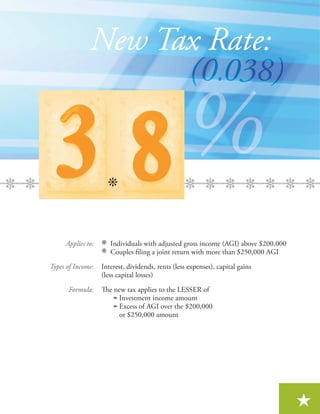
New Tax Rate:


     Applies to:      Individuals with adjusted gross income (AGI) above $200,000
                      Couples filing a joint return with more than $250,000 AGI
Types of Income:   Interest, dividends, rents (less expenses), capital gains
                   (less capital losses)
      Formula:     The new tax applies to the LESSER of
                        Investment income amount
                        Excess of AGI over the $200,000
                        or $250,000 amount


                                                                                    ★
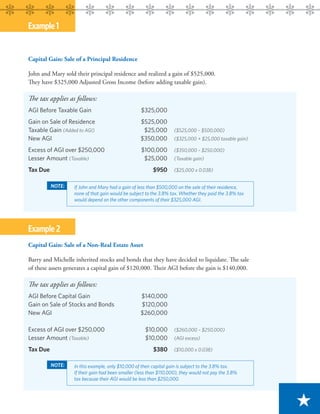
Example 1


Capital Gain: Sale of a Principal Residence

John and Mary sold their principal residence and realized a gain of $525,000.
They have $325,000 Adjusted Gross Income (before adding taxable gain).

The tax applies as follows:
AGI Before Taxable Gain                            $325,000
Gain on Sale of Residence                          $525,000
Taxable Gain (Added to AGI)                         $25,000         ($525,000 – $500,000)
New AGI                                            $350,000         ($325,000 + $25,000 taxable gain)

Excess of AGI over $250,000                        $100,000         ($350,000 – $250,000)
Lesser Amount (Taxable)                             $25,000         (Taxable gain)

Tax Due                                                  $950       ($25,000 x 0.038)


          NOTE:    If John and Mary had a gain of less than $500,000 on the sale of their residence,
                   none of that gain would be subject to the 3.8% tax. Whether they paid the 3.8% tax
                   would depend on the other components of their $325,000 AGI.


Example 2
Capital Gain: Sale of a Non-Real Estate Asset

Barry and Michelle inherited stocks and bonds that they have decided to liquidate. The sale
of these assets generates a capital gain of $120,000. Their AGI before the gain is $140,000.

The tax applies as follows:
AGI Before Capital Gain                            $140,000
Gain on Sale of Stocks and Bonds                   $120,000
New AGI                                            $260,000

Excess of AGI over $250,000                          $10,000        ($260,000 – $250,000)
Lesser Amount (Taxable)                              $10,000        (AGI excess)

Tax Due                                                  $380       ($10,000 x 0.038)

          NOTE:    In this example, only $10,000 of their capital gain is subject to the 3.8% tax.
                   If their gain had been smaller (less than $110,000), they would not pay the 3.8%
                   tax because their AGI would be less than $250,000.


                                                                                                        ★
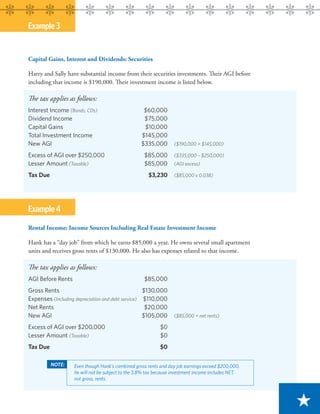
Example 3


Capital Gains, Interest and Dividends: Securities

Harry and Sally have substantial income from their securities investments. Their AGI before
including that income is $190,000. Their investment income is listed below.

The tax applies as follows:
Interest Income (Bonds, CDs)                       $60,000
Dividend Income                                    $75,000
Capital Gains                                      $10,000
Total Investment Income                           $145,000
New AGI                                           $335,000        ($190,000 + $145,000)

Excess of AGI over $250,000                         $85,000       ($335,000 – $250,000)
Lesser Amount (Taxable)                             $85,000       (AGI excess)

Tax Due                                               $3,230      ($85,000 x 0.038)


Example 4
Rental Income: Income Sources Including Real Estate Investment Income

Hank has a “day job” from which he earns $85,000 a year. He owns several small apartment
units and receives gross rents of $130,000. He also has expenses related to that income.

The tax applies as follows:
AGI Before Rents                                    $85,000
Gross Rents                                        $130,000
Expenses (Including depreciation and debt service) $110,000
Net Rents                                           $20,000
New AGI                                            $105,000       ($85,000 + net rents)

Excess of AGI over $200,000                                $0
Lesser Amount (Taxable)                                    $0
Tax Due                                                    $0

          NOTE:    Even though Hank’s combined gross rents and day job earnings exceed $200,000,
                   he will not be subject to the 3.8% tax because investment income includes NET,
                   not gross, rents.


                                                                                                    ★
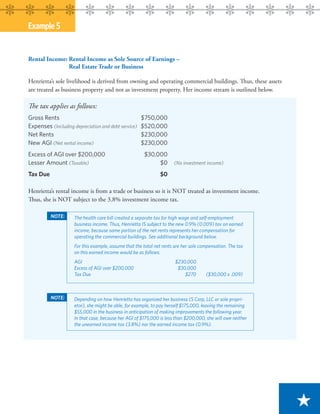
Example 5


Rental Income: Rental Income as Sole Source of Earnings –
               Real Estate Trade or Business

Henrietta’s sole livelihood is derived from owning and operating commercial buildings. Thus, these assets
are treated as business property and not as investment property. Her income stream is outlined below.

The tax applies as follows:
Gross Rents                                           $750,000
Expenses (Including depreciation and debt service)    $520,000
Net Rents                                             $230,000
New AGI (Net rental income)                           $230,000
Excess of AGI over $200,000                            $30,000
Lesser Amount (Taxable)                                     $0        (No investment income)

Tax Due                                                        $0

Henrietta’s rental income is from a trade or business so it is NOT treated as investment income.
Thus, she is NOT subject to the 3.8% investment income tax.

          NOTE:      The health care bill created a separate tax for high wage and self-employment
                     business income. Thus, Henrietta IS subject to the new 0.9% (0.009) tax on earned
                     income, because some portion of the net rents represents her compensation for
                     operating the commercial buildings. See additional background below.
                     For this example, assume that the total net rents are her sole compensation. The tax
                     on this earned income would be as follows:
                     AGI                                               $230,000
                     Excess of AGI over $200,000                        $30,000
                     Tax Due                                               $270       ($30,000 x .009)


          NOTE:      Depending on how Henrietta has organized her business (S Corp, LLC or sole propri-
                     etor), she might be able, for example, to pay herself $175,000, leaving the remaining
                     $55,000 in the business in anticipation of making improvements the following year.
                     In that case, because her AGI of $175,000 is less than $200,000, she will owe neither
                     the unearned income tax (3.8%) nor the earned income tax (0.9%).


                                                                                                             ★
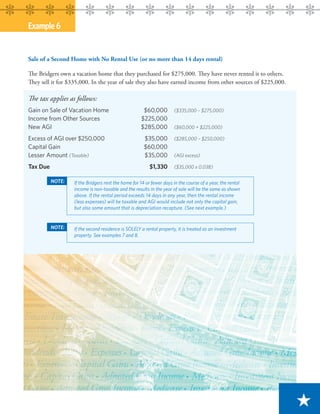
Example 6


Sale of a Second Home with No Rental Use (or no more than 14 days rental)

The Bridgers own a vacation home that they purchased for $275,000. They have never rented it to others.
They sell it for $335,000. In the year of sale they also have earned income from other sources of $225,000.

The tax applies as follows:
Gain on Sale of Vacation Home                         $60,000         ($335,000 – $275,000)
Income from Other Sources                            $225,000
New AGI                                              $285,000         ($60,000 + $225,000)

Excess of AGI over $250,000                            $35,000        ($285,000 – $250,000)
Capital Gain                                           $60,000
Lesser Amount (Taxable)                                $35,000        (AGI excess)

Tax Due                                                   $1,330      ($35,000 x 0.038)

          NOTE:    If the Bridgers rent the home for 14 or fewer days in the course of a year, the rental
                   income is non-taxable and the results in the year of sale will be the same as shown
                   above. If the rental period exceeds 14 days in any year, then the rental income
                   (less expenses) will be taxable and AGI would include not only the capital gain,
                   but also some amount that is depreciation recapture. (See next example.)


          NOTE:    If the second residence is SOLELY a rental property, it is treated as an investment
                   property. See examples 7 and 8.


                                                                                                              ★
7
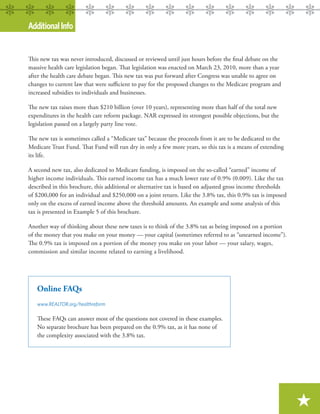
Additional Info


This new tax was never introduced, discussed or reviewed until just hours before the final debate on the
massive health care legislation began. That legislation was enacted on March 23, 2010, more than a year
after the health care debate began. This new tax was put forward after Congress was unable to agree on
changes to current law that were sufficient to pay for the proposed changes to the Medicare program and
increased subsidies to individuals and businesses.

The new tax raises more than $210 billion (over 10 years), representing more than half of the total new
expenditures in the health care reform package. NAR expressed its strongest possible objections, but the
legislation passed on a largely party line vote.

The new tax is sometimes called a “Medicare tax” because the proceeds from it are to be dedicated to the
Medicare Trust Fund. That Fund will run dry in only a few more years, so this tax is a means of extending
its life.

A second new tax, also dedicated to Medicare funding, is imposed on the so-called “earned” income of
higher income individuals. This earned income tax has a much lower rate of 0.9% (0.009). Like the tax
described in this brochure, this additional or alternative tax is based on adjusted gross income thresholds
of $200,000 for an individual and $250,000 on a joint return. Like the 3.8% tax, this 0.9% tax is imposed
only on the excess of earned income above the threshold amounts. An example and some analysis of this
tax is presented in Example 5 of this brochure.

Another way of thinking about these new taxes is to think of the 3.8% tax as being imposed on a portion
of the money that you make on your money — your capital (sometimes referred to as “unearned income”).
The 0.9% tax is imposed on a portion of the money you make on your labor — your salary, wages,
commission and similar income related to earning a livelihood.


   Online FAQs
   www.REALTOR.org/healthreform

   These FAQs can answer most of the questions not covered in these examples.
   No separate brochure has been prepared on the 0.9% tax, as it has none of
   the complexity associated with the 3.8% tax.


                                                                                                              ★
LEARN MORE ABOUT GOVERNMENT AFFAIRS:
WWW.REALTOR.ORG/GOVERNMENT_AFFAIRS
ACCESS INFORMATION ON CURRENT INITIATIVES

3.8% medicare tax

  • 1.
    ★★★★★★★★★ The 3.8% Tax Real Estate Scenarios & Examples Effective January 1, 2013
  • 2.
    Intro Beginning January 1,2013, a new 3.8 percent tax on some investment income will take effect. Since this new tax will affect some real estate transactions, it is important for REALTORS® to clearly understand the tax and how it could impact your clients. It’s a complicated tax, so you won’t be able to predict how it will affect every buyer or seller. To get you up to speed about this new tax legislation, the NATIONAL ASSOCIATION OF REALTORS® has developed this informational brochure. On the following pages, you’ll read examples of different scenarios in which this new tax — passed by Congress in 2010 with the intent of generating an estimated $210 billion to help fund President Barack Obama’s health care and Medicare overhaul plans — could be relevant to your clients. Understand that this tax WILL NOT be imposed on all real estate transactions, a common misconception. Rather, when the legislation becomes effective in 2013, it may impose a 3.8% tax on some (but not all) income from interest, dividends, rents (less expenses) and capital gains (less capital losses). The tax will fall only on individuals with an adjusted gross income (AGI) above $200,000 and couples filing a joint return with more than $250,000 AGI. ★
  • 3.
    New Tax Rate: Applies to: Individuals with adjusted gross income (AGI) above $200,000 Couples filing a joint return with more than $250,000 AGI Types of Income: Interest, dividends, rents (less expenses), capital gains (less capital losses) Formula: The new tax applies to the LESSER of Investment income amount Excess of AGI over the $200,000 or $250,000 amount ★
  • 4.
    Example 1 Capital Gain:Sale of a Principal Residence John and Mary sold their principal residence and realized a gain of $525,000. They have $325,000 Adjusted Gross Income (before adding taxable gain). The tax applies as follows: AGI Before Taxable Gain $325,000 Gain on Sale of Residence $525,000 Taxable Gain (Added to AGI) $25,000 ($525,000 – $500,000) New AGI $350,000 ($325,000 + $25,000 taxable gain) Excess of AGI over $250,000 $100,000 ($350,000 – $250,000) Lesser Amount (Taxable) $25,000 (Taxable gain) Tax Due $950 ($25,000 x 0.038) NOTE: If John and Mary had a gain of less than $500,000 on the sale of their residence, none of that gain would be subject to the 3.8% tax. Whether they paid the 3.8% tax would depend on the other components of their $325,000 AGI. Example 2 Capital Gain: Sale of a Non-Real Estate Asset Barry and Michelle inherited stocks and bonds that they have decided to liquidate. The sale of these assets generates a capital gain of $120,000. Their AGI before the gain is $140,000. The tax applies as follows: AGI Before Capital Gain $140,000 Gain on Sale of Stocks and Bonds $120,000 New AGI $260,000 Excess of AGI over $250,000 $10,000 ($260,000 – $250,000) Lesser Amount (Taxable) $10,000 (AGI excess) Tax Due $380 ($10,000 x 0.038) NOTE: In this example, only $10,000 of their capital gain is subject to the 3.8% tax. If their gain had been smaller (less than $110,000), they would not pay the 3.8% tax because their AGI would be less than $250,000. ★
  • 5.
    Example 3 Capital Gains,Interest and Dividends: Securities Harry and Sally have substantial income from their securities investments. Their AGI before including that income is $190,000. Their investment income is listed below. The tax applies as follows: Interest Income (Bonds, CDs) $60,000 Dividend Income $75,000 Capital Gains $10,000 Total Investment Income $145,000 New AGI $335,000 ($190,000 + $145,000) Excess of AGI over $250,000 $85,000 ($335,000 – $250,000) Lesser Amount (Taxable) $85,000 (AGI excess) Tax Due $3,230 ($85,000 x 0.038) Example 4 Rental Income: Income Sources Including Real Estate Investment Income Hank has a “day job” from which he earns $85,000 a year. He owns several small apartment units and receives gross rents of $130,000. He also has expenses related to that income. The tax applies as follows: AGI Before Rents $85,000 Gross Rents $130,000 Expenses (Including depreciation and debt service) $110,000 Net Rents $20,000 New AGI $105,000 ($85,000 + net rents) Excess of AGI over $200,000 $0 Lesser Amount (Taxable) $0 Tax Due $0 NOTE: Even though Hank’s combined gross rents and day job earnings exceed $200,000, he will not be subject to the 3.8% tax because investment income includes NET, not gross, rents. ★
  • 6.
    Example 5 Rental Income:Rental Income as Sole Source of Earnings – Real Estate Trade or Business Henrietta’s sole livelihood is derived from owning and operating commercial buildings. Thus, these assets are treated as business property and not as investment property. Her income stream is outlined below. The tax applies as follows: Gross Rents $750,000 Expenses (Including depreciation and debt service) $520,000 Net Rents $230,000 New AGI (Net rental income) $230,000 Excess of AGI over $200,000 $30,000 Lesser Amount (Taxable) $0 (No investment income) Tax Due $0 Henrietta’s rental income is from a trade or business so it is NOT treated as investment income. Thus, she is NOT subject to the 3.8% investment income tax. NOTE: The health care bill created a separate tax for high wage and self-employment business income. Thus, Henrietta IS subject to the new 0.9% (0.009) tax on earned income, because some portion of the net rents represents her compensation for operating the commercial buildings. See additional background below. For this example, assume that the total net rents are her sole compensation. The tax on this earned income would be as follows: AGI $230,000 Excess of AGI over $200,000 $30,000 Tax Due $270 ($30,000 x .009) NOTE: Depending on how Henrietta has organized her business (S Corp, LLC or sole propri- etor), she might be able, for example, to pay herself $175,000, leaving the remaining $55,000 in the business in anticipation of making improvements the following year. In that case, because her AGI of $175,000 is less than $200,000, she will owe neither the unearned income tax (3.8%) nor the earned income tax (0.9%). ★
  • 7.
    Example 6 Sale ofa Second Home with No Rental Use (or no more than 14 days rental) The Bridgers own a vacation home that they purchased for $275,000. They have never rented it to others. They sell it for $335,000. In the year of sale they also have earned income from other sources of $225,000. The tax applies as follows: Gain on Sale of Vacation Home $60,000 ($335,000 – $275,000) Income from Other Sources $225,000 New AGI $285,000 ($60,000 + $225,000) Excess of AGI over $250,000 $35,000 ($285,000 – $250,000) Capital Gain $60,000 Lesser Amount (Taxable) $35,000 (AGI excess) Tax Due $1,330 ($35,000 x 0.038) NOTE: If the Bridgers rent the home for 14 or fewer days in the course of a year, the rental income is non-taxable and the results in the year of sale will be the same as shown above. If the rental period exceeds 14 days in any year, then the rental income (less expenses) will be taxable and AGI would include not only the capital gain, but also some amount that is depreciation recapture. (See next example.) NOTE: If the second residence is SOLELY a rental property, it is treated as an investment property. See examples 7 and 8. ★
  • 8.
  • 9.
    Additional Info This newtax was never introduced, discussed or reviewed until just hours before the final debate on the massive health care legislation began. That legislation was enacted on March 23, 2010, more than a year after the health care debate began. This new tax was put forward after Congress was unable to agree on changes to current law that were sufficient to pay for the proposed changes to the Medicare program and increased subsidies to individuals and businesses. The new tax raises more than $210 billion (over 10 years), representing more than half of the total new expenditures in the health care reform package. NAR expressed its strongest possible objections, but the legislation passed on a largely party line vote. The new tax is sometimes called a “Medicare tax” because the proceeds from it are to be dedicated to the Medicare Trust Fund. That Fund will run dry in only a few more years, so this tax is a means of extending its life. A second new tax, also dedicated to Medicare funding, is imposed on the so-called “earned” income of higher income individuals. This earned income tax has a much lower rate of 0.9% (0.009). Like the tax described in this brochure, this additional or alternative tax is based on adjusted gross income thresholds of $200,000 for an individual and $250,000 on a joint return. Like the 3.8% tax, this 0.9% tax is imposed only on the excess of earned income above the threshold amounts. An example and some analysis of this tax is presented in Example 5 of this brochure. Another way of thinking about these new taxes is to think of the 3.8% tax as being imposed on a portion of the money that you make on your money — your capital (sometimes referred to as “unearned income”). The 0.9% tax is imposed on a portion of the money you make on your labor — your salary, wages, commission and similar income related to earning a livelihood. Online FAQs www.REALTOR.org/healthreform These FAQs can answer most of the questions not covered in these examples. No separate brochure has been prepared on the 0.9% tax, as it has none of the complexity associated with the 3.8% tax. ★
  • 10.
    LEARN MORE ABOUTGOVERNMENT AFFAIRS: WWW.REALTOR.ORG/GOVERNMENT_AFFAIRS ACCESS INFORMATION ON CURRENT INITIATIVES