Direct Taxes Code Bill, 2009 PART II- 16 th  December, 2009
Synopsis – Covered on 15.9.2009 –For memory lane Introduction Rates of Tax  New Definitions Residence Income deemed to accrue in India Scope of Total Income Tax Deduction at Source Branch Profit Tax
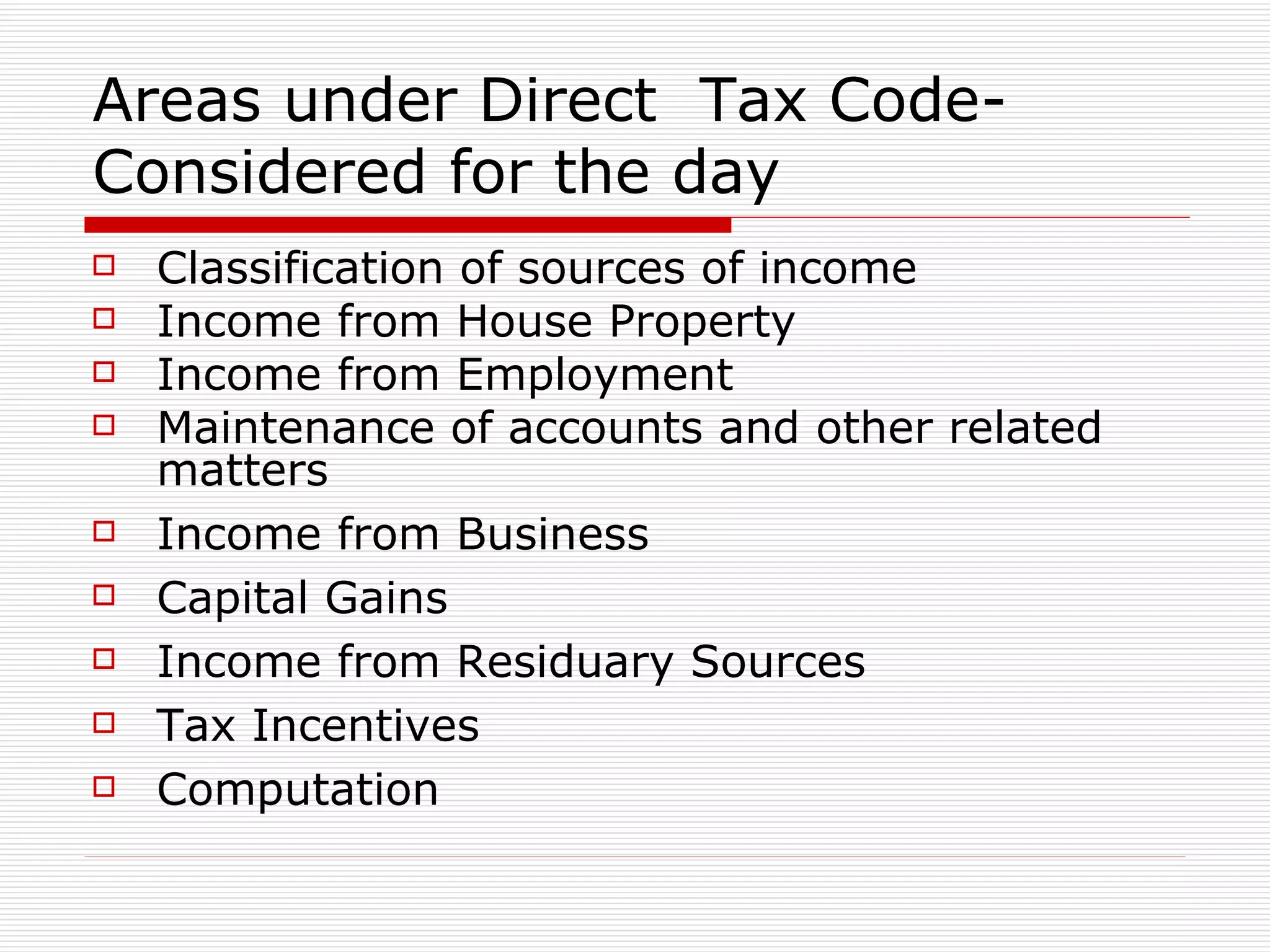
Areas under Direct  Tax Code- Considered for the day Classification of sources of income  Income from House Property Income from Employment  Maintenance of accounts and other related matters Income from Business Capital Gains Income from Residuary Sources Tax Incentives Computation
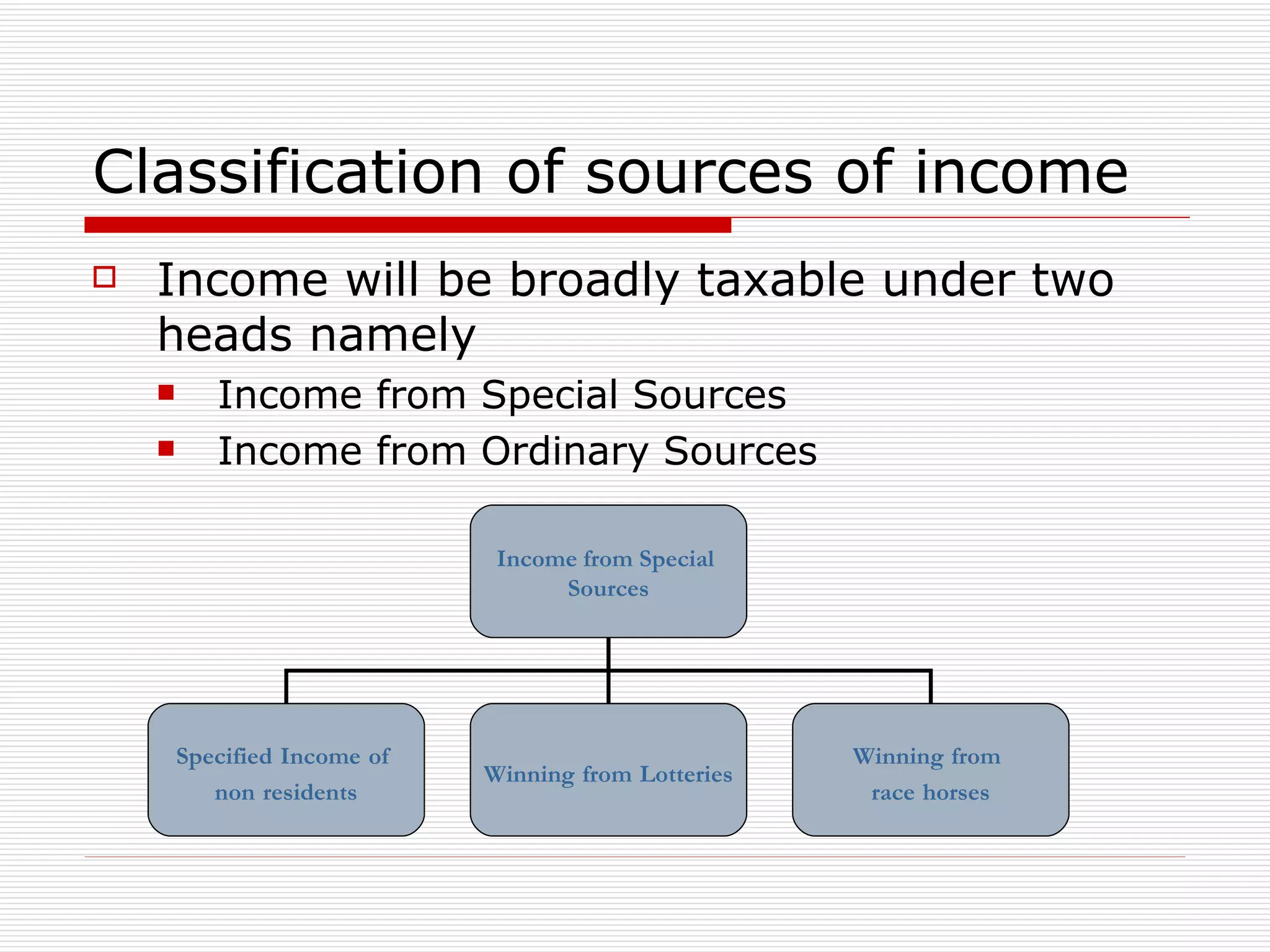
Classification of sources of income Income will be broadly taxable under two heads namely Income from Special Sources Income from Ordinary Sources Income from Special  Sources Specified   Income   of   non   residents Winning   from   Lotteries Winning   from   race   horses
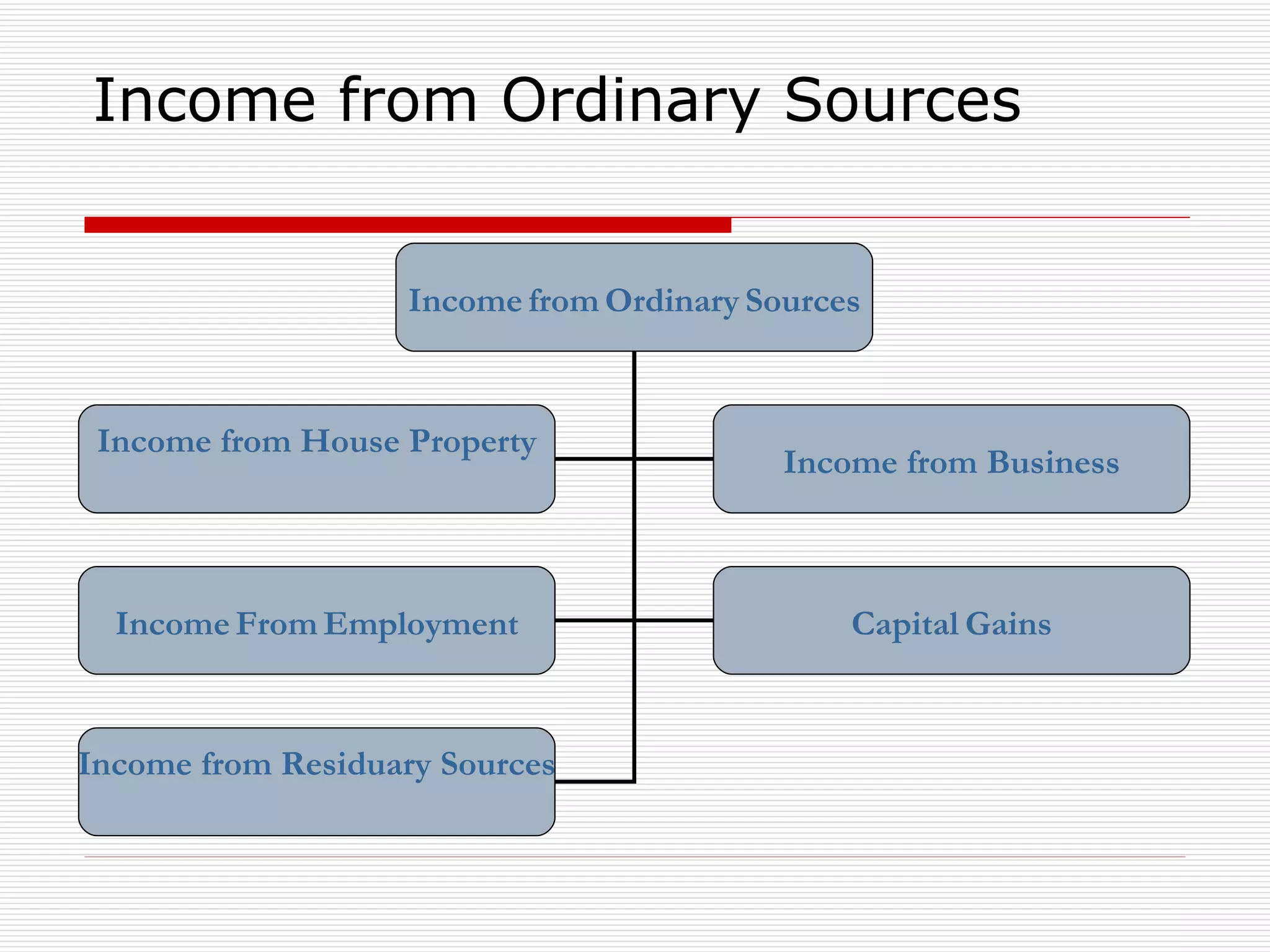
Income from Ordinary Sources Income   from   Ordinary   Sources Income from House Property Income   from   Business Income   From   Employment Capital   Gains Income   from   Residuary   Sources
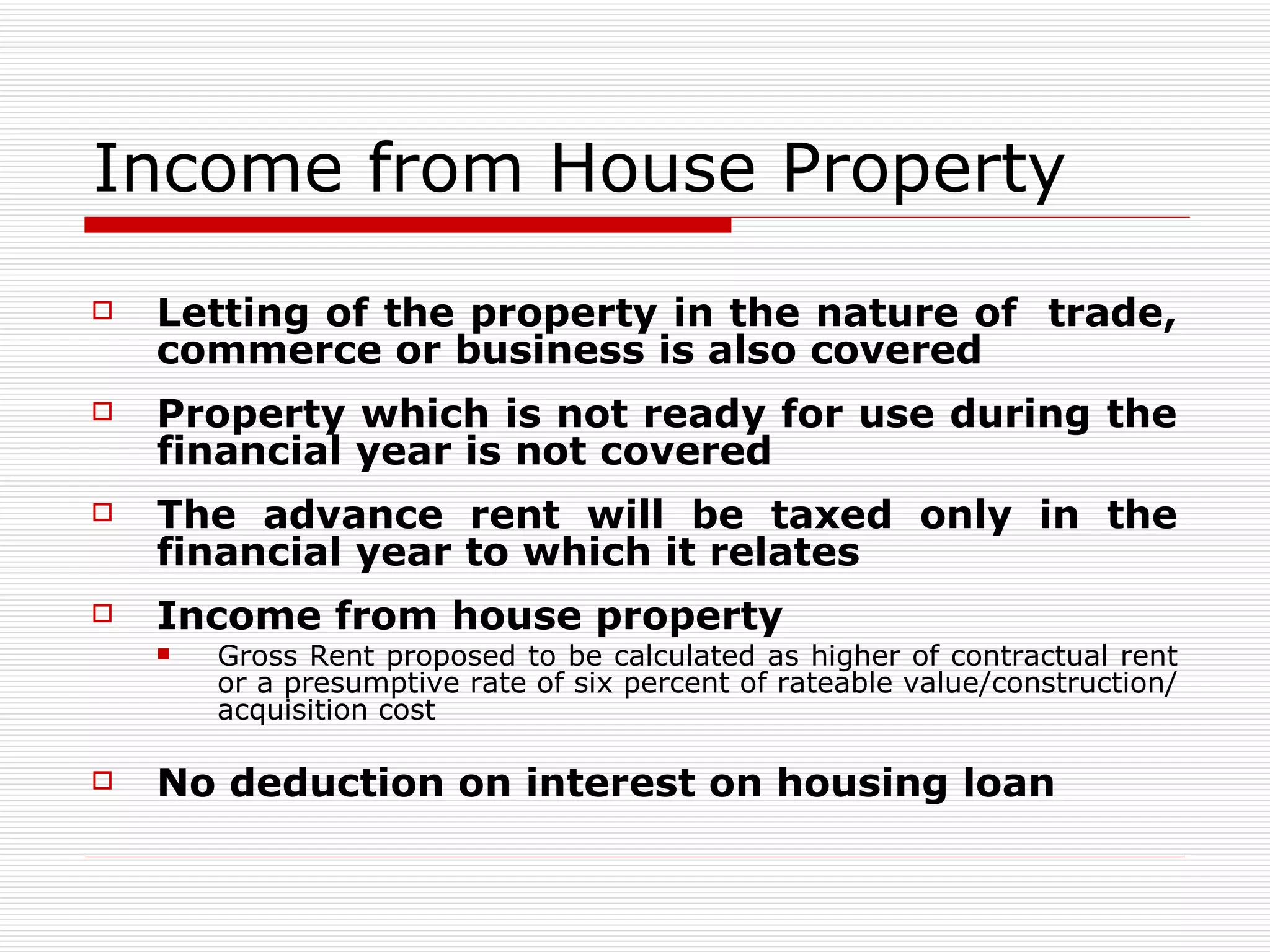
Income from House Property Letting of the property in the nature of  trade, commerce or business is also covered Property which is not ready for use during the financial year is not covered The advance rent will be taxed only in the financial year to which it relates Income from house property Gross Rent proposed to be calculated as higher of contractual rent or a presumptive rate of six percent of rateable value/construction/acquisition cost  No deduction on interest on housing loan
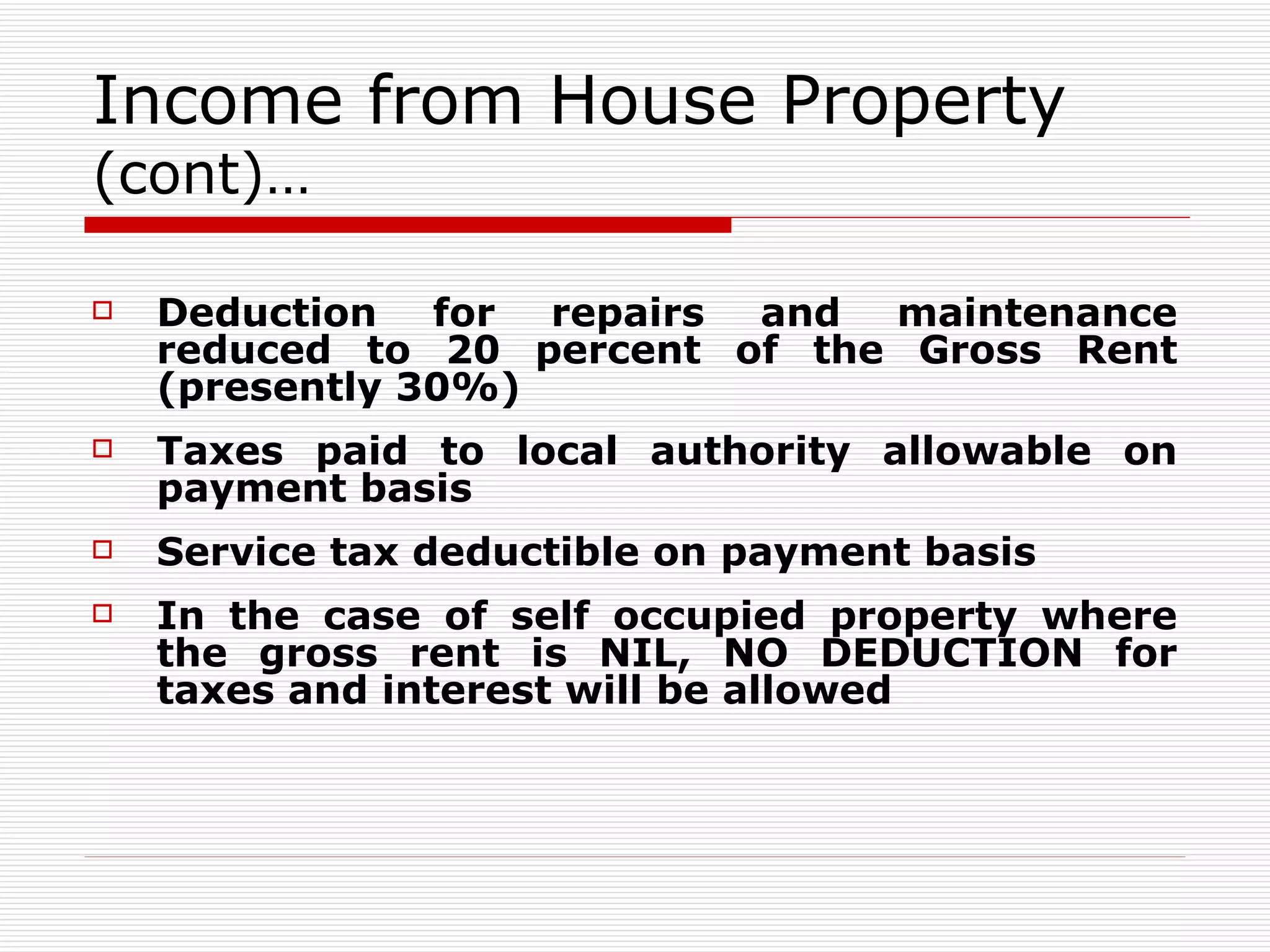
Income from House Property  (cont)… Deduction for repairs and maintenance reduced to 20 percent of the Gross Rent (presently 30%) Taxes paid to local authority allowable on payment basis  Service tax deductible on payment basis In the case of self occupied property where the gross rent is NIL, NO DEDUCTION for taxes and interest will be allowed
Income from Employment Salary due or paid (including arrears or advance) employer or former employer Employment income = Gross Salary- Aggregate of specified deductions Distinction between Government and private sector employers – no more while taxing perks Exemptions  –  Profession Tax Conveyance Allowance Pension received by gallantry awardees  Voluntary retirement or termination of service or voluntary separation under any scheme Amount received in commutation of pension Amount of gratuity received on retirement or death But,  alas !!!!taxable at the time of withdrawal, mostly on retirement, disturbing his withdrawn  life when he requires solace !!! Exemptions –Not specified, hence taxable House Rent Allowance Leave Travel Concession Leave Encashment Tax on non- monetary perquisite borne by employer  Medical reimbursements
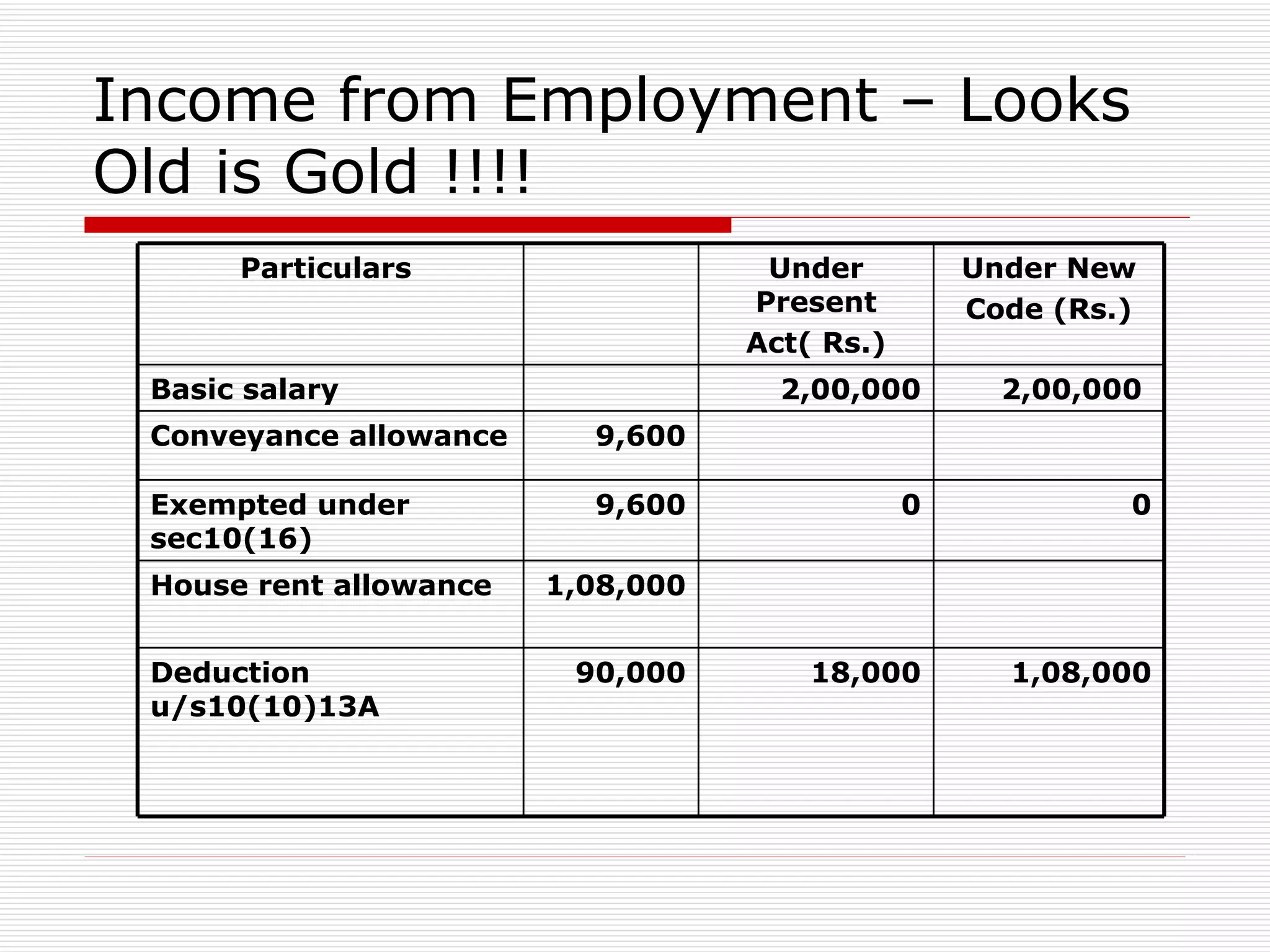
Income from Employment – Looks Old is Gold !!!! 90,000 1,08,000 9,600 9,600 1,08,000 18,000 Deduction u/s10(10)13A House rent allowance 0 0 Exempted under sec10(16) Conveyance allowance  2,00,000  2,00,000 Basic salary  Under New Code (Rs.) Under Present Act( Rs.) Particulars
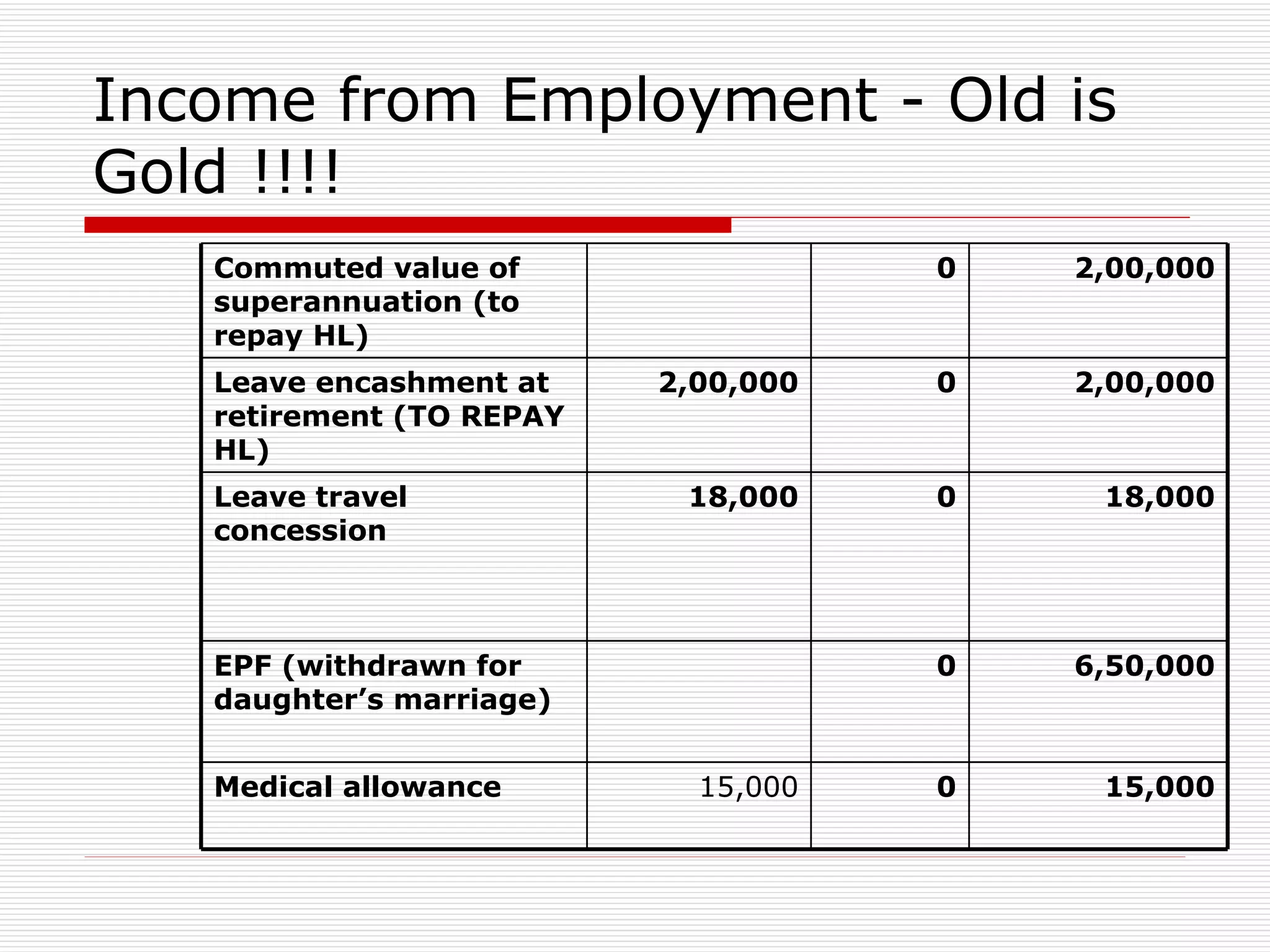
Income from Employment - Old is Gold !!!! 6,50,000 0 EPF (withdrawn for daughter’s marriage) 2,00,000 0 Commuted value of superannuation (to repay HL) 15,000 0 15,000 Medical allowance 18,000 0 18,000 Leave travel concession 2,00,000 0 2,00,000 Leave encashment at retirement (TO REPAY HL)
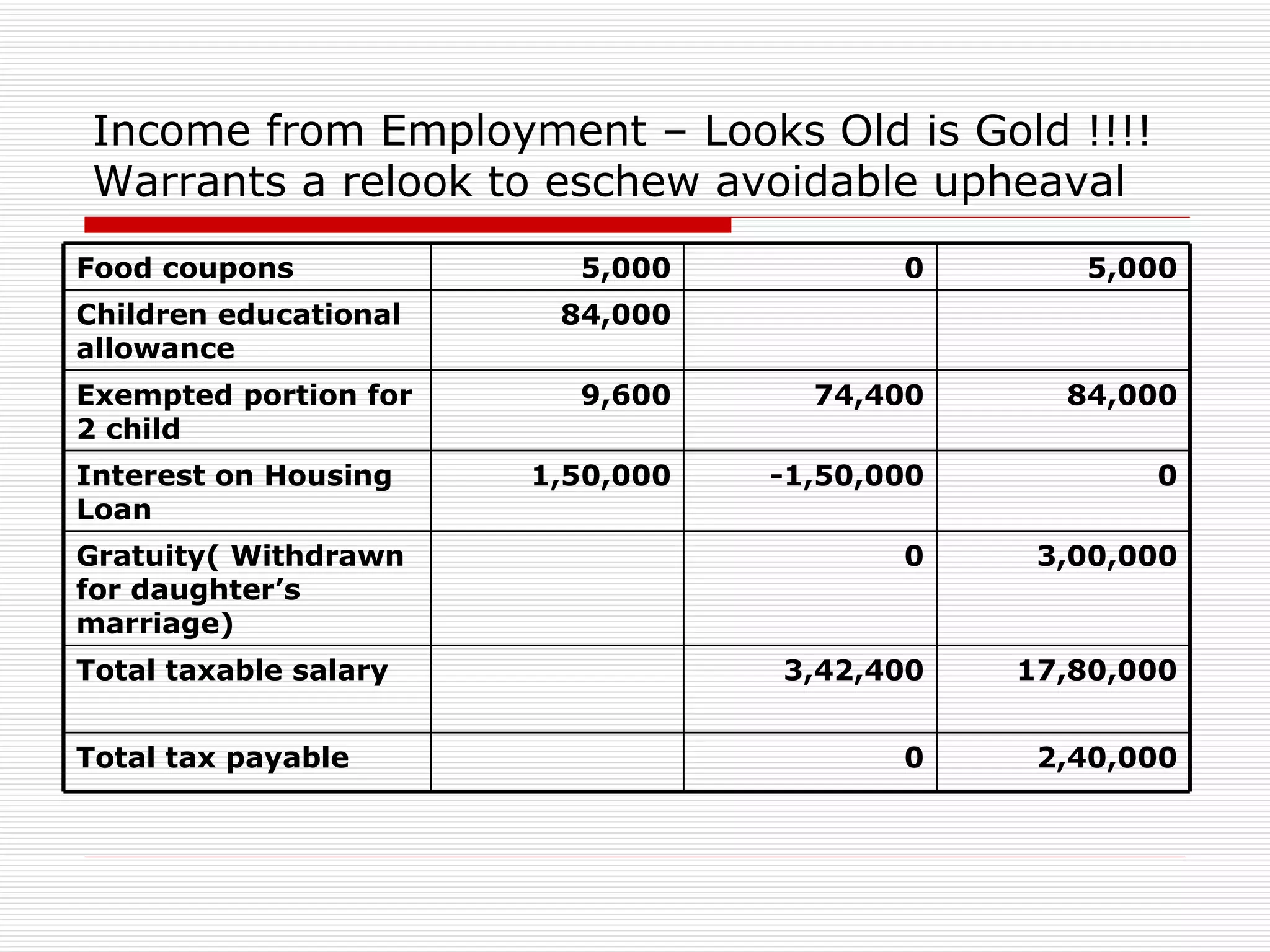
Income from Employment – Looks Old is Gold !!!! Warrants a relook to eschew avoidable upheaval 17,80,000 3,42,400 Total taxable salary 1,50,000 9,600 84,000 5,000 2,40,000 0 Total tax payable 3,00,000 0 Gratuity( Withdrawn for daughter’s marriage) 0 -1,50,000 Interest on Housing Loan 84,000 74,400 Exempted portion for 2 child Children educational allowance 5,000 0 Food coupons
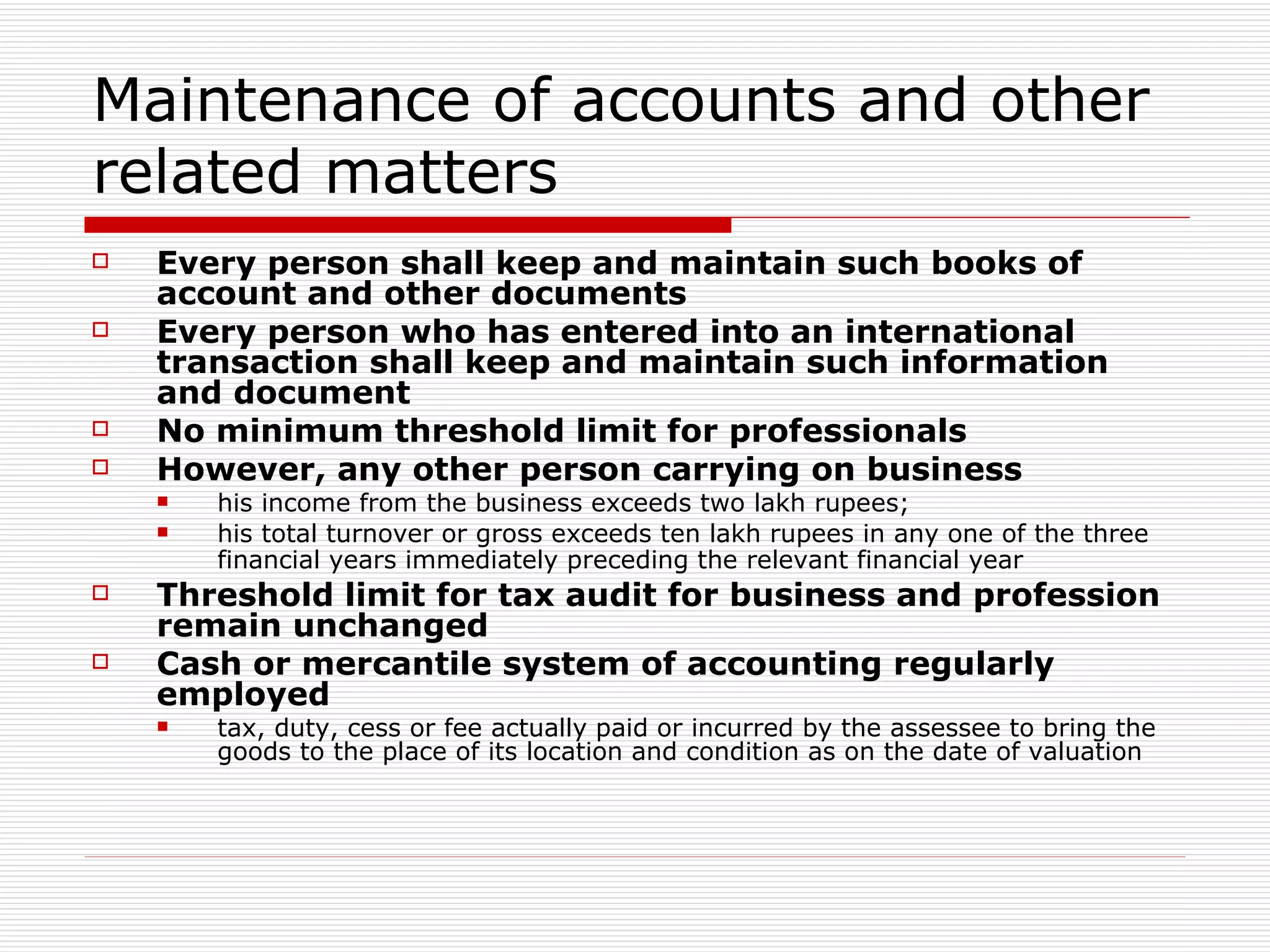
Maintenance of accounts and other related matters Every person shall keep and maintain such books of account and other documents Every person who has entered into an international transaction shall keep and maintain such information and document No minimum threshold limit for professionals However, any other person carrying on business his income from the business exceeds two lakh rupees; his total turnover or gross exceeds ten lakh rupees in any one of the three financial years immediately preceding the relevant financial year   Threshold limit for tax audit for business and profession remain unchanged Cash or mercantile system of accounting regularly employed tax, duty, cess or fee actually paid or incurred by the assessee to bring the goods to the place of its location and condition as on the date of valuation
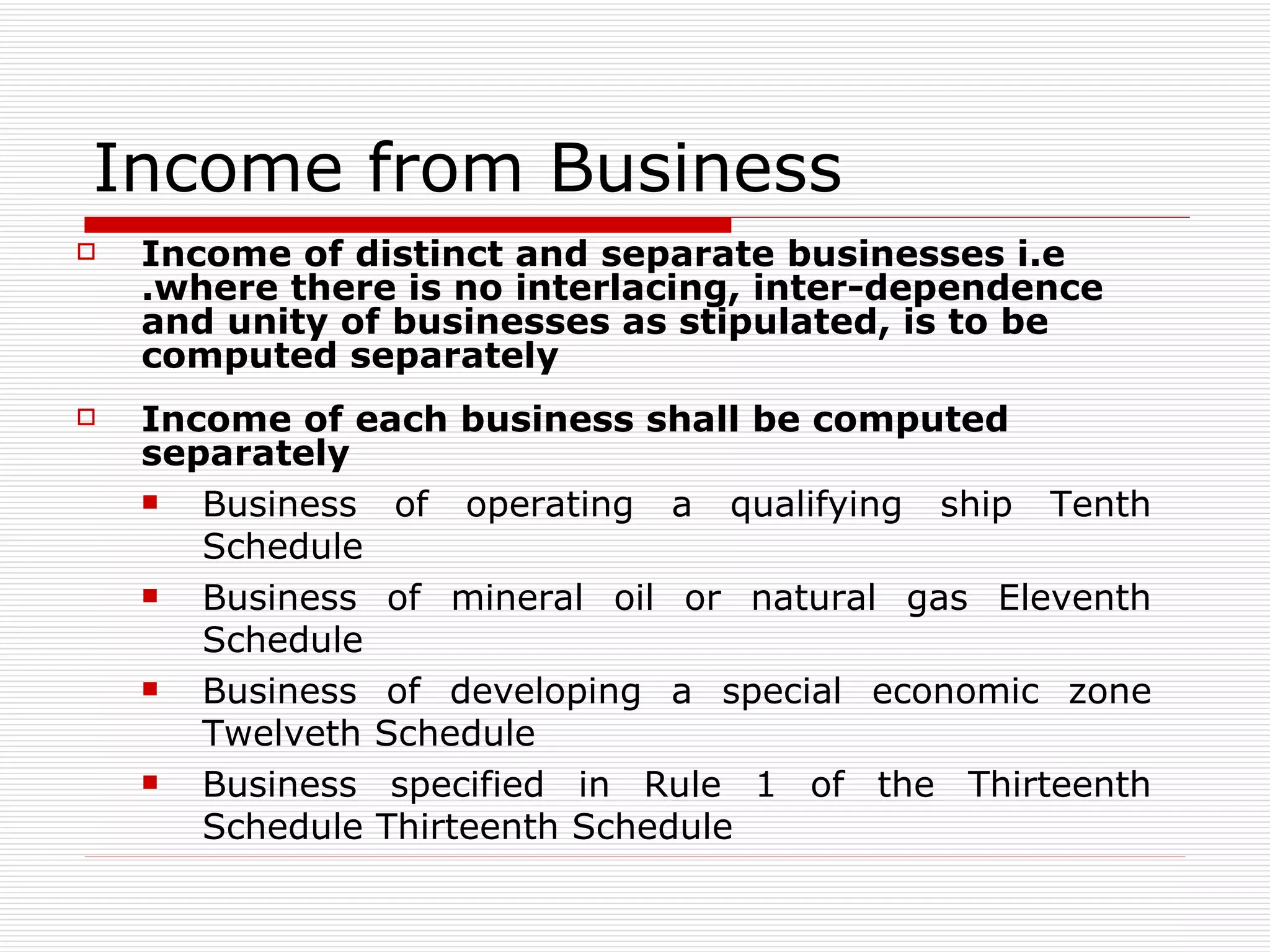
Income from Business  Income of distinct and separate businesses i.e .where there is no interlacing, inter-dependence and unity of businesses as stipulated, is to be computed separately Income of each business shall be computed separately Business of operating a qualifying ship Tenth Schedule Business of mineral oil or natural gas Eleventh Schedule Business of developing a special economic zone Twelveth Schedule Business specified in Rule 1 of the Thirteenth Schedule Thirteenth Schedule
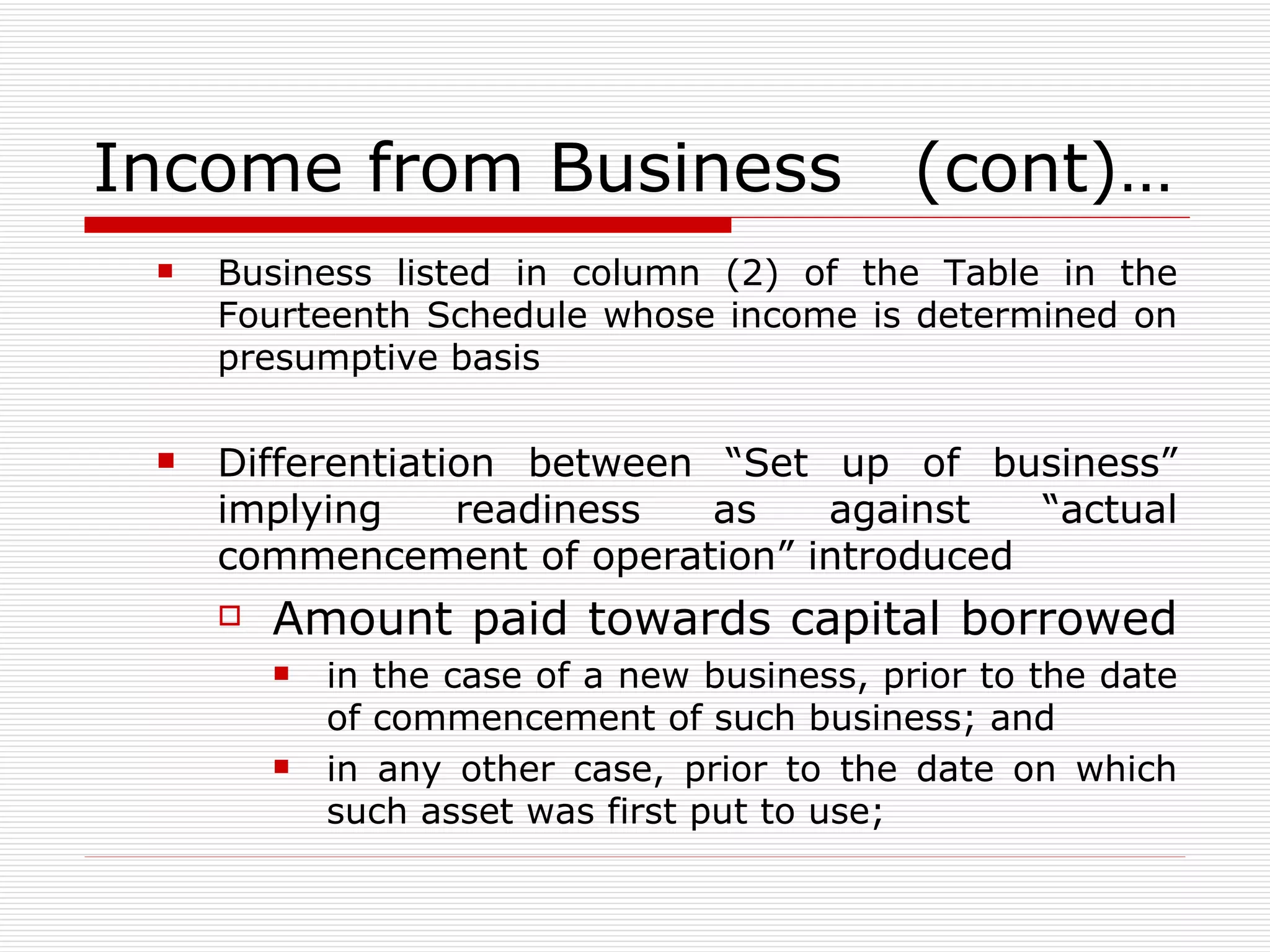
Income from Business  (cont)… Business listed in column (2) of the Table in the Fourteenth Schedule whose income is determined on presumptive basis Differentiation between “Set up of business” implying readiness as against “actual commencement of operation” introduced Amount paid towards capital borrowed  in the case of a new business, prior to the date of commencement of such business; and in any other case, prior to the date on which such asset was first put to use;
Income from Business (cont)… Cash assistance, subsidy or grant, by whatever name called, received from any person for, or in connection with, the business Remission, drawback or refund of any tax, duty or cess, received from the Government Profit on transfer of any business capital asset Consideration accrued or received on account of slump sale Amount accrued or received as reimbursement of any expenditure incurred Amount accrued or received, whether as advance, security deposit or otherwise, from the long term leasing, or transfer of whole or part of any business asset; or any interest in any business asset; Amount accrued or received on account of the cessation, termination or forfeiture of any agreement entered in the course of the business
Income from Business  (cont)… Deduction for business expenditure Operating expenditure for the purpose of business  Specific expenditure including net worth of assets transferred in slump sale Includes “Other expenditure akin to sec 37   Permitted finance charges for the purpose of business   Interest paid on capital borrowed or debt incurred, trade creditors Capital allowances- Depreciation including initial depreciation, research and development expenditure and amortization of business capital assets; Exception for capital expenditure on any building which is held by the person under a lease or other right of occupancy Depreciation to be allowed even though the block of asset is empty New class of assets covering deferred revenue expenditure like non compete fees, lease premium, business reorganization expenditure @ 25 %
Capital Gains The base year for calculation of capital gains shifted from 1.4.1981 to 1.4.2000 Capital loss will not be allowed to be set off against any other income Inflation indexation of cost of acquisition/improvement to continue Transfer of asset as gift will not attract capital gain provisions Gains not taxed (rollover benefit) if invested in approved capital gains savings scheme, first residential house, farm land Cost of acquisition to be nil if it cannot be determined or ascertained for any reason Security transactions tax  to be withdrawn and capital gains to be taxed in new format Capital gains on shares and securities to be taxed as income. Distinction between long-term and short-term capital assets to go All withdrawals from any capital gains savings scheme will be included in residual income
Capital Gains  (cont)… Capital Gain will be chargeable on investment asset Business assets like self generated assets, right to manufacture and other capital assets related to the business will not be included Further ,the indexation facility would be available to all investment assets held for more than one year Cost of acquisition/ improvement of an asset is not determinable then the cost is to be taken as “NIL” Current income from capital gains = full value of the consideration- aggregate amount of the deductions The higher of the stamp duty value of the asset and the value of the asset ascertained on reference, if any, to the Valuation Officer. Indexed cost of acquisition will be available if investment asset is transferred at any time after one year from the end of the financial year in which the asset is acquired The losses under this head will be allowed to be carried forward for any number of years for set off against the income under this head only – Atleast a relief  !!!!
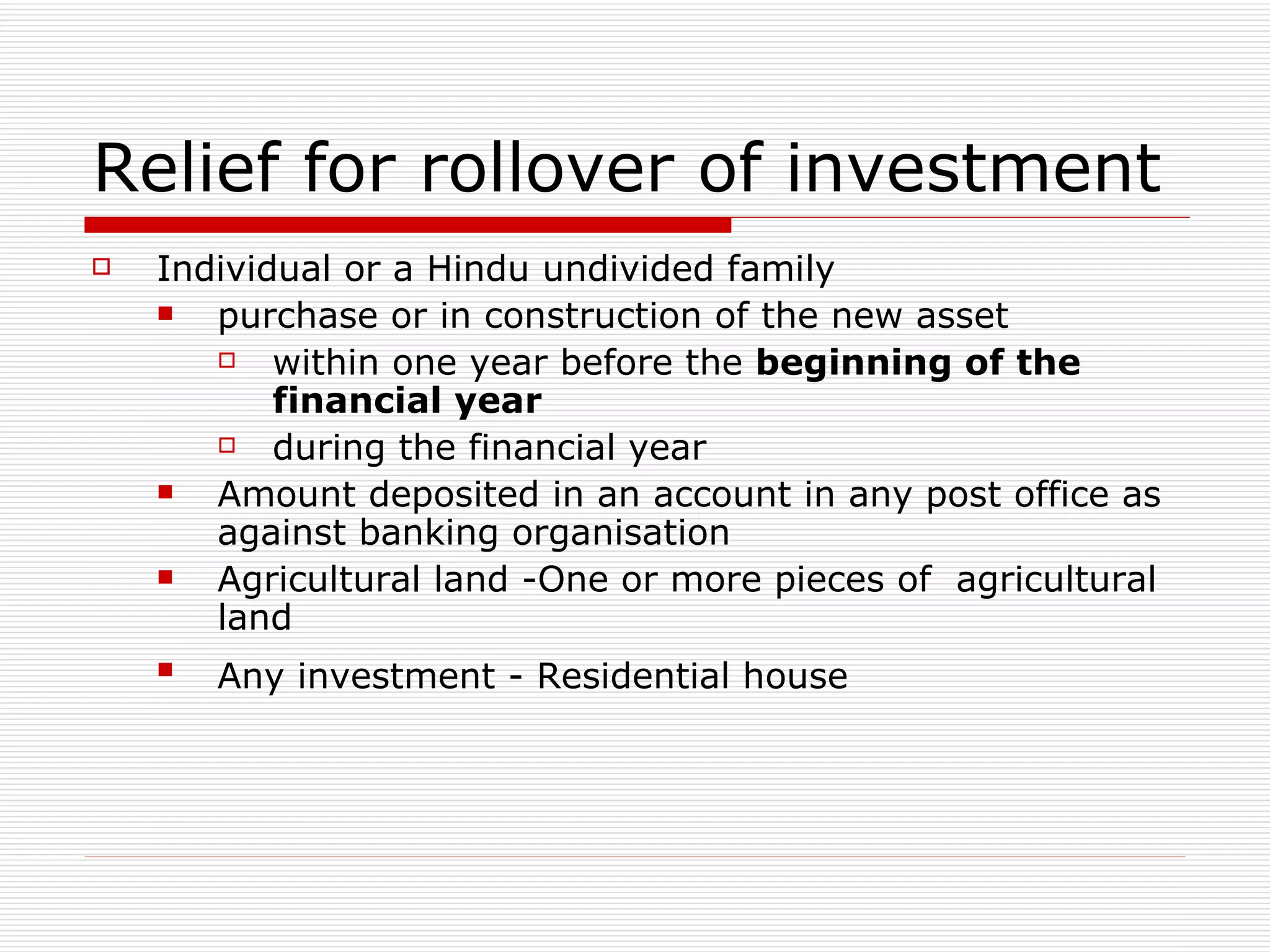
Relief for rollover of investment Individual or a Hindu undivided family purchase or in construction of the new asset within one year before the  beginning of the financial year during the financial year Amount deposited in an account in any post office as against banking organisation Agricultural land -One or more pieces of  agricultural land Any investment - Residential house
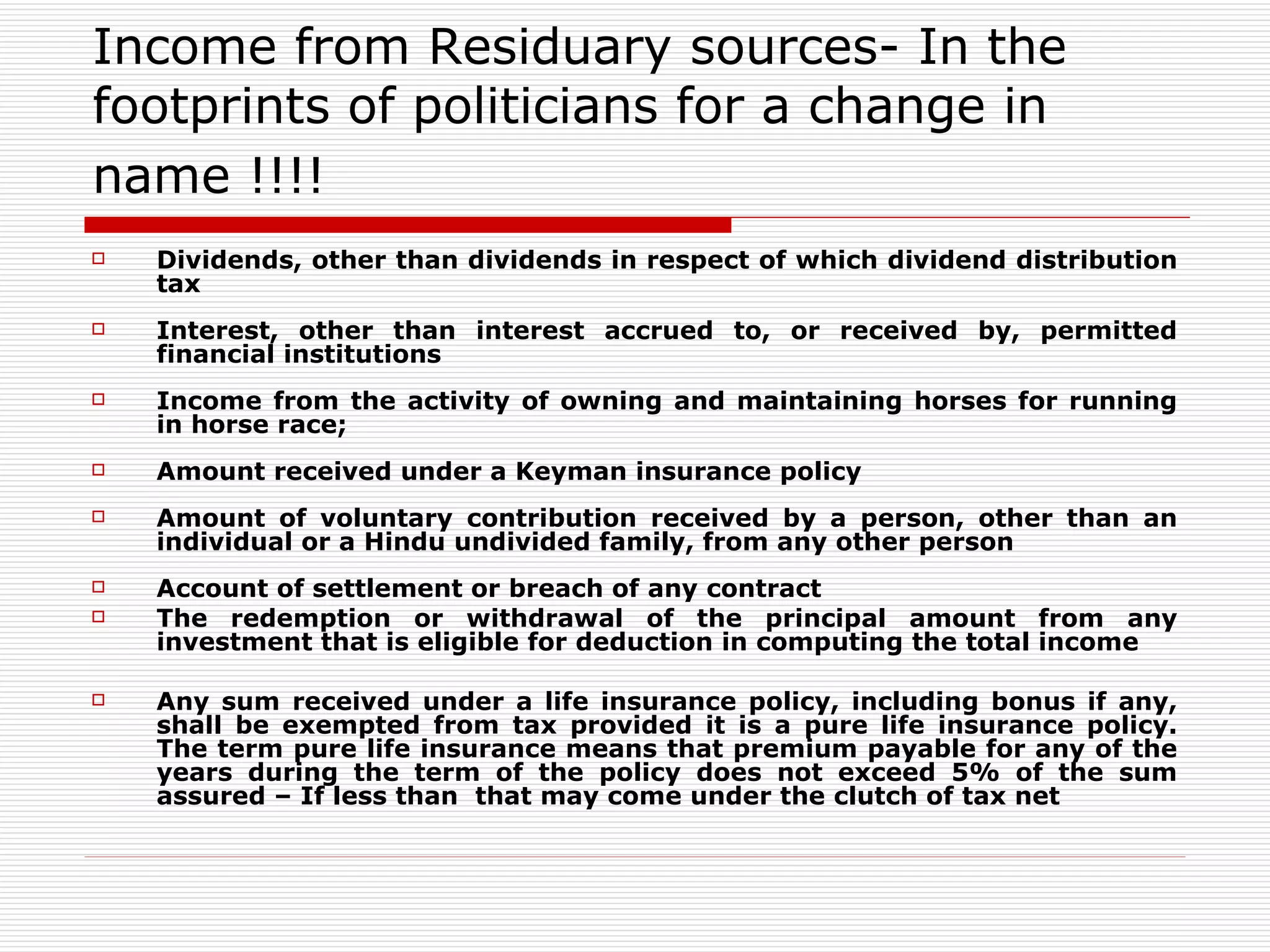
Income from Residuary sources- In the footprints of politicians for a change in name !!!!   Dividends, other than dividends in respect of which dividend distribution tax Interest, other than interest accrued to, or received by, permitted financial institutions Income from the activity of owning and maintaining horses for running in horse race; Amount received under a Keyman insurance policy Amount of voluntary contribution received by a person, other than an individual or a Hindu undivided family, from any other person Account of settlement or breach of any contract The redemption or withdrawal of the principal amount from any investment that is eligible for deduction in computing the total income Any sum received under a life insurance policy, including bonus if any, shall be exempted from tax provided it is a pure life insurance policy. The term pure life insurance means that premium payable for any of the years during the term of the policy does not exceed 5% of the sum assured – If less than  that may come under the clutch of tax net
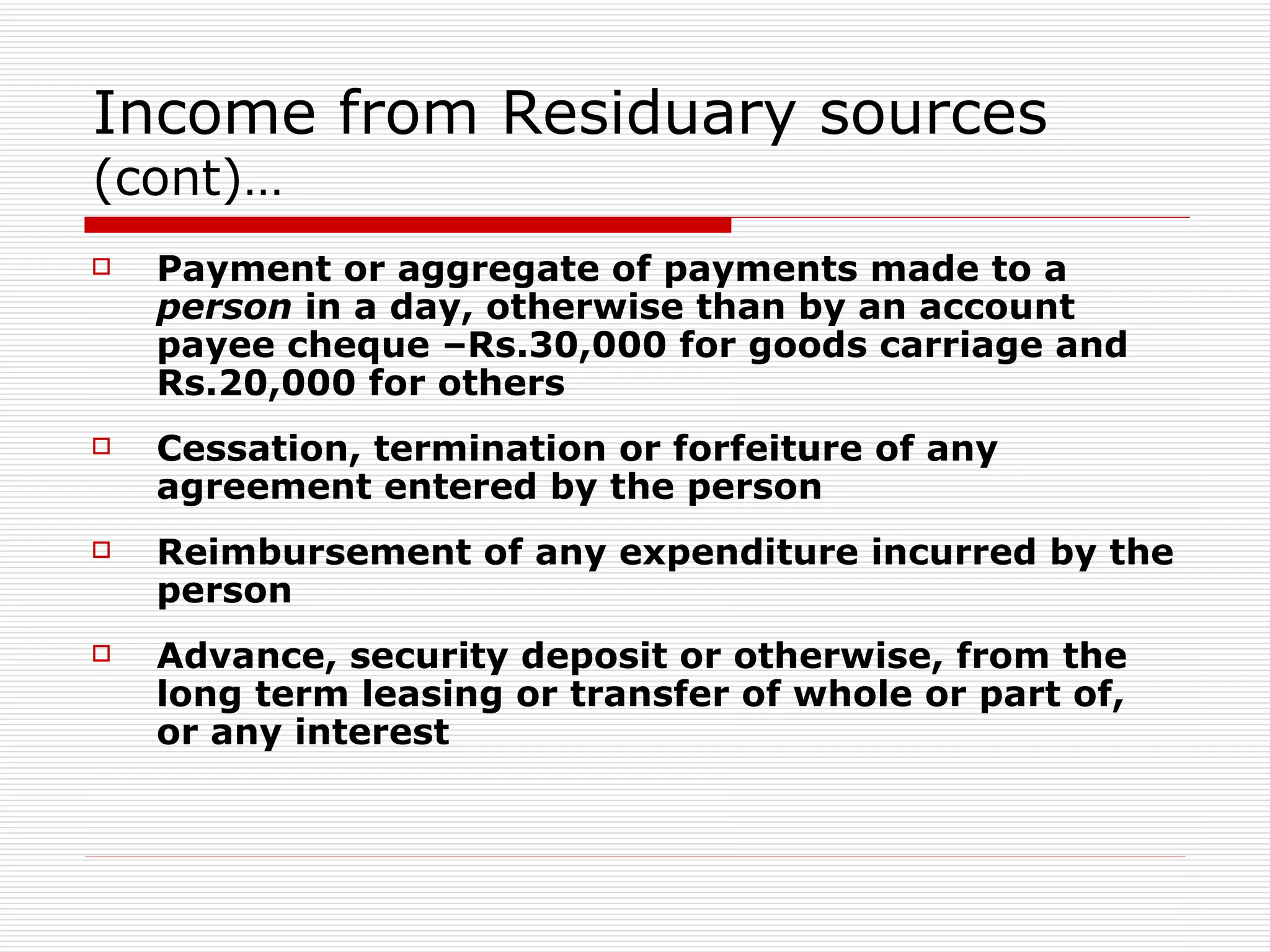
Income from Residuary sources  (cont)… Payment or aggregate of payments made to a  person  in a day, otherwise than by an account payee cheque –Rs.30,000 for goods carriage and Rs.20,000 for others Cessation, termination or forfeiture of any agreement entered by the person Reimbursement of any expenditure incurred by the person Advance, security deposit or otherwise, from the long term leasing or transfer of whole or part of, or any interest
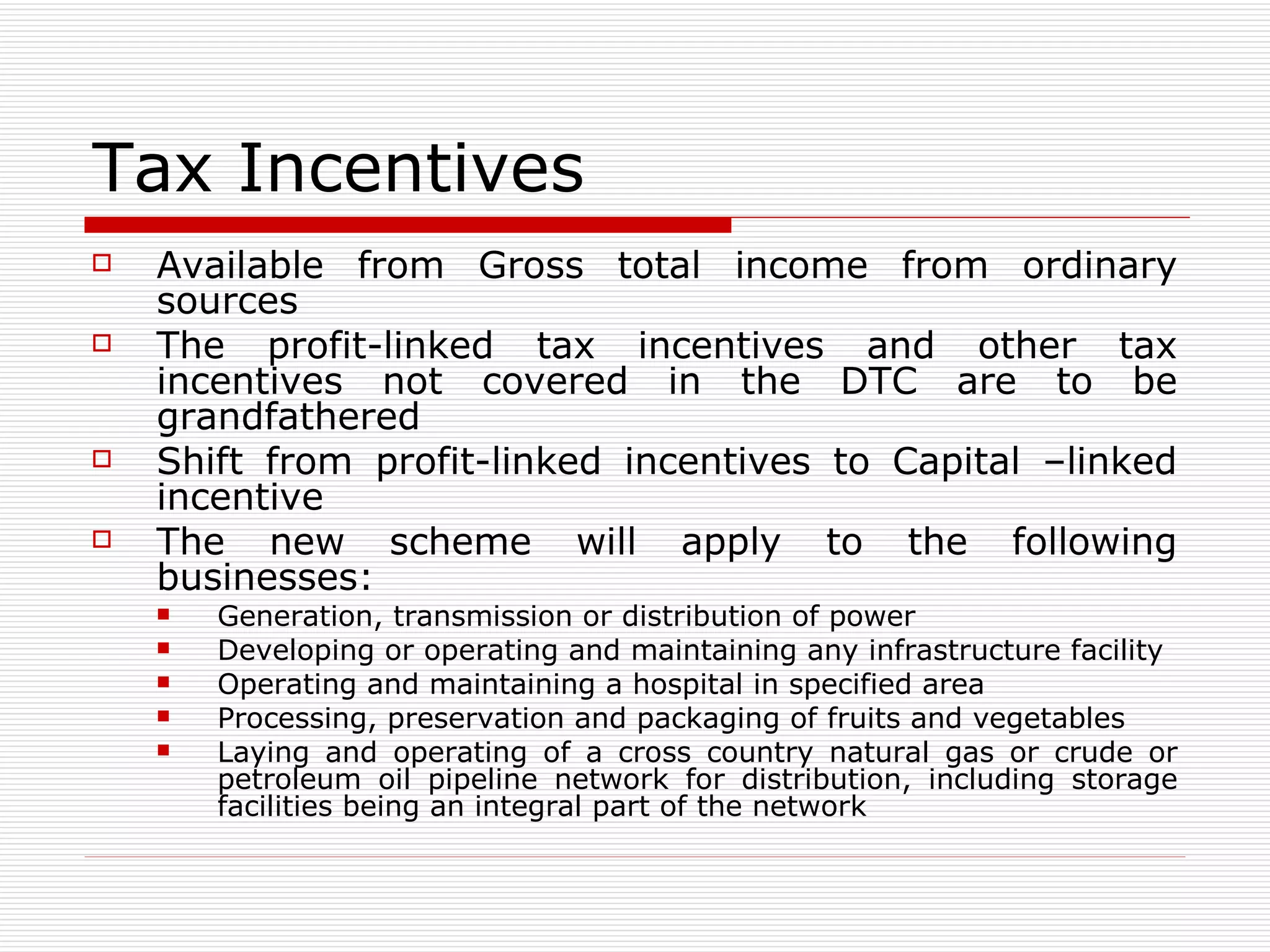
Tax Incentives  Available from Gross total income from ordinary sources The profit-linked tax incentives and other tax incentives not covered in the DTC are to be grandfathered  Shift from profit-linked incentives to Capital –linked incentive  The new scheme will apply to the following businesses: Generation, transmission or distribution of power Developing or operating and maintaining any infrastructure facility Operating and maintaining a hospital in specified area Processing, preservation and packaging of fruits and vegetables Laying and operating of a cross country natural gas or crude or petroleum oil pipeline network for distribution, including storage facilities being an integral part of the network
Tax Incentives  (cont)… Setting up and operating a cold chain facility Setting up and operating a warehousing facility for the storage of agricultural produce Exploration and production of mineral or natural gas Developing a Special Economic Zone Incentive by way of  tax savings investments to individual and HUF will be up to Rupees 3 lakhs Deposited with any permitted savings intermediary
Tax Incentives  (cont)… Deductions in respect of children’s education Paid as tuition fee to any university, college, school or other educational institution situated within India; and For the purpose of full-time education of any two children of such individual or Hindu undivided family (other than towards development fees or donation) Deduction in respect of interest on loan taken for higher education of himself or relative any amount actually paid Deduction in respect of health insurance premia
Tax Incentives  (cont)… Deduction in respect of medical treatment, etc. Deduction in respect of maintenance of a disabled dependant Deduction in respect of donations to certain funds, non-profit organisations, etc. Deduction in respect of royalty income, etc., of authors of certain books Deduction in respect of royalty on patents Expenditure for promoting family planning and preventing HIV-aids – Available to companies
Computation Income from Special sources- Loss from Special source can d indefinitely be set off Income from Ordinary sources- Loss from Ordinary source can be set off Unabsorbed losses can be C/Fd Loss from business can be set off against income from employment Distinction between business loss and unabsorbed depreciation to be done away with  Return of income to be furnished by the due date   Unabsorbed current capital loss  Unabsorbed current loss from ordinary sources Unabsorbed current loss from the special source
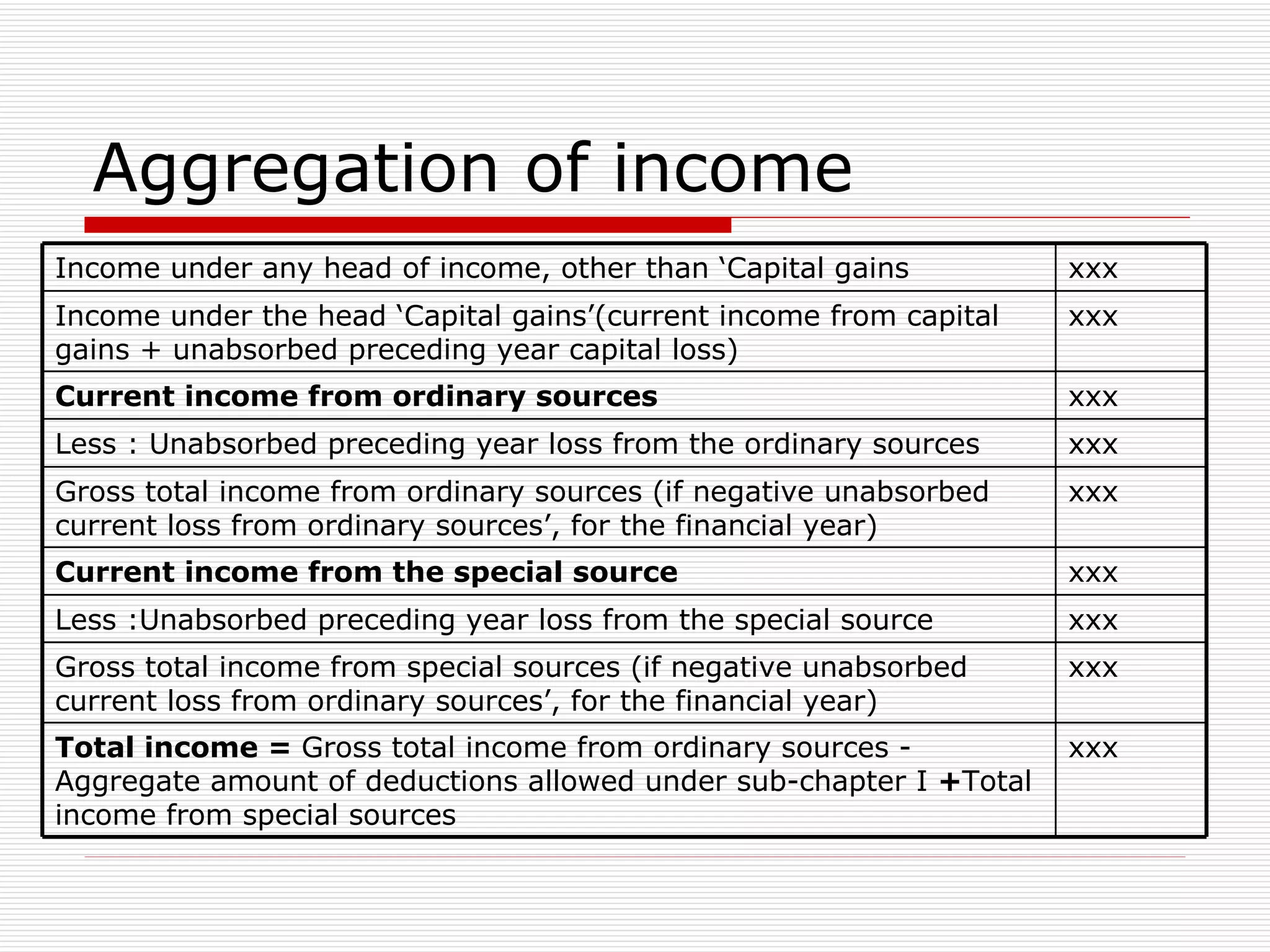
Aggregation of income xxx Total income =  Gross total income from ordinary sources - Aggregate amount of deductions allowed under sub-chapter I  + Total income from special sources xxx Gross total income from special sources (if negative unabsorbed current loss from ordinary sources’, for the financial year) xxx Less :Unabsorbed preceding year loss from the special source  xxx Current income from the special source xxx Gross total income from ordinary sources (if negative unabsorbed current loss from ordinary sources’, for the financial year) xxx Less : Unabsorbed preceding year loss from the ordinary sources xxx Current income from ordinary sources xxx Income under the head ‘Capital gains’(current income from capital gains + unabsorbed preceding year capital loss) xxx Income under any head of income, other than ‘Capital gains
Thank You  Any Questions  ??

DTC PART !!

  • 1.
    Direct Taxes CodeBill, 2009 PART II- 16 th December, 2009
  • 2.
    Synopsis – Coveredon 15.9.2009 –For memory lane Introduction Rates of Tax New Definitions Residence Income deemed to accrue in India Scope of Total Income Tax Deduction at Source Branch Profit Tax
  • 3.
    Areas under Direct Tax Code- Considered for the day Classification of sources of income Income from House Property Income from Employment Maintenance of accounts and other related matters Income from Business Capital Gains Income from Residuary Sources Tax Incentives Computation
  • 4.
    Classification of sourcesof income Income will be broadly taxable under two heads namely Income from Special Sources Income from Ordinary Sources Income from Special Sources Specified Income of non residents Winning from Lotteries Winning from race horses
  • 5.
    Income from OrdinarySources Income from Ordinary Sources Income from House Property Income from Business Income From Employment Capital Gains Income from Residuary Sources
  • 6.
    Income from HouseProperty Letting of the property in the nature of trade, commerce or business is also covered Property which is not ready for use during the financial year is not covered The advance rent will be taxed only in the financial year to which it relates Income from house property Gross Rent proposed to be calculated as higher of contractual rent or a presumptive rate of six percent of rateable value/construction/acquisition cost No deduction on interest on housing loan
  • 7.
    Income from HouseProperty (cont)… Deduction for repairs and maintenance reduced to 20 percent of the Gross Rent (presently 30%) Taxes paid to local authority allowable on payment basis Service tax deductible on payment basis In the case of self occupied property where the gross rent is NIL, NO DEDUCTION for taxes and interest will be allowed
  • 8.
    Income from EmploymentSalary due or paid (including arrears or advance) employer or former employer Employment income = Gross Salary- Aggregate of specified deductions Distinction between Government and private sector employers – no more while taxing perks Exemptions – Profession Tax Conveyance Allowance Pension received by gallantry awardees Voluntary retirement or termination of service or voluntary separation under any scheme Amount received in commutation of pension Amount of gratuity received on retirement or death But, alas !!!!taxable at the time of withdrawal, mostly on retirement, disturbing his withdrawn life when he requires solace !!! Exemptions –Not specified, hence taxable House Rent Allowance Leave Travel Concession Leave Encashment Tax on non- monetary perquisite borne by employer Medical reimbursements
  • 9.
    Income from Employment– Looks Old is Gold !!!! 90,000 1,08,000 9,600 9,600 1,08,000 18,000 Deduction u/s10(10)13A House rent allowance 0 0 Exempted under sec10(16) Conveyance allowance 2,00,000 2,00,000 Basic salary Under New Code (Rs.) Under Present Act( Rs.) Particulars
  • 10.
    Income from Employment- Old is Gold !!!! 6,50,000 0 EPF (withdrawn for daughter’s marriage) 2,00,000 0 Commuted value of superannuation (to repay HL) 15,000 0 15,000 Medical allowance 18,000 0 18,000 Leave travel concession 2,00,000 0 2,00,000 Leave encashment at retirement (TO REPAY HL)
  • 11.
    Income from Employment– Looks Old is Gold !!!! Warrants a relook to eschew avoidable upheaval 17,80,000 3,42,400 Total taxable salary 1,50,000 9,600 84,000 5,000 2,40,000 0 Total tax payable 3,00,000 0 Gratuity( Withdrawn for daughter’s marriage) 0 -1,50,000 Interest on Housing Loan 84,000 74,400 Exempted portion for 2 child Children educational allowance 5,000 0 Food coupons
  • 12.
    Maintenance of accountsand other related matters Every person shall keep and maintain such books of account and other documents Every person who has entered into an international transaction shall keep and maintain such information and document No minimum threshold limit for professionals However, any other person carrying on business his income from the business exceeds two lakh rupees; his total turnover or gross exceeds ten lakh rupees in any one of the three financial years immediately preceding the relevant financial year Threshold limit for tax audit for business and profession remain unchanged Cash or mercantile system of accounting regularly employed tax, duty, cess or fee actually paid or incurred by the assessee to bring the goods to the place of its location and condition as on the date of valuation
  • 13.
    Income from Business Income of distinct and separate businesses i.e .where there is no interlacing, inter-dependence and unity of businesses as stipulated, is to be computed separately Income of each business shall be computed separately Business of operating a qualifying ship Tenth Schedule Business of mineral oil or natural gas Eleventh Schedule Business of developing a special economic zone Twelveth Schedule Business specified in Rule 1 of the Thirteenth Schedule Thirteenth Schedule
  • 14.
    Income from Business (cont)… Business listed in column (2) of the Table in the Fourteenth Schedule whose income is determined on presumptive basis Differentiation between “Set up of business” implying readiness as against “actual commencement of operation” introduced Amount paid towards capital borrowed in the case of a new business, prior to the date of commencement of such business; and in any other case, prior to the date on which such asset was first put to use;
  • 15.
    Income from Business(cont)… Cash assistance, subsidy or grant, by whatever name called, received from any person for, or in connection with, the business Remission, drawback or refund of any tax, duty or cess, received from the Government Profit on transfer of any business capital asset Consideration accrued or received on account of slump sale Amount accrued or received as reimbursement of any expenditure incurred Amount accrued or received, whether as advance, security deposit or otherwise, from the long term leasing, or transfer of whole or part of any business asset; or any interest in any business asset; Amount accrued or received on account of the cessation, termination or forfeiture of any agreement entered in the course of the business
  • 16.
    Income from Business (cont)… Deduction for business expenditure Operating expenditure for the purpose of business Specific expenditure including net worth of assets transferred in slump sale Includes “Other expenditure akin to sec 37 Permitted finance charges for the purpose of business Interest paid on capital borrowed or debt incurred, trade creditors Capital allowances- Depreciation including initial depreciation, research and development expenditure and amortization of business capital assets; Exception for capital expenditure on any building which is held by the person under a lease or other right of occupancy Depreciation to be allowed even though the block of asset is empty New class of assets covering deferred revenue expenditure like non compete fees, lease premium, business reorganization expenditure @ 25 %
  • 17.
    Capital Gains Thebase year for calculation of capital gains shifted from 1.4.1981 to 1.4.2000 Capital loss will not be allowed to be set off against any other income Inflation indexation of cost of acquisition/improvement to continue Transfer of asset as gift will not attract capital gain provisions Gains not taxed (rollover benefit) if invested in approved capital gains savings scheme, first residential house, farm land Cost of acquisition to be nil if it cannot be determined or ascertained for any reason Security transactions tax  to be withdrawn and capital gains to be taxed in new format Capital gains on shares and securities to be taxed as income. Distinction between long-term and short-term capital assets to go All withdrawals from any capital gains savings scheme will be included in residual income
  • 18.
    Capital Gains (cont)… Capital Gain will be chargeable on investment asset Business assets like self generated assets, right to manufacture and other capital assets related to the business will not be included Further ,the indexation facility would be available to all investment assets held for more than one year Cost of acquisition/ improvement of an asset is not determinable then the cost is to be taken as “NIL” Current income from capital gains = full value of the consideration- aggregate amount of the deductions The higher of the stamp duty value of the asset and the value of the asset ascertained on reference, if any, to the Valuation Officer. Indexed cost of acquisition will be available if investment asset is transferred at any time after one year from the end of the financial year in which the asset is acquired The losses under this head will be allowed to be carried forward for any number of years for set off against the income under this head only – Atleast a relief !!!!
  • 19.
    Relief for rolloverof investment Individual or a Hindu undivided family purchase or in construction of the new asset within one year before the beginning of the financial year during the financial year Amount deposited in an account in any post office as against banking organisation Agricultural land -One or more pieces of agricultural land Any investment - Residential house
  • 20.
    Income from Residuarysources- In the footprints of politicians for a change in name !!!! Dividends, other than dividends in respect of which dividend distribution tax Interest, other than interest accrued to, or received by, permitted financial institutions Income from the activity of owning and maintaining horses for running in horse race; Amount received under a Keyman insurance policy Amount of voluntary contribution received by a person, other than an individual or a Hindu undivided family, from any other person Account of settlement or breach of any contract The redemption or withdrawal of the principal amount from any investment that is eligible for deduction in computing the total income Any sum received under a life insurance policy, including bonus if any, shall be exempted from tax provided it is a pure life insurance policy. The term pure life insurance means that premium payable for any of the years during the term of the policy does not exceed 5% of the sum assured – If less than that may come under the clutch of tax net
  • 21.
    Income from Residuarysources (cont)… Payment or aggregate of payments made to a person in a day, otherwise than by an account payee cheque –Rs.30,000 for goods carriage and Rs.20,000 for others Cessation, termination or forfeiture of any agreement entered by the person Reimbursement of any expenditure incurred by the person Advance, security deposit or otherwise, from the long term leasing or transfer of whole or part of, or any interest
  • 22.
    Tax Incentives Available from Gross total income from ordinary sources The profit-linked tax incentives and other tax incentives not covered in the DTC are to be grandfathered Shift from profit-linked incentives to Capital –linked incentive The new scheme will apply to the following businesses: Generation, transmission or distribution of power Developing or operating and maintaining any infrastructure facility Operating and maintaining a hospital in specified area Processing, preservation and packaging of fruits and vegetables Laying and operating of a cross country natural gas or crude or petroleum oil pipeline network for distribution, including storage facilities being an integral part of the network
  • 23.
    Tax Incentives (cont)… Setting up and operating a cold chain facility Setting up and operating a warehousing facility for the storage of agricultural produce Exploration and production of mineral or natural gas Developing a Special Economic Zone Incentive by way of  tax savings investments to individual and HUF will be up to Rupees 3 lakhs Deposited with any permitted savings intermediary
  • 24.
    Tax Incentives (cont)… Deductions in respect of children’s education Paid as tuition fee to any university, college, school or other educational institution situated within India; and For the purpose of full-time education of any two children of such individual or Hindu undivided family (other than towards development fees or donation) Deduction in respect of interest on loan taken for higher education of himself or relative any amount actually paid Deduction in respect of health insurance premia
  • 25.
    Tax Incentives (cont)… Deduction in respect of medical treatment, etc. Deduction in respect of maintenance of a disabled dependant Deduction in respect of donations to certain funds, non-profit organisations, etc. Deduction in respect of royalty income, etc., of authors of certain books Deduction in respect of royalty on patents Expenditure for promoting family planning and preventing HIV-aids – Available to companies
  • 26.
    Computation Income fromSpecial sources- Loss from Special source can d indefinitely be set off Income from Ordinary sources- Loss from Ordinary source can be set off Unabsorbed losses can be C/Fd Loss from business can be set off against income from employment Distinction between business loss and unabsorbed depreciation to be done away with Return of income to be furnished by the due date Unabsorbed current capital loss Unabsorbed current loss from ordinary sources Unabsorbed current loss from the special source
  • 27.
    Aggregation of incomexxx Total income = Gross total income from ordinary sources - Aggregate amount of deductions allowed under sub-chapter I + Total income from special sources xxx Gross total income from special sources (if negative unabsorbed current loss from ordinary sources’, for the financial year) xxx Less :Unabsorbed preceding year loss from the special source xxx Current income from the special source xxx Gross total income from ordinary sources (if negative unabsorbed current loss from ordinary sources’, for the financial year) xxx Less : Unabsorbed preceding year loss from the ordinary sources xxx Current income from ordinary sources xxx Income under the head ‘Capital gains’(current income from capital gains + unabsorbed preceding year capital loss) xxx Income under any head of income, other than ‘Capital gains
  • 28.
    Thank You Any Questions ??

Editor's Notes

  • #7 (2) The contractual rent referred to in sub-section (1) shall be the rent receivable by the assessee under a contract, whether in writing or otherwise. For the purposes of section 22 , the annual value of any property shall be deemed to be— ( a ) the sum for which the property might reasonably be expected to let from year to year; or ( b ) where the property or any part of the property is let and the actual rent received or receivable 20 by the owner in respect thereof is in excess of the sum referred to in clause ( a ), the amount so received or receivable; or ( c ) where the property or any part of the property is let and was vacant during the whole or any part of the previous year and owing to such vacancy the actual rent received or receivable by the owner in respect thereof is less than the sum referred to in clause ( a ), the amount so received or receivable :
  • #9 “ the deductions under d, e, and f above would be available only to the extent the amount is deposited in a “Retirement Benefit Account” or the “NEW PENSION SYSTEM TRUST”. The amount received from approved superannuation fund, which hither to exempted fromincome tax will henceforth will also be treated in the same manner” As per paragraph 7.5 of the code, the amount deposited in the tax saving schemes during the period of earning is restricted to only four avenues namely, approved provident funds[GPF,EPF,PPF], approved superannuation fund, life insurance schemes and New Pension System Trust only. The accretions to the deposits in these accounts remain untaxed till they are withdrawn. At the time of withdrawal they are taxed on receipt basis at the marginal rate applicable to the assessee in the year of withdrawal. 169. “maximum marginal rate” means the rate of income-tax applicable in relation to the highest slab of income in the case of an individual, as specified in the First Schedule;
  • #12 a) operating expenditure referred to in section 33, incurred by the assessee; (b) permitted finance charges referred to in section 34, incurred by the assessee; (c) expenditure on any license charges, rental fees or other charges, if actually paid; (d) expenditure on purchase, lease or rental of land or land rights; (e) capital expenditure incurred by the assessee; (f) expenditure on infructuous or abortive exploration of any area; (g) expenditure referred to in clauses (a) to (f) incurred before commencement of the business; (h) the amount of negative profit computed under this Schedule for any financial year immediately preceeding the relevant financial year.
  • #13 Every person shall keep and maintain such books of account and other documents as may enable the Assessing Officer to compute his total income in accordance with the provisions of this Code. legal, medical, engineering, architectural profession or profession of accountancy, technical consultancy, interior decoration or any other profession as “ business” includes - (a) any trade, commerce or manufacture; (b) any adventure, or concern of that nature; (c) any profession;and (d) any vocation; Every person carrying on business or profession [not being a profession referred to in sub-section (1)] shall,— ( i ) if his income from business or profession exceeds 38 [one lakh twenty] thousand rupees or his total sales, turnover or gross receipts, as the case may be, in business or profession exceed or exceeds 39 [ten lakh] rupees in any one of the three years immediately preceding the previous year; or ( ii ) where the business or profession is newly set up in any previous year, if his income from business or profession is likely to exceed 40 [one lakh twenty] thousand rupees or his total sales, turnover or gross receipts, as the case may be, in business or profession are or is likely to exceed 41 [ten lakh] rupees, 42 [during such previous year; or
  • #14 A business shall be deemed to be distinct and separate from another business, if- (a) the unit of the business is processing, producing or manufacturing the same goods as in the other business and such unit is located physically apart from other unit; (b) the unit of the business is producing, processing or manufacturing the same goods as in the other business and utilizes raw material or manufacturing process, which is different from the raw material or the manufacturing process of the other unit; (c) separate books of account are maintained or capable of being maintained, for such business; or (d) it is a business in respect of which profits are determined under sub-section (2) of section 30. Business of operating a qualifying ship Tenth Schedule 02. Business of mineral oil or natural gas Eleventh Schedule 03. Business of developing a special economic zone Thirtheen th schedule business of generation, transmission or distribution of power; (b) business of developing, or operating and maintaining, any infrastructure facility; (c) business of operating and maintaining a hospital in any area, other than the excluded area; (d) business of processing, preservation and packaging of fruits and vegetables. (e) business of laying and operating a cross country natural gas or crude or petroleum oil pipeline network for distribution, including storage facilities being an integral part of the network; (f) business of setting up and operating a cold chain facility; and (g) business of setting up and operating a warehousing facility for storage of agricultural produce.
  • #15 Q ualifying ship having Amount of daily tonnage net tonnage income (1) (2) up to 1,000 tons Rs. 46 for each 100 tons exceeding 1,000 tons but not more Rs. 460 plus Rs. 35 for each than 10,000 tons 100 tons exceeding 1,000 tons exceeding 10,000 tons but not more Rs. 3,610 plus Rs. 28 for each than 25,000 tons 100 tons exceeding 10,000 tons exceeding 25,000 tons Rs.7,810 plus Rs. 19 for each 100 tons exceeding 25,000 tons. The amount of permitted finance charges referred to in sub-section (1) shall not include- (a) any amount paid in respect of capital borrowed or debt incurred for acquisition of a capital asset (whether capitalized in the books of account or not) for any period - (i) in the case of a new business, prior to the date of commencement of such business; and (ii) in any other case, prior to the date on which such asset was first put to use; and
  • #16 42. “business capital asset” means,- (a) any capital asset self -generated in the course of business; (b) any intangible capital asset in the nature of,- (i) goodwill of a business, (ii) a trade mark or brand name associated with the business, (iii) a right to manufacture or produce any article or thing, (iv) right to carry on any business, (v) tenancy right in respect of premises occupied by the assessee and used by him for the purposes of his business, or (vi) licence, right or permit (by whatever name called) acquired in connection with, or in the course of, any business; (c) any tangible capital asset in the nature of a building, machinery, plant or furniture;or (d) any other capital asset connected with or used for the purposes of any business of the assessee; cash assistance (by whatever name called) received or receivable by any person against exports under any scheme of the Government of India ;]
  • #17 Around 43 items exhaustively defined as operating expenditure (i) in the case of a new business, prior to the date of commencement of such business; and (ii) in any other case, prior to the date on which such asset was first put to use; and Any interest referred to in sub-section (3) which has been converted into a loan or borrowing shall not be deemed to have been actually paid for the purposes of that sub-section. (5) The depreciation allowance on assets referred to in section 35 shall, regardless of the fact that all business capital assets in any block of assets have ceased to exist by reason of being demolished, destroyed, discarded or transferred, be allowed to a person in respect of the block of asset if the adjusted value of the block of assets is greater than zero.
  • #18 As a result, all capital gains before April 2000 will be exempt. The carry forward loss under this head will be allowed as deduction from gains before it is subjected to tax in the current year. However, if the investment asset is transferred at any time after one year from the end of the financial year in which the asset is acquired by the assessee,
  • #19 Value adopted for stamp duty valuation is to be considered If the stamp duty value exceeds the fair market value then reference is to be made to the Valuation officer If there is still an unabsorbed loss the same may be carried forward to next year. If the capital gain is available then it has to be added to the other heads of income and taxed at the appropriate marginal tax rate applicable to person’s total income.
  • #20 within a period of one year before or 30 [two years] after the date on which the transfer took place purchased, or has within a period of three years after that date constructed, a residential house (hereafter in this section referred to as the new asset), the capital gain shall be dealt with in accordance with the following provisions of this section, that is The original investment asset was acquired prior to one year before the beginning of the financial year in which the transfer of the asset took place. Agricultural land One or more pieces of The original investment asset was agricultural land. (i) an agricultural land during two years immediately preceeding the financial year in which the asset is transferred; and (ii) acquired prior to one year before the beginning of the financial year in which the transfer of the asset took place. 2. Any investment Residential house. (i) The assessee does not own any asset residential house, other than the new investment asset, on the date of transfer of the original investment asset; and (ii) The original investment asset was acquired prior to one year before the beginning of the financial year in which the transfer of the asset took place. 3. Any investment Deposit in an account (i) The original investment asset was asset maintained under the acquired prior to one year before B-48 Capital Gains Savings the beginning of the financial Scheme year in which the transfer of asset took place; and (ii) The deposit is made within a period of sixty days from the date of transfer of the original investment asset. Sl Description of Description of the Conditions No. the original new investment investment asset asset (1) (2) (3) (4)
  • #21 The amount referred to in clause (h) of sub-section (2) shall not include any amount received - (a) from any relative; (b) on the occasion of the marriage of the individual; (c) under a will or by way of inheritance; (d) in contemplation of death of the payer; (e) from any local authority; or (f) from any non-profit organisation. (4) For the purposes of this section,- (a) ‘relative’ shall not include any person referred to in sub-clause (g) of clause (233) of section 284; (b) ‘specified property’shall mean- (i) immovable property being land or building or both; (ii) shares and securities; (iii) jewellery; (iv) archaeological collections; (v) drawings; (vi) paintings; B-51 (vii) sculptures; or (viii)any work of art; the amount equal to thirty-three and one-third per cent of income or fifteen thousand rupees, whichever is less, in respect of family pension interest received by a person on compensation, or an enhanced compensation, Shall The following amounts shall, regardless of anything to the contrary contained in this section, not be allowed as a deduction, namely:- (a) any amount relating to personal expenses of the person; (b) any amount paid on account of wealth-tax;or (c) any sum received under a Keyman insurance policy; (6)
  • #22 any amount found credited in the books of an person maintained for the financial year, if - (i) the person offers no explanation about the nature and source thereof; or (ii) the person offers an explanation but fails to substantiate the explanation; or (iii) the explanation offered by him is not, in the opinion of the Assessing Officer, satisfactory; the value of any investment made by the person in the financial year to the extent for which,- the value of any money, bullion, jewellery or other valuable article owned by the person to the extent for which,- the amount of any expenditure incurred by the person in the financial year, if-
  • #23 Capital expenditure incurred for specified businesses will be allowed as a deductible expenditure and the loss hall be allowed to be carried forward till it is absorbed completely. A  grandfather clause  is an exception that allows an old rule to continue to apply to some existing situations, when a new rule will apply to all future situations. It is often used as a  verb : to  grandfather  means to grant such an exemption. Frequently, the exemption is limited; it may extend for a set period of time, or it may be lost once a change is made. For example, a "grandfathered power plant" might be exempt from new, more restrictive pollution laws, which would be applied if the plant were expanded. Often, such a provision is used as a compromise , to effect new rules without upsetting a well-established logistical or  political  situation. This extends the idea of a rule not being  retroactively applied .
  • #24 • However, profit-linked incentives are inherently inefficient. Essentially, a profitlinked incentive is regressive in nature. Consequently, there is an inbuilt incentive for laundering and shifting of profits to the exempted activity. Since profit is the basis for exemption, there is no incentive for investment and upgradation during the period of tax holiday. Such profit-linked incentives also lead to significant loss of revenue and encourage rent-seeking behaviour. Hence, the Code substitutes profit-linked incentives by a new scheme. Under the new scheme, a person would be allowed to recover all capital and revenue expenditure during the tax holiday period “ permitted savings intermediaries” means,- (a) approved provident fund; (b) approved superannuation fund; (c) life insurer; and (d) New Pension System Trust;
  • #26 The payment to, or deposit with, the permitted savings intermediary shall be made in accordance with the scheme framed and prescribed by the Central Government in this behalf. The amount of deduction under sub-section (1) shall not exceed in the aggregate - (a) twenty thousand rupees, if the amount is paid in respect of a specified person, who is a senior citizen; and (b) fifteen thousand rupees, in any other case. The amount of deduction under sub-section (1) shall not exceed in the aggregate - (a) sixty thousand rupees, if the amount is paid in respect of any specified person, who is a senior citizen; and (b) forty thousand rupees, in any other case. (2) The amount of deduction under sub-section (1) shall not exceed in the aggregate - (a) one hundred thousand rupees, if the dependant is a person with severe disability; and (b) fifty thousand rupees, in any other case. B-58 (a) one and one-fourth times of the amount of money actually paid by him in the financial year as donation to any person specified in Part-A of the Sixteenth Schedule; (b) hundred per cent. of the amount of money actually paid by him in the financial year as donation to any person specified in Part-B of the Sixteenth Schedule; (c) fifty per cent of the aggregate of the amount of money actually paid by him in the financial year as donation to any person specified in Part-C of the Sixteenth Schedule.
  • #28 The amount of ‘unabsorbed current capital loss’, ‘unabsorbed current loss from ordinary sources’and the ‘unabsorbed current loss from the special source’, for the financial year shall, regardless of anything contained in any provision of this Code, be deemed to be ‘nil’, if the return of income for the financial year is not furnished by the due date.