Java Programming Course Code: 3350703
GTU/ NITTTR Bhopal/14-15 Gujarat State
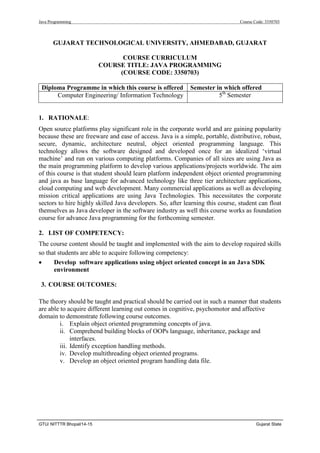
GUJARAT TECHNOLOGICAL UNIVERSITY, AHMEDABAD, GUJARAT
COURSE CURRICULUM
COURSE TITLE: JAVA PROGRAMMING
(COURSE CODE: 3350703)
Diploma Programme in which this course is offered Semester in which offered
Computer Engineering/ Information Technology 5th
Semester
1. RATIONALE:
Open source platforms play significant role in the corporate world and are gaining popularity
because these are freeware and ease of access. Java is a simple, portable, distributive, robust,
secure, dynamic, architecture neutral, object oriented programming language. This
technology allows the software designed and developed once for an idealized ‘virtual
machine’ and run on various computing platforms. Companies of all sizes are using Java as
the main programming platform to develop various applications/projects worldwide. The aim
of this course is that student should learn platform independent object oriented programming
and java as base language for advanced technology like three tier architecture applications,
cloud computing and web development. Many commercial applications as well as developing
mission critical applications are using Java Technologies. This necessitates the corporate
sectors to hire highly skilled Java developers. So, after learning this course, student can float
themselves as Java developer in the software industry as well this course works as foundation
course for advance Java programming for the forthcoming semester.
2. LIST OF COMPETENCY:
The course content should be taught and implemented with the aim to develop required skills
so that students are able to acquire following competency:
 Develop software applications using object oriented concept in an Java SDK
environment
3. COURSE OUTCOMES:
The theory should be taught and practical should be carried out in such a manner that students
are able to acquire different learning out comes in cognitive, psychomotor and affective
domain to demonstrate following course outcomes.
i. Explain object oriented programming concepts of java.
ii. Comprehend building blocks of OOPs language, inheritance, package and
interfaces.
iii. Identify exception handling methods.
iv. Develop multithreading object oriented programs.
v. Develop an object oriented program handling data file.
Java Programming Course Code: 3350703
GTU/ NITTTR Bhopal/14-15 Gujarat State
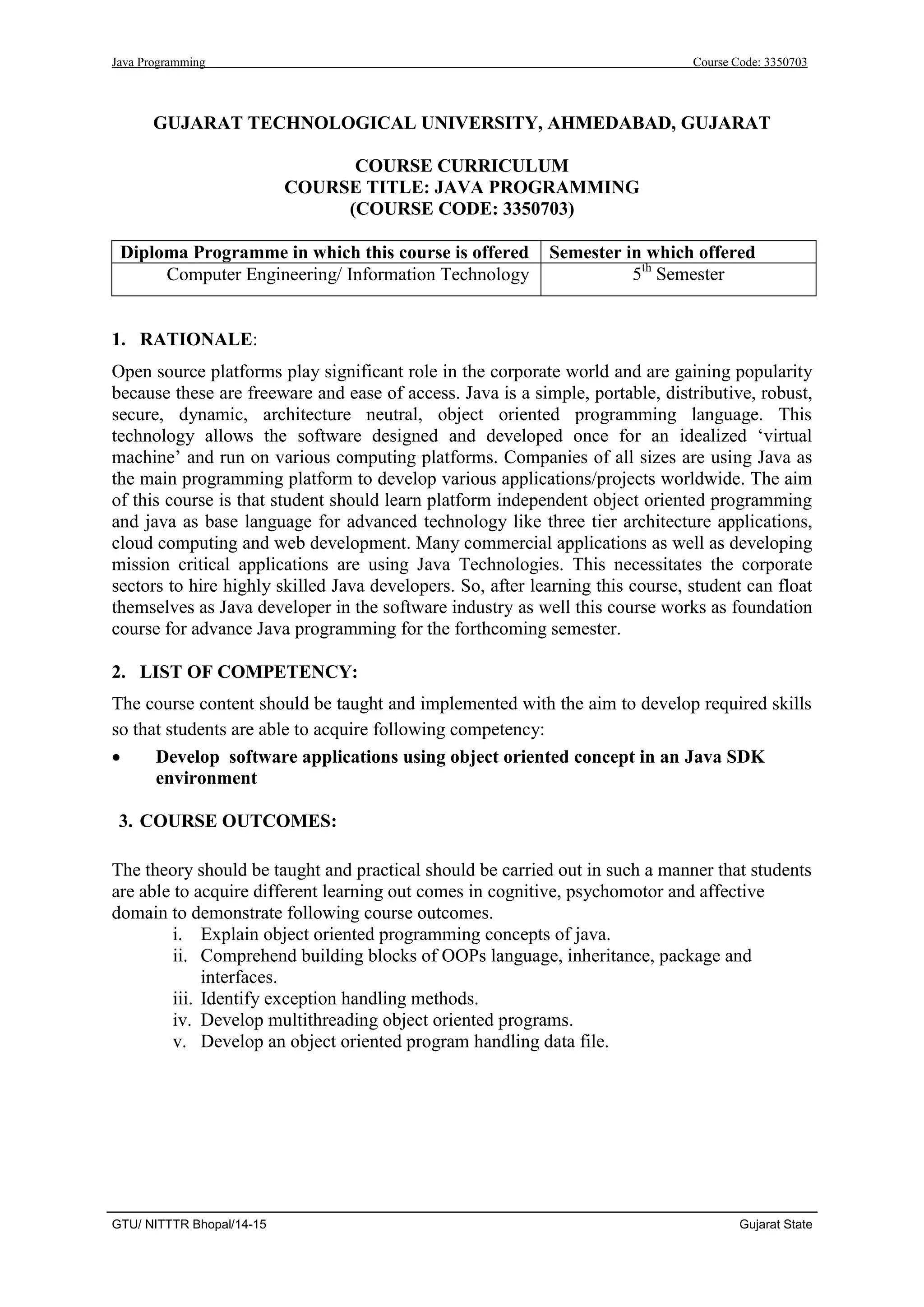
4. TEACHING AND EXAMINATION SCHEME
Teaching Scheme
(In Hours)
Total Credits
(L+T+P)
Examination Scheme
Theory Marks Practical Marks Total Marks
L T P C ESE PA ESE PA 200
3 0 4 7 70 30 40 60
Legends: L - Lecture; T - Tutorial/Teacher Guided Student Activity; P - Practical; C -
Credit; ESE - End Semester Examination; PA - Progressive Assessment
5. COURSE CONTENT DETAILS
Unit
Major Learning Outcomes
(in cognitive domain)
Topics and Sub-topics
Unit – I
Introduction to
Java
1a. Describe Internet role,
advantages and,
environment setup of
Java.
1.1 Basics of Java, Background/History of
Java, Java and the Internet, Advantages of
Java
1.2 Java Virtual Machine & Byte Code
1.3 Java Environment Setup
1.4 Java Program Structure
1b.Differentiate between
POP and OOP
1.5 Procedure-Oriented vs. Object-Oriented
Programming concept
1c. List important OOP
fundamentals
1.6 Basics of OOP: Abstraction, Inheritance,
Encapsulation, Classes, subclasses and super
classes, Polymorphism and Overloading,
message communication
1d. Write simple programs
using java
1.7 Compiling and running a simple "Hello
World" program: Setting Up Your Computer,
Writing a Program, Compiling, Interpreting
and Running the program, Common Errors
Unit – II
Building
Blocks of the
Language
2a. Explain Data types:
constant and variables
2.1 Primitive Data Types : Integers, Floating
Point type, Characters, Booleans etc
2.2 User Defined Data Type
2.3 Identifiers & Literals
2.4 Declarations of constants & variables
2.5 Type Conversion and Casting
2.6 Scope of variables & default values of
variables declared
2.7 Wrapper classes
2.8 Comment Syntax
2.9 Garbage Collection
2b. State the steps to
implement programs for
Arrays and String
Handling
2.10 Arrays of Primitive Data Types
2.11 Types of Arrays
2.12 Creation, concatenation and conversion
of a string, changing case of string,
character extraction, String
Java Programming Course Code: 3350703
GTU/ NITTTR Bhopal/14-15 Gujarat State
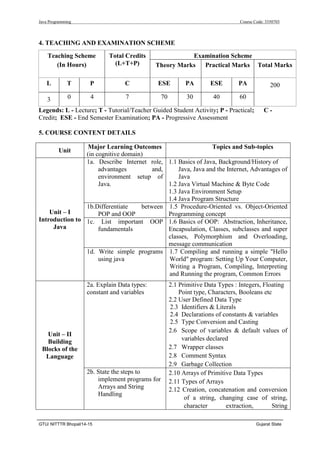
Comparison, String Buffer
2c. List different types of
operators
2.13 Different Operators: Arithmetic,
Bitwise, Rational, Logical,
Assignment, Conditional, Ternary,
Increment and Decrement,
Mathematical Functions
2d. State the steps to
implement small
programs using Decision
& Control Structures
2.14 Decision & Control Statements:
Selection Statement (if, if...else, switch),
Loops (while, do-while, for), Jump
statements (break, continue, return &
exit)
Unit – III
Object
Oriented
Programming
Concepts
3a.Define Objects and
Classes and methods
3.1 Defining classes, fields and methods,
creating objects, accessing rules, this
keyword, static keyword, method
overloading, final keyword,
3b.Explain Constructors &
its types, Object as a
parameter, constructor
overloading
3.2 Constructors: Default constructors,
Parameterized constructors, Copy
constructors, Passing object as a
parameter, constructor overloading
Unit– IV
Inheritance,
Packages &
Interfaces
4a. Describe Inheritance and
method overriding
4b. List the types of
Inheritance
4.1 Basics of Inheritance, Types of
inheritance: single, multiple, multilevel,
hierarchical and hybrid inheritance,
concepts of method overriding, extending
class, super class, subclass, dynamic
method dispatch & Object class
4c. Describe Creating
package, importing
package, access rules for
packages, class hiding
rules in a package
4d. Define interface.
4e. Explain inheritance on
interfaces, implementing
interface, multiple
inheritance using interface
4.2 Creating package, importing package,
access rules for packages, class hiding
rules in a package.
4.3 Defining interface, inheritance on
interfaces, implementing interface,
multiple inheritance using interface
4f.Describe Abstract & final
classes
4.4 Abstract class and final class
Unit – V
Exception
Handling &
Multithreaded
5a. Explain errors, &
exceptions
5b. List types of errors
5.1 Types of errors, exceptions, try..catch
statement, multiple catch blocks, throw
and throws keywords, finally clause, uses
of exceptions, user defined exceptions
Java Programming Course Code: 3350703
GTU/ NITTTR Bhopal/14-15 Gujarat State
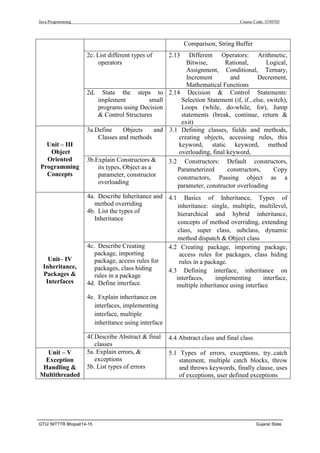
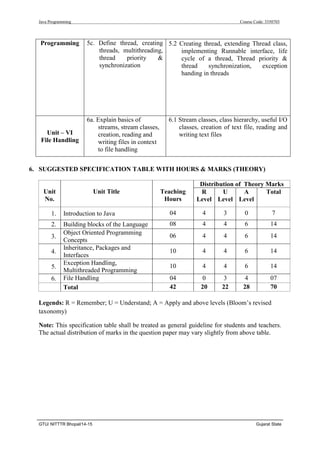
Programming 5c. Define thread, creating
threads, multithreading,
thread priority &
synchronization
5.2 Creating thread, extending Thread class,
implementing Runnable interface, life
cycle of a thread, Thread priority &
thread synchronization, exception
handing in threads
Unit – VI
File Handling
6a. Explain basics of
streams, stream classes,
creation, reading and
writing files in context
to file handling
6.1 Stream classes, class hierarchy, useful I/O
classes, creation of text file, reading and
writing text files
6. SUGGESTED SPECIFICATION TABLE WITH HOURS & MARKS (THEORY)
Unit
No.
Unit Title Teaching
Hours
Distribution of Theory Marks
R
Level
U
Level
A
Level
Total
1. Introduction to Java 04 4 3 0 7
2. Building blocks of the Language 08 4 4 6 14
3.
Object Oriented Programming
Concepts
06 4 4 6 14
4.
Inheritance, Packages and
Interfaces
10 4 4 6 14
5.
Exception Handling,
Multithreaded Programming
10 4 4 6 14
6. File Handling 04 0 3 4 07
Total 42 20 22 28 70
Legends: R = Remember; U = Understand; A = Apply and above levels (Bloom’s revised
taxonomy)
Note: This specification table shall be treated as general guideline for students and teachers.
The actual distribution of marks in the question paper may vary slightly from above table.
Java Programming Course Code: 3350703
GTU/ NITTTR Bhopal/14-15 Gujarat State
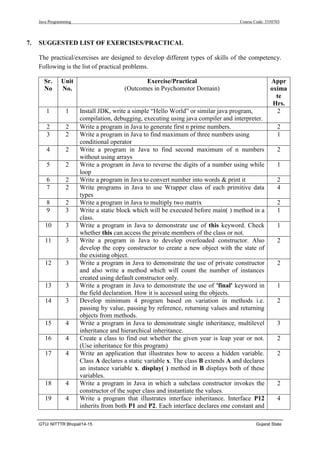
7. SUGGESTED LIST OF EXERCISES/PRACTICAL
The practical/exercises are designed to develop different types of skills of the competency.
Following is the list of practical problems.
Sr.
No
Unit
No.
Exercise/Practical
(Outcomes in Psychomotor Domain)
Appr
oxima
te
Hrs.
1 1 Install JDK, write a simple “Hello World” or similar java program,
compilation, debugging, executing using java compiler and interpreter.
2
2 2 Write a program in Java to generate first n prime numbers. 2
3 2 Write a program in Java to find maximum of three numbers using
conditional operator
1
4 2 Write a program in Java to find second maximum of n numbers
without using arrays
2
5 2 Write a program in Java to reverse the digits of a number using while
loop
1
6 2 Write a program in Java to convert number into words & print it 2
7 2 Write programs in Java to use Wrapper class of each primitive data
types
4
8 2 Write a program in Java to multiply two matrix 2
9 3 Write a static block which will be executed before main( ) method in a
class.
1
10 3 Write a program in Java to demonstrate use of this keyword. Check
whether this can access the private members of the class or not.
1
11 3 Write a program in Java to develop overloaded constructor. Also
develop the copy constructor to create a new object with the state of
the existing object.
2
12 3 Write a program in Java to demonstrate the use of private constructor
and also write a method which will count the number of instances
created using default constructor only.
2
13 3 Write a program in Java to demonstrate the use of 'final' keyword in
the field declaration. How it is accessed using the objects.
1
14 3 Develop minimum 4 program based on variation in methods i.e.
passing by value, passing by reference, returning values and returning
objects from methods.
2
15 4 Write a program in Java to demonstrate single inheritance, multilevel
inheritance and hierarchical inheritance.
3
16 4 Create a class to find out whether the given year is leap year or not.
(Use inheritance for this program)
2
17 4 Write an application that illustrates how to access a hidden variable.
Class A declares a static variable x. The class B extends A and declares
an instance variable x. display( ) method in B displays both of these
variables.
2
18 4 Write a program in Java in which a subclass constructor invokes the
constructor of the super class and instantiate the values.
2
19 4 Write a program that illustrates interface inheritance. Interface P12
inherits from both P1 and P2. Each interface declares one constant and
4
Java Programming Course Code: 3350703
GTU/ NITTTR Bhopal/14-15 Gujarat State
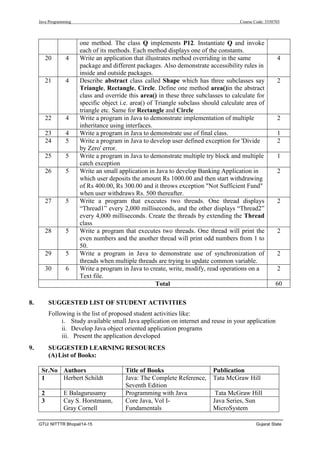
one method. The class Q implements P12. Instantiate Q and invoke
each of its methods. Each method displays one of the constants.
20 4 Write an application that illustrates method overriding in the same
package and different packages. Also demonstrate accessibility rules in
inside and outside packages.
4
21 4 Describe abstract class called Shape which has three subclasses say
Triangle, Rectangle, Circle. Define one method area()in the abstract
class and override this area() in these three subclasses to calculate for
specific object i.e. area() of Triangle subclass should calculate area of
triangle etc. Same for Rectangle and Circle
2
22 4 Write a program in Java to demonstrate implementation of multiple
inheritance using interfaces.
2
23 4 Write a program in Java to demonstrate use of final class. 1
24 5 Write a program in Java to develop user defined exception for 'Divide
by Zero' error.
2
25 5 Write a program in Java to demonstrate multiple try block and multiple
catch exception
1
26 5 Write an small application in Java to develop Banking Application in
which user deposits the amount Rs 1000.00 and then start withdrawing
of Rs 400.00, Rs 300.00 and it throws exception "Not Sufficient Fund"
when user withdraws Rs. 500 thereafter.
2
27 5 Write a program that executes two threads. One thread displays
“Thread1” every 2,000 milliseconds, and the other displays “Thread2”
every 4,000 milliseconds. Create the threads by extending the Thread
class
2
28 5 Write a program that executes two threads. One thread will print the
even numbers and the another thread will print odd numbers from 1 to
50.
2
29 5 Write a program in Java to demonstrate use of synchronization of
threads when multiple threads are trying to update common variable.
2
30 6 Write a program in Java to create, write, modify, read operations on a
Text file.
2
Total 60
8. SUGGESTED LIST OF STUDENT ACTIVITIES
Following is the list of proposed student activities like:
i. Study available small Java application on internet and reuse in your application
ii. Develop Java object oriented application programs
iii. Present the application developed
9. SUGGESTED LEARNING RESOURCES
(A)List of Books:
Sr.No Authors Title of Books Publication
1 Herbert Schildt Java: The Complete Reference,
Seventh Edition
Tata McGraw Hill
2 E Balagurusamy Programming with Java Tata McGraw Hill
3 Cay S. Horstmann,
Gray Cornell
Core Java, Vol I-
Fundamentals
Java Series, Sun
MicroSystem
Java Programming Course Code: 3350703
GTU/ NITTTR Bhopal/14-15 Gujarat State
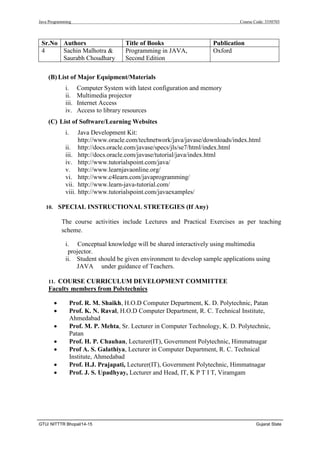
Sr.No Authors Title of Books Publication
4 Sachin Malhotra &
Saurabh Choudhary
Programming in JAVA,
Second Edition
Oxford
(B) List of Major Equipment/Materials
i. Computer System with latest configuration and memory
ii. Multimedia projector
iii. Internet Access
iv. Access to library resources
(C) List of Software/Learning Websites
i. Java Development Kit:
http://www.oracle.com/technetwork/java/javase/downloads/index.html
ii. http://docs.oracle.com/javase/specs/jls/se7/html/index.html
iii. http://docs.oracle.com/javase/tutorial/java/index.html
iv. http://www.tutorialspoint.com/java/
v. http://www.learnjavaonline.org/
vi. http://www.c4learn.com/javaprogramming/
vii. http://www.learn-java-tutorial.com/
viii. http://www.tutorialspoint.com/javaexamples/
10. SPECIAL INSTRUCTIONAL STRETEGIES (If Any)
The course activities include Lectures and Practical Exercises as per teaching
scheme.
i. Conceptual knowledge will be shared interactively using multimedia
projector.
ii. Student should be given environment to develop sample applications using
JAVA under guidance of Teachers.
11. COURSE CURRICULUM DEVELOPMENT COMMITTEE
Faculty members from Polytechnics
 Prof. R. M. Shaikh, H.O.D Computer Department, K. D. Polytechnic, Patan
 Prof. K. N. Raval, H.O.D Computer Department, R. C. Technical Institute,
Ahmedabad
 Prof. M. P. Mehta, Sr. Lecturer in Computer Technology, K. D. Polytechnic,
Patan
 Prof. H. P. Chauhan, Lecturer(IT), Government Polytechnic, Himmatnagar
 Prof A. S. Galathiya, Lecturer in Computer Department, R. C. Technical
Institute, Ahmedabad
 Prof. H.J. Prajapati, Lecturer(IT), Government Polytechnic, Himmatnagar
 Prof. J. S. Upadhyay, Lecturer and Head, IT, K P T I T, Viramgam
Java Programming Course Code: 3350703
GTU/ NITTTR Bhopal/14-15 Gujarat State
Coordinator and Faculty Members from NITTTR Bhopal
 Dr. Shailendra Singh, Professor & Head, Dept. of Computer Engineering and
Applications.
 Dr. James K. Mathai, Associate Professor, Dept. of Computer Engineering
and Applications.

3350703

  • 1.
    Java Programming CourseCode: 3350703 GTU/ NITTTR Bhopal/14-15 Gujarat State GUJARAT TECHNOLOGICAL UNIVERSITY, AHMEDABAD, GUJARAT COURSE CURRICULUM COURSE TITLE: JAVA PROGRAMMING (COURSE CODE: 3350703) Diploma Programme in which this course is offered Semester in which offered Computer Engineering/ Information Technology 5th Semester 1. RATIONALE: Open source platforms play significant role in the corporate world and are gaining popularity because these are freeware and ease of access. Java is a simple, portable, distributive, robust, secure, dynamic, architecture neutral, object oriented programming language. This technology allows the software designed and developed once for an idealized ‘virtual machine’ and run on various computing platforms. Companies of all sizes are using Java as the main programming platform to develop various applications/projects worldwide. The aim of this course is that student should learn platform independent object oriented programming and java as base language for advanced technology like three tier architecture applications, cloud computing and web development. Many commercial applications as well as developing mission critical applications are using Java Technologies. This necessitates the corporate sectors to hire highly skilled Java developers. So, after learning this course, student can float themselves as Java developer in the software industry as well this course works as foundation course for advance Java programming for the forthcoming semester. 2. LIST OF COMPETENCY: The course content should be taught and implemented with the aim to develop required skills so that students are able to acquire following competency:  Develop software applications using object oriented concept in an Java SDK environment 3. COURSE OUTCOMES: The theory should be taught and practical should be carried out in such a manner that students are able to acquire different learning out comes in cognitive, psychomotor and affective domain to demonstrate following course outcomes. i. Explain object oriented programming concepts of java. ii. Comprehend building blocks of OOPs language, inheritance, package and interfaces. iii. Identify exception handling methods. iv. Develop multithreading object oriented programs. v. Develop an object oriented program handling data file.
  • 2.
    Java Programming CourseCode: 3350703 GTU/ NITTTR Bhopal/14-15 Gujarat State 4. TEACHING AND EXAMINATION SCHEME Teaching Scheme (In Hours) Total Credits (L+T+P) Examination Scheme Theory Marks Practical Marks Total Marks L T P C ESE PA ESE PA 200 3 0 4 7 70 30 40 60 Legends: L - Lecture; T - Tutorial/Teacher Guided Student Activity; P - Practical; C - Credit; ESE - End Semester Examination; PA - Progressive Assessment 5. COURSE CONTENT DETAILS Unit Major Learning Outcomes (in cognitive domain) Topics and Sub-topics Unit – I Introduction to Java 1a. Describe Internet role, advantages and, environment setup of Java. 1.1 Basics of Java, Background/History of Java, Java and the Internet, Advantages of Java 1.2 Java Virtual Machine & Byte Code 1.3 Java Environment Setup 1.4 Java Program Structure 1b.Differentiate between POP and OOP 1.5 Procedure-Oriented vs. Object-Oriented Programming concept 1c. List important OOP fundamentals 1.6 Basics of OOP: Abstraction, Inheritance, Encapsulation, Classes, subclasses and super classes, Polymorphism and Overloading, message communication 1d. Write simple programs using java 1.7 Compiling and running a simple "Hello World" program: Setting Up Your Computer, Writing a Program, Compiling, Interpreting and Running the program, Common Errors Unit – II Building Blocks of the Language 2a. Explain Data types: constant and variables 2.1 Primitive Data Types : Integers, Floating Point type, Characters, Booleans etc 2.2 User Defined Data Type 2.3 Identifiers & Literals 2.4 Declarations of constants & variables 2.5 Type Conversion and Casting 2.6 Scope of variables & default values of variables declared 2.7 Wrapper classes 2.8 Comment Syntax 2.9 Garbage Collection 2b. State the steps to implement programs for Arrays and String Handling 2.10 Arrays of Primitive Data Types 2.11 Types of Arrays 2.12 Creation, concatenation and conversion of a string, changing case of string, character extraction, String
  • 3.
    Java Programming CourseCode: 3350703 GTU/ NITTTR Bhopal/14-15 Gujarat State Comparison, String Buffer 2c. List different types of operators 2.13 Different Operators: Arithmetic, Bitwise, Rational, Logical, Assignment, Conditional, Ternary, Increment and Decrement, Mathematical Functions 2d. State the steps to implement small programs using Decision & Control Structures 2.14 Decision & Control Statements: Selection Statement (if, if...else, switch), Loops (while, do-while, for), Jump statements (break, continue, return & exit) Unit – III Object Oriented Programming Concepts 3a.Define Objects and Classes and methods 3.1 Defining classes, fields and methods, creating objects, accessing rules, this keyword, static keyword, method overloading, final keyword, 3b.Explain Constructors & its types, Object as a parameter, constructor overloading 3.2 Constructors: Default constructors, Parameterized constructors, Copy constructors, Passing object as a parameter, constructor overloading Unit– IV Inheritance, Packages & Interfaces 4a. Describe Inheritance and method overriding 4b. List the types of Inheritance 4.1 Basics of Inheritance, Types of inheritance: single, multiple, multilevel, hierarchical and hybrid inheritance, concepts of method overriding, extending class, super class, subclass, dynamic method dispatch & Object class 4c. Describe Creating package, importing package, access rules for packages, class hiding rules in a package 4d. Define interface. 4e. Explain inheritance on interfaces, implementing interface, multiple inheritance using interface 4.2 Creating package, importing package, access rules for packages, class hiding rules in a package. 4.3 Defining interface, inheritance on interfaces, implementing interface, multiple inheritance using interface 4f.Describe Abstract & final classes 4.4 Abstract class and final class Unit – V Exception Handling & Multithreaded 5a. Explain errors, & exceptions 5b. List types of errors 5.1 Types of errors, exceptions, try..catch statement, multiple catch blocks, throw and throws keywords, finally clause, uses of exceptions, user defined exceptions
  • 4.
    Java Programming CourseCode: 3350703 GTU/ NITTTR Bhopal/14-15 Gujarat State Programming 5c. Define thread, creating threads, multithreading, thread priority & synchronization 5.2 Creating thread, extending Thread class, implementing Runnable interface, life cycle of a thread, Thread priority & thread synchronization, exception handing in threads Unit – VI File Handling 6a. Explain basics of streams, stream classes, creation, reading and writing files in context to file handling 6.1 Stream classes, class hierarchy, useful I/O classes, creation of text file, reading and writing text files 6. SUGGESTED SPECIFICATION TABLE WITH HOURS & MARKS (THEORY) Unit No. Unit Title Teaching Hours Distribution of Theory Marks R Level U Level A Level Total 1. Introduction to Java 04 4 3 0 7 2. Building blocks of the Language 08 4 4 6 14 3. Object Oriented Programming Concepts 06 4 4 6 14 4. Inheritance, Packages and Interfaces 10 4 4 6 14 5. Exception Handling, Multithreaded Programming 10 4 4 6 14 6. File Handling 04 0 3 4 07 Total 42 20 22 28 70 Legends: R = Remember; U = Understand; A = Apply and above levels (Bloom’s revised taxonomy) Note: This specification table shall be treated as general guideline for students and teachers. The actual distribution of marks in the question paper may vary slightly from above table.
  • 5.
    Java Programming CourseCode: 3350703 GTU/ NITTTR Bhopal/14-15 Gujarat State 7. SUGGESTED LIST OF EXERCISES/PRACTICAL The practical/exercises are designed to develop different types of skills of the competency. Following is the list of practical problems. Sr. No Unit No. Exercise/Practical (Outcomes in Psychomotor Domain) Appr oxima te Hrs. 1 1 Install JDK, write a simple “Hello World” or similar java program, compilation, debugging, executing using java compiler and interpreter. 2 2 2 Write a program in Java to generate first n prime numbers. 2 3 2 Write a program in Java to find maximum of three numbers using conditional operator 1 4 2 Write a program in Java to find second maximum of n numbers without using arrays 2 5 2 Write a program in Java to reverse the digits of a number using while loop 1 6 2 Write a program in Java to convert number into words & print it 2 7 2 Write programs in Java to use Wrapper class of each primitive data types 4 8 2 Write a program in Java to multiply two matrix 2 9 3 Write a static block which will be executed before main( ) method in a class. 1 10 3 Write a program in Java to demonstrate use of this keyword. Check whether this can access the private members of the class or not. 1 11 3 Write a program in Java to develop overloaded constructor. Also develop the copy constructor to create a new object with the state of the existing object. 2 12 3 Write a program in Java to demonstrate the use of private constructor and also write a method which will count the number of instances created using default constructor only. 2 13 3 Write a program in Java to demonstrate the use of 'final' keyword in the field declaration. How it is accessed using the objects. 1 14 3 Develop minimum 4 program based on variation in methods i.e. passing by value, passing by reference, returning values and returning objects from methods. 2 15 4 Write a program in Java to demonstrate single inheritance, multilevel inheritance and hierarchical inheritance. 3 16 4 Create a class to find out whether the given year is leap year or not. (Use inheritance for this program) 2 17 4 Write an application that illustrates how to access a hidden variable. Class A declares a static variable x. The class B extends A and declares an instance variable x. display( ) method in B displays both of these variables. 2 18 4 Write a program in Java in which a subclass constructor invokes the constructor of the super class and instantiate the values. 2 19 4 Write a program that illustrates interface inheritance. Interface P12 inherits from both P1 and P2. Each interface declares one constant and 4
  • 6.
    Java Programming CourseCode: 3350703 GTU/ NITTTR Bhopal/14-15 Gujarat State one method. The class Q implements P12. Instantiate Q and invoke each of its methods. Each method displays one of the constants. 20 4 Write an application that illustrates method overriding in the same package and different packages. Also demonstrate accessibility rules in inside and outside packages. 4 21 4 Describe abstract class called Shape which has three subclasses say Triangle, Rectangle, Circle. Define one method area()in the abstract class and override this area() in these three subclasses to calculate for specific object i.e. area() of Triangle subclass should calculate area of triangle etc. Same for Rectangle and Circle 2 22 4 Write a program in Java to demonstrate implementation of multiple inheritance using interfaces. 2 23 4 Write a program in Java to demonstrate use of final class. 1 24 5 Write a program in Java to develop user defined exception for 'Divide by Zero' error. 2 25 5 Write a program in Java to demonstrate multiple try block and multiple catch exception 1 26 5 Write an small application in Java to develop Banking Application in which user deposits the amount Rs 1000.00 and then start withdrawing of Rs 400.00, Rs 300.00 and it throws exception "Not Sufficient Fund" when user withdraws Rs. 500 thereafter. 2 27 5 Write a program that executes two threads. One thread displays “Thread1” every 2,000 milliseconds, and the other displays “Thread2” every 4,000 milliseconds. Create the threads by extending the Thread class 2 28 5 Write a program that executes two threads. One thread will print the even numbers and the another thread will print odd numbers from 1 to 50. 2 29 5 Write a program in Java to demonstrate use of synchronization of threads when multiple threads are trying to update common variable. 2 30 6 Write a program in Java to create, write, modify, read operations on a Text file. 2 Total 60 8. SUGGESTED LIST OF STUDENT ACTIVITIES Following is the list of proposed student activities like: i. Study available small Java application on internet and reuse in your application ii. Develop Java object oriented application programs iii. Present the application developed 9. SUGGESTED LEARNING RESOURCES (A)List of Books: Sr.No Authors Title of Books Publication 1 Herbert Schildt Java: The Complete Reference, Seventh Edition Tata McGraw Hill 2 E Balagurusamy Programming with Java Tata McGraw Hill 3 Cay S. Horstmann, Gray Cornell Core Java, Vol I- Fundamentals Java Series, Sun MicroSystem
  • 7.
    Java Programming CourseCode: 3350703 GTU/ NITTTR Bhopal/14-15 Gujarat State Sr.No Authors Title of Books Publication 4 Sachin Malhotra & Saurabh Choudhary Programming in JAVA, Second Edition Oxford (B) List of Major Equipment/Materials i. Computer System with latest configuration and memory ii. Multimedia projector iii. Internet Access iv. Access to library resources (C) List of Software/Learning Websites i. Java Development Kit: http://www.oracle.com/technetwork/java/javase/downloads/index.html ii. http://docs.oracle.com/javase/specs/jls/se7/html/index.html iii. http://docs.oracle.com/javase/tutorial/java/index.html iv. http://www.tutorialspoint.com/java/ v. http://www.learnjavaonline.org/ vi. http://www.c4learn.com/javaprogramming/ vii. http://www.learn-java-tutorial.com/ viii. http://www.tutorialspoint.com/javaexamples/ 10. SPECIAL INSTRUCTIONAL STRETEGIES (If Any) The course activities include Lectures and Practical Exercises as per teaching scheme. i. Conceptual knowledge will be shared interactively using multimedia projector. ii. Student should be given environment to develop sample applications using JAVA under guidance of Teachers. 11. COURSE CURRICULUM DEVELOPMENT COMMITTEE Faculty members from Polytechnics  Prof. R. M. Shaikh, H.O.D Computer Department, K. D. Polytechnic, Patan  Prof. K. N. Raval, H.O.D Computer Department, R. C. Technical Institute, Ahmedabad  Prof. M. P. Mehta, Sr. Lecturer in Computer Technology, K. D. Polytechnic, Patan  Prof. H. P. Chauhan, Lecturer(IT), Government Polytechnic, Himmatnagar  Prof A. S. Galathiya, Lecturer in Computer Department, R. C. Technical Institute, Ahmedabad  Prof. H.J. Prajapati, Lecturer(IT), Government Polytechnic, Himmatnagar  Prof. J. S. Upadhyay, Lecturer and Head, IT, K P T I T, Viramgam
  • 8.
    Java Programming CourseCode: 3350703 GTU/ NITTTR Bhopal/14-15 Gujarat State Coordinator and Faculty Members from NITTTR Bhopal  Dr. Shailendra Singh, Professor & Head, Dept. of Computer Engineering and Applications.  Dr. James K. Mathai, Associate Professor, Dept. of Computer Engineering and Applications.