Federal District Court
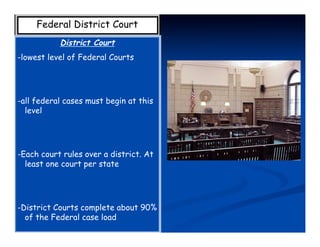
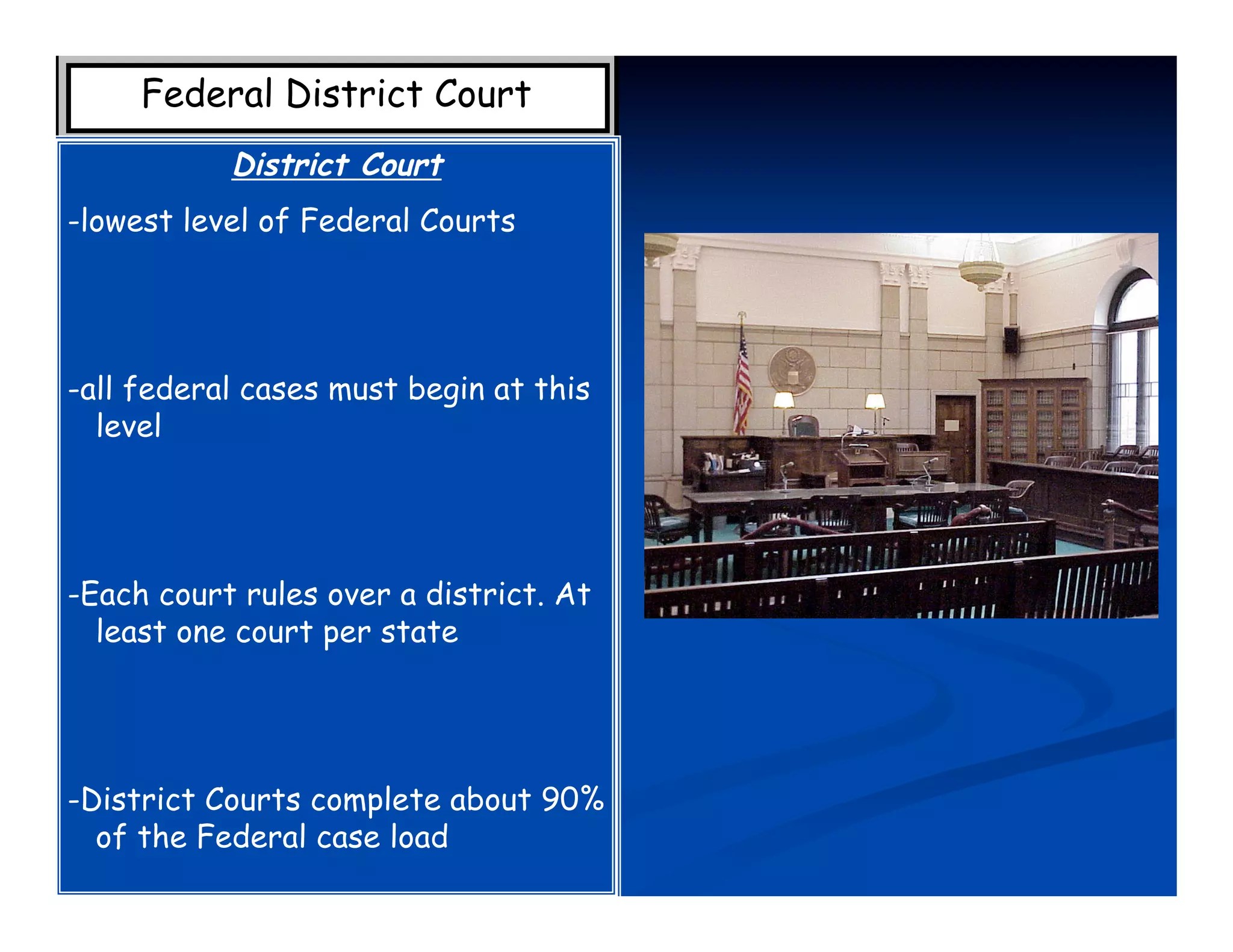
           District Court
-lowest level of Federal Courts


-all federal cases must begin at this
  level


-Each court rules over a district. At
  least one court per state


-District Courts complete about 90%
  of the Federal case load
Federal District Court

           Court’s Purpose
-District Courts handle cases that
  fall under Federal jurisdiction


-District Courts use a jury trial to
  decide guilt or innocence


-Judges are to interpret the law and
  determine punishments
Federal District Court
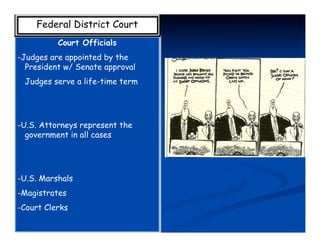
          Court Officials
-Judges are appointed by the
  President w/ Senate approval
 Judges serve a life-time term


-U.S. Attorneys represent the
  government in all cases


-U.S. Marshals
-Magistrates
-Court Clerks
Federal Appeals Court
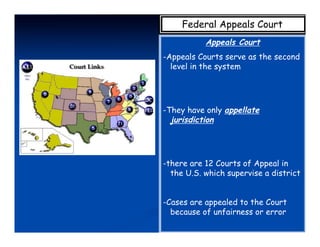
           Appeals Court
-Appeals Courts serve as the second
  level in the system


-They have only appellate
  jurisdiction


-there are 12 Courts of Appeal in
  the U.S. which supervise a district


-Cases are appealed to the Court
  because of unfairness or error
Federal Appeals Court
          Court Procedures
-No juries are used in Appeals Courts


-No determination is made on guilt or
  innocence


-Only decision is whether a fair trial
  was given


-Written Briefs of the unfair ruling or
  trial error are prepared and oral
  arguments are presented before the
  court


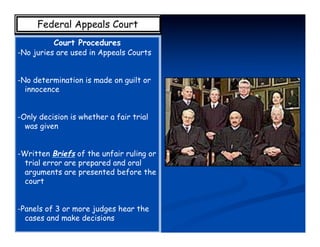
-Panels of 3 or more judges hear the
  cases and make decisions
Federal Appeals Court
            Court Rulings
-Appeals Courts can make three
  decisions in a case


-Uphold
 confirm the previous court’s
 decision


-Overturn
 -reverse the previous court’s
 decision


-Remand
 -send the case back down to a
 lower court for retrial

33 lower federal courts

  • 1.
    Federal District Court District Court -lowest level of Federal Courts -all federal cases must begin at this level -Each court rules over a district. At least one court per state -District Courts complete about 90% of the Federal case load
  • 2.
    Federal District Court Court’s Purpose -District Courts handle cases that fall under Federal jurisdiction -District Courts use a jury trial to decide guilt or innocence -Judges are to interpret the law and determine punishments
  • 3.
    Federal District Court Court Officials -Judges are appointed by the President w/ Senate approval Judges serve a life-time term -U.S. Attorneys represent the government in all cases -U.S. Marshals -Magistrates -Court Clerks
  • 4.
    Federal Appeals Court Appeals Court -Appeals Courts serve as the second level in the system -They have only appellate jurisdiction -there are 12 Courts of Appeal in the U.S. which supervise a district -Cases are appealed to the Court because of unfairness or error
  • 5.
    Federal Appeals Court Court Procedures -No juries are used in Appeals Courts -No determination is made on guilt or innocence -Only decision is whether a fair trial was given -Written Briefs of the unfair ruling or trial error are prepared and oral arguments are presented before the court -Panels of 3 or more judges hear the cases and make decisions
  • 6.
    Federal Appeals Court Court Rulings -Appeals Courts can make three decisions in a case -Uphold confirm the previous court’s decision -Overturn -reverse the previous court’s decision -Remand -send the case back down to a lower court for retrial