ICT Integration
in Teaching and
Learning
Presented by:
MELODY M. VALLENTE
Why do we need
Technology Integration?
• Technology is revolutionizing the way we
think, work, and play.
• Technology enables teachers to provide
multiple representations of content and
multiple options for expression
Why do we need
Technology Integration?
• Computer technology changes
traditional classroom instructional
techniques.
• Computers enable students to
process the information via
multiple intelligences.
• Technology helps change the
student/teacher roles and relationships.
• Technology cannot teach; only teachers
can teach.
• Technology can enhance the teaching-
learning process.
What is Technology integration?
• Technology integration is
the use of technology
resources in daily
classroom practices.
How to use Information
Technologies effectively ?
• Using computer-based services
• Using a variety of media to
retrieve information.
• Decoding information in variety of
forms
Instructional I T
• Improved /expanded faculty-
student communications
• Improved instructional logistics and
communications
Instructional I T
• Expanded and improved
classrooms and laboratory
instructional methods
• Use of alternate learning delivery
mechanisms
Instructional I T
• Faculty IT access to electronic
material
• Wired classrooms with audio/visual
equipment and computer projection
and instructional laboratories.
Attributes of Computer-based
Technology
• Multi-sensory delivery: Text, graphics,
animation, sound and video.
• Active learning: enhanced learner
interest.
• Co-operative learning: positive
group/social interaction.
Attributes of Computer-based
Technology
• Communication Skills: one-to-one, one-
to-many, many-to-many.
• Multicultural education: link students
from across the country/around the
world.
• Motivation: greater learner engagement
Challenges to Educators
• The teachers have to learn how to use the
variety of ICT applications;
• The teachers have to use, adapt and
design ICT-enhanced curricula;
• They have to expand the content area of
knowledge;
• They have to take new roles; and
• They have to respond to individual
students
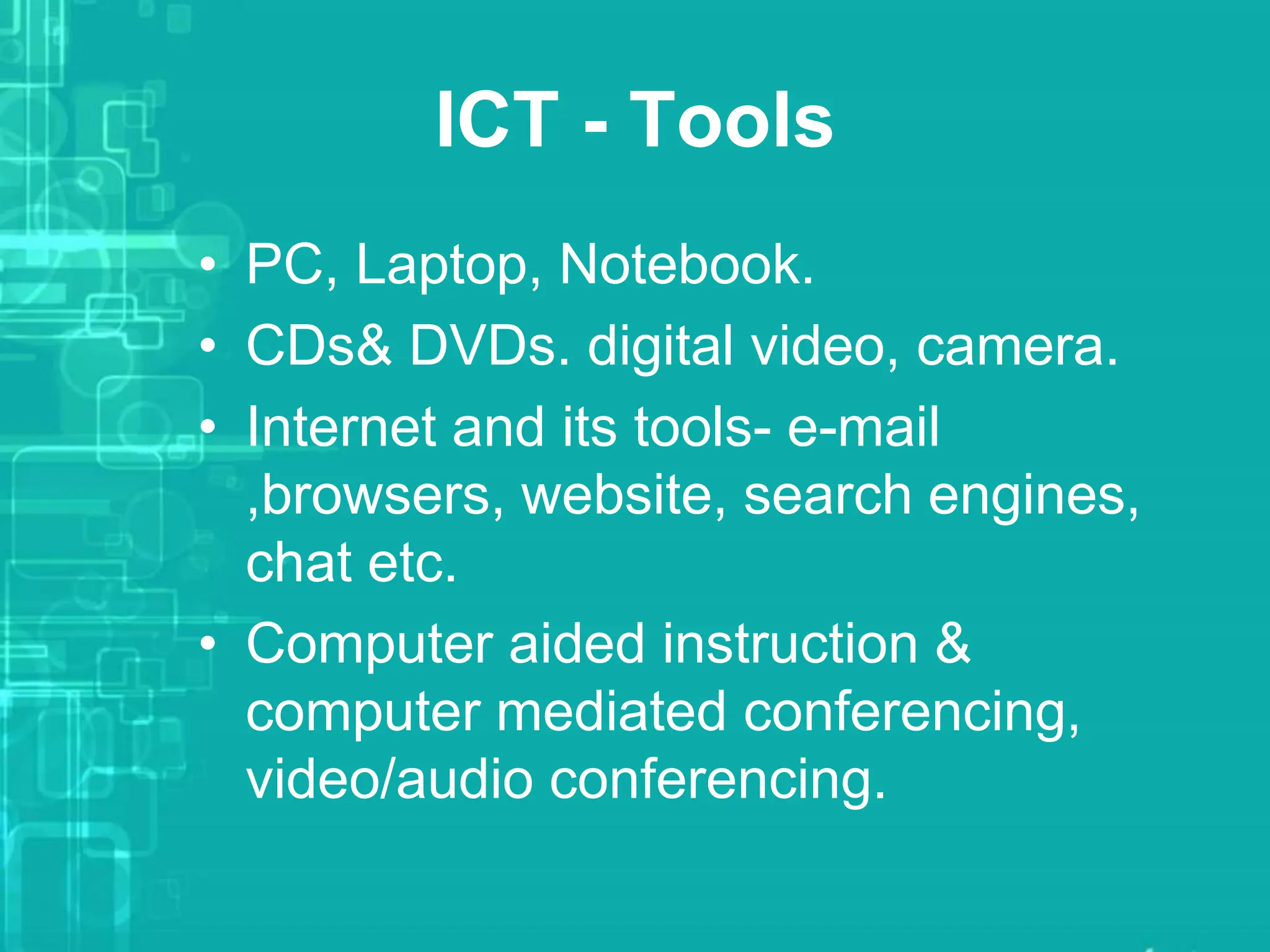
ICT - Tools
• PC, Laptop, Notebook.
• CDs& DVDs. digital video, camera.
• Internet and its tools- e-mail
,browsers, website, search engines,
chat etc.
• Computer aided instruction &
computer mediated conferencing,
video/audio conferencing.
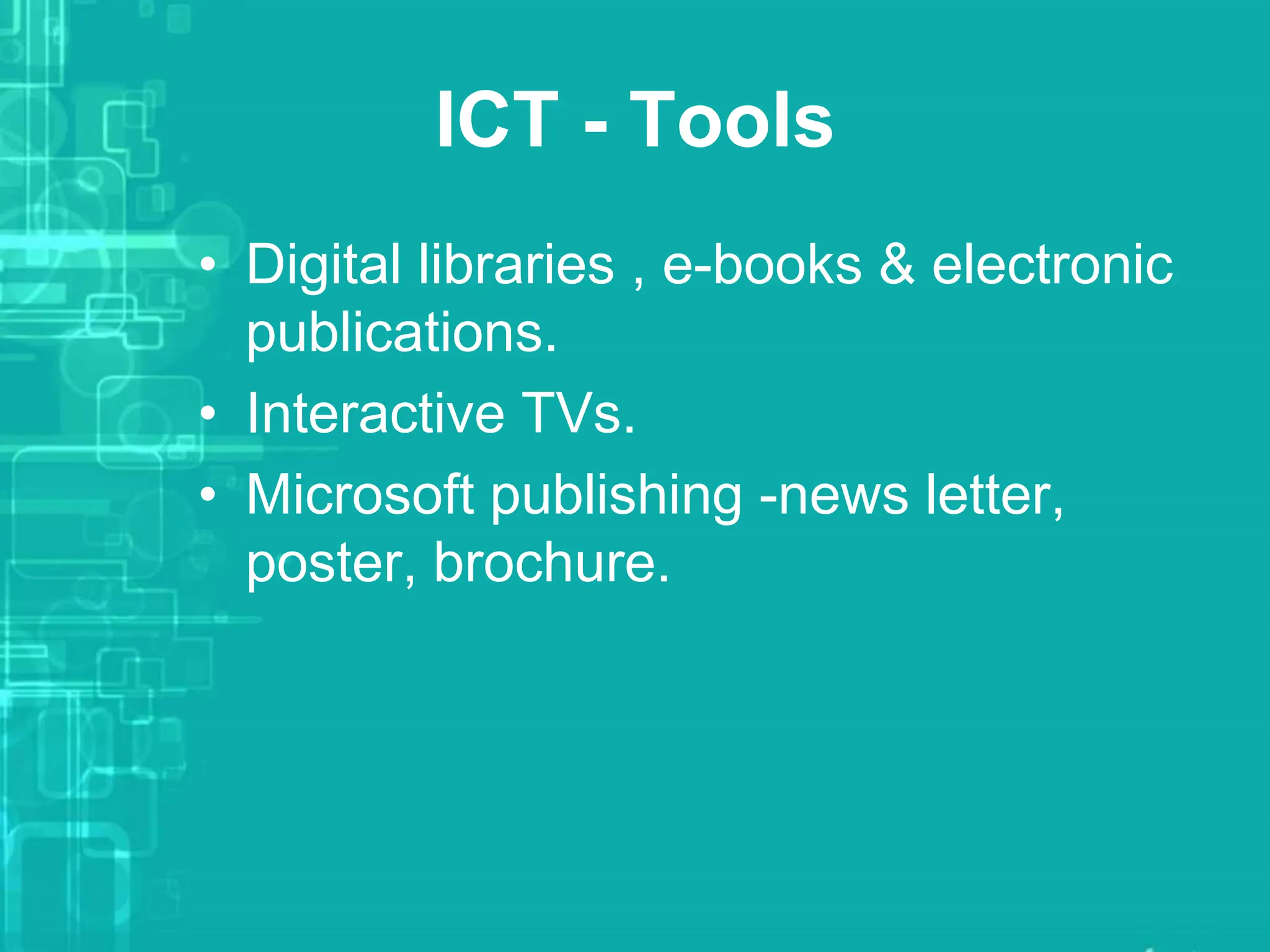
ICT - Tools
• Digital libraries , e-books & electronic
publications.
• Interactive TVs.
• Microsoft publishing -news letter,
poster, brochure.
• “Technology will not have a
significant impact on student
learning until teachers change the
way they teach.”
Larry Cuban, 1986
Food for thought
• “ Any technology which increase
the rate of learning would enable
the teacher to teach less and the
learner to learn more”
•
329075385-Ict-Integration-in-Teaching-and-Learning.ppt

329075385-Ict-Integration-in-Teaching-and-Learning.ppt

  • 1.
    ICT Integration in Teachingand Learning Presented by: MELODY M. VALLENTE
  • 2.
    Why do weneed Technology Integration? • Technology is revolutionizing the way we think, work, and play. • Technology enables teachers to provide multiple representations of content and multiple options for expression
  • 3.
    Why do weneed Technology Integration? • Computer technology changes traditional classroom instructional techniques. • Computers enable students to process the information via multiple intelligences.
  • 4.
    • Technology helpschange the student/teacher roles and relationships. • Technology cannot teach; only teachers can teach. • Technology can enhance the teaching- learning process.
  • 5.
    What is Technologyintegration? • Technology integration is the use of technology resources in daily classroom practices.
  • 6.
    How to useInformation Technologies effectively ? • Using computer-based services • Using a variety of media to retrieve information. • Decoding information in variety of forms
  • 7.
    Instructional I T •Improved /expanded faculty- student communications • Improved instructional logistics and communications
  • 8.
    Instructional I T •Expanded and improved classrooms and laboratory instructional methods • Use of alternate learning delivery mechanisms
  • 9.
    Instructional I T •Faculty IT access to electronic material • Wired classrooms with audio/visual equipment and computer projection and instructional laboratories.
  • 10.
    Attributes of Computer-based Technology •Multi-sensory delivery: Text, graphics, animation, sound and video. • Active learning: enhanced learner interest. • Co-operative learning: positive group/social interaction.
  • 11.
    Attributes of Computer-based Technology •Communication Skills: one-to-one, one- to-many, many-to-many. • Multicultural education: link students from across the country/around the world. • Motivation: greater learner engagement
  • 12.
    Challenges to Educators •The teachers have to learn how to use the variety of ICT applications; • The teachers have to use, adapt and design ICT-enhanced curricula; • They have to expand the content area of knowledge; • They have to take new roles; and • They have to respond to individual students
  • 13.
    ICT - Tools •PC, Laptop, Notebook. • CDs& DVDs. digital video, camera. • Internet and its tools- e-mail ,browsers, website, search engines, chat etc. • Computer aided instruction & computer mediated conferencing, video/audio conferencing.
  • 14.
    ICT - Tools •Digital libraries , e-books & electronic publications. • Interactive TVs. • Microsoft publishing -news letter, poster, brochure.
  • 15.
    • “Technology willnot have a significant impact on student learning until teachers change the way they teach.” Larry Cuban, 1986
  • 16.
    Food for thought •“ Any technology which increase the rate of learning would enable the teacher to teach less and the learner to learn more” •

Editor's Notes

  • #3 (images, graphs, diagrams, tables) and multiple options for expression ( multimedia, power point).
  • #6 -- computers, Internet, e-mail, digital cameras, CD-ROMs, software applications, electronic publications, etc. --
  • #7 Using computer-based services to search for and find relevant information in a range of contexts. using a variety of media to retrieve information. Decoding information in variety of forms- written, statistical and graphic.
  • #8 1.Improved /expanded faculty- student communications-e.g e-mail, on-line chatrooms, virtual class hours. 2.Improved instructional logistics and communications-e.g. e-syllabus, on-line submission of assignment, on-line testing
  • #9 3.Expanded and improved classrooms and laboratory instructional methods- e.g. simulations ,visualization applications. 4.Use of alternate learning delivery mechanisms- e.g. satellite, video, cable, internet
  • #10 5.Faculty IT access to electronic material-e.g. digital library, multimedia 6.The IT infrastructure needed to support the above uses-e.g. www, file servers, news servers, courseware acquisition and distribution. Wired classrooms with audio/visual equipment and computer projection and instructional laboratories.
  • #14 ICT does not automatically add quality to teaching and learning. ICT application in education can accelerate and improve learning on a number of fronts from basic skills, problem solving, information management, establishing life-long learning habits and concepts development. It can also provide the means of gathering, connecting and analyzing data about teaching and learning.
  • #15 ICT does not automatically add quality to teaching and learning. ICT application in education can accelerate and improve learning on a number of fronts from basic skills, problem solving, information management, establishing life-long learning habits and concepts development. It can also provide the means of gathering, connecting and analyzing data about teaching and learning.