Fall 2014
MGMT 310
Organizational Behavior
127 Summerfield
Professor Dan Spencer
Office: 315G
Phone: 864-7527
Fax: 864-5328
E-mail: dspencer@ku.edu
Office Hours: T,Th 8:30-9:30 a.m.; 12:30-1:30p.m.; and by appointment
Course Description
This course serves as an introduction to the study of individual and group behavior within the context of an organization.
An objective is the development of the student’s potential for becoming an effective organizational member and manager of
people. Experiential learning methods are utilized to involve the student actively. A wide variety of topics and theories may
be covered, generally including motivation, leadership, job design, group dynamics, and formal organizational structure and
process. Prerequisites: Completion of ECON 142 or ECON 143, ACCT 200, PSYC 104 or PSYC 105, and prior completion
or co-enrollment in in ACCT 201 and DSCI 202 or DSCI 301.
Purpose of the Course
The purpose of this course is to introduce the student to the study of human behavior in work settings and the application of
that study to the management of business organizations. The material to be studied is behavioral in the sense that it
emphasizes quantitative observation and measurement rather than qualitative inquiry and philosophy. This “propositional”
knowledge has been generated primarily by empirical research methods where such observation and measurement have been
carried out in as controlled and objective manner as possible, utilizing certain tools for the purposes of prediction and
explanation. The course will explore both the strengths and limitations of this knowledge with the intent of developing the
student’s capabilities to be a more sophisticated and critical consumer of this knowledge.
The course will assess what we know and, just as important, what we do not know about various aspects of managing and
leading people at work. The general format of the course consists of the generic menu of topics described in the course
catalog. These topics will be addressed in a sequence that begins at the level of analysis of the individual and group within
organizations and then proceeds to the organization level of analysis. To encourage integration across this diverse set of
topics and levels of analysis the overarching focus of the course will be on learning, knowledge building, and critical and
systems thinking engaged in by individuals and teams. A particular concern will be how managers and leaders can influence
these processes so as to affect their own and others behavior within organizations in positive and ethical ways. More
generally, the course will examine how systematically influencing these processes can promote the incremental and strategic
enhancement of organizations and their human resources as well as their products and/or services.
As indicated in the course description, “experiential learning” methods will be utilized. The primary learning vehicle for the
course will be the experiential exercise. These exercises will allow students to analyze, evaluate, and apply course-related
concepts. A common theme will be bridging experience to concepts and concepts to experience. Experiential learning
involves active rather than passive learning on the part of students. Students are required to take responsibility for their
learning and self-direct their own learning processes, both individually and collectively. Students will be grouped into
“learning teams” on the fourth day of class and will conduct all activities for the remainder of the course in these teams.
There will be no lecture. As these activities occur at regular intervals throughout the course the instructor will serve as
facilitator and co-interpreter of phenomena to which the student is exposed. Traditional “cognitive learning” will also take
place as students are exposed to information in reading materials. In addition “vicarious learning” will take place as students
are exposed to videos across the range of topics. By drawing on these information sources, as well as the knowledge and
experience students bring to class, the instructor will attempt to promote a process where he and the students jointly shape
and expand their understandings of human behavior in organizations. Hopefully, through these learning activities, the course
of study will provide students with an understanding of the processes necessary for applying relevant knowledge in the field
of organizational behavior to the management of organizations.
Instructional Objectives
By the end of this course the student who has fully taken advantage of the active learning opportunities in the course and has
successfully self-directed their learning process shall be able to do the following:
 Explain what it means to be an effective team member and demonstrate the use of team skills.
 Discuss and differentiate individual and team-based problem solving and decision making processes, and engage in
these processes to analyze and solve problems.
 Describe what it means to effectively influence and lead others through the use communication and motivational
tools.
 Examine and characterize organization dimensions such as structure, technology, strategy, and culture from a
systemic perspective, and relate how their design and modification can affect organizational operations and
performance.
 Define what it means to be an effective and ethical organization member and organization citizen.
Method of Evaluation
1. 24 sets of reading notes. To encourage preparation for each class, students will utilize one 8-1/2” x 11” piece of paper
(front and back) to prepare a set of notes for 24 class periods where reading material is assigned. Notes must be the
student’s independent work; use of a word processor to generate notes is encouraged; no photocopied material allowed.
Five points will be allotted based on the thoroughness of the student's text / reading notes. Example notes available on
Blackboard. Notes will only be accepted at the end of class for which they are due. (GRADING WEIGHT = 120 PTS.)
2. Three short-answer essay examinations. Examinations cover the previous weeks’ readings, exercises, videos, and
discussion of material. The student will be allowed to utilize their previously prepared notes for the exam and may
utilize space remaining on these documents to incorporate insights encountered in class. Notes will be submitted with
the student’s completed examination. Example exams available on Blackboard. (GRADING WEIGHT = 100
PTS./EXAM)
3. Two team process critiques. To facilitate continuous reflection on experience each student will be expected to construct
a “critique” their team’s interpersonal processes for each of two class periods. The TPC writer will compile information
for the critique supplied by other members of the team as well as use their own observations. The TPC writer will
maintain the anonymity of the feedback provided. In general, each TPC will encompass a critique of the performance of
the team, note any lessons learned relevant to team performance, and provide suggestions for improvement. In
particular, the TPC will identify process losses of the team and evaluate the performance of team members playing key
roles, especially the primary facilitator role. Topic and date of the exercise, team members present, roles played by each
member (spokesperson, primary facilitator, scribe, etc.), and indication of those members who contributed input to the
TPC are to be clearly indicated. Any concepts/terminology used are to be boldfaced (or underscored). Team process
critiques are not to exceed one typed page and are to be submitted to the instructor by the beginning of the next class
period. Copies are to be supplied to team members prior to the start of the next class period. Example TPCs available
on Blackboard. (GRADING WEIGHT = 20 PTS./ TPC)
4. One team case analysis. Learning teams will prepare responses to a set of questions that will accompany the case (limit:
three single-spaced typed pages). They are to be submitted to the instructor at the beginning of the 11-18-14 class
period. The case will be available 11-11-14. (GRADING WEIGHT = 50 PTS.)
5. One team paper. Learning teams will reflect back on and “analyze” the range of experiences encountered in their teams.
Students are to describe the development of their team, analyze the characteristics of and performance of their team, and
identify what could have been done, in hindsight, to have improved their performance. All team process critiques
written during the semester are to be included in an appendix and referenced as necessary. Learning teams are expected
to reference relevant critical incidents and use course-related concepts/terminology in their analyses. Concepts/terms
used are to be boldfaced or underscored. Papers are to be typed and are not to exceed five double-spaced pages.
Performance feedback form is available on Blackboard. They are to be submitted to the instructor at the beginning of the
12-04-14 class period. (GRADING WEIGHT = 50 PTS.)
6. One individual paper. This paper is to address the student’s personal and professional development in the course. The
student will want to demonstrate how they have taken control of and self-directed their learning processes throughout the
course: how they have established learning goals at the beginning of the course and how they have worked toward
achieving those goals throughout the course by taking advantage of opportunities to proactively experiment with
modifying their cognitions and behavior. Students will reflect back on, “describe,” and “analyze” their experiences in
their learning teams and experiences that they have had with other aspects of the course. In general, students may wish
to focus on what they have learned about themselves as a learner, team member, and the conditions under which they
best learn and can best contribute to a team. In particular, students may wish to reflect on how they may think
differently about themselves, their personal predispositions and assumptions about the world, their values, and their
knowledge and skill sets. These insights about self and changes in self may be a function of exposure to experiences and
ideas encountered in class and perhaps the ways in which ideas have been used by the student both inside and/or outside
of class since their initial exposure to them. To validate assertions made, students are expected to reference relevant
critical incidents that support the assertions made. Also, students are expected to use course-related concepts in their
analyses. Concepts used are to be boldfaced or underscored. Papers are to be typed and are not to exceed five double-
spaced pages. Performance feedback form is available on Blackboard. They are to be submitted to the instructor no later
than the 12-11-14 class period. (GRADING WEIGHT = 50 PTS.)
7. Class and team participation. Classroom citizenship behavior will be evaluated in terms of: attendance (30pts: -10
pts/absence after two absences, -20 pts/absence after 4 absences, -40 pts/absence after 6 absences, +5 / 1 absence, +10 /
no absences, an extra 10 pts subtracted for missing any “attendance required” day); tardiness (20 points: -3 pt/tardy after
two tardies, -6pts/tardy after 4 tardies, -9pts/tardy after 6 tardies, +3 / one tardy, +6 no tardies); advance preparation (-5
pts / no preparation); and contribution to one’s learning team (40 pts). Information on the latter contribution will be
generated by an in-class peer evaluation on 12-04-14. Peer evaluations will be generated using peer appraisal
instruments that the learning teams themselves will construct the eighth week of class. (GRADING WEIGHT = 90
PTS.)
8. Total Points: NOTES (120 PTS.) + EXAMS (300 PTS.) + CASE ANALYSIS (50 PTS.) + TEAM PROCESS
CRITIQUES (40 PTS.) + TEAM PAPER (50 PTS.) + INDIVIDUAL PAPER (50 PTS.) + CLASS AND TEAM
PARTICIPATION (90 PTS.) = 700 TOTAL PTS.
9. Grading system: A plus and minus system will be used to assign final grades: 93% = A (4.0), 90% = A- (3.7), 87% =
B+ (3.3), 83% = B (3.0), 80% = B- (2.7), 77% = C+ (2.3), 73% = C (2.0), 70% = C- (1.7), 67% = D+ (1.3), 63% = D
(1.0), 60% = D- (0.7), below 60% = F (0.0)
The School of Business Honor System
According to the Honor System of the School of Business, all School of Business faculty are to include the following in
every syllabus:
The School of Business Assembly has adopted an Honor System proposed by its students and faculty to promote academic
integrity and has enacted an Honor Code. As a student in a School of Business class, you will be protected by and expected to
conduct yourself in accordance with this system. For a complete description of the system see the School of Business
Website: http://business.ku.edu/honor-code .
.
In addition, the following pledge must also be signed by all students at the end of all examinations:
“On my honor, I have neither given nor received unauthorized aid on this exam. Furthermore, I am not aware of
anyone giving or receiving unauthorized aid on this exam.”
_______________________ ___________
Signature Date
Conduct of Class Sessions
Students are expected to have completed the assigned reading and note preparation prior to each class period. Students are
expected to arrive for class by the scheduled start time. Class will begin promptly with a reflection on experiences from the
previous class period, this will involve sharing of “team process critiques.”
Most class periods will be devoted to team based experiential learning and discussion. Students are expected to have
completed the necessary preparation (if any) for an exercise prior to the class period for which it is scheduled. It is the
student’s responsibility to have obtained, read, and processed the necessary materials from the course website. It is
absolutely essential that students are capable of becoming meaningfully involved in team exercises.
Students will be assigned to teams the fourth day of class and from that point forward are expected to rotate the primary
facilitator role, spokesperson duties, and team process critique writing duties in addition to other roles including scribe,
devil’s advocate and timekeeper. The first "Team Process Critique" submission will be based on the exercise that is planned
for Tuesday September 9th
; it is due Thursday September 11th
. Several examples of TPC’s can be found on the course web
site. Beginning with the September 11th
class period the student assigned as primary facilitator for the day will be
responsible for ensuring that the TPC is meaningfully discussed by the learning team during the first five minutes of class.
The primary facilitator will also be responsible for ensuring that a team development goal is established for the session.
Depending on the activity, teams may be engaged in an exercise or discussion for a period of 10 to 50 minutes. The
instructor will be available during this time to answer questions or help facilitate. Thorough student preparation – advanced
reading and notes on the reading materials, instructor commentary, and videos – will be essential for efficiently and
effectively processing information when applying, analyzing, synthesizing, and evaluating ideas. Each team will be assigned
to a geographic area of the classroom with its own "writing wall." The lower part of the writing wall will be used to capture
and organize the team's ideas.
One or more persons from each team will be asked to present their team’s ideas, conclusions, position, etc. to the rest of the
class. Other team members may support these spokespersons as needed. The team will place a representation of the
information that they wish to convey on the upper portion of the team's writing wall. When a spokesperson has the floor it is
expected that the remainder of the class will cease all discussion and give that person their full attention.
The instructor will interject comments as appropriate and generally try to encourage dialogue and critical thinking regarding
the issues under consideration. The process will largely be circular, rather than linear. It will typically involve a lot of
uncertainty and can unfold slowly. It will usually be multiperspectival. It will frequently involve consideration of many
different aspects of complex systems. Thus, it is important for the student to become comfortable with an activity where both
they and the instructor are contributors to an unfolding collective sensemaking process.
At the end of the class period students will submit their notes for evaluation. Under no circumstances will students be
allowed to construct notes over the reading materials during the class session. This behavior, which detracts from both the
learning experience of the student as well as his/her student colleagues, will not be tolerated.
Note: If used to their maximum advantage the teams can be vehicles for students to safely articulate their assumptions,
beliefs, opinions, and understandings to and receive feedback from other learning team members before they may be
articulated to the class as a whole. Team activities can provide experiential learning opportunities for students to safely
experiment with new behaviors. In general, teams can be used not only as a vehicles for stimulating learning at a deeper
level but also learning that is shared and collaborative where students help each other to learn.
Disability
The staff of Disability Resources, 22 Strong Hall, 785-864-2620, coordinates accommodations and services for KU courses.
If you have a disability for which you may request accommodation in KU classes and have not contacted them, please do so
as soon as possible. Please also see me privately in regard to this course.
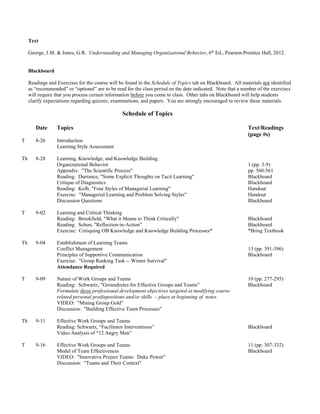
Text
George, J.M. & Jones, G.R. Understanding and Managing Organizational Behavior, 6th
Ed., Pearson-Prentice Hall, 2012.
Blackboard
Readings and Exercises for the course will be found in the Schedule of Topics tab on Blackboard. All materials not identified
as “recommended” or “optional” are to be read for the class period on the date indicated. Note that a number of the exercises
will require that you process certain information before you come to class. Other tabs on Blackboard will help students
clarify expectations regarding quizzes, examinations, and papers. You are strongly encouraged to review these materials.
Schedule of Topics
Date Topics Text/Readings
(page #s)
T 8-26 Introduction
Learning Style Assessment
Th 8-28 Learning, Knowledge, and Knowledge Building
Organizational Behavior
Appendix: "The Scientific Process"
Reading: Durrance, "Some Explicit Thoughts on Tacit Learning"
Critique of Diagnostics
Reading: Kolb, "Four Styles of Managerial Learning"
Exercise: "Managerial Learning and Problem Solving Styles"
Discussion Questions
1 (pp. 3-9)
pp. 560-561
Blackboard
Blackboard
Handout
Handout
Blackboard
T 9-02 Learning and Critical Thinking
Reading: Brookfield, "What it Means to Think Critically"
Reading: Schon, "Reflection-in-Action”
Exercise: Critiquing OB Knowledge and Knowledge Building Processes*
Blackboard
Blackboard
*Bring Textbook
Th 9-04 Establishment of Learning Teams
Conflict Management
Principles of Supportive Communication
Exercise: "Group Ranking Task -- Winter Survival"
Attendance Required
13 (pp. 391-396)
Blackboard
T 9-09 Nature of Work Groups and Teams
Reading: Schwartz, "Groundrules for Effective Groups and Teams"
Formulate three professional development objectives targeted at modifying course
related personal predispositions and/or skills – place at beginning of notes
VIDEO: "Mining Group Gold"
Discussion: "Building Effective Team Processes"
10 (pp. 277-295)
Blackboard
Th 9-11 Effective Work Groups and Teams
Reading: Schwartz, “Facilitator Interventions”
Video Analysis of “12 Angry Men”
Blackboard
T 9-16 Effective Work Groups and Teams
Model of Team Effectiveness
VIDEO: "Innovative Project Teams: Duke Power"
Discussion: "Teams and Their Context"
11 (pp. 307-332)
Blackboard
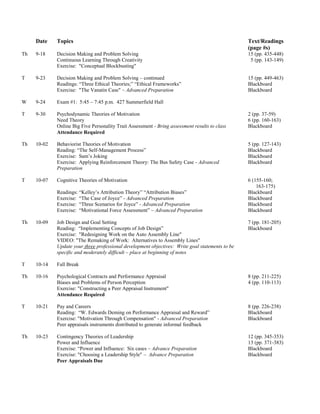
Date Topics Text/Readings
(page #s)
Th 9-18 Decision Making and Problem Solving
Continuous Learning Through Creativity
Exercise: "Conceptual Blockbusting"
15 (pp. 435-448)
5 (pp. 143-149)
T 9-23 Decision Making and Problem Solving – continued
Readings: “Three Ethical Theories;” “Ethical Frameworks”
Exercise: "The Vanatin Case" – Advanced Preparation
15 (pp. 449-463)
Blackboard
Blackboard
W 9-24 Exam #1: 5:45 – 7:45 p.m. 427 Summerfield Hall
T 9-30 Psychodynamic Theories of Motivation
Need Theory
Online Big Five Personality Trait Assessment - Bring assessment results to class
Attendance Required
2 (pp. 37-59)
6 (pp. 160-163)
Blackboard
Th 10-02 Behaviorist Theories of Motivation
Reading: “The Self-Management Process”
Exercise: Sam’s Joking
Exercise: Applying Reinforcement Theory: The Bus Safety Case - Advanced
Preparation
5 (pp. 127-143)
Blackboard
Blackboard
Blackboard
T 10-07 Cognitive Theories of Motivation
Readings: “Kelley’s Attribution Theory” “Attribution Biases”
Exercise: “The Case of Joyce” - Advanced Preparation
Exercise: “Three Scenarios for Joyce” - Advanced Preparation
Exercise: “Motivational Force Assessment” – Advanced Preparation
6 (155-160;
163-175)
Blackboard
Blackboard
Blackboard
Blackboard
Th 10-09 Job Design and Goal Setting
Reading: “Implementing Concepts of Job Design”
Exercise: "Redesigning Work on the Auto Assembly Line"
VIDEO: "The Remaking of Work: Alternatives to Assembly Lines"
Update your three professional development objectives: Write goal statements to be
specific and moderately difficult – place at beginning of notes
7 (pp. 181-205)
Blackboard
T 10-14 Fall Break
Th 10-16 Psychological Contracts and Performance Appraisal
Biases and Problems of Person Perception
Exercise: "Constructing a Peer Appraisal Instrument"
Attendance Required
8 (pp. 211-225)
4 (pp. 110-113)
T 10-21 Pay and Careers
Reading: “W. Edwards Deming on Performance Appraisal and Reward”
Exercise: "Motivation Through Compensation" - Advanced Preparation
Peer appraisals instruments distributed to generate informal feedback
8 (pp. 226-238)
Blackboard
Blackboard
Th 10-23 Contingency Theories of Leadership
Power and Influence
Exercise: “Power and Influence: Six cases – Advance Preparation
Exercise: "Choosing a Leadership Style" – Advance Preparation
Peer Appraisals Due
12 (pp. 345-353)
13 (pp. 371-383)
Blackboard
Blackboard
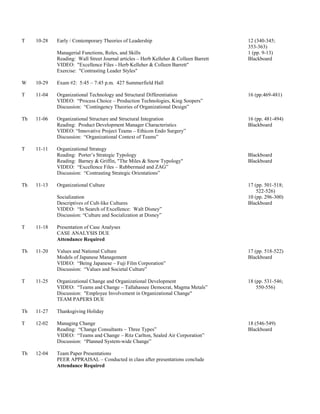
T 10-28 Early / Contemporary Theories of Leadership
Managerial Functions, Roles, and Skills
Reading: Wall Street Journal articles – Herb Kelleher & Colleen Barrett
VIDEO: "Excellence Files - Herb Kelleher & Colleen Barrett"
Exercise: "Contrasting Leader Styles"
12 (340-345;
353-363)
1 (pp. 9-13)
Blackboard
W 10-29 Exam #2: 5:45 – 7:45 p.m. 427 Summerfield Hall
T 11-04 Organizational Technology and Structural Differentiation
VIDEO: “Process Choice – Production Technologies, King Soopers”
Discussion: “Contingency Theories of Organizational Design”
16 (pp.469-481)
Th 11-06 Organizational Structure and Structural Integration
Reading: Product Development Manager Characteristics
VIDEO: “Innovative Project Teams – Ethicon Endo Surgery”
Discussion: “Organizational Context of Teams”
16 (pp. 481-494)
Blackboard
T 11-11 Organizational Strategy
Reading: Porter’s Strategic Typology
Reading: Barney & Griffin, "The Miles & Snow Typology"
VIDEO: “Excellence Files – Rubbermaid and ZAG”
Discussion: “Contrasting Strategic Orientations”
Blackboard
Blackboard
Th 11-13 Organizational Culture
Socialization
Descriptives of Cult-like Cultures
VIDEO: “In Search of Excellence: Walt Disney”
Discussion: “Culture and Socialization at Disney”
17 (pp. 501-518;
522-526)
10 (pp. 296-300)
Blackboard
T 11-18 Presentation of Case Analyses
CASE ANALYSIS DUE
Attendance Required
Th 11-20 Values and National Culture
Models of Japanese Management
VIDEO: “Being Japanese – Fuji Film Corporation”
Discussion: “Values and Societal Culture”
17 (pp. 518-522)
Blackboard
T 11-25 Organizational Change and Organizational Development
VIDEO: “Teams and Change – Tallahassee Democrat, Magma Metals”
Discussion: "Employee Involvement in Organizational Change"
TEAM PAPERS DUE
18 (pp. 531-546;
550-556)
Th 11-27 Thanksgiving Holiday
T 12-02 Managing Change
Reading: “Change Consultants – Three Types”
VIDEO: “Teams and Change – Ritz Carlton, Sealed Air Corporation”
Discussion: “Planned System-wide Change”
18 (546-549)
Blackboard
Th 12-04 Team Paper Presentations
PEER APPRAISAL – Conducted in class after presentations conclude
Attendance Required
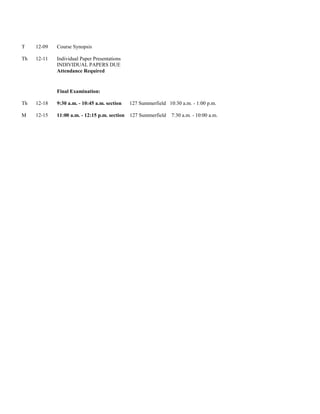
T 12-09 Course Synopsis
Th 12-11 Individual Paper Presentations
INDIVIDUAL PAPERS DUE
Attendance Required
Final Examination:
Th
M
12-18
12-15
9:30 a.m. - 10:45 a.m. section 127 Summerfield 10:30 a.m. - 1:00 p.m.
11:00 a.m. - 12:15 p.m. section 127 Summerfield 7:30 a.m. - 10:00 a.m.

310syllabus fall2014

  • 1.
    Fall 2014 MGMT 310 OrganizationalBehavior 127 Summerfield Professor Dan Spencer Office: 315G Phone: 864-7527 Fax: 864-5328 E-mail: dspencer@ku.edu Office Hours: T,Th 8:30-9:30 a.m.; 12:30-1:30p.m.; and by appointment Course Description This course serves as an introduction to the study of individual and group behavior within the context of an organization. An objective is the development of the student’s potential for becoming an effective organizational member and manager of people. Experiential learning methods are utilized to involve the student actively. A wide variety of topics and theories may be covered, generally including motivation, leadership, job design, group dynamics, and formal organizational structure and process. Prerequisites: Completion of ECON 142 or ECON 143, ACCT 200, PSYC 104 or PSYC 105, and prior completion or co-enrollment in in ACCT 201 and DSCI 202 or DSCI 301. Purpose of the Course The purpose of this course is to introduce the student to the study of human behavior in work settings and the application of that study to the management of business organizations. The material to be studied is behavioral in the sense that it emphasizes quantitative observation and measurement rather than qualitative inquiry and philosophy. This “propositional” knowledge has been generated primarily by empirical research methods where such observation and measurement have been carried out in as controlled and objective manner as possible, utilizing certain tools for the purposes of prediction and explanation. The course will explore both the strengths and limitations of this knowledge with the intent of developing the student’s capabilities to be a more sophisticated and critical consumer of this knowledge. The course will assess what we know and, just as important, what we do not know about various aspects of managing and leading people at work. The general format of the course consists of the generic menu of topics described in the course catalog. These topics will be addressed in a sequence that begins at the level of analysis of the individual and group within organizations and then proceeds to the organization level of analysis. To encourage integration across this diverse set of topics and levels of analysis the overarching focus of the course will be on learning, knowledge building, and critical and systems thinking engaged in by individuals and teams. A particular concern will be how managers and leaders can influence these processes so as to affect their own and others behavior within organizations in positive and ethical ways. More generally, the course will examine how systematically influencing these processes can promote the incremental and strategic enhancement of organizations and their human resources as well as their products and/or services. As indicated in the course description, “experiential learning” methods will be utilized. The primary learning vehicle for the course will be the experiential exercise. These exercises will allow students to analyze, evaluate, and apply course-related concepts. A common theme will be bridging experience to concepts and concepts to experience. Experiential learning involves active rather than passive learning on the part of students. Students are required to take responsibility for their learning and self-direct their own learning processes, both individually and collectively. Students will be grouped into “learning teams” on the fourth day of class and will conduct all activities for the remainder of the course in these teams. There will be no lecture. As these activities occur at regular intervals throughout the course the instructor will serve as facilitator and co-interpreter of phenomena to which the student is exposed. Traditional “cognitive learning” will also take place as students are exposed to information in reading materials. In addition “vicarious learning” will take place as students are exposed to videos across the range of topics. By drawing on these information sources, as well as the knowledge and experience students bring to class, the instructor will attempt to promote a process where he and the students jointly shape and expand their understandings of human behavior in organizations. Hopefully, through these learning activities, the course of study will provide students with an understanding of the processes necessary for applying relevant knowledge in the field of organizational behavior to the management of organizations.
  • 2.
    Instructional Objectives By theend of this course the student who has fully taken advantage of the active learning opportunities in the course and has successfully self-directed their learning process shall be able to do the following:  Explain what it means to be an effective team member and demonstrate the use of team skills.  Discuss and differentiate individual and team-based problem solving and decision making processes, and engage in these processes to analyze and solve problems.  Describe what it means to effectively influence and lead others through the use communication and motivational tools.  Examine and characterize organization dimensions such as structure, technology, strategy, and culture from a systemic perspective, and relate how their design and modification can affect organizational operations and performance.  Define what it means to be an effective and ethical organization member and organization citizen. Method of Evaluation 1. 24 sets of reading notes. To encourage preparation for each class, students will utilize one 8-1/2” x 11” piece of paper (front and back) to prepare a set of notes for 24 class periods where reading material is assigned. Notes must be the student’s independent work; use of a word processor to generate notes is encouraged; no photocopied material allowed. Five points will be allotted based on the thoroughness of the student's text / reading notes. Example notes available on Blackboard. Notes will only be accepted at the end of class for which they are due. (GRADING WEIGHT = 120 PTS.) 2. Three short-answer essay examinations. Examinations cover the previous weeks’ readings, exercises, videos, and discussion of material. The student will be allowed to utilize their previously prepared notes for the exam and may utilize space remaining on these documents to incorporate insights encountered in class. Notes will be submitted with the student’s completed examination. Example exams available on Blackboard. (GRADING WEIGHT = 100 PTS./EXAM) 3. Two team process critiques. To facilitate continuous reflection on experience each student will be expected to construct a “critique” their team’s interpersonal processes for each of two class periods. The TPC writer will compile information for the critique supplied by other members of the team as well as use their own observations. The TPC writer will maintain the anonymity of the feedback provided. In general, each TPC will encompass a critique of the performance of the team, note any lessons learned relevant to team performance, and provide suggestions for improvement. In particular, the TPC will identify process losses of the team and evaluate the performance of team members playing key roles, especially the primary facilitator role. Topic and date of the exercise, team members present, roles played by each member (spokesperson, primary facilitator, scribe, etc.), and indication of those members who contributed input to the TPC are to be clearly indicated. Any concepts/terminology used are to be boldfaced (or underscored). Team process critiques are not to exceed one typed page and are to be submitted to the instructor by the beginning of the next class period. Copies are to be supplied to team members prior to the start of the next class period. Example TPCs available on Blackboard. (GRADING WEIGHT = 20 PTS./ TPC) 4. One team case analysis. Learning teams will prepare responses to a set of questions that will accompany the case (limit: three single-spaced typed pages). They are to be submitted to the instructor at the beginning of the 11-18-14 class period. The case will be available 11-11-14. (GRADING WEIGHT = 50 PTS.) 5. One team paper. Learning teams will reflect back on and “analyze” the range of experiences encountered in their teams. Students are to describe the development of their team, analyze the characteristics of and performance of their team, and identify what could have been done, in hindsight, to have improved their performance. All team process critiques written during the semester are to be included in an appendix and referenced as necessary. Learning teams are expected to reference relevant critical incidents and use course-related concepts/terminology in their analyses. Concepts/terms used are to be boldfaced or underscored. Papers are to be typed and are not to exceed five double-spaced pages. Performance feedback form is available on Blackboard. They are to be submitted to the instructor at the beginning of the 12-04-14 class period. (GRADING WEIGHT = 50 PTS.)
  • 3.
    6. One individualpaper. This paper is to address the student’s personal and professional development in the course. The student will want to demonstrate how they have taken control of and self-directed their learning processes throughout the course: how they have established learning goals at the beginning of the course and how they have worked toward achieving those goals throughout the course by taking advantage of opportunities to proactively experiment with modifying their cognitions and behavior. Students will reflect back on, “describe,” and “analyze” their experiences in their learning teams and experiences that they have had with other aspects of the course. In general, students may wish to focus on what they have learned about themselves as a learner, team member, and the conditions under which they best learn and can best contribute to a team. In particular, students may wish to reflect on how they may think differently about themselves, their personal predispositions and assumptions about the world, their values, and their knowledge and skill sets. These insights about self and changes in self may be a function of exposure to experiences and ideas encountered in class and perhaps the ways in which ideas have been used by the student both inside and/or outside of class since their initial exposure to them. To validate assertions made, students are expected to reference relevant critical incidents that support the assertions made. Also, students are expected to use course-related concepts in their analyses. Concepts used are to be boldfaced or underscored. Papers are to be typed and are not to exceed five double- spaced pages. Performance feedback form is available on Blackboard. They are to be submitted to the instructor no later than the 12-11-14 class period. (GRADING WEIGHT = 50 PTS.) 7. Class and team participation. Classroom citizenship behavior will be evaluated in terms of: attendance (30pts: -10 pts/absence after two absences, -20 pts/absence after 4 absences, -40 pts/absence after 6 absences, +5 / 1 absence, +10 / no absences, an extra 10 pts subtracted for missing any “attendance required” day); tardiness (20 points: -3 pt/tardy after two tardies, -6pts/tardy after 4 tardies, -9pts/tardy after 6 tardies, +3 / one tardy, +6 no tardies); advance preparation (-5 pts / no preparation); and contribution to one’s learning team (40 pts). Information on the latter contribution will be generated by an in-class peer evaluation on 12-04-14. Peer evaluations will be generated using peer appraisal instruments that the learning teams themselves will construct the eighth week of class. (GRADING WEIGHT = 90 PTS.) 8. Total Points: NOTES (120 PTS.) + EXAMS (300 PTS.) + CASE ANALYSIS (50 PTS.) + TEAM PROCESS CRITIQUES (40 PTS.) + TEAM PAPER (50 PTS.) + INDIVIDUAL PAPER (50 PTS.) + CLASS AND TEAM PARTICIPATION (90 PTS.) = 700 TOTAL PTS. 9. Grading system: A plus and minus system will be used to assign final grades: 93% = A (4.0), 90% = A- (3.7), 87% = B+ (3.3), 83% = B (3.0), 80% = B- (2.7), 77% = C+ (2.3), 73% = C (2.0), 70% = C- (1.7), 67% = D+ (1.3), 63% = D (1.0), 60% = D- (0.7), below 60% = F (0.0) The School of Business Honor System According to the Honor System of the School of Business, all School of Business faculty are to include the following in every syllabus: The School of Business Assembly has adopted an Honor System proposed by its students and faculty to promote academic integrity and has enacted an Honor Code. As a student in a School of Business class, you will be protected by and expected to conduct yourself in accordance with this system. For a complete description of the system see the School of Business Website: http://business.ku.edu/honor-code . . In addition, the following pledge must also be signed by all students at the end of all examinations: “On my honor, I have neither given nor received unauthorized aid on this exam. Furthermore, I am not aware of anyone giving or receiving unauthorized aid on this exam.” _______________________ ___________ Signature Date
  • 4.
    Conduct of ClassSessions Students are expected to have completed the assigned reading and note preparation prior to each class period. Students are expected to arrive for class by the scheduled start time. Class will begin promptly with a reflection on experiences from the previous class period, this will involve sharing of “team process critiques.” Most class periods will be devoted to team based experiential learning and discussion. Students are expected to have completed the necessary preparation (if any) for an exercise prior to the class period for which it is scheduled. It is the student’s responsibility to have obtained, read, and processed the necessary materials from the course website. It is absolutely essential that students are capable of becoming meaningfully involved in team exercises. Students will be assigned to teams the fourth day of class and from that point forward are expected to rotate the primary facilitator role, spokesperson duties, and team process critique writing duties in addition to other roles including scribe, devil’s advocate and timekeeper. The first "Team Process Critique" submission will be based on the exercise that is planned for Tuesday September 9th ; it is due Thursday September 11th . Several examples of TPC’s can be found on the course web site. Beginning with the September 11th class period the student assigned as primary facilitator for the day will be responsible for ensuring that the TPC is meaningfully discussed by the learning team during the first five minutes of class. The primary facilitator will also be responsible for ensuring that a team development goal is established for the session. Depending on the activity, teams may be engaged in an exercise or discussion for a period of 10 to 50 minutes. The instructor will be available during this time to answer questions or help facilitate. Thorough student preparation – advanced reading and notes on the reading materials, instructor commentary, and videos – will be essential for efficiently and effectively processing information when applying, analyzing, synthesizing, and evaluating ideas. Each team will be assigned to a geographic area of the classroom with its own "writing wall." The lower part of the writing wall will be used to capture and organize the team's ideas. One or more persons from each team will be asked to present their team’s ideas, conclusions, position, etc. to the rest of the class. Other team members may support these spokespersons as needed. The team will place a representation of the information that they wish to convey on the upper portion of the team's writing wall. When a spokesperson has the floor it is expected that the remainder of the class will cease all discussion and give that person their full attention. The instructor will interject comments as appropriate and generally try to encourage dialogue and critical thinking regarding the issues under consideration. The process will largely be circular, rather than linear. It will typically involve a lot of uncertainty and can unfold slowly. It will usually be multiperspectival. It will frequently involve consideration of many different aspects of complex systems. Thus, it is important for the student to become comfortable with an activity where both they and the instructor are contributors to an unfolding collective sensemaking process. At the end of the class period students will submit their notes for evaluation. Under no circumstances will students be allowed to construct notes over the reading materials during the class session. This behavior, which detracts from both the learning experience of the student as well as his/her student colleagues, will not be tolerated. Note: If used to their maximum advantage the teams can be vehicles for students to safely articulate their assumptions, beliefs, opinions, and understandings to and receive feedback from other learning team members before they may be articulated to the class as a whole. Team activities can provide experiential learning opportunities for students to safely experiment with new behaviors. In general, teams can be used not only as a vehicles for stimulating learning at a deeper level but also learning that is shared and collaborative where students help each other to learn. Disability The staff of Disability Resources, 22 Strong Hall, 785-864-2620, coordinates accommodations and services for KU courses. If you have a disability for which you may request accommodation in KU classes and have not contacted them, please do so as soon as possible. Please also see me privately in regard to this course.
  • 5.
    Text George, J.M. &Jones, G.R. Understanding and Managing Organizational Behavior, 6th Ed., Pearson-Prentice Hall, 2012. Blackboard Readings and Exercises for the course will be found in the Schedule of Topics tab on Blackboard. All materials not identified as “recommended” or “optional” are to be read for the class period on the date indicated. Note that a number of the exercises will require that you process certain information before you come to class. Other tabs on Blackboard will help students clarify expectations regarding quizzes, examinations, and papers. You are strongly encouraged to review these materials. Schedule of Topics Date Topics Text/Readings (page #s) T 8-26 Introduction Learning Style Assessment Th 8-28 Learning, Knowledge, and Knowledge Building Organizational Behavior Appendix: "The Scientific Process" Reading: Durrance, "Some Explicit Thoughts on Tacit Learning" Critique of Diagnostics Reading: Kolb, "Four Styles of Managerial Learning" Exercise: "Managerial Learning and Problem Solving Styles" Discussion Questions 1 (pp. 3-9) pp. 560-561 Blackboard Blackboard Handout Handout Blackboard T 9-02 Learning and Critical Thinking Reading: Brookfield, "What it Means to Think Critically" Reading: Schon, "Reflection-in-Action” Exercise: Critiquing OB Knowledge and Knowledge Building Processes* Blackboard Blackboard *Bring Textbook Th 9-04 Establishment of Learning Teams Conflict Management Principles of Supportive Communication Exercise: "Group Ranking Task -- Winter Survival" Attendance Required 13 (pp. 391-396) Blackboard T 9-09 Nature of Work Groups and Teams Reading: Schwartz, "Groundrules for Effective Groups and Teams" Formulate three professional development objectives targeted at modifying course related personal predispositions and/or skills – place at beginning of notes VIDEO: "Mining Group Gold" Discussion: "Building Effective Team Processes" 10 (pp. 277-295) Blackboard Th 9-11 Effective Work Groups and Teams Reading: Schwartz, “Facilitator Interventions” Video Analysis of “12 Angry Men” Blackboard T 9-16 Effective Work Groups and Teams Model of Team Effectiveness VIDEO: "Innovative Project Teams: Duke Power" Discussion: "Teams and Their Context" 11 (pp. 307-332) Blackboard
  • 6.
    Date Topics Text/Readings (page#s) Th 9-18 Decision Making and Problem Solving Continuous Learning Through Creativity Exercise: "Conceptual Blockbusting" 15 (pp. 435-448) 5 (pp. 143-149) T 9-23 Decision Making and Problem Solving – continued Readings: “Three Ethical Theories;” “Ethical Frameworks” Exercise: "The Vanatin Case" – Advanced Preparation 15 (pp. 449-463) Blackboard Blackboard W 9-24 Exam #1: 5:45 – 7:45 p.m. 427 Summerfield Hall T 9-30 Psychodynamic Theories of Motivation Need Theory Online Big Five Personality Trait Assessment - Bring assessment results to class Attendance Required 2 (pp. 37-59) 6 (pp. 160-163) Blackboard Th 10-02 Behaviorist Theories of Motivation Reading: “The Self-Management Process” Exercise: Sam’s Joking Exercise: Applying Reinforcement Theory: The Bus Safety Case - Advanced Preparation 5 (pp. 127-143) Blackboard Blackboard Blackboard T 10-07 Cognitive Theories of Motivation Readings: “Kelley’s Attribution Theory” “Attribution Biases” Exercise: “The Case of Joyce” - Advanced Preparation Exercise: “Three Scenarios for Joyce” - Advanced Preparation Exercise: “Motivational Force Assessment” – Advanced Preparation 6 (155-160; 163-175) Blackboard Blackboard Blackboard Blackboard Th 10-09 Job Design and Goal Setting Reading: “Implementing Concepts of Job Design” Exercise: "Redesigning Work on the Auto Assembly Line" VIDEO: "The Remaking of Work: Alternatives to Assembly Lines" Update your three professional development objectives: Write goal statements to be specific and moderately difficult – place at beginning of notes 7 (pp. 181-205) Blackboard T 10-14 Fall Break Th 10-16 Psychological Contracts and Performance Appraisal Biases and Problems of Person Perception Exercise: "Constructing a Peer Appraisal Instrument" Attendance Required 8 (pp. 211-225) 4 (pp. 110-113) T 10-21 Pay and Careers Reading: “W. Edwards Deming on Performance Appraisal and Reward” Exercise: "Motivation Through Compensation" - Advanced Preparation Peer appraisals instruments distributed to generate informal feedback 8 (pp. 226-238) Blackboard Blackboard Th 10-23 Contingency Theories of Leadership Power and Influence Exercise: “Power and Influence: Six cases – Advance Preparation Exercise: "Choosing a Leadership Style" – Advance Preparation Peer Appraisals Due 12 (pp. 345-353) 13 (pp. 371-383) Blackboard Blackboard
  • 7.
    T 10-28 Early/ Contemporary Theories of Leadership Managerial Functions, Roles, and Skills Reading: Wall Street Journal articles – Herb Kelleher & Colleen Barrett VIDEO: "Excellence Files - Herb Kelleher & Colleen Barrett" Exercise: "Contrasting Leader Styles" 12 (340-345; 353-363) 1 (pp. 9-13) Blackboard W 10-29 Exam #2: 5:45 – 7:45 p.m. 427 Summerfield Hall T 11-04 Organizational Technology and Structural Differentiation VIDEO: “Process Choice – Production Technologies, King Soopers” Discussion: “Contingency Theories of Organizational Design” 16 (pp.469-481) Th 11-06 Organizational Structure and Structural Integration Reading: Product Development Manager Characteristics VIDEO: “Innovative Project Teams – Ethicon Endo Surgery” Discussion: “Organizational Context of Teams” 16 (pp. 481-494) Blackboard T 11-11 Organizational Strategy Reading: Porter’s Strategic Typology Reading: Barney & Griffin, "The Miles & Snow Typology" VIDEO: “Excellence Files – Rubbermaid and ZAG” Discussion: “Contrasting Strategic Orientations” Blackboard Blackboard Th 11-13 Organizational Culture Socialization Descriptives of Cult-like Cultures VIDEO: “In Search of Excellence: Walt Disney” Discussion: “Culture and Socialization at Disney” 17 (pp. 501-518; 522-526) 10 (pp. 296-300) Blackboard T 11-18 Presentation of Case Analyses CASE ANALYSIS DUE Attendance Required Th 11-20 Values and National Culture Models of Japanese Management VIDEO: “Being Japanese – Fuji Film Corporation” Discussion: “Values and Societal Culture” 17 (pp. 518-522) Blackboard T 11-25 Organizational Change and Organizational Development VIDEO: “Teams and Change – Tallahassee Democrat, Magma Metals” Discussion: "Employee Involvement in Organizational Change" TEAM PAPERS DUE 18 (pp. 531-546; 550-556) Th 11-27 Thanksgiving Holiday T 12-02 Managing Change Reading: “Change Consultants – Three Types” VIDEO: “Teams and Change – Ritz Carlton, Sealed Air Corporation” Discussion: “Planned System-wide Change” 18 (546-549) Blackboard Th 12-04 Team Paper Presentations PEER APPRAISAL – Conducted in class after presentations conclude Attendance Required
  • 8.
    T 12-09 CourseSynopsis Th 12-11 Individual Paper Presentations INDIVIDUAL PAPERS DUE Attendance Required Final Examination: Th M 12-18 12-15 9:30 a.m. - 10:45 a.m. section 127 Summerfield 10:30 a.m. - 1:00 p.m. 11:00 a.m. - 12:15 p.m. section 127 Summerfield 7:30 a.m. - 10:00 a.m.