
DESIGN OF FOUNDATION
• The design of foundation consist of determining,
1) Width of the foundation, B
2) Depth of the foundation below ground level, h
3) Depth of concrete block below masonry footing. d
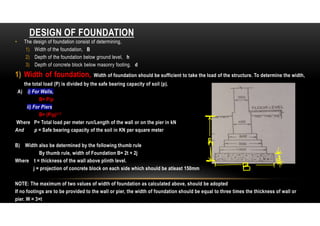
1) Width of foundation, Width of foundation should be sufficient to take the load of the structure. To determine the width,
the total load (P) is divided by the safe bearing capacity of soil (p).
A) i) For Walls,
B= P/p
ii) For Piers
B= (P/p)1/2
Where P= Total load per meter run/Length of the wall or on the pier in kN
And p = Safe bearing capacity of the soil in KN per square meter
B) Width also be determined by the following thumb rule
By thumb rule, width of Foundation B= 2t + 2j
Where t = thickness of the wall above plinth level.
j = projection of concrete block on each side which should be atleast 150mm
NOTE: The maximum of two values of width of foundation as calculated above, should be adopted
If no footings are to be provided to the wall or pier, the width of foundation should be equal to three times the thickness of wall or
pier. W = 3×t
DESIGN OF FOUNDATION
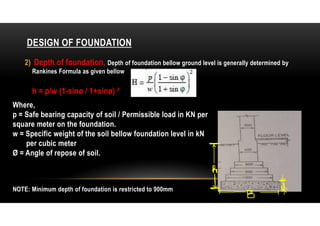
2) Depth of foundation, Depth of foundation bellow ground level is generally determined by
Rankines Formula as given bellow
h = p/w (1-sinø / 1+sinø) ²
Where,
p = Safe bearing capacity of soil / Permissible load in KN per
square meter on the foundation.
w = Specific weight of the soil bellow foundation level in kN
per cubic meter
Ø = Angle of repose of soil.
NOTE: Minimum depth of foundation is restricted to 900mm
DESIGN OF FOUNDATION
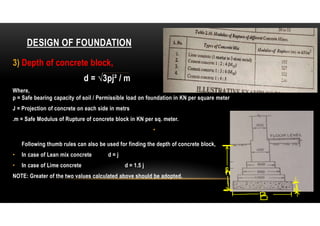
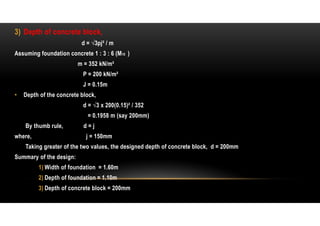
3) Depth of concrete block,
d = √3pj² / m
Where,
p = Safe bearing capacity of soil / Permissible load on foundation in KN per square meter
J = Projection of concrete on each side in metrs
.m = Safe Modulus of Rupture of concrete block in KN per sq. meter.
•
Following thumb rules can also be used for finding the depth of concrete block,
• In case of Lean mix concrete d = j
• In case of Lime concrete d = 1.5 j
NOTE: Greater of the two values calculated above should be adopted.
EXAMPLE:2.1
• A 400 mm thick brick wall carries a load of 300kN per running metre at ground level. The angle
of repose of the soil is 33° 41’ and weight of the soil is 16kN per cu.m. If the safe load on the
soil be taken as 200 kN per sq. metre, design the foundation which you consider suitable.
 SOLUTION: The design of foundation consist of determining,
1) Width of the foundation,
2) Depth of the foundation below ground level,
3) Depth of concrete block below masonry footing.
1) Width of foundation, B= P/p
Where P= Total load per metre run of the wall
= 300+10 (Taking 10kN as weight of footing and concrete block).
= 310
And p = 200 kN/m²
• Width, B = 310/200 = 1.55 m
By thumb rule, width, B= 2t + 2j
Where t = 400mm (Taking the projection of concrete block, j = 150mm)
j = 150mm
• Width = 2 x 400 + 2 x 150
= 800 + 300 = 1100mm
= 1.10m
Taking greater of the two values, the designed width of foundation,
B = 1.55m (say 1.6m)
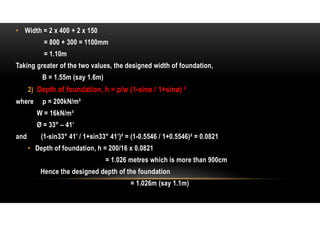
2) Depth of foundation, h = p/w (1-sinø / 1+sinø) ²
where p = 200kN/m²
W = 16kN/m³
Ø = 33° – 41’
and (1-sin33° 41’ / 1+sin33° 41’)² = (1-0.5546 / 1+0.5546)² = 0.0821
• Depth of foundation, h = 200/16 x 0.0821
= 1.026 metres which is more than 900cm
Hence the designed depth of the foundation
= 1.026m (say 1.1m)
3) Depth of concrete block,
d = √3pj² / m
Assuming foundation concrete 1 : 3 : 6 (M10 )
m = 352 kN/m²
P = 200 kN/m²
J = 0.15m
• Depth of the concrete block,
d = √3 x 200(0.15)² / 352
= 0.1958 m (say 200mm)
By thumb rule, d = j
where, j = 150mm
Taking greater of the two values, the designed depth of concrete block, d = 200mm
Summary of the design:
1) Width of foundation = 1.60m
2) Depth of foundation = 1.10m
3) Depth of concrete block = 200mm
EXAMPLE: 2.2.
• A 300 mm thick wall carries a load of 250 kN per running metre at ground level. The angle of repose of soil
is 30° and weight of the soil is 16.5 kN per cubic metre. Safe bearing power of the soil is 200 kN per sq.
metre. Sketch the foundation which you consider will be suitable.
 SOLUTION: The design of a foundation consist of determining.
1) Width of the foundation,
2) Depth of the foundation.
3) Depth of concrete block.
1) Width of foundation, B= P/p
Where P= 250+10 (Taking 10kN as weight of footing and concrete block).
= 260
p= 200 kN/m²
• Width, B = 260/200 = 1.3 m
By thumb rule, width, B= 2t + 2j
Where t = 300mm (Taking the projection of concrete block, j = 150mm)
j = 150mm
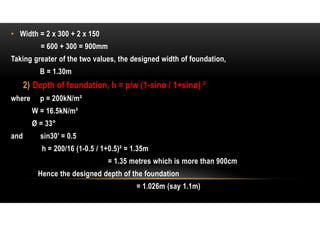
• Width = 2 x 300 + 2 x 150
= 600 + 300 = 900mm
Taking greater of the two values, the designed width of foundation,
B = 1.30m
2) Depth of foundation, h = p/w (1-sinø / 1+sinø) ²
where p = 200kN/m²
W = 16.5kN/m³
Ø = 33°
and sin30’ = 0.5
h = 200/16 (1-0.5 / 1+0.5)² = 1.35m
= 1.35 metres which is more than 900cm
Hence the designed depth of the foundation
= 1.026m (say 1.1m)
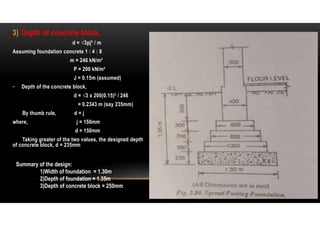
3) Depth of concrete block,
d = √3pj² / m
Assuming foundation concrete 1 : 4 : 8
m = 246 kN/m²
P = 200 kN/m²
J = 0.15m (assumed)
• Depth of the concrete block,
d = √3 x 200(0.15)² / 246
= 0.2343 m (say 235mm)
By thumb rule, d = j
where, j = 150mm
d = 150mm
Taking greater of the two values, the designed depth
of concrete block, d = 235mm
Summary of the design:
1)Width of foundation = 1.30m
2)Depth of foundation = 1.35m
3)Depth of concrete block = 250mm
EXAMPLE: 2.3
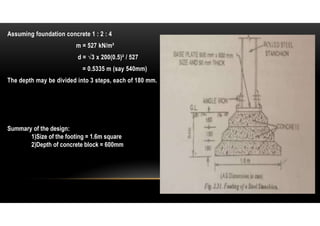
• Design and sketch the following as rolled steel stanchion with a steel base plate 600mm
x 600mm x 50mm fixed by anchor bolts on the top of the concrete block. The stanchion
carries an axial load of 500 kN. The soil under the footing can safely bear a maximum
pressure of 200 kN per sq. metre.
 SOLUTION: The base area of concrete block,
A = Total load / Safe bearing capacity of the soil
= 500/200
{neglecting the self weight of footing since this is very small
as compared to load coming over it.}
= 2.5 sq. metre
• Side of the footing = √2.50 = 1.58m (say 1.6m)
Depth of footing, d = √3pj² / m
where, P = 200kN/m²
j = 1.6 – 0.6 / 2 = 1.0 / 2
= 0.50m
Assuming foundation concrete 1 : 2 : 4
m = 527 kN/m²
d = √3 x 200(0.5)² / 527
= 0.5335 m (say 540mm)
The depth may be divided into 3 steps, each of 180 mm.
Summary of the design:
1)Size of the footing = 1.6m square
2)Depth of concrete block = 600mm

3. Foundation. Examples.pdf

  • 1.
  • 2.
    DESIGN OF FOUNDATION •The design of foundation consist of determining, 1) Width of the foundation, B 2) Depth of the foundation below ground level, h 3) Depth of concrete block below masonry footing. d 1) Width of foundation, Width of foundation should be sufficient to take the load of the structure. To determine the width, the total load (P) is divided by the safe bearing capacity of soil (p). A) i) For Walls, B= P/p ii) For Piers B= (P/p)1/2 Where P= Total load per meter run/Length of the wall or on the pier in kN And p = Safe bearing capacity of the soil in KN per square meter B) Width also be determined by the following thumb rule By thumb rule, width of Foundation B= 2t + 2j Where t = thickness of the wall above plinth level. j = projection of concrete block on each side which should be atleast 150mm NOTE: The maximum of two values of width of foundation as calculated above, should be adopted If no footings are to be provided to the wall or pier, the width of foundation should be equal to three times the thickness of wall or pier. W = 3×t
  • 3.
    DESIGN OF FOUNDATION 2)Depth of foundation, Depth of foundation bellow ground level is generally determined by Rankines Formula as given bellow h = p/w (1-sinø / 1+sinø) ² Where, p = Safe bearing capacity of soil / Permissible load in KN per square meter on the foundation. w = Specific weight of the soil bellow foundation level in kN per cubic meter Ø = Angle of repose of soil. NOTE: Minimum depth of foundation is restricted to 900mm
  • 4.
    DESIGN OF FOUNDATION 3)Depth of concrete block, d = √3pj² / m Where, p = Safe bearing capacity of soil / Permissible load on foundation in KN per square meter J = Projection of concrete on each side in metrs .m = Safe Modulus of Rupture of concrete block in KN per sq. meter. • Following thumb rules can also be used for finding the depth of concrete block, • In case of Lean mix concrete d = j • In case of Lime concrete d = 1.5 j NOTE: Greater of the two values calculated above should be adopted.
  • 5.
    EXAMPLE:2.1 • A 400mm thick brick wall carries a load of 300kN per running metre at ground level. The angle of repose of the soil is 33° 41’ and weight of the soil is 16kN per cu.m. If the safe load on the soil be taken as 200 kN per sq. metre, design the foundation which you consider suitable.  SOLUTION: The design of foundation consist of determining, 1) Width of the foundation, 2) Depth of the foundation below ground level, 3) Depth of concrete block below masonry footing. 1) Width of foundation, B= P/p Where P= Total load per metre run of the wall = 300+10 (Taking 10kN as weight of footing and concrete block). = 310 And p = 200 kN/m² • Width, B = 310/200 = 1.55 m By thumb rule, width, B= 2t + 2j Where t = 400mm (Taking the projection of concrete block, j = 150mm) j = 150mm
  • 6.
    • Width =2 x 400 + 2 x 150 = 800 + 300 = 1100mm = 1.10m Taking greater of the two values, the designed width of foundation, B = 1.55m (say 1.6m) 2) Depth of foundation, h = p/w (1-sinø / 1+sinø) ² where p = 200kN/m² W = 16kN/m³ Ø = 33° – 41’ and (1-sin33° 41’ / 1+sin33° 41’)² = (1-0.5546 / 1+0.5546)² = 0.0821 • Depth of foundation, h = 200/16 x 0.0821 = 1.026 metres which is more than 900cm Hence the designed depth of the foundation = 1.026m (say 1.1m)
  • 7.
    3) Depth ofconcrete block, d = √3pj² / m Assuming foundation concrete 1 : 3 : 6 (M10 ) m = 352 kN/m² P = 200 kN/m² J = 0.15m • Depth of the concrete block, d = √3 x 200(0.15)² / 352 = 0.1958 m (say 200mm) By thumb rule, d = j where, j = 150mm Taking greater of the two values, the designed depth of concrete block, d = 200mm Summary of the design: 1) Width of foundation = 1.60m 2) Depth of foundation = 1.10m 3) Depth of concrete block = 200mm
  • 8.
    EXAMPLE: 2.2. • A300 mm thick wall carries a load of 250 kN per running metre at ground level. The angle of repose of soil is 30° and weight of the soil is 16.5 kN per cubic metre. Safe bearing power of the soil is 200 kN per sq. metre. Sketch the foundation which you consider will be suitable.  SOLUTION: The design of a foundation consist of determining. 1) Width of the foundation, 2) Depth of the foundation. 3) Depth of concrete block. 1) Width of foundation, B= P/p Where P= 250+10 (Taking 10kN as weight of footing and concrete block). = 260 p= 200 kN/m² • Width, B = 260/200 = 1.3 m By thumb rule, width, B= 2t + 2j Where t = 300mm (Taking the projection of concrete block, j = 150mm) j = 150mm
  • 9.
    • Width =2 x 300 + 2 x 150 = 600 + 300 = 900mm Taking greater of the two values, the designed width of foundation, B = 1.30m 2) Depth of foundation, h = p/w (1-sinø / 1+sinø) ² where p = 200kN/m² W = 16.5kN/m³ Ø = 33° and sin30’ = 0.5 h = 200/16 (1-0.5 / 1+0.5)² = 1.35m = 1.35 metres which is more than 900cm Hence the designed depth of the foundation = 1.026m (say 1.1m)
  • 10.
    3) Depth ofconcrete block, d = √3pj² / m Assuming foundation concrete 1 : 4 : 8 m = 246 kN/m² P = 200 kN/m² J = 0.15m (assumed) • Depth of the concrete block, d = √3 x 200(0.15)² / 246 = 0.2343 m (say 235mm) By thumb rule, d = j where, j = 150mm d = 150mm Taking greater of the two values, the designed depth of concrete block, d = 235mm Summary of the design: 1)Width of foundation = 1.30m 2)Depth of foundation = 1.35m 3)Depth of concrete block = 250mm
  • 11.
    EXAMPLE: 2.3 • Designand sketch the following as rolled steel stanchion with a steel base plate 600mm x 600mm x 50mm fixed by anchor bolts on the top of the concrete block. The stanchion carries an axial load of 500 kN. The soil under the footing can safely bear a maximum pressure of 200 kN per sq. metre.  SOLUTION: The base area of concrete block, A = Total load / Safe bearing capacity of the soil = 500/200 {neglecting the self weight of footing since this is very small as compared to load coming over it.} = 2.5 sq. metre • Side of the footing = √2.50 = 1.58m (say 1.6m) Depth of footing, d = √3pj² / m where, P = 200kN/m² j = 1.6 – 0.6 / 2 = 1.0 / 2 = 0.50m
  • 12.
    Assuming foundation concrete1 : 2 : 4 m = 527 kN/m² d = √3 x 200(0.5)² / 527 = 0.5335 m (say 540mm) The depth may be divided into 3 steps, each of 180 mm. Summary of the design: 1)Size of the footing = 1.6m square 2)Depth of concrete block = 600mm