Footing Design
Isolated Footing Design
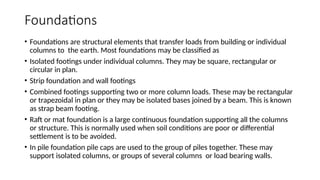
Foundations
• Foundations are structural elements that transfer loads from building or individual
columns to the earth. Most foundations may be classified as
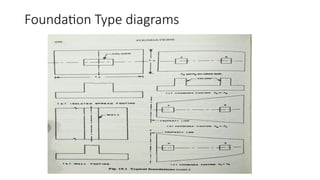
• Isolated footings under individual columns. They may be square, rectangular or
circular in plan.
• Strip foundation and wall footings
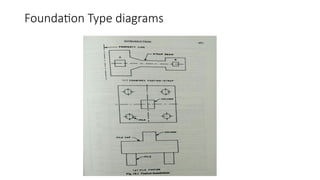
• Combined footings supporting two or more column loads. These may be rectangular
or trapezoidal in plan or they may be isolated bases joined by a beam. This is known
as strap beam footing.
• Raft or mat foundation is a large continuous foundation supporting all the columns
or structure. This is normally used when soil conditions are poor or differential
settlement is to be avoided.
• In pile foundation pile caps are used to the group of piles together. These may
support isolated columns, or groups of several columns or load bearing walls.
Foundation Type diagrams
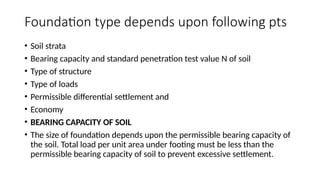
Foundation type depends upon following pts
• Soil strata
• Bearing capacity and standard penetration test value N of soil
• Type of structure
• Type of loads
• Permissible differential settlement and
• Economy
• BEARING CAPACITY OF SOIL
• The size of foundation depends upon the permissible bearing capacity of
the soil. Total load per unit area under footing must be less than the
permissible bearing capacity of soil to prevent excessive settlement.
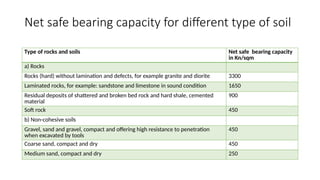
Net safe bearing capacity for different type of soil
Type of rocks and soils Net safe bearing capacity
in Kn/sqm
a) Rocks
Rocks (hard) without lamination and defects, for example granite and diorite 3300
Laminated rocks, for example: sandstone and limestone in sound condition 1650
Residual deposits of shattered and broken bed rock and hard shale, cemented
material
900
Soft rock 450
b) Non-cohesive soils
Gravel, sand and gravel, compact and offering high resistance to penetration
when excavated by tools
450
Coarse sand, compact and dry 450
Medium sand, compact and dry 250
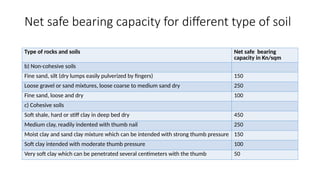
Net safe bearing capacity for different type of soil
Type of rocks and soils Net safe bearing
capacity in Kn/sqm
b) Non-cohesive soils
Fine sand, silt (dry lumps easily pulverized by fingers) 150
Loose gravel or sand mixtures, loose coarse to medium sand dry 250
Fine sand, loose and dry 100
c) Cohesive soils
Soft shale, hard or stiff clay in deep bed dry 450
Medium clay, readily indented with thumb nail 250
Moist clay and sand clay mixture which can be intended with strong thumb pressure 150
Soft clay intended with moderate thumb pressure 100
Very soft clay which can be penetrated several centimeters with the thumb 50
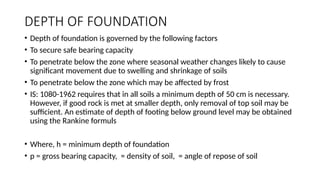
DEPTH OF FOUNDATION
• Depth of foundation is governed by the following factors
• To secure safe bearing capacity
• To penetrate below the zone where seasonal weather changes likely to cause
significant movement due to swelling and shrinkage of soils
• To penetrate below the zone which may be affected by frost
• IS: 1080-1962 requires that in all soils a minimum depth of 50 cm is necessary.
However, if good rock is met at smaller depth, only removal of top soil may be
sufficient. An estimate of depth of footing below ground level may be obtained
using the Rankine formuls
• Where, h = minimum depth of foundation
• p = gross bearing capacity, = density of soil, = angle of repose of soil
Example:
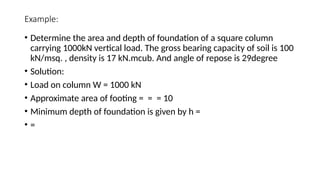
• Determine the area and depth of foundation of a square column
carrying 1000kN vertical load. The gross bearing capacity of soil is 100
kN/msq. , density is 17 kN.mcub. And angle of repose is 29degree
• Solution:
• Load on column W = 1000 kN
• Approximate area of footing = = = 10
• Minimum depth of foundation is given by h =
• =
Continued
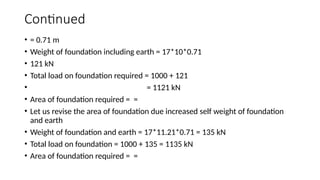
• = 0.71 m
• Weight of foundation including earth = 17*10*0.71
• 121 kN
• Total load on foundation required = 1000 + 121
• = 1121 kN
• Area of foundation required = =
• Let us revise the area of foundation due increased self weight of foundation
and earth
• Weight of foundation and earth = 17*11.21*0.71 = 135 kN
• Total load on foundation = 1000 + 135 = 1135 kN
• Area of foundation required = =
Foundation Analysis
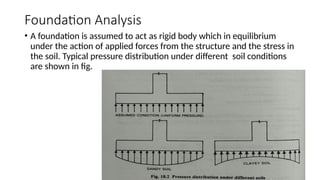
• A foundation is assumed to act as rigid body which in equilibrium
under the action of applied forces from the structure and the stress in
the soil. Typical pressure distribution under different soil conditions
are shown in fig.
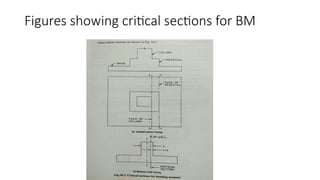
Critical Sections for Analysis of footing
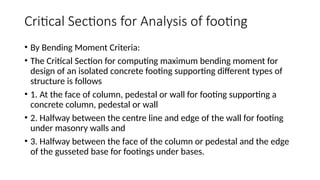
• By Bending Moment Criteria:
• The Critical Section for computing maximum bending moment for
design of an isolated concrete footing supporting different types of
structure is follows
• 1. At the face of column, pedestal or wall for footing supporting a
concrete column, pedestal or wall
• 2. Halfway between the centre line and edge of the wall for footing
under masonry walls and
• 3. Halfway between the face of the column or pedestal and the edge
of the gusseted base for footings under bases.
Figures showing critical sections for BM
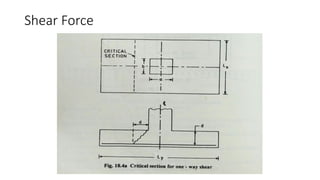
Shear Force
• The shear strength of footing is checked in one-way bending action and in two-
way bending action in accordance with clause 34.2.4.1 of the code.
• When bending is primary in one way, the footing should be checked in vertical
shear.
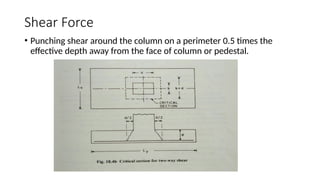
• When bending is primary in two way, the footing should be checked in
punching shear.
• A shear failure should not occur prior to reaching the member flexure capacity.
• (1) Vertical shear across the full width of the base on a vertical section located
from the face of column, pedestal or wall at a distance equal to:
• (a) the effective depth of the footing in case of footings on soils, and
• (b) half the effective depth of the footing for footings on the piles.
Shear Force
Shear Force
• Punching shear around the column on a perimeter 0.5 times the
effective depth away from the face of column or pedestal.
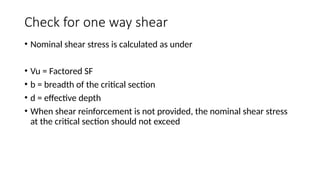
Check for one way shear
• Nominal shear stress is calculated as under
• Vu = Factored SF
• b = breadth of the critical section
• d = effective depth
• When shear reinforcement is not provided, the nominal shear stress
at the critical section should not exceed
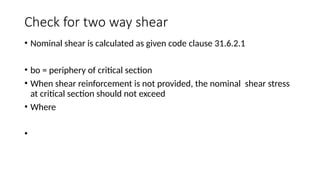
Check for two way shear
• Nominal shear is calculated as given code clause 31.6.2.1
• bo = periphery of critical section
• When shear reinforcement is not provided, the nominal shear stress
at critical section should not exceed
• Where
•

Footing Design - Isolated Footing Design

  • 1.
  • 2.
    Foundations • Foundations arestructural elements that transfer loads from building or individual columns to the earth. Most foundations may be classified as • Isolated footings under individual columns. They may be square, rectangular or circular in plan. • Strip foundation and wall footings • Combined footings supporting two or more column loads. These may be rectangular or trapezoidal in plan or they may be isolated bases joined by a beam. This is known as strap beam footing. • Raft or mat foundation is a large continuous foundation supporting all the columns or structure. This is normally used when soil conditions are poor or differential settlement is to be avoided. • In pile foundation pile caps are used to the group of piles together. These may support isolated columns, or groups of several columns or load bearing walls.
  • 3.
  • 4.
  • 5.
    Foundation type dependsupon following pts • Soil strata • Bearing capacity and standard penetration test value N of soil • Type of structure • Type of loads • Permissible differential settlement and • Economy • BEARING CAPACITY OF SOIL • The size of foundation depends upon the permissible bearing capacity of the soil. Total load per unit area under footing must be less than the permissible bearing capacity of soil to prevent excessive settlement.
  • 6.
    Net safe bearingcapacity for different type of soil Type of rocks and soils Net safe bearing capacity in Kn/sqm a) Rocks Rocks (hard) without lamination and defects, for example granite and diorite 3300 Laminated rocks, for example: sandstone and limestone in sound condition 1650 Residual deposits of shattered and broken bed rock and hard shale, cemented material 900 Soft rock 450 b) Non-cohesive soils Gravel, sand and gravel, compact and offering high resistance to penetration when excavated by tools 450 Coarse sand, compact and dry 450 Medium sand, compact and dry 250
  • 7.
    Net safe bearingcapacity for different type of soil Type of rocks and soils Net safe bearing capacity in Kn/sqm b) Non-cohesive soils Fine sand, silt (dry lumps easily pulverized by fingers) 150 Loose gravel or sand mixtures, loose coarse to medium sand dry 250 Fine sand, loose and dry 100 c) Cohesive soils Soft shale, hard or stiff clay in deep bed dry 450 Medium clay, readily indented with thumb nail 250 Moist clay and sand clay mixture which can be intended with strong thumb pressure 150 Soft clay intended with moderate thumb pressure 100 Very soft clay which can be penetrated several centimeters with the thumb 50
  • 8.
    DEPTH OF FOUNDATION •Depth of foundation is governed by the following factors • To secure safe bearing capacity • To penetrate below the zone where seasonal weather changes likely to cause significant movement due to swelling and shrinkage of soils • To penetrate below the zone which may be affected by frost • IS: 1080-1962 requires that in all soils a minimum depth of 50 cm is necessary. However, if good rock is met at smaller depth, only removal of top soil may be sufficient. An estimate of depth of footing below ground level may be obtained using the Rankine formuls • Where, h = minimum depth of foundation • p = gross bearing capacity, = density of soil, = angle of repose of soil
  • 9.
    Example: • Determine thearea and depth of foundation of a square column carrying 1000kN vertical load. The gross bearing capacity of soil is 100 kN/msq. , density is 17 kN.mcub. And angle of repose is 29degree • Solution: • Load on column W = 1000 kN • Approximate area of footing = = = 10 • Minimum depth of foundation is given by h = • =
  • 10.
    Continued • = 0.71m • Weight of foundation including earth = 17*10*0.71 • 121 kN • Total load on foundation required = 1000 + 121 • = 1121 kN • Area of foundation required = = • Let us revise the area of foundation due increased self weight of foundation and earth • Weight of foundation and earth = 17*11.21*0.71 = 135 kN • Total load on foundation = 1000 + 135 = 1135 kN • Area of foundation required = =
  • 11.
    Foundation Analysis • Afoundation is assumed to act as rigid body which in equilibrium under the action of applied forces from the structure and the stress in the soil. Typical pressure distribution under different soil conditions are shown in fig.
  • 12.
    Critical Sections forAnalysis of footing • By Bending Moment Criteria: • The Critical Section for computing maximum bending moment for design of an isolated concrete footing supporting different types of structure is follows • 1. At the face of column, pedestal or wall for footing supporting a concrete column, pedestal or wall • 2. Halfway between the centre line and edge of the wall for footing under masonry walls and • 3. Halfway between the face of the column or pedestal and the edge of the gusseted base for footings under bases.
  • 13.
    Figures showing criticalsections for BM
  • 14.
    Shear Force • Theshear strength of footing is checked in one-way bending action and in two- way bending action in accordance with clause 34.2.4.1 of the code. • When bending is primary in one way, the footing should be checked in vertical shear. • When bending is primary in two way, the footing should be checked in punching shear. • A shear failure should not occur prior to reaching the member flexure capacity. • (1) Vertical shear across the full width of the base on a vertical section located from the face of column, pedestal or wall at a distance equal to: • (a) the effective depth of the footing in case of footings on soils, and • (b) half the effective depth of the footing for footings on the piles.
  • 15.
  • 16.
    Shear Force • Punchingshear around the column on a perimeter 0.5 times the effective depth away from the face of column or pedestal.
  • 17.
    Check for oneway shear • Nominal shear stress is calculated as under • Vu = Factored SF • b = breadth of the critical section • d = effective depth • When shear reinforcement is not provided, the nominal shear stress at the critical section should not exceed
  • 18.
    Check for twoway shear • Nominal shear is calculated as given code clause 31.6.2.1 • bo = periphery of critical section • When shear reinforcement is not provided, the nominal shear stress at critical section should not exceed • Where •