The Ceramic Experts.
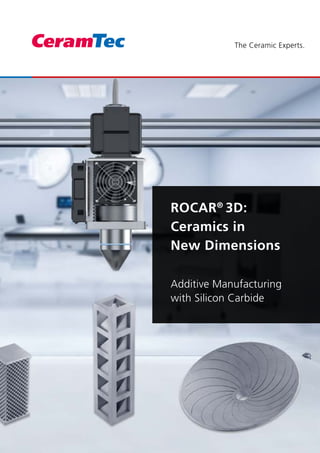
ROCAR®
3D:
Ceramics in
New Dimensions
Additive Manufacturing
with Silicon Carbide
„
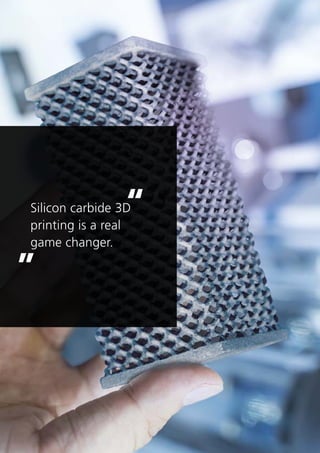
Silicon carbide 3D
printing is a real
game changer.
“
3
Additive manufacturing without
compromise
Maximum flexibility, time and cost savings alongside optimal product quality:
This 3D printing technology boasts numerous, often decisive advantages.
At CeramTec, over 100 years of advanced ceramics expertise meets innovative
spirit. We will guide you through the product development process, from
the idea to the finished product.
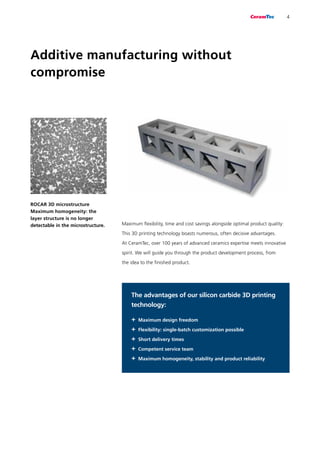
ROCAR 3D microstructure
Maximum homogeneity: the
layer structure is no longer
detectable in the microstructure.
4
The advantages of our silicon carbide 3D printing
technology:
+	Maximum design freedom
+	Flexibility: single-batch customization possible
+	Short delivery times
+	Competent service team
+	Maximum homogeneity, stability and product reliability
Design freedom meets optimal material
quality
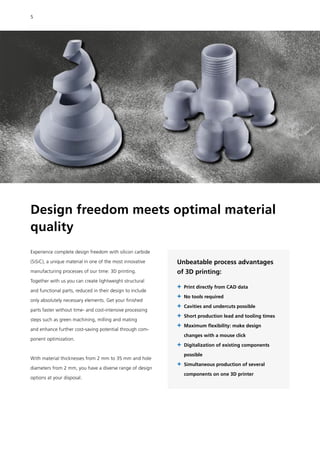
Experience complete design freedom with silicon carbide
(SiSiC), a unique material in one of the most innovative
manufacturing processes of our time: 3D printing.
Together with us you can create lightweight structural
and functional parts, reduced in their design to include
only absolutely necessary elements. Get your finished
parts faster without time- and cost-intensive processing
steps such as green machining, milling and mating
and enhance further cost-saving potential through com-
ponent optimization.
With material thicknesses from 2 mm to 35 mm and hole
diameters from 2 mm, you have a diverse range of design
options at your disposal.
Unbeatable process advantages
of 3D printing:
+	Print directly from CAD data
+	No tools required
+	Cavities and undercuts possible
+	Short production lead and tooling times
+	
Maximum flexibility: make design
changes with a mouse click
+	
Digitalization of existing components
possible
+	
Simultaneous production of several
components on one 3D printer
5
Maximum flexibility and reliability
– with all the advantages of 3D printing
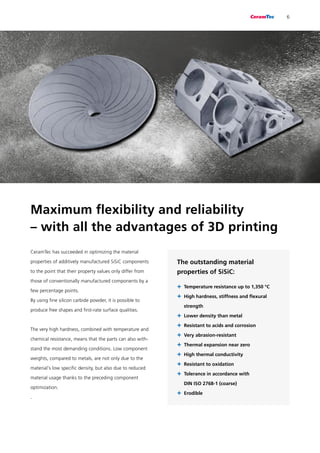
CeramTec has succeeded in optimizing the material
properties of additively manufactured SiSiC components
to the point that their property values only differ from
those of conventionally manufactured components by a
few percentage points.
By using fine silicon carbide powder, it is possible to
produce free shapes and first-rate surface qualities.
The very high hardness, combined with temperature and
chemical resistance, means that the parts can also with-
stand the most demanding conditions. Low component
weights, compared to metals, are not only due to the
material‘s low specific density, but also due to reduced
material usage thanks to the preceding component
optimization.
.
The outstanding material
properties of SiSiC:
+	Temperature resistance up to 1,350 °C
+	
High hardness, stiffness and flexural
strength
+	Lower density than metal
+	Resistant to acids and corrosion
+	Very abrasion-resistant
+	Thermal expansion near zero
+	High thermal conductivity
+	Resistant to oxidation
+	
Tolerance in accordance with
DIN ISO 2768-1 (coarse)
+	Erodible
6
CeramTec’s additive manufacturing specialists draw on their comprehensive expertise in ceramics to support you in
the implementation of your projects. From the evaluation of data to the optimization of production – from single-batch
customization to small-batch production.
Thermal process Surface finishing
3D printing
Technological
evaluation of the
3D model
Our expertise for your success
7
Our service team ensures optimal results
For developers
who think outside
the box.
„
“
Material properties
8
PROPERTY TEST METHOD, PARAMETERS AND STANDARD UNIT VALUE
GENERAL PROPERTIES OF SILICON CARBIDE (ROCAR®
3D)
Main component percentage % +/- 70–75 Vol% SiC
Minor component percentage % +/- 25–30 Vol% Si
Density Archimedes, DIN EN 623-2 g/cm3
≥ 2.95
Achievable average roughness Ra
sand blasted μm ≤ 25
MECHANICAL PROPERTIES
Flexural strengtht 4-point flexural test, 20 °C, DIN EN 843-1 MPa ≥ 2201)
Weibull modulus m 4-point flexural test, 20 °C, DIN EN 843-5 [ - ] ≥ 10
Fracture toughness KIc
SEVNB, DIN EN 14425-5 MPa(m)1/2
≥ 2.0
Young’s modulus Ultrasonic, DIN EN 843-2 GPa +/- 340
Poisson number Ultrasonic, DIN EN 843-2 [ - ] +/- 0.18
Hardness Vickers, similar toDIN EN 843-4 GPa ≥
Two-phase
material2)
THERMAL PROPERTIES
Thermal expansion coefficient a 20–100°C, DIN EN 821-2 10-6
K-1
+/- 4.0
Thermal conductivity λ 20–100°C, Xe-flash, DIN EN 821-2 W/(m·K) +/- 160
Notes:
1)
along the Z-axis 200 MPa
2)
HV 0.2 1200 (Si) / 2700 (SiC)
All herein aforementioned measured values were determined for test samples and are applicable as standard values. The values were determined on the basis of national
or international standards and if these were not available, on the basis of CeramTec internal specifications standards. Statements regarding the suitability of products
for certain types of applications are based on knowledge of typical requirements that are often placed on CeramTec products in generic applications and must not be
transferred to specific applications. The same applies to the indicated values. The information contained herein does not constitute a guarantee for certain properties.
CeramTec and its affiliates do not assume any responsibility for the correctness of such information nor for damages consequent to its use. Please note that all product,
product specifications and data detailed in this media are subject to changes.
CeramTec GmbH
CeramTec-Platz 1–9
73207 Plochingen, Germany
Phone +49.7153.611-0
Fax +49.7153.25421
E-Mail myceramtec@ceramtec.de
CA200068.DE.100.2005.LC.Printed
in
Germany

3 d printing brochure ct

  • 1.
    The Ceramic Experts. ROCAR® 3D: Ceramicsin New Dimensions Additive Manufacturing with Silicon Carbide
  • 2.
    „ Silicon carbide 3D printingis a real game changer. “ 3
  • 3.
    Additive manufacturing without compromise Maximumflexibility, time and cost savings alongside optimal product quality: This 3D printing technology boasts numerous, often decisive advantages. At CeramTec, over 100 years of advanced ceramics expertise meets innovative spirit. We will guide you through the product development process, from the idea to the finished product. ROCAR 3D microstructure Maximum homogeneity: the layer structure is no longer detectable in the microstructure. 4 The advantages of our silicon carbide 3D printing technology: + Maximum design freedom + Flexibility: single-batch customization possible + Short delivery times + Competent service team + Maximum homogeneity, stability and product reliability
  • 4.
    Design freedom meetsoptimal material quality Experience complete design freedom with silicon carbide (SiSiC), a unique material in one of the most innovative manufacturing processes of our time: 3D printing. Together with us you can create lightweight structural and functional parts, reduced in their design to include only absolutely necessary elements. Get your finished parts faster without time- and cost-intensive processing steps such as green machining, milling and mating and enhance further cost-saving potential through com- ponent optimization. With material thicknesses from 2 mm to 35 mm and hole diameters from 2 mm, you have a diverse range of design options at your disposal. Unbeatable process advantages of 3D printing: + Print directly from CAD data + No tools required + Cavities and undercuts possible + Short production lead and tooling times + Maximum flexibility: make design changes with a mouse click + Digitalization of existing components possible + Simultaneous production of several components on one 3D printer 5
  • 5.
    Maximum flexibility andreliability – with all the advantages of 3D printing CeramTec has succeeded in optimizing the material properties of additively manufactured SiSiC components to the point that their property values only differ from those of conventionally manufactured components by a few percentage points. By using fine silicon carbide powder, it is possible to produce free shapes and first-rate surface qualities. The very high hardness, combined with temperature and chemical resistance, means that the parts can also with- stand the most demanding conditions. Low component weights, compared to metals, are not only due to the material‘s low specific density, but also due to reduced material usage thanks to the preceding component optimization. . The outstanding material properties of SiSiC: + Temperature resistance up to 1,350 °C + High hardness, stiffness and flexural strength + Lower density than metal + Resistant to acids and corrosion + Very abrasion-resistant + Thermal expansion near zero + High thermal conductivity + Resistant to oxidation + Tolerance in accordance with DIN ISO 2768-1 (coarse) + Erodible 6
  • 6.
    CeramTec’s additive manufacturingspecialists draw on their comprehensive expertise in ceramics to support you in the implementation of your projects. From the evaluation of data to the optimization of production – from single-batch customization to small-batch production. Thermal process Surface finishing 3D printing Technological evaluation of the 3D model Our expertise for your success 7 Our service team ensures optimal results For developers who think outside the box. „ “
  • 7.
    Material properties 8 PROPERTY TESTMETHOD, PARAMETERS AND STANDARD UNIT VALUE GENERAL PROPERTIES OF SILICON CARBIDE (ROCAR® 3D) Main component percentage % +/- 70–75 Vol% SiC Minor component percentage % +/- 25–30 Vol% Si Density Archimedes, DIN EN 623-2 g/cm3 ≥ 2.95 Achievable average roughness Ra sand blasted μm ≤ 25 MECHANICAL PROPERTIES Flexural strengtht 4-point flexural test, 20 °C, DIN EN 843-1 MPa ≥ 2201) Weibull modulus m 4-point flexural test, 20 °C, DIN EN 843-5 [ - ] ≥ 10 Fracture toughness KIc SEVNB, DIN EN 14425-5 MPa(m)1/2 ≥ 2.0 Young’s modulus Ultrasonic, DIN EN 843-2 GPa +/- 340 Poisson number Ultrasonic, DIN EN 843-2 [ - ] +/- 0.18 Hardness Vickers, similar toDIN EN 843-4 GPa ≥ Two-phase material2) THERMAL PROPERTIES Thermal expansion coefficient a 20–100°C, DIN EN 821-2 10-6 K-1 +/- 4.0 Thermal conductivity λ 20–100°C, Xe-flash, DIN EN 821-2 W/(m·K) +/- 160 Notes: 1) along the Z-axis 200 MPa 2) HV 0.2 1200 (Si) / 2700 (SiC) All herein aforementioned measured values were determined for test samples and are applicable as standard values. The values were determined on the basis of national or international standards and if these were not available, on the basis of CeramTec internal specifications standards. Statements regarding the suitability of products for certain types of applications are based on knowledge of typical requirements that are often placed on CeramTec products in generic applications and must not be transferred to specific applications. The same applies to the indicated values. The information contained herein does not constitute a guarantee for certain properties. CeramTec and its affiliates do not assume any responsibility for the correctness of such information nor for damages consequent to its use. Please note that all product, product specifications and data detailed in this media are subject to changes.
  • 8.
    CeramTec GmbH CeramTec-Platz 1–9 73207Plochingen, Germany Phone +49.7153.611-0 Fax +49.7153.25421 E-Mail myceramtec@ceramtec.de CA200068.DE.100.2005.LC.Printed in Germany