Social Impact
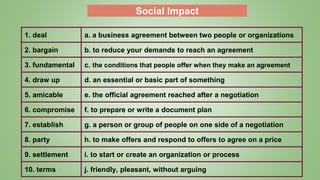
1. deal a. a business agreement between two people or organizations
2. bargain b. to reduce your demands to reach an agreement
3. fundamental c. the conditions that people offer when they make an agreement
4. draw up d. an essential or basic part of something
5. amicable e. the official agreement reached after a negotiation
6. compromise f. to prepare or write a document plan
7. establish g. a person or group of people on one side of a negotiation
8. party h. to make offers and respond to offers to agree on a price
9. settlement i. to start or create an organization or process
10. terms j. friendly, pleasant, without arguing
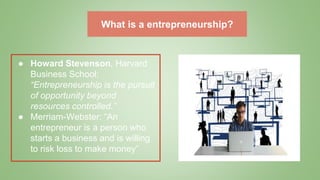
What is a entrepreneurship?
● Howard Stevenson, Harvard
Business School:
“Entrepreneurship is the pursuit
of opportunity beyond
resources controlled.”
● Merriam-Webster: “An
entrepreneur is a person who
starts a business and is willing
to risk loss to make money”
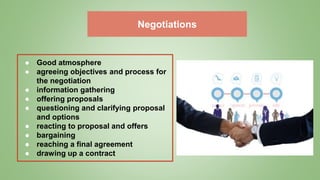
Negotiations
● Good atmosphere
● agreeing objectives and process for
the negotiation
● information gathering
● offering proposals
● questioning and clarifying proposal
and options
● reacting to proposal and offers
● bargaining
● reaching a final agreement
● drawing up a contract
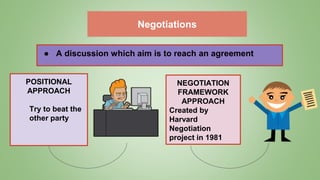
Negotiations
● A discussion which aim is to reach an agreement
POSITIONAL
APPROACH
Try to beat the
other party
NEGOTIATION
FRAMEWORK
APPROACH
Created by
Harvard
Negotiation
project in 1981
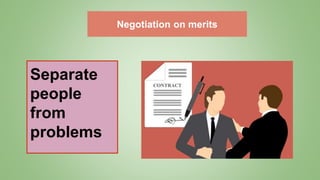
Negotiation on merits
Separate
people
from
problems
Negotiation on merits
Focus on
the
interests of
the parties
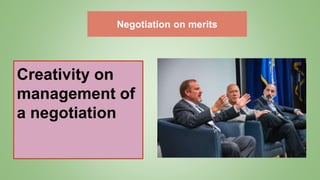
Negotiation on merits
Creativity on
management of
a negotiation
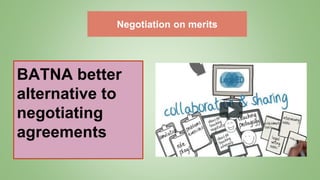
Negotiation on merits
BATNA better
alternative to
negotiating
agreements
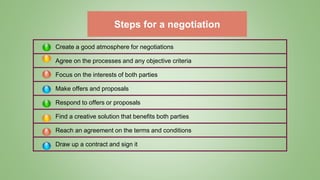
Steps for a negotiation
Create a good atmosphere for negotiations
Agree on the processes and any objective criteria
Focus on the interests of both parties
Make offers and proposals
Respond to offers or proposals
Find a creative solution that benefits both parties
Reach an agreement on the terms and conditions
Draw up a contract and sign it
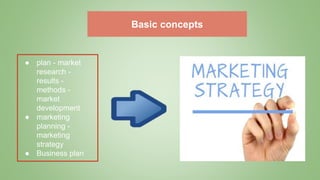
Basic concepts
● plan - market
research -
results -
methods -
market
development
● marketing
planning -
marketing
strategy
● Business plan
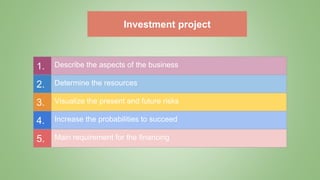
Investment project
1. Describe the aspects of the business
2. Determine the resources
3. Visualize the present and future risks
4. Increase the probabilities to succeed
5. Main requirement for the financing
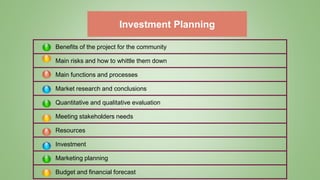
Investment Planning
Benefits of the project for the community
Main risks and how to whittle them down
Main functions and processes
Market research and conclusions
Quantitative and qualitative evaluation
Meeting stakeholders needs
Resources
Investment
Marketing planning
Budget and financial forecast
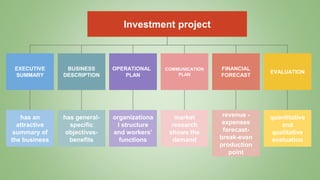
Investment project
EXECUTIVE
SUMMARY
FINANCIAL
FORECAST
COMMUNICATION
PLAN
OPERATIONAL
PLAN
BUSINESS
DESCRIPTION
EVALUATION
has an
attractive
summary of
the business
has general-
specific
objectives-
benefits
organizationa
l structure
and workers’
functions
market
research
shows the
demand
revenue -
expenses
forecast-
break-even
production
point
quantitative
and
qualitative
evaluation
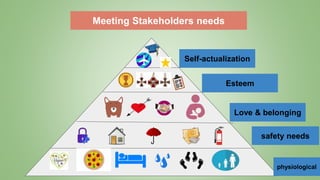
Meeting Stakeholders needs
Self-actualization
Esteem
Love & belonging
safety needs
physiological
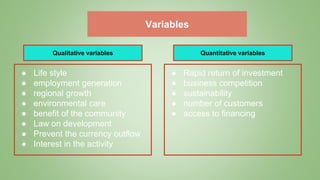
Variables
● Life style
● employment generation
● regional growth
● environmental care
● benefit of the community
● Law on development
● Prevent the currency outflow
● Interest in the activity
● Rapid return of investment
● business competition
● sustainability
● number of customers
● access to financing
Qualitative variables Quantitative variables
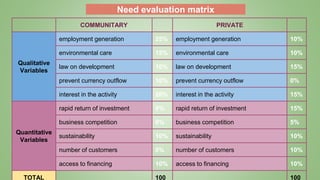
Need evaluation matrix
COMMUNITARY PRIVATE
Qualitative
Variables
employment generation 25% employment generation 10%
environmental care 15% environmental care 10%
law on development 10% law on development 15%
prevent currency outflow 10% prevent currency outflow 0%
interest in the activity 20% interest in the activity 15%
Quantitative
Variables
rapid return of investment 0% rapid return of investment 15%
business competition 0% business competition 5%
sustainability 10% sustainability 10%
number of customers 0% number of customers 10%
access to financing 10% access to financing 10%
TOTAL 100 100
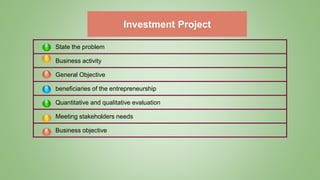
Investment Project
State the problem
Business activity
General Objective
beneficiaries of the entrepreneurship
Quantitative and qualitative evaluation
Meeting stakeholders needs
Business objective
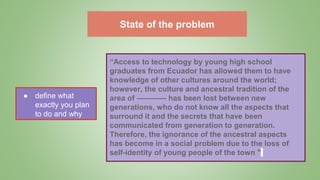
State of the problem
● define what
exactly you plan
to do and why
“Access to technology by young high school
graduates from Ecuador has allowed them to have
knowledge of other cultures around the world;
however, the culture and ancestral tradition of the
area of ​​––––––– has been lost between new
generations, who do not know all the aspects that
surround it and the secrets that have been
communicated from generation to generation.
Therefore, the ignorance of the ancestral aspects
has become in a social problem due to the loss of
self-identity of young people of the town "
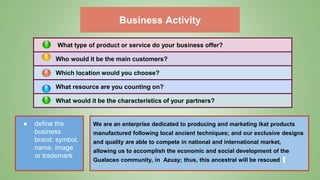
Business Activity
● define the
business
brand: symbol,
name, image
or trademark
What type of product or service do your business offer?
Who would it be the main customers?
Which location would you choose?
What resource are you counting on?
What would it be the characteristics of your partners?
We are an enterprise dedicated to producing and marketing ikat products
manufactured following local ancient techniques; and our exclusive designs
and quality are able to compete in national and international market,
allowing us to accomplish the economic and social development of the
Gualaceo community, in Azuay; thus, this ancestral will be rescued.
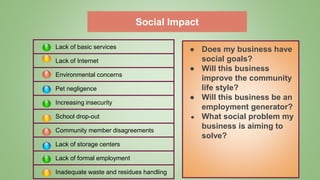
Social Impact
Lack of basic services
Lack of Internet
Environmental concerns
Pet negligence
Increasing insecurity
School drop-out
Community member disagreements
Lack of storage centers
Lack of formal employment
Inadequate waste and residues handling
● Does my business have
social goals?
● Will this business
improve the community
life style?
● Will this business be an
employment generator?
● What social problem my
business is aiming to
solve?

3 bgu negotiations

  • 2.
    Social Impact 1. deala. a business agreement between two people or organizations 2. bargain b. to reduce your demands to reach an agreement 3. fundamental c. the conditions that people offer when they make an agreement 4. draw up d. an essential or basic part of something 5. amicable e. the official agreement reached after a negotiation 6. compromise f. to prepare or write a document plan 7. establish g. a person or group of people on one side of a negotiation 8. party h. to make offers and respond to offers to agree on a price 9. settlement i. to start or create an organization or process 10. terms j. friendly, pleasant, without arguing
  • 3.
    What is aentrepreneurship? ● Howard Stevenson, Harvard Business School: “Entrepreneurship is the pursuit of opportunity beyond resources controlled.” ● Merriam-Webster: “An entrepreneur is a person who starts a business and is willing to risk loss to make money”
  • 4.
    Negotiations ● Good atmosphere ●agreeing objectives and process for the negotiation ● information gathering ● offering proposals ● questioning and clarifying proposal and options ● reacting to proposal and offers ● bargaining ● reaching a final agreement ● drawing up a contract
  • 5.
    Negotiations ● A discussionwhich aim is to reach an agreement POSITIONAL APPROACH Try to beat the other party NEGOTIATION FRAMEWORK APPROACH Created by Harvard Negotiation project in 1981
  • 6.
  • 7.
    Negotiation on merits Focuson the interests of the parties
  • 8.
    Negotiation on merits Creativityon management of a negotiation
  • 9.
    Negotiation on merits BATNAbetter alternative to negotiating agreements
  • 10.
    Steps for anegotiation Create a good atmosphere for negotiations Agree on the processes and any objective criteria Focus on the interests of both parties Make offers and proposals Respond to offers or proposals Find a creative solution that benefits both parties Reach an agreement on the terms and conditions Draw up a contract and sign it
  • 11.
    Basic concepts ● plan- market research - results - methods - market development ● marketing planning - marketing strategy ● Business plan
  • 12.
    Investment project 1. Describethe aspects of the business 2. Determine the resources 3. Visualize the present and future risks 4. Increase the probabilities to succeed 5. Main requirement for the financing
  • 13.
    Investment Planning Benefits ofthe project for the community Main risks and how to whittle them down Main functions and processes Market research and conclusions Quantitative and qualitative evaluation Meeting stakeholders needs Resources Investment Marketing planning Budget and financial forecast
  • 14.
    Investment project EXECUTIVE SUMMARY FINANCIAL FORECAST COMMUNICATION PLAN OPERATIONAL PLAN BUSINESS DESCRIPTION EVALUATION has an attractive summaryof the business has general- specific objectives- benefits organizationa l structure and workers’ functions market research shows the demand revenue - expenses forecast- break-even production point quantitative and qualitative evaluation
  • 15.
    Meeting Stakeholders needs Self-actualization Esteem Love& belonging safety needs physiological
  • 16.
    Variables ● Life style ●employment generation ● regional growth ● environmental care ● benefit of the community ● Law on development ● Prevent the currency outflow ● Interest in the activity ● Rapid return of investment ● business competition ● sustainability ● number of customers ● access to financing Qualitative variables Quantitative variables
  • 17.
    Need evaluation matrix COMMUNITARYPRIVATE Qualitative Variables employment generation 25% employment generation 10% environmental care 15% environmental care 10% law on development 10% law on development 15% prevent currency outflow 10% prevent currency outflow 0% interest in the activity 20% interest in the activity 15% Quantitative Variables rapid return of investment 0% rapid return of investment 15% business competition 0% business competition 5% sustainability 10% sustainability 10% number of customers 0% number of customers 10% access to financing 10% access to financing 10% TOTAL 100 100
  • 18.
    Investment Project State theproblem Business activity General Objective beneficiaries of the entrepreneurship Quantitative and qualitative evaluation Meeting stakeholders needs Business objective
  • 19.
    State of theproblem ● define what exactly you plan to do and why “Access to technology by young high school graduates from Ecuador has allowed them to have knowledge of other cultures around the world; however, the culture and ancestral tradition of the area of ​​––––––– has been lost between new generations, who do not know all the aspects that surround it and the secrets that have been communicated from generation to generation. Therefore, the ignorance of the ancestral aspects has become in a social problem due to the loss of self-identity of young people of the town "
  • 20.
    Business Activity ● definethe business brand: symbol, name, image or trademark What type of product or service do your business offer? Who would it be the main customers? Which location would you choose? What resource are you counting on? What would it be the characteristics of your partners? We are an enterprise dedicated to producing and marketing ikat products manufactured following local ancient techniques; and our exclusive designs and quality are able to compete in national and international market, allowing us to accomplish the economic and social development of the Gualaceo community, in Azuay; thus, this ancestral will be rescued.
  • 21.
    Social Impact Lack ofbasic services Lack of Internet Environmental concerns Pet negligence Increasing insecurity School drop-out Community member disagreements Lack of storage centers Lack of formal employment Inadequate waste and residues handling ● Does my business have social goals? ● Will this business improve the community life style? ● Will this business be an employment generator? ● What social problem my business is aiming to solve?

Editor's Notes

  • #3 1.a - 2.h - 3.d - 4.f - 5.j - 6.b - 7.i - 8.g - 9.e - 10.c