Introduction to Horticulture Plant: Digitalis Term:  Hydroponics
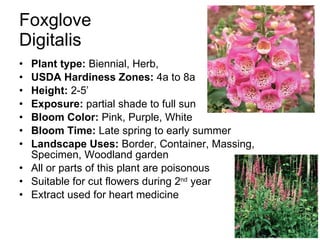
Foxglove Digitalis Plant type:  Biennial, Herb,  USDA Hardiness Zones:  4a to 8a  Height:  2-5’  Exposure:  partial shade to full sun  Bloom Color:  Pink, Purple, White  Bloom Time:  Late spring to early summer Landscape Uses:  Border, Container, Massing, Specimen, Woodland garden  All or parts of this plant are poisonous Suitable for cut flowers during 2 nd  year Extract used for heart medicine
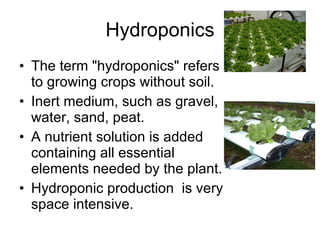
Hydroponics The term "hydroponics" refers to growing crops without soil. Inert medium, such as gravel, water, sand, peat.  A nutrient solution is added containing all essential elements needed by the plant.  Hydroponic production  is very space intensive.
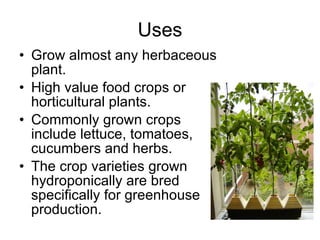
Uses Grow almost any herbaceous plant.  High value food crops or horticultural plants.  Commonly grown crops include lettuce, tomatoes, cucumbers and herbs.  The crop varieties grown hydroponically are bred specifically for greenhouse production.
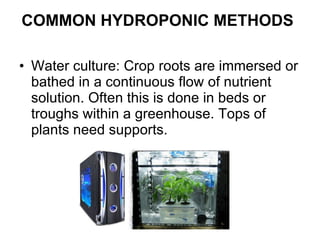
COMMON HYDROPONIC METHODS   Water culture: Crop roots are immersed or bathed in a continuous flow of nutrient solution. Often this is done in beds or troughs within a greenhouse. Tops of plants need supports.
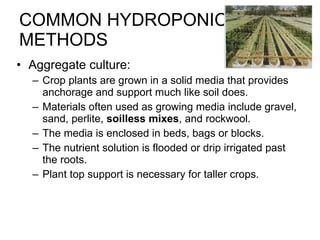
COMMON HYDROPONIC METHODS Aggregate culture:  Crop plants are grown in a solid media that provides anchorage and support much like soil does.  Materials often used as growing media include gravel, sand, perlite,  soilless mixes , and rockwool.  The media is enclosed in beds, bags or blocks.  The nutrient solution is flooded or drip irrigated past the roots. Plant top support is necessary for taller crops.
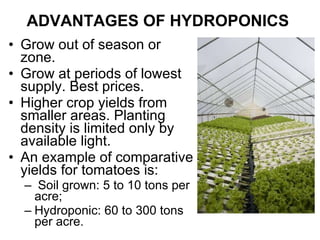
ADVANTAGES OF HYDROPONICS   Grow out of season or zone.  Grow at periods of lowest supply. Best prices. Higher crop yields from smaller areas. Planting density is limited only by available light.  An example of comparative yields for tomatoes is: Soil grown: 5 to 10 tons per acre;  Hydroponic: 60 to 300 tons per acre.
More ADVANTAGES Plants can mature faster and more evenly  Crops can be vine-ripened and sold immediately.  Soil-borne insect and disease problems are reduced  Crops do not need to be rotated.  Crops do not need to be cultivated or weeded.  Nutrient application timing and nutrient quantities can be custom tailored to a particular crop's specific needs.
DISADVANTAGES OF HYDROPONICS Costs The initial investment is high Specialized equipment  Greenhouse heating can be quite expensive in the winter months.  More skill is required than for traditional methods.  The grower/operator must be highly trained in plant nutrition and system operation and maintenance .
Movie Hydroponic lettuce
Fertilizer levels Monitored through EC readings EC = electric conductivity Gives a general reading of the solute content of a liquid Each fertilizer is different Read the label Peters Excel = ?
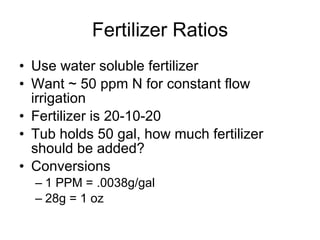
Fertilizer Ratios Use water soluble fertilizer Want ~ 50 ppm N for constant flow irrigation Fertilizer is 20-10-20 Tub holds 50 gal, how much fertilizer should be added? Conversions 1 PPM = .0038g/gal 28g = 1 oz
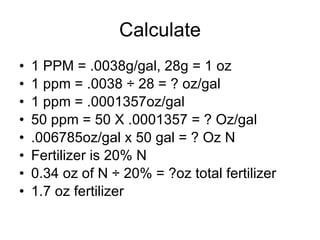
Calculate 1 PPM = .0038g/gal, 28g = 1 oz 1 ppm = .0038  ÷ 28 = ? oz/gal 1 ppm = .0001357oz/gal 50 ppm = 50 X .0001357 = ? Oz/gal .006785oz/gal x 50 gal = ? Oz N Fertilizer is 20% N 0 .34 oz of N ÷ 20% = ?oz total fertilizer 1.7 oz fertilizer
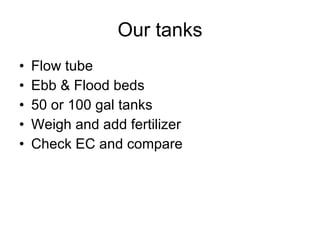
Our tanks Flow tube Ebb & Flood beds 50 or 100 gal tanks Weigh and add fertilizer Check EC and compare

3 23 Hydroponics

  • 1.
    Introduction to HorticulturePlant: Digitalis Term: Hydroponics
  • 2.
    Foxglove Digitalis Planttype: Biennial, Herb, USDA Hardiness Zones: 4a to 8a Height: 2-5’ Exposure: partial shade to full sun Bloom Color: Pink, Purple, White Bloom Time: Late spring to early summer Landscape Uses: Border, Container, Massing, Specimen, Woodland garden All or parts of this plant are poisonous Suitable for cut flowers during 2 nd year Extract used for heart medicine
  • 3.
    Hydroponics The term"hydroponics" refers to growing crops without soil. Inert medium, such as gravel, water, sand, peat. A nutrient solution is added containing all essential elements needed by the plant. Hydroponic production is very space intensive.
  • 4.
    Uses Grow almostany herbaceous plant. High value food crops or horticultural plants. Commonly grown crops include lettuce, tomatoes, cucumbers and herbs. The crop varieties grown hydroponically are bred specifically for greenhouse production.
  • 5.
    COMMON HYDROPONIC METHODS Water culture: Crop roots are immersed or bathed in a continuous flow of nutrient solution. Often this is done in beds or troughs within a greenhouse. Tops of plants need supports.
  • 6.
    COMMON HYDROPONIC METHODSAggregate culture: Crop plants are grown in a solid media that provides anchorage and support much like soil does. Materials often used as growing media include gravel, sand, perlite, soilless mixes , and rockwool. The media is enclosed in beds, bags or blocks. The nutrient solution is flooded or drip irrigated past the roots. Plant top support is necessary for taller crops.
  • 7.
    ADVANTAGES OF HYDROPONICS Grow out of season or zone. Grow at periods of lowest supply. Best prices. Higher crop yields from smaller areas. Planting density is limited only by available light. An example of comparative yields for tomatoes is: Soil grown: 5 to 10 tons per acre; Hydroponic: 60 to 300 tons per acre.
  • 8.
    More ADVANTAGES Plantscan mature faster and more evenly Crops can be vine-ripened and sold immediately. Soil-borne insect and disease problems are reduced Crops do not need to be rotated. Crops do not need to be cultivated or weeded. Nutrient application timing and nutrient quantities can be custom tailored to a particular crop's specific needs.
  • 9.
    DISADVANTAGES OF HYDROPONICSCosts The initial investment is high Specialized equipment Greenhouse heating can be quite expensive in the winter months. More skill is required than for traditional methods. The grower/operator must be highly trained in plant nutrition and system operation and maintenance .
  • 10.
  • 11.
    Fertilizer levels Monitoredthrough EC readings EC = electric conductivity Gives a general reading of the solute content of a liquid Each fertilizer is different Read the label Peters Excel = ?
  • 12.
    Fertilizer Ratios Usewater soluble fertilizer Want ~ 50 ppm N for constant flow irrigation Fertilizer is 20-10-20 Tub holds 50 gal, how much fertilizer should be added? Conversions 1 PPM = .0038g/gal 28g = 1 oz
  • 13.
    Calculate 1 PPM= .0038g/gal, 28g = 1 oz 1 ppm = .0038 ÷ 28 = ? oz/gal 1 ppm = .0001357oz/gal 50 ppm = 50 X .0001357 = ? Oz/gal .006785oz/gal x 50 gal = ? Oz N Fertilizer is 20% N 0 .34 oz of N ÷ 20% = ?oz total fertilizer 1.7 oz fertilizer
  • 14.
    Our tanks Flowtube Ebb & Flood beds 50 or 100 gal tanks Weigh and add fertilizer Check EC and compare