CHILD AND ADOLESCENT
LEARNERS AND LEARNING
PRINCIPLES
Basic Concepts and Issues
on Human development
HUMAN DEVELOPMENT:
MEANING, CONCEPTS AND APPROACHES
2 Approaches of Human Development
Traditional – Shows extensive change from birth to
adolescence, little or no change in adulthood and
decline in the old age.
HUMAN DEVELOPMENT:
MEANING, CONCEPTS AND APPROACHES
2 Approaches of Human Development
Life Span – Developmental change occurs during
childhood to adulthood.
HUMAN DEVELOPMENT: MEANING, CONCEPTS AND APPROACHES
Characteristics of Life Span development
(Santrock, 2002)
1. Development is Lifelong.
2. Development is plastic.
Plasticity refers to the potential for change.
Aging is associated with decline in certain
intellectual abilities.
HUMAN DEVELOPMENT: MEANING, CONCEPTS AND APPROACHES
Characteristics of Life Span development (Santrock, 2002)
3. Development is Multidimensional.
Development consist of biological, cognitive and socio-emotional
dimensions.
Biological processes involves changes in the individual’s physical
nature.
Cognitive processes involves changes in the individual’s thought,
intelligence and language.
Socio-emotional processes involves changes in the individual’s
relationship with others, emotion and personality.
HUMAN DEVELOPMENT: MEANING, CONCEPTS AND APPROACHES
Characteristics of Life Span development
(Santrock, 2002)
4. Development is Contextual.
These contexts include individual’s biological make up,
physical environment, cognitive processes, historical,
social and cultural contexts.
5. Development involves growth, maintenance and
regulation.
STAGES OF DEVELOPMENT AND DEVELOPMENTAL TASKS
Stages of Development
Pre-natal Period – refers to the stage of pre-natal
development.
Infancy – refer to the stage from birth to 2 years
Early Childhood – refer to 3 to 5 years
Middle and Late Childhood – refer to 6 to12 years
Adolescence – refer to 13 to 18 years
STAGES OF DEVELOPMENT AND DEVELOPMENTAL TASKS
Stages of Development
Early Adulthood – refer to 19 to 29 years
Middle Adulthood – refer to 30 to 60 years
Late Adulthood – refer to 61 years and above
RESEARCH IN CHILD AND ADOLESCENT DEVELOPMENT
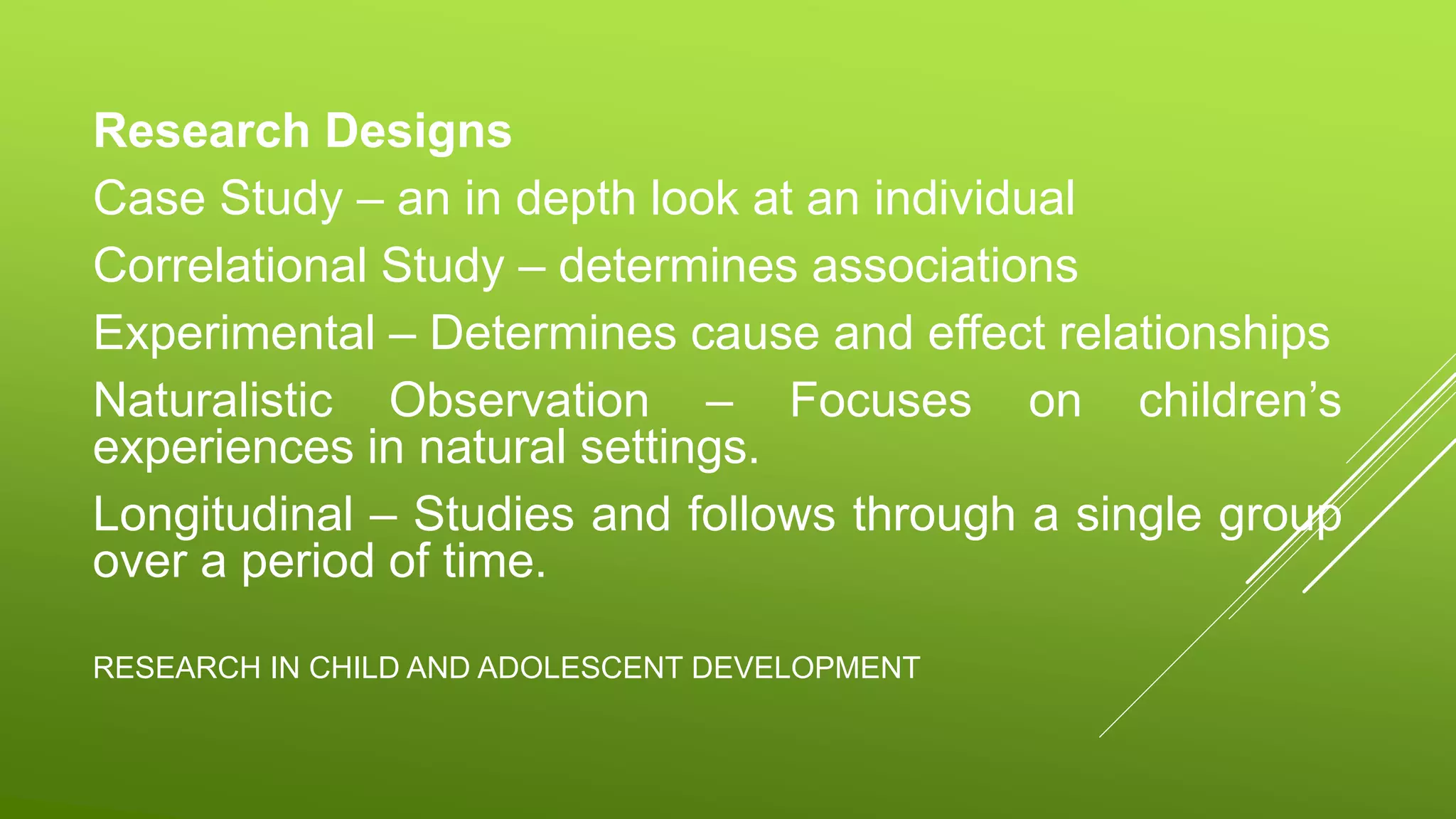
Research Designs
Case Study – an in depth look at an individual
Correlational Study – determines associations
Experimental – Determines cause and effect relationships
Naturalistic Observation – Focuses on children’s
experiences in natural settings.
Longitudinal – Studies and follows through a single group
over a period of time.
RESEARCH IN CHILD AND ADOLESCENT DEVELOPMENT
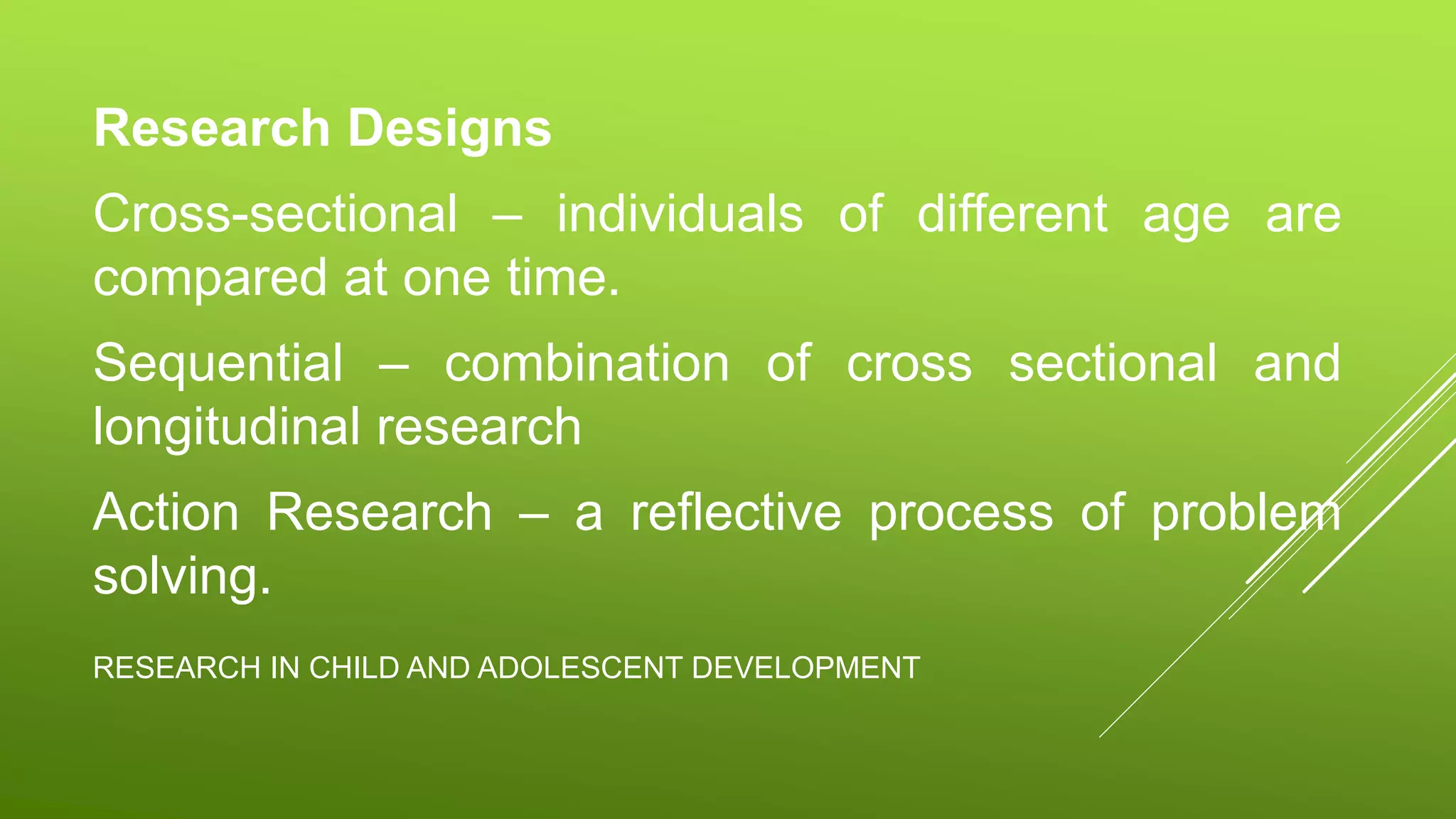
Research Designs
Cross-sectional – individuals of different age are
compared at one time.
Sequential – combination of cross sectional and
longitudinal research
Action Research – a reflective process of problem
solving.
RESEARCH IN CHILD AND ADOLESCENT DEVELOPMENT
Data Gathering Techniques
Observation – done in real world like classroom and home.
Physiological measures – indicators of children’s development
Standardized – prepared test to assess individual performance
Interviews and questionnaires – asking participants for data
Life history records- records of information about lifetime chronology
of events and activities.
RESEARCH IN CHILD AND ADOLESCENT DEVELOPMENT
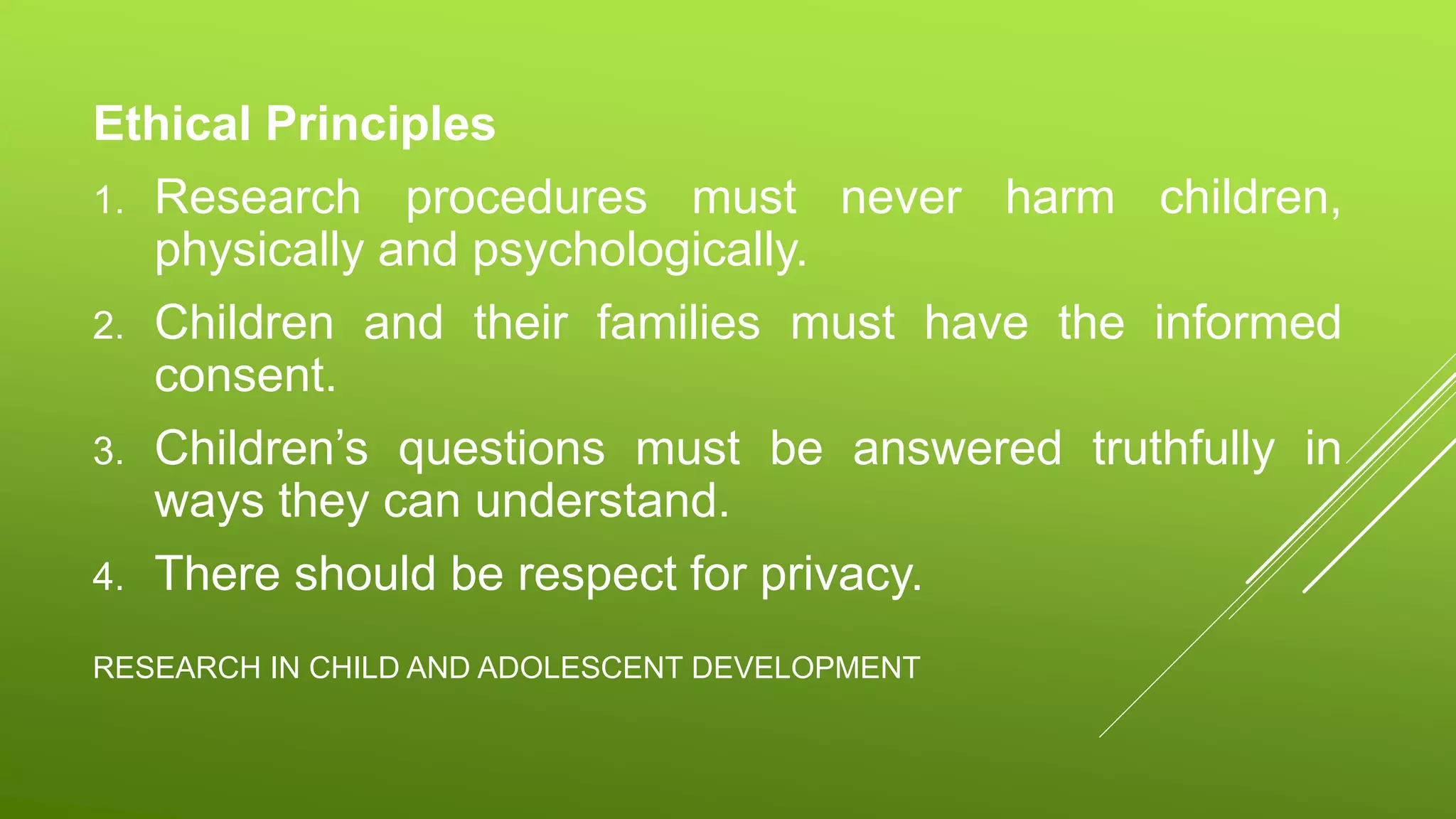
Ethical Principles
1. Research procedures must never harm children,
physically and psychologically.
2. Children and their families must have the informed
consent.
3. Children’s questions must be answered truthfully in
ways they can understand.
4. There should be respect for privacy.
RESEARCH IN CHILD AND ADOLESCENT DEVELOPMENT
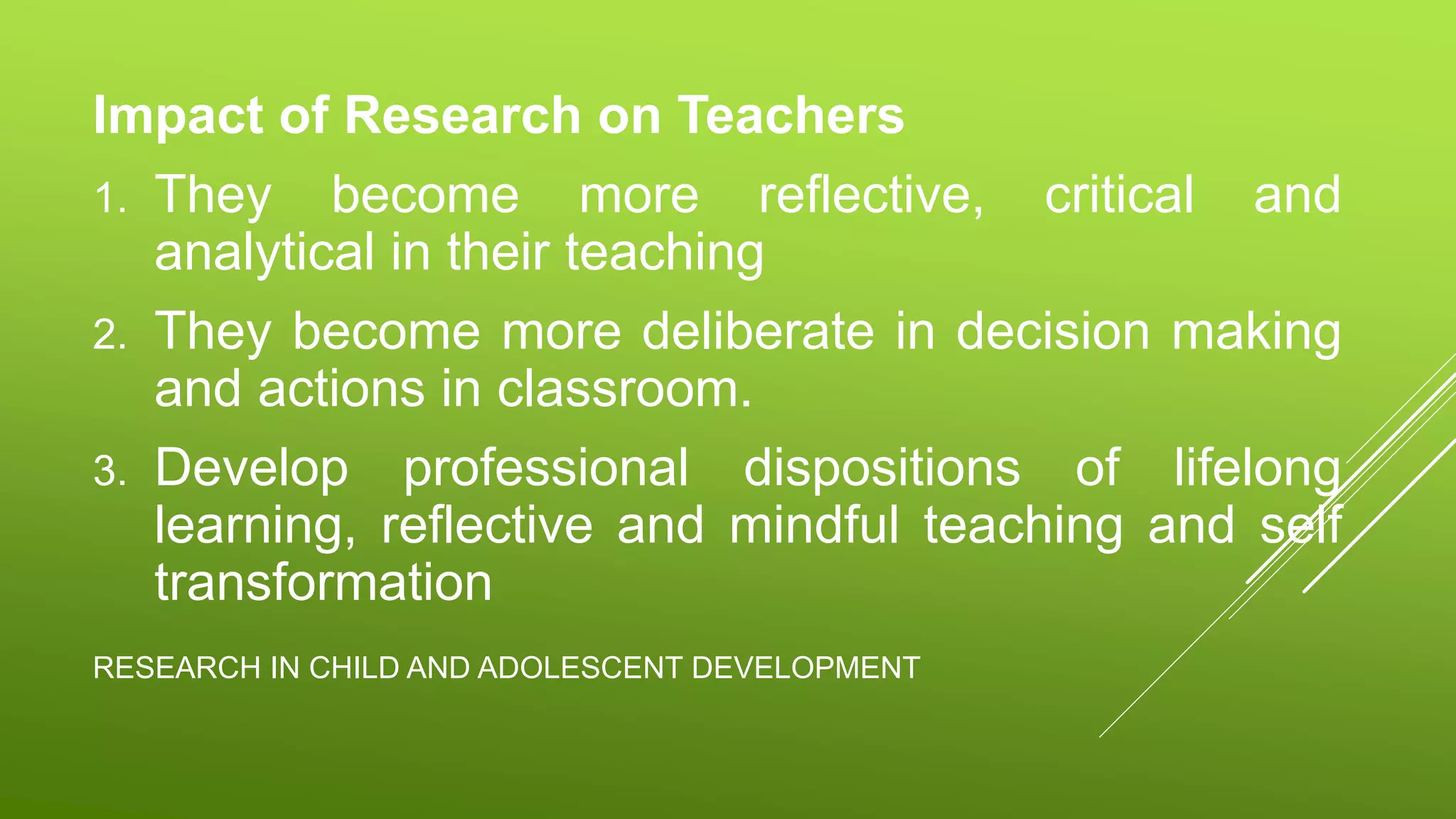
Impact of Research on Teachers
1. They become more reflective, critical and
analytical in their teaching
2. They become more deliberate in decision making
and actions in classroom.
3. Develop professional dispositions of lifelong
learning, reflective and mindful teaching and self
transformation
RESEARCH IN CHILD AND ADOLESCENT DEVELOPMENT
Impact of Research on Teachers
4. Lead to rethinking and reconstructing what it
means to be a teacher.
5. Realized that learning to teach is inherently
connected to learning to inquire.
RESEARCH IN CHILD AND ADOLESCENT DEVELOPMENT
Modular Activity # 2
1. Write a 100 word essay on the quotation:
“Man is an unfinished project. He is always in the process of becoming”.
2. Which is more important factor of development?
a. Nature versus Nurture
b. Continuity versus discontinuity
c. Stability versus change
Choose only 1 and please observe indention and neatness.
Deadline of Submission: September 14, 2020
REFERENCE
 The child and adolescent learners and learning principles
By: Brenda R. Corpuz, PhD
Ma. Rita D. Lucas, PhD
Heidi grade L. Borabo, PhD
Paz I. Lucido, PhD

2_unit_ii_child_and_adolescent_learners_and_learning_principles.ppt

  • 1.
    CHILD AND ADOLESCENT LEARNERSAND LEARNING PRINCIPLES Basic Concepts and Issues on Human development
  • 2.
    HUMAN DEVELOPMENT: MEANING, CONCEPTSAND APPROACHES 2 Approaches of Human Development Traditional – Shows extensive change from birth to adolescence, little or no change in adulthood and decline in the old age.
  • 3.
    HUMAN DEVELOPMENT: MEANING, CONCEPTSAND APPROACHES 2 Approaches of Human Development Life Span – Developmental change occurs during childhood to adulthood.
  • 4.
    HUMAN DEVELOPMENT: MEANING,CONCEPTS AND APPROACHES Characteristics of Life Span development (Santrock, 2002) 1. Development is Lifelong. 2. Development is plastic. Plasticity refers to the potential for change. Aging is associated with decline in certain intellectual abilities.
  • 5.
    HUMAN DEVELOPMENT: MEANING,CONCEPTS AND APPROACHES Characteristics of Life Span development (Santrock, 2002) 3. Development is Multidimensional. Development consist of biological, cognitive and socio-emotional dimensions. Biological processes involves changes in the individual’s physical nature. Cognitive processes involves changes in the individual’s thought, intelligence and language. Socio-emotional processes involves changes in the individual’s relationship with others, emotion and personality.
  • 6.
    HUMAN DEVELOPMENT: MEANING,CONCEPTS AND APPROACHES Characteristics of Life Span development (Santrock, 2002) 4. Development is Contextual. These contexts include individual’s biological make up, physical environment, cognitive processes, historical, social and cultural contexts. 5. Development involves growth, maintenance and regulation.
  • 7.
    STAGES OF DEVELOPMENTAND DEVELOPMENTAL TASKS Stages of Development Pre-natal Period – refers to the stage of pre-natal development. Infancy – refer to the stage from birth to 2 years Early Childhood – refer to 3 to 5 years Middle and Late Childhood – refer to 6 to12 years Adolescence – refer to 13 to 18 years
  • 8.
    STAGES OF DEVELOPMENTAND DEVELOPMENTAL TASKS Stages of Development Early Adulthood – refer to 19 to 29 years Middle Adulthood – refer to 30 to 60 years Late Adulthood – refer to 61 years and above
  • 9.
    RESEARCH IN CHILDAND ADOLESCENT DEVELOPMENT Research Designs Case Study – an in depth look at an individual Correlational Study – determines associations Experimental – Determines cause and effect relationships Naturalistic Observation – Focuses on children’s experiences in natural settings. Longitudinal – Studies and follows through a single group over a period of time.
  • 10.
    RESEARCH IN CHILDAND ADOLESCENT DEVELOPMENT Research Designs Cross-sectional – individuals of different age are compared at one time. Sequential – combination of cross sectional and longitudinal research Action Research – a reflective process of problem solving.
  • 11.
    RESEARCH IN CHILDAND ADOLESCENT DEVELOPMENT Data Gathering Techniques Observation – done in real world like classroom and home. Physiological measures – indicators of children’s development Standardized – prepared test to assess individual performance Interviews and questionnaires – asking participants for data Life history records- records of information about lifetime chronology of events and activities.
  • 12.
    RESEARCH IN CHILDAND ADOLESCENT DEVELOPMENT Ethical Principles 1. Research procedures must never harm children, physically and psychologically. 2. Children and their families must have the informed consent. 3. Children’s questions must be answered truthfully in ways they can understand. 4. There should be respect for privacy.
  • 13.
    RESEARCH IN CHILDAND ADOLESCENT DEVELOPMENT Impact of Research on Teachers 1. They become more reflective, critical and analytical in their teaching 2. They become more deliberate in decision making and actions in classroom. 3. Develop professional dispositions of lifelong learning, reflective and mindful teaching and self transformation
  • 14.
    RESEARCH IN CHILDAND ADOLESCENT DEVELOPMENT Impact of Research on Teachers 4. Lead to rethinking and reconstructing what it means to be a teacher. 5. Realized that learning to teach is inherently connected to learning to inquire.
  • 15.
    RESEARCH IN CHILDAND ADOLESCENT DEVELOPMENT Modular Activity # 2 1. Write a 100 word essay on the quotation: “Man is an unfinished project. He is always in the process of becoming”. 2. Which is more important factor of development? a. Nature versus Nurture b. Continuity versus discontinuity c. Stability versus change Choose only 1 and please observe indention and neatness. Deadline of Submission: September 14, 2020
  • 16.
    REFERENCE  The childand adolescent learners and learning principles By: Brenda R. Corpuz, PhD Ma. Rita D. Lucas, PhD Heidi grade L. Borabo, PhD Paz I. Lucido, PhD