1 | U G S y l l a b u s 2 n d y e a r 2 0 1 3
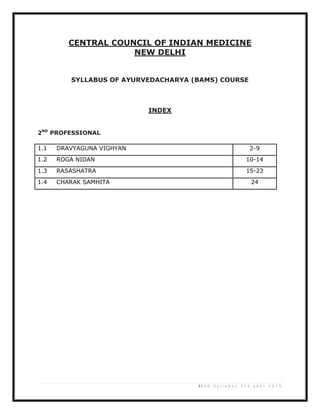
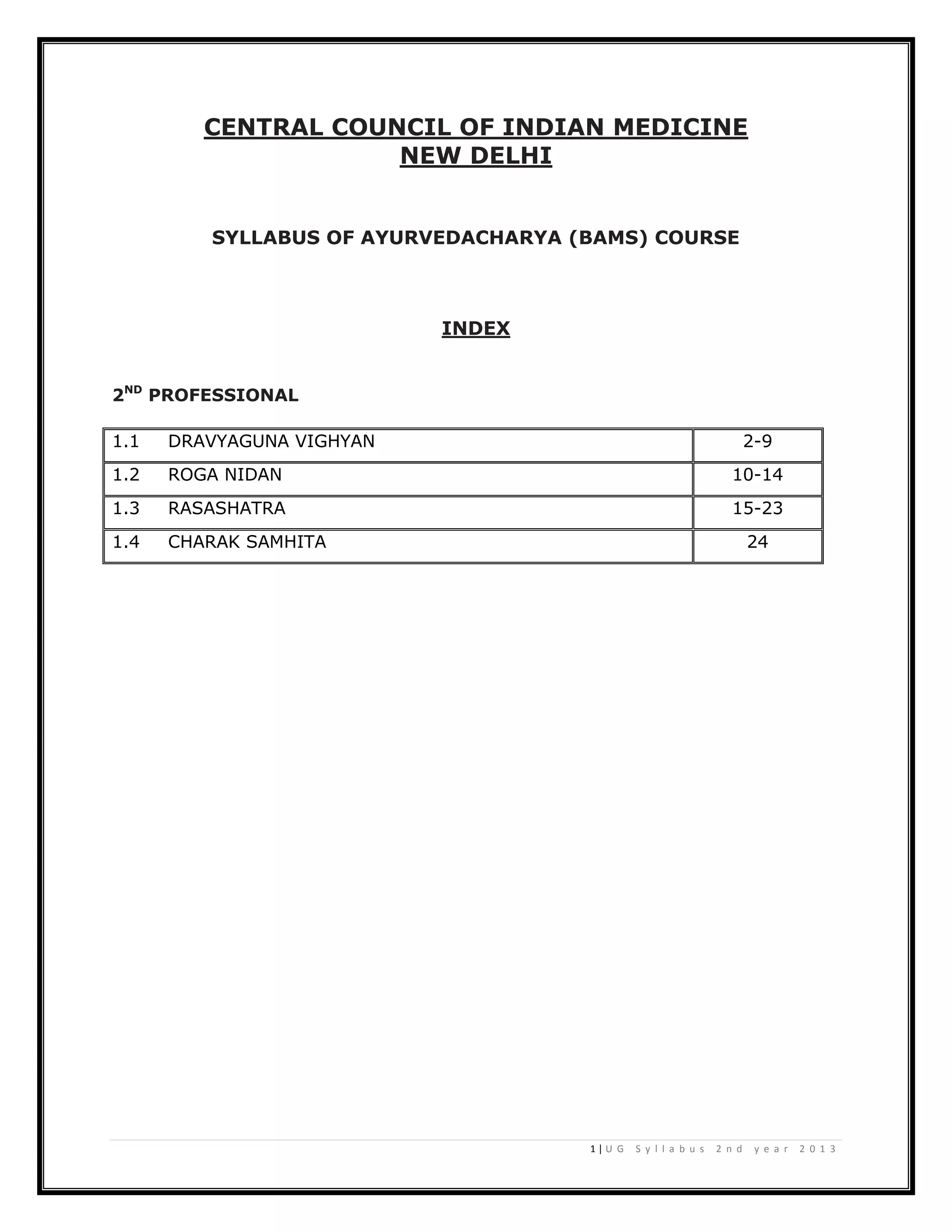
CENTRAL COUNCIL OF INDIAN MEDICINE
NEW DELHI
SYLLABUS OF AYURVEDACHARYA (BAMS) COURSE
INDEX
2ND
PROFESSIONAL
1.1 DRAVYAGUNA VIGHYAN 2-9
1.2 ROGA NIDAN 10-14
1.3 RASASHATRA 15-23
1.4 CHARAK SAMHITA 24
2 | U G S y l l a b u s 2 n d y e a r 2 0 1 3
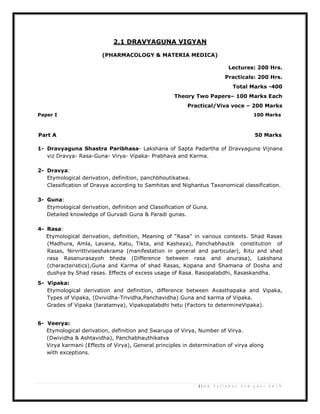
2.1 DRAVYAGUNA VIGYAN
(PHARMACOLOGY & MATERIA MEDICA)
Lectures: 200 Hrs.
Practicals: 200 Hrs.
Total Marks -400
Theory Two Papers– 100 Marks Each
Practical/Viva voce – 200 Marks
Paper I 100 Marks
Part A 50 Marks
1- Dravyaguna Shastra Paribhasa- Lakshana of Sapta Padartha of Dravyaguna Vijnana
viz Dravya- Rasa-Guna- Virya- Vipaka- Prabhava and Karma.
2- Dravya:
Etymological derivation, definition, panchbhoutikatwa.
Classification of Dravya according to Samhitas and Nighantus Taxonomical classification.
3- Guna:
Etymological derivation, definition and Classification of Guna.
Detailed knowledge of Gurvadi Guna & Paradi gunas.
4- Rasa:
Etymological derivation, definition, Meaning of “Rasa” in various contexts. Shad Rasas
(Madhura, Amla, Lavana, Katu, Tikta, and Kashaya), Panchabhautik constitution of
Rasas, Nirvrittiviseshakrama (manifestation in general and particular), Ritu and shad
rasa Rasanurasayoh bheda (Difference between rasa and anurasa), Lakshana
(characteristics),Guna and Karma of shad Rasas, Kopana and Shamana of Dosha and
dushya by Shad rasas. Effects of excess usage of Rasa. Rasopalabdhi, Rasaskandha.
5- Vipaka:
Etymological derivation and definition, difference between Avasthapaka and Vipaka,
Types of Vipaka, (Dvividha-Trividha,Panchavidha) Guna and karma of Vipaka.
Grades of Vipaka (taratamya), Vipakopalabdhi hetu (Factors to determineVipaka).
6- Veerya:
Etymological derivation, definition and Swarupa of Virya, Number of Virya.
(Dwividha & Ashtavidha), Panchabhauthikatva
Virya karmani (Effects of Virya), General principles in determination of virya along
with exceptions.
3 | U G S y l l a b u s 2 n d y e a r 2 0 1 3
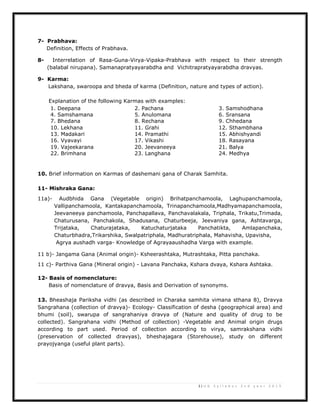
7- Prabhava:
Definition, Effects of Prabhava.
8- Interrelation of Rasa-Guna-Virya-Vipaka-Prabhava with respect to their strength
(balabal nirupana). Samanapratyayarabdha and Vichitrapratyayarabdha dravyas.
9- Karma:
Lakshana, swaroopa and bheda of karma (Definition, nature and types of action).
Explanation of the following Karmas with examples:
1. Deepana 2. Pachana 3. Samshodhana
4. Samshamana 5. Anulomana 6. Sransana
7. Bhedana 8. Rechana 9. Chhedana
10. Lekhana 11. Grahi 12. Sthambhana
13. Madakari 14. Pramathi 15. Abhishyandi
16. Vyavayi 17. Vikashi 18. Rasayana
19. Vajeekarana 20. Jeevaneeya 21. Balya
22. Brimhana 23. Langhana 24. Medhya
10. Brief information on Karmas of dashemani gana of Charak Samhita.
11- Mishraka Gana:
11a)- Audbhida Gana (Vegetable origin) Brihatpanchamoola, Laghupanchamoola,
Vallipanchamoola, Kantakapanchamoola, Trinapanchamoola,Madhyamapanchamoola,
Jeevaneeya panchamoola, Panchapallava, Panchavalakala, Triphala, Trikatu,Trimada,
Chaturusana, Panchakola, Shadusana, Chaturbeeja, Jeevaniya gana, Ashtavarga,
Trijataka, Chaturajataka, Katuchaturjataka Panchatikta, Amlapanchaka,
Chaturbhadra,Trikarshika, Swalpatriphala, Madhuratriphala, Mahavisha, Upavisha,
Agrya aushadh varga- Knowledge of Agrayaaushadha Varga with example.
11 b)- Jangama Gana (Animal origin)- Ksheerashtaka, Mutrashtaka, Pitta panchaka.
11 c)- Parthiva Gana (Mineral origin) - Lavana Panchaka, Kshara dvaya, Kshara Ashtaka.
12- Basis of nomenclature:
Basis of nomenclature of dravya, Basis and Derivation of synonyms.
13. Bheashaja Pariksha vidhi (as described in Charaka samhita vimana sthana 8), Dravya
Sangrahana (collection of dravya)- Ecology- Classification of desha (geographical area) and
bhumi (soil), swarupa of sangrahaniya dravya of (Nature and quality of drug to be
collected). Sangrahana vidhi (Method of collection) -Vegetable and Animal origin drugs
according to part used. Period of collection according to virya, samrakshana vidhi
(preservation of collected dravyas), bheshajagara (Storehouse), study on different
prayojyanga (useful plant parts).
4 | U G S y l l a b u s 2 n d y e a r 2 0 1 3
Part B 50 Marks
(I) 20 Marks
14 a) Concept of dravya shodhan (purification of dravya).
14 b) Brief knowledge of Apamishran (adulterants)
14 c) Concept of Abhava pratinidhi dravya (substitutes)
15- Prashasta bheshaja (ideal drug), plant extracts. Concept of viruddha Dravya
(incompatibility of the dravya).
16- Introduction to Nighantu Vigyan - Dhanwantari Nighantu, Bhavaprakashanighantu,
Rajanighantu.
17- Brief knowledge of cultivation, conservation of medicinal plants and information about
endangered species.
(II) 30 Marks
18. - Introduction, Definition & scope of Pharmacology and Principles of general
Pharmacology. Brief Knowledge about pharmacology of the following - Anaesthetics, CNS
depressants, Sedatives, Hypnotics, Tranquilisers, Antipyretics, Analgesics, Antiepileptics,
Antihypertensive, Antianginal, Antiplatelet, Hypolipidaemic, Haemopoetic, Coagulants,
Bronchodialators, Aerosols/ Inhalants, Expectorants, Digestants, Carminatives, Antacids,
Antiulcer, Laxatives, Antidiarrhoeals, Antiemetic, Hepatoprotective, Diuretic, Antidiuretic,
Lithotriptic, Antiinflammatory, Hormonal therapy, Antiobesity, Antidiabetic, Antithyroid,
Oxytocic. Galactagogues, Contraceptives, Styptics, Antihistamines, Antimicrobial,
Antibiotics, Antimalarial, Amoebicidal, Antifilarial, Anthelmentic, Antifungal,Vitamins,
Minerals,Water imbalance and IV fluids, Vaccines, antivenom, antirabbies serum, Local anti
septics, drugs in ophthalmic practice, Anti cancer drugs and immunomodulators.
Paper II 100 Marks
Part A 70 marks
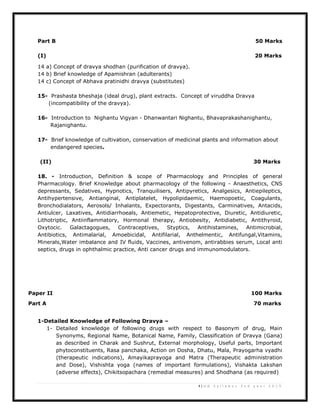
1-Detailed Knowledge of Following Dravya –
1- Detailed knowledge of following drugs with respect to Basonym of drug, Main
Synonyms, Regional Name, Botanical Name, Family, Classification of Dravya (Gana)
as described in Charak and Sushrut, External morphology, Useful parts, Important
phytoconstituents, Rasa panchaka, Action on Dosha, Dhatu, Mala, Prayogarha vyadhi
(therapeutic indications), Amayikaprayoga and Matra (Therapeutic administration
and Dose), Vishishta yoga (names of important formulations), Vishakta Lakshan
(adverse effects), Chikitsopachara (remedial measures) and Shodhana (as required)
5 | U G S y l l a b u s 2 n d y e a r 2 0 1 3
[Alphabetical order and Botanical names to all the drugs are to be added]
Agaru Guggulu Pashanabheda
Agnimantha Haridradvaya Patala
Agnimantha Haritaki Pippali-Pippalimula
Ahiphena Hingu Prishniparni
Amalaki Jambu Punarnava
Apamarga Jatamansi Pushkarmoola
Aragvadha Jatiphal Rasna
Aragvadha Jeerakadvaya Rasona
Ardraka-Sunti Jyotishmati Rohitaka
Arjuna Kalamegha Saireyaka
Arjuna Kampillaka Sarivadvaya
Arkadvaya Kanchanara Sarpagandha
Ashvagandha Kantakari Shalaparni
Asoka Kapikacchu Shallaki
Ativisha Karkatakshringi Shalmali
Bakuchi Karpura Shankhapushpi
Baladvayam. Katuki Shatavari
Bhallataka Khadira Shigru
Bharangi Kiratatikta Shirisha
Bhrungaraj Kumari Shyonaka
Bibhitaka Kumkum Kesara Talisa Patra
Bijak/ Vijaysar Kupilu Tila
Bilva Kushta Trivrut
Brahmi Kutaja Tulasi
Bruhati Lavanga Tvak
Chandanadvaya, Lodhra Ushira
Chitraka Madanaphala Vacha
Dadima Mandukaparni. Varahi
Devadaru Manjishtha Varahi
Dhataki Maricha Varuna
Durva Musta Vasa
Eladvayam Nagakeshara Vatsanabha
Eranda Nimba Vidanga
Gambhari Nirgundi Vidari
Gokshura Palasha Yastimadhu
Guduchi Parpata Yavani
Part B-
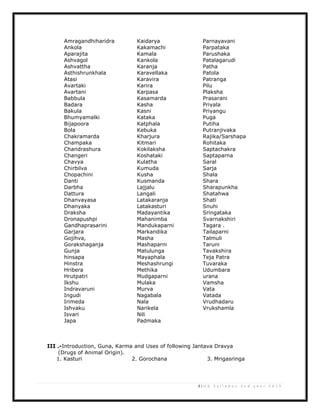
II- Brief Knowledge of following dravyas with Respect to Sanskrit Name, Botanical Name,
Family, Habit (Samanya Swarupa), Parts Used and Indications.
Agastya Jati Palandu
Ajamoda Jayapala Parasika Yavani
Akarkarabh Jeevanti Parijata
Amlavetasa Kadali, Parisha
Amra Kadamba Parnabija
6 | U G S y l l a b u s 2 n d y e a r 2 0 1 3
Amragandhiharidra Kaidarya Parnayavani
Ankola Kakamachi Parpataka
Aparajita Kamala Parushaka
Ashvagol Kankola Patalagarudi
Ashvattha Karanja Patha
Asthishrunkhala Karavellaka Patola
Atasi Karavira Patranga
Avartaki Karira Pilu
Avartani Karpasa Plaksha
Babbula Kasamarda Prasarani
Badara Kasha Priyala
Bakula Kasni Priyangu
Bhumyamalki Kataka Puga
Bijapoora Katphala Putiha
Bola Kebuka Putranjivaka
Chakramarda Kharjura Rajika/Sarshapa
Champaka Kitmari Rohitaka
Chandrashura Kokilaksha Saptachakra
Changeri Koshataki Saptaparna
Chavya Kulatha Saral
Chirbilva Kumuda Sarja
Chopachini Kusha Shala
Danti Kusmanda Shara
Darbha Lajjalu Sharapunkha
Dattura Langali Shatahwa
Dhanvayasa Latakaranja Shati
Dhanyaka Latakasturi Snuhi
Draksha Madayantika Sringataka
Dronapushpi Mahanimba Svarnakshiri
Gandhaprasarini Mandukaparni Tagara .
Garjara Markandika Tailaparni
Gojihva, Masha Talmuli
Gorakshaganja Mashaparni Taruni
Gunja Matulunga Tavakshira
hinsapa Mayaphala Teja Patra
Hinstra Meshashrungi Tuvaraka
Hribera Methika Udumbara
Hrutpatri Mudgaparni urana
Ikshu Mulaka Vamsha
Indravaruni Murva Vata
Ingudi Nagabala Vatada
Irimeda Nala Vrudhadaru
Ishvaku Narikela Vrukshamla
Isvari Nili
Japa Padmaka
III .-Introduction, Guna, Karma and Uses of following Jantava Dravya
(Drugs of Animal Origin).
1. Kasturi 2. Gorochana 3. Mrigasringa
7 | U G S y l l a b u s 2 n d y e a r 2 0 1 3
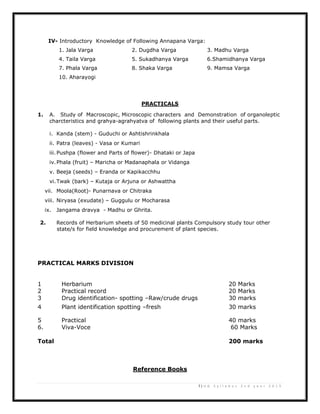
IV- Introductory Knowledge of Following Annapana Varga:
1. Jala Varga 2. Dugdha Varga 3. Madhu Varga
4. Taila Varga 5. Sukadhanya Varga 6.Shamidhanya Varga
7. Phala Varga 8. Shaka Varga 9. Mamsa Varga
10. Aharayogi
PRACTICALS
1. A. Study of Macroscopic, Microscopic characters and Demonstration of organoleptic
charcteristics and grahya-agrahyatva of following plants and their useful parts.
i. Kanda (stem) - Guduchi or Ashtishrinkhala
ii. Patra (leaves) - Vasa or Kumari
iii.Pushpa (flower and Parts of flower)- Dhataki or Japa
iv.Phala (fruit) – Maricha or Madanaphala or Vidanga
v. Beeja (seeds) – Eranda or Kapikacchhu
vi.Twak (bark) – Kutaja or Arjuna or Ashwattha
vii. Moola(Root)- Punarnava or Chitraka
viii. Niryasa (exudate) – Guggulu or Mocharasa
ix. Jangama dravya - Madhu or Ghrita.
2. Records of Herbarium sheets of 50 medicinal plants Compulsory study tour other
state/s for field knowledge and procurement of plant species.
PRACTICAL MARKS DIVISION
1 Herbarium 20 Marks
2 Practical record 20 Marks
3 Drug identification- spotting –Raw/crude drugs 30 marks
4 Plant identification spotting –fresh 30 marks
5 Practical 40 marks
6. Viva-Voce 60 Marks
Total 200 marks
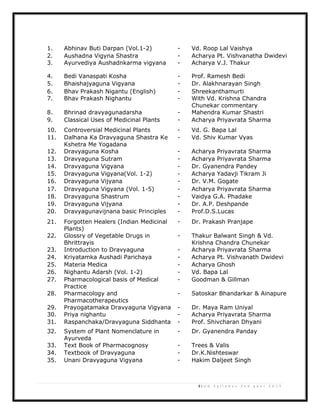
Reference Books
8 | U G S y l l a b u s 2 n d y e a r 2 0 1 3
1. Abhinav Buti Darpan (Vol.1-2) - Vd. Roop Lal Vaishya
2. Aushadna Vigyna Shastra - Acharya Pt. Vishvanatha Dwidevi
3. Ayurvediya Aushadnkarma vigyana - Acharya V.J. Thakur
4. Bedi Vanaspati Kosha - Prof. Ramesh Bedi
5. Bhaishajyaguna Vigyana - Dr. Alakhnarayan Singh
6. Bhav Prakash Nigantu (English) - Shreekanthamurti
7. Bhav Prakash Nighantu - With Vd. Krishna Chandra
Chunekar commentary
8. Bhrinad dravyagunadarsha - Mahendra Kumar Shastri
9. Classical Uses of Medicinal Plants - Acharya Priyavrata Sharma
10. Controversial Medicinal Plants - Vd. G. Bapa Lal
11. Dalhana Ka Dravyaguna Shastra Ke
Kshetra Me Yogadana
- Vd. Shiv Kumar Vyas
12. Dravyaguna Kosha - Acharya Priyavrata Sharma
13. Dravyaguna Sutram - Acharya Priyavrata Sharma
14. Dravyaguna Vigyana - Dr. Gyanendra Pandey
15. Dravyaguna Vigyana(Vol. 1-2) - Acharya Yadavji Tikram Ji
16. Dravyaguna Vijyana - Dr. V.M. Gogate
17. Dravyaguna Vigyana (Vol. 1-5) - Acharya Priyavrata Sharma
18. Dravyaguna Shastrum - Vaidya G.A. Phadake
19. Dravyaguna Vijyana - Dr. A.P. Deshpande
20. Dravyagunavijnana basic Principles - Prof.D.S.Lucas
21. Forgotten Healers (Indian Medicinal
Plants)
- Dr. Prakash Pranjape
22. Glossry of Vegetable Drugs in
Bhrittrayis
- Thakur Balwant Singh & Vd.
Krishna Chandra Chunekar
23. Introduction to Dravyaguna - Acharya Priyavrata Sharma
24. Kriyatamka Aushadi Parichaya - Acharya Pt. Vishvanath Dwidevi
25. Materia Medica - Acharya Ghosh
26. Nighantu Adarsh (Vol. 1-2) - Vd. Bapa Lal
27. Pharmacological basis of Medical
Practice
- Goodman & Gillman
28. Pharmacology and
Pharmacotherapeutics
- Satoskar Bhandarkar & Ainapure
29. Prayogatamaka Dravyaguna Vigyana - Dr. Maya Ram Uniyal
30. Priya nighantu - Acharya Priyavrata Sharma
31. Raspanchaka/Dravyaguna Siddhanta - Prof. Shivcharan Dhyani
32. System of Plant Nomenclature in
Ayurveda
- Dr. Gyanendra Panday
33. Text Book of Pharmacognosy - Trees & Valis
34. Textbook of Dravyaguna - Dr.K.Nishteswar
35. Unani Dravyaguna Vigyana - Hakim Daljeet Singh
9 | U G S y l l a b u s 2 n d y e a r 2 0 1 3
36. Useful parts of Charaka, Sushurut,
and Vagbhata.
-
37. Uttarakand Ki Vanaspatiya - Dr. Gyanendra Pandey
38. Vanoaushadi Darshika - Thakur Balwant Singh
39. Vanoaushadi Nidarshika - Dr. Ram Sushil Singh
40. Vedic Vanaspatiyan - Dr. Dinesh Chandra Sharma
*****
***
*
10 | U G S y l l a b u s 2 n d y e a r 2 0 1 3
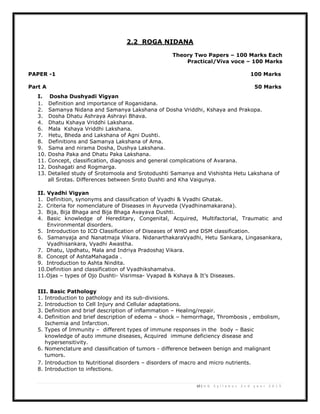
2.2 ROGA NIDANA
Theory Two Papers – 100 Marks Each
Practical/Viva voce – 100 Marks
PAPER -1 100 Marks
Part A 50 Marks
I. Dosha Dushyadi Vigyan
1. Definition and importance of Roganidana.
2. Samanya Nidana and Samanya Lakshana of Dosha Vriddhi, Kshaya and Prakopa.
3. Dosha Dhatu Ashraya Ashrayi Bhava.
4. Dhatu Kshaya Vriddhi Lakshana.
6. Mala Kshaya Vriddhi Lakshana.
7. Hetu, Bheda and Lakshana of Agni Dushti.
8. Definitions and Samanya Lakshana of Ama.
9. Sama and nirama Dosha, Dushya Lakshana.
10. Dosha Paka and Dhatu Paka Lakshana.
11. Concept, classification, diagnosis and general complications of Avarana.
12. Doshagati and Rogmarga.
13. Detailed study of Srotomoola and Srotodushti Samanya and Vishishta Hetu Lakshana of
all Srotas. Differences between Sroto Dushti and Kha Vaigunya.
II. Vyadhi Vigyan
1. Definition, synonyms and classification of Vyadhi & Vyadhi Ghatak.
2. Criteria for nomenclature of Diseases in Ayurveda (Vyadhinamakarana).
3. Bija, Bija Bhaga and Bija Bhaga Avayava Dushti.
4. Basic knowledge of Hereditary, Congenital, Acquired, Multifactorial, Traumatic and
Environmental disorders.
5. Introduction to ICD Classification of Diseases of WHO and DSM classification.
6. Samanyaja and Nanatmaja Vikara. NidanarthakaraVyadhi, Hetu Sankara, Lingasankara,
Vyadhisankara, Vyadhi Awastha.
7. Dhatu, Updhatu, Mala and Indriya Pradoshaj Vikara.
8. Concept of AshtaMahagada .
9. Introduction to Ashta Nindita.
10.Definition and classification of Vyadhikshamatva.
11.Ojas – types of Ojo Dushti- Visrimsa- Vyapad & Kshaya & It’s Diseases.
III. Basic Pathology
1. Introduction to pathology and its sub-divisions.
2. Introduction to Cell Injury and Cellular adaptations.
3. Definition and brief description of inflammation – Healing/repair.
4. Definition and brief description of edema – shock – hemorrhage, Thrombosis , embolism,
Ischemia and Infarction.
5. Types of Immunity – different types of immune responses in the body – Basic
knowledge of auto immune diseases, Acquired immune deficiency disease and
hypersensitivity.
6. Nomenclature and classification of tumors - difference between benign and malignant
tumors.
7. Introduction to Nutritional disorders – disorders of macro and micro nutrients.
8. Introduction to infections.
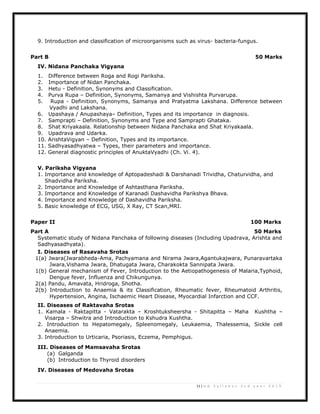
11 | U G S y l l a b u s 2 n d y e a r 2 0 1 3
9. Introduction and classification of microorganisms such as virus- bacteria-fungus.
Part B 50 Marks
IV. Nidana Panchaka Vigyana
1. Difference between Roga and Rogi Pariksha.
2. Importance of Nidan Panchaka.
3. Hetu - Definition, Synonyms and Classification.
4. Purva Rupa – Definition, Synonyms, Samanya and Vishishta Purvarupa.
5. Rupa - Definition, Synonyms, Samanya and Pratyatma Lakshana. Difference between
Vyadhi and Lakshana.
6. Upashaya / Anupashaya– Definition, Types and its importance in diagnosis.
7. Samprapti – Definition, Synonyms and Type and Samprapti Ghataka.
8. Shat Kriyakaala. Relationship between Nidana Panchaka and Shat Kriyakaala.
9. Upadrava and Udarka.
10. ArishtaVigyan – Definition, Types and its importance.
11. Sadhyasadhyatwa – Types, their parameters and importance.
12. General diagnostic principles of AnuktaVyadhi (Ch. Vi. 4).
V. Pariksha Vigyana
1. Importance and knowledge of Aptopadeshadi & Darshanadi Trividha, Chaturvidha, and
Shadvidha Pariksha.
2. Importance and Knowledge of Ashtasthana Pariksha.
3. Importance and Knowledge of Karanadi Dashavidha Parikshya Bhava.
4. Importance and Knowledge of Dashavidha Pariksha.
5. Basic knowledge of ECG, USG, X Ray, CT Scan,MRI.
Paper II 100 Marks
Part A 50 Marks
Systematic study of Nidana Panchaka of following diseases (Including Upadrava, Arishta and
Sadhyasadhyata).
I. Diseases of Rasavaha Srotas
1(a) Jwara(Jwarabheda-Ama, Pachyamana and Nirama Jwara,Agantukajwara, Punaravartaka
Jwara,Vishama Jwara, Dhatugata Jwara, Charakokta Sannipata Jwara.
1(b) General mechanism of Fever, Introduction to the Aetiopathogenesis of Malaria,Typhoid,
Dengue fever, Influenza and Chikungunya.
2(a) Pandu, Amavata, Hridroga, Shotha.
2(b) Introduction to Anaemia & its Classification, Rheumatic fever, Rheumatoid Arthritis,
Hypertension, Angina, Ischaemic Heart Disease, Myocardial Infarction and CCF.
II. Diseases of Raktavaha Srotas
1. Kamala - Raktapitta - Vatarakta – Kroshtuksheersha - Shitapitta – Maha Kushtha –
Visarpa – Shwitra and Introduction to Kshudra Kushtha.
2. Introduction to Hepatomegaly, Spleenomegaly, Leukaemia, Thalessemia, Sickle cell
Anaemia.
3. Introduction to Urticaria, Psoriasis, Eczema, Pemphigus.
III. Diseases of Mamsavaha Srotas
(a) Galganda
(b) Introduction to Thyroid disorders
IV. Diseases of Medovaha Srotas
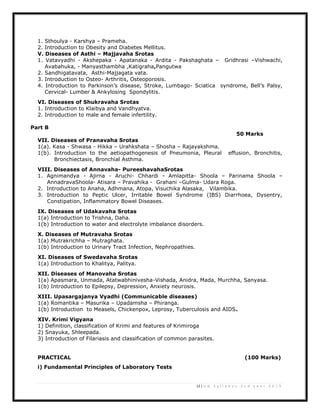
12 | U G S y l l a b u s 2 n d y e a r 2 0 1 3
1. Sthoulya - Karshya – Prameha.
2. Introduction to Obesity and Diabetes Mellitus.
V. Diseases of Asthi – Majjavaha Srotas
1. Vatavyadhi - Akshepaka - Apatanaka - Ardita - Pakshaghata – Gridhrasi –Vishwachi,
Avabahuka, - Manyasthambha ,Katigraha,Pangutwa
2. Sandhigatavata, Asthi-Majjagata vata.
3. Introduction to Osteo- Arthritis, Osteoporosis.
4. Introduction to Parkinson’s disease, Stroke, Lumbago- Sciatica syndrome, Bell’s Palsy,
Cervical- Lumber & Ankylosing Spondylitis.
VI. Diseases of Shukravaha Srotas
1. Introduction to Klaibya and Vandhyatva.
2. Introduction to male and female infertility.
Part B
50 Marks
VII. Diseases of Pranavaha Srotas
1(a). Kasa - Shwasa - Hikka – Urahkshata – Shosha – Rajayakshma.
1(b). Introduction to the aetiopathogenesis of Pneumonia, Pleural effusion, Bronchitis,
Bronchiectasis, Bronchial Asthma.
VIII. Diseases of Annavaha- PureeshavahaSrotas
1. Agnimandya - Ajirna - Aruchi- Chhardi - Amlapitta- Shoola – Parinama Shoola –
AnnadravaShoola- Atisara – Pravahika - Grahani –Gulma- Udara Roga.
2. Introduction to Anaha, Adhmana, Atopa, Visuchika Alasaka, Vilambika.
3. Introduction to Peptic Ulcer, Irritable Bowel Syndrome (IBS) Diarrhoea, Dysentry,
Constipation, Inflammatory Bowel Diseases.
IX. Diseases of Udakavaha Srotas
1(a) Introduction to Trishna, Daha.
1(b) Introduction to water and electrolyte imbalance disorders.
X. Diseases of Mutravaha Srotas
1(a) Mutrakrichha – Mutraghata.
1(b) Introduction to Urinary Tract Infection, Nephropathies.
XI. Diseases of Swedavaha Srotas
1(a) Introduction to Khalitya, Palitya.
XII. Diseases of Manovaha Srotas
1(a) Apasmara, Unmada, Atatwabhinivesha-Vishada, Anidra, Mada, Murchha, Sanyasa.
1(b) Introduction to Epilepsy, Depression, Anxiety neurosis.
XIII. Upasargajanya Vyadhi (Communicable diseases)
1(a) Romantika – Masurika – Upadamsha – Phiranga.
1(b) Introduction to Measels, Chickenpox, Leprosy, Tuberculosis and AIDS.
XIV. Krimi Vigyana
1) Definition, classification of Krimi and features of Krimiroga
2) Snayuka, Shleepada.
3) Introduction of Filariasis and classification of common parasites.
PRACTICAL (100 Marks)
i) Fundamental Principles of Laboratory Tests
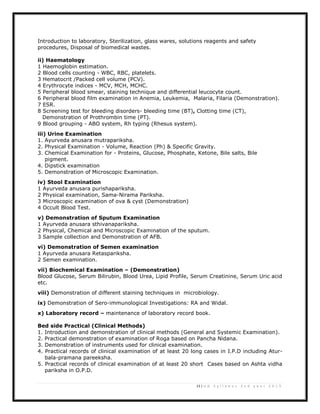
13 | U G S y l l a b u s 2 n d y e a r 2 0 1 3
Introduction to laboratory, Sterilization, glass wares, solutions reagents and safety
procedures, Disposal of biomedical wastes.
ii) Haematology
1 Haemoglobin estimation.
2 Blood cells counting - WBC, RBC, platelets.
3 Hematocrit /Packed cell volume (PCV).
4 Erythrocyte indices - MCV, MCH, MCHC.
5 Peripheral blood smear, staining technique and differential leucocyte count.
6 Peripheral blood film examination in Anemia, Leukemia, Malaria, Filaria (Demonstration).
7 ESR.
8 Screening test for bleeding disorders- bleeding time (BT), Clotting time (CT),
Demonstration of Prothrombin time (PT).
9 Blood grouping - ABO system, Rh typing (Rhesus system).
iii) Urine Examination
1. Ayurveda anusara mutrapariksha.
2. Physical Examination - Volume, Reaction (Ph) & Specific Gravity.
3. Chemical Examination for - Proteins, Glucose, Phosphate, Ketone, Bile salts, Bile
pigment.
4. Dipstick examination
5. Demonstration of Microscopic Examination.
iv) Stool Examination
1 Ayurveda anusara purishapariksha.
2 Physical examination, Sama-Nirama Pariksha.
3 Microscopic examination of ova & cyst (Demonstration)
4 Occult Blood Test.
v) Demonstration of Sputum Examination
1 Ayurveda anusara sthivanapariksha.
2 Physical, Chemical and Microscopic Examination of the sputum.
3 Sample collection and Demonstration of AFB.
vi) Demonstration of Semen examination
1 Ayurveda anusara Retaspariksha.
2 Semen examination.
vii) Biochemical Examination – (Demonstration)
Blood Glucose, Serum Bilirubin, Blood Urea, Lipid Profile, Serum Creatinine, Serum Uric acid
etc.
viii) Demonstration of different staining techniques in microbiology.
ix) Demonstration of Sero-immunological Investigations: RA and Widal.
x) Laboratory record – maintenance of laboratory record book.
Bed side Practical (Clinical Methods)
1. Introduction and demonstration of clinical methods (General and Systemic Examination).
2. Practical demonstration of examination of Roga based on Pancha Nidana.
3. Demonstration of instruments used for clinical examination.
4. Practical records of clinical examination of at least 20 long cases in I.P.D including Atur-
bala-pramana pareeksha.
5. Practical records of clinical examination of at least 20 short Cases based on Ashta vidha
pariksha in O.P.D.
14 | U G S y l l a b u s 2 n d y e a r 2 0 1 3
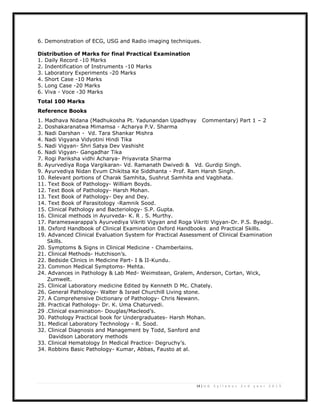
6. Demonstration of ECG, USG and Radio imaging techniques.
Distribution of Marks for final Practical Examination
1. Daily Record -10 Marks
2. Indentification of Instruments -10 Marks
3. Laboratory Experiments -20 Marks
4. Short Case -10 Marks
5. Long Case -20 Marks
6. Viva - Voce -30 Marks
Total 100 Marks
Reference Books
1. Madhava Nidana (Madhukosha Pt. Yadunandan Upadhyay Commentary) Part 1 – 2
2. Doshakaranatwa Mimamsa - Acharya P.V. Sharma
3. Nadi Darshan - Vd. Tara Shankar Mishra
4. Nadi Vigyana Vidyotini Hindi Tika
5. Nadi Vigyan- Shri Satya Dev Vashisht
6. Nadi Vigyan- Gangadhar Tika
7. Rogi Pariksha vidhi Acharya- Priyavrata Sharma
8. Ayurvediya Roga Vargikaran- Vd. Ramanath Dwivedi & Vd. Gurdip Singh.
9. Ayurvediya Nidan Evum Chikitsa Ke Siddhanta - Prof. Ram Harsh Singh.
10. Relevant portions of Charak Samhita, Sushrut Samhita and Vagbhata.
11. Text Book of Pathology- William Boyds.
12. Text Book of Pathology- Harsh Mohan.
13. Text Book of Pathology- Dey and Dey.
14. Text Book of Parasitology -Ramnik Sood.
15. Clinical Pathology and Bacteriology- S.P. Gupta.
16. Clinical methods in Ayurveda- K. R . S. Murthy.
17. Parameswarappa’s Ayurvediya Vikriti Vigyan and Roga Vikriti Vigyan-Dr. P.S. Byadgi.
18. Oxford Handbook of Clinical Examination Oxford Handbooks and Practical Skills.
19. Advanced Clinical Evaluation System for Practical Assessment of Clinical Examination
Skills.
20. Symptoms & Signs in Clinical Medicine - Chamberlains.
21. Clinical Methods- Hutchison’s.
22. Bedside Clinics in Medicine Part- I & II-Kundu.
23. Common Medical Symptoms- Mehta.
24. Advances in Pathology & Lab Med- Weimstean, Gralem, Anderson, Cortan, Wick,
Zumwelt.
25. Clinical Laboratory medicine Edited by Kenneth D Mc. Chately.
26. General Pathology- Walter & Israel Churchill Living stone.
27. A Comprehensive Dictionary of Pathology- Chris Newann.
28. Practical Pathology- Dr. K. Uma Chaturvedi.
29 .Clinical examination- Douglas/Macleod’s.
30. Pathology Practical book for Undergraduates- Harsh Mohan.
31. Medical Laboratory Technology - R. Sood.
32. Clinical Diagnosis and Management by Todd, Sanford and
Davidson Laboratory methods
33. Clinical Hematology In Medical Practice- Degruchy’s.
34. Robbins Basic Pathology- Kumar, Abbas, Fausto at al.
15 | U G S y l l a b u s 2 n d y e a r 2 0 1 3
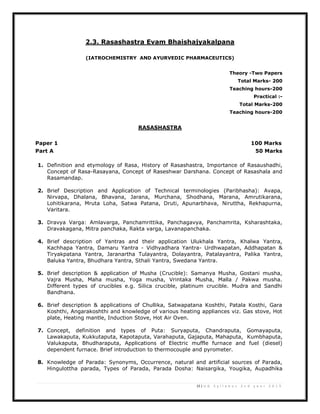
2.3. Rasashastra Evam Bhaishajyakalpana
(IATROCHEMISTRY AND AYURVEDIC PHARMACEUTICS)
Theory -Two Papers
Total Marks- 200
Teaching hours-200
Practical :-
Total Marks-200
Teaching hours-200
RASASHASTRA
Paper 1 100 Marks
Part A 50 Marks
1. Definition and etymology of Rasa, History of Rasashastra, Importance of Rasaushadhi,
Concept of Rasa-Rasayana, Concept of Raseshwar Darshana. Concept of Rasashala and
Rasamandap.
2. Brief Description and Application of Technical terminologies (Paribhasha): Avapa,
Nirvapa, Dhalana, Bhavana, Jarana, Murchana, Shodhana, Marana, Amrutikarana,
Lohitikarana, Mruta Loha, Satwa Patana, Druti, Apunarbhava, Niruttha, Rekhapurna,
Varitara.
3. Dravya Varga: Amlavarga, Panchamrittika, Panchagavya, Panchamrita, Ksharashtaka,
Dravakagana, Mitra panchaka, Rakta varga, Lavanapanchaka.
4. Brief description of Yantras and their application Ulukhala Yantra, Khalwa Yantra,
Kachhapa Yantra, Damaru Yantra - Vidhyadhara Yantra- Urdhwapatan, Addhapatan &
Tiryakpatana Yantra, Jaranartha Tulayantra, Dolayantra, Patalayantra, Palika Yantra,
Baluka Yantra, Bhudhara Yantra, Sthali Yantra, Swedana Yantra.
5. Brief description & application of Musha (Crucible): Samanya Musha, Gostani musha,
Vajra Musha, Maha musha, Yoga musha, Vrintaka Musha, Malla / Pakwa musha.
Different types of crucibles e.g. Silica crucible, platinum crucible. Mudra and Sandhi
Bandhana.
6. Brief description & applications of Chullika, Satwapatana Koshthi, Patala Kosthi, Gara
Koshthi, Angarakoshthi and knowledge of various heating appliances viz. Gas stove, Hot
plate, Heating mantle, Induction Stove, Hot Air Oven.
7. Concept, definition and types of Puta: Suryaputa, Chandraputa, Gomayaputa,
Lawakaputa, Kukkutaputa, Kapotaputa, Varahaputa, Gajaputa, Mahaputa, Kumbhaputa,
Valukaputa, Bhudharaputa, Applications of Electric muffle furnace and fuel (diesel)
dependent furnace. Brief introduction to thermocouple and pyrometer.
8. Knowledge of Parada: Synonyms, Occurrence, natural and artificial sources of Parada,
Hingulottha parada, Types of Parada, Parada Dosha: Naisargika, Yougika, Aupadhika
16 | U G S y l l a b u s 2 n d y e a r 2 0 1 3
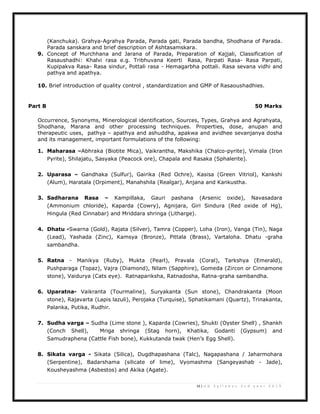
(Kanchuka). Grahya-Agrahya Parada, Parada gati, Parada bandha, Shodhana of Parada.
Parada sanskara and brief description of Ashtasamskara.
9. Concept of Murchhana and Jarana of Parada, Preparation of Kajjali, Classification of
Rasaushadhi: Khalvi rasa e.g. Tribhuvana Keerti Rasa, Parpati Rasa- Rasa Parpati,
Kupipakva Rasa- Rasa sindur, Pottali rasa - Hemagarbha pottali. Rasa sevana vidhi and
pathya and apathya.
10. Brief introduction of quality control , standardization and GMP of Rasaoushadhies.
Part B 50 Marks
Occurrence, Synonyms, Minerological identification, Sources, Types, Grahya and Agrahyata,
Shodhana, Marana and other processing techniques. Properties, dose, anupan and
therapeutic uses, pathya – apathya and ashuddha, apakwa and avidhee sevanjanya dosha
and its management, important formulations of the following:
1. Maharasa –Abhraka (Biotite Mica), Vaikrantha, Makshika (Chalco-pyrite), Vimala (Iron
Pyrite), Shilajatu, Sasyaka (Peacock ore), Chapala and Rasaka (Sphalerite).
2. Uparasa – Gandhaka (Sulfur), Gairika (Red Ochre), Kasisa (Green Vitriol), Kankshi
(Alum), Haratala (Orpiment), Manahshila (Realgar), Anjana and Kankustha.
3. Sadharana Rasa – Kampillaka, Gauri pashana (Arsenic oxide), Navasadara
(Ammonium chloride), Kaparda (Cowry), Agnijara, Giri Sindura (Red oxide of Hg),
Hingula (Red Cinnabar) and Mriddara shringa (Litharge).
4. Dhatu -Swarna (Gold), Rajata (Silver), Tamra (Copper), Loha (Iron), Vanga (Tin), Naga
(Lead), Yashada (Zinc), Kamsya (Bronze), Pittala (Brass), Vartaloha. Dhatu -graha
sambandha.
5. Ratna - Manikya (Ruby), Mukta (Pearl), Pravala (Coral), Tarkshya (Emerald),
Pushparaga (Topaz), Vajra (Diamond), Nilam (Sapphire), Gomeda (Zircon or Cinnamone
stone), Vaidurya (Cats eye). Ratnapariksha, Ratnadosha, Ratna-graha sambandha.
6. Uparatna- Vaikranta (Tourmaline), Suryakanta (Sun stone), Chandrakanta (Moon
stone), Rajavarta (Lapis lazuli), Perojaka (Turquise), Sphatikamani (Quartz), Trinakanta,
Palanka, Putika, Rudhir.
7. Sudha varga – Sudha (Lime stone ), Kaparda (Cowries), Shukti (Oyster Shell) , Shankh
(Conch Shell), Mriga shringa (Stag horn), Khatika, Godanti (Gypsum) and
Samudraphena (Cattle Fish bone), Kukkutanda twak (Hen’s Egg Shell).
8. Sikata varga - Sikata (Silica), Dugdhapashana (Talc), Nagapashana / Jaharmohara
(Serpentine), Badarshama (silicate of lime), Vyomashma (Sangeyashab - Jade),
Kousheyashma (Asbestos) and Akika (Agate).
17 | U G S y l l a b u s 2 n d y e a r 2 0 1 3
9. Kshara varga - Sarja kshara (Sodium bicarbonate), Yava kshara, Tankana kshara
(Borax), Surya Kshara (Potassium Nitrate).
10. Miscellaneous - Mandura, Bola, Dam-ul Akhawayan (Raktabandhini), Kasturi,
Bhoonag, Mayurpiccha, Sarjarasa, Madhoocchishta.
11. Visha and Upavisha-Introduction, collection and storage, classification, synonyms,
shodhana, antidote, therapeutic and toxic doses, anupan, therapeutic uses, and
formulations of following Visha and Upavisha-Vatsanabha, Kuchala, Jayapala,
Dhattura, Bhanga, Bhallataka, Gunja, Arka, Snuhi. Langali, Karaveera, Ahiphena and
Chitrakmool.
12. Aushadhi Yoga Gyanam- ingredients, manufacturing process, and
bheshajprayogvidhi. Arogya Vardhini Gutika, Kasturibhairava Rasa, Kumara Kalyana
Rasa, Garbhapala Rasa, Chandraprabha Vati, Chandramrita Rasa, Pratapalankeshwara
Rasa, Pravalapanchamrita Rasa, Anandbhairava Rasa, Yogendra Rasa, Laxmivilas Rasa,
Vasantakusumakara, Vasantamalati Rasa, Brihat Vata Chintamani Rasa, Shankha vati,
Shwaskuthara Rasa, Hinguleswara Rasa, Hemagarbhapottali, Hridyarnava Rasa,
Swarnavanga, Makaradhwaja, Putapakwavaisham Jwarantaka Loha, Vatvidhvamsan
Rasa, Kamadugha Rasa, Laghusutshekhar Rasa, Navayasa Loha, Saptamrita Loha,
Tamra Parpati, Panchamrita Parpati, Sveta Parpati.
13. Introduction to pharamcovigilance and its status in India, with reference to Ayurvedic
drugs.
A) Necessary to know – From part A and B : S. No. 1 to 9
B) Desired to know – From part B : S. No. 10
Practical 100 Marks
Minimum Twenty five practicals to be performed
1. Rasa [Parada] Samanya Shodhana of Parada
Kajjali
Mugdha rasa
2 Maharasa varga Shodhana of Abhraka
Dhanyabhraka nirmana
Shodhana of Makshika
Shodhana of Shilajatu
Shodhana of Sasyaka.
3. Uparasa varga Shodhana of Gandhaka
Shodhana of Gairika
Shodhana of Kasisa
Shodhana of Kankshi
Shodhana of Haratala
Rasa manikya nirman
Shodana of Manashila
18 | U G S y l l a b u s 2 n d y e a r 2 0 1 3
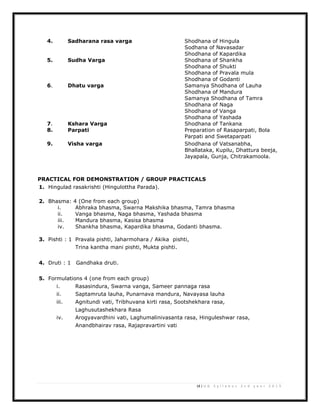
4. Sadharana rasa varga Shodhana of Hingula
Sodhana of Navasadar
Shodhana of Kapardika
5. Sudha Varga Shodhana of Shankha
Shodhana of Shukti
Shodhana of Pravala mula
Shodhana of Godanti
6. Dhatu varga Samanya Shodhana of Lauha
Shodhana of Mandura
Samanya Shodhana of Tamra
Shodhana of Naga
Shodhana of Vanga
Shodhana of Yashada
7. Kshara Varga Shodhana of Tankana
8. Parpati Preparation of Rasaparpati, Bola
Parpati and Swetaparpati
9. Visha varga Shodhana of Vatsanabha,
Bhallataka, Kupilu, Dhattura beeja,
Jayapala, Gunja, Chitrakamoola.
PRACTICAL FOR DEMONSTRATION / GROUP PRACTICALS
1. Hingulad rasakrishti (Hingulottha Parada).
2. Bhasma: 4 (One from each group)
i. Abhraka bhasma, Swarna Makshika bhasma, Tamra bhasma
ii. Vanga bhasma, Naga bhasma, Yashada bhasma
iii. Mandura bhasma, Kasisa bhasma
iv. Shankha bhasma, Kapardika bhasma, Godanti bhasma.
3. Pishti : 1 Pravala pishti, Jaharmohara / Akika pishti,
Trina kantha mani pishti, Mukta pishti.
4. Druti : 1 Gandhaka druti.
5. Formulations 4 (one from each group)
i. Rasasindura, Swarna vanga, Sameer pannaga rasa
ii. Saptamruta lauha, Punarnava mandura, Navayasa lauha
iii. Agnitundi vati, Tribhuvana kirti rasa, Sootshekhara rasa,
Laghusutashekhara Rasa
iv. Arogyavardhini vati, Laghumalinivasanta rasa, Hinguleshwar rasa,
Anandbhairav rasa, Rajapravartini vati
19 | U G S y l l a b u s 2 n d y e a r 2 0 1 3
BHAISHAJYAKALPANA
Paper II 100 Marks
Part A 50 Marks
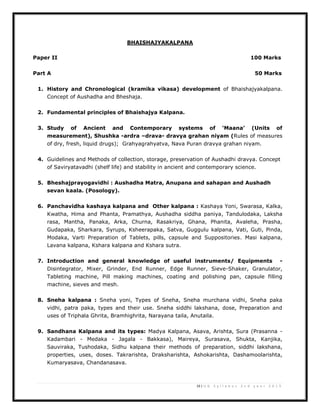
1. History and Chronological (kramika vikasa) development of Bhaishajyakalpana.
Concept of Aushadha and Bheshaja.
2. Fundamental principles of Bhaishajya Kalpana.
3. Study of Ancient and Contemporary systems of ‘Maana’ (Units of
measurement), Shushka -ardra –drava- dravya grahan niyam (Rules of measures
of dry, fresh, liquid drugs); Grahyagrahyatva, Nava Puran dravya grahan niyam.
4. Guidelines and Methods of collection, storage, preservation of Aushadhi dravya. Concept
of Saviryatavadhi (shelf life) and stability in ancient and contemporary science.
5. Bheshajprayogavidhi : Aushadha Matra, Anupana and sahapan and Aushadh
sevan kaala. (Posology).
6. Panchavidha kashaya kalpana and Other kalpana : Kashaya Yoni, Swarasa, Kalka,
Kwatha, Hima and Phanta, Pramathya, Aushadha siddha paniya, Tandulodaka, Laksha
rasa, Mantha, Panaka, Arka, Churna, Rasakriya, Ghana, Phanita, Avaleha, Prasha,
Gudapaka, Sharkara, Syrups, Ksheerapaka, Satva, Guggulu kalpana, Vati, Guti, Pinda,
Modaka, Varti Preparation of Tablets, pills, capsule and Suppositories. Masi kalpana,
Lavana kalpana, Kshara kalpana and Kshara sutra.
7. Introduction and general knowledge of useful instruments/ Equipments -
Disintegrator, Mixer, Grinder, End Runner, Edge Runner, Sieve-Shaker, Granulator,
Tableting machine, Pill making machines, coating and polishing pan, capsule filling
machine, sieves and mesh.
8. Sneha kalpana : Sneha yoni, Types of Sneha, Sneha murchana vidhi, Sneha paka
vidhi, patra paka, types and their use. Sneha siddhi lakshana, dose, Preparation and
uses of Triphala Ghrita, Bramhighrita, Narayana taila, Anutaila.
9. Sandhana Kalpana and its types: Madya Kalpana, Asava, Arishta, Sura (Prasanna -
Kadambari - Medaka - Jagala - Bakkasa), Maireya, Surasava, Shukta, Kanjika,
Sauviraka, Tushodaka, Sidhu kalpana their methods of preparation, siddhi lakshana,
properties, uses, doses. Takrarishta, Draksharishta, Ashokarishta, Dashamoolarishta,
Kumaryasava, Chandanasava.
20 | U G S y l l a b u s 2 n d y e a r 2 0 1 3
10. Kritanna and Aushadhisiddha anna Kalpana: Definition of Kritanna, Concept of
Pathya and Apathya, Yavagu –types of yavagu, Manda, Peya, Vilepi, Anna, Bhakta,
Odan, Yush -types, Krishara, Mansa rasa, Vesavara, Khad Kamblika, Raga, Shadava,
Dadhi and Takra Varga – Takra, Udasvita, Katvar, Mathita, Chhachika.
PART B
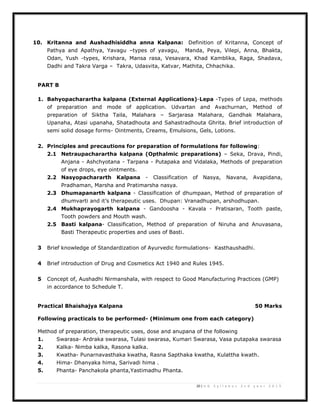
1. Bahyopacharartha kalpana (External Applications)-Lepa -Types of Lepa, methods
of preparation and mode of application. Udvartan and Avachurnan, Method of
preparation of Siktha Taila, Malahara – Sarjarasa Malahara, Gandhak Malahara,
Upanaha, Atasi upanaha, Shatadhouta and Sahastradhouta Ghrita. Brief introduction of
semi solid dosage forms- Ointments, Creams, Emulsions, Gels, Lotions.
2. Principles and precautions for preparation of formulations for following:
2.1 Netraupacharartha kalpana (Opthalmic preparations) – Seka, Drava, Pindi,
Anjana - Ashchyotana - Tarpana - Putapaka and Vidalaka, Methods of preparation
of eye drops, eye ointments.
2.2 Nasyopachararth Kalpana - Classification of Nasya, Navana, Avapidana,
Pradhaman, Marsha and Pratimarsha nasya.
2.3 Dhumapanarth kalpana - Classification of dhumpaan, Method of preparation of
dhumvarti and it’s therapeutic uses. Dhupan: Vranadhupan, arshodhupan.
2.4 Mukhaprayogarth kalpana - Gandoosha - Kavala - Pratisaran, Tooth paste,
Tooth powders and Mouth wash.
2.5 Basti kalpana- Classification, Method of preparation of Niruha and Anuvasana,
Basti Therapeutic properties and uses of Basti.
3 Brief knowledge of Standardization of Ayurvedic formulations- Kasthaushadhi.
4 Brief introduction of Drug and Cosmetics Act 1940 and Rules 1945.
5 Concept of, Aushadhi Nirmanshala, with respect to Good Manufacturing Practices (GMP)
in accordance to Schedule T.
Practical Bhaishajya Kalpana 50 Marks
Following practicals to be performed- (Minimum one from each category)
Method of preparation, therapeutic uses, dose and anupana of the following
1. Swarasa- Ardraka swarasa, Tulasi swarasa, Kumari Swarasa, Vasa putapaka swarasa
2. Kalka- Nimba kalka, Rasona kalka.
3. Kwatha- Punarnavasthaka kwatha, Rasna Sapthaka kwatha, Kulattha kwath.
4. Hima- Dhanyaka hima, Sarivadi hima .
5. Phanta- Panchakola phanta,Yastimadhu Phanta.
21 | U G S y l l a b u s 2 n d y e a r 2 0 1 3
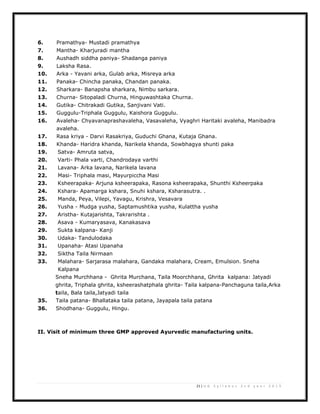
6. Pramathya- Mustadi pramathya
7. Mantha- Kharjuradi mantha
8. Aushadh siddha paniya- Shadanga paniya
9. Laksha Rasa.
10. Arka - Yavani arka, Gulab arka, Misreya arka
11. Panaka- Chincha panaka, Chandan panaka.
12. Sharkara- Banapsha sharkara, Nimbu sarkara.
13. Churna- Sitopaladi Churna, Hinguwashtaka Churna.
14. Gutika- Chitrakadi Gutika, Sanjivani Vati.
15. Guggulu-Triphala Guggulu, Kaishora Guggulu.
16. Avaleha- Chyavanaprashavaleha, Vasavaleha, Vyaghri Haritaki avaleha, Manibadra
avaleha.
17. Rasa kriya - Darvi Rasakriya, Guduchi Ghana, Kutaja Ghana.
18. Khanda- Haridra khanda, Narikela khanda, Sowbhagya shunti paka
19. Satva- Amruta satva,
20. Varti- Phala varti, Chandrodaya varthi
21. Lavana- Arka lavana, Narikela lavana
22. Masi- Triphala masi, Mayurpiccha Masi
23. Ksheerapaka- Arjuna ksheerapaka, Rasona ksheerapaka, Shunthi Ksheerpaka
24. Kshara- Apamarga kshara, Snuhi kshara, Ksharasutra. .
25. Manda, Peya, Vilepi, Yavagu, Krishra, Vesavara
26. Yusha - Mudga yusha, Saptamushtika yusha, Kulattha yusha
27. Aristha- Kutajarishta, Takrarishta .
28. Asava - Kumaryasava, Kanakasava
29. Sukta kalpana- Kanji
30. Udaka- Tandulodaka
31. Upanaha- Atasi Upanaha
32. Siktha Taila Nirmaan
33. Malahara- Sarjarasa malahara, Gandaka malahara, Cream, Emulsion. Sneha
Kalpana
Sneha Murchhana - Ghrita Murchana, Taila Moorchhana, Ghrita kalpana: Jatyadi
ghrita, Triphala ghrita, ksheerashatphala ghrita- Taila kalpana-Panchaguna taila,Arka
taila, Bala taila,Jatyadi taila
35. Taila patana- Bhallataka taila patana, Jayapala taila patana
36. Shodhana- Guggulu, Hingu.
II. Visit of minimum three GMP approved Ayurvedic manufacturing units.
22 | U G S y l l a b u s 2 n d y e a r 2 0 1 3
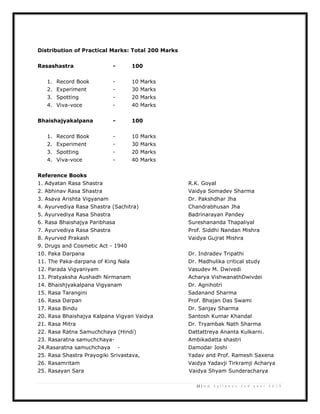
Distribution of Practical Marks: Total 200 Marks
Rasashastra - 100
1. Record Book - 10 Marks
2. Experiment - 30 Marks
3. Spotting - 20 Marks
4. Viva-voce - 40 Marks
Bhaishajyakalpana - 100
1. Record Book - 10 Marks
2. Experiment - 30 Marks
3. Spotting - 20 Marks
4. Viva-voce - 40 Marks
Reference Books
1. Adyatan Rasa Shastra R.K. Goyal
2. Abhinav Rasa Shastra Vaidya Somadev Sharma
3. Asava Arishta Vigyanam Dr. Pakshdhar Jha
4. Ayurvediya Rasa Shastra (Sachitra) Chandrabhusan Jha
5. Ayurvediya Rasa Shastra Badrinarayan Pandey
6. Rasa Bhaishajya Paribhasa Sureshananda Thapaliyal
7. Ayurvediya Rasa Shastra Prof. Siddhi Nandan Mishra
8. Ayurved Prakash Vaidya Gujrat Mishra
9. Drugs and Cosmetic Act - 1940
10. Paka Darpana Dr. Indradev Tripathi
11. The Paka-darpana of King Nala Dr. Madhulika critical study
12. Parada Vigyaniyam Vasudev M. Dwivedi
13. Pratyaksha Aushadh Nirmanam Acharya VishwanathDwivdei
14. Bhaishjyakalpana Vigyanam Dr. Agnihotri
15. Rasa Tarangini Sadanand Sharma
16. Rasa Darpan Prof. Bhajan Das Swami
17. Rasa Bindu Dr. Sanjay Sharma
20. Rasa Bhaishajya Kalpana Vigyan Vaidya Santosh Kumar Khandal
21. Rasa Mitra Dr. Tryambak Nath Sharma
22. Rasa Ratna Samuchchaya (Hindi) Dattattreya Ananta Kulkarni.
23. Rasaratna samuchchaya- Ambikadatta shastri
24.Rasaratna samuchchaya - Damodar Joshi
25. Rasa Shastra Prayogiki Srivastava, Yadav and Prof. Ramesh Saxena
26. Rasamritam Vaidya Yadavji Tirkramji Acharya
25. Rasayan Sara Vaidya Shyam Sunderacharya
23 | U G S y l l a b u s 2 n d y e a r 2 0 1 3
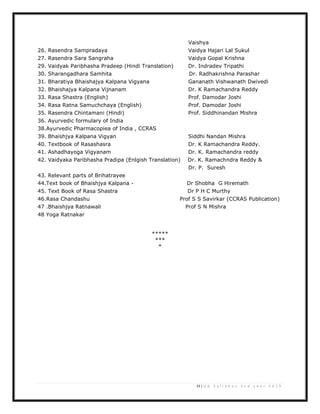
Vaishya
26. Rasendra Sampradaya Vaidya Hajari Lal Sukul
27. Rasendra Sara Sangraha Vaidya Gopal Krishna
29. Vaidyak Paribhasha Pradeep (Hindi Translation) Dr. Indradev Tripathi
30. Sharangadhara Samhita Dr. Radhakrishna Parashar
31. Bharatiya Bhaishajya Kalpana Vigyana Gananath Vishwanath Dwivedi
32. Bhaishajya Kalpana Vijnanam Dr. K Ramachandra Reddy
33. Rasa Shastra (English) Prof. Damodar Joshi
34. Rasa Ratna Samuchchaya (English) Prof. Damodar Joshi
35. Rasendra Chintamani (Hindi) Prof. Siddhinandan Mishra
36. Ayurvedic formulary of India
38.Ayurvedic Pharmacopiea of India , CCRAS
39. Bhaishjya Kalpana Vigyan Siddhi Nandan Mishra
40. Textbook of Rasashasra Dr. K Ramachandra Reddy.
41. Ashadhayoga Vigyanam Dr. K. Ramachandra reddy
42. Vaidyaka Paribhasha Pradipa (Enlgish Translation) Dr. K. Ramachndra Reddy &
Dr. P. Suresh
43. Relevant parts of Brihatrayee
44.Text book of Bhaishjya Kalpana - Dr Shobha G Hiremath
45. Text Book of Rasa Shastra Dr P H C Murthy
46.Rasa Chandashu Prof S S Savirkar (CCRAS Publication)
47 .Bhaishjya Ratnawali Prof S N Mishra
48 Yoga Ratnakar
*****
***
*
24 | U G S y l l a b u s 2 n d y e a r 2 0 1 3
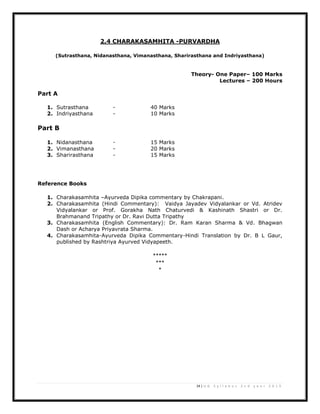
2.4 CHARAKASAMHITA -PURVARDHA
(Sutrasthana, Nidanasthana, Vimanasthana, Sharirasthana and Indriyasthana)
Theory- One Paper– 100 Marks
Lectures – 200 Hours
Part A
1. Sutrasthana - 40 Marks
2. Indriyasthana - 10 Marks
Part B
1. Nidanasthana - 15 Marks
2. Vimanasthana - 20 Marks
3. Sharirasthana - 15 Marks
Reference Books
1. Charakasamhita –Ayurveda Dipika commentary by Chakrapani.
2. Charakasamhita (Hindi Commentary): Vaidya Jayadev Vidyalankar or Vd. Atridev
Vidyalankar or Prof. Gorakha Nath Chaturvedi & Kashinath Shastri or Dr.
Brahmanand Tripathy or Dr. Ravi Dutta Tripathy
3. Charakasamhita (English Commentary): Dr. Ram Karan Sharma & Vd. Bhagwan
Dash or Acharya Priyavrata Sharma.
4. Charakasamhita-Ayurveda Dipika Commentary-Hindi Translation by Dr. B L Gaur,
published by Rashtriya Ayurved Vidyapeeth.
*****
***
*

2nd_year_UG_Syllabus.pdf

  • 1.
    1 | UG S y l l a b u s 2 n d y e a r 2 0 1 3 CENTRAL COUNCIL OF INDIAN MEDICINE NEW DELHI SYLLABUS OF AYURVEDACHARYA (BAMS) COURSE INDEX 2ND PROFESSIONAL 1.1 DRAVYAGUNA VIGHYAN 2-9 1.2 ROGA NIDAN 10-14 1.3 RASASHATRA 15-23 1.4 CHARAK SAMHITA 24
  • 2.
    2 | UG S y l l a b u s 2 n d y e a r 2 0 1 3 2.1 DRAVYAGUNA VIGYAN (PHARMACOLOGY & MATERIA MEDICA) Lectures: 200 Hrs. Practicals: 200 Hrs. Total Marks -400 Theory Two Papers– 100 Marks Each Practical/Viva voce – 200 Marks Paper I 100 Marks Part A 50 Marks 1- Dravyaguna Shastra Paribhasa- Lakshana of Sapta Padartha of Dravyaguna Vijnana viz Dravya- Rasa-Guna- Virya- Vipaka- Prabhava and Karma. 2- Dravya: Etymological derivation, definition, panchbhoutikatwa. Classification of Dravya according to Samhitas and Nighantus Taxonomical classification. 3- Guna: Etymological derivation, definition and Classification of Guna. Detailed knowledge of Gurvadi Guna & Paradi gunas. 4- Rasa: Etymological derivation, definition, Meaning of “Rasa” in various contexts. Shad Rasas (Madhura, Amla, Lavana, Katu, Tikta, and Kashaya), Panchabhautik constitution of Rasas, Nirvrittiviseshakrama (manifestation in general and particular), Ritu and shad rasa Rasanurasayoh bheda (Difference between rasa and anurasa), Lakshana (characteristics),Guna and Karma of shad Rasas, Kopana and Shamana of Dosha and dushya by Shad rasas. Effects of excess usage of Rasa. Rasopalabdhi, Rasaskandha. 5- Vipaka: Etymological derivation and definition, difference between Avasthapaka and Vipaka, Types of Vipaka, (Dvividha-Trividha,Panchavidha) Guna and karma of Vipaka. Grades of Vipaka (taratamya), Vipakopalabdhi hetu (Factors to determineVipaka). 6- Veerya: Etymological derivation, definition and Swarupa of Virya, Number of Virya. (Dwividha & Ashtavidha), Panchabhauthikatva Virya karmani (Effects of Virya), General principles in determination of virya along with exceptions.
  • 3.
    3 | UG S y l l a b u s 2 n d y e a r 2 0 1 3 7- Prabhava: Definition, Effects of Prabhava. 8- Interrelation of Rasa-Guna-Virya-Vipaka-Prabhava with respect to their strength (balabal nirupana). Samanapratyayarabdha and Vichitrapratyayarabdha dravyas. 9- Karma: Lakshana, swaroopa and bheda of karma (Definition, nature and types of action). Explanation of the following Karmas with examples: 1. Deepana 2. Pachana 3. Samshodhana 4. Samshamana 5. Anulomana 6. Sransana 7. Bhedana 8. Rechana 9. Chhedana 10. Lekhana 11. Grahi 12. Sthambhana 13. Madakari 14. Pramathi 15. Abhishyandi 16. Vyavayi 17. Vikashi 18. Rasayana 19. Vajeekarana 20. Jeevaneeya 21. Balya 22. Brimhana 23. Langhana 24. Medhya 10. Brief information on Karmas of dashemani gana of Charak Samhita. 11- Mishraka Gana: 11a)- Audbhida Gana (Vegetable origin) Brihatpanchamoola, Laghupanchamoola, Vallipanchamoola, Kantakapanchamoola, Trinapanchamoola,Madhyamapanchamoola, Jeevaneeya panchamoola, Panchapallava, Panchavalakala, Triphala, Trikatu,Trimada, Chaturusana, Panchakola, Shadusana, Chaturbeeja, Jeevaniya gana, Ashtavarga, Trijataka, Chaturajataka, Katuchaturjataka Panchatikta, Amlapanchaka, Chaturbhadra,Trikarshika, Swalpatriphala, Madhuratriphala, Mahavisha, Upavisha, Agrya aushadh varga- Knowledge of Agrayaaushadha Varga with example. 11 b)- Jangama Gana (Animal origin)- Ksheerashtaka, Mutrashtaka, Pitta panchaka. 11 c)- Parthiva Gana (Mineral origin) - Lavana Panchaka, Kshara dvaya, Kshara Ashtaka. 12- Basis of nomenclature: Basis of nomenclature of dravya, Basis and Derivation of synonyms. 13. Bheashaja Pariksha vidhi (as described in Charaka samhita vimana sthana 8), Dravya Sangrahana (collection of dravya)- Ecology- Classification of desha (geographical area) and bhumi (soil), swarupa of sangrahaniya dravya of (Nature and quality of drug to be collected). Sangrahana vidhi (Method of collection) -Vegetable and Animal origin drugs according to part used. Period of collection according to virya, samrakshana vidhi (preservation of collected dravyas), bheshajagara (Storehouse), study on different prayojyanga (useful plant parts).
  • 4.
    4 | UG S y l l a b u s 2 n d y e a r 2 0 1 3 Part B 50 Marks (I) 20 Marks 14 a) Concept of dravya shodhan (purification of dravya). 14 b) Brief knowledge of Apamishran (adulterants) 14 c) Concept of Abhava pratinidhi dravya (substitutes) 15- Prashasta bheshaja (ideal drug), plant extracts. Concept of viruddha Dravya (incompatibility of the dravya). 16- Introduction to Nighantu Vigyan - Dhanwantari Nighantu, Bhavaprakashanighantu, Rajanighantu. 17- Brief knowledge of cultivation, conservation of medicinal plants and information about endangered species. (II) 30 Marks 18. - Introduction, Definition & scope of Pharmacology and Principles of general Pharmacology. Brief Knowledge about pharmacology of the following - Anaesthetics, CNS depressants, Sedatives, Hypnotics, Tranquilisers, Antipyretics, Analgesics, Antiepileptics, Antihypertensive, Antianginal, Antiplatelet, Hypolipidaemic, Haemopoetic, Coagulants, Bronchodialators, Aerosols/ Inhalants, Expectorants, Digestants, Carminatives, Antacids, Antiulcer, Laxatives, Antidiarrhoeals, Antiemetic, Hepatoprotective, Diuretic, Antidiuretic, Lithotriptic, Antiinflammatory, Hormonal therapy, Antiobesity, Antidiabetic, Antithyroid, Oxytocic. Galactagogues, Contraceptives, Styptics, Antihistamines, Antimicrobial, Antibiotics, Antimalarial, Amoebicidal, Antifilarial, Anthelmentic, Antifungal,Vitamins, Minerals,Water imbalance and IV fluids, Vaccines, antivenom, antirabbies serum, Local anti septics, drugs in ophthalmic practice, Anti cancer drugs and immunomodulators. Paper II 100 Marks Part A 70 marks 1-Detailed Knowledge of Following Dravya – 1- Detailed knowledge of following drugs with respect to Basonym of drug, Main Synonyms, Regional Name, Botanical Name, Family, Classification of Dravya (Gana) as described in Charak and Sushrut, External morphology, Useful parts, Important phytoconstituents, Rasa panchaka, Action on Dosha, Dhatu, Mala, Prayogarha vyadhi (therapeutic indications), Amayikaprayoga and Matra (Therapeutic administration and Dose), Vishishta yoga (names of important formulations), Vishakta Lakshan (adverse effects), Chikitsopachara (remedial measures) and Shodhana (as required)
  • 5.
    5 | UG S y l l a b u s 2 n d y e a r 2 0 1 3 [Alphabetical order and Botanical names to all the drugs are to be added] Agaru Guggulu Pashanabheda Agnimantha Haridradvaya Patala Agnimantha Haritaki Pippali-Pippalimula Ahiphena Hingu Prishniparni Amalaki Jambu Punarnava Apamarga Jatamansi Pushkarmoola Aragvadha Jatiphal Rasna Aragvadha Jeerakadvaya Rasona Ardraka-Sunti Jyotishmati Rohitaka Arjuna Kalamegha Saireyaka Arjuna Kampillaka Sarivadvaya Arkadvaya Kanchanara Sarpagandha Ashvagandha Kantakari Shalaparni Asoka Kapikacchu Shallaki Ativisha Karkatakshringi Shalmali Bakuchi Karpura Shankhapushpi Baladvayam. Katuki Shatavari Bhallataka Khadira Shigru Bharangi Kiratatikta Shirisha Bhrungaraj Kumari Shyonaka Bibhitaka Kumkum Kesara Talisa Patra Bijak/ Vijaysar Kupilu Tila Bilva Kushta Trivrut Brahmi Kutaja Tulasi Bruhati Lavanga Tvak Chandanadvaya, Lodhra Ushira Chitraka Madanaphala Vacha Dadima Mandukaparni. Varahi Devadaru Manjishtha Varahi Dhataki Maricha Varuna Durva Musta Vasa Eladvayam Nagakeshara Vatsanabha Eranda Nimba Vidanga Gambhari Nirgundi Vidari Gokshura Palasha Yastimadhu Guduchi Parpata Yavani Part B- II- Brief Knowledge of following dravyas with Respect to Sanskrit Name, Botanical Name, Family, Habit (Samanya Swarupa), Parts Used and Indications. Agastya Jati Palandu Ajamoda Jayapala Parasika Yavani Akarkarabh Jeevanti Parijata Amlavetasa Kadali, Parisha Amra Kadamba Parnabija
  • 6.
    6 | UG S y l l a b u s 2 n d y e a r 2 0 1 3 Amragandhiharidra Kaidarya Parnayavani Ankola Kakamachi Parpataka Aparajita Kamala Parushaka Ashvagol Kankola Patalagarudi Ashvattha Karanja Patha Asthishrunkhala Karavellaka Patola Atasi Karavira Patranga Avartaki Karira Pilu Avartani Karpasa Plaksha Babbula Kasamarda Prasarani Badara Kasha Priyala Bakula Kasni Priyangu Bhumyamalki Kataka Puga Bijapoora Katphala Putiha Bola Kebuka Putranjivaka Chakramarda Kharjura Rajika/Sarshapa Champaka Kitmari Rohitaka Chandrashura Kokilaksha Saptachakra Changeri Koshataki Saptaparna Chavya Kulatha Saral Chirbilva Kumuda Sarja Chopachini Kusha Shala Danti Kusmanda Shara Darbha Lajjalu Sharapunkha Dattura Langali Shatahwa Dhanvayasa Latakaranja Shati Dhanyaka Latakasturi Snuhi Draksha Madayantika Sringataka Dronapushpi Mahanimba Svarnakshiri Gandhaprasarini Mandukaparni Tagara . Garjara Markandika Tailaparni Gojihva, Masha Talmuli Gorakshaganja Mashaparni Taruni Gunja Matulunga Tavakshira hinsapa Mayaphala Teja Patra Hinstra Meshashrungi Tuvaraka Hribera Methika Udumbara Hrutpatri Mudgaparni urana Ikshu Mulaka Vamsha Indravaruni Murva Vata Ingudi Nagabala Vatada Irimeda Nala Vrudhadaru Ishvaku Narikela Vrukshamla Isvari Nili Japa Padmaka III .-Introduction, Guna, Karma and Uses of following Jantava Dravya (Drugs of Animal Origin). 1. Kasturi 2. Gorochana 3. Mrigasringa
  • 7.
    7 | UG S y l l a b u s 2 n d y e a r 2 0 1 3 IV- Introductory Knowledge of Following Annapana Varga: 1. Jala Varga 2. Dugdha Varga 3. Madhu Varga 4. Taila Varga 5. Sukadhanya Varga 6.Shamidhanya Varga 7. Phala Varga 8. Shaka Varga 9. Mamsa Varga 10. Aharayogi PRACTICALS 1. A. Study of Macroscopic, Microscopic characters and Demonstration of organoleptic charcteristics and grahya-agrahyatva of following plants and their useful parts. i. Kanda (stem) - Guduchi or Ashtishrinkhala ii. Patra (leaves) - Vasa or Kumari iii.Pushpa (flower and Parts of flower)- Dhataki or Japa iv.Phala (fruit) – Maricha or Madanaphala or Vidanga v. Beeja (seeds) – Eranda or Kapikacchhu vi.Twak (bark) – Kutaja or Arjuna or Ashwattha vii. Moola(Root)- Punarnava or Chitraka viii. Niryasa (exudate) – Guggulu or Mocharasa ix. Jangama dravya - Madhu or Ghrita. 2. Records of Herbarium sheets of 50 medicinal plants Compulsory study tour other state/s for field knowledge and procurement of plant species. PRACTICAL MARKS DIVISION 1 Herbarium 20 Marks 2 Practical record 20 Marks 3 Drug identification- spotting –Raw/crude drugs 30 marks 4 Plant identification spotting –fresh 30 marks 5 Practical 40 marks 6. Viva-Voce 60 Marks Total 200 marks Reference Books
  • 8.
    8 | UG S y l l a b u s 2 n d y e a r 2 0 1 3 1. Abhinav Buti Darpan (Vol.1-2) - Vd. Roop Lal Vaishya 2. Aushadna Vigyna Shastra - Acharya Pt. Vishvanatha Dwidevi 3. Ayurvediya Aushadnkarma vigyana - Acharya V.J. Thakur 4. Bedi Vanaspati Kosha - Prof. Ramesh Bedi 5. Bhaishajyaguna Vigyana - Dr. Alakhnarayan Singh 6. Bhav Prakash Nigantu (English) - Shreekanthamurti 7. Bhav Prakash Nighantu - With Vd. Krishna Chandra Chunekar commentary 8. Bhrinad dravyagunadarsha - Mahendra Kumar Shastri 9. Classical Uses of Medicinal Plants - Acharya Priyavrata Sharma 10. Controversial Medicinal Plants - Vd. G. Bapa Lal 11. Dalhana Ka Dravyaguna Shastra Ke Kshetra Me Yogadana - Vd. Shiv Kumar Vyas 12. Dravyaguna Kosha - Acharya Priyavrata Sharma 13. Dravyaguna Sutram - Acharya Priyavrata Sharma 14. Dravyaguna Vigyana - Dr. Gyanendra Pandey 15. Dravyaguna Vigyana(Vol. 1-2) - Acharya Yadavji Tikram Ji 16. Dravyaguna Vijyana - Dr. V.M. Gogate 17. Dravyaguna Vigyana (Vol. 1-5) - Acharya Priyavrata Sharma 18. Dravyaguna Shastrum - Vaidya G.A. Phadake 19. Dravyaguna Vijyana - Dr. A.P. Deshpande 20. Dravyagunavijnana basic Principles - Prof.D.S.Lucas 21. Forgotten Healers (Indian Medicinal Plants) - Dr. Prakash Pranjape 22. Glossry of Vegetable Drugs in Bhrittrayis - Thakur Balwant Singh & Vd. Krishna Chandra Chunekar 23. Introduction to Dravyaguna - Acharya Priyavrata Sharma 24. Kriyatamka Aushadi Parichaya - Acharya Pt. Vishvanath Dwidevi 25. Materia Medica - Acharya Ghosh 26. Nighantu Adarsh (Vol. 1-2) - Vd. Bapa Lal 27. Pharmacological basis of Medical Practice - Goodman & Gillman 28. Pharmacology and Pharmacotherapeutics - Satoskar Bhandarkar & Ainapure 29. Prayogatamaka Dravyaguna Vigyana - Dr. Maya Ram Uniyal 30. Priya nighantu - Acharya Priyavrata Sharma 31. Raspanchaka/Dravyaguna Siddhanta - Prof. Shivcharan Dhyani 32. System of Plant Nomenclature in Ayurveda - Dr. Gyanendra Panday 33. Text Book of Pharmacognosy - Trees & Valis 34. Textbook of Dravyaguna - Dr.K.Nishteswar 35. Unani Dravyaguna Vigyana - Hakim Daljeet Singh
  • 9.
    9 | UG S y l l a b u s 2 n d y e a r 2 0 1 3 36. Useful parts of Charaka, Sushurut, and Vagbhata. - 37. Uttarakand Ki Vanaspatiya - Dr. Gyanendra Pandey 38. Vanoaushadi Darshika - Thakur Balwant Singh 39. Vanoaushadi Nidarshika - Dr. Ram Sushil Singh 40. Vedic Vanaspatiyan - Dr. Dinesh Chandra Sharma ***** *** *
  • 10.
    10 | UG S y l l a b u s 2 n d y e a r 2 0 1 3 2.2 ROGA NIDANA Theory Two Papers – 100 Marks Each Practical/Viva voce – 100 Marks PAPER -1 100 Marks Part A 50 Marks I. Dosha Dushyadi Vigyan 1. Definition and importance of Roganidana. 2. Samanya Nidana and Samanya Lakshana of Dosha Vriddhi, Kshaya and Prakopa. 3. Dosha Dhatu Ashraya Ashrayi Bhava. 4. Dhatu Kshaya Vriddhi Lakshana. 6. Mala Kshaya Vriddhi Lakshana. 7. Hetu, Bheda and Lakshana of Agni Dushti. 8. Definitions and Samanya Lakshana of Ama. 9. Sama and nirama Dosha, Dushya Lakshana. 10. Dosha Paka and Dhatu Paka Lakshana. 11. Concept, classification, diagnosis and general complications of Avarana. 12. Doshagati and Rogmarga. 13. Detailed study of Srotomoola and Srotodushti Samanya and Vishishta Hetu Lakshana of all Srotas. Differences between Sroto Dushti and Kha Vaigunya. II. Vyadhi Vigyan 1. Definition, synonyms and classification of Vyadhi & Vyadhi Ghatak. 2. Criteria for nomenclature of Diseases in Ayurveda (Vyadhinamakarana). 3. Bija, Bija Bhaga and Bija Bhaga Avayava Dushti. 4. Basic knowledge of Hereditary, Congenital, Acquired, Multifactorial, Traumatic and Environmental disorders. 5. Introduction to ICD Classification of Diseases of WHO and DSM classification. 6. Samanyaja and Nanatmaja Vikara. NidanarthakaraVyadhi, Hetu Sankara, Lingasankara, Vyadhisankara, Vyadhi Awastha. 7. Dhatu, Updhatu, Mala and Indriya Pradoshaj Vikara. 8. Concept of AshtaMahagada . 9. Introduction to Ashta Nindita. 10.Definition and classification of Vyadhikshamatva. 11.Ojas – types of Ojo Dushti- Visrimsa- Vyapad & Kshaya & It’s Diseases. III. Basic Pathology 1. Introduction to pathology and its sub-divisions. 2. Introduction to Cell Injury and Cellular adaptations. 3. Definition and brief description of inflammation – Healing/repair. 4. Definition and brief description of edema – shock – hemorrhage, Thrombosis , embolism, Ischemia and Infarction. 5. Types of Immunity – different types of immune responses in the body – Basic knowledge of auto immune diseases, Acquired immune deficiency disease and hypersensitivity. 6. Nomenclature and classification of tumors - difference between benign and malignant tumors. 7. Introduction to Nutritional disorders – disorders of macro and micro nutrients. 8. Introduction to infections.
  • 11.
    11 | UG S y l l a b u s 2 n d y e a r 2 0 1 3 9. Introduction and classification of microorganisms such as virus- bacteria-fungus. Part B 50 Marks IV. Nidana Panchaka Vigyana 1. Difference between Roga and Rogi Pariksha. 2. Importance of Nidan Panchaka. 3. Hetu - Definition, Synonyms and Classification. 4. Purva Rupa – Definition, Synonyms, Samanya and Vishishta Purvarupa. 5. Rupa - Definition, Synonyms, Samanya and Pratyatma Lakshana. Difference between Vyadhi and Lakshana. 6. Upashaya / Anupashaya– Definition, Types and its importance in diagnosis. 7. Samprapti – Definition, Synonyms and Type and Samprapti Ghataka. 8. Shat Kriyakaala. Relationship between Nidana Panchaka and Shat Kriyakaala. 9. Upadrava and Udarka. 10. ArishtaVigyan – Definition, Types and its importance. 11. Sadhyasadhyatwa – Types, their parameters and importance. 12. General diagnostic principles of AnuktaVyadhi (Ch. Vi. 4). V. Pariksha Vigyana 1. Importance and knowledge of Aptopadeshadi & Darshanadi Trividha, Chaturvidha, and Shadvidha Pariksha. 2. Importance and Knowledge of Ashtasthana Pariksha. 3. Importance and Knowledge of Karanadi Dashavidha Parikshya Bhava. 4. Importance and Knowledge of Dashavidha Pariksha. 5. Basic knowledge of ECG, USG, X Ray, CT Scan,MRI. Paper II 100 Marks Part A 50 Marks Systematic study of Nidana Panchaka of following diseases (Including Upadrava, Arishta and Sadhyasadhyata). I. Diseases of Rasavaha Srotas 1(a) Jwara(Jwarabheda-Ama, Pachyamana and Nirama Jwara,Agantukajwara, Punaravartaka Jwara,Vishama Jwara, Dhatugata Jwara, Charakokta Sannipata Jwara. 1(b) General mechanism of Fever, Introduction to the Aetiopathogenesis of Malaria,Typhoid, Dengue fever, Influenza and Chikungunya. 2(a) Pandu, Amavata, Hridroga, Shotha. 2(b) Introduction to Anaemia & its Classification, Rheumatic fever, Rheumatoid Arthritis, Hypertension, Angina, Ischaemic Heart Disease, Myocardial Infarction and CCF. II. Diseases of Raktavaha Srotas 1. Kamala - Raktapitta - Vatarakta – Kroshtuksheersha - Shitapitta – Maha Kushtha – Visarpa – Shwitra and Introduction to Kshudra Kushtha. 2. Introduction to Hepatomegaly, Spleenomegaly, Leukaemia, Thalessemia, Sickle cell Anaemia. 3. Introduction to Urticaria, Psoriasis, Eczema, Pemphigus. III. Diseases of Mamsavaha Srotas (a) Galganda (b) Introduction to Thyroid disorders IV. Diseases of Medovaha Srotas
  • 12.
    12 | UG S y l l a b u s 2 n d y e a r 2 0 1 3 1. Sthoulya - Karshya – Prameha. 2. Introduction to Obesity and Diabetes Mellitus. V. Diseases of Asthi – Majjavaha Srotas 1. Vatavyadhi - Akshepaka - Apatanaka - Ardita - Pakshaghata – Gridhrasi –Vishwachi, Avabahuka, - Manyasthambha ,Katigraha,Pangutwa 2. Sandhigatavata, Asthi-Majjagata vata. 3. Introduction to Osteo- Arthritis, Osteoporosis. 4. Introduction to Parkinson’s disease, Stroke, Lumbago- Sciatica syndrome, Bell’s Palsy, Cervical- Lumber & Ankylosing Spondylitis. VI. Diseases of Shukravaha Srotas 1. Introduction to Klaibya and Vandhyatva. 2. Introduction to male and female infertility. Part B 50 Marks VII. Diseases of Pranavaha Srotas 1(a). Kasa - Shwasa - Hikka – Urahkshata – Shosha – Rajayakshma. 1(b). Introduction to the aetiopathogenesis of Pneumonia, Pleural effusion, Bronchitis, Bronchiectasis, Bronchial Asthma. VIII. Diseases of Annavaha- PureeshavahaSrotas 1. Agnimandya - Ajirna - Aruchi- Chhardi - Amlapitta- Shoola – Parinama Shoola – AnnadravaShoola- Atisara – Pravahika - Grahani –Gulma- Udara Roga. 2. Introduction to Anaha, Adhmana, Atopa, Visuchika Alasaka, Vilambika. 3. Introduction to Peptic Ulcer, Irritable Bowel Syndrome (IBS) Diarrhoea, Dysentry, Constipation, Inflammatory Bowel Diseases. IX. Diseases of Udakavaha Srotas 1(a) Introduction to Trishna, Daha. 1(b) Introduction to water and electrolyte imbalance disorders. X. Diseases of Mutravaha Srotas 1(a) Mutrakrichha – Mutraghata. 1(b) Introduction to Urinary Tract Infection, Nephropathies. XI. Diseases of Swedavaha Srotas 1(a) Introduction to Khalitya, Palitya. XII. Diseases of Manovaha Srotas 1(a) Apasmara, Unmada, Atatwabhinivesha-Vishada, Anidra, Mada, Murchha, Sanyasa. 1(b) Introduction to Epilepsy, Depression, Anxiety neurosis. XIII. Upasargajanya Vyadhi (Communicable diseases) 1(a) Romantika – Masurika – Upadamsha – Phiranga. 1(b) Introduction to Measels, Chickenpox, Leprosy, Tuberculosis and AIDS. XIV. Krimi Vigyana 1) Definition, classification of Krimi and features of Krimiroga 2) Snayuka, Shleepada. 3) Introduction of Filariasis and classification of common parasites. PRACTICAL (100 Marks) i) Fundamental Principles of Laboratory Tests
  • 13.
    13 | UG S y l l a b u s 2 n d y e a r 2 0 1 3 Introduction to laboratory, Sterilization, glass wares, solutions reagents and safety procedures, Disposal of biomedical wastes. ii) Haematology 1 Haemoglobin estimation. 2 Blood cells counting - WBC, RBC, platelets. 3 Hematocrit /Packed cell volume (PCV). 4 Erythrocyte indices - MCV, MCH, MCHC. 5 Peripheral blood smear, staining technique and differential leucocyte count. 6 Peripheral blood film examination in Anemia, Leukemia, Malaria, Filaria (Demonstration). 7 ESR. 8 Screening test for bleeding disorders- bleeding time (BT), Clotting time (CT), Demonstration of Prothrombin time (PT). 9 Blood grouping - ABO system, Rh typing (Rhesus system). iii) Urine Examination 1. Ayurveda anusara mutrapariksha. 2. Physical Examination - Volume, Reaction (Ph) & Specific Gravity. 3. Chemical Examination for - Proteins, Glucose, Phosphate, Ketone, Bile salts, Bile pigment. 4. Dipstick examination 5. Demonstration of Microscopic Examination. iv) Stool Examination 1 Ayurveda anusara purishapariksha. 2 Physical examination, Sama-Nirama Pariksha. 3 Microscopic examination of ova & cyst (Demonstration) 4 Occult Blood Test. v) Demonstration of Sputum Examination 1 Ayurveda anusara sthivanapariksha. 2 Physical, Chemical and Microscopic Examination of the sputum. 3 Sample collection and Demonstration of AFB. vi) Demonstration of Semen examination 1 Ayurveda anusara Retaspariksha. 2 Semen examination. vii) Biochemical Examination – (Demonstration) Blood Glucose, Serum Bilirubin, Blood Urea, Lipid Profile, Serum Creatinine, Serum Uric acid etc. viii) Demonstration of different staining techniques in microbiology. ix) Demonstration of Sero-immunological Investigations: RA and Widal. x) Laboratory record – maintenance of laboratory record book. Bed side Practical (Clinical Methods) 1. Introduction and demonstration of clinical methods (General and Systemic Examination). 2. Practical demonstration of examination of Roga based on Pancha Nidana. 3. Demonstration of instruments used for clinical examination. 4. Practical records of clinical examination of at least 20 long cases in I.P.D including Atur- bala-pramana pareeksha. 5. Practical records of clinical examination of at least 20 short Cases based on Ashta vidha pariksha in O.P.D.
  • 14.
    14 | UG S y l l a b u s 2 n d y e a r 2 0 1 3 6. Demonstration of ECG, USG and Radio imaging techniques. Distribution of Marks for final Practical Examination 1. Daily Record -10 Marks 2. Indentification of Instruments -10 Marks 3. Laboratory Experiments -20 Marks 4. Short Case -10 Marks 5. Long Case -20 Marks 6. Viva - Voce -30 Marks Total 100 Marks Reference Books 1. Madhava Nidana (Madhukosha Pt. Yadunandan Upadhyay Commentary) Part 1 – 2 2. Doshakaranatwa Mimamsa - Acharya P.V. Sharma 3. Nadi Darshan - Vd. Tara Shankar Mishra 4. Nadi Vigyana Vidyotini Hindi Tika 5. Nadi Vigyan- Shri Satya Dev Vashisht 6. Nadi Vigyan- Gangadhar Tika 7. Rogi Pariksha vidhi Acharya- Priyavrata Sharma 8. Ayurvediya Roga Vargikaran- Vd. Ramanath Dwivedi & Vd. Gurdip Singh. 9. Ayurvediya Nidan Evum Chikitsa Ke Siddhanta - Prof. Ram Harsh Singh. 10. Relevant portions of Charak Samhita, Sushrut Samhita and Vagbhata. 11. Text Book of Pathology- William Boyds. 12. Text Book of Pathology- Harsh Mohan. 13. Text Book of Pathology- Dey and Dey. 14. Text Book of Parasitology -Ramnik Sood. 15. Clinical Pathology and Bacteriology- S.P. Gupta. 16. Clinical methods in Ayurveda- K. R . S. Murthy. 17. Parameswarappa’s Ayurvediya Vikriti Vigyan and Roga Vikriti Vigyan-Dr. P.S. Byadgi. 18. Oxford Handbook of Clinical Examination Oxford Handbooks and Practical Skills. 19. Advanced Clinical Evaluation System for Practical Assessment of Clinical Examination Skills. 20. Symptoms & Signs in Clinical Medicine - Chamberlains. 21. Clinical Methods- Hutchison’s. 22. Bedside Clinics in Medicine Part- I & II-Kundu. 23. Common Medical Symptoms- Mehta. 24. Advances in Pathology & Lab Med- Weimstean, Gralem, Anderson, Cortan, Wick, Zumwelt. 25. Clinical Laboratory medicine Edited by Kenneth D Mc. Chately. 26. General Pathology- Walter & Israel Churchill Living stone. 27. A Comprehensive Dictionary of Pathology- Chris Newann. 28. Practical Pathology- Dr. K. Uma Chaturvedi. 29 .Clinical examination- Douglas/Macleod’s. 30. Pathology Practical book for Undergraduates- Harsh Mohan. 31. Medical Laboratory Technology - R. Sood. 32. Clinical Diagnosis and Management by Todd, Sanford and Davidson Laboratory methods 33. Clinical Hematology In Medical Practice- Degruchy’s. 34. Robbins Basic Pathology- Kumar, Abbas, Fausto at al.
  • 15.
    15 | UG S y l l a b u s 2 n d y e a r 2 0 1 3 2.3. Rasashastra Evam Bhaishajyakalpana (IATROCHEMISTRY AND AYURVEDIC PHARMACEUTICS) Theory -Two Papers Total Marks- 200 Teaching hours-200 Practical :- Total Marks-200 Teaching hours-200 RASASHASTRA Paper 1 100 Marks Part A 50 Marks 1. Definition and etymology of Rasa, History of Rasashastra, Importance of Rasaushadhi, Concept of Rasa-Rasayana, Concept of Raseshwar Darshana. Concept of Rasashala and Rasamandap. 2. Brief Description and Application of Technical terminologies (Paribhasha): Avapa, Nirvapa, Dhalana, Bhavana, Jarana, Murchana, Shodhana, Marana, Amrutikarana, Lohitikarana, Mruta Loha, Satwa Patana, Druti, Apunarbhava, Niruttha, Rekhapurna, Varitara. 3. Dravya Varga: Amlavarga, Panchamrittika, Panchagavya, Panchamrita, Ksharashtaka, Dravakagana, Mitra panchaka, Rakta varga, Lavanapanchaka. 4. Brief description of Yantras and their application Ulukhala Yantra, Khalwa Yantra, Kachhapa Yantra, Damaru Yantra - Vidhyadhara Yantra- Urdhwapatan, Addhapatan & Tiryakpatana Yantra, Jaranartha Tulayantra, Dolayantra, Patalayantra, Palika Yantra, Baluka Yantra, Bhudhara Yantra, Sthali Yantra, Swedana Yantra. 5. Brief description & application of Musha (Crucible): Samanya Musha, Gostani musha, Vajra Musha, Maha musha, Yoga musha, Vrintaka Musha, Malla / Pakwa musha. Different types of crucibles e.g. Silica crucible, platinum crucible. Mudra and Sandhi Bandhana. 6. Brief description & applications of Chullika, Satwapatana Koshthi, Patala Kosthi, Gara Koshthi, Angarakoshthi and knowledge of various heating appliances viz. Gas stove, Hot plate, Heating mantle, Induction Stove, Hot Air Oven. 7. Concept, definition and types of Puta: Suryaputa, Chandraputa, Gomayaputa, Lawakaputa, Kukkutaputa, Kapotaputa, Varahaputa, Gajaputa, Mahaputa, Kumbhaputa, Valukaputa, Bhudharaputa, Applications of Electric muffle furnace and fuel (diesel) dependent furnace. Brief introduction to thermocouple and pyrometer. 8. Knowledge of Parada: Synonyms, Occurrence, natural and artificial sources of Parada, Hingulottha parada, Types of Parada, Parada Dosha: Naisargika, Yougika, Aupadhika
  • 16.
    16 | UG S y l l a b u s 2 n d y e a r 2 0 1 3 (Kanchuka). Grahya-Agrahya Parada, Parada gati, Parada bandha, Shodhana of Parada. Parada sanskara and brief description of Ashtasamskara. 9. Concept of Murchhana and Jarana of Parada, Preparation of Kajjali, Classification of Rasaushadhi: Khalvi rasa e.g. Tribhuvana Keerti Rasa, Parpati Rasa- Rasa Parpati, Kupipakva Rasa- Rasa sindur, Pottali rasa - Hemagarbha pottali. Rasa sevana vidhi and pathya and apathya. 10. Brief introduction of quality control , standardization and GMP of Rasaoushadhies. Part B 50 Marks Occurrence, Synonyms, Minerological identification, Sources, Types, Grahya and Agrahyata, Shodhana, Marana and other processing techniques. Properties, dose, anupan and therapeutic uses, pathya – apathya and ashuddha, apakwa and avidhee sevanjanya dosha and its management, important formulations of the following: 1. Maharasa –Abhraka (Biotite Mica), Vaikrantha, Makshika (Chalco-pyrite), Vimala (Iron Pyrite), Shilajatu, Sasyaka (Peacock ore), Chapala and Rasaka (Sphalerite). 2. Uparasa – Gandhaka (Sulfur), Gairika (Red Ochre), Kasisa (Green Vitriol), Kankshi (Alum), Haratala (Orpiment), Manahshila (Realgar), Anjana and Kankustha. 3. Sadharana Rasa – Kampillaka, Gauri pashana (Arsenic oxide), Navasadara (Ammonium chloride), Kaparda (Cowry), Agnijara, Giri Sindura (Red oxide of Hg), Hingula (Red Cinnabar) and Mriddara shringa (Litharge). 4. Dhatu -Swarna (Gold), Rajata (Silver), Tamra (Copper), Loha (Iron), Vanga (Tin), Naga (Lead), Yashada (Zinc), Kamsya (Bronze), Pittala (Brass), Vartaloha. Dhatu -graha sambandha. 5. Ratna - Manikya (Ruby), Mukta (Pearl), Pravala (Coral), Tarkshya (Emerald), Pushparaga (Topaz), Vajra (Diamond), Nilam (Sapphire), Gomeda (Zircon or Cinnamone stone), Vaidurya (Cats eye). Ratnapariksha, Ratnadosha, Ratna-graha sambandha. 6. Uparatna- Vaikranta (Tourmaline), Suryakanta (Sun stone), Chandrakanta (Moon stone), Rajavarta (Lapis lazuli), Perojaka (Turquise), Sphatikamani (Quartz), Trinakanta, Palanka, Putika, Rudhir. 7. Sudha varga – Sudha (Lime stone ), Kaparda (Cowries), Shukti (Oyster Shell) , Shankh (Conch Shell), Mriga shringa (Stag horn), Khatika, Godanti (Gypsum) and Samudraphena (Cattle Fish bone), Kukkutanda twak (Hen’s Egg Shell). 8. Sikata varga - Sikata (Silica), Dugdhapashana (Talc), Nagapashana / Jaharmohara (Serpentine), Badarshama (silicate of lime), Vyomashma (Sangeyashab - Jade), Kousheyashma (Asbestos) and Akika (Agate).
  • 17.
    17 | UG S y l l a b u s 2 n d y e a r 2 0 1 3 9. Kshara varga - Sarja kshara (Sodium bicarbonate), Yava kshara, Tankana kshara (Borax), Surya Kshara (Potassium Nitrate). 10. Miscellaneous - Mandura, Bola, Dam-ul Akhawayan (Raktabandhini), Kasturi, Bhoonag, Mayurpiccha, Sarjarasa, Madhoocchishta. 11. Visha and Upavisha-Introduction, collection and storage, classification, synonyms, shodhana, antidote, therapeutic and toxic doses, anupan, therapeutic uses, and formulations of following Visha and Upavisha-Vatsanabha, Kuchala, Jayapala, Dhattura, Bhanga, Bhallataka, Gunja, Arka, Snuhi. Langali, Karaveera, Ahiphena and Chitrakmool. 12. Aushadhi Yoga Gyanam- ingredients, manufacturing process, and bheshajprayogvidhi. Arogya Vardhini Gutika, Kasturibhairava Rasa, Kumara Kalyana Rasa, Garbhapala Rasa, Chandraprabha Vati, Chandramrita Rasa, Pratapalankeshwara Rasa, Pravalapanchamrita Rasa, Anandbhairava Rasa, Yogendra Rasa, Laxmivilas Rasa, Vasantakusumakara, Vasantamalati Rasa, Brihat Vata Chintamani Rasa, Shankha vati, Shwaskuthara Rasa, Hinguleswara Rasa, Hemagarbhapottali, Hridyarnava Rasa, Swarnavanga, Makaradhwaja, Putapakwavaisham Jwarantaka Loha, Vatvidhvamsan Rasa, Kamadugha Rasa, Laghusutshekhar Rasa, Navayasa Loha, Saptamrita Loha, Tamra Parpati, Panchamrita Parpati, Sveta Parpati. 13. Introduction to pharamcovigilance and its status in India, with reference to Ayurvedic drugs. A) Necessary to know – From part A and B : S. No. 1 to 9 B) Desired to know – From part B : S. No. 10 Practical 100 Marks Minimum Twenty five practicals to be performed 1. Rasa [Parada] Samanya Shodhana of Parada Kajjali Mugdha rasa 2 Maharasa varga Shodhana of Abhraka Dhanyabhraka nirmana Shodhana of Makshika Shodhana of Shilajatu Shodhana of Sasyaka. 3. Uparasa varga Shodhana of Gandhaka Shodhana of Gairika Shodhana of Kasisa Shodhana of Kankshi Shodhana of Haratala Rasa manikya nirman Shodana of Manashila
  • 18.
    18 | UG S y l l a b u s 2 n d y e a r 2 0 1 3 4. Sadharana rasa varga Shodhana of Hingula Sodhana of Navasadar Shodhana of Kapardika 5. Sudha Varga Shodhana of Shankha Shodhana of Shukti Shodhana of Pravala mula Shodhana of Godanti 6. Dhatu varga Samanya Shodhana of Lauha Shodhana of Mandura Samanya Shodhana of Tamra Shodhana of Naga Shodhana of Vanga Shodhana of Yashada 7. Kshara Varga Shodhana of Tankana 8. Parpati Preparation of Rasaparpati, Bola Parpati and Swetaparpati 9. Visha varga Shodhana of Vatsanabha, Bhallataka, Kupilu, Dhattura beeja, Jayapala, Gunja, Chitrakamoola. PRACTICAL FOR DEMONSTRATION / GROUP PRACTICALS 1. Hingulad rasakrishti (Hingulottha Parada). 2. Bhasma: 4 (One from each group) i. Abhraka bhasma, Swarna Makshika bhasma, Tamra bhasma ii. Vanga bhasma, Naga bhasma, Yashada bhasma iii. Mandura bhasma, Kasisa bhasma iv. Shankha bhasma, Kapardika bhasma, Godanti bhasma. 3. Pishti : 1 Pravala pishti, Jaharmohara / Akika pishti, Trina kantha mani pishti, Mukta pishti. 4. Druti : 1 Gandhaka druti. 5. Formulations 4 (one from each group) i. Rasasindura, Swarna vanga, Sameer pannaga rasa ii. Saptamruta lauha, Punarnava mandura, Navayasa lauha iii. Agnitundi vati, Tribhuvana kirti rasa, Sootshekhara rasa, Laghusutashekhara Rasa iv. Arogyavardhini vati, Laghumalinivasanta rasa, Hinguleshwar rasa, Anandbhairav rasa, Rajapravartini vati
  • 19.
    19 | UG S y l l a b u s 2 n d y e a r 2 0 1 3 BHAISHAJYAKALPANA Paper II 100 Marks Part A 50 Marks 1. History and Chronological (kramika vikasa) development of Bhaishajyakalpana. Concept of Aushadha and Bheshaja. 2. Fundamental principles of Bhaishajya Kalpana. 3. Study of Ancient and Contemporary systems of ‘Maana’ (Units of measurement), Shushka -ardra –drava- dravya grahan niyam (Rules of measures of dry, fresh, liquid drugs); Grahyagrahyatva, Nava Puran dravya grahan niyam. 4. Guidelines and Methods of collection, storage, preservation of Aushadhi dravya. Concept of Saviryatavadhi (shelf life) and stability in ancient and contemporary science. 5. Bheshajprayogavidhi : Aushadha Matra, Anupana and sahapan and Aushadh sevan kaala. (Posology). 6. Panchavidha kashaya kalpana and Other kalpana : Kashaya Yoni, Swarasa, Kalka, Kwatha, Hima and Phanta, Pramathya, Aushadha siddha paniya, Tandulodaka, Laksha rasa, Mantha, Panaka, Arka, Churna, Rasakriya, Ghana, Phanita, Avaleha, Prasha, Gudapaka, Sharkara, Syrups, Ksheerapaka, Satva, Guggulu kalpana, Vati, Guti, Pinda, Modaka, Varti Preparation of Tablets, pills, capsule and Suppositories. Masi kalpana, Lavana kalpana, Kshara kalpana and Kshara sutra. 7. Introduction and general knowledge of useful instruments/ Equipments - Disintegrator, Mixer, Grinder, End Runner, Edge Runner, Sieve-Shaker, Granulator, Tableting machine, Pill making machines, coating and polishing pan, capsule filling machine, sieves and mesh. 8. Sneha kalpana : Sneha yoni, Types of Sneha, Sneha murchana vidhi, Sneha paka vidhi, patra paka, types and their use. Sneha siddhi lakshana, dose, Preparation and uses of Triphala Ghrita, Bramhighrita, Narayana taila, Anutaila. 9. Sandhana Kalpana and its types: Madya Kalpana, Asava, Arishta, Sura (Prasanna - Kadambari - Medaka - Jagala - Bakkasa), Maireya, Surasava, Shukta, Kanjika, Sauviraka, Tushodaka, Sidhu kalpana their methods of preparation, siddhi lakshana, properties, uses, doses. Takrarishta, Draksharishta, Ashokarishta, Dashamoolarishta, Kumaryasava, Chandanasava.
  • 20.
    20 | UG S y l l a b u s 2 n d y e a r 2 0 1 3 10. Kritanna and Aushadhisiddha anna Kalpana: Definition of Kritanna, Concept of Pathya and Apathya, Yavagu –types of yavagu, Manda, Peya, Vilepi, Anna, Bhakta, Odan, Yush -types, Krishara, Mansa rasa, Vesavara, Khad Kamblika, Raga, Shadava, Dadhi and Takra Varga – Takra, Udasvita, Katvar, Mathita, Chhachika. PART B 1. Bahyopacharartha kalpana (External Applications)-Lepa -Types of Lepa, methods of preparation and mode of application. Udvartan and Avachurnan, Method of preparation of Siktha Taila, Malahara – Sarjarasa Malahara, Gandhak Malahara, Upanaha, Atasi upanaha, Shatadhouta and Sahastradhouta Ghrita. Brief introduction of semi solid dosage forms- Ointments, Creams, Emulsions, Gels, Lotions. 2. Principles and precautions for preparation of formulations for following: 2.1 Netraupacharartha kalpana (Opthalmic preparations) – Seka, Drava, Pindi, Anjana - Ashchyotana - Tarpana - Putapaka and Vidalaka, Methods of preparation of eye drops, eye ointments. 2.2 Nasyopachararth Kalpana - Classification of Nasya, Navana, Avapidana, Pradhaman, Marsha and Pratimarsha nasya. 2.3 Dhumapanarth kalpana - Classification of dhumpaan, Method of preparation of dhumvarti and it’s therapeutic uses. Dhupan: Vranadhupan, arshodhupan. 2.4 Mukhaprayogarth kalpana - Gandoosha - Kavala - Pratisaran, Tooth paste, Tooth powders and Mouth wash. 2.5 Basti kalpana- Classification, Method of preparation of Niruha and Anuvasana, Basti Therapeutic properties and uses of Basti. 3 Brief knowledge of Standardization of Ayurvedic formulations- Kasthaushadhi. 4 Brief introduction of Drug and Cosmetics Act 1940 and Rules 1945. 5 Concept of, Aushadhi Nirmanshala, with respect to Good Manufacturing Practices (GMP) in accordance to Schedule T. Practical Bhaishajya Kalpana 50 Marks Following practicals to be performed- (Minimum one from each category) Method of preparation, therapeutic uses, dose and anupana of the following 1. Swarasa- Ardraka swarasa, Tulasi swarasa, Kumari Swarasa, Vasa putapaka swarasa 2. Kalka- Nimba kalka, Rasona kalka. 3. Kwatha- Punarnavasthaka kwatha, Rasna Sapthaka kwatha, Kulattha kwath. 4. Hima- Dhanyaka hima, Sarivadi hima . 5. Phanta- Panchakola phanta,Yastimadhu Phanta.
  • 21.
    21 | UG S y l l a b u s 2 n d y e a r 2 0 1 3 6. Pramathya- Mustadi pramathya 7. Mantha- Kharjuradi mantha 8. Aushadh siddha paniya- Shadanga paniya 9. Laksha Rasa. 10. Arka - Yavani arka, Gulab arka, Misreya arka 11. Panaka- Chincha panaka, Chandan panaka. 12. Sharkara- Banapsha sharkara, Nimbu sarkara. 13. Churna- Sitopaladi Churna, Hinguwashtaka Churna. 14. Gutika- Chitrakadi Gutika, Sanjivani Vati. 15. Guggulu-Triphala Guggulu, Kaishora Guggulu. 16. Avaleha- Chyavanaprashavaleha, Vasavaleha, Vyaghri Haritaki avaleha, Manibadra avaleha. 17. Rasa kriya - Darvi Rasakriya, Guduchi Ghana, Kutaja Ghana. 18. Khanda- Haridra khanda, Narikela khanda, Sowbhagya shunti paka 19. Satva- Amruta satva, 20. Varti- Phala varti, Chandrodaya varthi 21. Lavana- Arka lavana, Narikela lavana 22. Masi- Triphala masi, Mayurpiccha Masi 23. Ksheerapaka- Arjuna ksheerapaka, Rasona ksheerapaka, Shunthi Ksheerpaka 24. Kshara- Apamarga kshara, Snuhi kshara, Ksharasutra. . 25. Manda, Peya, Vilepi, Yavagu, Krishra, Vesavara 26. Yusha - Mudga yusha, Saptamushtika yusha, Kulattha yusha 27. Aristha- Kutajarishta, Takrarishta . 28. Asava - Kumaryasava, Kanakasava 29. Sukta kalpana- Kanji 30. Udaka- Tandulodaka 31. Upanaha- Atasi Upanaha 32. Siktha Taila Nirmaan 33. Malahara- Sarjarasa malahara, Gandaka malahara, Cream, Emulsion. Sneha Kalpana Sneha Murchhana - Ghrita Murchana, Taila Moorchhana, Ghrita kalpana: Jatyadi ghrita, Triphala ghrita, ksheerashatphala ghrita- Taila kalpana-Panchaguna taila,Arka taila, Bala taila,Jatyadi taila 35. Taila patana- Bhallataka taila patana, Jayapala taila patana 36. Shodhana- Guggulu, Hingu. II. Visit of minimum three GMP approved Ayurvedic manufacturing units.
  • 22.
    22 | UG S y l l a b u s 2 n d y e a r 2 0 1 3 Distribution of Practical Marks: Total 200 Marks Rasashastra - 100 1. Record Book - 10 Marks 2. Experiment - 30 Marks 3. Spotting - 20 Marks 4. Viva-voce - 40 Marks Bhaishajyakalpana - 100 1. Record Book - 10 Marks 2. Experiment - 30 Marks 3. Spotting - 20 Marks 4. Viva-voce - 40 Marks Reference Books 1. Adyatan Rasa Shastra R.K. Goyal 2. Abhinav Rasa Shastra Vaidya Somadev Sharma 3. Asava Arishta Vigyanam Dr. Pakshdhar Jha 4. Ayurvediya Rasa Shastra (Sachitra) Chandrabhusan Jha 5. Ayurvediya Rasa Shastra Badrinarayan Pandey 6. Rasa Bhaishajya Paribhasa Sureshananda Thapaliyal 7. Ayurvediya Rasa Shastra Prof. Siddhi Nandan Mishra 8. Ayurved Prakash Vaidya Gujrat Mishra 9. Drugs and Cosmetic Act - 1940 10. Paka Darpana Dr. Indradev Tripathi 11. The Paka-darpana of King Nala Dr. Madhulika critical study 12. Parada Vigyaniyam Vasudev M. Dwivedi 13. Pratyaksha Aushadh Nirmanam Acharya VishwanathDwivdei 14. Bhaishjyakalpana Vigyanam Dr. Agnihotri 15. Rasa Tarangini Sadanand Sharma 16. Rasa Darpan Prof. Bhajan Das Swami 17. Rasa Bindu Dr. Sanjay Sharma 20. Rasa Bhaishajya Kalpana Vigyan Vaidya Santosh Kumar Khandal 21. Rasa Mitra Dr. Tryambak Nath Sharma 22. Rasa Ratna Samuchchaya (Hindi) Dattattreya Ananta Kulkarni. 23. Rasaratna samuchchaya- Ambikadatta shastri 24.Rasaratna samuchchaya - Damodar Joshi 25. Rasa Shastra Prayogiki Srivastava, Yadav and Prof. Ramesh Saxena 26. Rasamritam Vaidya Yadavji Tirkramji Acharya 25. Rasayan Sara Vaidya Shyam Sunderacharya
  • 23.
    23 | UG S y l l a b u s 2 n d y e a r 2 0 1 3 Vaishya 26. Rasendra Sampradaya Vaidya Hajari Lal Sukul 27. Rasendra Sara Sangraha Vaidya Gopal Krishna 29. Vaidyak Paribhasha Pradeep (Hindi Translation) Dr. Indradev Tripathi 30. Sharangadhara Samhita Dr. Radhakrishna Parashar 31. Bharatiya Bhaishajya Kalpana Vigyana Gananath Vishwanath Dwivedi 32. Bhaishajya Kalpana Vijnanam Dr. K Ramachandra Reddy 33. Rasa Shastra (English) Prof. Damodar Joshi 34. Rasa Ratna Samuchchaya (English) Prof. Damodar Joshi 35. Rasendra Chintamani (Hindi) Prof. Siddhinandan Mishra 36. Ayurvedic formulary of India 38.Ayurvedic Pharmacopiea of India , CCRAS 39. Bhaishjya Kalpana Vigyan Siddhi Nandan Mishra 40. Textbook of Rasashasra Dr. K Ramachandra Reddy. 41. Ashadhayoga Vigyanam Dr. K. Ramachandra reddy 42. Vaidyaka Paribhasha Pradipa (Enlgish Translation) Dr. K. Ramachndra Reddy & Dr. P. Suresh 43. Relevant parts of Brihatrayee 44.Text book of Bhaishjya Kalpana - Dr Shobha G Hiremath 45. Text Book of Rasa Shastra Dr P H C Murthy 46.Rasa Chandashu Prof S S Savirkar (CCRAS Publication) 47 .Bhaishjya Ratnawali Prof S N Mishra 48 Yoga Ratnakar ***** *** *
  • 24.
    24 | UG S y l l a b u s 2 n d y e a r 2 0 1 3 2.4 CHARAKASAMHITA -PURVARDHA (Sutrasthana, Nidanasthana, Vimanasthana, Sharirasthana and Indriyasthana) Theory- One Paper– 100 Marks Lectures – 200 Hours Part A 1. Sutrasthana - 40 Marks 2. Indriyasthana - 10 Marks Part B 1. Nidanasthana - 15 Marks 2. Vimanasthana - 20 Marks 3. Sharirasthana - 15 Marks Reference Books 1. Charakasamhita –Ayurveda Dipika commentary by Chakrapani. 2. Charakasamhita (Hindi Commentary): Vaidya Jayadev Vidyalankar or Vd. Atridev Vidyalankar or Prof. Gorakha Nath Chaturvedi & Kashinath Shastri or Dr. Brahmanand Tripathy or Dr. Ravi Dutta Tripathy 3. Charakasamhita (English Commentary): Dr. Ram Karan Sharma & Vd. Bhagwan Dash or Acharya Priyavrata Sharma. 4. Charakasamhita-Ayurveda Dipika Commentary-Hindi Translation by Dr. B L Gaur, published by Rashtriya Ayurved Vidyapeeth. ***** *** *