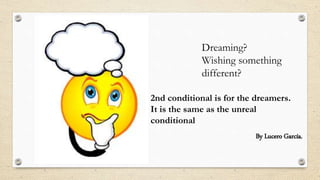
Dreaming?
Wishing something
different?
2nd conditional is for the dreamers.
It is the same as the unreal
conditional
By Lucero García.
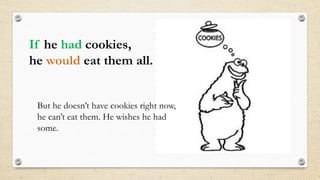
If he had cookies,
he would eat them all.
But he doesn’t have cookies right now,
he can’t eat them. He wishes he had
some.
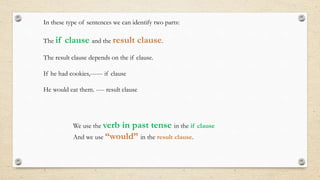
In these type of sentences we can identify two parts:
The if clause and the result clause.
The result clause depends on the if clause.
If he had cookies,------ if clause
He would eat them. ---- result clause
We use the verb in past tense in the if clause
And we use “would” in the result clause.
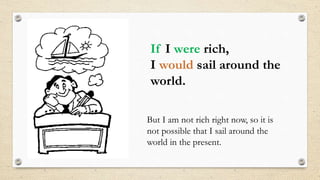
If I were rich,
I would sail around the
world.
But I am not rich right now, so it is
not possible that I sail around the
world in the present.
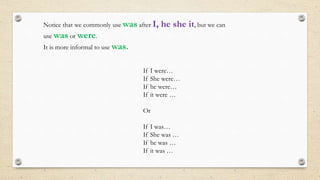
Notice that we commonly use was after I, he she it, but we can
use was or were.
It is more informal to use was.
If I were…
If She were…
If he were…
If it were …
Or
If I was…
If She was …
If he was …
If it was …
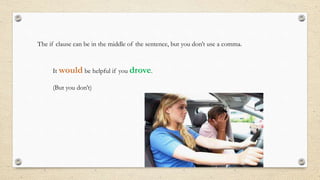
The if clause can be in the middle of the sentence, but you don’t use a comma.
It would be helpful if you drove.
(But you don’t)
When to use the 2nd
conditional
We can use it to talk about
something in the present which is
impossible because it is not
true.
We can use it to talk about things
in the future that probably are not
going to be true.
Maybe it is a dream.
Examples:
If I were rich, I wouldn’t work.
If Tom had more time, he would read more.
If you didn’t want to go to the party, you wouldn’t go.
If it didn’t rain, I would go to the park.
You’d feel better if you got more exercise.
I’d be very frightened if I saw a big spider.
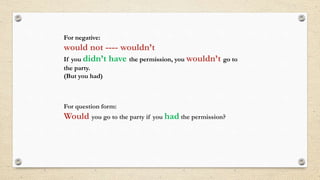
For negative:
would not ---- wouldn’t
If you didn’t have the permission, you wouldn’t go to
the party.
(But you had)
For question form:
Would you go to the party if you had the permission?

2nd conditional

  • 1.
    Dreaming? Wishing something different? 2nd conditionalis for the dreamers. It is the same as the unreal conditional By Lucero García.
  • 2.
    If he hadcookies, he would eat them all. But he doesn’t have cookies right now, he can’t eat them. He wishes he had some.
  • 3.
    In these typeof sentences we can identify two parts: The if clause and the result clause. The result clause depends on the if clause. If he had cookies,------ if clause He would eat them. ---- result clause We use the verb in past tense in the if clause And we use “would” in the result clause.
  • 4.
    If I wererich, I would sail around the world. But I am not rich right now, so it is not possible that I sail around the world in the present.
  • 5.
    Notice that wecommonly use was after I, he she it, but we can use was or were. It is more informal to use was. If I were… If She were… If he were… If it were … Or If I was… If She was … If he was … If it was …
  • 6.
    The if clausecan be in the middle of the sentence, but you don’t use a comma. It would be helpful if you drove. (But you don’t)
  • 7.
    When to usethe 2nd conditional We can use it to talk about something in the present which is impossible because it is not true. We can use it to talk about things in the future that probably are not going to be true. Maybe it is a dream.
  • 8.
    Examples: If I wererich, I wouldn’t work. If Tom had more time, he would read more. If you didn’t want to go to the party, you wouldn’t go. If it didn’t rain, I would go to the park. You’d feel better if you got more exercise. I’d be very frightened if I saw a big spider.
  • 9.
    For negative: would not---- wouldn’t If you didn’t have the permission, you wouldn’t go to the party. (But you had) For question form: Would you go to the party if you had the permission?