UNIT
5
Ecosystems
Natural Science 2. Secondary Education
THE MIGRATION OF BIRDS
UNIT
5
The migration of birds
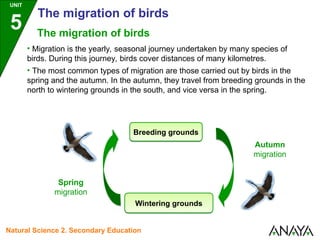
• Migration is the yearly, seasonal journey undertaken by many species of
birds. During this journey, birds cover distances of many kilometres.
• The most common types of migration are those carried out by birds in the
spring and the autumn. In the autumn, they travel from breeding grounds in the
north to wintering grounds in the south, and vice versa in the spring.
Breeding grounds
Wintering grounds
Autumn
migration
Spring
migration
Natural Science 2. Secondary Education
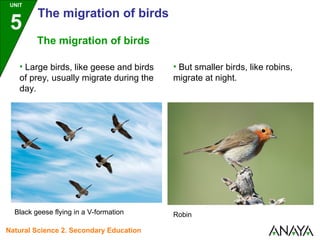
• Large birds, like geese and birds
of prey, usually migrate during the
day.
Black geese flying in a V-formation
• But smaller birds, like robins,
migrate at night.
Robin
The migration of birds
UNIT
5
The migration of birds
Natural Science 2. Secondary Education
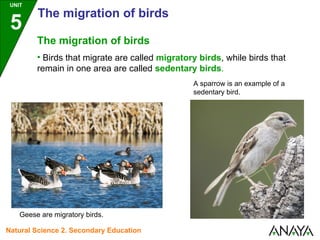
• Birds that migrate are called migratory birds, while birds that
remain in one area are called sedentary birds.
Geese are migratory birds.
A sparrow is an example of a
sedentary bird.
The migration of birds
UNIT
5
The migration of birds
Natural Science 2. Secondary Education
Why do birds migrate?
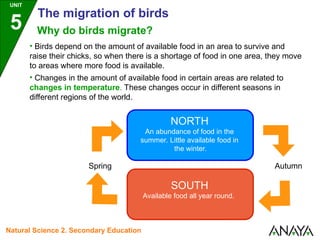
• Birds depend on the amount of available food in an area to survive and
raise their chicks, so when there is a shortage of food in one area, they move
to areas where more food is available.
• Changes in the amount of available food in certain areas are related to
changes in temperature. These changes occur in different seasons in
different regions of the world.
NORTH
An abundance of food in the
summer. Little available food in
the winter.
SOUTH
Available food all year round.
Spring Autumn
UNIT
5
The migration of birds
Natural Science 2. Secondary Education
Migratory routes
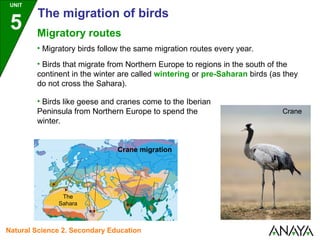
• Migratory birds follow the same migration routes every year.
• Birds that migrate from Northern Europe to regions in the south of the
continent in the winter are called wintering or pre-Saharan birds (as they
do not cross the Sahara).
• Birds like geese and cranes come to the Iberian
Peninsula from Northern Europe to spend the
winter.
The
Sahara
Crane migration
Crane
UNIT
5
The migration of birds
Natural Science 2. Secondary Education
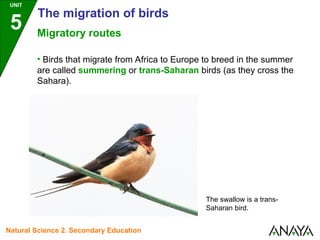
• Birds that migrate from Africa to Europe to breed in the summer
are called summering or trans-Saharan birds (as they cross the
Sahara).
The swallow is a trans-
Saharan bird.
UNIT
5
The migration of birds
Migratory routes
Natural Science 2. Secondary Education
The
Sahara
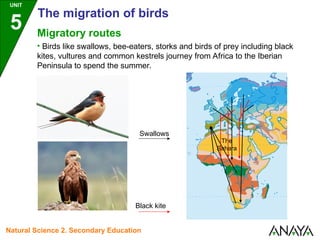
• Birds like swallows, bee-eaters, storks and birds of prey including black
kites, vultures and common kestrels journey from Africa to the Iberian
Peninsula to spend the summer.
Swallows
Black kite
UNIT
5
The migration of birds
Migratory routes
Natural Science 2. Secondary Education
Interesting examples
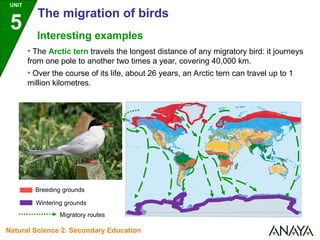
• The Arctic tern travels the longest distance of any migratory bird: it journeys
from one pole to another two times a year, covering 40,000 km.
• Over the course of its life, about 26 years, an Arctic tern can travel up to 1
million kilometres.
Breeding grounds
Wintering grounds
Migratory routes
UNIT
5
The migration of birds
Natural Science 2. Secondary Education
Interesting examples
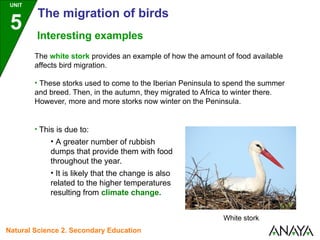
The white stork provides an example of how the amount of food available
affects bird migration.
• These storks used to come to the Iberian Peninsula to spend the summer
and breed. Then, in the autumn, they migrated to Africa to winter there.
However, more and more storks now winter on the Peninsula.
• This is due to:
• A greater number of rubbish
dumps that provide them with food
throughout the year.
• It is likely that the change is also
related to the higher temperatures
resulting from climate change.
White stork
UNIT
5
The migration of birds
Natural Science 2. Secondary Education

2CN_migration_birds_SC.pptadfbafsd bcvx dfbvasfbvdc

  • 1.
    UNIT 5 Ecosystems Natural Science 2.Secondary Education THE MIGRATION OF BIRDS
  • 2.
    UNIT 5 The migration ofbirds The migration of birds • Migration is the yearly, seasonal journey undertaken by many species of birds. During this journey, birds cover distances of many kilometres. • The most common types of migration are those carried out by birds in the spring and the autumn. In the autumn, they travel from breeding grounds in the north to wintering grounds in the south, and vice versa in the spring. Breeding grounds Wintering grounds Autumn migration Spring migration Natural Science 2. Secondary Education
  • 3.
    • Large birds,like geese and birds of prey, usually migrate during the day. Black geese flying in a V-formation • But smaller birds, like robins, migrate at night. Robin The migration of birds UNIT 5 The migration of birds Natural Science 2. Secondary Education
  • 4.
    • Birds thatmigrate are called migratory birds, while birds that remain in one area are called sedentary birds. Geese are migratory birds. A sparrow is an example of a sedentary bird. The migration of birds UNIT 5 The migration of birds Natural Science 2. Secondary Education
  • 5.
    Why do birdsmigrate? • Birds depend on the amount of available food in an area to survive and raise their chicks, so when there is a shortage of food in one area, they move to areas where more food is available. • Changes in the amount of available food in certain areas are related to changes in temperature. These changes occur in different seasons in different regions of the world. NORTH An abundance of food in the summer. Little available food in the winter. SOUTH Available food all year round. Spring Autumn UNIT 5 The migration of birds Natural Science 2. Secondary Education
  • 6.
    Migratory routes • Migratorybirds follow the same migration routes every year. • Birds that migrate from Northern Europe to regions in the south of the continent in the winter are called wintering or pre-Saharan birds (as they do not cross the Sahara). • Birds like geese and cranes come to the Iberian Peninsula from Northern Europe to spend the winter. The Sahara Crane migration Crane UNIT 5 The migration of birds Natural Science 2. Secondary Education
  • 7.
    • Birds thatmigrate from Africa to Europe to breed in the summer are called summering or trans-Saharan birds (as they cross the Sahara). The swallow is a trans- Saharan bird. UNIT 5 The migration of birds Migratory routes Natural Science 2. Secondary Education
  • 8.
    The Sahara • Birds likeswallows, bee-eaters, storks and birds of prey including black kites, vultures and common kestrels journey from Africa to the Iberian Peninsula to spend the summer. Swallows Black kite UNIT 5 The migration of birds Migratory routes Natural Science 2. Secondary Education
  • 9.
    Interesting examples • TheArctic tern travels the longest distance of any migratory bird: it journeys from one pole to another two times a year, covering 40,000 km. • Over the course of its life, about 26 years, an Arctic tern can travel up to 1 million kilometres. Breeding grounds Wintering grounds Migratory routes UNIT 5 The migration of birds Natural Science 2. Secondary Education
  • 10.
    Interesting examples The whitestork provides an example of how the amount of food available affects bird migration. • These storks used to come to the Iberian Peninsula to spend the summer and breed. Then, in the autumn, they migrated to Africa to winter there. However, more and more storks now winter on the Peninsula. • This is due to: • A greater number of rubbish dumps that provide them with food throughout the year. • It is likely that the change is also related to the higher temperatures resulting from climate change. White stork UNIT 5 The migration of birds Natural Science 2. Secondary Education