DOI: 10.1145/2834964  COPYRIGHT HELD BY AUTHOR
UX Research vs. UX Design
UX researchers. Graphic designers,
industrial designers, and engineers who
are adept at creating tangible products
would then be perfectly primed to work
as UX designers.
These are not hard and fast rules.
These are the result of Skot’s and my
attempt to define and organize a very
complex, multidisciplinary field. Skot
adds, “I think one unified way to define
UX is that it is a perspective—a lens
through which you can view your
product, service, or organization. It is the
lens through which your users view you,
as well. In my opinion, anyone who can
use this perspective is practicing UX.”
We are curious to hear what other
UX professionals think. We would love
to hear how you bring clarity about your
role and responsibilities to your design
team. Until next time, please enjoy the
experience.
	 Ashley Karr specializes in HCI, UX
research, and design. She teaches at General
Assembly and runs the Design Thinking
Boutique, where she creates products to help
design professionals stay inspired and satisfied
in their craft. http://interactions.acm.org/blog/
author/8592/Ashley%20Karr
→ ashley@ashleykarr.com
I
f you get an opportunity to have a
conversation with Skot Carruth,
take it. He is a UX professional
and principle at philosophie, a
UX and product consulting firm.
In addition, he is a fellow UCLA
graduate, a smart man, and an all-
around good person. Happily, we both
stumbled upon the same phenomenon:
There exists in industry a general lack
of clarity and understanding regarding
the role of a UX professional. On the
one hand, this is unfortunate. We want
everyone to know, love, and understand
our chosen profession. On the other
hand, this is very fortunate. It means, to
paraphrase Don Norman, we are leaders
in an emerging field and we have the
opportunity to spread the word.
We enjoyed ourselves as we kicked
around the questions:
•	Is UX a noun or verb?
•	Is UX a role you play or a process you
champion?
•	Where does the work of a UX
professional begin and end?
•	Where is the intersection of time
spent and quality derived in the UX
research and design process?
We did not generate sensational
answers to all of these questions;
however, we did celebrate when
we settled on the idea that UX is a
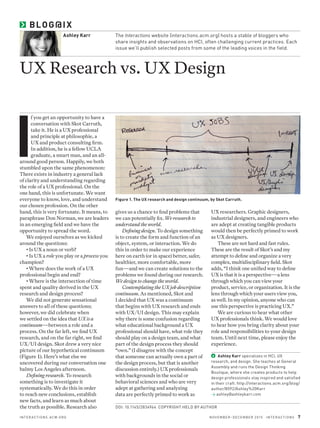
continuum—between a role and a
process. On the far left, we find UX
research, and on the far right, we find
UX/UI design. Skot drew a very nice
picture of our hypothetical continuum
(Figure 1). Here’s what else we
uncovered during our conversation one
balmy Los Angeles afternoon.
Defining research. To research
something is to investigate it
systematically. We do this in order
to reach new conclusions, establish
new facts, and learn as much about
the truth as possible. Research also
gives us a chance to find problems that
we can potentially fix. We research to
understand the world.
Defining design. To design something
is to create the form and function of an
object, system, or interaction. We do
this in order to make our experience
here on earth (or in space) better, safer,
healthier, more comfortable, more
fun—and we can create solutions to the
problems we found during our research.
We design to change the world.
Contemplating the UX job description
continuum. As mentioned, Skot and
I decided that UX was a continuum
that begins with UX research and ends
with UX/UI design. This may explain
why there is some confusion regarding
what educational background a UX
professional should have, what role they
should play on a design team, and what
part of the design process they should
“own.” (I disagree with the concept
that someone can actually own a part of
the design process, but that is another
discussion entirely.) UX professionals
with backgrounds in the social or
behavioral sciences and who are very
adept at gathering and analyzing
data are perfectly primed to work as
Figure 1. The UX research and design continuum, by Skot Carruth.
The Interactions website (interactions.acm.org) hosts a stable of bloggers who
share insights and observations on HCI, often challenging current practices. Each
issue we’ll publish selected posts from some of the leading voices in the field.
NOV EMBER–DECEMBER 2015 IN T ER ACT IONS 7IN T ER ACT IONS. ACM.ORG
Ashley Karr
BLOG@IX

2834964

  • 1.
    DOI: 10.1145/2834964  COPYRIGHTHELD BY AUTHOR UX Research vs. UX Design UX researchers. Graphic designers, industrial designers, and engineers who are adept at creating tangible products would then be perfectly primed to work as UX designers. These are not hard and fast rules. These are the result of Skot’s and my attempt to define and organize a very complex, multidisciplinary field. Skot adds, “I think one unified way to define UX is that it is a perspective—a lens through which you can view your product, service, or organization. It is the lens through which your users view you, as well. In my opinion, anyone who can use this perspective is practicing UX.” We are curious to hear what other UX professionals think. We would love to hear how you bring clarity about your role and responsibilities to your design team. Until next time, please enjoy the experience. Ashley Karr specializes in HCI, UX research, and design. She teaches at General Assembly and runs the Design Thinking Boutique, where she creates products to help design professionals stay inspired and satisfied in their craft. http://interactions.acm.org/blog/ author/8592/Ashley%20Karr → ashley@ashleykarr.com I f you get an opportunity to have a conversation with Skot Carruth, take it. He is a UX professional and principle at philosophie, a UX and product consulting firm. In addition, he is a fellow UCLA graduate, a smart man, and an all- around good person. Happily, we both stumbled upon the same phenomenon: There exists in industry a general lack of clarity and understanding regarding the role of a UX professional. On the one hand, this is unfortunate. We want everyone to know, love, and understand our chosen profession. On the other hand, this is very fortunate. It means, to paraphrase Don Norman, we are leaders in an emerging field and we have the opportunity to spread the word. We enjoyed ourselves as we kicked around the questions: • Is UX a noun or verb? • Is UX a role you play or a process you champion? • Where does the work of a UX professional begin and end? • Where is the intersection of time spent and quality derived in the UX research and design process? We did not generate sensational answers to all of these questions; however, we did celebrate when we settled on the idea that UX is a continuum—between a role and a process. On the far left, we find UX research, and on the far right, we find UX/UI design. Skot drew a very nice picture of our hypothetical continuum (Figure 1). Here’s what else we uncovered during our conversation one balmy Los Angeles afternoon. Defining research. To research something is to investigate it systematically. We do this in order to reach new conclusions, establish new facts, and learn as much about the truth as possible. Research also gives us a chance to find problems that we can potentially fix. We research to understand the world. Defining design. To design something is to create the form and function of an object, system, or interaction. We do this in order to make our experience here on earth (or in space) better, safer, healthier, more comfortable, more fun—and we can create solutions to the problems we found during our research. We design to change the world. Contemplating the UX job description continuum. As mentioned, Skot and I decided that UX was a continuum that begins with UX research and ends with UX/UI design. This may explain why there is some confusion regarding what educational background a UX professional should have, what role they should play on a design team, and what part of the design process they should “own.” (I disagree with the concept that someone can actually own a part of the design process, but that is another discussion entirely.) UX professionals with backgrounds in the social or behavioral sciences and who are very adept at gathering and analyzing data are perfectly primed to work as Figure 1. The UX research and design continuum, by Skot Carruth. The Interactions website (interactions.acm.org) hosts a stable of bloggers who share insights and observations on HCI, often challenging current practices. Each issue we’ll publish selected posts from some of the leading voices in the field. NOV EMBER–DECEMBER 2015 IN T ER ACT IONS 7IN T ER ACT IONS. ACM.ORG Ashley Karr BLOG@IX