SEARCHING FOR POTENTIAL FUTURE SOLUTIONS
FOR MANAGING AQUATIC WEEDS – SOME
AUSTRALASIAN EXPERIENCES
Peter Harper, Bettersafe Pest & Weed Management, Australia
Dr. Nimal Chandrasena, GHD Pty Ltd, Australia
Bill Chisholm Aquatic Plant Control, New Zealand
AQUATIC PLANTS ARE USEFUL & BENEFICIAL
In natural systems, such as lakes and ponds, light to
moderate growth of aquatic plants serve useful purposes:
Provide oxygen, food and cover for fish and other
aquatic organisms, and
may stabilize bottom sediment
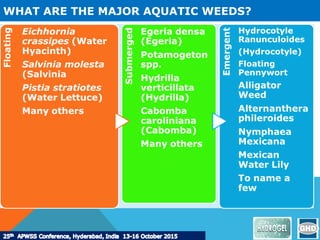
WHAT ARE THE MAJOR AQUATIC WEEDS?
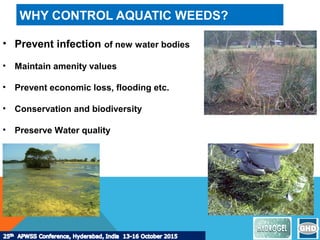
WHY CONTROL AQUATIC WEEDS?
• Prevent infection of new water bodies
• Maintain amenity values
• Prevent economic loss, flooding etc.
• Conservation and biodiversity
• Preserve Water quality
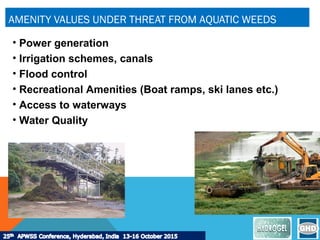
AMENITY VALUES UNDER THREAT FROM AQUATIC WEEDS
• Power generation
• Irrigation schemes, canals
• Flood control
• Recreational Amenities (Boat ramps, ski lanes etc.)
• Access to waterways
• Water Quality
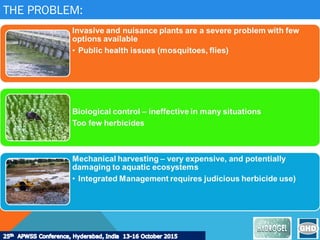
THE PROBLEM:
In Australia Only:
 Diquat
 ‘Bi-active’ Glyphosate
 Metsulfuron-Methyl (for Alligatorweed)
 24D amine ( special Permit)
 Acrolein (restricted use)
 Fluridone (SONAR – Registered under
special permit)
 Carfentrazone (SHARK)
THE PROBLEM:
GLOBALLY VERY FEW HERBICIDES ARE AVAILABLE FOR
MANAGING AQUATIC WEEDS IN WATERWAYS
 Imazomox
 Imazapyr
 Endothal
 Triclopyr - amine
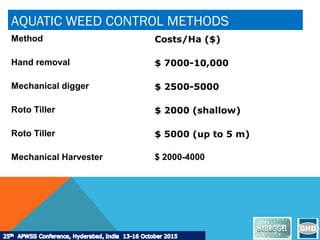
AQUATIC WEED CONTROL METHODS
Method Costs/Ha ($)
Hand removal $ 7000-10,000
Mechanical digger $ 2500-5000
Roto Tiller $ 2000 (shallow)
Roto Tiller $ 5000 (up to 5 m)
Mechanical Harvester $ 2000-4000
AQUATIC WEED CONTROL METHODS
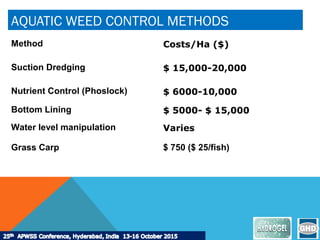
Method Costs/Ha ($)
Suction Dredging $ 15,000-20,000
Nutrient Control (Phoslock) $ 6000-10,000
Bottom Lining $ 5000- $ 15,000
Water level manipulation Varies
Grass Carp $ 750 ($ 25/fish)
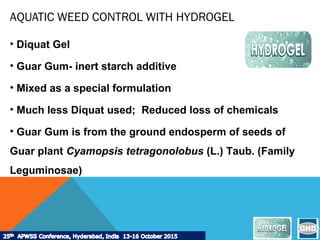
AQUATIC WEED CONTROL WITH HYDROGEL
• Diquat Gel
• Guar Gum- inert starch additive
• Mixed as a special formulation
• Much less Diquat used; Reduced loss of chemicals
• Guar Gum is from the ground endosperm of seeds of
Guar plant Cyamopsis tetragonolobus (L.) Taub. (Family
Leguminosae)
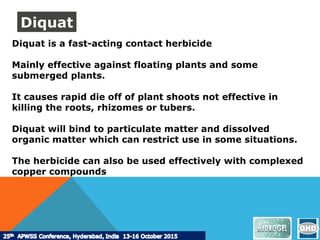
Diquat is a fast-acting contact herbicide
Mainly effective against floating plants and some
submerged plants.
It causes rapid die off of plant shoots not effective in
killing the roots, rhizomes or tubers.
Diquat will bind to particulate matter and dissolved
organic matter which can restrict use in some situations.
The herbicide can also be used effectively with complexed
copper compounds
Diquat
AQUATIC WEED CONTROL WITH HYDROGEL
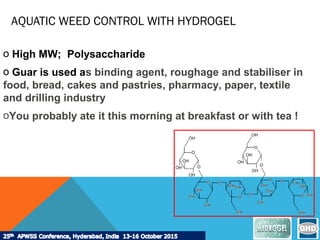
o High MW; Polysaccharide
o Guar is used as binding agent, roughage and stabiliser in
food, bread, cakes and pastries, pharmacy, paper, textile
and drilling industry
oYou probably ate it this morning at breakfast or with tea !
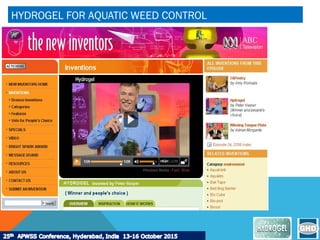
HYDROGEL FOR AQUATIC WEED CONTROL
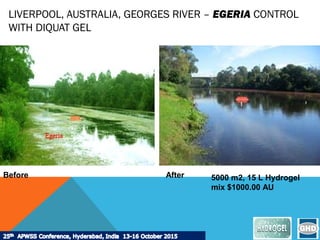
LIVERPOOL, AUSTRALIA, GEORGES RIVER – EGERIA CONTROL
WITH DIQUAT GEL
Before After 5000 m2, 15 L Hydrogel
mix $1000.00 AU
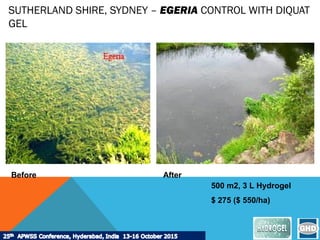
SUTHERLAND SHIRE, SYDNEY – EGERIA CONTROL WITH DIQUAT
GEL
Before After
500 m2, 3 L Hydrogel
$ 275 ($ 550/ha)
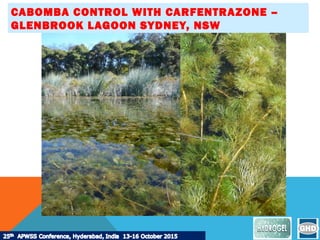
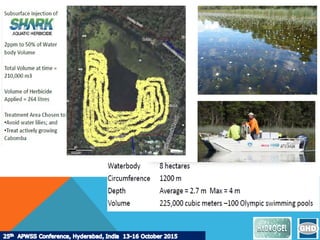
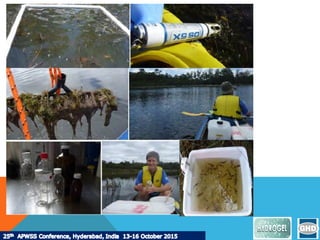
CABOMBA CONTROL WITH CARFENTRAZONE –
GLENBROOK LAGOON SYDNEY, NSW
Carfentrazone (Shark) is an EW (emulsion in water)
formulation.
It is a rapid-acting, non-translocated, light dependant,
contact herbicide, rapidly taken up by plant foliage
Forms peroxides which attack the cell wall, causing the
cells to collapse and die.
The foliage shows signs of burning within 24 to 48
hours.
Plant death generally follows within 7 to 28 days for
emerged plants and slightly longer for submerged plants.
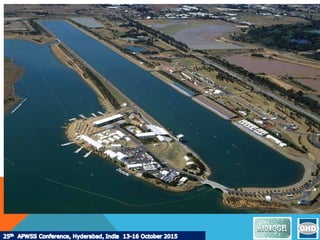
FLURIDONE USE - AT SYDNEY OLYMPIC LAKES FOR HYDRILLA
CONTROL
The Competition and Warm-Up Lakes cover an area of 76
ha; lakes are separated by barriers
The Competition Lake is 2,300 m in length and 167 m in
width. The average depth is 5 m and the volume of water
is 2,112,550 m3 or approximately 2113 mega litres (ML).
3 applications over 56 days
Day 1: 109.8 L,
Day 28:45.4 L,
Day 56 30.3 L) to achieve 42.1ppb
approximate
CONCLUSIONS
Herbicides are useful and effective if used correctly
Some can be used selectively at low doses.
Diquat is suited for treatments in water bodies lakes
ponds and rivers and you can selectively target weed
infestations with hydrogel
Carfentrazone and Fluridone are both suitable for
whole water body treatments
We highly recommend that with any aquatic herbicide
treatment you seek expert advice

25 apwss 2015_hydrogel_presentation

  • 1.
    SEARCHING FOR POTENTIALFUTURE SOLUTIONS FOR MANAGING AQUATIC WEEDS – SOME AUSTRALASIAN EXPERIENCES Peter Harper, Bettersafe Pest & Weed Management, Australia Dr. Nimal Chandrasena, GHD Pty Ltd, Australia Bill Chisholm Aquatic Plant Control, New Zealand
  • 2.
    AQUATIC PLANTS AREUSEFUL & BENEFICIAL In natural systems, such as lakes and ponds, light to moderate growth of aquatic plants serve useful purposes: Provide oxygen, food and cover for fish and other aquatic organisms, and may stabilize bottom sediment
  • 3.
    WHAT ARE THEMAJOR AQUATIC WEEDS?
  • 4.
    WHY CONTROL AQUATICWEEDS? • Prevent infection of new water bodies • Maintain amenity values • Prevent economic loss, flooding etc. • Conservation and biodiversity • Preserve Water quality
  • 5.
    AMENITY VALUES UNDERTHREAT FROM AQUATIC WEEDS • Power generation • Irrigation schemes, canals • Flood control • Recreational Amenities (Boat ramps, ski lanes etc.) • Access to waterways • Water Quality
  • 6.
  • 7.
    In Australia Only: Diquat  ‘Bi-active’ Glyphosate  Metsulfuron-Methyl (for Alligatorweed)  24D amine ( special Permit)  Acrolein (restricted use)  Fluridone (SONAR – Registered under special permit)  Carfentrazone (SHARK) THE PROBLEM: GLOBALLY VERY FEW HERBICIDES ARE AVAILABLE FOR MANAGING AQUATIC WEEDS IN WATERWAYS  Imazomox  Imazapyr  Endothal  Triclopyr - amine
  • 8.
    AQUATIC WEED CONTROLMETHODS Method Costs/Ha ($) Hand removal $ 7000-10,000 Mechanical digger $ 2500-5000 Roto Tiller $ 2000 (shallow) Roto Tiller $ 5000 (up to 5 m) Mechanical Harvester $ 2000-4000
  • 9.
    AQUATIC WEED CONTROLMETHODS Method Costs/Ha ($) Suction Dredging $ 15,000-20,000 Nutrient Control (Phoslock) $ 6000-10,000 Bottom Lining $ 5000- $ 15,000 Water level manipulation Varies Grass Carp $ 750 ($ 25/fish)
  • 10.
    AQUATIC WEED CONTROLWITH HYDROGEL • Diquat Gel • Guar Gum- inert starch additive • Mixed as a special formulation • Much less Diquat used; Reduced loss of chemicals • Guar Gum is from the ground endosperm of seeds of Guar plant Cyamopsis tetragonolobus (L.) Taub. (Family Leguminosae)
  • 11.
    Diquat is afast-acting contact herbicide Mainly effective against floating plants and some submerged plants. It causes rapid die off of plant shoots not effective in killing the roots, rhizomes or tubers. Diquat will bind to particulate matter and dissolved organic matter which can restrict use in some situations. The herbicide can also be used effectively with complexed copper compounds Diquat
  • 12.
    AQUATIC WEED CONTROLWITH HYDROGEL o High MW; Polysaccharide o Guar is used as binding agent, roughage and stabiliser in food, bread, cakes and pastries, pharmacy, paper, textile and drilling industry oYou probably ate it this morning at breakfast or with tea !
  • 13.
  • 14.
    LIVERPOOL, AUSTRALIA, GEORGESRIVER – EGERIA CONTROL WITH DIQUAT GEL Before After 5000 m2, 15 L Hydrogel mix $1000.00 AU
  • 15.
    SUTHERLAND SHIRE, SYDNEY– EGERIA CONTROL WITH DIQUAT GEL Before After 500 m2, 3 L Hydrogel $ 275 ($ 550/ha)
  • 16.
    CABOMBA CONTROL WITHCARFENTRAZONE – GLENBROOK LAGOON SYDNEY, NSW
  • 17.
    Carfentrazone (Shark) isan EW (emulsion in water) formulation. It is a rapid-acting, non-translocated, light dependant, contact herbicide, rapidly taken up by plant foliage Forms peroxides which attack the cell wall, causing the cells to collapse and die. The foliage shows signs of burning within 24 to 48 hours. Plant death generally follows within 7 to 28 days for emerged plants and slightly longer for submerged plants.
  • 20.
    FLURIDONE USE -AT SYDNEY OLYMPIC LAKES FOR HYDRILLA CONTROL The Competition and Warm-Up Lakes cover an area of 76 ha; lakes are separated by barriers The Competition Lake is 2,300 m in length and 167 m in width. The average depth is 5 m and the volume of water is 2,112,550 m3 or approximately 2113 mega litres (ML). 3 applications over 56 days Day 1: 109.8 L, Day 28:45.4 L, Day 56 30.3 L) to achieve 42.1ppb approximate
  • 23.
    CONCLUSIONS Herbicides are usefuland effective if used correctly Some can be used selectively at low doses. Diquat is suited for treatments in water bodies lakes ponds and rivers and you can selectively target weed infestations with hydrogel Carfentrazone and Fluridone are both suitable for whole water body treatments We highly recommend that with any aquatic herbicide treatment you seek expert advice

Editor's Notes

  • #8 Globally very herbicides have the capability of managing aquatic weeds in waterways
  • #9 So, we’ve been working on different options; and costs; as well as assess how economical and practicable these options are: Some details in brief are: Manual control; Plastic lining/matting; Weed cutter/ Roto tiller/Mechanical Harvester Suction dredge Herbicides (Diquat, Endothall, Acrolein, Fluridone) Biological control (Grass Carp, Weevils, Beetles) Public Education
  • #11 There are several gel adjuvants; we have concentrated on Guar Gum; activated by a unique process, so that it becomes stickier; ionised; Diquat Gel; Guar Gum- inert starch additive Mixed as a special formulation Much less Diquat used; Reduced loss of chemicals Guar Gum is from the ground endosperm of seeds of Guar plant Cyamopsis tetragonolobus (L.) Taub. (Family Leguminosae)
  • #13 Guar is used as binding agent, roughage and stabiliser in food, bread, cakes and pastries, pharmacy, paper, textile and drilling industry
  • #17 We undertook treatment of a stormwater Lagoon infested with Cabomba (Fanwort); began as a small colony 10 years ago, and then took over the Lagoon; Carfentraozone was determined to be the only chemical that can kill Cabomba;
  • #18 Carfentrazone (Shark) is an EW (emulsion in water) formulation.  It is a rapid-acting, non-translocated, light dependant, contact herbicide which is rapidly taken up by plant foliage Forms peroxides which attack the cell wall, causing the cells to collapse and die. The foliage shows signs of burning within 24 to 48 hours. Plant death generally follows within 7 to 28 days for emerged plants and slightly longer for submerged plants.  
  • #19 Information on treatments given; applied to ½ the pond; dissipated quickly; 2 ppm applied; became 1 ppm in whole pond; rapid collapse of plants within 4 days; soft tissue, easily killed; application was in 3-4 December, not ideal because warm conditions in which DO is low anyway; DO dissolution highest around 15 degrees in water; so water was getting stressed and the treatment added to the stress; 95% reduction in about a month; DO decline was dramatic; but gradually improved with aeration; after 6 weeks, WQ and aquatic health had recovered.
  • #20 We do diligent water quality monitoring over time; herbicide residues etc.
  • #23 We’ve given the treatments and are measuring water quality and herbicide residues; we applied at 24 ppb; and measured about 20 ppb, which is still in the pond; after one week before we left, Fluridone was 19 ppb all over the Competition Lake; we expect to give a second treatment at the end of the month; and Hydrilla and Vallisneria to die over the 2 months