Lower Urinary tract
infection
Dr. AMMAR FADIL
UTI
• Urinary tract infection (UTI) is a term that
is applied to a variety of clinical conditions
ranging from cystitis to severe infection of
the kidney with resultant sepsis.
2
Lower UTI
cystitis
UTI
Upper UTI
Pyelonephritis
3
UTI
May also be classified as
1. Isolated UTI
a single episode of lower tract infection occurs
frequently in females and is rarely complicated.
2. Recurrent UTI
is >2 infections in 6 months, or 3 within 12
months.
4
Predisposing causes of urinary tract
infection
• Incomplete emptying of the bladder,
bladder outflow obstruction,
bladder diverticulum,
neurogenic bladder
• A calculus, foreign body or neoplasm.
• Incomplete emptying of the upper tract,
dilatation of the ureters associated with
pregnancy, or vesicoureteric reflux VUR.
5
• Oestrogen deficiency, which may give rise
to lowered local resistance.
• Colonisation of the perineal skin by strains of
Escherichia coli expressing molecules that
facilitate adherence to mucosa
• Diabetes.
• Immunosuppression
6
Acute cystitis
• urinary infection of the lower urinary tract,
principally the bladder.
• Acute cystitis ♀ > ♂.
• The primary mode of infection is
ascending from the periurethral / vaginal
and fecal flora.
• The diagnosis is made clinically.
7
PRESENTATION
• There is frequent voiding of small volumes,
dysuria, urgency, suprapubic pain, hematuria.
• 50% of women will have an episode of cystitis
in their lifetime
– Fever and systemic symptoms are rare.
8
INVESTIGATIONS
• Urinalysis WBCs in the urine & hematuria
may be present.
• Urine culture is required to confirm the
diagnosis & identify the causative organism.
• However, when the clinical picture &
urinalysis are suggestive of the Dx of
acute cystitis, urine culture may not be
needed.
9
RADIOGRAPHIC IMAGING
• In uncomplicated infection of the bladder,
radiologic evaluation is often not
necessary
• recurrent UTI, Fever, UTI in children
• US
• VCUG
10
Treatment
• Management for acute cystitis consists of a
short course of oral antibiotics.
–TMP SMX
–Nitrofurantoin
–Quinolones
Short oral course 3-5 d ♀
Days for ♂ & child 7 d
11
Honeymoon Cystitis
• Is the term for a UTI that often occurs after
sexual activity. Sexual activity can push
infecting bacteria into the urethra resulting
in an infection.
12
13
• Recurrent UTI may be due to
– Reinfection (i.e., infection by a different
bacteria) or
– Bacterial persistence (infection by the same
organism).
Bacterial persistence is caused by
– the presence of bacteria within calculi
(e.g., struvite calculi)
– antimicrobial resistance,
– patient noncompliance with therapy
Recurrent UTI
1. Bacterial persistence
presence of bacteria within a site in the
urinary tract, leads to repeat episodes of
infection.
• Such sites include
 urolithiasis anywhere in the urinary tract,
 chronic bacterial prostatitis,
 obstructed or atrophic kidney
14
15
The recurrent UTIs will not resolve until
this underlying problem has been
addressed and corrected.
e.g. surgical removal of the infected source
(such as urinary calculi)
Recurrent UTI
2. Reinfections
usually occur after a prolonged interval
(months) from the previous infection and are
often caused by a different organism than
the previous infecting bacterium
16
MANAGEMENT
• renal ultrasound, CT scan, cystoscopy) to
evaluate for a potential source of bacterial
persistence.
• In the absence of finding an underlying
functional or anatomic abnormality,
they can be managed in one of the
following ways.
17
18
• Low-dose antibiotic prophylaxis
trimethoprim, nitrofurantoin, low-dose
cephalexin, and the fluoroquinolones
appear to have minimal adverse effects on
the fecal and vaginal flora.
• Prophylactic therapy requires only a small
dose of an antimicrobial agent, generally
given at bedtime for 3 to 6 months
continuous prophylactic antibiotic
• Nitrofurantoin, 50 or 100 mg daily
• TMP-SMX, 40/200 mg daily
• Trimethoprim, 100 mg daily
• Cephalexin, 250 mg daily
• Ciprofloxacin, 250 mg daily
19
Recurrent cystitis/ UTI
• ♀with reinfection do not usually have an
underlying functional or anatomical abnormality.
But have higher adherence of bacteria to their
mucosal cells compared to women who never had
UTI.
• ♂ with reinfection may have underlying bladder
outlet obstruction (due to prostate enlargement or
urethral stricture), which makes them more likely to
develop a repeated infection.
20
Other Measures in women
–When the recurrent cystitis/UTI is
related to sexual activity frequent
emptying of the bladder after coitus.
–either CPA or post intercourse
prophylaxis can significantly reduce the
incidence of recurrent infection
• Yogurt applied to the vulva and vagina can
help restore normal vaginal flora,
• Cranberry taken orally
21
Infection in pregnancy
• The incidence of asymptomatic bacteriuria in
pregnant women is twice as high as in non-
pregnant women.
• Simple uncomplicated infection can be treated
following urine culture with an antibiotic that is
not contraindicated in pregnancy, such as
cephalosporin or ampicillin.
• Pyelonephritis need I.V ABS and close
observation. 22
Antibiotics in urology
• TMP SMX:
– highly effective against many
uropathogenes except pseudomonas &
entreococcus.
– interfere with bacterial metabolism of folate.
SE: rash, GIT upset, leukopenia.
CI: G6PD, pregnant
23
Quinolones
• Ciprofloxacin, levofloxacin
• broad spectrum, interfere with bacterial
DNA.
Adverse reactions include tendon damage,
arthropathy in children
CI: children & pregnant
24
Nitrofurantoin
has good activity against most gram –ve
except Pseudomonas & proteus.
It inhibit bacterial enzymes & DNA
activity.
SE: polyneuropathy, hepatotoxicity.
• Aminoglycosides
used for complicated UTI.
When combined with ampicilline act
against enterococci
25
Cephalosporine
Have good activity against most uropathogene.
1st generation gram positive & E.Coli.
2nd generation anaerobic & H.influenze.
3rd generation ceftriaxone , cefotaxim
boader coverage against G –ve less
against G+ve
4th generation cefepim
oral 3rd cefixime effective in febrile UTI in
children
26
Penicillin
• Are ineffective against uropathogene.
• Ampicilline & amoxicilline have good activity against uropathogene but G-ve bacteria quickly develop resistance.
• Addition of B lactamase inhibitor such as clavulanic acid makes combination more active against G-ve
bacteria.
27
Schistosomiasis (bilharziasis)
• Urinary schistosomiasis is caused by the
Schistoma haematobium. It is endemic in Iraq,
Egypt, and the Middle East.
• Fresh water bulinus snails release the infective
form of the parasite (cercariae), which can
penetrate skin, and migrate to the liver (as
schistosomules), where they mature.
28
29
• Adult flukes couple, migrate to vesical veins,
and lay eggs , which leave the body by
penetrating the bladder and entering the urine.
The disease has two stages:
• active (when adult worms are
actively laying eggs)
• inactive (when the adult has died, and there
is a reaction to the remaining eggs). The
development of squamous cell carcinoma of
the bladder is result of the chronic
inflammation.
Clinical features
Swimmer’s itch.
• Active inflammation results in hematuria,
frequency, and terminal dysuria.
30
Investigations
Urinalysis
Early morning urine specimen, to see ova
with terminal spine.
• Serology tests (ELISA).
IVP
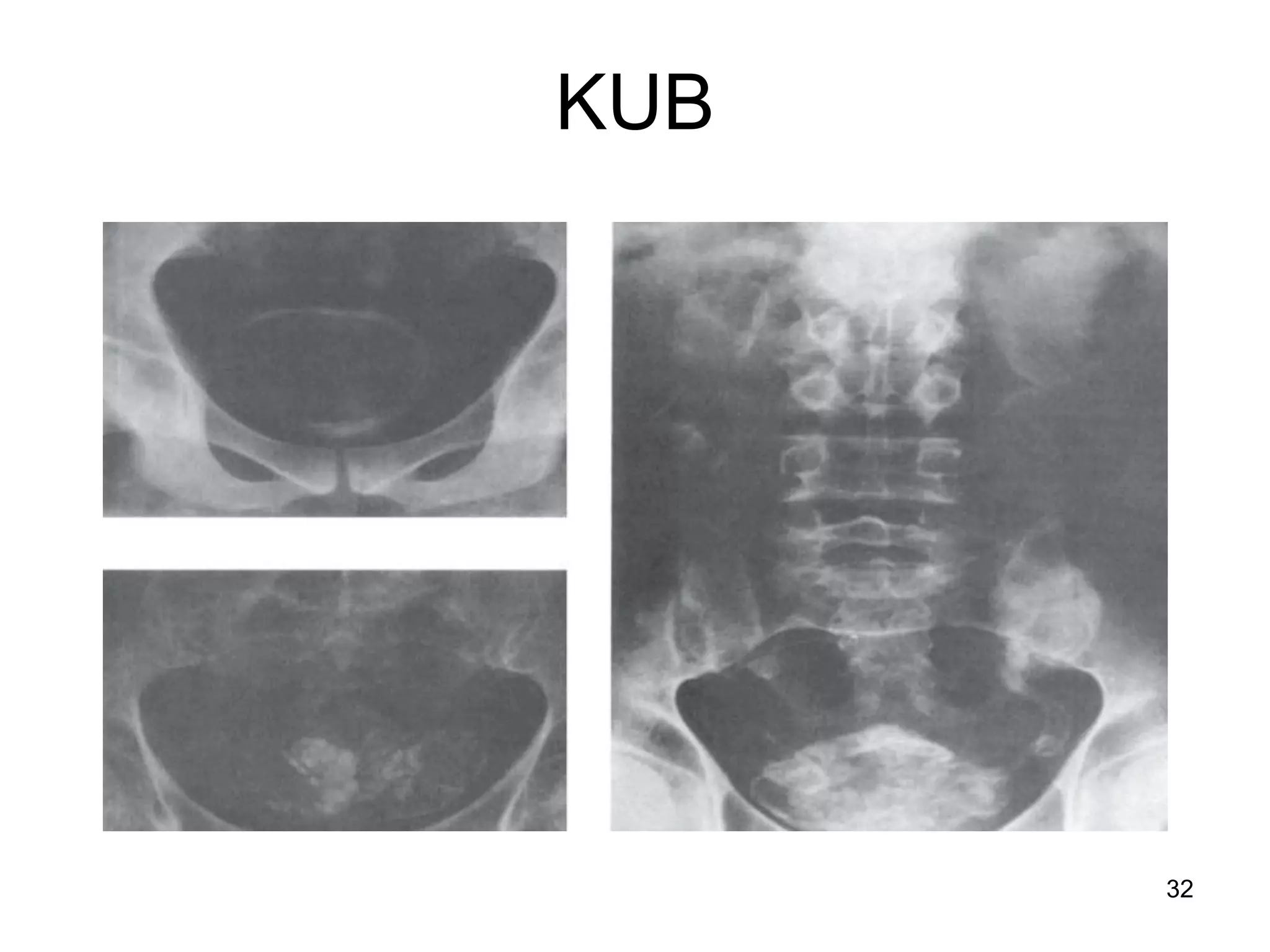
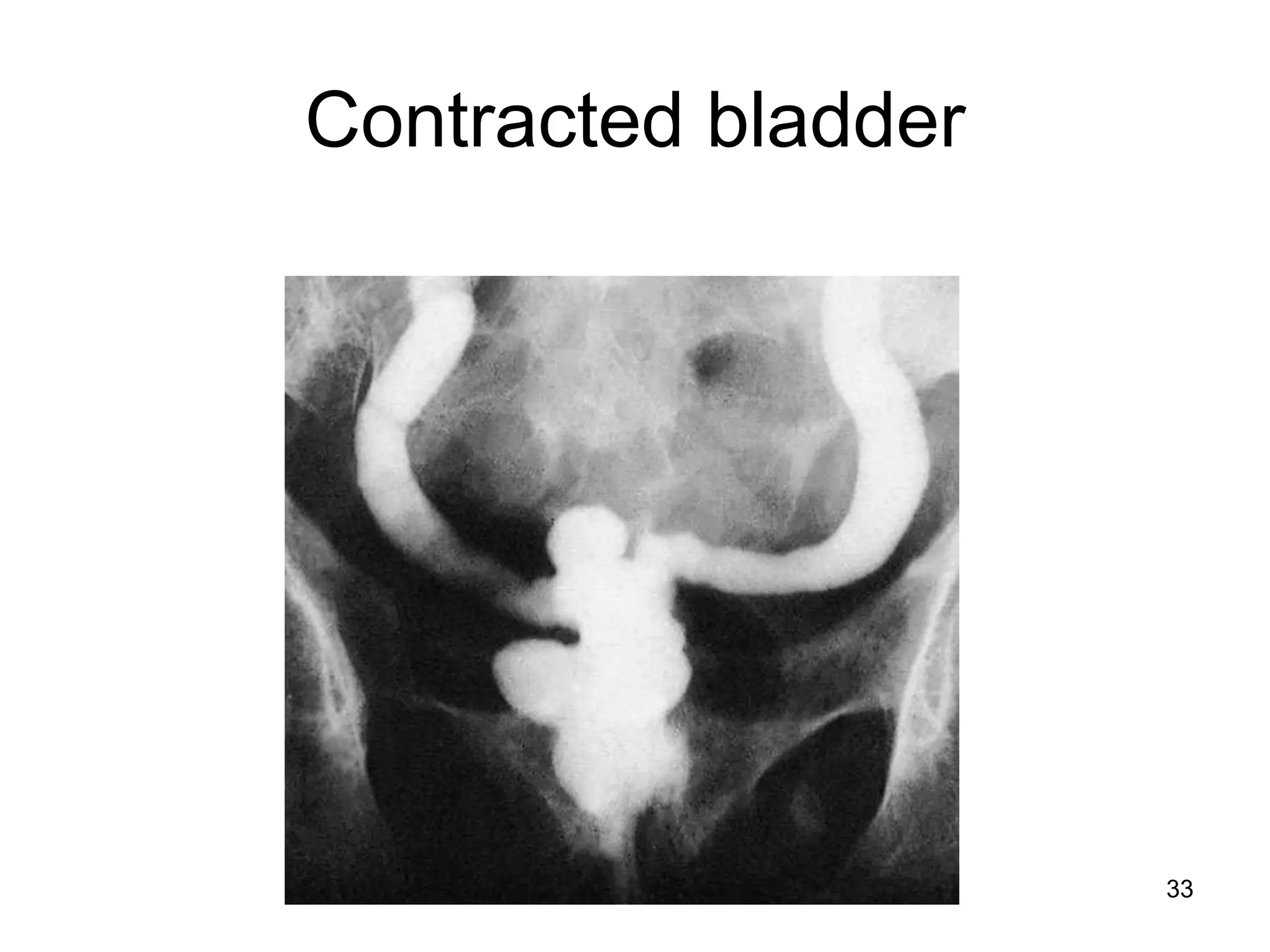
may show a calcified, contracted bladder,
and obstructive uropathy.
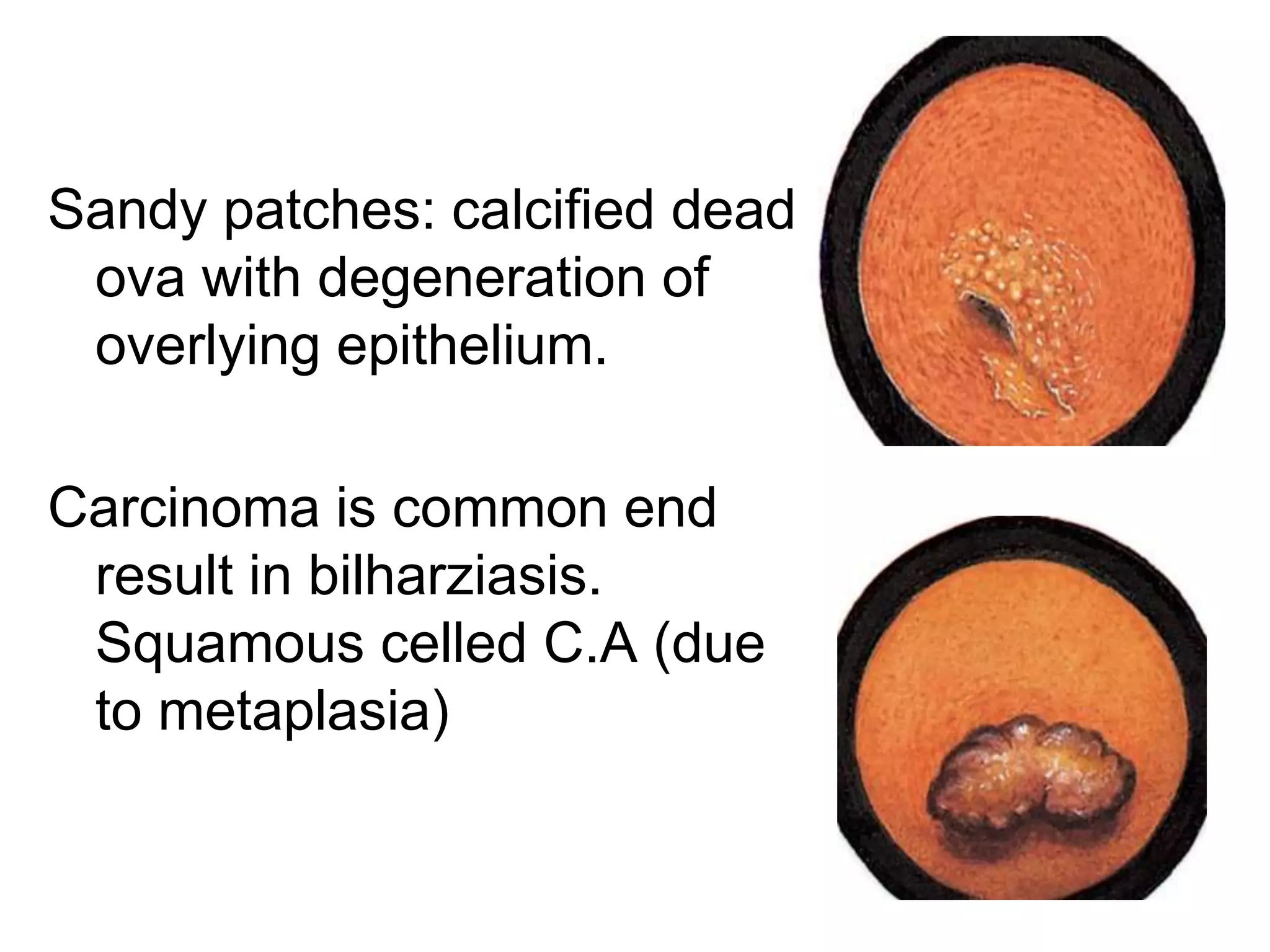
• Cystoscopy identifies eggs in the trigone
(“sandy patches”).
31
KUB
32
Contracted bladder
33
Sandy patches: calcified dead
ova with degeneration of
overlying epithelium.
Carcinoma is common end
result in bilharziasis.
Squamous celled C.A (due
to metaplasia)
34
Complication
Chronic infection can lead to obstructive uropathy,
ureteric stenosis, renal failure, and bladder
contraction.
The most significant and concerning
complication is the development of
squamous cell carcinoma of the bladder
that often presents at an advanced stage.
35
Interstitial cystitis/ BPS
• Interstitial cystitis (IC). this is confined to women,
also known as painful bladder syndrome of
unknown etiology
• IC is characterized by
daytime & night time urinary frequency,
urgency, suprapubic pain,
no identifiable pathological cause.
urinary tract infection are absent.
36
Interstitial cystitis/BPS
IC is a diagnosis of exclusion.
Urine culture
Cystoscopy: characteristic ulcer is
found in the fundus.
Bladder biopsy
37
treatment
• Oral : Amitriptyline,
Pentosanpolysulphate, cimitidine
• Intravesical: onabotulinum toxin A plus
Hydrostatic dilatation under anaesthesia
may give relief for some months.
38
39
• Recurrent UTI due to reinfection treated by
low-dose continuous prophylactic antibiotic
has been shown to reduce the recurrences of
UTI by 95% compared to placebo.

2_2020_10_24!09_23_09_AM.ppt

  • 1.
  • 2.
    UTI • Urinary tractinfection (UTI) is a term that is applied to a variety of clinical conditions ranging from cystitis to severe infection of the kidney with resultant sepsis. 2
  • 3.
  • 4.
    UTI May also beclassified as 1. Isolated UTI a single episode of lower tract infection occurs frequently in females and is rarely complicated. 2. Recurrent UTI is >2 infections in 6 months, or 3 within 12 months. 4
  • 5.
    Predisposing causes ofurinary tract infection • Incomplete emptying of the bladder, bladder outflow obstruction, bladder diverticulum, neurogenic bladder • A calculus, foreign body or neoplasm. • Incomplete emptying of the upper tract, dilatation of the ureters associated with pregnancy, or vesicoureteric reflux VUR. 5
  • 6.
    • Oestrogen deficiency,which may give rise to lowered local resistance. • Colonisation of the perineal skin by strains of Escherichia coli expressing molecules that facilitate adherence to mucosa • Diabetes. • Immunosuppression 6
  • 7.
    Acute cystitis • urinaryinfection of the lower urinary tract, principally the bladder. • Acute cystitis ♀ > ♂. • The primary mode of infection is ascending from the periurethral / vaginal and fecal flora. • The diagnosis is made clinically. 7
  • 8.
    PRESENTATION • There isfrequent voiding of small volumes, dysuria, urgency, suprapubic pain, hematuria. • 50% of women will have an episode of cystitis in their lifetime – Fever and systemic symptoms are rare. 8
  • 9.
    INVESTIGATIONS • Urinalysis WBCsin the urine & hematuria may be present. • Urine culture is required to confirm the diagnosis & identify the causative organism. • However, when the clinical picture & urinalysis are suggestive of the Dx of acute cystitis, urine culture may not be needed. 9
  • 10.
    RADIOGRAPHIC IMAGING • Inuncomplicated infection of the bladder, radiologic evaluation is often not necessary • recurrent UTI, Fever, UTI in children • US • VCUG 10
  • 11.
    Treatment • Management foracute cystitis consists of a short course of oral antibiotics. –TMP SMX –Nitrofurantoin –Quinolones Short oral course 3-5 d ♀ Days for ♂ & child 7 d 11
  • 12.
    Honeymoon Cystitis • Isthe term for a UTI that often occurs after sexual activity. Sexual activity can push infecting bacteria into the urethra resulting in an infection. 12
  • 13.
    13 • Recurrent UTImay be due to – Reinfection (i.e., infection by a different bacteria) or – Bacterial persistence (infection by the same organism). Bacterial persistence is caused by – the presence of bacteria within calculi (e.g., struvite calculi) – antimicrobial resistance, – patient noncompliance with therapy
  • 14.
    Recurrent UTI 1. Bacterialpersistence presence of bacteria within a site in the urinary tract, leads to repeat episodes of infection. • Such sites include  urolithiasis anywhere in the urinary tract,  chronic bacterial prostatitis,  obstructed or atrophic kidney 14
  • 15.
    15 The recurrent UTIswill not resolve until this underlying problem has been addressed and corrected. e.g. surgical removal of the infected source (such as urinary calculi)
  • 16.
    Recurrent UTI 2. Reinfections usuallyoccur after a prolonged interval (months) from the previous infection and are often caused by a different organism than the previous infecting bacterium 16
  • 17.
    MANAGEMENT • renal ultrasound,CT scan, cystoscopy) to evaluate for a potential source of bacterial persistence. • In the absence of finding an underlying functional or anatomic abnormality, they can be managed in one of the following ways. 17
  • 18.
    18 • Low-dose antibioticprophylaxis trimethoprim, nitrofurantoin, low-dose cephalexin, and the fluoroquinolones appear to have minimal adverse effects on the fecal and vaginal flora. • Prophylactic therapy requires only a small dose of an antimicrobial agent, generally given at bedtime for 3 to 6 months
  • 19.
    continuous prophylactic antibiotic •Nitrofurantoin, 50 or 100 mg daily • TMP-SMX, 40/200 mg daily • Trimethoprim, 100 mg daily • Cephalexin, 250 mg daily • Ciprofloxacin, 250 mg daily 19
  • 20.
    Recurrent cystitis/ UTI •♀with reinfection do not usually have an underlying functional or anatomical abnormality. But have higher adherence of bacteria to their mucosal cells compared to women who never had UTI. • ♂ with reinfection may have underlying bladder outlet obstruction (due to prostate enlargement or urethral stricture), which makes them more likely to develop a repeated infection. 20
  • 21.
    Other Measures inwomen –When the recurrent cystitis/UTI is related to sexual activity frequent emptying of the bladder after coitus. –either CPA or post intercourse prophylaxis can significantly reduce the incidence of recurrent infection • Yogurt applied to the vulva and vagina can help restore normal vaginal flora, • Cranberry taken orally 21
  • 22.
    Infection in pregnancy •The incidence of asymptomatic bacteriuria in pregnant women is twice as high as in non- pregnant women. • Simple uncomplicated infection can be treated following urine culture with an antibiotic that is not contraindicated in pregnancy, such as cephalosporin or ampicillin. • Pyelonephritis need I.V ABS and close observation. 22
  • 23.
    Antibiotics in urology •TMP SMX: – highly effective against many uropathogenes except pseudomonas & entreococcus. – interfere with bacterial metabolism of folate. SE: rash, GIT upset, leukopenia. CI: G6PD, pregnant 23
  • 24.
    Quinolones • Ciprofloxacin, levofloxacin •broad spectrum, interfere with bacterial DNA. Adverse reactions include tendon damage, arthropathy in children CI: children & pregnant 24
  • 25.
    Nitrofurantoin has good activityagainst most gram –ve except Pseudomonas & proteus. It inhibit bacterial enzymes & DNA activity. SE: polyneuropathy, hepatotoxicity. • Aminoglycosides used for complicated UTI. When combined with ampicilline act against enterococci 25
  • 26.
    Cephalosporine Have good activityagainst most uropathogene. 1st generation gram positive & E.Coli. 2nd generation anaerobic & H.influenze. 3rd generation ceftriaxone , cefotaxim boader coverage against G –ve less against G+ve 4th generation cefepim oral 3rd cefixime effective in febrile UTI in children 26
  • 27.
    Penicillin • Are ineffectiveagainst uropathogene. • Ampicilline & amoxicilline have good activity against uropathogene but G-ve bacteria quickly develop resistance. • Addition of B lactamase inhibitor such as clavulanic acid makes combination more active against G-ve bacteria. 27
  • 28.
    Schistosomiasis (bilharziasis) • Urinaryschistosomiasis is caused by the Schistoma haematobium. It is endemic in Iraq, Egypt, and the Middle East. • Fresh water bulinus snails release the infective form of the parasite (cercariae), which can penetrate skin, and migrate to the liver (as schistosomules), where they mature. 28
  • 29.
    29 • Adult flukescouple, migrate to vesical veins, and lay eggs , which leave the body by penetrating the bladder and entering the urine. The disease has two stages: • active (when adult worms are actively laying eggs) • inactive (when the adult has died, and there is a reaction to the remaining eggs). The development of squamous cell carcinoma of the bladder is result of the chronic inflammation.
  • 30.
    Clinical features Swimmer’s itch. •Active inflammation results in hematuria, frequency, and terminal dysuria. 30
  • 31.
    Investigations Urinalysis Early morning urinespecimen, to see ova with terminal spine. • Serology tests (ELISA). IVP may show a calcified, contracted bladder, and obstructive uropathy. • Cystoscopy identifies eggs in the trigone (“sandy patches”). 31
  • 32.
  • 33.
  • 34.
    Sandy patches: calcifieddead ova with degeneration of overlying epithelium. Carcinoma is common end result in bilharziasis. Squamous celled C.A (due to metaplasia) 34
  • 35.
    Complication Chronic infection canlead to obstructive uropathy, ureteric stenosis, renal failure, and bladder contraction. The most significant and concerning complication is the development of squamous cell carcinoma of the bladder that often presents at an advanced stage. 35
  • 36.
    Interstitial cystitis/ BPS •Interstitial cystitis (IC). this is confined to women, also known as painful bladder syndrome of unknown etiology • IC is characterized by daytime & night time urinary frequency, urgency, suprapubic pain, no identifiable pathological cause. urinary tract infection are absent. 36
  • 37.
    Interstitial cystitis/BPS IC isa diagnosis of exclusion. Urine culture Cystoscopy: characteristic ulcer is found in the fundus. Bladder biopsy 37
  • 38.
    treatment • Oral :Amitriptyline, Pentosanpolysulphate, cimitidine • Intravesical: onabotulinum toxin A plus Hydrostatic dilatation under anaesthesia may give relief for some months. 38
  • 39.
    39 • Recurrent UTIdue to reinfection treated by low-dose continuous prophylactic antibiotic has been shown to reduce the recurrences of UTI by 95% compared to placebo.