Android Developer Fundamentals V2
This work is licensed under a Creative
Commons Attribution 4.0 International
License.
Activities and
Intents
Android Developer Fundamentals V2
This work is licensed under a Creative
Commons Attribution 4.0 International
License.
Activities and
Intents 1
1
Activities and
Intents
1
Android Developer Fundamentals V2
Lesson 2
Android Developer Fundamentals V2
This work is licensed under a Creative
Commons Attribution 4.0 International
License.
Activities and
Intents
2.1 Activities and Intents
2
Android Developer Fundamentals V2
This work is licensed under a Creative
Commons Attribution 4.0 International
License.
Activities and
Intents
Contents
3
● Activities
● Defining an Activity
● Starting a new Activity with an Intent
● Passing data between activities with extras
● Navigating between activities
Android Developer Fundamentals V2
Activities
(high-level view)
4
Android Developer Fundamentals V2
This work is licensed under a Creative
Commons Attribution 4.0 International
License.
Activities and
Intents
What is an Activity?
5
● An Activity is an application component
● Represents one window, one hierarchy of views
● Typically fills the screen, but can be embedded in other
Activity or a appear as floating window
● Java class, typically one Activity in one file
Android Developer Fundamentals V2
This work is licensed under a Creative
Commons Attribution 4.0 International
License.
Activities and
Intents
What does an Activity do?
6
● Represents an activity, such as ordering groceries,
sending email, or getting directions
● Handles user interactions, such as button clicks, text
entry, or login verification
● Can start other activities in the same or other apps
● Has a life cycle—is created, started, runs, is paused,
resumed, stopped, and destroyed
Android Developer Fundamentals V2
This work is licensed under a Creative
Commons Attribution 4.0 International
License.
Activities and
Intents
Examples of activities
7
Android Developer Fundamentals V2
This work is licensed under a Creative
Commons Attribution 4.0 International
License.
Activities and
Intents
Apps and activities
8
● Activities are loosely tied together to make up an app
● First Activity user sees is typically called "main activity"
● Activities can be organized in parent-child relationships in
the Android manifest to aid navigation
Android Developer Fundamentals V2
This work is licensed under a Creative
Commons Attribution 4.0 International
License.
Activities and
Intents
Layouts and Activities
● An Activity typically has a UI layout
● Layout is usually defined in one or more XML files
● Activity "inflates" layout as part of being created
9
Android Developer Fundamentals V2
Implementing
Activities
10
Android Developer Fundamentals V2
This work is licensed under a Creative
Commons Attribution 4.0 International
License.
Activities and
Intents
Implement new activities
11
1. Define layout in XML
2. Define Activity Java class
○ extends AppCompatActivity
3. Connect Activity with Layout
○ Set content view in onCreate()
4. Declare Activity in the Android manifest
Android Developer Fundamentals V2
This work is licensed under a Creative
Commons Attribution 4.0 International
License.
Activities and
Intents
1.Define layout in XML
<?xml version="1.0" encoding="utf-8"?>
<RelativeLayout
xmlns:android="http://schemas.android.com/apk/res/android"
android:layout_width="match_parent"
android:layout_height="match_parent">
<TextView
android:layout_width="wrap_content"
android:layout_height="wrap_content"
android:text="Let's Shop for Food!" />
</RelativeLayout>
12
Android Developer Fundamentals V2
This work is licensed under a Creative
Commons Attribution 4.0 International
License.
Activities and
Intents
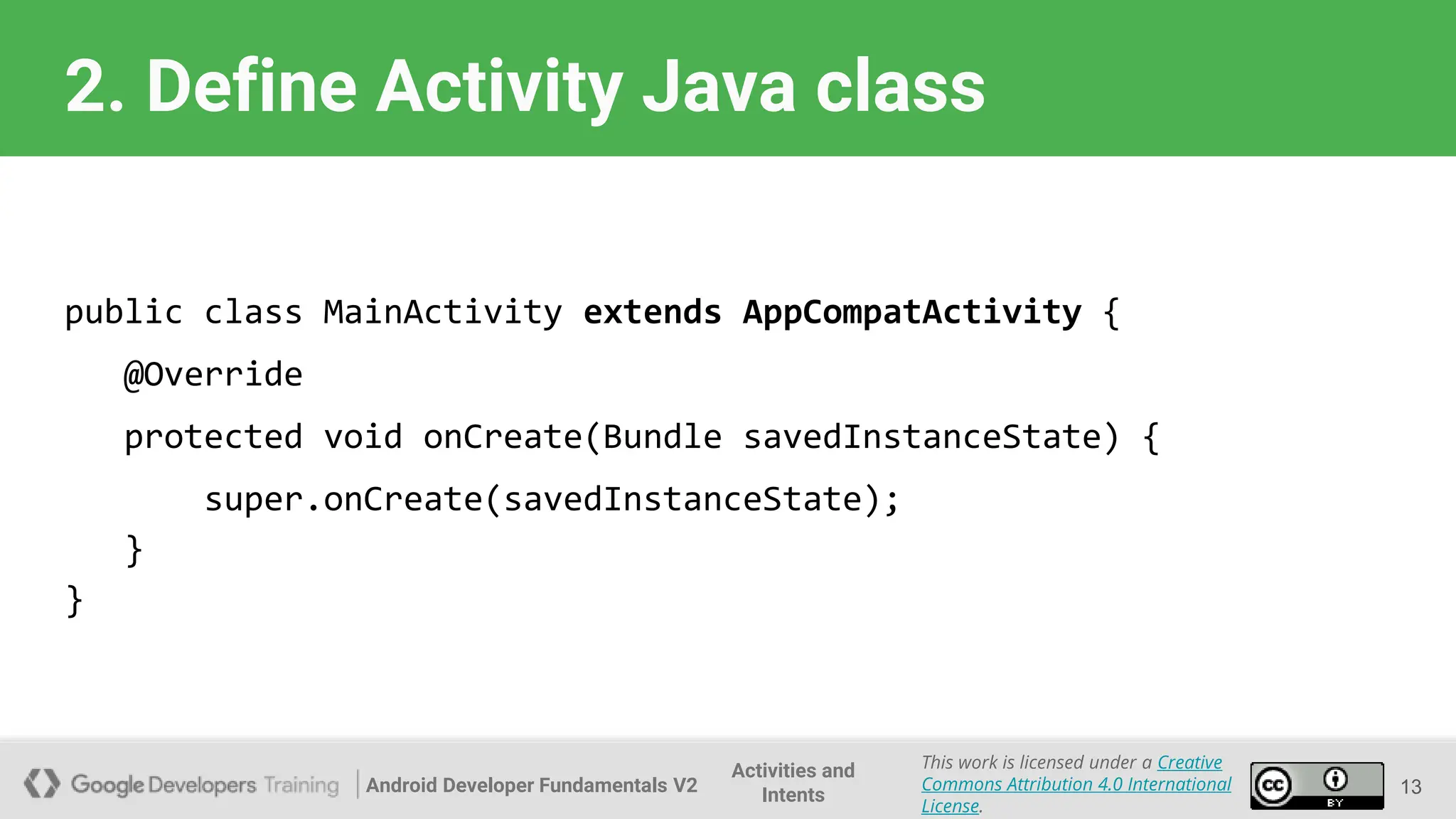
2. Define Activity Java class
public class MainActivity extends AppCompatActivity {
@Override
protected void onCreate(Bundle savedInstanceState) {
super.onCreate(savedInstanceState);
}
}
13
Android Developer Fundamentals V2
This work is licensed under a Creative
Commons Attribution 4.0 International
License.
Activities and
Intents
3. Connect activity with layout
public class MainActivity extends AppCompatActivity {
@Override
protected void onCreate(Bundle savedInstanceState) {
super.onCreate(savedInstanceState);
setContentView(R.layout.activity_main);
}
}
14
in this XML file
is layout
Resource
Android Developer Fundamentals V2
This work is licensed under a Creative
Commons Attribution 4.0 International
License.
Activities and
Intents
4. Declare activity in Android manifest
<activity android:name=".MainActivity">
15
Android Developer Fundamentals V2
This work is licensed under a Creative
Commons Attribution 4.0 International
License.
Activities and
Intents
4. Declare main activity in manifest
MainActivity needs to include intent-filter to start
from launcher
<activity android:name=".MainActivity">
<intent-filter>
<action android:name="android.intent.action.MAIN" />
<category android:name="android.intent.category.LAUNCHER" />
</intent-filter>
</activity>
16
Android Developer Fundamentals V2
Intents
17
Android Developer Fundamentals V2
This work is licensed under a Creative
Commons Attribution 4.0 International
License.
Activities and
Intents
What is an intent?
18
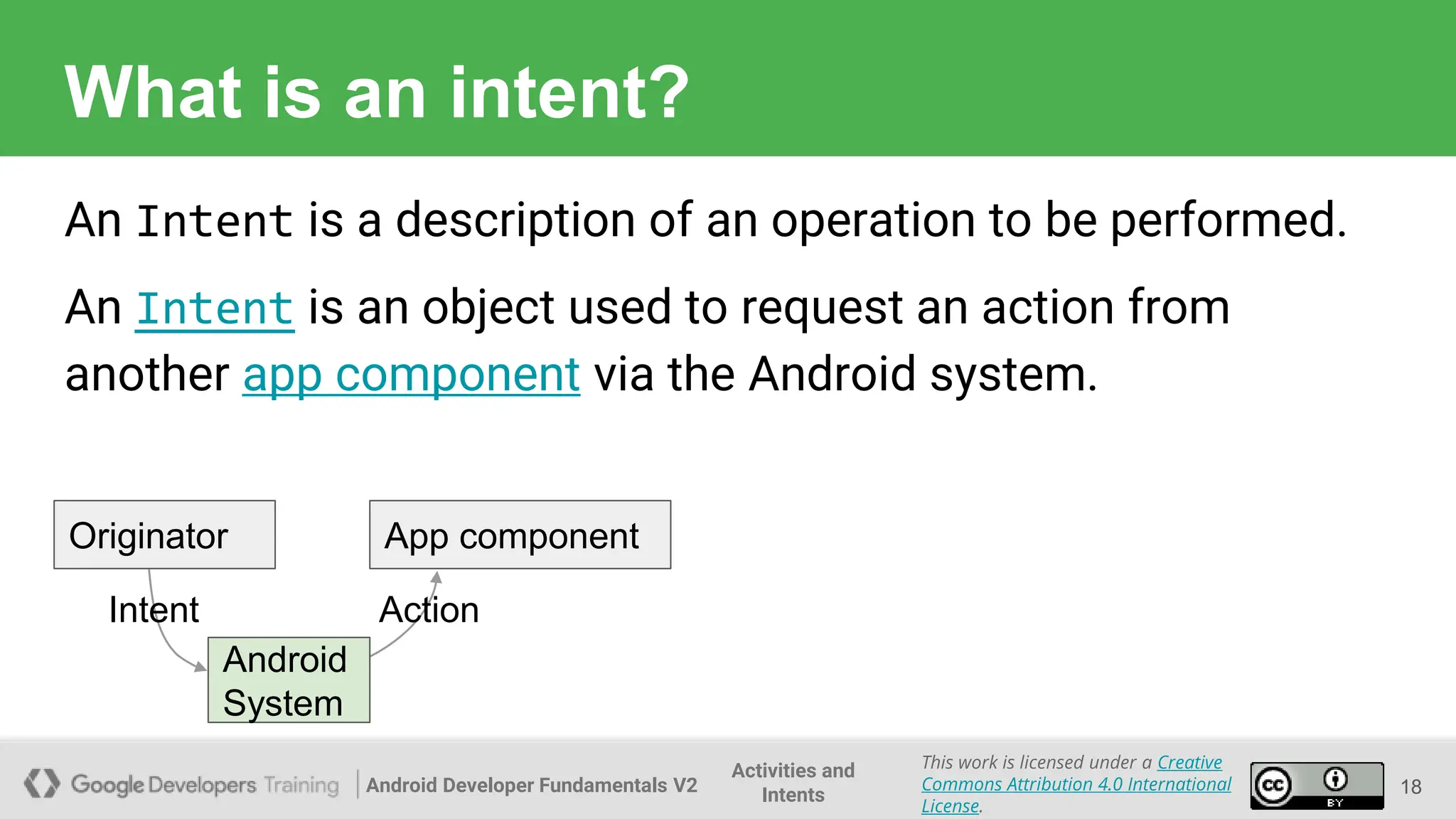
An Intent is a description of an operation to be performed.
An Intent is an object used to request an action from
another app component via the Android system.
App component
Originator
Intent Action
Android
System
Android Developer Fundamentals V2
This work is licensed under a Creative
Commons Attribution 4.0 International
License.
Activities and
Intents
What can intents do?
19
● Start an Activity
○ A button click starts a new Activity for text entry
○ Clicking Share opens an app that allows you to post a photo
● Start an Service
○ Initiate downloading a file in the background
● Deliver Broadcast
○ The system informs everybody that the phone is now charging
Android Developer Fundamentals V2
This work is licensed under a Creative
Commons Attribution 4.0 International
License.
Activities and
Intents
Explicit and implicit intents
20
Explicit Intent
● Starts a specific Activity
○ Request tea with milk delivered by Nikita
○ Main activity starts the ViewShoppingCart Activity
Implicit Intent
● Asks system to find an Activity that can handle this request
○ Find an open store that sells green tea
○ Clicking Share opens a chooser with a list of apps
Android Developer Fundamentals V2
Starting
Activities
21
Android Developer Fundamentals V2
This work is licensed under a Creative
Commons Attribution 4.0 International
License.
Activities and
Intents
Start an Activity with an explicit intent
To start a specific Activity, use an explicit Intent
1. Create an Intent
○ Intent intent = new Intent(this, ActivityName.class);
2. Use the Intent to start the Activity
○ startActivity(intent);
22
Android Developer Fundamentals V2
This work is licensed under a Creative
Commons Attribution 4.0 International
License.
Activities and
Intents
Start an Activity with implicit intent
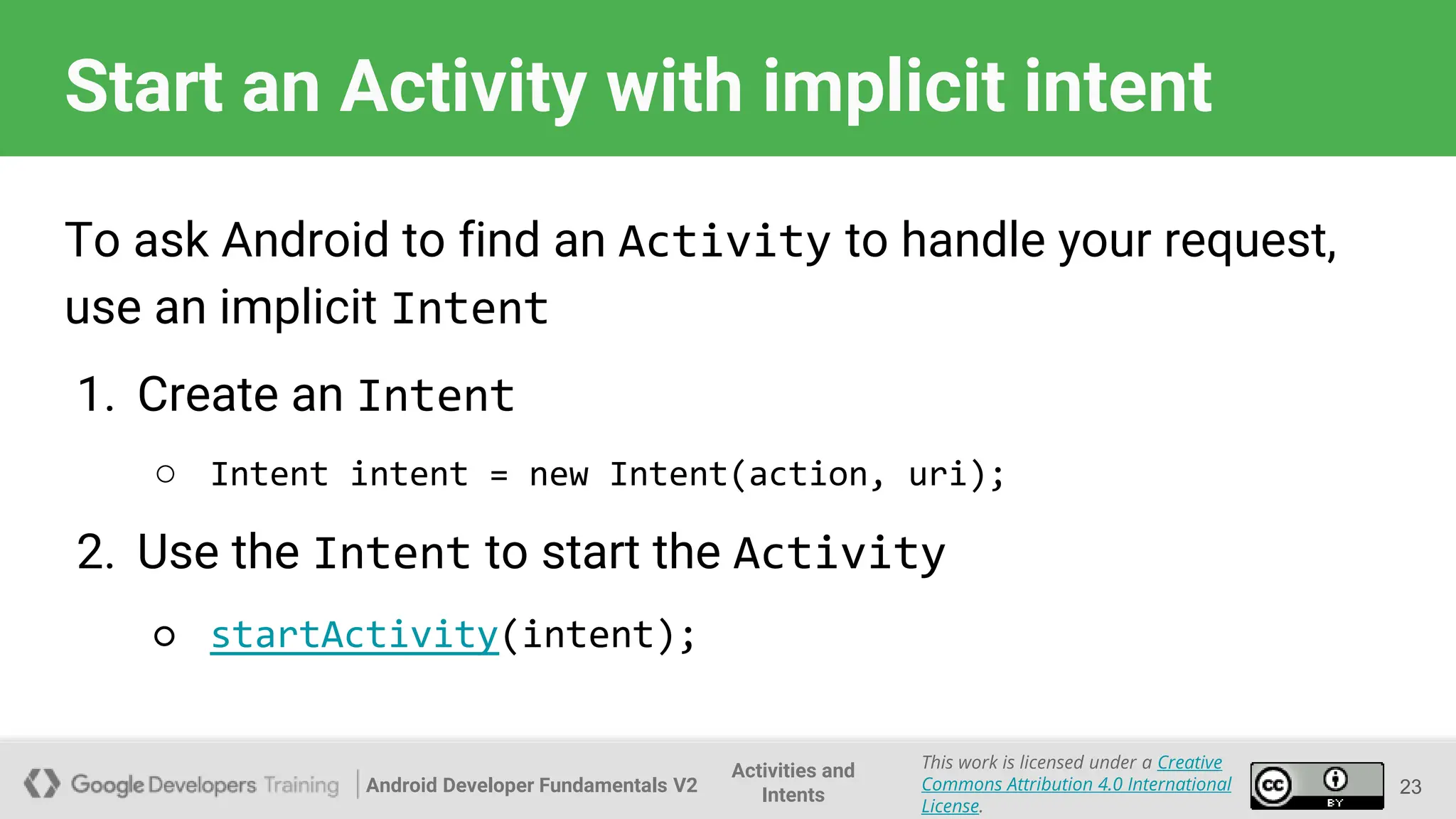
To ask Android to find an Activity to handle your request,
use an implicit Intent
1. Create an Intent
○ Intent intent = new Intent(action, uri);
2. Use the Intent to start the Activity
○ startActivity(intent);
23
Android Developer Fundamentals V2
This work is licensed under a Creative
Commons Attribution 4.0 International
License.
Activities and
Intents
Implicit Intents - Examples
24
Show a web page
Uri uri = Uri.parse("http://www.google.com");
Intent it = new Intent(Intent.ACTION_VIEW,uri);
startActivity(it);
Dial a phone number
Uri uri = Uri.parse("tel:8005551234");
Intent it = new Intent(Intent.ACTION_DIAL, uri);
startActivity(it);
Android Developer Fundamentals V2
This work is licensed under a Creative
Commons Attribution 4.0 International
License.
Activities and
Intents
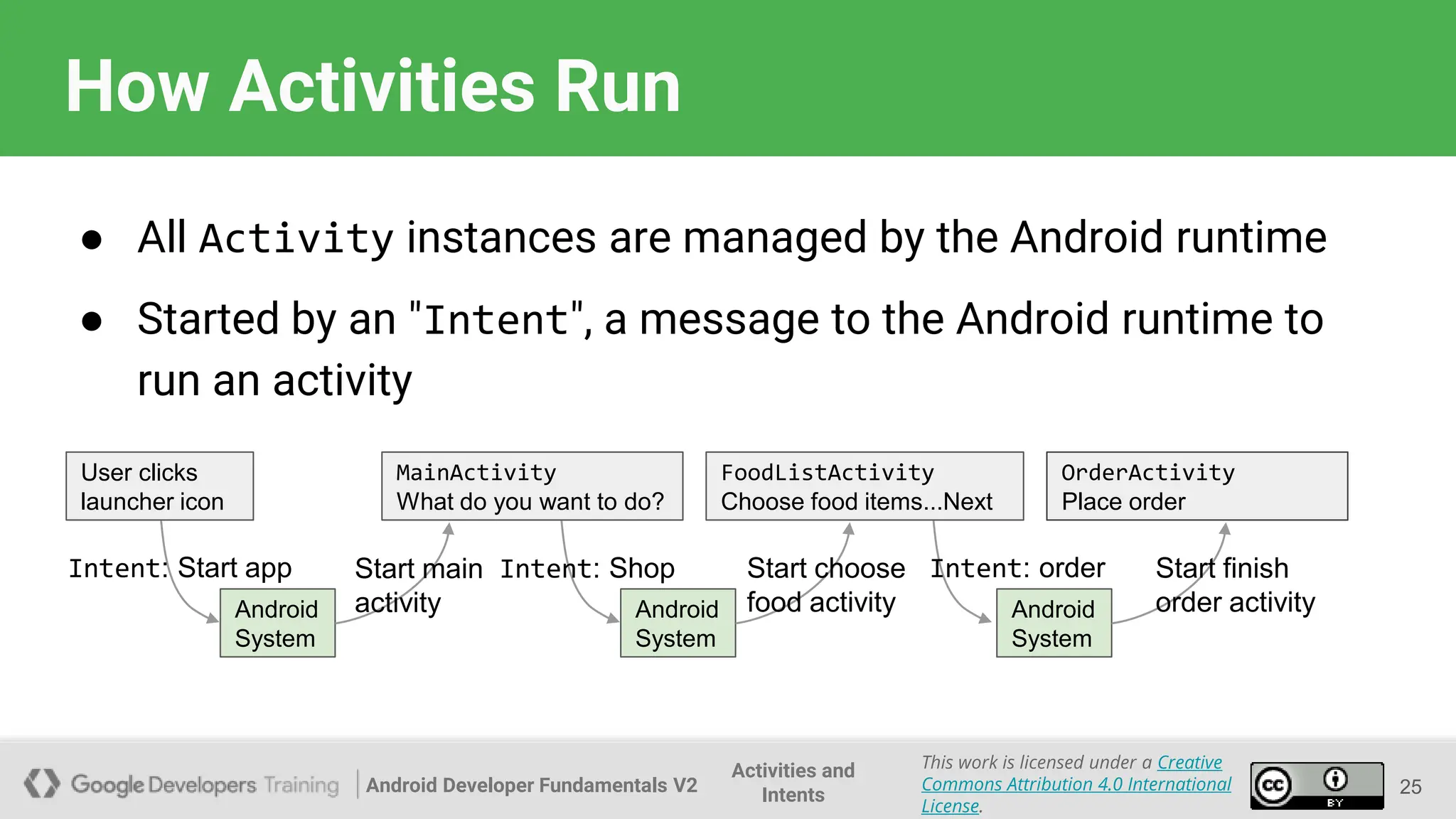
How Activities Run
● All Activity instances are managed by the Android runtime
● Started by an "Intent", a message to the Android runtime to
run an activity
25
MainActivity
What do you want to do?
FoodListActivity
Choose food items...Next
OrderActivity
Place order
User clicks
launcher icon
Android
System
Intent: Start app Start main
activity Android
System
Start choose
food activity Android
System
Start finish
order activity
Intent: Shop Intent: order
Android Developer Fundamentals V2
Sending and
Receiving Data
26
Android Developer Fundamentals V2
This work is licensed under a Creative
Commons Attribution 4.0 International
License.
Activities and
Intents
Two types of sending data with intents
● Data—one piece of information whose data location can
be represented by an URI
● Extras—one or more pieces of information as a collection
of key-value pairs in a Bundle
27
Android Developer Fundamentals V2
This work is licensed under a Creative
Commons Attribution 4.0 International
License.
Activities and
Intents
Sending and retrieving data
In the first (sending) Activity:
1. Create the Intent object
2. Put data or extras into that Intent
3. Start the new Activity with startActivity()
In the second (receiving) Activity:
1. Get the Intent object, the Activity was started with
2. Retrieve the data or extras from the Intent object
28
Android Developer Fundamentals V2
This work is licensed under a Creative
Commons Attribution 4.0 International
License.
Activities and
Intents
Putting a URI as intent data
// A web page URL
intent.setData(
Uri.parse("http://www.google.com"));
// a Sample file URI
intent.setData(
Uri.fromFile(new
File("/sdcard/sample.jpg")));
29
Android Developer Fundamentals V2
This work is licensed under a Creative
Commons Attribution 4.0 International
License.
Activities and
Intents
Put information into intent extras
● putExtra(String name, int value)
⇒ intent.putExtra("level", 406);
● putExtra(String name, String[] value)
⇒ String[] foodList = {"Rice", "Beans", "Fruit"};
intent.putExtra("food", foodList);
● putExtras(bundle);
⇒ if lots of data, first create a bundle and pass the bundle.
● See documentation for all
30
Android Developer Fundamentals V2
This work is licensed under a Creative
Commons Attribution 4.0 International
License.
Activities and
Intents
Sending data to an activity with extras
public static final String EXTRA_MESSAGE_KEY =
"com.example.android.twoactivities.extra.MESSAGE";
Intent intent = new Intent(this,
SecondActivity.class);
String message = "Hello Activity!";
intent.putExtra(EXTRA_MESSAGE_KEY, message);
startActivity(intent);
31
Android Developer Fundamentals V2
This work is licensed under a Creative
Commons Attribution 4.0 International
License.
Activities and
Intents
Get data from intents
● getData();
⇒ Uri locationUri = intent.getData();
● int getIntExtra (String name, int defaultValue)
⇒ int level = intent.getIntExtra("level", 0);
● Bundle bundle = intent.getExtras();
⇒ Get all the data at once as a bundle.
● See documentation for all
32
Android Developer Fundamentals V2
This work is licensed under a Creative
Commons Attribution 4.0 International
License.
Activities and
Intents
Returning data to the starting activity
1. Use startActivityForResult() to start the second Activity
2. To return data from the second Activity:
● Create a new Intent
● Put the response data in the Intent using putExtra()
● Set the result to Activity.RESULT_OK
or RESULT_CANCELED, if the user cancelled out
● call finish() to close the Activity
1. Implement onActivityResult() in first Activity
33
Android Developer Fundamentals V2
This work is licensed under a Creative
Commons Attribution 4.0 International
License.
Activities and
Intents
startActivityForResult()
startActivityForResult(intent, requestCode);
● Starts Activity (intent), assigns it identifier (requestCode)
● Returns data via Intent extras
● When done, pop stack, return to previous Activity, and
execute onActivityResult() callback to process returned
data
● Use requestCode to identify which Activity has "returned"
34
Android Developer Fundamentals V2
This work is licensed under a Creative
Commons Attribution 4.0 International
License.
Activities and
Intents
1.startActivityForResult() Example
public static final int CHOOSE_FOOD_REQUEST = 1;
Intent intent = new Intent(this, ChooseFoodItemsActivity.class);
startActivityForResult(intent, CHOOSE_FOOD_REQUEST);
35
Android Developer Fundamentals V2
This work is licensed under a Creative
Commons Attribution 4.0 International
License.
Activities and
Intents
2.Return data and finish second activity
// Create an intent
Intent replyIntent = new Intent();
// Put the data to return into the extra
replyIntent.putExtra(EXTRA_REPLY, reply);
// Set the activity's result to RESULT_OK
setResult(RESULT_OK, replyIntent);
// Finish the current activity
finish();
36
Android Developer Fundamentals V2
This work is licensed under a Creative
Commons Attribution 4.0 International
License.
Activities and
Intents
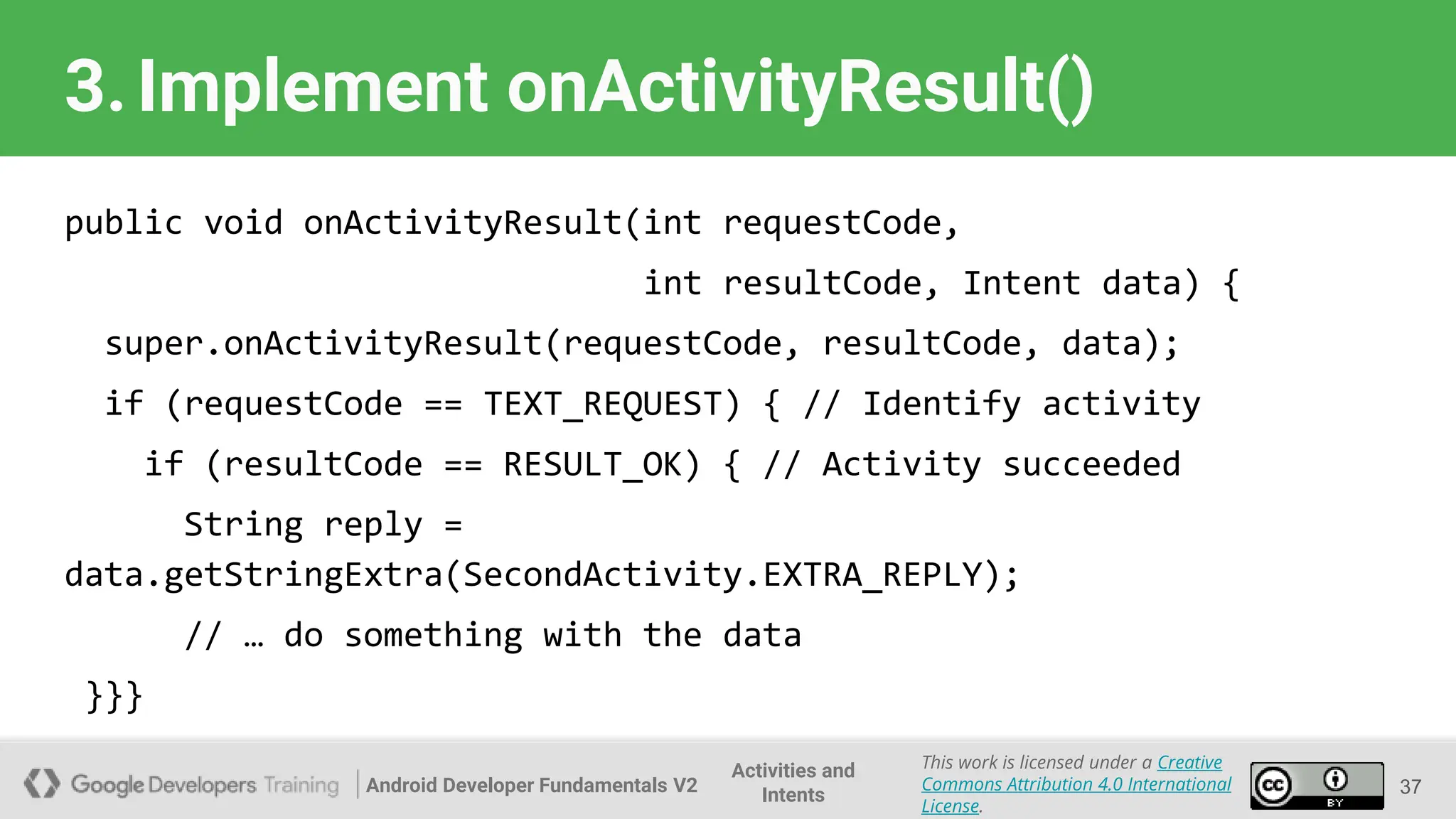
3.Implement onActivityResult()
public void onActivityResult(int requestCode,
int resultCode, Intent data) {
super.onActivityResult(requestCode, resultCode, data);
if (requestCode == TEXT_REQUEST) { // Identify activity
if (resultCode == RESULT_OK) { // Activity succeeded
String reply =
data.getStringExtra(SecondActivity.EXTRA_REPLY);
// … do something with the data
}}}
37
Android Developer Fundamentals V2
Navigation
38
Android Developer Fundamentals V2
This work is licensed under a Creative
Commons Attribution 4.0 International
License.
Activities and
Intents
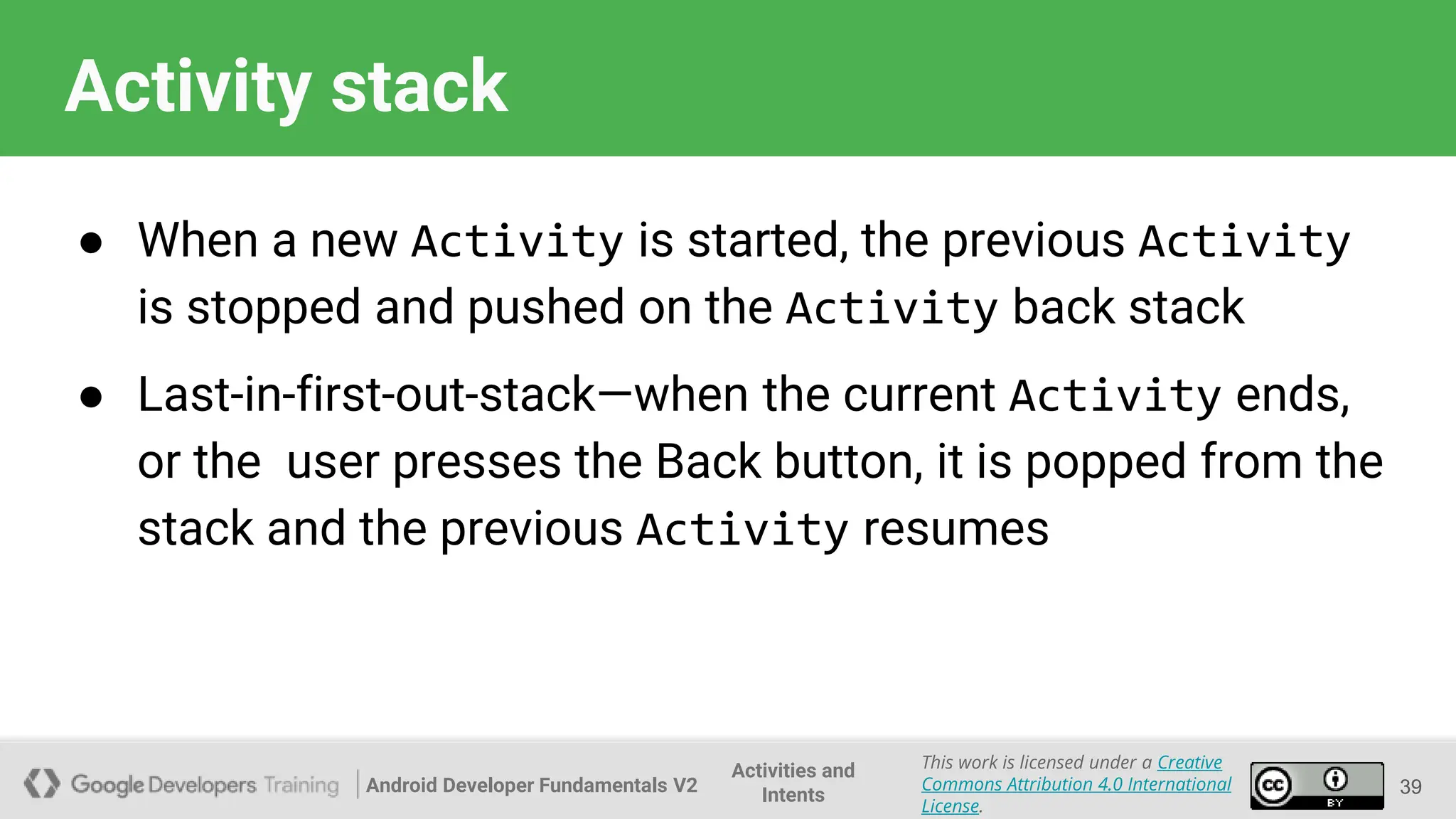
Activity stack
● When a new Activity is started, the previous Activity
is stopped and pushed on the Activity back stack
● Last-in-first-out-stack—when the current Activity ends,
or the user presses the Back button, it is popped from the
stack and the previous Activity resumes
39
Android Developer Fundamentals V2
This work is licensed under a Creative
Commons Attribution 4.0 International
License.
Activities and
Intents
Activity Stack
40
MainActivity
What do you want to do?
FoodListActivity
Choose food items
CartActivity
View shopping cart
MainActivity
What do you want to do?
FoodListActivity
Choose food items
MainActivity
What do you want to do?
FoodListActivity
Choose food items
CartActivity
View shopping cart
OrderActivity
Place order
MainActivity
What do you want to do?
After viewing shopping
cart, user decides to add
more items, then places
order.
Android Developer Fundamentals V2
This work is licensed under a Creative
Commons Attribution 4.0 International
License.
Activities and
Intents
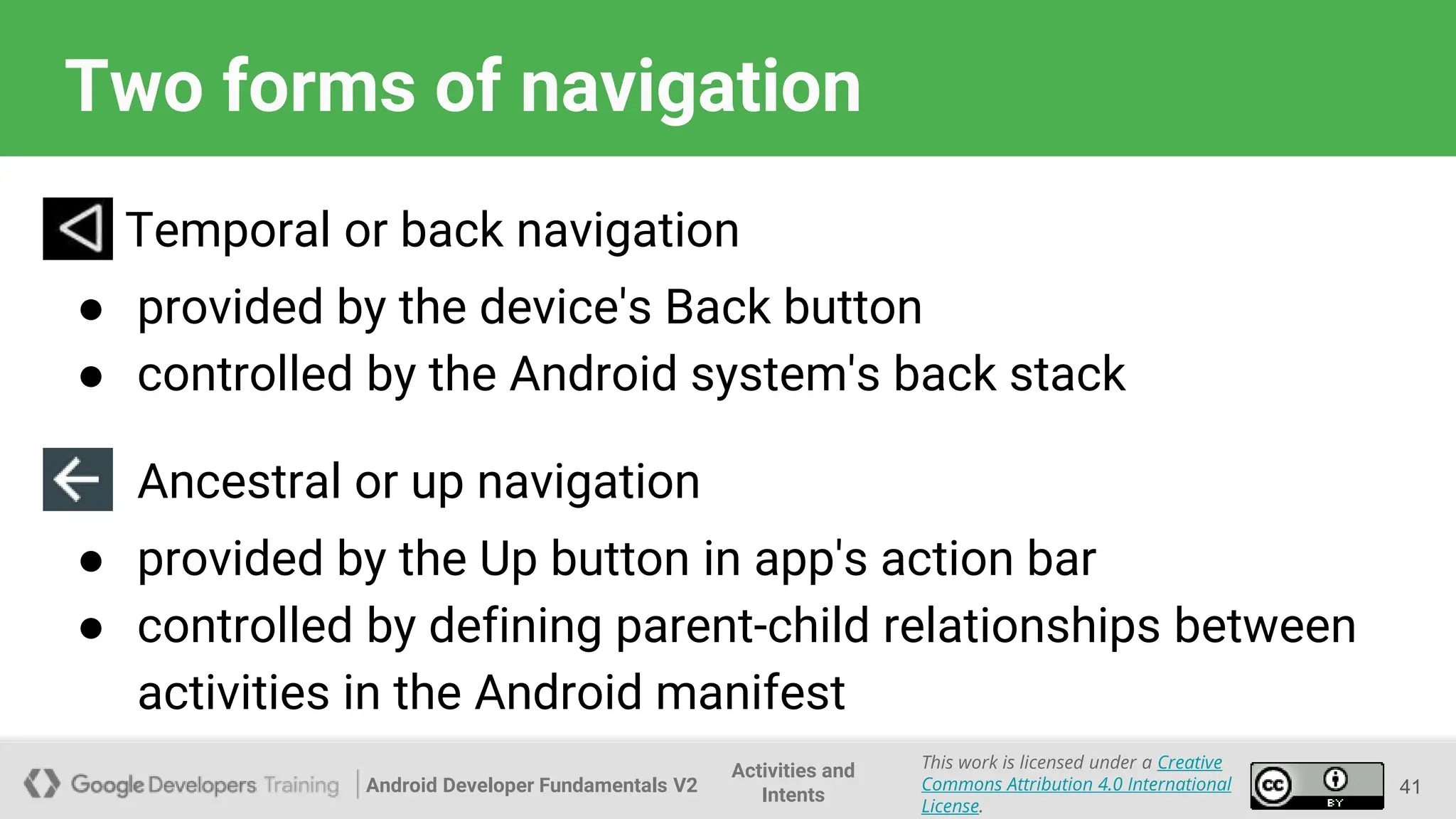
Two forms of navigation
Temporal or back navigation
● provided by the device's Back button
● controlled by the Android system's back stack
Ancestral or up navigation
● provided by the Up button in app's action bar
● controlled by defining parent-child relationships between
activities in the Android manifest
41
Android Developer Fundamentals V2
This work is licensed under a Creative
Commons Attribution 4.0 International
License.
Activities and
Intents
Back navigation
● Back stack preserves history of recently viewed screens
● Back stack contains all the Activity instances that have been
launched by the user in reverse order for the current task
● Each task has its own back stack
● Switching between tasks activates that task's back stack
42
Android Developer Fundamentals V2
This work is licensed under a Creative
Commons Attribution 4.0 International
License.
Activities and
Intents
Up navigation
43
● Goes to parent of current Activity
● Define an Activity parent in Android manifest
● Set parentActivityName
<activity
android:name=".ShowDinnerActivity"
android:parentActivityName=".MainActivity" >
</activity>
Android Developer Fundamentals V2
Learn more
44
Android Developer Fundamentals V2
This work is licensed under a Creative
Commons Attribution 4.0 International
License.
Activities and
Intents
Learn more
● Android Application Fundamentals
● Starting Another Activity
● Activity (API Guide)
● Activity (API Reference)
● Intents and Intent Filters (API Guide)
● Intent (API Reference)
● Navigation
45
Android Developer Fundamentals V2
This work is licensed under a Creative
Commons Attribution 4.0 International
License.
Activities and
Intents
What's Next?
46
● Concept Chapter: 2.1 Activities and Intents
● Practical: 2.1 Activities and intents
Android Developer Fundamentals V2
END
47

2.1-Activities and Intents.pptx

  • 1.
    Android Developer FundamentalsV2 This work is licensed under a Creative Commons Attribution 4.0 International License. Activities and Intents Android Developer Fundamentals V2 This work is licensed under a Creative Commons Attribution 4.0 International License. Activities and Intents 1 1 Activities and Intents 1 Android Developer Fundamentals V2 Lesson 2
  • 2.
    Android Developer FundamentalsV2 This work is licensed under a Creative Commons Attribution 4.0 International License. Activities and Intents 2.1 Activities and Intents 2
  • 3.
    Android Developer FundamentalsV2 This work is licensed under a Creative Commons Attribution 4.0 International License. Activities and Intents Contents 3 ● Activities ● Defining an Activity ● Starting a new Activity with an Intent ● Passing data between activities with extras ● Navigating between activities
  • 4.
    Android Developer FundamentalsV2 Activities (high-level view) 4
  • 5.
    Android Developer FundamentalsV2 This work is licensed under a Creative Commons Attribution 4.0 International License. Activities and Intents What is an Activity? 5 ● An Activity is an application component ● Represents one window, one hierarchy of views ● Typically fills the screen, but can be embedded in other Activity or a appear as floating window ● Java class, typically one Activity in one file
  • 6.
    Android Developer FundamentalsV2 This work is licensed under a Creative Commons Attribution 4.0 International License. Activities and Intents What does an Activity do? 6 ● Represents an activity, such as ordering groceries, sending email, or getting directions ● Handles user interactions, such as button clicks, text entry, or login verification ● Can start other activities in the same or other apps ● Has a life cycle—is created, started, runs, is paused, resumed, stopped, and destroyed
  • 7.
    Android Developer FundamentalsV2 This work is licensed under a Creative Commons Attribution 4.0 International License. Activities and Intents Examples of activities 7
  • 8.
    Android Developer FundamentalsV2 This work is licensed under a Creative Commons Attribution 4.0 International License. Activities and Intents Apps and activities 8 ● Activities are loosely tied together to make up an app ● First Activity user sees is typically called "main activity" ● Activities can be organized in parent-child relationships in the Android manifest to aid navigation
  • 9.
    Android Developer FundamentalsV2 This work is licensed under a Creative Commons Attribution 4.0 International License. Activities and Intents Layouts and Activities ● An Activity typically has a UI layout ● Layout is usually defined in one or more XML files ● Activity "inflates" layout as part of being created 9
  • 10.
    Android Developer FundamentalsV2 Implementing Activities 10
  • 11.
    Android Developer FundamentalsV2 This work is licensed under a Creative Commons Attribution 4.0 International License. Activities and Intents Implement new activities 11 1. Define layout in XML 2. Define Activity Java class ○ extends AppCompatActivity 3. Connect Activity with Layout ○ Set content view in onCreate() 4. Declare Activity in the Android manifest
  • 12.
    Android Developer FundamentalsV2 This work is licensed under a Creative Commons Attribution 4.0 International License. Activities and Intents 1.Define layout in XML <?xml version="1.0" encoding="utf-8"?> <RelativeLayout xmlns:android="http://schemas.android.com/apk/res/android" android:layout_width="match_parent" android:layout_height="match_parent"> <TextView android:layout_width="wrap_content" android:layout_height="wrap_content" android:text="Let's Shop for Food!" /> </RelativeLayout> 12
  • 13.
    Android Developer FundamentalsV2 This work is licensed under a Creative Commons Attribution 4.0 International License. Activities and Intents 2. Define Activity Java class public class MainActivity extends AppCompatActivity { @Override protected void onCreate(Bundle savedInstanceState) { super.onCreate(savedInstanceState); } } 13
  • 14.
    Android Developer FundamentalsV2 This work is licensed under a Creative Commons Attribution 4.0 International License. Activities and Intents 3. Connect activity with layout public class MainActivity extends AppCompatActivity { @Override protected void onCreate(Bundle savedInstanceState) { super.onCreate(savedInstanceState); setContentView(R.layout.activity_main); } } 14 in this XML file is layout Resource
  • 15.
    Android Developer FundamentalsV2 This work is licensed under a Creative Commons Attribution 4.0 International License. Activities and Intents 4. Declare activity in Android manifest <activity android:name=".MainActivity"> 15
  • 16.
    Android Developer FundamentalsV2 This work is licensed under a Creative Commons Attribution 4.0 International License. Activities and Intents 4. Declare main activity in manifest MainActivity needs to include intent-filter to start from launcher <activity android:name=".MainActivity"> <intent-filter> <action android:name="android.intent.action.MAIN" /> <category android:name="android.intent.category.LAUNCHER" /> </intent-filter> </activity> 16
  • 17.
  • 18.
    Android Developer FundamentalsV2 This work is licensed under a Creative Commons Attribution 4.0 International License. Activities and Intents What is an intent? 18 An Intent is a description of an operation to be performed. An Intent is an object used to request an action from another app component via the Android system. App component Originator Intent Action Android System
  • 19.
    Android Developer FundamentalsV2 This work is licensed under a Creative Commons Attribution 4.0 International License. Activities and Intents What can intents do? 19 ● Start an Activity ○ A button click starts a new Activity for text entry ○ Clicking Share opens an app that allows you to post a photo ● Start an Service ○ Initiate downloading a file in the background ● Deliver Broadcast ○ The system informs everybody that the phone is now charging
  • 20.
    Android Developer FundamentalsV2 This work is licensed under a Creative Commons Attribution 4.0 International License. Activities and Intents Explicit and implicit intents 20 Explicit Intent ● Starts a specific Activity ○ Request tea with milk delivered by Nikita ○ Main activity starts the ViewShoppingCart Activity Implicit Intent ● Asks system to find an Activity that can handle this request ○ Find an open store that sells green tea ○ Clicking Share opens a chooser with a list of apps
  • 21.
    Android Developer FundamentalsV2 Starting Activities 21
  • 22.
    Android Developer FundamentalsV2 This work is licensed under a Creative Commons Attribution 4.0 International License. Activities and Intents Start an Activity with an explicit intent To start a specific Activity, use an explicit Intent 1. Create an Intent ○ Intent intent = new Intent(this, ActivityName.class); 2. Use the Intent to start the Activity ○ startActivity(intent); 22
  • 23.
    Android Developer FundamentalsV2 This work is licensed under a Creative Commons Attribution 4.0 International License. Activities and Intents Start an Activity with implicit intent To ask Android to find an Activity to handle your request, use an implicit Intent 1. Create an Intent ○ Intent intent = new Intent(action, uri); 2. Use the Intent to start the Activity ○ startActivity(intent); 23
  • 24.
    Android Developer FundamentalsV2 This work is licensed under a Creative Commons Attribution 4.0 International License. Activities and Intents Implicit Intents - Examples 24 Show a web page Uri uri = Uri.parse("http://www.google.com"); Intent it = new Intent(Intent.ACTION_VIEW,uri); startActivity(it); Dial a phone number Uri uri = Uri.parse("tel:8005551234"); Intent it = new Intent(Intent.ACTION_DIAL, uri); startActivity(it);
  • 25.
    Android Developer FundamentalsV2 This work is licensed under a Creative Commons Attribution 4.0 International License. Activities and Intents How Activities Run ● All Activity instances are managed by the Android runtime ● Started by an "Intent", a message to the Android runtime to run an activity 25 MainActivity What do you want to do? FoodListActivity Choose food items...Next OrderActivity Place order User clicks launcher icon Android System Intent: Start app Start main activity Android System Start choose food activity Android System Start finish order activity Intent: Shop Intent: order
  • 26.
    Android Developer FundamentalsV2 Sending and Receiving Data 26
  • 27.
    Android Developer FundamentalsV2 This work is licensed under a Creative Commons Attribution 4.0 International License. Activities and Intents Two types of sending data with intents ● Data—one piece of information whose data location can be represented by an URI ● Extras—one or more pieces of information as a collection of key-value pairs in a Bundle 27
  • 28.
    Android Developer FundamentalsV2 This work is licensed under a Creative Commons Attribution 4.0 International License. Activities and Intents Sending and retrieving data In the first (sending) Activity: 1. Create the Intent object 2. Put data or extras into that Intent 3. Start the new Activity with startActivity() In the second (receiving) Activity: 1. Get the Intent object, the Activity was started with 2. Retrieve the data or extras from the Intent object 28
  • 29.
    Android Developer FundamentalsV2 This work is licensed under a Creative Commons Attribution 4.0 International License. Activities and Intents Putting a URI as intent data // A web page URL intent.setData( Uri.parse("http://www.google.com")); // a Sample file URI intent.setData( Uri.fromFile(new File("/sdcard/sample.jpg"))); 29
  • 30.
    Android Developer FundamentalsV2 This work is licensed under a Creative Commons Attribution 4.0 International License. Activities and Intents Put information into intent extras ● putExtra(String name, int value) ⇒ intent.putExtra("level", 406); ● putExtra(String name, String[] value) ⇒ String[] foodList = {"Rice", "Beans", "Fruit"}; intent.putExtra("food", foodList); ● putExtras(bundle); ⇒ if lots of data, first create a bundle and pass the bundle. ● See documentation for all 30
  • 31.
    Android Developer FundamentalsV2 This work is licensed under a Creative Commons Attribution 4.0 International License. Activities and Intents Sending data to an activity with extras public static final String EXTRA_MESSAGE_KEY = "com.example.android.twoactivities.extra.MESSAGE"; Intent intent = new Intent(this, SecondActivity.class); String message = "Hello Activity!"; intent.putExtra(EXTRA_MESSAGE_KEY, message); startActivity(intent); 31
  • 32.
    Android Developer FundamentalsV2 This work is licensed under a Creative Commons Attribution 4.0 International License. Activities and Intents Get data from intents ● getData(); ⇒ Uri locationUri = intent.getData(); ● int getIntExtra (String name, int defaultValue) ⇒ int level = intent.getIntExtra("level", 0); ● Bundle bundle = intent.getExtras(); ⇒ Get all the data at once as a bundle. ● See documentation for all 32
  • 33.
    Android Developer FundamentalsV2 This work is licensed under a Creative Commons Attribution 4.0 International License. Activities and Intents Returning data to the starting activity 1. Use startActivityForResult() to start the second Activity 2. To return data from the second Activity: ● Create a new Intent ● Put the response data in the Intent using putExtra() ● Set the result to Activity.RESULT_OK or RESULT_CANCELED, if the user cancelled out ● call finish() to close the Activity 1. Implement onActivityResult() in first Activity 33
  • 34.
    Android Developer FundamentalsV2 This work is licensed under a Creative Commons Attribution 4.0 International License. Activities and Intents startActivityForResult() startActivityForResult(intent, requestCode); ● Starts Activity (intent), assigns it identifier (requestCode) ● Returns data via Intent extras ● When done, pop stack, return to previous Activity, and execute onActivityResult() callback to process returned data ● Use requestCode to identify which Activity has "returned" 34
  • 35.
    Android Developer FundamentalsV2 This work is licensed under a Creative Commons Attribution 4.0 International License. Activities and Intents 1.startActivityForResult() Example public static final int CHOOSE_FOOD_REQUEST = 1; Intent intent = new Intent(this, ChooseFoodItemsActivity.class); startActivityForResult(intent, CHOOSE_FOOD_REQUEST); 35
  • 36.
    Android Developer FundamentalsV2 This work is licensed under a Creative Commons Attribution 4.0 International License. Activities and Intents 2.Return data and finish second activity // Create an intent Intent replyIntent = new Intent(); // Put the data to return into the extra replyIntent.putExtra(EXTRA_REPLY, reply); // Set the activity's result to RESULT_OK setResult(RESULT_OK, replyIntent); // Finish the current activity finish(); 36
  • 37.
    Android Developer FundamentalsV2 This work is licensed under a Creative Commons Attribution 4.0 International License. Activities and Intents 3.Implement onActivityResult() public void onActivityResult(int requestCode, int resultCode, Intent data) { super.onActivityResult(requestCode, resultCode, data); if (requestCode == TEXT_REQUEST) { // Identify activity if (resultCode == RESULT_OK) { // Activity succeeded String reply = data.getStringExtra(SecondActivity.EXTRA_REPLY); // … do something with the data }}} 37
  • 38.
  • 39.
    Android Developer FundamentalsV2 This work is licensed under a Creative Commons Attribution 4.0 International License. Activities and Intents Activity stack ● When a new Activity is started, the previous Activity is stopped and pushed on the Activity back stack ● Last-in-first-out-stack—when the current Activity ends, or the user presses the Back button, it is popped from the stack and the previous Activity resumes 39
  • 40.
    Android Developer FundamentalsV2 This work is licensed under a Creative Commons Attribution 4.0 International License. Activities and Intents Activity Stack 40 MainActivity What do you want to do? FoodListActivity Choose food items CartActivity View shopping cart MainActivity What do you want to do? FoodListActivity Choose food items MainActivity What do you want to do? FoodListActivity Choose food items CartActivity View shopping cart OrderActivity Place order MainActivity What do you want to do? After viewing shopping cart, user decides to add more items, then places order.
  • 41.
    Android Developer FundamentalsV2 This work is licensed under a Creative Commons Attribution 4.0 International License. Activities and Intents Two forms of navigation Temporal or back navigation ● provided by the device's Back button ● controlled by the Android system's back stack Ancestral or up navigation ● provided by the Up button in app's action bar ● controlled by defining parent-child relationships between activities in the Android manifest 41
  • 42.
    Android Developer FundamentalsV2 This work is licensed under a Creative Commons Attribution 4.0 International License. Activities and Intents Back navigation ● Back stack preserves history of recently viewed screens ● Back stack contains all the Activity instances that have been launched by the user in reverse order for the current task ● Each task has its own back stack ● Switching between tasks activates that task's back stack 42
  • 43.
    Android Developer FundamentalsV2 This work is licensed under a Creative Commons Attribution 4.0 International License. Activities and Intents Up navigation 43 ● Goes to parent of current Activity ● Define an Activity parent in Android manifest ● Set parentActivityName <activity android:name=".ShowDinnerActivity" android:parentActivityName=".MainActivity" > </activity>
  • 44.
  • 45.
    Android Developer FundamentalsV2 This work is licensed under a Creative Commons Attribution 4.0 International License. Activities and Intents Learn more ● Android Application Fundamentals ● Starting Another Activity ● Activity (API Guide) ● Activity (API Reference) ● Intents and Intent Filters (API Guide) ● Intent (API Reference) ● Navigation 45
  • 46.
    Android Developer FundamentalsV2 This work is licensed under a Creative Commons Attribution 4.0 International License. Activities and Intents What's Next? 46 ● Concept Chapter: 2.1 Activities and Intents ● Practical: 2.1 Activities and intents
  • 47.

Editor's Notes