Harvard Referencing
Introduction to Referencing
a) In-text citations
b) Reference List
What will you learn today?
• Different referencing styles used in the world (in-text vs number-note)
• In-text referencing
• How to reference different types of sources
• Common mistakes and errors in referencing
What is referencing?
A way of acknowledging source
You need to put references in TWO places
1. In your text, next to the information that you use. (This
is an in-text citation.)
2. At the end of your essay, this is a reference list.
In 2004 the average male Kazakh aged 18-24 ate 3.6 bananas a week
(Crowquill and Blotted, 2006).
Crowquill, V. H. and Blotter, Z. (2006) ‘Banana consumption behaviour in
Central Asia: a grounded theory model’, International Journal of Banana
Studies, 11(3), pp.124-167.
What referencing styles are most
popular?
Two main STYLES of referencing
1. IN-TEXT REFERENCING SYSTEMS
2. NUMBER-NOTE REFERENCING SYSTEMS
In text reference e.g. Davis and McKay (1996, p.112) note that “it is
important to be flexible about the system of referencing and adopt whichever
style is appropriate”.
Full reference e.g.
Davis, L.B. and McKay, S. (1996) Structures and Strategies: An introduction
to Academic Writing, Macmillan Education Australia, Melbourne.
Numbered reference Davis and McKay note that “it is important to be flexible
about the system of referencing and adopt whichever style is appropriate” [1].
Full reference:
Lloyd Davis and Susan McKay, Structures and Strategies: An introduction to
Academic Writing, Macmillan Education Australia, Melbourne, 1996, p.112.
TYPES of Referencing
There are a few main types
of referencing: Harvard
(mostly used by Social
Sciences, Business,
Engineering and Science),
Oxford and Cambridge
(mostly used in Law
subjects and occasionally
referred to as 'footnoting')
and APA (American
Psychological Association
(Psychology and some
Health Science areas) –
but there are also others.
NUMBER-NOTE REFERENCING
SYSTEMS
•Oxford system
•Vancouver system
•Cambridge reference
IN-TEXT REFERENCING SYSTEMS
•Harvard system
•APA system (American Psychological
Association system)
•MLA system (Modern Language
Association) Humanities
1. IN-TEXT REFERENCING SYSTEMS
In text reference
Davis and McKay (1996, p.112) note
that it is important to be flexible about
the system of referencing and adopt
whichever style is appropriate.
Full reference
Davis, L.B. and McKay, S. 1996,
Structures and Strategies: An
introduction to Academic Writing,
Macmillan Education Australia,
Melbourne.
Harvard system
In text reference
Davis and McKay (1996) note that it is
important to be flexible about the system
of referencing and adopt whichever style
is appropriate (p.112).
Full reference
Davis, L.B. & McKay, S. 1996,
Structures and Strategies: An
introduction to Academic Writing,
Melbourne: Macmillan Education
Australia.
APA system
In text reference Davis and McKay note that it is important to be flexible about the
system of referencing and adopt whichever style is appropriate (112).
Full reference Davis, Lloyd and Susan McKay. Structures and Strategies: An
introduction to Academic Writing. Melbourne: Macmillan Education Australia,
MLA system
2. NUMBER-NOTE REFERENCING SYSTEMS
OXFORD SYSTEM Numbered reference Davis and McKay note that it is important to
be flexible about the system of referencing and adopt whichever style is appropriate [1].
Full reference Lloyd Davis and Susan McKay, Structures and Strategies: An
introduction to Academic Writing, Macmillan Education Australia, Melbourne, 1996,
p.112.
VANCOUVER SYSTEM Numbered reference Davis and McKay note that it is important
to be flexible about the system of referencing and adopt whichever style is appropriate1
.
Full reference Davis, L.B. & McKay, S. Structures and Strategies: An introduction to
Academic Writing, Melbourne: Macmillan Education Australia, 1996
CAMBRIDGE FOOTNOTING REFERENCE Numbered reference Davis and McKay
note that it is important to be flexible about the system of referencing and adopt whichever
style is appropriate1
.
Full reference (appears at the bottom of the page) 1. Lloyd Davis and Susan McKay.
Structures and Strategies: An introduction to Academic Writing. Macmillan
Let’s talk about Harvard style….
IN-TEXT CITATIONS
Harvard Referencing
It is the most widely used
system in business disciplines
It is the standard in most UK
universities and all NCUK Centres
When you are taking notes, you should
record not only the main points of the
author’s work, but also your initial
critical evaluation of the material
(Davis & McKay, 1996).
In-text references for a
paraphrase* require:
1. Authors Surname (s)
2. A comma
3. Year of Publication
* PARAPHRASE is when you re-word the writers words (same
idea but different words)
No author? Use the name of the Institution eg: Oxford
University, Tianshui Normal University
Harvard Referencing -
Quoting
In-text citations can be divided
into:
•Direct citation
•Indirect citation
Direct citations require use of
reporting verbs such as:
•X Says
•X Argues
•X Claims
•According to X
Taking notes during university lectures is
crucial (Davis and Mckay, 1996)
There is strong evidence that “…note
taking is a key part of lectures”
(Davis & McKay, 1996, p. 6)
Davis and McKay (1996) explain that
taking notes during university lectures
is crucial.
If you “quote” you need
to add page number
Harvard Referencing -
Quoting
If the text you want to use is short,
you can copy it your essay. You
must use quotation marks….
“ ”
…and the page number
If the text is 4 lines or more, do
not use quotation marks. Instead
put it in its own paragraph
According to Crowquill and Blotter
(2006, p. 23), “in 2004 the average
male Kazakh aged 18-24 ate 3.6
bananas a week.”
According to Crowquill and Blotter (2006, p. 23):
The notorious banana bubble that emerged
in Uzbekistan in the late 1980s was the
direct result of Soviet interventionist policies
that failed to obey the laws of the f ree market.
This supports my view that markets are sacred….
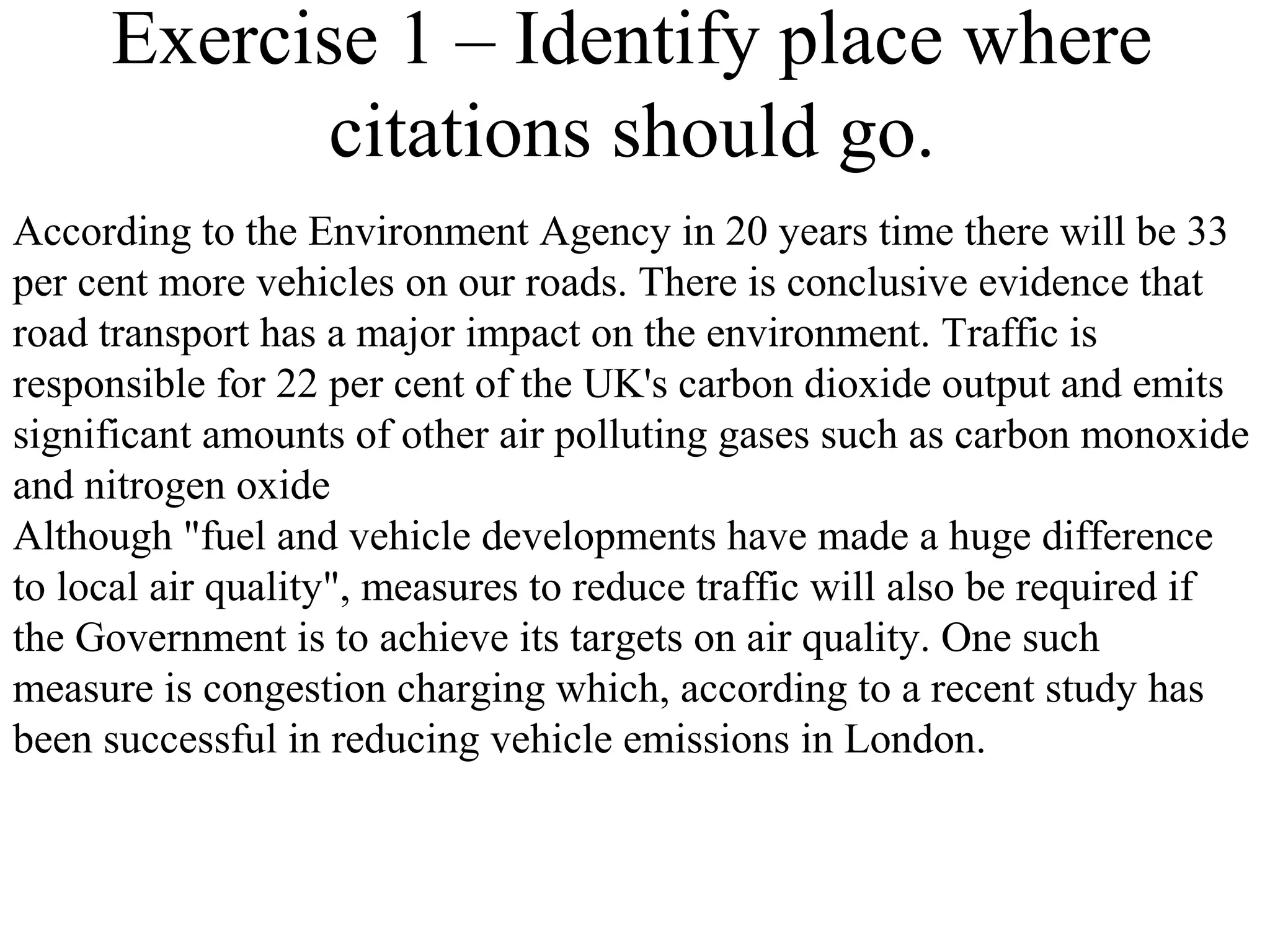
Exercise 1 – Identify place where
citations should go.
According to the Environment Agency in 20 years time there will be 33
per cent more vehicles on our roads. There is conclusive evidence that
road transport has a major impact on the environment. Traffic is
responsible for 22 per cent of the UK's carbon dioxide output and emits
significant amounts of other air polluting gases such as carbon monoxide
and nitrogen oxide
Although "fuel and vehicle developments have made a huge difference
to local air quality", measures to reduce traffic will also be required if
the Government is to achieve its targets on air quality. One such
measure is congestion charging which, according to a recent study has
been successful in reducing vehicle emissions in London.
Exercise – fill in the gaps
According to the Environment Agency ………, in 20 years time there will be 33 per cent more vehicles on our roads.
There is conclusive evidence that road transport has a major impact on the environment. Traffic is responsible for 22
per cent of the UK's carbon dioxide output (Foley and Fergusson …….. and emits significant amounts of other air
polluting gases such as carbon monoxide and nitrogen oxide …………… 1999).
Cairns ………. p. 75) argues that although "fuel and vehicle developments have made a huge difference to local air
quality", measures to reduce traffic will also be required if the Government is to achieve its targets on air quality.
One such measure is congestion charging which, according to a recent study by …………………….. (2005), has
been successful in reducing vehicle emissions in London.
BIBLIOGRAPHY
Beevers, S.D. and Carslaw, D.C. (2005) 'The impact of congestion charging on vehicle emissions in
London', Atmospheric Environment, 39(1), pp.1-5.
Cairns, S. (2003) 'Getting somewhere: tackling traffic emissions', Town and Country Planning, 72(30), pp. 74-75.
Environment Agency (2003) Reducing the environmental impacts of road and air transport: position
statement. Available at: http://www.environment-agency.gov.uk/research/library/position/41181.aspx (Accessed: 7
September 2009).
Foley, J. and Fergusson, M. (2003) Putting the brakes on climate change: a policy report on road transport and
climate change. [Online]. Available at: http://www.ippr.org.uk/ecomm/files/PuttingtheBrakeson.pdf (Accessed: 21
July 2005).
Schwela, D. and Zali, O. (1999) Urban traffic pollution. London: Spon.
Let’s talk about Harvard style….
REFERENCE LIST
What does final reference list look
like?
• Adam, A. R. (2014). Plagiarism detection algorithm using natural language processing based on grammar analyzing. Journal of Theoretical
& Applied Information Technology, 63(1).
• Asim, M., et al (2011), “Overview and Comparison of Plagiarism detection tools”, Ostrava
• Association of Teachers and Lecturers. (2008). School work plagued by plagiarism - ATL survey. Technical report, Association of Teachers
and Lecturers, London, UK.Available at: www.atl.org.uk/Images/ FrontlineSpring08.pdf.
• Amsberry, D. (2009). Deconstructing plagiarism: international students and textual borrowing practices. The Reference Librarian, 51(1), 31-
44.
• Ask, S., (2007). Vagar till et akademisk skriftsprak, Doctoral thesis. Vaxjo Uniersity, Vaxjo, Sweden
• Ballard, B., & Clanchy, J. (1984). Study abroad: A manual for Asian students. Kuala Lumpur: Longman
• Barks, D., & Watts, P. (2001). Textual borrowing strategies for graduate-level ESL writers. Linking literacies: Perspectives on L2 reading-
writing connections, 246-267.
• Basharina, O. K. (2007). An activity theory perspective on student-reported contradictions in international telecollaboration. Language
Learning & Technology, 11(2), 82-103.
• Bhatia, Aban T (1974). An error analysis of students’ compositions.IRAL. Vol. 12/4
• Bloch, J., (2012). Plagiarism, intellectual property and the teaching of L2 writing. Bristol, UK: Multilingual
• Borg, E. (2009). Local plagiarisms. Assessment and Evaluation in Higher Education 34.4, 415–426.
• Cadman, K. (1997). Thesis writing for international students: A question of identity? English for Specific Purposes 16.1, 3–14.
• Chandrasoma, R., Thompson, C., & Pennycook, A. (2004). Beyond plagiarism: Transgressive and nontransgressive intertextuality. Journal
of Language, Identity, and Education, 3(3), 171-193.
• Chuo, T. W. I. (2007). The effects of the WebQuest writing instruction program on EFL learners’ writing performance, writing
apprehension, and perception. TESL-EJ, 11(3), 1-27.
• Comas-Forgas, R., & Sureda-Negre, J. (2010). Academic plagiarism: explanatory factors from students’ perspective. Journal of Academic
Ethics,8(3), 217-232
• Cotterall, S. (2003). Learner independence: reflecting on experience Keynote Address. In Proceedings of the Independent Learning
Conference. Pp. 1-6
Book
Journal Article
Author Year Title of
Article/
Chapter
Title of
Publicat
ion
Issue
informat
ion
Place of
Publicat
ion
Publishe
r
Edition Page
Number
URL Date
Accessed
Book
√ √ √ √ √ √
Chapter
√ √ √ √ √ √ √ √
Journal
√ √ √ √ √ √
Online
Journal
√ √ √ √ √ √ √ √
Internet
Site
√ √ √ √ √
Newspa
per
Article √ √
√
√ √ √
Final Reference Checklist
Understanding references
Journal articles
Creese, A. (2002) Cost-effectiveness of HIV/AIDS
interventions in Africa: a systematic review of the
evidence. The Lancet, 3(3), pp. 1635-1642.
Understanding references
Books
Hahn, R. (1999) Anthropology in Public
Health. Oxford: Oxford University Press.
Understanding references
Book chapters
Manning, N. (1998) ‘Social needs, social
problems and social welfare’, in Alcock P.,
Erskine, A. and May, M. (eds.) The
student’s companion to social policy.
Oxford, Blackwell: pp. 31-36.
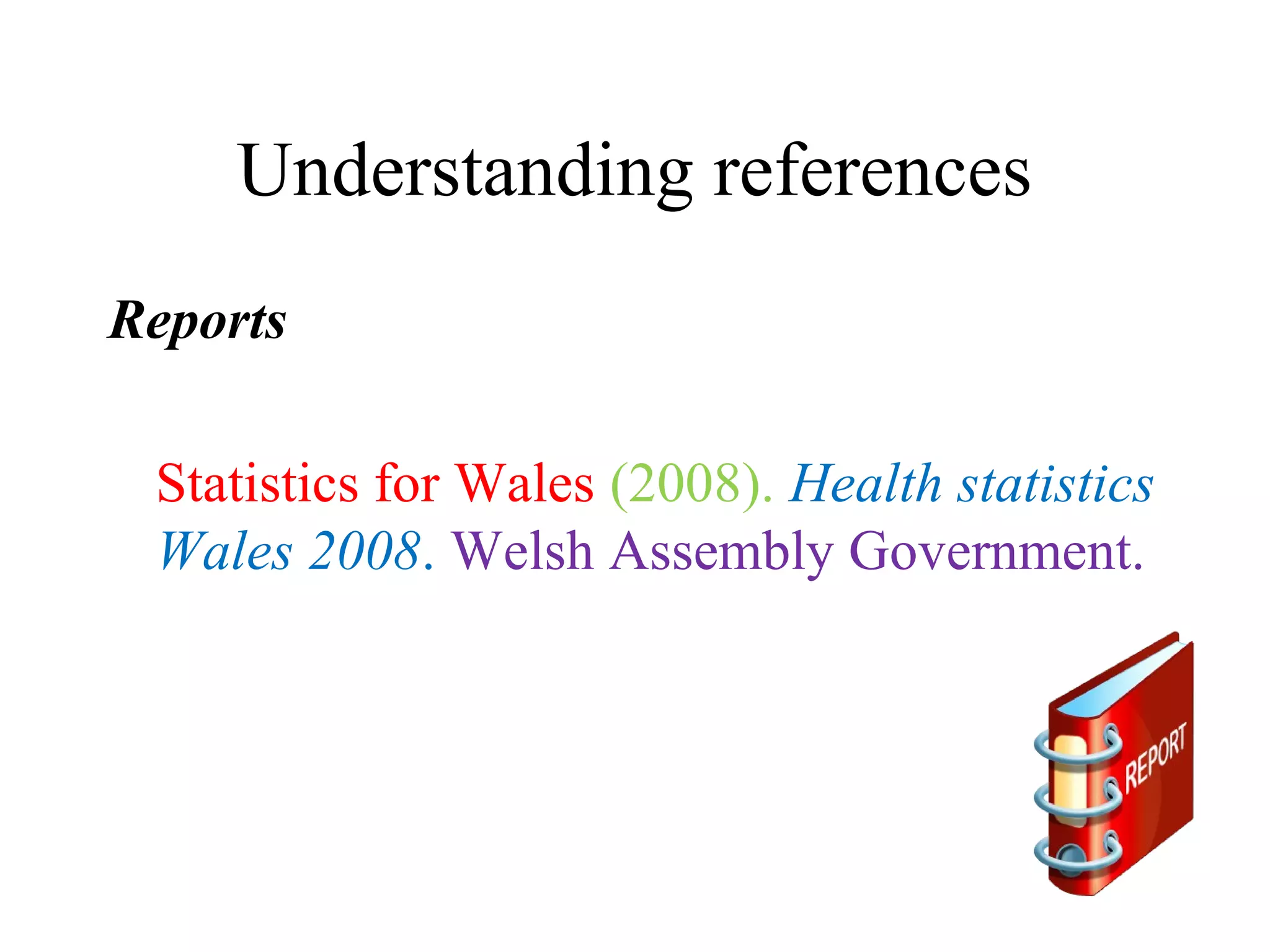
Understanding references
Reports
Statistics for Wales (2008). Health statistics
Wales 2008. Welsh Assembly Government.
Let’s do some exercises now
Exercise 3
Write references for the sources
given to you by the teacher.
The Reference list
The sources you have used and referred to in-text are written on a
separate page that is headed References. Only the work you have cited
in-text is included in the reference list. Do not number the references.
The reference list is arranged alphabetically according to the author’s
surname or corporate name, or if there is no author, the title of the work.
If there are two or more references by the same author, then the
earliest publication should be listed first.
Book citations must include the authors name, date of publication,
title of the book in italics, the publisher and place of publication.
Information from journals, newspapers and audiovisual sources should
show: the author if given; the title of the article in single inverted
commas; the title of the journal, underlined or in italics; the volume
number; issue number if given, and the page number(s).
Put the following REFERENCE LIST in the correct
order Carol Nine-Curt, 1979, ‘Cultural differences in nonverbal
communication’, in D. Fassler & N. Lay, Encounter with a New
World, Prentice-Hall, Inc., New York.
Robinson, G. 1985, Pergamon Publications (Aust), Sydney, Cross-cultural
Understanding
Clyne, M., ‘Modes of communication and culture’, Communication at
University, papers of the Second Annual Study Skills Conference, La
Trobe University, pp. 101-115, 1982 .
Bock, H. 1982, pp. 140-155 ‘University essays as cultural
battlegrounds: the problems of migrant students’, Communication at
University: Purpose, Process and Product, papers of the Second
Annual Study Skills Conference, La Trobe University,
Bock, H. & Harry Lewitt, 1984, ‘Head counting or skullduggery’, in
“Language and Learning at tertiary level”, the Fifth Annual Study
Skills conference, Deakin University, pp. 1-13.
Referencing Protocol The marker/reader wants to know
that:
In NCUK use the Harvard System of referencing. However,
the university you will go to may use different style.
Referencing Protocol
– You understood what you read;
– You have sought relevant materials, preferably
beyond the text;
– You have ‘read’* those materials;
– You can see how those materials
relate to other work.
*this includes scan-reading
How to Use the Work of
Others
•3 main approaches:
–Direct quotes
–Paraphrasing
–Summarising
Direct Quotes
•Important to build a
context around them.
Example: Travel is an excellent tool for
broadening the mind and gaining skills in
cross-cultural communication. “Travel helps
build character” (Lee, 2005 p. 7). It is
important to travel with an open mind and to
restrict yourself from judging based on your
home country.
•When the words are
taken exactly they
must be
acknowledged as a
direct quote.The quote is not linked to the rest of the text. Try
rewriting the text so the quote is SYNTHESISED
In fact, some psychologists feel that / prominent
psychologist, Terence Lee goes as far as saying……
Who?
Paraphrases - Plagiarism
•The content of the paraphrase should not be too
similar to the original text
When Central Asian wholesalers make a decision about adopting a new
variety of banana, their criteria are similar to those of fruit buyers in
western countries.
ORIGINAL TEXT
PARAPHRASE - TOO SIMILAR!
Paraphrases - Synonyms
•PARAPHRASING: SYNONYMS
•First, find synonyms for some of the words.
•Central Asian wholesalers →
•make a decision →
•about adopting →
•variety →
•criteria →
•are similar to →
•fruit buyers →
•in western countries →
traders in Central Asia
decide
whether to take
kind
standards
resemble
their counterparts
western
NEW VERSION
When traders in Central Asia decide whether to take a
new kind of banana, their standards resemble those of
their Western counterparts
Paraphrases -
Structure
•The content of the paraphrase should not be too
similar to the original text
When traders in Central Asia decide whether to take a new
kind of banana, their standards resemble those of their
Western counterparts.
OLD STRUCTURE
NEW STRUCTURE
Summarising
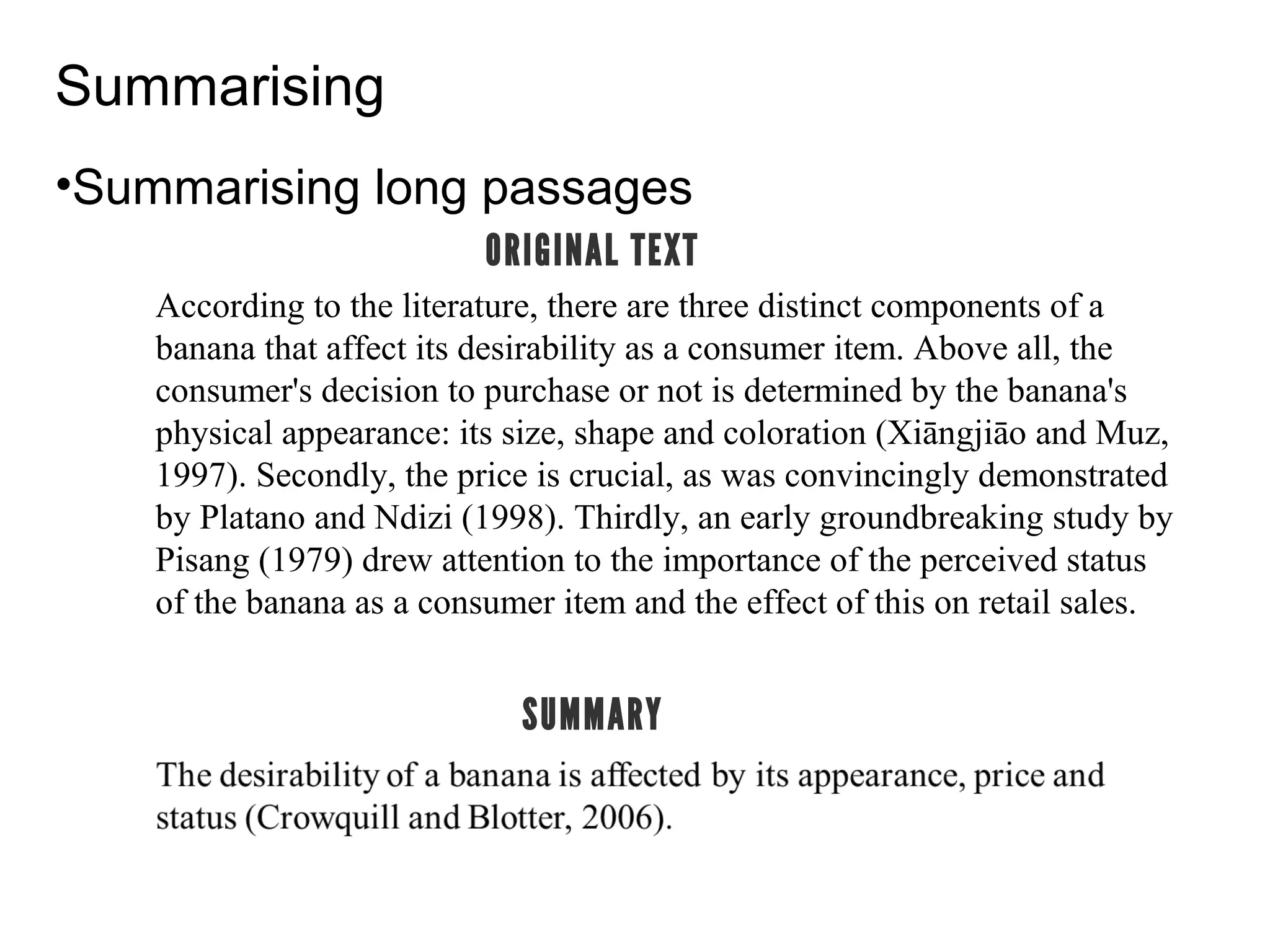
•Summarising long passages
According to the literature, there are three distinct components of a
banana that affect its desirability as a consumer item. Above all, the
consumer's decision to purchase or not is determined by the banana's
physical appearance: its size, shape and coloration (Xiāngjiāo and Muz,
1997). Secondly, the price is crucial, as was convincingly demonstrated
by Platano and Ndizi (1998). Thirdly, an early groundbreaking study by
Pisang (1979) drew attention to the importance of the perceived status
of the banana as a consumer item and the effect of this on retail sales.
ORIGINAL TEXT
SUMMARY
Primary and Secondary Sources
•The source (article, book, etc.) that you are reading may refer to other
sources that you have not read.
For example, Crowquill and Blotter write:
Thirdly, an early ground-breaking study by Pisang (1979)
drew attention to the importance of the perceived status of the
banana as a consumer item and the effect of this on retail sales.
•Primary source: a book by Pisang, published in 1979. You have not
read this book.
•Secondary source: the article by Crowquill and Blotter, published in
2006, which you have read.
Direct Quotes: Short Quote
•Interpersonal perception is defined as
“how we see other people” (Lewis et al.
2000, p. 33).
et al. for more than 3 authors. Sometimes
this can be in italics. The message – be
consistent!!!
Year only. Page number is ONLY FOR
QUOTES – not for paraphrased
information.
When to Cite? General, common
knowledge ideas can be stated - but you need to
be sure.
How accurate are these statement?
Everywhere?
Too general – Where? Who? Statistics?
Some places have flood problems
–Terrorism is everywhere.
–There is widespread acceptance of a global
water shortage.
–Most people smoke.
When to Cite?
Commonly known facts do not need a citation.
TASK 2: Look at the following statements. Which one
needs a citation?
a) The moon revolves
around the earth.
b) Sydney is on the east
coast of Australia.
c) Australia’s population
will double by 2010.
d) Food is necessary for
survival.

NCUK Harvard Referencing

  • 1.
    Harvard Referencing Introduction toReferencing a) In-text citations b) Reference List
  • 2.
    What will youlearn today? • Different referencing styles used in the world (in-text vs number-note) • In-text referencing • How to reference different types of sources • Common mistakes and errors in referencing
  • 3.
    What is referencing? Away of acknowledging source
  • 4.
    You need toput references in TWO places 1. In your text, next to the information that you use. (This is an in-text citation.) 2. At the end of your essay, this is a reference list. In 2004 the average male Kazakh aged 18-24 ate 3.6 bananas a week (Crowquill and Blotted, 2006). Crowquill, V. H. and Blotter, Z. (2006) ‘Banana consumption behaviour in Central Asia: a grounded theory model’, International Journal of Banana Studies, 11(3), pp.124-167.
  • 5.
    What referencing stylesare most popular?
  • 6.
    Two main STYLESof referencing 1. IN-TEXT REFERENCING SYSTEMS 2. NUMBER-NOTE REFERENCING SYSTEMS In text reference e.g. Davis and McKay (1996, p.112) note that “it is important to be flexible about the system of referencing and adopt whichever style is appropriate”. Full reference e.g. Davis, L.B. and McKay, S. (1996) Structures and Strategies: An introduction to Academic Writing, Macmillan Education Australia, Melbourne. Numbered reference Davis and McKay note that “it is important to be flexible about the system of referencing and adopt whichever style is appropriate” [1]. Full reference: Lloyd Davis and Susan McKay, Structures and Strategies: An introduction to Academic Writing, Macmillan Education Australia, Melbourne, 1996, p.112.
  • 7.
    TYPES of Referencing Thereare a few main types of referencing: Harvard (mostly used by Social Sciences, Business, Engineering and Science), Oxford and Cambridge (mostly used in Law subjects and occasionally referred to as 'footnoting') and APA (American Psychological Association (Psychology and some Health Science areas) – but there are also others. NUMBER-NOTE REFERENCING SYSTEMS •Oxford system •Vancouver system •Cambridge reference IN-TEXT REFERENCING SYSTEMS •Harvard system •APA system (American Psychological Association system) •MLA system (Modern Language Association) Humanities
  • 8.
    1. IN-TEXT REFERENCINGSYSTEMS In text reference Davis and McKay (1996, p.112) note that it is important to be flexible about the system of referencing and adopt whichever style is appropriate. Full reference Davis, L.B. and McKay, S. 1996, Structures and Strategies: An introduction to Academic Writing, Macmillan Education Australia, Melbourne. Harvard system In text reference Davis and McKay (1996) note that it is important to be flexible about the system of referencing and adopt whichever style is appropriate (p.112). Full reference Davis, L.B. & McKay, S. 1996, Structures and Strategies: An introduction to Academic Writing, Melbourne: Macmillan Education Australia. APA system In text reference Davis and McKay note that it is important to be flexible about the system of referencing and adopt whichever style is appropriate (112). Full reference Davis, Lloyd and Susan McKay. Structures and Strategies: An introduction to Academic Writing. Melbourne: Macmillan Education Australia, MLA system
  • 9.
    2. NUMBER-NOTE REFERENCINGSYSTEMS OXFORD SYSTEM Numbered reference Davis and McKay note that it is important to be flexible about the system of referencing and adopt whichever style is appropriate [1]. Full reference Lloyd Davis and Susan McKay, Structures and Strategies: An introduction to Academic Writing, Macmillan Education Australia, Melbourne, 1996, p.112. VANCOUVER SYSTEM Numbered reference Davis and McKay note that it is important to be flexible about the system of referencing and adopt whichever style is appropriate1 . Full reference Davis, L.B. & McKay, S. Structures and Strategies: An introduction to Academic Writing, Melbourne: Macmillan Education Australia, 1996 CAMBRIDGE FOOTNOTING REFERENCE Numbered reference Davis and McKay note that it is important to be flexible about the system of referencing and adopt whichever style is appropriate1 . Full reference (appears at the bottom of the page) 1. Lloyd Davis and Susan McKay. Structures and Strategies: An introduction to Academic Writing. Macmillan
  • 10.
    Let’s talk aboutHarvard style…. IN-TEXT CITATIONS
  • 11.
    Harvard Referencing It isthe most widely used system in business disciplines It is the standard in most UK universities and all NCUK Centres When you are taking notes, you should record not only the main points of the author’s work, but also your initial critical evaluation of the material (Davis & McKay, 1996). In-text references for a paraphrase* require: 1. Authors Surname (s) 2. A comma 3. Year of Publication * PARAPHRASE is when you re-word the writers words (same idea but different words) No author? Use the name of the Institution eg: Oxford University, Tianshui Normal University
  • 12.
    Harvard Referencing - Quoting In-textcitations can be divided into: •Direct citation •Indirect citation Direct citations require use of reporting verbs such as: •X Says •X Argues •X Claims •According to X Taking notes during university lectures is crucial (Davis and Mckay, 1996) There is strong evidence that “…note taking is a key part of lectures” (Davis & McKay, 1996, p. 6) Davis and McKay (1996) explain that taking notes during university lectures is crucial. If you “quote” you need to add page number
  • 13.
    Harvard Referencing - Quoting Ifthe text you want to use is short, you can copy it your essay. You must use quotation marks…. “ ” …and the page number If the text is 4 lines or more, do not use quotation marks. Instead put it in its own paragraph According to Crowquill and Blotter (2006, p. 23), “in 2004 the average male Kazakh aged 18-24 ate 3.6 bananas a week.” According to Crowquill and Blotter (2006, p. 23): The notorious banana bubble that emerged in Uzbekistan in the late 1980s was the direct result of Soviet interventionist policies that failed to obey the laws of the f ree market. This supports my view that markets are sacred….
  • 14.
    Exercise 1 –Identify place where citations should go. According to the Environment Agency in 20 years time there will be 33 per cent more vehicles on our roads. There is conclusive evidence that road transport has a major impact on the environment. Traffic is responsible for 22 per cent of the UK's carbon dioxide output and emits significant amounts of other air polluting gases such as carbon monoxide and nitrogen oxide Although "fuel and vehicle developments have made a huge difference to local air quality", measures to reduce traffic will also be required if the Government is to achieve its targets on air quality. One such measure is congestion charging which, according to a recent study has been successful in reducing vehicle emissions in London.
  • 15.
    Exercise – fillin the gaps According to the Environment Agency ………, in 20 years time there will be 33 per cent more vehicles on our roads. There is conclusive evidence that road transport has a major impact on the environment. Traffic is responsible for 22 per cent of the UK's carbon dioxide output (Foley and Fergusson …….. and emits significant amounts of other air polluting gases such as carbon monoxide and nitrogen oxide …………… 1999). Cairns ………. p. 75) argues that although "fuel and vehicle developments have made a huge difference to local air quality", measures to reduce traffic will also be required if the Government is to achieve its targets on air quality. One such measure is congestion charging which, according to a recent study by …………………….. (2005), has been successful in reducing vehicle emissions in London. BIBLIOGRAPHY Beevers, S.D. and Carslaw, D.C. (2005) 'The impact of congestion charging on vehicle emissions in London', Atmospheric Environment, 39(1), pp.1-5. Cairns, S. (2003) 'Getting somewhere: tackling traffic emissions', Town and Country Planning, 72(30), pp. 74-75. Environment Agency (2003) Reducing the environmental impacts of road and air transport: position statement. Available at: http://www.environment-agency.gov.uk/research/library/position/41181.aspx (Accessed: 7 September 2009). Foley, J. and Fergusson, M. (2003) Putting the brakes on climate change: a policy report on road transport and climate change. [Online]. Available at: http://www.ippr.org.uk/ecomm/files/PuttingtheBrakeson.pdf (Accessed: 21 July 2005). Schwela, D. and Zali, O. (1999) Urban traffic pollution. London: Spon.
  • 16.
    Let’s talk aboutHarvard style…. REFERENCE LIST
  • 17.
    What does finalreference list look like? • Adam, A. R. (2014). Plagiarism detection algorithm using natural language processing based on grammar analyzing. Journal of Theoretical & Applied Information Technology, 63(1). • Asim, M., et al (2011), “Overview and Comparison of Plagiarism detection tools”, Ostrava • Association of Teachers and Lecturers. (2008). School work plagued by plagiarism - ATL survey. Technical report, Association of Teachers and Lecturers, London, UK.Available at: www.atl.org.uk/Images/ FrontlineSpring08.pdf. • Amsberry, D. (2009). Deconstructing plagiarism: international students and textual borrowing practices. The Reference Librarian, 51(1), 31- 44. • Ask, S., (2007). Vagar till et akademisk skriftsprak, Doctoral thesis. Vaxjo Uniersity, Vaxjo, Sweden • Ballard, B., & Clanchy, J. (1984). Study abroad: A manual for Asian students. Kuala Lumpur: Longman • Barks, D., & Watts, P. (2001). Textual borrowing strategies for graduate-level ESL writers. Linking literacies: Perspectives on L2 reading- writing connections, 246-267. • Basharina, O. K. (2007). An activity theory perspective on student-reported contradictions in international telecollaboration. Language Learning & Technology, 11(2), 82-103. • Bhatia, Aban T (1974). An error analysis of students’ compositions.IRAL. Vol. 12/4 • Bloch, J., (2012). Plagiarism, intellectual property and the teaching of L2 writing. Bristol, UK: Multilingual • Borg, E. (2009). Local plagiarisms. Assessment and Evaluation in Higher Education 34.4, 415–426. • Cadman, K. (1997). Thesis writing for international students: A question of identity? English for Specific Purposes 16.1, 3–14. • Chandrasoma, R., Thompson, C., & Pennycook, A. (2004). Beyond plagiarism: Transgressive and nontransgressive intertextuality. Journal of Language, Identity, and Education, 3(3), 171-193. • Chuo, T. W. I. (2007). The effects of the WebQuest writing instruction program on EFL learners’ writing performance, writing apprehension, and perception. TESL-EJ, 11(3), 1-27. • Comas-Forgas, R., & Sureda-Negre, J. (2010). Academic plagiarism: explanatory factors from students’ perspective. Journal of Academic Ethics,8(3), 217-232 • Cotterall, S. (2003). Learner independence: reflecting on experience Keynote Address. In Proceedings of the Independent Learning Conference. Pp. 1-6
  • 18.
  • 19.
    Author Year Titleof Article/ Chapter Title of Publicat ion Issue informat ion Place of Publicat ion Publishe r Edition Page Number URL Date Accessed Book √ √ √ √ √ √ Chapter √ √ √ √ √ √ √ √ Journal √ √ √ √ √ √ Online Journal √ √ √ √ √ √ √ √ Internet Site √ √ √ √ √ Newspa per Article √ √ √ √ √ √ Final Reference Checklist
  • 20.
    Understanding references Journal articles Creese,A. (2002) Cost-effectiveness of HIV/AIDS interventions in Africa: a systematic review of the evidence. The Lancet, 3(3), pp. 1635-1642.
  • 21.
    Understanding references Books Hahn, R.(1999) Anthropology in Public Health. Oxford: Oxford University Press.
  • 22.
    Understanding references Book chapters Manning,N. (1998) ‘Social needs, social problems and social welfare’, in Alcock P., Erskine, A. and May, M. (eds.) The student’s companion to social policy. Oxford, Blackwell: pp. 31-36.
  • 23.
    Understanding references Reports Statistics forWales (2008). Health statistics Wales 2008. Welsh Assembly Government.
  • 24.
    Let’s do someexercises now Exercise 3
  • 25.
    Write references forthe sources given to you by the teacher.
  • 26.
    The Reference list Thesources you have used and referred to in-text are written on a separate page that is headed References. Only the work you have cited in-text is included in the reference list. Do not number the references. The reference list is arranged alphabetically according to the author’s surname or corporate name, or if there is no author, the title of the work. If there are two or more references by the same author, then the earliest publication should be listed first. Book citations must include the authors name, date of publication, title of the book in italics, the publisher and place of publication. Information from journals, newspapers and audiovisual sources should show: the author if given; the title of the article in single inverted commas; the title of the journal, underlined or in italics; the volume number; issue number if given, and the page number(s).
  • 27.
    Put the followingREFERENCE LIST in the correct order Carol Nine-Curt, 1979, ‘Cultural differences in nonverbal communication’, in D. Fassler & N. Lay, Encounter with a New World, Prentice-Hall, Inc., New York. Robinson, G. 1985, Pergamon Publications (Aust), Sydney, Cross-cultural Understanding Clyne, M., ‘Modes of communication and culture’, Communication at University, papers of the Second Annual Study Skills Conference, La Trobe University, pp. 101-115, 1982 . Bock, H. 1982, pp. 140-155 ‘University essays as cultural battlegrounds: the problems of migrant students’, Communication at University: Purpose, Process and Product, papers of the Second Annual Study Skills Conference, La Trobe University, Bock, H. & Harry Lewitt, 1984, ‘Head counting or skullduggery’, in “Language and Learning at tertiary level”, the Fifth Annual Study Skills conference, Deakin University, pp. 1-13.
  • 28.
    Referencing Protocol Themarker/reader wants to know that: In NCUK use the Harvard System of referencing. However, the university you will go to may use different style. Referencing Protocol – You understood what you read; – You have sought relevant materials, preferably beyond the text; – You have ‘read’* those materials; – You can see how those materials relate to other work. *this includes scan-reading
  • 29.
    How to Usethe Work of Others •3 main approaches: –Direct quotes –Paraphrasing –Summarising
  • 30.
    Direct Quotes •Important tobuild a context around them. Example: Travel is an excellent tool for broadening the mind and gaining skills in cross-cultural communication. “Travel helps build character” (Lee, 2005 p. 7). It is important to travel with an open mind and to restrict yourself from judging based on your home country. •When the words are taken exactly they must be acknowledged as a direct quote.The quote is not linked to the rest of the text. Try rewriting the text so the quote is SYNTHESISED In fact, some psychologists feel that / prominent psychologist, Terence Lee goes as far as saying…… Who?
  • 31.
    Paraphrases - Plagiarism •Thecontent of the paraphrase should not be too similar to the original text When Central Asian wholesalers make a decision about adopting a new variety of banana, their criteria are similar to those of fruit buyers in western countries. ORIGINAL TEXT PARAPHRASE - TOO SIMILAR!
  • 32.
    Paraphrases - Synonyms •PARAPHRASING:SYNONYMS •First, find synonyms for some of the words. •Central Asian wholesalers → •make a decision → •about adopting → •variety → •criteria → •are similar to → •fruit buyers → •in western countries → traders in Central Asia decide whether to take kind standards resemble their counterparts western NEW VERSION When traders in Central Asia decide whether to take a new kind of banana, their standards resemble those of their Western counterparts
  • 33.
    Paraphrases - Structure •The contentof the paraphrase should not be too similar to the original text When traders in Central Asia decide whether to take a new kind of banana, their standards resemble those of their Western counterparts. OLD STRUCTURE NEW STRUCTURE
  • 34.
    Summarising •Summarising long passages Accordingto the literature, there are three distinct components of a banana that affect its desirability as a consumer item. Above all, the consumer's decision to purchase or not is determined by the banana's physical appearance: its size, shape and coloration (Xiāngjiāo and Muz, 1997). Secondly, the price is crucial, as was convincingly demonstrated by Platano and Ndizi (1998). Thirdly, an early groundbreaking study by Pisang (1979) drew attention to the importance of the perceived status of the banana as a consumer item and the effect of this on retail sales. ORIGINAL TEXT SUMMARY
  • 35.
    Primary and SecondarySources •The source (article, book, etc.) that you are reading may refer to other sources that you have not read. For example, Crowquill and Blotter write: Thirdly, an early ground-breaking study by Pisang (1979) drew attention to the importance of the perceived status of the banana as a consumer item and the effect of this on retail sales. •Primary source: a book by Pisang, published in 1979. You have not read this book. •Secondary source: the article by Crowquill and Blotter, published in 2006, which you have read.
  • 36.
    Direct Quotes: ShortQuote •Interpersonal perception is defined as “how we see other people” (Lewis et al. 2000, p. 33). et al. for more than 3 authors. Sometimes this can be in italics. The message – be consistent!!! Year only. Page number is ONLY FOR QUOTES – not for paraphrased information.
  • 37.
    When to Cite?General, common knowledge ideas can be stated - but you need to be sure. How accurate are these statement? Everywhere? Too general – Where? Who? Statistics? Some places have flood problems –Terrorism is everywhere. –There is widespread acceptance of a global water shortage. –Most people smoke.
  • 38.
    When to Cite? Commonlyknown facts do not need a citation. TASK 2: Look at the following statements. Which one needs a citation? a) The moon revolves around the earth. b) Sydney is on the east coast of Australia. c) Australia’s population will double by 2010. d) Food is necessary for survival.

Editor's Notes

  • #21 Here is a typical journal article reference. The different parts have been colour-coded to make them easier to distinguish. An easy way to spot a journal article is that it will usually have lots of numbers at the end, corresponding to the volume or issue number(s) and page numbers. It should also have the journal title and the article title. The authors are generally written with their surname first followed by their initials. If there are lots of authors, the primary author only may be mentioned, with the list of others replaced by the term “et al”. The year of publication should always be quoted. A full reference will also give the title of the article. This may sometimes be left off in reading lists – but it should still be straightforward to find the right article by the author(s), provided that journal volume/issue numbers are given. At the end is called the “source information”: details of the journal the article is published in. This should include: the journal title, which may be abbreviated (and is given in italics, to indicate that it is one of the most important pieces of information to help in finding the work); the volume or issue number (sometimes these are two numbers – usually volume corresponds to a particular year, and issue to the issue within that year); and start and end page numbers (note that journals sometimes continue their page numbering from previous issues – the above issue of the Lancet started at page 1629, so the article above was towards the front).
  • #22 Here is a typical book reference. The different parts have been colour-coded to make them easier to distinguish. An easy way to spot a book reference is that it will have the publisher’s name at the end, and often the city as well. Again, authors are generally written with their surname first followed by their initials. If there are lots of authors, “et al” is added. The year of publication should always be quoted. Note that books can be updated and re-published in different editions; the publication year and the edition number will help you to find the correct version. If no edition number is quoted in the reference, you can assume that the first edition is the one you want. A full reference will also give the title of the book. At the end are details of the publisher – which should include both the name of the publisher and the city they are based in. The city may sometimes be left off in reading lists.
  • #23 Here is a typical reference to a chapter in a book. The different parts have been colour-coded to make them easier to distinguish. An easy way to spot a book chapter reference is that it is usually pretty long. It sometimes looks very like a book reference, but with two titles or two lists of authors. Again, authors are generally written with their surname first followed by their initials. If there are lots of authors, “et al” is added. Some books have different authors for each chapter, and editors which compile the book as a whole. In a book chapter reference, the authors of the chapter are quoted first. As we’re looking for a book, again the year of publication is important to make sure we get the correct edition. Next we have titles. First the title of the chapter, then the title of the book. If the book has different authors or editors to the chapter, they should also be included. As with a book, we then get the details of the publisher. At the end we get the page numbers of the chapter.
  • #24 Here is a typical reference to a report. The different parts have been colour-coded to make them easier to distinguish. It is quite easy to mistake a report reference for a book reference. The easiest way to spot a report reference is to look at the publisher. If something “book-like” is published by an institution rather than a publishing company, it’s probably a report. Again, authors are generally written with their surname first followed by their initials. With reports, it is quite common for the institution which produced the report to be the author, rather than a named individual. Once again we have the year of publication. Many reports are updated every year so it’s important to know which year you need. Then we have the title of the report and finally the details of the publisher. This can often be the same as the author.