Ralph Ellison
The Norton Anthology of American Literature, 8th Edition | Copyright © 2012 W.W. Norton & Company
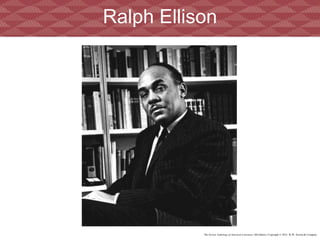
Ralph Ellison
The Norton Anthology of American Literature, 8th Edition | Copyright © 2012 W.W. Norton & Company
• Born in Oklahoma in 1914
• Attended the Tuskeegee Institute on a state
scholarship
• Studied music in college; played the trumpet
• Moved to New York City in 1936, where he
met novelist Richard Wright
• Began writing Invisible Man in 1945 (it was
published in 1952)
Ellison’s Early Life
The Norton Anthology of American Literature, 8th Edition | Copyright © 2012 W.W. Norton & Company
“[O]ur life is a war and I have been a traitor
all my born days, a spy in the enemy’s
country . . . Live with your head in the lion’s
mouth. I want you to overcome ’em with
yesses, undermine ’em with grins, agree ’em
to death and destruction, let ’em swoller you
till they vomit or bust wide open.”
Invisible Man
The Norton Anthology of American Literature, 8th Edition | Copyright © 2012 W.W. Norton & Company
Invisible Man
The Norton Anthology of American Literature, 8th Edition | Copyright © 2012 W.W. Norton & Company
“I am an invisible man. No, I am not a spook
like those who haunted Edgar Allan Poe; nor
am I one of your Hollywood-movie ectoplasms.
I am a man of substance, of flesh and bone,
fiber and liquids—and I might even be said to
possess a mind. I am invisible, understand,
simply because people refuse to see me.”
Invisible Man
The Norton Anthology of American Literature, 8th Edition | Copyright © 2012 W.W. Norton & Company
“Brothers and sisters, my text this morning
is the ‘Blackness of Blackness.’ ”
And a congregation of voices answered:
“That blackness is most black, brother, most
black . . .”
Invisible Man
The Norton Anthology of American Literature, 8th Edition | Copyright © 2012 W.W. Norton & Company
“What did I do
To be so black,
And blue?”
Invisible Man
The Norton Anthology of American Literature, 8th Edition | Copyright © 2012 W.W. Norton & Company
Invisible Man
The Norton Anthology of American Literature, 8th Edition | Copyright © 2012 W.W. Norton & Company
“Everyone fought hysterically. It was
complete anarchy. Everybody fought
everybody else. No group fought together
for long. Two, three, four, fought one, then
turned to fight each other, were themselves
attacked.”
Invisible Man
The Norton Anthology of American Literature, 8th Edition | Copyright © 2012 W.W. Norton & Company
Invisible Man
The Norton Anthology of American Literature, 8th Edition | Copyright © 2012 W.W. Norton & Company
Invisible Man
Visit the StudySpace at:
http://wwnorton.com/studyspace
For more learning resources,
please visit the StudySpace site for
The Norton Anthology
of American Literature.
This concludes the Lecture
PowerPoint presentation for
Ralph Ellison

2130_American Lit Module 3_Ralph Ellison

  • 1.
  • 2.
    The Norton Anthologyof American Literature, 8th Edition | Copyright © 2012 W.W. Norton & Company Ralph Ellison
  • 3.
    The Norton Anthologyof American Literature, 8th Edition | Copyright © 2012 W.W. Norton & Company • Born in Oklahoma in 1914 • Attended the Tuskeegee Institute on a state scholarship • Studied music in college; played the trumpet • Moved to New York City in 1936, where he met novelist Richard Wright • Began writing Invisible Man in 1945 (it was published in 1952) Ellison’s Early Life
  • 4.
    The Norton Anthologyof American Literature, 8th Edition | Copyright © 2012 W.W. Norton & Company “[O]ur life is a war and I have been a traitor all my born days, a spy in the enemy’s country . . . Live with your head in the lion’s mouth. I want you to overcome ’em with yesses, undermine ’em with grins, agree ’em to death and destruction, let ’em swoller you till they vomit or bust wide open.” Invisible Man
  • 5.
    The Norton Anthologyof American Literature, 8th Edition | Copyright © 2012 W.W. Norton & Company Invisible Man
  • 6.
    The Norton Anthologyof American Literature, 8th Edition | Copyright © 2012 W.W. Norton & Company “I am an invisible man. No, I am not a spook like those who haunted Edgar Allan Poe; nor am I one of your Hollywood-movie ectoplasms. I am a man of substance, of flesh and bone, fiber and liquids—and I might even be said to possess a mind. I am invisible, understand, simply because people refuse to see me.” Invisible Man
  • 7.
    The Norton Anthologyof American Literature, 8th Edition | Copyright © 2012 W.W. Norton & Company “Brothers and sisters, my text this morning is the ‘Blackness of Blackness.’ ” And a congregation of voices answered: “That blackness is most black, brother, most black . . .” Invisible Man
  • 8.
    The Norton Anthologyof American Literature, 8th Edition | Copyright © 2012 W.W. Norton & Company “What did I do To be so black, And blue?” Invisible Man
  • 9.
    The Norton Anthologyof American Literature, 8th Edition | Copyright © 2012 W.W. Norton & Company Invisible Man
  • 10.
    The Norton Anthologyof American Literature, 8th Edition | Copyright © 2012 W.W. Norton & Company “Everyone fought hysterically. It was complete anarchy. Everybody fought everybody else. No group fought together for long. Two, three, four, fought one, then turned to fight each other, were themselves attacked.” Invisible Man
  • 11.
    The Norton Anthologyof American Literature, 8th Edition | Copyright © 2012 W.W. Norton & Company Invisible Man
  • 12.
    The Norton Anthologyof American Literature, 8th Edition | Copyright © 2012 W.W. Norton & Company Invisible Man
  • 13.
    Visit the StudySpaceat: http://wwnorton.com/studyspace For more learning resources, please visit the StudySpace site for The Norton Anthology of American Literature. This concludes the Lecture PowerPoint presentation for Ralph Ellison

Editor's Notes

  • #3 Ralph Ellison, African American author and college instructor. Photograph, 1961. Photographer unknown. Despite only publishing one novel in his life—Invisible Man (1952)—Ralph Ellison is a major figure in American and African American literary history. Invisible Man serves, in many ways, as a capstone of the Harlem Renaissance and as a prediction of the diverse scope of African American fiction that would be produced during the second half of the twentieth century. Even though he never published another novel, Ellison continued to be an influential presence in literary circles as a professor at New York University, Bard College, and the University of Chicago, and as an essayist and critic. Two novels have been published posthumously based on manuscripts that Ellison left behind: Juneteenth (1999) and Three Days Before the Shooting . . . (2010).
  • #4 Ellison’s biography is similar to that of the unnamed protagonist of Invisible Man: both were scholarship students who attended historically black colleges in the South before moving to New York City and becoming exposed to the world of African American political and artistic life. One of the things your students will notice in the selections from Invisible Man, however, is the element of the absurd that Ellison introduces to the life of his unnamed protagonist (he lives in a basement room filled with over a thousand light bulbs? And he was forced to fight with other black men before receiving his college scholarship?). You will want to discuss this in detail with your students: Why does Ellison turn to the absurd to document race relations in America? What is gained and what is lost from his argument by employing absurdist imagery? Ultimately, you’ll want your students to see the legacy of racism itself as an absurdity that tormented the lives of African Americans.
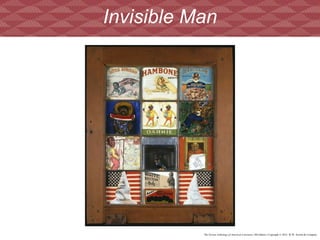
  • #5 The preface and first chapter of Invisible Man introduce readers to the racist climate of early-twentieth-century America and the troubling impact of racial stereotypes on individual consciousness. When the unnamed narrator of Invisible Man recounts for us the final warning of his grandfather—reprinted on this slide—it immediately raises the question of how to live within a world that has created racist expectations of who you are to the point that living authentically becomes a virtually insurmountable challenge. The image on the following slide shows how one twentieth-century artist took those racist images and reframed them in such a way so as to challenge and even redefine their racist implications. Does Ellison do something similar in Invisible Man?
  • #6 Black Crows in the White Section Only, 1872. By Betye Saar. The image on this slide shows how one twentieth-century artist took racist images from a variety of product advertisements and reframed them in such a way so as to challenge and even redefine their racist implications. Does Ellison do something similar in Invisible Man? Does Ellison remix the racist imagery of his culture in an effort to redefine it? What are those images and what does Ellison do with them?
  • #7 After discussing the ways in which Invisible Man works to challenge and reframe the racist stereotypes of the era, move on to the central metaphor of the invisible man. What does it mean for the narrator to identify himself as invisible? Given that his black skin makes him conspicuous in white society, why does he insist that he is invisible? Help your students to see the irony in the metaphor of the invisible man. Phrases such as “I might even be said to possess a mind” point to the bitter irony that the narrator experiences as someone who is both scrutinized and overlooked merely because of the color of his skin.
  • #8 The lengthy italicized section in the prologue is worth spending some time with. Some of your students will probably struggle with what’s happening in this passage, so review the major moments with them: it begins in a jazz club then moves quickly to a slave auction before settling in on the sounds of a call-and-response episode in a black church; the narrator then speaks to a jazz singer who somehow becomes a slave woman, and the passage ends with a return to the music in the jazz club. Help your students to see that Ellison is working with the form of jazz music in this passage, picking up literary themes and experimenting with them in a variety of settings just as a jazz musician repeats and modifies a musical theme in a variety of settings. Have your students identify the themes (freedom, oppression, identity, and so on) and the settings (the church, a slave auction, a jazz club, and so on) of the passage and discuss how they work together to explore an idea. As with jazz, the goal is not to provide a definitive answer; the goal is to explore, experiment, and improvise. If your students can’t figure out what exactly is happening here, tell them that’s okay. What, instead, are the impressions you get from these various themes and settings?
  • #9 The narrator quotes jazz musician Louis Armstrong’s “innocent” question, “What did I do / To be so black, / And blue?” Is this the narrator’s question as well? Does the text provide any answers? Is the question pointed at us as readers?
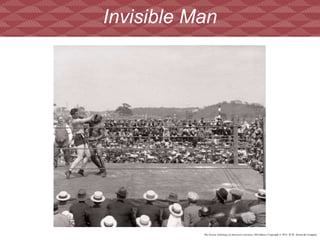
  • #10 Jack Johnson and Jess Willard. April 5, 1915, Havana, Cuba. The “Battle Royal” chapter in Invisible Man can strike many novice readers as absurd and bewildering. Why did this free-for-all battle between young black men take place? Why did the narrator agree to go along with it? Are we supposed to take this seriously? One way to contextualize the episode for readers is to remind them of the ways in which African-American men had been fetishized and objectivized as physical brutes. This photograph of Jack Johnson, the African American boxing champion, and Jess Willard, known in the press as “The Great White Hope,” can serve as a reminder to students that less than a hundred years ago white Americans were intensely troubled by the notion that a black man could be the best fighter in the world. Willard ultimately defeated Johnson, but speculation persisted for years that Johnson threw the fight.
  • #11 What are the different allegorical registers of the “battle royal”? How does the image of black men turning against each other in a vain attempt to win the favor of wealthy white men relate to the social conditions of the time period?
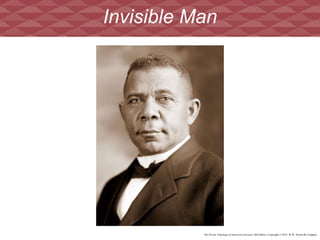
  • #12 When the narrator finally gives his speech in the “Battle Royal” chapter, he quotes extensively from a controversial address by Booker T. Washington (pictured), a turn-of-the-century civil rights leader who encouraged African Americans to stay in the South, endure racism, and work for the greater good of society. Ellison has his narrator repeat the rallying cry of “Cast down your bucket where you are.” What is the effect of this in the text? Is this an ironic critique of Washington, or a sincere appreciation of his efforts? Wikimedia Commons
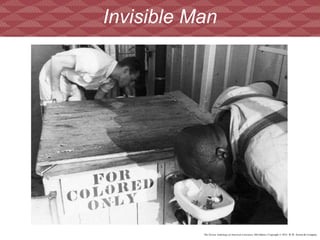
  • #13 Segregated drinking fountain in use in the American South. Undated photograph. Invisible Man appeared during a time of segregation throughout much of the United States—formalized in the South and less formal elsewhere. Toward the end of the “Battle Royal” chapter, the unnamed narrator misspeaks at one moment while surrounded by a group white men and says “social equality” instead of “social responsibility.” How does this slipup by the narrator play out in the text? How does Ellison use this moment to comment on the state of equality in mid-century America?