European Journal of Business and Management                                                www.iiste.org
ISSN 2222-1905 (Paper) ISSN 2222-2839 (Online)
Vol 3, No.3


      Customer Perception of Services Quality in The Retail

                                    Banking Sector

                                        H.VasanthaKumari

                  Research Scholar and Faculty, Sathyabama University, Chennai.

                                          S.Sheela Rani

           Research Supervisor, Professor, New college Institute of Management, Chennai.


Abstract

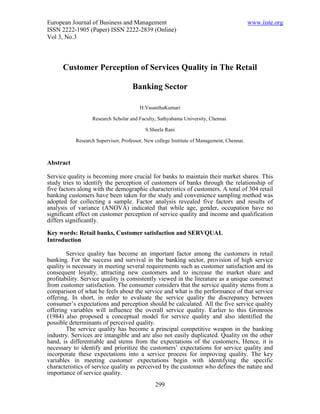
Service quality is becoming more crucial for banks to maintain their market shares. This
study tries to identify the perception of customers of banks through the relationship of
five factors along with the demographic characteristics of customers. A total of 304 retail
banking customers have been taken for the study and convenience sampling method was
adopted for collecting a sample. Factor analysis revealed five factors and results of
analysis of variance (ANOVA) indicated that while age, gender, occupation have no
significant effect on customer perception of service quality and income and qualification
differs significantly.

Key words: Retail banks, Customer satisfaction and SERVQUAL
Introduction

        Service quality has become an important factor among the customers in retail
banking. For the success and survival in the banking sector, provision of high service
quality is necessary in meeting several requirements such as customer satisfaction and its
consequent loyalty, attracting new customers and to increase the market share and
profitability. Service quality is consistently viewed in the literature as a unique construct
from customer satisfaction. The consumer considers that the service quality stems from a
comparison of what he feels about the service and what is the performance of that service
offering. In short, in order to evaluate the service quality the discrepancy between
consumer’s expectations and perception should be calculated. All the five service quality
offering variables will influence the overall service quality. Earlier to this Gronroos
(1984) also proposed a conceptual model for service quality and also identified the
possible determinants of perceived quality.
        The service quality has become a principal competitive weapon in the banking
industry. Services are intangible and are also not easily duplicated. Quality on the other
hand, is differentiable and stems from the expectations of the customers, Hence, it is
necessary to identify and prioritize the customers’ expectations for service quality and
incorporate these expectations into a service process for improving quality. The key
variables in meeting customer expectations begin with identifying the specific
characteristics of service quality as perceived by the customer who defines the nature and
importance of service quality.
                                               299
European Journal of Business and Management                                        www.iiste.org
ISSN 2222-1905 (Paper) ISSN 2222-2839 (Online)
Vol 3, No.3

        Among the service industry, the banking sector is perhaps the largest one that
caters to the needs of people belonging to all sections of society. Moreover, perceived
service quality tends to play a significant role in high involvement (high interaction
between customers and service providers) industry like banks (Angur et al., 1999). Also,
banks traditionally have long term business relationships with customers. In addition, the
banking sector is large enough to capture and represent almost all the critical features of
customer-perceived service quality and the critical dimensions of TQS that the
management may have to encounter in order to manage a service organization
effectively.


Literature Review
Measuring Service quality:
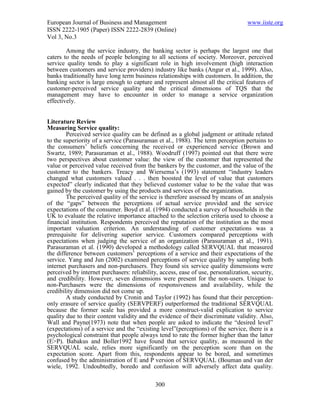
        Perceived service quality can be defined as a global judgment or attitude related
to the superiority of a service (Parasuraman et al., 1988). The term perception pertains to
the consumers’ beliefs concerning the received or experienced service (Brown and
Swartz, 1989; Parasuraman et al., 1988). Woodruff (1997) pointed out that there were
two perspectives about customer value: the view of the customer that represented the
value or perceived value received from the bankers by the customer, and the value of the
customer to the bankers. Treacy and Wiersema’s (1993) statement “industry leaders
changed what customers valued . . . then boosted the level of value that customers
expected” clearly indicated that they believed customer value to be the value that was
gained by the customer by using the products and services of the organization.
        The perceived quality of the service is therefore assessed by means of an analysis
of the “gaps” between the perceptions of actual service provided and the service
expectations of the consumer. Boyd et al. (1994) conducted a survey of households in the
UK to evaluate the relative importance attached to the selection criteria used to choose a
financial institution. Respondents perceived the reputation of the institution as the most
important valuation criterion. An understanding of customer expectations was a
prerequisite for delivering superior service. Customers compared perceptions with
expectations when judging the service of an organization (Parasuraman et al., 1991).
Parasuraman et al. (1990) developed a methodology called SERVQUAL that measured
the difference between customers’ perceptions of a service and their expectations of the
service. Yang and Jun (2002) examined perceptions of service quality by sampling both
internet purchasers and non-purchasers. They found six service quality dimensions were
perceived by internet purchasers: reliability, access, ease of use, personalization, security,
and credibility. However, seven dimensions were present for the non-users. Unique to
non-Purchasers were the dimensions of responsiveness and availability, while the
credibility dimension did not come up.
        A study conducted by Cronin and Taylor (1992) has found that their perception-
only erasure of service quality (SERVPERF) outperformed the traditional SERVQUAL
because the former scale has provided a more construct-valid explication to service
quality due to their content validity and the evidence of their discriminate validity. Also,
Wall and Payne(1973) note that when people are asked to indicate the “desired level”
(expectations) of a service and the “existing level”(perceptions) of the service, there is a
psychological constraint that people always tend to rate the former higher than the latter
(E>P). Babakus and Boller1992 have found that service quality, as measured in the
SERVQUAL scale, relies more significantly on the perception score than on the
expectation score. Apart from this, respondents appear to be bored, and sometimes
confused by the administration of E and P version of SERVQUAL (Bouman and van der
wiele, 1992. Undoubtedly, boredo and confusion will adversely affect data quality.

                                             300
European Journal of Business and Management                                       www.iiste.org
ISSN 2222-1905 (Paper) ISSN 2222-2839 (Online)
Vol 3, No.3

Therefore, perception- only measure seems to be more realistic and applicable in this
study.

Hypothesis of the study
Following hypothesis have been selected in the study based on the analytical
interpretations in the previous section:
H01: Gender of respondents has no significant impact on the customer perception towards
services offered by their banks.
H02: Age of respondents has no significant impact on the customer perception towards
services offered by their banks.
H03: Income of respondents has no significant impact on the customer perception towards
services offered by their banks.
H04: Qualification of respondents has no significant impact on the customer perception
towards services offered by their banks.
Methodology
Research instrument
         In order to test the customer perceptions towards retail banking services within
the framework of the value disciplines, a questionnaire with two sections was designed
(Treacy and Wiersema, 1993, 1995). Section captured demographic information for the
purpose of describing the sample. Section B was designed to measure customer
perceptions of the value being delivered by their banks. The 16 statements were measured
on a Five point Likert scale where 5 indicated strongly agree and 1 strongly disagrees.
Sample
         Present study is an empirical research to study the demographic influences on
customer perception towards retail banking services offered by their banks. The survey
questionnaires were distributed to 350 respondents in Chennai, 304 usable questionnaires
were collected, resulting in an 86.9 percent response rate. The Study was conducted in
Chennai during the period of Jan – March 2011. Convenient sampling method was
adopted for collecting a sample. The data was analyzed using SPSS version 16.0 for
windows throughout the study.
Results and Discussion:
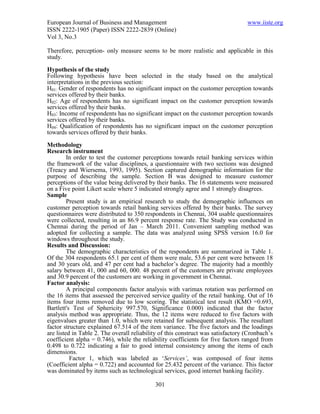
         The demographic characteristics of the respondents are summarized in Table 1.
Of the 304 respondents 65.1 per cent of them were male, 53.6 per cent were between 18
and 30 years old, and 47 per cent had a bachelor’s degree. The majority had a monthly
salary between 41, 000 and 60, 000. 48 percent of the customers are private employees
and 30.9 percent of the customers are working in government in Chennai.
Factor analysis:
         A principal components factor analysis with varimax rotation was performed on
the 16 items that assessed the perceived service quality of the retail banking. Out of 16
items four items removed due to low scoring. The statistical test result (KMO =0.693,
Bartlett's Test of Sphericity 997.570, Significance 0.000) indicated that the factor
analysis method was appropriate. Thus, the 12 items were reduced to five factors with
eigenvalues greater than 1.0, which were retained for subsequent analysis. The resultant
factor structure explained 67.514 of the item variance. The five factors and the loadings
are listed in Table 2. The overall reliability of this construct was satisfactory (Cronbach’s
coefficient alpha = 0.746), while the reliability coefficients for five factors ranged from
0.498 to 0.722 indicating a fair to good internal consistency among the items of each
dimensions.
          Factor 1, which was labeled as ‘Services’, was composed of four items
(Coefficient alpha = 0.722) and accounted for 25.432 percent of the variance. This factor
was dominated by items such as technological services, good internet banking facility.

                                            301
European Journal of Business and Management                                      www.iiste.org
    ISSN 2222-1905 (Paper) ISSN 2222-2839 (Online)
    Vol 3, No.3

             Factor 2 comprised of three items that related to the ‘Reliability’ of the services
    (Coefficient alpha = 0.623) and accounted for an additional 14.051 percent of the
    variance. Queries and complaints, low interest rates on loans are the items occupy highest
    loadings.
              Factor 3 was labeled as ‘Tangibles’ that included three items (Coefficient alpha
    = 0.498). It accounted for the additional 10.558 percent of the total variance. The three
    items were convenient operating hours, modern looking equipments, and fast in solving
    problems. These were all influences customers when entering in to bank. These
    characteristics helped to establish the image of the bank and influences customer
    expectations.
         Factor 4 was‘Time Duration’ that contain only one item is time taken by the bank
    for sanctioning loan. It accounted for the additional 9.535 percent of the variance.
          Factor 5 was interpreted as a ‘Growth’ and contains one item of growth of my bank
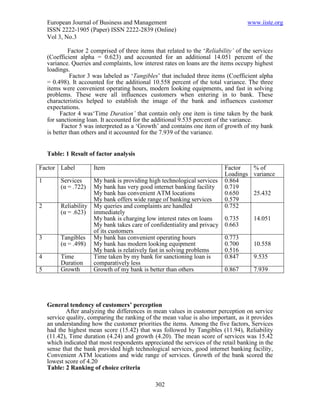
    is better than others and it accounted for the 7.939 of the variance.


    Table: 1 Result of factor analysis

Factor Label           Item                                                 Factor   % of
                                                                            Loadings variance
1        Services      My bank is providing high technological services     0.864
         (α = .722)    My bank has very good internet banking facility      0.719
                       My bank has convenient ATM locations                 0.650    25.432
                       My bank offers wide range of banking services        0.579
2        Reliability   My queries and complaints are handled                0.752
         (α = .623)    immediately
                       My bank is charging low interest rates on loans      0.735       14.051
                       My bank takes care of confidentiality and privacy    0.663
                       of its customers
3        Tangibles     My bank has convenient operating hours               0.773
         (α = .498)    My bank has modern looking equipment                 0.700       10.558
                       My bank is relatively fast in solving problems       0.516
4        Time          Time taken by my bank for sanctioning loan is        0.847       9.535
         Duration      comparatively less
5        Growth        Growth of my bank is better than others              0.867       7.939


    General tendency of customers’ perception
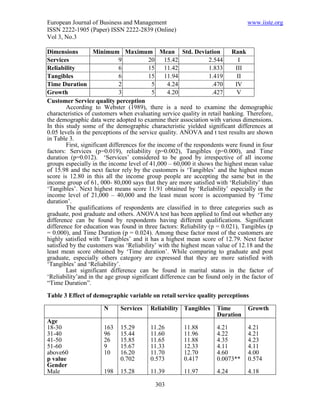
            After analyzing the differences in mean values in customer perception on service
    service quality, comparing the ranking of the mean value is also important, as it provides
    an understanding how the customer priorities the items. Among the five factors, Services
    had the highest mean score (15.42) that was followed by Tangibles (11.94), Reliability
    (11.42), Time duration (4.24) and growth (4.20). The mean score of services was 15.42
    which indicated that most respondents appreciated the services of the retail banking in the
    sense that the bank provided high technological services, good internet banking facility,
    Convenient ATM locations and wide range of services. Growth of the bank scored the
    lowest score of 4.20
    Table: 2 Ranking of choice criteria

                                                302
European Journal of Business and Management                                     www.iiste.org
ISSN 2222-1905 (Paper) ISSN 2222-2839 (Online)
Vol 3, No.3

Dimensions          Minimum Maximum Mean Std. Deviation                    Rank
Services                       9           20     15.42           2.544       I
Reliability                    6           15     11.42           1.833     III
Tangibles                      6           15     11.94           1.419      II
Time Duration                  2             5     4.24            .470     IV
Growth                         3             5     4.20            .427      V
Customer Service quality perception
        According to Webster (1989), there is a need to examine the demographic
characteristics of customers when evaluating service quality in retail banking. Therefore,
the demographic data were adopted to examine their association with various dimensions.
In this study some of the demographic characteristic yielded significant differences at
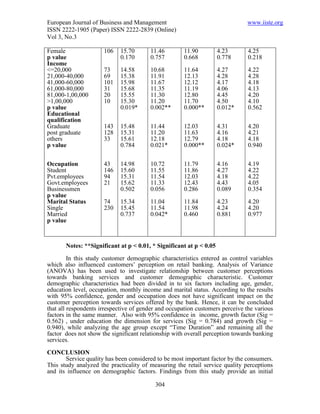
0.05 levels in the perceptions of the service quality. ANOVA and t test results are shown
in Table 3.
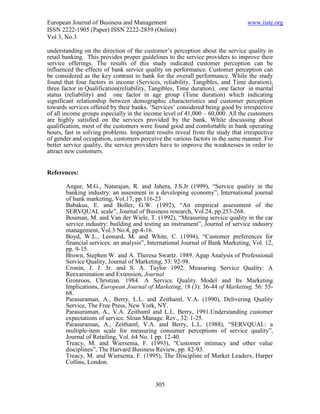
        First, significant differences for the income of the respondents were found in four
factors: Services (p=0.019), reliability (p=0.002), Tangibles (p=0.000), and Time
duration (p=0.012). ‘Services’ considered to be good by irrespective of all income
groups especially in the income level of 41,000 – 60,000 it shows the highest mean value
of 15.98 and the next factor rely by the customers is ‘Tangibles’ and the highest mean
score is 12.80 in this all the income group people are accepting the same but in the
income group of 61, 000- 80,000 says that they are more satisfied with ‘Reliability’ than
‘Tangibles’. Next highest means score 11.91 obtained by ‘Reliability’ especially in the
income level of 21,000 – 40,000 and the least mean score is accompanied by ‘Time
duration’.
        The qualifications of respondents are classified in to three categories such as
graduate, post graduate and others. ANOVA test has been applied to find out whether any
difference can be found by respondents having different qualifications. Significant
difference for education was found in three factors: Reliability (p = 0.021), Tangibles (p
= 0.000), and Time Duration (p = 0.024). Among these factor most of the customers are
highly satisfied with ‘Tangibles’ and it has a highest mean score of 12.79. Next factor
satisfied by the customers was ‘Reliability’ with the highest mean value of 12.18 and the
least mean score obtained by ‘Time duration’. While comparing to graduate and post
graduate, especially others category are expressed that they are more satisfied with
‘Tangibles’ and ‘Reliability’.
        Last significant difference can be found in marital status in the factor of
‘Reliability’and in the age group significant difference can be found only in the factor of
“Time Duration”.

Table 3 Effect of demographic variable on retail service quality perceptions

                      N      Services    Reliability Tangibles      Time        Growth
                                                                    Duration
Age
18-30                 163    15.29       11.26         11.88        4.21        4.21
31-40                 96     15.44       11.60         11.96        4.22        4.21
41-50                 26     15.85       11.65         11.88        4.35        4.23
51-60                 9      15.67       11.33         12.33        4.11        4.11
above60               10     16.20       11.70         12.70        4.60        4.00
p value                      0.702       0.573         0.417        0.0073**    0.574
Gender
Male                  198    15.28       11.39         11.97        4.24        4.18

                                           303
European Journal of Business and Management                                   www.iiste.org
ISSN 2222-1905 (Paper) ISSN 2222-2839 (Online)
Vol 3, No.3

Female                106   15.70       11.46        11.90           4.23      4.25
p value                     0.170       0.757        0.668           0.778     0.218
Income
<=20,000              73    14.58       10.68        11.64           4.27      4.22
21,000-40,000         69    15.38       11.91        12.13           4.28      4.28
41,000-60,000         101   15.98       11.67        12.12           4.17      4.18
61,000-80,000         31    15.68       11.35        11.19           4.06      4.13
81,000-1,00,000       20    15.55       11.30        12.80           4.45      4.20
>1,00,000             10    15.30       11.20        11.70           4.50      4.10
p value                     0.019*      0.002**      0.000**         0.012*    0.562
Educational
qualification
Graduate              143   15.48       11.44        12.03           4.31      4.20
post graduate         128   15.31       11.20        11.63           4.16      4.21
others                33    15.61       12.18        12.79           4.18      4.18
p value                     0.784       0.021*       0.000**         0.024*    0.940


Occupation            43    14.98       10.72        11.79           4.16      4.19
Student               146   15.60       11.55        11.86           4.27      4.22
Pvt.employees         94    15.31       11.54        12.03           4.18      4.22
Govt.employees        21    15.62       11.33        12.43           4.43      4.05
Businessmen                 0.502       0.056        0.286           0.089     0.354
p value
Marital Status        74    15.34       11.04        11.84           4.23      4.20
Single                230   15.45       11.54        11.98           4.24      4.20
Married                     0.737       0.042*       0.460           0.881     0.977
p value


       Notes: **Significant at p < 0.01, * Significant at p < 0.05

         In this study customer demographic characteristics entered as control variables
which also influenced customers’ perception on retail banking. Analysis of Variance
(ANOVA) has been used to investigate relationship between customer perceptions
towards banking services and customer demographic characteristic. Customer
demographic characteristics had been divided in to six factors including age, gender,
education level, occupation, monthly income and marital status. According to the results
with 95% confidence, gender and occupation does not have significant impact on the
customer perception towards services offered by the bank. Hence, it can be concluded
that all respondents irrespective of gender and occupation customers perceive the various
factors in the same manner. Also with 95% confidence in income, growth factor (Sig =
0.562) , under education the dimension for services (Sig = 0.784) and growth (Sig =
0.940), while analyzing the age group except “Time Duration” and remaining all the
factor does not show the significant relationship with overall perception towards banking
services.

CONCLUSION
       Service quality has been considered to be most important factor by the consumers.
This study analyzed the practicality of measuring the retail service quality perceptions
and its influence on demographic factors. Findings from this study provide an initial

                                          304
European Journal of Business and Management                                     www.iiste.org
ISSN 2222-1905 (Paper) ISSN 2222-2839 (Online)
Vol 3, No.3

understanding on the direction of the customer’s perception about the service quality in
retail banking. This provides proper guidelines to the service providers to improve their
service offerings. The results of this study indicated customer perception can be
influenced the effects of bank service quality on performance. Customer perception can
be considered as the key contrast to bank for the overall performance. While the study
found that four factors in income (Services, reliability, Tangibles, and Time duration),
three factor in Qualification(reliability, Tangibles, Time duration), one factor in marital
status (reliability) and one factor in age group (Time duration) which indicating
significant relationship between demographic characteristics and customer perception
towards services offered by their banks. ‘Services’ considered being good by irrespective
of all income groups especially in the income level of 41,000 – 60,000. All the customers
are highly satisfied on the services provided by the bank. While discussing about
qualification, most of the customers were found good and comfortable in bank operating
hours, fast in solving problems. Important results reveal from the study that irrespective
of gender and occupation, customers perceive the various factors in the same manner. For
better service quality, the service providers have to improve the weaknesses in order to
attract new customers.


References:

       Angur, M.G., Natarajan, R. and Jahera, J.S.Jr (1999), “Service quality in the
       banking industry: an assesment in a developing economy”, International journal
       of bank marketing, Vol.17, pp.116-23
       Babakus, E. and Boller, G.W. (1992), “An empirical assessment of the
       SERVQUAL scale”, Journal of Business research, Vol.24, pp.253-268.
       Bouman, M. and Van der Wiele, T. (1992), “Measuring service quality in the car
       service industry: building and testing an instrument”, Journal of service industry
       management, Vol.3 No.4, pp.4-16.
       Boyd, W.L., Leonard, M. and White, C. (1994), “Customer preferences for
       financial services: an analysis”, International Journal of Bank Marketing, Vol. 12,
       pp. 9-15.
       Brown, Stephen W. and A. Theresa Swartz. 1989. Agap Analysis of Professional
       Service Quality, Journal of Marketing, 53: 92-98.
       Cronin, J. J. Jr. and S. A. Taylor 1992. Measuring Service Quality: A
       Reexamination and Extension, Journal
       Gronroos, Christian. 1984. A Service Quality Model and Its Marketing
       Implications, European Journal of Marketing, 18 (3): 36-44 of Marketing, 56: 55-
       68.
       Parasuraman, A., Berry, L.L. and Zeithaml, V.A. (1990), Delivering Quality
       Service, The Free Press, New York, NY.
       Parasuraman, A., V.A. Zeithaml and L.L. Berry, 1991.Understanding customer
       expectations of service. Sloan Manage. Rev., 32: 1-25.
       Parasuraman, A., Zeithaml, V.A. and Berry, L.L. (1988), “SERVQUAL: a
       multiple-item scale for measuring consumer perceptions of service quality”,
       Journal of Retailing, Vol. 64 No. 1 pp. 12-40.
       Treacy, M. and Wiersema, F. (1993), “Customer intimacy and other value
       disciplines”, The Harvard Business Review, pp. 82-93.
       Treacy, M. and Wiersema, F. (1995), The Discipline of Market Leaders, Harper
       Collins, London.


                                           305
European Journal of Business and Management                               www.iiste.org
ISSN 2222-1905 (Paper) ISSN 2222-2839 (Online)
Vol 3, No.3

      Webster, C. (1989), “Can consumer be segmented on the basis of their service
      quality expectaitons?” Journal of service marketing, vol. 3, Spring, pp.73-80.
      Woodruff, R.B. (1997), “Customer value: the next source for competitive
      advantage”, Journal of the Academy of Marketing Science, Vol. 25, pp. 139-53.
      Yang, Z. and Jun, M. (2002),”Consumer perception of e-service quality: From
      internet purchaser and non-purchaser perspectives”, Journal of Business
      strategies, Vol.19 No.1, pp. 19-41.


                                       306

21 h.vasantha kumari_299-306

  • 1.
    European Journal ofBusiness and Management www.iiste.org ISSN 2222-1905 (Paper) ISSN 2222-2839 (Online) Vol 3, No.3 Customer Perception of Services Quality in The Retail Banking Sector H.VasanthaKumari Research Scholar and Faculty, Sathyabama University, Chennai. S.Sheela Rani Research Supervisor, Professor, New college Institute of Management, Chennai. Abstract Service quality is becoming more crucial for banks to maintain their market shares. This study tries to identify the perception of customers of banks through the relationship of five factors along with the demographic characteristics of customers. A total of 304 retail banking customers have been taken for the study and convenience sampling method was adopted for collecting a sample. Factor analysis revealed five factors and results of analysis of variance (ANOVA) indicated that while age, gender, occupation have no significant effect on customer perception of service quality and income and qualification differs significantly. Key words: Retail banks, Customer satisfaction and SERVQUAL Introduction Service quality has become an important factor among the customers in retail banking. For the success and survival in the banking sector, provision of high service quality is necessary in meeting several requirements such as customer satisfaction and its consequent loyalty, attracting new customers and to increase the market share and profitability. Service quality is consistently viewed in the literature as a unique construct from customer satisfaction. The consumer considers that the service quality stems from a comparison of what he feels about the service and what is the performance of that service offering. In short, in order to evaluate the service quality the discrepancy between consumer’s expectations and perception should be calculated. All the five service quality offering variables will influence the overall service quality. Earlier to this Gronroos (1984) also proposed a conceptual model for service quality and also identified the possible determinants of perceived quality. The service quality has become a principal competitive weapon in the banking industry. Services are intangible and are also not easily duplicated. Quality on the other hand, is differentiable and stems from the expectations of the customers, Hence, it is necessary to identify and prioritize the customers’ expectations for service quality and incorporate these expectations into a service process for improving quality. The key variables in meeting customer expectations begin with identifying the specific characteristics of service quality as perceived by the customer who defines the nature and importance of service quality. 299
  • 2.
    European Journal ofBusiness and Management www.iiste.org ISSN 2222-1905 (Paper) ISSN 2222-2839 (Online) Vol 3, No.3 Among the service industry, the banking sector is perhaps the largest one that caters to the needs of people belonging to all sections of society. Moreover, perceived service quality tends to play a significant role in high involvement (high interaction between customers and service providers) industry like banks (Angur et al., 1999). Also, banks traditionally have long term business relationships with customers. In addition, the banking sector is large enough to capture and represent almost all the critical features of customer-perceived service quality and the critical dimensions of TQS that the management may have to encounter in order to manage a service organization effectively. Literature Review Measuring Service quality: Perceived service quality can be defined as a global judgment or attitude related to the superiority of a service (Parasuraman et al., 1988). The term perception pertains to the consumers’ beliefs concerning the received or experienced service (Brown and Swartz, 1989; Parasuraman et al., 1988). Woodruff (1997) pointed out that there were two perspectives about customer value: the view of the customer that represented the value or perceived value received from the bankers by the customer, and the value of the customer to the bankers. Treacy and Wiersema’s (1993) statement “industry leaders changed what customers valued . . . then boosted the level of value that customers expected” clearly indicated that they believed customer value to be the value that was gained by the customer by using the products and services of the organization. The perceived quality of the service is therefore assessed by means of an analysis of the “gaps” between the perceptions of actual service provided and the service expectations of the consumer. Boyd et al. (1994) conducted a survey of households in the UK to evaluate the relative importance attached to the selection criteria used to choose a financial institution. Respondents perceived the reputation of the institution as the most important valuation criterion. An understanding of customer expectations was a prerequisite for delivering superior service. Customers compared perceptions with expectations when judging the service of an organization (Parasuraman et al., 1991). Parasuraman et al. (1990) developed a methodology called SERVQUAL that measured the difference between customers’ perceptions of a service and their expectations of the service. Yang and Jun (2002) examined perceptions of service quality by sampling both internet purchasers and non-purchasers. They found six service quality dimensions were perceived by internet purchasers: reliability, access, ease of use, personalization, security, and credibility. However, seven dimensions were present for the non-users. Unique to non-Purchasers were the dimensions of responsiveness and availability, while the credibility dimension did not come up. A study conducted by Cronin and Taylor (1992) has found that their perception- only erasure of service quality (SERVPERF) outperformed the traditional SERVQUAL because the former scale has provided a more construct-valid explication to service quality due to their content validity and the evidence of their discriminate validity. Also, Wall and Payne(1973) note that when people are asked to indicate the “desired level” (expectations) of a service and the “existing level”(perceptions) of the service, there is a psychological constraint that people always tend to rate the former higher than the latter (E>P). Babakus and Boller1992 have found that service quality, as measured in the SERVQUAL scale, relies more significantly on the perception score than on the expectation score. Apart from this, respondents appear to be bored, and sometimes confused by the administration of E and P version of SERVQUAL (Bouman and van der wiele, 1992. Undoubtedly, boredo and confusion will adversely affect data quality. 300
  • 3.
    European Journal ofBusiness and Management www.iiste.org ISSN 2222-1905 (Paper) ISSN 2222-2839 (Online) Vol 3, No.3 Therefore, perception- only measure seems to be more realistic and applicable in this study. Hypothesis of the study Following hypothesis have been selected in the study based on the analytical interpretations in the previous section: H01: Gender of respondents has no significant impact on the customer perception towards services offered by their banks. H02: Age of respondents has no significant impact on the customer perception towards services offered by their banks. H03: Income of respondents has no significant impact on the customer perception towards services offered by their banks. H04: Qualification of respondents has no significant impact on the customer perception towards services offered by their banks. Methodology Research instrument In order to test the customer perceptions towards retail banking services within the framework of the value disciplines, a questionnaire with two sections was designed (Treacy and Wiersema, 1993, 1995). Section captured demographic information for the purpose of describing the sample. Section B was designed to measure customer perceptions of the value being delivered by their banks. The 16 statements were measured on a Five point Likert scale where 5 indicated strongly agree and 1 strongly disagrees. Sample Present study is an empirical research to study the demographic influences on customer perception towards retail banking services offered by their banks. The survey questionnaires were distributed to 350 respondents in Chennai, 304 usable questionnaires were collected, resulting in an 86.9 percent response rate. The Study was conducted in Chennai during the period of Jan – March 2011. Convenient sampling method was adopted for collecting a sample. The data was analyzed using SPSS version 16.0 for windows throughout the study. Results and Discussion: The demographic characteristics of the respondents are summarized in Table 1. Of the 304 respondents 65.1 per cent of them were male, 53.6 per cent were between 18 and 30 years old, and 47 per cent had a bachelor’s degree. The majority had a monthly salary between 41, 000 and 60, 000. 48 percent of the customers are private employees and 30.9 percent of the customers are working in government in Chennai. Factor analysis: A principal components factor analysis with varimax rotation was performed on the 16 items that assessed the perceived service quality of the retail banking. Out of 16 items four items removed due to low scoring. The statistical test result (KMO =0.693, Bartlett's Test of Sphericity 997.570, Significance 0.000) indicated that the factor analysis method was appropriate. Thus, the 12 items were reduced to five factors with eigenvalues greater than 1.0, which were retained for subsequent analysis. The resultant factor structure explained 67.514 of the item variance. The five factors and the loadings are listed in Table 2. The overall reliability of this construct was satisfactory (Cronbach’s coefficient alpha = 0.746), while the reliability coefficients for five factors ranged from 0.498 to 0.722 indicating a fair to good internal consistency among the items of each dimensions. Factor 1, which was labeled as ‘Services’, was composed of four items (Coefficient alpha = 0.722) and accounted for 25.432 percent of the variance. This factor was dominated by items such as technological services, good internet banking facility. 301
  • 4.
    European Journal ofBusiness and Management www.iiste.org ISSN 2222-1905 (Paper) ISSN 2222-2839 (Online) Vol 3, No.3 Factor 2 comprised of three items that related to the ‘Reliability’ of the services (Coefficient alpha = 0.623) and accounted for an additional 14.051 percent of the variance. Queries and complaints, low interest rates on loans are the items occupy highest loadings. Factor 3 was labeled as ‘Tangibles’ that included three items (Coefficient alpha = 0.498). It accounted for the additional 10.558 percent of the total variance. The three items were convenient operating hours, modern looking equipments, and fast in solving problems. These were all influences customers when entering in to bank. These characteristics helped to establish the image of the bank and influences customer expectations. Factor 4 was‘Time Duration’ that contain only one item is time taken by the bank for sanctioning loan. It accounted for the additional 9.535 percent of the variance. Factor 5 was interpreted as a ‘Growth’ and contains one item of growth of my bank is better than others and it accounted for the 7.939 of the variance. Table: 1 Result of factor analysis Factor Label Item Factor % of Loadings variance 1 Services My bank is providing high technological services 0.864 (α = .722) My bank has very good internet banking facility 0.719 My bank has convenient ATM locations 0.650 25.432 My bank offers wide range of banking services 0.579 2 Reliability My queries and complaints are handled 0.752 (α = .623) immediately My bank is charging low interest rates on loans 0.735 14.051 My bank takes care of confidentiality and privacy 0.663 of its customers 3 Tangibles My bank has convenient operating hours 0.773 (α = .498) My bank has modern looking equipment 0.700 10.558 My bank is relatively fast in solving problems 0.516 4 Time Time taken by my bank for sanctioning loan is 0.847 9.535 Duration comparatively less 5 Growth Growth of my bank is better than others 0.867 7.939 General tendency of customers’ perception After analyzing the differences in mean values in customer perception on service service quality, comparing the ranking of the mean value is also important, as it provides an understanding how the customer priorities the items. Among the five factors, Services had the highest mean score (15.42) that was followed by Tangibles (11.94), Reliability (11.42), Time duration (4.24) and growth (4.20). The mean score of services was 15.42 which indicated that most respondents appreciated the services of the retail banking in the sense that the bank provided high technological services, good internet banking facility, Convenient ATM locations and wide range of services. Growth of the bank scored the lowest score of 4.20 Table: 2 Ranking of choice criteria 302
  • 5.
    European Journal ofBusiness and Management www.iiste.org ISSN 2222-1905 (Paper) ISSN 2222-2839 (Online) Vol 3, No.3 Dimensions Minimum Maximum Mean Std. Deviation Rank Services 9 20 15.42 2.544 I Reliability 6 15 11.42 1.833 III Tangibles 6 15 11.94 1.419 II Time Duration 2 5 4.24 .470 IV Growth 3 5 4.20 .427 V Customer Service quality perception According to Webster (1989), there is a need to examine the demographic characteristics of customers when evaluating service quality in retail banking. Therefore, the demographic data were adopted to examine their association with various dimensions. In this study some of the demographic characteristic yielded significant differences at 0.05 levels in the perceptions of the service quality. ANOVA and t test results are shown in Table 3. First, significant differences for the income of the respondents were found in four factors: Services (p=0.019), reliability (p=0.002), Tangibles (p=0.000), and Time duration (p=0.012). ‘Services’ considered to be good by irrespective of all income groups especially in the income level of 41,000 – 60,000 it shows the highest mean value of 15.98 and the next factor rely by the customers is ‘Tangibles’ and the highest mean score is 12.80 in this all the income group people are accepting the same but in the income group of 61, 000- 80,000 says that they are more satisfied with ‘Reliability’ than ‘Tangibles’. Next highest means score 11.91 obtained by ‘Reliability’ especially in the income level of 21,000 – 40,000 and the least mean score is accompanied by ‘Time duration’. The qualifications of respondents are classified in to three categories such as graduate, post graduate and others. ANOVA test has been applied to find out whether any difference can be found by respondents having different qualifications. Significant difference for education was found in three factors: Reliability (p = 0.021), Tangibles (p = 0.000), and Time Duration (p = 0.024). Among these factor most of the customers are highly satisfied with ‘Tangibles’ and it has a highest mean score of 12.79. Next factor satisfied by the customers was ‘Reliability’ with the highest mean value of 12.18 and the least mean score obtained by ‘Time duration’. While comparing to graduate and post graduate, especially others category are expressed that they are more satisfied with ‘Tangibles’ and ‘Reliability’. Last significant difference can be found in marital status in the factor of ‘Reliability’and in the age group significant difference can be found only in the factor of “Time Duration”. Table 3 Effect of demographic variable on retail service quality perceptions N Services Reliability Tangibles Time Growth Duration Age 18-30 163 15.29 11.26 11.88 4.21 4.21 31-40 96 15.44 11.60 11.96 4.22 4.21 41-50 26 15.85 11.65 11.88 4.35 4.23 51-60 9 15.67 11.33 12.33 4.11 4.11 above60 10 16.20 11.70 12.70 4.60 4.00 p value 0.702 0.573 0.417 0.0073** 0.574 Gender Male 198 15.28 11.39 11.97 4.24 4.18 303
  • 6.
    European Journal ofBusiness and Management www.iiste.org ISSN 2222-1905 (Paper) ISSN 2222-2839 (Online) Vol 3, No.3 Female 106 15.70 11.46 11.90 4.23 4.25 p value 0.170 0.757 0.668 0.778 0.218 Income <=20,000 73 14.58 10.68 11.64 4.27 4.22 21,000-40,000 69 15.38 11.91 12.13 4.28 4.28 41,000-60,000 101 15.98 11.67 12.12 4.17 4.18 61,000-80,000 31 15.68 11.35 11.19 4.06 4.13 81,000-1,00,000 20 15.55 11.30 12.80 4.45 4.20 >1,00,000 10 15.30 11.20 11.70 4.50 4.10 p value 0.019* 0.002** 0.000** 0.012* 0.562 Educational qualification Graduate 143 15.48 11.44 12.03 4.31 4.20 post graduate 128 15.31 11.20 11.63 4.16 4.21 others 33 15.61 12.18 12.79 4.18 4.18 p value 0.784 0.021* 0.000** 0.024* 0.940 Occupation 43 14.98 10.72 11.79 4.16 4.19 Student 146 15.60 11.55 11.86 4.27 4.22 Pvt.employees 94 15.31 11.54 12.03 4.18 4.22 Govt.employees 21 15.62 11.33 12.43 4.43 4.05 Businessmen 0.502 0.056 0.286 0.089 0.354 p value Marital Status 74 15.34 11.04 11.84 4.23 4.20 Single 230 15.45 11.54 11.98 4.24 4.20 Married 0.737 0.042* 0.460 0.881 0.977 p value Notes: **Significant at p < 0.01, * Significant at p < 0.05 In this study customer demographic characteristics entered as control variables which also influenced customers’ perception on retail banking. Analysis of Variance (ANOVA) has been used to investigate relationship between customer perceptions towards banking services and customer demographic characteristic. Customer demographic characteristics had been divided in to six factors including age, gender, education level, occupation, monthly income and marital status. According to the results with 95% confidence, gender and occupation does not have significant impact on the customer perception towards services offered by the bank. Hence, it can be concluded that all respondents irrespective of gender and occupation customers perceive the various factors in the same manner. Also with 95% confidence in income, growth factor (Sig = 0.562) , under education the dimension for services (Sig = 0.784) and growth (Sig = 0.940), while analyzing the age group except “Time Duration” and remaining all the factor does not show the significant relationship with overall perception towards banking services. CONCLUSION Service quality has been considered to be most important factor by the consumers. This study analyzed the practicality of measuring the retail service quality perceptions and its influence on demographic factors. Findings from this study provide an initial 304
  • 7.
    European Journal ofBusiness and Management www.iiste.org ISSN 2222-1905 (Paper) ISSN 2222-2839 (Online) Vol 3, No.3 understanding on the direction of the customer’s perception about the service quality in retail banking. This provides proper guidelines to the service providers to improve their service offerings. The results of this study indicated customer perception can be influenced the effects of bank service quality on performance. Customer perception can be considered as the key contrast to bank for the overall performance. While the study found that four factors in income (Services, reliability, Tangibles, and Time duration), three factor in Qualification(reliability, Tangibles, Time duration), one factor in marital status (reliability) and one factor in age group (Time duration) which indicating significant relationship between demographic characteristics and customer perception towards services offered by their banks. ‘Services’ considered being good by irrespective of all income groups especially in the income level of 41,000 – 60,000. All the customers are highly satisfied on the services provided by the bank. While discussing about qualification, most of the customers were found good and comfortable in bank operating hours, fast in solving problems. Important results reveal from the study that irrespective of gender and occupation, customers perceive the various factors in the same manner. For better service quality, the service providers have to improve the weaknesses in order to attract new customers. References: Angur, M.G., Natarajan, R. and Jahera, J.S.Jr (1999), “Service quality in the banking industry: an assesment in a developing economy”, International journal of bank marketing, Vol.17, pp.116-23 Babakus, E. and Boller, G.W. (1992), “An empirical assessment of the SERVQUAL scale”, Journal of Business research, Vol.24, pp.253-268. Bouman, M. and Van der Wiele, T. (1992), “Measuring service quality in the car service industry: building and testing an instrument”, Journal of service industry management, Vol.3 No.4, pp.4-16. Boyd, W.L., Leonard, M. and White, C. (1994), “Customer preferences for financial services: an analysis”, International Journal of Bank Marketing, Vol. 12, pp. 9-15. Brown, Stephen W. and A. Theresa Swartz. 1989. Agap Analysis of Professional Service Quality, Journal of Marketing, 53: 92-98. Cronin, J. J. Jr. and S. A. Taylor 1992. Measuring Service Quality: A Reexamination and Extension, Journal Gronroos, Christian. 1984. A Service Quality Model and Its Marketing Implications, European Journal of Marketing, 18 (3): 36-44 of Marketing, 56: 55- 68. Parasuraman, A., Berry, L.L. and Zeithaml, V.A. (1990), Delivering Quality Service, The Free Press, New York, NY. Parasuraman, A., V.A. Zeithaml and L.L. Berry, 1991.Understanding customer expectations of service. Sloan Manage. Rev., 32: 1-25. Parasuraman, A., Zeithaml, V.A. and Berry, L.L. (1988), “SERVQUAL: a multiple-item scale for measuring consumer perceptions of service quality”, Journal of Retailing, Vol. 64 No. 1 pp. 12-40. Treacy, M. and Wiersema, F. (1993), “Customer intimacy and other value disciplines”, The Harvard Business Review, pp. 82-93. Treacy, M. and Wiersema, F. (1995), The Discipline of Market Leaders, Harper Collins, London. 305
  • 8.
    European Journal ofBusiness and Management www.iiste.org ISSN 2222-1905 (Paper) ISSN 2222-2839 (Online) Vol 3, No.3 Webster, C. (1989), “Can consumer be segmented on the basis of their service quality expectaitons?” Journal of service marketing, vol. 3, Spring, pp.73-80. Woodruff, R.B. (1997), “Customer value: the next source for competitive advantage”, Journal of the Academy of Marketing Science, Vol. 25, pp. 139-53. Yang, Z. and Jun, M. (2002),”Consumer perception of e-service quality: From internet purchaser and non-purchaser perspectives”, Journal of Business strategies, Vol.19 No.1, pp. 19-41. 306