Progressive Education Society’s
Modern College of Pharmacy,
Yamunanagar, Nigdi, Pune 411044
Dr. Kalyani Kakad.
Assistant Professor
Pharmacognosy Department
PES Modern College of Pharmacy, Nigdi,
Pune-411044.
Medicinal Plants:
Good Agricultural Practice (GAP)
Learning Outcomes
Learners will be able to
1. Need for Good Agricultural Practices
2. The general guidelines for harvesting and processing of Medicinal Plants.
3. The guidelines for collection of different parts of the medicinal plants.
Background- Need for Good Agricultural Practices
‱ India has a rich tradition of plant based health care systems contained in its classical texts
like Charak Samhita and Sushruta Samhita.
‱ The Government of India have recognized Ayurveda, Yoga & Naturopathy, Siddha, Unnani
and Homoeopathy as the alternative systems of medicine under the National Health Policy.
‱ To ensure and enhance the quality of ASU medicines, the Government of India have notified
Good Manufacturing Practices under Schedule “T” of the Drugs and Cosmetics Act 1940.
‱ These guidelines for Good Agricultural Practices seek to lay down standards for production
of raw material that goes in to the making of the ASU medicines and standardize the
production processes from farm to factory.
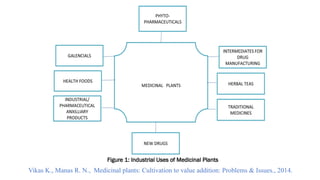
Figure 1: Industrial Uses of Medicinal Plants
Vikas K., Manas R. N., Medicinal plants: Cultivation to value addition: Problems & Issues., 2014.
Good Agricultural Practice (GAP)
‱ A Good agricultural practice of medicinal plants is a cultivation program designed
to ensure optimal yield in terms of both the quality quantity of any crop
intended for health purposes.
‱ The guidelines on Good agricultural practices (GAP) provides the documented
proof of how to handle medicinal plants right from cultivation to post harvesting
operations.
‱ Raw material plant materials should meet all applicable national or regional
quality standards.
‱ The guidelines, therefore, may need to be adjusted according to each country
situation.
Objectives of GAP:
‱ To contribute to the quality assurance of medicinal plant materials used as the source for
herbal medicines, which aims to improve the quality, safety and efficacy of finished
herbal products.
‱ To guide the formulation of national or regional guidelines and monographs for medicinal
plants and related standard operating procedure (SOPs).
‱ To encourage and support the sustainable cultivation and collection of medicinal plants of
good quality.
WHO guidelines on
Good agricultural and collection practices
(GACP)
for medicinal plants
Note: WHO has developed a series of technical guidelines relating to the quality control of herbal medicines of
which these WHO guidelines on good agricultural and collection practices (GACP) for medicinal plants are the
latest. The guidelines provide a detailed description of the techniques and measures required for the appropriate
cultivation and collection of medicinal plants and for the recording and documentation of necessary data and
information during their processing.
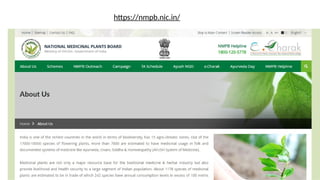
https://nmpb.nic.in/
National Medicinal Plants Board
‱ In order to promote medicinal plants sector, Government of India set up National
Medicinal Plants Board (NMPB) on 24th November 2000. Currently the board is
working as a section of Ministry of AYUSH (Ayurveda, Yoga & Naturopathy, Unani,
Siddha & Homoeopathy), Government of India.
‱ The primary mandate of NMPB is to develop an appropriate mechanism for
coordination between various ministries/ departments/ organization and implementation
of support policies/programs for overall (conservation, cultivation, trade and export)
growth of medicinal plants sector both at the Central /State and International level.
Overall, NMPB’s main objective is the development of medicinal plants sector
through developing a strong coordination between various ministries/
departments/ organization for implementation of policies / programs on
medicinal plants.
General guidelines on GAP for medicinal plants
1. Selection of medicinal plants.
2. Identification/ authentication of cultivated medicinal plants.
3. Specimens
4. Seeds and other propagating materials
5. Cultivation
6. Site selection
7. Ecological environment and social impact
8. Climate
9. Soil
10. Irrigation and drainage
11. Plant maintenance and protection
12. Harvesting and drying
13. Storage
14. Personnel
1. Selection of medicinal plants
‱ The species or botanical variety selected for cultivation should be the same
as that specified in the national Pharmacopeia or recommended by other
authoritative national documents of the end users country.
‱ In the absence of such national documents, the selection of species or
botanical varieties specified in the pharmacopeia or other authoritative
documents of other countries should be considered. Other countries
pharmacopeia or other traditional documents.
‱ In the case of newly introduced medicinal plants, the species or Botanical
variety selected for cultivation should be identified and documented as the
source material used or describe in the traditional medicine of original
country.
Note:
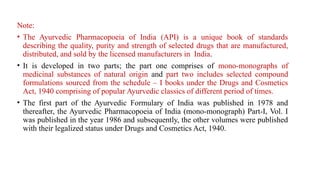
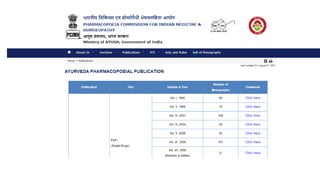
‱ The Ayurvedic Pharmacopoeia of India (API) is a unique book of standards
describing the quality, purity and strength of selected drugs that are manufactured,
distributed, and sold by the licensed manufacturers in India.
‱ It is developed in two parts; the part one comprises of mono-monographs of
medicinal substances of natural origin and part two includes selected compound
formulations sourced from the schedule – I books under the Drugs and Cosmetics
Act, 1940 comprising of popular Ayurvedic classics of different period of times.
‱ The first part of the Ayurvedic Formulary of India was published in 1978 and
thereafter, the Ayurvedic Pharmacopoeia of India (mono-monograph) Part-I, Vol. I
was published in the year 1986 and subsequently, the other volumes were published
with their legalized status under Drugs and Cosmetics Act, 1940.
2. Identification/authentication of cultivated of medicinal plants
‱ The botanical identity – scientific name (genus, species, subspecies/variety, author, and
family) – of each medicinal plant under cultivation should be verified and recorded.
‱ If available, the local and English common names should also be recorded. Other
relevant information, such as the cultivar name, ecotype, chemotype or phenotype, may
also be provided, as appropriate.
‱ For commercially available cultivars, the name of the cultivar and of the supplier
should be provided.
‱ In the case of landraces collected, propagated, disseminated and grown in a specific
region, records should be kept of the locally named line, including the origin of the
source seeds, plants or propagation materials.
‱ An ecotype is a population of organisms that is genetically adapted to a specific environment.
‱ A chemotype is a group of plants or microorganisms that have a distinct chemical composition. Chemotypes are
subspecies of a plant that have the same physical characteristics but different chemical compositions.
‱ The set of observable characteristics of an individual resulting from the interaction of its genotype with the
environment.
3. Specimens
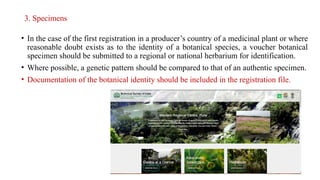
‱ In the case of the first registration in a producer’s country of a medicinal plant or where
reasonable doubt exists as to the identity of a botanical species, a voucher botanical
specimen should be submitted to a regional or national herbarium for identification.
‱ Where possible, a genetic pattern should be compared to that of an authentic specimen.
‱ Documentation of the botanical identity should be included in the registration file.
4. Seeds and other propagation materials
‱ Seeds and other propagation materials should be specified, and suppliers of seeds and
other propagation materials should provide all necessary information relating to the
identity, quality and performance of their products, as well as their breeding history, where
possible.
‱ The propagation or planting materials should be of the appropriate quality and be as
free as possible from contamination and diseases in order to promote healthy plant growth.
Planting material should preferably be resistant or tolerant to biotic or abiotic factors.
Seeds and other propagation materials
‱ Seeds and other propagation materials used for organic production should be certified
as being organically derived. The quality of propagation material − including any
genetically modified germplasm − should comply with regional and/or national
regulations and be appropriately labelled and documented, as required.
‱ Care should be taken to exclude extraneous species, botanical varieties and strains of
medicinal plants during the entire production process. Counterfeit, substandard and
adulterated propagation materials must be avoided.
5. Cultivation
‱ Cultivation of medicinal plants requires intensive care and management. The
conditions and duration of cultivation required vary depending on the quality of
medicinal plant materials required.
‱ If no scientific published or documented cultivation data are available, traditional
methods of cultivation should be followed, where feasible. Otherwise a method should
be developed through research.
6. Site selection
‱ Medicinal plant materials derived from the same species can show significant
differences in quality when cultivated at different sites, owing to the influence of soil,
climate and other factors. These differences may relate to physical appearance or to
variations in their constituents, the biosynthesis of which may be affected by extrinsic
environmental conditions, including ecological and geographical variables, and should
be taken into consideration.
‱ Risks of contamination as a result of pollution of the soil, air or water by hazardous,
chemicals should be avoided. The impact of past land uses on the cultivation site,
including the planting of previous crops and any applications of plant protection
products, should be evaluated.
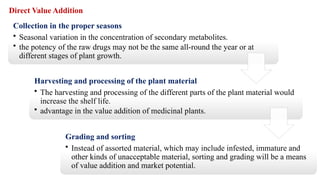
Direct Value Addition
Collection in the proper seasons
‱ Seasonal variation in the concentration of secondary metabolites.
‱ the potency of the raw drugs may not be the same all-round the year or at
different stages of plant growth.
Harvesting and processing of the plant material
‱ The harvesting and processing of the different parts of the plant material would
increase the shelf life.
‱ advantage in the value addition of medicinal plants.
Grading and sorting
‱ Instead of assorted material, which may include infested, immature and
other kinds of unacceptable material, sorting and grading will be a means
of value addition and market potential.
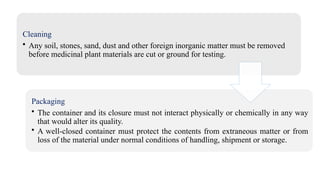
Cleaning
‱ Any soil, stones, sand, dust and other foreign inorganic matter must be removed
before medicinal plant materials are cut or ground for testing.
Packaging
‱ The container and its closure must not interact physically or chemically in any way
that would alter its quality.
‱ A well-closed container must protect the contents from extraneous matter or from
loss of the material under normal conditions of handling, shipment or storage.
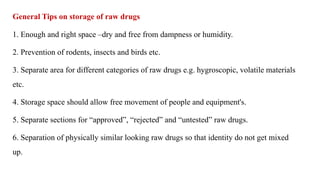
General Tips on storage of raw drugs
1. Enough and right space –dry and free from dampness or humidity.
2. Prevention of rodents, insects and birds etc.
3. Separate area for different categories of raw drugs e.g. hygroscopic, volatile materials
etc.
4. Storage space should allow free movement of people and equipment's.
5. Separate sections for “approved”, “rejected” and “untested” raw drugs.
6. Separation of physically similar looking raw drugs so that identity do not get mixed
up.
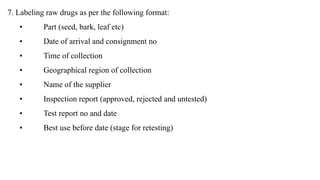
7. Labeling raw drugs as per the following format:
‱ Part (seed, bark, leaf etc)
‱ Date of arrival and consignment no
‱ Time of collection
‱ Geographical region of collection
‱ Name of the supplier
‱ Inspection report (approved, rejected and untested)
‱ Test report no and date
‱ Best use before date (stage for retesting)
8. Name of the raw drug Keep authenticated samples as “reference standards” for
each drug in stores.
9. Use raw drugs on a first in first out basis (FIFO).
10. Place packed raw drugs on wooden or plastic pallets. Keep one raw drug in one
pallet.
11. Use appropriate packing material for storing raw drugs.
Always avoid
1. Storing in open spaces
2. Storing on the surface directly
3. Storing the same raw drugs in close vicinity.
4. Using inappropriate packing material.
5. Storing the material for long time. Always use raw drugs on a first in first out basis
6. Keeping the material exposed to heat and moisture.
7. Storing inadequately processed materials.
As per WHO Guidelines (Harvesting)
1. Medicinal plants/herbal drugs should be harvested when they are at the best possible quality for the
proposed use.
2. Damaged plants or parts plants need to be excluded.
3. Medicinal plants/herbal drugs should be harvested under the best possible conditions avoiding wet soil,
dew, rain or exceptionally high air humidity. If harvesting occurs in wet conditions possible adverse
effects on the medicinal plant/herbal drug due to increased moisture levels should be counteracted.
4. Cutting devices or harvesters must be adjusted such that contamination from soil particles is reduced to
a minimum.
5. The harvested medicinal plant/herbal drug should not come into direct contact with the
soil. It must be promptly collected and transported in dry, clean conditions.
6. During harvesting, care should be taken to ensure that no toxic weeds mix with harvested
medicinal plants/herbal drugs.
7. All containers used during harvesting must be clean and free of contamination from
previous harvests. When containers are not in use, they must be kept in dry conditions free
of pests and inaccessible to mice/rodents, livestock and domestic animals.
8. Mechanical damage and compacting of the harvested medicinal plant/herbal drug that would result in
undesirable quality changes must be avoided. In this respect, attention must be paid to
(a) overfilling of the sacks,
(b) Stacking up of sacks.
9. Freshly harvested medicinal plants/herbal drugs must be delivered as quickly as possible to the
processing facility in order to prevent thermal degradation.
10. The harvested crop must be protected from pests, mice/rodents, livestock and domestic animals. Any
pest control measures taken should be documented.
Certification of the quality.
Semi-processing of the medicinal plants to value added products
Powder
Tablets / capsules
Extracts
Limits to the development of trade
Cultivation of medicinal plants faces a number of problems, partly due to the typically small scale of operation.
These include the following:
The majority of farmers have small land holdings
Shortage of labor in rural high-altitude areas
Long period between crop growing and harvesting
Poor quality control procedures
Lack of research and development on product and process development;
Difficulties in marketing
Lack of local markets for primary processed products
Lack of access to latest technological and market information
Lack of knowledge of their supply capabilities
Limited knowledge of plant properties
Intellectual property rights
General Guidelines for harvesting and processing of Medicinal Plants
 Collect only mature parts.
 Do not collect the herbs from Roadsides, Sea Shores, Anthills, near Sewerage etc.
 Start drying process immediately after collection.
 Ensure complete drying before packing and storage.
 Dry aromatic herbs, delicate fruits etc. in shade.
 Store the herbs in properly constructed stores to minimize losses on storage.
Guidelines for collection of different parts of the medicinal plants:
I. Underground Parts & Whole Plants
 Collect the whole plants after seed shedding.
 Collect underground parts when the mother plant is fully mature.
 Dry fleshy parts before packing and storing. Cut large parts into smaller pieces.
II. Bark and Stem
 Do not harvest from immature Plants.
 Collect from the Branches instead of Main Trunk.
 Strip the bark longitudinally & not all over the circumference of Trunk/Branches.
 Cut into small pieces to facilitate complete drying.
 Harvest only mature branches or stem
III. Leaves Flowers, Fruits, Seeds and Floral Parts etc.
 Harvest only mature parts.
 Do not collect from unhealthy plants.
 Do not collect parts manifested with insects, fungi etc.
 Dry flowers and floral parts in shade. Fleshy flowers may be dried in Sun.
 Rotten and diseased fruits should be segregated from rest of the supply.
IV. Gums, Oils, Resins, Galls etc.
 Make vertical incisions only on some portions of the tree.
 Do not collect the gums or resins from a tree continuously.
 Collect the gum/resin in the right season.
Some key features of the trade in medicinal plants are highlighted by this review
‱Pressure on the natural resource is increasing for the plants which are in greatest demand.
‱The increasing market for the plant materials that are used in health and medical products.
‱International trade in medicinal plants is expanding.
‱Regulation is increasing.
‱There is a lack of detailed, accurate, information available.
REFERENCES
1. Doreswamy R, Panwar SD, Sharma D. (eds.). 2006. Medicinal and aromatic plants abstracts, Vol.
28. National Institute of Science Communication and Information Resources,The Council of Scientific & Industrial
Research, New Delhi, India.
2. Indian Herbal Pharmacopoeia, Vol I, (1998), Regional Research Laboratory, Jammu Tawi& Indian Drug
manufacturers Association, Mumbai.
3. Indian Herbal Pharmacopoeia, Vol II, (1999), Regional Research Laboratory, Jammu Tawi& Indian Drug
manufacturers Association, Mumbai.
4. Pharmacopoeia of India [The Indian Pharmacopoeia], II Edn., (1996), Ministry of Health, Govt.of India, New
Delhi.
5. Quality Control Methods for Medicinal Plant Materials, (1998), World Health Organisation, Geneva.
6. Standardisation of Single Drugs of Unani Medicine, Part II, (1992), Central Council for Research in Unani
Medicine, Ministry of Health and Family Welfare, Govt.of India, New Delhi.
7. Standardisatiion of Botanicals, Testing and Extraction Methods of Medicinal Herbs, Vol I, (2002), Eastern Publishers, New Delhi.
8. The Ayurvedic Pharmacopoeia of India, Vol I, Part I, (1986), Ministry of Health and Family Welfare, Govt.of India, New Delhi.
9. The Ayurvedic Pharmacopoeia of India, Vol II, Part I, (1999), Ministry of Health and Family Welfare, Govt.of India, New Delhi.
10. The Ayurvedic Pharmacopoeia of India, Vol III, Part I, (2001), Ministry of Health and Family Welfare, Govt.of India, New Delhi.
11. The Indian Pharmaceutical Codex, Vol I, (1953), Council of Scientific and Industrial Research, New Delhi.
12. Shanley P, Luz, L. Eastern Amazonian Medicinals: Marketing, Use and Implications of Forest Loss. Bio Science. 2003;53 (6):
573-584.
13. Schippmann, U.; Leaman, D. and Cunningham A. B.(2006).A comparison of cultivation and wild
collection of medicinal and aromatic plants under sustainability aspects. p. 75–95. In: R.J. Bogers,
14. L.E. Craker, and D. Lange (eds.), Medicinal and aromatic plants. Proc. Frontis Workshop on
Medicinal and Aromatic Plants, Wageningen, The Netherlands, 17–20, April 2005. Nucleus for
Strategic Expertise Wageningen University and Research Centre, Wageningen.
15. www.unep-wcmc.org/species/plants/ghana.
41
Thank you

2026 Revised_GAP - Copy.pptxcyifitdoyydoyf9

  • 1.
    Progressive Education Society’s ModernCollege of Pharmacy, Yamunanagar, Nigdi, Pune 411044
  • 2.
    Dr. Kalyani Kakad. AssistantProfessor Pharmacognosy Department PES Modern College of Pharmacy, Nigdi, Pune-411044. Medicinal Plants: Good Agricultural Practice (GAP)
  • 3.
    Learning Outcomes Learners willbe able to 1. Need for Good Agricultural Practices 2. The general guidelines for harvesting and processing of Medicinal Plants. 3. The guidelines for collection of different parts of the medicinal plants.
  • 4.
    Background- Need forGood Agricultural Practices ‱ India has a rich tradition of plant based health care systems contained in its classical texts like Charak Samhita and Sushruta Samhita. ‱ The Government of India have recognized Ayurveda, Yoga & Naturopathy, Siddha, Unnani and Homoeopathy as the alternative systems of medicine under the National Health Policy. ‱ To ensure and enhance the quality of ASU medicines, the Government of India have notified Good Manufacturing Practices under Schedule “T” of the Drugs and Cosmetics Act 1940. ‱ These guidelines for Good Agricultural Practices seek to lay down standards for production of raw material that goes in to the making of the ASU medicines and standardize the production processes from farm to factory.
  • 5.
    Figure 1: IndustrialUses of Medicinal Plants Vikas K., Manas R. N., Medicinal plants: Cultivation to value addition: Problems & Issues., 2014.
  • 6.
    Good Agricultural Practice(GAP) ‱ A Good agricultural practice of medicinal plants is a cultivation program designed to ensure optimal yield in terms of both the quality quantity of any crop intended for health purposes. ‱ The guidelines on Good agricultural practices (GAP) provides the documented proof of how to handle medicinal plants right from cultivation to post harvesting operations. ‱ Raw material plant materials should meet all applicable national or regional quality standards. ‱ The guidelines, therefore, may need to be adjusted according to each country situation.
  • 7.
    Objectives of GAP: ‱To contribute to the quality assurance of medicinal plant materials used as the source for herbal medicines, which aims to improve the quality, safety and efficacy of finished herbal products. ‱ To guide the formulation of national or regional guidelines and monographs for medicinal plants and related standard operating procedure (SOPs). ‱ To encourage and support the sustainable cultivation and collection of medicinal plants of good quality.
  • 8.
    WHO guidelines on Goodagricultural and collection practices (GACP) for medicinal plants Note: WHO has developed a series of technical guidelines relating to the quality control of herbal medicines of which these WHO guidelines on good agricultural and collection practices (GACP) for medicinal plants are the latest. The guidelines provide a detailed description of the techniques and measures required for the appropriate cultivation and collection of medicinal plants and for the recording and documentation of necessary data and information during their processing.
  • 9.
  • 10.
    National Medicinal PlantsBoard ‱ In order to promote medicinal plants sector, Government of India set up National Medicinal Plants Board (NMPB) on 24th November 2000. Currently the board is working as a section of Ministry of AYUSH (Ayurveda, Yoga & Naturopathy, Unani, Siddha & Homoeopathy), Government of India. ‱ The primary mandate of NMPB is to develop an appropriate mechanism for coordination between various ministries/ departments/ organization and implementation of support policies/programs for overall (conservation, cultivation, trade and export) growth of medicinal plants sector both at the Central /State and International level. Overall, NMPB’s main objective is the development of medicinal plants sector through developing a strong coordination between various ministries/ departments/ organization for implementation of policies / programs on medicinal plants.
  • 11.
    General guidelines onGAP for medicinal plants 1. Selection of medicinal plants. 2. Identification/ authentication of cultivated medicinal plants. 3. Specimens 4. Seeds and other propagating materials 5. Cultivation 6. Site selection 7. Ecological environment and social impact 8. Climate 9. Soil 10. Irrigation and drainage 11. Plant maintenance and protection 12. Harvesting and drying 13. Storage 14. Personnel
  • 12.
    1. Selection ofmedicinal plants ‱ The species or botanical variety selected for cultivation should be the same as that specified in the national Pharmacopeia or recommended by other authoritative national documents of the end users country. ‱ In the absence of such national documents, the selection of species or botanical varieties specified in the pharmacopeia or other authoritative documents of other countries should be considered. Other countries pharmacopeia or other traditional documents. ‱ In the case of newly introduced medicinal plants, the species or Botanical variety selected for cultivation should be identified and documented as the source material used or describe in the traditional medicine of original country.
  • 13.
    Note: ‱ The AyurvedicPharmacopoeia of India (API) is a unique book of standards describing the quality, purity and strength of selected drugs that are manufactured, distributed, and sold by the licensed manufacturers in India. ‱ It is developed in two parts; the part one comprises of mono-monographs of medicinal substances of natural origin and part two includes selected compound formulations sourced from the schedule – I books under the Drugs and Cosmetics Act, 1940 comprising of popular Ayurvedic classics of different period of times. ‱ The first part of the Ayurvedic Formulary of India was published in 1978 and thereafter, the Ayurvedic Pharmacopoeia of India (mono-monograph) Part-I, Vol. I was published in the year 1986 and subsequently, the other volumes were published with their legalized status under Drugs and Cosmetics Act, 1940.
  • 15.
    2. Identification/authentication ofcultivated of medicinal plants ‱ The botanical identity – scientific name (genus, species, subspecies/variety, author, and family) – of each medicinal plant under cultivation should be verified and recorded. ‱ If available, the local and English common names should also be recorded. Other relevant information, such as the cultivar name, ecotype, chemotype or phenotype, may also be provided, as appropriate. ‱ For commercially available cultivars, the name of the cultivar and of the supplier should be provided. ‱ In the case of landraces collected, propagated, disseminated and grown in a specific region, records should be kept of the locally named line, including the origin of the source seeds, plants or propagation materials. ‱ An ecotype is a population of organisms that is genetically adapted to a specific environment. ‱ A chemotype is a group of plants or microorganisms that have a distinct chemical composition. Chemotypes are subspecies of a plant that have the same physical characteristics but different chemical compositions. ‱ The set of observable characteristics of an individual resulting from the interaction of its genotype with the environment.
  • 16.
    3. Specimens ‱ Inthe case of the first registration in a producer’s country of a medicinal plant or where reasonable doubt exists as to the identity of a botanical species, a voucher botanical specimen should be submitted to a regional or national herbarium for identification. ‱ Where possible, a genetic pattern should be compared to that of an authentic specimen. ‱ Documentation of the botanical identity should be included in the registration file.
  • 17.
    4. Seeds andother propagation materials ‱ Seeds and other propagation materials should be specified, and suppliers of seeds and other propagation materials should provide all necessary information relating to the identity, quality and performance of their products, as well as their breeding history, where possible. ‱ The propagation or planting materials should be of the appropriate quality and be as free as possible from contamination and diseases in order to promote healthy plant growth. Planting material should preferably be resistant or tolerant to biotic or abiotic factors.
  • 18.
    Seeds and otherpropagation materials ‱ Seeds and other propagation materials used for organic production should be certified as being organically derived. The quality of propagation material − including any genetically modified germplasm − should comply with regional and/or national regulations and be appropriately labelled and documented, as required. ‱ Care should be taken to exclude extraneous species, botanical varieties and strains of medicinal plants during the entire production process. Counterfeit, substandard and adulterated propagation materials must be avoided.
  • 19.
    5. Cultivation ‱ Cultivationof medicinal plants requires intensive care and management. The conditions and duration of cultivation required vary depending on the quality of medicinal plant materials required. ‱ If no scientific published or documented cultivation data are available, traditional methods of cultivation should be followed, where feasible. Otherwise a method should be developed through research.
  • 20.
    6. Site selection ‱Medicinal plant materials derived from the same species can show significant differences in quality when cultivated at different sites, owing to the influence of soil, climate and other factors. These differences may relate to physical appearance or to variations in their constituents, the biosynthesis of which may be affected by extrinsic environmental conditions, including ecological and geographical variables, and should be taken into consideration. ‱ Risks of contamination as a result of pollution of the soil, air or water by hazardous, chemicals should be avoided. The impact of past land uses on the cultivation site, including the planting of previous crops and any applications of plant protection products, should be evaluated.
  • 21.
    Direct Value Addition Collectionin the proper seasons ‱ Seasonal variation in the concentration of secondary metabolites. ‱ the potency of the raw drugs may not be the same all-round the year or at different stages of plant growth. Harvesting and processing of the plant material ‱ The harvesting and processing of the different parts of the plant material would increase the shelf life. ‱ advantage in the value addition of medicinal plants. Grading and sorting ‱ Instead of assorted material, which may include infested, immature and other kinds of unacceptable material, sorting and grading will be a means of value addition and market potential.
  • 22.
    Cleaning ‱ Any soil,stones, sand, dust and other foreign inorganic matter must be removed before medicinal plant materials are cut or ground for testing. Packaging ‱ The container and its closure must not interact physically or chemically in any way that would alter its quality. ‱ A well-closed container must protect the contents from extraneous matter or from loss of the material under normal conditions of handling, shipment or storage.
  • 23.
    General Tips onstorage of raw drugs 1. Enough and right space –dry and free from dampness or humidity. 2. Prevention of rodents, insects and birds etc. 3. Separate area for different categories of raw drugs e.g. hygroscopic, volatile materials etc. 4. Storage space should allow free movement of people and equipment's. 5. Separate sections for “approved”, “rejected” and “untested” raw drugs. 6. Separation of physically similar looking raw drugs so that identity do not get mixed up.
  • 24.
    7. Labeling rawdrugs as per the following format: ‱ Part (seed, bark, leaf etc) ‱ Date of arrival and consignment no ‱ Time of collection ‱ Geographical region of collection ‱ Name of the supplier ‱ Inspection report (approved, rejected and untested) ‱ Test report no and date ‱ Best use before date (stage for retesting)
  • 25.
    8. Name ofthe raw drug Keep authenticated samples as “reference standards” for each drug in stores. 9. Use raw drugs on a first in first out basis (FIFO). 10. Place packed raw drugs on wooden or plastic pallets. Keep one raw drug in one pallet. 11. Use appropriate packing material for storing raw drugs.
  • 26.
    Always avoid 1. Storingin open spaces 2. Storing on the surface directly 3. Storing the same raw drugs in close vicinity. 4. Using inappropriate packing material. 5. Storing the material for long time. Always use raw drugs on a first in first out basis 6. Keeping the material exposed to heat and moisture. 7. Storing inadequately processed materials.
  • 27.
    As per WHOGuidelines (Harvesting) 1. Medicinal plants/herbal drugs should be harvested when they are at the best possible quality for the proposed use. 2. Damaged plants or parts plants need to be excluded. 3. Medicinal plants/herbal drugs should be harvested under the best possible conditions avoiding wet soil, dew, rain or exceptionally high air humidity. If harvesting occurs in wet conditions possible adverse effects on the medicinal plant/herbal drug due to increased moisture levels should be counteracted. 4. Cutting devices or harvesters must be adjusted such that contamination from soil particles is reduced to a minimum.
  • 28.
    5. The harvestedmedicinal plant/herbal drug should not come into direct contact with the soil. It must be promptly collected and transported in dry, clean conditions. 6. During harvesting, care should be taken to ensure that no toxic weeds mix with harvested medicinal plants/herbal drugs. 7. All containers used during harvesting must be clean and free of contamination from previous harvests. When containers are not in use, they must be kept in dry conditions free of pests and inaccessible to mice/rodents, livestock and domestic animals.
  • 29.
    8. Mechanical damageand compacting of the harvested medicinal plant/herbal drug that would result in undesirable quality changes must be avoided. In this respect, attention must be paid to (a) overfilling of the sacks, (b) Stacking up of sacks. 9. Freshly harvested medicinal plants/herbal drugs must be delivered as quickly as possible to the processing facility in order to prevent thermal degradation. 10. The harvested crop must be protected from pests, mice/rodents, livestock and domestic animals. Any pest control measures taken should be documented.
  • 30.
    Certification of thequality. Semi-processing of the medicinal plants to value added products Powder Tablets / capsules Extracts
  • 31.
    Limits to thedevelopment of trade Cultivation of medicinal plants faces a number of problems, partly due to the typically small scale of operation. These include the following: The majority of farmers have small land holdings Shortage of labor in rural high-altitude areas Long period between crop growing and harvesting Poor quality control procedures Lack of research and development on product and process development; Difficulties in marketing Lack of local markets for primary processed products Lack of access to latest technological and market information Lack of knowledge of their supply capabilities Limited knowledge of plant properties Intellectual property rights
  • 32.
    General Guidelines forharvesting and processing of Medicinal Plants  Collect only mature parts.  Do not collect the herbs from Roadsides, Sea Shores, Anthills, near Sewerage etc.  Start drying process immediately after collection.  Ensure complete drying before packing and storage.  Dry aromatic herbs, delicate fruits etc. in shade.  Store the herbs in properly constructed stores to minimize losses on storage.
  • 33.
    Guidelines for collectionof different parts of the medicinal plants: I. Underground Parts & Whole Plants  Collect the whole plants after seed shedding.  Collect underground parts when the mother plant is fully mature.  Dry fleshy parts before packing and storing. Cut large parts into smaller pieces.
  • 34.
    II. Bark andStem  Do not harvest from immature Plants.  Collect from the Branches instead of Main Trunk.  Strip the bark longitudinally & not all over the circumference of Trunk/Branches.  Cut into small pieces to facilitate complete drying.  Harvest only mature branches or stem
  • 35.
    III. Leaves Flowers,Fruits, Seeds and Floral Parts etc.  Harvest only mature parts.  Do not collect from unhealthy plants.  Do not collect parts manifested with insects, fungi etc.  Dry flowers and floral parts in shade. Fleshy flowers may be dried in Sun.  Rotten and diseased fruits should be segregated from rest of the supply.
  • 36.
    IV. Gums, Oils,Resins, Galls etc.  Make vertical incisions only on some portions of the tree.  Do not collect the gums or resins from a tree continuously.  Collect the gum/resin in the right season.
  • 37.
    Some key featuresof the trade in medicinal plants are highlighted by this review ‱Pressure on the natural resource is increasing for the plants which are in greatest demand. ‱The increasing market for the plant materials that are used in health and medical products. ‱International trade in medicinal plants is expanding. ‱Regulation is increasing. ‱There is a lack of detailed, accurate, information available.
  • 38.
    REFERENCES 1. Doreswamy R,Panwar SD, Sharma D. (eds.). 2006. Medicinal and aromatic plants abstracts, Vol. 28. National Institute of Science Communication and Information Resources,The Council of Scientific & Industrial Research, New Delhi, India. 2. Indian Herbal Pharmacopoeia, Vol I, (1998), Regional Research Laboratory, Jammu Tawi& Indian Drug manufacturers Association, Mumbai. 3. Indian Herbal Pharmacopoeia, Vol II, (1999), Regional Research Laboratory, Jammu Tawi& Indian Drug manufacturers Association, Mumbai. 4. Pharmacopoeia of India [The Indian Pharmacopoeia], II Edn., (1996), Ministry of Health, Govt.of India, New Delhi. 5. Quality Control Methods for Medicinal Plant Materials, (1998), World Health Organisation, Geneva. 6. Standardisation of Single Drugs of Unani Medicine, Part II, (1992), Central Council for Research in Unani Medicine, Ministry of Health and Family Welfare, Govt.of India, New Delhi.
  • 39.
    7. Standardisatiion ofBotanicals, Testing and Extraction Methods of Medicinal Herbs, Vol I, (2002), Eastern Publishers, New Delhi. 8. The Ayurvedic Pharmacopoeia of India, Vol I, Part I, (1986), Ministry of Health and Family Welfare, Govt.of India, New Delhi. 9. The Ayurvedic Pharmacopoeia of India, Vol II, Part I, (1999), Ministry of Health and Family Welfare, Govt.of India, New Delhi. 10. The Ayurvedic Pharmacopoeia of India, Vol III, Part I, (2001), Ministry of Health and Family Welfare, Govt.of India, New Delhi. 11. The Indian Pharmaceutical Codex, Vol I, (1953), Council of Scientific and Industrial Research, New Delhi. 12. Shanley P, Luz, L. Eastern Amazonian Medicinals: Marketing, Use and Implications of Forest Loss. Bio Science. 2003;53 (6): 573-584.
  • 40.
    13. Schippmann, U.;Leaman, D. and Cunningham A. B.(2006).A comparison of cultivation and wild collection of medicinal and aromatic plants under sustainability aspects. p. 75–95. In: R.J. Bogers, 14. L.E. Craker, and D. Lange (eds.), Medicinal and aromatic plants. Proc. Frontis Workshop on Medicinal and Aromatic Plants, Wageningen, The Netherlands, 17–20, April 2005. Nucleus for Strategic Expertise Wageningen University and Research Centre, Wageningen. 15. www.unep-wcmc.org/species/plants/ghana.
  • 41.