Biyoinformatik
Biyoinformatik
Akademi
Akademi
Your
bioinformatics
Path
Exploring Bioinformatics: Mastering the Path
to Excellence
ERES Biotech
Ocak 2024
Elçin Ekşi
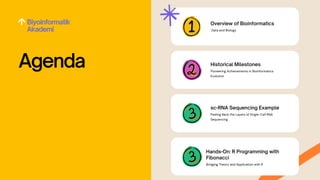
Agenda
Overview of Bioinformatics
Data and Biology
Historical Milestones
Pioneering Achievements in Bioinformatics
Evolution
sc-RNA Sequencing Example
Peeling Back the Layers of Single-Cell RNA
Sequencing
Hands-On: R Programming with
Fibonacci
Bridging Theory and Application with R
Biyoinformatik
Biyoinformatik
Akademi
Akademi
About the
Biyoinformatik
Akademi
ERES Biotechnology, a leader in biotech R&D, has a decade of
experience in bioinformatics education. We've established
the Bioinformatics Academy, offering a specialized online
platform for academics, researchers, and professionals
seeking expertise in the field. Our experienced instructors and
updated content ensure support throughout your
bioinformatics journey.
Bioinformatics
Bioinformatics is the interdisciplinary field that
amalgamates biological sciences with
computational methodologies to interpret and
analyze complex biological data.
Scope and Intersection
Data-Driven Exploration
Medical Applications
Genomic Revolution
Structural Biology
Toolbox of Methods
Biyoinformatik
Biyoinformatik
Akademi
Akademi
How
big can
it be?
Let's first examine together how large a new
generation sequencing data can be.
1
Let's go to this link:
https://www.ebi.ac.uk/ena/brow
ser/home
2
In the top right box, type the
term "SRR1553610" and search.
What do you see in the results?
3
Here, there is sequenced nucleic
acid data for this organism.
You can download this data and
analyze it yourself.
For now, we will just look at the
file size.
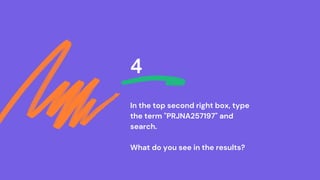
4
In the top second right box, type
the term "PRJNA257197" and
search.
What do you see in the results?
Genomics: 2-40 Exabytes in
Next Decade
1 exabyte =
1 000 000 000 gigabytes
Stephens, Z. D., Lee, S. Y., Faghri, F., Campbell, R. H., Zhai, C., Efron, M. J., ... & Robinson, G. E. (2015). Big data: astronomical or genomical?. PLoS biology, 13(7), e1002195.
Genomics: 2-40 Exabytes in
Next Decade
Moore's Law: Computer
power doubles every two
years, boosting
technology.
https://www.genome.gov/about-genomics/fact-sheets/DNA-Sequencing-Costs-Data
Historical Moment
Historical
Milestones
These milestones represent key moments in the
integration of biology, computer science, and data
analysis, laying the foundation for our current
understanding of genomics and computational biology.
1950s-1960s:
protein sequences, Margaret
Oakley Dayhoff, Atlas of Protein
Sequence and Structure
1970s
The Needleman–Wunsch
algorithm
1990-2003
Human Genome Project
1980s
GenBank and DNA Databases
Historical
Milestones
1990s
BLAST Algorithm and sequence
similarity searching in vast
databases
2000s
Next-Generation Sequencing
(NGS)
2010 - today
Omics era, gene editing, new
methods ...
2010s
Big Data Challenges and
Machine Learning
RNA
sequencing
Advancing studies
without lab experiments.
RNA-seq data from GEO
Data analysis
significant results
Let's
create a
chart of
Fibonacci
numbers.
trinket.io
https://trinket.io/R/6ff5a74fe0
Try it
Let's change the numbers and generate different
charts
Rstudio
RStudio’yu indirip inceleyebilirsiniz.
# Initialize a vector to store Fibonacci numbers
Fibonacci <- numeric(50)
# Set the first two elements
Fibonacci[1] <- Fibonacci[2] <- 1
# Generate the rest of the Fibonacci numbers
for (i in 3:50) {
Fibonacci[i] <- Fibonacci[i - 2] + Fibonacci[i - 1]
}
# Print the first 50 Fibonacci numbers
cat("First 50 Fibonacci numbers:n")
cat(Fibonacci, sep = ", ")
# Create a bar plot
barplot(Fibonacci, names.arg = 1:50, main = "First 50
Fibonacci Numbers", xlab = "Index", ylab = "Fibonacci
Value")

2024-bioinformatics course.pdf

  • 1.
  • 2.
    Agenda Overview of Bioinformatics Dataand Biology Historical Milestones Pioneering Achievements in Bioinformatics Evolution sc-RNA Sequencing Example Peeling Back the Layers of Single-Cell RNA Sequencing Hands-On: R Programming with Fibonacci Bridging Theory and Application with R Biyoinformatik Biyoinformatik Akademi Akademi
  • 3.
    About the Biyoinformatik Akademi ERES Biotechnology,a leader in biotech R&D, has a decade of experience in bioinformatics education. We've established the Bioinformatics Academy, offering a specialized online platform for academics, researchers, and professionals seeking expertise in the field. Our experienced instructors and updated content ensure support throughout your bioinformatics journey.
  • 4.
    Bioinformatics Bioinformatics is theinterdisciplinary field that amalgamates biological sciences with computational methodologies to interpret and analyze complex biological data. Scope and Intersection Data-Driven Exploration Medical Applications Genomic Revolution Structural Biology Toolbox of Methods Biyoinformatik Biyoinformatik Akademi Akademi
  • 5.
    How big can it be? Let'sfirst examine together how large a new generation sequencing data can be.
  • 6.
    1 Let's go tothis link: https://www.ebi.ac.uk/ena/brow ser/home
  • 7.
    2 In the topright box, type the term "SRR1553610" and search. What do you see in the results?
  • 8.
    3 Here, there issequenced nucleic acid data for this organism. You can download this data and analyze it yourself. For now, we will just look at the file size.
  • 9.
    4 In the topsecond right box, type the term "PRJNA257197" and search. What do you see in the results?
  • 10.
    Genomics: 2-40 Exabytesin Next Decade 1 exabyte = 1 000 000 000 gigabytes Stephens, Z. D., Lee, S. Y., Faghri, F., Campbell, R. H., Zhai, C., Efron, M. J., ... & Robinson, G. E. (2015). Big data: astronomical or genomical?. PLoS biology, 13(7), e1002195.
  • 11.
    Genomics: 2-40 Exabytesin Next Decade Moore's Law: Computer power doubles every two years, boosting technology. https://www.genome.gov/about-genomics/fact-sheets/DNA-Sequencing-Costs-Data
  • 12.
  • 13.
    Historical Milestones These milestones representkey moments in the integration of biology, computer science, and data analysis, laying the foundation for our current understanding of genomics and computational biology. 1950s-1960s: protein sequences, Margaret Oakley Dayhoff, Atlas of Protein Sequence and Structure 1970s The Needleman–Wunsch algorithm 1990-2003 Human Genome Project 1980s GenBank and DNA Databases
  • 14.
    Historical Milestones 1990s BLAST Algorithm andsequence similarity searching in vast databases 2000s Next-Generation Sequencing (NGS) 2010 - today Omics era, gene editing, new methods ... 2010s Big Data Challenges and Machine Learning
  • 15.
  • 16.
  • 17.
    RNA-seq data fromGEO Data analysis significant results
  • 18.
    Let's create a chart of Fibonacci numbers. trinket.io https://trinket.io/R/6ff5a74fe0 Tryit Let's change the numbers and generate different charts Rstudio RStudio’yu indirip inceleyebilirsiniz.
  • 19.
    # Initialize avector to store Fibonacci numbers Fibonacci <- numeric(50) # Set the first two elements Fibonacci[1] <- Fibonacci[2] <- 1 # Generate the rest of the Fibonacci numbers for (i in 3:50) { Fibonacci[i] <- Fibonacci[i - 2] + Fibonacci[i - 1] } # Print the first 50 Fibonacci numbers cat("First 50 Fibonacci numbers:n") cat(Fibonacci, sep = ", ") # Create a bar plot barplot(Fibonacci, names.arg = 1:50, main = "First 50 Fibonacci Numbers", xlab = "Index", ylab = "Fibonacci Value")