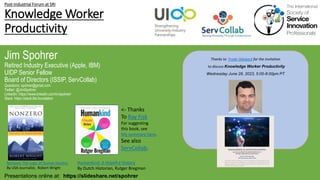
Post-Industrial Forum at SRI
Knowledge Worker
Productivity
Jim Spohrer
Retired Industry Executive (Apple, IBM)
UIDP Senior Fellow
Board of Directors (ISSIP, ServCollab)
Questions: spohrer@gmail.com
Twitter: @JimSpohrer
LinkedIn: https://www.linkedin.com/in/spohrer/
Slack: https://slack.lfai.foundation
Presentations online at: https://slideshare.net/spohrer
Thanks to Frode Odegard for the invitation
to discuss Knowledge Worker Productivity
Wednesday June 28, 2023, 5:00-8:00pm PT
Humankind: A Hopeful History
By Dutch Historian, Rutger Bregman
<- Thanks
To Ray Fisk
For suggesting
this book, see
My summary here.
See also
ServCollab.
Nonzero: The Logic of Human Destiny
By USA Journalist, Robert Wright
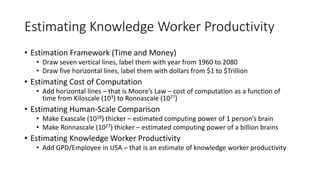
Estimating Knowledge Worker Productivity
• Estimation Framework (Time and Money)
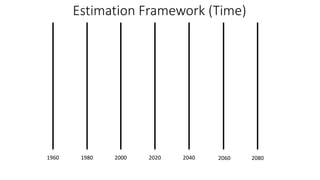
• Draw seven vertical lines, label them with year from 1960 to 2080
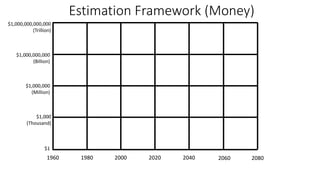
• Draw five horizontal lines, label them with dollars from $1 to $Trillion
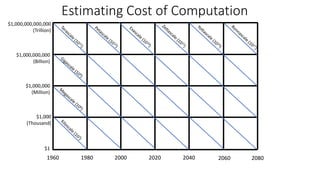
• Estimating Cost of Computation
• Add horizontal lines – that is Moore’s Law – cost of computation as a function of
time from Kiloscale (103) to Ronnascale (1027)
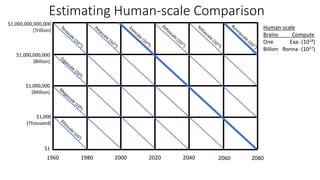
• Estimating Human-Scale Comparison
• Make Exascale (1018) thicker – estimated computing power of 1 person’s brain
• Make Ronnascale (1027) thicker – estimated computing power of a billion brains
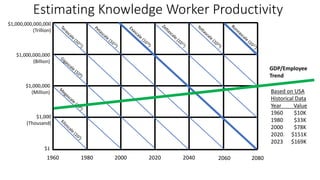
• Estimating Knowledge Worker Productivity
• Add GPD/Employee in USA – that is an estimate of knowledge worker productivity
1960 1980 2000 2020 2040 2060 2080
Estimation Framework (Time)
1960 1980 2000 2020 2040 2060 2080
$1,000,000,000,000
(Trillion)
$1,000,000
(Million)
$1,000,000,000
(Billion)
$1,000
(Thousand)
$1
Estimation Framework (Money)
1960 1980 2000 2020 2040 2060 2080
$1,000,000,000,000
(Trillion)
$1,000,000
(Million)
$1,000,000,000
(Billion)
$1,000
(Thousand)
$1
Estimating Cost of Computation
1960 1980 2000 2020 2040 2060 2080
$1,000,000,000,000
(Trillion)
$1,000,000
(Million)
$1,000,000,000
(Billion)
$1,000
(Thousand)
$1
Estimating Human-scale Comparison
Human-scale
Brains Compute
One Exa- (1018)
Billion Ronna- (1027)
1960 1980 2000 2020 2040 2060 2080
$1,000,000,000,000
(Trillion)
$1,000,000
(Million)
$1,000,000,000
(Billion)
$1,000
(Thousand)
$1
GDP/Employee
Trend
Estimating Knowledge Worker Productivity
Based on USA
Historical Data
Year Value
1960 $10K
1980 $33K
2000 $78K
2020. $151K
2023 $169K
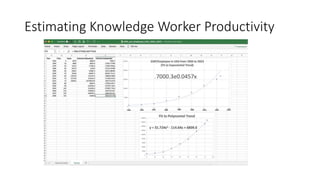
Estimating Knowledge Worker Productivity
9
September 2018 / © 2018 IBM Corporation
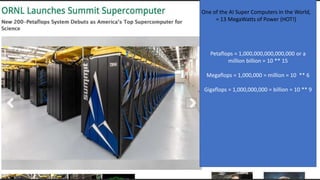
Petaflops = 1,000,000,000,000,000 or a
million billion = 10 ** 15
Megaflops = 1,000,000 = million = 10 ** 6
Gigaflops = 1,000,000,000 = billion = 10 ** 9
One of the AI Super Computers in the World,
= 13 MegaWatts of Power (HOT!)
10
September 2018 / © 2018 IBM Corporation
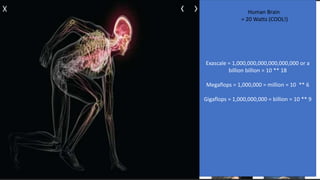
Exascale = 1,000,000,000,000,000,000 or a
billion billion = 10 ** 18
Megaflops = 1,000,000 = million = 10 ** 6
Gigaflops = 1,000,000,000 = billion = 10 ** 9
Human Brain
= 20 Watts (COOL!)
6/29/2023 Jim Spohrer (ISSIP.org) 11
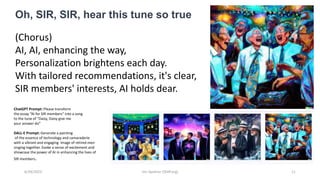
(Chorus)
AI, AI, enhancing the way,
Personalization brightens each day.
With tailored recommendations, it's clear,
SIR members' interests, AI holds dear.
Oh, SIR, SIR, hear this tune so true
ChatGPT Prompt: Please transform
the essay “AI for SIR members” into a song
to the tune of "Daisy, Daisy give me
your answer do”
DALL-E Prompt: Generate a painting
of the essence of technology and camaraderie
with a vibrant and engaging image of retired men
singing together. Evoke a sense of excitement and
showcase the power of AI in enhancing the lives of
SIR members.
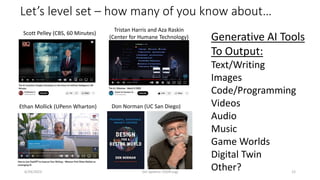
Let’s level set – how many of you know about…
Ethan Mollick (UPenn Wharton) Don Norman (UC San Diego)
Scott Pelley (CBS, 60 Minutes)
Tristan Harris and Aza Raskin
(Center for Humane Technology) Generative AI Tools
To Output:
Text/Writing
Images
Code/Programming
Videos
Audio
Music
Game Worlds
Digital Twin
Other?
6/29/2023 Jim Spohrer (ISSIP.org) 12
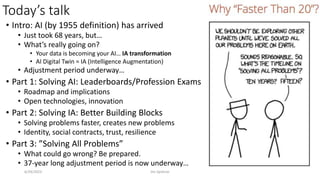
Today’s talk
• Intro: AI (by 1955 definition) has arrived
• Just took 68 years, but…
• What’s really going on?
• Your data is becoming your AI… IA transformation
• AI Digital Twin = IA (Intelligence Augmentation)
• Adjustment period underway…
• Part 1: Solving AI: Leaderboards/Profession Exams
• Roadmap and implications
• Open technologies, innovation
• Part 2: Solving IA: Better Building Blocks
• Solving problems faster, creates new problems
• Identity, social contracts, trust, resilience
• Part 3: ”Solving All Problems”
• What could go wrong? Be prepared.
• 37-year long adjustment period is now underway…
6/29/2023 Jim Spohrer 13
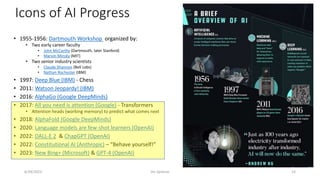
Icons of AI Progress
• 1955-1956: Dartmouth Workshop organized by:
• Two early career faculty
• John McCarthy (Dartmouth, later Stanford)
• Marvin Minsky (MIT)
• Two senior industry scientists
• Claude Shannon (Bell Labs)
• Nathan Rochester (IBM)
• 1997: Deep Blue (IBM) - Chess
• 2011: Watson Jeopardy! (IBM)
• 2016: AlphaGo (Google DeepMinds)
• 2017: All you need is attention (Google) - Transformers
• Attention heads (working memory) to predict what comes next
• 2018: AlphaFold (Google DeepMinds)
• 2020: Language models are few-shot learners (OpenAI)
• 2022: DALL-E 2 & ChapGPT (OpenAI)
• 2022: Constitutional AI (Anthropic) – “Behave yourself!”
• 2023: New Bing+ (Microsoft) & GPT-4 (OpenAI)
6/29/2023 Jim Spohrer 14
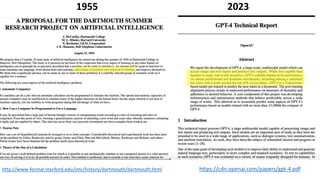
http://www-formal.stanford.edu/jmc/history/dartmouth/dartmouth.html https://cdn.openai.com/papers/gpt-4.pdf
1955 2023
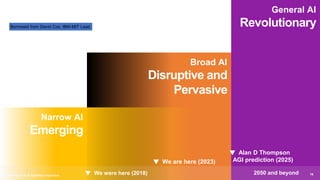
Narrow AI
Emerging
Broad AI
Disruptive and
Pervasive
General AI
Revolutionary
▼ We are here (2023)
2050 and beyond 16
IBM Research AI © 2018 IBM Corporation
The evolution of AI
Borrowed from David Cox, IBM-MIT Lead
▼ We were here (2018)
▼ Alan D Thompson
AGI prediction (2025)
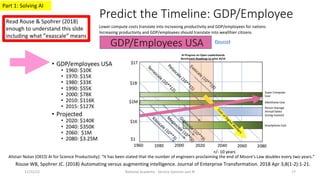
Predict the Timeline: GDP/Employee
National Academy - Service Systems and AI 17
(Source)
Lower compute costs translate into increasing productivity and GDP/employees for nations
Increasing productivity and GDP/employees should translate into wealthier citizens
AI Progress on Open Leaderboards
Benchmark Roadmap to solve AI/IA
Alistair Nolan (OECD AI for Science Productivity): “It has been stated that the number of engineers proclaiming the end of Moore's Law doubles every two years.”
Rouse WB, Spohrer JC. (2018) Automating versus augmenting intelligence. Journal of Enterprise Transformation. 2018 Apr 3;8(1-2):1-21.
Read Rouse & Spohrer (2018)
enough to understand this slide
including what ”exascale” means
11/22/22
Part 1: Solving AI
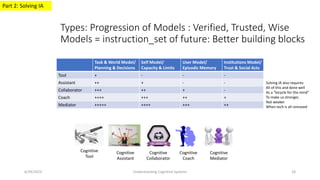
Types: Progression of Models : Verified, Trusted, Wise
Models = instruction_set of future: Better building blocks
6/29/2023 Understanding Cognitive Systems 18
Task & World Model/
Planning & Decisions
Self Model/
Capacity & Limits
User Model/
Episodic Memory
Institutions Model/
Trust & Social Acts
Tool + - - -
Assistant ++ + - -
Collaborator +++ ++ + -
Coach ++++ +++ ++ +
Mediator +++++ ++++ +++ ++
Cognitive
Tool
Cognitive
Assistant
Cognitive
Collaborator
Cognitive
Coach
Cognitive
Mediator
Part 2: Solving IA
Solving IA also requires
All of this and done well
As a “bicycle for the mind”
To make us stronger,
Not weaker
When tech is all removed
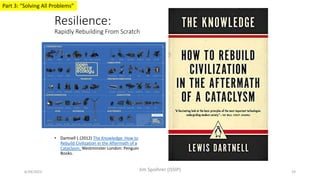
Resilience:
Rapidly Rebuilding From Scratch
• Dartnell L (2012) The Knowledge: How to
Rebuild Civilization in the Aftermath of a
Cataclysm. Westminster London: Penguin
Books.
6/29/2023 Jim Spoihrer (ISSIP) 19
Part 3: “Solving All Problems”
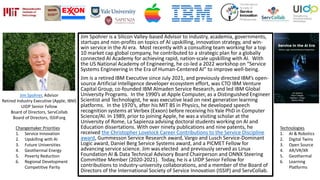
Jim Spohrer is a Silicon Valley-based Advisor to industry, academia, governments,
startups and non-profits on topics of AI upskilling, innovation strategy, and win-
win service in the AI era. Most recently with a consulting team working for a top
10 market cap global company, he contributed to a strategic plan for a globally
connected AI Academy for achieving rapid, nation-scale upskilling with AI. With
the US National Academy of Engineering, he co-led a 2022 workshop on “Service
Systems Engineering in the Era of Human-Centered AI” to improve well-being.
Jim is a retired IBM Executive since July 2021, and previously directed IBM’s open-
source Artificial Intelligence developer ecosystem effort, was CTO IBM Venture
Capital Group, co-founded IBM Almaden Service Research, and led IBM Global
University Programs. In the 1990’s at Apple Computer, as a Distinguished Engineer
Scientist and Technologist, he was executive lead on next generation learning
platforms. In the 1970’s, after his MIT BS in Physics, he developed speech
recognition systems at Verbex (Exxon) before receiving his Yale PhD in Computer
Science/AI. In 1989, prior to joining Apple, he was a visiting scholar at the
University of Rome, La Sapienza advising doctoral students working on AI and
Education dissertations. With over ninety publications and nine patents, he
received the Christopher Lovelock Career Contributions to the Service Discipline
award, Gummesson Service Research award, Vargo and Lusch Service-Dominant
Logic award, Daniel Berg Service Systems award, and a PICMET Fellow for
advancing service science. Jim was elected and previously served as Linux
Foundation AI & Data Technical Advisory Board Chairperson and ONNX Steering
Committee Member (2020-2021). Today, he is a UIDP Senior Fellow for
contributions to industry-university collaborations, and a member of the Board of
Directors of the International Society of Service Innovation (ISSIP) and ServCollab.
Jim Spohrer, Advisor
Retired Industry Executive (Apple, IBM)
UIDP Senior Fellow
Board of Directors, ServCollab
Board of Directors, ISSIP.org
Changemaker Priorities
1. Service Innovation
2. Upskilling with AI
3. Future Universities
4. Geothermal Energy
5. Poverty Reduction
6. Regional Development
Competitive Parity
Technologies
1. AI & Robotics
2. Digital Twins
3. Open Source
4. AR/VR/XR
5. Geothermal
6. Learning
Platforms
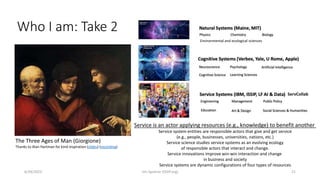
Who I am: Take 2
The Three Ages of Man (Giorgione)
Thanks to Alan Hartman for kind inspiration (slides) (recording)
Service is an actor applying resources (e.g., knowledge) to benefit another
Service system entities are responsible actors that give and get service
(e.g., people, businesses, universities, nations, etc.)
Service science studies service systems as an evolving ecology
of responsible actors that interact and change.
Service innovations improve win-win interaction and change
in business and society
Service systems are dynamic configurations of four types of resources
6/29/2023 Jim Spohrer (ISSIP.org) 21
Environmental and ecological sciences
ServCollab
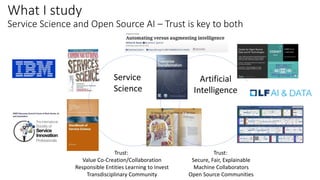
What I study
Service Science and Open Source AI – Trust is key to both
Service
Science
Artificial
Intelligence
Trust:
Value Co-Creation/Collaboration
Responsible Entities Learning to Invest
Transdisciplinary Community
Trust:
Secure, Fair, Explainable
Machine Collaborators
Open Source Communities

Worker Productivity 20230628 v1.pptx

  • 1.
    Post-Industrial Forum atSRI Knowledge Worker Productivity Jim Spohrer Retired Industry Executive (Apple, IBM) UIDP Senior Fellow Board of Directors (ISSIP, ServCollab) Questions: spohrer@gmail.com Twitter: @JimSpohrer LinkedIn: https://www.linkedin.com/in/spohrer/ Slack: https://slack.lfai.foundation Presentations online at: https://slideshare.net/spohrer Thanks to Frode Odegard for the invitation to discuss Knowledge Worker Productivity Wednesday June 28, 2023, 5:00-8:00pm PT Humankind: A Hopeful History By Dutch Historian, Rutger Bregman <- Thanks To Ray Fisk For suggesting this book, see My summary here. See also ServCollab. Nonzero: The Logic of Human Destiny By USA Journalist, Robert Wright
  • 2.
    Estimating Knowledge WorkerProductivity • Estimation Framework (Time and Money) • Draw seven vertical lines, label them with year from 1960 to 2080 • Draw five horizontal lines, label them with dollars from $1 to $Trillion • Estimating Cost of Computation • Add horizontal lines – that is Moore’s Law – cost of computation as a function of time from Kiloscale (103) to Ronnascale (1027) • Estimating Human-Scale Comparison • Make Exascale (1018) thicker – estimated computing power of 1 person’s brain • Make Ronnascale (1027) thicker – estimated computing power of a billion brains • Estimating Knowledge Worker Productivity • Add GPD/Employee in USA – that is an estimate of knowledge worker productivity
  • 3.
    1960 1980 20002020 2040 2060 2080 Estimation Framework (Time)
  • 4.
    1960 1980 20002020 2040 2060 2080 $1,000,000,000,000 (Trillion) $1,000,000 (Million) $1,000,000,000 (Billion) $1,000 (Thousand) $1 Estimation Framework (Money)
  • 5.
    1960 1980 20002020 2040 2060 2080 $1,000,000,000,000 (Trillion) $1,000,000 (Million) $1,000,000,000 (Billion) $1,000 (Thousand) $1 Estimating Cost of Computation
  • 6.
    1960 1980 20002020 2040 2060 2080 $1,000,000,000,000 (Trillion) $1,000,000 (Million) $1,000,000,000 (Billion) $1,000 (Thousand) $1 Estimating Human-scale Comparison Human-scale Brains Compute One Exa- (1018) Billion Ronna- (1027)
  • 7.
    1960 1980 20002020 2040 2060 2080 $1,000,000,000,000 (Trillion) $1,000,000 (Million) $1,000,000,000 (Billion) $1,000 (Thousand) $1 GDP/Employee Trend Estimating Knowledge Worker Productivity Based on USA Historical Data Year Value 1960 $10K 1980 $33K 2000 $78K 2020. $151K 2023 $169K
  • 8.
  • 9.
    9 September 2018 /© 2018 IBM Corporation Petaflops = 1,000,000,000,000,000 or a million billion = 10 ** 15 Megaflops = 1,000,000 = million = 10 ** 6 Gigaflops = 1,000,000,000 = billion = 10 ** 9 One of the AI Super Computers in the World, = 13 MegaWatts of Power (HOT!)
  • 10.
    10 September 2018 /© 2018 IBM Corporation Exascale = 1,000,000,000,000,000,000 or a billion billion = 10 ** 18 Megaflops = 1,000,000 = million = 10 ** 6 Gigaflops = 1,000,000,000 = billion = 10 ** 9 Human Brain = 20 Watts (COOL!)
  • 11.
    6/29/2023 Jim Spohrer(ISSIP.org) 11 (Chorus) AI, AI, enhancing the way, Personalization brightens each day. With tailored recommendations, it's clear, SIR members' interests, AI holds dear. Oh, SIR, SIR, hear this tune so true ChatGPT Prompt: Please transform the essay “AI for SIR members” into a song to the tune of "Daisy, Daisy give me your answer do” DALL-E Prompt: Generate a painting of the essence of technology and camaraderie with a vibrant and engaging image of retired men singing together. Evoke a sense of excitement and showcase the power of AI in enhancing the lives of SIR members.
  • 12.
    Let’s level set– how many of you know about… Ethan Mollick (UPenn Wharton) Don Norman (UC San Diego) Scott Pelley (CBS, 60 Minutes) Tristan Harris and Aza Raskin (Center for Humane Technology) Generative AI Tools To Output: Text/Writing Images Code/Programming Videos Audio Music Game Worlds Digital Twin Other? 6/29/2023 Jim Spohrer (ISSIP.org) 12
  • 13.
    Today’s talk • Intro:AI (by 1955 definition) has arrived • Just took 68 years, but… • What’s really going on? • Your data is becoming your AI… IA transformation • AI Digital Twin = IA (Intelligence Augmentation) • Adjustment period underway… • Part 1: Solving AI: Leaderboards/Profession Exams • Roadmap and implications • Open technologies, innovation • Part 2: Solving IA: Better Building Blocks • Solving problems faster, creates new problems • Identity, social contracts, trust, resilience • Part 3: ”Solving All Problems” • What could go wrong? Be prepared. • 37-year long adjustment period is now underway… 6/29/2023 Jim Spohrer 13
  • 14.
    Icons of AIProgress • 1955-1956: Dartmouth Workshop organized by: • Two early career faculty • John McCarthy (Dartmouth, later Stanford) • Marvin Minsky (MIT) • Two senior industry scientists • Claude Shannon (Bell Labs) • Nathan Rochester (IBM) • 1997: Deep Blue (IBM) - Chess • 2011: Watson Jeopardy! (IBM) • 2016: AlphaGo (Google DeepMinds) • 2017: All you need is attention (Google) - Transformers • Attention heads (working memory) to predict what comes next • 2018: AlphaFold (Google DeepMinds) • 2020: Language models are few-shot learners (OpenAI) • 2022: DALL-E 2 & ChapGPT (OpenAI) • 2022: Constitutional AI (Anthropic) – “Behave yourself!” • 2023: New Bing+ (Microsoft) & GPT-4 (OpenAI) 6/29/2023 Jim Spohrer 14
  • 15.
  • 16.
    Narrow AI Emerging Broad AI Disruptiveand Pervasive General AI Revolutionary ▼ We are here (2023) 2050 and beyond 16 IBM Research AI © 2018 IBM Corporation The evolution of AI Borrowed from David Cox, IBM-MIT Lead ▼ We were here (2018) ▼ Alan D Thompson AGI prediction (2025)
  • 17.
    Predict the Timeline:GDP/Employee National Academy - Service Systems and AI 17 (Source) Lower compute costs translate into increasing productivity and GDP/employees for nations Increasing productivity and GDP/employees should translate into wealthier citizens AI Progress on Open Leaderboards Benchmark Roadmap to solve AI/IA Alistair Nolan (OECD AI for Science Productivity): “It has been stated that the number of engineers proclaiming the end of Moore's Law doubles every two years.” Rouse WB, Spohrer JC. (2018) Automating versus augmenting intelligence. Journal of Enterprise Transformation. 2018 Apr 3;8(1-2):1-21. Read Rouse & Spohrer (2018) enough to understand this slide including what ”exascale” means 11/22/22 Part 1: Solving AI
  • 18.
    Types: Progression ofModels : Verified, Trusted, Wise Models = instruction_set of future: Better building blocks 6/29/2023 Understanding Cognitive Systems 18 Task & World Model/ Planning & Decisions Self Model/ Capacity & Limits User Model/ Episodic Memory Institutions Model/ Trust & Social Acts Tool + - - - Assistant ++ + - - Collaborator +++ ++ + - Coach ++++ +++ ++ + Mediator +++++ ++++ +++ ++ Cognitive Tool Cognitive Assistant Cognitive Collaborator Cognitive Coach Cognitive Mediator Part 2: Solving IA Solving IA also requires All of this and done well As a “bicycle for the mind” To make us stronger, Not weaker When tech is all removed
  • 19.
    Resilience: Rapidly Rebuilding FromScratch • Dartnell L (2012) The Knowledge: How to Rebuild Civilization in the Aftermath of a Cataclysm. Westminster London: Penguin Books. 6/29/2023 Jim Spoihrer (ISSIP) 19 Part 3: “Solving All Problems”
  • 20.
    Jim Spohrer isa Silicon Valley-based Advisor to industry, academia, governments, startups and non-profits on topics of AI upskilling, innovation strategy, and win- win service in the AI era. Most recently with a consulting team working for a top 10 market cap global company, he contributed to a strategic plan for a globally connected AI Academy for achieving rapid, nation-scale upskilling with AI. With the US National Academy of Engineering, he co-led a 2022 workshop on “Service Systems Engineering in the Era of Human-Centered AI” to improve well-being. Jim is a retired IBM Executive since July 2021, and previously directed IBM’s open- source Artificial Intelligence developer ecosystem effort, was CTO IBM Venture Capital Group, co-founded IBM Almaden Service Research, and led IBM Global University Programs. In the 1990’s at Apple Computer, as a Distinguished Engineer Scientist and Technologist, he was executive lead on next generation learning platforms. In the 1970’s, after his MIT BS in Physics, he developed speech recognition systems at Verbex (Exxon) before receiving his Yale PhD in Computer Science/AI. In 1989, prior to joining Apple, he was a visiting scholar at the University of Rome, La Sapienza advising doctoral students working on AI and Education dissertations. With over ninety publications and nine patents, he received the Christopher Lovelock Career Contributions to the Service Discipline award, Gummesson Service Research award, Vargo and Lusch Service-Dominant Logic award, Daniel Berg Service Systems award, and a PICMET Fellow for advancing service science. Jim was elected and previously served as Linux Foundation AI & Data Technical Advisory Board Chairperson and ONNX Steering Committee Member (2020-2021). Today, he is a UIDP Senior Fellow for contributions to industry-university collaborations, and a member of the Board of Directors of the International Society of Service Innovation (ISSIP) and ServCollab. Jim Spohrer, Advisor Retired Industry Executive (Apple, IBM) UIDP Senior Fellow Board of Directors, ServCollab Board of Directors, ISSIP.org Changemaker Priorities 1. Service Innovation 2. Upskilling with AI 3. Future Universities 4. Geothermal Energy 5. Poverty Reduction 6. Regional Development Competitive Parity Technologies 1. AI & Robotics 2. Digital Twins 3. Open Source 4. AR/VR/XR 5. Geothermal 6. Learning Platforms
  • 21.
    Who I am:Take 2 The Three Ages of Man (Giorgione) Thanks to Alan Hartman for kind inspiration (slides) (recording) Service is an actor applying resources (e.g., knowledge) to benefit another Service system entities are responsible actors that give and get service (e.g., people, businesses, universities, nations, etc.) Service science studies service systems as an evolving ecology of responsible actors that interact and change. Service innovations improve win-win interaction and change in business and society Service systems are dynamic configurations of four types of resources 6/29/2023 Jim Spohrer (ISSIP.org) 21 Environmental and ecological sciences ServCollab
  • 22.
    What I study ServiceScience and Open Source AI – Trust is key to both Service Science Artificial Intelligence Trust: Value Co-Creation/Collaboration Responsible Entities Learning to Invest Transdisciplinary Community Trust: Secure, Fair, Explainable Machine Collaborators Open Source Communities