Integrated Management of
Childhood Illness 2022
1
IMCI PROCESS FOR ALL YOUNG INFANTS (Birth up to two months)
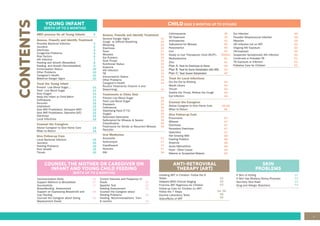
CONTENTS YOUNG INFANT
(BIRTH UP TO 2 MONTHS)
IMCI process for all Young Infants 2
Assess, Classify and Identify Treatment
Possible Bacterial Infection
Jaundice
Diarrhoea
Congenital Problems
Risk Factors
HIV Infection
Feeding and Growth (Breastfed)
Feeding and Growth (Non-breastfed)
Immunisation Status
Other Problems
Caregiver’s Health
Maternal Danger Signs
3
3
4
5
6
7
8
9
10
10
10
10
Treat the Young Infant
Prevent Low Blood Sugar…
Treat Low Blood Sugar
Give Oxygen
Keep the Infant or Child Warm
Ceftriaxone
Penicillin
Cephalexin
Give ARV Prophylaxis: Nevirapine (NVP)
Give ARV Prophylaxis: Zidovudine (AZT).
Diarrhoea
Local Infections
11
11
11
11
11
12
12
12
12
12
12
Counsel the Caregiver
Advise Caregiver to Give Home Care
When to Return
14
14
Give Follow-up Care
Local Bacterial Infection
Jaundice
Feeding Problems
Poor Growth
Thrush
15
15
15
15
15
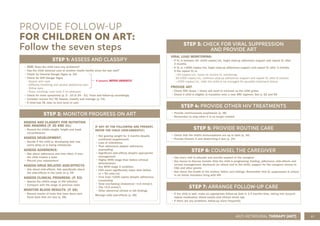
ANTI-RETROVIRAL
THERAPY (ART)
Initiating ART in Children: Follow the 6
Steps
Adapted WHO Clinical Staging
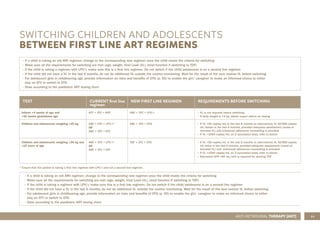
First-line ART Regimens for Children
Follow-up Care for Children on ART:
Follow the 7 Steps
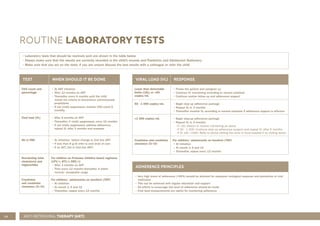
Routine Laboratory Tests
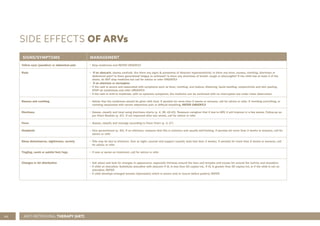
Side-effects of ART
52
53
53
54- 56
58
60
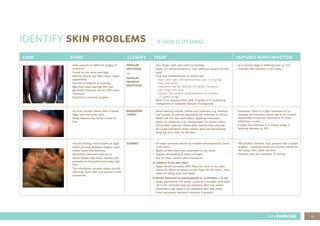
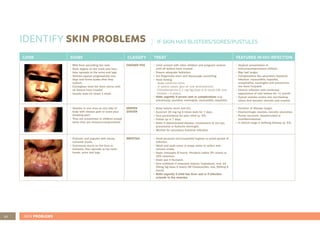
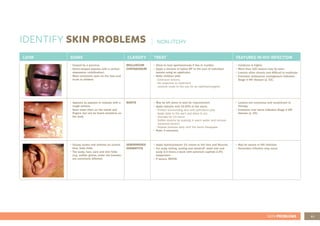
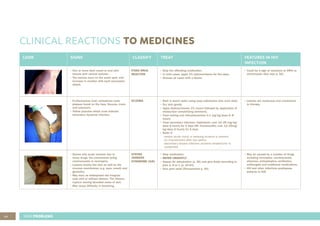
SKIN
PROBLEMS
If Skin is Itching
If Skin has Blisters/Sores/Pustules
Non-itchy Skin Rash
Drug and Allergic Reactions
61
62
63
64
COUNSEL THE MOTHER OR CAREGIVER ON
INFANT AND YOUNG CHILD FEEDING
(BIRTH UP TO 2 MONTHS)
Communication Skills
Support Mothers to Breastfeed
Successfully
Breastfeeding Assessment
Support on Expressing Breastmilk and
Cup Feeding
Counsel the Caregiver about Giving
Replacement Feeds
16
17
17
18
19
Correct Volumes and Frequency of
Feeds
Appetite Test
Feeding Assessment
Counsel the Caregiver about
Feeding Problems
Feeding Recommendations from
6 months
20
20
21
22
23
Assess, Classify and Identify Treatment
General Danger Signs
Cough or Difficult Breathing
Wheezing
Diarrhoea
Fever
Measles
Ear Problem
Sore Throat
Nutritional Status
Anaemia
HIV Infection
TB
Immunisation Status
Other Problems
Caregiver’s Health
Routine Treatments (Vitamin A and
Deworming)
24
25
25
26
27
28
29
29
30
31
32
33
34
34
34
34
Treatments in Clinic Only
Prevent Low Blood Sugar
Treat Low Blood Sugar
Diazepam
Ceftriaxone
Stabilising Feed (F-75)
Oxygen
Nebulised Adrenaline
Salbutamol for Wheeze & Severe
Classification
Prednisone for Stridor or Recurrent Wheeze
Penicillin
35
35
35
35
35
36
36
36
36
36
Oral Medicines
Amoxicillin
Azithromycin
Ciprofloxacin
Penicillin
INH
37
37
37
37
38
CHILD (AGE 2 MONTHS UP TO 5YEARS)
Cotrimoxazole
TB Treatment
Antimalarials
Salbutamol for Wheeze
Paracetamol
Iron
Ready to Use Therapeutic Food (RUTF).
Multivitamins
Zinc
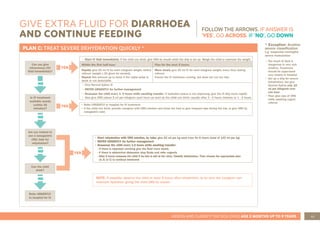
Plan A: Treat for Diarrhoea at Home
Plan B: Treat for Some Dehydration with ORS.
Plan C: Treat Severe Dehydration
38
39
40
40
40
41
20&41
41
41
42
42
43
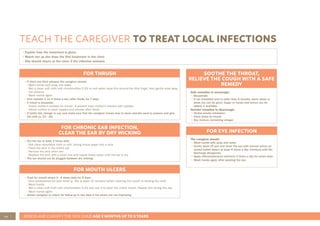
Treat for Local Infections
Dry the Ear by Wicking
Mouth Ulcers
Thrush
Soothe the Throat, Relieve the Cough
Eye Infection
44
44
44
44
44
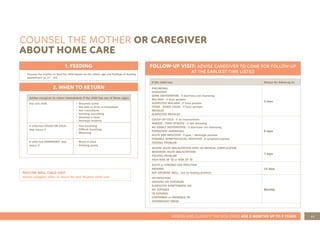
Counsel the Caregiver
Advise Caregiver to Give Home Care
When to Return
45-46
45
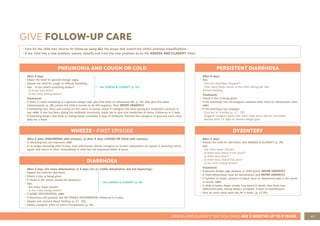
Give Follow-up Care
Pneumonia
Wheeze
Diarrhoea
Persistent Diarrhoea
Dysentery
Not Growing Well
Feeding Problem
Anaemia
Acute Malnutrition
Fever - Other Cause
Malaria or Suspected Malaria
47
47
47
47
47
48
48
48
48
49
49
Ear Infection
Possible Streptococcal Infection
Measles
HIV Infection not on ART
Ongoing HIV Exposure
HIV-exposed
Suspected Symptomatic HIV infection
Confirmed or Probable TB
TB Exposure or Infection
Palliative Care for Children
49
49
49
50
50
50
50
51
51
51
2 IMCI PROCESS FOR ALL YOUNG INFANTS (Birth up to two months)
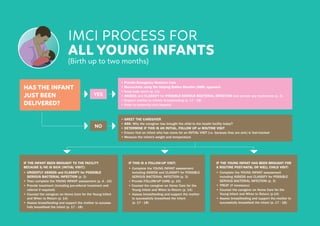
IMCI PROCESS FOR
ALL YOUNG INFANTS
(Birth up to two months)
HAS THE INFANT
JUST BEEN
DELIVERED?
• Provide Emergency Newborn Care
• Resuscitate using the Helping Babies Breathe (HBB) approach
• Keep baby warm (p. 11)
• ASSESS and CLASSIFY for POSSIBLE SERIOUS BACTERIAL INFECTION and provide any treatments (p. 3)
• Support mother to initiate breastfeeding (p. 17 - 18)
• Refer to maternity unit/hospital
• GREET THE CAREGIVER
• ASK: Why the caregiver has brought the child to the health facility today?
• DETERMINE IF THIS IS AN INITIAL, FOLLOW UP or ROUTINE VISIT
• Ensure that an infant who has come for an INITIAL VISIT (i.e. because they are sick) is fast-tracked
• Measure the infant’s weight and temperature
YES
NO
IF THE INFANT BEEN BROUGHT TO THE FACILITY
BECAUSE S/HE IS SICK (INITIAL VISIT):
• URGENTLY ASSESS and CLASSIFY for POSSIBLE 		
SERIOUS BACTERIAL INFECTION (p. 3)
• Then complete the YOUNG INFANT assessment (p. 4 - 10)
• Provide treatment (including pre-referral treatment and
referral if required)
• Counsel the caregiver on Home Care for the Young Infant
and When to Return (p. 14)
• Assess breastfeeding and support the mother to success-
fully breastfeed the infant (p. 17 - 18)
IF THIS IS A FOLLOW-UP VISIT:
• Complete the YOUNG INFANT assessment
including ASSESS and CLASSIFY for POSSIBLE
SERIOUS BACTERIAL INFECTION (p. 3)
• Provide FOLLOW-UP CARE (p. 15)
• Counsel the caregiver on Home Care for the
Young Infant and When to Return (p. 14)
• Assess breastfeeding and support the mother
to successfully breastfeed the infant
(p. 17 - 18)
IF THE YOUNG INFANT HAS BEEN BROUGHT FOR
A ROUTINE POST-NATAL OR WELL CHILD VISIT:
• Complete the YOUNG INFANT assessment 		
including ASSESS and CLASSIFY for POSSIBLE
SERIOUS BACTERIAL INFECTION (p. 3)
• TREAT (if necessary)
• Counsel the caregiver on Home Care for the
Young Infant and When to Return (p.14)
• Assess breastfeeding and support the mother to
successfully breastfeed the infant (p. 17 - 18)
3
IMCI PROCESS FOR ALL YOUNG INFANTS (Birth up to two months)
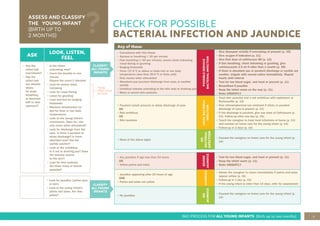
CHECK FOR POSSIBLE
BACTERIAL INFECTION AND JAUNDICE
ASK
LOOK, LISTEN,
FEEL
• Has the
infant had
convulsions?
• Has the
infant had
any attacks
where
he stops
breathing,
or becomes
stiff or blue
(apnoea)?
• Is the infant
convulsing now?
• Count the breaths in one
minute
Repeat the count if elevated
• Look for severe chest
indrawing
• Look for nasal flaring
• Listen for grunting
• Look and feel for bulging
fontanelle
• Measure temperature (or
feel for fever or low body
temperature)
• Look at the young infant’s
movements. Does he/ she
only move when stimulated?
• Look for discharge from the
eyes. Is there a purulent or
sticky discharge? Is there
abundant pus? Are the
eyelids swollen?
• Look at the umbilicus.
Is it red or draining pus? Does
the redness extend
to the skin?
• Look for skin pustules.
Are there many or severe
pustules?
Any of these:
• Convulsions with this illness
• Apnoea or breathing < 30 per minute
• Fast breathing (> 60 per minute), severe chest indrawing,
nasal flaring or grunting
• Bulging fontanelle
• Fever (37.5°C or above or feels hot) or low body
temperature (less than 35.5°C or feels cold)
• Only moves when stimulated
• Abundant pus/purulent discharge from eyes, or swollen
eyelids
• Umbilical redness extending to the skin and/or draining pus
• Many or severe skin pustules.
POSSIBLE
SERIOUS
BACTERIAL
INFECTION
• Give diazepam rectally if convulsing at present (p. 35)
• Give oxygen if indicated (p. 11)
• Give first dose of ceftriaxone IM (p. 12)
• If fast breathing, chest indrawing or grunting, give
cotrimoxazole 2.5 ml if older than 1 month (p. 38)
• If there is abundant pus or purulent discharge or eyelids are
swollen, irrigate with normal saline immediately. Repeat
hourly until referral
• Test for low blood sugar, and treat or prevent (p. 11)
• Breastfeed if possible
• Keep the infant warm on the way (p. 11)
• Refer URGENTLY
• Purulent (small amount) or sticky discharge of eyes
OR
• Red umbilicus
OR
• Skin pustules
LOCAL
BACTERIAL
INFECTION
• Treat skin pustules and a red umbilicus with cephalexin or
flucloxacillin (p. 12)
• Give chloramphenicol eye ointment if sticky or purulent
discharge of eyes is present (p. 13)
• If the discharge is purulent, give one dose of Ceftriaxone (p.
12). Follow-up after one day (p. 15).
• Teach the caregiver to treat local infections at home (p. 13)
and counsel on home care for the young infant (p. 14)
• Follow-up in 2 days (p. 15)
• None of the above signs
NO
BACTERIAL
IN
FECTION
• Counsel the caregiver on home care for the young infant (p.
14)
• Any jaundice if age less than 24 hours
OR
• Yellow palms and soles
SEVERE
JAUNDICE
• Test for low blood sugar, and treat or prevent (p. 11)
• Keep the infant warm (p. 11)
• Refer URGENTLY
• Jaundice appearing after 24 hours of age
AND
• Palms and soles not yellow
JAUNDICE
• Advise the caregiver to return immediately if palms and soles
appear yellow (p. 15)
• Follow-up in 1 day (p. 15)
• If the young infant is older than 14 days, refer for assessment
• No jaundice
NO
JAUNDICE
• Counsel the caregiver on home care for the young infant (p.
14)
ASSESS AND CLASSIFY
THE YOUNG INFANT
(BIRTH UP TO
2 MONTHS)
Young
infant must
be calm
• Look for jaundice (yellow eyes
or skin)
• Look at the young infant’s
palms and soles. Are they
yellow?
CLASSIFY
ALL YOUNG
INFANTS
CLASSIFY
ALL YOUNG
INFANTS
4 IMCI PROCESS FOR ALL YOUNG INFANTS (Birth up to two months)
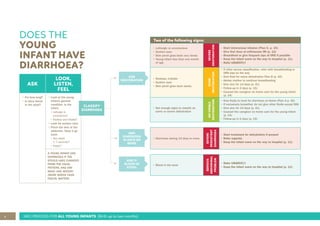
DOES THE
YOUNG
INFANT HAVE
DIARRHOEA?
ASK
LOOK,
LISTEN,
FEEL
• For how long?
• Is there blood
in the stool?
• Look at the young
infant’s general
condition. Is the
infant:
• Lethargic or
unconscious?
• Restless and irritable?
• Look for sunken eyes
• Pinch the skin of the
abdomen. Does it go
back:
• Very slowly
(> 2 seconds)?
• Slowly?
A YOUNG INFANT HAS
DIARRHOEA IF THE
STOOLS HAVE CHANGED
FROM THE USUAL
PATTERN, AND ARE
MANY AND WATERY
(MORE WATER THAN
FAECAL MATTER)
AND IF
BLOOD IN
STOOL
AND
DIARRHOEA
14 DAYS OR
MORE
FOR
DEHYDRATION
Two of the following signs:
• Lethargic or unconscious
• Sunken eyes
• Skin pinch goes back very slowly
• Young infant less than one month
of age
SEVERE
DEHYDRATION
• Start intravenous infusion (Plan C, p. 43)
• Give first dose of ceftriaxone IM (p. 12)
• Breastfeed or give frequent sips of ORS if possible
• Keep the infant warm on the way to hospital (p. 11)
• Refer URGENTLY
• Restless, irritable
• Sunken eyes
• Skin pinch goes back slowly
SOME
DEHYDRATION
• If other severe classification, refer with breastfeeding or
ORS sips on the way
• Give fluid for some dehydration Plan B (p. 42)
• Advise mother to continue breastfeeding
• Give zinc for 14 days (p. 41)
• Follow-up in 2 days (p. 15)
• Counsel the caregiver on home care for the young infant
(p. 14)
• Not enough signs to classify as
some or severe dehydration
NO
VISIBLE
DEHYDRATION
• Give fluids to treat for diarrhoea at Home (Plan A p. 42)
• If exclusively breastfed, do not give other fluids except SSS
• Give zinc for 14 days (p. 41)
• Counsel the caregiver on home care for the young infant
(p. 14)
• Follow-up in 2 days (p. 15)
• Diarrhoea lasting 14 days or more
SEVERE
PERSISTENT
DIARRHOEA
• Start treatment for dehydration if present
• Refer urgently
• Keep the infant warm on the way to hospital (p. 11)
• Blood in the stool
SERIOUS
ABDOMINAL
PROBLEM
• Refer URGENTLY
• Keep the infant warm on the way to hospital (p. 11)
CLASSIFY
DIARRHOEA
5
IMCI PROCESS FOR ALL YOUNG INFANTS (Birth up to two months)
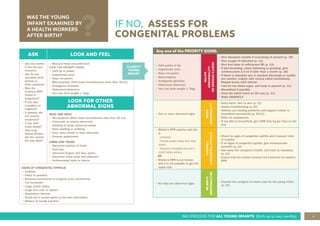
WAS THE YOUNG
INFANT EXAMINED BY
A HEALTH WORKERS
AFTER BIRTH?
IF NO, ASSESS FOR
CONGENITAL PROBLEMS
ASK LOOK AND FEEL
• Ask the mother
if she has any
concerns
• Ask for any
identified birth
defects or
other problems
• Was the
mother’s RPR
tested in
pregnancy?
• If yes, was
it positive or
negative?
• If positive, did
she receive
treatment?
• If yes, how
many doses?
• How long
before delivery
did she receive
the last dose?
• Measure head circumference
LOOK FOR PRIORITY SIGNS
• Cleft lip or palate
• Imperforate anus
• Nose not patent
• Macrocephaly (birth head circumference more than 39cm)
• Ambiguous Genitalia
• Abdominal distention
• Very low birth weight (≤ 2kg)
LOOK FOR OTHER
ABNORMAL SIGNS
HEAD AND NECK
• Microcephaly (Birth head circumference less than 32 cm)
• Fontanelle or sutures abnormal
• Swelling of scalp, abnormal shape
• Neck swelling or webbing
• Face, eyes, mouth or nose abnormal
• Unusual appearance
LIMBS AND TRUNK
• Abnormal position of limbs
• Club foot
• Abnormal fingers and toes, palms
• Abnormal chest, back and abdomen
• Undescended testis or hernia
SIGNS OF CONGENITAL SYPHILIS
• Oedema
• Pallor or jaundice
• Reduced movements or irregular, jerky movements
• Full fontanelle
• Large lymph nodes
• Large liver and/ or spleen
• Respiratory distress
• Small red or purple spots on the skin (petechiae)
• Blisters on hands and feet
Any one of the PRIORITY SIGNS:
• Cleft palate or lip
• Imperforate anus
• Nose not patent
• Macrocephaly
• Ambiguous genitalia
• Abdominal distention
• Very low birth weight (≤ 2kg)
MAJOR
ABNORMALITY
OR
SERIOUS
ILLNESS
• Give diazepam rectally if convulsing at present (p. 35)
• Give oxygen if indicated (p. 11)
• Give first dose of ceftriaxone IM (p. 12)
• If fast breathing, chest indrawing or grunting, give
cotrimoxazole 2.5 ml if older than 1 month (p. 38)
• If there is abundant pus or purulent discharge or eyelids
are swollen, irrigate with normal saline immediately.
Repeat hourly until referral.
• Test for low blood sugar, and treat or prevent (p. 11)
• Breastfeed if possible
• Keep the infant warm on the way (p. 11)
• Refer URGENTLY
• One or more abnormal signs
BIRTH
ABNORMALITY
• Keep warm, skin to skin (p. 11)
• Assess breastfeeding (p. 20)
• Address any feeding problems and support mother to
breastfeed successfully (p. 20-21)
• Refer for assessment
• If not able to breastfeed, give EBM 3ml/kg per hour on the
way
• Mother’s RPR positive and she
is
- Untreated
- Partially treated (fewer than three
doses)
- Treatment completed less than 1
month before delivery
OR
• Mother’s RPR is not known,
and it is not possible to get the
result now
POSSIBLE
CONGENITAL
SYPHILIS
• Check for signs of congenital syphilis and if present refer
to hospital
• If no signs of congenital syphilis, give intramuscular
penicillin (p. 12)
• Ask about the caregiver’s health, and treat as necessary
(p. 10)
• Ensure that the mother receives full treatment for positive
RPR
• No risks nor abnormal signs
NO
BIRTH
ABNORMALITIES
• Counsel the caregiver on home care for the young infant
(p. 14)
CLASSIFY
YOUNG
INFANT
6 IMCI PROCESS FOR ALL YOUNG INFANTS (Birth up to two months)
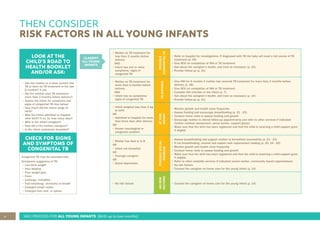
THEN CONSIDER
RISK FACTORS IN ALL YOUNG INFANTS
LOOK AT THE
CHILD’S ROAD TO
HEALTH BOOKLET
AND/OR ASK:
• Has the mother or a close contact had
TB or been on TB treatment in the last
6 months? If yes:
• Did the mother start TB treatment
more than 2 months before delivery?
• Assess the infant for symptoms and
signs of congenital TB (box below)
• How much did the infant weigh at
birth?
• Was the infant admitted to hospital
after birth? If so, for how many days?
• Who is the child’s caregiver?
• How old is the mother/caregiver?
• Is the infant exclusively breastfed?
CHECK FOR SIGNS
AND SYMPTOMS OF
CONGENITAL TB
Congenital TB may be asymptomatic.
Symptoms suggestive of TB:
• Low birth weight
• Poor feeding
• Poor weight gain
• Fever
• Lethargy/ irritability
• Fast breathing/ shortness of breath
• Enlarged lymph nodes
• Enlarged liver and/ or spleen
CLASSIFY
ALL YOUNG
INFANTS
• Mother on TB treatment for
less than 2 months before
delivery
AND
• Infant has one or more
symptoms/ signs of
congenital TB
POSSIBLE
CONGENITAL
TB
• Refer to hospital for investigations. If diagnosed with TB the baby will need a full course of TB
treatment (p. 39)
• Give BCG on completion of INH or TB treatment
• Ask about the caregiver’s health, and treat as necessary (p. 10)
• Provide follow-up (p. 51)
• Mother on TB treatment for
more than 2 months before
delivery
AND
• Infant has no symptoms/
signs of congenital TB
TB
EXPOSED
• Give INH for 6 months if mother has received TB treatment for more than 2 months before
delivery (p. 38)
• Give BCG on completion of INH or TB treatment
• Consider HIV infection in the infant (p. 7)
• Ask about the caregiver’s health, and treat as necessary (p. 10)
• Provide follow-up (p. 51)
• Infant weighed less than 2 kg
at birth
OR
• Admitted to hospital for more
than three days after delivery
OR
• Known neurological or
congenital problem
AT
RISK
INFANT
• Monitor growth and health more frequently
• Assess feeding and encourage breastfeeding (p. 21 - 23)
• Conduct home visits to assess feeding and growth
• Encourage mother to attend follow-up appointments and refer to other services if indicated
(further medical assessment, social worker, support group)
• Make sure that the birth has been registered and that the child is receiving a child support grant
if eligible
• Mother has died or is ill
OR
• Infant not breastfed
OR
• Teenage caregiver
OR
• Social deprivation
POSSIBLE
SOCIAL
PROBLEM
• Assess breastfeeding and support mother to breastfeed successfully (p. 21 - 23)
• If not breastfeeding, counsel and explain safe replacement feeding (p. 20, 24 - 25)
• Monitor growth and health more frequently
• Conduct home visits to assess feeding and growth
• Make sure that the birth has been registered and that the child is receiving a child support grant
if eligible.
• Refer to other available services if indicated (social worker, community based organisations)
• No risk factors
• Counsel the caregiver on home care for the young infant (p. 14)
• No risk factors
NO
RISK
FACTORS
• Counsel the caregiver on home care for the young infant (p. 14)
7
IMCI PROCESS FOR ALL YOUNG INFANTS (Birth up to two months)
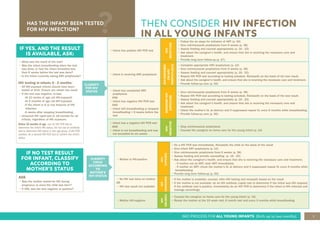
HAS THE INFANT BEEN TESTED
FOR HIV INFECTION?
THEN CONSIDER HIV INFECTION
IN ALL YOUNG INFANTS
IF YES, AND THE RESULT
IS AVAILABLE, ASK:
• What was the result of the test?
• Was the infant breastfeeding when the test
was done, or had the infant breastfed less
than 6 weeks before the test was done?
• Is the infant currently taking ARV prophylaxis?
HIV testing in infants 0 - 2 months:
• All HIV-exposed infants should have been
tested at birth. Ensure you obtain the result
• If the test was negative, re-test:
-At 10 weeks of age (all HIV-exposed)
-At 6 months of age (all HIV-exposed)
-If the infant is ill or has features of HIV
infection
-6 weeks after stopping breastfeeding.
• Universal HIV rapid test at 18 months for all
infants, regardless of HIV exposure.
Below 18 months of age, use an HIV PCR test to
determine the child’s HIV status. Do not use an antibody
test to determine HIV status in this age group. If HIV PCR
positive, do a second HIV PCR test to confirm the child’s
status
CLASSIFY
CHILD
ACCORDING
TO
MOTHER’S
HIV STATUS
• Infant has positive HIV PCR test
HIV
INFECTION
• Follow the six steps for initiation of ART (p. 52)
• Give cotrimoxazole prophylaxis from 6 weeks (p. 38)
• Assess feeding and counsel appropriately (p. 16 - 22)
• Ask about the caregiver’s health, and ensure that she is receiving the necessary care and
treatment.
• Provide long term follow-up (p. 57)
• Infant is receiving ARV prophylaxis
HIV
-
EXPOSED:
ON
ARV
PROPHYLAXIS
• Complete appropriate ARV prophylaxis (p. 12)
• Give cotrimoxazole prophylaxis from 6 weeks (p. 38)
• Assess feeding and counsel appropriately (p. 16 - 22)
• Repeat HIV PCR test according to testing schedule. Reclassify on the basis of the test result.
• Ask about the caregiver’s health, and ensure that she is receiving the necessary care and treatment.
• Provide follow-up care (p. 50)
• Infant has completed ARV
prophylaxis
AND
• Infant has negative HIV PCR test
AND
• Infant still breastfeeding or stopped
breastfeeding < 6 weeks before the
test
ONGOING
HIV
EXPOSURE
• Give cotrimoxazole prophylaxis from 6 weeks (p. 38)
• Repeat HIV PCR test according to testing schedule. Reclassify on the basis of the test result.
• Assess feeding and counsel appropriately (p. 16 - 22)
• Ask about the caregiver’s health, and ensure that she is receiving the necessary care and
treatment.
• Check the mother’s VL at delivery and if suppressed repeat VL every 6 months while breastfeeding.
• Provide follow-up care (p. 50)
• Infant has a negative HIV PCR test
AND
• Infant is not breastfeeding and was
not breastfed for six weeks
HIV
-
NEGATIVE
• Stop cotrimoxazole prophylaxis
• Counsel the caregiver on home care for the young infant (p. 14)
• Mother is HIV-positive
HIV
-
EXPOSED
• Do a HIV PCR test immediately. Reclassify the child on the basis of the result
• Give infant ART prophylaxis (p. 12)
• Give cotrimoxazole prophylaxis from 6 weeks (p. 38)
• Assess feeding and provide counselling (p. 16 - 22)
• Ask about the caregiver’s health, and ensure that she is receiving the necessary care and treatment.
- If mother not on ART: start ART immediately
- If mother on ART: check the mother’s VL at delivery and if suppressed repeat VL every 6 months while
breastfeeding
• Provide long term follow-up (p. 50)
• No HIV test done on mother
OR
• HIV test result not available
HIV
UNKNOWN
• If the mother is available: counsel, offer HIV testing and reclassify based on the result
• If the mother is not available: do an HIV antibody (rapid) test to determine if the infant was HIV exposed
If the antibody test is positive, immediately do an HIV PCR to determine if the infant is HIV–infected and
manage accordingly
• Mother HIV-negative
HIV
UNLIKELY
• Counsel the caregiver on home care for the young infant (p. 14)
• Retest the mother at the 10 week visit, 6 month visit and every 3 months while breastfeeding
IF NO TEST RESULT
FOR INFANT, CLASSIFY
ACCORDING TO
MOTHER’S STATUS
ASK
• Was the mother tested for HIV during
pregnancy or since the child was born?
• If YES, was the test negative or positive?
CLASSIFY
FOR HIV
STATUS
8 IMCI PROCESS FOR ALL YOUNG INFANTS (Birth up to two months)
THEN CHECK FOR
FEEDING AND GROWTH
Breastfed infants
CLASSIFY
FEEDING IN
ALL YOUNG
INFANTS
ASK
LOOK, LISTEN,
FEEL
• How is feeding going?
• How many times do you breastfeed in 24 hours?
• Does your baby get any other food or drink?
• If yes, how often?
• What do you use to feed your baby?
• Plot the weight on the RTHB to
determine the weight for age
• Look at the shape of the
curve. Is the child growing
well?
• If the child is less than 10
days old: Has the child lost
more than expected body
weight?
• Has the child regained birth
weight at 10 days?
• Is the child gaining sufficient
weight?
• Look for ulcers or white
patches in the mouth (thrush)
IF THE BABY:
• Has any difficulty feeding, or
• Is breastfeeding less than 8 times in 24 hours, or
• Is taking any other foods or drinks, or
• Is low weight for age, or
• Is not gaining weight
AND
• Has no indications to refer urgently to hospital:
THEN ASSESS BREASTFEEDING:
• Has the baby breastfed in the previous hour?
• If baby has not fed in the last hour, ask mother to put baby to the breast. Observe the
breastfeed for 4 minutes. (If baby was fed during the last hour, ask mother if she can
wait and tell you when the infant is willing to feed again)
• Is baby able to attach?
not at all OR poor attachment OR good attachment
• Is the baby suckling well (that is, slow deep sucks, sometimes pausing)?
not at all OR not suckling well OR suckling well
• Clear a blocked nose if it interferes with breastfeeding
NOTE:
• Young infants may lose up to 10% of their birth weight in the first few days after birth,
but should regain their birth weight by ten days of age
• Thereafter minimum weight gain should be: Preterm: 10g/kg/day or Term: 20g/kg/day
10% OF BIRTH WEIGHT = BIRTH WEIGHT divided by 10
• Not able to feed
OR
• No attachment at all
OR
• Not suckling at all
NOT
ABLE
TO
FEED
• Treat as possible serious bacterial infection (p.
3)
• Give first dose of ceftriaxone IM (p. 12)
• Test for low blood sugar, and treat or prevent (p.
11)
• Refer URGENTLY to hospital—make sure that the
baby is kept warm (p. 11)
• Not well attached to breast
OR
• Not suckling effectively
OR
• Less than 8 breastfeeds in 24
hours
OR
• Infant is taking foods or drinks
other than breastmilk
OR
• Thrush
FEEDING
PROBLEM
• Advise the mother to breastfeed as often and for
as long as the infant wants, day and night
• If not well attached or not suckling effectively,
teach correct positioning and attachment (p. 17)
• If breastfeeding less than 8 times in 24 hours,
advise to increase frequency of feeding
• If mother has a breastfeeding problem see advice
for common breastfeeding problems (p. 17-18,22)
• If receiving other foods or drinks, counsel mother
on exclusive breastfeeding, and the importance of
stopping other foods or drinks (p. 17-18,22)
• If thrush, treat and teach the mother to treat for
thrush at home (p. 13)
• Follow-up in 2 days (p. 15)
• More than 10% weight loss in
the first week of life
OR
• Weight less than birth weight
at or after 2 week visit
OR
• Low weight for age. or
• Weight gain is unsatisfactory
OR
• Weight loss following
discharge of LBW infant
POOR
GROWTH
• Advise the mother to breastfeed as often and for
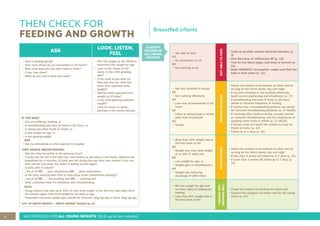
as long as the infant wants, day and night
• If less than 2 weeks old follow-up in 2 days (p. 15)
• If more than 2 weeks old follow-up in 7 days (p.
15)
• Not low weight for age and
no other signs of inadequate
feeding
• Less than 10% weight loss in
the first week of life
FEEDING
AND
GROWING
WELL
• Praise the mother for feeding the infant well
• Counsel the caregiver on home care for the young
infant (p. 14)
9
IMCI PROCESS FOR ALL YOUNG INFANTS (Birth up to two months)
THEN CHECK FOR
FEEDING AND GROWTH
CLASSIFY
FEEDING
AND
GROWTH
IN ALL
YOUNG
INFANTS
ASK
LOOK, LISTEN,
FEEL
• How is feeding going?
• What milk are you giving?
• How many times during the day and night?
• How much is given at each feed?
• How are you preparing the milk?
• Let caregiver demonstrate or explain how
a feed is prepared, and how it is given to
the baby
• Are you giving any breastmilk at all?
• What foods and fluids in addition to
replacement milk is being given?
• How is the milk being given? Cup or
bottle?
• How are you cleaning the utensils?
• Plot the weight on the RTHB to
determine the weight for age
• Look at the shape of the
curve. Is the child growing
well?
• If the child is less than 10
days old: Has the child lost
more than expected body
weight?
• Has the child regained birth
weight at 10 days?
• Is the child gaining sufficient
weight?
• Look for ulcers or white
patches in the mouth (thrush)
NOTE:
• Young infants may lose up to 10% of their birth weight in the first week after
birth, then from day 7-10 regain birth weight loss
• Thereafter minimum weight gain should be: Preterm: 10g/kg/day OR Term:
20g/kg/day
10% OF BIRTH WEIGHT = BIRTH WEIGHT divided by 10
• Not able to feed
OR
• Not sucking at all
NOT
ABLE
TO
FEED
• Treat as possible serious bacterial infection (p. 3)
• Give first dose of ceftriaxone IM (p. 12)
• Test for low blood sugar, and treat or prevent (p. 11)
• Refer URGENTLY —make sure that the baby is kept warm
• Milk incorrectly or
unhygienically prepared
OR
• Giving inappropriate
replacement milk or other
foods/fluids
OR
• Giving insufficient
replacement feeds
OR
• Using a feeding bottle
OR
• Thrush
FEEDING
PROBLEM
• Counsel about feeding and explain the guidelines for safe
replacement feeding (p. 19 - 20)
• Identify concerns of caregiver and family about feeding
• If caregiver is using a bottle, teach cup feeding (p. 18)
• If thrush, treat and teach the caregiver to treat it at home
(p. 13)
• Follow-up in 2 days (p. 15)
• More than 10% weight loss in
the first week of life
OR
• Weight less than birth weight
at or after 10 days of age
OR
• Weight gain is unsatisfactory
OR
• Weight loss following
discharge of LBW infant
POOR
GROWTH
• Check for feeding problem (p. 21)
• Counsel about feeding (p. 19 - 20)
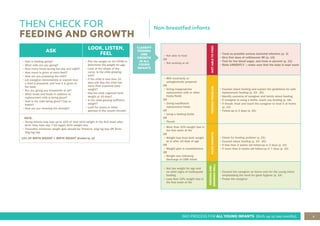
• If less than 2 weeks old follow-up in 2 days (p. 15)
• If more than 2 weeks old follow-up in 7 days (p. 15)
• Not low weight for age and
no other signs of inadequate
feeding
• Less than 10% weight loss in
the first week of life
FEEDING
AND
GROWING
WELL
• Counsel the caregiver on home care for the young infant
emphasising the need for good hygiene (p. 14)
• Praise the caregiver
Non-breastfed infants
10 IMCI PROCESS FOR ALL YOUNG INFANTS (Birth up to two months)
THEN CHECK THE YOUNG INFANT’S IMMUNISATION
STATUS AND IMMUNISE IF NEEDED
ASSESS THE CAREGIVER’S HEALTH
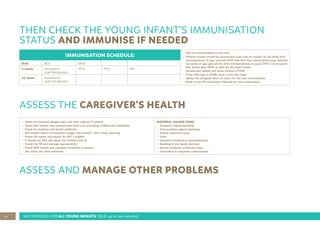
IMMUNISATION SCHEDULE:
• Give all missed doses on this visit
• Preterm infants should be immunised at six and ten weeks: do not delay their
immunisations. If they received OPV0 less than four weeks before they reached
six weeks of age, give all the other immunisations as usual (OPV1 can be given
four weeks after OPV0 or with the ten week doses)
• Include sick babies and those without a RTHB
• If the child has no RTHB, issue a new one today
• Advise the caregiver when to return for the next immunisation
• Refer to the EPI Vaccinator’s Manual for more information
Birth BCG OPV0
6 weeks Hexavalent1
(DaPT-IPV-HB-Hib1)
OPV1 PCV1 RV1
10 weeks Hexavalent2
(DaPT-IPV-HB-Hib2)
• Check for maternal danger signs and refer urgently if present
• Check that mother has received post-natal care according to Maternity Guidelines
• Check for anaemia and breast problems
• Ask mother about contraceptive usage, and counsel/ offer family planning
• Check HIV status and assess for ART if eligible
• If already on ART, ask about the mother’s last VL
• Screen for TB and manage appropriately
• Check RPR results and complete treatment if positive
• Ask about any other problems
MATERNAL DANGER SIGNS
• Excessive vaginal bleeding
• Foul smelling vaginal discharge
• Severe abdominal pain
• Fever
• Excessive tiredness or breathlessness
• Swelling of the hands and face
• Severe headache or blurred vision
• Convulsion or impaired consciousness
ASSESS AND MANAGE OTHER PROBLEMS
11
IMCI PROCESS FOR ALL YOUNG INFANTS (Birth up to two months)
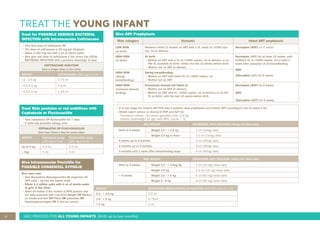
TREAT THE
YOUNG INFANT
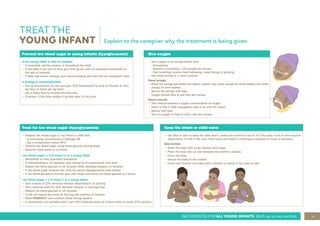
Keep the infant or child warm
• Use Skin to skin to keep the baby warm, unless the mother is too ill, or if the baby is too ill and requires
observation. (If this is the case, then nurse the infant in a transport incubator or wrap in blankets.)
Skin-to-Skin
• Dress the baby with a cap, booties and nappy
• Place the baby skin to skin between the mother’s breasts
• Cover the baby
• Secure the baby to the mother
• Cover both mother and baby with a blanket or jacket if the room is cold
Explain to the caregiver why the treatment is being given
Prevent low blood sugar in young infants (hypoglycaemia)
If the young infant is able to swallow:
• If breastfed: ask the mother to breastfeed the child
• If the baby is too sick to feed, give 3ml/kg per hour of expressed breastmilk on
the way to hospital
• If baby has severe lethargy and cannot swallow, give the milk by nasogastric tube
If feeding is contraindicated:
• Put up intravenous (IV) line and give 10% Neonatalyte by slow IV infusion at 3ml/
kg/hour (3 drops per kg/hour)
• Use a dial-a-flow to monitor the flow rate
• Example: If the baby weighs 4 kg then give 12 ml/hour
Treat for low blood sugar (hypoglycaemia)
• Suspect low blood sugar in any infant or child that:
- is convulsing, unconscious or lethargic OR
- has a temperature below 35ºC
• Confirm low blood sugar using blood glucose testing strips
• Keep the baby warm at all times
Low blood sugar (< 2.5 mmol/L) in a young infant
• Breastfeed or feed expressed breastmilk
• If breastfeeding is not possible, give 10mg/kg of replacement milk feed
• Repeat the blood glucose in 15 minutes while awaiting transport to hospital
• If the blood sugar remains low, treat for severe hypoglycaemia (see below)
• If the blood glucose is normal, give milk feeds and check the blood glucose 2-3 hourly
Low blood sugar < 1.4 mmol/L in a young infant
• Give a bolus of 10% dextrose infusion (Neonatalyte) at 2ml/kg
• Then continue with the 10% dextrose infusion at 3ml/kg/hour
• Repeat the blood glucose in 15 minutes
• If still low repeat the bolus of 2ml/kg and continue IV infusion
• Refer URGENTLY and continue feeds during transfer
• If neonatalyte not available add 1 part 50% dextrose water to 4 parts water to make 10% solution
Give oxygen
• Give oxygen to all young infants with:
- Convulsions
- Apnoea or breathing < 30 breaths per minute
- Fast breathing, severe chest indrawing, nasal flaring or grunting
• Use nasal prongs or a nasal cannula
Nasal prongs
• Place the prongs just below the baby’s nostrils. Use 1mm prongs for small babies and 2mm
prongs for term babies
• Secure the prongs with tape
• Oxygen should flow at one litre per minute
Nasal cannula
• This method delivers a higher concentration of oxygen
• Insert a FG5 or FG6 nasogastric tube 2 cm into the nostril
• Secure with tape
• Turn on oxygen to flow of half a litre per minute
12 IMCI PROCESS FOR ALL YOUNG INFANTS (Birth up to two months)
TREAT THE YOUNG INFANT
Treat for POSSIBLE SERIOUS BACTERIAL
INFECTION with Intramuscular Ceftriaxone
• Give first dose of ceftriaxone IM
• The dose of ceftriaxone is 50 mg per kilogram
• Dilute a 250 mg vial with 1 ml of sterile water
• Also give one dose of ceftriaxone if the infant has LOCAL
BACTERIAL INFECTION with a purulent discharge of eyes
CEFTRIAXONE INJECTION
Give a single dose in the clinic
WEIGHT CEFTRIAXONE (250 mg in 1 ml)
>2 - 2.5 kg 0.75 ml
>2.5-3.5 kg 0.9 ml
>3.5-5.5 kg 1.25 ml
Give Intramuscular Penicillin for
POSSIBLE CONGENITAL SYPHILIS
Give once only
• Give Benzathine Benzylpenicillin IM (injection) 50
000 units / kg into the lateral thigh
• Dilute 1.2 million units with 4 ml of sterile water
to give in the clinic
• Refer all babies if the mother is RPR positive and
the baby presents with Low birth Weight OR Blisters
on hands and feet OR Pallor OR petechiae OR
hepatosplenomegaly OR if you are unsure
Give ARV Prophylaxis
Risk category Scenario Infant ART prophylaxis
LOW RISK
(at birth)
Newborn infant of mother on ART with a VL result of <1000 cop-
ies/ ml at delivery
Nevirapine (NVP) for 6 weeks
HIGH RISK
(at birth)
At birth:
• Mother on ART with a VL of >1000 copies/ ml at delivery or no
HIV VL available at birth/ within the last 12 weeks before birth
• Mother not on ART at delivery
Nevirapine (NVP) for at least 12 weeks, until
mother’s VL is <1000 copies/ ml or until 1
week after cessation of all breastfeeding
AND
Zidovudine (AZT) for 6 weeks
HIGH RISK
(during
breastfeeding)
During breastfeeding:
• Mother on ART with latest VL of >1000 copies/ ml
• Mother not on ART
HIGH RISK
(exclusive formula
feeding)
Exclusively formula fed infant of:
• Mother not on ART at delivery
• Mother on ART with VL >1000 copies/ ml at delivery or no HIV
VL at birth/ with the last 12 weeks before birth
Nevirapine (NVP) for 6 weeks
AND
Zidovudine (AZT) for 6 weeks
Treat Skin pustules or red umbilicus with
Cephalexin or Flucloxacillin
• Give cephalexin OR flucloxacillin for 7 days
• If child has penicillin allergy, refer
CEPHALEXIN OR FLUCLOXACILLIN
Give four times a day for seven days
WEIGHT Cephalexin syrup
125 mg in 5 ml
Flucloxacillin syrup
125 mg in 5 ml
Up to 5 kg 2.5 ml 2.5 ml
≥ 5kg 5 ml 5 ml
• If at any stage the infant’s HIV PCR test is positive, stop prophylaxis and initiate ART according to the six steps p 52.
• Obtain expert advice on dosing of NVP and AZT for:
- Premature infants <35 weeks gestation and <2.0 kg.
- Infants underweight for age (with WFA z-score < -3).
AGE/WEIGHT NEVIRAPINE (NVP) SOLUTION (10mg/ml) Once daily
Birth to 6 weeks Weight 2.0 - < 2.5 kg 1 ml (10mg) daily
Weight 2.5 kg or more 1.5 ml (15mg) daily
6 weeks up to 6 months 2 ml (20mg) daily
6 months up to 9 months 3 ml (30mg) daily
9 months until 1 week after breastfeeding stops 4 ml (40mg) daily
AGE/WEIGHT ZIDOVUDINE (AZT) SOLUTION (10mg/ml) Twice daily
Birth to 6 weeks Weight 2.0 - < 2.5kg kg 1 ml (10 mg) twice daily
Weight 2.5 kg 1.5 ml (15 mg) twice daily
> 6 weeks Weight 3.0 - < 6 kg 6 ml (60 mg) twice daily
Weight 6 - 8 kg 9 ml (90 mg) twice daily
WEIGHT BENZATHINE BENZYLPENICILLIN INJECTION 300 000 units in 1 ml
2.5 - < 3.5 kg 0.5 ml
3.5 - < 5 kg 0.75ml
> 5 kg 1 ml
13
IMCI PROCESS FOR ALL YOUNG INFANTS (Birth up to two months)
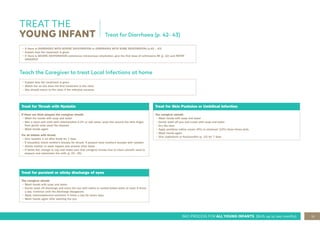
TREAT THE
YOUNG INFANT Treat for Diarrhoea (p. 42- 43)
Teach the Caregiver to treat Local Infections at home
Treat for Thrush with Nystatin
If there are thick plaques the caregiver should:
• Wash her hands with soap and water
• Wet a clean soft cloth with chlorhexidine 0.2% or salt water, wrap this around the little finger,
then gently wipe away the plaques
• Wash hands again
For all infants with thrush
• Give nystatin 1 ml after feeds for 7 days
• If breastfed, check mother’s breasts for thrush. If present treat mother’s breasts with nystatin
• Advise mother to wash nipples and areolae after feeds
• If bottle fed, change to cup and make sure that caregiver knows how to clean utensils used to
prepare and administer the milk (p. 23 - 25)
Treat for Skin Pustules or Umbilical Infection
The caregiver should:
• Wash hands with soap and water
• Gently wash off pus and crusts with soap and water
• Dry the area
• Apply povidone iodine cream (5%) or ointment (10%) three times daily
• Wash hands again
• Give cephalexin or flucloxacillin (p. 12) for 7 days
Treat for purulent or sticky discharge of eyes
The caregiver should:
• Wash hands with soap and water
• Gently wash off discharge and clean the eye with saline or cooled boiled water at least 4 times
a day. Continue until the discharge disappears
• Apply chloramphenicol ointment 4 times a day for seven days
• Wash hands again after washing the eye
• If there is DIARRHOEA WITH SEVERE DEHYDRATION or DIARRHOEA WITH SOME DEHYDRATION (p.42 – 43)
• Explain how the treatment is given
• If there is SEVERE DEHYDRATION commence intravenous rehydration, give the first dose of ceftriaxone IM (p. 12) and REFER
URGENTLY
• Explain how the treatment is given
• Watch her as she does the first treatment in the clinic
• She should return to the clinic if the infection worsens
14 IMCI PROCESS FOR ALL YOUNG INFANTS (Birth up to two months)
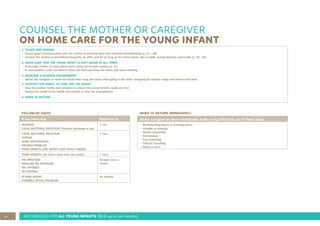
COUNSEL THE MOTHER OR CAREGIVER
ON HOME CARE FOR THE YOUNG INFANT
FOLLOW-UP VISITS nt has:up in:
If the infant has: Follow-up in:
JAUNDICE
LOCAL BACTERIAL INFECTION: Purulent discharge of eye
1 day
LOCAL BACTERIAL INFECTION
THRUSH
SOME DEHYDRATION
FEEDING PROBLEM
POOR GROWTH AND INFANT LESS THAN 2 WEEKS
2 days
POOR GROWTH and infant more than two weeks 7 days
HIV INFECTION
ONGOING HIV EXPOSURE
HIV EXPOSED
TB EXPOSED
At least once a
month
AT RISK INFANT
POSSIBLE SOCIAL PROBLEM
As needed
WHEN TO RETURN IMMEDIATELY:
Advise caregiver to return immediately if the young infant has any of these signs:
• Breastfeeding poorly or drinking poorly
• Irritable or lethargic
• Vomits everything
• Convulsions
• Fast breathing
• Difficult breathing
• Blood in stool
1. FLUIDS AND FEEDING
• Ensure good communication with the mother to promote early and exclusive breastfeeding (p. 17—18)
• Counsel the mother to breastfeed frequently, as often and for as long as the infant wants, day or night, during sickness and health (p. 18 - 20)
2. MAKE SURE THAT THE YOUNG INFANT IS KEPT WARM AT ALL TIMES
• Encourage mother to keep infant warm using skin-to-skin contact (p. 11)
• In cool weather, cover the infant’s head and feet and dress the infant with extra clothing
3. MAINTAIN A HYGIENIC ENVIRONMENT
• Advise the caregiver to wash her hands with soap and water after going to the toilet, changing the infant’s nappy and before each feed
4. SUPPORT THE FAMILY TO CARE FOR THE INFANT
• Help the mother, family and caregiver to ensure the young infant’s needs are met
• Assess any needs of the family and provide or refer for management
5. WHEN TO RETURN
15
IMCI PROCESS FOR ALL YOUNG INFANTS (Birth up to two months)
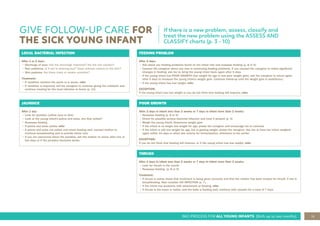
GIVE FOLLOW-UP CARE FOR
THE SICK YOUNG INFANT
If there is a new problem, assess, classify and
treat the new problem using the ASSESS AND
CLASSIFY charts (p. 3 - 10)
LOCAL BACTERIAL INFECTION
After 1 or 2 days:
• Discharge of eyes: has the discharge improved? Are the lids swollen?
• Red umbilicus: Is it red or draining pus? Does redness extend to the skin?
• Skin pustules: Are there many or severe pustules?
Treatment:
• If condition remains the same or is worse, refer
• If condition is improved, tell the caregiver to continue giving the antibiotic and
continue treating for the local infection at home (p. 13)
FEEDING PROBLEM
After 2 days:
• Ask about any feeding problems found on the initial visit and reassess feeding (p. 8 or 9)
• Counsel the caregiver about any new or continuing feeding problems. If you counsel the caregiver to make significant
changes in feeding, ask her to bring the young infant back again after 5 days
• If the young infant has POOR GROWTH (low weight for age or has poor weight gain), ask the caregiver to return again
after 5 days to measure the young infant’s weight gain. Continue follow-up until the weight gain is satisfactory
• If the young infant has lost weight, refer
EXCEPTION:
If the young infant has lost weight or you do not think that feeding will improve, refer
JAUNDICE
After 1 day:
• Look for jaundice (yellow eyes or skin)
• Look at the young infant’s palms and soles. Are they yellow?
• Reassess feeding
• If palms and soles yellow, refer
• If palms and soles not yellow and infant feeding well, counsel mother to
continue breastfeeding and to provide home care
• If you are concerned about the jaundice, ask the mother to return after one or
two days or if the jaundice becomes worse
POOR GROWTH
After 2 days in infant less than 2 weeks or 7 days in infant more than 2 weeks:
• Reassess feeding (p. 8 or 9)
• Check for possible serious bacterial infection and treat if present (p. 3)
• Weigh the young infant. Determine weight gain
• If the infant is no longer low weight for age, praise the caregiver and encourage her to continue
• If the infant is still low weight for age, but is gaining weight, praise the caregiver. Ask her to have her infant weighed
again within 14 days or when she returns for immunisation, whichever is the earlier
EXCEPTION:
If you do not think that feeding will improve, or if the young infant has lost weight, refer
THRUSH
After 2 days in infant less than 2 weeks or 7 days in infant more than 2 weeks:
• Look for thrush in the mouth
• Reassess feeding. (p. 8 or 9)
Treatment:
• If thrush is worse check that treatment is being given correctly, and that the mother has been treated for thrush, if she is
breastfeeding. Also consider HIV INFECTION (p. 7)
• If the infant has problems with attachment or feeding, refer
• If thrush is the same or better, and the baby is feeding well, continue with nystatin for a total of 7 days
16 COUNSEL THE MOTHER OR CAREGIVER ON INFANT AND YOUNG CHILD FEEDING
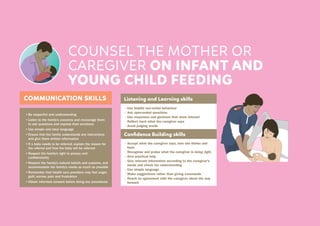
COUNSEL THE MOTHER OR
CAREGIVER ON INFANT AND
YOUNG CHILD FEEDING
COMMUNICATION SKILLS
• Be respectful and understanding
• Listen to the family’s concerns and encourage them
to ask questions and express their emotions
• Use simple and clear language
• Ensure that the family understands any instructions
and give them written information
• If a baby needs to be referred, explain the reason for
the referral and how the baby will be referred
• Respect the family’s right to privacy and
confidentiality
• Respect the family’s cultural beliefs and customs, and
accommodate the family’s needs as much as possible
• Remember that health care providers may feel anger,
guilt, sorrow, pain and frustration
• Obtain informed consent before doing any procedures
Listening and Learning skills
• Use helpful non-verbal behaviour
• Ask open-ended questions
• Use responses and gestures that show interest
• Reflect back what the caregiver says
• Avoid judging words
Confidence Building skills
• Accept what the caregiver says, how she thinks and
feels
• Recognise and praise what the caregiver is doing right.
• Give practical help
• Give relevant information according to the caregiver’s
needs and check her understanding
• Use simple language
• Make suggestions rather than giving commands
• Reach an agreement with the caregiver about the way
forward
17
COUNSEL THE MOTHER OR CAREGIVER ON INFANT AND YOUNG CHILD
SUPPORT MOTHERS TO BREASTFEED SUCCESSFULLY
BREASTFEEDING ASSESSMENT
• Has the baby breastfed in the previous hour?
• If baby has not fed in the last hour, ask mother to put baby to the breast. Observe the
breastfeed for 4 minutes. (If baby was fed during the last hour, ask mother if she can wait
and tell you when the infant is willing to feed again)
• Is baby able to attach?
not at all poor attachment good attachment
• Is the baby suckling well (that is, slow deep sucks, sometimes pausing)?
not at all not suckling well suckling well
• Clear a blocked nose if it interferes with breastfeeding
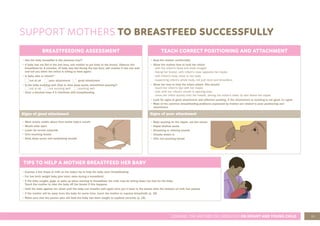
Signs of good attachment
• More areola visible above than below baby’s mouth
• Mouth wide open
• Lower lip turned outwards
• Chin touching breast
• Slow, deep sucks and swallowing sounds
TEACH CORRECT POSITIONING AND ATTACHMENT
• Seat the mother comfortably
• Show the mother how to hold her infant:
- with the infant’s head and body straight
- facing her breast, with infant’s nose opposite her nipple
- with infant’s body close to her body
- supporting infant’s whole body, not just neck and shoulders.
• Show her how to help the infant attach. She should:
- touch her infant’s lips with her nipple
- wait until her infant’s mouth is opening wide
- move her infant quickly onto her breast, aiming the infant’s lower lip well below the nipple
• Look for signs of good attachment and effective suckling. If the attachment or suckling is not good, try again
• Most of the common breastfeeding problems expressed by mother are related to poor positioning and
attachment
Signs of poor attachment
• Baby sucking on the nipple, not the areola
• Rapid shallow sucks
• Smacking or clicking sounds
• Cheeks drawn in
• Chin not touching breast
TIPS TO HELP A MOTHER BREASTFEED HER BABY
• Express a few drops of milk on the baby’s lip to help the baby start breastfeeding
• For low birth weight baby give short rests during a breastfeed
• If the baby coughs, gags, or spits up when starting to breastfeed, the milk may be letting down too fast for the baby.
Teach the mother to take the baby off the breast if this happens
• Hold the baby against her chest until the baby can breathe well again then put it back to the breast after the letdown of milk has passed
• If the mother will be away from the baby for some time, teach the mother to express breastmilk (p. 18)
• Make sure that the person who will feed the baby has been taught to cupfeed correctly (p. 18)
18 COUNSEL THE MOTHER OR CAREGIVER ON INFANT AND YOUNG CHILD FEEDING
SUPPORT ON EXPRESSING BREASTMILK AND
CUPFEEDING SUCCESSFULLY
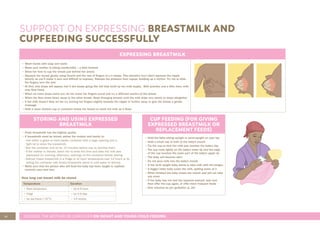
EXPRESSING BREASTMILK
• Wash hands with soap and water
• Make sure mother is sitting comfortably – a little forward
• Show her how to cup the breast just behind her areola
• Squeeze the breast gently, using thumb and the rest of fingers in a C shape. This shouldn’t hurt (don’t squeeze the nipple
directly as you’ll make it sore and difficult to express). Release the pressure then repeat, building up a rhythm. Try not to slide
the fingers over the skin
• At first, only drops will appear, but if she keeps going this will help build up her milk supply. With practice and a little time, milk
may flow freely
• When no more drops come out, let her move her fingers round and try a different section of the breast
• When the flow slows down, swop to the other breast. Keep changing breasts until the milk drips very slowly or stops altogether
• If the milk doesn’t flow, let her try moving her fingers slightly towards the nipple or further away, or give the breast a gentle
massage
• Hold a clean (boiled) cup or container below the breast to catch the milk as it flows
STORING AND USING EXPRESSED
BREASTMILK
• Fresh breastmilk has the highest quality
• If breastmilk must be stored, advise the mother and family to:
- Use either a glass or hard plastic container with a large opening and a
tight lid to store the breastmilk
- Boil the container and lid for 10 minutes before use to sterilise them
- If the mother is literate, teach her to write the time and date the milk was
expressed (or morning, afternoon, evening) on the container before storing
- Defrost frozen breastmilk in a fridge or at room temperature over 12 hours or by
letting the container with frozen breastmilk stand in cold water to defrost
• Make sure that the person who will feed the baby has been taught to cupfeed
correctly (see next box)
How long can breast milk be stored
Temperature Duration
• Room temperature • Up to 8 hours
• Fridge • Up to 6 days
• Ice box freezer (-18°C) • 3-6 months
CUP FEEDING (FOR GIVING
EXPRESSED BREASTMILK OR
REPLACEMENT FEEDS)
• Hold the baby sitting upright or semi-upright on your lap
• Hold a small cup of milk to the baby’s mouth
• Tip the cup so that the milk just reaches the baby’s lips
• The cup rests lightly on the baby’s lower lip and the edge
of the cup touches the outer part of the baby’s upper lip
• The baby will become alert
• Do not pour milk into the baby’s mouth
• A low birth weight baby starts to take milk with the tongue
• A bigger/older baby sucks the milk, spilling some of it
• When finished the baby closes the mouth and will not take
any more
• If the baby has not had the required amount, wait and
then offer the cup again, or offer more frequent feeds
• Give volumes as per guideline (p. 20)
19
COUNSEL THE MOTHER OR CAREGIVER ON INFANT AND YOUNG CHILD
COUNSEL THE CAREGIVER ABOUT
GIVING REPLACEMENT FEEDS
REQUIREMENTS FOR
SAFE REPLACEMENT FEEDING
• The mother or caregiver must purchase all the formula herself, and be prepared to do this for
12 months
• She must safely prepare milk before EACH of 6 – 8 feeds a day
• Running water in the house and electricity and a kettle are advisable for safe preparation of
6 – 8 feeds a day
• She must be able to clean and sterilise the equipment after each feed
• She should use a cup to feed the baby as it is safer than a bottle (p. 18)
REPLACEMENT FEEDS
• Ensure that the mother understands the benefits of breastfeeding and risks of not breastfeeding
• If the mother (or caregiver) nevertheless chooses not to breastfeed, ensure that she understands the
requirements for safe replacement feeding and knows how to prepare replacements feeds safely
• Infants who are on replacement feeds should receive no other foods or drinks until six months of age
• Young infants require to be fed at least 8 times in 24 hours
• Prepare correct strength and amount of replacement feeds before use (p. 20)
• Cup feeding is safer than bottle feeding. Use a cup which can be kept clean i.e. not one with a spout (p.18)
• Pasteurised full cream milk may be introduced to the non-breastfed infant’s diet from 12 months of age.
Avoid coffee, tea, creamers and condensed milk
• Where infant formula is not available, children over six months may temporarily receive undiluted
pasteurised full cream milk (boiled), provided that iron supplements or iron-fortified foods are consumed
and the amount of fluid in the overall diet is adequate
SAFE PREPARATION OF REPLACEMENT FEEDS
• Wash your hands with soap and water before preparing a feed
• Boil the water. If you are boiling the water in a pot, it must boil for three minutes. Cover the pot
with the lid while the water cools down. If using an automatic kettle, lift the lid of the kettle and
let it boil for three minutes
• The water must still be hot when you mix the feed to kill germs that might be in the powder
• Carefully pour the amount of water that will be needed in the marked cup. Check if the water
level is correct before adding the powder. Measure the powder according to the instructions on
the tin using the scoop provided. Only use the scoop that was supplied with the formula
• Mix by stirring with a clean spoon
• Cool the feed to body temperature under a running tap or in a container with cold water. Pour
the mixed formula into a cup to feed the baby
• Only make enough formula for one feed at a time
• Feed the baby using a cup (p. 18) and discard any leftover milk within two hours
Cleaning of equipment used for preparation and giving of feeds.
• If the infant is being cup fed:
- Wash all containers and utensils used for feeding and preparation thoroughly in hot soapy water. Make
sure that all remaining feed is removed. Rinse with clean water, allow to dry or dry with a clean cloth
and store in a clean place
- If possible, all containers and utensils should be sterilised once a day as described below
• If the caregiver is using bottles to feed the infant:
- Wash all containers and utensils used for feeding and preparation thoroughly in hot soapy water. Make
sure that all remaining feed is removed using a bottle brush. Rinse with clean water
- The bottles and other equipment must be sterilised after each use as described below
• Sterilisation should be done as follows:
- fill a large pot with water and completely submerge all washed feeding and preparation equipment,
ensuring there are no trapped air bubbles
- cover the pot with a lid and bring to a rolling boil, making sure the pot does not boil dry
- keep the pot covered until the feeding and preparation equipment is needed
BENEFITS OF BREASTFEEDING
• Breastfeeding is the perfect food for the baby. It contains many antibodies and substances that fight infection, mature the gut and body, and promote optimal growth, development and health for the baby
• The risk of not breastfeeding is a much higher chance of the baby becoming ill with, or even dying from, diarrhoea, pneumonia or malnutrition
• If the mother is HIV positive, with ART prophylaxis the risk of HIV transmission is much less than in the past
20 COUNSEL THE MOTHER OR CAREGIVER ON INFANT AND YOUNG CHILD FEEDING
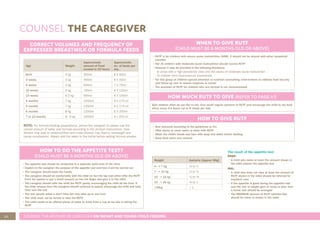
COUNSEL THE CAREGIVER
CORRECT VOLUMES AND FREQUENCY OF
EXPRESSED BREASTMILK OR FORMULA FEEDS
Age Weight
Approximate
amount of Feed
needed in 24 hours
Approximate
no. of feeds per
day.
Birth 3 kg 400ml 8 X 50ml
2 weeks 3 kg 400ml 8 X 50ml
6 weeks 4 kg 600ml 7 X 75ml
10 weeks 5 kg 750ml 6 X 125ml
14 weeks 6.5 kg 900ml 6 X 150ml
4 months 7 kg 1050ml 6 X 175 ml
5 months 7 kg 1050ml 6 X 175 ml
6 months 8 kg 1200ml 6 X 200ml
7 to 12 months 8 - 9 kg 1000ml 4 x 250 ml
NOTE: For formula feeding preparations, advise the caregiver to always use the
correct amount of water and formula according to the product instructions. Over-
dilution may lead to undernutrition and under-dilution may lead to overweight and
cause constipation. Always add the water to the bottle before adding formula powder.
WHEN TO GIVE RUTF
(CHILD MUST BE 6 MONTHS OLD OR ABOVE)
• RUTF is for children with severe acute malnutrition (SAM). It should not be shared with other household
member
• Not all children with moderate acute malnutrition should receive RUTF
• However it may be provided in the following situations:
- In areas with a high prevalence (new and old cases) of moderate acute malnutrition
- To children from food-insecure households
• For this group of children special attention to nutrition counselling, interventions to address food security
and follow-up care to assess response is crucial
• The provision of RUTF for children who are stunted is not recommended
HOW TO DO THE APPETITE TEST?
(CHILD MUST BE 6 MONTHS OLD OR ABOVE)
• The appetite test should be conducted in a separate quiet area of the clinic
• Explain to the caregiver the purpose of the appetite test and how it will be carried out
• The caregiver should wash her hands
• The caregiver should sit comfortably with the child on her/his lap and either offer the RUTF
from the packet or put a small amount on her/his finger and give it to the child
• The caregiver should offer the child the RUTF gently, encouraging the child all the time. If
the child refuses then the caregiver should continue to quietly encourage the child and take
time over the test
• The test usually takes a short time but may take up to one hour
• The child must not be forced to take the RUTF
• The child needs to be offered plenty of water to drink from a cup as he/she is taking the
RUTF
HOW TO GIVE RUTF
• Give amounts according to the guidelines (p 41)
• Offer plenty of clean water to drink with RUTF
• Wash the child’s hands and face with soap and water before feeding
• Keep food clean and covered
HOW MUCH RUTF TO GIVE (REFER TO PAGE 41)
Sick children often do not like to eat. Give small regular portions of RUTF and encourage the child to eat food
often, every 3-4 hours (up to 8 meals per day)
Weight Sachets (Approx 90g)
4 - < 7 kg ¼ to
7 - < 10 kg to ½
10 - < 15 kg ½ to ¾
15 - < 30 kg ¾ to 1
>30kg > 1
The result of the appetite test
PASS:
• A child who takes at least the amount shown in
the table passes the appetite test
FAIL:
• A child who does not take at least the amount of
RUTF shown in the table should be referred for
inpatient care
• If the appetite is good during the appetite test
and the rate of weight gain at home is poor then
a home visit should be arranged
• The MINIMUM amount of RUTF sachets that
should be taken is shown in the table
21
COUNSEL THE MOTHER OR CAREGIVER ON INFANT AND YOUNG CHILD
FEEDING ASSESSMENT
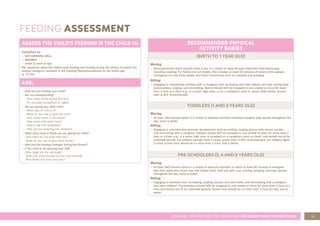
ASSESS THE CHILD’S FEEDING IF THE CHILD IS:
Classified as:
• NOT GROWING WELL
• ANAEMIA
• Under 2 years of age
Ask questions about the child’s usual feeding and feeding during this illness. Compare the
mother/caregiver’s answers to the Feeding Recommendations for the child’s age
(p. 17-23)
ASK:
• How are you feeding your child?
• Are you breastfeeding?
- How many times during the day?
- Do you also breastfeed at night?
• Are you giving any other milk?
- What type of milk is it?
- What do you use to give the milk?
- How many times in 24 hours?
- How much milk each time?
- How is the milk prepared?
- How are you cleaning the utensils?
• What other food or fluids are you giving the child?
- How often do you feed him/her?
- What do you use to give other fluids?
• How has the feeding changed during this illness?
• If the child is not growing well, ASK:
- How large are the servings?
- Does the child receive his/her own serving?
- Who feeds the child and how?
RECOMMENDED PHYSICAL
ACTIVITY BABIES
(BIRTH TO 1 YEAR OLD)
Moving
• Being physically active several times a day in a variety of ways through interactive floor-based play,
including crawling. For babies not yet mobile, this includes at least 30 minutes of tummy time spread
throughout the day while awake, and other movements such as reaching and grasping
Sitting
• Engaging in stimulating activities with a caregiver, such as playing with safe objects and toys, having baby
conversations, singing, and storytelling. Babies should NOT be strapped in and unable to move for more
than 1 hour at a time (e.g., in a pram, high chair, or on a caregiver’s back or chest) while awake. Screen
time is NOT recommended
TODDLERS (1 AND 2 YEARS OLD)
Moving
• At least 180 minutes spent in a variety of physical activities including energetic play, spread throughout the
day; more is better
Sitting
• Engaging in activities that promote development such as reading, singing, games with blocks, puzzles,
and storytelling with a caregiver. Toddlers should NOT be strapped in and unable to move for more than 1
hour at a time (e.g., in a pram, high chair or strapped on a caregiver’s back or chest), and should not sit for
extended periods. For toddlers younger than 2 years, screen time is NOT recommended. For toddlers aged
2 years, screen time should be no more than 1 hour; less is better
PRE-SCHOOLERS (3, 4 AND 5 YEARS OLD)
Moving
• At least 180 minutes spent in a variety of physical activities, of which at least 60 minutes is energetic
play that raises their heart rate and makes them ‘huff and puff’ (e.g. running, jumping, dancing), spread
throughout the day; more is better
Sitting
• Engaging in activities such as reading, singing, puzzles, arts and crafts, and story-telling with a caregiver
and other children. Pre-schoolers should NOT be strapped in and unable to move for more than 1 hour at a
time and should not sit for extended periods. Screen time should be no more than 1 hour per day; less is
better
22 COUNSEL THE MOTHER OR CAREGIVER ON INFANT AND YOUNG CHILD FEEDING
COUNSEL THE CAREGIVER
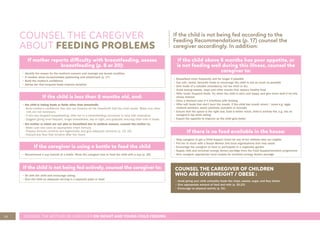
ABOUT FEEDING PROBLEMS
If the child is not being fed according to the
Feeding Recommendations (p. 17) counsel the
caregiver accordingly. In addition:
If mother reports difficulty with breastfeeding, assess
breastfeeding (p. 8 or 20):
• Identify the reason for the mother’s concern and manage any breast condition
• If needed, show recommended positioning and attachment (p. 17)
• Build the mother’s confidence
• Advise her that frequent feeds improve lactation
If the child above 6 months has poor appetite, or
is not feeding well during this illness, counsel the
caregiver to:
• Breastfeed more frequently and for longer if possible
• Use soft, varied, favourite foods to encourage the child to eat as much as possible
• Give foods of a suitable consistency, not too thick or dry
• Avoid buying sweets, chips and other snacks that replace healthy food
• Offer small, frequent feeds. Try when the child is alert and happy, and give more food if he/she
shows interest
• Clear a blocked nose if it interferes with feeding
• Offer soft foods that don’t burn the mouth, if the child has mouth ulcers / sores e.g. eggs,
mashed potatoes, sweet potatoes, pumpkin or avocado
• Ensure that the spoon is the right size, food is within reach, child is actively fed, e.g. sits on
caregiver’s lap while eating
• Expect the appetite to improve as the child gets better
If there is no food available in the house:
• Help caregiver to get a Child Support Grant for any of her children who are eligible
• Put her in touch with a Social Worker and local organisations that may assist
• Encourage the caregiver to have or participate in a vegetable garden
• Supply milk and enriched (energy dense) porridge from the Food Supplementation programme
• Give caregiver appropriate local recipes for enriched (energy dense) porridge
COUNSEL THE CAREGIVER OF CHILDREN
WHO ARE OVERWEIGHT / OBESE :
• Avoid giving your child unhealthy foods like chips, sweets, sugar, and fizzy drinks
• Give appropriate amount of food and milk (p. 20,23)
• Encourage on physical activity (p. 21)
If the child is less than 6 months old, and:
• the child is taking foods or fluids other than breastmilk:
- Build mother’s confidence that she can produce all the breastmilk that the child needs. Water and other
milk are not necessary
- If she has stopped breastfeeding, refer her to a breastfeeding counsellor to help with relactation
- Suggest giving more frequent, longer breastfeeds, day or night, and gradually reducing other milk or foods
• the mother or infant are not able to breastfeed due to medical reasons, counsel the mother to:
- Make sure she uses an appropriate infant formula
- Prepare formula correctly and hygienically, and give adequate amounts (p. 19- 20)
- Discard any feed that remains after two hours
If the caregiver is using a bottle to feed the child
• Recommend a cup instead of a bottle. Show the caregiver how to feed the child with a cup (p. 18)
If the child is not being fed actively, counsel the caregiver to:
• Sit with the child and encourage eating
• Give the child an adequate serving in a separate plate or bowl
23
COUNSEL THE MOTHER OR CAREGIVER ON INFANT AND YOUNG CHILD
24 ASSESS AND CLASSIFY THE SICK CHILD AGE 2 MONTHS UP TO 5 YEARS
AGE 2 MONTHS UP TO 5 YEARS
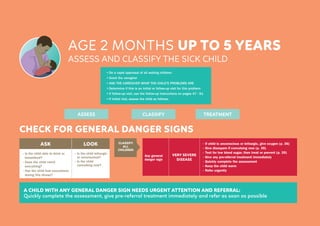
ASSESS AND CLASSIFY THE SICK CHILD
CHECK FOR GENERAL DANGER SIGNS
• Do a rapid appraisal of all waiting children
• Greet the caregiver
• ASK THE CAREGIVER WHAT THE CHILD’S PROBLEMS ARE
• Determine if this is an initial or follow-up visit for this problem
• If follow-up visit, use the follow-up instructions on pages 47 - 51
• If initial visit, assess the child as follows:
ASSESS CLASSIFY TREATMENT
ASK LOOK
• Is the child able to drink or
breastfeed?
• Does the child vomit
everything?
• Has the child had convulsions
during this illness?
• Is the child lethargic
or unconscious?
• Is the child
convulsing now?
CLASSIFY
ALL
CHILDREN
Any general
danger sign
VERY SEVERE
DISEASE
• If child is unconscious or lethargic, give oxygen (p. 36)
• Give diazepam if convulsing now (p. 35)
• Test for low blood sugar, then treat or prevent (p. 35)
• Give any pre-referral treatment immediately
• Quickly complete the assessment
• Keep the child warm
• Refer urgently
A CHILD WITH ANY GENERAL DANGER SIGN NEEDS URGENT ATTENTION AND REFERRAL:
Quickly complete the assessment, give pre-referral treatment immediately and refer as soon as possible
25
ASSESS AND CLASSIFY THE SICK CHILD AGE 2 MONTHS UP TO 5 YEARS
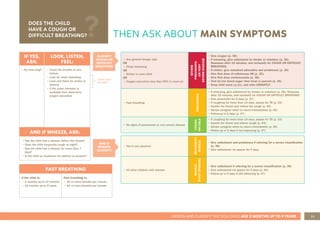
THEN ASK ABOUT MAIN SYMPTOMS
IF YES,
ASK:
LOOK, LISTEN,
FEEL:
• For how long? • Count the breaths in one
minute
• Look for chest indrawing
• Look and listen for stridor or
wheeze
• If the pulse oximeter is
available then determine
oxygen saturation
AND IF WHEEZE, ASK:
• Has the child had a wheeze before this illness?
• Does the child frequently cough at night?
• Has the child had a wheeze for more than 7
days?
• Is the child on treatment for asthma at present?
CLASSIFY
COUGH OR
DIFFICULT
BREATHING
AND IF
WHEEZE
CLASSIFY
• Any general danger sign
OR
• Chest indrawing
OR
• Stridor in calm child
OR
• Oxygen saturation less than 90% in room air
SEVERE
PNEUMONIA
OR
VERY
SEVERE
DISEASE
• Give oxygen (p. 36)
• If wheezing, give salbutamol by inhaler or nebuliser (p. 36).
Reassess after 15 minutes, and reclassify for COUGH OR DIFFICULT
BREATHING.
• If stridor: give nebulised adrenaline and prednisone (p. 36)
• Give first dose of ceftriaxone IM (p. 35)
• Give first dose cotrimoxazole (p. 38)
• Test for low blood sugar, then treat or prevent (p. 35)
• Keep child warm (p.11), and refer URGENTLY
• Fast breathing
PNEUMONIA
• If wheezing, give salbutamol by inhaler or nebuliser (p. 36). Reassess
after 15 minutes, and reclassify for COUGH OR DIFFICULT BREATHING
• Give amoxicillin for 5 days (p. 37)
• If coughing for more than 14 days, assess for TB (p. 33)
• Soothe the throat and relieve the cough (p. 44)
• Advise caregiver when to return immediately (p. 45)
• Follow-up in 2 days (p. 47)
• No signs of pneumonia or very severe disease
COUGH
OR
COLD
• If coughing for more than 14 days, assess for TB (p. 33)
• Soothe the throat and relieve cough (p. 44)
• Advise caregiver when to return immediately (p. 45)
• Follow up in 5 days if not improving (p. 47)
• Yes to any question
RECURRENT
WHEEZE
• Give salbutamol and prednisone if referring for a severe classification
(p. 36)
• Give salbutamol via spacer for 5 days
• All other children with wheeze
WHEEZE
(FIRST
EPISODE)
• Give salbutamol if referring for a severe classification (p. 36)
• Give salbutamol via spacer for 5 days (p. 40)
• Follow-up in 5 days if still wheezing (p. 47)
DOES THE CHILD
HAVE A COUGH OR
DIFFICULT BREATHING?
FAST BREATHING
If the child is:
• 2 months up to 12 months
• 12 months up to 5 years
Fast breathing is:
• 50 or more breaths per minute
• 40 or more breaths per minute
Child must
be calm
26 ASSESS AND CLASSIFY THE SICK CHILD AGE 2 MONTHS UP TO 5 YEARS
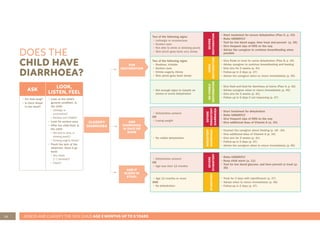
DOES THE
CHILD HAVE
DIARRHOEA?
ASK
LOOK,
LISTEN, FEEL
• For how long?
• Is there blood
in the stool?
• Look at the child’s
general condition. Is
the child:
• Lethargic or
unconscious?
• Restless and irritable?
• Look for sunken eyes
• Offer the child fluid. Is
the child:
• Not able to drink, or
drinking poorly?
• Drinking eagerly, thirsty?
• Pinch the skin of the
abdomen. Does it go
back:
• Very slowly
(> 2 seconds)?
• Slowly?
AND IF
BLOOD IN
STOOL
AND
DIARRHOEA
14 DAYS OR
MORE
FOR
DEHYDRATION
Two of the following signs:
• Lethargic or unconscious
• Sunken eyes
• Not able to drink or drinking poorly
• Skin pinch goes back very slowly
SEVERE
DEHYDRATION
• Start treatment for severe dehydration (Plan C, p. 43)
• Refer URGENTLY
• Test for low blood sugar, then treat and prevent (p. 35)
• Give frequent sips of ORS on the way
• Advise the caregiver to continue breastfeeding when
possible
Two of the following signs:
• Restless, irritable
• Sunken eyes
• Drinks eagerly, thirsty
• Skin pinch goes back slowly
SOME
DEHYDRATION
• Give fluids to treat for some dehydration (Plan B, p. 42)
• Advise caregiver to continue breastfeeding and feeding
• Give zinc for 2 weeks (p. 41)
• Follow-up in 2 days (p. 47)
• Advise the caregiver when to return immediately (p. 45)
• Not enough signs to classify as
severe or some dehydration
NO
VISIBLE
DEHYDRATION
• Give fluid and food for diarrhoea at home (Plan A, p. 42)
• Advise caregiver when to return immediately (p. 45)
• Give zinc for 2 weeks (p. 41)
• Follow up in 5 days if not improving (p. 47)
• Dehydration present
OR
• Losing weight
SEVERE
PERSISTENT
DIARRHOEA
• Start treatment for dehydration
• Refer URGENTLY
• Give frequent sips of ORS on the way
• Give additional dose of Vitamin A (p. 34)
• No visible dehydration
PERSISTENT
DIARRHOEA
• Counsel the caregiver about feeding (p. 18 - 24)
• Give additional dose of Vitamin A (p. 34)
• Give zinc for 2 weeks (p. 41)
• Follow-up in 5 days (p. 47)
• Advise the caregiver when to return immediately (p. 45)
• Dehydration present
OR
• Age less than 12 months
SEVERE
DYSENTERY
• Refer URGENTLY
• Keep child warm (p. 11)
• Test for low blood glucose, and then prevent or treat (p.
35)
• Age 12 months or more
AND
• No dehydration
DYSENTERY
• Treat for 3 days with ciprofloxacin (p. 37)
• Advise when to return immediately (p. 45)
• Follow-up in 2 days (p. 47)
CLASSIFY
DIARRHOEA
27
ASSESS AND CLASSIFY THE SICK CHILD AGE 2 MONTHS UP TO 5 YEARS
DOES THE CHILD HAVE FEVER?
FOR
SUSPECTED
MENINGITIS
AND IF
MALARIA
RISK
CLASSIFY
FEVER
ASK:
LOOK
AND FEEL:
• For how long? • stiff neck
• bulging
fontanelle
IF YES, DECIDE THE
CHILD’S MALARIA RISK
• Malaria Risk means: Lives in malaria zone
or visited a malaria zone during the past 4
weeks. If in doubt, classify for malaria risk
AND IF MALARIA RISK
• Do a rapid malaria test
IF MALARIA TEST NOT
AVAILABLE
• Look for a cold with runny nose
• Look for another adequate cause of fever
CONSIDER MEASLES IF
• Generalized rash with any of the following:
• Runny nose, OR
• Red eyes, OR
• Cough
Use the Measles chart (p. 28)
By history, by feel, or axillary temp is
37.5° C or above
• Any general danger sign
OR
• Stiff neck or bulging fontanelle
SUSPECTED
MENINGITIS
• Give first dose of ceftriaxone IM (p. 35)
• Test for low blood sugar, then treat or prevent (p. 35)
• Give one dose of paracetamol for fever 38°C or above (p.
40)
• Refer URGENTLY
• None of the above signs
FEVER
OTHER
CAUSE
• Give paracetamol for fever 38°C or above (p. 40)
• If fever present for more than 7 days, consider TB (p. 33)
• Treat for other causes
• Advise caregiver when to return immediately (p. 45)
• Follow-up in 2 days if fever persists (p. 49)
• Any general danger sign
OR
• Stiff neck or bulging fontanelle
SUSPECTED
SEVERE
MALARIA
• If Malaria test positive and child older then 12 months,
treat for Malaria (p. 40)
• Treat for SUSPECTED MENINGITIS
• Test for low blood sugar, then treat or prevent (p. 35)
• Give one dose of paracetamol for fever 38°C or above (p.
40)
• Refer URGENTLY
• Malaria test positive
MALARIA
• If age less than 12 months, refer URGENTLY
• If older than 12 months, treat for malaria (p. 40)
• Give paracetamol for fever 38°C or above (p. 40)
• Advise caregiver when to return immediately (p. 45)
• Notify confirmed malaria cases
• Follow-up in 2 days if fever persists (p. 49)
• Malaria test not done and PNEUMONIA
OR
• Malaria test not done and no other
adequate cause of fever found
SUSPECTED
MALARIA
• Refer child to facility where Malaria Rapid Test can be done
• Give paracetamol for fever 38°C or above (p. 40)
• If fever present for more than 7 days, assess for TB (p. 33)
• Malaria test negative
OR
• Malaria test not done and a cold with
runny nose, or other adequate cause of
fever found
FEVER
OTHER
CAUSE
• Give paracetamol for fever 38°C or above (p. 40)
• If fever present for more than 7 days, assess for TB (p. 33)
• Treat for other causes
• Advise caregiver when to return immediately (p. 45)
• Follow-up in 2 days if fever persists (p. 49)
28 ASSESS AND CLASSIFY THE SICK CHILD AGE 2 MONTHS UP TO 5 YEARS
MEASLES
CLASSIFY
FOR
MEASLES
Use this chart if the child has Fever and Generalised rash
WITH Runny nose or Cough or Red eyes
ASK: LOOK:
• Has the child been in
contact with anyone
with measles?
• Look for mouth ulcers
-Are they deep and extensive?
• Look for pus draining from the eye
• Look for clouding of the cornea
TEST FOR MEASLES
• Take 5 mls of blood for serology and a throat swab for viral
isolation
• Send blood specimen on ice—consult EPI co-ordinator or EPI
guidelines for details
• Send the throat swab in a packed labeled viral transport tube
ensuring that the swab is immersed in the sponge containing
the viral transport medium
• Specimens should be collected as soon after onset of rash as
possible
NOTE:
IF FEVER IS STILL PRESENT AFTER THE THIRD DAY OF THE RASH,
A COMPLICATION SHOULD BE SUSPECTED
• Any general danger sign
OR
• PNEUMONIA
OR
• Symptomatic HIV infection
OR
• Clouding of cornea
OR
• Deep or extensive mouth ulcers.
SUSPECTED
COMPLICATED
MEASLES
• Give additional dose Vitamin A (p. 34)
• If clouding of the cornea or pus draining from the eye,
apply chloramphenicol eye ointment (p. 44)
• Give first dose of amoxicillin (p. 37) unless child is
receiving IM ceftriaxone for another reason
• REFER URGENTLY
• Immunise all close contacts within 72 hours of exposure
(a close contact is defined as who has been in the same
room or vehicle as the child with measles)
• Measles symptoms present
AND
• Measles test positive
MEASLES
• Give additional doses Vitamin A (p. 34)
• If pus draining from the eye, treat eye infection with
chloramphenicol eye ointment for 7 days (p. 44)
• If mouth ulcers, treat with chlorhexidine (p. 44)
• Notify EPI coordinator, and complete necessary forms
• Isolate the child from other children for 5 days
• Immunise all close contacts within 72 hours of exposure (a
close contact is defined as who has been in the same room
or vehicle as the child with measles)
• Follow up in 2 days (p. 49)
• Measles test results not available
AND
• Measles symptoms present
SUSPECTED
MEASLES
• Give additional doses Vitamin A (p. 34)
• Notify EPI coordinator, and complete necessary forms
• Take specimens as advised by EPI coordinator, and send
these to the NICD
• Isolate the child from other children for 5 days
• Immunise all close contacts within 72 hours of exposure (a
close contact is defined as who has been in the same room
or vehicle as the child with measles)
• Follow up in 2 days (p. 49)
29
ASSESS AND CLASSIFY THE SICK CHILD AGE 2 MONTHS UP TO 5 YEARS
DOES THE CHILD HAVE AN EAR PROBLEM?
CLASSIFY
EAR
PROBLEM
IF YES, ASK:
LOOK AND
FEEL:
• Is there ear pain?
• Does it wake the
child at night?
• Is there ear
discharge?
• If yes, for how long?
• Look for pus draining
from the ear
• Feel for tender
swelling behind the
ear
• Tender swelling behind the ear
MASTOIDITIS
• Give ceftriaxone IM (p. 35)
• Give first dose of paracetamol (p. 40)
• Refer URGENTLY
• Pus seen draining from the ear and discharge is
reported for less than 14 days
OR
• Ear pain which wakes the child at night
ACUTE
EAR
INFECTION
• Give amoxicillin for 5 days (p. 37)
• If ear discharge: Teach caregiver to clean ear by dry wicking (p. 44)
• Give paracetamol for pain (p. 40). Give for two days.
• Follow-up in 5 days if pain or discharge persists (p. 49)
• Follow-up in 14 days (p. 49)
• Pus is seen draining from the ear
AND
• Discharge is reported for 14 days or more
CHRONIC
EAR
INFECTION
• Teach caregiver to clean ear by dry wicking (p. 44)
• Then instil recommended ear drops, if available (p. 44)
• Tell the caregiver to come back if she suspects hearing loss
• Follow up in 14 days (p. 49)
• No ear pain or ear pain which does not wake
the child at night
AND
• No pus seen draining from the ear
NO
EAR
INFECTION
• No additional treatment
CLASSIFY
SORE
THROAT
IF YES, ASK:
LOOK AND
FEEL:
• Does the child have
a rash?*
• Does the child have
a runny nose?
• Does the child have
a cough?
• Enlarged tonsils
• White or yellow
exudate on tonsils
• Scarlatiniform rash*
• Enlarged tonsils with white or yellow exudate
AND
One or more of the following:
• No runny nose
• No cough
• Scarlatiniform rash
POSSIBLE
STREPTOCOCCAL
INFECTION
• Give penicillin (p. 36)
• Treat pain and fever (p. 43)
• Soothe the throat with a safe remedy (p. 44)
• Follow-up in 5 days if symptoms worse or not resolving (p. 49)
• Not enough signs to classify as streptococcal
sore throat
SORE
THROAT • Soothe the throat with a safe remedy (p. 44)
ASK DOES THE CHILD HAVE A SORE THROAT?
If the child is 3 years old or older
* The typical streptococcal rash is red, becomes pale
when pressed and has a rough feel (like sandpaper).
30 ASSESS AND CLASSIFY THE SICK CHILD AGE 2 MONTHS UP TO 5 YEARS
THEN
CHECK ALL
CHILDREN FOR
MALNUTRITION
LOOK AND FEEL:
• Look for mouth ulcers. Are
they deep and extensive?
• Weigh the child and plot the
child’s weight-for-age in the
RTHB
• Look at the shape of
the child’s weight curve.
Does it show weight loss,
unsatisfactory weight gain or
satisfactory weight gain?
• If the child is 6 months or
older measure the child’s
MUAC* and record in the
child’s RTHB
• If the child’s weight-for-age
chart shows a problem it is
important to also measure
and record their length/
height-for-age and weight-for-
length/height in the child’s
RTHB to check for stunting
and wasting, respectively
• Look for oedema of both feet
• Conduct an Appetite Test if
indicated (p. 20)
* MUAC is Mid-Upper Arm
Circumference which should
be measured in all children 6
months or older using a MUAC
tape.
** Growth curve flattening/
decreasing is defined by
changes on the growth curve
over a 2-3 month period.
One or more of the following
• Oedema of both feet
• Weight for length/ height z-score less
than -3 OR MUAC less than 11.5cm
AND
One or more of the following:
• Any danger sign
• Any other RED or YELLOW classification
• Weighs 4 kg or less
• Less than six months of age
• If fails appetite test (p. 20)
SEVERE
ACUTE
MALNUTRITION
WITH
MEDICAL
COMPLICATION
• Test for low blood sugar, then prevent (p. 35)
• Keep the child warm (p. 11)
• Give antibiotic. If indicated for another classification, give ceftriaxone
(p. 35). Otherwise give first dose of amoxicillin (p. 37)
• Give stabilizing feed or F75 (p. 35)
• Give dose of Vitamin A (p. 34)
• Refer URGENTLY
• Weight for length/ Height z-score < -3
OR
• MUAC ≤ 11.5 cm
AND
• No oedema of both feet
• Six months or older
• Weighs 4 kg or more
• No other RED or YELLOW classification
SEVERE
ACUTE
MALNUTRITION
WITHOUT
MEDICAL
COMPLICATION
• Give amoxicillin for 5 days (p. 37)
• Give dose of Vitamin A (p. 34) and treat for worms if due (p. 34)
• Assess the child’s feeding and counsel the caregiver on the feeding recommendations
(p. 16 - 23)
• Assess for possible HIV & TB infection (p. 32 & 33)
• Provide RUTF or other supplements according to local guidelines (p. 41)
• Advise caregiver when to return immediately (p. 45)
• Make sure that the has a birth certificate, and is receiving a child support grant if eligible.
• Refer to other available services if indicated (CHW, social worker, community based organisations)
• Follow up in 7 days (p. 48)
• Weight for length/height between -3
and –2 z-score OR MUAC from 11.5 cm
to 12.5cm
• No oedema of both feet
MODERATE
ACUTE
MALNUTRITION
• Give dose of Vitamin A (p. 34) and treat for worms if due (p. 34)
• Assess the child’s feeding and counsel the caregiver on the feeding recommendations
(p. 16 - 23)
• Assess for possible HIV & TB infection (p. 32 & 33)
• Provide RUTF or other supplements according to local guidelines (p. 41)
• Advise caregiver when to return immediately (p. 45)
• Make sure that the has a birth certificate, and is receiving a child support grant if eligible.
• Refer to other available services if indicated (CHW, social worker, community based
organisations)
• Follow up in 7 days (p. 48)
• Losing weight OR
• Weight gain unsatisfactory OR
• Low or very low weight OR
• Low length for age (children below 24
months)
NOT
GROWING
WELL
• Assess the child’s feeding and counsel the caregiver on the feeding recommendations (p. 16 -
23)
• Assess for possible HIV & TB infection (p. 32 & 33)
• Treat for worms and give Vitamin A if due (p. 34)
• Make sure that the child has a birth certificate, and is receiving a child support grant if
eligible. Refer to other available services if indicated (CHW, social worker, community based
organisations)
• Advise caregiver when to return immediately (p.45)
• If feeding problem follow up in 7 days (p. 48)
• If no feeding problem, follow-up after 14 days (p. 48)
• Weight for length/height greater than
+2 z-score
OVERWEIGHT
/
OBESE
• Assess feeding, and counsel caregiver( p. 23)
• Provide dietary counseling (p. 22)
• Encouraging healthy eating habits for entire family (p. 23)
• Provide advice on physical activity (p. 21)
• Weight normal AND
• Weight gain satisfactory AND
• Weight for length/height –2 z-score or
more OR MUAC 12.5 cm or more
GROWING
WELL
• Praise the caregiver
• If the child is less than 2 years old, assess feeding and counsel the caregiver on feeding
according to the feeding recommendations (p. 18 - 20)
• If feeding problem, follow up in 7 days (p. 48)
CLASSIFY ALL
CHILDREN’S
NUTRITIONAL
STATUS
31
ASSESS AND CLASSIFY THE SICK CHILD AGE 2 MONTHS UP TO 5 YEARS
CLASSIFY ALL
CHILDREN FOR
ANAEMIA
THEN CHECK ALL
CHILDREN FOR ANAEMIA
LOOK:
• Look for palmar pallor. Is there:
-Severe palmar pallor?
-Some palmar pallor?
• If any pallor, check haemoglobin (Hb)
level
NOTE:
• DO NOT give Iron if the child is receiving
RUTF. Small amounts are available in
RUTF
• Iron is extremely toxic in overdose,
particularly in children
• All medication should be stored out of
reach of children
• Severe palmar pallor
OR
• HB < 7g/dl
SEVERE
ANAEMIA
• Refer URGENTLY
• Some palmar pallor
• OR
• Hb 7 g/dl up to 11 g/dl
ANAEMIA
• Give iron (p. 41) and counsel on iron-rich foods
• Assess feeding and counsel regarding any feeding problems (p. 17 - 23)
• Treat for worms if due (p. 34)
• Advise caregiver when to return immediately (p. 45)
• Follow-up in 14 days (p. 48)
• No pallor.
NO
ANAEMIA
• If child is less than 2 years, assess feeding and counsel (p. 17 - 20)
32 ASSESS AND CLASSIFY THE SICK CHILD AGE 2 MONTHS UP TO 5 YEARS
THEN CHECK ALL CHILDREN FOR HIV INFECTION
IF YES, ASK:
• What was the result?
• If the test was positive, is the child on ART?
• If the test was negative, was the child still breastfeeding at the time that the test was
done, or had the child been breastfed in the 6 weeks before the test was done? Is the
child still breastfeeding?
HIV TESTING IN CHILDREN:
• All HIV-exposed infants should have been tested at birth. Ensure you obtain the result
• If the test was negative, re-test:
- At 10 weeks of age— all HIV-exposed infants.
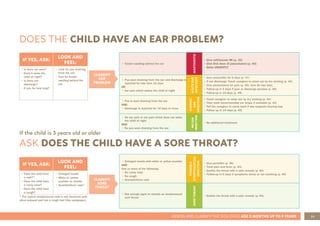
- At 6 months of age— all HIV-exposed infants.
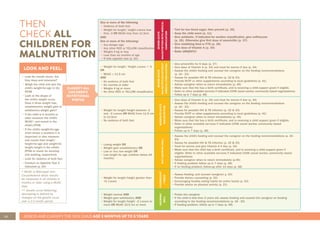
- If the child is ill or has features of HIV infection
- 6 weeks after stopping breastfeeding.
- Universal HIV rapid test at 18 months for all
infants, regardless of HIV exposure.
Below 18 months of age, use an HIV PCR test as the first HIV test. If HIV PCR is positive, do a second HIV
PCR test to confirm the child’s status.
Between 18 months and 2 years, use an HIV antibody (rapid) test as the first HIV test, but an HIV PCR to
confirm the child’s HIV status. HIV PCR should be used to confirm any positive HIV test up to 2 years.
2 years and older, use an HIV antibody (rapid) test as the firsts HIV test. If positive, use a confirmatory
HIV antibody (rapid) test kit. If the confirmatory test is positive, this confirms HIV infection. If the second
test is negative, refer for ELISA test and assessment.
• Positive HIV test in child.
OR
• Child on ART
HIV
INFECTION
• Follow the six steps for initiation of ART (p. 52)
• Give cotrimoxazole prophylaxis from 6 weeks (p. 38)
• Ask about the caregiver’s health and manage appropriately
• Provide long term follow-up (p. 57)
• Infant is receiving ARV
prophylaxis
HIV
-
EXPOSED:
ON
ARV
PROPHYLAXIS
• Complete appropriate ARV prophylaxis (p. 12)
• Repeat HIV PCR test according to testing schedule. Reclassify on
the basis of the test result
• Ask about the caregiver’s health, and ensure that she is receiving
the necessary care and treatment
• Provide follow-up care (p. 50)
• Negative HIV test
AND
• Child still breastfeeding or
stopped breastfeeding < 6
weeks before the test.
ONGOING
HIV
EXPOSURE
• Complete appropriate infant ARV prophylaxis (p. 12)
• Repeat HIV testing when indicated. Reclassify the child based on
the test result
• Provide follow-up care (p. 50)
• Negative HIV test.
AND
• All breastfeeding stopped
≥6 weeks before the test.
HIV
-
NEGATIVE
• Consider other causes if child has features of HIV infection (repeat
HIV test if indicated)
• 3 or more
features of HIV
infection.
SUSPECTED
SYMPTOMATIC
HIV
INFECTIO
N
• Counsel and offer HIV testing for the child. Reclassify the child on the
basis of the test result
• Counsel the caregiver about her health, offer HIV testing (if mother
tests HIV positive: offer same-day initiation)
• Provide long-term follow-up (p. 50)
• Mother HIV-
positive
HIV
-
EXPOSED
• Give infant ARV prophylaxis (p.14)
• Counsel and offer HIV testing for the child. Reclassify based on the test result
• Counsel the caregiver about her health, and provide treatment as necessary
• If mother is not on ART: start ART immediately
• If mother is on ART: check the mother’s VL and if suppressed repeat VL every
6 months while breastfeeding
• Provide long-term follow-up (p. 50)
• One or two
features of HIV
infection
POSSIBLE
HIV
INFECTION
• Provide routine care including HIV testing for the child
• Counsel the caregiver about her health, offer HIV testing and treatment as
necessary
• Reclassify the child based on the test results
• No features of
HIV infection
HIV
INFECTION
UNLIKELY
• Provide routine care including HIV testing for the child and caregiver. (If mother
is HIV negative, retest at the 10 week visit, 6 month visit and every 3 months
while breastfeeding)
CLASSIFY
FOR
HIV
INFECTION
IN
THE
CHILD
ASK:
• Ask the mother if she had an HIV test. If yes, what was the result?
• If the test was positive, is the child on ART?
• If the test was negative, was the child still breastfeeding at the time that
the test was done, or had the child been breastfed in the 6 weeks before
the test was done? Is the child still breastfeeding?
FEATURES OF HIV INFECTION
ASK:
• Does the child have PNEUMONIA now?
• Is there PERSISTENT DIARRHOEA, now
or in the past 3 months?
• Has the child ever had ear discharge?
• Is there low weight?
• Has weight gain been unsatisfactory?
LOOK and FEEL:
• Any enlarged lymph glands in
two or more of the following
sites - neck, axilla or groin?
• Is there oral thrush?
• Is there parotid enlargement?
Has the child been
tested for HIV infection?
CLASSIFY
FOR HIV
INFECTION
33
ASSESS AND CLASSIFY THE SICK CHILD AGE 2 MONTHS UP TO 5 YEARS
CLASSIFY ALL CHILDREN FOR TB RISK
• Yes to any question
RISK
OF
TB
• Investigate for TB (see below)
• No to all questions
LOW
RISK
OF
TB
• Routine care
NOTE:
• A close TB contact is an adult who has had pulmonary TB in the last 12 months,
who lives in the same household as the child, or some-one with whom the child is
in close contact or in contact for extended periods. If in doubt, discuss the case
with an expert or refer the child.
• Chest X-rays can assist in making the diagnosis of TB in children. Decisions as
to how they are used in your area should be based on the availability of expertise
for taking and interpreting good quality Xrays in children. Follow local guidelines in
this regard. Although it is advisable that all children should have a CXR before TB
treatment is commenced, where good quality CXR are not available, do not delay
treatment.
• If you are unsure about the diagnosis of TB, refer the child for assessment and
investigation.
• Any child with suspected complicated TB, e.g. TB meningitis or miliary TB should
be referred.
• GXP or TB culture positive
CONFIRMED
TB
• Treat for TB (p. 39)
• Notify and register in TB register
• Check HIV status (p. 32)
• Trace contacts and manage according to TB guidelines
• Follow-up monthly to review progress (p. 51)
One or more symptoms and signs of
TB risk
AND
• TB contact, OR
• TST positive, OR
• CXR suggestive of TB
PROBABLE
TB
• Treat for TB (p. 39)
• Notify and register in TB register
• Check HIV status (p. 32)
• Trace contacts and manage according to TB guidelines
• Follow-up monthly to review progress (p. 51)
One or more symptoms or signs of TB
risk, BUT
• No TB contact
• Negative TST
• CXR not suggestive of TB
POSSIBLE
TB
• Refer for further assessment or investigation if not done
• Close TB contact or TST positive
AND
• CXR not suggestive of TB
• TB culture negative
• GXP negative
• No symptoms present
TB
EXPOSED
• Treat with INH for 6 months (p. 38)
• Trace other contacts
• Follow-up monthly (p. 51)
CLASSIFY
FOR TB
RISK
CLASSIFY
FOR TB IF
CLASSIFIED AS
HAVING RISK
OF TB
ASK
• Any history of TB contact in the past 12
months?
• Cough for more than 2 weeks?
• Fever for more than 7 days?
• Not growing well?*
*Classification of SAM, MAM or poor weight gain
or weight loss for 3 months
INVESTIGATE FOR TB
• Send sputum or gastric aspirate for Gene Xpert
and TB culture (one specimen for each test)
• Do a TST
- TST > 10 mm (or > 5 mm in an HIV
infected child) is positive
• Do a chest x-ray (ideally for all children, but
guided by local availability)
34 ASSESS AND CLASSIFY THE SICK CHILD AGE 2 MONTHS UP TO 5 YEARS
THEN CHECK THE CHILD’S IMMUNISATION STATUS
AND GIVE ROUTINE TREATMENTS
CHECK THE CAREGIVER’S HEALTH
IMMUNISATION SCHEDULE
• Give all missed immunisations on this visit (observing contraindications). This includes
sick children and those without a RTHB. If the child has no RTHB, give a new one today
• Advise caregiver when to return for the next immunisation
• Give routine Vitamin A (p. 34) and record on the RTHB
• Give routine treatment for worms (p. 34) and record on the RTHB
• Refer to the EPI Vaccinators Manual or EDL for catch up schedule and contraindications
• Make sure that the child has a birth certificate . If not, refer to Home Affairs or to social
worker
• Make sure that eligible children are receiving a child support grant. If not refer to SASSA
or social worker
Birth BCG OPV0
6 weeks Hexavalent1 (DaPT-IPV-HB-Hib1) OPV1 PCV1 RV1
10 weeks Hexavalent2 (DaPT-IPV-HB-Hib2)
14 weeks Hexavalent3 (DaPT-IPV-HB-Hib3) PCV2 RV2
6 months Measles1
9 months PCV3
12 months Measles2
18 months Hexavalent4 (DaPT-IPV-HB-Hib4)
6 years Td
12 years Td
ASSESS ANY OTHER PROBLEM e.g. Skin rashes, social problems
GIVE VITAMIN A
• Give Vitamin A routinely to all children from the age of
6 months to prevent severe illness (prophylaxis)
• If the child has had a dose of Vitamin A in the past
30 days, defer Vitamin A until 30 days has elapsed
• Vitamin A is not contraindicated if the child is on
multivitamin treatment
• Vitamin A capsules come in 100 000 IU and 200 000 IU
• Record the date Vitamin A given on the RTHB
ROUTINE VITAMIN A*
Age Vitamin A dose
6 up to
12 months
A single dose of 100 000 IU at age 6
months or up to 12 months
1 up to
5 years
A single dose of 200 000 IU at 12
months, then a dose of 200 000 IU
every 6 months up to 5 years
ADDITIONAL DOSE FOR SEVERE
MALNUTRITION, PERSISTENT
DIARRHOEA, MEASLES OR
XEROPHTHALMIA
• Give therapeutic (non-routine) dose of
Vitamin A if the child has severe acute
malnutrition, persistent diarrhoea,
measles or xerophthalmia (dry eyes)
• If the child has measles or
xerophthalmia (dry eyes), give caregiver
a second dose to take the next day
Age
Vitamin A
Additional dose
< 6 months 50 000IU
6 up to 12 months 100 000 IU
1 up to 5 years 200 000 IU
GIVE MEBENDAZOLE OR ALBENDAZOLE
• Children older than one year of age should receive routine deworming treatment every 6 months
• Give Mebendazole or Albendazole
• Give single dose (or first dose) in the clinic
• Record the dose in the child’s RTHB
Age
MEBENDAZOLE
Suspension (100 mg per
5 ml)
Tablet (100 mg) Tablet (500 mg)
12 up to
24 months
5 ml twice daily for
3 days
One tablet twice daily for 3
days
2 up to 5
years
25 ml as single dose Five tablets as single dose One tablet as single dose
Age
ALBENDAZOLE
Tablet (100 mg) Tablet (200 mg)
12 up to 24 months One tablet as single dose
2 up to 5 years One tablet as single dose
35
ASSESS AND CLASSIFY THE SICK CHILD AGE 2 MONTHS UP TO 5 YEARS
GIVE THESE TREATMENTS
IN THE CLINIC ONLY
PREVENT LOW BLOOD SUGAR
(HYPOGLYCAEMIA)
• If the child is able to swallow:
- If breastfed: ask the mother to breastfeed the child, or give expressed breastmilk
- If not breastfed: give a breastmilk substitute or sugar water. Give 30 - 50 ml of milk
or sugar water before the child leaves the facility
- To make sugar water: Dissolve 4 level teaspoons of sugar (20 grams) in a 200ml cup of
---clean water.
• If the child is not able to swallow:
- Insert nasogastric tube and check the position of the tube
GIVE DIAZEPAM TO STOP CONVULSIONS
• Turn the child to the side and clear the
airway. Avoid putting things in the mouth
• Give 0.5 mg per kg diazepam injection
solution per rectum. Use a small syringe
without a needle or a catheter
• Test for low blood sugar, then treat or
prevent
• Give oxygen (p. 36)
• REFER URGENTLY
• If convulsions have not stopped after 10
minutes, repeat the dose once while waiting
for transport
WEIGHT Age Dose
3 - < 4 kg 0 up to 2 months 2 mg (0.4 ml)
4 - < 5 kg 2 up to 3 months 2.5 mg (0.5 ml)
5 - < 15 kg 3 up to 24 months 5 mg (1 ml)
15 - 25 kg 2 up to 5 years 7.5 mg (1.5 ml)
TREAT FOR LOW BLOOD SUGAR
(HYPOGLYCAEMIA)
Low blood sugar < 3 mmol/L in a child
• Suspect low blood sugar in any infant or child that:
- is convulsing, unconscious or lethargic; OR
- has a temperature below 35ºC
• Children with severe malnutrition are particularly likely to be hypoglycaemic
• Confirm low blood sugar using blood glucose testing strips
• Treat with:
- 10% Glucose - 5 ml for every kg body weight - by nasogastric tube OR intravenous line
- Keep warm
- Refer urgently and continue feeds during transfer
• If neonatalyte is not available, add 1 part 50% dextrose water to 4 parts water to make 10%
solution
GIVE STABILISING FEED
• Encourage the caregiver to continue breastfeeding
and giving F-75 during referral
• Give one feed immediately. Repeat two hourly
until the child reaches the hospital
• Keep the child warm (p. 12)
WEIGHT F - 75
3.0 - < 5 kg 60 ml
5 - < 8 kg 90 ml
≥ 8 kg 120 ml
• Explain to the caregiver why the medicine is given
• Determine the dose appropriate for the child’s weight (or age)
• Measure the dose accurately
GIVE CEFTRIAXONE IM
• Wherever possible use the weight to calculate the dose
• Dilute 250 mg vial with 1 ml of sterile water, or 500 mg with 2 ml sterile water (250 mg per ml)
• Give the injection in the upper thigh, not the buttocks
• IF REFERRAL IS NOT POSSIBLE OR DELAYED, repeat the ceftriaxone injection every 24 hours
WEIGHT Age Dose
3.5 - < 5.5 kg 1 up to 3 months 312 mg (1.25 ml)
5.5 - < 7 kg 3 up to 6 months 440 mg (1.75 ml)
7 - < 9 kg 6 up to 12 months 625 mg (2.5 ml)
9 - < 11 kg 12 up to 18 months 750 mg (3 ml)
11 - < 14 kg 18 months up to 3 years 810 mg (3.25 ml)
14 - < 17.5 kg 3 up to 5 years 1 g (4 ml)*
≥17.5 kg 5 years and older 1.5 g (5.5 ml)**
*Give 2ml in each thigh
**For children weighing more than 17.5 kg, dilute 1g in 3.5 ml sterile water and give 5.5 ml IM
36 ASSESS AND CLASSIFY THE SICK CHILD AGE 2 MONTHS UP TO 5 YEARS
GIVE THESE TREATMENTS IN THE CLINIC ONLY
GIVE PREDNISONE FOR STRIDOR OR
RECURRENT WHEEZE WITH SEVERE
CLASSIFICATION
• Give one dose of
prednisone as part of
pre-referral treatment for
STRIDOR or for RECURRENT
WHEEZE with severe
classification
WEIGHT AGE PREDNISONE 5 mg
Up to 8 kg - 2 tabs
> 8 kg
Up to 2 years 4 tabs
2 - 5 years 6 tabs
GIVE NEBULIZED ADRENALINE FOR STRIDOR
• Add 1 ml of 1:1000 adrenaline (one vial) to 1 ml of saline and administer using a nebulizer
• Always use oxygen at flow-rate of 6 - 8 litres
• Repeat every 15 minutes, until the child is transferred (or the stridor disappears)
• Give one dose of prednisone as part of pre-referral treatment for stridor
GIVE IM PENICILLIN FOR POSSIBLE
STREPTOCOCCAL INFECTION
GIVE IM SINGLE DOSE OR ORAL TREATMENT TWICE DAILY (P. 37)
• IM Penicillin is the treatment of choice (see below)
• Give azithromycin if the child is allergic to penicillin (p. 37)
• Only give oral penicillin if the caregiver does not want the child to have an injection (p. 37)
• Dilute 1.2 million units with 3 ml of sterile water or 3 ml of lidocaine 1% without adrenaline
WEIGHT Age
BENZATHINE BENZYLPENICILLIN IM INJECTION
1.2mu in 3 ml sterile water
1.2mu in 3 ml lidocaine
1% without adrenaline
Up to 30 kg 3 up to 5 years 1.5 ml 1.5ml
GIVE OXYGEN
• Give oxygen to all young infants with:
- severe pneumonia, with or without wheeze
- lethargy or if the child is unconscious
- convulsions
• Use nasal prongs or a nasal cannula
Nasal prongs
• Place the prongs just inside or below the baby’s nostrils.
• Secure the prongs with tape
• Oxygen should flow 1 - 2 litres per minute
Nasal cannula
• This method delivers a higher concentration of oxygen
• Insert a FG8 nasogastric tube
• Measure the distance from the side of the nostril to the inner
eyebrow margin with the catheter
• Insert the catheter as shown in the diagramme
• Secure with tape
• Turn on oxygen to flow of half to one a litre per minute
GIVE SALBUTAMOL FOR WHEEZE WITH SEVERE
CLASSIFICATION
SALBUTAMOL
Nebulised salbutamol
(2.5 ml nebule)
• Dilute 1ml in 3 ml saline
• Nebulise in the clinic
• Always use oxygen at flow rate of 6-8 litres
• If still wheezing repeat every 15 minutes in first hour and 2 - 4 hourly
thereafter
• Add Ipratropium bromide 0.5 ml if available
OR
MDI - 100 ug per puff • 4 - 8 puffs using a spacer
• Allow 4 breaths per puff
• If still wheezing repeat every 15 minutes in first hour and 2-4 hourly
thereafter
37
ASSESS AND CLASSIFY THE SICK CHILD AGE 2 MONTHS UP TO 5 YEARS
TEACH THE CAREGIVER
TO GIVE ORAL
MEDICINES AT HOME
TREAT THE SICK CHILD
Carry out the treatment steps identified on the assess and classify chart
GIVE AMOXICILLIN* FOR PNEUMONIA, ACUTE EAR
INFECTION OR SEVERE ACUTE MALNUTRITION WITHOUT
MEDICAL COMPLICATIONS
• Give two times daily for 5 days
• * If the child is allergic to penicillins, or amoxicillin is out of stock, use azithromycin
WEIGHT Age
AMOXICILLIN
SUSP
. (125mg
per 5 ml)
SUSP. (250mg
per 5 ml)
CAPSULE
250 mg
3.5 - 5 kg 2 up to 3 months 7 ml 3.5 ml
5 - < 7 kg 3 up to 6 months 10 ml 5 ml
7 - < 11 kg 6 up to 18 months 15 ml 7.5 ml
11 - < 14 kg 18 months up to 3 years 10 ml Two
14 - < 17.5 kg 3 to 5 years 15 ml Three
≥ 17.5 kg ≥ 5 years 20 ml Four
≥
GIVE AZITHROMYCIN IF ALLERGIC TO PENICILLIN
• Give azithromycin depending on the child’s weight
• Give azithromycin once daily for three days only
WEIGHT Age
AZITHROMYCIN SUSPENSSION
(200 mg per 5 ml)
3.5 - <5kg 1 up to 3 months 40mg (1 ml)
5- <7kg 3 up to 6 months 60 mg (1.5 ml)
7 - < 9 kg 6 up to 12 months 80 mg (2 ml)
9 - < 11 kg 12 up to 18 months 100 mg (2.5 ml)
11 - < 14 kg 18 months up to 3 years 120 mg (3 ml)
14 - < 18 kg 3 up to 5 years 160 mg (4 ml)
≥ 18 kg ≥ 5 years 200 mg (5 ml)
GIVE CIPROFLOXACIN FOR DYSENTERY
• Give twice a day for 3 days
WEIGHT Age
CIPROFLOXACIN SUSPENSION CIPROFLOXACIN TABLET
(250 mg per 5ml) (250mg)
< 11 kg 12 up to 18 months 3ml
11 - < 14 kg 18 months up to 3 years 4ml
14 - < 17.5 kg 3 up to 5 years 5ml One
17.5 - < 25 kg 3 up to 5 years 6ml
GIVE PENICILLIN FOR POSSIBLE STREPTOCOCCAL INFECTION
• Give twice a day for 10 days
• The recommended treatment for POSSIBLE STREPTOCOOCAL INFECTION is IM Benzathine Benzylpenicillin (p. 36)
• Only give oral penicillin if the caregiver refuses an injection
• If the child is allergic, use azithromycin instead
WEIGHT Age
PHENOXYMETHYL PENICILLIN
SUSPENSION (250 mg per 5ml) TABLET (250 mg)
11 - < 35 kg 3 up to 5 years 5 ml One tablet
Follow the general instructions below for all oral medicines to be given at home
Also follow the instructions listed with the dosage table for each medicine
• Determine the appropriate medicines and dosage for the child’s weight or age
• Tell the caregiver the reason for giving the medicine to the child
• Demonstrate how to measure a dose
• Watch the caregiver practise measuring a dose by herself
• Explain carefully how to give the medicine
• Ask the caregiver to give the first dose to her child
• Advise the caregiver to store the medicines safely
• Explain that the course of treatment must be finished, even if the child is better
• Check the caregiver’s understanding before she leaves the clinic
38 ASSESS AND CLASSIFY THE SICK CHILD AGE 2 MONTHS UP TO 5 YEARS
TEACH THE CAREGIVER
TO GIVE ORAL MEDICINES AT HOME
INH FOR TB EXPOSURE
GIVE ONCE DAILY
• Follow the general instructions for all oral medicines to be given at
home
• Tablets can be crushed and dissolved in water if necessary
• Treatment must be given for 6 months
• Follow-up children each month (p. 51) to check adherence and
progress, and to provide medication
WEIGHT
ISONIAZID (INH) 100 mg tablet
Once daily
2 - < 3.5 kg ¼ tab
3.5 - < 5 kg ½ tab
5 - <7.5 kg ¾ tab
7.5 - < 10 kg 1 tab
10 - < 15 kg 1½ tabs
15 - < 20 kg 2 tabs
20 - 25 kg 2½ tabs
≥ 25 kg 3 tabs
Preventative therapy in case of drug-resistant TB contact:
Isoniazid mono-resistant contact:
Rifampicin, oral, 15 mg/kg for 4 months
Rifampicin mono-resistant contact:
Isoniazid, oral, 10 mg/kg daily for 6 months (see table above)
GIVE COTRIMOXAZOLE
GIVE ONCE DAILY AS PROPHYLAXIS
• Give to all children with HIV INFECTION (criteria for stopping in children on ART are shown below)
INDICATIONS WHEN TO START WHEN TO STOP
HIV-infected infants
(< 1 year of age)
From 6 weeks of age Continue until 1 year of age, regardless of
clinical stage and CD4 count
HIV-positive children 1-5
years of age.
All symptomatic children: WHO
clinical stage 2, 3 or 4
OR
CD4 <25% / CD4 <500 cells/
μl.
Stop if clinically well on ART and CD4 ≥25%
or ≥500 cells/μl on ≥2 occasions 3-6
months apart
Recommence if CD4 drops <200 cells/μl,
if ART fails or if new opportunistic infection
develops
HIV-positive children ≥ 5
years of age, adolescents
and adults.
Start if CD4 <200 cell/μl
OR
Clinical stage 3 or 4 disease
(including TB)
Stop if clinically well on ART and CD4 ≥200
cells/μl on ≥2 occasions 3-6 months apart.
Recommence if CD4 drops below 200 cells/
μl
WEIGHT
COTRIMOXAZOLE SYRUP COTRIMOXAZOLE TABLET
(200/40 mg per 5 ml) 400/80 mg 800/160 mg
2.5 - < 5 kg 2.5 ml ¼ tablet
5 - < 14 kg 5 ml ½ tablet
14 - < 30 kg 10 ml 1 tablet ½ tablet
≥ 30 kg 2 tablets 1 tablet
39
ASSESS AND CLASSIFY THE SICK CHILD AGE 2 MONTHS UP TO 5 YEARS
TEACH THE CAREGIVER TO GIVE
ORAL MEDICINES AT HOME
GIVE REGIMEN 3A FOR UNCOMPLICATED TB
• Uncomplicated TB includes low bacilliary load TB disease such as pulmonary TB with minimal lung
parenchymal involvement (with or without involvement of hilar nodes), TB lymphadenitis and TB pleural
effusion
• All children should receive Rifampicin/INH (RH) together with pyrazinamide (PZA) for two months followed
by RH for a further four months
• For small infants dissolve one dispersible PZA tablet (150 mg) in 3 ml of water
• Add Pyridoxine 12.5mg daily for 6 months if the child is HIV positive or malnourished
REGIMEN
3A
INTENSIVE PHASE
TWO MONTHS Once daily
CONTINUATION
PHASE
FOUR MONTHS
Once daily
WEIGHT RH (60mg/60)mg PZA (500mg) OR PZA** 150 mg/3 ml RH (60mg/60mg)
2 - < 3 kg ½ tab
EXPERT
ADVICE ON
DOSE
1.5 ml ½ tab
3 - < 4 kg ¾ tab ¼ tab 2.5 ml ¾ tab
4 - < 6 kg 1 tab ¼ tab 3 ml 1 tab
6 - < 8 kg 1½ tab ½ tab 1½ tabs
8 - < 12 kg 2 tabs ½ tab 2 tabs
12 - < 15 kg 3 tabs 1 tab 3 tabs
15 - < 20 kg 3½ tabs 1 tab 3½ tabs
20 - < 25 kg 4½ tabs 1½ tabs 4½ tabs
25- < 30 kg 5 tabs 2 tabs 5 tabs
GIVE REGIMEN 3B FOR COMPLICATED TB
• Use this regimen in children with all forms of severe TB (extensive pulmonary TB, spinal or
osteo-articular TB or abdominal TB) or retreatment cases
• All children should receive four medicines during the intensive phase (Rifampicin/INH (RH),
pyrazinamide (PZA) and ethambutol) for two months. This is followed by RH for a further four
months (continuation phase)
• For small infants dissolve one dispersible PZA tablet (150 mg) in 3 ml of water
• To make ethambutol solution, crush one tablet (400 mg) to a fine powder and dissolve in 8
ml of water. Discard unused solution
• Add Pyridoxine 12.5 mg daily for 6 months if the child is HIV positive or malnourished
REGIMEN
3B
INTENSIVE PHASE
TWO MONTHS Once daily
CONTINUATION
PHASE
FOUR MONTHS
Once daily
WEIGHT
RH
(60mg/
60)mg
PZA
(500mg)
OR
PZA**
150 mg/
3 ml
ETHAMBUTOL
400mg/8ml
solution OR
400 mg tablet
RH
(60mg/60mg)
2 - < 3 kg ½ tab
EXPERT
ADVICE
ON
DOSE
1.5 ml 1ml ½ tab
3 - < 4 kg ¾ tab ¼ tab 2.5 ml 1.5ml ¾ tab
4 - < 6 kg 1 tab ¼ tab 3 ml 2ml 1 tab
6 - < 8 kg 1½ tab ½ tab 3ml 1½ tabs
8 - < 12 kg 2 tabs ½ tab ½ tab 2 tabs
12 - < 15 kg 3 tabs 1 tab ¾ tab 3 tabs
15 - < 20 kg 3½ tabs 1 tab 1 tab 3½ tabs
20 - < 25 kg 4½ tabs 1½ tabs 1 tab 4½ tabs
25- < 30 kg 5 tabs 2 tabs 1½ tabs 5 tabs
• Follow the general instructions for all oral medicines to be given at home
• Also follow the instructions listed with the dosage table of each medicine
• Do not change the regimen of children referred from hospital or a TB clinic without discussing
this with an exvpert
• Treatment should be given as Directly Observed Treatment (DOT) 7 days a week
• Follow-up children each month (p. 51) to check adherence and progress
40 ASSESS AND CLASSIFY THE SICK CHILD AGE 2 MONTHS UP TO 5 YEARS
TEACH THE CAREGIVER TO
GIVE MEDICINES AT HOME
TREAT FOR MALARIA
• Give the current malaria treatment recommended for your area. See the Malaria Treatment Guidelines
• Treat only test-confirmed malaria. Refer if unable to test, or if the child is unable to swallow, or is
under one year of age
• Record and notify malaria cases
In all provinces combination therapy (Co-Artem) must be used.
It is advisable to consult the provincial guidelines on a regular basis.
Artemether + Lumefantrine (Co-Artem)
• Watch the caregiver give the first dose of Co-Artem in the clinic and observe for one hour. If the child
vomits within an hour repeat the dose
• Give Co-Artem with fat-containing food/milk to ensure adequate absorption
• Give first dose immediately
• Second dose should be taken at home 8 hours later. Then twice daily for two more days
WEIGHT
WEIGHT CO-ARTEMETHER TABLET (20mg/120mg)
Day 1: First dose and repeat
this after 8 hours ( 2 doses)
Days 2 and 3: take dose twice
daily (4 doses)
< 15 kg 1 tablet 1 tab twice a day
15 - 25 kg 2 tablets 2 tabs twice a day
GIVE SALBUTAMOL FOR WHEEZE
• Home treatment should be given with an MDI and spacer
• Teach caregiver how to use it
• While the child breathes, spray 1 puff into the bottle. Allow the
child to breathe for 4 breaths per puff
SALBUTAMOL
MDI - 100 ug per puff:
1-2 puffs using a spacer.
Allow 4 breaths per puff.
Repeat 3 to 4 times a day.
GIVE PARACETAMOL
FOR FEVER 38°C OR ABOVE, OR FOR PAIN
• Give a dose for fever 38o
C or above
• For pain: give paracetamol every 6 hours until free of pain
(maximum one week)
• Treat the underlying cause of fever or pain
• Refer if no pain relief with paracetamol
WEIGHT AGE
PARACETAMOL SYRUP
(120 mg per 5 ml)
3 - < 5 kg 0 up to 3 months 2 ml
5 - < 7 kg 3 up to 6 months 2.5 ml
7 - < 9 kg 6 up to 12 months 4 ml
9 - < 14 kg 12 months up to 3 years 5 ml
14 - < 17.5 kg 3 years up to 5 years 7.5 ml
• Follow the general instructions for all oral medicines to be given at home
• Also follow the instructions listed with the dosage table of each medicine
41
ASSESS AND CLASSIFY THE SICK CHILD AGE 2 MONTHS UP TO 5 YEARS
GIVE IRON FOR ANAEMIA
• Give three doses daily. Supply enough for 14 days
• Follow-up every 14 days and continue treatment for 2 months
• Each dose is 2 mg elemental iron for every kilogram weight. Elemental iron content depends on the preparation you have
• Check the strength and dose of the iron syrup or tablet very carefully
• Tell caregiver to keep Iron out of reach of children, because an overdose is very dangerous
• Give Iron with food if possible. Inform the caregiver that it can make the stools look black
• REMEMBER: Do not give Iron if the child is receiving the RUTF, as RUTF contains sufficient iron
WEIGHT
AGE
Only if you
do not know
the weight
Ferrous Gluconate
(40 mg elemental iron
per 5 ml)
OR
Ferrous Lactate drops
(25 mg elemental iron per ml)
OR
Ferrous Sulphate
tablet
(60 mg elemental
iron)
Give 3 times a day with meals
3 - < 6 kg
0 up to
3 months
1.25 ml 0.3 ml (½ dropper)
6 - < 10 kg
3 up to
12 months
2 .5 ml 0.6 ml (1 dropper)
10 - < 25 kg
One up to
5 years
5.0 ml 0.9 ml (1½ dropper) ½ tablet
GIVE RUTF TO SAM WITHOUT MEDICAL
COMPLICATION AND ELIGIBLE MAM
CASES (SEE P. 48 FOR CRITERIA)
• The child should be at least 6 months of age and weigh more than 4 kg
• Make sure that the caregiver knows how to use the RUTF (p. 20)
• The child may have been referred from hospital for ongoing care. Give
amounts according to directions from the referring facility, or according to
local guidelines
WEIGHT
RUTF 500Kcal/92gm sachet
For SAM without medical
complication:
Child needs 200kcal/
kg/day
For MAM
Child needs additional 75 Kcal/
kg/day above his daily food
intake of 100kcal/day.
SAM SAM MAM MAM
Sachets
(per day)
Sachets
(per week)
Sachets
(per week)
Sachets
(per month)
4 - < 5 kg 2 14 4 16
5 - < 7 kg 2½ 18 5 20
7 - < 8.5 kg 3 21 7 28
8.5 - < 9.5 kg 3½ 25 9 36
9.5 - < 10.5 kg 4 28 10 40
10.5 - < 12 kg 4½ 32 11 44
≥ 12 kg 5 35 13 52
GIVE ELEMENTAL ZINC (ZINC SULPHATE,
GLUCONATE, ACETATE OR PICOLINATE)
Give elemental zinc 10 mg once daily for 14 days
GIVE MULTIVITAMINS
• Give prophylaxis dose to child with Low birth Weight or Preterm from the third week of life
• Give to children with Severe Acute Malnutrition not on feed with combined mineral and vitamin complex or Anaemia
AGE WEIGHT
MULTIVITAMINS
Once Daily
Drops Syrup
Birth to 6 weeks
< 2.5 kg 0.3 ml
≥ 2.5 kg 0.6 ml
All other children 5 ml
TEACH THE CAREGIVER TO GIVE
ORAL MEDICINES AT HOME
• Follow the general instructions for every oral medicines to be given at home
• Also follow the instructions listed with the dosage table of each medicine
42 ASSESS AND CLASSIFY THE SICK CHILD AGE 2 MONTHS UP TO 5 YEARS
GIVE EXTRA FLUID FOR DIARRHOEA
AND CONTINUE FEEDING
PLAN A: TREAT FOR DIARRHOEA AT HOME
Counsel the caregiver on the 4 Rules of Home Treatment:
1. GIVE EXTRA FLUID (as much as the child will take)
• COUNSEL THE CAREGIVER:
- Breastfeed frequently and for longer at each feed
- If the child is exclusively breastfed, give sugar-salt solution (SSS) or ORS in addition to breastmilk
- If the child is not receiving breastmilk or is not exclusively breastfed, give one or more of the
following: food-based fluids such as soft porridge, amasi (maas) or SSS or ORS
- It is especially important to give ORS at home when:
• the child has been treated with Plan B or Plan C during this visit
• the child cannot return to a clinic if the diarrhoea gets worse
• TEACH THE CAREGIVER HOW TO MIX AND GIVE SSS or ORS:
- To make SSS:
1 litre boiled water + 8 level teaspoons sugar + half a level teaspoon salt
SSS is the solution to be used at home to prevent dehydration
NB The contents of the ORS sachet is mixed with clean water and administered to correct dehydration
• SHOW THE CAREGIVER HOW MUCH FLUID TO GIVE IN ADDITION TO THE USUAL FLUID INTAKE:
Up to 2 years 50 to 100 ml after each loose stool.
2 years or more 100 to 200 ml after each loose stool.
• Counsel the caregiver to:
- Give frequent small sips from a cup.
- If the child vomits, wait 10 minutes. Then continue, but more slowly.
- Continue giving extra fluid until the diarrhoea stops
2. GIVE ZINC (p. 41)
3. CONTINUE FEEDING (p. 17 - 23)
4. WHEN TO RETURN (p. 14 or p. 45)
PLAN B: TREAT FOR SOME DEHYDRATION WITH ORS
In the clinic: Give recommended amount of ORS over 4-hour period
• DETERMINE AMOUNT OF ORS TO GIVE DURING FIRST 4 HOURS
* The amount of ORS needed each hour is about 20 ml for each kilogram weight. Multiply the
child’s weight in kg by 20 for each hour. Multiply this by four for the total number of ml over the first
four hours. One teacup is approximately 200 ml
• SHOW THE CAREGIVER HOW TO GIVE ORS SOLUTION:
- Give frequent small sips from a cup
- If the child vomits, wait 10 minutes. Then continue, but more slowly
- Counsel the mother to continue breastfeeding whenever the child wants
- If the child wants more ORS than shown, give more
• AFTER 4 HOURS:
- Reassess the child and classify the child for dehydration
- Select the appropriate plan to continue treatment
- Begin feeding the child in clinic
• IF CAREGIVER MUST LEAVE BEFORE COMPLETING TREATMENT, OR THE CLINIC IS CLOSING:
- Refer if possible. Otherwise:
•Show her how to prepare ORS solution at home
•Show her how much ORS to give to finish the 4-hour treatment at home
•Show her how to prepare SSS for use at home
•Explain the Four Rules of Home Treatment:
1. GIVE EXTRA FLUID
2. GIVE ZINC (p. 41)
3. CONTINUE FEEDING (p. 17 - 23)
4. WHEN TO RETURN (p. 14 or p. 45)
43
ASSESS AND CLASSIFY THE SICK CHILD AGE 2 MONTHS UP TO 5 YEARS
GIVE EXTRA FLUID FOR DIARRHOEA
AND CONTINUE FEEDING
PLAN C: TREAT SEVERE DEHYDRATION QUICKLY *
• Start IV fluid immediately. If the child can drink, give ORS by mouth while the drip is set up. Weigh the child or estimate the weight
Within the first half hour: Plan for the next 5 hours:
Rapidly give 20 ml IV for each kilogram weight, before
referral (weight x 20 gives ml needed).
Repeat this amount up to twice if the radial pulse is
weak or not detectable.
More slowly give 20 ml IV for each kilogram weight, every hour, during
referral.
Ensure the IV continues running, but does not run too fast.
• Give Normal Saline IV
• REFER URGENTLY for further management
• Reassess the child every 1- 2 hours while awaiting transfer. If hydration status is not improving, give the IV drip more rapidly
• Also give ORS (about 5 ml per kilogram each hour) as soon as the child can drink: usually after 3 - 4 hours (infants) or 1 - 2 hours
NO
NO
NO
NO
YES
YES
YES
Can you give
intravenous (IV)
fluid immediately?
Is IV treatment
available nearby
(within 30
minutes)?
Are you trained to
use a nasogastric
(NG) tube for
rehydration?
Refer URGENTLY
to hospital for IV
Can the child
drink?
FOLLOW THE ARROWS. IF ANSWER IS
‘YES’, GO ACROSS. IF ‘NO’, GO DOWN
NOTE: If possible, observe the child at least 6 hours after rehydration, to be sure the caregiver can
maintain hydration giving the child ORS by mouth.
* Exception: Another
severe classification
e.g. suspected meningitis,
severe malnutrition
• Too much IV fluid is
dangerous in very sick
children. Treatment
should be supervised
very closely in hospital
• Set up a drip for severe
dehydration, but give
Normal Saline only 10
ml per kilogram over
one hour
• Then give sips of ORS
while awaiting urgent
referral
•
• Start rehydration with ORS solution, by tube:
Start rehydration with ORS solution, by tube: give 20 ml per kg each hour for 6 hours (total of 120 ml per kg)
give 20 ml per kg each hour for 6 hours (total of 120 ml per kg)
•
• REFER URGENTLY for further management
REFER URGENTLY for further management
•
• Reassess the child every 1-2 hours while awaiting transfer:
Reassess the child every 1-2 hours while awaiting transfer:
- If there is repeated vomiting give the fluid more slowly
- If there is abdominal distension stop fluids and refer urgently
- After 6 hours reassess the child if he/she is still at the clinic. Classify dehydration. Then choose the appropriate plan
(A, B, or C) to continue treatment
• Refer URGENTLY to hospital for IV treatment
• If the child can drink, provide caregiver with ORS solution and show her how to give frequent sips during the trip, or give ORS by
nasogastric tube
44 ASSESS AND CLASSIFY THE SICK CHILD AGE 2 MONTHS UP TO 5 YEARS
TEACH THE CAREGIVER TO TREAT LOCAL INFECTIONS
FOR THRUSH
• If there are thick plaques the caregiver should:
- Wash hands with soap and water
- Wet a clean soft cloth with chlorhexidine 0.2% or salt water, wrap this around the little finger, then gentle wipe away
the plaques
- Wash hands again
• Give nystatin 1 ml 4 times a day (after feeds) for 7 days
• If infant is breastfed,
- Check mother’s breasts for thrush. If present treat mother’s breasts with nystatin
- Advise mother to wash nipples and areolae after feeds
• If bottle fed, change to cup and make sure that the caregiver knows how to clean utensils used to prepare and give
the milk (p. 23 - 25)
SOOTHE THE THROAT,
RELIEVE THE COUGH WITH A SAFE
REMEDY
Safe remedies to encourage:
• Breastmilk
• If not breastfed and/or older than 6 months, warm water or
weak tea can be given. Sugar or honey and lemon can be
added, if available
Harmful remedies to discourage:
• Herbal smoke inhalation
• Vicks drops by mouth
• Any mixture containing vinegar
FOR EYE INFECTION
The caregiver should:
• Wash hands with soap and water
• Gently wash off pus and clean the eye with normal saline (or
cooled boiled water) at least 4 times a day. Continue until the
discharge disappears
• Apply chloramphenicol ointment 4 times a day for seven days
• Wash hands again after washing the eye
FOR CHRONIC EAR INFECTION,
CLEAR THE EAR BY DRY WICKING
• Dry the ear at least 3 times daily
- Roll clean absorbent cloth or soft, strong tissue paper into a wick
- Place the wick in the child’s ear
- Remove the wick when wet
- Replace the wick with a clean one and repeat these steps until the ear is dry
• The ear should not be plugged between dry wicking
FOR MOUTH ULCERS
• Treat for mouth ulcers 3 - 4 times daily for 5 days:
- Give paracetamol for pain relief (p. 40) at least 30 minutes before cleaning the mouth or feeding the child
- Wash hands
- Wet a clean soft cloth with chlorhexidine 0.2% and use it to wash the child’s mouth. Repeat this during the day
- Wash hands again
• Advise caregiver to return for follow-up in two days if the ulcers are not improving
• Explain how the treatment is given
• Watch her as she does the first treatment in the clinic
• She should return to the clinic if the infection worsens
45
ASSESS AND CLASSIFY THE SICK CHILD AGE 2 MONTHS UP TO 5 YEARS
COUNSEL THE MOTHER OR CAREGIVER
ABOUT HOME CARE
1. FEEDING
• Counsel the mother to feed her child based on the child’s age and findings of feeding
assessment (p. 17 - 23)
2. WHEN TO RETURN
Advise caregiver to return immediately if the child has any of these signs:
Any sick child • Becomes sicker
• Not able to drink or breastfeed
• Has convulsions
• Vomiting everything
• Develops a fever
• Develops oedema
If child has COUGH OR COLD,
also return if
• Fast breathing
• Difficult breathing
• Wheezing
If child has DIARRHOEA, also
return if
• Blood in stool
• Drinking poorly
FOLLOW-UP VISIT: ADVISE CAREGIVER TO COME FOR FOLLOW-UP
AT THE EARLIEST TIME LISTED
If the child has: Return for follow-up in:
PNEUMONIA
DYSENTERY
SOME DEHYDRATION - if diarrhoea not improving
MALARIA - if fever persists
SUSPECTED MALARIA - if fever persists
FEVER - OTHER CAUSE - if fever persists
MEASLES
SUSPECTED MEASLES
2 days
COUGH OR COLD - if no improvement
WHEEZE - FIRST EPISODE - if still wheezing
NO VISIBLE DEHYDRATION - if diarrhoea not improving
PERSISTENT DIARRHOEA
ACUTE EAR INFECTION - if pain / discharge persists
POSSIBLE STREPTOCOCCAL INFECTION - if symptoms persist
FEEDING PROBLEM
5 days
SEVERE ACUTE MALNUTRITION WITH NO MEDICAL COMPLICATION
MODERATE ACUTE MALNUTRITION
FEEDING PROBLEM
HIGH RISK OF TB or RISK OF TB
7 days
ACUTE or CHRONIC EAR INFECTION
ANAEMIA
NOT GROWING WELL - but no feeding problem
14 days
HIV-INFECTION
ONGOING HIV EXPOSURE
SUSPECTED SYMPTOMATIC HIV
HIV EXPOSED
TB EXPOSED
CONFIRMED or PROBABLE TB
OVERWEIGHT/OBESE
Monthly
ROUTINE WELL CHILD VISIT
Advise caregiver when to return for next Routine Child visit
46 ASSESS AND CLASSIFY THE SICK CHILD AGE 2 MONTHS UP TO 5 YEARS
COUNSEL THE MOTHER OR CAREGIVER
ABOUT HOME CARE
3. SUPPORT THE FAMILY TO CARE
FOR THE CHILD
• Help the mother, family and caregiver to ensure the child’s needs are met
• Assess any needs of the family and provide or refer for management
4. COUNSEL THE CAREGIVER ABOUT
HER OWN HEALTH
• If the caregiver is sick, provide care for her, or refer her for help
• Advise the caregiver to eat well to keep up his/her own strength and health
• Encourage caregiver to grow local foods, if possible, and to eat fresh fruit and vegetables
• Ensure that the child’s birth is registered
• Where indicated, encourage the caregiver to seek social support services e.g. Child Support Grant
• Make sure the caregiver has access to:
- Contraception and sexual health services, including HIV testing services
- If mother is HIV negative: retest at the 10 week postnatal visit, 6 month visit and
every 3 months while breastfeeding
- Counselling on STI and HIV prevention
- Any other health or social services she requires
5. GIVE ADDITIONAL COUNSELLING IF
THE MOTHER OR CAREGIVER IS HIV-POSITIVE
• Encourage disclosure: disclosure may improve adherence and viral suppression which is important
for all caregivers, including breastfeeding mothers
• If mother is not on ART: offer same-day ART initiation
• If mother is on ART: check the mother’s VL and if suppressed repeat VL every 6 months while
breastfeeding. If not virally suppressed: follow the VL non-suppression algorithm in national ART
guidelines
• Emphasise the importance of adherence if on ART
• Emphasise early treatment of illnesses, opportunistic infections or drug reaction
• Counsel caregiver on eating healthy foods that include protein, fat, carbohydrate, vitamins and
minerals
• Reassure her that with regular follow-up, much can be done to prevent serious illness, and
maintain her and the child’s health
47
ASSESS AND CLASSIFY THE SICK CHILD AGE 2 MONTHS UP TO 5 YEARS
GIVE FOLLOW-UP CARE
PNEUMONIA AND COUGH OR COLD
After 2 days
• Check the child for general danger signs
• Assess the child for cough or difficult breathing
• Ask: - Is the child’s breathing slower?
- Is there less fever?
- Is the child eating better?
Treatment:
• If there is chest indrawing or a general danger sign, give first dose of ceftriaxone IM. (p. 35) Also give first dose
cotrimoxazole (p. 38) unless the child is known to be HIV-negative. Then REFER URGENTLY
• If breathing rate, fever and eating are the same, or worse, check if caregiver has been giving the treatment correctly. If
yes, refer. If she has been giving the antibiotic incorrectly, teach her to give oral medicines at home. Follow-up in 2 days
• If breathing slower, less fever or eating better, complete 5 days of antibiotic. Remind the caregiver to give one extra meal
daily for a week
WHEEZE - FIRST EPISODE
After 2 days (PNEUMONIA with wheeze), or after 5 days (COUGH OR COLD with wheeze):
• If wheezing has not improved, refer
• If no longer wheezing after 5 days, stop salbutamol. Advise caregiver to re-start salbutamol via spacer if wheezing starts
again, and return to clinic immediately if child has not improved within 4 hours
DIARRHOEA
After 2 days (for some dehydration) or 5 days (for no visible dehydration, but not improving):
• Assess the child for diarrhoea
• Check if zinc is being given
• If blood in the stools, assess for dysentery
• Ask:
- Are there fewer stools?
- Is the child eating better?
• If SOME DEHYDRATION, refer
• If diarrhoea still present, but NO VISIBLE DEHYDRATION, follow-up in 5 days
• Assess and counsel about feeding (p. 17 - 20)
• Advise caregiver when to return immediately (p. 45)
PERSISTENT DIARRHOEA
After 5 days:
• Ask:
- Has the diarrhoea stopped?
- How many loose stools is the child having per day
Assess feeding
Treatment:
• Check if zinc is being given
• If the diarrhoea has not stopped reassess child, treat for dehydration, then
refer
• If the diarrhoea has stopped:
- Counsel on feeding (p. 17 - 20)
- Suggest caregiver gives one extra meal every day for one week
- Review after 14 days to assess weight gain
DYSENTERY
After 2 days:
• Assess the child for diarrhoea. See ASSESS & CLASSIFY (p. 26)
Ask:
- Are there fewer stools?
- Is there less blood in the stool?
- Is there less fever?
- Is there less abdominal pain?
- Is the child eating better?
Treatment:
• If general danger sign present, or child sicker, REFER URGENTLY
• If child dehydrated, treat for dehydration, and REFER URGENTLY
• If number of stools, amount of blood, fever or abdominal pain is the same
or worse, refer
• If child is better (fewer stools, less blood in stools, less fever, less
abdominal pain, eating better), complete 3 days of Ciprofloxacin
• Give an extra meal each day for a week. (p. 17-20)
See ASSESS & CLASSIFY (p. 25)
See ASSESS & CLASSIFY (p. 26)
• Care for the child who returns for follow-up using ALL the boxes that match the child’s previous classifications
• If the child has a new problem, assess, classify and treat the new problem as on the ASSESS AND CLASSIFY Chart
48 ASSESS AND CLASSIFY THE SICK CHILD AGE 2 MONTHS UP TO 5 YEARS
GIVE FOLLOW-UP CARE
NOT GROWING WELL
After 14 days:
• Weigh the child and determine if the child is still low weight for age
• Determine weight gain
• Reassess feeding (p. 17 - 23)
Treatment:
• If the child is gaining weight well, praise the caregiver. Review every 2 weeks until GROWING WELL
• If the child is still NOT GROWING WELL
- Check for TB and manage appropriately
- Check for HIV infection and manage appropriately
- Check for feeding problem. If feeding problem, counsel and follow-up in 5 days
- Counsel on feeding recommendations
• If the child has lost weight or you think feeding will not improve, refer. Otherwise review again after
14 days: if child has still not gained weight, or has lost weight, refer
• Check if the child is accessing other additional care and support (e.g. Social security grants)
SEVERE ACUTE MALNUTRITION (SAM)
WITHOUT MEDICAL COMPLICATION OR MODERATE
ACUTE MALNUTRITION (INCLUDING SAM PATIENTS
DISCHARGED FROM INPATIENT CARE)
After 7 days:
ASK:
• Is the child feeding well?
• Is the child finishing the weekly amount of RUTF? Are there any new problems?
LOOK FOR:
• General danger signs, medical complications, fever and fast breathing. If present or there is a new
problem, assess and classify accordingly
• Weight, MUAC, oedema and anaemia
• If the child is well and gaining weight, there is no need to repeat the appetite test. If the child is not
gaining weight or you are concerned for any reason, repeat the appetite test
Treatment:
If any one of the following are present, refer:
• Any danger sign, RED or YELLOW CLASSIFICATION or other problem
• Poor response as indicated by:
- oedema
- weight loss of more than 5% of body weight at any visit or for 2 consecutive visits
- static weight for 3 consecutive visits
- failure to reach the discharge criteria after 2 months of outpatient treatment.
- child fails the appetite test
If there is no indication for referral:
• Assess for possible HIV and TB infection (p. 32 - 33)
• Give a weekly supply of RUTF (p. 41)
• Counsel the caregiver on feeding her child (p. 23)
• Give immunisations and routine treatments when due (p. 34)
• Follow-up weekly until stable
• Continue to see the child monthly for at least two months until the child is feeding well and gaining
weight regularly or until the child is classified as GROWING WELL
FEEDING PROBLEM
After 5 days:
• Reassess feeding (p. 17 - 23)
• Ask about feeding problems and counsel the caregiver about any new or continuing feeding
problems
• If child is NOT GROWING WELL, review after 14 days to check weight gain
ANAEMIA
After 14 days:
• Check haemoglobin
Treatment:
• If haemoglobin lower than before, refer
• If haemoglobin the same or higher than before, continue iron. Recommend iron rich diet. Review in
14 days. Continue giving iron every day for 2 months (p. 41)
• If the haemoglobin has not improved or the child has palmar pallor after one month, refer
MODERATE ACUTE MALNUTRITION
Routinely providing supplementary foods (RUTF) to moderately acute malnutrition to infants and
children presenting to primary healthcare facilities is not recommended
Supplementary foods are recommended in the following situations:
• Areas with a high prevalence (new and old cases) of moderate acute malnutrition
• Children/family who are food and nutrient insecure and/or where food based approach is not
feasible (no or very little food)
• For this group of children special attention to nutrition counselling, interventions to address food
security and follow-up care to assess response is crucial
• Care for the child who returns for follow-up using ALL the boxes that match the child’s
previous classifications
• If the child has a new problem, assess, classify and treat the new problem as on the
ASSESS AND CLASSIFY Chart
49
ASSESS AND CLASSIFY THE SICK CHILD AGE 2 MONTHS UP TO 5 YEARS
EAR INFECTION
Reassess for ear problem. See ASSESS & CLASSIFY (p. 29)
Treatment:
• If there is tender swelling behind the ear or the child has a high fever, REFER
URGENTLY
ACUTE EAR INFECTION:
After 5 days:
• If ear pain or discharge persists, treat with amoxicillin for 5 more days
• Continue dry wicking if discharge persists
• Follow-up in 5 more days
• After two weeks of adequate wicking, if discharge persists, refer
CHRONIC EAR INFECTION:
After 14 days:
• If some improvement, continue dry wicking, and review in 14 days
• If no improvement, refer
POSSIBLE STREPTOCOCCAL INFECTION
After 5 days:
• Assess and monitor dehydration as some children with a sore throat are
reluctant to drink or eat due to pain
• Stress the importance of completing 10 days of oral treatment
• If no improvement, follow-up in 5 more days
• After 10 days: If symptoms worse or not resolving, refer
GIVE FOLLOW-UP CARE
FEVER: OTHER CAUSE
If fever persists after 2 days:
Do a full reassessment of the child
Treatment:
• If the child has any general danger sign or stiff neck or bulging fontanelle, treat for SUSPECTED MENINGITIS (p. 27) and
REFER URGENTLY
• If fever has been present for 7 days, assess for TB (p. 33)
• Treat for other causes of fever
MALARIA OR SUSPECTED MALARIA
If fever persists after 2 days:
• Do a full reassessment of the child
• Assess for other causes of fever
Treatment:
• If the child has any general danger signs, bulging fontanelle or stiff neck, treat as SUSPECTED SEVERE MALARIA (p. 27)
and REFER URGENTLY
• If malaria rapid test was positive at initial visit and fever persists or recurs, REFER URGENTLY
• If malaria test was negative at the initial visit, and no other cause for the fever is found after reassessment, repeat the test:
• - If malaria test is negative or unavailable, refer
- If malaria rapid test is positive, treat for malaria
• Treat for any other cause of fever
MEASLES
If fever persists after 2 days or caregiver complains of new problems, do a full reassessment (p. 24 - 34)
• Look for mouth ulcers and clouding of the cornea
• Check that the child has received two doses of Vitamin A (p. 34)
• Check that the necessary specimens have been sent and that contacts have been immunised
Treatment:
• If child has any danger sign or severe classification, provide prereferral treatment, and REFER URGENTLY
• If child is still feverish, has mouth or eye complications, DIARRHOEA WITH SOME DEHYDRATION, PNEUMONIA or has lost
weight, refer
• If child has improved, advise caregiver to provide home care, including providing an extra meal for one week. Make sure
she knows when to return (p. 14 or 45)
• Care for the child who returns for follow-up using all the boxes that match the child’s previous classifications
• If the child has a new problem, assess, classify and treat the new problem as on the ASSESS AND CLASSIFY chart (p. 24-34)
50 ASSESS AND CLASSIFY THE SICK CHILD AGE 2 MONTHS UP TO 5 YEARS
GIVE FOLLOW-UP CARE
HIV INFECTION NOT ON ART
All children with confirmed HIV should be initiated on ART
Children whose caregivers are not willing and able to start ART should be referred to the counselor
and social worker to identify obstacles to treatment and should start ART as soon as possible.
The following should be provided at each visit:
• Routine child health care: immunisation, growth monitoring, feeding assessment and counseling and
developmental screening
• Find out why the child is not on ART and counsel appropriately
• Provide cotrimoxazole prophylaxis (p. 38)
• Assessment, classification and treatment of any new problem
• Ask about the caregiver’s health. Provide HIV testing and treatment if necessary
HIV TEST
NB: All HIV-exposed
infants not on ART
should be tested/
retested:
• At birth
• At 10 weeks of age
• At 6 months of age
• If the child becomes ill or develops symptoms of HIV
• At 18 months of age (all infants regardless of HIV
exposure)
• 6 weeks after cessation of breastfeeding
• In infants/ children under 18 months of age, test and
confirm HIV with HIV PCR tests
AGE INITIAL TEST CONFIRMATORY TEST
< 18 months
HIV-exposed HIV PCR 2nd
HIV PCR
Exposure
unknown
A positive HIV antibody test confirms exposure.
HIV PCR test to determine if child is infected.
2nd
HIV PCR
Infant 18 - 24 months HIV antibody (rapid or ELISA) HIV PCR
Child > 2 years HIV antibody (rapid or ELISA) HIV antibody (rapid or ELISA)
HIV-EXPOSED: ON ARV PROPHYLAXIS, ONGOING HIV EXPOSURE OR HIV-EXPOSED
See the child at least once every month. At each visit provide:
• Routine child health care: immunisation, growth monitoring, and developmental screening
• Check that the infant/ child has been receiving prophylactic ARVs correctly (p. 12)
• Support the mother to exclusively breastfeed the infant (p. 17 - 18). If the infant is not breastfed, provide counselling on replacement feeding (p. 23-25) and address any feeding problems (p. 21)
• Infants of mothers on 1st line regimens and VL > 1000 copies/ ml:
- Regain maternal VL suppression as a matter of urgency
- Continue breastfeeding
- Continue or re-initiate high risk prophylaxis with AZT twice daily for 6 weeks and NVP once daily for a minimum of 12 weeks
- NVP should only be stopped once the maternal VL is confirmed to be < 1000 copies/ ml, or until 1 week after all breastfeeding has stopped
• Infants of mothers on 2nd
or 3rd
line regimens and VL >1000 copies/ ml:
- Advise not to breastfeed
- Arrange replacement feeding through dietitian
• Provide cotrimoxazole prophylaxis (p. 38)
• Assess, classify and treat any new problem
• Recheck the child’s HIV status according to the HIV testing schedule (below). Reclassify the child according to the test result, and provide care accordingly
• Ask about the caregiver’s health. Provide counselling, testing and treatment as necessary
SUSPECTED SYMPTOMATIC HIV INFECTION
Children with this classification should be tested immediately with an age-
appropriate HIV test, and reclassified on the basis of their test result
See the child at least once a month. At each visit:
• Provide routine child health care: immunization, growth monitoring, feeding assessment and
counseling, and developmental screening
• Provide Cotrimoxazole prophylaxis from 6 weeks of age (p. 38)
• Assess, classify and treat any new problem
• Ask about the caregiver’s health. Provide HIV testing and appropriate treatment
51
ASSESS AND CLASSIFY THE SICK CHILD AGE 2 MONTHS UP TO 5 YEARS
GIVE FOLLOW-UP CARE
CONFIRMED OR PROBABLE TB (ON TREATMENT)
• Follow-up monthly
• Ensure that the child is receiving regular treatment, ideally as Directly Observed Treatment, 7 days a week.
Remember to switch to the continuation phase after two months treatment (p. 39)
• Ask about symptoms and check weight
• If symptoms are not improving or if the child is not growing well, refer
• Counsel regarding the need for adherence, and for completing six months treatment
• Counsel and recommend HIV testing if the child’s HIV status is not known
TB EXPOSURE (ON TREATMENT)
• Follow-up monthly
• Ask about symptoms and check weight
• If symptoms develop, or if child is not growing well, refer
• Counsel regarding the need for adherence, and for completing six months treatment
• Ensure that the child is receiving medication, and provide treatment for one month where necessary (p. 38)
52 ANTI-RETROVIRAL THERAPY (ART)
INITIATING ART IN
CHILDREN: Follow the
six steps
STEP 1: RECORD PATIENT DETAILS AND HISTORY
Record the following information in the HIV clinical chart.
• Patient details.
• Caregiver details: Details of primary and secondary caregiver.
• Past medical history:
- Allergies
- Mode of transmission
- ARVs prior to ART start date including PMTCT prophylaxis
- ART transfer in details
- Disclosure status
- Immunisation status (update from RTHB)
- Past medical history including surgical history
STEP 2: DECIDE IF THE CHILD HAS
CONFIRMED HIV INFECTION
Infant/ child <18 months:
The first positive HIV PCR test is confirmed with a second positive HIV PCR
• Proceed to Steps 3 - 6 whilst awaiting second HIV PCR result
Child >18 months:
Under 2 years: A positive rapid HIV antibody test is confirmed with a positive HIV PCR
Over 2 years: A positive rapid HIV antibody tests confirmed with a second positive HIV antibody test
(rapid or ELISA)
• If the first rapid HIV test is positive and the second test is negative (discordant), do an ELISA or refer
• Send outstanding tests but proceed to step 3 while awaiting results
STEP 3: DECIDE IF THE CAREGIVER
IS ABLE TO GIVE ART
• Check that the caregiver is willing and able to administer ART
• Complete psychosocial readiness and social record sections in the HIV clinical chart
• The caregiver should ideally have disclosed the child’s HIV status to another adult who can assist with
providing ART (or be part of a support group)
• If caregiver is willing and able to give ART, move to Step 4
• If not, classify as HIV INFECTION not on ART, and provide care as outlined on p 50
STEP 4: DECIDE IF A IMCI NURSE
SHOULD INITIATE ART
Check for the following:
- General danger signs or any severe classification
- Infant <1 month of age
- Child weighs less than 3 kg
- TB
- Fast breathing
- Any WHO stage 4 condition
• If any of these are present, refer to next level of care for ART initiation
• If none present, move to Step 5
STEP 5: ASSESS AND RECORD BASELINE
INFORMATION
• Nutrition assessment:
• Weight, height/length, head circumference (if <2 years), MUAC
• BMI or WFH z-score. Classify based on findings
• Assess and classify for anaemia (p. 31)
• TB screening and TB contacts (p. 33)
• Developmental screening, school attendance and school performance
• WHO clinical staging
• Baseline laboratory investigations:
BASELINE INVESTIGATIONS DONE FOR
CD4 count and FBC/ Hb All children starting ART.
Creatinine and eGFR (p. 56) Children/ adolescents starting tenofovir (TDF).
Alanine Aminotransferase (ALT) On TB treatment or starting nevirapine (NVP).
• If the child has SEVERE ACUTE MALNUTRITION, SEVERE ANAEMIA (Hb < 7g/dl) or TB refer to the
next level of care for management and for initiation of ART
• If Hb is 7 g/dl - 11 g/dl, classify as ANAEMIA and treat (p. 31). Do not delay starting ART
• Send any outstanding laboratory tests. If the child already meets the criteria for starting
STEP 6: START ART
• ART regimens always include 3 drugs
• See ART dosing and instructions (p.
52-59)
• Remember to counsel the caregiver
on how to give the drugs and possible
side-effects
• Remember to give cotrimoxazole
(p. 38)
• Give other routine treatments (p. 34)
• Follow-up after one week
WEIGHT/ AGE ART REGIMEN
Age >1 month AND
Weight 2.5kg - < 20 kg
Abacavir (ABC)
Lamivudine (3TC)
Lopinavir/ritonavir (LPV/r)
Weight 20 - < 35 kg
OR Age < 10yrs
Abacavir (ABC)
Lamivudine (3TC)
Dolutegravir (DTG)
Age ≥10 years AND
Weight ≥ 35kg
Tenofovir (TDF)*
Lamivudine (3TC)
Dolutegravir (DTG)
53
ANTI-RETROVIRAL THERAPY (ART)
ADAPTED WHO CLINICAL STAGING
STAGE 1 STAGE 2 STAGE 3 STAGE 4
• No symptoms
• Persistent generalised lymphadenopathy
• Unexplained persistent enlarged liver and/
or spleen
• Papular pruritic eruptions
• Seborrheic dermatitis
• Extensive human papilloma infection
• Extensive molluscum contagiosum
• Fungal nail infections
• Recurrent oral ulcerations
• Linear gingival erythema
• Angular cheilitis
• Unexplained persistent enlarged parotid
• Herpes zoster
• Recurrent or chronic respiratory tract
infections (sinusitis, ear infection, otorrhoea,
sinusitis, tonsillitis)
• Unexplained Moderate Malnutrition not
adequately responding to standard therapy
• Oral thrush (outside neonatal period)
• Oral hairy leucoplakia
• Acute necrotising ulcerative gingivitis/
periodontitis
• The following conditions if unexplained and if not
responding to standard treatment:
- Diarrhoea for 14 days or more
- Fever for one month or more
- Anaemia (Hb <8 g/dL) for one month or more
- Neutropaenia (< 500/mm3) for one month
- Thrombocytopaenia (platelets <50,000/mm3)
for one month or more
• Recurrent severe bacterial pneumonia
• Pulmonary TB
• TB lymphadenopathy
• Chronic HIV-associated lung disease, including
bronchiectasis
• Symptomatic Lymphoid Interstitial Pneumonitis
• Unexplained severe wasting or Severe
Malnutrition not adequately responding to
standard therapy
• Oesophageal thrush
• Herpes simplex ulceration for one month or more
• Severe multiple or recurrent bacterial infections,
two or more episodes in a year (not including
pneumonia)
• Pneumocystis pneumonia (PCP/ PJP)
• Kaposi sarcoma
• Extrapulmonary TB
• All children with CONFIRMED HIV INFECTION must be staged at diagnosis and as part of regular follow-up
• Children are staged in order to monitor their progress on ART
• If in doubt, discuss the child with a colleague or refer
54
STARTING ART
FOR CHILDREN
ABACAVIR (ABC) GIVE ONCE OR TWICE DAILY
• Tablets (except 60mg) must not be chewed, divided or crushed. They should be swallowed whole, with
or without food
• A hypersensitivity (allergic) reaction to abacavir may occur in a very small number of children. This
usually happens in the first six weeks of treatment
- Symptoms tend to worsen in the hours immediately after the dose, and worsen with each
subsequent dose
- Common side-effect symptoms include fever and rash (usually raised and itchy), gastrointestinal
symptoms (nausea, vomiting, abdominal pain) and respiratory symptoms (dyspnoea, sore throat,
cough)
- If the child has at least 2 of the above, do NOT stop the medicine but call for advice or
refer URGENTLY
- If a hypersensitivity reaction is confirmed, abacavir will be stopped
- A child who has had a hypersensitivity reaction must never be given abacavir again. Make sure that
the reaction is recorded, and that the patient knows that he/ she should never take abacavir again
ABACAVIR / ABC (choose one option)
Weight Solution: 20 mg/ml Tablet: 60 mg Tablet: 300 mg
≤3 kg or neonate Consult with expert
3 – < 5 kg 2 ml twice daily
5 – < 7 kg 3 ml twice daily
7 – <10 kg 4 ml twice daily
10 – <14 kg
6 ml twice daily OR
12 ml once daily
2 tablets twice daily OR
4 tablets once daily
14 – < 20 kg
8 ml twice daily OR
15 ml once daily
2½ tablets twice daily
OR 5 tablets once daily
1 tablet once daily
20 – < 23 kg
10 ml twice daily OR
20 ml once daily
3 x 60 mg tablets twice daily OR
1 x 300 mg + 1 x 60 mg tablet once daily
23 – < 25 kg
10 ml twice daily OR
20 ml once daily
3 x 60 mg tablets twice daily OR
1 x 300 mg + 2 x 60 mg tablet once daily
> 25 kg
1 x 300 mg tablet twice daily OR 1 x 600 mg tablet
once daily
LAMIVUDINE (3TC) GIVE ONCE OR TWICE DAILY
• Lamivudine is very well tolerated and can be taken with our without food
• Tablets are scored and can be easily divided. They may be crushed and mixed with a small
amount of water or food—if this is done they must be given immediately
• Side-effects are minimal ,but include headache, tiredness, abdominal pain and red cell aplasia
• If side-effects are mild continue treatment
• If the child has severe symptoms, REFER URGENTLY
LAMIVUDINE / 3TC (choose one option)
Weight Solution: 10 mg/ml Tablet: 150 mg Tablet: 300 mg
≤3 kg or neonate Consult with expert
3 – < 5 kg 2 ml twice daily
5 – < 7 kg 3 ml twice daily
7 – <10 kg 4 ml twice daily
10 – <14 kg
6 ml twice daily OR
12 ml once daily
14 – < 20 kg
8 ml twice daily OR
15 ml once daily
½ tablets twice daily OR
1 tablet once daily
20 – < 25 kg
15 ml twice daily OR
30 ml once daily
1 tablet twice daily OR
2 tablet once daily 1 tablet once daily
> 25 kg
15 ml twice daily OR
30 ml once daily
1 tablet twice daily OR
2 tablet once daily
1 tablet once daily
One ABC/3TC (600/300 mg) combination tablet once daily
All children should receive three drugs in
their ART regimen (p. 52)
ANTI-RETROVIRAL THERAPY (ART)
55
ANTI-RETROVIRAL THERAPY (ART)
STARTING ART
FOR CHILDREN
LOPINAVIR/ RITONAVIR (LPV/R)
MUST BE GIVEN TWICE DAILY
• The solution should be stored in a fridge. However it can be stored at room temperature up to 25O
C for
up to 6 weeks
• Give with food (a high-fat meal is best)
• May need techniques to increase tolerance and palatability: coat mouth with peanut butter, dull taste
buds with ice, follow dose with sweet foods
• Tablets must not be chewed, divided or crushed. Swallow them whole, with or without food
• Side-effects include nausea, vomiting and diarrhoea. Continue if these are mild
• There are many drug interactions, and doses must be adjusted for children on TB medicines
(e.g. TB drugs).
LOPINAVIR/ RITONAVIR (choose one option)
Weight Solution: 80/20 mg/ml Tablet: 100/25 mg Tablet: 200/50 mg
≤3 kg or neonate Consult with expert
3 – < 5 kg 1 ml twice daily
5 – <10 kg 1.5 ml twice daily
10 – <14 kg 2 ml twice daily
2 tablets in morning 1
tablet in evening
14 – < 20 kg 2.5 ml twice daily 2 tablets twice daily 1 tablet once daily
20 – <25 kg 3 ml twice daily 2 tablets twice daily 1 tablet once daily
25 – <30 kg
3.5 ml twice daily
3 tablets twice daily
2 tablets in morning plus
1 tablet in evening
1 of each tablet twice daily
>30 kg 5 ml twice daily 4 tablets twice daily 2 tablets twice daily
DOLUTEGRAVIR (DTG) GIVE ONCE DAILY
• Dolutegravir belongs to a ARV drug class called integrase inhibitors
• It is not recommended for children and adolescents weighing <20kg
• Dolutegravir is well tolerated and can be taken with or without food
• Can be taken in the morning or in the evening according to preference, but if the patient develops
insomnia it should be taken in the morning
• Side-effects are usually mild and self-limiting, but may include insomnia, headache, central
nervous system (CNS) effects, gastrointestinal effects, and weight gain
• There is a possible association between Dolutegravir and increased risk of neural tube defects
(NTD) if taken in the first six weeks of a pregnancy. Extra care must be taken among girls/
women living with HIV desiring pregnancy or who may be at risk of pregnancy for any reason
• Standard Dose:
- Children ≥20kg and <35kg regardless of age: 50 mg daily (combined with ABC and 3TC)
- Children/ adolescents ≥35kg and ≥10 years of age: 50 mg daily (combined with TDF and 3TC
in the fixed dose formulation TLD)
DOLUTEGRAVIR / DTG (choose one option)
Weight Dose DTG tablet: 50 mg
TLD combination tablet
(TDF 300mg + 3TC 300mg
+ DTG 50mg)
≥35 kg 2 ml twice daily 1 tablet once daily
20 – < 35 kg 2 ml twice daily 1 tablet once daily
All children should receive three drugs in
their ART regimen (p. 52)
56 ASSESS AND CLASSIFY THE SICK CHILD AGE 2 MONTHS UP TO 5 YEARS
STARTING ART
FOR CHILDREN
TENOFOVIR (TDF) GIVE ONCE DAILY
• Tenofovir is not recommended for children/ adolescents <10 years old and weighing < 35kg
• Tenofovir is well tolerated can be taken with or without food in the morning or in the evening
• Uncommon but important side effects of Tenofovir include reduced bone density and reduced kidney
function
• Creatinine and estimated GFR are done before starting Tenofovir and then monitored at month 3, 6
and 12, and thereafter every 12 months
• If eGFR <80 ml/min: start or change to ABC in place or TDF and refer
• Estimated GFR will need to be calculated for children/ adolescents 10-<16 years:
eGFR (ml/min) = height [cm] x 40 x creatinine [μmol/l]
TENOFOVIR / TDF (choose one option)
Weight Solution: 20 mg/ml Tablet: 300 mg
TLD combination tablet
(TDF 300mg + 3TC 300mg
+ DTG 50mg)
<35 kg AND
<10 years old
Not recommended for children/ adolescents <35 kg and <10 years old
≥35 kg and ≥10 years old 300 mg 1 tablet once daily 1 tablet once daily
EFAVIRENZ (EFV) GIVE ONCE DAILY AT NIGHT
• Efavirenz is not recommended in children < 3 years and weighing <10 kg
• Can be taken with our without food, but avoid giving with fatty foods
• Tablets must not be chewed, divided or crushed. They should be swallowed whole
• Capsules may be opened and powder content dispersed in water or mixed with a small amount
of food (e.g. yogurt, to disguise peppery taste) and immediately ingested
• Side-effects include skin rash, sleep disturbances and confusion/abnormal thinking. REFER
children who develop these symptoms
• Best given at bed time to reduce central nervous side effects, especially during the first two
weeks
EFAVIRENZ / EFV (choose one option)
Weight Dose 50 mg tablet/ capsule 200 mg tablet/ capsule 600 mg tablet
10 – <14 kg 200 mg 1 capsule/ tablet
14 – <25 kg 300 mg
2 x 50 mg capsules/ tablets +
1 x 200 mg capsule/ tablet
25 – <40 kg 400 mg 2 capsules/ tablets
≥40 kg 600 mg 1 tablet
All children should receive three drugs in
their ART regimen (p. 52)
ANTI-RETROVIRAL THERAPY (ART)
57
ASSESS AND CLASSIFY THE SICK CHILD AGE 2 MONTHS UP TO 5 YEARS
PROVIDE FOLLOW-UP
FOR CHILDREN ON ART:
Follow the seven steps
STEP 1: ASSESS AND CLASSIFY
• ASK: Does the child have any problems?
• Has the child received care at another health facility since the last visit?
• Check for General Danger Signs (p. 24)
• Check for ART Danger Signs
- Severe skin rash
- Difficulty breathing and severe abdominal pain
- Yellow eyes
- Fever, vomiting, rash (only if on abacavir)
• Check for main symptoms (p. 5 - 10 or 24 - 31). Treat and follow-up accordingly.
• Consider (screen for) TB: Assess, classify and manage (p. 33)
• If child has TB, refer to next level of care
STEP 4: PROVIDE OTHER HIV TREATMENTS
• Provide cotrimoxazole prophylaxis (p. 38)
• Remember to stop when it is no longer needed
STEP 5: PROVIDE ROUTINE CARE
• Check that the child’s immunisations are up to date (p. 34)
• Provide Vitamin A and deworming if due (p. 34)
STEP 7: ARRANGE FOLLOW-UP CARE
• If the child is well, make an appropriate follow-up date in 1-3 months time, taking into account
repeat medication, blood results and clinical check ups
• If there are any problems, follow-up more frequently
STEP 6: COUNSEL THE CAREGIVER
• Use every visit to educate and provide support to the caregiver
• Key issues to discuss include: How the child is progressing, feeding, adherence, side-effects and
correct management, disclosure (to others and to the child), support for the caregiver, access to
CSG and other grants
• Ask about the health of the mother, father, and siblings. Remember that VL suppression is critical
in all family members living with HIV
STEP 3: CHECK FOR VIRAL SUPPRESSION
AND PROVIDE ART
VIRAL LOAD MONITORING:
• If VL is between 50 -1000 copies/mL, begin step-up adherence support and repeat VL after
3 months
• If VL is >1000 copies/mL, begin step-up adherence support and repeat VL after 3 months
If the repeat VL is:
- <50 copies/mL, return to routine VL monitoring
- 50-1000 copes/mL, continue step-up adherence support and repeat VL after 6 months
- >1000 copies/mL, refer the child to be managed for possible treatment failure
PROVIDE ART
• Check ARV doses —these will need to increase as the child grows
• Check if child is eligible to transition onto a new ARV regimen. See p. 52 and 59
STEP 2: MONITOR PROGRESS ON ART
ASSESS AND CLASSIFY FOR NUTRITION
AND ANAEMIA (P. 30 AND 31):
• Record the child’s weight, height and head
circumference
ASSESS DEVELOPMENT:
• Decide if the child is: developing well, has
some delay or is losing milestones
ASSESS ADHERENCE:
• Ask about adherence and how often, if ever,
the child misses a dose
• Record your assessment
ASSESS DRUG RELATED SIDE-EFFECTS:
• Ask about side-effects. Ask specifically about
the side-effects in the table on p. 59
ASSESS CLINICAL PROGRESS: (P. 53)
• Assess the child’s stage of HIV infection
• Compare with the stage at previous visits
MONITOR BLOOD RESULTS: (P. 58)
• Record results of tests that have been sent.
Send tests that are due (p. 58)
IF ANY OF THE FOLLOWING ARE PRESENT,
REFER THE CHILD (NON-URGENTLY)
• Not gaining weight for 3 months despite
nutritional supplements
• Loss of milestones
• Poor adherence despite adherence
counselling
• Significant side-effects despite appropriate
management
• Higher WHO stage than before (clinical
deterioration)
• Any WHO stage 4 condition
• CD4 count significantly lower than before
or < 50 cells/mL
• Viral load >1000 copies despite adherence
counselling
• Total non-fasting cholesterol >3.5 mmol/L
• TGs >5.6 mmol/L
• Other abnormal clinical or lab findings
Manage mild side-effects (p. 59)
If present, REFER URGENTLY
ANTI-RETROVIRAL THERAPY (ART)
58
ROUTINE LABORATORY TESTS
TEST WHEN SHOULD IT BE DONE
CD4 count and
percentage
• At ART initiation
• After 12 months on ART
• Thereafter every 6 months until the child
meets the criteria to discontinue cotrimoxazole
prophylaxis
• If not virally suppressed, monitor CD4 count 6
monthly
Viral load (VL) • After 6 months on ART
• Thereafter, if virally suppressed, every 12 months
• If not virally suppressed, address adherence,
repeat VL after 3 months and reassess
Hb or FBC • At initiation/ before change to 2nd line ART
• If less than 8 g/dl refer to next level of care
• If on AZT (1st or 2nd line ART)
Non-fasting total
cholesterol and
triglycerides
For children on Protease Inhibitor based regimens
(LPV/r, ATV/r, DRV/r)
• After 3 months on ART
• Then every 12 months thereafter, if within
normal/ acceptable range
Creatinine
and creatinine
clearance (Cr Cl)
For children/ adolescents on tenofovir (TDF)
• At initiation
• At month 3, 6 and 12
• Thereafter, repeat every 12 months
VIRAL LOAD (VL) RESPONSE
Lower than detectable
limits (LDL) or <50
copies/mL
• Praise the patient and caregiver (s)
• Continue VL monitoring according to normal schedule
• Continue routine follow up and adherence support
50 - 1 000 copies/mL • Begin step up adherence package
• Repeat VL in 3 months
• Thereafter monitor VL according to normal schedule if adherence support is effective
>1 000 copies/mL • Begin step-up adherence package
• Repeat VL in 3 months:
- If <50: Return to routine monitoring as above
- If 50 - 1 000: Continue step up adherence support and repeat VL after 6 months
- If VL still >1000: Refer to doctor visiting the clinic or local hospital if no visiting doctor
Creatinine and creatinine
clearance (Cr Cl)
For children/ adolescents on tenofovir (TDF)
• At initiation
• At month 3, 6 and 12
• Thereafter, repeat every 12 months
ADHERENCE PRINCIPLES
• Very high levels of adherence (>95%) should be attained for adequate virological response and prevention of viral
resistance
• This can be achieved with regular education and support
• All efforts to encourage this level of adherence should be made
• Viral load measurements are useful for monitoring adherence
ANTI-RETROVIRAL THERAPY (ART)
• Laboratory tests that should be routinely sent are shown in the table below
• Always make sure that the results are correctly recorded in the child’s records and Paediatric and Adolescent Stationery
• Make sure that you act on the tests: if you are unsure discuss the test results with a colleague or refer the child
59
SWITCHING CHILDREN AND ADOLESCENTS
BETWEEN FIRST LINE ART REGIMENS
• If a child is taking an old ARV regimen, change to the corresponding new regimen once the child meets the criteria for switching
• Make sure all the requirements for switching are met (age, weight, Viral Load (VL), renal function if switching to TDF)
• If the child is taking a regimen with LPV/r, make sure this is a first line regimen. Do not switch if the child/adolescent is on a second line regimen
• If the child did not have a VL in the last 6 months, do not do additional VL outside the routine monitoring. Wait for the result of the next routine VL before switching
• For adolescent girls in childbearing age, provide information on risks and benefits of DTG (p. 55) to enable the girl/ caregiver to make an informed choice to either
stay on EFV or switch to DTG
• Dose according to the paediatric ART dosing chart
TEST CURRENT first line
regimen
NEW FIRST LINE REGIMEN REQUIREMENTS BEFORE SWITCHING
Infants >4 weeks of age and
>42 weeks gestational age
AZT + 3TC + NVP ABC + 3TC + LPV/r • VL is not required before switching
• If body weight is <3 kg, obtain expert advice on dosing
Children and adolescents weighing ≥20 kg ABC + 3TC + LPV/r*
OR
ABC + 3TC + EFV
ABC + 3TC + DTG • If VL <50 copies/mL in the last 6 months or alternatively VL 50-999 copies/
mL twicee in the last 6 months, provided adequate assessment (cause of
elevated VL) and enhanced adherence counselling is provided
• If VL >1000 copies/mL on 2 successive tests, refer to doctor
Children and adolescents weighing ≥35 kg and
≥10 years of age
ABC + 3TC + LPV/r*
OR
ABC + 3TC + EFV
TDF + 3TC + DTG • If VL <50 copies/mL in the last 6 months or alternatively VL 50-999 copies/
mL twice in the last 6 months, provided adequate assessment (cause of
elevated VL) and enhanced adherence counselling is provided
• If VL >1000 copies/mL on 2 successive tests, refer to doctor
• Estimated GFR >80 mL/min is required for starting TDF
* Ensure that the patient is taking a first line regimen with LPV/r and not a second line regimen.
ANTI-RETROVIRAL THERAPY (ART)
• If a child is taking an old ARV regimen, change to the corresponding new regimen once the child meets the criteria for switching
• Make sure all the requirements for switching are met (age, weight, Viral Load (VL), renal function if switching to TDF)
• If the child is taking a regimen with LPV/r, make sure this is a first line regimen. Do not switch if the child/adolescent is on a second line regimen
• If the child did not have a VL in the last 6 months, do not do additional VL outside the routine monitoring. Wait for the result of the next routine VL before switching
• For adolescent girls in childbearing age, provide information on risks and benefits of DTG (p. 55) to enable the girl/ caregiver to make an informed choice to either
stay on EFV or switch to DTG
• Dose according to the paediatric ART dosing chart
60
SIDE EFFECTS OF ARVs
SIGNS/SYMPTOMS MANAGEMENT
Yellow eyes (jaundice) or abdominal pain • Stop medicines and REFER URGENTLY
Rash • If on abacavir, assess carefully. Are there any signs & symptoms of Abacavir hypersensitivity: Is there any fever, nausea, vomiting, diarrhoea or
abdominal pain? Is there generalized fatigue or achiness? Is there any shortness of breath, cough or pharyngitis? If the child has at least 2 of the
above, do NOT stop medicine but call for advice or refer URGENTLY
• If on efavirenz or nevirapine:
• If the rash is severe and associated with symptoms such as fever, vomiting, oral lesions, blistering, facial swelling, conjunctivitis and skin peeling,
STOP all mediciness and refer URGENTLY
• If the rash is mild to moderate, with no systemic symptoms; the medicine can be continued with no interruption but under close observation
Nausea and vomiting • Advise that the medicines should be given with food. If persists for more than 2 weeks or worsens, call for advice or refer. If vomiting everything, or
vomiting associated with severe abdominal pain or difficult breathing, REFER URGENTLY
Diarrhoea • Assess, classify and treat using diarrhoea charts (p. 4, 26, 42-43). Reassure caregiver that if due to ARV, it will improve in a few weeks. Follow-up as
per Chart Booklet (p. 47). If not improved after two weeks, call for advice or refer
Fever • Assess, classify and manage according to Fever Chart (p. 3, 27)
Headache • Give paracetamol (p. 40). If on efavirenz, reassure that this is common and usually self-limiting. If persists for more than 2 weeks or worsens, call for
advice or refer
Sleep disturbances, nightmares, anxiety • This may be due to efavirenz. Give at night; counsel and support (usually lasts less than 3 weeks). If persists for more than 2 weeks or worsens, call
for advice or refer
Tingling, numb or painful feet/legs • If new or worse on treatment, call for advice or refer
Changes in fat distribution • Ask about and look for changes in appearance, especially thinness around the face and temples and excess fat around the tummy and shoulders.
• If child on stavudine: Substitute stavudine with abacavir if VL is less than 50 copies/mL. If VL is greater than 50 copies/mL or if the child is not on
stavudine, REFER
• If child develops enlarged breasts (lipomastia) which is severe and/or occurs before puberty, REFER
ANTI-RETROVIRAL THERAPY (ART)
61
SKIN PROBLEMS
IDENTIFY SKIN PROBLEMS
LOOK SIGNS CLASSIFY TREAT FEATURES IN HIV INFECTION
• Itchy papules at different stages of
evolution.
• Found on the arms and legs.
• Healed lesions are often dark/ hyper
pigmented.
• The itch is difficult to manage.
• May flare after starting ART, but
generally improves as the CD4 count
increases.
• Essential to exclude scabies.
PAPULAR
URTICARIA
OR
PAPULAR
PRURITIC
ERUPTIONS
• Trim finger nails and avoid scratching.
• Apply 1% hydrocortisone to new, inflamed lesions for five
days.
• Give oral antihistamine to relieve itch:
- Short term use: Chlorphenamine, oral, 0.1mg/kg/
dose 6-8 hourly
- Long term use for children 2-6 years: Cetirizine,
oral, 5mg once daily
- Caution: Do not give antihistamines to children
< 2 years of age.
• Refer if no improvement after 2 weeks or if underlying
malignancy or systemic disease is suspected.
• Is a clinical stage 2 defining case (p. 53)
• Consider HIV infection in all cases.
• An itchy circular lesion with a raised
edge and fine scaly area.
• Scalp lesions may result in loss of
hair.
RINGWORM
(TINEA)
• Avoid sharing clothes, towels and toiletries (e.g. brushes
and combs) to prevent spreading the infection to others.
• Wash and dry skin well before applying treatment.
• Apply an imidazole (e.g. clotrimazole 1% cream) three
times daily until two weeks after lesions have cleared.
• For scalp infections (tinea capitis) give oral fluconazole
6mg/kg once daily for 28 days.
• Extensive: there is a high incidence of co-
existing nail infection which has to be treated
adequately to prevent recurrence of tinea
infections of skin.
• Fungal nail infection is a clinical stage 2
defining disease (p. 53).
• Intense itching, more severe at night.
• Small burrows between fingers, tows,
elbow areas and buttocks.
• Secondary infection may occur.
• Small babies may have vesicles and
pustules on the palms and soles and
face.
• The infestation spreads easily, usually
affecting more than one person in the
household.
SCABIES • All close contacts should be treated simultaneously (even
if not itchy).
• Wash all bed linen and underwear in hot water
• Expose all bedding to direct sunlight.
• Put on clean clothes after treatment.
In children 6 yrs and older
• Apply benzyl benzoate 25% from the neck to the toes.
Allow the lotion to remain on the body for 24 hours , then
wash off using soap and water.
If benzyl benzoate is unsuccessful or in children > 6 yrs
• Apply permethrin 5% lotion. Leave on overnight and wash
off in the morning (may be repeated after one week).
• Treatment may need to be repeated after one week.
• Treat secondary bacterial infection if present.
• HIV-positive children, may present with crusted
scabies - extensive areas of crusting mainly on
the scalp, face, back and feet.
• Patients may not complain of itching.
IF SKIN IS ITCHING
62 SKIN PROBLEMS
IDENTIFY SKIN PROBLEMS
LOOK SIGNS CLASSIFY TREAT FEATURES IN HIV INFECTION
• Mild fever preceding the rash.
• Rash begins on the trunk and face,
later spreads to the arms and legs.
• Vesicles appear progressively over
days and forms scabs after they
rupture.
• Contagious from the fever starts until
all lesions have crusted.
• Usually lasts for about 1 week.
CHICKEN POX • Limit contact with other children and pregnant women
until all lesions have crusted.
• Ensure adequate hydration.
• Cut fingernails short and discourage scratching.
• Treat itching:
- Apply calamine lotion
- In severe cases, give an oral antihistamine:
Chlorphenamine 0.1 mg/kg/dose 6–8 hourly NB: only
children >2 years).
• Refer urgently if severe rash or complications (e.g.
pneumonia, jaundice, meningitis, myocarditis, hepatitis).
• Atypical presentation in
immunocompromised children.
• May last longer.
• Complications like secondary bacterial
infection, myocarditis, hepatitis,
encephalitis, meningitis and pneumonia
are more frequent.
• Chronic infection with continued
appearance of new lesions for >1 month;
• Typical vesicles evolve into non-healing
ulcers that become necrotic and crusted.
• Vesicles in one area on one side of
body with intense pain or scars plus
shooting pain.
• They are uncommon in children except
when they are immune-compromised.
HERPES
ZOSTER
• Keep lesions clean and dry.
• Acyclovir 20 mg/kg 4 times daily for 7 days.
• Give paracetamol for pain relief (p. 40).
• Follow up in 7 days.
• Refer if disseminated disease, involvement of the eye,
pneumonia or features meningtis.
• Monitor for secondary bacterial infection.
• Duration of disease longer.
• Haemorrhagic vesicles, necrotic ulceration.
• Rarely recurrent, disseminated or
multidermatomal.
• A clinical stage 2 defining disease (p. 53).
• Pustules and papules with honey-
coloured crusts.
• Commonly starts on the face or
buttocks, then spreads to the neck,
hands, arms and legs.
IMPETIGO • Good personal and household hygiene to avoid spread of
infection.
• Wash and soak sores in soapy water to soften and
remove crusts.
• Apply antiseptic 8 hourly: Povidone iodine 5% cream or
10% ointment.
• Drain pus if fluctuant.
• Give antibiotic if extensive lesions: Cephalexin, oral, 12-
25mg/kg/dose 6 hourly OR Flucloxacillin, oral, 500mg 6
hourly.
• Refer urgently if child has fever and or if infection
extends to the muscles.
IF SKIN HAS BLISTERS/SORES/PUSTULES
63
SKIN PROBLEMS
IDENTIFY SKIN PROBLEMS
LOOK SIGNS CLASSIFY TREAT FEATURES IN HIV INFECTION
• Caused by a poxvirus.
• Dome-shaped papules with a central
depression (umblication).
• Most commonly seen on the face and
trunk in children.
MOLLUSCUM
CONTAGIOSUM
• Allow to heal spontaneously if few in number.
• Apply a tincture of iodine BP to the core of individual
lesions using an applicator.
• Refer children with:
- Extensive lesions
- No response to treatment
- Lesions close to the eye (to an ophthalmologist).
• Incidence is higher.
• More than 100 lesions may be seen.
• Lesions often chronic and difficult to eradicate.
• Extensive molluscum contagiosum indicates
Stage II HIV disease (p. 53).
• Appears as papules or nodules with a
rough surface.
• Seen most often on the hands and
fingers, but can be found anywhere on
the body.
WARTS • May be left alone to wait for improvement
• Apply salicylic acid 15-20% to the warts.
- Protect surrounding skin with petroleum jelly
- Apply daily to the wart and allow to dry
- Occlude for 24 hours
- Soften lesions by soaking in warm water, and remove
loosened keratin.
- Repeat process daily until the warts disappear.
• Refer if extensive.
• Lesions are numerous and recalcitrant to
therapy.
• Extensive viral warts indicates Stage II HIV
disease (p. 53).
• Greasy scales and redness on central
face, body folds.
• The scalp, face, ears and skin folds
(e.g. axillae, groins, under the breasts)
are commonly affected.
SEBORRHOEIC
DERMATITIS
• Apply hydrocortisone 1% cream to the face and flexures.
• For scalp itching, scaling and dandruff: wash hair and
scalp 2-3 times a week with selenium suphide 2.5%
suspension.
• If severe, REFER.
• May be severe in HIV infection.
• Secondary infection may occur.
NON-ITCHY
64
CLINICAL REACTIONS TO MEDICINES
LOOK SIGNS CLASSIFY TREAT FEATURES IN HIV
INFECTION
• One or more dark round or oval skin
lesions with central vesicles .
• The lesions recur on the same spot, and
increase in number with each successive
attack.
FIXED DRUG
REACTION
• Stop the offending medication.
• In mild cases, apply 1% hydrocortisone for five days.
• Discuss all cases with a doctor.
• Could be a sign of reactions to ARVs or
clotrimazole (See also p. 59).
• Erythematous (red), sometimes scaly
plaques found on the face, flexures, trunk
and extensors.
• Yellow pustules which crust indicate
secondary bacterial infection.
ECZEMA • Bath in warm water using soap substitutes only once daily.
• Dry skin gently.
• Apply Hydrocortisone 1% cream followed by application of
moisturizer (emulsifying ointment).
• Treat itching oral chlorphenamine 0.1 mg/kg/dose 6–8
hourly
• Treat secondary infection: Cephalexin, oral, 12–25 mg/kg/
dose 6 hourly for 5 days OR: Flucloxacillin, oral, 12–25mg/
kg/dose 6 hourly for 5 days.
• Refer if:
- severe acute moist or weeping eczema is present
- no improvement after two weeks
- Secondary herpes infection (eczema herpeticum) is
suspected
• Lesions are numerous and recalcitrant
to therapy.
• Severe and acute reaction due to
many drugs, the commonest being
cotrimoxazole or nevirapine.
• Lesions involve the skin as well as the
mucous membranes (e.g. eyes, mouth and
genitalia).
• May start as widespread red irregular
rash with or without blisters. The blisters
rupture leaving denuded areas of skin.
• May cause difficulty in breathing.
STEVEN
JOHNSON
SYNDROME (SJS)
• Stop medication
• REFER URGENTLY
• Assess for dehydration (p. 26) and give fluids according to
plan A, B or C (p. 42-43).
• Give pain relief (Paracetamol p. 40).
• May be caused by a number of drugs
including nevirapine, cotrimoxazole,
efavirenz, antiepileptics, antibiotics,
antifungals and traditional medications.
• HIV and other infections predispose
patients to SJS.
SKIN PROBLEMS
65
ASSESS AND CLASSIFY THE SICK CHILD AGE 2 MONTHS UP TO 5 YEARS
Hearing/
communication
Vision and
adaptive
Cognitive/
behaviour Motor skills
Caregiver
concerns
18 months
Date __ /__ /__
Sign_________
Understands
names of at
least 2
common
objects e.g.
cup
Uses at least
3 words other
than names
Looks at small
things and
pictures
Follows simple
commands
(e.g. ‘come
here’)
Walks alone
feed
3 years
Date __ /__ /__
Sign_________
Child speaks in
simple 3 word
sentences
Sees small
shapes clearly
at a distance
(across room)
Plays with
other children/
adults
Uses pretend
play (e.g. feeds
doll)
Runs well
Eats on own
5-6 years
Date __ /__ /__
Sign_________
Speaks in full
sentences
Caregiver
understands
child’s speech
No reported/
observed
vision
problems
(Use illiterate E
chart if available)
Interacts with
children and
adults
Understands
multiple
commands
(e.g. ‘go to the
kitchen and
bring me your
plate’)
Hops on one
foot
Holds with
or middle of
pencil or stick
to draw
Dresses self
REFERRED TO: Speech
therapy
Audiology
Doctor
Doctor
Optometrist
Ophthalmic
nurse
Occupational
therapist
Occupational
therapist
Doctor
Psychologist
Speech
therapist
Physiotherapist
Occupational
therapist
Doctor
initial developmental assessment: Doctor/physiotherapist/occupational therapist/speech therapist
I NEED
HIGH RES
PDF or
OPEN FILES
23
For Health Workers…
child hears, sees, communicates, learns, behaves, interacts with others and uses their hands,
arms, legs and body.
Tick the boxes above if the caregiver says that the child CAN do the following or if it was
OBSERVED during the visit. Try to elicit the behaviour or movement if not observed through
spontaneous play and interaction.
If the child can complete the task, tick the box ✓ . If the child cannot complete the task,
cross the box ✕ . If you were unable to assess the task, indicate ND (not done) next to the
relevant task.
Developmental screening
Hearing/
communication
Vision and
adaptive
Cognitive/
behaviour Motor skills
Caregiver
concerns
6 weeks
10 weeks
14 weeks
Date __ /__ /__
Sign_________
Startles to
loud sounds
Follows face or
close objects
with eyes
Smiles at
people
Holds head
upright when
held against
shoulder
Hands are
open most of
the time
6 months
Date __ /__ /__
Sign_________
Moves eyes or
head in
direction of
sounds
Responds by
making sounds
when talked to
Eyes move
well together
(no squint)
Recognises
familiar faces
Looks at own
hands
Laughs aloud
Uses different
cries or
sounds to
show hunger,
tiredness,
discomfort
Grasps toy in
each hand
Lifts head
when lying on
tummy
9 months
Date __ /__ /__
Sign_________
Babbles
(‘ma-ma’,
‘da-da’)
Turns when
called
Eyes focus on
far objects
Throws, bangs
toys/objects
Reacts when
caregiver
leaves, calms
when she/he
returns
Sits without
support
Moves objects
from hand to
hand
12 months
Date __ /__ /__
Sign_________
Uses simple
gestures
(e.g. lifts arms
to be picked up)
Has one
meaningful word
(dada, mama)
although
sounds may
not be clear
Imitates
different
speech sounds
Looks for toys/
objects that
disappear
Looks closely
at toys/objects
and pictures
Imitates
gestures
(e.g. clapping
hands)
Understands
‘no’
Stands with
support
Picks up small
objects with
thumb and
66
67
ASSESS AND CLASSIFY THE SICK CHILD AGE 2 MONTHS UP TO 5 YEARS
68
BOYS: Height-for-age charts
birth to 5 years
INTERPRETATION OF LINES
This Length/Height-for-Age Chart
shows height relative to age in
comparison to the Median green
(0-line)
A boy whose length/height-for-age
is below the orange -2 line, is
stunted
A boy whose length/height-for-age
is below the red -3 line, is severely
stunted
69
ASSESS AND CLASSIFY THE SICK CHILD AGE 2 MONTHS UP TO 5 YEARS
16
Birth to 1 year
0.5
1
2
3
4
5
6
7
8
9
10
11
12
13
14
15
16
17kg
1.5
2.5
3.5
4.5
5.5
6.5
7.5
8.5
9.5
10.5
11.5
12.5
13.5
14.5
15.5
16.5
3.5
4
3
5
6
7
8
9
10
11
12
13
14
15
16
17
18
19
20kg
4.5
5.5
6.5
7.5
8.5
9.5
10.5
11.5
12.5
13.5
14.5
15.5
16.5
17.5
18.5
19.5
Birth Weight
1 2 3
4 5 6 7 8 9 10 11 12
Months
1 2 3 4 5 6 7 8 9 10 11 12 13 14
GIRLS: Weight-for-age charts
WEEKS
+3 line
-3 line
+2 line
-2 line
0 Line (median)
16
0.5
1
2
3
4
5
6
7
8
9
10
11
12
13
14
15
16
17kg
1.5
2.5
3.5
4.5
5.5
6.5
7.5
8.5
9.5
10.5
11.5
12.5
13.5
14.5
15.5
16.5
SideBySide final layout.indd 16 2018/02/16 3:52 PM
17
1 to 2 years
2 to 3 years
7.5
8
5kg
9
6
10
7
11
12
13
14
15
16
17
18
19
20
21
22
23
24kg
8.5
5.5
9.5
6.5
10.5
11.5
12.5
13.5
14.5
15.5
16.5
17.5
18.5
19.5
20.5
21.5
22.5
23.5
3.5
4
3
5
6
7
8
9
10
11
12
13
14
15
16
17
18
19
20kg
4.5
5.5
6.5
7.5
8.5
9.5
10.5
11.5
12.5
13.5
14.5
15.5
16.5
17.5
18.5
19.5
Birth Weight
1 2 3
4 5 6 7 8 9 10 11 12
13 14 15 16 17 18 19 20 21 22 23 24
25 26 27 28 29 30 31 32 33 34 35 36
Months
Months
Interpretation of lines:
l This Weight-for-Age Chart shows body-weight relative to age in comparison to the Median (0-line).
l A girl whose weight-for-age is below the orange (-2 line), is underweight.
l A girl whose weight-for-age is below the red (-3 line), is severely underweight.
l If her line crosses a z-score line and the shift is away from the median, this may indicate a
problem or risk of a problem.
l If her line shifts away from her birth trend line, this may indicate a problem or a risk of a problem.
17
GIRLS: Weight-for-age charts
-3 line
-2 line
7.5
8
5kg
9
6
10
7
11
12
13
14
15
16
17
18
19
20
21
22
23
24kg
8.5
5.5
9.5
6.5
10.5
11.5
12.5
13.5
14.5
15.5
16.5
17.5
18.5
19.5
20.5
21.5
22.5
23.5
+2 line
0 Line (median)
+3 line
SideBySide final layout.indd 17 2018/02/16 3:52 PM
70
19
INTERPRETATION OF LINES
This Length/Height-for-Age Chart shows height relative to age in comparison to the Median green (0-line)
A girl whose length/height-for-age is below the orange -2 line, is stunted
A girl whose length/height-for-age is below the red -3 line, is severely stunted
GIRLS: Height-for-age charts
birth to 5 years
GIRLS: Weight-for-age charts
36 37 38 39 40 41 42 43 44 45 46 47 48
49 50 51 52 53 54 55 56 57 58 59 60
Months
Months
5.5
7.5
9.5
11.5
13.5
15.5
17.5
19.5
21.5
6.5
8.5
10.5
12.5
14.5
16.5
18.5
20.5
22.5
6
8
10
12
14
16
18
20
22
7
9
11
13
15
17
19
21
23kg
23.5
24.5
25.5
26.5
24
25
26
27kg
7.5
9.5
11.5
13.5
15.5
17.5
19.5
21.5
8.5
10.5
12.5
14.5
16.5
18.5
20.5
22.5
23.5
24.5
25.5
27.5
26.5
28.5
8
10
12
14
16
18
20
22
7
9
11
13
15
17
19
21
23kg
24
25
26
28
27kg
29kg
29.5
30kg
29.5
30kg
0 Line (median)
+3 line
-2 line
-3 line
7.5
9.5
11.5
13.5
15.5
17.5
19.5
21.5
8.5
10.5
12.5
14.5
16.5
18.5
20.5
22.5
23.5
24.5
25.5
27.5
26.5
28.5
8
10
12
14
16
18
20
22
7
9
11
13
15
17
19
21
23
24
25
26
28
27kg
29kg
3 to 5 years
+2 line
3 to 4 years
4 to 5 years
71
ASSESS AND CLASSIFY THE SICK CHILD AGE 2 MONTHS UP TO 5 YEARS
72
Name:
__________________________________
Sex:
Male
Female
Age:
________________
HC:
__________cm
Weight:
___________kg		
Temp:
_______________
Date:
_________________Time:______________
CHECK:
Has
the
baby
just
been
delivered?
If
yes,
follow
the
Helping
Babies
Breathe
approach
ASK:
Does
the
baby
have
any
problems?
If
yes,
record
here:
__________________________________________
________________________________________________________________________________________________
ASK:
Has
the
baby
received
care
at
another
health
facility
since
birth?
If
yes,
record
here:
_________________
________________________________________________________________________________________________
________________________________________________________________________________________________
________________________________________________________________________________________________
________________________________________________________________________________________________
CHECK
FOR
POSSIBLE
BACTERIAL
INFECTION
AND
JAUNDICE
(ALL
YOUNG
INFANTS)
convulsions
with
this
illness
apnoea
Breaths
per
minute:
______
Repeat
(if
required):
____
fast
breathing
severe
chest
indrawing
nasal
flaring
or
grunting
bulging
fontanelle
fever
(37.5
o
C
or
above)
or
low
temperature
(below
35.5
o
C
or
feels
cold)
only
moves
when
stimulated
pus
draining
from
eye
sticky
discharge
from
eyes
umbilical
redness
If
yes,
does
it
extend
to
skin
or
is
pus
draining
skin
pustules
present
If
yes,
are
they
many
or
severe
jaundice
if
age
less
than
24
hours
jaundice
appearing
after
24
hours
of
age
yellow
palms
and
soles
ALWAYS
classify:
DOES
THE
YOUNG
INFANT
HAVE
DIARRHOEA?
yes
no
Diarrhoea
for_____
days
very
young
infant
(<
1
month)
blood
in
stool
lethargic
or
unconscious
restless
and
irritable
sunken
eyes
Skin
pinch:
normal
goes
back
slowly
goes
back
very
slowly
(>
2
secs)
If
infant
has
not
been
seen
by
health
worker
before,
CHECK
FOR
CONGENITAL
PROBLEMS
Check
Mother
RPR
results
Positive
Negative
Unknown
If
positive,
Mother
is
Untreated
Partially
treated
Tx
completed
<
a
month
before
delivery
Check
for
Priority
Signs:
Cleft
lip
or
palate
Imperforate
anus
Ambiguous
Genitalia
Nose
not
patent
Macrocephaly
Abdominal
distension
Very
low
birth
weight
(≤
2kg)
Check
Head
and
Neck:
Microcephaly
Fontanelle
or
sutures
abnormal
Swelling
of
scalp,
abnormal
shape
Neck
Swellings,
webbing
Face,
Eyes,
Mouth
or
nose
abnormal
Unusual
appearance
Other
problems
Check
Limbs
and
Trunk:
Abnormal
position
of
limbs
Club
foot
Abnormal
Fingers
and
toes,
palms
Abnormal
chest,
back
and
abdomen
Undescended
testis
or
hernia
CONSIDER
RISK
FACTORS
IN
ALL
YOUNG
INFANTS
ALWAYS
classify:
Signs/symptoms
of
congenital
TB
Mother
is
on
TB
treatment
Admitted
to
hospital
for
more
than
three
days
after
delivery
Infant
weighed
less
than
2
kg
at
birth
Known
neurological
or
congenital
problem
CONSIDER
HIV
INFECTION
Has
the
baby
had
an
HIV
(PCR)
test?
No
test
Pos
test
Neg
test
If
test
is
negative,
is
the
child
being
breastfed
(or
breastfed
in
the
6
weeks
before
the
test
was
done)?
yes
no
If
child
not
tested,
has
the
mother
had
an
HIV
test?
No
test
Pos
test
Neg
test
ALWAYS
classify:
73
THEN
CHECK
FOR
FEEDING
PROBLEM
OR
POOR
GROWTH
(all
young
infants);
Breastfeeding		
no
yes
______
times
in
24
hours
Difficulties
with
feeding
no
yes
Receiving
other
food
or
drinks
no
yes
______
times
in
24
hours
If
yes,
what
do
you
use
to
feed
the
baby?
__________________________________
Plot
weight
for
age
low
weight
not
low
weight
Weight
gain
satisfactory
unsatisfactory
Thrush
ALWAYS
classify:
If
the
young
infant
has
any
difficulty
feeding,
or
is
feeding
less
than
8
times
in
24
hours,
taking
any
other
food
or
drinks,
or
is
low
weight
for
age
AND
has
no
indication
to
refer
urgently
to
hospital,
assess
feeding.
Record
findings
here:
ASSESS
BREASTFEEDING
Breastfed
in
previous
hour?
yes
no
If
the
mother
has
not
fed
in
the
previous
hour,
ask
the
mother
to
put
the
child
to
the
breast
Observe
the
breastfeed
for
four
minutes,
check
attachment:
Chin
touching
breast
yes
no
Mouth
wide
open
yes
no
Lower
lip
turned
out
yes
no
More
areola
above
than
below
the
mouth
yes
no
Not
attached
Not
well
attached
Good
attachment
Is
the
young
infant
suckling
effectively
(slow
deep
sucks,
sometimes
pausing)?
Not
sucking
at
all
Not
suckling
effectively
Suckling
effectively
For
non-breastfed
infants:
Which
breastmilk
substitute
is
the
infant
receiving?
_______________________________________________
Is
enough
milk
being
given
in
24
hrs?
yes
no
Correct
feed
preparation?
yes
no
Any
food
or
fluids
other
than
formula?
yes
no
Feeding
utensils?
cup
bottle
Utensils
cleaned
adequately?
yes
no
CHECK
THE
YOUNG
INFANT’S
IMMUNISATION
STATUS
(All
young
infants)
:Underline
those
already
given
-
Tick
those
needed
today
Birth
6
weeks
10
weeks
BCG
DaPT-IPV-HB-Hib1
DaPT-IPV-HB-Hib2
OPV0
OPV1
PCV1
RV1
Doses
needed
today:
Next
immunisation
date
:
CONSIDER
OTHER
RISK
FACTORS
AND
PROBLEMS
ASK
ABOUT
THE
MOTHER
OR
CAREGIVER’S
HEALTH
(RECORD
FINDINGS
AND
MANAGEMENT)
TREAT
THE
SICK
YOUNG
INFANT
Return
for
follow-up
in:
__________________________Give
any
immunization
today:
_______________________
Name:
_________________________________________Designation:
_____________________________________
Signature:
__________________________________
SANC
no:
________________________________________
Contact
no:
____________________________________
74
Name:
__________________________________
Sex:
Male
Female
Age:
________________
HC:
__________cm
Weight:
___________kg		
Temp:
______________
Date:
_________________Time:______________
Visit:
First
visit
Follow-up
visit
What
are
the
child’s
problems?
_____________________________________________________________
CHECK
FOR
GENERAL
DANGER
SIGNS
yes
no
NOT
ABLE
TO
DRINK
OR
BREASTFEED
CONVULSIONS
DURING
THIS
ILLNESS
VOMITS
EVERYTHING
LETHARGIC
OR
UNCONSCIOUS
ALWAYS
classify:
COUGH
OR
DIFFICULT
BREATHING?
yes
no
For
how
long?
______
days
Counted
______
breaths
per
minute
Fast
breathing
Chest
indrawing
Stridor
Wheeze
If
wheeze,
ask:
Wheeze
before
this
illness
Wheeze
for
more
than
7
days
Frequent
cough
at
night
Treatment
for
asthma
at
present
DIARRHOEA?
yes
no
For
how
long?
_____
days
Blood
in
the
stool
How
much
/
what
fluid
mother
has
given:
_______________________________________________________
General
condition:
Lethargic
or
unconscious
Restless
or
irritable
Sunken
eyes
Not
able
to
drink/drinking
poorly
Drinking
eagerly,
thirsty
Pinched
abdomen
skin
goes
back:
Normal
Slowly
Very
slowly
(>
2
secs)
FEVER
(by
history
or
feel
or
37.5°C
or
above)?
yes
no
Fever
for
how
long?_____­­­
_
days
Stiff
neck
Bulging
fontanelle
Malaria
Risk.
If
malaria
risk:
Malaria
Test:
Positive
Negative
Not
done
MEASLES?
yes
no
Fever
Measles
rash
Runny
nose,
or
Cough
or
Red
eyes
Contact
with
measles
Pneumonia
Symptomatic
HIV
infection
Cornea
clouded
Deep
mouth
ulcers
Mouth
ulcers
Eyes
draining
pus
EAR
PROBLEM?
yes
no
Ear
pain
Wakes
child
at
night?
Pus
seen
draining
from
ear.
Ear
discharge
reported:
for
_____
days
Tender
swelling
behind
the
ear
SORE
THROAT
(for
children
3
years
old
or
older)?
yes
no
Scarlatiniform
rash
Runny
nose
Cough
Enlarged
tonsils
White/yellow
exudate
on
tonsils
CHECK
FOR
MALNUTRITION
All
children
ALWAYS
classify:
Weight
Very
Low
Weight
Losing
weight
Weight
gain
unsatisfactory
Weight
gain
satisfactory
MUAC
<
11.5cm
≥11.5
-
<
12.5cm
>
12.5cm
Weight
for
Height/length
z-score
<
-3
z-score
≥-3
and
-2
z-score
≥-2
and
2
z-score
≥
2
or
more
Ht:_____
Oedema
of
both
feet
Yes
No
CHECK
FOR
ANAEMIA
All
children
Severe
Pallor
Some
Pallor
No
Pallor
If
pale,
Haemoglobin
measured
_______
gm
/
dl
ALWAYS
classify:
CONSIDER
HIV
INFECTION
All
children
Has
the
child
had
an
HIV
test?
If
yes,
what
was
the
result?
Pos
HIV
test
Neg
HIV
test
If
Test
Positive:
is
child
on
ART
yes
no
If
no
test,
has
the
mother
had
an
HIV
test?
No
test
Pos
HIV
test
Neg
HIV
test
And:
Pneumonia
now
Unsatisfactory
weight
gain
Persistent
diarrhoea
now
or
in
past
3
months
Oral
thrush
Ear
discharge
now
or
in
the
past
Parotid
enlargement
Low
weight
for
age
Enlarged
glands
in
2
or
more
of:
neck,
axilla
or
groin
ALWAYS
classify:
TB
RISK
All
children
Close
TB
contact
Cough
for
2
weeks
Loss
of
weight
Fever
for
7days
NOT
GROWING
WELL
All
children
with
HIGH
RISK
OF
TB
or
RISK
OF
TB
must
have
full
TB
assessment
and
be
classified
ALWAYS
classify:
75
ASSESS
CHILD’S
FEEDING
if
anaemia,
not
growing
well
or
age
<
two
years
How
are
you
feeding
your
child?
_____________________________________________________________
_________________________________________________________________________________________
Breastfed:
________
times
during
the
day
Breast
fed
during
the
night
Given
other
milk:
______________
type
Using
____________________to
give
the
milk
Other
milk
given
__________
times
per
day.
Amounts
of
other
milk
each
time:_____________
Given
other
food
or
fluids.
These
are:
_____________________________________________________
_________________________________________________________________________________________
These
given
__________
times
per
day.
Using_________________
to
give
other
fluids
Feeding
changed
in
this
illness
If
yes,
how?
_______________________________
_________________________________________________________________________________________
If
Not
Growing
Well:
How
large
are
the
servings?
______________________________________________
Own
serving
given
Who
feeds
the
child
and
how?
________
_________________________________________________________________________________________
ALWAYS
classify:
CHECK
IMMUNISATION
STATUS
AND
GIVE
ROUTINE
TREATMENTS
Underline
those
that
have
been
given.
Tick
those
already
given
Birth
6
weeks
10
weeks
14
weeks
6
months
9
months
12
months
18
months
6
years
BCG
DaPT-IPV-HB-Hib1
DaPT-IPV-HB-Hib2
DaPT-IPV-HB-Hib3
DaPT-IPV-HB-Hib4
Td
OPV0
OPV1
RV1
RV2
Measles1
Measles2
PCV1
PCV2
PCV3
Vitamin
A
Yes
No
Mebendazole
Yes
No
ASSESS
OTHER
PROBLEMS:
__________________________________________________________________________________
TREAT
THE
SICK
CHILD
Refer
any
child
who
has
a
danger
sign,
even
if
no
other
severe
classification.
Name:
_________________________________________Designation:
____________________________________
Signature:
__________________________________
SANC
no:
_______________________________________
Contact
no:
____________________________________
2022 IMCI chart booklet_final.pdf

2022 IMCI chart booklet_final.pdf

  • 1.
  • 3.
    1 IMCI PROCESS FORALL YOUNG INFANTS (Birth up to two months) CONTENTS YOUNG INFANT (BIRTH UP TO 2 MONTHS) IMCI process for all Young Infants 2 Assess, Classify and Identify Treatment Possible Bacterial Infection Jaundice Diarrhoea Congenital Problems Risk Factors HIV Infection Feeding and Growth (Breastfed) Feeding and Growth (Non-breastfed) Immunisation Status Other Problems Caregiver’s Health Maternal Danger Signs 3 3 4 5 6 7 8 9 10 10 10 10 Treat the Young Infant Prevent Low Blood Sugar… Treat Low Blood Sugar Give Oxygen Keep the Infant or Child Warm Ceftriaxone Penicillin Cephalexin Give ARV Prophylaxis: Nevirapine (NVP) Give ARV Prophylaxis: Zidovudine (AZT). Diarrhoea Local Infections 11 11 11 11 11 12 12 12 12 12 12 Counsel the Caregiver Advise Caregiver to Give Home Care When to Return 14 14 Give Follow-up Care Local Bacterial Infection Jaundice Feeding Problems Poor Growth Thrush 15 15 15 15 15 ANTI-RETROVIRAL THERAPY (ART) Initiating ART in Children: Follow the 6 Steps Adapted WHO Clinical Staging First-line ART Regimens for Children Follow-up Care for Children on ART: Follow the 7 Steps Routine Laboratory Tests Side-effects of ART 52 53 53 54- 56 58 60 SKIN PROBLEMS If Skin is Itching If Skin has Blisters/Sores/Pustules Non-itchy Skin Rash Drug and Allergic Reactions 61 62 63 64 COUNSEL THE MOTHER OR CAREGIVER ON INFANT AND YOUNG CHILD FEEDING (BIRTH UP TO 2 MONTHS) Communication Skills Support Mothers to Breastfeed Successfully Breastfeeding Assessment Support on Expressing Breastmilk and Cup Feeding Counsel the Caregiver about Giving Replacement Feeds 16 17 17 18 19 Correct Volumes and Frequency of Feeds Appetite Test Feeding Assessment Counsel the Caregiver about Feeding Problems Feeding Recommendations from 6 months 20 20 21 22 23 Assess, Classify and Identify Treatment General Danger Signs Cough or Difficult Breathing Wheezing Diarrhoea Fever Measles Ear Problem Sore Throat Nutritional Status Anaemia HIV Infection TB Immunisation Status Other Problems Caregiver’s Health Routine Treatments (Vitamin A and Deworming) 24 25 25 26 27 28 29 29 30 31 32 33 34 34 34 34 Treatments in Clinic Only Prevent Low Blood Sugar Treat Low Blood Sugar Diazepam Ceftriaxone Stabilising Feed (F-75) Oxygen Nebulised Adrenaline Salbutamol for Wheeze & Severe Classification Prednisone for Stridor or Recurrent Wheeze Penicillin 35 35 35 35 35 36 36 36 36 36 Oral Medicines Amoxicillin Azithromycin Ciprofloxacin Penicillin INH 37 37 37 37 38 CHILD (AGE 2 MONTHS UP TO 5YEARS) Cotrimoxazole TB Treatment Antimalarials Salbutamol for Wheeze Paracetamol Iron Ready to Use Therapeutic Food (RUTF). Multivitamins Zinc Plan A: Treat for Diarrhoea at Home Plan B: Treat for Some Dehydration with ORS. Plan C: Treat Severe Dehydration 38 39 40 40 40 41 20&41 41 41 42 42 43 Treat for Local Infections Dry the Ear by Wicking Mouth Ulcers Thrush Soothe the Throat, Relieve the Cough Eye Infection 44 44 44 44 44 Counsel the Caregiver Advise Caregiver to Give Home Care When to Return 45-46 45 Give Follow-up Care Pneumonia Wheeze Diarrhoea Persistent Diarrhoea Dysentery Not Growing Well Feeding Problem Anaemia Acute Malnutrition Fever - Other Cause Malaria or Suspected Malaria 47 47 47 47 47 48 48 48 48 49 49 Ear Infection Possible Streptococcal Infection Measles HIV Infection not on ART Ongoing HIV Exposure HIV-exposed Suspected Symptomatic HIV infection Confirmed or Probable TB TB Exposure or Infection Palliative Care for Children 49 49 49 50 50 50 50 51 51 51
  • 4.
    2 IMCI PROCESSFOR ALL YOUNG INFANTS (Birth up to two months) IMCI PROCESS FOR ALL YOUNG INFANTS (Birth up to two months) HAS THE INFANT JUST BEEN DELIVERED? • Provide Emergency Newborn Care • Resuscitate using the Helping Babies Breathe (HBB) approach • Keep baby warm (p. 11) • ASSESS and CLASSIFY for POSSIBLE SERIOUS BACTERIAL INFECTION and provide any treatments (p. 3) • Support mother to initiate breastfeeding (p. 17 - 18) • Refer to maternity unit/hospital • GREET THE CAREGIVER • ASK: Why the caregiver has brought the child to the health facility today? • DETERMINE IF THIS IS AN INITIAL, FOLLOW UP or ROUTINE VISIT • Ensure that an infant who has come for an INITIAL VISIT (i.e. because they are sick) is fast-tracked • Measure the infant’s weight and temperature YES NO IF THE INFANT BEEN BROUGHT TO THE FACILITY BECAUSE S/HE IS SICK (INITIAL VISIT): • URGENTLY ASSESS and CLASSIFY for POSSIBLE SERIOUS BACTERIAL INFECTION (p. 3) • Then complete the YOUNG INFANT assessment (p. 4 - 10) • Provide treatment (including pre-referral treatment and referral if required) • Counsel the caregiver on Home Care for the Young Infant and When to Return (p. 14) • Assess breastfeeding and support the mother to success- fully breastfeed the infant (p. 17 - 18) IF THIS IS A FOLLOW-UP VISIT: • Complete the YOUNG INFANT assessment including ASSESS and CLASSIFY for POSSIBLE SERIOUS BACTERIAL INFECTION (p. 3) • Provide FOLLOW-UP CARE (p. 15) • Counsel the caregiver on Home Care for the Young Infant and When to Return (p. 14) • Assess breastfeeding and support the mother to successfully breastfeed the infant (p. 17 - 18) IF THE YOUNG INFANT HAS BEEN BROUGHT FOR A ROUTINE POST-NATAL OR WELL CHILD VISIT: • Complete the YOUNG INFANT assessment including ASSESS and CLASSIFY for POSSIBLE SERIOUS BACTERIAL INFECTION (p. 3) • TREAT (if necessary) • Counsel the caregiver on Home Care for the Young Infant and When to Return (p.14) • Assess breastfeeding and support the mother to successfully breastfeed the infant (p. 17 - 18)
  • 5.
    3 IMCI PROCESS FORALL YOUNG INFANTS (Birth up to two months) CHECK FOR POSSIBLE BACTERIAL INFECTION AND JAUNDICE ASK LOOK, LISTEN, FEEL • Has the infant had convulsions? • Has the infant had any attacks where he stops breathing, or becomes stiff or blue (apnoea)? • Is the infant convulsing now? • Count the breaths in one minute Repeat the count if elevated • Look for severe chest indrawing • Look for nasal flaring • Listen for grunting • Look and feel for bulging fontanelle • Measure temperature (or feel for fever or low body temperature) • Look at the young infant’s movements. Does he/ she only move when stimulated? • Look for discharge from the eyes. Is there a purulent or sticky discharge? Is there abundant pus? Are the eyelids swollen? • Look at the umbilicus. Is it red or draining pus? Does the redness extend to the skin? • Look for skin pustules. Are there many or severe pustules? Any of these: • Convulsions with this illness • Apnoea or breathing < 30 per minute • Fast breathing (> 60 per minute), severe chest indrawing, nasal flaring or grunting • Bulging fontanelle • Fever (37.5°C or above or feels hot) or low body temperature (less than 35.5°C or feels cold) • Only moves when stimulated • Abundant pus/purulent discharge from eyes, or swollen eyelids • Umbilical redness extending to the skin and/or draining pus • Many or severe skin pustules. POSSIBLE SERIOUS BACTERIAL INFECTION • Give diazepam rectally if convulsing at present (p. 35) • Give oxygen if indicated (p. 11) • Give first dose of ceftriaxone IM (p. 12) • If fast breathing, chest indrawing or grunting, give cotrimoxazole 2.5 ml if older than 1 month (p. 38) • If there is abundant pus or purulent discharge or eyelids are swollen, irrigate with normal saline immediately. Repeat hourly until referral • Test for low blood sugar, and treat or prevent (p. 11) • Breastfeed if possible • Keep the infant warm on the way (p. 11) • Refer URGENTLY • Purulent (small amount) or sticky discharge of eyes OR • Red umbilicus OR • Skin pustules LOCAL BACTERIAL INFECTION • Treat skin pustules and a red umbilicus with cephalexin or flucloxacillin (p. 12) • Give chloramphenicol eye ointment if sticky or purulent discharge of eyes is present (p. 13) • If the discharge is purulent, give one dose of Ceftriaxone (p. 12). Follow-up after one day (p. 15). • Teach the caregiver to treat local infections at home (p. 13) and counsel on home care for the young infant (p. 14) • Follow-up in 2 days (p. 15) • None of the above signs NO BACTERIAL IN FECTION • Counsel the caregiver on home care for the young infant (p. 14) • Any jaundice if age less than 24 hours OR • Yellow palms and soles SEVERE JAUNDICE • Test for low blood sugar, and treat or prevent (p. 11) • Keep the infant warm (p. 11) • Refer URGENTLY • Jaundice appearing after 24 hours of age AND • Palms and soles not yellow JAUNDICE • Advise the caregiver to return immediately if palms and soles appear yellow (p. 15) • Follow-up in 1 day (p. 15) • If the young infant is older than 14 days, refer for assessment • No jaundice NO JAUNDICE • Counsel the caregiver on home care for the young infant (p. 14) ASSESS AND CLASSIFY THE YOUNG INFANT (BIRTH UP TO 2 MONTHS) Young infant must be calm • Look for jaundice (yellow eyes or skin) • Look at the young infant’s palms and soles. Are they yellow? CLASSIFY ALL YOUNG INFANTS CLASSIFY ALL YOUNG INFANTS
  • 6.
    4 IMCI PROCESSFOR ALL YOUNG INFANTS (Birth up to two months) DOES THE YOUNG INFANT HAVE DIARRHOEA? ASK LOOK, LISTEN, FEEL • For how long? • Is there blood in the stool? • Look at the young infant’s general condition. Is the infant: • Lethargic or unconscious? • Restless and irritable? • Look for sunken eyes • Pinch the skin of the abdomen. Does it go back: • Very slowly (> 2 seconds)? • Slowly? A YOUNG INFANT HAS DIARRHOEA IF THE STOOLS HAVE CHANGED FROM THE USUAL PATTERN, AND ARE MANY AND WATERY (MORE WATER THAN FAECAL MATTER) AND IF BLOOD IN STOOL AND DIARRHOEA 14 DAYS OR MORE FOR DEHYDRATION Two of the following signs: • Lethargic or unconscious • Sunken eyes • Skin pinch goes back very slowly • Young infant less than one month of age SEVERE DEHYDRATION • Start intravenous infusion (Plan C, p. 43) • Give first dose of ceftriaxone IM (p. 12) • Breastfeed or give frequent sips of ORS if possible • Keep the infant warm on the way to hospital (p. 11) • Refer URGENTLY • Restless, irritable • Sunken eyes • Skin pinch goes back slowly SOME DEHYDRATION • If other severe classification, refer with breastfeeding or ORS sips on the way • Give fluid for some dehydration Plan B (p. 42) • Advise mother to continue breastfeeding • Give zinc for 14 days (p. 41) • Follow-up in 2 days (p. 15) • Counsel the caregiver on home care for the young infant (p. 14) • Not enough signs to classify as some or severe dehydration NO VISIBLE DEHYDRATION • Give fluids to treat for diarrhoea at Home (Plan A p. 42) • If exclusively breastfed, do not give other fluids except SSS • Give zinc for 14 days (p. 41) • Counsel the caregiver on home care for the young infant (p. 14) • Follow-up in 2 days (p. 15) • Diarrhoea lasting 14 days or more SEVERE PERSISTENT DIARRHOEA • Start treatment for dehydration if present • Refer urgently • Keep the infant warm on the way to hospital (p. 11) • Blood in the stool SERIOUS ABDOMINAL PROBLEM • Refer URGENTLY • Keep the infant warm on the way to hospital (p. 11) CLASSIFY DIARRHOEA
  • 7.
    5 IMCI PROCESS FORALL YOUNG INFANTS (Birth up to two months) WAS THE YOUNG INFANT EXAMINED BY A HEALTH WORKERS AFTER BIRTH? IF NO, ASSESS FOR CONGENITAL PROBLEMS ASK LOOK AND FEEL • Ask the mother if she has any concerns • Ask for any identified birth defects or other problems • Was the mother’s RPR tested in pregnancy? • If yes, was it positive or negative? • If positive, did she receive treatment? • If yes, how many doses? • How long before delivery did she receive the last dose? • Measure head circumference LOOK FOR PRIORITY SIGNS • Cleft lip or palate • Imperforate anus • Nose not patent • Macrocephaly (birth head circumference more than 39cm) • Ambiguous Genitalia • Abdominal distention • Very low birth weight (≤ 2kg) LOOK FOR OTHER ABNORMAL SIGNS HEAD AND NECK • Microcephaly (Birth head circumference less than 32 cm) • Fontanelle or sutures abnormal • Swelling of scalp, abnormal shape • Neck swelling or webbing • Face, eyes, mouth or nose abnormal • Unusual appearance LIMBS AND TRUNK • Abnormal position of limbs • Club foot • Abnormal fingers and toes, palms • Abnormal chest, back and abdomen • Undescended testis or hernia SIGNS OF CONGENITAL SYPHILIS • Oedema • Pallor or jaundice • Reduced movements or irregular, jerky movements • Full fontanelle • Large lymph nodes • Large liver and/ or spleen • Respiratory distress • Small red or purple spots on the skin (petechiae) • Blisters on hands and feet Any one of the PRIORITY SIGNS: • Cleft palate or lip • Imperforate anus • Nose not patent • Macrocephaly • Ambiguous genitalia • Abdominal distention • Very low birth weight (≤ 2kg) MAJOR ABNORMALITY OR SERIOUS ILLNESS • Give diazepam rectally if convulsing at present (p. 35) • Give oxygen if indicated (p. 11) • Give first dose of ceftriaxone IM (p. 12) • If fast breathing, chest indrawing or grunting, give cotrimoxazole 2.5 ml if older than 1 month (p. 38) • If there is abundant pus or purulent discharge or eyelids are swollen, irrigate with normal saline immediately. Repeat hourly until referral. • Test for low blood sugar, and treat or prevent (p. 11) • Breastfeed if possible • Keep the infant warm on the way (p. 11) • Refer URGENTLY • One or more abnormal signs BIRTH ABNORMALITY • Keep warm, skin to skin (p. 11) • Assess breastfeeding (p. 20) • Address any feeding problems and support mother to breastfeed successfully (p. 20-21) • Refer for assessment • If not able to breastfeed, give EBM 3ml/kg per hour on the way • Mother’s RPR positive and she is - Untreated - Partially treated (fewer than three doses) - Treatment completed less than 1 month before delivery OR • Mother’s RPR is not known, and it is not possible to get the result now POSSIBLE CONGENITAL SYPHILIS • Check for signs of congenital syphilis and if present refer to hospital • If no signs of congenital syphilis, give intramuscular penicillin (p. 12) • Ask about the caregiver’s health, and treat as necessary (p. 10) • Ensure that the mother receives full treatment for positive RPR • No risks nor abnormal signs NO BIRTH ABNORMALITIES • Counsel the caregiver on home care for the young infant (p. 14) CLASSIFY YOUNG INFANT
  • 8.
    6 IMCI PROCESSFOR ALL YOUNG INFANTS (Birth up to two months) THEN CONSIDER RISK FACTORS IN ALL YOUNG INFANTS LOOK AT THE CHILD’S ROAD TO HEALTH BOOKLET AND/OR ASK: • Has the mother or a close contact had TB or been on TB treatment in the last 6 months? If yes: • Did the mother start TB treatment more than 2 months before delivery? • Assess the infant for symptoms and signs of congenital TB (box below) • How much did the infant weigh at birth? • Was the infant admitted to hospital after birth? If so, for how many days? • Who is the child’s caregiver? • How old is the mother/caregiver? • Is the infant exclusively breastfed? CHECK FOR SIGNS AND SYMPTOMS OF CONGENITAL TB Congenital TB may be asymptomatic. Symptoms suggestive of TB: • Low birth weight • Poor feeding • Poor weight gain • Fever • Lethargy/ irritability • Fast breathing/ shortness of breath • Enlarged lymph nodes • Enlarged liver and/ or spleen CLASSIFY ALL YOUNG INFANTS • Mother on TB treatment for less than 2 months before delivery AND • Infant has one or more symptoms/ signs of congenital TB POSSIBLE CONGENITAL TB • Refer to hospital for investigations. If diagnosed with TB the baby will need a full course of TB treatment (p. 39) • Give BCG on completion of INH or TB treatment • Ask about the caregiver’s health, and treat as necessary (p. 10) • Provide follow-up (p. 51) • Mother on TB treatment for more than 2 months before delivery AND • Infant has no symptoms/ signs of congenital TB TB EXPOSED • Give INH for 6 months if mother has received TB treatment for more than 2 months before delivery (p. 38) • Give BCG on completion of INH or TB treatment • Consider HIV infection in the infant (p. 7) • Ask about the caregiver’s health, and treat as necessary (p. 10) • Provide follow-up (p. 51) • Infant weighed less than 2 kg at birth OR • Admitted to hospital for more than three days after delivery OR • Known neurological or congenital problem AT RISK INFANT • Monitor growth and health more frequently • Assess feeding and encourage breastfeeding (p. 21 - 23) • Conduct home visits to assess feeding and growth • Encourage mother to attend follow-up appointments and refer to other services if indicated (further medical assessment, social worker, support group) • Make sure that the birth has been registered and that the child is receiving a child support grant if eligible • Mother has died or is ill OR • Infant not breastfed OR • Teenage caregiver OR • Social deprivation POSSIBLE SOCIAL PROBLEM • Assess breastfeeding and support mother to breastfeed successfully (p. 21 - 23) • If not breastfeeding, counsel and explain safe replacement feeding (p. 20, 24 - 25) • Monitor growth and health more frequently • Conduct home visits to assess feeding and growth • Make sure that the birth has been registered and that the child is receiving a child support grant if eligible. • Refer to other available services if indicated (social worker, community based organisations) • No risk factors • Counsel the caregiver on home care for the young infant (p. 14) • No risk factors NO RISK FACTORS • Counsel the caregiver on home care for the young infant (p. 14)
  • 9.
    7 IMCI PROCESS FORALL YOUNG INFANTS (Birth up to two months) HAS THE INFANT BEEN TESTED FOR HIV INFECTION? THEN CONSIDER HIV INFECTION IN ALL YOUNG INFANTS IF YES, AND THE RESULT IS AVAILABLE, ASK: • What was the result of the test? • Was the infant breastfeeding when the test was done, or had the infant breastfed less than 6 weeks before the test was done? • Is the infant currently taking ARV prophylaxis? HIV testing in infants 0 - 2 months: • All HIV-exposed infants should have been tested at birth. Ensure you obtain the result • If the test was negative, re-test: -At 10 weeks of age (all HIV-exposed) -At 6 months of age (all HIV-exposed) -If the infant is ill or has features of HIV infection -6 weeks after stopping breastfeeding. • Universal HIV rapid test at 18 months for all infants, regardless of HIV exposure. Below 18 months of age, use an HIV PCR test to determine the child’s HIV status. Do not use an antibody test to determine HIV status in this age group. If HIV PCR positive, do a second HIV PCR test to confirm the child’s status CLASSIFY CHILD ACCORDING TO MOTHER’S HIV STATUS • Infant has positive HIV PCR test HIV INFECTION • Follow the six steps for initiation of ART (p. 52) • Give cotrimoxazole prophylaxis from 6 weeks (p. 38) • Assess feeding and counsel appropriately (p. 16 - 22) • Ask about the caregiver’s health, and ensure that she is receiving the necessary care and treatment. • Provide long term follow-up (p. 57) • Infant is receiving ARV prophylaxis HIV - EXPOSED: ON ARV PROPHYLAXIS • Complete appropriate ARV prophylaxis (p. 12) • Give cotrimoxazole prophylaxis from 6 weeks (p. 38) • Assess feeding and counsel appropriately (p. 16 - 22) • Repeat HIV PCR test according to testing schedule. Reclassify on the basis of the test result. • Ask about the caregiver’s health, and ensure that she is receiving the necessary care and treatment. • Provide follow-up care (p. 50) • Infant has completed ARV prophylaxis AND • Infant has negative HIV PCR test AND • Infant still breastfeeding or stopped breastfeeding < 6 weeks before the test ONGOING HIV EXPOSURE • Give cotrimoxazole prophylaxis from 6 weeks (p. 38) • Repeat HIV PCR test according to testing schedule. Reclassify on the basis of the test result. • Assess feeding and counsel appropriately (p. 16 - 22) • Ask about the caregiver’s health, and ensure that she is receiving the necessary care and treatment. • Check the mother’s VL at delivery and if suppressed repeat VL every 6 months while breastfeeding. • Provide follow-up care (p. 50) • Infant has a negative HIV PCR test AND • Infant is not breastfeeding and was not breastfed for six weeks HIV - NEGATIVE • Stop cotrimoxazole prophylaxis • Counsel the caregiver on home care for the young infant (p. 14) • Mother is HIV-positive HIV - EXPOSED • Do a HIV PCR test immediately. Reclassify the child on the basis of the result • Give infant ART prophylaxis (p. 12) • Give cotrimoxazole prophylaxis from 6 weeks (p. 38) • Assess feeding and provide counselling (p. 16 - 22) • Ask about the caregiver’s health, and ensure that she is receiving the necessary care and treatment. - If mother not on ART: start ART immediately - If mother on ART: check the mother’s VL at delivery and if suppressed repeat VL every 6 months while breastfeeding • Provide long term follow-up (p. 50) • No HIV test done on mother OR • HIV test result not available HIV UNKNOWN • If the mother is available: counsel, offer HIV testing and reclassify based on the result • If the mother is not available: do an HIV antibody (rapid) test to determine if the infant was HIV exposed If the antibody test is positive, immediately do an HIV PCR to determine if the infant is HIV–infected and manage accordingly • Mother HIV-negative HIV UNLIKELY • Counsel the caregiver on home care for the young infant (p. 14) • Retest the mother at the 10 week visit, 6 month visit and every 3 months while breastfeeding IF NO TEST RESULT FOR INFANT, CLASSIFY ACCORDING TO MOTHER’S STATUS ASK • Was the mother tested for HIV during pregnancy or since the child was born? • If YES, was the test negative or positive? CLASSIFY FOR HIV STATUS
  • 10.
    8 IMCI PROCESSFOR ALL YOUNG INFANTS (Birth up to two months) THEN CHECK FOR FEEDING AND GROWTH Breastfed infants CLASSIFY FEEDING IN ALL YOUNG INFANTS ASK LOOK, LISTEN, FEEL • How is feeding going? • How many times do you breastfeed in 24 hours? • Does your baby get any other food or drink? • If yes, how often? • What do you use to feed your baby? • Plot the weight on the RTHB to determine the weight for age • Look at the shape of the curve. Is the child growing well? • If the child is less than 10 days old: Has the child lost more than expected body weight? • Has the child regained birth weight at 10 days? • Is the child gaining sufficient weight? • Look for ulcers or white patches in the mouth (thrush) IF THE BABY: • Has any difficulty feeding, or • Is breastfeeding less than 8 times in 24 hours, or • Is taking any other foods or drinks, or • Is low weight for age, or • Is not gaining weight AND • Has no indications to refer urgently to hospital: THEN ASSESS BREASTFEEDING: • Has the baby breastfed in the previous hour? • If baby has not fed in the last hour, ask mother to put baby to the breast. Observe the breastfeed for 4 minutes. (If baby was fed during the last hour, ask mother if she can wait and tell you when the infant is willing to feed again) • Is baby able to attach? not at all OR poor attachment OR good attachment • Is the baby suckling well (that is, slow deep sucks, sometimes pausing)? not at all OR not suckling well OR suckling well • Clear a blocked nose if it interferes with breastfeeding NOTE: • Young infants may lose up to 10% of their birth weight in the first few days after birth, but should regain their birth weight by ten days of age • Thereafter minimum weight gain should be: Preterm: 10g/kg/day or Term: 20g/kg/day 10% OF BIRTH WEIGHT = BIRTH WEIGHT divided by 10 • Not able to feed OR • No attachment at all OR • Not suckling at all NOT ABLE TO FEED • Treat as possible serious bacterial infection (p. 3) • Give first dose of ceftriaxone IM (p. 12) • Test for low blood sugar, and treat or prevent (p. 11) • Refer URGENTLY to hospital—make sure that the baby is kept warm (p. 11) • Not well attached to breast OR • Not suckling effectively OR • Less than 8 breastfeeds in 24 hours OR • Infant is taking foods or drinks other than breastmilk OR • Thrush FEEDING PROBLEM • Advise the mother to breastfeed as often and for as long as the infant wants, day and night • If not well attached or not suckling effectively, teach correct positioning and attachment (p. 17) • If breastfeeding less than 8 times in 24 hours, advise to increase frequency of feeding • If mother has a breastfeeding problem see advice for common breastfeeding problems (p. 17-18,22) • If receiving other foods or drinks, counsel mother on exclusive breastfeeding, and the importance of stopping other foods or drinks (p. 17-18,22) • If thrush, treat and teach the mother to treat for thrush at home (p. 13) • Follow-up in 2 days (p. 15) • More than 10% weight loss in the first week of life OR • Weight less than birth weight at or after 2 week visit OR • Low weight for age. or • Weight gain is unsatisfactory OR • Weight loss following discharge of LBW infant POOR GROWTH • Advise the mother to breastfeed as often and for as long as the infant wants, day and night • If less than 2 weeks old follow-up in 2 days (p. 15) • If more than 2 weeks old follow-up in 7 days (p. 15) • Not low weight for age and no other signs of inadequate feeding • Less than 10% weight loss in the first week of life FEEDING AND GROWING WELL • Praise the mother for feeding the infant well • Counsel the caregiver on home care for the young infant (p. 14)
  • 11.
    9 IMCI PROCESS FORALL YOUNG INFANTS (Birth up to two months) THEN CHECK FOR FEEDING AND GROWTH CLASSIFY FEEDING AND GROWTH IN ALL YOUNG INFANTS ASK LOOK, LISTEN, FEEL • How is feeding going? • What milk are you giving? • How many times during the day and night? • How much is given at each feed? • How are you preparing the milk? • Let caregiver demonstrate or explain how a feed is prepared, and how it is given to the baby • Are you giving any breastmilk at all? • What foods and fluids in addition to replacement milk is being given? • How is the milk being given? Cup or bottle? • How are you cleaning the utensils? • Plot the weight on the RTHB to determine the weight for age • Look at the shape of the curve. Is the child growing well? • If the child is less than 10 days old: Has the child lost more than expected body weight? • Has the child regained birth weight at 10 days? • Is the child gaining sufficient weight? • Look for ulcers or white patches in the mouth (thrush) NOTE: • Young infants may lose up to 10% of their birth weight in the first week after birth, then from day 7-10 regain birth weight loss • Thereafter minimum weight gain should be: Preterm: 10g/kg/day OR Term: 20g/kg/day 10% OF BIRTH WEIGHT = BIRTH WEIGHT divided by 10 • Not able to feed OR • Not sucking at all NOT ABLE TO FEED • Treat as possible serious bacterial infection (p. 3) • Give first dose of ceftriaxone IM (p. 12) • Test for low blood sugar, and treat or prevent (p. 11) • Refer URGENTLY —make sure that the baby is kept warm • Milk incorrectly or unhygienically prepared OR • Giving inappropriate replacement milk or other foods/fluids OR • Giving insufficient replacement feeds OR • Using a feeding bottle OR • Thrush FEEDING PROBLEM • Counsel about feeding and explain the guidelines for safe replacement feeding (p. 19 - 20) • Identify concerns of caregiver and family about feeding • If caregiver is using a bottle, teach cup feeding (p. 18) • If thrush, treat and teach the caregiver to treat it at home (p. 13) • Follow-up in 2 days (p. 15) • More than 10% weight loss in the first week of life OR • Weight less than birth weight at or after 10 days of age OR • Weight gain is unsatisfactory OR • Weight loss following discharge of LBW infant POOR GROWTH • Check for feeding problem (p. 21) • Counsel about feeding (p. 19 - 20) • If less than 2 weeks old follow-up in 2 days (p. 15) • If more than 2 weeks old follow-up in 7 days (p. 15) • Not low weight for age and no other signs of inadequate feeding • Less than 10% weight loss in the first week of life FEEDING AND GROWING WELL • Counsel the caregiver on home care for the young infant emphasising the need for good hygiene (p. 14) • Praise the caregiver Non-breastfed infants
  • 12.
    10 IMCI PROCESSFOR ALL YOUNG INFANTS (Birth up to two months) THEN CHECK THE YOUNG INFANT’S IMMUNISATION STATUS AND IMMUNISE IF NEEDED ASSESS THE CAREGIVER’S HEALTH IMMUNISATION SCHEDULE: • Give all missed doses on this visit • Preterm infants should be immunised at six and ten weeks: do not delay their immunisations. If they received OPV0 less than four weeks before they reached six weeks of age, give all the other immunisations as usual (OPV1 can be given four weeks after OPV0 or with the ten week doses) • Include sick babies and those without a RTHB • If the child has no RTHB, issue a new one today • Advise the caregiver when to return for the next immunisation • Refer to the EPI Vaccinator’s Manual for more information Birth BCG OPV0 6 weeks Hexavalent1 (DaPT-IPV-HB-Hib1) OPV1 PCV1 RV1 10 weeks Hexavalent2 (DaPT-IPV-HB-Hib2) • Check for maternal danger signs and refer urgently if present • Check that mother has received post-natal care according to Maternity Guidelines • Check for anaemia and breast problems • Ask mother about contraceptive usage, and counsel/ offer family planning • Check HIV status and assess for ART if eligible • If already on ART, ask about the mother’s last VL • Screen for TB and manage appropriately • Check RPR results and complete treatment if positive • Ask about any other problems MATERNAL DANGER SIGNS • Excessive vaginal bleeding • Foul smelling vaginal discharge • Severe abdominal pain • Fever • Excessive tiredness or breathlessness • Swelling of the hands and face • Severe headache or blurred vision • Convulsion or impaired consciousness ASSESS AND MANAGE OTHER PROBLEMS
  • 13.
    11 IMCI PROCESS FORALL YOUNG INFANTS (Birth up to two months) TREAT THE YOUNG INFANT Keep the infant or child warm • Use Skin to skin to keep the baby warm, unless the mother is too ill, or if the baby is too ill and requires observation. (If this is the case, then nurse the infant in a transport incubator or wrap in blankets.) Skin-to-Skin • Dress the baby with a cap, booties and nappy • Place the baby skin to skin between the mother’s breasts • Cover the baby • Secure the baby to the mother • Cover both mother and baby with a blanket or jacket if the room is cold Explain to the caregiver why the treatment is being given Prevent low blood sugar in young infants (hypoglycaemia) If the young infant is able to swallow: • If breastfed: ask the mother to breastfeed the child • If the baby is too sick to feed, give 3ml/kg per hour of expressed breastmilk on the way to hospital • If baby has severe lethargy and cannot swallow, give the milk by nasogastric tube If feeding is contraindicated: • Put up intravenous (IV) line and give 10% Neonatalyte by slow IV infusion at 3ml/ kg/hour (3 drops per kg/hour) • Use a dial-a-flow to monitor the flow rate • Example: If the baby weighs 4 kg then give 12 ml/hour Treat for low blood sugar (hypoglycaemia) • Suspect low blood sugar in any infant or child that: - is convulsing, unconscious or lethargic OR - has a temperature below 35ºC • Confirm low blood sugar using blood glucose testing strips • Keep the baby warm at all times Low blood sugar (< 2.5 mmol/L) in a young infant • Breastfeed or feed expressed breastmilk • If breastfeeding is not possible, give 10mg/kg of replacement milk feed • Repeat the blood glucose in 15 minutes while awaiting transport to hospital • If the blood sugar remains low, treat for severe hypoglycaemia (see below) • If the blood glucose is normal, give milk feeds and check the blood glucose 2-3 hourly Low blood sugar < 1.4 mmol/L in a young infant • Give a bolus of 10% dextrose infusion (Neonatalyte) at 2ml/kg • Then continue with the 10% dextrose infusion at 3ml/kg/hour • Repeat the blood glucose in 15 minutes • If still low repeat the bolus of 2ml/kg and continue IV infusion • Refer URGENTLY and continue feeds during transfer • If neonatalyte not available add 1 part 50% dextrose water to 4 parts water to make 10% solution Give oxygen • Give oxygen to all young infants with: - Convulsions - Apnoea or breathing < 30 breaths per minute - Fast breathing, severe chest indrawing, nasal flaring or grunting • Use nasal prongs or a nasal cannula Nasal prongs • Place the prongs just below the baby’s nostrils. Use 1mm prongs for small babies and 2mm prongs for term babies • Secure the prongs with tape • Oxygen should flow at one litre per minute Nasal cannula • This method delivers a higher concentration of oxygen • Insert a FG5 or FG6 nasogastric tube 2 cm into the nostril • Secure with tape • Turn on oxygen to flow of half a litre per minute
  • 14.
    12 IMCI PROCESSFOR ALL YOUNG INFANTS (Birth up to two months) TREAT THE YOUNG INFANT Treat for POSSIBLE SERIOUS BACTERIAL INFECTION with Intramuscular Ceftriaxone • Give first dose of ceftriaxone IM • The dose of ceftriaxone is 50 mg per kilogram • Dilute a 250 mg vial with 1 ml of sterile water • Also give one dose of ceftriaxone if the infant has LOCAL BACTERIAL INFECTION with a purulent discharge of eyes CEFTRIAXONE INJECTION Give a single dose in the clinic WEIGHT CEFTRIAXONE (250 mg in 1 ml) >2 - 2.5 kg 0.75 ml >2.5-3.5 kg 0.9 ml >3.5-5.5 kg 1.25 ml Give Intramuscular Penicillin for POSSIBLE CONGENITAL SYPHILIS Give once only • Give Benzathine Benzylpenicillin IM (injection) 50 000 units / kg into the lateral thigh • Dilute 1.2 million units with 4 ml of sterile water to give in the clinic • Refer all babies if the mother is RPR positive and the baby presents with Low birth Weight OR Blisters on hands and feet OR Pallor OR petechiae OR hepatosplenomegaly OR if you are unsure Give ARV Prophylaxis Risk category Scenario Infant ART prophylaxis LOW RISK (at birth) Newborn infant of mother on ART with a VL result of <1000 cop- ies/ ml at delivery Nevirapine (NVP) for 6 weeks HIGH RISK (at birth) At birth: • Mother on ART with a VL of >1000 copies/ ml at delivery or no HIV VL available at birth/ within the last 12 weeks before birth • Mother not on ART at delivery Nevirapine (NVP) for at least 12 weeks, until mother’s VL is <1000 copies/ ml or until 1 week after cessation of all breastfeeding AND Zidovudine (AZT) for 6 weeks HIGH RISK (during breastfeeding) During breastfeeding: • Mother on ART with latest VL of >1000 copies/ ml • Mother not on ART HIGH RISK (exclusive formula feeding) Exclusively formula fed infant of: • Mother not on ART at delivery • Mother on ART with VL >1000 copies/ ml at delivery or no HIV VL at birth/ with the last 12 weeks before birth Nevirapine (NVP) for 6 weeks AND Zidovudine (AZT) for 6 weeks Treat Skin pustules or red umbilicus with Cephalexin or Flucloxacillin • Give cephalexin OR flucloxacillin for 7 days • If child has penicillin allergy, refer CEPHALEXIN OR FLUCLOXACILLIN Give four times a day for seven days WEIGHT Cephalexin syrup 125 mg in 5 ml Flucloxacillin syrup 125 mg in 5 ml Up to 5 kg 2.5 ml 2.5 ml ≥ 5kg 5 ml 5 ml • If at any stage the infant’s HIV PCR test is positive, stop prophylaxis and initiate ART according to the six steps p 52. • Obtain expert advice on dosing of NVP and AZT for: - Premature infants <35 weeks gestation and <2.0 kg. - Infants underweight for age (with WFA z-score < -3). AGE/WEIGHT NEVIRAPINE (NVP) SOLUTION (10mg/ml) Once daily Birth to 6 weeks Weight 2.0 - < 2.5 kg 1 ml (10mg) daily Weight 2.5 kg or more 1.5 ml (15mg) daily 6 weeks up to 6 months 2 ml (20mg) daily 6 months up to 9 months 3 ml (30mg) daily 9 months until 1 week after breastfeeding stops 4 ml (40mg) daily AGE/WEIGHT ZIDOVUDINE (AZT) SOLUTION (10mg/ml) Twice daily Birth to 6 weeks Weight 2.0 - < 2.5kg kg 1 ml (10 mg) twice daily Weight 2.5 kg 1.5 ml (15 mg) twice daily > 6 weeks Weight 3.0 - < 6 kg 6 ml (60 mg) twice daily Weight 6 - 8 kg 9 ml (90 mg) twice daily WEIGHT BENZATHINE BENZYLPENICILLIN INJECTION 300 000 units in 1 ml 2.5 - < 3.5 kg 0.5 ml 3.5 - < 5 kg 0.75ml > 5 kg 1 ml
  • 15.
    13 IMCI PROCESS FORALL YOUNG INFANTS (Birth up to two months) TREAT THE YOUNG INFANT Treat for Diarrhoea (p. 42- 43) Teach the Caregiver to treat Local Infections at home Treat for Thrush with Nystatin If there are thick plaques the caregiver should: • Wash her hands with soap and water • Wet a clean soft cloth with chlorhexidine 0.2% or salt water, wrap this around the little finger, then gently wipe away the plaques • Wash hands again For all infants with thrush • Give nystatin 1 ml after feeds for 7 days • If breastfed, check mother’s breasts for thrush. If present treat mother’s breasts with nystatin • Advise mother to wash nipples and areolae after feeds • If bottle fed, change to cup and make sure that caregiver knows how to clean utensils used to prepare and administer the milk (p. 23 - 25) Treat for Skin Pustules or Umbilical Infection The caregiver should: • Wash hands with soap and water • Gently wash off pus and crusts with soap and water • Dry the area • Apply povidone iodine cream (5%) or ointment (10%) three times daily • Wash hands again • Give cephalexin or flucloxacillin (p. 12) for 7 days Treat for purulent or sticky discharge of eyes The caregiver should: • Wash hands with soap and water • Gently wash off discharge and clean the eye with saline or cooled boiled water at least 4 times a day. Continue until the discharge disappears • Apply chloramphenicol ointment 4 times a day for seven days • Wash hands again after washing the eye • If there is DIARRHOEA WITH SEVERE DEHYDRATION or DIARRHOEA WITH SOME DEHYDRATION (p.42 – 43) • Explain how the treatment is given • If there is SEVERE DEHYDRATION commence intravenous rehydration, give the first dose of ceftriaxone IM (p. 12) and REFER URGENTLY • Explain how the treatment is given • Watch her as she does the first treatment in the clinic • She should return to the clinic if the infection worsens
  • 16.
    14 IMCI PROCESSFOR ALL YOUNG INFANTS (Birth up to two months) COUNSEL THE MOTHER OR CAREGIVER ON HOME CARE FOR THE YOUNG INFANT FOLLOW-UP VISITS nt has:up in: If the infant has: Follow-up in: JAUNDICE LOCAL BACTERIAL INFECTION: Purulent discharge of eye 1 day LOCAL BACTERIAL INFECTION THRUSH SOME DEHYDRATION FEEDING PROBLEM POOR GROWTH AND INFANT LESS THAN 2 WEEKS 2 days POOR GROWTH and infant more than two weeks 7 days HIV INFECTION ONGOING HIV EXPOSURE HIV EXPOSED TB EXPOSED At least once a month AT RISK INFANT POSSIBLE SOCIAL PROBLEM As needed WHEN TO RETURN IMMEDIATELY: Advise caregiver to return immediately if the young infant has any of these signs: • Breastfeeding poorly or drinking poorly • Irritable or lethargic • Vomits everything • Convulsions • Fast breathing • Difficult breathing • Blood in stool 1. FLUIDS AND FEEDING • Ensure good communication with the mother to promote early and exclusive breastfeeding (p. 17—18) • Counsel the mother to breastfeed frequently, as often and for as long as the infant wants, day or night, during sickness and health (p. 18 - 20) 2. MAKE SURE THAT THE YOUNG INFANT IS KEPT WARM AT ALL TIMES • Encourage mother to keep infant warm using skin-to-skin contact (p. 11) • In cool weather, cover the infant’s head and feet and dress the infant with extra clothing 3. MAINTAIN A HYGIENIC ENVIRONMENT • Advise the caregiver to wash her hands with soap and water after going to the toilet, changing the infant’s nappy and before each feed 4. SUPPORT THE FAMILY TO CARE FOR THE INFANT • Help the mother, family and caregiver to ensure the young infant’s needs are met • Assess any needs of the family and provide or refer for management 5. WHEN TO RETURN
  • 17.
    15 IMCI PROCESS FORALL YOUNG INFANTS (Birth up to two months) GIVE FOLLOW-UP CARE FOR THE SICK YOUNG INFANT If there is a new problem, assess, classify and treat the new problem using the ASSESS AND CLASSIFY charts (p. 3 - 10) LOCAL BACTERIAL INFECTION After 1 or 2 days: • Discharge of eyes: has the discharge improved? Are the lids swollen? • Red umbilicus: Is it red or draining pus? Does redness extend to the skin? • Skin pustules: Are there many or severe pustules? Treatment: • If condition remains the same or is worse, refer • If condition is improved, tell the caregiver to continue giving the antibiotic and continue treating for the local infection at home (p. 13) FEEDING PROBLEM After 2 days: • Ask about any feeding problems found on the initial visit and reassess feeding (p. 8 or 9) • Counsel the caregiver about any new or continuing feeding problems. If you counsel the caregiver to make significant changes in feeding, ask her to bring the young infant back again after 5 days • If the young infant has POOR GROWTH (low weight for age or has poor weight gain), ask the caregiver to return again after 5 days to measure the young infant’s weight gain. Continue follow-up until the weight gain is satisfactory • If the young infant has lost weight, refer EXCEPTION: If the young infant has lost weight or you do not think that feeding will improve, refer JAUNDICE After 1 day: • Look for jaundice (yellow eyes or skin) • Look at the young infant’s palms and soles. Are they yellow? • Reassess feeding • If palms and soles yellow, refer • If palms and soles not yellow and infant feeding well, counsel mother to continue breastfeeding and to provide home care • If you are concerned about the jaundice, ask the mother to return after one or two days or if the jaundice becomes worse POOR GROWTH After 2 days in infant less than 2 weeks or 7 days in infant more than 2 weeks: • Reassess feeding (p. 8 or 9) • Check for possible serious bacterial infection and treat if present (p. 3) • Weigh the young infant. Determine weight gain • If the infant is no longer low weight for age, praise the caregiver and encourage her to continue • If the infant is still low weight for age, but is gaining weight, praise the caregiver. Ask her to have her infant weighed again within 14 days or when she returns for immunisation, whichever is the earlier EXCEPTION: If you do not think that feeding will improve, or if the young infant has lost weight, refer THRUSH After 2 days in infant less than 2 weeks or 7 days in infant more than 2 weeks: • Look for thrush in the mouth • Reassess feeding. (p. 8 or 9) Treatment: • If thrush is worse check that treatment is being given correctly, and that the mother has been treated for thrush, if she is breastfeeding. Also consider HIV INFECTION (p. 7) • If the infant has problems with attachment or feeding, refer • If thrush is the same or better, and the baby is feeding well, continue with nystatin for a total of 7 days
  • 18.
    16 COUNSEL THEMOTHER OR CAREGIVER ON INFANT AND YOUNG CHILD FEEDING COUNSEL THE MOTHER OR CAREGIVER ON INFANT AND YOUNG CHILD FEEDING COMMUNICATION SKILLS • Be respectful and understanding • Listen to the family’s concerns and encourage them to ask questions and express their emotions • Use simple and clear language • Ensure that the family understands any instructions and give them written information • If a baby needs to be referred, explain the reason for the referral and how the baby will be referred • Respect the family’s right to privacy and confidentiality • Respect the family’s cultural beliefs and customs, and accommodate the family’s needs as much as possible • Remember that health care providers may feel anger, guilt, sorrow, pain and frustration • Obtain informed consent before doing any procedures Listening and Learning skills • Use helpful non-verbal behaviour • Ask open-ended questions • Use responses and gestures that show interest • Reflect back what the caregiver says • Avoid judging words Confidence Building skills • Accept what the caregiver says, how she thinks and feels • Recognise and praise what the caregiver is doing right. • Give practical help • Give relevant information according to the caregiver’s needs and check her understanding • Use simple language • Make suggestions rather than giving commands • Reach an agreement with the caregiver about the way forward
  • 19.
    17 COUNSEL THE MOTHEROR CAREGIVER ON INFANT AND YOUNG CHILD SUPPORT MOTHERS TO BREASTFEED SUCCESSFULLY BREASTFEEDING ASSESSMENT • Has the baby breastfed in the previous hour? • If baby has not fed in the last hour, ask mother to put baby to the breast. Observe the breastfeed for 4 minutes. (If baby was fed during the last hour, ask mother if she can wait and tell you when the infant is willing to feed again) • Is baby able to attach? not at all poor attachment good attachment • Is the baby suckling well (that is, slow deep sucks, sometimes pausing)? not at all not suckling well suckling well • Clear a blocked nose if it interferes with breastfeeding Signs of good attachment • More areola visible above than below baby’s mouth • Mouth wide open • Lower lip turned outwards • Chin touching breast • Slow, deep sucks and swallowing sounds TEACH CORRECT POSITIONING AND ATTACHMENT • Seat the mother comfortably • Show the mother how to hold her infant: - with the infant’s head and body straight - facing her breast, with infant’s nose opposite her nipple - with infant’s body close to her body - supporting infant’s whole body, not just neck and shoulders. • Show her how to help the infant attach. She should: - touch her infant’s lips with her nipple - wait until her infant’s mouth is opening wide - move her infant quickly onto her breast, aiming the infant’s lower lip well below the nipple • Look for signs of good attachment and effective suckling. If the attachment or suckling is not good, try again • Most of the common breastfeeding problems expressed by mother are related to poor positioning and attachment Signs of poor attachment • Baby sucking on the nipple, not the areola • Rapid shallow sucks • Smacking or clicking sounds • Cheeks drawn in • Chin not touching breast TIPS TO HELP A MOTHER BREASTFEED HER BABY • Express a few drops of milk on the baby’s lip to help the baby start breastfeeding • For low birth weight baby give short rests during a breastfeed • If the baby coughs, gags, or spits up when starting to breastfeed, the milk may be letting down too fast for the baby. Teach the mother to take the baby off the breast if this happens • Hold the baby against her chest until the baby can breathe well again then put it back to the breast after the letdown of milk has passed • If the mother will be away from the baby for some time, teach the mother to express breastmilk (p. 18) • Make sure that the person who will feed the baby has been taught to cupfeed correctly (p. 18)
  • 20.
    18 COUNSEL THEMOTHER OR CAREGIVER ON INFANT AND YOUNG CHILD FEEDING SUPPORT ON EXPRESSING BREASTMILK AND CUPFEEDING SUCCESSFULLY EXPRESSING BREASTMILK • Wash hands with soap and water • Make sure mother is sitting comfortably – a little forward • Show her how to cup the breast just behind her areola • Squeeze the breast gently, using thumb and the rest of fingers in a C shape. This shouldn’t hurt (don’t squeeze the nipple directly as you’ll make it sore and difficult to express). Release the pressure then repeat, building up a rhythm. Try not to slide the fingers over the skin • At first, only drops will appear, but if she keeps going this will help build up her milk supply. With practice and a little time, milk may flow freely • When no more drops come out, let her move her fingers round and try a different section of the breast • When the flow slows down, swop to the other breast. Keep changing breasts until the milk drips very slowly or stops altogether • If the milk doesn’t flow, let her try moving her fingers slightly towards the nipple or further away, or give the breast a gentle massage • Hold a clean (boiled) cup or container below the breast to catch the milk as it flows STORING AND USING EXPRESSED BREASTMILK • Fresh breastmilk has the highest quality • If breastmilk must be stored, advise the mother and family to: - Use either a glass or hard plastic container with a large opening and a tight lid to store the breastmilk - Boil the container and lid for 10 minutes before use to sterilise them - If the mother is literate, teach her to write the time and date the milk was expressed (or morning, afternoon, evening) on the container before storing - Defrost frozen breastmilk in a fridge or at room temperature over 12 hours or by letting the container with frozen breastmilk stand in cold water to defrost • Make sure that the person who will feed the baby has been taught to cupfeed correctly (see next box) How long can breast milk be stored Temperature Duration • Room temperature • Up to 8 hours • Fridge • Up to 6 days • Ice box freezer (-18°C) • 3-6 months CUP FEEDING (FOR GIVING EXPRESSED BREASTMILK OR REPLACEMENT FEEDS) • Hold the baby sitting upright or semi-upright on your lap • Hold a small cup of milk to the baby’s mouth • Tip the cup so that the milk just reaches the baby’s lips • The cup rests lightly on the baby’s lower lip and the edge of the cup touches the outer part of the baby’s upper lip • The baby will become alert • Do not pour milk into the baby’s mouth • A low birth weight baby starts to take milk with the tongue • A bigger/older baby sucks the milk, spilling some of it • When finished the baby closes the mouth and will not take any more • If the baby has not had the required amount, wait and then offer the cup again, or offer more frequent feeds • Give volumes as per guideline (p. 20)
  • 21.
    19 COUNSEL THE MOTHEROR CAREGIVER ON INFANT AND YOUNG CHILD COUNSEL THE CAREGIVER ABOUT GIVING REPLACEMENT FEEDS REQUIREMENTS FOR SAFE REPLACEMENT FEEDING • The mother or caregiver must purchase all the formula herself, and be prepared to do this for 12 months • She must safely prepare milk before EACH of 6 – 8 feeds a day • Running water in the house and electricity and a kettle are advisable for safe preparation of 6 – 8 feeds a day • She must be able to clean and sterilise the equipment after each feed • She should use a cup to feed the baby as it is safer than a bottle (p. 18) REPLACEMENT FEEDS • Ensure that the mother understands the benefits of breastfeeding and risks of not breastfeeding • If the mother (or caregiver) nevertheless chooses not to breastfeed, ensure that she understands the requirements for safe replacement feeding and knows how to prepare replacements feeds safely • Infants who are on replacement feeds should receive no other foods or drinks until six months of age • Young infants require to be fed at least 8 times in 24 hours • Prepare correct strength and amount of replacement feeds before use (p. 20) • Cup feeding is safer than bottle feeding. Use a cup which can be kept clean i.e. not one with a spout (p.18) • Pasteurised full cream milk may be introduced to the non-breastfed infant’s diet from 12 months of age. Avoid coffee, tea, creamers and condensed milk • Where infant formula is not available, children over six months may temporarily receive undiluted pasteurised full cream milk (boiled), provided that iron supplements or iron-fortified foods are consumed and the amount of fluid in the overall diet is adequate SAFE PREPARATION OF REPLACEMENT FEEDS • Wash your hands with soap and water before preparing a feed • Boil the water. If you are boiling the water in a pot, it must boil for three minutes. Cover the pot with the lid while the water cools down. If using an automatic kettle, lift the lid of the kettle and let it boil for three minutes • The water must still be hot when you mix the feed to kill germs that might be in the powder • Carefully pour the amount of water that will be needed in the marked cup. Check if the water level is correct before adding the powder. Measure the powder according to the instructions on the tin using the scoop provided. Only use the scoop that was supplied with the formula • Mix by stirring with a clean spoon • Cool the feed to body temperature under a running tap or in a container with cold water. Pour the mixed formula into a cup to feed the baby • Only make enough formula for one feed at a time • Feed the baby using a cup (p. 18) and discard any leftover milk within two hours Cleaning of equipment used for preparation and giving of feeds. • If the infant is being cup fed: - Wash all containers and utensils used for feeding and preparation thoroughly in hot soapy water. Make sure that all remaining feed is removed. Rinse with clean water, allow to dry or dry with a clean cloth and store in a clean place - If possible, all containers and utensils should be sterilised once a day as described below • If the caregiver is using bottles to feed the infant: - Wash all containers and utensils used for feeding and preparation thoroughly in hot soapy water. Make sure that all remaining feed is removed using a bottle brush. Rinse with clean water - The bottles and other equipment must be sterilised after each use as described below • Sterilisation should be done as follows: - fill a large pot with water and completely submerge all washed feeding and preparation equipment, ensuring there are no trapped air bubbles - cover the pot with a lid and bring to a rolling boil, making sure the pot does not boil dry - keep the pot covered until the feeding and preparation equipment is needed BENEFITS OF BREASTFEEDING • Breastfeeding is the perfect food for the baby. It contains many antibodies and substances that fight infection, mature the gut and body, and promote optimal growth, development and health for the baby • The risk of not breastfeeding is a much higher chance of the baby becoming ill with, or even dying from, diarrhoea, pneumonia or malnutrition • If the mother is HIV positive, with ART prophylaxis the risk of HIV transmission is much less than in the past
  • 22.
    20 COUNSEL THEMOTHER OR CAREGIVER ON INFANT AND YOUNG CHILD FEEDING COUNSEL THE CAREGIVER CORRECT VOLUMES AND FREQUENCY OF EXPRESSED BREASTMILK OR FORMULA FEEDS Age Weight Approximate amount of Feed needed in 24 hours Approximate no. of feeds per day. Birth 3 kg 400ml 8 X 50ml 2 weeks 3 kg 400ml 8 X 50ml 6 weeks 4 kg 600ml 7 X 75ml 10 weeks 5 kg 750ml 6 X 125ml 14 weeks 6.5 kg 900ml 6 X 150ml 4 months 7 kg 1050ml 6 X 175 ml 5 months 7 kg 1050ml 6 X 175 ml 6 months 8 kg 1200ml 6 X 200ml 7 to 12 months 8 - 9 kg 1000ml 4 x 250 ml NOTE: For formula feeding preparations, advise the caregiver to always use the correct amount of water and formula according to the product instructions. Over- dilution may lead to undernutrition and under-dilution may lead to overweight and cause constipation. Always add the water to the bottle before adding formula powder. WHEN TO GIVE RUTF (CHILD MUST BE 6 MONTHS OLD OR ABOVE) • RUTF is for children with severe acute malnutrition (SAM). It should not be shared with other household member • Not all children with moderate acute malnutrition should receive RUTF • However it may be provided in the following situations: - In areas with a high prevalence (new and old cases) of moderate acute malnutrition - To children from food-insecure households • For this group of children special attention to nutrition counselling, interventions to address food security and follow-up care to assess response is crucial • The provision of RUTF for children who are stunted is not recommended HOW TO DO THE APPETITE TEST? (CHILD MUST BE 6 MONTHS OLD OR ABOVE) • The appetite test should be conducted in a separate quiet area of the clinic • Explain to the caregiver the purpose of the appetite test and how it will be carried out • The caregiver should wash her hands • The caregiver should sit comfortably with the child on her/his lap and either offer the RUTF from the packet or put a small amount on her/his finger and give it to the child • The caregiver should offer the child the RUTF gently, encouraging the child all the time. If the child refuses then the caregiver should continue to quietly encourage the child and take time over the test • The test usually takes a short time but may take up to one hour • The child must not be forced to take the RUTF • The child needs to be offered plenty of water to drink from a cup as he/she is taking the RUTF HOW TO GIVE RUTF • Give amounts according to the guidelines (p 41) • Offer plenty of clean water to drink with RUTF • Wash the child’s hands and face with soap and water before feeding • Keep food clean and covered HOW MUCH RUTF TO GIVE (REFER TO PAGE 41) Sick children often do not like to eat. Give small regular portions of RUTF and encourage the child to eat food often, every 3-4 hours (up to 8 meals per day) Weight Sachets (Approx 90g) 4 - < 7 kg ¼ to 7 - < 10 kg to ½ 10 - < 15 kg ½ to ¾ 15 - < 30 kg ¾ to 1 >30kg > 1 The result of the appetite test PASS: • A child who takes at least the amount shown in the table passes the appetite test FAIL: • A child who does not take at least the amount of RUTF shown in the table should be referred for inpatient care • If the appetite is good during the appetite test and the rate of weight gain at home is poor then a home visit should be arranged • The MINIMUM amount of RUTF sachets that should be taken is shown in the table
  • 23.
    21 COUNSEL THE MOTHEROR CAREGIVER ON INFANT AND YOUNG CHILD FEEDING ASSESSMENT ASSESS THE CHILD’S FEEDING IF THE CHILD IS: Classified as: • NOT GROWING WELL • ANAEMIA • Under 2 years of age Ask questions about the child’s usual feeding and feeding during this illness. Compare the mother/caregiver’s answers to the Feeding Recommendations for the child’s age (p. 17-23) ASK: • How are you feeding your child? • Are you breastfeeding? - How many times during the day? - Do you also breastfeed at night? • Are you giving any other milk? - What type of milk is it? - What do you use to give the milk? - How many times in 24 hours? - How much milk each time? - How is the milk prepared? - How are you cleaning the utensils? • What other food or fluids are you giving the child? - How often do you feed him/her? - What do you use to give other fluids? • How has the feeding changed during this illness? • If the child is not growing well, ASK: - How large are the servings? - Does the child receive his/her own serving? - Who feeds the child and how? RECOMMENDED PHYSICAL ACTIVITY BABIES (BIRTH TO 1 YEAR OLD) Moving • Being physically active several times a day in a variety of ways through interactive floor-based play, including crawling. For babies not yet mobile, this includes at least 30 minutes of tummy time spread throughout the day while awake, and other movements such as reaching and grasping Sitting • Engaging in stimulating activities with a caregiver, such as playing with safe objects and toys, having baby conversations, singing, and storytelling. Babies should NOT be strapped in and unable to move for more than 1 hour at a time (e.g., in a pram, high chair, or on a caregiver’s back or chest) while awake. Screen time is NOT recommended TODDLERS (1 AND 2 YEARS OLD) Moving • At least 180 minutes spent in a variety of physical activities including energetic play, spread throughout the day; more is better Sitting • Engaging in activities that promote development such as reading, singing, games with blocks, puzzles, and storytelling with a caregiver. Toddlers should NOT be strapped in and unable to move for more than 1 hour at a time (e.g., in a pram, high chair or strapped on a caregiver’s back or chest), and should not sit for extended periods. For toddlers younger than 2 years, screen time is NOT recommended. For toddlers aged 2 years, screen time should be no more than 1 hour; less is better PRE-SCHOOLERS (3, 4 AND 5 YEARS OLD) Moving • At least 180 minutes spent in a variety of physical activities, of which at least 60 minutes is energetic play that raises their heart rate and makes them ‘huff and puff’ (e.g. running, jumping, dancing), spread throughout the day; more is better Sitting • Engaging in activities such as reading, singing, puzzles, arts and crafts, and story-telling with a caregiver and other children. Pre-schoolers should NOT be strapped in and unable to move for more than 1 hour at a time and should not sit for extended periods. Screen time should be no more than 1 hour per day; less is better
  • 24.
    22 COUNSEL THEMOTHER OR CAREGIVER ON INFANT AND YOUNG CHILD FEEDING COUNSEL THE CAREGIVER ABOUT FEEDING PROBLEMS If the child is not being fed according to the Feeding Recommendations (p. 17) counsel the caregiver accordingly. In addition: If mother reports difficulty with breastfeeding, assess breastfeeding (p. 8 or 20): • Identify the reason for the mother’s concern and manage any breast condition • If needed, show recommended positioning and attachment (p. 17) • Build the mother’s confidence • Advise her that frequent feeds improve lactation If the child above 6 months has poor appetite, or is not feeding well during this illness, counsel the caregiver to: • Breastfeed more frequently and for longer if possible • Use soft, varied, favourite foods to encourage the child to eat as much as possible • Give foods of a suitable consistency, not too thick or dry • Avoid buying sweets, chips and other snacks that replace healthy food • Offer small, frequent feeds. Try when the child is alert and happy, and give more food if he/she shows interest • Clear a blocked nose if it interferes with feeding • Offer soft foods that don’t burn the mouth, if the child has mouth ulcers / sores e.g. eggs, mashed potatoes, sweet potatoes, pumpkin or avocado • Ensure that the spoon is the right size, food is within reach, child is actively fed, e.g. sits on caregiver’s lap while eating • Expect the appetite to improve as the child gets better If there is no food available in the house: • Help caregiver to get a Child Support Grant for any of her children who are eligible • Put her in touch with a Social Worker and local organisations that may assist • Encourage the caregiver to have or participate in a vegetable garden • Supply milk and enriched (energy dense) porridge from the Food Supplementation programme • Give caregiver appropriate local recipes for enriched (energy dense) porridge COUNSEL THE CAREGIVER OF CHILDREN WHO ARE OVERWEIGHT / OBESE : • Avoid giving your child unhealthy foods like chips, sweets, sugar, and fizzy drinks • Give appropriate amount of food and milk (p. 20,23) • Encourage on physical activity (p. 21) If the child is less than 6 months old, and: • the child is taking foods or fluids other than breastmilk: - Build mother’s confidence that she can produce all the breastmilk that the child needs. Water and other milk are not necessary - If she has stopped breastfeeding, refer her to a breastfeeding counsellor to help with relactation - Suggest giving more frequent, longer breastfeeds, day or night, and gradually reducing other milk or foods • the mother or infant are not able to breastfeed due to medical reasons, counsel the mother to: - Make sure she uses an appropriate infant formula - Prepare formula correctly and hygienically, and give adequate amounts (p. 19- 20) - Discard any feed that remains after two hours If the caregiver is using a bottle to feed the child • Recommend a cup instead of a bottle. Show the caregiver how to feed the child with a cup (p. 18) If the child is not being fed actively, counsel the caregiver to: • Sit with the child and encourage eating • Give the child an adequate serving in a separate plate or bowl
  • 25.
    23 COUNSEL THE MOTHEROR CAREGIVER ON INFANT AND YOUNG CHILD
  • 26.
    24 ASSESS ANDCLASSIFY THE SICK CHILD AGE 2 MONTHS UP TO 5 YEARS AGE 2 MONTHS UP TO 5 YEARS ASSESS AND CLASSIFY THE SICK CHILD CHECK FOR GENERAL DANGER SIGNS • Do a rapid appraisal of all waiting children • Greet the caregiver • ASK THE CAREGIVER WHAT THE CHILD’S PROBLEMS ARE • Determine if this is an initial or follow-up visit for this problem • If follow-up visit, use the follow-up instructions on pages 47 - 51 • If initial visit, assess the child as follows: ASSESS CLASSIFY TREATMENT ASK LOOK • Is the child able to drink or breastfeed? • Does the child vomit everything? • Has the child had convulsions during this illness? • Is the child lethargic or unconscious? • Is the child convulsing now? CLASSIFY ALL CHILDREN Any general danger sign VERY SEVERE DISEASE • If child is unconscious or lethargic, give oxygen (p. 36) • Give diazepam if convulsing now (p. 35) • Test for low blood sugar, then treat or prevent (p. 35) • Give any pre-referral treatment immediately • Quickly complete the assessment • Keep the child warm • Refer urgently A CHILD WITH ANY GENERAL DANGER SIGN NEEDS URGENT ATTENTION AND REFERRAL: Quickly complete the assessment, give pre-referral treatment immediately and refer as soon as possible
  • 27.
    25 ASSESS AND CLASSIFYTHE SICK CHILD AGE 2 MONTHS UP TO 5 YEARS THEN ASK ABOUT MAIN SYMPTOMS IF YES, ASK: LOOK, LISTEN, FEEL: • For how long? • Count the breaths in one minute • Look for chest indrawing • Look and listen for stridor or wheeze • If the pulse oximeter is available then determine oxygen saturation AND IF WHEEZE, ASK: • Has the child had a wheeze before this illness? • Does the child frequently cough at night? • Has the child had a wheeze for more than 7 days? • Is the child on treatment for asthma at present? CLASSIFY COUGH OR DIFFICULT BREATHING AND IF WHEEZE CLASSIFY • Any general danger sign OR • Chest indrawing OR • Stridor in calm child OR • Oxygen saturation less than 90% in room air SEVERE PNEUMONIA OR VERY SEVERE DISEASE • Give oxygen (p. 36) • If wheezing, give salbutamol by inhaler or nebuliser (p. 36). Reassess after 15 minutes, and reclassify for COUGH OR DIFFICULT BREATHING. • If stridor: give nebulised adrenaline and prednisone (p. 36) • Give first dose of ceftriaxone IM (p. 35) • Give first dose cotrimoxazole (p. 38) • Test for low blood sugar, then treat or prevent (p. 35) • Keep child warm (p.11), and refer URGENTLY • Fast breathing PNEUMONIA • If wheezing, give salbutamol by inhaler or nebuliser (p. 36). Reassess after 15 minutes, and reclassify for COUGH OR DIFFICULT BREATHING • Give amoxicillin for 5 days (p. 37) • If coughing for more than 14 days, assess for TB (p. 33) • Soothe the throat and relieve the cough (p. 44) • Advise caregiver when to return immediately (p. 45) • Follow-up in 2 days (p. 47) • No signs of pneumonia or very severe disease COUGH OR COLD • If coughing for more than 14 days, assess for TB (p. 33) • Soothe the throat and relieve cough (p. 44) • Advise caregiver when to return immediately (p. 45) • Follow up in 5 days if not improving (p. 47) • Yes to any question RECURRENT WHEEZE • Give salbutamol and prednisone if referring for a severe classification (p. 36) • Give salbutamol via spacer for 5 days • All other children with wheeze WHEEZE (FIRST EPISODE) • Give salbutamol if referring for a severe classification (p. 36) • Give salbutamol via spacer for 5 days (p. 40) • Follow-up in 5 days if still wheezing (p. 47) DOES THE CHILD HAVE A COUGH OR DIFFICULT BREATHING? FAST BREATHING If the child is: • 2 months up to 12 months • 12 months up to 5 years Fast breathing is: • 50 or more breaths per minute • 40 or more breaths per minute Child must be calm
  • 28.
    26 ASSESS ANDCLASSIFY THE SICK CHILD AGE 2 MONTHS UP TO 5 YEARS DOES THE CHILD HAVE DIARRHOEA? ASK LOOK, LISTEN, FEEL • For how long? • Is there blood in the stool? • Look at the child’s general condition. Is the child: • Lethargic or unconscious? • Restless and irritable? • Look for sunken eyes • Offer the child fluid. Is the child: • Not able to drink, or drinking poorly? • Drinking eagerly, thirsty? • Pinch the skin of the abdomen. Does it go back: • Very slowly (> 2 seconds)? • Slowly? AND IF BLOOD IN STOOL AND DIARRHOEA 14 DAYS OR MORE FOR DEHYDRATION Two of the following signs: • Lethargic or unconscious • Sunken eyes • Not able to drink or drinking poorly • Skin pinch goes back very slowly SEVERE DEHYDRATION • Start treatment for severe dehydration (Plan C, p. 43) • Refer URGENTLY • Test for low blood sugar, then treat and prevent (p. 35) • Give frequent sips of ORS on the way • Advise the caregiver to continue breastfeeding when possible Two of the following signs: • Restless, irritable • Sunken eyes • Drinks eagerly, thirsty • Skin pinch goes back slowly SOME DEHYDRATION • Give fluids to treat for some dehydration (Plan B, p. 42) • Advise caregiver to continue breastfeeding and feeding • Give zinc for 2 weeks (p. 41) • Follow-up in 2 days (p. 47) • Advise the caregiver when to return immediately (p. 45) • Not enough signs to classify as severe or some dehydration NO VISIBLE DEHYDRATION • Give fluid and food for diarrhoea at home (Plan A, p. 42) • Advise caregiver when to return immediately (p. 45) • Give zinc for 2 weeks (p. 41) • Follow up in 5 days if not improving (p. 47) • Dehydration present OR • Losing weight SEVERE PERSISTENT DIARRHOEA • Start treatment for dehydration • Refer URGENTLY • Give frequent sips of ORS on the way • Give additional dose of Vitamin A (p. 34) • No visible dehydration PERSISTENT DIARRHOEA • Counsel the caregiver about feeding (p. 18 - 24) • Give additional dose of Vitamin A (p. 34) • Give zinc for 2 weeks (p. 41) • Follow-up in 5 days (p. 47) • Advise the caregiver when to return immediately (p. 45) • Dehydration present OR • Age less than 12 months SEVERE DYSENTERY • Refer URGENTLY • Keep child warm (p. 11) • Test for low blood glucose, and then prevent or treat (p. 35) • Age 12 months or more AND • No dehydration DYSENTERY • Treat for 3 days with ciprofloxacin (p. 37) • Advise when to return immediately (p. 45) • Follow-up in 2 days (p. 47) CLASSIFY DIARRHOEA
  • 29.
    27 ASSESS AND CLASSIFYTHE SICK CHILD AGE 2 MONTHS UP TO 5 YEARS DOES THE CHILD HAVE FEVER? FOR SUSPECTED MENINGITIS AND IF MALARIA RISK CLASSIFY FEVER ASK: LOOK AND FEEL: • For how long? • stiff neck • bulging fontanelle IF YES, DECIDE THE CHILD’S MALARIA RISK • Malaria Risk means: Lives in malaria zone or visited a malaria zone during the past 4 weeks. If in doubt, classify for malaria risk AND IF MALARIA RISK • Do a rapid malaria test IF MALARIA TEST NOT AVAILABLE • Look for a cold with runny nose • Look for another adequate cause of fever CONSIDER MEASLES IF • Generalized rash with any of the following: • Runny nose, OR • Red eyes, OR • Cough Use the Measles chart (p. 28) By history, by feel, or axillary temp is 37.5° C or above • Any general danger sign OR • Stiff neck or bulging fontanelle SUSPECTED MENINGITIS • Give first dose of ceftriaxone IM (p. 35) • Test for low blood sugar, then treat or prevent (p. 35) • Give one dose of paracetamol for fever 38°C or above (p. 40) • Refer URGENTLY • None of the above signs FEVER OTHER CAUSE • Give paracetamol for fever 38°C or above (p. 40) • If fever present for more than 7 days, consider TB (p. 33) • Treat for other causes • Advise caregiver when to return immediately (p. 45) • Follow-up in 2 days if fever persists (p. 49) • Any general danger sign OR • Stiff neck or bulging fontanelle SUSPECTED SEVERE MALARIA • If Malaria test positive and child older then 12 months, treat for Malaria (p. 40) • Treat for SUSPECTED MENINGITIS • Test for low blood sugar, then treat or prevent (p. 35) • Give one dose of paracetamol for fever 38°C or above (p. 40) • Refer URGENTLY • Malaria test positive MALARIA • If age less than 12 months, refer URGENTLY • If older than 12 months, treat for malaria (p. 40) • Give paracetamol for fever 38°C or above (p. 40) • Advise caregiver when to return immediately (p. 45) • Notify confirmed malaria cases • Follow-up in 2 days if fever persists (p. 49) • Malaria test not done and PNEUMONIA OR • Malaria test not done and no other adequate cause of fever found SUSPECTED MALARIA • Refer child to facility where Malaria Rapid Test can be done • Give paracetamol for fever 38°C or above (p. 40) • If fever present for more than 7 days, assess for TB (p. 33) • Malaria test negative OR • Malaria test not done and a cold with runny nose, or other adequate cause of fever found FEVER OTHER CAUSE • Give paracetamol for fever 38°C or above (p. 40) • If fever present for more than 7 days, assess for TB (p. 33) • Treat for other causes • Advise caregiver when to return immediately (p. 45) • Follow-up in 2 days if fever persists (p. 49)
  • 30.
    28 ASSESS ANDCLASSIFY THE SICK CHILD AGE 2 MONTHS UP TO 5 YEARS MEASLES CLASSIFY FOR MEASLES Use this chart if the child has Fever and Generalised rash WITH Runny nose or Cough or Red eyes ASK: LOOK: • Has the child been in contact with anyone with measles? • Look for mouth ulcers -Are they deep and extensive? • Look for pus draining from the eye • Look for clouding of the cornea TEST FOR MEASLES • Take 5 mls of blood for serology and a throat swab for viral isolation • Send blood specimen on ice—consult EPI co-ordinator or EPI guidelines for details • Send the throat swab in a packed labeled viral transport tube ensuring that the swab is immersed in the sponge containing the viral transport medium • Specimens should be collected as soon after onset of rash as possible NOTE: IF FEVER IS STILL PRESENT AFTER THE THIRD DAY OF THE RASH, A COMPLICATION SHOULD BE SUSPECTED • Any general danger sign OR • PNEUMONIA OR • Symptomatic HIV infection OR • Clouding of cornea OR • Deep or extensive mouth ulcers. SUSPECTED COMPLICATED MEASLES • Give additional dose Vitamin A (p. 34) • If clouding of the cornea or pus draining from the eye, apply chloramphenicol eye ointment (p. 44) • Give first dose of amoxicillin (p. 37) unless child is receiving IM ceftriaxone for another reason • REFER URGENTLY • Immunise all close contacts within 72 hours of exposure (a close contact is defined as who has been in the same room or vehicle as the child with measles) • Measles symptoms present AND • Measles test positive MEASLES • Give additional doses Vitamin A (p. 34) • If pus draining from the eye, treat eye infection with chloramphenicol eye ointment for 7 days (p. 44) • If mouth ulcers, treat with chlorhexidine (p. 44) • Notify EPI coordinator, and complete necessary forms • Isolate the child from other children for 5 days • Immunise all close contacts within 72 hours of exposure (a close contact is defined as who has been in the same room or vehicle as the child with measles) • Follow up in 2 days (p. 49) • Measles test results not available AND • Measles symptoms present SUSPECTED MEASLES • Give additional doses Vitamin A (p. 34) • Notify EPI coordinator, and complete necessary forms • Take specimens as advised by EPI coordinator, and send these to the NICD • Isolate the child from other children for 5 days • Immunise all close contacts within 72 hours of exposure (a close contact is defined as who has been in the same room or vehicle as the child with measles) • Follow up in 2 days (p. 49)
  • 31.
    29 ASSESS AND CLASSIFYTHE SICK CHILD AGE 2 MONTHS UP TO 5 YEARS DOES THE CHILD HAVE AN EAR PROBLEM? CLASSIFY EAR PROBLEM IF YES, ASK: LOOK AND FEEL: • Is there ear pain? • Does it wake the child at night? • Is there ear discharge? • If yes, for how long? • Look for pus draining from the ear • Feel for tender swelling behind the ear • Tender swelling behind the ear MASTOIDITIS • Give ceftriaxone IM (p. 35) • Give first dose of paracetamol (p. 40) • Refer URGENTLY • Pus seen draining from the ear and discharge is reported for less than 14 days OR • Ear pain which wakes the child at night ACUTE EAR INFECTION • Give amoxicillin for 5 days (p. 37) • If ear discharge: Teach caregiver to clean ear by dry wicking (p. 44) • Give paracetamol for pain (p. 40). Give for two days. • Follow-up in 5 days if pain or discharge persists (p. 49) • Follow-up in 14 days (p. 49) • Pus is seen draining from the ear AND • Discharge is reported for 14 days or more CHRONIC EAR INFECTION • Teach caregiver to clean ear by dry wicking (p. 44) • Then instil recommended ear drops, if available (p. 44) • Tell the caregiver to come back if she suspects hearing loss • Follow up in 14 days (p. 49) • No ear pain or ear pain which does not wake the child at night AND • No pus seen draining from the ear NO EAR INFECTION • No additional treatment CLASSIFY SORE THROAT IF YES, ASK: LOOK AND FEEL: • Does the child have a rash?* • Does the child have a runny nose? • Does the child have a cough? • Enlarged tonsils • White or yellow exudate on tonsils • Scarlatiniform rash* • Enlarged tonsils with white or yellow exudate AND One or more of the following: • No runny nose • No cough • Scarlatiniform rash POSSIBLE STREPTOCOCCAL INFECTION • Give penicillin (p. 36) • Treat pain and fever (p. 43) • Soothe the throat with a safe remedy (p. 44) • Follow-up in 5 days if symptoms worse or not resolving (p. 49) • Not enough signs to classify as streptococcal sore throat SORE THROAT • Soothe the throat with a safe remedy (p. 44) ASK DOES THE CHILD HAVE A SORE THROAT? If the child is 3 years old or older * The typical streptococcal rash is red, becomes pale when pressed and has a rough feel (like sandpaper).
  • 32.
    30 ASSESS ANDCLASSIFY THE SICK CHILD AGE 2 MONTHS UP TO 5 YEARS THEN CHECK ALL CHILDREN FOR MALNUTRITION LOOK AND FEEL: • Look for mouth ulcers. Are they deep and extensive? • Weigh the child and plot the child’s weight-for-age in the RTHB • Look at the shape of the child’s weight curve. Does it show weight loss, unsatisfactory weight gain or satisfactory weight gain? • If the child is 6 months or older measure the child’s MUAC* and record in the child’s RTHB • If the child’s weight-for-age chart shows a problem it is important to also measure and record their length/ height-for-age and weight-for- length/height in the child’s RTHB to check for stunting and wasting, respectively • Look for oedema of both feet • Conduct an Appetite Test if indicated (p. 20) * MUAC is Mid-Upper Arm Circumference which should be measured in all children 6 months or older using a MUAC tape. ** Growth curve flattening/ decreasing is defined by changes on the growth curve over a 2-3 month period. One or more of the following • Oedema of both feet • Weight for length/ height z-score less than -3 OR MUAC less than 11.5cm AND One or more of the following: • Any danger sign • Any other RED or YELLOW classification • Weighs 4 kg or less • Less than six months of age • If fails appetite test (p. 20) SEVERE ACUTE MALNUTRITION WITH MEDICAL COMPLICATION • Test for low blood sugar, then prevent (p. 35) • Keep the child warm (p. 11) • Give antibiotic. If indicated for another classification, give ceftriaxone (p. 35). Otherwise give first dose of amoxicillin (p. 37) • Give stabilizing feed or F75 (p. 35) • Give dose of Vitamin A (p. 34) • Refer URGENTLY • Weight for length/ Height z-score < -3 OR • MUAC ≤ 11.5 cm AND • No oedema of both feet • Six months or older • Weighs 4 kg or more • No other RED or YELLOW classification SEVERE ACUTE MALNUTRITION WITHOUT MEDICAL COMPLICATION • Give amoxicillin for 5 days (p. 37) • Give dose of Vitamin A (p. 34) and treat for worms if due (p. 34) • Assess the child’s feeding and counsel the caregiver on the feeding recommendations (p. 16 - 23) • Assess for possible HIV & TB infection (p. 32 & 33) • Provide RUTF or other supplements according to local guidelines (p. 41) • Advise caregiver when to return immediately (p. 45) • Make sure that the has a birth certificate, and is receiving a child support grant if eligible. • Refer to other available services if indicated (CHW, social worker, community based organisations) • Follow up in 7 days (p. 48) • Weight for length/height between -3 and –2 z-score OR MUAC from 11.5 cm to 12.5cm • No oedema of both feet MODERATE ACUTE MALNUTRITION • Give dose of Vitamin A (p. 34) and treat for worms if due (p. 34) • Assess the child’s feeding and counsel the caregiver on the feeding recommendations (p. 16 - 23) • Assess for possible HIV & TB infection (p. 32 & 33) • Provide RUTF or other supplements according to local guidelines (p. 41) • Advise caregiver when to return immediately (p. 45) • Make sure that the has a birth certificate, and is receiving a child support grant if eligible. • Refer to other available services if indicated (CHW, social worker, community based organisations) • Follow up in 7 days (p. 48) • Losing weight OR • Weight gain unsatisfactory OR • Low or very low weight OR • Low length for age (children below 24 months) NOT GROWING WELL • Assess the child’s feeding and counsel the caregiver on the feeding recommendations (p. 16 - 23) • Assess for possible HIV & TB infection (p. 32 & 33) • Treat for worms and give Vitamin A if due (p. 34) • Make sure that the child has a birth certificate, and is receiving a child support grant if eligible. Refer to other available services if indicated (CHW, social worker, community based organisations) • Advise caregiver when to return immediately (p.45) • If feeding problem follow up in 7 days (p. 48) • If no feeding problem, follow-up after 14 days (p. 48) • Weight for length/height greater than +2 z-score OVERWEIGHT / OBESE • Assess feeding, and counsel caregiver( p. 23) • Provide dietary counseling (p. 22) • Encouraging healthy eating habits for entire family (p. 23) • Provide advice on physical activity (p. 21) • Weight normal AND • Weight gain satisfactory AND • Weight for length/height –2 z-score or more OR MUAC 12.5 cm or more GROWING WELL • Praise the caregiver • If the child is less than 2 years old, assess feeding and counsel the caregiver on feeding according to the feeding recommendations (p. 18 - 20) • If feeding problem, follow up in 7 days (p. 48) CLASSIFY ALL CHILDREN’S NUTRITIONAL STATUS
  • 33.
    31 ASSESS AND CLASSIFYTHE SICK CHILD AGE 2 MONTHS UP TO 5 YEARS CLASSIFY ALL CHILDREN FOR ANAEMIA THEN CHECK ALL CHILDREN FOR ANAEMIA LOOK: • Look for palmar pallor. Is there: -Severe palmar pallor? -Some palmar pallor? • If any pallor, check haemoglobin (Hb) level NOTE: • DO NOT give Iron if the child is receiving RUTF. Small amounts are available in RUTF • Iron is extremely toxic in overdose, particularly in children • All medication should be stored out of reach of children • Severe palmar pallor OR • HB < 7g/dl SEVERE ANAEMIA • Refer URGENTLY • Some palmar pallor • OR • Hb 7 g/dl up to 11 g/dl ANAEMIA • Give iron (p. 41) and counsel on iron-rich foods • Assess feeding and counsel regarding any feeding problems (p. 17 - 23) • Treat for worms if due (p. 34) • Advise caregiver when to return immediately (p. 45) • Follow-up in 14 days (p. 48) • No pallor. NO ANAEMIA • If child is less than 2 years, assess feeding and counsel (p. 17 - 20)
  • 34.
    32 ASSESS ANDCLASSIFY THE SICK CHILD AGE 2 MONTHS UP TO 5 YEARS THEN CHECK ALL CHILDREN FOR HIV INFECTION IF YES, ASK: • What was the result? • If the test was positive, is the child on ART? • If the test was negative, was the child still breastfeeding at the time that the test was done, or had the child been breastfed in the 6 weeks before the test was done? Is the child still breastfeeding? HIV TESTING IN CHILDREN: • All HIV-exposed infants should have been tested at birth. Ensure you obtain the result • If the test was negative, re-test: - At 10 weeks of age— all HIV-exposed infants. - At 6 months of age— all HIV-exposed infants. - If the child is ill or has features of HIV infection - 6 weeks after stopping breastfeeding. - Universal HIV rapid test at 18 months for all infants, regardless of HIV exposure. Below 18 months of age, use an HIV PCR test as the first HIV test. If HIV PCR is positive, do a second HIV PCR test to confirm the child’s status. Between 18 months and 2 years, use an HIV antibody (rapid) test as the first HIV test, but an HIV PCR to confirm the child’s HIV status. HIV PCR should be used to confirm any positive HIV test up to 2 years. 2 years and older, use an HIV antibody (rapid) test as the firsts HIV test. If positive, use a confirmatory HIV antibody (rapid) test kit. If the confirmatory test is positive, this confirms HIV infection. If the second test is negative, refer for ELISA test and assessment. • Positive HIV test in child. OR • Child on ART HIV INFECTION • Follow the six steps for initiation of ART (p. 52) • Give cotrimoxazole prophylaxis from 6 weeks (p. 38) • Ask about the caregiver’s health and manage appropriately • Provide long term follow-up (p. 57) • Infant is receiving ARV prophylaxis HIV - EXPOSED: ON ARV PROPHYLAXIS • Complete appropriate ARV prophylaxis (p. 12) • Repeat HIV PCR test according to testing schedule. Reclassify on the basis of the test result • Ask about the caregiver’s health, and ensure that she is receiving the necessary care and treatment • Provide follow-up care (p. 50) • Negative HIV test AND • Child still breastfeeding or stopped breastfeeding < 6 weeks before the test. ONGOING HIV EXPOSURE • Complete appropriate infant ARV prophylaxis (p. 12) • Repeat HIV testing when indicated. Reclassify the child based on the test result • Provide follow-up care (p. 50) • Negative HIV test. AND • All breastfeeding stopped ≥6 weeks before the test. HIV - NEGATIVE • Consider other causes if child has features of HIV infection (repeat HIV test if indicated) • 3 or more features of HIV infection. SUSPECTED SYMPTOMATIC HIV INFECTIO N • Counsel and offer HIV testing for the child. Reclassify the child on the basis of the test result • Counsel the caregiver about her health, offer HIV testing (if mother tests HIV positive: offer same-day initiation) • Provide long-term follow-up (p. 50) • Mother HIV- positive HIV - EXPOSED • Give infant ARV prophylaxis (p.14) • Counsel and offer HIV testing for the child. Reclassify based on the test result • Counsel the caregiver about her health, and provide treatment as necessary • If mother is not on ART: start ART immediately • If mother is on ART: check the mother’s VL and if suppressed repeat VL every 6 months while breastfeeding • Provide long-term follow-up (p. 50) • One or two features of HIV infection POSSIBLE HIV INFECTION • Provide routine care including HIV testing for the child • Counsel the caregiver about her health, offer HIV testing and treatment as necessary • Reclassify the child based on the test results • No features of HIV infection HIV INFECTION UNLIKELY • Provide routine care including HIV testing for the child and caregiver. (If mother is HIV negative, retest at the 10 week visit, 6 month visit and every 3 months while breastfeeding) CLASSIFY FOR HIV INFECTION IN THE CHILD ASK: • Ask the mother if she had an HIV test. If yes, what was the result? • If the test was positive, is the child on ART? • If the test was negative, was the child still breastfeeding at the time that the test was done, or had the child been breastfed in the 6 weeks before the test was done? Is the child still breastfeeding? FEATURES OF HIV INFECTION ASK: • Does the child have PNEUMONIA now? • Is there PERSISTENT DIARRHOEA, now or in the past 3 months? • Has the child ever had ear discharge? • Is there low weight? • Has weight gain been unsatisfactory? LOOK and FEEL: • Any enlarged lymph glands in two or more of the following sites - neck, axilla or groin? • Is there oral thrush? • Is there parotid enlargement? Has the child been tested for HIV infection? CLASSIFY FOR HIV INFECTION
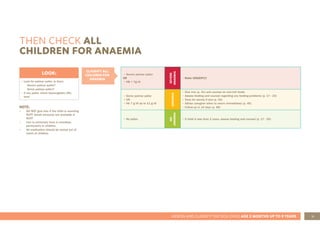
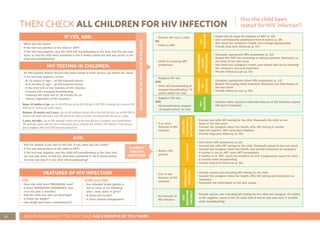
  • 35.
    33 ASSESS AND CLASSIFYTHE SICK CHILD AGE 2 MONTHS UP TO 5 YEARS CLASSIFY ALL CHILDREN FOR TB RISK • Yes to any question RISK OF TB • Investigate for TB (see below) • No to all questions LOW RISK OF TB • Routine care NOTE: • A close TB contact is an adult who has had pulmonary TB in the last 12 months, who lives in the same household as the child, or some-one with whom the child is in close contact or in contact for extended periods. If in doubt, discuss the case with an expert or refer the child. • Chest X-rays can assist in making the diagnosis of TB in children. Decisions as to how they are used in your area should be based on the availability of expertise for taking and interpreting good quality Xrays in children. Follow local guidelines in this regard. Although it is advisable that all children should have a CXR before TB treatment is commenced, where good quality CXR are not available, do not delay treatment. • If you are unsure about the diagnosis of TB, refer the child for assessment and investigation. • Any child with suspected complicated TB, e.g. TB meningitis or miliary TB should be referred. • GXP or TB culture positive CONFIRMED TB • Treat for TB (p. 39) • Notify and register in TB register • Check HIV status (p. 32) • Trace contacts and manage according to TB guidelines • Follow-up monthly to review progress (p. 51) One or more symptoms and signs of TB risk AND • TB contact, OR • TST positive, OR • CXR suggestive of TB PROBABLE TB • Treat for TB (p. 39) • Notify and register in TB register • Check HIV status (p. 32) • Trace contacts and manage according to TB guidelines • Follow-up monthly to review progress (p. 51) One or more symptoms or signs of TB risk, BUT • No TB contact • Negative TST • CXR not suggestive of TB POSSIBLE TB • Refer for further assessment or investigation if not done • Close TB contact or TST positive AND • CXR not suggestive of TB • TB culture negative • GXP negative • No symptoms present TB EXPOSED • Treat with INH for 6 months (p. 38) • Trace other contacts • Follow-up monthly (p. 51) CLASSIFY FOR TB RISK CLASSIFY FOR TB IF CLASSIFIED AS HAVING RISK OF TB ASK • Any history of TB contact in the past 12 months? • Cough for more than 2 weeks? • Fever for more than 7 days? • Not growing well?* *Classification of SAM, MAM or poor weight gain or weight loss for 3 months INVESTIGATE FOR TB • Send sputum or gastric aspirate for Gene Xpert and TB culture (one specimen for each test) • Do a TST - TST > 10 mm (or > 5 mm in an HIV infected child) is positive • Do a chest x-ray (ideally for all children, but guided by local availability)
  • 36.
    34 ASSESS ANDCLASSIFY THE SICK CHILD AGE 2 MONTHS UP TO 5 YEARS THEN CHECK THE CHILD’S IMMUNISATION STATUS AND GIVE ROUTINE TREATMENTS CHECK THE CAREGIVER’S HEALTH IMMUNISATION SCHEDULE • Give all missed immunisations on this visit (observing contraindications). This includes sick children and those without a RTHB. If the child has no RTHB, give a new one today • Advise caregiver when to return for the next immunisation • Give routine Vitamin A (p. 34) and record on the RTHB • Give routine treatment for worms (p. 34) and record on the RTHB • Refer to the EPI Vaccinators Manual or EDL for catch up schedule and contraindications • Make sure that the child has a birth certificate . If not, refer to Home Affairs or to social worker • Make sure that eligible children are receiving a child support grant. If not refer to SASSA or social worker Birth BCG OPV0 6 weeks Hexavalent1 (DaPT-IPV-HB-Hib1) OPV1 PCV1 RV1 10 weeks Hexavalent2 (DaPT-IPV-HB-Hib2) 14 weeks Hexavalent3 (DaPT-IPV-HB-Hib3) PCV2 RV2 6 months Measles1 9 months PCV3 12 months Measles2 18 months Hexavalent4 (DaPT-IPV-HB-Hib4) 6 years Td 12 years Td ASSESS ANY OTHER PROBLEM e.g. Skin rashes, social problems GIVE VITAMIN A • Give Vitamin A routinely to all children from the age of 6 months to prevent severe illness (prophylaxis) • If the child has had a dose of Vitamin A in the past 30 days, defer Vitamin A until 30 days has elapsed • Vitamin A is not contraindicated if the child is on multivitamin treatment • Vitamin A capsules come in 100 000 IU and 200 000 IU • Record the date Vitamin A given on the RTHB ROUTINE VITAMIN A* Age Vitamin A dose 6 up to 12 months A single dose of 100 000 IU at age 6 months or up to 12 months 1 up to 5 years A single dose of 200 000 IU at 12 months, then a dose of 200 000 IU every 6 months up to 5 years ADDITIONAL DOSE FOR SEVERE MALNUTRITION, PERSISTENT DIARRHOEA, MEASLES OR XEROPHTHALMIA • Give therapeutic (non-routine) dose of Vitamin A if the child has severe acute malnutrition, persistent diarrhoea, measles or xerophthalmia (dry eyes) • If the child has measles or xerophthalmia (dry eyes), give caregiver a second dose to take the next day Age Vitamin A Additional dose < 6 months 50 000IU 6 up to 12 months 100 000 IU 1 up to 5 years 200 000 IU GIVE MEBENDAZOLE OR ALBENDAZOLE • Children older than one year of age should receive routine deworming treatment every 6 months • Give Mebendazole or Albendazole • Give single dose (or first dose) in the clinic • Record the dose in the child’s RTHB Age MEBENDAZOLE Suspension (100 mg per 5 ml) Tablet (100 mg) Tablet (500 mg) 12 up to 24 months 5 ml twice daily for 3 days One tablet twice daily for 3 days 2 up to 5 years 25 ml as single dose Five tablets as single dose One tablet as single dose Age ALBENDAZOLE Tablet (100 mg) Tablet (200 mg) 12 up to 24 months One tablet as single dose 2 up to 5 years One tablet as single dose
  • 37.
    35 ASSESS AND CLASSIFYTHE SICK CHILD AGE 2 MONTHS UP TO 5 YEARS GIVE THESE TREATMENTS IN THE CLINIC ONLY PREVENT LOW BLOOD SUGAR (HYPOGLYCAEMIA) • If the child is able to swallow: - If breastfed: ask the mother to breastfeed the child, or give expressed breastmilk - If not breastfed: give a breastmilk substitute or sugar water. Give 30 - 50 ml of milk or sugar water before the child leaves the facility - To make sugar water: Dissolve 4 level teaspoons of sugar (20 grams) in a 200ml cup of ---clean water. • If the child is not able to swallow: - Insert nasogastric tube and check the position of the tube GIVE DIAZEPAM TO STOP CONVULSIONS • Turn the child to the side and clear the airway. Avoid putting things in the mouth • Give 0.5 mg per kg diazepam injection solution per rectum. Use a small syringe without a needle or a catheter • Test for low blood sugar, then treat or prevent • Give oxygen (p. 36) • REFER URGENTLY • If convulsions have not stopped after 10 minutes, repeat the dose once while waiting for transport WEIGHT Age Dose 3 - < 4 kg 0 up to 2 months 2 mg (0.4 ml) 4 - < 5 kg 2 up to 3 months 2.5 mg (0.5 ml) 5 - < 15 kg 3 up to 24 months 5 mg (1 ml) 15 - 25 kg 2 up to 5 years 7.5 mg (1.5 ml) TREAT FOR LOW BLOOD SUGAR (HYPOGLYCAEMIA) Low blood sugar < 3 mmol/L in a child • Suspect low blood sugar in any infant or child that: - is convulsing, unconscious or lethargic; OR - has a temperature below 35ºC • Children with severe malnutrition are particularly likely to be hypoglycaemic • Confirm low blood sugar using blood glucose testing strips • Treat with: - 10% Glucose - 5 ml for every kg body weight - by nasogastric tube OR intravenous line - Keep warm - Refer urgently and continue feeds during transfer • If neonatalyte is not available, add 1 part 50% dextrose water to 4 parts water to make 10% solution GIVE STABILISING FEED • Encourage the caregiver to continue breastfeeding and giving F-75 during referral • Give one feed immediately. Repeat two hourly until the child reaches the hospital • Keep the child warm (p. 12) WEIGHT F - 75 3.0 - < 5 kg 60 ml 5 - < 8 kg 90 ml ≥ 8 kg 120 ml • Explain to the caregiver why the medicine is given • Determine the dose appropriate for the child’s weight (or age) • Measure the dose accurately GIVE CEFTRIAXONE IM • Wherever possible use the weight to calculate the dose • Dilute 250 mg vial with 1 ml of sterile water, or 500 mg with 2 ml sterile water (250 mg per ml) • Give the injection in the upper thigh, not the buttocks • IF REFERRAL IS NOT POSSIBLE OR DELAYED, repeat the ceftriaxone injection every 24 hours WEIGHT Age Dose 3.5 - < 5.5 kg 1 up to 3 months 312 mg (1.25 ml) 5.5 - < 7 kg 3 up to 6 months 440 mg (1.75 ml) 7 - < 9 kg 6 up to 12 months 625 mg (2.5 ml) 9 - < 11 kg 12 up to 18 months 750 mg (3 ml) 11 - < 14 kg 18 months up to 3 years 810 mg (3.25 ml) 14 - < 17.5 kg 3 up to 5 years 1 g (4 ml)* ≥17.5 kg 5 years and older 1.5 g (5.5 ml)** *Give 2ml in each thigh **For children weighing more than 17.5 kg, dilute 1g in 3.5 ml sterile water and give 5.5 ml IM
  • 38.
    36 ASSESS ANDCLASSIFY THE SICK CHILD AGE 2 MONTHS UP TO 5 YEARS GIVE THESE TREATMENTS IN THE CLINIC ONLY GIVE PREDNISONE FOR STRIDOR OR RECURRENT WHEEZE WITH SEVERE CLASSIFICATION • Give one dose of prednisone as part of pre-referral treatment for STRIDOR or for RECURRENT WHEEZE with severe classification WEIGHT AGE PREDNISONE 5 mg Up to 8 kg - 2 tabs > 8 kg Up to 2 years 4 tabs 2 - 5 years 6 tabs GIVE NEBULIZED ADRENALINE FOR STRIDOR • Add 1 ml of 1:1000 adrenaline (one vial) to 1 ml of saline and administer using a nebulizer • Always use oxygen at flow-rate of 6 - 8 litres • Repeat every 15 minutes, until the child is transferred (or the stridor disappears) • Give one dose of prednisone as part of pre-referral treatment for stridor GIVE IM PENICILLIN FOR POSSIBLE STREPTOCOCCAL INFECTION GIVE IM SINGLE DOSE OR ORAL TREATMENT TWICE DAILY (P. 37) • IM Penicillin is the treatment of choice (see below) • Give azithromycin if the child is allergic to penicillin (p. 37) • Only give oral penicillin if the caregiver does not want the child to have an injection (p. 37) • Dilute 1.2 million units with 3 ml of sterile water or 3 ml of lidocaine 1% without adrenaline WEIGHT Age BENZATHINE BENZYLPENICILLIN IM INJECTION 1.2mu in 3 ml sterile water 1.2mu in 3 ml lidocaine 1% without adrenaline Up to 30 kg 3 up to 5 years 1.5 ml 1.5ml GIVE OXYGEN • Give oxygen to all young infants with: - severe pneumonia, with or without wheeze - lethargy or if the child is unconscious - convulsions • Use nasal prongs or a nasal cannula Nasal prongs • Place the prongs just inside or below the baby’s nostrils. • Secure the prongs with tape • Oxygen should flow 1 - 2 litres per minute Nasal cannula • This method delivers a higher concentration of oxygen • Insert a FG8 nasogastric tube • Measure the distance from the side of the nostril to the inner eyebrow margin with the catheter • Insert the catheter as shown in the diagramme • Secure with tape • Turn on oxygen to flow of half to one a litre per minute GIVE SALBUTAMOL FOR WHEEZE WITH SEVERE CLASSIFICATION SALBUTAMOL Nebulised salbutamol (2.5 ml nebule) • Dilute 1ml in 3 ml saline • Nebulise in the clinic • Always use oxygen at flow rate of 6-8 litres • If still wheezing repeat every 15 minutes in first hour and 2 - 4 hourly thereafter • Add Ipratropium bromide 0.5 ml if available OR MDI - 100 ug per puff • 4 - 8 puffs using a spacer • Allow 4 breaths per puff • If still wheezing repeat every 15 minutes in first hour and 2-4 hourly thereafter
  • 39.
    37 ASSESS AND CLASSIFYTHE SICK CHILD AGE 2 MONTHS UP TO 5 YEARS TEACH THE CAREGIVER TO GIVE ORAL MEDICINES AT HOME TREAT THE SICK CHILD Carry out the treatment steps identified on the assess and classify chart GIVE AMOXICILLIN* FOR PNEUMONIA, ACUTE EAR INFECTION OR SEVERE ACUTE MALNUTRITION WITHOUT MEDICAL COMPLICATIONS • Give two times daily for 5 days • * If the child is allergic to penicillins, or amoxicillin is out of stock, use azithromycin WEIGHT Age AMOXICILLIN SUSP . (125mg per 5 ml) SUSP. (250mg per 5 ml) CAPSULE 250 mg 3.5 - 5 kg 2 up to 3 months 7 ml 3.5 ml 5 - < 7 kg 3 up to 6 months 10 ml 5 ml 7 - < 11 kg 6 up to 18 months 15 ml 7.5 ml 11 - < 14 kg 18 months up to 3 years 10 ml Two 14 - < 17.5 kg 3 to 5 years 15 ml Three ≥ 17.5 kg ≥ 5 years 20 ml Four ≥ GIVE AZITHROMYCIN IF ALLERGIC TO PENICILLIN • Give azithromycin depending on the child’s weight • Give azithromycin once daily for three days only WEIGHT Age AZITHROMYCIN SUSPENSSION (200 mg per 5 ml) 3.5 - <5kg 1 up to 3 months 40mg (1 ml) 5- <7kg 3 up to 6 months 60 mg (1.5 ml) 7 - < 9 kg 6 up to 12 months 80 mg (2 ml) 9 - < 11 kg 12 up to 18 months 100 mg (2.5 ml) 11 - < 14 kg 18 months up to 3 years 120 mg (3 ml) 14 - < 18 kg 3 up to 5 years 160 mg (4 ml) ≥ 18 kg ≥ 5 years 200 mg (5 ml) GIVE CIPROFLOXACIN FOR DYSENTERY • Give twice a day for 3 days WEIGHT Age CIPROFLOXACIN SUSPENSION CIPROFLOXACIN TABLET (250 mg per 5ml) (250mg) < 11 kg 12 up to 18 months 3ml 11 - < 14 kg 18 months up to 3 years 4ml 14 - < 17.5 kg 3 up to 5 years 5ml One 17.5 - < 25 kg 3 up to 5 years 6ml GIVE PENICILLIN FOR POSSIBLE STREPTOCOCCAL INFECTION • Give twice a day for 10 days • The recommended treatment for POSSIBLE STREPTOCOOCAL INFECTION is IM Benzathine Benzylpenicillin (p. 36) • Only give oral penicillin if the caregiver refuses an injection • If the child is allergic, use azithromycin instead WEIGHT Age PHENOXYMETHYL PENICILLIN SUSPENSION (250 mg per 5ml) TABLET (250 mg) 11 - < 35 kg 3 up to 5 years 5 ml One tablet Follow the general instructions below for all oral medicines to be given at home Also follow the instructions listed with the dosage table for each medicine • Determine the appropriate medicines and dosage for the child’s weight or age • Tell the caregiver the reason for giving the medicine to the child • Demonstrate how to measure a dose • Watch the caregiver practise measuring a dose by herself • Explain carefully how to give the medicine • Ask the caregiver to give the first dose to her child • Advise the caregiver to store the medicines safely • Explain that the course of treatment must be finished, even if the child is better • Check the caregiver’s understanding before she leaves the clinic
  • 40.
    38 ASSESS ANDCLASSIFY THE SICK CHILD AGE 2 MONTHS UP TO 5 YEARS TEACH THE CAREGIVER TO GIVE ORAL MEDICINES AT HOME INH FOR TB EXPOSURE GIVE ONCE DAILY • Follow the general instructions for all oral medicines to be given at home • Tablets can be crushed and dissolved in water if necessary • Treatment must be given for 6 months • Follow-up children each month (p. 51) to check adherence and progress, and to provide medication WEIGHT ISONIAZID (INH) 100 mg tablet Once daily 2 - < 3.5 kg ¼ tab 3.5 - < 5 kg ½ tab 5 - <7.5 kg ¾ tab 7.5 - < 10 kg 1 tab 10 - < 15 kg 1½ tabs 15 - < 20 kg 2 tabs 20 - 25 kg 2½ tabs ≥ 25 kg 3 tabs Preventative therapy in case of drug-resistant TB contact: Isoniazid mono-resistant contact: Rifampicin, oral, 15 mg/kg for 4 months Rifampicin mono-resistant contact: Isoniazid, oral, 10 mg/kg daily for 6 months (see table above) GIVE COTRIMOXAZOLE GIVE ONCE DAILY AS PROPHYLAXIS • Give to all children with HIV INFECTION (criteria for stopping in children on ART are shown below) INDICATIONS WHEN TO START WHEN TO STOP HIV-infected infants (< 1 year of age) From 6 weeks of age Continue until 1 year of age, regardless of clinical stage and CD4 count HIV-positive children 1-5 years of age. All symptomatic children: WHO clinical stage 2, 3 or 4 OR CD4 <25% / CD4 <500 cells/ μl. Stop if clinically well on ART and CD4 ≥25% or ≥500 cells/μl on ≥2 occasions 3-6 months apart Recommence if CD4 drops <200 cells/μl, if ART fails or if new opportunistic infection develops HIV-positive children ≥ 5 years of age, adolescents and adults. Start if CD4 <200 cell/μl OR Clinical stage 3 or 4 disease (including TB) Stop if clinically well on ART and CD4 ≥200 cells/μl on ≥2 occasions 3-6 months apart. Recommence if CD4 drops below 200 cells/ μl WEIGHT COTRIMOXAZOLE SYRUP COTRIMOXAZOLE TABLET (200/40 mg per 5 ml) 400/80 mg 800/160 mg 2.5 - < 5 kg 2.5 ml ¼ tablet 5 - < 14 kg 5 ml ½ tablet 14 - < 30 kg 10 ml 1 tablet ½ tablet ≥ 30 kg 2 tablets 1 tablet
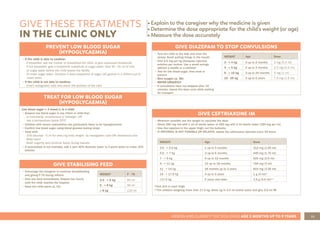
  • 41.
    39 ASSESS AND CLASSIFYTHE SICK CHILD AGE 2 MONTHS UP TO 5 YEARS TEACH THE CAREGIVER TO GIVE ORAL MEDICINES AT HOME GIVE REGIMEN 3A FOR UNCOMPLICATED TB • Uncomplicated TB includes low bacilliary load TB disease such as pulmonary TB with minimal lung parenchymal involvement (with or without involvement of hilar nodes), TB lymphadenitis and TB pleural effusion • All children should receive Rifampicin/INH (RH) together with pyrazinamide (PZA) for two months followed by RH for a further four months • For small infants dissolve one dispersible PZA tablet (150 mg) in 3 ml of water • Add Pyridoxine 12.5mg daily for 6 months if the child is HIV positive or malnourished REGIMEN 3A INTENSIVE PHASE TWO MONTHS Once daily CONTINUATION PHASE FOUR MONTHS Once daily WEIGHT RH (60mg/60)mg PZA (500mg) OR PZA** 150 mg/3 ml RH (60mg/60mg) 2 - < 3 kg ½ tab EXPERT ADVICE ON DOSE 1.5 ml ½ tab 3 - < 4 kg ¾ tab ¼ tab 2.5 ml ¾ tab 4 - < 6 kg 1 tab ¼ tab 3 ml 1 tab 6 - < 8 kg 1½ tab ½ tab 1½ tabs 8 - < 12 kg 2 tabs ½ tab 2 tabs 12 - < 15 kg 3 tabs 1 tab 3 tabs 15 - < 20 kg 3½ tabs 1 tab 3½ tabs 20 - < 25 kg 4½ tabs 1½ tabs 4½ tabs 25- < 30 kg 5 tabs 2 tabs 5 tabs GIVE REGIMEN 3B FOR COMPLICATED TB • Use this regimen in children with all forms of severe TB (extensive pulmonary TB, spinal or osteo-articular TB or abdominal TB) or retreatment cases • All children should receive four medicines during the intensive phase (Rifampicin/INH (RH), pyrazinamide (PZA) and ethambutol) for two months. This is followed by RH for a further four months (continuation phase) • For small infants dissolve one dispersible PZA tablet (150 mg) in 3 ml of water • To make ethambutol solution, crush one tablet (400 mg) to a fine powder and dissolve in 8 ml of water. Discard unused solution • Add Pyridoxine 12.5 mg daily for 6 months if the child is HIV positive or malnourished REGIMEN 3B INTENSIVE PHASE TWO MONTHS Once daily CONTINUATION PHASE FOUR MONTHS Once daily WEIGHT RH (60mg/ 60)mg PZA (500mg) OR PZA** 150 mg/ 3 ml ETHAMBUTOL 400mg/8ml solution OR 400 mg tablet RH (60mg/60mg) 2 - < 3 kg ½ tab EXPERT ADVICE ON DOSE 1.5 ml 1ml ½ tab 3 - < 4 kg ¾ tab ¼ tab 2.5 ml 1.5ml ¾ tab 4 - < 6 kg 1 tab ¼ tab 3 ml 2ml 1 tab 6 - < 8 kg 1½ tab ½ tab 3ml 1½ tabs 8 - < 12 kg 2 tabs ½ tab ½ tab 2 tabs 12 - < 15 kg 3 tabs 1 tab ¾ tab 3 tabs 15 - < 20 kg 3½ tabs 1 tab 1 tab 3½ tabs 20 - < 25 kg 4½ tabs 1½ tabs 1 tab 4½ tabs 25- < 30 kg 5 tabs 2 tabs 1½ tabs 5 tabs • Follow the general instructions for all oral medicines to be given at home • Also follow the instructions listed with the dosage table of each medicine • Do not change the regimen of children referred from hospital or a TB clinic without discussing this with an exvpert • Treatment should be given as Directly Observed Treatment (DOT) 7 days a week • Follow-up children each month (p. 51) to check adherence and progress
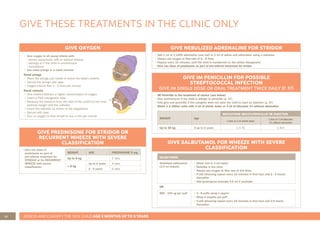
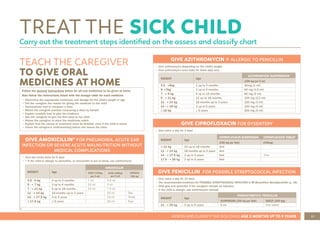
  • 42.
    40 ASSESS ANDCLASSIFY THE SICK CHILD AGE 2 MONTHS UP TO 5 YEARS TEACH THE CAREGIVER TO GIVE MEDICINES AT HOME TREAT FOR MALARIA • Give the current malaria treatment recommended for your area. See the Malaria Treatment Guidelines • Treat only test-confirmed malaria. Refer if unable to test, or if the child is unable to swallow, or is under one year of age • Record and notify malaria cases In all provinces combination therapy (Co-Artem) must be used. It is advisable to consult the provincial guidelines on a regular basis. Artemether + Lumefantrine (Co-Artem) • Watch the caregiver give the first dose of Co-Artem in the clinic and observe for one hour. If the child vomits within an hour repeat the dose • Give Co-Artem with fat-containing food/milk to ensure adequate absorption • Give first dose immediately • Second dose should be taken at home 8 hours later. Then twice daily for two more days WEIGHT WEIGHT CO-ARTEMETHER TABLET (20mg/120mg) Day 1: First dose and repeat this after 8 hours ( 2 doses) Days 2 and 3: take dose twice daily (4 doses) < 15 kg 1 tablet 1 tab twice a day 15 - 25 kg 2 tablets 2 tabs twice a day GIVE SALBUTAMOL FOR WHEEZE • Home treatment should be given with an MDI and spacer • Teach caregiver how to use it • While the child breathes, spray 1 puff into the bottle. Allow the child to breathe for 4 breaths per puff SALBUTAMOL MDI - 100 ug per puff: 1-2 puffs using a spacer. Allow 4 breaths per puff. Repeat 3 to 4 times a day. GIVE PARACETAMOL FOR FEVER 38°C OR ABOVE, OR FOR PAIN • Give a dose for fever 38o C or above • For pain: give paracetamol every 6 hours until free of pain (maximum one week) • Treat the underlying cause of fever or pain • Refer if no pain relief with paracetamol WEIGHT AGE PARACETAMOL SYRUP (120 mg per 5 ml) 3 - < 5 kg 0 up to 3 months 2 ml 5 - < 7 kg 3 up to 6 months 2.5 ml 7 - < 9 kg 6 up to 12 months 4 ml 9 - < 14 kg 12 months up to 3 years 5 ml 14 - < 17.5 kg 3 years up to 5 years 7.5 ml • Follow the general instructions for all oral medicines to be given at home • Also follow the instructions listed with the dosage table of each medicine
  • 43.
    41 ASSESS AND CLASSIFYTHE SICK CHILD AGE 2 MONTHS UP TO 5 YEARS GIVE IRON FOR ANAEMIA • Give three doses daily. Supply enough for 14 days • Follow-up every 14 days and continue treatment for 2 months • Each dose is 2 mg elemental iron for every kilogram weight. Elemental iron content depends on the preparation you have • Check the strength and dose of the iron syrup or tablet very carefully • Tell caregiver to keep Iron out of reach of children, because an overdose is very dangerous • Give Iron with food if possible. Inform the caregiver that it can make the stools look black • REMEMBER: Do not give Iron if the child is receiving the RUTF, as RUTF contains sufficient iron WEIGHT AGE Only if you do not know the weight Ferrous Gluconate (40 mg elemental iron per 5 ml) OR Ferrous Lactate drops (25 mg elemental iron per ml) OR Ferrous Sulphate tablet (60 mg elemental iron) Give 3 times a day with meals 3 - < 6 kg 0 up to 3 months 1.25 ml 0.3 ml (½ dropper) 6 - < 10 kg 3 up to 12 months 2 .5 ml 0.6 ml (1 dropper) 10 - < 25 kg One up to 5 years 5.0 ml 0.9 ml (1½ dropper) ½ tablet GIVE RUTF TO SAM WITHOUT MEDICAL COMPLICATION AND ELIGIBLE MAM CASES (SEE P. 48 FOR CRITERIA) • The child should be at least 6 months of age and weigh more than 4 kg • Make sure that the caregiver knows how to use the RUTF (p. 20) • The child may have been referred from hospital for ongoing care. Give amounts according to directions from the referring facility, or according to local guidelines WEIGHT RUTF 500Kcal/92gm sachet For SAM without medical complication: Child needs 200kcal/ kg/day For MAM Child needs additional 75 Kcal/ kg/day above his daily food intake of 100kcal/day. SAM SAM MAM MAM Sachets (per day) Sachets (per week) Sachets (per week) Sachets (per month) 4 - < 5 kg 2 14 4 16 5 - < 7 kg 2½ 18 5 20 7 - < 8.5 kg 3 21 7 28 8.5 - < 9.5 kg 3½ 25 9 36 9.5 - < 10.5 kg 4 28 10 40 10.5 - < 12 kg 4½ 32 11 44 ≥ 12 kg 5 35 13 52 GIVE ELEMENTAL ZINC (ZINC SULPHATE, GLUCONATE, ACETATE OR PICOLINATE) Give elemental zinc 10 mg once daily for 14 days GIVE MULTIVITAMINS • Give prophylaxis dose to child with Low birth Weight or Preterm from the third week of life • Give to children with Severe Acute Malnutrition not on feed with combined mineral and vitamin complex or Anaemia AGE WEIGHT MULTIVITAMINS Once Daily Drops Syrup Birth to 6 weeks < 2.5 kg 0.3 ml ≥ 2.5 kg 0.6 ml All other children 5 ml TEACH THE CAREGIVER TO GIVE ORAL MEDICINES AT HOME • Follow the general instructions for every oral medicines to be given at home • Also follow the instructions listed with the dosage table of each medicine
  • 44.
    42 ASSESS ANDCLASSIFY THE SICK CHILD AGE 2 MONTHS UP TO 5 YEARS GIVE EXTRA FLUID FOR DIARRHOEA AND CONTINUE FEEDING PLAN A: TREAT FOR DIARRHOEA AT HOME Counsel the caregiver on the 4 Rules of Home Treatment: 1. GIVE EXTRA FLUID (as much as the child will take) • COUNSEL THE CAREGIVER: - Breastfeed frequently and for longer at each feed - If the child is exclusively breastfed, give sugar-salt solution (SSS) or ORS in addition to breastmilk - If the child is not receiving breastmilk or is not exclusively breastfed, give one or more of the following: food-based fluids such as soft porridge, amasi (maas) or SSS or ORS - It is especially important to give ORS at home when: • the child has been treated with Plan B or Plan C during this visit • the child cannot return to a clinic if the diarrhoea gets worse • TEACH THE CAREGIVER HOW TO MIX AND GIVE SSS or ORS: - To make SSS: 1 litre boiled water + 8 level teaspoons sugar + half a level teaspoon salt SSS is the solution to be used at home to prevent dehydration NB The contents of the ORS sachet is mixed with clean water and administered to correct dehydration • SHOW THE CAREGIVER HOW MUCH FLUID TO GIVE IN ADDITION TO THE USUAL FLUID INTAKE: Up to 2 years 50 to 100 ml after each loose stool. 2 years or more 100 to 200 ml after each loose stool. • Counsel the caregiver to: - Give frequent small sips from a cup. - If the child vomits, wait 10 minutes. Then continue, but more slowly. - Continue giving extra fluid until the diarrhoea stops 2. GIVE ZINC (p. 41) 3. CONTINUE FEEDING (p. 17 - 23) 4. WHEN TO RETURN (p. 14 or p. 45) PLAN B: TREAT FOR SOME DEHYDRATION WITH ORS In the clinic: Give recommended amount of ORS over 4-hour period • DETERMINE AMOUNT OF ORS TO GIVE DURING FIRST 4 HOURS * The amount of ORS needed each hour is about 20 ml for each kilogram weight. Multiply the child’s weight in kg by 20 for each hour. Multiply this by four for the total number of ml over the first four hours. One teacup is approximately 200 ml • SHOW THE CAREGIVER HOW TO GIVE ORS SOLUTION: - Give frequent small sips from a cup - If the child vomits, wait 10 minutes. Then continue, but more slowly - Counsel the mother to continue breastfeeding whenever the child wants - If the child wants more ORS than shown, give more • AFTER 4 HOURS: - Reassess the child and classify the child for dehydration - Select the appropriate plan to continue treatment - Begin feeding the child in clinic • IF CAREGIVER MUST LEAVE BEFORE COMPLETING TREATMENT, OR THE CLINIC IS CLOSING: - Refer if possible. Otherwise: •Show her how to prepare ORS solution at home •Show her how much ORS to give to finish the 4-hour treatment at home •Show her how to prepare SSS for use at home •Explain the Four Rules of Home Treatment: 1. GIVE EXTRA FLUID 2. GIVE ZINC (p. 41) 3. CONTINUE FEEDING (p. 17 - 23) 4. WHEN TO RETURN (p. 14 or p. 45)
  • 45.
    43 ASSESS AND CLASSIFYTHE SICK CHILD AGE 2 MONTHS UP TO 5 YEARS GIVE EXTRA FLUID FOR DIARRHOEA AND CONTINUE FEEDING PLAN C: TREAT SEVERE DEHYDRATION QUICKLY * • Start IV fluid immediately. If the child can drink, give ORS by mouth while the drip is set up. Weigh the child or estimate the weight Within the first half hour: Plan for the next 5 hours: Rapidly give 20 ml IV for each kilogram weight, before referral (weight x 20 gives ml needed). Repeat this amount up to twice if the radial pulse is weak or not detectable. More slowly give 20 ml IV for each kilogram weight, every hour, during referral. Ensure the IV continues running, but does not run too fast. • Give Normal Saline IV • REFER URGENTLY for further management • Reassess the child every 1- 2 hours while awaiting transfer. If hydration status is not improving, give the IV drip more rapidly • Also give ORS (about 5 ml per kilogram each hour) as soon as the child can drink: usually after 3 - 4 hours (infants) or 1 - 2 hours NO NO NO NO YES YES YES Can you give intravenous (IV) fluid immediately? Is IV treatment available nearby (within 30 minutes)? Are you trained to use a nasogastric (NG) tube for rehydration? Refer URGENTLY to hospital for IV Can the child drink? FOLLOW THE ARROWS. IF ANSWER IS ‘YES’, GO ACROSS. IF ‘NO’, GO DOWN NOTE: If possible, observe the child at least 6 hours after rehydration, to be sure the caregiver can maintain hydration giving the child ORS by mouth. * Exception: Another severe classification e.g. suspected meningitis, severe malnutrition • Too much IV fluid is dangerous in very sick children. Treatment should be supervised very closely in hospital • Set up a drip for severe dehydration, but give Normal Saline only 10 ml per kilogram over one hour • Then give sips of ORS while awaiting urgent referral • • Start rehydration with ORS solution, by tube: Start rehydration with ORS solution, by tube: give 20 ml per kg each hour for 6 hours (total of 120 ml per kg) give 20 ml per kg each hour for 6 hours (total of 120 ml per kg) • • REFER URGENTLY for further management REFER URGENTLY for further management • • Reassess the child every 1-2 hours while awaiting transfer: Reassess the child every 1-2 hours while awaiting transfer: - If there is repeated vomiting give the fluid more slowly - If there is repeated vomiting give the fluid more slowly - If there is abdominal distension stop fluids and refer urgently - If there is abdominal distension stop fluids and refer urgently - After 6 hours reassess the child if he/she is still at the clinic. Classify dehydration. Then choose the appropriate plan - After 6 hours reassess the child if he/she is still at the clinic. Classify dehydration. Then choose the appropriate plan (A, B, or C) to continue treatment (A, B, or C) to continue treatment • Refer URGENTLY to hospital for IV treatment • If the child can drink, provide caregiver with ORS solution and show her how to give frequent sips during the trip, or give ORS by nasogastric tube
  • 46.
    44 ASSESS ANDCLASSIFY THE SICK CHILD AGE 2 MONTHS UP TO 5 YEARS TEACH THE CAREGIVER TO TREAT LOCAL INFECTIONS FOR THRUSH • If there are thick plaques the caregiver should: - Wash hands with soap and water - Wet a clean soft cloth with chlorhexidine 0.2% or salt water, wrap this around the little finger, then gentle wipe away the plaques - Wash hands again • Give nystatin 1 ml 4 times a day (after feeds) for 7 days • If infant is breastfed, - Check mother’s breasts for thrush. If present treat mother’s breasts with nystatin - Advise mother to wash nipples and areolae after feeds • If bottle fed, change to cup and make sure that the caregiver knows how to clean utensils used to prepare and give the milk (p. 23 - 25) SOOTHE THE THROAT, RELIEVE THE COUGH WITH A SAFE REMEDY Safe remedies to encourage: • Breastmilk • If not breastfed and/or older than 6 months, warm water or weak tea can be given. Sugar or honey and lemon can be added, if available Harmful remedies to discourage: • Herbal smoke inhalation • Vicks drops by mouth • Any mixture containing vinegar FOR EYE INFECTION The caregiver should: • Wash hands with soap and water • Gently wash off pus and clean the eye with normal saline (or cooled boiled water) at least 4 times a day. Continue until the discharge disappears • Apply chloramphenicol ointment 4 times a day for seven days • Wash hands again after washing the eye FOR CHRONIC EAR INFECTION, CLEAR THE EAR BY DRY WICKING • Dry the ear at least 3 times daily - Roll clean absorbent cloth or soft, strong tissue paper into a wick - Place the wick in the child’s ear - Remove the wick when wet - Replace the wick with a clean one and repeat these steps until the ear is dry • The ear should not be plugged between dry wicking FOR MOUTH ULCERS • Treat for mouth ulcers 3 - 4 times daily for 5 days: - Give paracetamol for pain relief (p. 40) at least 30 minutes before cleaning the mouth or feeding the child - Wash hands - Wet a clean soft cloth with chlorhexidine 0.2% and use it to wash the child’s mouth. Repeat this during the day - Wash hands again • Advise caregiver to return for follow-up in two days if the ulcers are not improving • Explain how the treatment is given • Watch her as she does the first treatment in the clinic • She should return to the clinic if the infection worsens
  • 47.
    45 ASSESS AND CLASSIFYTHE SICK CHILD AGE 2 MONTHS UP TO 5 YEARS COUNSEL THE MOTHER OR CAREGIVER ABOUT HOME CARE 1. FEEDING • Counsel the mother to feed her child based on the child’s age and findings of feeding assessment (p. 17 - 23) 2. WHEN TO RETURN Advise caregiver to return immediately if the child has any of these signs: Any sick child • Becomes sicker • Not able to drink or breastfeed • Has convulsions • Vomiting everything • Develops a fever • Develops oedema If child has COUGH OR COLD, also return if • Fast breathing • Difficult breathing • Wheezing If child has DIARRHOEA, also return if • Blood in stool • Drinking poorly FOLLOW-UP VISIT: ADVISE CAREGIVER TO COME FOR FOLLOW-UP AT THE EARLIEST TIME LISTED If the child has: Return for follow-up in: PNEUMONIA DYSENTERY SOME DEHYDRATION - if diarrhoea not improving MALARIA - if fever persists SUSPECTED MALARIA - if fever persists FEVER - OTHER CAUSE - if fever persists MEASLES SUSPECTED MEASLES 2 days COUGH OR COLD - if no improvement WHEEZE - FIRST EPISODE - if still wheezing NO VISIBLE DEHYDRATION - if diarrhoea not improving PERSISTENT DIARRHOEA ACUTE EAR INFECTION - if pain / discharge persists POSSIBLE STREPTOCOCCAL INFECTION - if symptoms persist FEEDING PROBLEM 5 days SEVERE ACUTE MALNUTRITION WITH NO MEDICAL COMPLICATION MODERATE ACUTE MALNUTRITION FEEDING PROBLEM HIGH RISK OF TB or RISK OF TB 7 days ACUTE or CHRONIC EAR INFECTION ANAEMIA NOT GROWING WELL - but no feeding problem 14 days HIV-INFECTION ONGOING HIV EXPOSURE SUSPECTED SYMPTOMATIC HIV HIV EXPOSED TB EXPOSED CONFIRMED or PROBABLE TB OVERWEIGHT/OBESE Monthly ROUTINE WELL CHILD VISIT Advise caregiver when to return for next Routine Child visit
  • 48.
    46 ASSESS ANDCLASSIFY THE SICK CHILD AGE 2 MONTHS UP TO 5 YEARS COUNSEL THE MOTHER OR CAREGIVER ABOUT HOME CARE 3. SUPPORT THE FAMILY TO CARE FOR THE CHILD • Help the mother, family and caregiver to ensure the child’s needs are met • Assess any needs of the family and provide or refer for management 4. COUNSEL THE CAREGIVER ABOUT HER OWN HEALTH • If the caregiver is sick, provide care for her, or refer her for help • Advise the caregiver to eat well to keep up his/her own strength and health • Encourage caregiver to grow local foods, if possible, and to eat fresh fruit and vegetables • Ensure that the child’s birth is registered • Where indicated, encourage the caregiver to seek social support services e.g. Child Support Grant • Make sure the caregiver has access to: - Contraception and sexual health services, including HIV testing services - If mother is HIV negative: retest at the 10 week postnatal visit, 6 month visit and every 3 months while breastfeeding - Counselling on STI and HIV prevention - Any other health or social services she requires 5. GIVE ADDITIONAL COUNSELLING IF THE MOTHER OR CAREGIVER IS HIV-POSITIVE • Encourage disclosure: disclosure may improve adherence and viral suppression which is important for all caregivers, including breastfeeding mothers • If mother is not on ART: offer same-day ART initiation • If mother is on ART: check the mother’s VL and if suppressed repeat VL every 6 months while breastfeeding. If not virally suppressed: follow the VL non-suppression algorithm in national ART guidelines • Emphasise the importance of adherence if on ART • Emphasise early treatment of illnesses, opportunistic infections or drug reaction • Counsel caregiver on eating healthy foods that include protein, fat, carbohydrate, vitamins and minerals • Reassure her that with regular follow-up, much can be done to prevent serious illness, and maintain her and the child’s health
  • 49.
    47 ASSESS AND CLASSIFYTHE SICK CHILD AGE 2 MONTHS UP TO 5 YEARS GIVE FOLLOW-UP CARE PNEUMONIA AND COUGH OR COLD After 2 days • Check the child for general danger signs • Assess the child for cough or difficult breathing • Ask: - Is the child’s breathing slower? - Is there less fever? - Is the child eating better? Treatment: • If there is chest indrawing or a general danger sign, give first dose of ceftriaxone IM. (p. 35) Also give first dose cotrimoxazole (p. 38) unless the child is known to be HIV-negative. Then REFER URGENTLY • If breathing rate, fever and eating are the same, or worse, check if caregiver has been giving the treatment correctly. If yes, refer. If she has been giving the antibiotic incorrectly, teach her to give oral medicines at home. Follow-up in 2 days • If breathing slower, less fever or eating better, complete 5 days of antibiotic. Remind the caregiver to give one extra meal daily for a week WHEEZE - FIRST EPISODE After 2 days (PNEUMONIA with wheeze), or after 5 days (COUGH OR COLD with wheeze): • If wheezing has not improved, refer • If no longer wheezing after 5 days, stop salbutamol. Advise caregiver to re-start salbutamol via spacer if wheezing starts again, and return to clinic immediately if child has not improved within 4 hours DIARRHOEA After 2 days (for some dehydration) or 5 days (for no visible dehydration, but not improving): • Assess the child for diarrhoea • Check if zinc is being given • If blood in the stools, assess for dysentery • Ask: - Are there fewer stools? - Is the child eating better? • If SOME DEHYDRATION, refer • If diarrhoea still present, but NO VISIBLE DEHYDRATION, follow-up in 5 days • Assess and counsel about feeding (p. 17 - 20) • Advise caregiver when to return immediately (p. 45) PERSISTENT DIARRHOEA After 5 days: • Ask: - Has the diarrhoea stopped? - How many loose stools is the child having per day Assess feeding Treatment: • Check if zinc is being given • If the diarrhoea has not stopped reassess child, treat for dehydration, then refer • If the diarrhoea has stopped: - Counsel on feeding (p. 17 - 20) - Suggest caregiver gives one extra meal every day for one week - Review after 14 days to assess weight gain DYSENTERY After 2 days: • Assess the child for diarrhoea. See ASSESS & CLASSIFY (p. 26) Ask: - Are there fewer stools? - Is there less blood in the stool? - Is there less fever? - Is there less abdominal pain? - Is the child eating better? Treatment: • If general danger sign present, or child sicker, REFER URGENTLY • If child dehydrated, treat for dehydration, and REFER URGENTLY • If number of stools, amount of blood, fever or abdominal pain is the same or worse, refer • If child is better (fewer stools, less blood in stools, less fever, less abdominal pain, eating better), complete 3 days of Ciprofloxacin • Give an extra meal each day for a week. (p. 17-20) See ASSESS & CLASSIFY (p. 25) See ASSESS & CLASSIFY (p. 26) • Care for the child who returns for follow-up using ALL the boxes that match the child’s previous classifications • If the child has a new problem, assess, classify and treat the new problem as on the ASSESS AND CLASSIFY Chart
  • 50.
    48 ASSESS ANDCLASSIFY THE SICK CHILD AGE 2 MONTHS UP TO 5 YEARS GIVE FOLLOW-UP CARE NOT GROWING WELL After 14 days: • Weigh the child and determine if the child is still low weight for age • Determine weight gain • Reassess feeding (p. 17 - 23) Treatment: • If the child is gaining weight well, praise the caregiver. Review every 2 weeks until GROWING WELL • If the child is still NOT GROWING WELL - Check for TB and manage appropriately - Check for HIV infection and manage appropriately - Check for feeding problem. If feeding problem, counsel and follow-up in 5 days - Counsel on feeding recommendations • If the child has lost weight or you think feeding will not improve, refer. Otherwise review again after 14 days: if child has still not gained weight, or has lost weight, refer • Check if the child is accessing other additional care and support (e.g. Social security grants) SEVERE ACUTE MALNUTRITION (SAM) WITHOUT MEDICAL COMPLICATION OR MODERATE ACUTE MALNUTRITION (INCLUDING SAM PATIENTS DISCHARGED FROM INPATIENT CARE) After 7 days: ASK: • Is the child feeding well? • Is the child finishing the weekly amount of RUTF? Are there any new problems? LOOK FOR: • General danger signs, medical complications, fever and fast breathing. If present or there is a new problem, assess and classify accordingly • Weight, MUAC, oedema and anaemia • If the child is well and gaining weight, there is no need to repeat the appetite test. If the child is not gaining weight or you are concerned for any reason, repeat the appetite test Treatment: If any one of the following are present, refer: • Any danger sign, RED or YELLOW CLASSIFICATION or other problem • Poor response as indicated by: - oedema - weight loss of more than 5% of body weight at any visit or for 2 consecutive visits - static weight for 3 consecutive visits - failure to reach the discharge criteria after 2 months of outpatient treatment. - child fails the appetite test If there is no indication for referral: • Assess for possible HIV and TB infection (p. 32 - 33) • Give a weekly supply of RUTF (p. 41) • Counsel the caregiver on feeding her child (p. 23) • Give immunisations and routine treatments when due (p. 34) • Follow-up weekly until stable • Continue to see the child monthly for at least two months until the child is feeding well and gaining weight regularly or until the child is classified as GROWING WELL FEEDING PROBLEM After 5 days: • Reassess feeding (p. 17 - 23) • Ask about feeding problems and counsel the caregiver about any new or continuing feeding problems • If child is NOT GROWING WELL, review after 14 days to check weight gain ANAEMIA After 14 days: • Check haemoglobin Treatment: • If haemoglobin lower than before, refer • If haemoglobin the same or higher than before, continue iron. Recommend iron rich diet. Review in 14 days. Continue giving iron every day for 2 months (p. 41) • If the haemoglobin has not improved or the child has palmar pallor after one month, refer MODERATE ACUTE MALNUTRITION Routinely providing supplementary foods (RUTF) to moderately acute malnutrition to infants and children presenting to primary healthcare facilities is not recommended Supplementary foods are recommended in the following situations: • Areas with a high prevalence (new and old cases) of moderate acute malnutrition • Children/family who are food and nutrient insecure and/or where food based approach is not feasible (no or very little food) • For this group of children special attention to nutrition counselling, interventions to address food security and follow-up care to assess response is crucial • Care for the child who returns for follow-up using ALL the boxes that match the child’s previous classifications • If the child has a new problem, assess, classify and treat the new problem as on the ASSESS AND CLASSIFY Chart
  • 51.
    49 ASSESS AND CLASSIFYTHE SICK CHILD AGE 2 MONTHS UP TO 5 YEARS EAR INFECTION Reassess for ear problem. See ASSESS & CLASSIFY (p. 29) Treatment: • If there is tender swelling behind the ear or the child has a high fever, REFER URGENTLY ACUTE EAR INFECTION: After 5 days: • If ear pain or discharge persists, treat with amoxicillin for 5 more days • Continue dry wicking if discharge persists • Follow-up in 5 more days • After two weeks of adequate wicking, if discharge persists, refer CHRONIC EAR INFECTION: After 14 days: • If some improvement, continue dry wicking, and review in 14 days • If no improvement, refer POSSIBLE STREPTOCOCCAL INFECTION After 5 days: • Assess and monitor dehydration as some children with a sore throat are reluctant to drink or eat due to pain • Stress the importance of completing 10 days of oral treatment • If no improvement, follow-up in 5 more days • After 10 days: If symptoms worse or not resolving, refer GIVE FOLLOW-UP CARE FEVER: OTHER CAUSE If fever persists after 2 days: Do a full reassessment of the child Treatment: • If the child has any general danger sign or stiff neck or bulging fontanelle, treat for SUSPECTED MENINGITIS (p. 27) and REFER URGENTLY • If fever has been present for 7 days, assess for TB (p. 33) • Treat for other causes of fever MALARIA OR SUSPECTED MALARIA If fever persists after 2 days: • Do a full reassessment of the child • Assess for other causes of fever Treatment: • If the child has any general danger signs, bulging fontanelle or stiff neck, treat as SUSPECTED SEVERE MALARIA (p. 27) and REFER URGENTLY • If malaria rapid test was positive at initial visit and fever persists or recurs, REFER URGENTLY • If malaria test was negative at the initial visit, and no other cause for the fever is found after reassessment, repeat the test: • - If malaria test is negative or unavailable, refer - If malaria rapid test is positive, treat for malaria • Treat for any other cause of fever MEASLES If fever persists after 2 days or caregiver complains of new problems, do a full reassessment (p. 24 - 34) • Look for mouth ulcers and clouding of the cornea • Check that the child has received two doses of Vitamin A (p. 34) • Check that the necessary specimens have been sent and that contacts have been immunised Treatment: • If child has any danger sign or severe classification, provide prereferral treatment, and REFER URGENTLY • If child is still feverish, has mouth or eye complications, DIARRHOEA WITH SOME DEHYDRATION, PNEUMONIA or has lost weight, refer • If child has improved, advise caregiver to provide home care, including providing an extra meal for one week. Make sure she knows when to return (p. 14 or 45) • Care for the child who returns for follow-up using all the boxes that match the child’s previous classifications • If the child has a new problem, assess, classify and treat the new problem as on the ASSESS AND CLASSIFY chart (p. 24-34)
  • 52.
    50 ASSESS ANDCLASSIFY THE SICK CHILD AGE 2 MONTHS UP TO 5 YEARS GIVE FOLLOW-UP CARE HIV INFECTION NOT ON ART All children with confirmed HIV should be initiated on ART Children whose caregivers are not willing and able to start ART should be referred to the counselor and social worker to identify obstacles to treatment and should start ART as soon as possible. The following should be provided at each visit: • Routine child health care: immunisation, growth monitoring, feeding assessment and counseling and developmental screening • Find out why the child is not on ART and counsel appropriately • Provide cotrimoxazole prophylaxis (p. 38) • Assessment, classification and treatment of any new problem • Ask about the caregiver’s health. Provide HIV testing and treatment if necessary HIV TEST NB: All HIV-exposed infants not on ART should be tested/ retested: • At birth • At 10 weeks of age • At 6 months of age • If the child becomes ill or develops symptoms of HIV • At 18 months of age (all infants regardless of HIV exposure) • 6 weeks after cessation of breastfeeding • In infants/ children under 18 months of age, test and confirm HIV with HIV PCR tests AGE INITIAL TEST CONFIRMATORY TEST < 18 months HIV-exposed HIV PCR 2nd HIV PCR Exposure unknown A positive HIV antibody test confirms exposure. HIV PCR test to determine if child is infected. 2nd HIV PCR Infant 18 - 24 months HIV antibody (rapid or ELISA) HIV PCR Child > 2 years HIV antibody (rapid or ELISA) HIV antibody (rapid or ELISA) HIV-EXPOSED: ON ARV PROPHYLAXIS, ONGOING HIV EXPOSURE OR HIV-EXPOSED See the child at least once every month. At each visit provide: • Routine child health care: immunisation, growth monitoring, and developmental screening • Check that the infant/ child has been receiving prophylactic ARVs correctly (p. 12) • Support the mother to exclusively breastfeed the infant (p. 17 - 18). If the infant is not breastfed, provide counselling on replacement feeding (p. 23-25) and address any feeding problems (p. 21) • Infants of mothers on 1st line regimens and VL > 1000 copies/ ml: - Regain maternal VL suppression as a matter of urgency - Continue breastfeeding - Continue or re-initiate high risk prophylaxis with AZT twice daily for 6 weeks and NVP once daily for a minimum of 12 weeks - NVP should only be stopped once the maternal VL is confirmed to be < 1000 copies/ ml, or until 1 week after all breastfeeding has stopped • Infants of mothers on 2nd or 3rd line regimens and VL >1000 copies/ ml: - Advise not to breastfeed - Arrange replacement feeding through dietitian • Provide cotrimoxazole prophylaxis (p. 38) • Assess, classify and treat any new problem • Recheck the child’s HIV status according to the HIV testing schedule (below). Reclassify the child according to the test result, and provide care accordingly • Ask about the caregiver’s health. Provide counselling, testing and treatment as necessary SUSPECTED SYMPTOMATIC HIV INFECTION Children with this classification should be tested immediately with an age- appropriate HIV test, and reclassified on the basis of their test result See the child at least once a month. At each visit: • Provide routine child health care: immunization, growth monitoring, feeding assessment and counseling, and developmental screening • Provide Cotrimoxazole prophylaxis from 6 weeks of age (p. 38) • Assess, classify and treat any new problem • Ask about the caregiver’s health. Provide HIV testing and appropriate treatment
  • 53.
    51 ASSESS AND CLASSIFYTHE SICK CHILD AGE 2 MONTHS UP TO 5 YEARS GIVE FOLLOW-UP CARE CONFIRMED OR PROBABLE TB (ON TREATMENT) • Follow-up monthly • Ensure that the child is receiving regular treatment, ideally as Directly Observed Treatment, 7 days a week. Remember to switch to the continuation phase after two months treatment (p. 39) • Ask about symptoms and check weight • If symptoms are not improving or if the child is not growing well, refer • Counsel regarding the need for adherence, and for completing six months treatment • Counsel and recommend HIV testing if the child’s HIV status is not known TB EXPOSURE (ON TREATMENT) • Follow-up monthly • Ask about symptoms and check weight • If symptoms develop, or if child is not growing well, refer • Counsel regarding the need for adherence, and for completing six months treatment • Ensure that the child is receiving medication, and provide treatment for one month where necessary (p. 38)
  • 54.
    52 ANTI-RETROVIRAL THERAPY(ART) INITIATING ART IN CHILDREN: Follow the six steps STEP 1: RECORD PATIENT DETAILS AND HISTORY Record the following information in the HIV clinical chart. • Patient details. • Caregiver details: Details of primary and secondary caregiver. • Past medical history: - Allergies - Mode of transmission - ARVs prior to ART start date including PMTCT prophylaxis - ART transfer in details - Disclosure status - Immunisation status (update from RTHB) - Past medical history including surgical history STEP 2: DECIDE IF THE CHILD HAS CONFIRMED HIV INFECTION Infant/ child <18 months: The first positive HIV PCR test is confirmed with a second positive HIV PCR • Proceed to Steps 3 - 6 whilst awaiting second HIV PCR result Child >18 months: Under 2 years: A positive rapid HIV antibody test is confirmed with a positive HIV PCR Over 2 years: A positive rapid HIV antibody tests confirmed with a second positive HIV antibody test (rapid or ELISA) • If the first rapid HIV test is positive and the second test is negative (discordant), do an ELISA or refer • Send outstanding tests but proceed to step 3 while awaiting results STEP 3: DECIDE IF THE CAREGIVER IS ABLE TO GIVE ART • Check that the caregiver is willing and able to administer ART • Complete psychosocial readiness and social record sections in the HIV clinical chart • The caregiver should ideally have disclosed the child’s HIV status to another adult who can assist with providing ART (or be part of a support group) • If caregiver is willing and able to give ART, move to Step 4 • If not, classify as HIV INFECTION not on ART, and provide care as outlined on p 50 STEP 4: DECIDE IF A IMCI NURSE SHOULD INITIATE ART Check for the following: - General danger signs or any severe classification - Infant <1 month of age - Child weighs less than 3 kg - TB - Fast breathing - Any WHO stage 4 condition • If any of these are present, refer to next level of care for ART initiation • If none present, move to Step 5 STEP 5: ASSESS AND RECORD BASELINE INFORMATION • Nutrition assessment: • Weight, height/length, head circumference (if <2 years), MUAC • BMI or WFH z-score. Classify based on findings • Assess and classify for anaemia (p. 31) • TB screening and TB contacts (p. 33) • Developmental screening, school attendance and school performance • WHO clinical staging • Baseline laboratory investigations: BASELINE INVESTIGATIONS DONE FOR CD4 count and FBC/ Hb All children starting ART. Creatinine and eGFR (p. 56) Children/ adolescents starting tenofovir (TDF). Alanine Aminotransferase (ALT) On TB treatment or starting nevirapine (NVP). • If the child has SEVERE ACUTE MALNUTRITION, SEVERE ANAEMIA (Hb < 7g/dl) or TB refer to the next level of care for management and for initiation of ART • If Hb is 7 g/dl - 11 g/dl, classify as ANAEMIA and treat (p. 31). Do not delay starting ART • Send any outstanding laboratory tests. If the child already meets the criteria for starting STEP 6: START ART • ART regimens always include 3 drugs • See ART dosing and instructions (p. 52-59) • Remember to counsel the caregiver on how to give the drugs and possible side-effects • Remember to give cotrimoxazole (p. 38) • Give other routine treatments (p. 34) • Follow-up after one week WEIGHT/ AGE ART REGIMEN Age >1 month AND Weight 2.5kg - < 20 kg Abacavir (ABC) Lamivudine (3TC) Lopinavir/ritonavir (LPV/r) Weight 20 - < 35 kg OR Age < 10yrs Abacavir (ABC) Lamivudine (3TC) Dolutegravir (DTG) Age ≥10 years AND Weight ≥ 35kg Tenofovir (TDF)* Lamivudine (3TC) Dolutegravir (DTG)
  • 55.
    53 ANTI-RETROVIRAL THERAPY (ART) ADAPTEDWHO CLINICAL STAGING STAGE 1 STAGE 2 STAGE 3 STAGE 4 • No symptoms • Persistent generalised lymphadenopathy • Unexplained persistent enlarged liver and/ or spleen • Papular pruritic eruptions • Seborrheic dermatitis • Extensive human papilloma infection • Extensive molluscum contagiosum • Fungal nail infections • Recurrent oral ulcerations • Linear gingival erythema • Angular cheilitis • Unexplained persistent enlarged parotid • Herpes zoster • Recurrent or chronic respiratory tract infections (sinusitis, ear infection, otorrhoea, sinusitis, tonsillitis) • Unexplained Moderate Malnutrition not adequately responding to standard therapy • Oral thrush (outside neonatal period) • Oral hairy leucoplakia • Acute necrotising ulcerative gingivitis/ periodontitis • The following conditions if unexplained and if not responding to standard treatment: - Diarrhoea for 14 days or more - Fever for one month or more - Anaemia (Hb <8 g/dL) for one month or more - Neutropaenia (< 500/mm3) for one month - Thrombocytopaenia (platelets <50,000/mm3) for one month or more • Recurrent severe bacterial pneumonia • Pulmonary TB • TB lymphadenopathy • Chronic HIV-associated lung disease, including bronchiectasis • Symptomatic Lymphoid Interstitial Pneumonitis • Unexplained severe wasting or Severe Malnutrition not adequately responding to standard therapy • Oesophageal thrush • Herpes simplex ulceration for one month or more • Severe multiple or recurrent bacterial infections, two or more episodes in a year (not including pneumonia) • Pneumocystis pneumonia (PCP/ PJP) • Kaposi sarcoma • Extrapulmonary TB • All children with CONFIRMED HIV INFECTION must be staged at diagnosis and as part of regular follow-up • Children are staged in order to monitor their progress on ART • If in doubt, discuss the child with a colleague or refer
  • 56.
    54 STARTING ART FOR CHILDREN ABACAVIR(ABC) GIVE ONCE OR TWICE DAILY • Tablets (except 60mg) must not be chewed, divided or crushed. They should be swallowed whole, with or without food • A hypersensitivity (allergic) reaction to abacavir may occur in a very small number of children. This usually happens in the first six weeks of treatment - Symptoms tend to worsen in the hours immediately after the dose, and worsen with each subsequent dose - Common side-effect symptoms include fever and rash (usually raised and itchy), gastrointestinal symptoms (nausea, vomiting, abdominal pain) and respiratory symptoms (dyspnoea, sore throat, cough) - If the child has at least 2 of the above, do NOT stop the medicine but call for advice or refer URGENTLY - If a hypersensitivity reaction is confirmed, abacavir will be stopped - A child who has had a hypersensitivity reaction must never be given abacavir again. Make sure that the reaction is recorded, and that the patient knows that he/ she should never take abacavir again ABACAVIR / ABC (choose one option) Weight Solution: 20 mg/ml Tablet: 60 mg Tablet: 300 mg ≤3 kg or neonate Consult with expert 3 – < 5 kg 2 ml twice daily 5 – < 7 kg 3 ml twice daily 7 – <10 kg 4 ml twice daily 10 – <14 kg 6 ml twice daily OR 12 ml once daily 2 tablets twice daily OR 4 tablets once daily 14 – < 20 kg 8 ml twice daily OR 15 ml once daily 2½ tablets twice daily OR 5 tablets once daily 1 tablet once daily 20 – < 23 kg 10 ml twice daily OR 20 ml once daily 3 x 60 mg tablets twice daily OR 1 x 300 mg + 1 x 60 mg tablet once daily 23 – < 25 kg 10 ml twice daily OR 20 ml once daily 3 x 60 mg tablets twice daily OR 1 x 300 mg + 2 x 60 mg tablet once daily > 25 kg 1 x 300 mg tablet twice daily OR 1 x 600 mg tablet once daily LAMIVUDINE (3TC) GIVE ONCE OR TWICE DAILY • Lamivudine is very well tolerated and can be taken with our without food • Tablets are scored and can be easily divided. They may be crushed and mixed with a small amount of water or food—if this is done they must be given immediately • Side-effects are minimal ,but include headache, tiredness, abdominal pain and red cell aplasia • If side-effects are mild continue treatment • If the child has severe symptoms, REFER URGENTLY LAMIVUDINE / 3TC (choose one option) Weight Solution: 10 mg/ml Tablet: 150 mg Tablet: 300 mg ≤3 kg or neonate Consult with expert 3 – < 5 kg 2 ml twice daily 5 – < 7 kg 3 ml twice daily 7 – <10 kg 4 ml twice daily 10 – <14 kg 6 ml twice daily OR 12 ml once daily 14 – < 20 kg 8 ml twice daily OR 15 ml once daily ½ tablets twice daily OR 1 tablet once daily 20 – < 25 kg 15 ml twice daily OR 30 ml once daily 1 tablet twice daily OR 2 tablet once daily 1 tablet once daily > 25 kg 15 ml twice daily OR 30 ml once daily 1 tablet twice daily OR 2 tablet once daily 1 tablet once daily One ABC/3TC (600/300 mg) combination tablet once daily All children should receive three drugs in their ART regimen (p. 52) ANTI-RETROVIRAL THERAPY (ART)
  • 57.
    55 ANTI-RETROVIRAL THERAPY (ART) STARTINGART FOR CHILDREN LOPINAVIR/ RITONAVIR (LPV/R) MUST BE GIVEN TWICE DAILY • The solution should be stored in a fridge. However it can be stored at room temperature up to 25O C for up to 6 weeks • Give with food (a high-fat meal is best) • May need techniques to increase tolerance and palatability: coat mouth with peanut butter, dull taste buds with ice, follow dose with sweet foods • Tablets must not be chewed, divided or crushed. Swallow them whole, with or without food • Side-effects include nausea, vomiting and diarrhoea. Continue if these are mild • There are many drug interactions, and doses must be adjusted for children on TB medicines (e.g. TB drugs). LOPINAVIR/ RITONAVIR (choose one option) Weight Solution: 80/20 mg/ml Tablet: 100/25 mg Tablet: 200/50 mg ≤3 kg or neonate Consult with expert 3 – < 5 kg 1 ml twice daily 5 – <10 kg 1.5 ml twice daily 10 – <14 kg 2 ml twice daily 2 tablets in morning 1 tablet in evening 14 – < 20 kg 2.5 ml twice daily 2 tablets twice daily 1 tablet once daily 20 – <25 kg 3 ml twice daily 2 tablets twice daily 1 tablet once daily 25 – <30 kg 3.5 ml twice daily 3 tablets twice daily 2 tablets in morning plus 1 tablet in evening 1 of each tablet twice daily >30 kg 5 ml twice daily 4 tablets twice daily 2 tablets twice daily DOLUTEGRAVIR (DTG) GIVE ONCE DAILY • Dolutegravir belongs to a ARV drug class called integrase inhibitors • It is not recommended for children and adolescents weighing <20kg • Dolutegravir is well tolerated and can be taken with or without food • Can be taken in the morning or in the evening according to preference, but if the patient develops insomnia it should be taken in the morning • Side-effects are usually mild and self-limiting, but may include insomnia, headache, central nervous system (CNS) effects, gastrointestinal effects, and weight gain • There is a possible association between Dolutegravir and increased risk of neural tube defects (NTD) if taken in the first six weeks of a pregnancy. Extra care must be taken among girls/ women living with HIV desiring pregnancy or who may be at risk of pregnancy for any reason • Standard Dose: - Children ≥20kg and <35kg regardless of age: 50 mg daily (combined with ABC and 3TC) - Children/ adolescents ≥35kg and ≥10 years of age: 50 mg daily (combined with TDF and 3TC in the fixed dose formulation TLD) DOLUTEGRAVIR / DTG (choose one option) Weight Dose DTG tablet: 50 mg TLD combination tablet (TDF 300mg + 3TC 300mg + DTG 50mg) ≥35 kg 2 ml twice daily 1 tablet once daily 20 – < 35 kg 2 ml twice daily 1 tablet once daily All children should receive three drugs in their ART regimen (p. 52)
  • 58.
    56 ASSESS ANDCLASSIFY THE SICK CHILD AGE 2 MONTHS UP TO 5 YEARS STARTING ART FOR CHILDREN TENOFOVIR (TDF) GIVE ONCE DAILY • Tenofovir is not recommended for children/ adolescents <10 years old and weighing < 35kg • Tenofovir is well tolerated can be taken with or without food in the morning or in the evening • Uncommon but important side effects of Tenofovir include reduced bone density and reduced kidney function • Creatinine and estimated GFR are done before starting Tenofovir and then monitored at month 3, 6 and 12, and thereafter every 12 months • If eGFR <80 ml/min: start or change to ABC in place or TDF and refer • Estimated GFR will need to be calculated for children/ adolescents 10-<16 years: eGFR (ml/min) = height [cm] x 40 x creatinine [μmol/l] TENOFOVIR / TDF (choose one option) Weight Solution: 20 mg/ml Tablet: 300 mg TLD combination tablet (TDF 300mg + 3TC 300mg + DTG 50mg) <35 kg AND <10 years old Not recommended for children/ adolescents <35 kg and <10 years old ≥35 kg and ≥10 years old 300 mg 1 tablet once daily 1 tablet once daily EFAVIRENZ (EFV) GIVE ONCE DAILY AT NIGHT • Efavirenz is not recommended in children < 3 years and weighing <10 kg • Can be taken with our without food, but avoid giving with fatty foods • Tablets must not be chewed, divided or crushed. They should be swallowed whole • Capsules may be opened and powder content dispersed in water or mixed with a small amount of food (e.g. yogurt, to disguise peppery taste) and immediately ingested • Side-effects include skin rash, sleep disturbances and confusion/abnormal thinking. REFER children who develop these symptoms • Best given at bed time to reduce central nervous side effects, especially during the first two weeks EFAVIRENZ / EFV (choose one option) Weight Dose 50 mg tablet/ capsule 200 mg tablet/ capsule 600 mg tablet 10 – <14 kg 200 mg 1 capsule/ tablet 14 – <25 kg 300 mg 2 x 50 mg capsules/ tablets + 1 x 200 mg capsule/ tablet 25 – <40 kg 400 mg 2 capsules/ tablets ≥40 kg 600 mg 1 tablet All children should receive three drugs in their ART regimen (p. 52) ANTI-RETROVIRAL THERAPY (ART)
  • 59.
    57 ASSESS AND CLASSIFYTHE SICK CHILD AGE 2 MONTHS UP TO 5 YEARS PROVIDE FOLLOW-UP FOR CHILDREN ON ART: Follow the seven steps STEP 1: ASSESS AND CLASSIFY • ASK: Does the child have any problems? • Has the child received care at another health facility since the last visit? • Check for General Danger Signs (p. 24) • Check for ART Danger Signs - Severe skin rash - Difficulty breathing and severe abdominal pain - Yellow eyes - Fever, vomiting, rash (only if on abacavir) • Check for main symptoms (p. 5 - 10 or 24 - 31). Treat and follow-up accordingly. • Consider (screen for) TB: Assess, classify and manage (p. 33) • If child has TB, refer to next level of care STEP 4: PROVIDE OTHER HIV TREATMENTS • Provide cotrimoxazole prophylaxis (p. 38) • Remember to stop when it is no longer needed STEP 5: PROVIDE ROUTINE CARE • Check that the child’s immunisations are up to date (p. 34) • Provide Vitamin A and deworming if due (p. 34) STEP 7: ARRANGE FOLLOW-UP CARE • If the child is well, make an appropriate follow-up date in 1-3 months time, taking into account repeat medication, blood results and clinical check ups • If there are any problems, follow-up more frequently STEP 6: COUNSEL THE CAREGIVER • Use every visit to educate and provide support to the caregiver • Key issues to discuss include: How the child is progressing, feeding, adherence, side-effects and correct management, disclosure (to others and to the child), support for the caregiver, access to CSG and other grants • Ask about the health of the mother, father, and siblings. Remember that VL suppression is critical in all family members living with HIV STEP 3: CHECK FOR VIRAL SUPPRESSION AND PROVIDE ART VIRAL LOAD MONITORING: • If VL is between 50 -1000 copies/mL, begin step-up adherence support and repeat VL after 3 months • If VL is >1000 copies/mL, begin step-up adherence support and repeat VL after 3 months If the repeat VL is: - <50 copies/mL, return to routine VL monitoring - 50-1000 copes/mL, continue step-up adherence support and repeat VL after 6 months - >1000 copies/mL, refer the child to be managed for possible treatment failure PROVIDE ART • Check ARV doses —these will need to increase as the child grows • Check if child is eligible to transition onto a new ARV regimen. See p. 52 and 59 STEP 2: MONITOR PROGRESS ON ART ASSESS AND CLASSIFY FOR NUTRITION AND ANAEMIA (P. 30 AND 31): • Record the child’s weight, height and head circumference ASSESS DEVELOPMENT: • Decide if the child is: developing well, has some delay or is losing milestones ASSESS ADHERENCE: • Ask about adherence and how often, if ever, the child misses a dose • Record your assessment ASSESS DRUG RELATED SIDE-EFFECTS: • Ask about side-effects. Ask specifically about the side-effects in the table on p. 59 ASSESS CLINICAL PROGRESS: (P. 53) • Assess the child’s stage of HIV infection • Compare with the stage at previous visits MONITOR BLOOD RESULTS: (P. 58) • Record results of tests that have been sent. Send tests that are due (p. 58) IF ANY OF THE FOLLOWING ARE PRESENT, REFER THE CHILD (NON-URGENTLY) • Not gaining weight for 3 months despite nutritional supplements • Loss of milestones • Poor adherence despite adherence counselling • Significant side-effects despite appropriate management • Higher WHO stage than before (clinical deterioration) • Any WHO stage 4 condition • CD4 count significantly lower than before or < 50 cells/mL • Viral load >1000 copies despite adherence counselling • Total non-fasting cholesterol >3.5 mmol/L • TGs >5.6 mmol/L • Other abnormal clinical or lab findings Manage mild side-effects (p. 59) If present, REFER URGENTLY ANTI-RETROVIRAL THERAPY (ART)
  • 60.
    58 ROUTINE LABORATORY TESTS TESTWHEN SHOULD IT BE DONE CD4 count and percentage • At ART initiation • After 12 months on ART • Thereafter every 6 months until the child meets the criteria to discontinue cotrimoxazole prophylaxis • If not virally suppressed, monitor CD4 count 6 monthly Viral load (VL) • After 6 months on ART • Thereafter, if virally suppressed, every 12 months • If not virally suppressed, address adherence, repeat VL after 3 months and reassess Hb or FBC • At initiation/ before change to 2nd line ART • If less than 8 g/dl refer to next level of care • If on AZT (1st or 2nd line ART) Non-fasting total cholesterol and triglycerides For children on Protease Inhibitor based regimens (LPV/r, ATV/r, DRV/r) • After 3 months on ART • Then every 12 months thereafter, if within normal/ acceptable range Creatinine and creatinine clearance (Cr Cl) For children/ adolescents on tenofovir (TDF) • At initiation • At month 3, 6 and 12 • Thereafter, repeat every 12 months VIRAL LOAD (VL) RESPONSE Lower than detectable limits (LDL) or <50 copies/mL • Praise the patient and caregiver (s) • Continue VL monitoring according to normal schedule • Continue routine follow up and adherence support 50 - 1 000 copies/mL • Begin step up adherence package • Repeat VL in 3 months • Thereafter monitor VL according to normal schedule if adherence support is effective >1 000 copies/mL • Begin step-up adherence package • Repeat VL in 3 months: - If <50: Return to routine monitoring as above - If 50 - 1 000: Continue step up adherence support and repeat VL after 6 months - If VL still >1000: Refer to doctor visiting the clinic or local hospital if no visiting doctor Creatinine and creatinine clearance (Cr Cl) For children/ adolescents on tenofovir (TDF) • At initiation • At month 3, 6 and 12 • Thereafter, repeat every 12 months ADHERENCE PRINCIPLES • Very high levels of adherence (>95%) should be attained for adequate virological response and prevention of viral resistance • This can be achieved with regular education and support • All efforts to encourage this level of adherence should be made • Viral load measurements are useful for monitoring adherence ANTI-RETROVIRAL THERAPY (ART) • Laboratory tests that should be routinely sent are shown in the table below • Always make sure that the results are correctly recorded in the child’s records and Paediatric and Adolescent Stationery • Make sure that you act on the tests: if you are unsure discuss the test results with a colleague or refer the child
  • 61.
    59 SWITCHING CHILDREN ANDADOLESCENTS BETWEEN FIRST LINE ART REGIMENS • If a child is taking an old ARV regimen, change to the corresponding new regimen once the child meets the criteria for switching • Make sure all the requirements for switching are met (age, weight, Viral Load (VL), renal function if switching to TDF) • If the child is taking a regimen with LPV/r, make sure this is a first line regimen. Do not switch if the child/adolescent is on a second line regimen • If the child did not have a VL in the last 6 months, do not do additional VL outside the routine monitoring. Wait for the result of the next routine VL before switching • For adolescent girls in childbearing age, provide information on risks and benefits of DTG (p. 55) to enable the girl/ caregiver to make an informed choice to either stay on EFV or switch to DTG • Dose according to the paediatric ART dosing chart TEST CURRENT first line regimen NEW FIRST LINE REGIMEN REQUIREMENTS BEFORE SWITCHING Infants >4 weeks of age and >42 weeks gestational age AZT + 3TC + NVP ABC + 3TC + LPV/r • VL is not required before switching • If body weight is <3 kg, obtain expert advice on dosing Children and adolescents weighing ≥20 kg ABC + 3TC + LPV/r* OR ABC + 3TC + EFV ABC + 3TC + DTG • If VL <50 copies/mL in the last 6 months or alternatively VL 50-999 copies/ mL twicee in the last 6 months, provided adequate assessment (cause of elevated VL) and enhanced adherence counselling is provided • If VL >1000 copies/mL on 2 successive tests, refer to doctor Children and adolescents weighing ≥35 kg and ≥10 years of age ABC + 3TC + LPV/r* OR ABC + 3TC + EFV TDF + 3TC + DTG • If VL <50 copies/mL in the last 6 months or alternatively VL 50-999 copies/ mL twice in the last 6 months, provided adequate assessment (cause of elevated VL) and enhanced adherence counselling is provided • If VL >1000 copies/mL on 2 successive tests, refer to doctor • Estimated GFR >80 mL/min is required for starting TDF * Ensure that the patient is taking a first line regimen with LPV/r and not a second line regimen. ANTI-RETROVIRAL THERAPY (ART) • If a child is taking an old ARV regimen, change to the corresponding new regimen once the child meets the criteria for switching • Make sure all the requirements for switching are met (age, weight, Viral Load (VL), renal function if switching to TDF) • If the child is taking a regimen with LPV/r, make sure this is a first line regimen. Do not switch if the child/adolescent is on a second line regimen • If the child did not have a VL in the last 6 months, do not do additional VL outside the routine monitoring. Wait for the result of the next routine VL before switching • For adolescent girls in childbearing age, provide information on risks and benefits of DTG (p. 55) to enable the girl/ caregiver to make an informed choice to either stay on EFV or switch to DTG • Dose according to the paediatric ART dosing chart
  • 62.
    60 SIDE EFFECTS OFARVs SIGNS/SYMPTOMS MANAGEMENT Yellow eyes (jaundice) or abdominal pain • Stop medicines and REFER URGENTLY Rash • If on abacavir, assess carefully. Are there any signs & symptoms of Abacavir hypersensitivity: Is there any fever, nausea, vomiting, diarrhoea or abdominal pain? Is there generalized fatigue or achiness? Is there any shortness of breath, cough or pharyngitis? If the child has at least 2 of the above, do NOT stop medicine but call for advice or refer URGENTLY • If on efavirenz or nevirapine: • If the rash is severe and associated with symptoms such as fever, vomiting, oral lesions, blistering, facial swelling, conjunctivitis and skin peeling, STOP all mediciness and refer URGENTLY • If the rash is mild to moderate, with no systemic symptoms; the medicine can be continued with no interruption but under close observation Nausea and vomiting • Advise that the medicines should be given with food. If persists for more than 2 weeks or worsens, call for advice or refer. If vomiting everything, or vomiting associated with severe abdominal pain or difficult breathing, REFER URGENTLY Diarrhoea • Assess, classify and treat using diarrhoea charts (p. 4, 26, 42-43). Reassure caregiver that if due to ARV, it will improve in a few weeks. Follow-up as per Chart Booklet (p. 47). If not improved after two weeks, call for advice or refer Fever • Assess, classify and manage according to Fever Chart (p. 3, 27) Headache • Give paracetamol (p. 40). If on efavirenz, reassure that this is common and usually self-limiting. If persists for more than 2 weeks or worsens, call for advice or refer Sleep disturbances, nightmares, anxiety • This may be due to efavirenz. Give at night; counsel and support (usually lasts less than 3 weeks). If persists for more than 2 weeks or worsens, call for advice or refer Tingling, numb or painful feet/legs • If new or worse on treatment, call for advice or refer Changes in fat distribution • Ask about and look for changes in appearance, especially thinness around the face and temples and excess fat around the tummy and shoulders. • If child on stavudine: Substitute stavudine with abacavir if VL is less than 50 copies/mL. If VL is greater than 50 copies/mL or if the child is not on stavudine, REFER • If child develops enlarged breasts (lipomastia) which is severe and/or occurs before puberty, REFER ANTI-RETROVIRAL THERAPY (ART)
  • 63.
    61 SKIN PROBLEMS IDENTIFY SKINPROBLEMS LOOK SIGNS CLASSIFY TREAT FEATURES IN HIV INFECTION • Itchy papules at different stages of evolution. • Found on the arms and legs. • Healed lesions are often dark/ hyper pigmented. • The itch is difficult to manage. • May flare after starting ART, but generally improves as the CD4 count increases. • Essential to exclude scabies. PAPULAR URTICARIA OR PAPULAR PRURITIC ERUPTIONS • Trim finger nails and avoid scratching. • Apply 1% hydrocortisone to new, inflamed lesions for five days. • Give oral antihistamine to relieve itch: - Short term use: Chlorphenamine, oral, 0.1mg/kg/ dose 6-8 hourly - Long term use for children 2-6 years: Cetirizine, oral, 5mg once daily - Caution: Do not give antihistamines to children < 2 years of age. • Refer if no improvement after 2 weeks or if underlying malignancy or systemic disease is suspected. • Is a clinical stage 2 defining case (p. 53) • Consider HIV infection in all cases. • An itchy circular lesion with a raised edge and fine scaly area. • Scalp lesions may result in loss of hair. RINGWORM (TINEA) • Avoid sharing clothes, towels and toiletries (e.g. brushes and combs) to prevent spreading the infection to others. • Wash and dry skin well before applying treatment. • Apply an imidazole (e.g. clotrimazole 1% cream) three times daily until two weeks after lesions have cleared. • For scalp infections (tinea capitis) give oral fluconazole 6mg/kg once daily for 28 days. • Extensive: there is a high incidence of co- existing nail infection which has to be treated adequately to prevent recurrence of tinea infections of skin. • Fungal nail infection is a clinical stage 2 defining disease (p. 53). • Intense itching, more severe at night. • Small burrows between fingers, tows, elbow areas and buttocks. • Secondary infection may occur. • Small babies may have vesicles and pustules on the palms and soles and face. • The infestation spreads easily, usually affecting more than one person in the household. SCABIES • All close contacts should be treated simultaneously (even if not itchy). • Wash all bed linen and underwear in hot water • Expose all bedding to direct sunlight. • Put on clean clothes after treatment. In children 6 yrs and older • Apply benzyl benzoate 25% from the neck to the toes. Allow the lotion to remain on the body for 24 hours , then wash off using soap and water. If benzyl benzoate is unsuccessful or in children > 6 yrs • Apply permethrin 5% lotion. Leave on overnight and wash off in the morning (may be repeated after one week). • Treatment may need to be repeated after one week. • Treat secondary bacterial infection if present. • HIV-positive children, may present with crusted scabies - extensive areas of crusting mainly on the scalp, face, back and feet. • Patients may not complain of itching. IF SKIN IS ITCHING
  • 64.
    62 SKIN PROBLEMS IDENTIFYSKIN PROBLEMS LOOK SIGNS CLASSIFY TREAT FEATURES IN HIV INFECTION • Mild fever preceding the rash. • Rash begins on the trunk and face, later spreads to the arms and legs. • Vesicles appear progressively over days and forms scabs after they rupture. • Contagious from the fever starts until all lesions have crusted. • Usually lasts for about 1 week. CHICKEN POX • Limit contact with other children and pregnant women until all lesions have crusted. • Ensure adequate hydration. • Cut fingernails short and discourage scratching. • Treat itching: - Apply calamine lotion - In severe cases, give an oral antihistamine: Chlorphenamine 0.1 mg/kg/dose 6–8 hourly NB: only children >2 years). • Refer urgently if severe rash or complications (e.g. pneumonia, jaundice, meningitis, myocarditis, hepatitis). • Atypical presentation in immunocompromised children. • May last longer. • Complications like secondary bacterial infection, myocarditis, hepatitis, encephalitis, meningitis and pneumonia are more frequent. • Chronic infection with continued appearance of new lesions for >1 month; • Typical vesicles evolve into non-healing ulcers that become necrotic and crusted. • Vesicles in one area on one side of body with intense pain or scars plus shooting pain. • They are uncommon in children except when they are immune-compromised. HERPES ZOSTER • Keep lesions clean and dry. • Acyclovir 20 mg/kg 4 times daily for 7 days. • Give paracetamol for pain relief (p. 40). • Follow up in 7 days. • Refer if disseminated disease, involvement of the eye, pneumonia or features meningtis. • Monitor for secondary bacterial infection. • Duration of disease longer. • Haemorrhagic vesicles, necrotic ulceration. • Rarely recurrent, disseminated or multidermatomal. • A clinical stage 2 defining disease (p. 53). • Pustules and papules with honey- coloured crusts. • Commonly starts on the face or buttocks, then spreads to the neck, hands, arms and legs. IMPETIGO • Good personal and household hygiene to avoid spread of infection. • Wash and soak sores in soapy water to soften and remove crusts. • Apply antiseptic 8 hourly: Povidone iodine 5% cream or 10% ointment. • Drain pus if fluctuant. • Give antibiotic if extensive lesions: Cephalexin, oral, 12- 25mg/kg/dose 6 hourly OR Flucloxacillin, oral, 500mg 6 hourly. • Refer urgently if child has fever and or if infection extends to the muscles. IF SKIN HAS BLISTERS/SORES/PUSTULES
  • 65.
    63 SKIN PROBLEMS IDENTIFY SKINPROBLEMS LOOK SIGNS CLASSIFY TREAT FEATURES IN HIV INFECTION • Caused by a poxvirus. • Dome-shaped papules with a central depression (umblication). • Most commonly seen on the face and trunk in children. MOLLUSCUM CONTAGIOSUM • Allow to heal spontaneously if few in number. • Apply a tincture of iodine BP to the core of individual lesions using an applicator. • Refer children with: - Extensive lesions - No response to treatment - Lesions close to the eye (to an ophthalmologist). • Incidence is higher. • More than 100 lesions may be seen. • Lesions often chronic and difficult to eradicate. • Extensive molluscum contagiosum indicates Stage II HIV disease (p. 53). • Appears as papules or nodules with a rough surface. • Seen most often on the hands and fingers, but can be found anywhere on the body. WARTS • May be left alone to wait for improvement • Apply salicylic acid 15-20% to the warts. - Protect surrounding skin with petroleum jelly - Apply daily to the wart and allow to dry - Occlude for 24 hours - Soften lesions by soaking in warm water, and remove loosened keratin. - Repeat process daily until the warts disappear. • Refer if extensive. • Lesions are numerous and recalcitrant to therapy. • Extensive viral warts indicates Stage II HIV disease (p. 53). • Greasy scales and redness on central face, body folds. • The scalp, face, ears and skin folds (e.g. axillae, groins, under the breasts) are commonly affected. SEBORRHOEIC DERMATITIS • Apply hydrocortisone 1% cream to the face and flexures. • For scalp itching, scaling and dandruff: wash hair and scalp 2-3 times a week with selenium suphide 2.5% suspension. • If severe, REFER. • May be severe in HIV infection. • Secondary infection may occur. NON-ITCHY
  • 66.
    64 CLINICAL REACTIONS TOMEDICINES LOOK SIGNS CLASSIFY TREAT FEATURES IN HIV INFECTION • One or more dark round or oval skin lesions with central vesicles . • The lesions recur on the same spot, and increase in number with each successive attack. FIXED DRUG REACTION • Stop the offending medication. • In mild cases, apply 1% hydrocortisone for five days. • Discuss all cases with a doctor. • Could be a sign of reactions to ARVs or clotrimazole (See also p. 59). • Erythematous (red), sometimes scaly plaques found on the face, flexures, trunk and extensors. • Yellow pustules which crust indicate secondary bacterial infection. ECZEMA • Bath in warm water using soap substitutes only once daily. • Dry skin gently. • Apply Hydrocortisone 1% cream followed by application of moisturizer (emulsifying ointment). • Treat itching oral chlorphenamine 0.1 mg/kg/dose 6–8 hourly • Treat secondary infection: Cephalexin, oral, 12–25 mg/kg/ dose 6 hourly for 5 days OR: Flucloxacillin, oral, 12–25mg/ kg/dose 6 hourly for 5 days. • Refer if: - severe acute moist or weeping eczema is present - no improvement after two weeks - Secondary herpes infection (eczema herpeticum) is suspected • Lesions are numerous and recalcitrant to therapy. • Severe and acute reaction due to many drugs, the commonest being cotrimoxazole or nevirapine. • Lesions involve the skin as well as the mucous membranes (e.g. eyes, mouth and genitalia). • May start as widespread red irregular rash with or without blisters. The blisters rupture leaving denuded areas of skin. • May cause difficulty in breathing. STEVEN JOHNSON SYNDROME (SJS) • Stop medication • REFER URGENTLY • Assess for dehydration (p. 26) and give fluids according to plan A, B or C (p. 42-43). • Give pain relief (Paracetamol p. 40). • May be caused by a number of drugs including nevirapine, cotrimoxazole, efavirenz, antiepileptics, antibiotics, antifungals and traditional medications. • HIV and other infections predispose patients to SJS. SKIN PROBLEMS
  • 67.
    65 ASSESS AND CLASSIFYTHE SICK CHILD AGE 2 MONTHS UP TO 5 YEARS Hearing/ communication Vision and adaptive Cognitive/ behaviour Motor skills Caregiver concerns 18 months Date __ /__ /__ Sign_________ Understands names of at least 2 common objects e.g. cup Uses at least 3 words other than names Looks at small things and pictures Follows simple commands (e.g. ‘come here’) Walks alone feed 3 years Date __ /__ /__ Sign_________ Child speaks in simple 3 word sentences Sees small shapes clearly at a distance (across room) Plays with other children/ adults Uses pretend play (e.g. feeds doll) Runs well Eats on own 5-6 years Date __ /__ /__ Sign_________ Speaks in full sentences Caregiver understands child’s speech No reported/ observed vision problems (Use illiterate E chart if available) Interacts with children and adults Understands multiple commands (e.g. ‘go to the kitchen and bring me your plate’) Hops on one foot Holds with or middle of pencil or stick to draw Dresses self REFERRED TO: Speech therapy Audiology Doctor Doctor Optometrist Ophthalmic nurse Occupational therapist Occupational therapist Doctor Psychologist Speech therapist Physiotherapist Occupational therapist Doctor initial developmental assessment: Doctor/physiotherapist/occupational therapist/speech therapist I NEED HIGH RES PDF or OPEN FILES 23 For Health Workers… child hears, sees, communicates, learns, behaves, interacts with others and uses their hands, arms, legs and body. Tick the boxes above if the caregiver says that the child CAN do the following or if it was OBSERVED during the visit. Try to elicit the behaviour or movement if not observed through spontaneous play and interaction. If the child can complete the task, tick the box ✓ . If the child cannot complete the task, cross the box ✕ . If you were unable to assess the task, indicate ND (not done) next to the relevant task. Developmental screening Hearing/ communication Vision and adaptive Cognitive/ behaviour Motor skills Caregiver concerns 6 weeks 10 weeks 14 weeks Date __ /__ /__ Sign_________ Startles to loud sounds Follows face or close objects with eyes Smiles at people Holds head upright when held against shoulder Hands are open most of the time 6 months Date __ /__ /__ Sign_________ Moves eyes or head in direction of sounds Responds by making sounds when talked to Eyes move well together (no squint) Recognises familiar faces Looks at own hands Laughs aloud Uses different cries or sounds to show hunger, tiredness, discomfort Grasps toy in each hand Lifts head when lying on tummy 9 months Date __ /__ /__ Sign_________ Babbles (‘ma-ma’, ‘da-da’) Turns when called Eyes focus on far objects Throws, bangs toys/objects Reacts when caregiver leaves, calms when she/he returns Sits without support Moves objects from hand to hand 12 months Date __ /__ /__ Sign_________ Uses simple gestures (e.g. lifts arms to be picked up) Has one meaningful word (dada, mama) although sounds may not be clear Imitates different speech sounds Looks for toys/ objects that disappear Looks closely at toys/objects and pictures Imitates gestures (e.g. clapping hands) Understands ‘no’ Stands with support Picks up small objects with thumb and
  • 68.
  • 69.
    67 ASSESS AND CLASSIFYTHE SICK CHILD AGE 2 MONTHS UP TO 5 YEARS
  • 70.
    68 BOYS: Height-for-age charts birthto 5 years INTERPRETATION OF LINES This Length/Height-for-Age Chart shows height relative to age in comparison to the Median green (0-line) A boy whose length/height-for-age is below the orange -2 line, is stunted A boy whose length/height-for-age is below the red -3 line, is severely stunted
  • 71.
    69 ASSESS AND CLASSIFYTHE SICK CHILD AGE 2 MONTHS UP TO 5 YEARS 16 Birth to 1 year 0.5 1 2 3 4 5 6 7 8 9 10 11 12 13 14 15 16 17kg 1.5 2.5 3.5 4.5 5.5 6.5 7.5 8.5 9.5 10.5 11.5 12.5 13.5 14.5 15.5 16.5 3.5 4 3 5 6 7 8 9 10 11 12 13 14 15 16 17 18 19 20kg 4.5 5.5 6.5 7.5 8.5 9.5 10.5 11.5 12.5 13.5 14.5 15.5 16.5 17.5 18.5 19.5 Birth Weight 1 2 3 4 5 6 7 8 9 10 11 12 Months 1 2 3 4 5 6 7 8 9 10 11 12 13 14 GIRLS: Weight-for-age charts WEEKS +3 line -3 line +2 line -2 line 0 Line (median) 16 0.5 1 2 3 4 5 6 7 8 9 10 11 12 13 14 15 16 17kg 1.5 2.5 3.5 4.5 5.5 6.5 7.5 8.5 9.5 10.5 11.5 12.5 13.5 14.5 15.5 16.5 SideBySide final layout.indd 16 2018/02/16 3:52 PM 17 1 to 2 years 2 to 3 years 7.5 8 5kg 9 6 10 7 11 12 13 14 15 16 17 18 19 20 21 22 23 24kg 8.5 5.5 9.5 6.5 10.5 11.5 12.5 13.5 14.5 15.5 16.5 17.5 18.5 19.5 20.5 21.5 22.5 23.5 3.5 4 3 5 6 7 8 9 10 11 12 13 14 15 16 17 18 19 20kg 4.5 5.5 6.5 7.5 8.5 9.5 10.5 11.5 12.5 13.5 14.5 15.5 16.5 17.5 18.5 19.5 Birth Weight 1 2 3 4 5 6 7 8 9 10 11 12 13 14 15 16 17 18 19 20 21 22 23 24 25 26 27 28 29 30 31 32 33 34 35 36 Months Months Interpretation of lines: l This Weight-for-Age Chart shows body-weight relative to age in comparison to the Median (0-line). l A girl whose weight-for-age is below the orange (-2 line), is underweight. l A girl whose weight-for-age is below the red (-3 line), is severely underweight. l If her line crosses a z-score line and the shift is away from the median, this may indicate a problem or risk of a problem. l If her line shifts away from her birth trend line, this may indicate a problem or a risk of a problem. 17 GIRLS: Weight-for-age charts -3 line -2 line 7.5 8 5kg 9 6 10 7 11 12 13 14 15 16 17 18 19 20 21 22 23 24kg 8.5 5.5 9.5 6.5 10.5 11.5 12.5 13.5 14.5 15.5 16.5 17.5 18.5 19.5 20.5 21.5 22.5 23.5 +2 line 0 Line (median) +3 line SideBySide final layout.indd 17 2018/02/16 3:52 PM
  • 72.
    70 19 INTERPRETATION OF LINES ThisLength/Height-for-Age Chart shows height relative to age in comparison to the Median green (0-line) A girl whose length/height-for-age is below the orange -2 line, is stunted A girl whose length/height-for-age is below the red -3 line, is severely stunted GIRLS: Height-for-age charts birth to 5 years GIRLS: Weight-for-age charts 36 37 38 39 40 41 42 43 44 45 46 47 48 49 50 51 52 53 54 55 56 57 58 59 60 Months Months 5.5 7.5 9.5 11.5 13.5 15.5 17.5 19.5 21.5 6.5 8.5 10.5 12.5 14.5 16.5 18.5 20.5 22.5 6 8 10 12 14 16 18 20 22 7 9 11 13 15 17 19 21 23kg 23.5 24.5 25.5 26.5 24 25 26 27kg 7.5 9.5 11.5 13.5 15.5 17.5 19.5 21.5 8.5 10.5 12.5 14.5 16.5 18.5 20.5 22.5 23.5 24.5 25.5 27.5 26.5 28.5 8 10 12 14 16 18 20 22 7 9 11 13 15 17 19 21 23kg 24 25 26 28 27kg 29kg 29.5 30kg 29.5 30kg 0 Line (median) +3 line -2 line -3 line 7.5 9.5 11.5 13.5 15.5 17.5 19.5 21.5 8.5 10.5 12.5 14.5 16.5 18.5 20.5 22.5 23.5 24.5 25.5 27.5 26.5 28.5 8 10 12 14 16 18 20 22 7 9 11 13 15 17 19 21 23 24 25 26 28 27kg 29kg 3 to 5 years +2 line 3 to 4 years 4 to 5 years
  • 73.
    71 ASSESS AND CLASSIFYTHE SICK CHILD AGE 2 MONTHS UP TO 5 YEARS
  • 74.
    72 Name: __________________________________ Sex: Male Female Age: ________________ HC: __________cm Weight: ___________kg Temp: _______________ Date: _________________Time:______________ CHECK: Has the baby just been delivered? If yes, follow the Helping Babies Breathe approach ASK: Does the baby have any problems? If yes, record here: __________________________________________ ________________________________________________________________________________________________ ASK: Has the baby received care at another health facility since birth? If yes, record here: _________________ ________________________________________________________________________________________________ ________________________________________________________________________________________________ ________________________________________________________________________________________________ ________________________________________________________________________________________________ CHECK FOR POSSIBLE BACTERIAL INFECTION AND JAUNDICE (ALL YOUNG INFANTS) convulsions with this illness apnoea Breaths per minute: ______ Repeat (if required): ____ fast breathing severe chest indrawing nasal flaring or grunting bulging fontanelle fever (37.5 o C or above) or low temperature (below 35.5 o C or feels cold) only moves when stimulated pus draining from eye sticky discharge from eyes umbilical redness If yes, does it extend to skin or is pus draining skin pustules present If yes, are they many or severe jaundice if age less than 24 hours jaundice appearing after 24 hours of age yellow palms and soles ALWAYS classify: DOES THE YOUNG INFANT HAVE DIARRHOEA? yes no Diarrhoea for_____ days very young infant (< 1 month) blood in stool lethargic or unconscious restless and irritable sunken eyes Skin pinch: normal goes back slowly goes back very slowly (> 2 secs) If infant has not been seen by health worker before, CHECK FOR CONGENITAL PROBLEMS Check Mother RPR results Positive Negative Unknown If positive, Mother is Untreated Partially treated Tx completed < a month before delivery Check for Priority Signs: Cleft lip or palate Imperforate anus Ambiguous Genitalia Nose not patent Macrocephaly Abdominal distension Very low birth weight (≤ 2kg) Check Head and Neck: Microcephaly Fontanelle or sutures abnormal Swelling of scalp, abnormal shape Neck Swellings, webbing Face, Eyes, Mouth or nose abnormal Unusual appearance Other problems Check Limbs and Trunk: Abnormal position of limbs Club foot Abnormal Fingers and toes, palms Abnormal chest, back and abdomen Undescended testis or hernia CONSIDER RISK FACTORS IN ALL YOUNG INFANTS ALWAYS classify: Signs/symptoms of congenital TB Mother is on TB treatment Admitted to hospital for more than three days after delivery Infant weighed less than 2 kg at birth Known neurological or congenital problem CONSIDER HIV INFECTION Has the baby had an HIV (PCR) test? No test Pos test Neg test If test is negative, is the child being breastfed (or breastfed in the 6 weeks before the test was done)? yes no If child not tested, has the mother had an HIV test? No test Pos test Neg test ALWAYS classify:
  • 75.
    73 THEN CHECK FOR FEEDING PROBLEM OR POOR GROWTH (all young infants); Breastfeeding no yes ______ times in 24 hours Difficulties with feeding no yes Receiving other food or drinks no yes ______ times in 24 hours If yes, what do you use to feed the baby? __________________________________ Plot weight for age low weight not low weight Weight gain satisfactory unsatisfactory Thrush ALWAYS classify: If the young infant has any difficulty feeding, or is feeding less than 8 times in 24 hours, taking any other food or drinks, or is low weight for age AND has no indication to refer urgently to hospital, assess feeding. Record findings here: ASSESS BREASTFEEDING Breastfed in previous hour? yes no If the mother has not fed in the previous hour, ask the mother to put the child to the breast Observe the breastfeed for four minutes, check attachment: Chin touching breast yes no Mouth wide open yes no Lower lip turned out yes no More areola above than below the mouth yes no Not attached Not well attached Good attachment Is the young infant suckling effectively (slow deep sucks, sometimes pausing)? Not sucking at all Not suckling effectively Suckling effectively For non-breastfed infants: Which breastmilk substitute is the infant receiving? _______________________________________________ Is enough milk being given in 24 hrs? yes no Correct feed preparation? yes no Any food or fluids other than formula? yes no Feeding utensils? cup bottle Utensils cleaned adequately? yes no CHECK THE YOUNG INFANT’S IMMUNISATION STATUS (All young infants) :Underline those already given - Tick those needed today Birth 6 weeks 10 weeks BCG DaPT-IPV-HB-Hib1 DaPT-IPV-HB-Hib2 OPV0 OPV1 PCV1 RV1 Doses needed today: Next immunisation date : CONSIDER OTHER RISK FACTORS AND PROBLEMS ASK ABOUT THE MOTHER OR CAREGIVER’S HEALTH (RECORD FINDINGS AND MANAGEMENT) TREAT THE SICK YOUNG INFANT Return for follow-up in: __________________________Give any immunization today: _______________________ Name: _________________________________________Designation: _____________________________________ Signature: __________________________________ SANC no: ________________________________________ Contact no: ____________________________________
  • 76.
    74 Name: __________________________________ Sex: Male Female Age: ________________ HC: __________cm Weight: ___________kg Temp: ______________ Date: _________________Time:______________ Visit: First visit Follow-up visit What are the child’s problems? _____________________________________________________________ CHECK FOR GENERAL DANGER SIGNS yes no NOT ABLE TO DRINK OR BREASTFEED CONVULSIONS DURING THIS ILLNESS VOMITS EVERYTHING LETHARGIC OR UNCONSCIOUS ALWAYS classify: COUGH OR DIFFICULT BREATHING? yes no For how long? ______ days Counted ______ breaths per minute Fast breathing Chest indrawing Stridor Wheeze If wheeze, ask: Wheeze before this illness Wheeze for more than 7 days Frequent cough at night Treatment for asthma at present DIARRHOEA? yes no For how long? _____ days Blood in the stool How much / what fluid mother has given: _______________________________________________________ General condition: Lethargic or unconscious Restless or irritable Sunken eyes Not able to drink/drinking poorly Drinking eagerly, thirsty Pinched abdomen skin goes back: Normal Slowly Very slowly (> 2 secs) FEVER (by history or feel or 37.5°C or above)? yes no Fever for how long?_____­­­ _ days Stiff neck Bulging fontanelle Malaria Risk. If malaria risk: Malaria Test: Positive Negative Not done MEASLES? yes no Fever Measles rash Runny nose, or Cough or Red eyes Contact with measles Pneumonia Symptomatic HIV infection Cornea clouded Deep mouth ulcers Mouth ulcers Eyes draining pus EAR PROBLEM? yes no Ear pain Wakes child at night? Pus seen draining from ear. Ear discharge reported: for _____ days Tender swelling behind the ear SORE THROAT (for children 3 years old or older)? yes no Scarlatiniform rash Runny nose Cough Enlarged tonsils White/yellow exudate on tonsils CHECK FOR MALNUTRITION All children ALWAYS classify: Weight Very Low Weight Losing weight Weight gain unsatisfactory Weight gain satisfactory MUAC < 11.5cm ≥11.5 - < 12.5cm > 12.5cm Weight for Height/length z-score < -3 z-score ≥-3 and -2 z-score ≥-2 and 2 z-score ≥ 2 or more Ht:_____ Oedema of both feet Yes No CHECK FOR ANAEMIA All children Severe Pallor Some Pallor No Pallor If pale, Haemoglobin measured _______ gm / dl ALWAYS classify: CONSIDER HIV INFECTION All children Has the child had an HIV test? If yes, what was the result? Pos HIV test Neg HIV test If Test Positive: is child on ART yes no If no test, has the mother had an HIV test? No test Pos HIV test Neg HIV test And: Pneumonia now Unsatisfactory weight gain Persistent diarrhoea now or in past 3 months Oral thrush Ear discharge now or in the past Parotid enlargement Low weight for age Enlarged glands in 2 or more of: neck, axilla or groin ALWAYS classify: TB RISK All children Close TB contact Cough for 2 weeks Loss of weight Fever for 7days NOT GROWING WELL All children with HIGH RISK OF TB or RISK OF TB must have full TB assessment and be classified ALWAYS classify:
  • 77.
    75 ASSESS CHILD’S FEEDING if anaemia, not growing well or age < two years How are you feeding your child? _____________________________________________________________ _________________________________________________________________________________________ Breastfed: ________ times during the day Breast fed during the night Given other milk: ______________ type Using ____________________to give the milk Other milk given __________ times per day. Amounts of other milk each time:_____________ Given other food or fluids. These are: _____________________________________________________ _________________________________________________________________________________________ These given __________ times per day. Using_________________ to give other fluids Feeding changed in this illness If yes, how? _______________________________ _________________________________________________________________________________________ If Not Growing Well: How large are the servings? ______________________________________________ Own serving given Who feeds the child and how? ________ _________________________________________________________________________________________ ALWAYS classify: CHECK IMMUNISATION STATUS AND GIVE ROUTINE TREATMENTS Underline those that have been given. Tick those already given Birth 6 weeks 10 weeks 14 weeks 6 months 9 months 12 months 18 months 6 years BCG DaPT-IPV-HB-Hib1 DaPT-IPV-HB-Hib2 DaPT-IPV-HB-Hib3 DaPT-IPV-HB-Hib4 Td OPV0 OPV1 RV1 RV2 Measles1 Measles2 PCV1 PCV2 PCV3 Vitamin A Yes No Mebendazole Yes No ASSESS OTHER PROBLEMS: __________________________________________________________________________________ TREAT THE SICK CHILD Refer any child who has a danger sign, even if no other severe classification. Name: _________________________________________Designation: ____________________________________ Signature: __________________________________ SANC no: _______________________________________ Contact no: ____________________________________