GREENHOUSE
VENTILATION SYSTEM
AND AUTOMATION
CONTROL IN
GREENHOUSES
Greenhouse Ventilation:
 Ventilation is the process of allowing the fresh air to enter into
the enclosed area by driving out the air with undesirable
properties.
 Ventilation is essential for reducing temperature, replenishing
carbondioxide and controlling relative humidity.
 It depends on the crop grown and the season of production.
 It is divided into
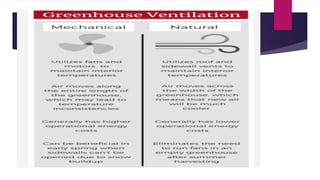
 Natural ventilation (passive system)
 Forced ventilation (active system)
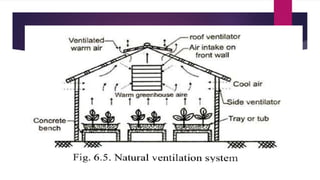
NATURAL VENTILATION :
 The process of supplying and removing air through an indoor space
without using mechanical systems.
 It refers to the flow of external air to an indoor space as a result of pressure
or temperature difference.
 BENEFITS :
 Improved indoor air quality
 Energy savings
 Cost effective
 Reduction of greenhouse gas emissions
 Increased worker productivity.
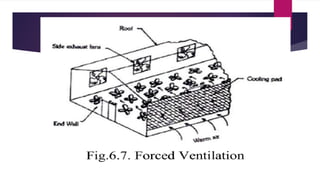
FORCED VENTILATION:
 Type of building ventilation system that uses fans or blowers to
provide fresh air to rooms when the forces of air pressure and
gravity are not enough to circulate air through a building.
 This type of ventilation can achieve uniform cooling.
 It includes summer fan and pad and fog cooling system and the
winter convention tube and horizontal airflow systems.
 It requires an initial investment for installation.
 It is used to maintain uniformity of the air circulation.
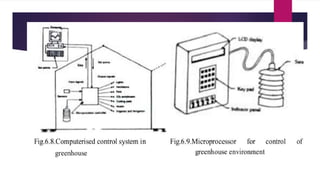
Computers in greenhouse :
 Computer systems can provide fully integrated control of
temperature, humidity, irrigation and carbondioxide level, light,
shade levels for virtually any size growing facility.
 It saves 15-50percent in energy, water, chemical and pesticide
application.
 Helps to achieve greater plant consistency, overall plant quality
and environmental purity.
THANK YOU

2021031099- protectedagric(Ape ppt).pptx

  • 1.
  • 2.
    Greenhouse Ventilation:  Ventilationis the process of allowing the fresh air to enter into the enclosed area by driving out the air with undesirable properties.  Ventilation is essential for reducing temperature, replenishing carbondioxide and controlling relative humidity.  It depends on the crop grown and the season of production.  It is divided into  Natural ventilation (passive system)  Forced ventilation (active system)
  • 4.
    NATURAL VENTILATION : The process of supplying and removing air through an indoor space without using mechanical systems.  It refers to the flow of external air to an indoor space as a result of pressure or temperature difference.  BENEFITS :  Improved indoor air quality  Energy savings  Cost effective  Reduction of greenhouse gas emissions  Increased worker productivity.
  • 6.
    FORCED VENTILATION:  Typeof building ventilation system that uses fans or blowers to provide fresh air to rooms when the forces of air pressure and gravity are not enough to circulate air through a building.  This type of ventilation can achieve uniform cooling.  It includes summer fan and pad and fog cooling system and the winter convention tube and horizontal airflow systems.  It requires an initial investment for installation.  It is used to maintain uniformity of the air circulation.
  • 8.
    Computers in greenhouse:  Computer systems can provide fully integrated control of temperature, humidity, irrigation and carbondioxide level, light, shade levels for virtually any size growing facility.  It saves 15-50percent in energy, water, chemical and pesticide application.  Helps to achieve greater plant consistency, overall plant quality and environmental purity.
  • 10.