Supporting a national funder’s Open Access policy
Vasco Vaz
Departamento da Sociedade da Informação
27 May 2019 | Ghent University | Belgium
Workshop “Research policy monitoring in the era of Open Science and Big Data”
Agenda
• Considerations and concepts
– RCAAP
– PT CRIS
– Ciência Vitae
• Open Access Policy
• Facilitating compliance
– Deposit in repository
– Export from CV
• Monitoring
– Processes
– Checking deposits through integration of RCAAP and FCT grant management
systems - example
• Benefits
• Outlook
Considerations
• Abstraction
• Work in progress
• Client’s perspective
• FCT’s role and capabilities
• Design infrastructures, adapt systems and services to respond to policy priorities
RCAAP
• Vital research e-infrastructure, part of the
NREN
• Initiated operation in November 2008 with
12 institutional repositories
• Integrates every public HEI repository
and makes all their deposited content
available via a single entry point
search portal
• Monitors and ensures that every
repository within the RCAAP network
conforms to the highest quality and
interoperability standards
Open AIRE guidelines
RCAAP
RCAAP and other systems
• Full integration with OpenAIRE
• Full integration with OASIS.BR (more than 1.700.000 (!) research publications from
Brasil and Portugal interchangeably retrieved from both networks and made available
through both Portals)
• Full integration with previous DeGóis® Platform (where national researchers
curricula were centralised and publicly made available)
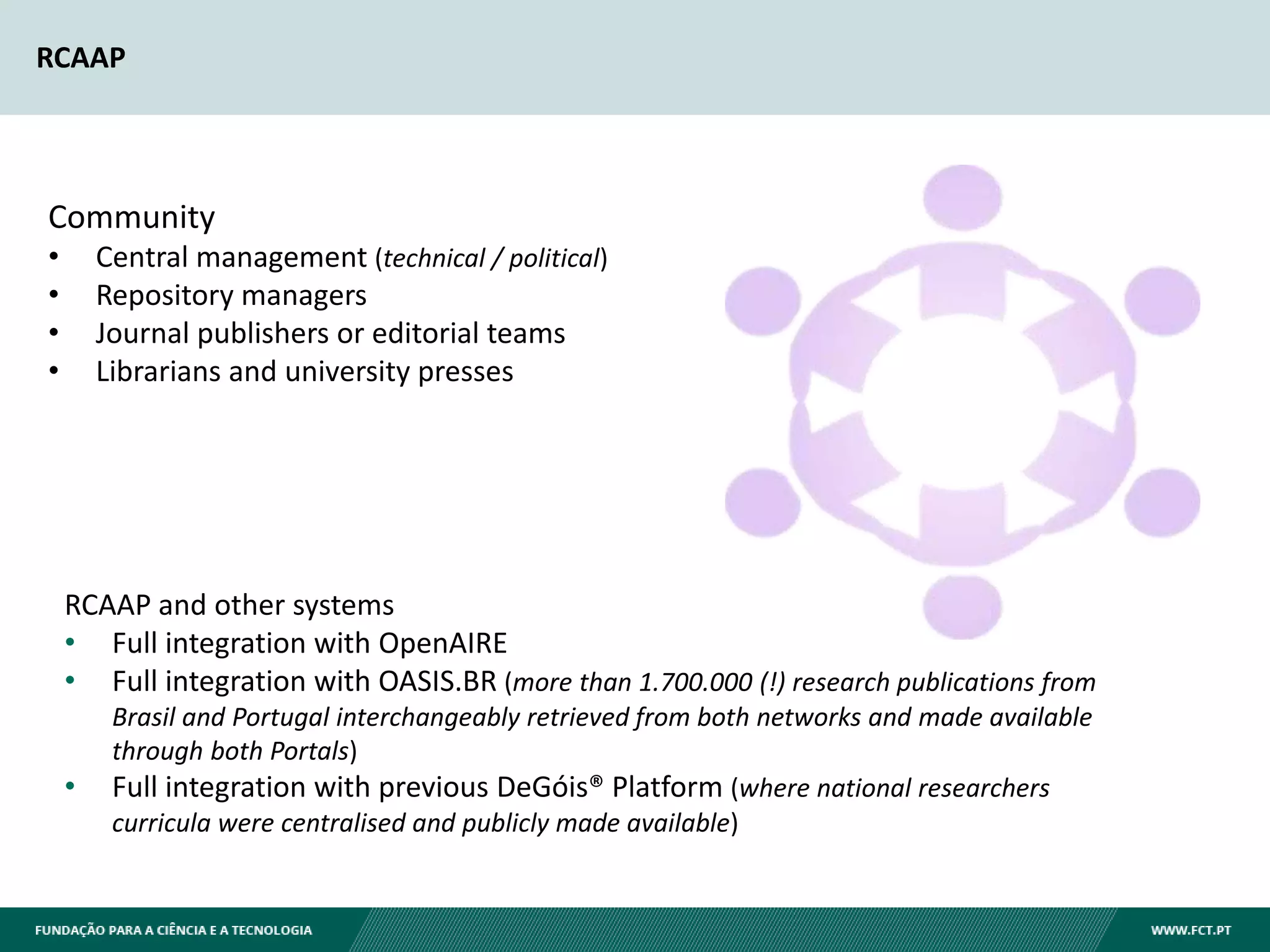
Community
• Central management (technical / political)
• Repository managers
• Journal publishers or editorial teams
• Librarians and university presses
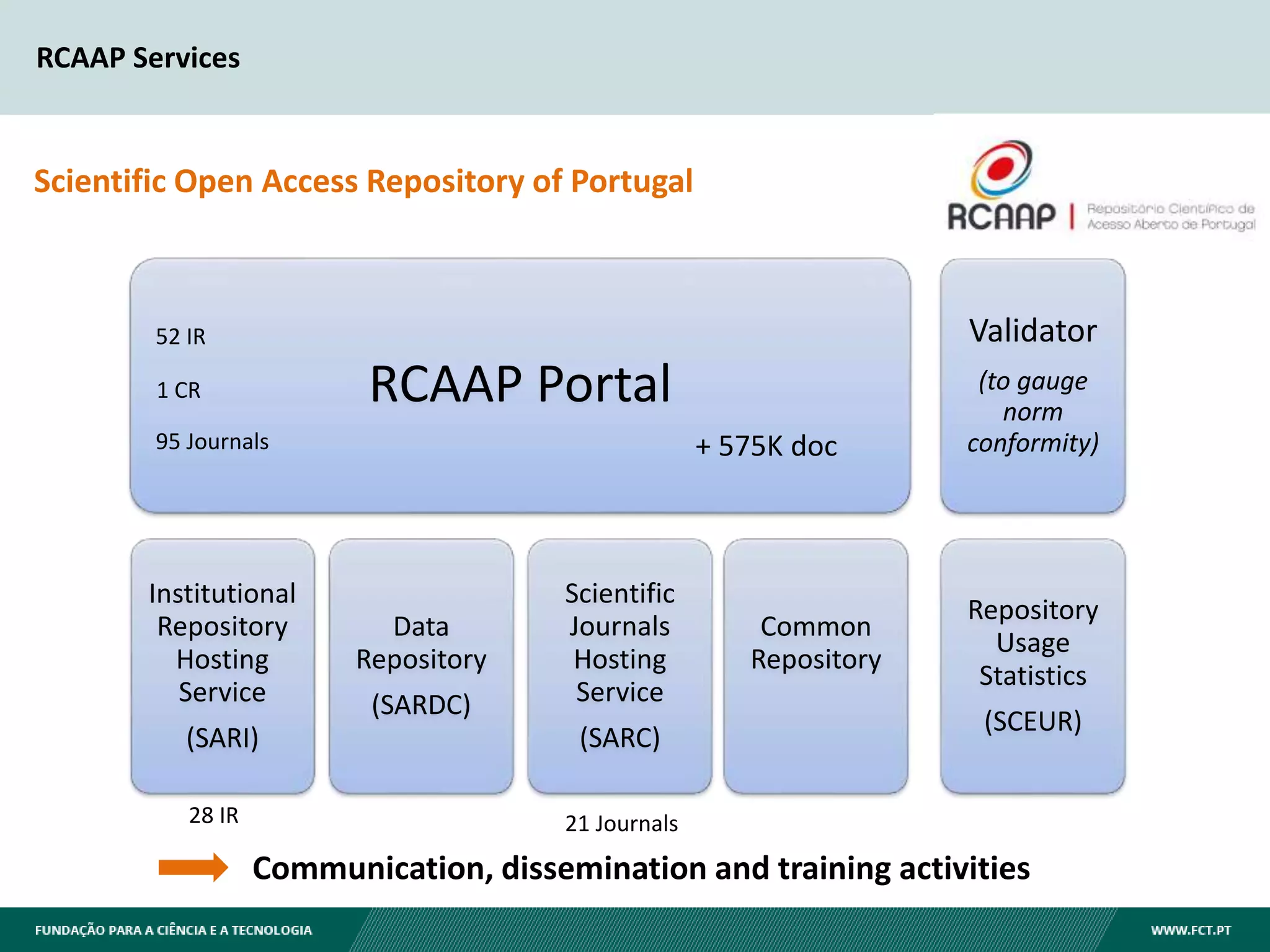
RCAAP Services
RCAAP Portal
Institutional
Repository
Hosting
Service
(SARI)
Data
Repository
(SARDC)
Scientific
Journals
Hosting
Service
(SARC)
Common
Repository
Validator
(to gauge
norm
conformity)
Repository
Usage
Statistics
(SCEUR)
Scientific Open Access Repository of Portugal
28 IR 21 Journals
52 IR
1 CR
+ 575K doc95 Journals
Communication, dissemination and training activities
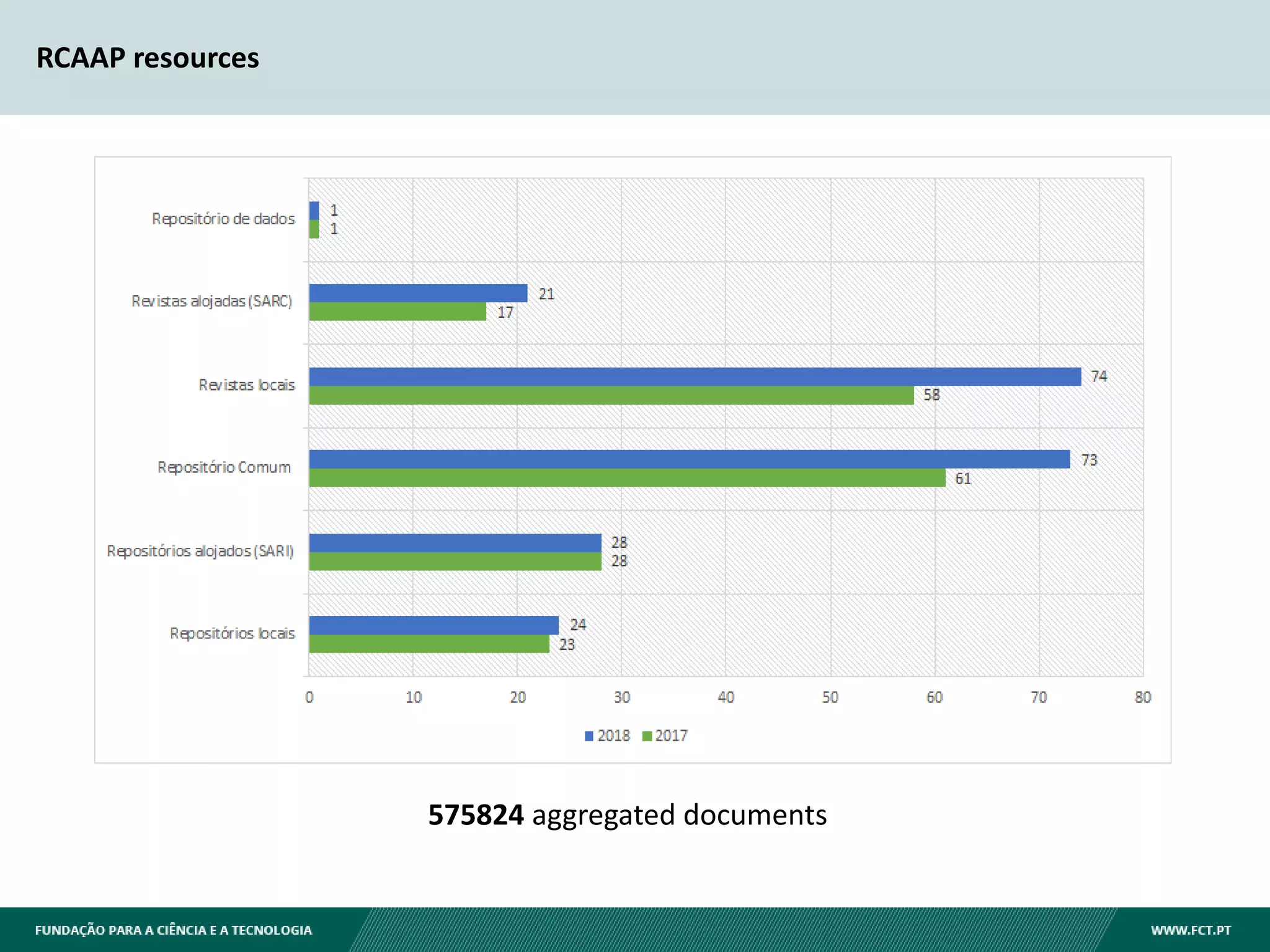
RCAAP resources
575824 aggregated documents
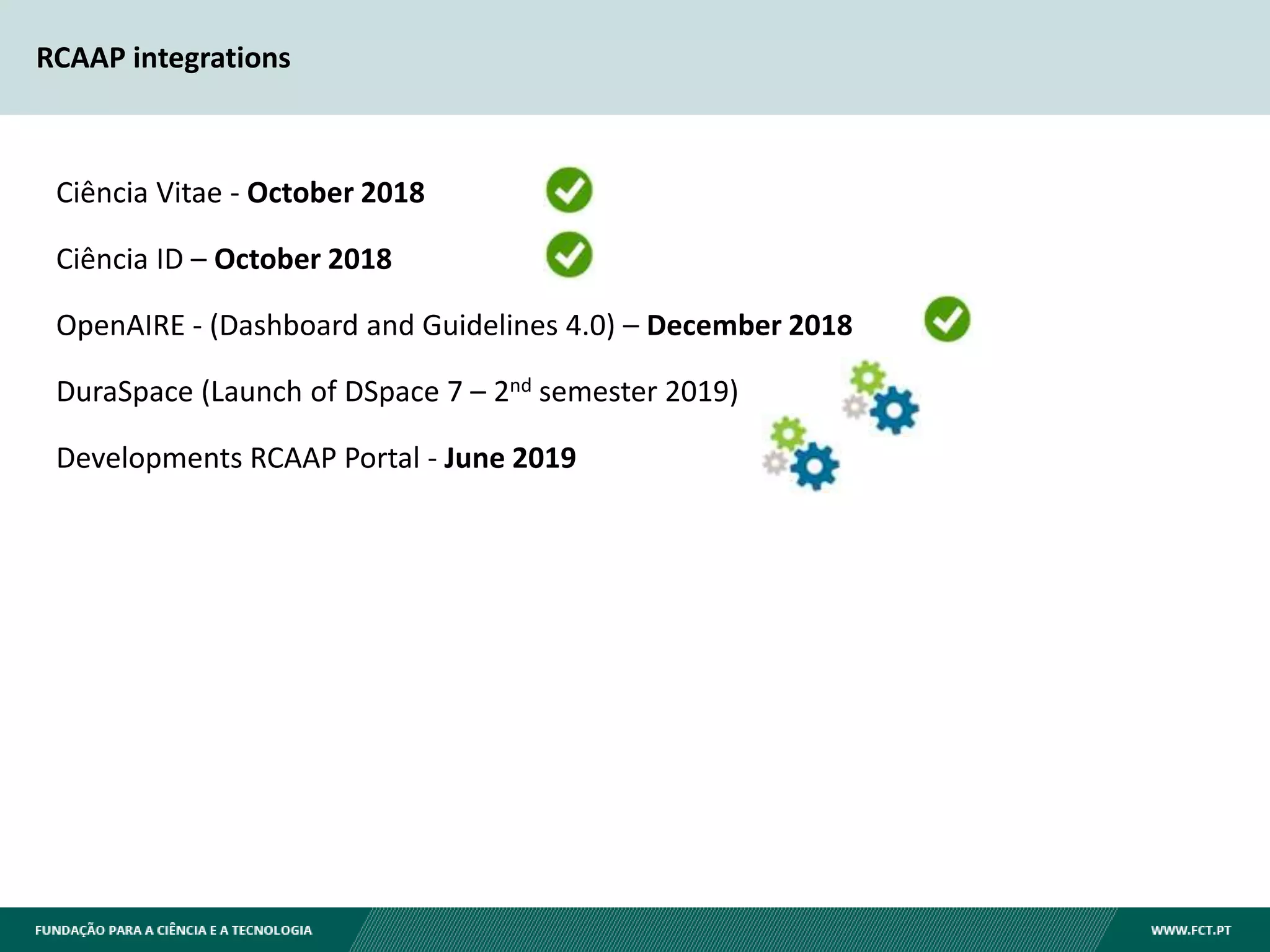
RCAAP integrations
Ciência Vitae - October 2018
Ciência ID – October 2018
OpenAIRE - (Dashboard and Guidelines 4.0) – December 2018
DuraSpace (Launch of DSpace 7 – 2nd semester 2019)
Developments RCAAP Portal - June 2019
PTCRIS -Mission
Ensure the creation and sustained development of national integrated information
ecosystem (PTCRIS) to support research management
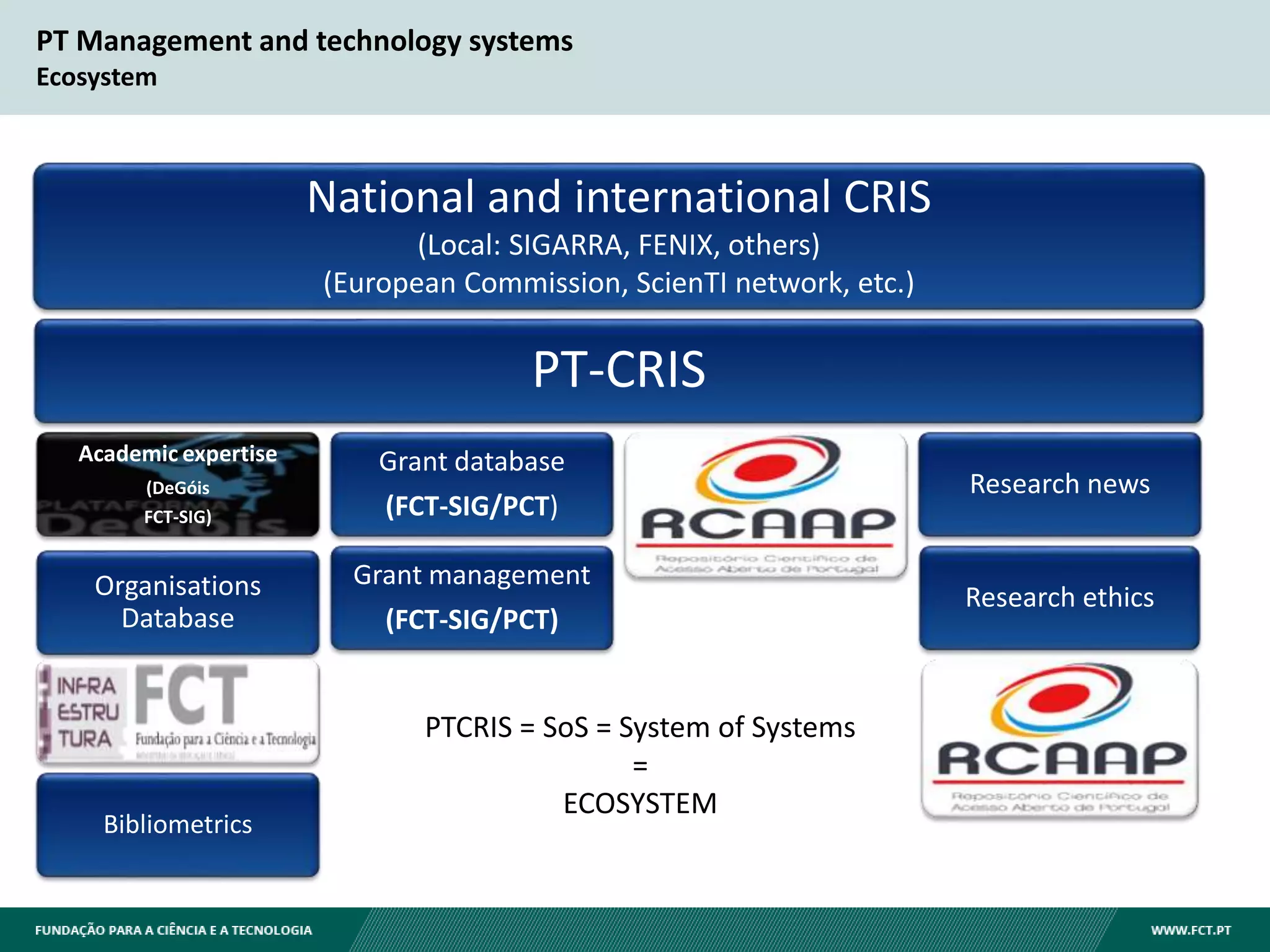
PT Management and technology systems
Ecosystem
National and international CRIS
(Local: SIGARRA, FENIX, others)
(European Commission, ScienTI network, etc.)
PT-CRIS
Academic expertise
(DeGóis
FCT-SIG)
Organisations
Database
Bibliometrics
Grant database
(FCT-SIG/PCT)
Grant management
(FCT-SIG/PCT)
Research news
Research ethics
PTCRIS = SoS = System of Systems
=
ECOSYSTEM
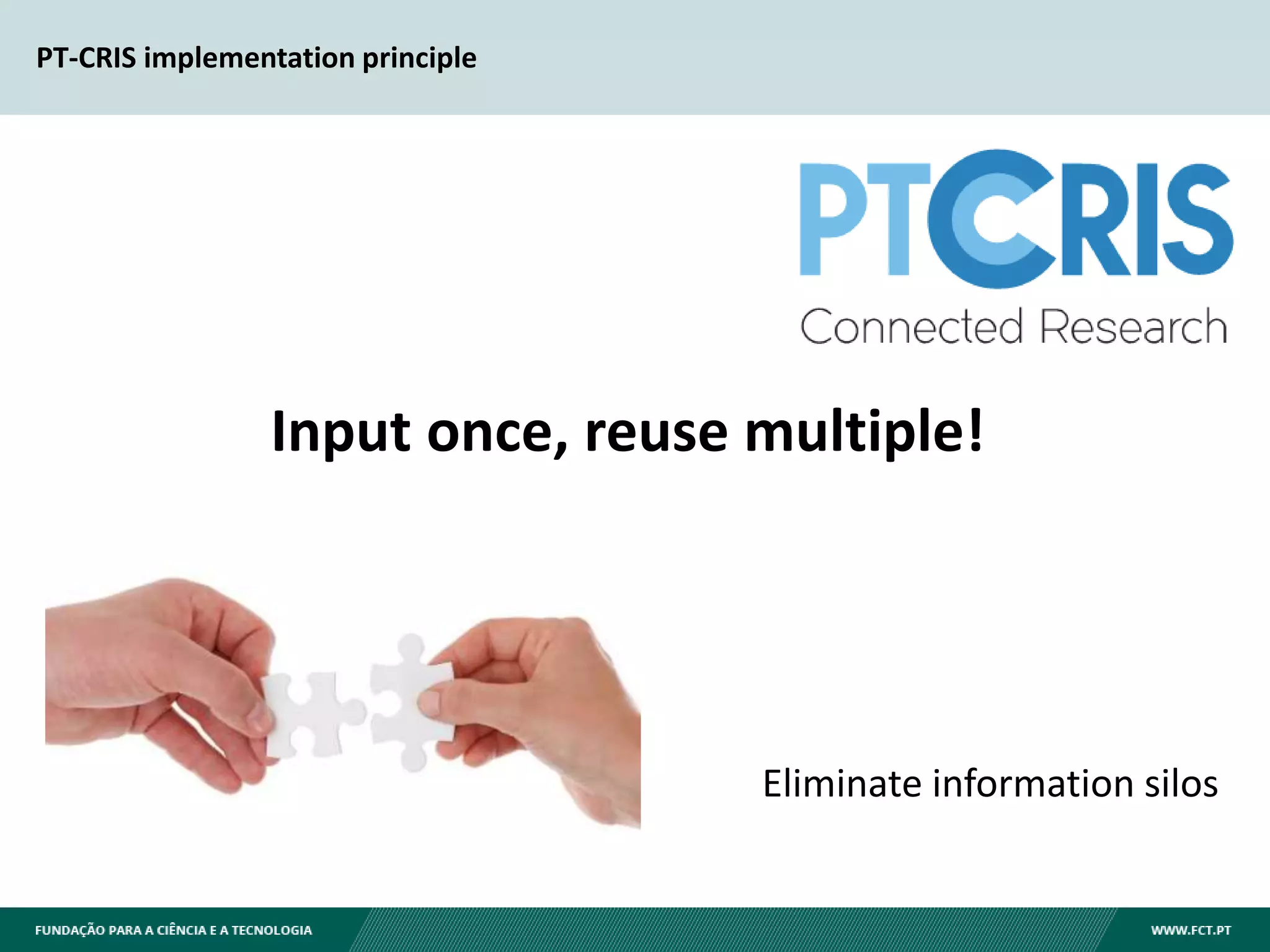
PT-CRIS implementation principle
Input once, reuse multiple!
Eliminate information silos
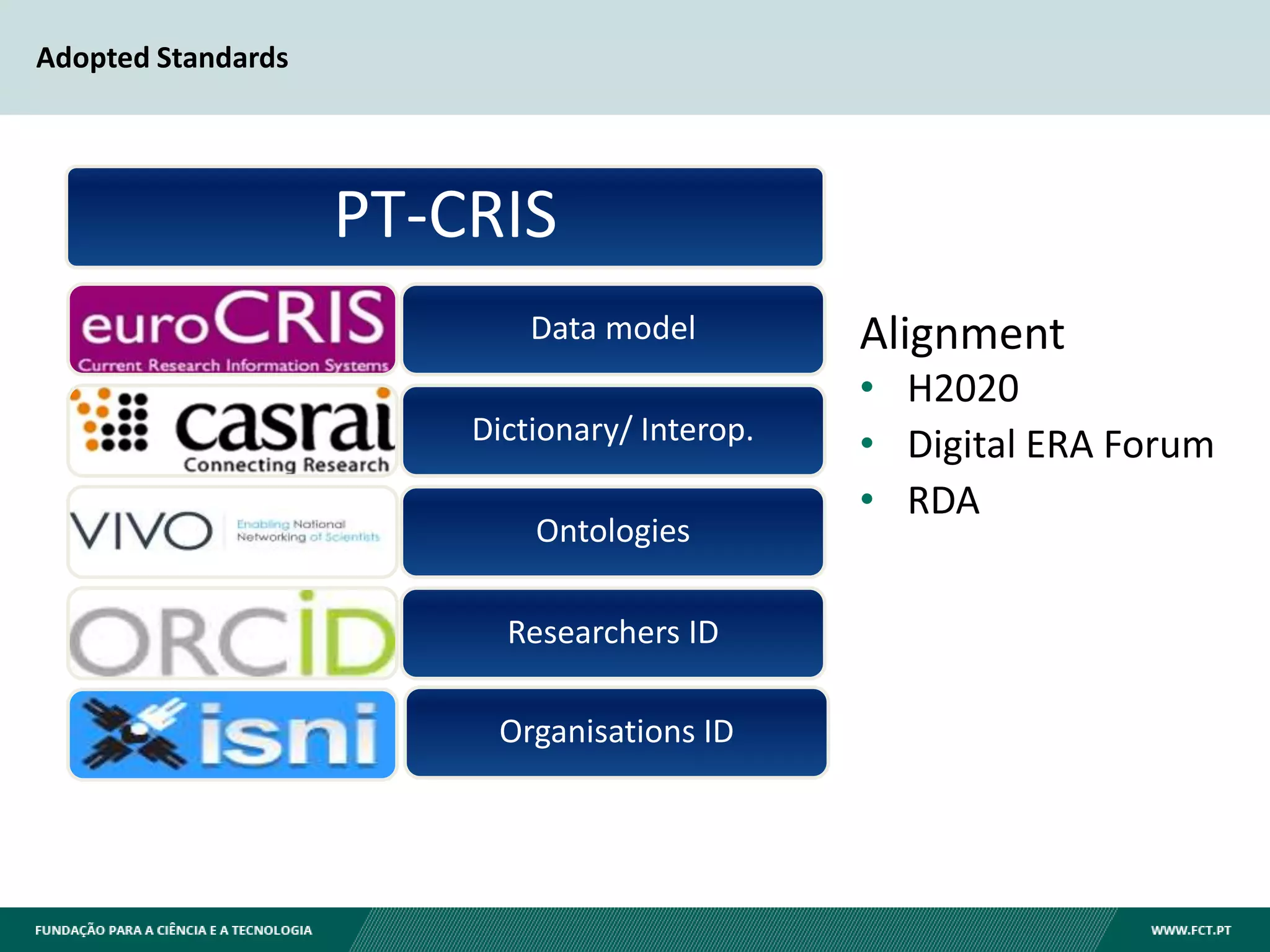
Adopted Standards
PT-CRIS
Data model
Dictionary/ Interop.
Ontologies
Researchers ID
Organisations ID
Alignment
• H2020
• Digital ERA Forum
• RDA
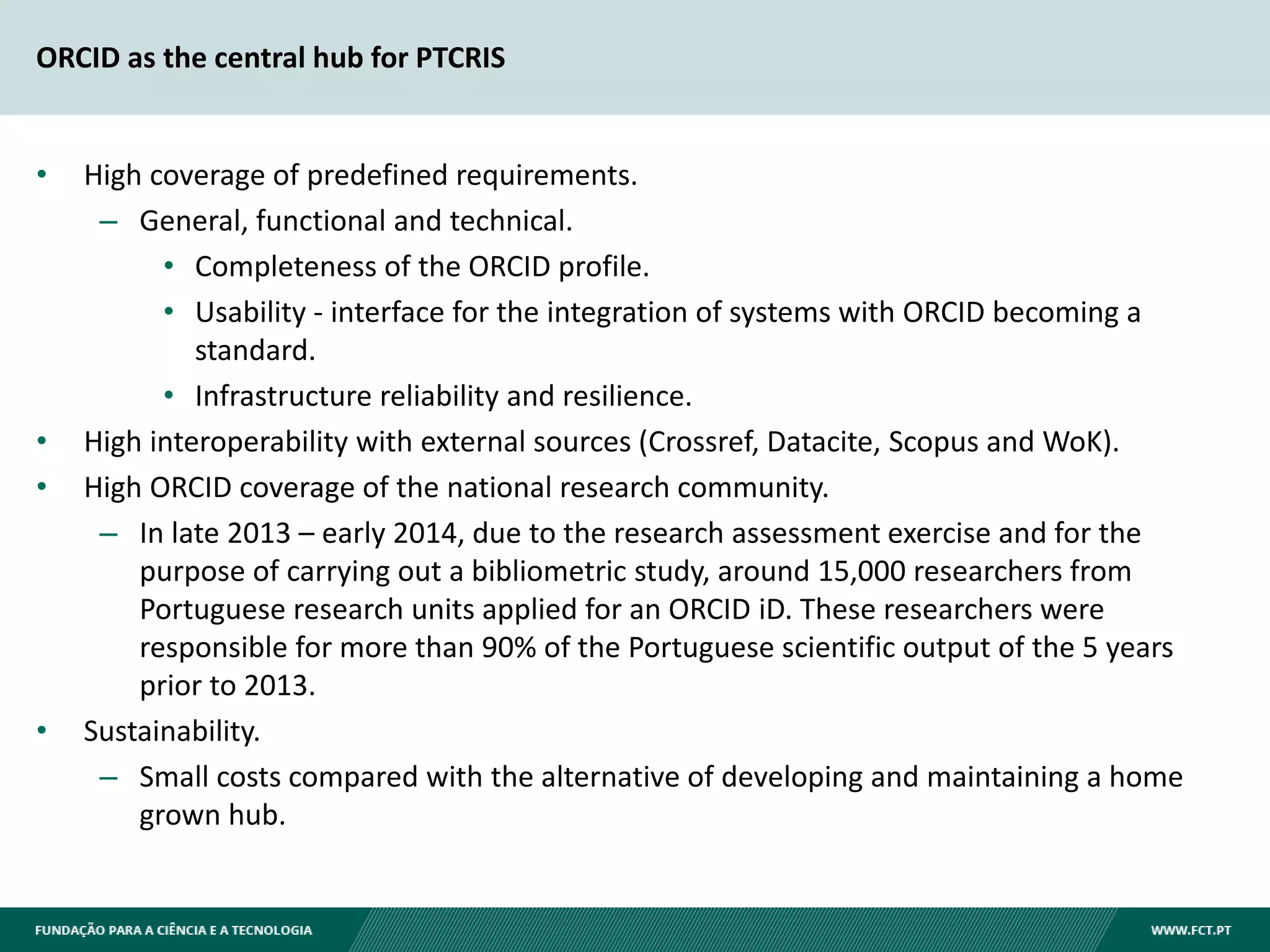
ORCID as the central hub for PTCRIS
• High coverage of predefined requirements.
– General, functional and technical.
• Completeness of the ORCID profile.
• Usability - interface for the integration of systems with ORCID becoming a
standard.
• Infrastructure reliability and resilience.
• High interoperability with external sources (Crossref, Datacite, Scopus and WoK).
• High ORCID coverage of the national research community.
– In late 2013 – early 2014, due to the research assessment exercise and for the
purpose of carrying out a bibliometric study, around 15,000 researchers from
Portuguese research units applied for an ORCID iD. These researchers were
responsible for more than 90% of the Portuguese scientific output of the 5 years
prior to 2013.
• Sustainability.
– Small costs compared with the alternative of developing and maintaining a home
grown hub.
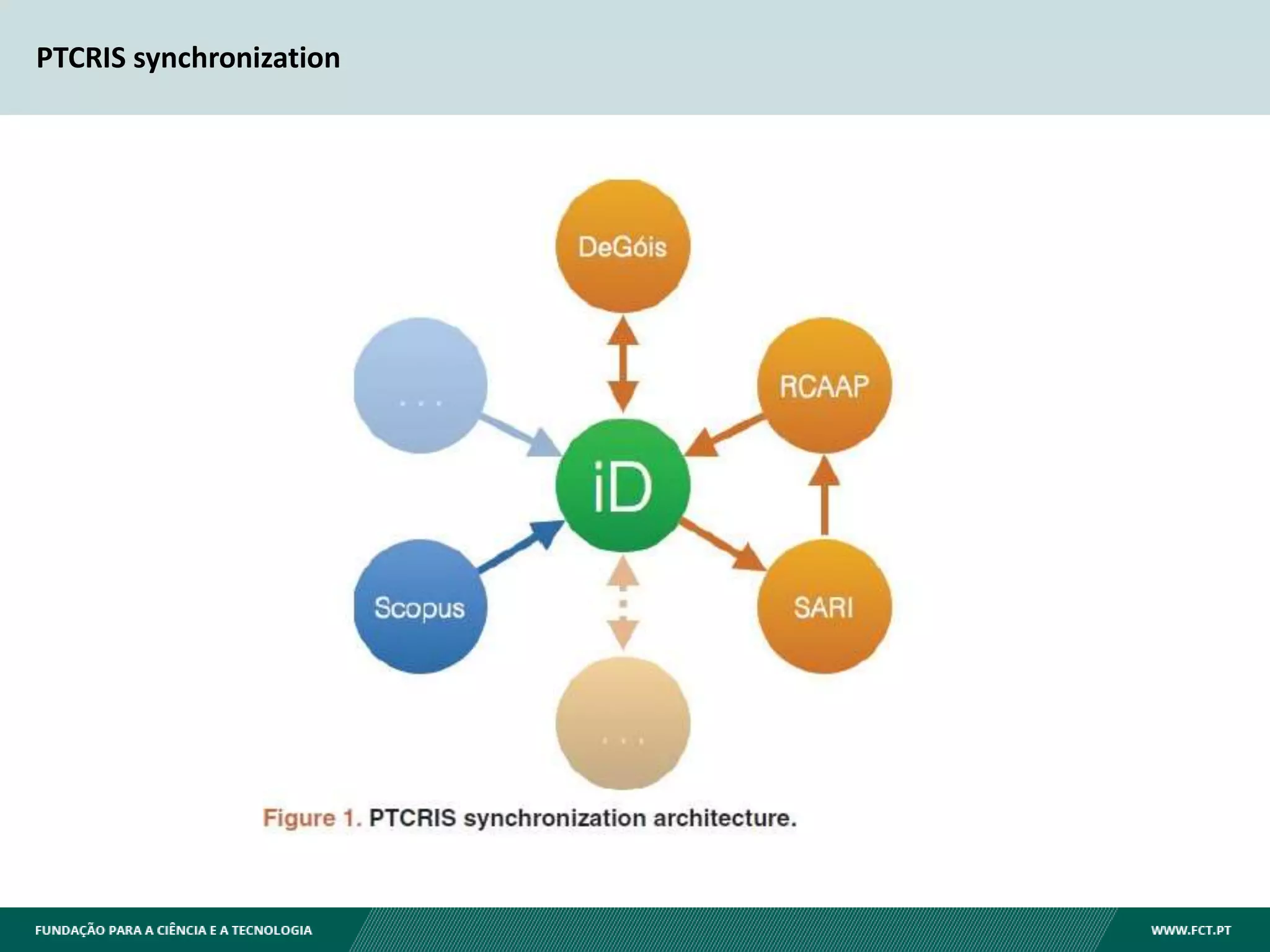
PTCRIS synchronization
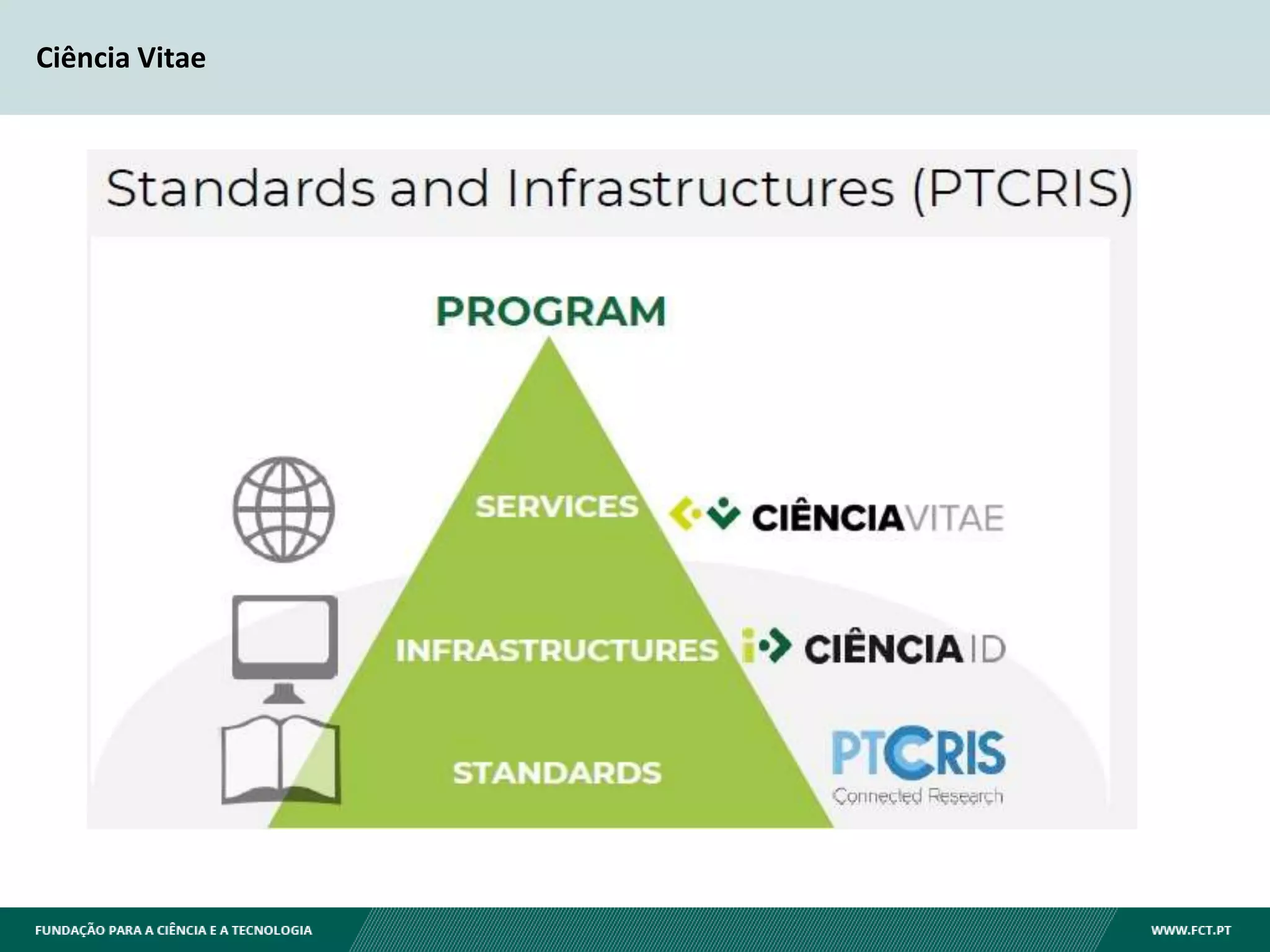
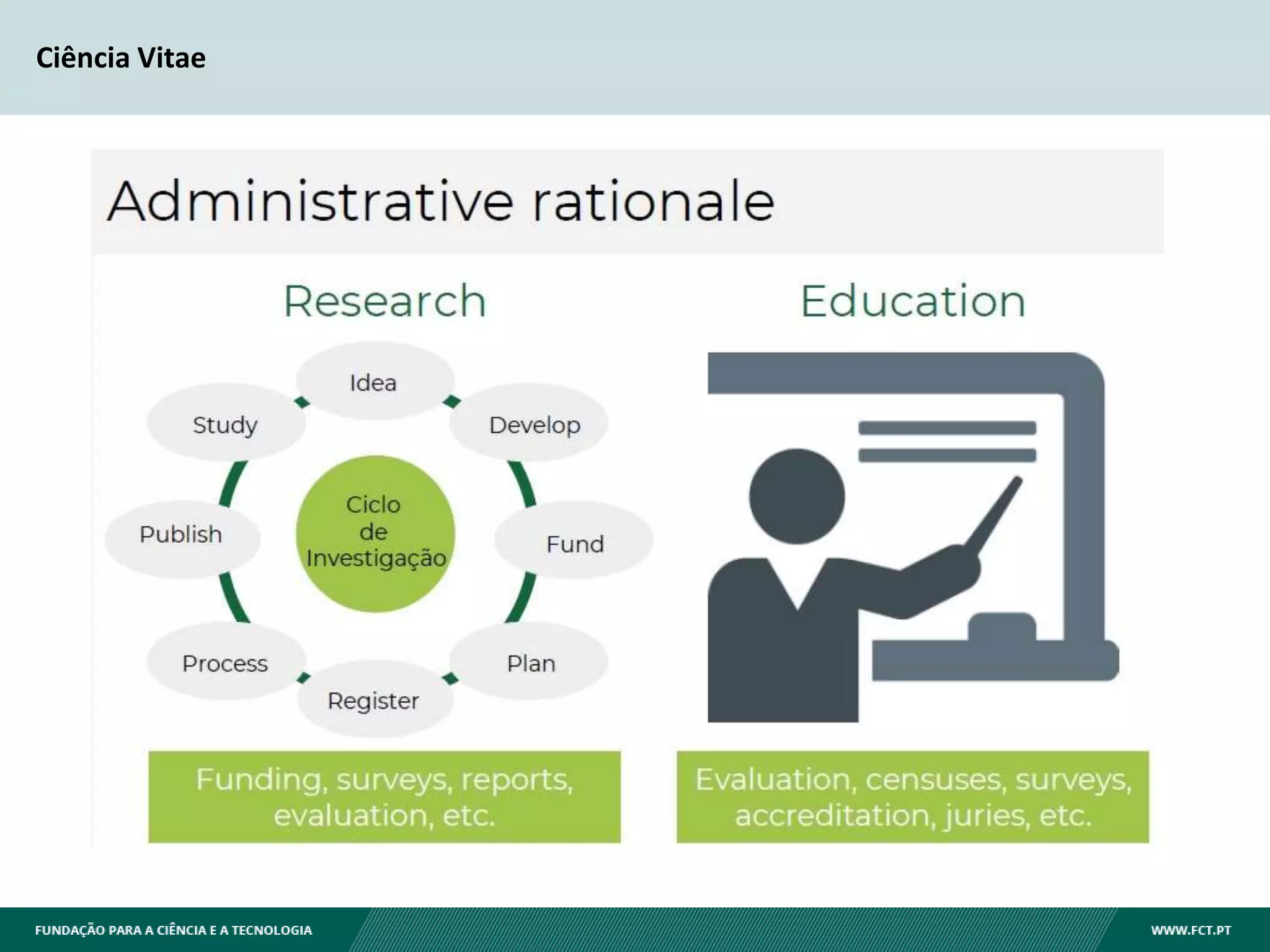
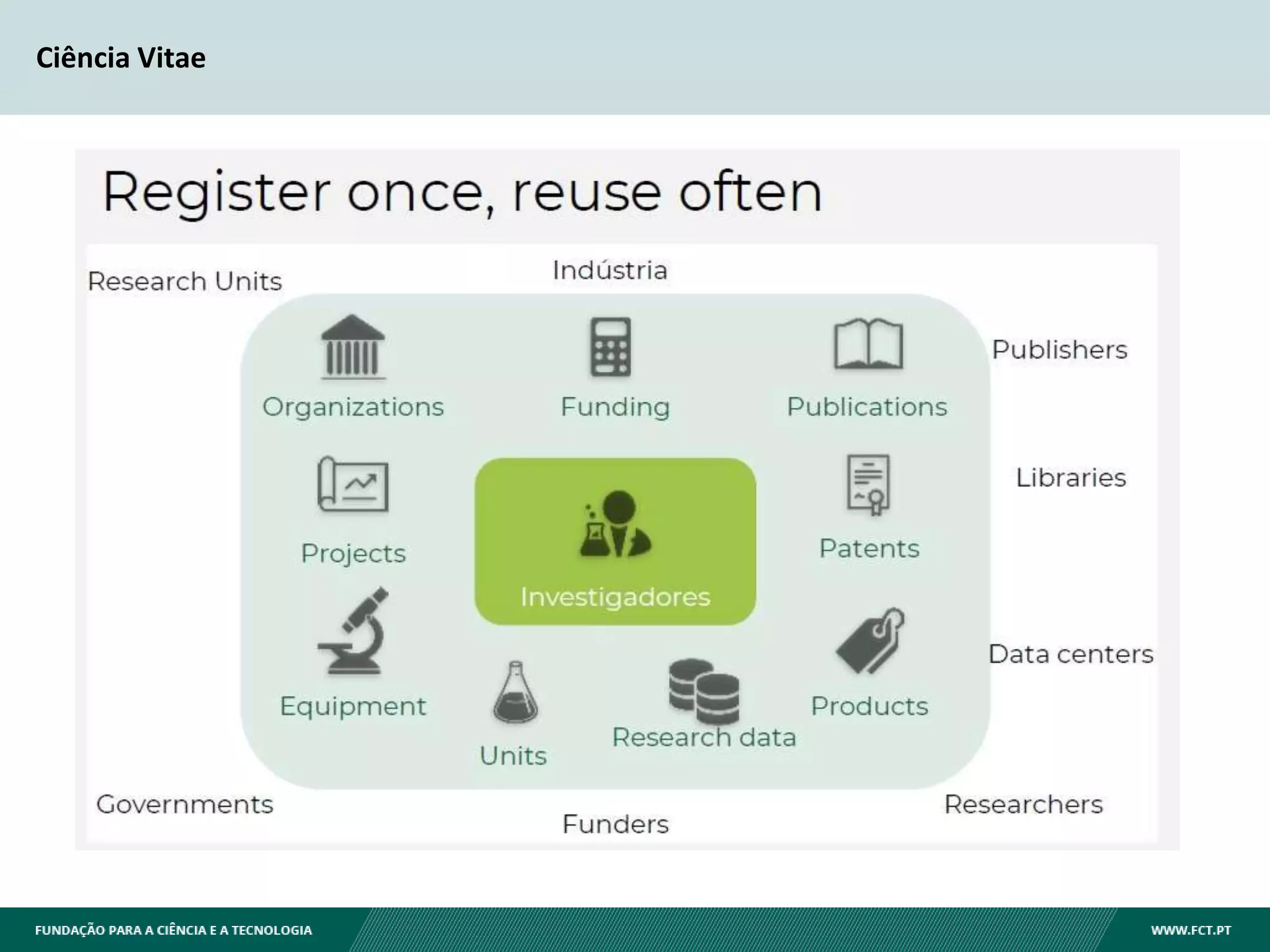
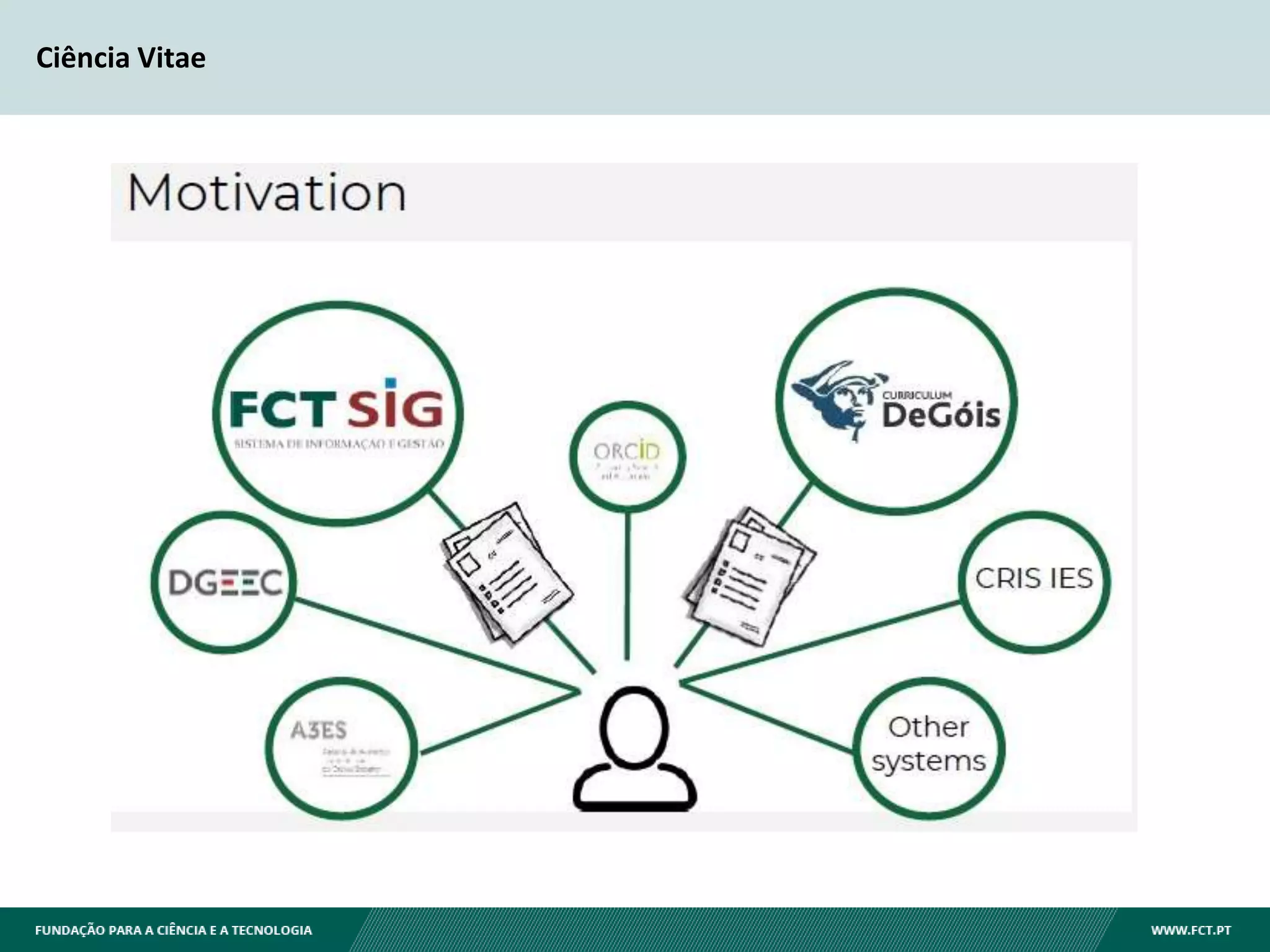
Ciência Vitae
Ciência Vitae
Ciência Vitae
Ciência Vitae
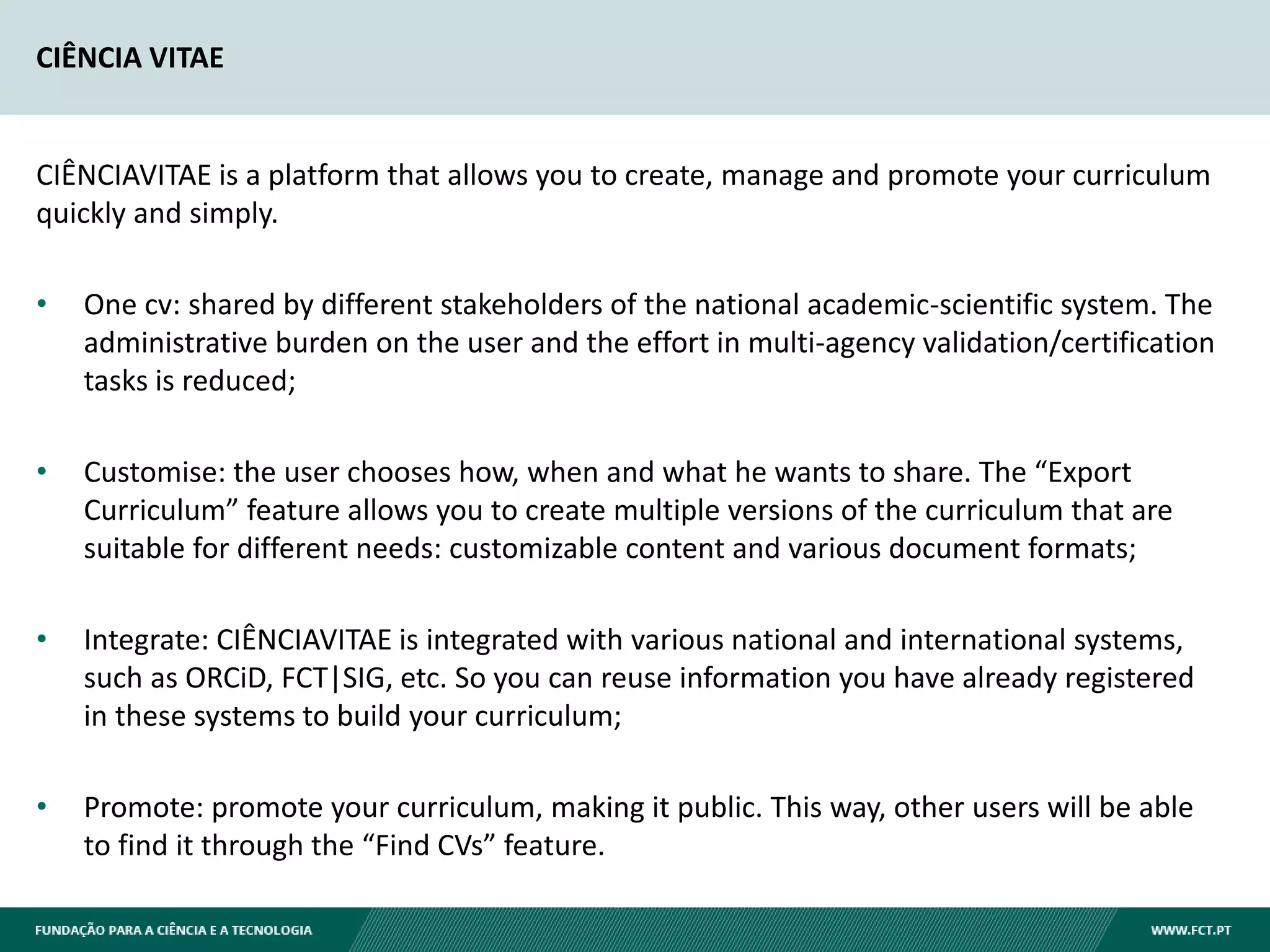
CIÊNCIA VITAE
CIÊNCIAVITAE is a platform that allows you to create, manage and promote your curriculum
quickly and simply.
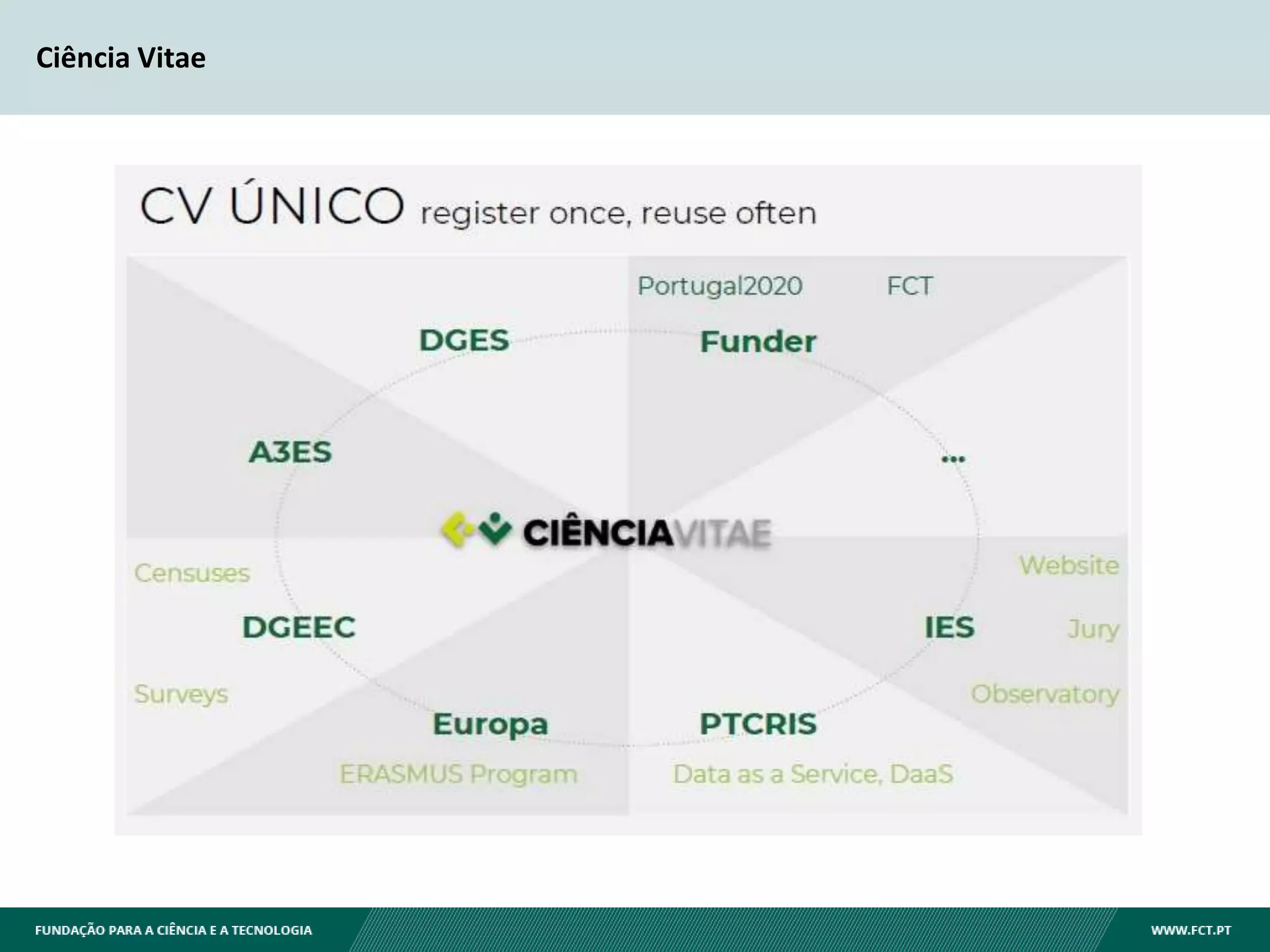
• One cv: shared by different stakeholders of the national academic-scientific system. The
administrative burden on the user and the effort in multi-agency validation/certification
tasks is reduced;
• Customise: the user chooses how, when and what he wants to share. The “Export
Curriculum” feature allows you to create multiple versions of the curriculum that are
suitable for different needs: customizable content and various document formats;
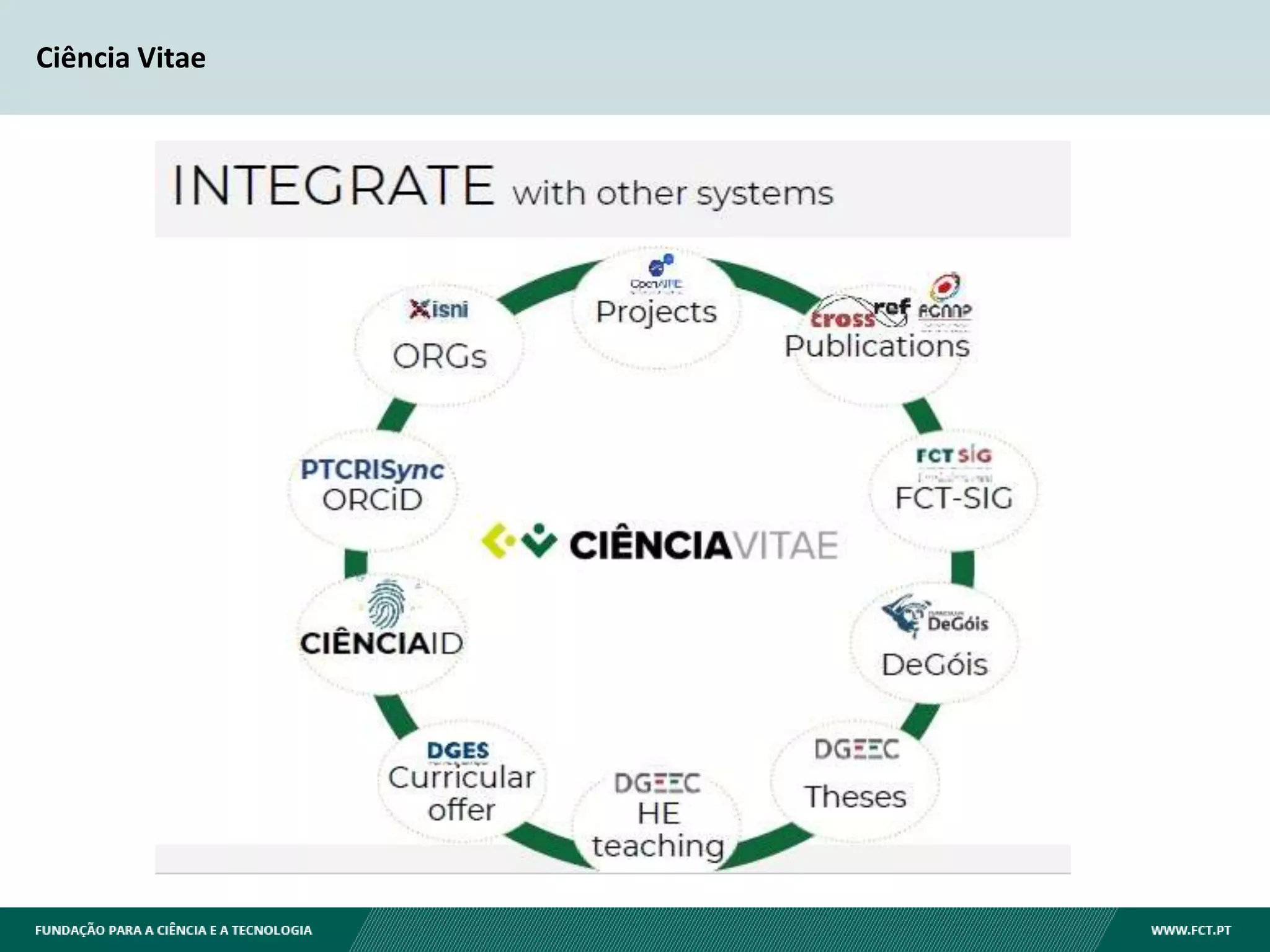
• Integrate: CIÊNCIAVITAE is integrated with various national and international systems,
such as ORCiD, FCT|SIG, etc. So you can reuse information you have already registered
in these systems to build your curriculum;
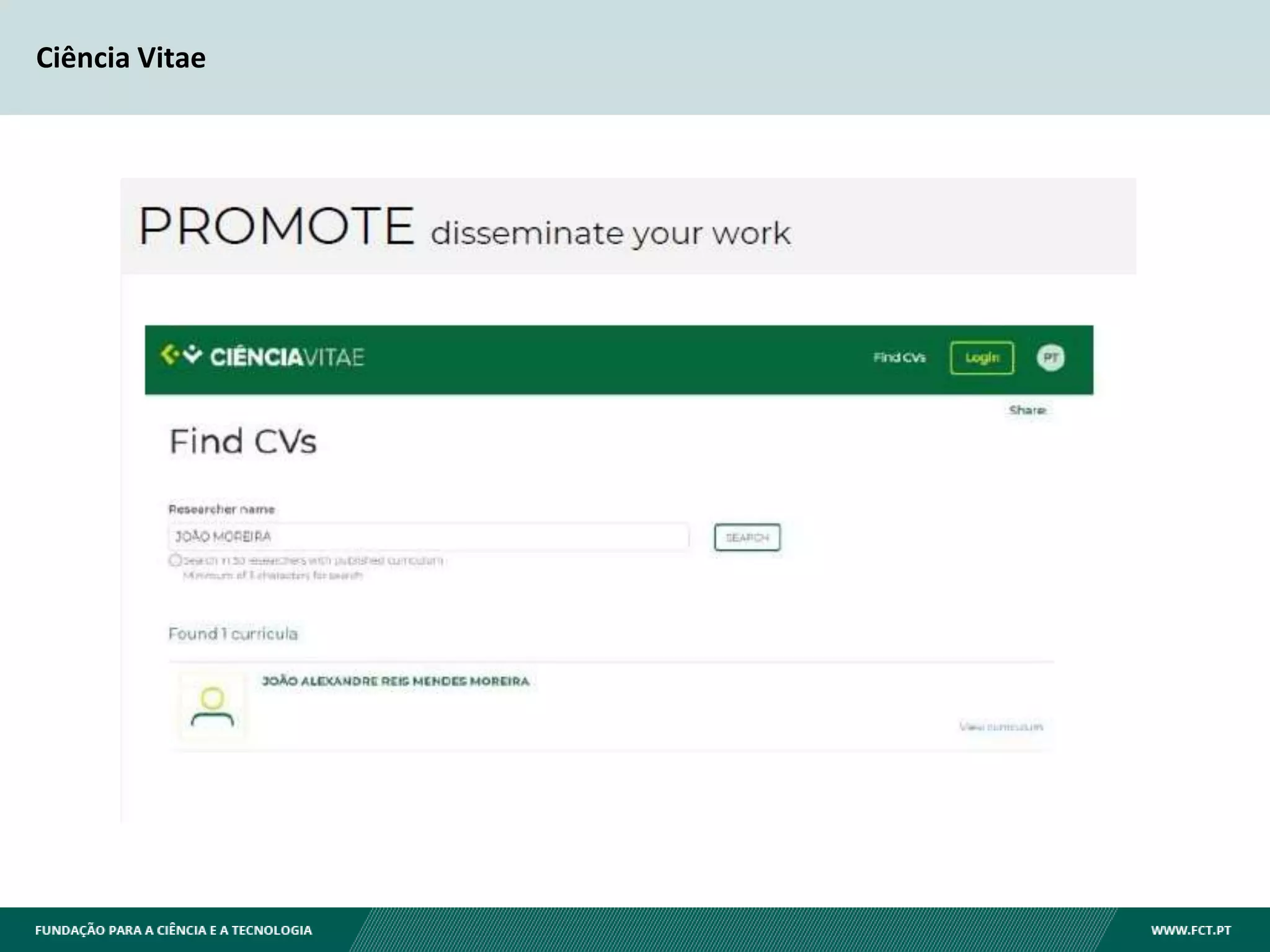
• Promote: promote your curriculum, making it public. This way, other users will be able
to find it through the “Find CVs” feature.
Ciência Vitae
Ciência Vitae
Ciência Vitae
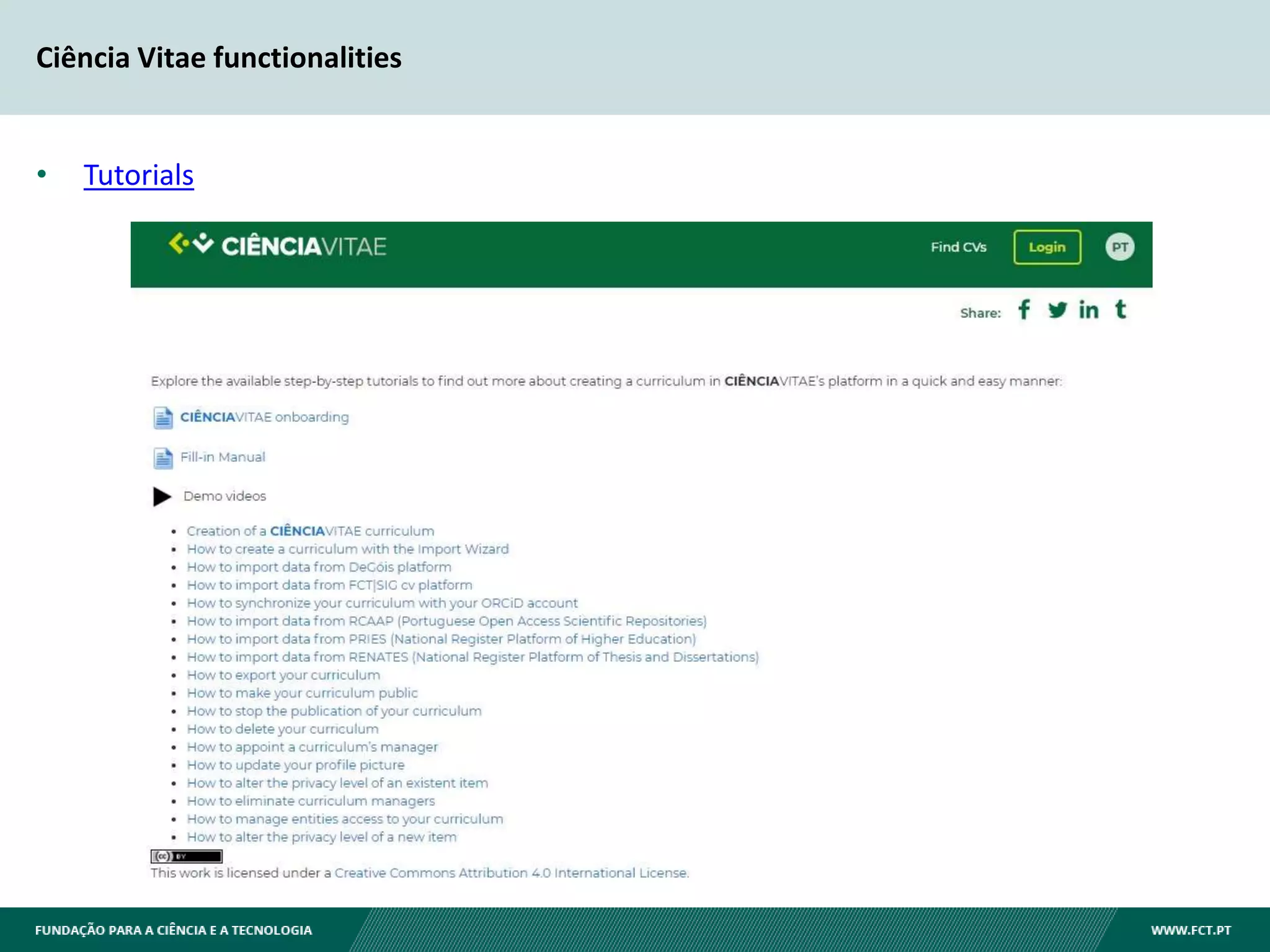
Ciência Vitae functionalities
• Tutorials
Ciência Vitae
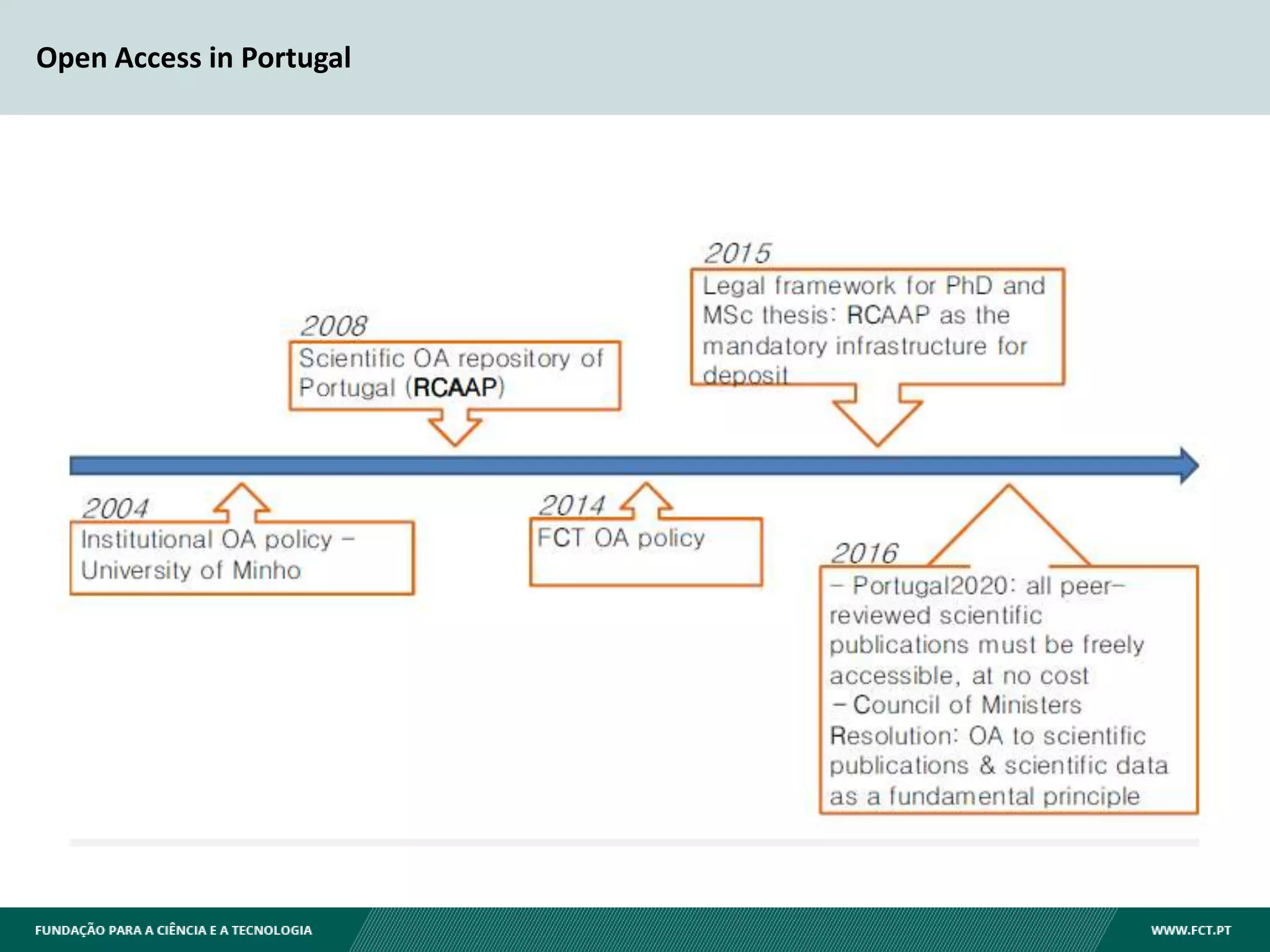
Open Access in Portugal
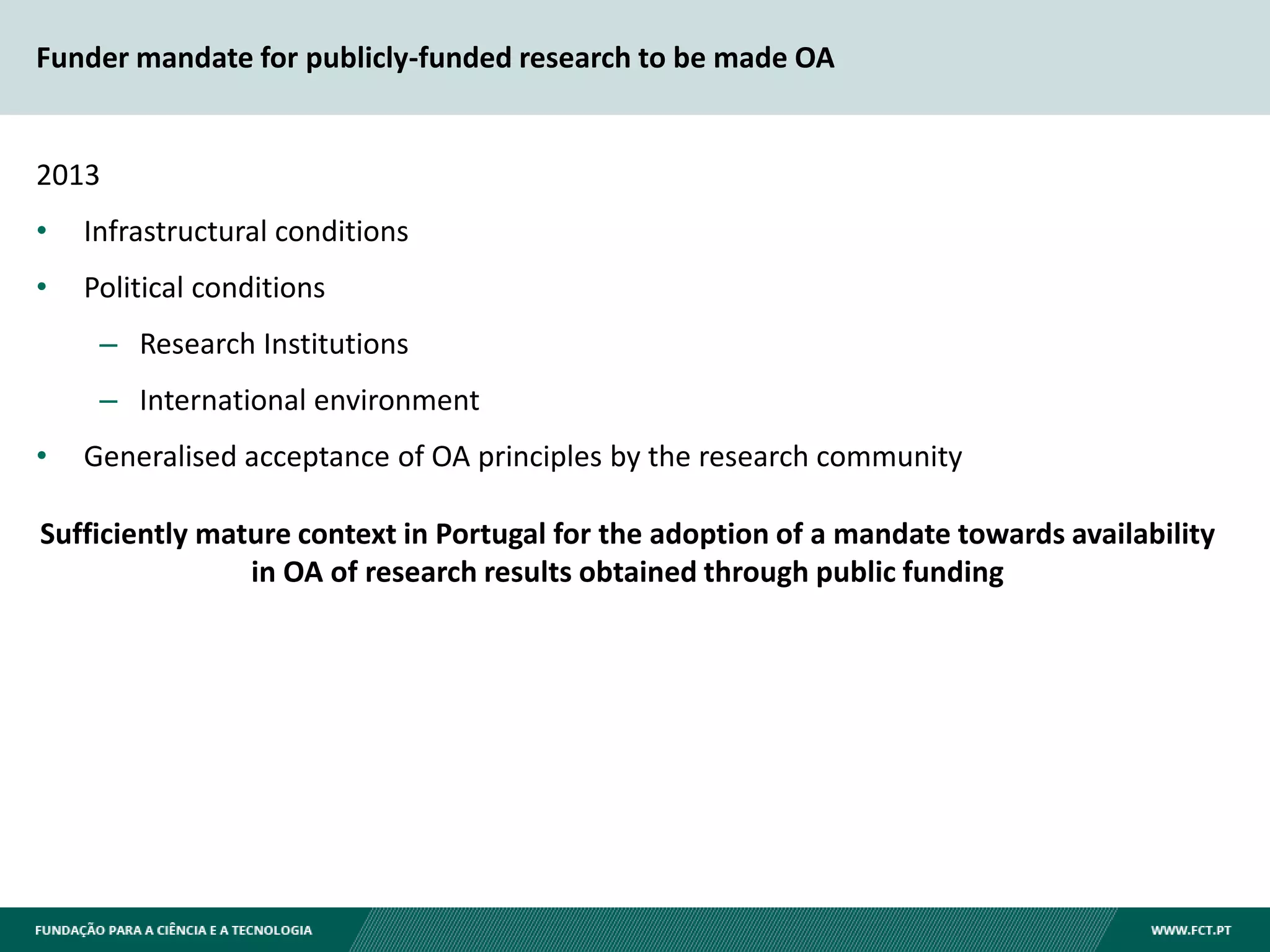
Funder mandate for publicly-funded research to be made OA
2013
• Infrastructural conditions
• Political conditions
– Research Institutions
– International environment
• Generalised acceptance of OA principles by the research community
Sufficiently mature context in Portugal for the adoption of a mandate towards availability
in OA of research results obtained through public funding
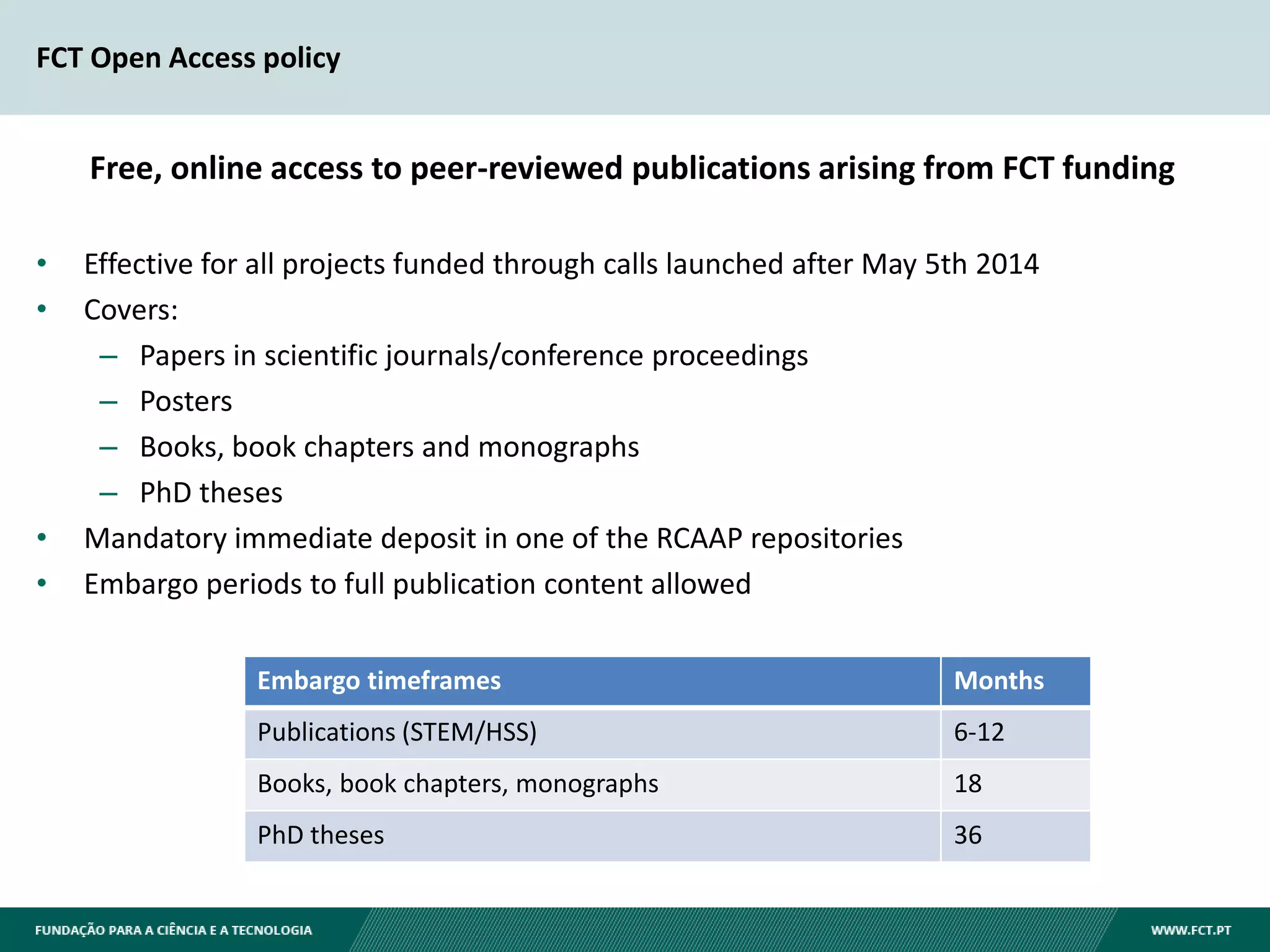
FCT Open Access policy
• Effective for all projects funded through calls launched after May 5th 2014
• Covers:
– Papers in scientific journals/conference proceedings
– Posters
– Books, book chapters and monographs
– PhD theses
• Mandatory immediate deposit in one of the RCAAP repositories
• Embargo periods to full publication content allowed
Embargo timeframes Months
Publications (STEM/HSS) 6-12
Books, book chapters, monographs 18
PhD theses 36
Free, online access to peer-reviewed publications arising from FCT funding
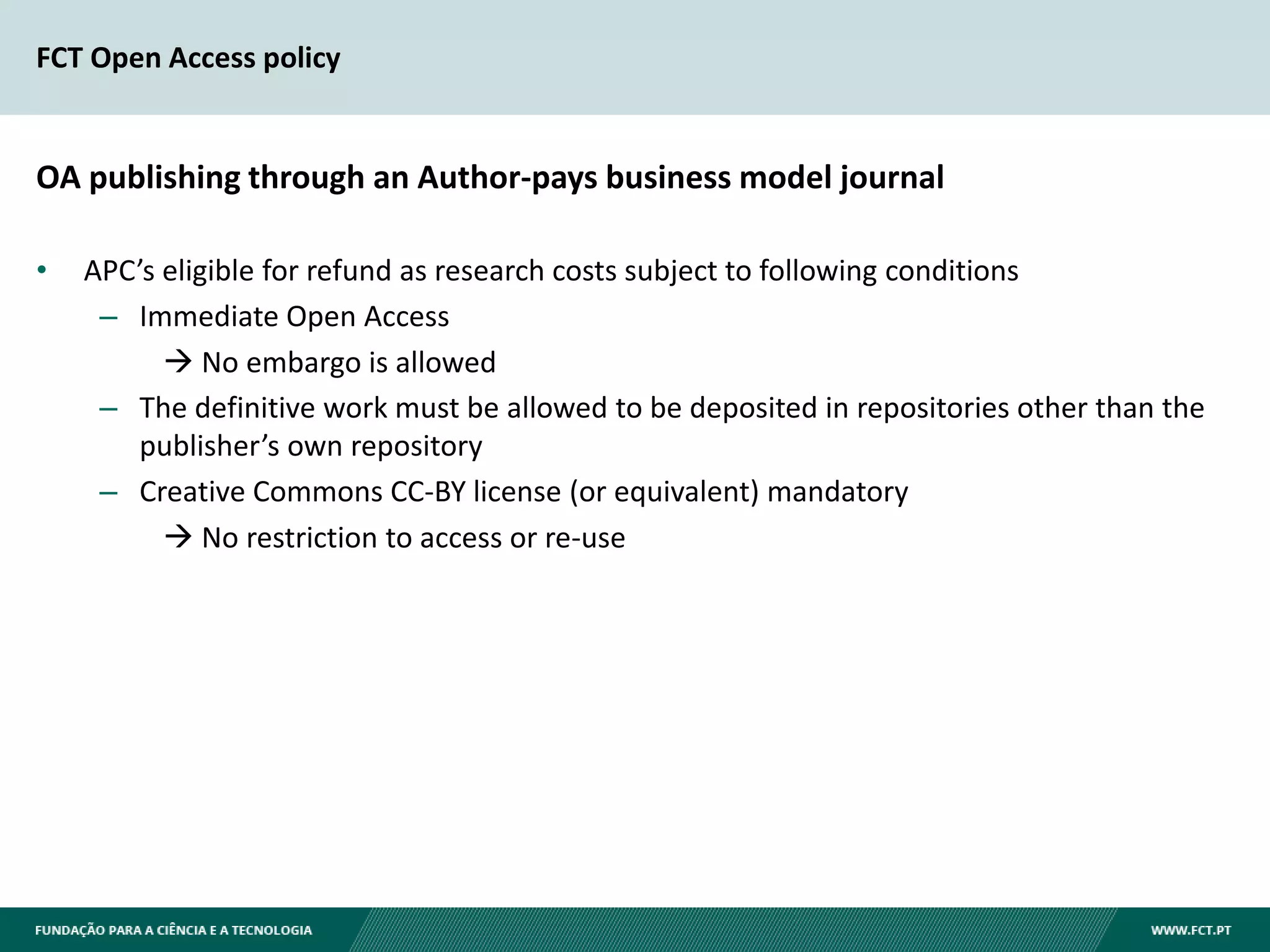
FCT Open Access policy
OA publishing through an Author-pays business model journal
• APC’s eligible for refund as research costs subject to following conditions
– Immediate Open Access
 No embargo is allowed
– The definitive work must be allowed to be deposited in repositories other than the
publisher’s own repository
– Creative Commons CC-BY license (or equivalent) mandatory
 No restriction to access or re-use
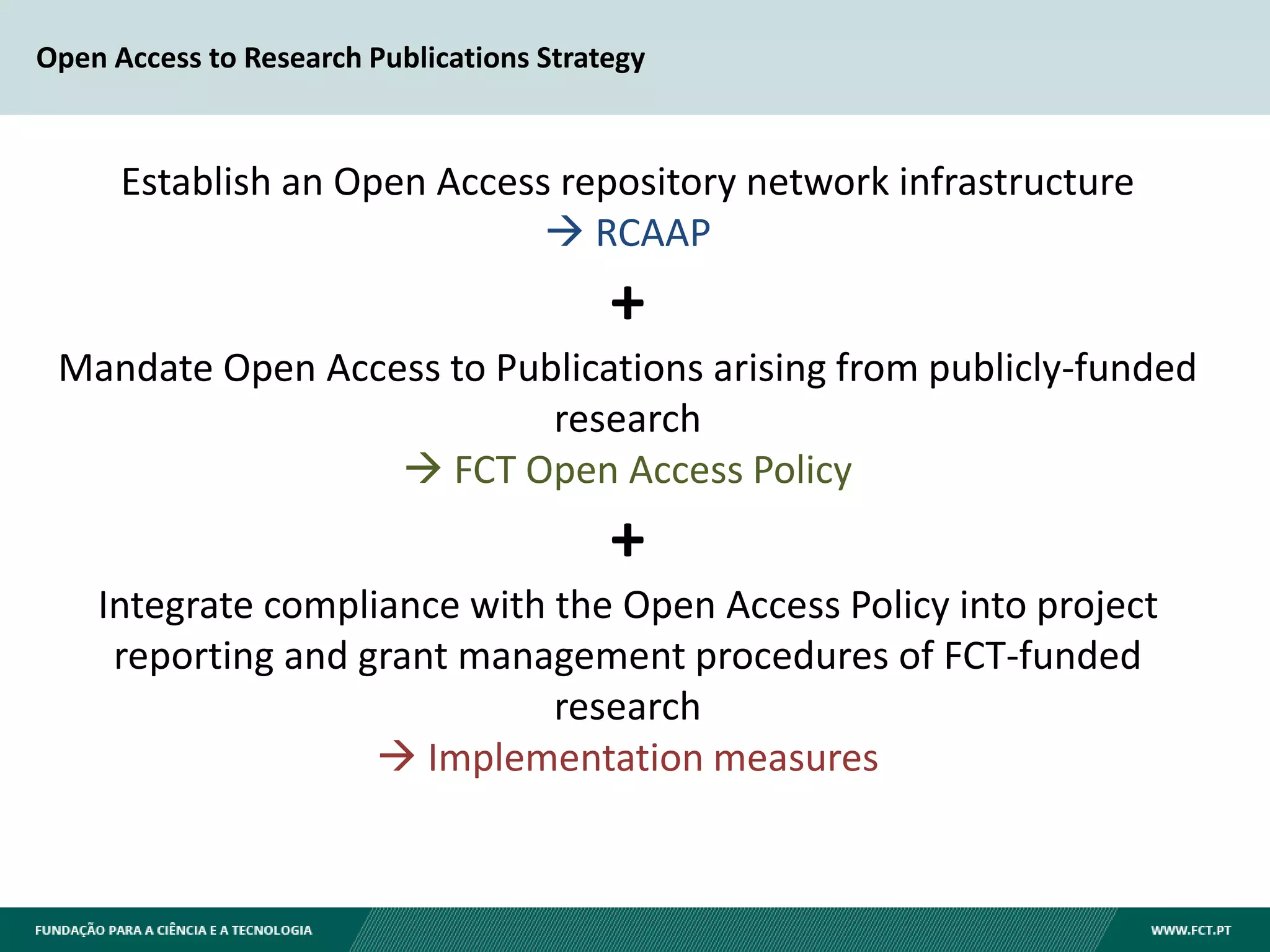
Open Access to Research Publications Strategy
Establish an Open Access repository network infrastructure
 RCAAP
+
Mandate Open Access to Publications arising from publicly-funded
research
 FCT Open Access Policy
+
Integrate compliance with the Open Access Policy into project
reporting and grant management procedures of FCT-funded
research
 Implementation measures
Deposit in repository
- Project Identification -
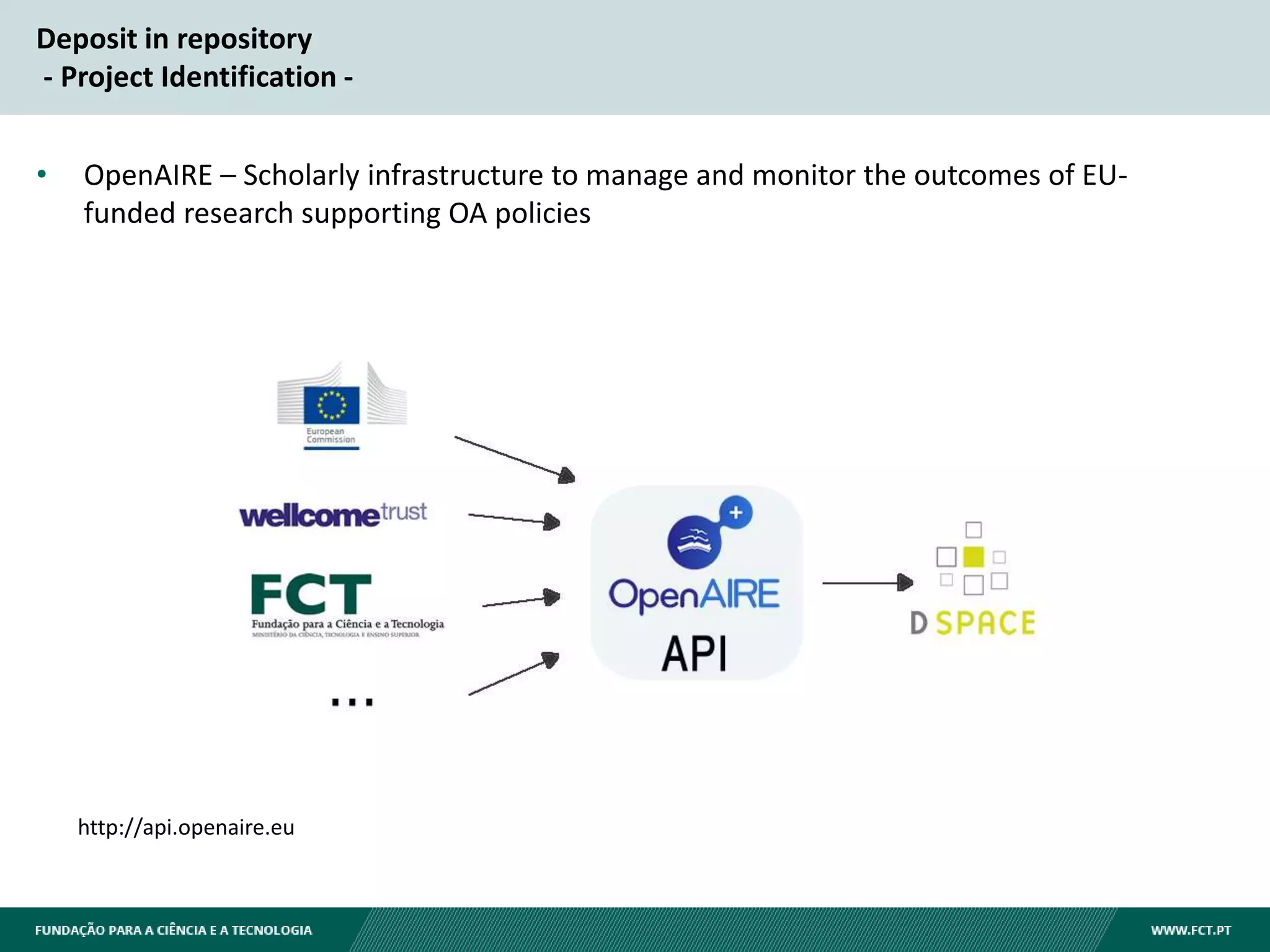
• OpenAIRE – Scholarly infrastructure to manage and monitor the outcomes of EU-
funded research supporting OA policies
http://api.openaire.eu
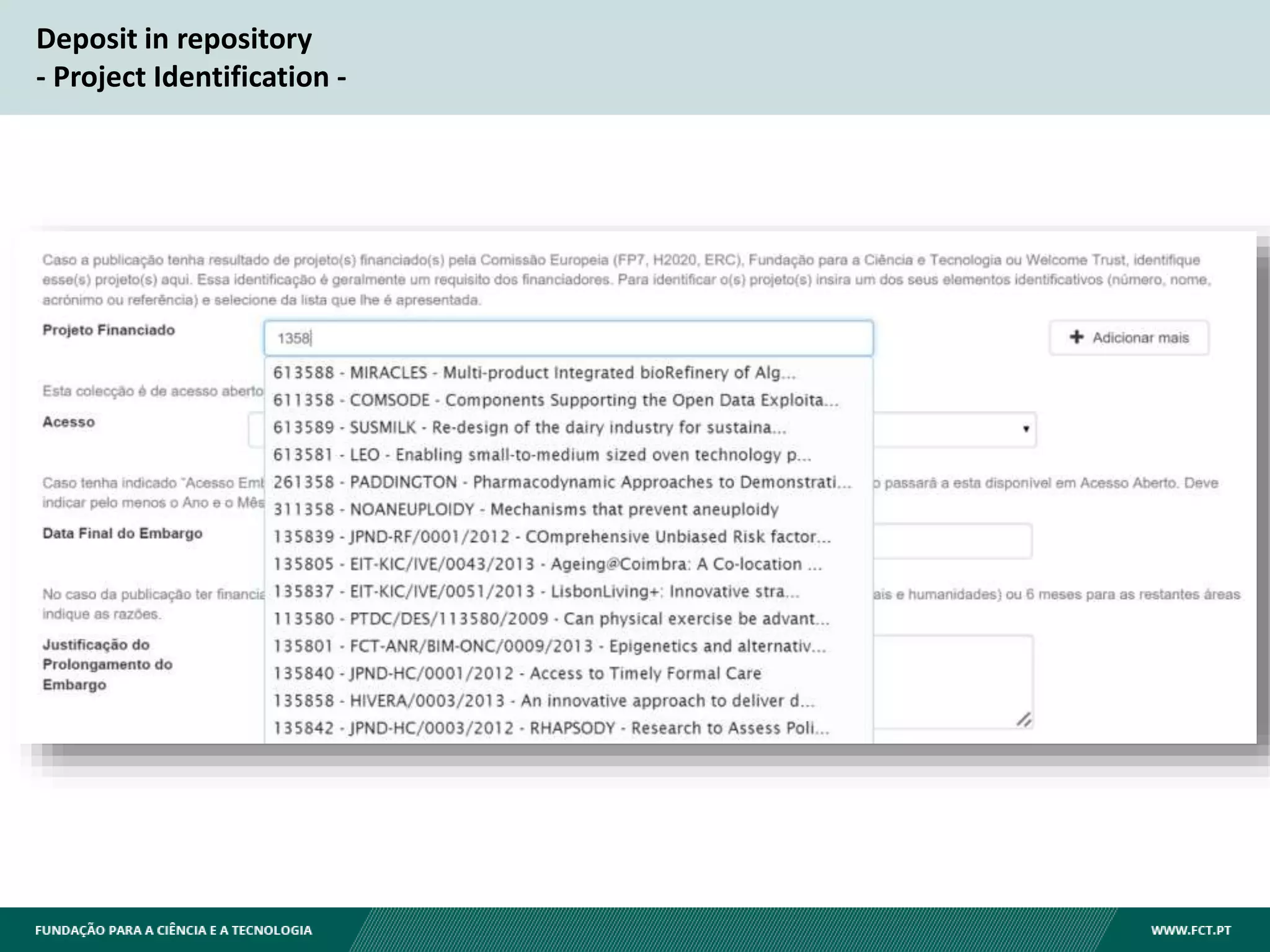
Deposit in repository
- Project Identification -
Deposit in repository
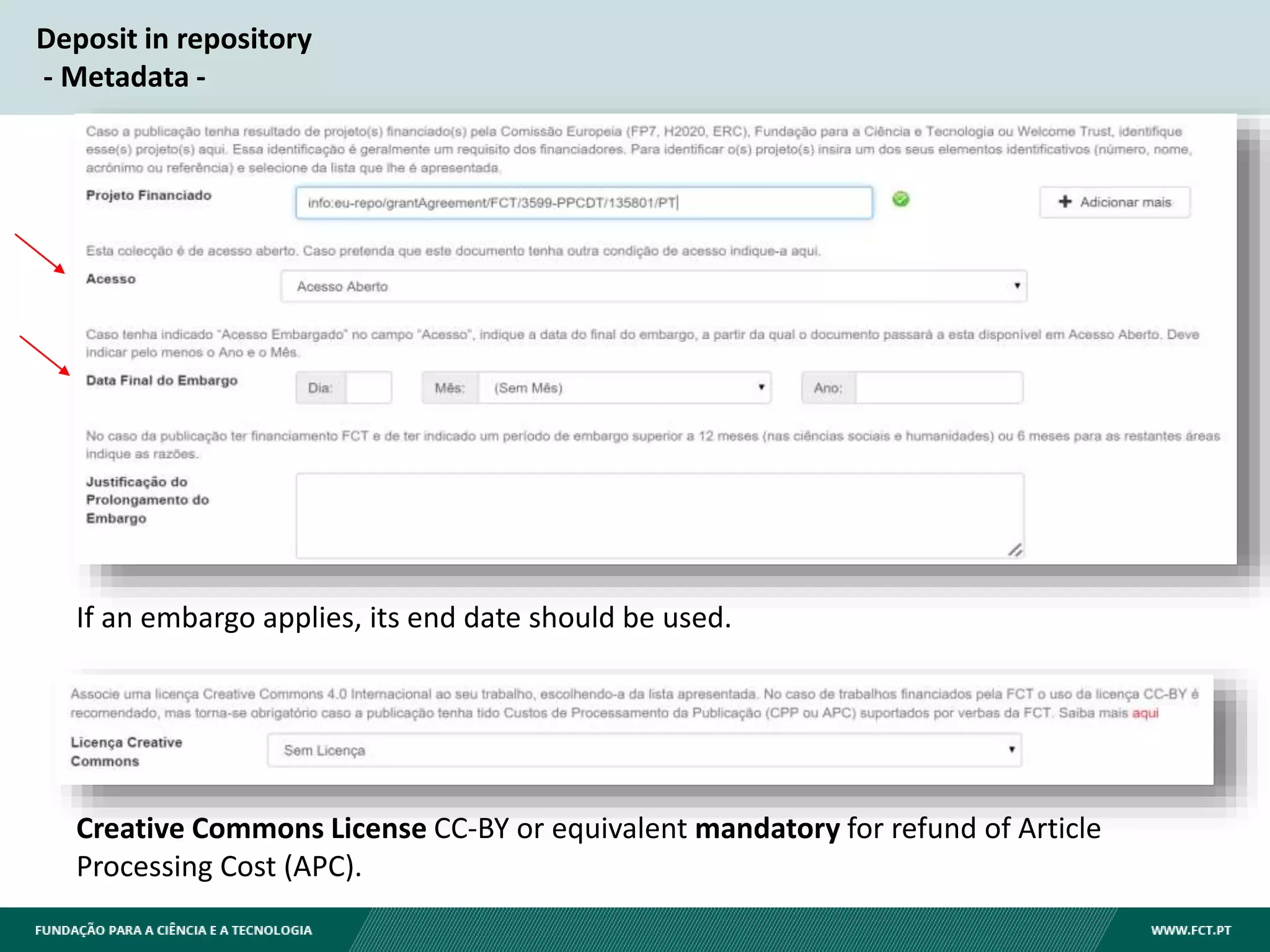
- Metadata -
If an embargo applies, its end date should be used.
Creative Commons License CC-BY or equivalent mandatory for refund of Article
Processing Cost (APC).
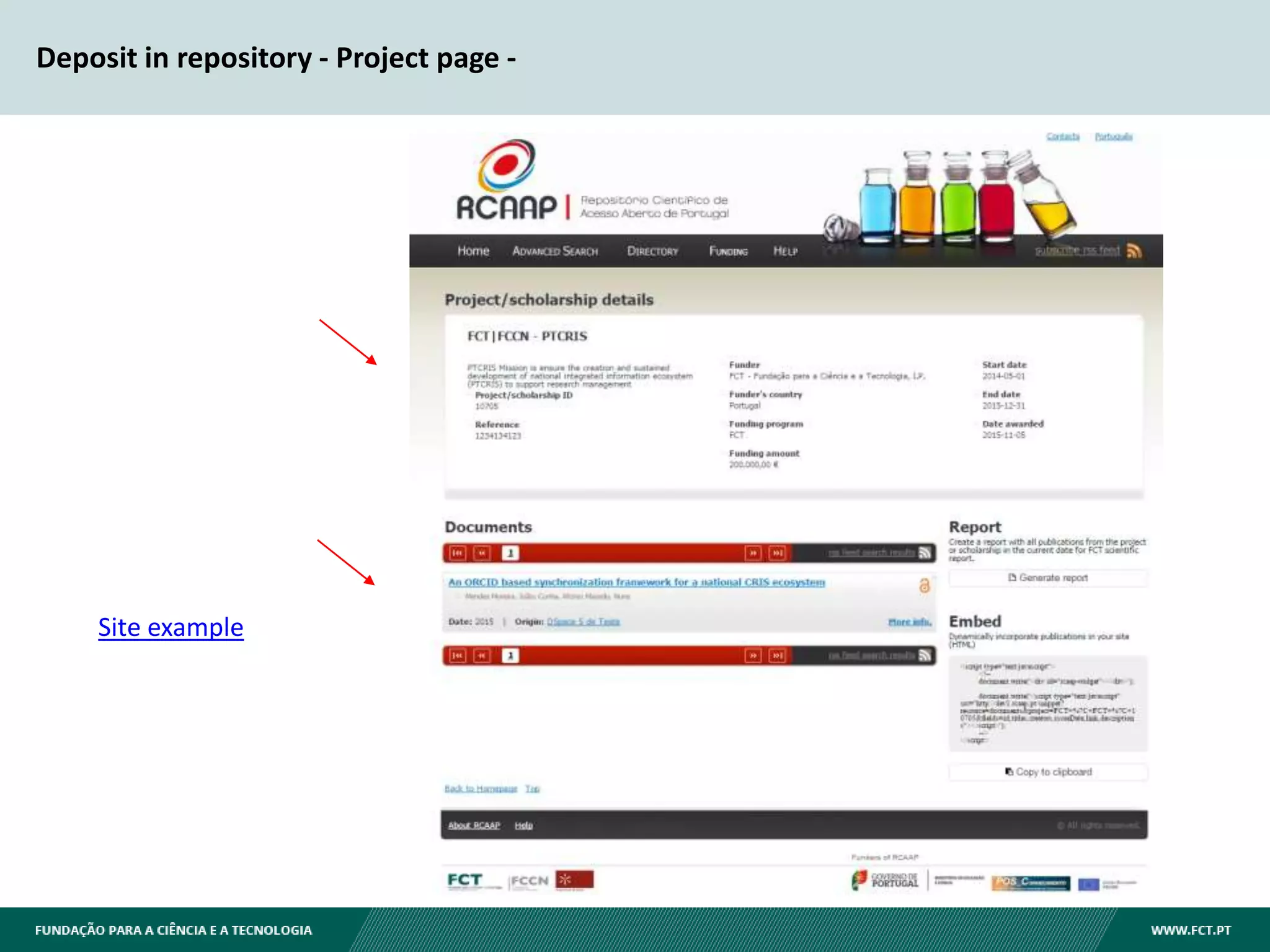
Deposit in repository - Project page -
Site example
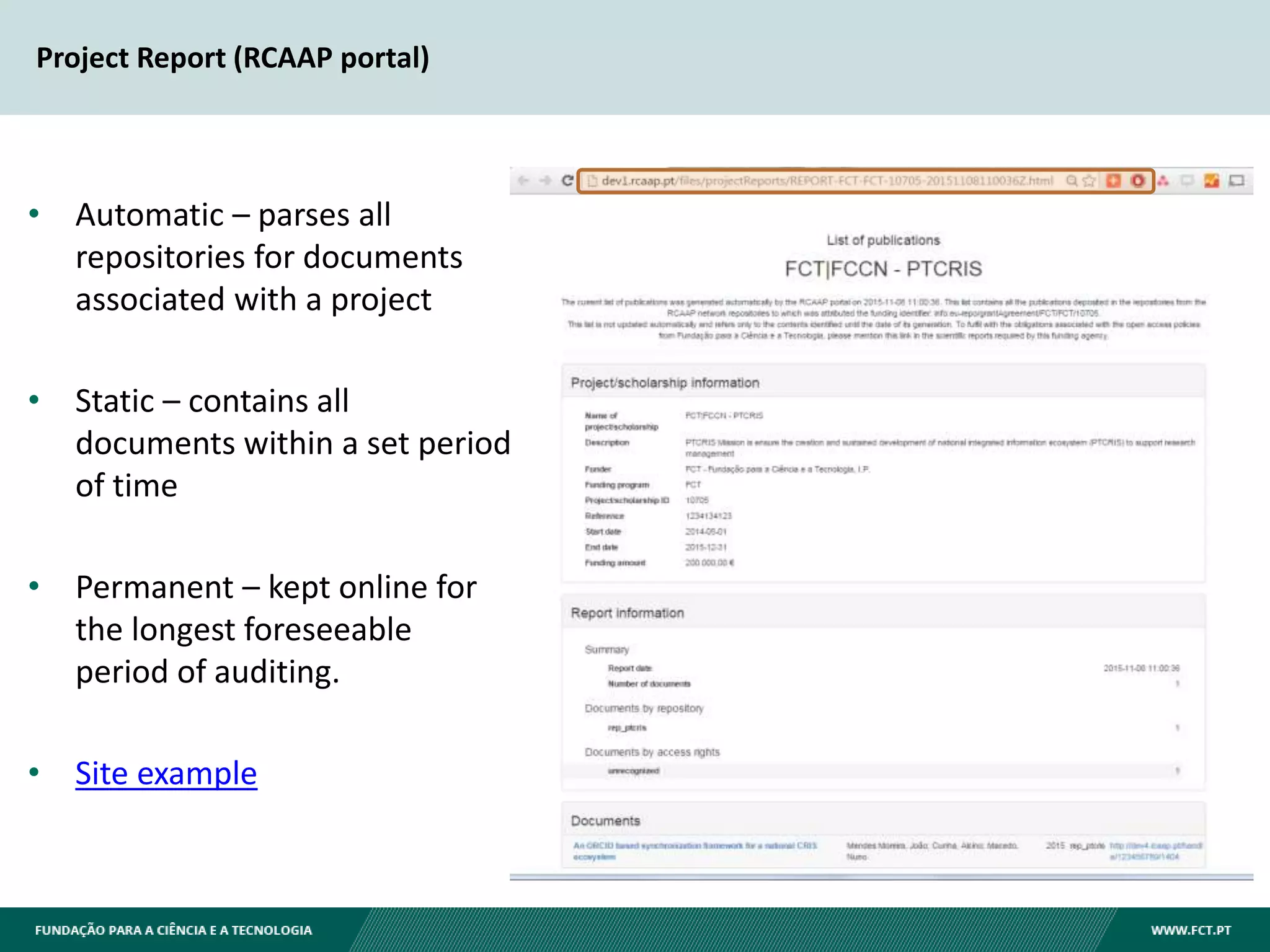
Project Report (RCAAP portal)
• Automatic – parses all
repositories for documents
associated with a project
• Static – contains all
documents within a set period
of time
• Permanent – kept online for
the longest foreseeable
period of auditing.
• Site example
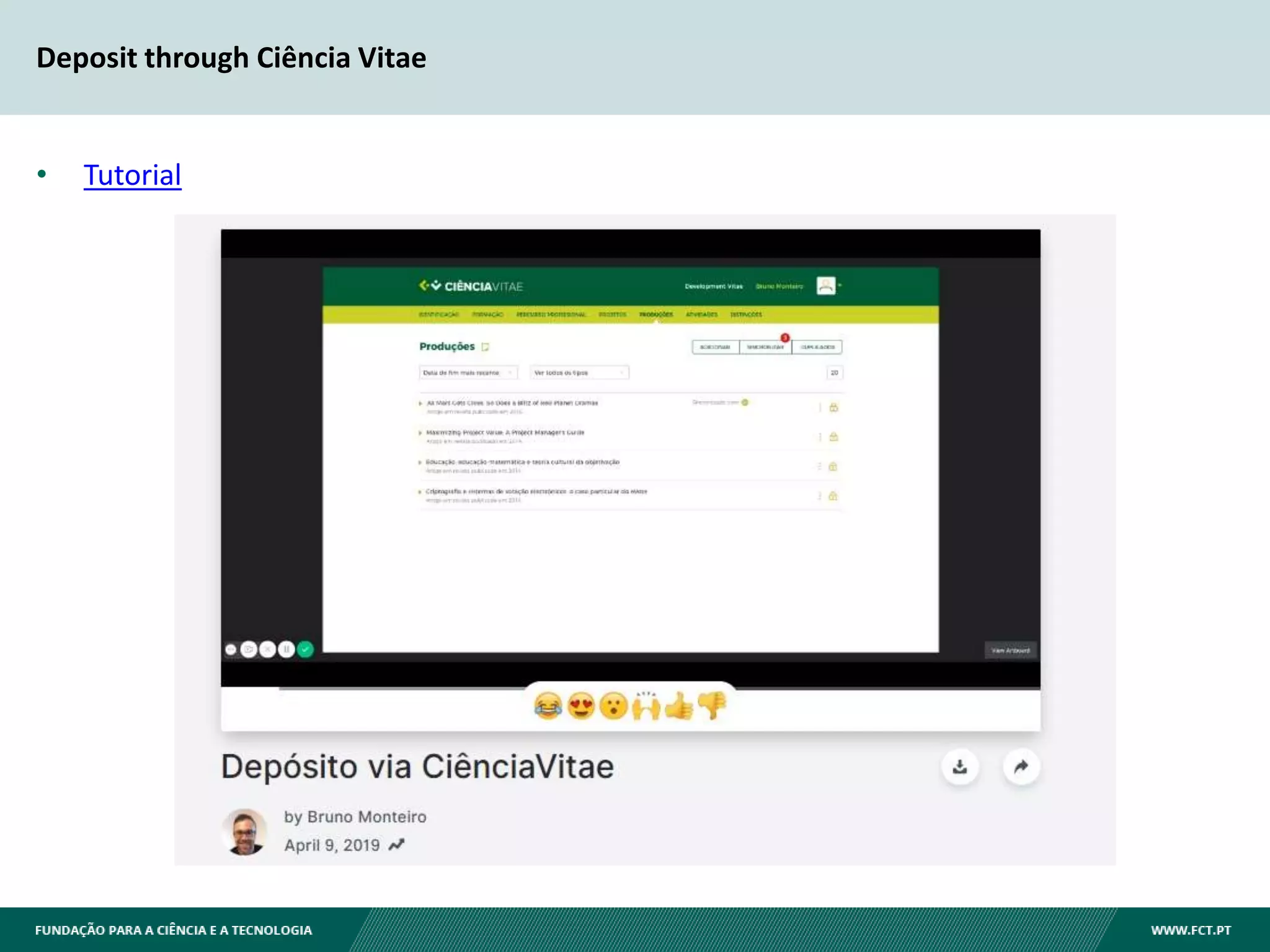
Deposit through Ciência Vitae
• Tutorial
Monitoring processes
1. Retrieve publications deposited in RCAAP with associated FCT funding
2. Cross-check with (multiple options):
– OpenAire
• Co-authorships
• Stats
– CrossRef
– WoS
– Research teams CV’s
3. TDM to retrieve publications associated with specific grant ID’s
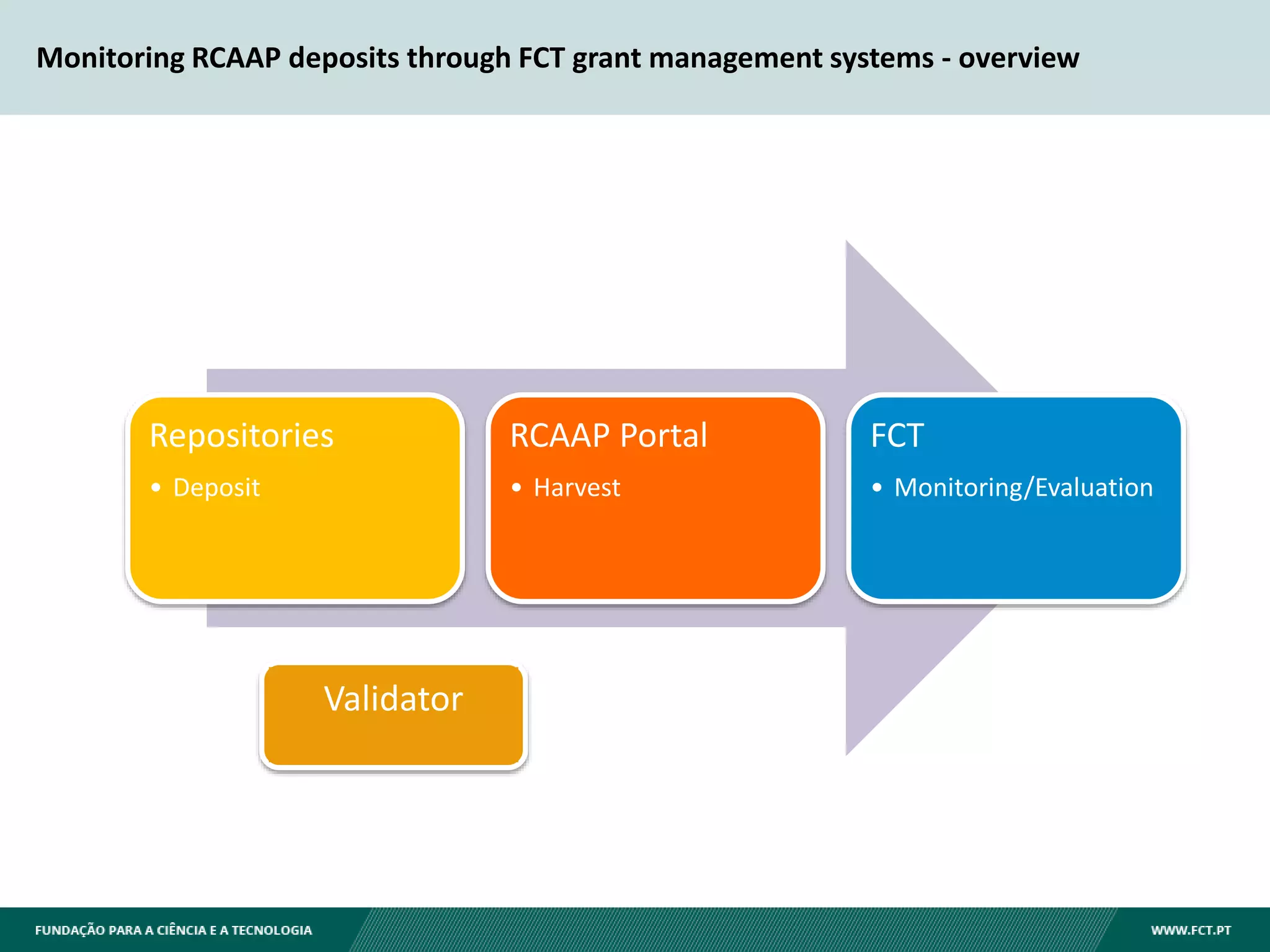
Monitoring RCAAP deposits through FCT grant management systems - overview
Repositories
• Deposit
RCAAP Portal
• Harvest
FCT
• Monitoring/Evaluation
Validator
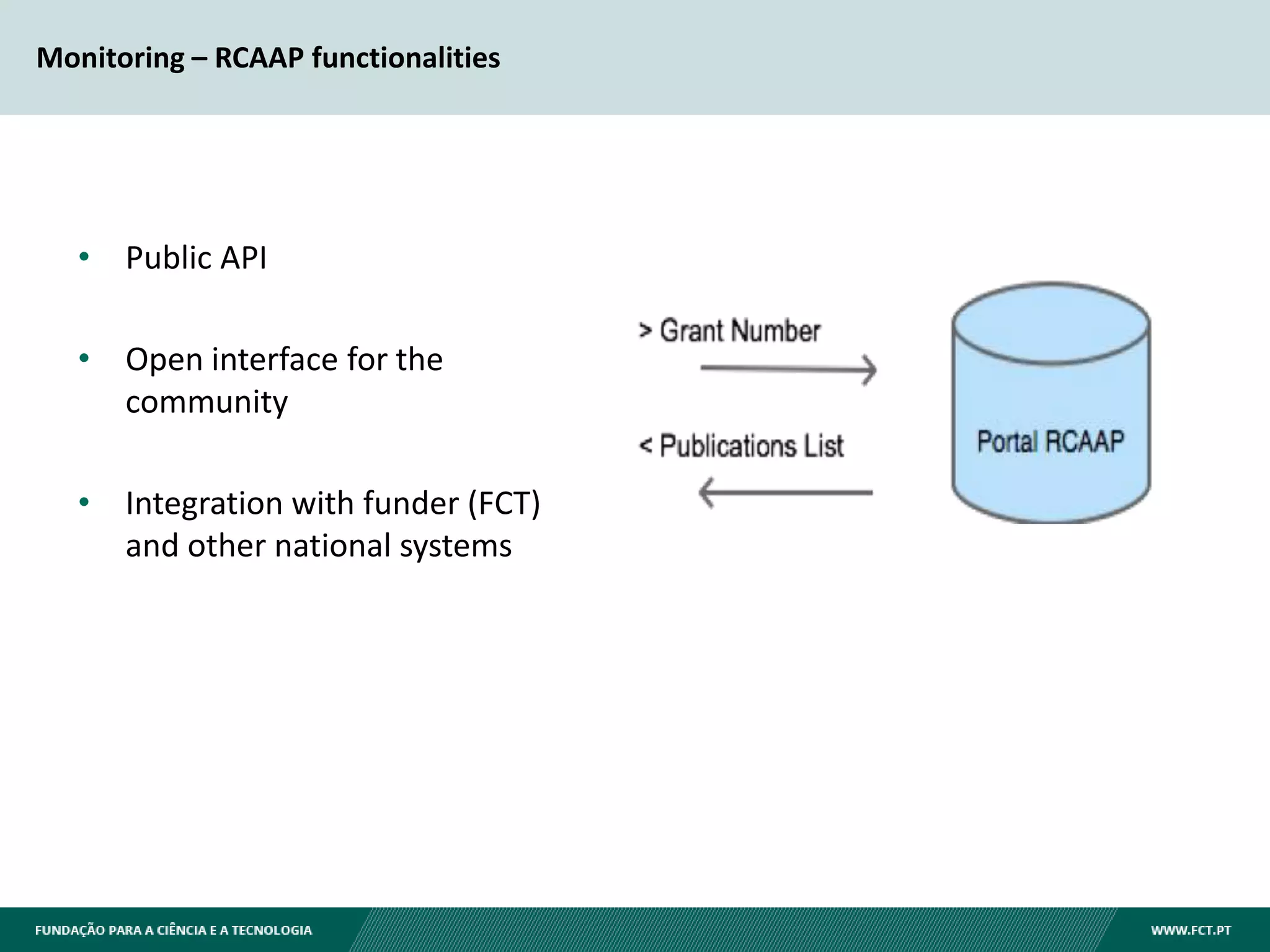
Monitoring – RCAAP functionalities
• Public API
• Open interface for the
community
• Integration with funder (FCT)
and other national systems
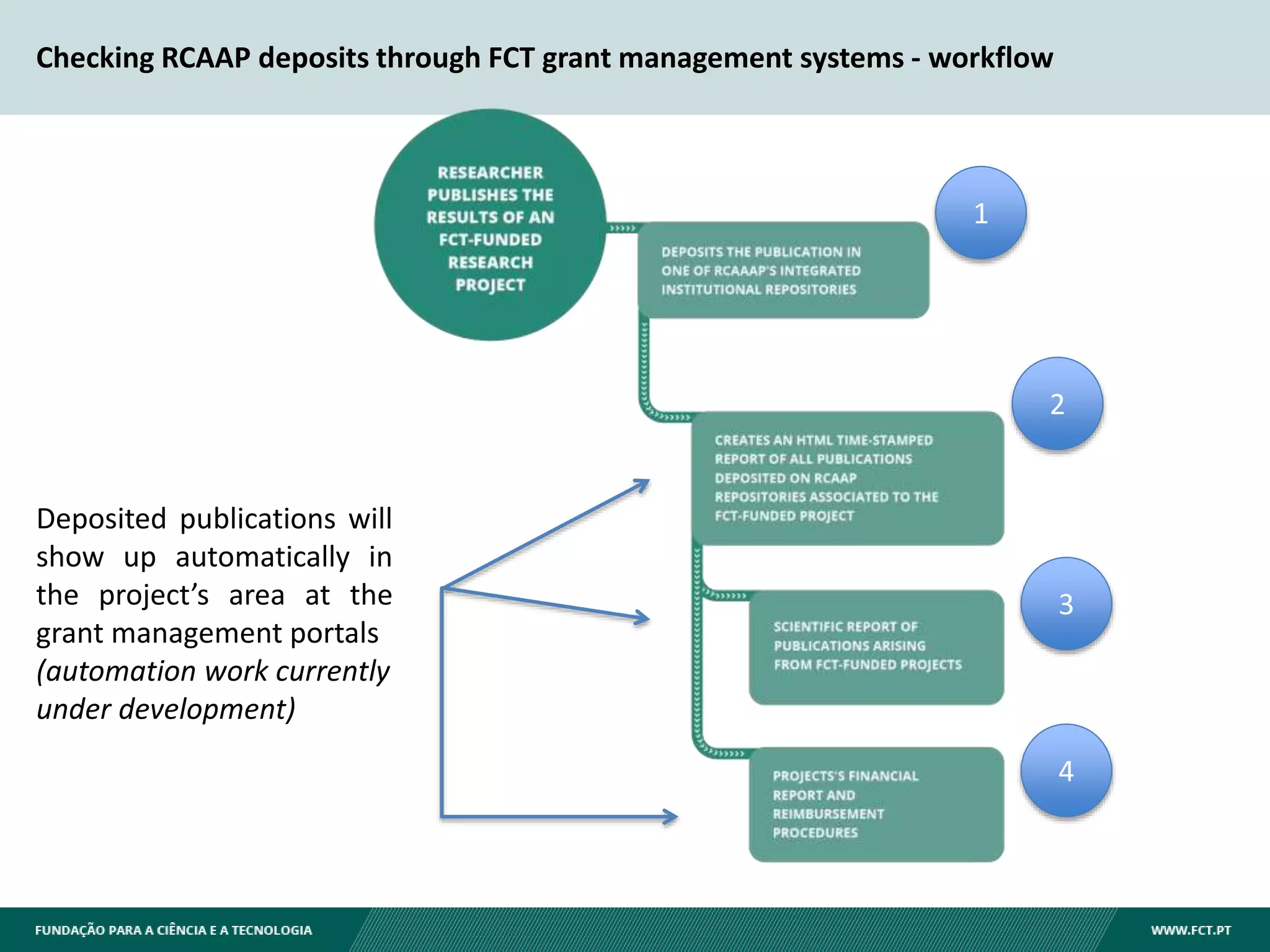
Checking RCAAP deposits through FCT grant management systems - workflow
1
2
3
4
Deposited publications will
show up automatically in
the project’s area at the
grant management portals
(automation work currently
under development)
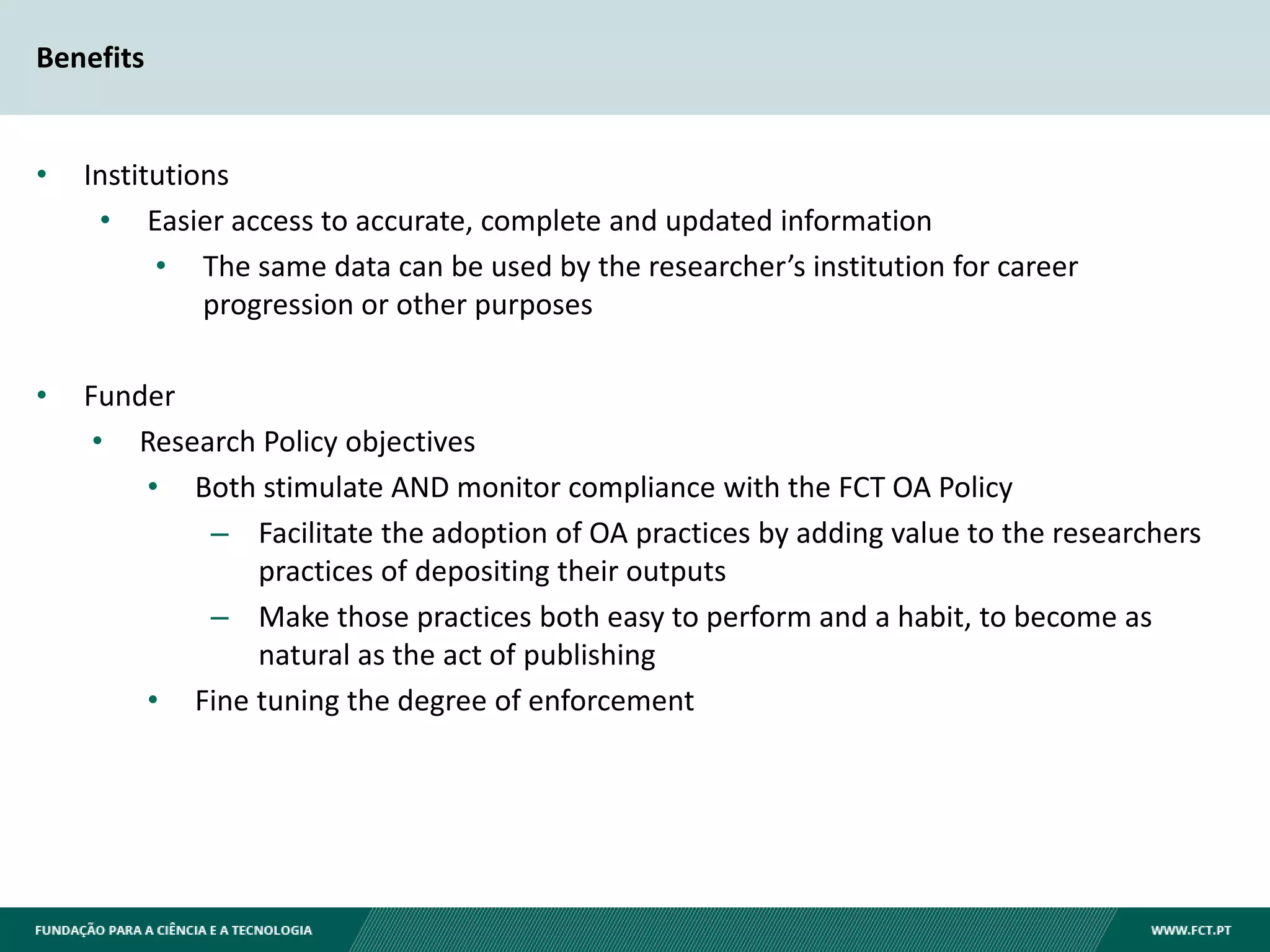
Benefits
• Researchers
• Simplification of the scientific and financial reporting at FCT
• RCAAP functionalities and reuse of RCAAP collected data for different purposes
• For research output report at FCT
• For research project expenses claims at FCT
• To form the basis of the scientific output of a researcher in his/her CV at
Ciência Vitae
• To check if a given repository is compliant with FCT OA policy (SARI)
• To check if an OA journal complies with the FCT cost eligibility requirements
(during the publication deposit process)
• Widget for research project websites (publication list export)
Benefits
• Institutions
• Easier access to accurate, complete and updated information
• The same data can be used by the researcher’s institution for career
progression or other purposes
• Funder
• Research Policy objectives
• Both stimulate AND monitor compliance with the FCT OA Policy
– Facilitate the adoption of OA practices by adding value to the researchers
practices of depositing their outputs
– Make those practices both easy to perform and a habit, to become as
natural as the act of publishing
• Fine tuning the degree of enforcement
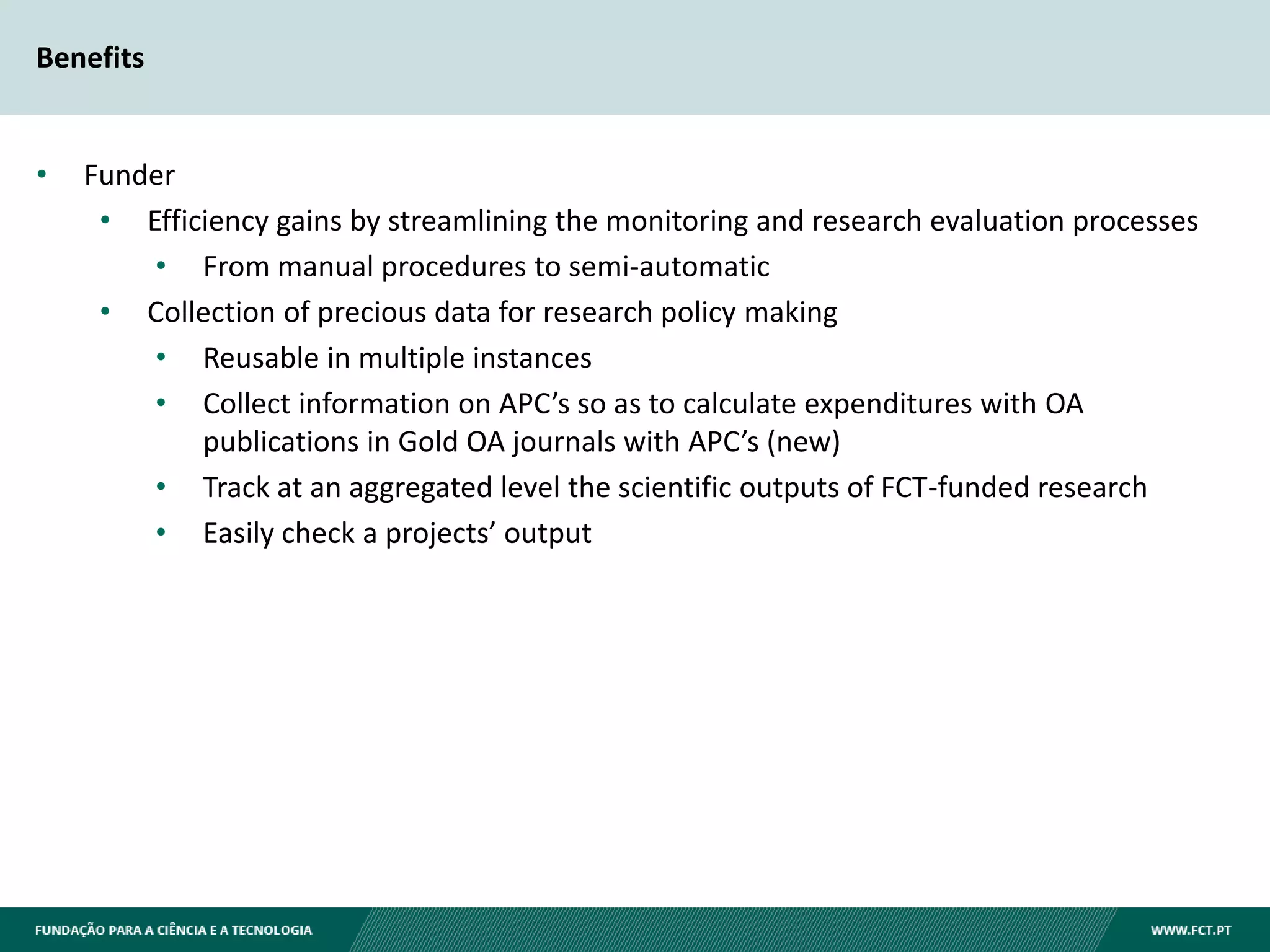
Benefits
• Funder
• Efficiency gains by streamlining the monitoring and research evaluation processes
• From manual procedures to semi-automatic
• Collection of precious data for research policy making
• Reusable in multiple instances
• Collect information on APC’s so as to calculate expenditures with OA
publications in Gold OA journals with APC’s (new)
• Track at an aggregated level the scientific outputs of FCT-funded research
• Easily check a projects’ output
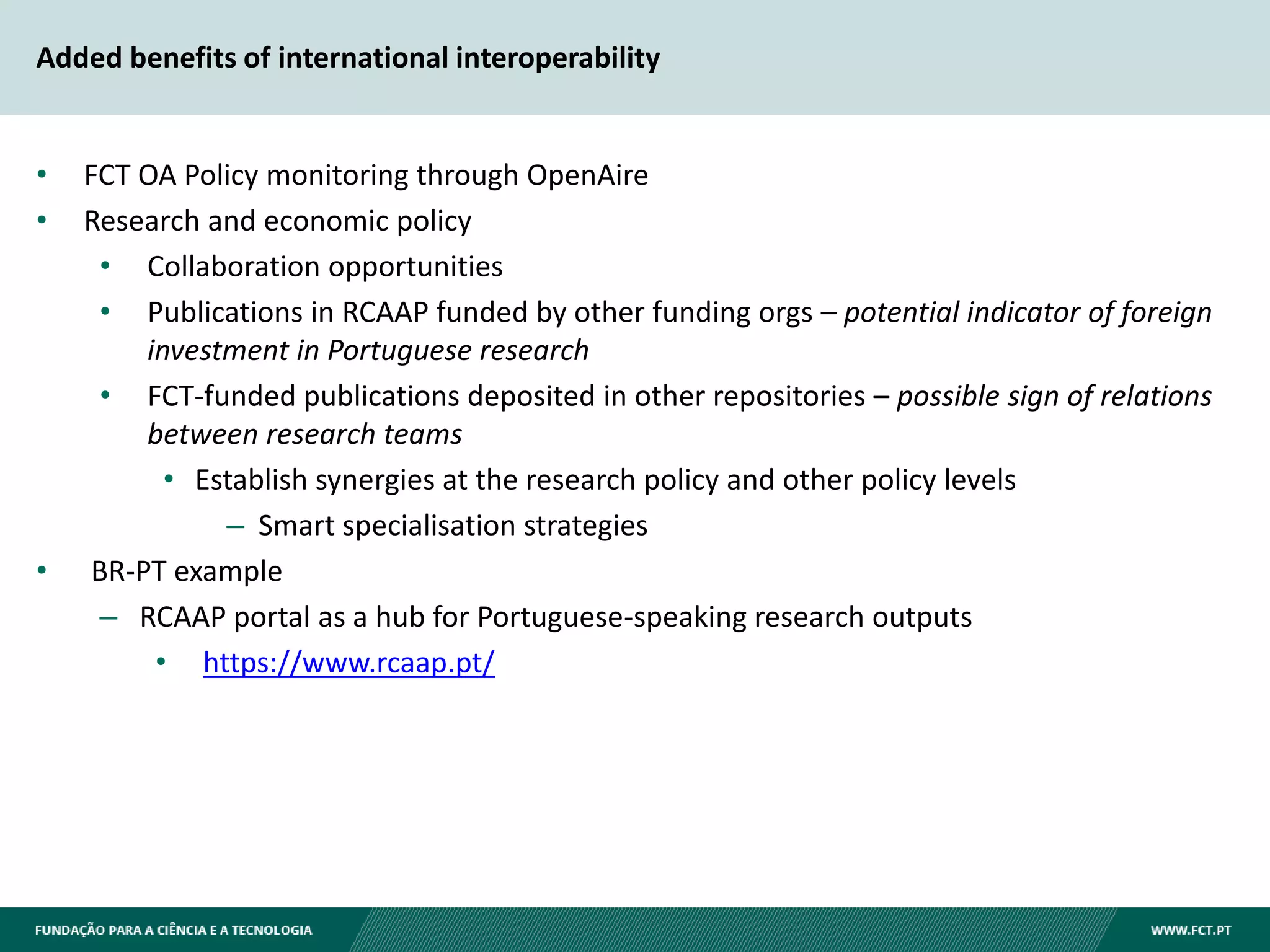
Added benefits of international interoperability
• FCT OA Policy monitoring through OpenAire
• Research and economic policy
• Collaboration opportunities
• Publications in RCAAP funded by other funding orgs – potential indicator of foreign
investment in Portuguese research
• FCT-funded publications deposited in other repositories – possible sign of relations
between research teams
• Establish synergies at the research policy and other policy levels
– Smart specialisation strategies
• BR-PT example
– RCAAP portal as a hub for Portuguese-speaking research outputs
• https://www.rcaap.pt/
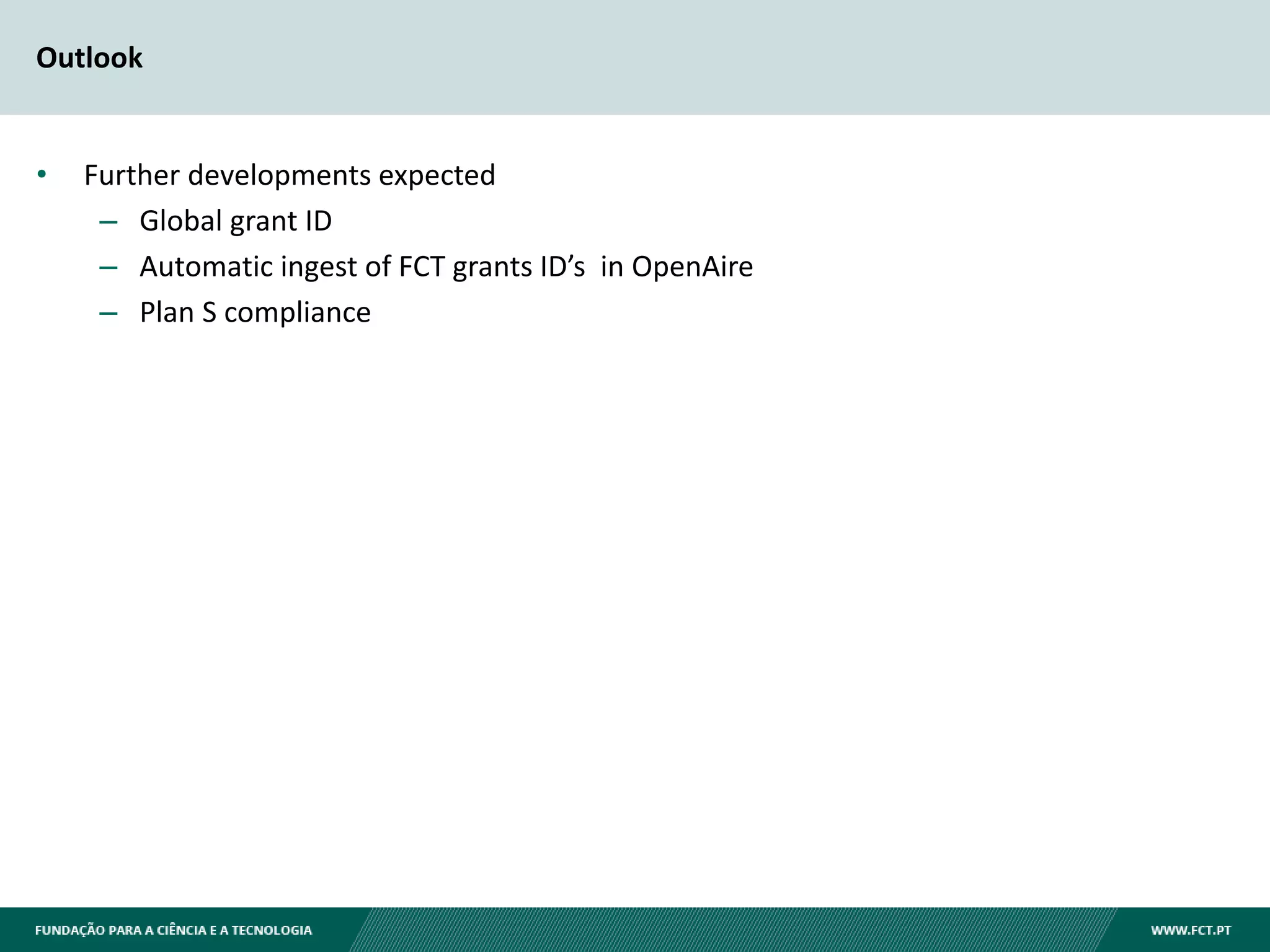
Outlook
• Further developments expected
– Global grant ID
– Automatic ingest of FCT grants ID’s in OpenAire
– Plan S compliance
Acknowledgements: RCAAP Project, PT CRIS, Ciência Vitae and FCT’s
Information Systems teams
EXCELÊNCIA| CONHECIMENTO | IMPACTO
?Thank you for your attention!
You can reach me at: vasco.vaz@fct.pt

Supporting a national funders open access policy (Portugal)

  • 1.
    Supporting a nationalfunder’s Open Access policy Vasco Vaz Departamento da Sociedade da Informação 27 May 2019 | Ghent University | Belgium Workshop “Research policy monitoring in the era of Open Science and Big Data”
  • 2.
    Agenda • Considerations andconcepts – RCAAP – PT CRIS – Ciência Vitae • Open Access Policy • Facilitating compliance – Deposit in repository – Export from CV • Monitoring – Processes – Checking deposits through integration of RCAAP and FCT grant management systems - example • Benefits • Outlook
  • 3.
    Considerations • Abstraction • Workin progress • Client’s perspective • FCT’s role and capabilities • Design infrastructures, adapt systems and services to respond to policy priorities
  • 4.
    RCAAP • Vital researche-infrastructure, part of the NREN • Initiated operation in November 2008 with 12 institutional repositories • Integrates every public HEI repository and makes all their deposited content available via a single entry point search portal • Monitors and ensures that every repository within the RCAAP network conforms to the highest quality and interoperability standards Open AIRE guidelines
  • 5.
    RCAAP RCAAP and othersystems • Full integration with OpenAIRE • Full integration with OASIS.BR (more than 1.700.000 (!) research publications from Brasil and Portugal interchangeably retrieved from both networks and made available through both Portals) • Full integration with previous DeGóis® Platform (where national researchers curricula were centralised and publicly made available) Community • Central management (technical / political) • Repository managers • Journal publishers or editorial teams • Librarians and university presses
  • 6.
    RCAAP Services RCAAP Portal Institutional Repository Hosting Service (SARI) Data Repository (SARDC) Scientific Journals Hosting Service (SARC) Common Repository Validator (togauge norm conformity) Repository Usage Statistics (SCEUR) Scientific Open Access Repository of Portugal 28 IR 21 Journals 52 IR 1 CR + 575K doc95 Journals Communication, dissemination and training activities
  • 7.
  • 8.
    RCAAP integrations Ciência Vitae- October 2018 Ciência ID – October 2018 OpenAIRE - (Dashboard and Guidelines 4.0) – December 2018 DuraSpace (Launch of DSpace 7 – 2nd semester 2019) Developments RCAAP Portal - June 2019
  • 9.
    PTCRIS -Mission Ensure thecreation and sustained development of national integrated information ecosystem (PTCRIS) to support research management
  • 10.
    PT Management andtechnology systems Ecosystem National and international CRIS (Local: SIGARRA, FENIX, others) (European Commission, ScienTI network, etc.) PT-CRIS Academic expertise (DeGóis FCT-SIG) Organisations Database Bibliometrics Grant database (FCT-SIG/PCT) Grant management (FCT-SIG/PCT) Research news Research ethics PTCRIS = SoS = System of Systems = ECOSYSTEM
  • 11.
    PT-CRIS implementation principle Inputonce, reuse multiple! Eliminate information silos
  • 12.
    Adopted Standards PT-CRIS Data model Dictionary/Interop. Ontologies Researchers ID Organisations ID Alignment • H2020 • Digital ERA Forum • RDA
  • 13.
    ORCID as thecentral hub for PTCRIS • High coverage of predefined requirements. – General, functional and technical. • Completeness of the ORCID profile. • Usability - interface for the integration of systems with ORCID becoming a standard. • Infrastructure reliability and resilience. • High interoperability with external sources (Crossref, Datacite, Scopus and WoK). • High ORCID coverage of the national research community. – In late 2013 – early 2014, due to the research assessment exercise and for the purpose of carrying out a bibliometric study, around 15,000 researchers from Portuguese research units applied for an ORCID iD. These researchers were responsible for more than 90% of the Portuguese scientific output of the 5 years prior to 2013. • Sustainability. – Small costs compared with the alternative of developing and maintaining a home grown hub.
  • 14.
  • 15.
  • 16.
  • 17.
  • 18.
  • 19.
    CIÊNCIA VITAE CIÊNCIAVITAE isa platform that allows you to create, manage and promote your curriculum quickly and simply. • One cv: shared by different stakeholders of the national academic-scientific system. The administrative burden on the user and the effort in multi-agency validation/certification tasks is reduced; • Customise: the user chooses how, when and what he wants to share. The “Export Curriculum” feature allows you to create multiple versions of the curriculum that are suitable for different needs: customizable content and various document formats; • Integrate: CIÊNCIAVITAE is integrated with various national and international systems, such as ORCiD, FCT|SIG, etc. So you can reuse information you have already registered in these systems to build your curriculum; • Promote: promote your curriculum, making it public. This way, other users will be able to find it through the “Find CVs” feature.
  • 20.
  • 21.
  • 22.
  • 23.
  • 24.
  • 25.
  • 26.
    Funder mandate forpublicly-funded research to be made OA 2013 • Infrastructural conditions • Political conditions – Research Institutions – International environment • Generalised acceptance of OA principles by the research community Sufficiently mature context in Portugal for the adoption of a mandate towards availability in OA of research results obtained through public funding
  • 27.
    FCT Open Accesspolicy • Effective for all projects funded through calls launched after May 5th 2014 • Covers: – Papers in scientific journals/conference proceedings – Posters – Books, book chapters and monographs – PhD theses • Mandatory immediate deposit in one of the RCAAP repositories • Embargo periods to full publication content allowed Embargo timeframes Months Publications (STEM/HSS) 6-12 Books, book chapters, monographs 18 PhD theses 36 Free, online access to peer-reviewed publications arising from FCT funding
  • 28.
    FCT Open Accesspolicy OA publishing through an Author-pays business model journal • APC’s eligible for refund as research costs subject to following conditions – Immediate Open Access  No embargo is allowed – The definitive work must be allowed to be deposited in repositories other than the publisher’s own repository – Creative Commons CC-BY license (or equivalent) mandatory  No restriction to access or re-use
  • 29.
    Open Access toResearch Publications Strategy Establish an Open Access repository network infrastructure  RCAAP + Mandate Open Access to Publications arising from publicly-funded research  FCT Open Access Policy + Integrate compliance with the Open Access Policy into project reporting and grant management procedures of FCT-funded research  Implementation measures
  • 30.
    Deposit in repository -Project Identification - • OpenAIRE – Scholarly infrastructure to manage and monitor the outcomes of EU- funded research supporting OA policies http://api.openaire.eu
  • 31.
    Deposit in repository -Project Identification -
  • 32.
    Deposit in repository -Metadata - If an embargo applies, its end date should be used. Creative Commons License CC-BY or equivalent mandatory for refund of Article Processing Cost (APC).
  • 33.
    Deposit in repository- Project page - Site example
  • 34.
    Project Report (RCAAPportal) • Automatic – parses all repositories for documents associated with a project • Static – contains all documents within a set period of time • Permanent – kept online for the longest foreseeable period of auditing. • Site example
  • 35.
    Deposit through CiênciaVitae • Tutorial
  • 36.
    Monitoring processes 1. Retrievepublications deposited in RCAAP with associated FCT funding 2. Cross-check with (multiple options): – OpenAire • Co-authorships • Stats – CrossRef – WoS – Research teams CV’s 3. TDM to retrieve publications associated with specific grant ID’s
  • 37.
    Monitoring RCAAP depositsthrough FCT grant management systems - overview Repositories • Deposit RCAAP Portal • Harvest FCT • Monitoring/Evaluation Validator
  • 38.
    Monitoring – RCAAPfunctionalities • Public API • Open interface for the community • Integration with funder (FCT) and other national systems
  • 39.
    Checking RCAAP depositsthrough FCT grant management systems - workflow 1 2 3 4 Deposited publications will show up automatically in the project’s area at the grant management portals (automation work currently under development)
  • 40.
    Benefits • Researchers • Simplificationof the scientific and financial reporting at FCT • RCAAP functionalities and reuse of RCAAP collected data for different purposes • For research output report at FCT • For research project expenses claims at FCT • To form the basis of the scientific output of a researcher in his/her CV at Ciência Vitae • To check if a given repository is compliant with FCT OA policy (SARI) • To check if an OA journal complies with the FCT cost eligibility requirements (during the publication deposit process) • Widget for research project websites (publication list export)
  • 41.
    Benefits • Institutions • Easieraccess to accurate, complete and updated information • The same data can be used by the researcher’s institution for career progression or other purposes • Funder • Research Policy objectives • Both stimulate AND monitor compliance with the FCT OA Policy – Facilitate the adoption of OA practices by adding value to the researchers practices of depositing their outputs – Make those practices both easy to perform and a habit, to become as natural as the act of publishing • Fine tuning the degree of enforcement
  • 42.
    Benefits • Funder • Efficiencygains by streamlining the monitoring and research evaluation processes • From manual procedures to semi-automatic • Collection of precious data for research policy making • Reusable in multiple instances • Collect information on APC’s so as to calculate expenditures with OA publications in Gold OA journals with APC’s (new) • Track at an aggregated level the scientific outputs of FCT-funded research • Easily check a projects’ output
  • 43.
    Added benefits ofinternational interoperability • FCT OA Policy monitoring through OpenAire • Research and economic policy • Collaboration opportunities • Publications in RCAAP funded by other funding orgs – potential indicator of foreign investment in Portuguese research • FCT-funded publications deposited in other repositories – possible sign of relations between research teams • Establish synergies at the research policy and other policy levels – Smart specialisation strategies • BR-PT example – RCAAP portal as a hub for Portuguese-speaking research outputs • https://www.rcaap.pt/
  • 44.
    Outlook • Further developmentsexpected – Global grant ID – Automatic ingest of FCT grants ID’s in OpenAire – Plan S compliance
  • 45.
    Acknowledgements: RCAAP Project,PT CRIS, Ciência Vitae and FCT’s Information Systems teams EXCELÊNCIA| CONHECIMENTO | IMPACTO ?Thank you for your attention! You can reach me at: vasco.vaz@fct.pt

Editor's Notes

  • #14 ORCID scored well in all requirements