woodmac.comTrusted intelligence
Research Presentation:
2019 State Policy Compass & U.S. Solar
Market Outlook
Austin Perea
Senior Analyst
Austin.Perea@woodmac.com
woodmac.comTrusted intelligence
Wood Mackenzie offices Wood Mackenzie Power & Renewables offices
Wood Mackenzie is ideally
positioned to support
consumers, producers and
financers of the new energy
economy.
 Acquisition of MAKE and Greentech
Media (GTM)
 Leaders in renewables, EV demand
and grid-connected storage
 Over 500 sector-dedicated analysts and
consultants globally, including 75
specifically to power and renewables
 Located close to clients and industry
contacts
About Wood Mackenzie
We provide commercial insight and access to our experts leveraging our integrated proprietary metals, energy
and renewables research platform
woodmac.comTrusted intelligence
2018 in review
woodmac.comTrusted intelligence
849
1,921
3,373
4,766
6,244
7,501
15,152
10,845 10,690
-
2,000
4,000
6,000
8,000
10,000
12,000
14,000
16,000
2010 2011 2012 2013 2014 2015 2016 2017 2018
Capacity(MWdc)
Residential PV Non-Residential PV Utility PV
The market experienced flat growth from 2017-2018, but segment narratives have nuance
woodmac.comTrusted intelligence
Economic competitiveness and corporate procurement drive new utility PPAs in 2018
• In 2016 over 50% of
procurement was policy
driven/enabled
• By 2018, nearly 80% of
procurement is driven by
economic competitiveness
and voluntary reasons
• Installation flatness was
primarily driven by risk
aversion to procurement
due to Section 201 tariff
uncertainty 2017-2018
Source: Wood Mackenzie Power and Renewables
Procurement Driver of Utility PV PPAs by Contract Execution Year
11%
14%
33%
1%
4%
29%
65%
72%
19%
21%
5%
9%
1.5%
5%
10%
0% 10% 20% 30% 40% 50% 60% 70% 80% 90% 100%
2018
2017
2016
RPS PURPA Voluntary Procurement Corporate Procurement CCA
woodmac.comTrusted intelligence
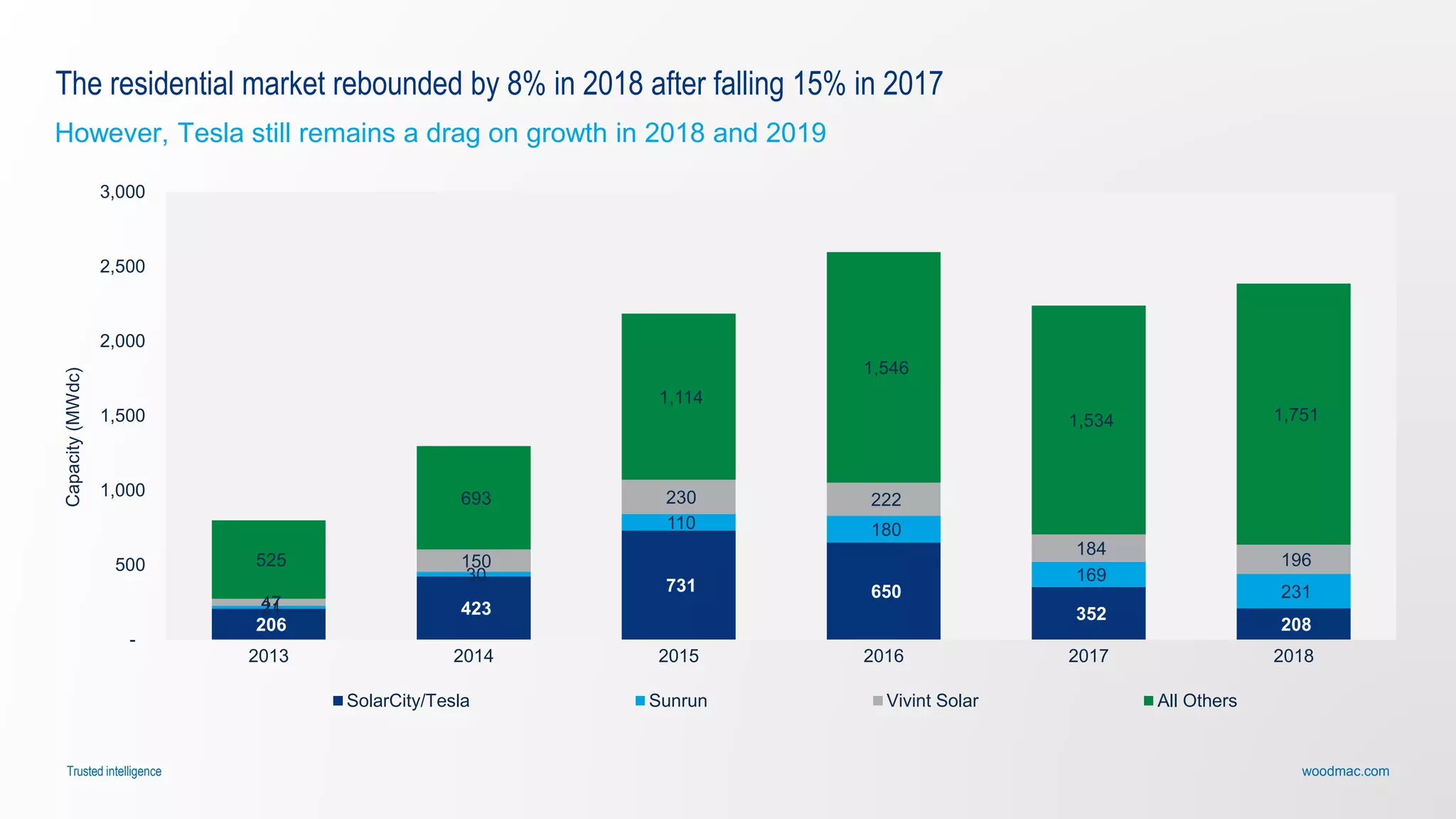
The residential market rebounded by 8% in 2018 after falling 15% in 2017
However, Tesla still remains a drag on growth in 2018 and 2019
206
423
731 650
352
208
21
30
110 180
169
231
47
150
230 222
184
196525
693
1,114
1,546
1,534 1,751
-
500
1,000
1,500
2,000
2,500
3,000
2013 2014 2015 2016 2017 2018
Capacity(MWdc)
SolarCity/Tesla Sunrun Vivint Solar All Others
woodmac.comTrusted intelligence
$0.62
$0.63
$0.66
$0.66
$0.66
$0.68
$0.59
$0.60
$2.69
$2.46
$2.42
$2.25
$2.11
$1.99
$1.83
$1.78
19%
20%
21%
23%
24%
26%
24%
25%
0%
5%
10%
15%
20%
25%
30%
$0.00
$0.50
$1.00
$1.50
$2.00
$2.50
$3.00
$3.50
2016 2017 2018 2019E 2020E 2021E 2022E 2023E
$/W
Customer Acquisition Cost Turnkey EPC Pricing
CAC % of System Price
Customer acquisition remains most expensive cost category in residential solar
• Customer acquisition costs have increased from
$.62/W in 2016 to $.66/W in 2018 due primarily to large
national and regional installers increasing marketing
budgets in attempt to take market share in the wake of
Tesla/SolarCity’s decline
• CAC are expected to remain relatively flat until 2021,
before an increase in the year before the federal ITC step-
down
• New-build home solar and greater familiarity with product
are expected to help reduce long-term CAC beyond 202
U.S. residential solar customer-acquisition costs, 2016-2023E
woodmac.comTrusted intelligence
But slow growth is expected as major market penetration ranges from 5-15%
Early adopter customers are being tapped in major markets with limited near-term retrofit growth opportunity
34%
15%
10%
7%
6% 6% 5% 5% 5% 4% 4% 4% 4% 3%
0%
5%
10%
15%
20%
25%
30%
35%
40%
0
200
400
600
800
1000
1200
MArketPenetration
Capacity(MWdc)
2016 2017 2018 2018 Market Penetration
woodmac.comTrusted intelligence
38%
5%
3%7%
7%
3%
4%
1%
2%
1%
29%
California
New York
Maryland
New Jersey
Arizona
Massachusetts
Texas
Utah
Connecticut
Hawaii
All Others
40%
8%8%
7%
6%
6%
3%
3%
2%
2%
15% California
New York
Maryland
New Jersey
Arizona
Massachusetts
Texas
Utah
Connecticut
Hawaii
All Others
Like utility-scale solar, residential solar is diversifying geographically
2016 residential capacity state breakdown 2018 residential capacity breakdown
woodmac.comTrusted intelligence
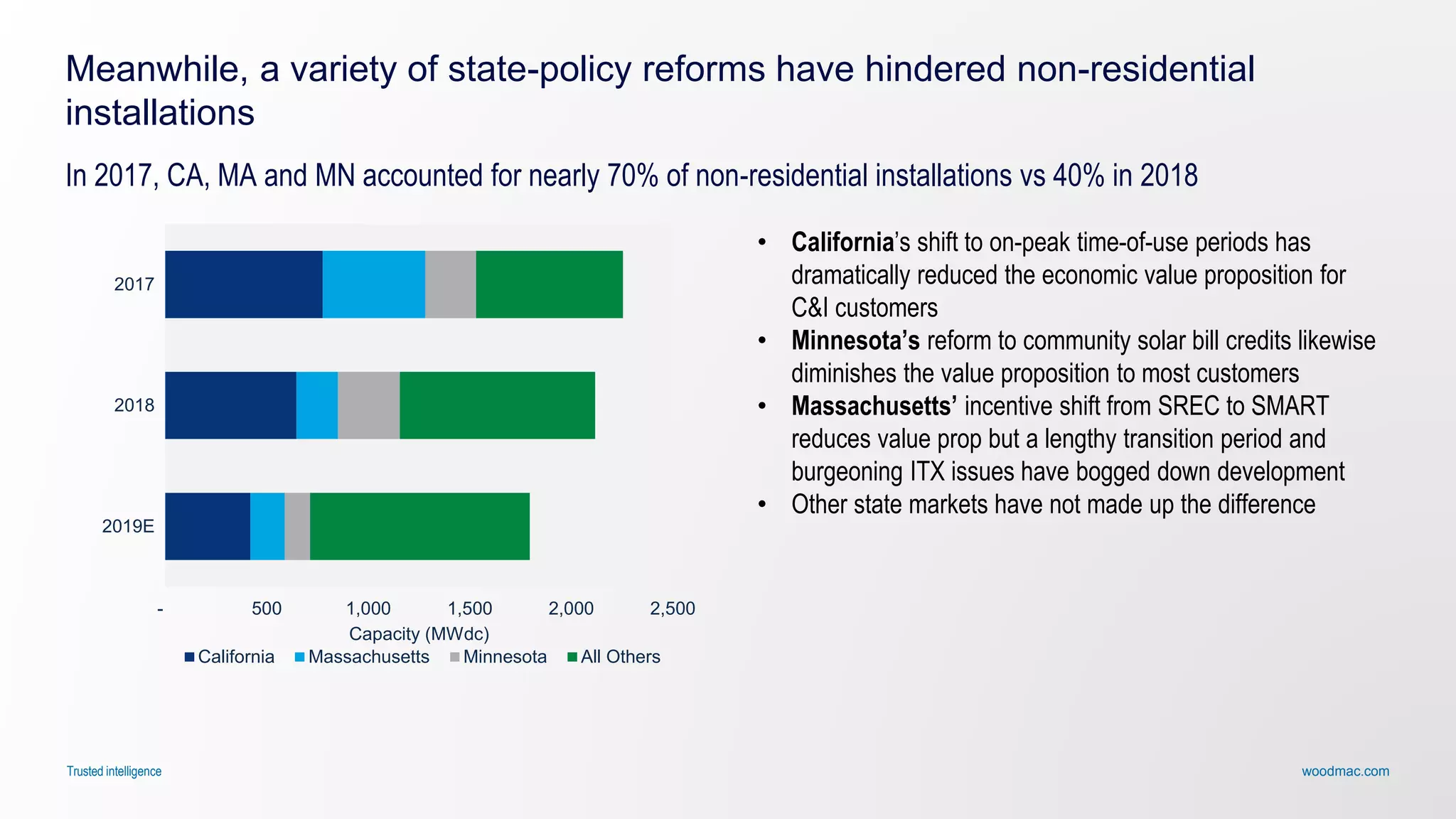
Meanwhile, a variety of state-policy reforms have hindered non-residential
installations
In 2017, CA, MA and MN accounted for nearly 70% of non-residential installations vs 40% in 2018
- 500 1,000 1,500 2,000 2,500
2019E
2018
2017
Capacity (MWdc)
California Massachusetts Minnesota All Others
• California’s shift to on-peak time-of-use periods has
dramatically reduced the economic value proposition for
C&I customers
• Minnesota’s reform to community solar bill credits likewise
diminishes the value proposition to most customers
• Massachusetts’ incentive shift from SREC to SMART
reduces value prop but a lengthy transition period and
burgeoning ITX issues have bogged down development
• Other state markets have not made up the difference
woodmac.comTrusted intelligence
0%
5%
10%
15%
20%
25%
30%
35%
0
500
1000
1500
2000
2500
3000
2014 2015 2016 2017 2018
Communitysolarmarketshare
Capacity(MWdc)
Community Solar On-site C&I CS market share
Though community solar is growing, the sub-segment hasn’t offset the decline of
major state markets from 2016-2018
Minnesota lead the pack, but Colorado and Massachusetts are following closely behind
woodmac.comTrusted intelligence
2019-2021 will feature both ITC phase-down in conjunction
with major changes to state-level solar policy and incentives
woodmac.comTrusted intelligence
California remains bedrock of residential solar market, but headwinds loom large
Flat in 2019E, 11% CAGR from 2019-2024E
Near-Term Outlook: Limited growth as market rebounds
Cost of customer acquisition remains high throughout 2018,
though installers have rebounded from the first wave of
Tesla & TPO provider declines
SCE super off-peak rates make resi difficult to pencil
Long-Term Outlook: Policy developments galore
1) NEM 3.0 expected to take effect in 2021-2022
CPUC will begin proceedings in 2019. Past proceedings have taken at
least 12 months to resolve, which means new installations through 2019
and 2020 will likely be grandfathered in under current NEM rules.
2) New home solar building mandate begins to offset impact
of NEM 3.0 beginning in 2020
3) However, uncertainty remains around the ongoing
bankruptcy proceeding of PG&E with both upside and
downside risks associated with residential PV.
0
200
400
600
800
1000
1200
1400
1600
2019E 2020E 2021E 2022E 2023E 2024E
Capacity(MWdc)
Total Retrofit New Home Construction
woodmac.comTrusted intelligence
But the Northeast is also undergoing significant policy upheaval
Every state has already or is scheduled to transition beyond just NEM compensation at the retail rate…
Maine:
Buy all, sell all arrangement… Amount of
PV production that offsets T&D charges is
reduced by 10% per year for new
installations
Massachusetts (under SMART):
• Community solar: Alternative on bill credit
• Residential (and small C&I rooftop) solar: NEM
at retail rate
• Onsite C&I solar: NEM if NEM program caps are
extended; otherwise projects will have to enroll
as a QF (qualified facility)
Connecticut:
NEM at retail rate in place
but…transitioning to a buy all, sell
credit (timing and value TBD)
Vermont:
NEM at retail rate but…with incentive adders
for < 150 kW systems and incentive
subtractors for systems greater than 150 kW
New Hampshire:
NEM below retail rate with 100% credit
for transmission and energy but only
partial credit for distribution
Rhode Island:
NEM available along with feed-in-tariff (RE
Growth program) set above retail rate
Wood Mackenzie Power & Renewables
New York:
VDER process expected to leave NEM
below the retail rate while large-scale C&I
has already undergone changes
woodmac.comTrusted intelligence
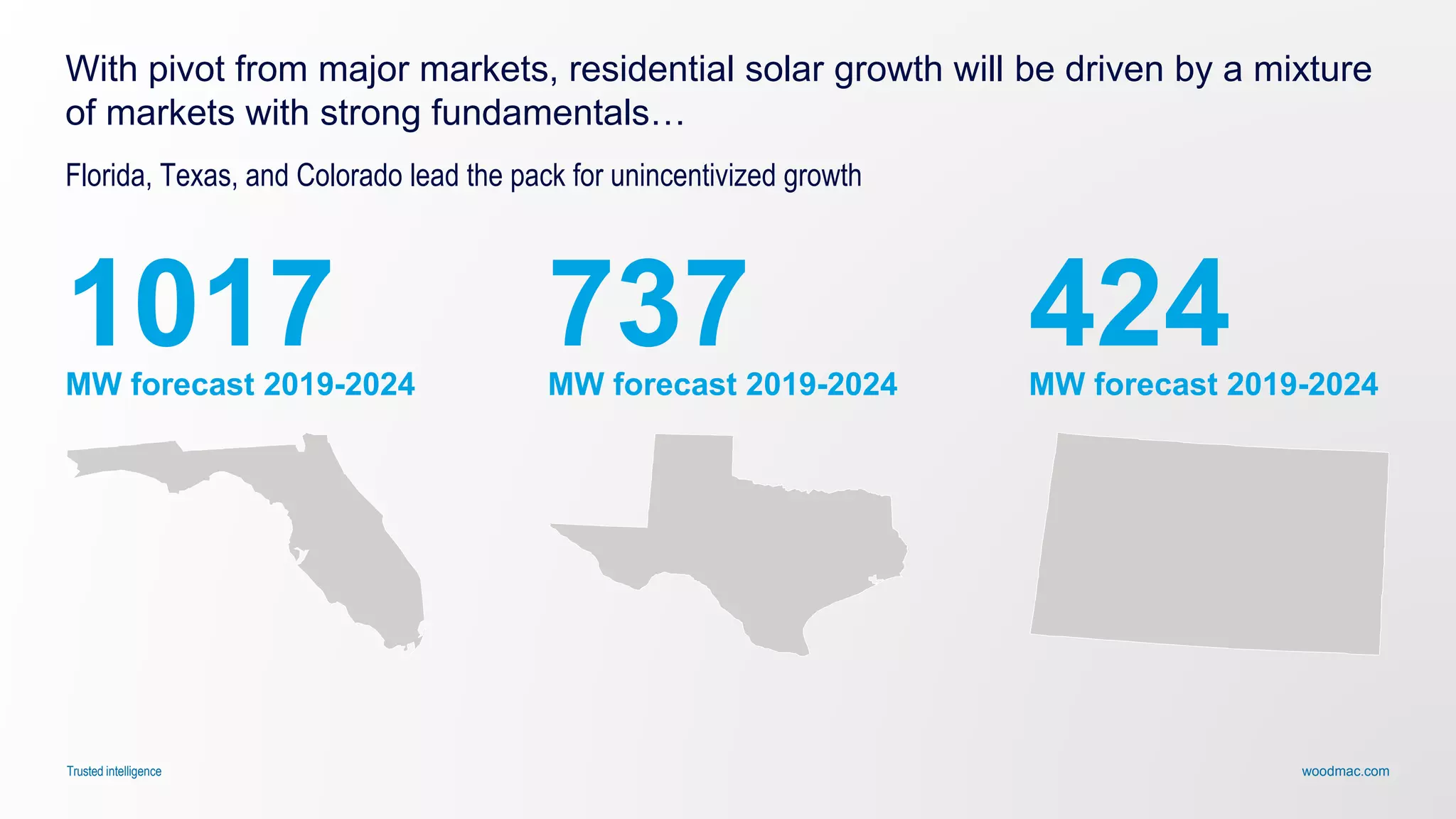
With pivot from major markets, residential solar growth will be driven by a mixture
of markets with strong fundamentals…
Florida, Texas, and Colorado lead the pack for unincentivized growth
1017MW forecast 2019-2024
737MW forecast 2019-2024
424MW forecast 2019-2024
woodmac.comTrusted intelligence
… but growth will also be driven by more lucrative incentive-enabled markets,
both in legacy and emerging states
Illinois, a revitalized Maryland, and South Carolina
*Upside not taken into account in current base-case forecasts
715MW forecast 2019-2024
644*MW forecast 2019-2024
206*MW forecast 2019-2024
woodmac.comTrusted intelligence
Residential solar to see limited growth as ITC stepdown and reforms to state-level policy hinder major markets
– but emerging markets increasingly able to offset major state decline
Near-term outlook is flat
• Customer acquisition costs and national
installer pull-back continue to hinder growth in
most major markets;
• Major market policy risk begins in 2018
• MA faces a incentive program change in 2018
• CA transitions to NEM 3.0 in 2021-2022
• NY pivots away from retail rate NEM in 2021
Long-term upside driven by two major policy drivers:
• IL to drive residential PV demand beginning 2019
• California’s new home solar mandate will begin
material impacting installations beginning in 2020
partially offset by NEM 3.0 implementation
Source: Wood Mackenzie Power & Renewables
Residential PV Historical and Forecasted Capacity
0
500
1,000
1,500
2,000
2,500
3,000
3,500
4,000
4,500
Capacity(MWdc)
woodmac.comTrusted intelligence
For non-residential PV, recent policy reform, budding
community solar programs, and solar-plus-storage will
boost our outlook despite ITC phase-down
woodmac.comTrusted intelligence
Illinois expected to drive over 800 MW of both on-site C&I and community solar
from 2019-2024
Program requirements and ITX issues pose major problems to non-resi development
• Hundreds of MW allocated to on-site C&I and
community solar RECs, but program received
nearly 2 GW of applications
• IPA allocated remainder of discretionary capacity
to large rooftop C&I as opposed to heavily
oversubscribed community solar
• Over 200 MW awarded to CS
• Over 125 MW awarded to large DG
-
20.00
40.00
60.00
80.00
100.00
120.00
140.00
160.00
180.00
200.00
2019E 2020E 2021E 2022E 2023E 2024E
Capacity(MWdc)
woodmac.comTrusted intelligence
Recent revisions to New York’s VDER Value Stack boost both on-site C&I and
community solar outlook for the Empire State
Since transition to VDER, NY on-site C&I has been all but extinguished
• To-date, NY on-site C&I has been extremely
challenging to pencil
• Recent extension of NEM to small- to medium-
size C&I customers bolsters our near-term outlook
• Meanwhile, revisions to the value stack elements
increases long-term certainty to disparate revenue
streams
• Finally, inclusion of community solar credit will
enable C&I anchor tenants – greatly improved
long-term community solar viability-
50
100
150
200
250
300
2018E 2019E 2020EE 2021EE 2022EE 2023EE 2024E
Capacity(MWdc)
Commuity Solar On-site C&I
woodmac.comTrusted intelligence
Other notable mid-Atlantic policy changes include New Jersey’s incentive
program transition + CS; RPS and community solar extension in Maryland
• NJ has already transitioned to shorter-term SRECs with little impact on
market; further transition expected in 2020-2021
• Community solar program to drive hundreds of MW, but issues are
around LMI have yet to be ironed out1 GW of C&I and CS
forecast from 2019-2024
• CEJA clears RPS expansion to 50% by 2030 and solar carve-out from
1.95% to 5.5% in 2019
• SRECs increased from $10/MWh in 2018 to ~$60/MWH after passage
with further appreciate expected in 2020
• Community solar program to-date has been constrained by land issues,
but expansion provides some upside potential
418 MW of C&I and CS
forecast from 2019-
2024
woodmac.comTrusted intelligence
0.0
100
200
300
400
500
600
700
800
2012 2013 2014 2015 2016 2017 2018 2019E 2020E 2021E 2022E 2023E 2024E
U.S.non-residentialenergystoragedeployments(MW)
Arizona California Colorado Hawaii Massachusetts Nevada New Jersey New York PJM (Ex. NJ) All Others
Source: Wood Mackenzie Power & Renewables
Non-residential energy storage market outlook (MW)
500 MW mark hit in 2022 as grid services, demand charge mgmt. and solar-plus-storage opportunities increase
U.S. annual non-residential energy storage deployment forecast, 2012-2024E (MW)
 California will lead the U.S. market for growth from procurement
programs such as AB 2514, LCR and PRP, alongside shifts in NEM rules
that will contribute to substantial solar-plus-storage growth.
 Massachusetts will begin to see significant build-out of SMART projects
in 2020 & ITX issues. Assignment of capacity rights to developers under
DPU 17-146-B and the state’s storage mandate will create additional
upside in the 2020s in addition to clean peak standard applications
 New York’s $310 million bridge incentive commitment under the coming
bridge incentive announced in late 2018 boosts long-term solar-plus-
storage outlook
woodmac.comTrusted intelligence
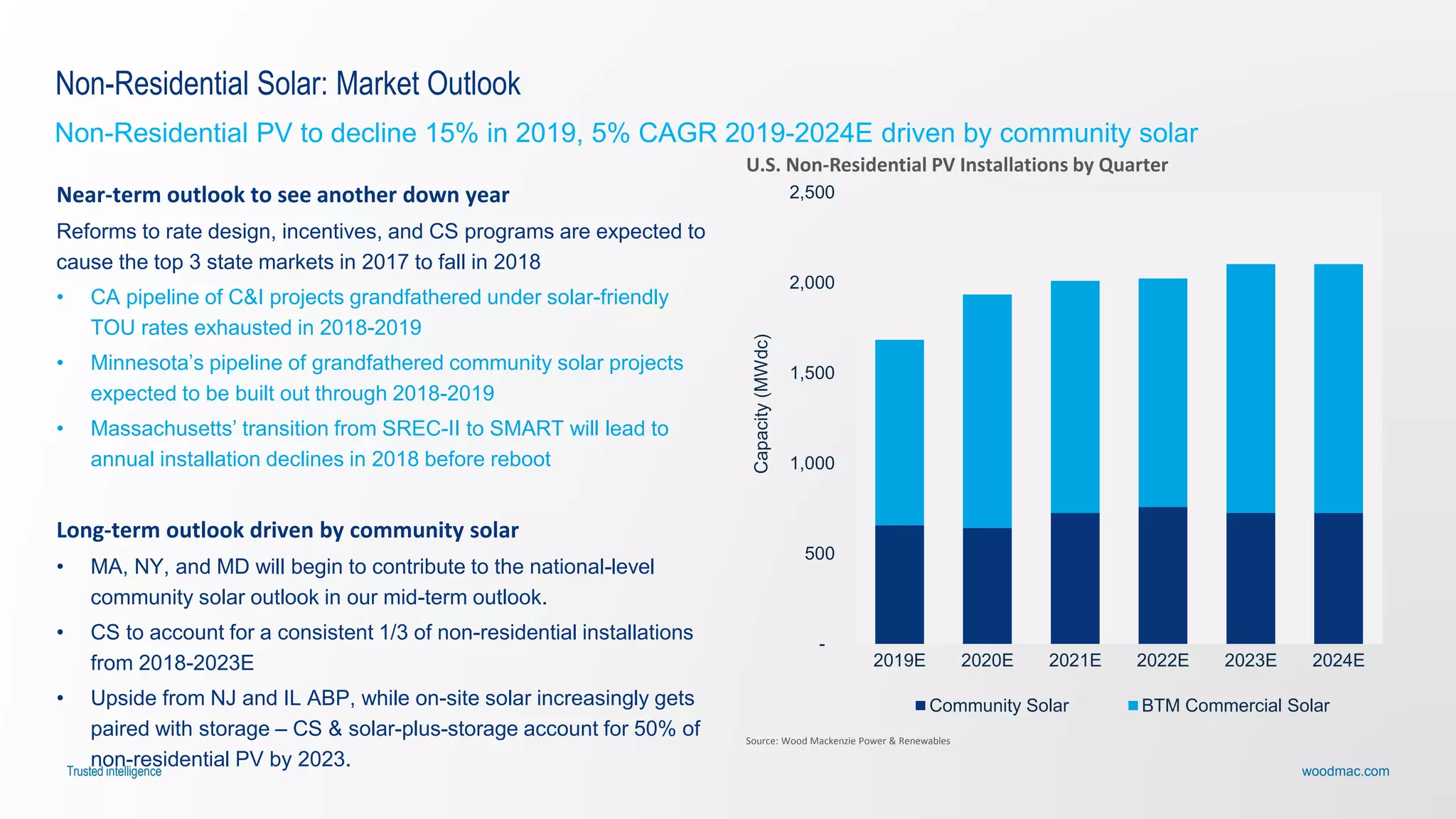
Non-Residential Solar: Market Outlook
Non-Residential PV to decline 15% in 2019, 5% CAGR 2019-2024E driven by community solar
Near-term outlook to see another down year
Reforms to rate design, incentives, and CS programs are expected to
cause the top 3 state markets in 2017 to fall in 2018
• CA pipeline of C&I projects grandfathered under solar-friendly
TOU rates exhausted in 2018-2019
• Minnesota’s pipeline of grandfathered community solar projects
expected to be built out through 2018-2019
• Massachusetts’ transition from SREC-II to SMART will lead to
annual installation declines in 2018 before reboot
Long-term outlook driven by community solar
• MA, NY, and MD will begin to contribute to the national-level
community solar outlook in our mid-term outlook.
• CS to account for a consistent 1/3 of non-residential installations
from 2018-2023E
• Upside from NJ and IL ABP, while on-site solar increasingly gets
paired with storage – CS & solar-plus-storage account for 50% of
non-residential PV by 2023.
Source: Wood Mackenzie Power & Renewables
U.S. Non-Residential PV Installations by Quarter
-
500
1,000
1,500
2,000
2,500
2019E 2020E 2021E 2022E 2023E 2024E
Capacity(MWdc)
Community Solar BTM Commercial Solar
woodmac.comTrusted intelligence
Finally, 2018-2019 legislative sessions point toward
renewed RPS growth to benefit long-term utility PV growth
at the expense of DG
woodmac.comTrusted intelligence
Legislation to Study
100% Clean Electricity
Introduced
Legislation Introduced
on 100% Clean Electricity
Standard
Legislation Enacted
on a 100% Clean
Electricity Standard
HI: 2045
(Renewables)
CA: 2045
(Clean)
CT: 2045
(Renewables)
WA: 2045
(Clean)
DC: 2032 (Renewables)
MT: 2050
(Renewables)
IA: 2050
(Renewables)
VA: 2036 (Clean)
MD: 2040 (Renewables)
MA: 2045
(Renewables)
MN: 2045-2050
(Clean)
NJ: 2035 (Renewables)
NY: 2030, 2050
(Clean)
NM: 2045-2050
(Clean)
TX: 2050
(Renewables)
IL: 2030 (Clean),
2050 (Renewables)
Governor Supports
100% Clean Electricity, But
No Bills Introduced
WI: 2050
(Clean)
Legislation Anticipated
on 100% Clean Electricity
to be Introduced in 2019
FL: 2050
(Renewables)
KEY
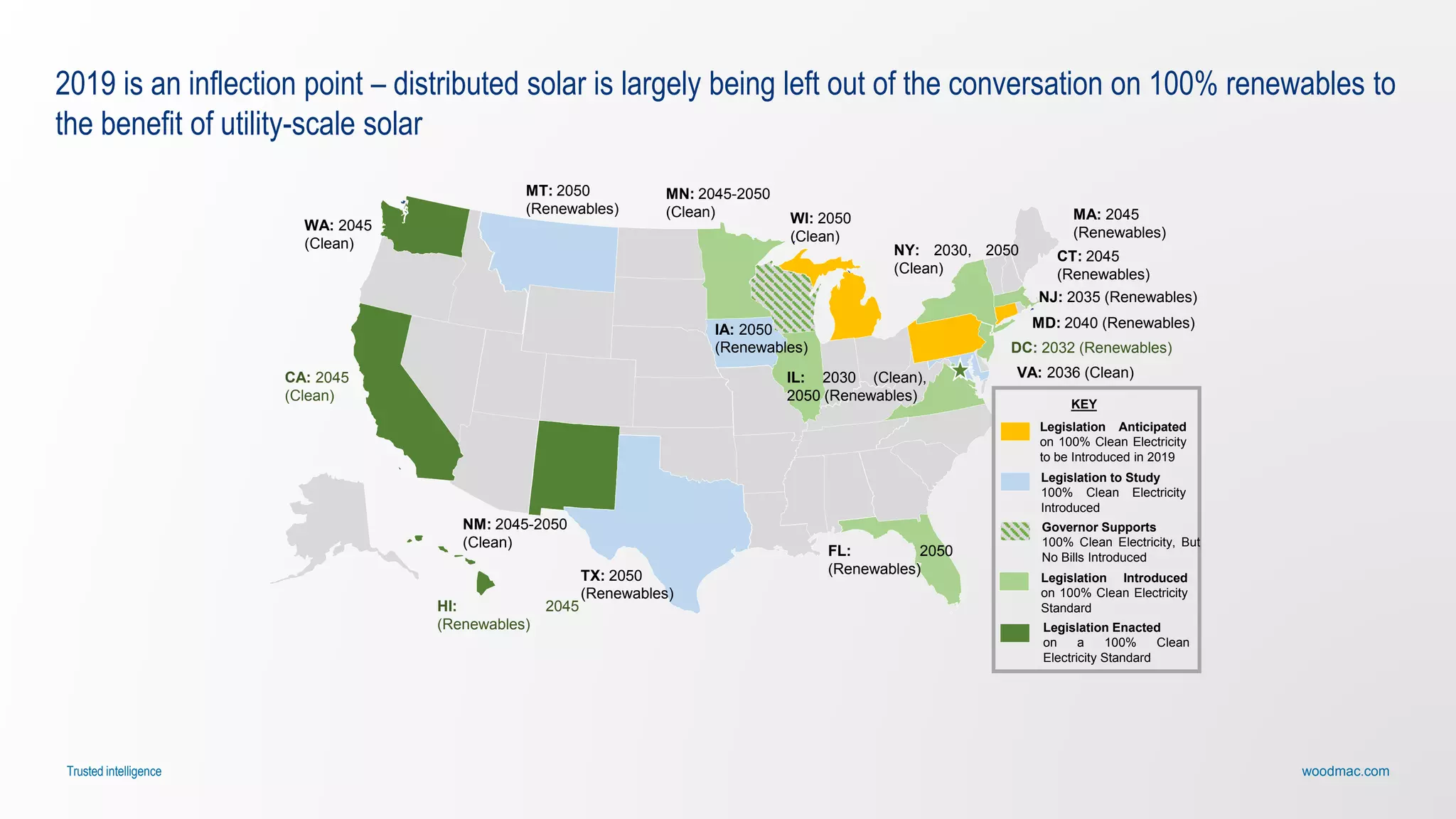
2019 is an inflection point – distributed solar is largely being left out of the conversation on 100% renewables to
the benefit of utility-scale solar
woodmac.comTrusted intelligence
The United States could add three California’s before the 2020 election
-
200
400
600
800
1,000
1,200
2019RetailSales(TWh)
California Full Democratic
Control
10 states equaling 2.5
California’s propose 100%
targets
New York
Illinois
Washington
New Jersey
Colorado
Oregon
Nevada
Connecticut
New Mexico
Maine
80% targets represents
2 California’s
Split Control
3 ‘split’ states
equaling 0.75
California’s
propose 100%
targets
Wisconsin
Minnesota
Massachusetts
Republican Control
2 Republican
states equaling
1.25 California’s
propose 100%
targets
Arizona Florida
A 60% target
across these
states
represents 3
California’s
woodmac.comTrusted intelligence
Key Takeaways – distributed solar faces material headwinds from 2019-2024
• Residential solar is entering a new phase of growth ranging from -5% YoY decline
to 20% annual growth leading up to ITC expiration
• At the same time of the ITC step-down, state-level policy changes present further
downside risk to economics
• Non-residential solar will benefit from recent policy reform, community solar and
growing solar-plus-storage availability
• Meanwhile, 100% clean and renewable energy targets will revitalize RPS as a
procurement driver for utility PV – but it remains to be seen whether distributed
solar will benefit from 100% RPS targets
woodmac.comTrusted intelligence
Thank You!
Austin Perea
Senior Analyst
Austin.Perea@woodmac.com
woodmac.comTrusted intelligence
Source: Wood Mackenzie Power and Renewables
Section 201 – Near term impact but long term recovery
Module tariffs have impacted utility solar but the market has proven astoundingly resilient
The White House announced on January 22nd that President Trump has
issued a 30 percent year-one tariff on imported c-Si solar cells and
modules.
• Tariffs: “Ad valorem” (percent-based) tariffs on imported c-Si cells and
modules will decline over a four year period, starting at 30% in year 1 and
declining by 5% per year to 15% in year 4.
• This will result in an average $0.10/W increase in year 1 prices to
modules, stepping down to a $0.04/W premium by year 4.
• Quotas: The first 2.5 gigawatts of imported c-Si cells are excluded from the
tariff in each of those four years.
• The safeguard measures (i.e. tariffs and quotas) took effect on February
7, 2018, which was 15 days from the date President Trump signed the
proclamation.
Final Decision on Section
201
Year 1 Year 2 Year 3 Year 4
Safeguard Tariff on Cells
and Modules
30% 25% 20% 15%
Cells Exempted from Tariff
(Quota)
2.5 GW 2.5 GW 2.5 GW 2.5 GW
-
7%[CELLRAN
GE]
6,198
[CELLRANGE]
-18%
7,786
[CELLRANGE]
8%
10,003
[CELLRANGE]
19%
10,383
[CELLRANGE]
8,655
8,638
9,287
0
2,000
4,000
6,000
8,000
10,000
12,000
2014 2016 2018 2020E 2022E 2024E
Annualinstalledcapacity(MWdc)
Q4-2017 Forecast Q1-2019 Forecast
Despite tariff impacts, the current 2018-
2022 forecast now exceeds Wood
Mackenzie’s pre-tariff forecast
woodmac.comTrusted intelligence
Source: Wood Mackenzie Power and
Renewables
Developers have begun to solidify their ITC stepdown strategy
Utility PV will aim to safe harbor 70% of 2020-2023 projects to the 30% ITC
100%
82%
70%
55%
18%
25%
32%
5%
11%
2%
100%
0%
20%
40%
60%
80%
100%
2020 2021 2022 2023 2024
%ofProjectssafe
harboredbyCODyear
30% ITC 26% ITC 22% ITC 10% ITC
• As recently as Q3-2018, developers expressed hesitation to safe harboring
projects in 2019 for 2021 COD
• Now the majority of developers are aiming to safe harbor 100% of their
contracted pipeline and a portion of their pre-contracted pipeline.
• This means 29.2 GWdc of projects will aim to qualify for the 30% ITC
through physical work test of 5% safe harbor test.
• Most developers are aiming to qualify through 5% safe harbor and will look to
secure modules to meet the 5% requirement.
• It is likely developers will also look to procuring trackers and inverters as an
alternative to modules
-
2,000
4,000
6,000
8,000
10,000
12,000
2020 2021 2022 2023 2024
MWdcofprojectssafesarboredbyCODyear
30% ITC 26% ITC 22% ITC 10% ITC
woodmac.comTrusted intelligence
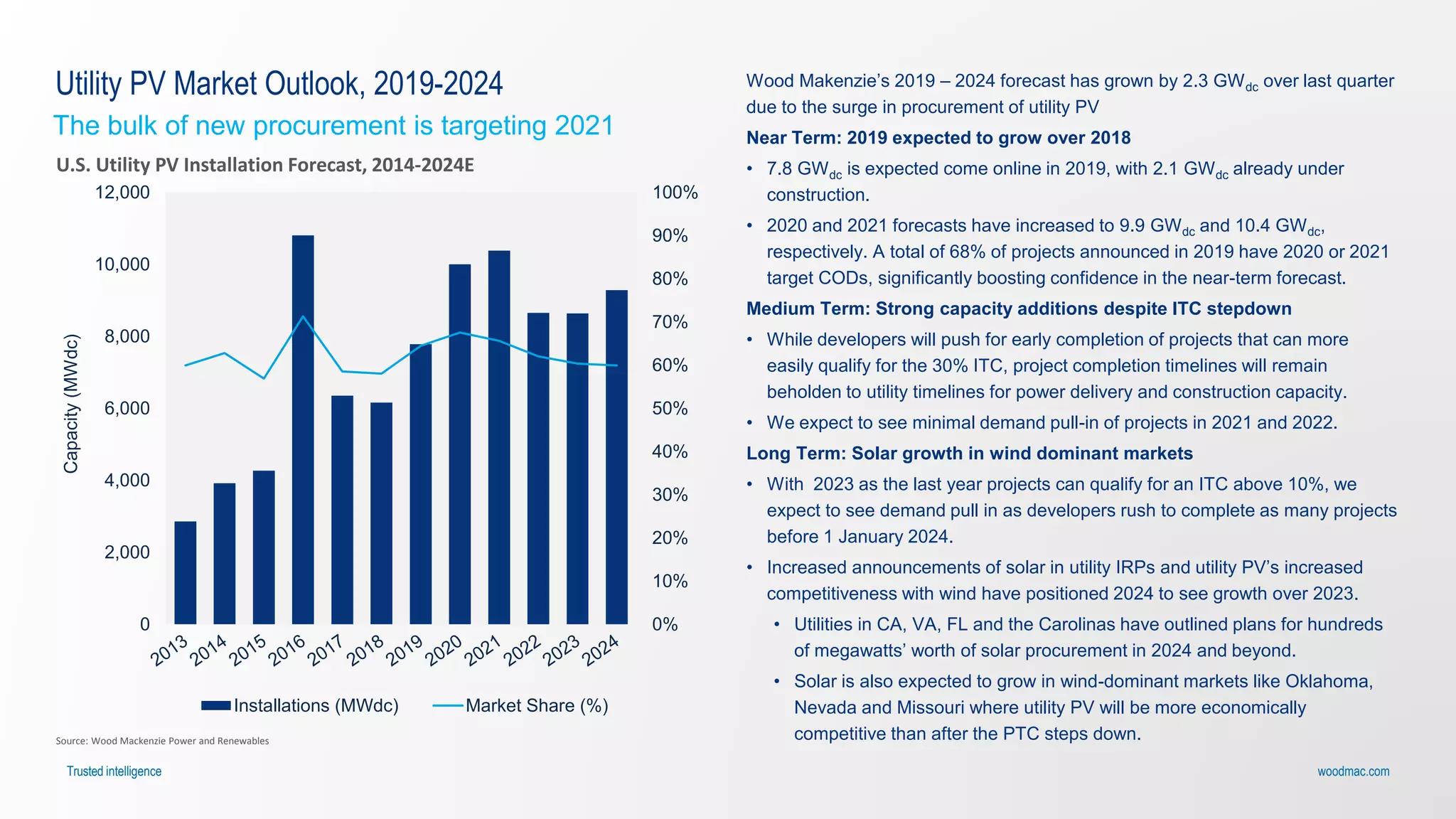
Utility PV Market Outlook, 2019-2024
The bulk of new procurement is targeting 2021
Wood Makenzie’s 2019 – 2024 forecast has grown by 2.3 GWdc over last quarter
due to the surge in procurement of utility PV
Near Term: 2019 expected to grow over 2018
• 7.8 GWdc is expected come online in 2019, with 2.1 GWdc already under
construction.
• 2020 and 2021 forecasts have increased to 9.9 GWdc and 10.4 GWdc,
respectively. A total of 68% of projects announced in 2019 have 2020 or 2021
target CODs, significantly boosting confidence in the near-term forecast.
Medium Term: Strong capacity additions despite ITC stepdown
• While developers will push for early completion of projects that can more
easily qualify for the 30% ITC, project completion timelines will remain
beholden to utility timelines for power delivery and construction capacity.
• We expect to see minimal demand pull-in of projects in 2021 and 2022.
Long Term: Solar growth in wind dominant markets
• With 2023 as the last year projects can qualify for an ITC above 10%, we
expect to see demand pull in as developers rush to complete as many projects
before 1 January 2024.
• Increased announcements of solar in utility IRPs and utility PV’s increased
competitiveness with wind have positioned 2024 to see growth over 2023.
• Utilities in CA, VA, FL and the Carolinas have outlined plans for hundreds
of megawatts’ worth of solar procurement in 2024 and beyond.
• Solar is also expected to grow in wind-dominant markets like Oklahoma,
Nevada and Missouri where utility PV will be more economically
competitive than after the PTC steps down.Source: Wood Mackenzie Power and Renewables
U.S. Utility PV Installation Forecast, 2014-2024E
0%
10%
20%
30%
40%
50%
60%
70%
80%
90%
100%
0
2,000
4,000
6,000
8,000
10,000
12,000
Capacity(MWdc)
Installations (MWdc) Market Share (%)
woodmac.comTrusted intelligence
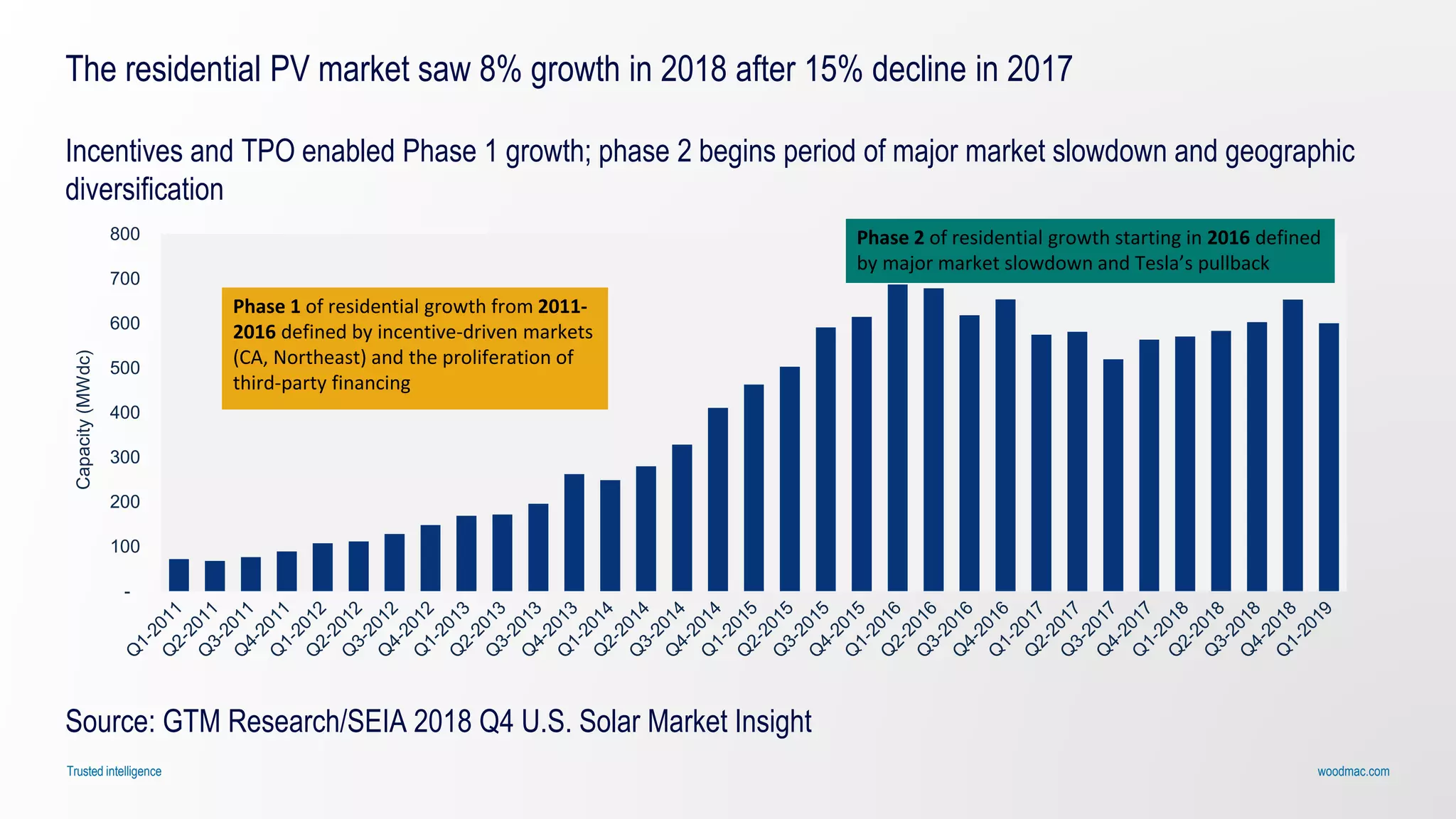
The residential PV market saw 8% growth in 2018 after 15% decline in 2017
Incentives and TPO enabled Phase 1 growth; phase 2 begins period of major market slowdown and geographic
diversification
Source: GTM Research/SEIA 2018 Q4 U.S. Solar Market Insight
-
100
200
300
400
500
600
700
800
Capacity(MWdc)
Phase 1 of residential growth from 2011-
2016 defined by incentive-driven markets
(CA, Northeast) and the proliferation of
third-party financing
Phase 2 of residential growth starting in 2016 defined
by major market slowdown and Tesla’s pullback

2019 State Policy Compass

  • 1.
    woodmac.comTrusted intelligence Research Presentation: 2019State Policy Compass & U.S. Solar Market Outlook Austin Perea Senior Analyst Austin.Perea@woodmac.com
  • 2.
    woodmac.comTrusted intelligence Wood Mackenzieoffices Wood Mackenzie Power & Renewables offices Wood Mackenzie is ideally positioned to support consumers, producers and financers of the new energy economy.  Acquisition of MAKE and Greentech Media (GTM)  Leaders in renewables, EV demand and grid-connected storage  Over 500 sector-dedicated analysts and consultants globally, including 75 specifically to power and renewables  Located close to clients and industry contacts About Wood Mackenzie We provide commercial insight and access to our experts leveraging our integrated proprietary metals, energy and renewables research platform
  • 3.
  • 4.
    woodmac.comTrusted intelligence 849 1,921 3,373 4,766 6,244 7,501 15,152 10,845 10,690 - 2,000 4,000 6,000 8,000 10,000 12,000 14,000 16,000 20102011 2012 2013 2014 2015 2016 2017 2018 Capacity(MWdc) Residential PV Non-Residential PV Utility PV The market experienced flat growth from 2017-2018, but segment narratives have nuance
  • 5.
    woodmac.comTrusted intelligence Economic competitivenessand corporate procurement drive new utility PPAs in 2018 • In 2016 over 50% of procurement was policy driven/enabled • By 2018, nearly 80% of procurement is driven by economic competitiveness and voluntary reasons • Installation flatness was primarily driven by risk aversion to procurement due to Section 201 tariff uncertainty 2017-2018 Source: Wood Mackenzie Power and Renewables Procurement Driver of Utility PV PPAs by Contract Execution Year 11% 14% 33% 1% 4% 29% 65% 72% 19% 21% 5% 9% 1.5% 5% 10% 0% 10% 20% 30% 40% 50% 60% 70% 80% 90% 100% 2018 2017 2016 RPS PURPA Voluntary Procurement Corporate Procurement CCA
  • 6.
    woodmac.comTrusted intelligence The residentialmarket rebounded by 8% in 2018 after falling 15% in 2017 However, Tesla still remains a drag on growth in 2018 and 2019 206 423 731 650 352 208 21 30 110 180 169 231 47 150 230 222 184 196525 693 1,114 1,546 1,534 1,751 - 500 1,000 1,500 2,000 2,500 3,000 2013 2014 2015 2016 2017 2018 Capacity(MWdc) SolarCity/Tesla Sunrun Vivint Solar All Others
  • 7.
    woodmac.comTrusted intelligence $0.62 $0.63 $0.66 $0.66 $0.66 $0.68 $0.59 $0.60 $2.69 $2.46 $2.42 $2.25 $2.11 $1.99 $1.83 $1.78 19% 20% 21% 23% 24% 26% 24% 25% 0% 5% 10% 15% 20% 25% 30% $0.00 $0.50 $1.00 $1.50 $2.00 $2.50 $3.00 $3.50 2016 20172018 2019E 2020E 2021E 2022E 2023E $/W Customer Acquisition Cost Turnkey EPC Pricing CAC % of System Price Customer acquisition remains most expensive cost category in residential solar • Customer acquisition costs have increased from $.62/W in 2016 to $.66/W in 2018 due primarily to large national and regional installers increasing marketing budgets in attempt to take market share in the wake of Tesla/SolarCity’s decline • CAC are expected to remain relatively flat until 2021, before an increase in the year before the federal ITC step- down • New-build home solar and greater familiarity with product are expected to help reduce long-term CAC beyond 202 U.S. residential solar customer-acquisition costs, 2016-2023E
  • 8.
    woodmac.comTrusted intelligence But slowgrowth is expected as major market penetration ranges from 5-15% Early adopter customers are being tapped in major markets with limited near-term retrofit growth opportunity 34% 15% 10% 7% 6% 6% 5% 5% 5% 4% 4% 4% 4% 3% 0% 5% 10% 15% 20% 25% 30% 35% 40% 0 200 400 600 800 1000 1200 MArketPenetration Capacity(MWdc) 2016 2017 2018 2018 Market Penetration
  • 9.
    woodmac.comTrusted intelligence 38% 5% 3%7% 7% 3% 4% 1% 2% 1% 29% California New York Maryland NewJersey Arizona Massachusetts Texas Utah Connecticut Hawaii All Others 40% 8%8% 7% 6% 6% 3% 3% 2% 2% 15% California New York Maryland New Jersey Arizona Massachusetts Texas Utah Connecticut Hawaii All Others Like utility-scale solar, residential solar is diversifying geographically 2016 residential capacity state breakdown 2018 residential capacity breakdown
  • 10.
    woodmac.comTrusted intelligence Meanwhile, avariety of state-policy reforms have hindered non-residential installations In 2017, CA, MA and MN accounted for nearly 70% of non-residential installations vs 40% in 2018 - 500 1,000 1,500 2,000 2,500 2019E 2018 2017 Capacity (MWdc) California Massachusetts Minnesota All Others • California’s shift to on-peak time-of-use periods has dramatically reduced the economic value proposition for C&I customers • Minnesota’s reform to community solar bill credits likewise diminishes the value proposition to most customers • Massachusetts’ incentive shift from SREC to SMART reduces value prop but a lengthy transition period and burgeoning ITX issues have bogged down development • Other state markets have not made up the difference
  • 11.
    woodmac.comTrusted intelligence 0% 5% 10% 15% 20% 25% 30% 35% 0 500 1000 1500 2000 2500 3000 2014 20152016 2017 2018 Communitysolarmarketshare Capacity(MWdc) Community Solar On-site C&I CS market share Though community solar is growing, the sub-segment hasn’t offset the decline of major state markets from 2016-2018 Minnesota lead the pack, but Colorado and Massachusetts are following closely behind
  • 12.
    woodmac.comTrusted intelligence 2019-2021 willfeature both ITC phase-down in conjunction with major changes to state-level solar policy and incentives
  • 13.
    woodmac.comTrusted intelligence California remainsbedrock of residential solar market, but headwinds loom large Flat in 2019E, 11% CAGR from 2019-2024E Near-Term Outlook: Limited growth as market rebounds Cost of customer acquisition remains high throughout 2018, though installers have rebounded from the first wave of Tesla & TPO provider declines SCE super off-peak rates make resi difficult to pencil Long-Term Outlook: Policy developments galore 1) NEM 3.0 expected to take effect in 2021-2022 CPUC will begin proceedings in 2019. Past proceedings have taken at least 12 months to resolve, which means new installations through 2019 and 2020 will likely be grandfathered in under current NEM rules. 2) New home solar building mandate begins to offset impact of NEM 3.0 beginning in 2020 3) However, uncertainty remains around the ongoing bankruptcy proceeding of PG&E with both upside and downside risks associated with residential PV. 0 200 400 600 800 1000 1200 1400 1600 2019E 2020E 2021E 2022E 2023E 2024E Capacity(MWdc) Total Retrofit New Home Construction
  • 14.
    woodmac.comTrusted intelligence But theNortheast is also undergoing significant policy upheaval Every state has already or is scheduled to transition beyond just NEM compensation at the retail rate… Maine: Buy all, sell all arrangement… Amount of PV production that offsets T&D charges is reduced by 10% per year for new installations Massachusetts (under SMART): • Community solar: Alternative on bill credit • Residential (and small C&I rooftop) solar: NEM at retail rate • Onsite C&I solar: NEM if NEM program caps are extended; otherwise projects will have to enroll as a QF (qualified facility) Connecticut: NEM at retail rate in place but…transitioning to a buy all, sell credit (timing and value TBD) Vermont: NEM at retail rate but…with incentive adders for < 150 kW systems and incentive subtractors for systems greater than 150 kW New Hampshire: NEM below retail rate with 100% credit for transmission and energy but only partial credit for distribution Rhode Island: NEM available along with feed-in-tariff (RE Growth program) set above retail rate Wood Mackenzie Power & Renewables New York: VDER process expected to leave NEM below the retail rate while large-scale C&I has already undergone changes
  • 15.
    woodmac.comTrusted intelligence With pivotfrom major markets, residential solar growth will be driven by a mixture of markets with strong fundamentals… Florida, Texas, and Colorado lead the pack for unincentivized growth 1017MW forecast 2019-2024 737MW forecast 2019-2024 424MW forecast 2019-2024
  • 16.
    woodmac.comTrusted intelligence … butgrowth will also be driven by more lucrative incentive-enabled markets, both in legacy and emerging states Illinois, a revitalized Maryland, and South Carolina *Upside not taken into account in current base-case forecasts 715MW forecast 2019-2024 644*MW forecast 2019-2024 206*MW forecast 2019-2024
  • 17.
    woodmac.comTrusted intelligence Residential solarto see limited growth as ITC stepdown and reforms to state-level policy hinder major markets – but emerging markets increasingly able to offset major state decline Near-term outlook is flat • Customer acquisition costs and national installer pull-back continue to hinder growth in most major markets; • Major market policy risk begins in 2018 • MA faces a incentive program change in 2018 • CA transitions to NEM 3.0 in 2021-2022 • NY pivots away from retail rate NEM in 2021 Long-term upside driven by two major policy drivers: • IL to drive residential PV demand beginning 2019 • California’s new home solar mandate will begin material impacting installations beginning in 2020 partially offset by NEM 3.0 implementation Source: Wood Mackenzie Power & Renewables Residential PV Historical and Forecasted Capacity 0 500 1,000 1,500 2,000 2,500 3,000 3,500 4,000 4,500 Capacity(MWdc)
  • 18.
    woodmac.comTrusted intelligence For non-residentialPV, recent policy reform, budding community solar programs, and solar-plus-storage will boost our outlook despite ITC phase-down
  • 19.
    woodmac.comTrusted intelligence Illinois expectedto drive over 800 MW of both on-site C&I and community solar from 2019-2024 Program requirements and ITX issues pose major problems to non-resi development • Hundreds of MW allocated to on-site C&I and community solar RECs, but program received nearly 2 GW of applications • IPA allocated remainder of discretionary capacity to large rooftop C&I as opposed to heavily oversubscribed community solar • Over 200 MW awarded to CS • Over 125 MW awarded to large DG - 20.00 40.00 60.00 80.00 100.00 120.00 140.00 160.00 180.00 200.00 2019E 2020E 2021E 2022E 2023E 2024E Capacity(MWdc)
  • 20.
    woodmac.comTrusted intelligence Recent revisionsto New York’s VDER Value Stack boost both on-site C&I and community solar outlook for the Empire State Since transition to VDER, NY on-site C&I has been all but extinguished • To-date, NY on-site C&I has been extremely challenging to pencil • Recent extension of NEM to small- to medium- size C&I customers bolsters our near-term outlook • Meanwhile, revisions to the value stack elements increases long-term certainty to disparate revenue streams • Finally, inclusion of community solar credit will enable C&I anchor tenants – greatly improved long-term community solar viability- 50 100 150 200 250 300 2018E 2019E 2020EE 2021EE 2022EE 2023EE 2024E Capacity(MWdc) Commuity Solar On-site C&I
  • 21.
    woodmac.comTrusted intelligence Other notablemid-Atlantic policy changes include New Jersey’s incentive program transition + CS; RPS and community solar extension in Maryland • NJ has already transitioned to shorter-term SRECs with little impact on market; further transition expected in 2020-2021 • Community solar program to drive hundreds of MW, but issues are around LMI have yet to be ironed out1 GW of C&I and CS forecast from 2019-2024 • CEJA clears RPS expansion to 50% by 2030 and solar carve-out from 1.95% to 5.5% in 2019 • SRECs increased from $10/MWh in 2018 to ~$60/MWH after passage with further appreciate expected in 2020 • Community solar program to-date has been constrained by land issues, but expansion provides some upside potential 418 MW of C&I and CS forecast from 2019- 2024
  • 22.
    woodmac.comTrusted intelligence 0.0 100 200 300 400 500 600 700 800 2012 20132014 2015 2016 2017 2018 2019E 2020E 2021E 2022E 2023E 2024E U.S.non-residentialenergystoragedeployments(MW) Arizona California Colorado Hawaii Massachusetts Nevada New Jersey New York PJM (Ex. NJ) All Others Source: Wood Mackenzie Power & Renewables Non-residential energy storage market outlook (MW) 500 MW mark hit in 2022 as grid services, demand charge mgmt. and solar-plus-storage opportunities increase U.S. annual non-residential energy storage deployment forecast, 2012-2024E (MW)  California will lead the U.S. market for growth from procurement programs such as AB 2514, LCR and PRP, alongside shifts in NEM rules that will contribute to substantial solar-plus-storage growth.  Massachusetts will begin to see significant build-out of SMART projects in 2020 & ITX issues. Assignment of capacity rights to developers under DPU 17-146-B and the state’s storage mandate will create additional upside in the 2020s in addition to clean peak standard applications  New York’s $310 million bridge incentive commitment under the coming bridge incentive announced in late 2018 boosts long-term solar-plus- storage outlook
  • 23.
    woodmac.comTrusted intelligence Non-Residential Solar:Market Outlook Non-Residential PV to decline 15% in 2019, 5% CAGR 2019-2024E driven by community solar Near-term outlook to see another down year Reforms to rate design, incentives, and CS programs are expected to cause the top 3 state markets in 2017 to fall in 2018 • CA pipeline of C&I projects grandfathered under solar-friendly TOU rates exhausted in 2018-2019 • Minnesota’s pipeline of grandfathered community solar projects expected to be built out through 2018-2019 • Massachusetts’ transition from SREC-II to SMART will lead to annual installation declines in 2018 before reboot Long-term outlook driven by community solar • MA, NY, and MD will begin to contribute to the national-level community solar outlook in our mid-term outlook. • CS to account for a consistent 1/3 of non-residential installations from 2018-2023E • Upside from NJ and IL ABP, while on-site solar increasingly gets paired with storage – CS & solar-plus-storage account for 50% of non-residential PV by 2023. Source: Wood Mackenzie Power & Renewables U.S. Non-Residential PV Installations by Quarter - 500 1,000 1,500 2,000 2,500 2019E 2020E 2021E 2022E 2023E 2024E Capacity(MWdc) Community Solar BTM Commercial Solar
  • 24.
    woodmac.comTrusted intelligence Finally, 2018-2019legislative sessions point toward renewed RPS growth to benefit long-term utility PV growth at the expense of DG
  • 25.
    woodmac.comTrusted intelligence Legislation toStudy 100% Clean Electricity Introduced Legislation Introduced on 100% Clean Electricity Standard Legislation Enacted on a 100% Clean Electricity Standard HI: 2045 (Renewables) CA: 2045 (Clean) CT: 2045 (Renewables) WA: 2045 (Clean) DC: 2032 (Renewables) MT: 2050 (Renewables) IA: 2050 (Renewables) VA: 2036 (Clean) MD: 2040 (Renewables) MA: 2045 (Renewables) MN: 2045-2050 (Clean) NJ: 2035 (Renewables) NY: 2030, 2050 (Clean) NM: 2045-2050 (Clean) TX: 2050 (Renewables) IL: 2030 (Clean), 2050 (Renewables) Governor Supports 100% Clean Electricity, But No Bills Introduced WI: 2050 (Clean) Legislation Anticipated on 100% Clean Electricity to be Introduced in 2019 FL: 2050 (Renewables) KEY 2019 is an inflection point – distributed solar is largely being left out of the conversation on 100% renewables to the benefit of utility-scale solar
  • 26.
    woodmac.comTrusted intelligence The UnitedStates could add three California’s before the 2020 election - 200 400 600 800 1,000 1,200 2019RetailSales(TWh) California Full Democratic Control 10 states equaling 2.5 California’s propose 100% targets New York Illinois Washington New Jersey Colorado Oregon Nevada Connecticut New Mexico Maine 80% targets represents 2 California’s Split Control 3 ‘split’ states equaling 0.75 California’s propose 100% targets Wisconsin Minnesota Massachusetts Republican Control 2 Republican states equaling 1.25 California’s propose 100% targets Arizona Florida A 60% target across these states represents 3 California’s
  • 27.
    woodmac.comTrusted intelligence Key Takeaways– distributed solar faces material headwinds from 2019-2024 • Residential solar is entering a new phase of growth ranging from -5% YoY decline to 20% annual growth leading up to ITC expiration • At the same time of the ITC step-down, state-level policy changes present further downside risk to economics • Non-residential solar will benefit from recent policy reform, community solar and growing solar-plus-storage availability • Meanwhile, 100% clean and renewable energy targets will revitalize RPS as a procurement driver for utility PV – but it remains to be seen whether distributed solar will benefit from 100% RPS targets
  • 28.
    woodmac.comTrusted intelligence Thank You! AustinPerea Senior Analyst Austin.Perea@woodmac.com
  • 29.
    woodmac.comTrusted intelligence Source: WoodMackenzie Power and Renewables Section 201 – Near term impact but long term recovery Module tariffs have impacted utility solar but the market has proven astoundingly resilient The White House announced on January 22nd that President Trump has issued a 30 percent year-one tariff on imported c-Si solar cells and modules. • Tariffs: “Ad valorem” (percent-based) tariffs on imported c-Si cells and modules will decline over a four year period, starting at 30% in year 1 and declining by 5% per year to 15% in year 4. • This will result in an average $0.10/W increase in year 1 prices to modules, stepping down to a $0.04/W premium by year 4. • Quotas: The first 2.5 gigawatts of imported c-Si cells are excluded from the tariff in each of those four years. • The safeguard measures (i.e. tariffs and quotas) took effect on February 7, 2018, which was 15 days from the date President Trump signed the proclamation. Final Decision on Section 201 Year 1 Year 2 Year 3 Year 4 Safeguard Tariff on Cells and Modules 30% 25% 20% 15% Cells Exempted from Tariff (Quota) 2.5 GW 2.5 GW 2.5 GW 2.5 GW - 7%[CELLRAN GE] 6,198 [CELLRANGE] -18% 7,786 [CELLRANGE] 8% 10,003 [CELLRANGE] 19% 10,383 [CELLRANGE] 8,655 8,638 9,287 0 2,000 4,000 6,000 8,000 10,000 12,000 2014 2016 2018 2020E 2022E 2024E Annualinstalledcapacity(MWdc) Q4-2017 Forecast Q1-2019 Forecast Despite tariff impacts, the current 2018- 2022 forecast now exceeds Wood Mackenzie’s pre-tariff forecast
  • 30.
    woodmac.comTrusted intelligence Source: WoodMackenzie Power and Renewables Developers have begun to solidify their ITC stepdown strategy Utility PV will aim to safe harbor 70% of 2020-2023 projects to the 30% ITC 100% 82% 70% 55% 18% 25% 32% 5% 11% 2% 100% 0% 20% 40% 60% 80% 100% 2020 2021 2022 2023 2024 %ofProjectssafe harboredbyCODyear 30% ITC 26% ITC 22% ITC 10% ITC • As recently as Q3-2018, developers expressed hesitation to safe harboring projects in 2019 for 2021 COD • Now the majority of developers are aiming to safe harbor 100% of their contracted pipeline and a portion of their pre-contracted pipeline. • This means 29.2 GWdc of projects will aim to qualify for the 30% ITC through physical work test of 5% safe harbor test. • Most developers are aiming to qualify through 5% safe harbor and will look to secure modules to meet the 5% requirement. • It is likely developers will also look to procuring trackers and inverters as an alternative to modules - 2,000 4,000 6,000 8,000 10,000 12,000 2020 2021 2022 2023 2024 MWdcofprojectssafesarboredbyCODyear 30% ITC 26% ITC 22% ITC 10% ITC
  • 31.
    woodmac.comTrusted intelligence Utility PVMarket Outlook, 2019-2024 The bulk of new procurement is targeting 2021 Wood Makenzie’s 2019 – 2024 forecast has grown by 2.3 GWdc over last quarter due to the surge in procurement of utility PV Near Term: 2019 expected to grow over 2018 • 7.8 GWdc is expected come online in 2019, with 2.1 GWdc already under construction. • 2020 and 2021 forecasts have increased to 9.9 GWdc and 10.4 GWdc, respectively. A total of 68% of projects announced in 2019 have 2020 or 2021 target CODs, significantly boosting confidence in the near-term forecast. Medium Term: Strong capacity additions despite ITC stepdown • While developers will push for early completion of projects that can more easily qualify for the 30% ITC, project completion timelines will remain beholden to utility timelines for power delivery and construction capacity. • We expect to see minimal demand pull-in of projects in 2021 and 2022. Long Term: Solar growth in wind dominant markets • With 2023 as the last year projects can qualify for an ITC above 10%, we expect to see demand pull in as developers rush to complete as many projects before 1 January 2024. • Increased announcements of solar in utility IRPs and utility PV’s increased competitiveness with wind have positioned 2024 to see growth over 2023. • Utilities in CA, VA, FL and the Carolinas have outlined plans for hundreds of megawatts’ worth of solar procurement in 2024 and beyond. • Solar is also expected to grow in wind-dominant markets like Oklahoma, Nevada and Missouri where utility PV will be more economically competitive than after the PTC steps down.Source: Wood Mackenzie Power and Renewables U.S. Utility PV Installation Forecast, 2014-2024E 0% 10% 20% 30% 40% 50% 60% 70% 80% 90% 100% 0 2,000 4,000 6,000 8,000 10,000 12,000 Capacity(MWdc) Installations (MWdc) Market Share (%)
  • 32.
    woodmac.comTrusted intelligence The residentialPV market saw 8% growth in 2018 after 15% decline in 2017 Incentives and TPO enabled Phase 1 growth; phase 2 begins period of major market slowdown and geographic diversification Source: GTM Research/SEIA 2018 Q4 U.S. Solar Market Insight - 100 200 300 400 500 600 700 800 Capacity(MWdc) Phase 1 of residential growth from 2011- 2016 defined by incentive-driven markets (CA, Northeast) and the proliferation of third-party financing Phase 2 of residential growth starting in 2016 defined by major market slowdown and Tesla’s pullback