2019 IPR
DISINFORMATION IN
SOCIETY REPORT
How Americans perceive intentionally
misleading news or information
© 2019 Institute for Public Relations
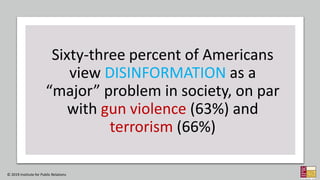
Sixty-three percent of Americans
view DISINFORMATION as a
“major” problem in society, on par
with gun violence (63%) and
terrorism (66%)
© 2019 Institute for Public Relations
Trustworthiness
of Sources
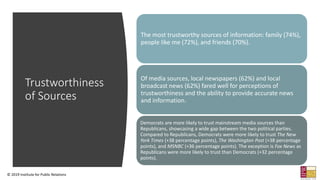
The most trustworthy sources of information: family (74%),
people like me (72%), and friends (70%).
Of media sources, local newspapers (62%) and local
broadcast news (62%) fared well for perceptions of
trustworthiness and the ability to provide accurate news
and information.
Democrats are more likely to trust mainstream media sources than
Republicans, showcasing a wide gap between the two political parties.
Compared to Republicans, Democrats were more likely to trust The New
York Times (+38 percentage points), The Washington Post (+38 percentage
points), and MSNBC (+36 percentage points). The exception is Fox News as
Republicans were more likely to trust than Democrats (+32 percentage
points).
© 2019 Institute for Public Relations
Responsibilities
for Spreading
and Combatting
Disinformation
Forty percent of respondents deemed President Trump to
be “very responsible” for spreading disinformation (40%),
along with fake accounts (55%) and politicians in general
(45%).
For social media platforms, 64% of respondents said
Facebook was “somewhat” responsible for spreading
disinformation; more than half also said Twitter (55%).
Among groups and individuals trying to combat
disinformation in the news, Americans give the most credit
to “people like me” (55%), the Supreme Court (51%) and
fact-checking websites (49%).
Seventy-two percent of Americans believe President Trump should be most
responsible for combatting disinformation, but only 36 percent say he is doing at least
“somewhat” well in combatting it. Similar gaps were found with the government (72%
vs. 33%) and Congress (67% vs. 29%). Journalists saw a smaller gap as 64% said they
should be responsible for combatting disinformation, but 44% said journalists were
helping to combat it.
© 2019 Institute for Public Relations
Methodology
2,200 adults surveyed
online between March 19-
24, 2019 by Morning
Consult among a national
sample of 2,200 adults.
Results from the full survey
have a margin of error of
plus or minus 2 percentage
points.
© 2019 Institute for Public Relations
For a link to the full study, please visit:
http://instituteforpr.org/ipr-disinformation-study/
© 2019 Institute for Public Relations

2019 IPR Disinformation Study

  • 1.
    2019 IPR DISINFORMATION IN SOCIETYREPORT How Americans perceive intentionally misleading news or information © 2019 Institute for Public Relations
  • 2.
    Sixty-three percent ofAmericans view DISINFORMATION as a “major” problem in society, on par with gun violence (63%) and terrorism (66%) © 2019 Institute for Public Relations
  • 3.
    Trustworthiness of Sources The mosttrustworthy sources of information: family (74%), people like me (72%), and friends (70%). Of media sources, local newspapers (62%) and local broadcast news (62%) fared well for perceptions of trustworthiness and the ability to provide accurate news and information. Democrats are more likely to trust mainstream media sources than Republicans, showcasing a wide gap between the two political parties. Compared to Republicans, Democrats were more likely to trust The New York Times (+38 percentage points), The Washington Post (+38 percentage points), and MSNBC (+36 percentage points). The exception is Fox News as Republicans were more likely to trust than Democrats (+32 percentage points). © 2019 Institute for Public Relations
  • 4.
    Responsibilities for Spreading and Combatting Disinformation Fortypercent of respondents deemed President Trump to be “very responsible” for spreading disinformation (40%), along with fake accounts (55%) and politicians in general (45%). For social media platforms, 64% of respondents said Facebook was “somewhat” responsible for spreading disinformation; more than half also said Twitter (55%). Among groups and individuals trying to combat disinformation in the news, Americans give the most credit to “people like me” (55%), the Supreme Court (51%) and fact-checking websites (49%). Seventy-two percent of Americans believe President Trump should be most responsible for combatting disinformation, but only 36 percent say he is doing at least “somewhat” well in combatting it. Similar gaps were found with the government (72% vs. 33%) and Congress (67% vs. 29%). Journalists saw a smaller gap as 64% said they should be responsible for combatting disinformation, but 44% said journalists were helping to combat it. © 2019 Institute for Public Relations
  • 5.
    Methodology 2,200 adults surveyed onlinebetween March 19- 24, 2019 by Morning Consult among a national sample of 2,200 adults. Results from the full survey have a margin of error of plus or minus 2 percentage points. © 2019 Institute for Public Relations
  • 6.
    For a linkto the full study, please visit: http://instituteforpr.org/ipr-disinformation-study/ © 2019 Institute for Public Relations

Editor's Notes

  • #6 METHODOLOGY: 2,200 adults surveyed online between March 19-24, 2019 by Morning Consult among a national sample of 2,200 adults. Results from the full survey have a margin of error of plus or minus 2 percentage points.