#TrustBarometer
2018 Edelman
Trust Barometer
South Korea
ㅍ
2
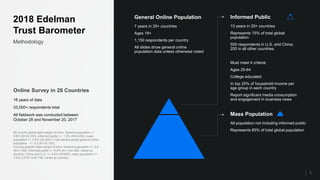
Methodology
2018 Edelman
Trust Barometer
Online Survey in 28 Countries
18 years of data
33,000+ respondents total
All fieldwork was conducted between
October 28 and November 20, 2017
General Online Population
7 years in 25+ countries
Ages 18+
1,150 respondents per country
All slides show general online
population data unless otherwise noted
Mass Population
All population not including informed public
Represents 85% of total global population
Informed Public
10 years in 20+ countries
Represents 15% of total global
population
500 respondents in U.S. and China;
200 in all other countries
Must meet 4 criteria:
Ages 25-64
College educated
In top 25% of household income per
age group in each country
Report significant media consumption
and engagement in business news
28-country global data margin of error: General population +/-
0.6% (N=32,200), informed public +/- 1.2% (N=6,200), mass
population +/- 0.6% (26,000+), half-sample global general online
population +/- 0.8 (N=16,100).
Country-specific data margin of error: General population +/- 2.9
(N=1,150), informed public +/- 6.9% (N = min 200, varies by
country), China and U.S. +/- 4.4% (N=500), mass population +/-
3.0 to 3.6 (N =min 740, varies by country).
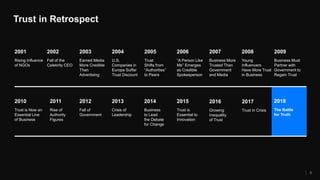
Trust in Retrospect
3
Rising Influence
of NGOs
2001
Business Must
Partner with
Government to
Regain Trust
2009
Fall of the
Celebrity CEO
2002
Earned Media
More Credible
Than
Advertising
2003
U.S.
Companies in
Europe Suffer
Trust Discount
2004
Trust
Shifts from
“Authorities”
to Peers
2005
“A Person Like
Me” Emerges
as Credible
Spokesperson
2006
Business More
Trusted Than
Government
and Media
2007
Young
Influencers
Have More Trust
in Business
2008
Trust is Now an
Essential Line
of Business
2010
Rise of
Authority
Figures
2011
Fall of
Government
2012
Crisis of
Leadership
2013
Business
to Lead
the Debate
for Change
2014
Trust is
Essential to
Innovation
2015
Growing
Inequality
of Trust
2016
Trust in Crisis
2017
The Battle
for Truth
2018
A Polarization
of Trust
Source: 2018 Edelman Trust Barometer. TRU_INS. Below is a list of institutions. For each one, please indicate how much you trust that institution to do
what is right using a nine-point scale, where one means that you “do not trust them at all” and nine means that you “trust them a great deal.” (Top 4 Box,
Trust) Informed Public and General Population, 28-country global total.
5
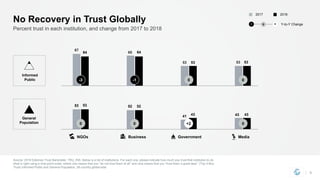
Percent trust in each institution, and change from 2017 to 2018
No Recovery in Trust Globally
53 52
41 43
53 52
43 43
67
65
53 53
64 64
53 53
-3 -1 0 0
Business MediaNGOs Government
0 0 +2 0
Informed
Public
General
Population
20182017
Y-to-Y Change− +0
Source: 2018 Edelman Trust Barometer.
The Trust Index is an average of a country's trust in the institutions
of government, business, media and NGOs. General population,
28-country global total.
6
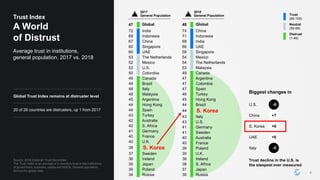
Average trust in institutions,
general population, 2017 vs. 2018
Trust Index
A World
of Distrust
Biggest changes in
47 Global
72 India
69 Indonesia
67 China
60 Singapore
60 UAE
53 The Netherlands
52 Mexico
52 U.S.
50 Colombia
49 Canada
48 Brazil
48 Italy
48 Malaysia
45 Argentina
44 Hong Kong
44 Spain
43 Turkey
42 Australia
42 S. Africa
41 Germany
40 France
40 U.K.
38 S. Korea
37 Sweden
36 Ireland
35 Japan
35 Poland
34 Russia
U.S. -9
China +7
S. Korea +6
UAE +6
Italy -5
Trust
(60-100)
Neutral
(50-59)
Distrust
(1-49)
Trust decline in the U.S. is
the steepest ever measured
48 Global
74 China
71 Indonesia
68 India
66 UAE
58 Singapore
54 Mexico
54 The Netherlands
53 Malaysia
49 Canada
47 Argentina
47 Colombia
47 Spain
46 Turkey
45 Hong Kong
44 Brazil
44 S. Korea
43 Italy
43 U.S.
41 Germany
41 Sweden
40 Australia
40 France
39 Poland
39 U.K.
38 Ireland
38 S. Africa
37 Japan
36 Russia
2017
General Population
2018
General Population
Global Trust Index remains at distruster level
20 of 28 countries are distrusters, up 1 from 2017
Source: 2018 Edelman Trust Barometer.
The Trust Index is an average of a country's trust in the institutions
of government, business, media and NGOs. Informed public,
28-country global total.
7
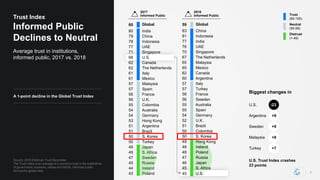
Average trust in institutions,
informed public, 2017 vs. 2018
Trust Index
Informed Public
Declines to Neutral
60 Global
80 India
79 China
78 Indonesia
77 UAE
71 Singapore
68 U.S.
62 Canada
62 The Netherlands
61 Italy
61 Mexico
57 Malaysia
57 Spain
56 France
56 U.K.
55 Colombia
54 Australia
54 Germany
53 Hong Kong
51 Argentina
51 Brazil
50 S. Korea
50 Turkey
49 Japan
49 S. Africa
47 Sweden
45 Russia
44 Ireland
43 Poland
2017
Informed Public
2018
Informed Public
Biggest changes in
U.S. -23
Argentina +9
Sweden +9
Malaysia +8
Turkey +7
U.S. Trust Index crashes
23 points
A 1-point decline in the Global Trust Index
Trust
(60-100)
Neutral
(50-59)
Distrust
(1-49)
59 Global
83 China
81 Indonesia
77 India
76 UAE
70 Singapore
67 The Netherlands
65 Malaysia
65 Mexico
62 Canada
60 Argentina
57 Italy
57 Turkey
56 France
56 Sweden
55 Australia
55 Spain
54 Germany
52 U.K.
51 Brazil
50 Colombia
50 S. Korea
49 Hong Kong
48 Ireland
48 Poland
47 Russia
46 Japan
45 S. Africa
45 U.S.
58 58
47 4749 48
33
42
73 74
63 64
51 54
33
42
Source: 2018 Edelman Trust Barometer. TRU_INS. Below is a list of institutions. For each one, please indicate how much you trust that institution to do what is right using
a nine-point scale, where one means that you “do not trust them at all” and nine means that you “trust them a great deal.” (Top 4 Box, Trust) Informed Public and General
Population, U.S. The Trust Index is an average of a country's trust in the institutions of government, business, media and NGOs. Informed Public and General Population,
U.S.
8
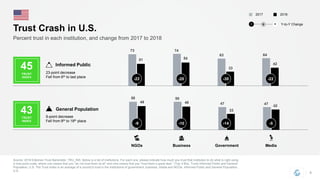
Trust Crash in U.S.
Business MediaNGOs Government
-9 -10 -14 -5
-22 -20 -30 -22
20182017
43TRUST
INDEX
45
TRUST
INDEX
9-point decrease
Fell from 8th to 18th place
General Population
23-point decrease
Fell from 6th to last place
Informed Public
Y-to-Y Change− +0
Percent trust in each institution, and change from 2017 to 2018
73
81
86
7776
85 89
80
61
67
76
6566
74
84
71
Source: 2018 Edelman Trust Barometer. TRU_INS. Below is a list of institutions. For each one, please indicate how much you trust that institution to do what is right using
a nine-point scale, where one means that you “do not trust them at all” and nine means that you “trust them a great deal.” (Top 4 Box, Trust) Informed Public and General
Population, China. The Trust Index is an average of a country's trust in the institutions of government, business, media and NGOs. Informed Public and General
Population, China.
9
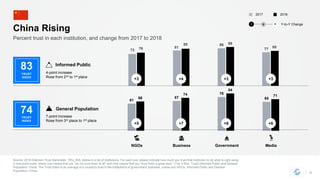
China Rising
+5 +7 +8 +6
+3 +4 +3 +3
20182017
Business MediaNGOs Government
7-point increase
Rose from 3rd place to 1st place
General Population
4-point increase
Rose from 2nd to 1st place
Informed Public
83
TRUST
INDEX
74TRUST
INDEX
Y-to-Y Change− +0
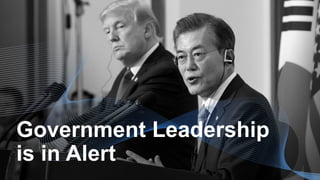
Government Leadership
is in Alert
Source: 2018 Edelman Trust Barometer. TRU_INS. Below is a list of institutions. For each one, please indicate how much you trust that institution to do
what is right using a nine-point scale, where one means that you “do not trust them at all” and nine means that you “trust them a great deal.” (Top 4 Box,
Trust) Informed Public and General Population, South Korea.
11
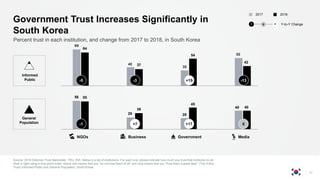
Percent trust in each institution, and change from 2017 to 2018, in South Korea
Government Trust Increases Significantly in
South Korea
56
29 28
40
55
36
45
40
69
40
35
55
64
37
54
42
-5 -3 +19 -13
Business MediaNGOs Government
-1 +7 +17 0
Informed
Public
General
Population
20182017
Y-to-Y Change− +0
43
14
18
24 25 27 28
33 33 34 35 35 36 37
41 43 44 45 46 46 46 46
51
54
65
70
73
77
84
Global28
S.Africa
Brazil
Colombia
Poland
Italy
Mexico
France
U.S.
Spain
Australia
Ireland
U.K.
Japan
Argentina
Germany
Russia
S.Korea
Canada
HongKong
Malaysia
Sweden
Turkey
The
Netherlands
Singapore
India
Indonesia
UAE
China
Source: 2018 Edelman Trust Barometer. TRU_INS. [GOVERNMENT IN GENERAL] Below is a list of institutions. For each one, please indicate how much you trust that institution
to do what is right using a nine-point scale where one means that you “do not trust them at all” and nine means that you “trust them a great deal.“ (Top 4 Box, Trust) General
Population, 28-country global total.
12
Trust in Government
Increases in 16 of 28 Markets
Percent trust in government, and change from 2017 to 2018
l llllllllllllllllllllllllllll+2 -1 -6 -8 +5 -4 +4 +8 -14 +9 -2 +3 0 0 +8 +5 0 +17 +3 +6 +9 +1 0 +3 -4 -5 +2 +2 +8
Distrusted in 21 markets
TrustNeutralDistrust
Y-to-Y Change− +0
13
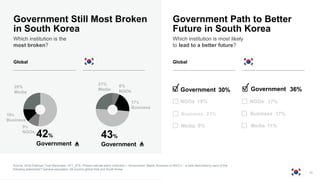
Government Still Most Broken
in South Korea
Which institution is the
most broken?
Source: 2018 Edelman Trust Barometer. ATT_STE. Please indicate which institution – Government, Media, Business or NGO’s – is best described by each of the
following statements? General population, 28-country global total and South Korea.
Business
42%
Government
43%
Government
Government✓
Government Path to Better
Future in South Korea
Which institution is most likely
to lead to a better future?
Global Global
23%
%
30%
%
Government✓
%
%
17%
36%
Source: 2018 Edelman Trust Barometer. ATT_STE. Please
indicate which institution – Government, Media, Business or
NGO’s – is best described by each of the following statements?
General population; APACMEA markets, APAC total and 28-
country global total.
14
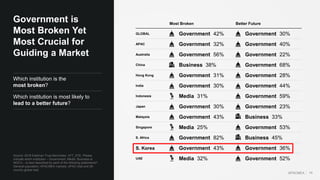
Which institution is the
most broken?
Government is
Most Broken Yet
Most Crucial for
Guiding a Market
Which institution is most likely to
lead to a better future?
Most Broken Better Future
GLOBAL Government 42% Government 30%
APAC Government 32% Government 40%
Australia Government 56% Government 22%
China Business 38% Government 68%
Hong Kong Government 31% Government 28%
India Government 30% Government 44%
Indonesia Media 31% Government 59%
Japan Government 30% Government 23%
Malaysia Government 43% Business 33%
Singapore Media 25% Government 53%
S. Africa Government 82% Business 45%
S. Korea Government 43% Government 36%
UAE Media 32% Government 52%
APACMEA
15
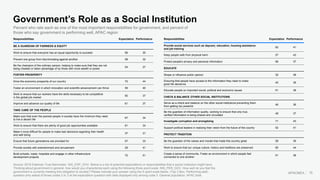
Government’s Role as a Social Institution
Source: 2018 Edelman Trust Barometer. INS_EXP_GOV. Below is a list of potential expectations or responsibilities that a social institution might have.
Thinking about government in general, how would you characterize each using the following three-point scale. INS_PER_GOV. How well do you feel the
government is currently meeting this obligation to society? Please indicate your answer using the 5-point scale below. (Top 2 Box, Performing well),
question only asked of those codes 2 or 3 at the expectation question with data displayed only among code 3. General population, APAC total.
APACMEA
Percent who rate each as one of the most important responsibilities for government, and percent of
those who say government is performing well, APAC region
Responsibilities Expectation Performance
BE A GUARDIAN OF FAIRNESS & EQUITY
Work to ensure that everyone has an equal opportunity to succeed 56 30
Prevent one group from discriminating against another 58 32
Be the champion of the ordinary person, helping to make sure that they are not
being cheated or taken advantage of by those with more wealth or power
54 27
FOSTER PROSPERITY
Drive the economic prosperity of our country 72 44
Foster an environment in which innovation and scientific advancement can thrive 59 40
Work to ensure that our workers have the skills necessary to be competitive
in the global job market
50 37
Improve and advance our quality of life 61 37
TAKE CARE OF THE PEOPLE
Make sure that even the poorest people in society have the minimum they need
to live a decent life
67 34
Work to ensure that there are plenty of good job opportunities available 61 34
Make it more difficult for people to make bad decisions regarding their health
and well being
37 31
Ensure that future generations are provided for 57 33
Provide society with entertainment and amusement 29 41
Build schools, roads, hospitals and engage in other infrastructure
development projects
72 51
Responsibilities Expectation Performance
Provide social services such as daycare, education, housing assistance
and job training
62 41
Keep people safe from physical harm 57 43
Protect people's privacy and personal information 56 37
EDUCATE
Shape or influence public opinion 32 38
Ensuring that people have access to the information they need to make
good life decisions
45 38
Educate people on important social, political and economic issues 51 38
CHECK & BALANCE OTHER SOCIAL INSTITUTIONS
Serve as a check and balance on the other social institutions preventing them
from getting too powerful
49 36
Be the guardian of information quality, working to ensure that only true,
verified information is being shared and circulated
48 37
Investigate corruption and wrongdoing 71 43
Support political leaders in realizing their vision from the future of the country 52 41
PROTECT TRADITION
Be the guardian of the values and morals that made this country great 59 39
Work to ensure that our unique culture, history and traditions are preserved 60 44
Create a sense of community. Foster an environment in which people feel
connected to one another
51 38
Balancing Act
for Business
72
57 57
60 60 62 64 65 66 68 68
71 71 71 71 72 72 72 73 74 75 76
79 80 81 82 83
86
90
Global28
Japan
S.Korea
Argentina
France
Turkey
Russia
Spain
Ireland
HongKong
Poland
Germany
S.Africa
Sweden
U.K.
Brazil
Italy
Malaysia
Singapore
Australia
Canada
UAE
U.S.
Mexico
TheNetherlands
China
Colombia
India
Indonesia
Source: 2018 Edelman Trust Barometer. TRU_INS. [YOUR EMPLOYER] Below is a list of institutions. For each one, please indicate how much you trust that institution to do what is right using a
nine-point scale where one means that you “do not trust them at all” and nine means that you “trust them a great deal.“ (Top 4 Box, Trust) General population, 28-country global total.
Note: 2016 data was taken from Q525-526. Thinking about your own company and other companies in your industry, please indicate how much you trust each to do what is right using a 9-point
scale where one means that you “do not trust them at all” and nine means that you “trust them a great deal”. (Top 4 Box, Trust), question asked of half of the sample. General population, 28-country
global total.
17
Percent trust in employer, and change from 2016 to 2018
Employers Trusted Around the World
TrustNeutralDistrust
l llllllllllllllllllllllllllll+7 +17 +2 -18 +12 -2 +16 +2 +6 +9 +12 +9 -1 +21 +14 -5 +14 -4 0 +20 +11 0 +15 -9 +19 +3 -2 +3 +13
Change, 2016 to 2018− +0
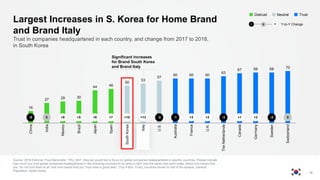
16
27 29 30
44 46
50
53
57
60 60 60
63
67 68 68 70
China
India
Mexico
Brazil
Japan
Spain
SouthKorea
Italy
U.S.
Australia
France
U.K.
TheNetherlands
Canada
Germany
Sweden
Switzerland
Source: 2018 Edelman Trust Barometer. TRU_NAT. Now we would like to focus on global companies headquartered in specific countries. Please indicate
how much you trust global companies headquartered in the following countries to do what is right. Use the same nine-point scale, where one means that
you “do not trust them at all” and nine means that you “trust them a great deal.” (Top 4 Box, Trust), countries shown to half of the sample. General
Population, South Korea.
18
Trust in companies headquartered in each country, and change from 2017 to 2018,
in South Korea
Largest Increases in S. Korea for Home Brand
and Brand Italy
l l l l l l l l l l l l l l l l l-5 0 +9 +5 +9 +7 +15 +13 -3 -1 +3 +3 -3 +1 +2 -2 0
Significant increases
for Brand South Korea
and Brand Italy
TrustNeutralDistrust
Y-to-Y Change− +0
Source: 2018 Edelman Trust Barometer. TRU_NAT. Now we would like to focus on global companies headquartered in specific countries. Please indicate
how much you trust global companies headquartered in the following countries to do what is right. Use the same nine-point scale, where one means that
you “do not trust them at all” and nine means that you “trust them a great deal.” (Top 4 Box, Trust), countries asked of half of the sample. General
Population; 28-country global total, APAC total and APACMEA markets.
19
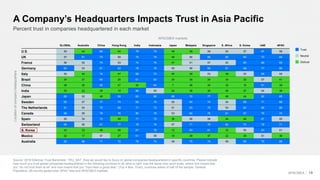
A Company’s Headquarters Impacts Trust in Asia Pacific
Percent trust in companies headquartered in each market
GLOBAL Australia China Hong Kong India Indonesia Japan Malaysia Singapore S. Africa S. Korea UAE APAC
U.S. 50 44 66 44 78 73 48 49 59 50 57 67 58
UK 57 61 73 59 75 78 48 56 66 60 60 73 64
France 56 52 75 53 74 75 47 51 57 52 60 69 60
Germany 62 53 81 63 78 76 55 56 65 61 68 77 66
Italy 50 44 74 47 68 72 40 49 53 49 53 68 55
Brazil 34 27 65 25 61 62 24 38 34 34 30 57 41
China 36 25 90 27 42 64 7 46 34 32 16 61 39
India 32 22 45 15 86 55 24 36 30 26 27 54 38
Japan 60 52 48 62 83 86 66 72 77 48 44 82 65
Sweden 65 57 77 74 69 74 55 64 74 54 68 71 68
The Netherlands 61 54 75 69 71 73 51 63 70 54 63 69 66
Canada 68 59 78 76 80 76 53 66 75 61 67 79 70
Spain 50 34 72 49 71 70 36 56 58 44 46 67 55
Switzerland 66 56 81 77 78 78 57 71 76 60 70 78 71
S. Korea 43 33 46 48 67 78 12 63 61 33 50 63 51
Mexico 32 17 57 27 61 59 18 39 37 22 29 51 38
Australia 63 66 71 72 79 74 49 70 74 59 60 75 68
Neutral
Trust
Distrust
APACMEA
Locationofcompanyheadquarters
APACMEA markets
2014 2015 2016 2017 2018
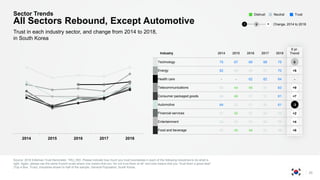
Sector Trends
All Sectors Rebound, Except Automotive
Source: 2018 Edelman Trust Barometer. TRU_IND. Please indicate how much you trust businesses in each of the following industries to do what is
right. Again, please use the same 9-point scale where one means that you “do not trust them at all” and nine means that you “trust them a great deal”.
(Top 4 Box, Trust), industries shown to half of the sample. General Population, South Korea.
20
Trust in each industry sector, and change from 2014 to 2018,
in South Korea
TrustNeutralDistrust
Industry 2014 2015 2016 2017 2018
5 yr.
Trend
Technology 75 67 69 68 75 0
Energy 62 58 59 57 70 +8
Health care - - 62 62 64 -
Telecommunications 54 44 48 51 63 +9
Consumer packaged goods 54 46 51 51 61 +7
Automotive 64 53 51 54 61 -3
Financial services 57 45 52 52 59 +2
Entertainment 54 53 53 52 58 +4
Food and beverage 52 45 48 52 58 +6
Change, 2014 to 2018− +0
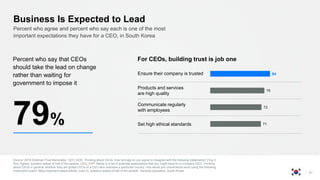
Business Is Expected to Lead
Source: 2018 Edelman Trust Barometer. CEO_AGR. Thinking about CEOs, how strongly do you agree or disagree with the following statements? (Top 4
Box, Agree), question asked of half of the sample. CEO_EXP. Below is a list of potential expectations that you might have for a company CEO. Thinking
about CEOs in general, whether they are global CEOs or a CEO who oversees a particular country, how would you characterize each using the following
three-point scale? (Most important responsibility, code 3), question asked of half of the sample. General population, South Korea.
21
Percent who agree and percent who say each is one of the most
important expectations they have for a CEO, in South Korea
Percent who say that CEOs
should take the lead on change
rather than waiting for
government to impose it
71
72
76
84
For CEOs, building trust is job one
79%
Products and services
are high quality
Ensure their company is trusted
Communicate regularly
with employees
Set high ethical standards
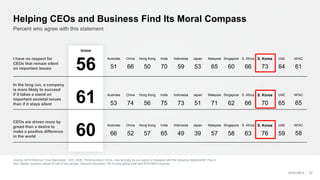
Helping CEOs and Business Find Its Moral Compass
Percent who agree with this statement
I have no respect for
CEOs that remain silent
on important issues
Australia China Hong Kong India Indonesia Japan Malaysia Singapore S. Africa S. Korea UAE APAC
51 66 50 70 59 53 65 60 66 73 64 61
In the long run, a company
is more likely to succeed
if it takes a stand on
important societal issues
than if it stays silent
CEOs are driven more by
greed than a desire to
make a positive difference
in the world
Source: 2018 Edelman Trust Barometer. CEO_AGR. Thinking about CEOs, how strongly do you agree or disagree with the following statements? (Top 4
Box, Agree), question asked of half of the sample. General population; 28-country global total and APACMEA markets.
22
56
61
60
Global
APACMEA
Australia China Hong Kong India Indonesia Japan Malaysia Singapore S. Africa S. Korea UAE APAC
53 74 56 75 73 51 71 62 66 70 65 65
Australia China Hong Kong India Indonesia Japan Malaysia Singapore S. Africa S. Korea UAE APAC
66 52 57 65 49 39 57 58 63 76 59 58
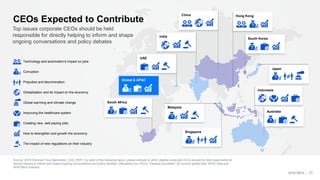
Technology and automation's impact on jobs
Corruption
Prejudice and discrimination
Globalization and its impact on the economy
Global warming and climate change
Improving the healthcare system
Creating new, well-paying jobs
How to strengthen and growth the economy
The impact of new regulations on their industry
Source: 2018 Edelman Trust Barometer. CEO_RSP. For each of the following topics, please indicate to which degree corporate CEOs should be held responsible for
directly helping to inform and shape ongoing conversations and policy debates. (Mandatory for CEOs). General population; 28-country global total, APAC total and
APACMEA markets.
23
Top issues corporate CEOs should be held
responsible for directly helping to inform and shape
ongoing conversations and policy debates
CEOs Expected to Contribute
China Hong Kong
Japan
Australia
Malaysia
Singapore
Indonesia
UAE
India
South Africa
South Korea
Global & APAC
APACMEA
In Search
of Truth
Source: 2018 Edelman Trust Barometer. ATT_MED_AGR. Below is a list of statements. For each one, please rate how much you agree or disagree with that statement
using a nine-point scale where one means “strongly disagree” and nine means “strongly agree”. (Top 4 Box, Agree), question asked of half of the sample. General
population; 28-country global total.
25
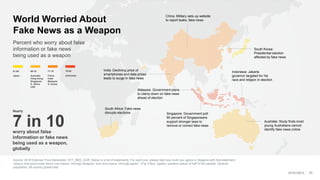
Percent who worry about false
information or fake news
being used as a weapon
World Worried About
Fake News as a Weapon
worry about false
information or fake news
being used as a weapon,
globally
7 in 10
Nearly
61-65 66-70 71-75 76-80
Japan Australia
Hong Kong
Singapore
S. Africa
UAE
China
India
Malaysia
S. Korea
Indonesia
South Korea:
Presidential election
affected by fake news
Indonesia: Jakarta
governor targeted for his
race and religion in election
Malaysia: Government plans
to clamp down on fake news
ahead of election
India: Declining price of
smartphones and data prices
leads to surge in fake news
Singapore: Government poll:
90 percent of Singaporeans
support stronger laws to
remove or correct fake news
China: Military sets up website
to report leaks, fake news
Australia: Study finds most
young Australians cannot
identify fake news online
South Africa: Fake news
disrupts elections
APACMEA
26
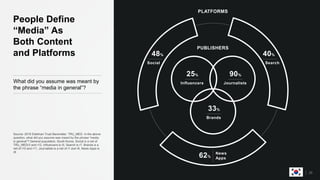
People Define
“Media” As
Both Content
and Platforms
What did you assume was meant by
the phrase “media in general”?
Source: 2018 Edelman Trust Barometer. TRU_MED. In the above
question, what did you assume was meant by the phrase “media
in general”? General population, South Korea. Social is a net of
TRU_MEDr3 and r12, Influencers is r5, Search is r7, Brands is a
net of r10 and r11, Journalists is a net of r1 and r6, News Apps is
r8.
PLATFORMS
PUBLISHERS
40%48%
SearchSocial
62%
News
Apps
25%
Influencers
90%
Journalists
33%
Brands
43
30 31 32 32 32 33 33 34 35 35
39 40 42 42 43 43 43 44 45 47 48 49
52
55 56
61
68
71
Global28
Turkey
Australia
Japan
Sweden
U.K.
France
Ireland
Poland
Russia
S.Africa
Argentina
S.Korea
Germany
U.S.
Brazil
Colombia
HongKong
Spain
Italy
Malaysia
Mexico
Canada
Singapore
TheNetherlands
UAE
India
Indonesia
China
Source: 2018 Edelman Trust Barometer. TRU_INS. [MEDIA IN GENERAL] Below is a list of institutions. For each one, please indicate how much you trust
that institution to do what is right using a nine-point scale where one means that you “do not trust them at all” and nine means that you “trust them a great
deal.“ (Top 4 Box, Trust) General population, 28-country global total.
27
Percent trust in media, and change from 2017 to 2018
Media Now Least Trusted Institution Globally
TrustNeutralDistrust
Distrusted in 22 of 28 of countries
l llllllllllllllllllllllllllll0 +5 -1 0 -1 0 0 +4 +3 +4 -4 -1 0 0 -5 -5 -2 +1 0 -3 +5 +1 +4 -2 +1 +12 -5 +1 +6
Y-to-Y Change− +0
28
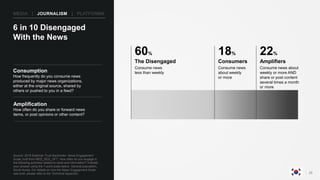
Consumption
How frequently do you consume news
produced by major news organizations,
either at the original source, shared by
others or pushed to you in a feed?
6 in 10 Disengaged
With the News
60%
The Disengaged
Consume news
less than weekly
18%
Consumers
Consume news
about weekly
or more
22%
Amplifiers
Consume news about
weekly or more AND
share or post content
several times a month
or more
Amplification
How often do you share or forward news
items, or post opinions or other content?
MEDIA | JOURNALISM | PLATFORMS
Source: 2018 Edelman Trust Barometer. News Engagement
Scale, built from MED_SEG_OFT. How often do you engage in
the following activities related to news and information? Indicate
your answer using the 7-point scale below. General population,
South Korea. For details on how the News Engagement Scale
was built, please refer to the Technical Appendix.
Source: 2018 Edelman Trust Barometer. ATT_MED_AGR. Below is a list of statements. For each one, please rate how much you agree or disagree with
that statement using a nine-point scale where one means “strongly disagree” and nine means “strongly agree”. (Top 4 Box, Agree), question asked of half
of the sample. General population, South Korea.
29
Percent who agree that news
organizations are overly focused on …
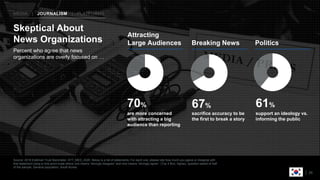
Skeptical About
News Organizations
70%
are more concerned
with attracting a big
audience than reporting
Attracting
Large Audiences
61%
support an ideology vs.
informing the public
Politics
67%
sacrifice accuracy to be
the first to break a story
Breaking News
MEDIA | JOURNALISM | PLATFORMS
Source: 2018 Edelman Trust Barometer. ATT_MED_AGR. Below is a list of statements. For each one, please rate how much you agree or disagree with
that statement using a nine-point scale where one means “strongly disagree” and nine means “strongly agree”. (Top 4 Box, Agree), question asked of half
of the sample. General population, South Korea.
30
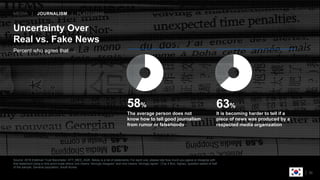
Percent who agree that …
Uncertainty Over
Real vs. Fake News
58%
The average person does not
know how to tell good journalism
from rumor or falsehoods
63%
It is becoming harder to tell if a
piece of news was produced by a
respected media organization
MEDIA | JOURNALISM | PLATFORMS
Source: 2018 Edelman Trust Barometer. Trust-building mandates Analysis. The most effective trust building mandates for each institution. INS_EXP_MED. Below is
a list of potential expectations or responsibilities that a social institution might have. Thinking about the media in general, how would you characterize each using the
following three-point scale. INS_PER_MED. How well do you feel the media is currently meeting this obligation to society? Please indicate your answer using the 5-
point scale below. (Top 2 Box, Performing well), question only asked of those codes 2 or 3 at the expectation question with data displayed only among code 3.
General population, South Korea. For more details on the Trust-building mandates Analysis, please refer to the Technical Appendix.
31
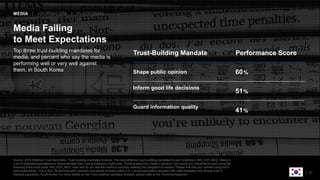
Top three trust-building mandates for
media, and percent who say the media is
performing well or very well against
them, in South Korea
Media Failing
to Meet Expectations
Trust-Building Mandate Performance Score
Shape public opinion 60
Inform good life decisions
51
Guard information quality
41
%
%
%
MEDIA | JOURNALISM | PLATFORMS
Source: 2018 Edelman Trust Barometer. MED_CON. What consequences are you experiencing as a direct result of the media not doing a good job fulfilling
its responsibilities? Question asked of those who answered codes 1-3 at MED_RSP. General population, South Korea.
32
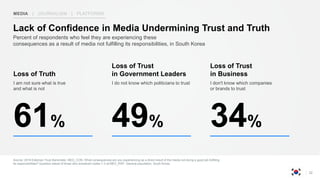
Percent of respondents who feel they are experiencing these
consequences as a result of media not fulfilling its responsibilities, in South Korea
Lack of Confidence in Media Undermining Trust and Truth
I am not sure what is true
and what is not
Loss of Truth
I do not know which politicians to trust
Loss of Trust
in Government Leaders
I don't know which companies
or brands to trust
Loss of Trust
in Business
61% 49% 34%
MEDIA | JOURNALISM | PLATFORMS
55
43
41 41 40
38
33
30
28
24 23
Technical
expert
Academic
expert
Financial
industryanalyst
Successful
entrepreneur
Apersonlike
yourself
NGO
representative
CEO
Employee
Journalist
Boardof
directors
Government
official/regulator
Source: 2018 Edelman Trust Barometer. CRE_PPL. Below is a list of people. In general, when forming an opinion of a company, if you heard information
about a company from each person, how credible would the information be—extremely credible, very credible, somewhat credible, or not credible at all?
(Top 2 Box, Very/Extremely Credible), question asked of half of the sample. General population, South Korea.
33
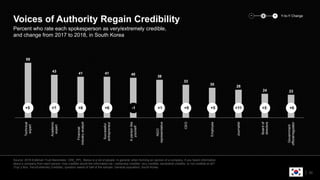
Percent who rate each spokesperson as very/extremely credible,
and change from 2017 to 2018, in South Korea
Voices of Authority Regain Credibility
+5 +7 +8 +6 -1 +1 +9 +5 +11 +5 +6
− Y-to-Y Change+0
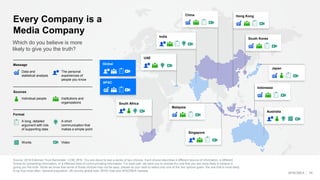
Message
Data and
statistical analysis
The personal
experiences of
people you know
Sources
Individual people Institutions and
organizations
Format
A long, detailed
argument with lots
of supporting data
A short
communication that
makes a simple point
Words Video
Every Company is a
Media Company
Source: 2018 Edelman Trust Barometer. COM_RFB. You are about to see a series of two choices. Each choice describes a different source of information, a different
format for presenting information, or a different style of communicating information. For each pair, we want you to choose the one that you are more likely to believe is
giving you the truth. While we know that some of these choices may not be easy, please do your best to select only one of the two options given- the one that is most likely
to be true most often. General population; 28-country global total, APAC total and APACMEA markets.
34
Which do you believe is more
likely to give you the truth?
Australia
Indonesia
Japan
South Korea
Hong KongChina
India
UAE
South Africa
Malaysia
Singapore
Global
APAC
APACMEA
Source:
35
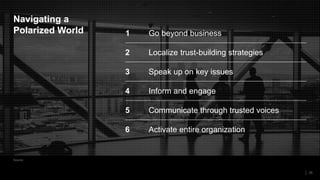
Navigating a
Polarized World 1 Go beyond business
2 Localize trust-building strategies
3 Speak up on key issues
4 Inform and engage
5 Communicate through trusted voices
6 Activate entire organization
#TrustBarometer
Thank You

2018 Edelman Trust Barometer - South Korea

  • 1.
  • 2.
    2 Methodology 2018 Edelman Trust Barometer OnlineSurvey in 28 Countries 18 years of data 33,000+ respondents total All fieldwork was conducted between October 28 and November 20, 2017 General Online Population 7 years in 25+ countries Ages 18+ 1,150 respondents per country All slides show general online population data unless otherwise noted Mass Population All population not including informed public Represents 85% of total global population Informed Public 10 years in 20+ countries Represents 15% of total global population 500 respondents in U.S. and China; 200 in all other countries Must meet 4 criteria: Ages 25-64 College educated In top 25% of household income per age group in each country Report significant media consumption and engagement in business news 28-country global data margin of error: General population +/- 0.6% (N=32,200), informed public +/- 1.2% (N=6,200), mass population +/- 0.6% (26,000+), half-sample global general online population +/- 0.8 (N=16,100). Country-specific data margin of error: General population +/- 2.9 (N=1,150), informed public +/- 6.9% (N = min 200, varies by country), China and U.S. +/- 4.4% (N=500), mass population +/- 3.0 to 3.6 (N =min 740, varies by country).
  • 3.
    Trust in Retrospect 3 RisingInfluence of NGOs 2001 Business Must Partner with Government to Regain Trust 2009 Fall of the Celebrity CEO 2002 Earned Media More Credible Than Advertising 2003 U.S. Companies in Europe Suffer Trust Discount 2004 Trust Shifts from “Authorities” to Peers 2005 “A Person Like Me” Emerges as Credible Spokesperson 2006 Business More Trusted Than Government and Media 2007 Young Influencers Have More Trust in Business 2008 Trust is Now an Essential Line of Business 2010 Rise of Authority Figures 2011 Fall of Government 2012 Crisis of Leadership 2013 Business to Lead the Debate for Change 2014 Trust is Essential to Innovation 2015 Growing Inequality of Trust 2016 Trust in Crisis 2017 The Battle for Truth 2018
  • 4.
  • 5.
    Source: 2018 EdelmanTrust Barometer. TRU_INS. Below is a list of institutions. For each one, please indicate how much you trust that institution to do what is right using a nine-point scale, where one means that you “do not trust them at all” and nine means that you “trust them a great deal.” (Top 4 Box, Trust) Informed Public and General Population, 28-country global total. 5 Percent trust in each institution, and change from 2017 to 2018 No Recovery in Trust Globally 53 52 41 43 53 52 43 43 67 65 53 53 64 64 53 53 -3 -1 0 0 Business MediaNGOs Government 0 0 +2 0 Informed Public General Population 20182017 Y-to-Y Change− +0
  • 6.
    Source: 2018 EdelmanTrust Barometer. The Trust Index is an average of a country's trust in the institutions of government, business, media and NGOs. General population, 28-country global total. 6 Average trust in institutions, general population, 2017 vs. 2018 Trust Index A World of Distrust Biggest changes in 47 Global 72 India 69 Indonesia 67 China 60 Singapore 60 UAE 53 The Netherlands 52 Mexico 52 U.S. 50 Colombia 49 Canada 48 Brazil 48 Italy 48 Malaysia 45 Argentina 44 Hong Kong 44 Spain 43 Turkey 42 Australia 42 S. Africa 41 Germany 40 France 40 U.K. 38 S. Korea 37 Sweden 36 Ireland 35 Japan 35 Poland 34 Russia U.S. -9 China +7 S. Korea +6 UAE +6 Italy -5 Trust (60-100) Neutral (50-59) Distrust (1-49) Trust decline in the U.S. is the steepest ever measured 48 Global 74 China 71 Indonesia 68 India 66 UAE 58 Singapore 54 Mexico 54 The Netherlands 53 Malaysia 49 Canada 47 Argentina 47 Colombia 47 Spain 46 Turkey 45 Hong Kong 44 Brazil 44 S. Korea 43 Italy 43 U.S. 41 Germany 41 Sweden 40 Australia 40 France 39 Poland 39 U.K. 38 Ireland 38 S. Africa 37 Japan 36 Russia 2017 General Population 2018 General Population Global Trust Index remains at distruster level 20 of 28 countries are distrusters, up 1 from 2017
  • 7.
    Source: 2018 EdelmanTrust Barometer. The Trust Index is an average of a country's trust in the institutions of government, business, media and NGOs. Informed public, 28-country global total. 7 Average trust in institutions, informed public, 2017 vs. 2018 Trust Index Informed Public Declines to Neutral 60 Global 80 India 79 China 78 Indonesia 77 UAE 71 Singapore 68 U.S. 62 Canada 62 The Netherlands 61 Italy 61 Mexico 57 Malaysia 57 Spain 56 France 56 U.K. 55 Colombia 54 Australia 54 Germany 53 Hong Kong 51 Argentina 51 Brazil 50 S. Korea 50 Turkey 49 Japan 49 S. Africa 47 Sweden 45 Russia 44 Ireland 43 Poland 2017 Informed Public 2018 Informed Public Biggest changes in U.S. -23 Argentina +9 Sweden +9 Malaysia +8 Turkey +7 U.S. Trust Index crashes 23 points A 1-point decline in the Global Trust Index Trust (60-100) Neutral (50-59) Distrust (1-49) 59 Global 83 China 81 Indonesia 77 India 76 UAE 70 Singapore 67 The Netherlands 65 Malaysia 65 Mexico 62 Canada 60 Argentina 57 Italy 57 Turkey 56 France 56 Sweden 55 Australia 55 Spain 54 Germany 52 U.K. 51 Brazil 50 Colombia 50 S. Korea 49 Hong Kong 48 Ireland 48 Poland 47 Russia 46 Japan 45 S. Africa 45 U.S.
  • 8.
    58 58 47 474948 33 42 73 74 63 64 51 54 33 42 Source: 2018 Edelman Trust Barometer. TRU_INS. Below is a list of institutions. For each one, please indicate how much you trust that institution to do what is right using a nine-point scale, where one means that you “do not trust them at all” and nine means that you “trust them a great deal.” (Top 4 Box, Trust) Informed Public and General Population, U.S. The Trust Index is an average of a country's trust in the institutions of government, business, media and NGOs. Informed Public and General Population, U.S. 8 Trust Crash in U.S. Business MediaNGOs Government -9 -10 -14 -5 -22 -20 -30 -22 20182017 43TRUST INDEX 45 TRUST INDEX 9-point decrease Fell from 8th to 18th place General Population 23-point decrease Fell from 6th to last place Informed Public Y-to-Y Change− +0 Percent trust in each institution, and change from 2017 to 2018
  • 9.
    Percent trust ineach institution, and change from 2017 to 2018 73 81 86 7776 85 89 80 61 67 76 6566 74 84 71 Source: 2018 Edelman Trust Barometer. TRU_INS. Below is a list of institutions. For each one, please indicate how much you trust that institution to do what is right using a nine-point scale, where one means that you “do not trust them at all” and nine means that you “trust them a great deal.” (Top 4 Box, Trust) Informed Public and General Population, China. The Trust Index is an average of a country's trust in the institutions of government, business, media and NGOs. Informed Public and General Population, China. 9 China Rising +5 +7 +8 +6 +3 +4 +3 +3 20182017 Business MediaNGOs Government 7-point increase Rose from 3rd place to 1st place General Population 4-point increase Rose from 2nd to 1st place Informed Public 83 TRUST INDEX 74TRUST INDEX Y-to-Y Change− +0
  • 10.
  • 11.
    Source: 2018 EdelmanTrust Barometer. TRU_INS. Below is a list of institutions. For each one, please indicate how much you trust that institution to do what is right using a nine-point scale, where one means that you “do not trust them at all” and nine means that you “trust them a great deal.” (Top 4 Box, Trust) Informed Public and General Population, South Korea. 11 Percent trust in each institution, and change from 2017 to 2018, in South Korea Government Trust Increases Significantly in South Korea 56 29 28 40 55 36 45 40 69 40 35 55 64 37 54 42 -5 -3 +19 -13 Business MediaNGOs Government -1 +7 +17 0 Informed Public General Population 20182017 Y-to-Y Change− +0
  • 12.
    43 14 18 24 25 2728 33 33 34 35 35 36 37 41 43 44 45 46 46 46 46 51 54 65 70 73 77 84 Global28 S.Africa Brazil Colombia Poland Italy Mexico France U.S. Spain Australia Ireland U.K. Japan Argentina Germany Russia S.Korea Canada HongKong Malaysia Sweden Turkey The Netherlands Singapore India Indonesia UAE China Source: 2018 Edelman Trust Barometer. TRU_INS. [GOVERNMENT IN GENERAL] Below is a list of institutions. For each one, please indicate how much you trust that institution to do what is right using a nine-point scale where one means that you “do not trust them at all” and nine means that you “trust them a great deal.“ (Top 4 Box, Trust) General Population, 28-country global total. 12 Trust in Government Increases in 16 of 28 Markets Percent trust in government, and change from 2017 to 2018 l llllllllllllllllllllllllllll+2 -1 -6 -8 +5 -4 +4 +8 -14 +9 -2 +3 0 0 +8 +5 0 +17 +3 +6 +9 +1 0 +3 -4 -5 +2 +2 +8 Distrusted in 21 markets TrustNeutralDistrust Y-to-Y Change− +0
  • 13.
    13 Government Still MostBroken in South Korea Which institution is the most broken? Source: 2018 Edelman Trust Barometer. ATT_STE. Please indicate which institution – Government, Media, Business or NGO’s – is best described by each of the following statements? General population, 28-country global total and South Korea. Business 42% Government 43% Government Government✓ Government Path to Better Future in South Korea Which institution is most likely to lead to a better future? Global Global 23% % 30% % Government✓ % % 17% 36%
  • 14.
    Source: 2018 EdelmanTrust Barometer. ATT_STE. Please indicate which institution – Government, Media, Business or NGO’s – is best described by each of the following statements? General population; APACMEA markets, APAC total and 28- country global total. 14 Which institution is the most broken? Government is Most Broken Yet Most Crucial for Guiding a Market Which institution is most likely to lead to a better future? Most Broken Better Future GLOBAL Government 42% Government 30% APAC Government 32% Government 40% Australia Government 56% Government 22% China Business 38% Government 68% Hong Kong Government 31% Government 28% India Government 30% Government 44% Indonesia Media 31% Government 59% Japan Government 30% Government 23% Malaysia Government 43% Business 33% Singapore Media 25% Government 53% S. Africa Government 82% Business 45% S. Korea Government 43% Government 36% UAE Media 32% Government 52% APACMEA
  • 15.
    15 Government’s Role asa Social Institution Source: 2018 Edelman Trust Barometer. INS_EXP_GOV. Below is a list of potential expectations or responsibilities that a social institution might have. Thinking about government in general, how would you characterize each using the following three-point scale. INS_PER_GOV. How well do you feel the government is currently meeting this obligation to society? Please indicate your answer using the 5-point scale below. (Top 2 Box, Performing well), question only asked of those codes 2 or 3 at the expectation question with data displayed only among code 3. General population, APAC total. APACMEA Percent who rate each as one of the most important responsibilities for government, and percent of those who say government is performing well, APAC region Responsibilities Expectation Performance BE A GUARDIAN OF FAIRNESS & EQUITY Work to ensure that everyone has an equal opportunity to succeed 56 30 Prevent one group from discriminating against another 58 32 Be the champion of the ordinary person, helping to make sure that they are not being cheated or taken advantage of by those with more wealth or power 54 27 FOSTER PROSPERITY Drive the economic prosperity of our country 72 44 Foster an environment in which innovation and scientific advancement can thrive 59 40 Work to ensure that our workers have the skills necessary to be competitive in the global job market 50 37 Improve and advance our quality of life 61 37 TAKE CARE OF THE PEOPLE Make sure that even the poorest people in society have the minimum they need to live a decent life 67 34 Work to ensure that there are plenty of good job opportunities available 61 34 Make it more difficult for people to make bad decisions regarding their health and well being 37 31 Ensure that future generations are provided for 57 33 Provide society with entertainment and amusement 29 41 Build schools, roads, hospitals and engage in other infrastructure development projects 72 51 Responsibilities Expectation Performance Provide social services such as daycare, education, housing assistance and job training 62 41 Keep people safe from physical harm 57 43 Protect people's privacy and personal information 56 37 EDUCATE Shape or influence public opinion 32 38 Ensuring that people have access to the information they need to make good life decisions 45 38 Educate people on important social, political and economic issues 51 38 CHECK & BALANCE OTHER SOCIAL INSTITUTIONS Serve as a check and balance on the other social institutions preventing them from getting too powerful 49 36 Be the guardian of information quality, working to ensure that only true, verified information is being shared and circulated 48 37 Investigate corruption and wrongdoing 71 43 Support political leaders in realizing their vision from the future of the country 52 41 PROTECT TRADITION Be the guardian of the values and morals that made this country great 59 39 Work to ensure that our unique culture, history and traditions are preserved 60 44 Create a sense of community. Foster an environment in which people feel connected to one another 51 38
  • 16.
  • 17.
    72 57 57 60 6062 64 65 66 68 68 71 71 71 71 72 72 72 73 74 75 76 79 80 81 82 83 86 90 Global28 Japan S.Korea Argentina France Turkey Russia Spain Ireland HongKong Poland Germany S.Africa Sweden U.K. Brazil Italy Malaysia Singapore Australia Canada UAE U.S. Mexico TheNetherlands China Colombia India Indonesia Source: 2018 Edelman Trust Barometer. TRU_INS. [YOUR EMPLOYER] Below is a list of institutions. For each one, please indicate how much you trust that institution to do what is right using a nine-point scale where one means that you “do not trust them at all” and nine means that you “trust them a great deal.“ (Top 4 Box, Trust) General population, 28-country global total. Note: 2016 data was taken from Q525-526. Thinking about your own company and other companies in your industry, please indicate how much you trust each to do what is right using a 9-point scale where one means that you “do not trust them at all” and nine means that you “trust them a great deal”. (Top 4 Box, Trust), question asked of half of the sample. General population, 28-country global total. 17 Percent trust in employer, and change from 2016 to 2018 Employers Trusted Around the World TrustNeutralDistrust l llllllllllllllllllllllllllll+7 +17 +2 -18 +12 -2 +16 +2 +6 +9 +12 +9 -1 +21 +14 -5 +14 -4 0 +20 +11 0 +15 -9 +19 +3 -2 +3 +13 Change, 2016 to 2018− +0
  • 18.
    16 27 29 30 4446 50 53 57 60 60 60 63 67 68 68 70 China India Mexico Brazil Japan Spain SouthKorea Italy U.S. Australia France U.K. TheNetherlands Canada Germany Sweden Switzerland Source: 2018 Edelman Trust Barometer. TRU_NAT. Now we would like to focus on global companies headquartered in specific countries. Please indicate how much you trust global companies headquartered in the following countries to do what is right. Use the same nine-point scale, where one means that you “do not trust them at all” and nine means that you “trust them a great deal.” (Top 4 Box, Trust), countries shown to half of the sample. General Population, South Korea. 18 Trust in companies headquartered in each country, and change from 2017 to 2018, in South Korea Largest Increases in S. Korea for Home Brand and Brand Italy l l l l l l l l l l l l l l l l l-5 0 +9 +5 +9 +7 +15 +13 -3 -1 +3 +3 -3 +1 +2 -2 0 Significant increases for Brand South Korea and Brand Italy TrustNeutralDistrust Y-to-Y Change− +0
  • 19.
    Source: 2018 EdelmanTrust Barometer. TRU_NAT. Now we would like to focus on global companies headquartered in specific countries. Please indicate how much you trust global companies headquartered in the following countries to do what is right. Use the same nine-point scale, where one means that you “do not trust them at all” and nine means that you “trust them a great deal.” (Top 4 Box, Trust), countries asked of half of the sample. General Population; 28-country global total, APAC total and APACMEA markets. 19 A Company’s Headquarters Impacts Trust in Asia Pacific Percent trust in companies headquartered in each market GLOBAL Australia China Hong Kong India Indonesia Japan Malaysia Singapore S. Africa S. Korea UAE APAC U.S. 50 44 66 44 78 73 48 49 59 50 57 67 58 UK 57 61 73 59 75 78 48 56 66 60 60 73 64 France 56 52 75 53 74 75 47 51 57 52 60 69 60 Germany 62 53 81 63 78 76 55 56 65 61 68 77 66 Italy 50 44 74 47 68 72 40 49 53 49 53 68 55 Brazil 34 27 65 25 61 62 24 38 34 34 30 57 41 China 36 25 90 27 42 64 7 46 34 32 16 61 39 India 32 22 45 15 86 55 24 36 30 26 27 54 38 Japan 60 52 48 62 83 86 66 72 77 48 44 82 65 Sweden 65 57 77 74 69 74 55 64 74 54 68 71 68 The Netherlands 61 54 75 69 71 73 51 63 70 54 63 69 66 Canada 68 59 78 76 80 76 53 66 75 61 67 79 70 Spain 50 34 72 49 71 70 36 56 58 44 46 67 55 Switzerland 66 56 81 77 78 78 57 71 76 60 70 78 71 S. Korea 43 33 46 48 67 78 12 63 61 33 50 63 51 Mexico 32 17 57 27 61 59 18 39 37 22 29 51 38 Australia 63 66 71 72 79 74 49 70 74 59 60 75 68 Neutral Trust Distrust APACMEA Locationofcompanyheadquarters APACMEA markets
  • 20.
    2014 2015 20162017 2018 Sector Trends All Sectors Rebound, Except Automotive Source: 2018 Edelman Trust Barometer. TRU_IND. Please indicate how much you trust businesses in each of the following industries to do what is right. Again, please use the same 9-point scale where one means that you “do not trust them at all” and nine means that you “trust them a great deal”. (Top 4 Box, Trust), industries shown to half of the sample. General Population, South Korea. 20 Trust in each industry sector, and change from 2014 to 2018, in South Korea TrustNeutralDistrust Industry 2014 2015 2016 2017 2018 5 yr. Trend Technology 75 67 69 68 75 0 Energy 62 58 59 57 70 +8 Health care - - 62 62 64 - Telecommunications 54 44 48 51 63 +9 Consumer packaged goods 54 46 51 51 61 +7 Automotive 64 53 51 54 61 -3 Financial services 57 45 52 52 59 +2 Entertainment 54 53 53 52 58 +4 Food and beverage 52 45 48 52 58 +6 Change, 2014 to 2018− +0
  • 21.
    Business Is Expectedto Lead Source: 2018 Edelman Trust Barometer. CEO_AGR. Thinking about CEOs, how strongly do you agree or disagree with the following statements? (Top 4 Box, Agree), question asked of half of the sample. CEO_EXP. Below is a list of potential expectations that you might have for a company CEO. Thinking about CEOs in general, whether they are global CEOs or a CEO who oversees a particular country, how would you characterize each using the following three-point scale? (Most important responsibility, code 3), question asked of half of the sample. General population, South Korea. 21 Percent who agree and percent who say each is one of the most important expectations they have for a CEO, in South Korea Percent who say that CEOs should take the lead on change rather than waiting for government to impose it 71 72 76 84 For CEOs, building trust is job one 79% Products and services are high quality Ensure their company is trusted Communicate regularly with employees Set high ethical standards
  • 22.
    Helping CEOs andBusiness Find Its Moral Compass Percent who agree with this statement I have no respect for CEOs that remain silent on important issues Australia China Hong Kong India Indonesia Japan Malaysia Singapore S. Africa S. Korea UAE APAC 51 66 50 70 59 53 65 60 66 73 64 61 In the long run, a company is more likely to succeed if it takes a stand on important societal issues than if it stays silent CEOs are driven more by greed than a desire to make a positive difference in the world Source: 2018 Edelman Trust Barometer. CEO_AGR. Thinking about CEOs, how strongly do you agree or disagree with the following statements? (Top 4 Box, Agree), question asked of half of the sample. General population; 28-country global total and APACMEA markets. 22 56 61 60 Global APACMEA Australia China Hong Kong India Indonesia Japan Malaysia Singapore S. Africa S. Korea UAE APAC 53 74 56 75 73 51 71 62 66 70 65 65 Australia China Hong Kong India Indonesia Japan Malaysia Singapore S. Africa S. Korea UAE APAC 66 52 57 65 49 39 57 58 63 76 59 58
  • 23.
    Technology and automation'simpact on jobs Corruption Prejudice and discrimination Globalization and its impact on the economy Global warming and climate change Improving the healthcare system Creating new, well-paying jobs How to strengthen and growth the economy The impact of new regulations on their industry Source: 2018 Edelman Trust Barometer. CEO_RSP. For each of the following topics, please indicate to which degree corporate CEOs should be held responsible for directly helping to inform and shape ongoing conversations and policy debates. (Mandatory for CEOs). General population; 28-country global total, APAC total and APACMEA markets. 23 Top issues corporate CEOs should be held responsible for directly helping to inform and shape ongoing conversations and policy debates CEOs Expected to Contribute China Hong Kong Japan Australia Malaysia Singapore Indonesia UAE India South Africa South Korea Global & APAC APACMEA
  • 24.
  • 25.
    Source: 2018 EdelmanTrust Barometer. ATT_MED_AGR. Below is a list of statements. For each one, please rate how much you agree or disagree with that statement using a nine-point scale where one means “strongly disagree” and nine means “strongly agree”. (Top 4 Box, Agree), question asked of half of the sample. General population; 28-country global total. 25 Percent who worry about false information or fake news being used as a weapon World Worried About Fake News as a Weapon worry about false information or fake news being used as a weapon, globally 7 in 10 Nearly 61-65 66-70 71-75 76-80 Japan Australia Hong Kong Singapore S. Africa UAE China India Malaysia S. Korea Indonesia South Korea: Presidential election affected by fake news Indonesia: Jakarta governor targeted for his race and religion in election Malaysia: Government plans to clamp down on fake news ahead of election India: Declining price of smartphones and data prices leads to surge in fake news Singapore: Government poll: 90 percent of Singaporeans support stronger laws to remove or correct fake news China: Military sets up website to report leaks, fake news Australia: Study finds most young Australians cannot identify fake news online South Africa: Fake news disrupts elections APACMEA
  • 26.
    26 People Define “Media” As BothContent and Platforms What did you assume was meant by the phrase “media in general”? Source: 2018 Edelman Trust Barometer. TRU_MED. In the above question, what did you assume was meant by the phrase “media in general”? General population, South Korea. Social is a net of TRU_MEDr3 and r12, Influencers is r5, Search is r7, Brands is a net of r10 and r11, Journalists is a net of r1 and r6, News Apps is r8. PLATFORMS PUBLISHERS 40%48% SearchSocial 62% News Apps 25% Influencers 90% Journalists 33% Brands
  • 27.
    43 30 31 3232 32 33 33 34 35 35 39 40 42 42 43 43 43 44 45 47 48 49 52 55 56 61 68 71 Global28 Turkey Australia Japan Sweden U.K. France Ireland Poland Russia S.Africa Argentina S.Korea Germany U.S. Brazil Colombia HongKong Spain Italy Malaysia Mexico Canada Singapore TheNetherlands UAE India Indonesia China Source: 2018 Edelman Trust Barometer. TRU_INS. [MEDIA IN GENERAL] Below is a list of institutions. For each one, please indicate how much you trust that institution to do what is right using a nine-point scale where one means that you “do not trust them at all” and nine means that you “trust them a great deal.“ (Top 4 Box, Trust) General population, 28-country global total. 27 Percent trust in media, and change from 2017 to 2018 Media Now Least Trusted Institution Globally TrustNeutralDistrust Distrusted in 22 of 28 of countries l llllllllllllllllllllllllllll0 +5 -1 0 -1 0 0 +4 +3 +4 -4 -1 0 0 -5 -5 -2 +1 0 -3 +5 +1 +4 -2 +1 +12 -5 +1 +6 Y-to-Y Change− +0
  • 28.
    28 Consumption How frequently doyou consume news produced by major news organizations, either at the original source, shared by others or pushed to you in a feed? 6 in 10 Disengaged With the News 60% The Disengaged Consume news less than weekly 18% Consumers Consume news about weekly or more 22% Amplifiers Consume news about weekly or more AND share or post content several times a month or more Amplification How often do you share or forward news items, or post opinions or other content? MEDIA | JOURNALISM | PLATFORMS Source: 2018 Edelman Trust Barometer. News Engagement Scale, built from MED_SEG_OFT. How often do you engage in the following activities related to news and information? Indicate your answer using the 7-point scale below. General population, South Korea. For details on how the News Engagement Scale was built, please refer to the Technical Appendix.
  • 29.
    Source: 2018 EdelmanTrust Barometer. ATT_MED_AGR. Below is a list of statements. For each one, please rate how much you agree or disagree with that statement using a nine-point scale where one means “strongly disagree” and nine means “strongly agree”. (Top 4 Box, Agree), question asked of half of the sample. General population, South Korea. 29 Percent who agree that news organizations are overly focused on … Skeptical About News Organizations 70% are more concerned with attracting a big audience than reporting Attracting Large Audiences 61% support an ideology vs. informing the public Politics 67% sacrifice accuracy to be the first to break a story Breaking News MEDIA | JOURNALISM | PLATFORMS
  • 30.
    Source: 2018 EdelmanTrust Barometer. ATT_MED_AGR. Below is a list of statements. For each one, please rate how much you agree or disagree with that statement using a nine-point scale where one means “strongly disagree” and nine means “strongly agree”. (Top 4 Box, Agree), question asked of half of the sample. General population, South Korea. 30 Percent who agree that … Uncertainty Over Real vs. Fake News 58% The average person does not know how to tell good journalism from rumor or falsehoods 63% It is becoming harder to tell if a piece of news was produced by a respected media organization MEDIA | JOURNALISM | PLATFORMS
  • 31.
    Source: 2018 EdelmanTrust Barometer. Trust-building mandates Analysis. The most effective trust building mandates for each institution. INS_EXP_MED. Below is a list of potential expectations or responsibilities that a social institution might have. Thinking about the media in general, how would you characterize each using the following three-point scale. INS_PER_MED. How well do you feel the media is currently meeting this obligation to society? Please indicate your answer using the 5- point scale below. (Top 2 Box, Performing well), question only asked of those codes 2 or 3 at the expectation question with data displayed only among code 3. General population, South Korea. For more details on the Trust-building mandates Analysis, please refer to the Technical Appendix. 31 Top three trust-building mandates for media, and percent who say the media is performing well or very well against them, in South Korea Media Failing to Meet Expectations Trust-Building Mandate Performance Score Shape public opinion 60 Inform good life decisions 51 Guard information quality 41 % % % MEDIA | JOURNALISM | PLATFORMS
  • 32.
    Source: 2018 EdelmanTrust Barometer. MED_CON. What consequences are you experiencing as a direct result of the media not doing a good job fulfilling its responsibilities? Question asked of those who answered codes 1-3 at MED_RSP. General population, South Korea. 32 Percent of respondents who feel they are experiencing these consequences as a result of media not fulfilling its responsibilities, in South Korea Lack of Confidence in Media Undermining Trust and Truth I am not sure what is true and what is not Loss of Truth I do not know which politicians to trust Loss of Trust in Government Leaders I don't know which companies or brands to trust Loss of Trust in Business 61% 49% 34% MEDIA | JOURNALISM | PLATFORMS
  • 33.
    55 43 41 41 40 38 33 30 28 2423 Technical expert Academic expert Financial industryanalyst Successful entrepreneur Apersonlike yourself NGO representative CEO Employee Journalist Boardof directors Government official/regulator Source: 2018 Edelman Trust Barometer. CRE_PPL. Below is a list of people. In general, when forming an opinion of a company, if you heard information about a company from each person, how credible would the information be—extremely credible, very credible, somewhat credible, or not credible at all? (Top 2 Box, Very/Extremely Credible), question asked of half of the sample. General population, South Korea. 33 Percent who rate each spokesperson as very/extremely credible, and change from 2017 to 2018, in South Korea Voices of Authority Regain Credibility +5 +7 +8 +6 -1 +1 +9 +5 +11 +5 +6 − Y-to-Y Change+0
  • 34.
    Message Data and statistical analysis Thepersonal experiences of people you know Sources Individual people Institutions and organizations Format A long, detailed argument with lots of supporting data A short communication that makes a simple point Words Video Every Company is a Media Company Source: 2018 Edelman Trust Barometer. COM_RFB. You are about to see a series of two choices. Each choice describes a different source of information, a different format for presenting information, or a different style of communicating information. For each pair, we want you to choose the one that you are more likely to believe is giving you the truth. While we know that some of these choices may not be easy, please do your best to select only one of the two options given- the one that is most likely to be true most often. General population; 28-country global total, APAC total and APACMEA markets. 34 Which do you believe is more likely to give you the truth? Australia Indonesia Japan South Korea Hong KongChina India UAE South Africa Malaysia Singapore Global APAC APACMEA
  • 35.
    Source: 35 Navigating a Polarized World1 Go beyond business 2 Localize trust-building strategies 3 Speak up on key issues 4 Inform and engage 5 Communicate through trusted voices 6 Activate entire organization
  • 36.