India Findings
28th–Feb-2017
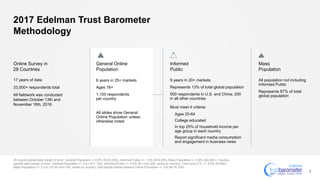
Informed
Public
9 years in 20+ markets
Represents 13% of total global population
500 respondents in U.S. and China; 200
in all other countries
Must meet 4 criteria:
Ages 25-64
College educated
In top 25% of household income per
age group in each country
Report significant media consumption
and engagement in business news
General Online
Population
6 years in 25+ markets
Ages 18+
1,150 respondents
per country
All slides show General
Online Population unless
otherwise noted
2017 Edelman Trust Barometer
Methodology
28-country global data margin of error: General Population +/-0.6% (N=32,200), Informed Public +/- 1.2% (N=6,200), Mass Population +/- 0.6% (26,000+). Country-
specific data margin of error: General Population +/- 2.9 ( N=1,150), Informed Public +/- 6.9% (N = min 200, varies by country), China and U.S. +/- 4.4% (N=500),
Mass Population +/- 3.0 to 3.6 (N =min 740, varies by country), half sample Global General Online Population +/- 0.8 (N=16,100).
2
17 years of data
33,000+ respondents total
All fieldwork was conducted
between October 13th and
November 16th, 2016
Online Survey in
28 Countries
Mass
Population
All population not including
Informed Public
Represents 87% of total
global population
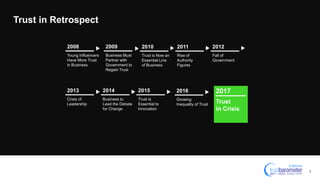
Trust in Retrospect
3
Business Must
Partner with
Government to
Regain Trust
2009
Young Influencers
Have More Trust
in Business
2008
Trust is Now an
Essential Line
of Business
2010
Rise of
Authority
Figures
2011
Fall of
Government
2012
Crisis of
Leadership
2013
Business to
Lead the Debate
for Change
2014
Trust is
Essential to
Innovation
2015
Trust
in Crisis
2017
Growing
Inequality of Trust
2016
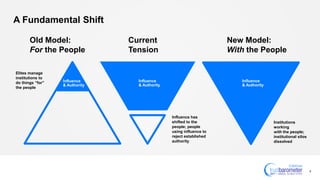
A Fundamental Shift
4
Current
Tension
Old Model:
For the People
New Model:
With the People
Elites manage
institutions to
do things “for”
the people
Influence has
shifted to the
people; people
using influence to
reject established
authority
Institutions
working
with the people;
institutional silos
dissolved
Influence
& Authority
Influence
& Authority
Influence
& Authority
Footer
5
Trust Themes
• Global Trust in Crisis
• India Bucks the Trend
• Building Trust
• Why Trust Matters
Global Trust in
Crisis
7
Footer
50% 55 53
48
42
53 52
43 41
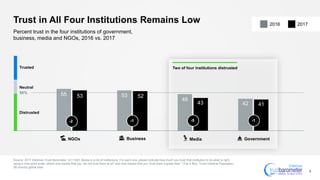
Trust in All Four Institutions Remains Low
Source: 2017 Edelman Trust Barometer. Q11-620. Below is a list of institutions. For each one, please indicate how much you trust that institution to do what is right
using a nine-point scale, where one means that you “do not trust them at all” and nine means that you “trust them a great deal.” (Top 4 Box, Trust) General Population,
28-country global total.
8
Percent trust in the four institutions of government,
business, media and NGOs, 2016 vs. 2017
Business MediaNGOs Government
Two of four institutions distrusted
Neutral
Trusted
Distrusted
-2 -1 -5 -1
20172016
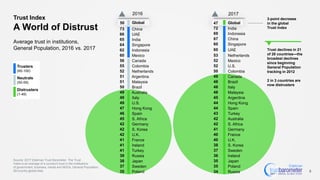
Trust Index
A World of Distrust
Average trust in institutions,
General Population, 2016 vs. 2017
9
47 Global
72 India
69 Indonesia
67 China
60 Singapore
60 UAE
53 Netherlands
52 Mexico
52 U.S.
50 Colombia
49 Canada
48 Brazil
48 Italy
48 Malaysia
45 Argentina
44 Hong Kong
44 Spain
43 Turkey
42 Australia
42 S. Africa
41 Germany
40 France
40 U.K.
38 S. Korea
37 Sweden
36 Ireland
35 Japan
35 Poland
34 Russia
2016 2017
50 Global
73 China
66 UAE
65 India
64 Singapore
62 Indonesia
60 Mexico
56 Canada
55 Colombia
52 Netherlands
51 Argentina
51 Malaysia
50 Brazil
49 Australia
49 Italy
49 U.S.
47 Hong Kong
46 Spain
45 S. Africa
42 Germany
42 S. Korea
42 U.K.
41 France
41 Ireland
41 Turkey
39 Russia
38 Japan
37 Sweden
35 Poland
Trusters
(60-100)
Neutrals
(50-59)
Distrusters
(1-49)
Source: 2017 Edelman Trust Barometer. The Trust
Index is an average of a country's trust in the institutions
of government, business, media and NGOs. General Population,
28-country global total.
3-point decrease
in the global
Trust Index
Trust declines in 21
of 28 countries—the
broadest declines
since beginning
General Population
tracking in 2012
2 in 3 countries are
now distrusters
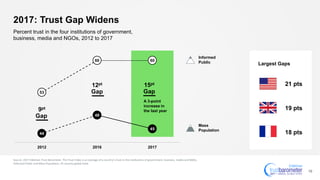
2017: Trust Gap Widens
Source: 2017 Edelman Trust Barometer. The Trust Index is an average of a country’s trust in the institutions of government, business, media and NGOs.
Informed Public and Mass Population, 25-country global total.
10
Percent trust in the four institutions of government,
business, media and NGOs, 2012 to 2017
21 pts
19 pts
18 pts
53
60 60
44
48
45
2012 2016 2017
Informed
Public
15pt
Gap
9pt
Gap
A 3-point
increase in
the last year
12pt
Gap
Largest Gaps
Mass
Population
53
47
21
23
31
39
43
46 46
48
52 53 54 55 56
58 58 58 59 59 59 60 60 60 61 61
64 64
71 71
Global28
GDP5
Russia
Sweden
Japan
Germany
Ireland
Netherlands
U.K.
Poland
Australia
Turkey
France
UAE
S.Korea
Malaysia
S.Africa
U.S.
Canada
HongKong
Italy
Brazil
Colombia
Spain
China
Singapore
Argentina
Indonesia
India
Mexico
Trust in NGOs Declines
Source: 2017 Edelman Trust Barometer. Q11-620. [TRACKING] [NGOs IN GENERAL] Below is a list of institutions. For each one, please indicate how much you trust
that institution to do what is right using a nine-point scale where one means that you “do not trust them at all” and nine means that you “trust them a great deal.“ (Top 4
Box, Trust) General Population, 28-country global total.
GDP 5 = U.S., China, Japan, Germany, U.K.
11
Percent trust in NGOs, and change from 2016 to 2017
Distrusted in 8 countries
50%
-2 +7 -3-6 +7-6-1-100-3+1+2-2+10-2 -2 -4 -2 -3-6 -3 -4 -5-3 -3 -6-2 -4 -2
Declines in 21 countries
Y-to-Y Change+−
NeutralDistrust Trust
NGOs less trusted than
business in 11 countries
Distrusted in 75% of countries
Trust in Government Further Evaporates
Source: 2017 Edelman Trust Barometer. Q11-620. [TRACKING] [GOVERNMENT IN GENERAL] Below is a list of institutions. For each one, please indicate how much
you trust that institution to do what is right using a nine-point scale where one means that you “do not trust them at all” and nine means that you “trust them a great
deal.“ (Top 4 Box, Trust) General Population, 28-country global total.
GDP 5 = U.S., China, Japan, Germany, U.K.
12
Percent trust in government, and change from 2016 to 2017
Declines in 14 countries
50%
41
47
15
20
24 24 25 25
28
31 32 32 33
36 37 37 37 38 40
43 44 45 47
51 51
69 71
75 75 76
Global28
GDP5
S.Africa
Poland
Brazil
Mexico
France
Spain
S.Korea
Italy
Colombia
Ireland
Argentina
U.K.
Australia
Japan
Malaysia
Germany
HongKong
Canada
Russia
Sweden
U.S.
Netherlands
Turkey
Singapore
Indonesia
India
UAE
China
0 +8 +2 +9 +13 +100+700+1+1+3+1+1 -1 -7 -2 -2 -1 -5 -10 -9 -5 -5 -3-1 -8 -8-1
Y-to-Y Change+−
NeutralDistrust Trust
43 43
25
29
31 31 32 32 32 33 33
39 40 40
42 42 42
44 44 45 45
47 47 48 48
54 54
65 66 67
Global28
GDP5
Turkey
Ireland
Poland
Russia
Australia
Japan
U.K.
France
Sweden
S.Africa
Argentina
S.Korea
Germany
HongKong
Malaysia
Spain
UAE
Canada
Colombia
Mexico
U.S.
Brazil
Italy
Netherlands
Singapore
China
India
Indonesia
Trust in Media Plunges to All-Time Lows
Source: 2017 Edelman Trust Barometer. Q11-620. [TRACKING] [MEDIA IN GENERAL] Below is a list of institutions. For each one, please indicate how much you
trust that institution to do what is right using a nine-point scale where one means that you “do not trust them at all” and nine means that you “trust them a great deal.“
(Top 4 Box, Trust) General Population, 28-country global total.
GDP 5 = U.S., China, Japan, Germany, U.K.
13
Percent trust in media, and change from 2016 to 2017
Distrusted in 82% of countries
50%
All-time low in 17 countries
-5 -11 +3 +4+2 -8-6-1-2-60-10-10-15-5-3-6 -13 -3 -2 -5-10 -6 -4 +2-10 -3 -7-5 -5
Y-to-Y Change+−
NeutralDistrust Trust
Business on the Brink of Distrust
Source: 2017 Edelman Trust Barometer. Q11-620. [TRACKING] [BUSINESS IN GENERAL] Below is a list of institutions. For each one, please indicate how much you
trust that institution to do what is right using a nine-point scale where one means that you “do not trust them at all” and nine means that you “trust them a great deal.“
(Top 4 Box, Trust) General Population, 28-country global total.
GDP 5 = U.S., China, Japan, Germany, U.K.
14
Percent trust in business, and change from 2016 to 2017
Distrusted in 13 countries
50%
52 51
29
34
39 40 41 41 43 43 45 45 46 46 48 50 50
55 56 56 58 58 60 61
64 64
67 67
74 76
Global28
GDP5
S.Korea
HongKong
Russia
Poland
Ireland
Japan
Germany
Turkey
Argentina
U.K.
Spain
Sweden
Australia
France
Canada
Italy
Malaysia
S.Africa
Singapore
U.S.
Netherlands
Brazil
Colombia
UAE
China
Mexico
India
Indonesia
-4 +4 -2 -2 -4 -2 +7 +4 -3 -6 -3 -3 -9 +5 +5-4 -5-1 0-8 -1 -2+1-2 -2 +1+1 +2 -6+1
Declines in 18 countries
Y-to-Y Change+−
NeutralDistrust Trust
India Bucks the
Trend
15
Footer
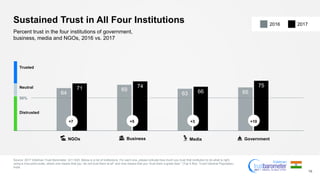
64
69
63 65
71 74
66
75
Sustained Trust in All Four Institutions
Source: 2017 Edelman Trust Barometer. Q11-620. Below is a list of institutions. For each one, please indicate how much you trust that institution to do what is right
using a nine-point scale, where one means that you “do not trust them at all” and nine means that you “trust them a great deal.” (Top 4 Box, Trust) General Population,
India.
16
Percent trust in the four institutions of government,
business, media and NGOs, 2016 vs. 2017
Business MediaNGOs Government
50%
Neutral
Trusted
Distrusted
+7 +5 +3 +10
20172016
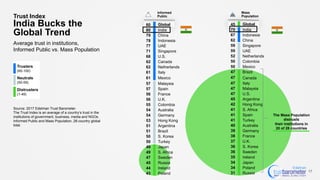
45 Global
70 India
67 Indonesia
62 China
59 Singapore
59 UAE
52 Netherlands
50 Colombia
50 Mexico
47 Brazil
47 Canada
47 Italy
47 Malaysia
47 U.S.
45 Argentina
42 Hong Kong
41 S. Africa
41 Spain
41 Turkey
40 Australia
39 Germany
38 France
37 U.K.
36 S. Korea
36 Sweden
35 Ireland
34 Japan
34 Poland
31 Russia
Trust Index
India Bucks the
Global Trend
Average trust in institutions,
Informed Public vs. Mass Population
The Mass Population
distrusts
their institutions in
20 of 28 countries
Source: 2017 Edelman Trust Barometer.
The Trust Index is an average of a country’s trust in the
institutions of government, business, media and NGOs.
Informed Public and Mass Population, 28-country global
total.
Mass
Population
Informed
Public
17
60 Global
80 India
79 China
78 Indonesia
77 UAE
71 Singapore
68 U.S.
62 Canada
62 Netherlands
61 Italy
61 Mexico
57 Malaysia
57 Spain
56 France
56 U.K.
55 Colombia
54 Australia
54 Germany
53 Hong Kong
51 Argentina
51 Brazil
50 S. Korea
50 Turkey
49 Japan
49 S. Africa
47 Sweden
45 Russia
44 Ireland
43 Poland
Trusters
(60-100)
Neutrals
(50-59)
Distrusters
(1-49)
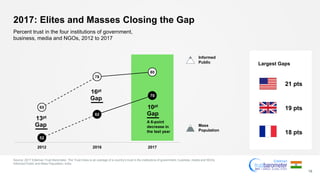
2017: Elites and Masses Closing the Gap
Source: 2017 Edelman Trust Barometer. The Trust Index is an average of a country’s trust in the institutions of government, business, media and NGOs.
Informed Public and Mass Population, India.
18
Percent trust in the four institutions of government,
business, media and NGOs, 2012 to 2017
21 pts
19 pts
18 pts
65
78
80
52
62
70
2012 2016 2017
Informed
Public
10pt
Gap
13pt
Gap
A 6-point
decrease in
the last year
16pt
Gap
Largest Gaps
Mass
Population
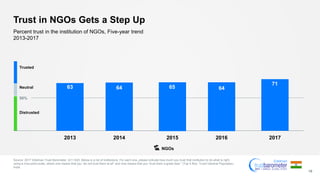
Trust in NGOs Gets a Step Up
Source: 2017 Edelman Trust Barometer. Q11-620. Below is a list of institutions. For each one, please indicate how much you trust that institution to do what is right
using a nine-point scale, where one means that you “do not trust them at all” and nine means that you “trust them a great deal.” (Top 4 Box, Trust) General Population,
India.
19
Percent trust in the institution of NGOs, Five-year trend
2013-2017
50%
Neutral
Trusted
Distrusted
2013 2014 2015 2016 2017
63 64 65 64
71
NGOs
20
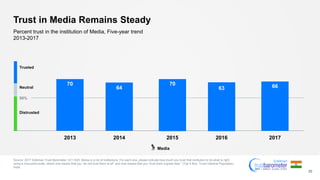
Trust in Media Remains Steady
Percent trust in the institution of Media, Five-year trend
2013-2017
50%
Neutral
Trusted
Distrusted
2013 2014 2015 2016 2017
70
64
70
63 66
Media
Source: 2017 Edelman Trust Barometer. Q11-620. Below is a list of institutions. For each one, please indicate how much you trust that institution to do what is right
using a nine-point scale, where one means that you “do not trust them at all” and nine means that you “trust them a great deal.” (Top 4 Box, Trust) General Population,
India.
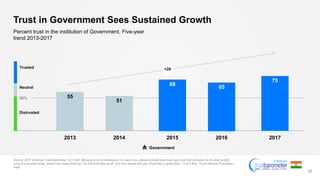
Trust in Government Sees Sustained Growth
Source: 2017 Edelman Trust Barometer. Q11-620. Below is a list of institutions. For each one, please indicate how much you trust that institution to do what is right
using a nine-point scale, where one means that you “do not trust them at all” and nine means that you “trust them a great deal.” (Top 4 Box, Trust) General Population,
India.
21
Percent trust in the institution of Government, Five-year
trend 2013-2017
Government
50%
Neutral
Trusted
Distrusted
2013 2014 2015 2016 2017
55
51
68
65
75
+20
How true is
this for you?
• Seeing change for the
better
• Positive about the future
• Believe change is
happening at the right pace
36%
45%
20%
India doesn’t escape
Systemic Uncertainty
Source: 2017 Edelman Trust Barometer. Q672-675, 678-680, 688-690. General Population, India. For details on how the “system failing” measure was calculated,
please refer to the Technical Appendix.
22
Not at all true
9 8 7 6 5 4 3 2 1
2 in 5 are uncertain
Completely true
System failing System workingMore than
23
NGOs 72 72 67
Business 72 75 74
Media 69 67 61
Government 72 76 80
Most Trusted
Government is the Most Trusted Institution NeutralDistrust Trust
% trust in each
institution
Among those
who believe the
System
is Working
Among those
who are
Uncertain
Among those
who believe the
System
is Failing
Most Trusted Most Trusted
Source: 2017 Edelman Trust Barometer. Q11-620. Below is a list of institutions. For each one, please indicate how much you trust that institution to do what is right
using a nine-point scale, where one means that you “do not trust them at all” and nine means that you “trust them a great deal.” (Top 4 Box, Trust) General Population,
India, cut by ‘the system is failing segments’.
Most Trusted
Most Trusted
Government is the most trusted
among everyone
Trust in Business Consistently High
Source: 2017 Edelman Trust Barometer. Q11-620. Below is a list of institutions. For each one, please indicate how much you trust that institution to do what is right
using a nine-point scale, where one means that you “do not trust them at all” and nine means that you “trust them a great deal.” (Top 4 Box, Trust) General Population,
India.
24
Percent trust in the institution of Business, Five-year
trend 2013-2017
50%
Neutral
Trusted
Distrusted
2013 2014 2015 2016 2017
68
63
68 69
74
Business
55%
60%
65%
70%
75%
80%
85%
90%
95%
2012 2013 2014 2015 2016 2017
Sector Trends
Tech Leads; Financial Services, Energy Rebound
Source: 2017 Edelman Trust Barometer. Q45-429. Please indicate how much you trust businesses in each of the following industries to do what is right. Again, please
use the same nine-point scale where one means that you “do not trust them at all” and nine means that you “trust them a great deal”. (Top 4 Box, Trust) General
Population, India.
25
Trust in each industry sector, 2012-2017
Industry 2012 2013 2014 2015 2016 2017
6 yr.
Trend
Technology 83% 87% 91% 89% 88% 92%
9
Food & Beverage 62% 76% 79% 78% 75% 85%
23
Automotive 74% 82% 87% 84% 82% 88%
14
Consumer Packaged Goods 64% 77% 78% 79% 76% 82%
18
Telecommunications 73% 83% 85% 84% 81% 86%
13
Energy 68% 80% 81% 80% 79% 87%
19
Financial Services 59% 71% 70% 77% 74% 83%
24
NeutralDistrust Trust
30
32 32
34
43
48 48
55 56
60 61 61
64 64
68 68 68
Mexico
Brazil
India
China
S.Korea
Italy
Spain
U.S.
France
Japan
Netherlands
U.K.
Australia
Germany
Canada
Sweden
Switzerland
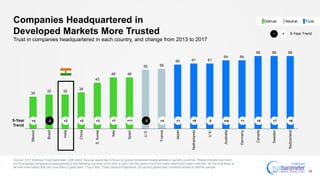
Companies Headquartered in
Developed Markets More Trusted
Source: 2017 Edelman Trust Barometer. Q26-Q422. Now we would like to focus on global companies headquartered in specific countries. Please indicate how much
you trust global companies headquartered in the following countries to do what is right. Use the same nine-point scale, where one means that you “do not trust them at
all” and nine means that you “trust them a great deal.” (Top 4 Box, Trust) General Population, 25-country global total, countries shown to half the sample.
26
Trust in companies headquartered in each country, and change from 2013 to 2017
+1+4+7 +11-2 +8 0 +1n/a +6+7+5-3+3+2+2+45-Year
Trend
NeutralDistrust Trust
5-Year Trend+−
45
58
61
67
69 69
71
75
80 81 81 81
83 84 84 84 85
China
Mexico
Brazil
S.Korea
Italy
Spain
Netherlands
Sweden
France
Australia
Canada
Switzerland
Germany
India
U.K.
U.S.
Japan
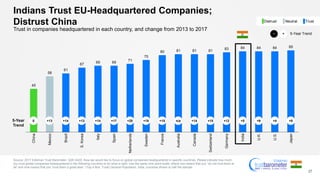
Indians Trust EU-Headquartered Companies;
Distrust China
Source: 2017 Edelman Trust Barometer. Q26-Q422. Now we would like to focus on global companies headquartered in specific countries. Please indicate how much
you trust global companies headquartered in the following countries to do what is right. Use the same nine-point scale, where one means that you “do not trust them at
all” and nine means that you “trust them a great deal.” (Top 4 Box, Trust) General Population, India, countries shown to half the sample.
27
Trust in companies headquartered in each country, and change from 2013 to 2017
n/a+15+17 +20+13 +14 +15 +5+12 +8+4+9+18+14+13+1405-Year
Trend
NeutralDistrust Trust
5-Year Trend+−
28
Footer
Building Trust
Who should communicate?
How should they communicate?
What should they communicate?
1
78 77 76 73 70 69 66
60 58Academic
expert
Technical
expert
Financial
industry
analyst
Apersonlike
yourself
CEO
Employee
Boardof
directors
NGO
representative
Government
official/
regulator
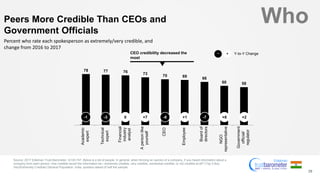
Peers More Credible Than CEOs and
Government Officials
Source: 2017 Edelman Trust Barometer. Q130-747. Below is a list of people. In general, when forming an opinion of a company, if you heard information about a
company from each person, how credible would the information be—extremely credible, very credible, somewhat credible, or not credible at all? (Top 2 Box,
Very/Extremely Credible) General Population, India, question asked of half the sample.
29
Percent who rate each spokesperson as extremely/very credible, and
change from 2016 to 2017
CEO credibility decreased the
most
-1 -3 0 +7 -8 +1 -7 +8 +2
Y-to-Y Change+−
Who
Partnerships/
programs to address
societal issues
Business practices/
crisis handling
Financial earnings &
operational
performance
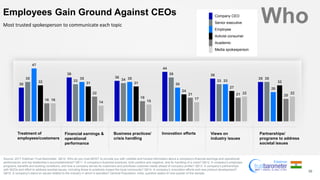
Employees Gain Ground Against CEOs
Source: 2017 Edelman Trust Barometer. Q610. Who do you trust MOST to provide you with credible and honest information about a company's financial earnings and operational
performance, and top leadership’s accomplishments? Q611. A company’s business practices, both positive and negative, and its handling of a crisis? Q612. A company’s employee
programs, benefits and working conditions, and how a company serves its customers and prioritizes customer needs ahead of company profits? Q613. A company’s partnerships
with NGOs and effort to address societal issues, including those to positively impact the local community? Q614. A company’s innovation efforts and new product development?
Q615. A company’s stand on issues related to the industry in which it operates? General Population, India, question asked of one-quarter of the sample.
30
Most trusted spokesperson to communicate each topic
Innovation effortsTreatment of
employees/customers
Views on
industry issues
Company CEO
Senior executive
Employee
Activist consumer
Academic
Media spokesperson
30
39
36
44
38
3535
33 34
39
33
35
47
35 35
30
33
26
32 31 31
24
27
32
16
22
18
21 21 20
16
14 15
17
22 22
Who
2012 2017
Search engines* 72 87
Traditional media 72 79
Online-only
media**
60 77
Social media 65 69
Owned media 53 63
Media as an
institution
60 66
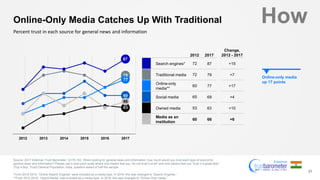
Online-Only Media Catches Up With Traditional
Source: 2017 Edelman Trust Barometer. Q178-182. When looking for general news and information, how much would you trust each type of source for
general news and information? Please use a nine-point scale where one means that you “do not trust it at all” and nine means that you “trust it a great deal.”
(Top 4 Box, Trust) General Population, India, question asked of half the sample
*From 2012-2015, “Online Search Engines” were included as a media type. In 2016, this was changed to “Search Engines.”
**From 2012-2015, “Hybrid Media” was included as a media type. In 2016, this was changed to “Online-Only media.”
Percent trust in each source for general news and information
31
Change,
2012 - 2017
+15
+7
+17
+4
+10
+6
Online-only media
up 17 points
79
77
69
87
63
66
2012 2013 2014 2015 2016 2017
How
32
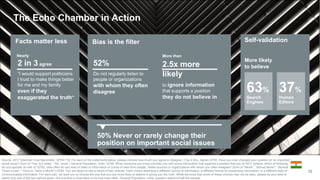
The Echo Chamber in Action
Facts matter less Bias is the filter Self-validation
2 in 3 agree
“I would support politicians
I trust to make things better
for me and my family
even if they
exaggerated the truth”
52%
Do not regularly listen to
people or organizations
with whom they often
disagree
More than
2.5x more
likely
to ignore information
that supports a position
they do not believe in
More likely
to believe
63%
Search
Engines
37%
Human
Editors
53%50% Never or rarely change their
position on important social issues
Source: 2017 Edelman Trust Barometer. Q709-718. For each of the statements below, please indicate how much you agree or disagree. (Top 4 Box, Agree) Q755. Have you ever changed your position on an important
social issue? (Sum of “Yes, but rarely”, “No, never”) General Population, India. Q749. When someone you know provides you with some information that supports a position that you do NOT believe, which of following
do you typically do with it? Q752. How often do you read or listen to information or points of view from people, media sources or organizations with whom you often disagree? (Sum of “Never”, “Almost Never”, “Several
Times a year”, “Once or Twice a Month”) Q754. You are about to see a series of two choices. Each choice describes a different source of information, a different format for presenting information, or a different style of
communicating information. For each pair, we want you to choose the one that you are more likely to believe is giving you the truth. While we know that some of these choices may not be easy, please do your best to
select only one of the two options given--the one that is most likely to be true most often. General Population, India, question asked of half the sample.
Nearly
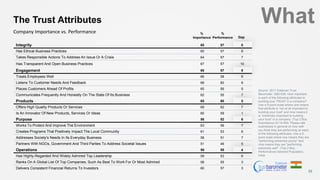
Integrity 65 57 8
Has Ethical Business Practices 65 57 8
Takes Responsible Actions To Address An Issue Or A Crisis 64 57 7
Has Transparent And Open Business Practices 67 57 10
Engagement 65 57 8
Treats Employees Well 66 58 8
Listens To Customer Needs And Feedback 68 60 8
Places Customers Ahead Of Profits 65 56 9
Communicates Frequently And Honestly On The State Of Its Business 62 55 7
Products 65 60 5
Offers High Quality Products Or Services 69 62 7
Is An Innovator Of New Products, Services Or Ideas 60 59 1
Purpose 58 52 6
Works To Protect And Improve The Environment 63 56 7
Creates Programs That Positively Impact The Local Community 61 53 8
Addresses Society's Needs In Its Everyday Business 58 51 7
Partners With NGOs, Government And Third Parties To Address Societal Issues 51 46 5
Operations 59 55 4
Has Highly-Regarded And Widely Admired Top Leadership 59 53 6
Ranks On A Global List Of Top Companies, Such As Best To Work For Or Most Admired 58 55 3
Delivers Consistent Financial Returns To Investors 60 57 3
The Trust Attributes
Company Importance vs. Performance %
Performance
%
Importance Gap
33
Source: 2017 Edelman Trust
Barometer. Q80-639. How important
is each of the following attributes to
building your TRUST in a company?
Use a 9-point scale where one means
that attribute is “not at all important to
building your trust” and nine means it
is “extremely important to building
your trust” in a company. (Top 2 Box,
Importance) Q114-654. Please rate
businesses in general on how well
you think they are performing on each
of the following attributes. Use a 9-
point scale where one means they are
"performing extremely poorly" and
nine means they are "performing
extremely well". (Top 2 Box,
Performance) General Population,
India.
What
Why Trust Matters
34
Footer
51
47
37
47
30
25
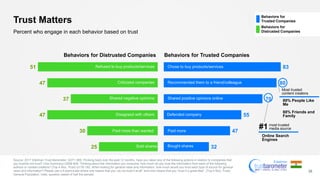
Trust Matters
Source: 2017 Edelman Trust Barometer. Q371-589. Thinking back over the past 12 months, have you taken any of the following actions in relation to companies that
you trust/do not trust? (Yes Summary) Q598-609. Thinking about the information you consume, how much do you trust the information from each of the following
authors or content creators? (Top 4 Box, Trust) Q178-182. When looking for general news and information, how much would you trust each type of source for general
news and information? Please use a 9-point scale where one means that you “do not trust it at all” and nine means that you “trust it a great deal”. (Top 4 Box, Trust)
General Population, India, question asked of half the sample.
35
Percent who engage in each behavior based on trust
Behaviors for Distrusted Companies Behaviors for Trusted Companies
Refused to buy products/services
Criticized companies
Shared negative opinions
Disagreed with others
Paid more than wanted
Sold shares
Chose to buy products/services
Recommended them to a friend/colleague
Shared positive opinions online
Defended company
Paid more
Bought shares
Most trusted
content creators
89% People Like
Me
88% Friends and
Family
most trusted
media source#1
Online Search
Engines
Behaviors for
Trusted Companies
Behaviors for
Distrusted Companies
83
80
70
55
47
32
Chose to buy products/services
Recommended them to a friend/colleague
Shared positive opinions online
Defended company
Paid more
Bought shares
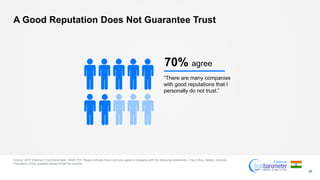
A Good Reputation Does Not Guarantee Trust
Source: 2017 Edelman Trust Barometer. Q249-757. Please indicate how much you agree or disagree with the following statements. (Top 4 Box, Agree). General
Population, India, question asked of half the sample.
36
70% agree
“There are many companies
with good reputations that I
personally do not trust.”
Source: 2017 Edelman Trust Barometer. Q732. What can businesses do that would cause the most damage to your trust in a better future?
(Please select up to five.) General Population, India, question asked of half the sample.
37
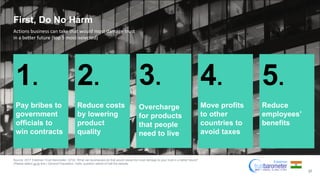
First, Do No Harm
Actions business can take that would most damage trust
in a better future (top 5 most-selected)
1.
Pay bribes to
government
officials to
win contracts
2.
Reduce costs
by lowering
product
quality
3.
Overcharge
for products
that people
need to live
4.
Move profits
to other
countries to
avoid taxes
5.
Reduce
employees’
benefits
38
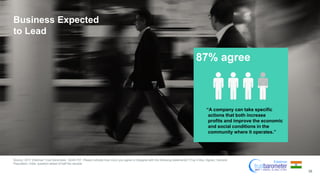
Business Expected
to Lead
Source: 2017 Edelman Trust Barometer. Q249-757. Please indicate how much you agree or disagree with the following statements? (Top 4 Box, Agree). General
Population, India, question asked of half the sample.
.
87% agree
“A company can take specific
actions that both increase
profits and improve the economic
and social conditions in the
community where it operates.”
Government Must Regulate to
Protect the Nation
Source: 2017 Edelman Trust Barometer. Q709-718. For each of the statements below, please indicate how much you agree or disagree. (Top 4 Box, Agree) General
Population, India.
39
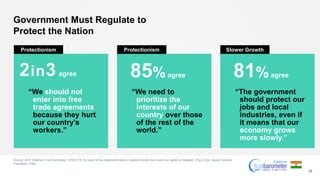
2in3 agree 85%agree 81%agree
Protectionism Slower Growth
“The government
should protect our
jobs and local
industries, even if
it means that our
economy grows
more slowly.”
“We need to
prioritize the
interests of our
country over those
of the rest of the
world.”
“We should not
enter into free
trade agreements
because they hurt
our country’s
workers.”
Protectionism
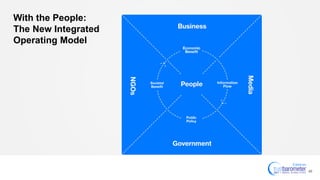
With the People:
The New Integrated
Operating Model
40
Appendices
Why Edelman Studies Trust
42
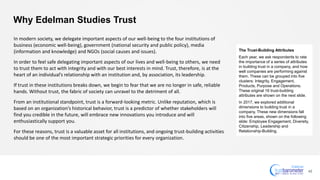
In modern society, we delegate important aspects of our well-being to the four institutions of
business (economic well-being), government (national security and public policy), media
(information and knowledge) and NGOs (social causes and issues).
In order to feel safe delegating important aspects of our lives and well-being to others, we need
to trust them to act with integrity and with our best interests in mind. Trust, therefore, is at the
heart of an individual’s relationship with an institution and, by association, its leadership.
If trust in these institutions breaks down, we begin to fear that we are no longer in safe, reliable
hands. Without trust, the fabric of society can unravel to the detriment of all.
From an institutional standpoint, trust is a forward-looking metric. Unlike reputation, which is
based on an organization’s historical behavior, trust is a predictor of whether stakeholders will
find you credible in the future, will embrace new innovations you introduce and will
enthusiastically support you.
For these reasons, trust is a valuable asset for all institutions, and ongoing trust-building activities
should be one of the most important strategic priorities for every organization.
The Trust-Building Attributes
Each year, we ask respondents to rate
the importance of a series of attributes
in building trust in a company, and how
well companies are performing against
them. These can be grouped into five
clusters: Integrity, Engagement,
Products, Purpose and Operations.
These original 16 trust-building
attributes are shown on the next slide.
In 2017, we explored additional
dimensions to building trust in a
company. These new dimensions fall
into five areas, shown on the following
slide: Employee Engagement, Diversity,
Citizenship, Leadership and
Relationship-Building.
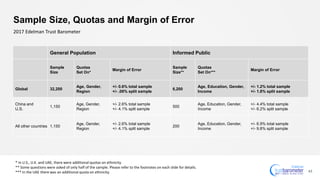
Sample Size, Quotas and Margin of Error
43
2017 Edelman Trust Barometer
General Population Informed Public
Sample
Size
Quotas
Set On*
Margin of Error
Sample
Size**
Quotas
Set On***
Margin of Error
Global 32,200
Age, Gender,
Region
+/- 0.6% total sample
+/- .08% split sample
6,200
Age, Education, Gender,
Income
+/- 1.2% total sample
+/- 1.8% split sample
China and
U.S.
1,150
Age, Gender,
Region
+/- 2.6% total sample
+/- 4.1% split sample
500
Age, Education, Gender,
Income
+/- 4.4% total sample
+/- 6.2% split sample
All other countries 1,150
Age, Gender,
Region
+/- 2.6% total sample
+/- 4.1% split sample
200
Age, Education, Gender,
Income
+/- 6.9% total sample
+/- 9.8% split sample
* In U.S., U.K. and UAE, there were additional quotas on ethnicity.
** Some questions were asked of only half of the sample. Please refer to the footnotes on each slide for details.
*** In the UAE there was an additional quota on ethnicity.
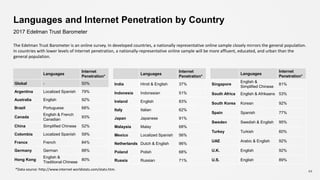
Languages and Internet Penetration by Country
The Edelman Trust Barometer is an online survey. In developed countries, a nationally representative online sample closely mirrors the general population.
In countries with lower levels of Internet penetration, a nationally-representative online sample will be more affluent, educated, and urban than the
general population.
44
Languages
Internet
Penetration*
Global - 50%
Argentina Localized Spanish 79%
Australia English 92%
Brazil Portuguese 68%
Canada
English & French
Canadian
93%
China Simplified Chinese 52%
Colombia Localized Spanish 59%
France French 84%
Germany German 88%
Hong Kong
English &
Traditional Chinese
80%
*Data source: http://www.internet worldstats.com/stats.htm.
Languages
Internet
Penetration*
India Hindi & English 37%
Indonesia Indonesian 51%
Ireland English 83%
Italy Italian 62%
Japan Japanese 91%
Malaysia Malay 68%
Mexico Localized Spanish 56%
Netherlands Dutch & English 96%
Poland Polish 68%
Russia Russian 71%
Languages
Internet
Penetration*
Singapore
English &
Simplified Chinese
81%
South Africa English & Afrikaans 53%
South Korea Korean 92%
Spain Spanish 77%
Sweden Swedish & English 95%
Turkey Turkish 60%
UAE Arabic & English 92%
U.K. English 92%
U.S. English 89%
2017 Edelman Trust Barometer
THANK YOU
Footer
45

2017 Edelman Trust Barometer - India

  • 1.
  • 2.
    Informed Public 9 years in20+ markets Represents 13% of total global population 500 respondents in U.S. and China; 200 in all other countries Must meet 4 criteria: Ages 25-64 College educated In top 25% of household income per age group in each country Report significant media consumption and engagement in business news General Online Population 6 years in 25+ markets Ages 18+ 1,150 respondents per country All slides show General Online Population unless otherwise noted 2017 Edelman Trust Barometer Methodology 28-country global data margin of error: General Population +/-0.6% (N=32,200), Informed Public +/- 1.2% (N=6,200), Mass Population +/- 0.6% (26,000+). Country- specific data margin of error: General Population +/- 2.9 ( N=1,150), Informed Public +/- 6.9% (N = min 200, varies by country), China and U.S. +/- 4.4% (N=500), Mass Population +/- 3.0 to 3.6 (N =min 740, varies by country), half sample Global General Online Population +/- 0.8 (N=16,100). 2 17 years of data 33,000+ respondents total All fieldwork was conducted between October 13th and November 16th, 2016 Online Survey in 28 Countries Mass Population All population not including Informed Public Represents 87% of total global population
  • 3.
    Trust in Retrospect 3 BusinessMust Partner with Government to Regain Trust 2009 Young Influencers Have More Trust in Business 2008 Trust is Now an Essential Line of Business 2010 Rise of Authority Figures 2011 Fall of Government 2012 Crisis of Leadership 2013 Business to Lead the Debate for Change 2014 Trust is Essential to Innovation 2015 Trust in Crisis 2017 Growing Inequality of Trust 2016
  • 4.
    A Fundamental Shift 4 Current Tension OldModel: For the People New Model: With the People Elites manage institutions to do things “for” the people Influence has shifted to the people; people using influence to reject established authority Institutions working with the people; institutional silos dissolved Influence & Authority Influence & Authority Influence & Authority
  • 5.
  • 6.
    Trust Themes • GlobalTrust in Crisis • India Bucks the Trend • Building Trust • Why Trust Matters
  • 7.
  • 8.
    50% 55 53 48 42 5352 43 41 Trust in All Four Institutions Remains Low Source: 2017 Edelman Trust Barometer. Q11-620. Below is a list of institutions. For each one, please indicate how much you trust that institution to do what is right using a nine-point scale, where one means that you “do not trust them at all” and nine means that you “trust them a great deal.” (Top 4 Box, Trust) General Population, 28-country global total. 8 Percent trust in the four institutions of government, business, media and NGOs, 2016 vs. 2017 Business MediaNGOs Government Two of four institutions distrusted Neutral Trusted Distrusted -2 -1 -5 -1 20172016
  • 9.
    Trust Index A Worldof Distrust Average trust in institutions, General Population, 2016 vs. 2017 9 47 Global 72 India 69 Indonesia 67 China 60 Singapore 60 UAE 53 Netherlands 52 Mexico 52 U.S. 50 Colombia 49 Canada 48 Brazil 48 Italy 48 Malaysia 45 Argentina 44 Hong Kong 44 Spain 43 Turkey 42 Australia 42 S. Africa 41 Germany 40 France 40 U.K. 38 S. Korea 37 Sweden 36 Ireland 35 Japan 35 Poland 34 Russia 2016 2017 50 Global 73 China 66 UAE 65 India 64 Singapore 62 Indonesia 60 Mexico 56 Canada 55 Colombia 52 Netherlands 51 Argentina 51 Malaysia 50 Brazil 49 Australia 49 Italy 49 U.S. 47 Hong Kong 46 Spain 45 S. Africa 42 Germany 42 S. Korea 42 U.K. 41 France 41 Ireland 41 Turkey 39 Russia 38 Japan 37 Sweden 35 Poland Trusters (60-100) Neutrals (50-59) Distrusters (1-49) Source: 2017 Edelman Trust Barometer. The Trust Index is an average of a country's trust in the institutions of government, business, media and NGOs. General Population, 28-country global total. 3-point decrease in the global Trust Index Trust declines in 21 of 28 countries—the broadest declines since beginning General Population tracking in 2012 2 in 3 countries are now distrusters
  • 10.
    2017: Trust GapWidens Source: 2017 Edelman Trust Barometer. The Trust Index is an average of a country’s trust in the institutions of government, business, media and NGOs. Informed Public and Mass Population, 25-country global total. 10 Percent trust in the four institutions of government, business, media and NGOs, 2012 to 2017 21 pts 19 pts 18 pts 53 60 60 44 48 45 2012 2016 2017 Informed Public 15pt Gap 9pt Gap A 3-point increase in the last year 12pt Gap Largest Gaps Mass Population
  • 11.
    53 47 21 23 31 39 43 46 46 48 52 5354 55 56 58 58 58 59 59 59 60 60 60 61 61 64 64 71 71 Global28 GDP5 Russia Sweden Japan Germany Ireland Netherlands U.K. Poland Australia Turkey France UAE S.Korea Malaysia S.Africa U.S. Canada HongKong Italy Brazil Colombia Spain China Singapore Argentina Indonesia India Mexico Trust in NGOs Declines Source: 2017 Edelman Trust Barometer. Q11-620. [TRACKING] [NGOs IN GENERAL] Below is a list of institutions. For each one, please indicate how much you trust that institution to do what is right using a nine-point scale where one means that you “do not trust them at all” and nine means that you “trust them a great deal.“ (Top 4 Box, Trust) General Population, 28-country global total. GDP 5 = U.S., China, Japan, Germany, U.K. 11 Percent trust in NGOs, and change from 2016 to 2017 Distrusted in 8 countries 50% -2 +7 -3-6 +7-6-1-100-3+1+2-2+10-2 -2 -4 -2 -3-6 -3 -4 -5-3 -3 -6-2 -4 -2 Declines in 21 countries Y-to-Y Change+− NeutralDistrust Trust NGOs less trusted than business in 11 countries
  • 12.
    Distrusted in 75%of countries Trust in Government Further Evaporates Source: 2017 Edelman Trust Barometer. Q11-620. [TRACKING] [GOVERNMENT IN GENERAL] Below is a list of institutions. For each one, please indicate how much you trust that institution to do what is right using a nine-point scale where one means that you “do not trust them at all” and nine means that you “trust them a great deal.“ (Top 4 Box, Trust) General Population, 28-country global total. GDP 5 = U.S., China, Japan, Germany, U.K. 12 Percent trust in government, and change from 2016 to 2017 Declines in 14 countries 50% 41 47 15 20 24 24 25 25 28 31 32 32 33 36 37 37 37 38 40 43 44 45 47 51 51 69 71 75 75 76 Global28 GDP5 S.Africa Poland Brazil Mexico France Spain S.Korea Italy Colombia Ireland Argentina U.K. Australia Japan Malaysia Germany HongKong Canada Russia Sweden U.S. Netherlands Turkey Singapore Indonesia India UAE China 0 +8 +2 +9 +13 +100+700+1+1+3+1+1 -1 -7 -2 -2 -1 -5 -10 -9 -5 -5 -3-1 -8 -8-1 Y-to-Y Change+− NeutralDistrust Trust
  • 13.
    43 43 25 29 31 3132 32 32 33 33 39 40 40 42 42 42 44 44 45 45 47 47 48 48 54 54 65 66 67 Global28 GDP5 Turkey Ireland Poland Russia Australia Japan U.K. France Sweden S.Africa Argentina S.Korea Germany HongKong Malaysia Spain UAE Canada Colombia Mexico U.S. Brazil Italy Netherlands Singapore China India Indonesia Trust in Media Plunges to All-Time Lows Source: 2017 Edelman Trust Barometer. Q11-620. [TRACKING] [MEDIA IN GENERAL] Below is a list of institutions. For each one, please indicate how much you trust that institution to do what is right using a nine-point scale where one means that you “do not trust them at all” and nine means that you “trust them a great deal.“ (Top 4 Box, Trust) General Population, 28-country global total. GDP 5 = U.S., China, Japan, Germany, U.K. 13 Percent trust in media, and change from 2016 to 2017 Distrusted in 82% of countries 50% All-time low in 17 countries -5 -11 +3 +4+2 -8-6-1-2-60-10-10-15-5-3-6 -13 -3 -2 -5-10 -6 -4 +2-10 -3 -7-5 -5 Y-to-Y Change+− NeutralDistrust Trust
  • 14.
    Business on theBrink of Distrust Source: 2017 Edelman Trust Barometer. Q11-620. [TRACKING] [BUSINESS IN GENERAL] Below is a list of institutions. For each one, please indicate how much you trust that institution to do what is right using a nine-point scale where one means that you “do not trust them at all” and nine means that you “trust them a great deal.“ (Top 4 Box, Trust) General Population, 28-country global total. GDP 5 = U.S., China, Japan, Germany, U.K. 14 Percent trust in business, and change from 2016 to 2017 Distrusted in 13 countries 50% 52 51 29 34 39 40 41 41 43 43 45 45 46 46 48 50 50 55 56 56 58 58 60 61 64 64 67 67 74 76 Global28 GDP5 S.Korea HongKong Russia Poland Ireland Japan Germany Turkey Argentina U.K. Spain Sweden Australia France Canada Italy Malaysia S.Africa Singapore U.S. Netherlands Brazil Colombia UAE China Mexico India Indonesia -4 +4 -2 -2 -4 -2 +7 +4 -3 -6 -3 -3 -9 +5 +5-4 -5-1 0-8 -1 -2+1-2 -2 +1+1 +2 -6+1 Declines in 18 countries Y-to-Y Change+− NeutralDistrust Trust
  • 15.
  • 16.
    64 69 63 65 71 74 66 75 SustainedTrust in All Four Institutions Source: 2017 Edelman Trust Barometer. Q11-620. Below is a list of institutions. For each one, please indicate how much you trust that institution to do what is right using a nine-point scale, where one means that you “do not trust them at all” and nine means that you “trust them a great deal.” (Top 4 Box, Trust) General Population, India. 16 Percent trust in the four institutions of government, business, media and NGOs, 2016 vs. 2017 Business MediaNGOs Government 50% Neutral Trusted Distrusted +7 +5 +3 +10 20172016
  • 17.
    45 Global 70 India 67Indonesia 62 China 59 Singapore 59 UAE 52 Netherlands 50 Colombia 50 Mexico 47 Brazil 47 Canada 47 Italy 47 Malaysia 47 U.S. 45 Argentina 42 Hong Kong 41 S. Africa 41 Spain 41 Turkey 40 Australia 39 Germany 38 France 37 U.K. 36 S. Korea 36 Sweden 35 Ireland 34 Japan 34 Poland 31 Russia Trust Index India Bucks the Global Trend Average trust in institutions, Informed Public vs. Mass Population The Mass Population distrusts their institutions in 20 of 28 countries Source: 2017 Edelman Trust Barometer. The Trust Index is an average of a country’s trust in the institutions of government, business, media and NGOs. Informed Public and Mass Population, 28-country global total. Mass Population Informed Public 17 60 Global 80 India 79 China 78 Indonesia 77 UAE 71 Singapore 68 U.S. 62 Canada 62 Netherlands 61 Italy 61 Mexico 57 Malaysia 57 Spain 56 France 56 U.K. 55 Colombia 54 Australia 54 Germany 53 Hong Kong 51 Argentina 51 Brazil 50 S. Korea 50 Turkey 49 Japan 49 S. Africa 47 Sweden 45 Russia 44 Ireland 43 Poland Trusters (60-100) Neutrals (50-59) Distrusters (1-49)
  • 18.
    2017: Elites andMasses Closing the Gap Source: 2017 Edelman Trust Barometer. The Trust Index is an average of a country’s trust in the institutions of government, business, media and NGOs. Informed Public and Mass Population, India. 18 Percent trust in the four institutions of government, business, media and NGOs, 2012 to 2017 21 pts 19 pts 18 pts 65 78 80 52 62 70 2012 2016 2017 Informed Public 10pt Gap 13pt Gap A 6-point decrease in the last year 16pt Gap Largest Gaps Mass Population
  • 19.
    Trust in NGOsGets a Step Up Source: 2017 Edelman Trust Barometer. Q11-620. Below is a list of institutions. For each one, please indicate how much you trust that institution to do what is right using a nine-point scale, where one means that you “do not trust them at all” and nine means that you “trust them a great deal.” (Top 4 Box, Trust) General Population, India. 19 Percent trust in the institution of NGOs, Five-year trend 2013-2017 50% Neutral Trusted Distrusted 2013 2014 2015 2016 2017 63 64 65 64 71 NGOs
  • 20.
    20 Trust in MediaRemains Steady Percent trust in the institution of Media, Five-year trend 2013-2017 50% Neutral Trusted Distrusted 2013 2014 2015 2016 2017 70 64 70 63 66 Media Source: 2017 Edelman Trust Barometer. Q11-620. Below is a list of institutions. For each one, please indicate how much you trust that institution to do what is right using a nine-point scale, where one means that you “do not trust them at all” and nine means that you “trust them a great deal.” (Top 4 Box, Trust) General Population, India.
  • 21.
    Trust in GovernmentSees Sustained Growth Source: 2017 Edelman Trust Barometer. Q11-620. Below is a list of institutions. For each one, please indicate how much you trust that institution to do what is right using a nine-point scale, where one means that you “do not trust them at all” and nine means that you “trust them a great deal.” (Top 4 Box, Trust) General Population, India. 21 Percent trust in the institution of Government, Five-year trend 2013-2017 Government 50% Neutral Trusted Distrusted 2013 2014 2015 2016 2017 55 51 68 65 75 +20
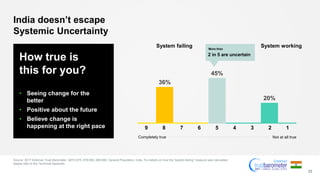
  • 22.
    How true is thisfor you? • Seeing change for the better • Positive about the future • Believe change is happening at the right pace 36% 45% 20% India doesn’t escape Systemic Uncertainty Source: 2017 Edelman Trust Barometer. Q672-675, 678-680, 688-690. General Population, India. For details on how the “system failing” measure was calculated, please refer to the Technical Appendix. 22 Not at all true 9 8 7 6 5 4 3 2 1 2 in 5 are uncertain Completely true System failing System workingMore than
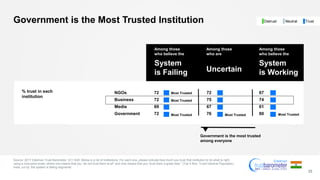
  • 23.
    23 NGOs 72 7267 Business 72 75 74 Media 69 67 61 Government 72 76 80 Most Trusted Government is the Most Trusted Institution NeutralDistrust Trust % trust in each institution Among those who believe the System is Working Among those who are Uncertain Among those who believe the System is Failing Most Trusted Most Trusted Source: 2017 Edelman Trust Barometer. Q11-620. Below is a list of institutions. For each one, please indicate how much you trust that institution to do what is right using a nine-point scale, where one means that you “do not trust them at all” and nine means that you “trust them a great deal.” (Top 4 Box, Trust) General Population, India, cut by ‘the system is failing segments’. Most Trusted Most Trusted Government is the most trusted among everyone
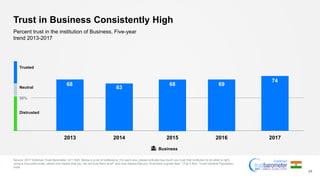
  • 24.
    Trust in BusinessConsistently High Source: 2017 Edelman Trust Barometer. Q11-620. Below is a list of institutions. For each one, please indicate how much you trust that institution to do what is right using a nine-point scale, where one means that you “do not trust them at all” and nine means that you “trust them a great deal.” (Top 4 Box, Trust) General Population, India. 24 Percent trust in the institution of Business, Five-year trend 2013-2017 50% Neutral Trusted Distrusted 2013 2014 2015 2016 2017 68 63 68 69 74 Business
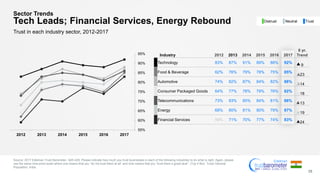
  • 25.
    55% 60% 65% 70% 75% 80% 85% 90% 95% 2012 2013 20142015 2016 2017 Sector Trends Tech Leads; Financial Services, Energy Rebound Source: 2017 Edelman Trust Barometer. Q45-429. Please indicate how much you trust businesses in each of the following industries to do what is right. Again, please use the same nine-point scale where one means that you “do not trust them at all” and nine means that you “trust them a great deal”. (Top 4 Box, Trust) General Population, India. 25 Trust in each industry sector, 2012-2017 Industry 2012 2013 2014 2015 2016 2017 6 yr. Trend Technology 83% 87% 91% 89% 88% 92% 9 Food & Beverage 62% 76% 79% 78% 75% 85% 23 Automotive 74% 82% 87% 84% 82% 88% 14 Consumer Packaged Goods 64% 77% 78% 79% 76% 82% 18 Telecommunications 73% 83% 85% 84% 81% 86% 13 Energy 68% 80% 81% 80% 79% 87% 19 Financial Services 59% 71% 70% 77% 74% 83% 24 NeutralDistrust Trust
  • 26.
    30 32 32 34 43 48 48 5556 60 61 61 64 64 68 68 68 Mexico Brazil India China S.Korea Italy Spain U.S. France Japan Netherlands U.K. Australia Germany Canada Sweden Switzerland Companies Headquartered in Developed Markets More Trusted Source: 2017 Edelman Trust Barometer. Q26-Q422. Now we would like to focus on global companies headquartered in specific countries. Please indicate how much you trust global companies headquartered in the following countries to do what is right. Use the same nine-point scale, where one means that you “do not trust them at all” and nine means that you “trust them a great deal.” (Top 4 Box, Trust) General Population, 25-country global total, countries shown to half the sample. 26 Trust in companies headquartered in each country, and change from 2013 to 2017 +1+4+7 +11-2 +8 0 +1n/a +6+7+5-3+3+2+2+45-Year Trend NeutralDistrust Trust 5-Year Trend+−
  • 27.
    45 58 61 67 69 69 71 75 80 8181 81 83 84 84 84 85 China Mexico Brazil S.Korea Italy Spain Netherlands Sweden France Australia Canada Switzerland Germany India U.K. U.S. Japan Indians Trust EU-Headquartered Companies; Distrust China Source: 2017 Edelman Trust Barometer. Q26-Q422. Now we would like to focus on global companies headquartered in specific countries. Please indicate how much you trust global companies headquartered in the following countries to do what is right. Use the same nine-point scale, where one means that you “do not trust them at all” and nine means that you “trust them a great deal.” (Top 4 Box, Trust) General Population, India, countries shown to half the sample. 27 Trust in companies headquartered in each country, and change from 2013 to 2017 n/a+15+17 +20+13 +14 +15 +5+12 +8+4+9+18+14+13+1405-Year Trend NeutralDistrust Trust 5-Year Trend+−
  • 28.
    28 Footer Building Trust Who shouldcommunicate? How should they communicate? What should they communicate?
  • 29.
    1 78 77 7673 70 69 66 60 58Academic expert Technical expert Financial industry analyst Apersonlike yourself CEO Employee Boardof directors NGO representative Government official/ regulator Peers More Credible Than CEOs and Government Officials Source: 2017 Edelman Trust Barometer. Q130-747. Below is a list of people. In general, when forming an opinion of a company, if you heard information about a company from each person, how credible would the information be—extremely credible, very credible, somewhat credible, or not credible at all? (Top 2 Box, Very/Extremely Credible) General Population, India, question asked of half the sample. 29 Percent who rate each spokesperson as extremely/very credible, and change from 2016 to 2017 CEO credibility decreased the most -1 -3 0 +7 -8 +1 -7 +8 +2 Y-to-Y Change+− Who
  • 30.
    Partnerships/ programs to address societalissues Business practices/ crisis handling Financial earnings & operational performance Employees Gain Ground Against CEOs Source: 2017 Edelman Trust Barometer. Q610. Who do you trust MOST to provide you with credible and honest information about a company's financial earnings and operational performance, and top leadership’s accomplishments? Q611. A company’s business practices, both positive and negative, and its handling of a crisis? Q612. A company’s employee programs, benefits and working conditions, and how a company serves its customers and prioritizes customer needs ahead of company profits? Q613. A company’s partnerships with NGOs and effort to address societal issues, including those to positively impact the local community? Q614. A company’s innovation efforts and new product development? Q615. A company’s stand on issues related to the industry in which it operates? General Population, India, question asked of one-quarter of the sample. 30 Most trusted spokesperson to communicate each topic Innovation effortsTreatment of employees/customers Views on industry issues Company CEO Senior executive Employee Activist consumer Academic Media spokesperson 30 39 36 44 38 3535 33 34 39 33 35 47 35 35 30 33 26 32 31 31 24 27 32 16 22 18 21 21 20 16 14 15 17 22 22 Who
  • 31.
    2012 2017 Search engines*72 87 Traditional media 72 79 Online-only media** 60 77 Social media 65 69 Owned media 53 63 Media as an institution 60 66 Online-Only Media Catches Up With Traditional Source: 2017 Edelman Trust Barometer. Q178-182. When looking for general news and information, how much would you trust each type of source for general news and information? Please use a nine-point scale where one means that you “do not trust it at all” and nine means that you “trust it a great deal.” (Top 4 Box, Trust) General Population, India, question asked of half the sample *From 2012-2015, “Online Search Engines” were included as a media type. In 2016, this was changed to “Search Engines.” **From 2012-2015, “Hybrid Media” was included as a media type. In 2016, this was changed to “Online-Only media.” Percent trust in each source for general news and information 31 Change, 2012 - 2017 +15 +7 +17 +4 +10 +6 Online-only media up 17 points 79 77 69 87 63 66 2012 2013 2014 2015 2016 2017 How
  • 32.
    32 The Echo Chamberin Action Facts matter less Bias is the filter Self-validation 2 in 3 agree “I would support politicians I trust to make things better for me and my family even if they exaggerated the truth” 52% Do not regularly listen to people or organizations with whom they often disagree More than 2.5x more likely to ignore information that supports a position they do not believe in More likely to believe 63% Search Engines 37% Human Editors 53%50% Never or rarely change their position on important social issues Source: 2017 Edelman Trust Barometer. Q709-718. For each of the statements below, please indicate how much you agree or disagree. (Top 4 Box, Agree) Q755. Have you ever changed your position on an important social issue? (Sum of “Yes, but rarely”, “No, never”) General Population, India. Q749. When someone you know provides you with some information that supports a position that you do NOT believe, which of following do you typically do with it? Q752. How often do you read or listen to information or points of view from people, media sources or organizations with whom you often disagree? (Sum of “Never”, “Almost Never”, “Several Times a year”, “Once or Twice a Month”) Q754. You are about to see a series of two choices. Each choice describes a different source of information, a different format for presenting information, or a different style of communicating information. For each pair, we want you to choose the one that you are more likely to believe is giving you the truth. While we know that some of these choices may not be easy, please do your best to select only one of the two options given--the one that is most likely to be true most often. General Population, India, question asked of half the sample. Nearly
  • 33.
    Integrity 65 578 Has Ethical Business Practices 65 57 8 Takes Responsible Actions To Address An Issue Or A Crisis 64 57 7 Has Transparent And Open Business Practices 67 57 10 Engagement 65 57 8 Treats Employees Well 66 58 8 Listens To Customer Needs And Feedback 68 60 8 Places Customers Ahead Of Profits 65 56 9 Communicates Frequently And Honestly On The State Of Its Business 62 55 7 Products 65 60 5 Offers High Quality Products Or Services 69 62 7 Is An Innovator Of New Products, Services Or Ideas 60 59 1 Purpose 58 52 6 Works To Protect And Improve The Environment 63 56 7 Creates Programs That Positively Impact The Local Community 61 53 8 Addresses Society's Needs In Its Everyday Business 58 51 7 Partners With NGOs, Government And Third Parties To Address Societal Issues 51 46 5 Operations 59 55 4 Has Highly-Regarded And Widely Admired Top Leadership 59 53 6 Ranks On A Global List Of Top Companies, Such As Best To Work For Or Most Admired 58 55 3 Delivers Consistent Financial Returns To Investors 60 57 3 The Trust Attributes Company Importance vs. Performance % Performance % Importance Gap 33 Source: 2017 Edelman Trust Barometer. Q80-639. How important is each of the following attributes to building your TRUST in a company? Use a 9-point scale where one means that attribute is “not at all important to building your trust” and nine means it is “extremely important to building your trust” in a company. (Top 2 Box, Importance) Q114-654. Please rate businesses in general on how well you think they are performing on each of the following attributes. Use a 9- point scale where one means they are "performing extremely poorly" and nine means they are "performing extremely well". (Top 2 Box, Performance) General Population, India. What
  • 34.
  • 35.
    51 47 37 47 30 25 Trust Matters Source: 2017Edelman Trust Barometer. Q371-589. Thinking back over the past 12 months, have you taken any of the following actions in relation to companies that you trust/do not trust? (Yes Summary) Q598-609. Thinking about the information you consume, how much do you trust the information from each of the following authors or content creators? (Top 4 Box, Trust) Q178-182. When looking for general news and information, how much would you trust each type of source for general news and information? Please use a 9-point scale where one means that you “do not trust it at all” and nine means that you “trust it a great deal”. (Top 4 Box, Trust) General Population, India, question asked of half the sample. 35 Percent who engage in each behavior based on trust Behaviors for Distrusted Companies Behaviors for Trusted Companies Refused to buy products/services Criticized companies Shared negative opinions Disagreed with others Paid more than wanted Sold shares Chose to buy products/services Recommended them to a friend/colleague Shared positive opinions online Defended company Paid more Bought shares Most trusted content creators 89% People Like Me 88% Friends and Family most trusted media source#1 Online Search Engines Behaviors for Trusted Companies Behaviors for Distrusted Companies 83 80 70 55 47 32 Chose to buy products/services Recommended them to a friend/colleague Shared positive opinions online Defended company Paid more Bought shares
  • 36.
    A Good ReputationDoes Not Guarantee Trust Source: 2017 Edelman Trust Barometer. Q249-757. Please indicate how much you agree or disagree with the following statements. (Top 4 Box, Agree). General Population, India, question asked of half the sample. 36 70% agree “There are many companies with good reputations that I personally do not trust.”
  • 37.
    Source: 2017 EdelmanTrust Barometer. Q732. What can businesses do that would cause the most damage to your trust in a better future? (Please select up to five.) General Population, India, question asked of half the sample. 37 First, Do No Harm Actions business can take that would most damage trust in a better future (top 5 most-selected) 1. Pay bribes to government officials to win contracts 2. Reduce costs by lowering product quality 3. Overcharge for products that people need to live 4. Move profits to other countries to avoid taxes 5. Reduce employees’ benefits
  • 38.
    38 Business Expected to Lead Source:2017 Edelman Trust Barometer. Q249-757. Please indicate how much you agree or disagree with the following statements? (Top 4 Box, Agree). General Population, India, question asked of half the sample. . 87% agree “A company can take specific actions that both increase profits and improve the economic and social conditions in the community where it operates.”
  • 39.
    Government Must Regulateto Protect the Nation Source: 2017 Edelman Trust Barometer. Q709-718. For each of the statements below, please indicate how much you agree or disagree. (Top 4 Box, Agree) General Population, India. 39 2in3 agree 85%agree 81%agree Protectionism Slower Growth “The government should protect our jobs and local industries, even if it means that our economy grows more slowly.” “We need to prioritize the interests of our country over those of the rest of the world.” “We should not enter into free trade agreements because they hurt our country’s workers.” Protectionism
  • 40.
    With the People: TheNew Integrated Operating Model 40
  • 41.
  • 42.
    Why Edelman StudiesTrust 42 In modern society, we delegate important aspects of our well-being to the four institutions of business (economic well-being), government (national security and public policy), media (information and knowledge) and NGOs (social causes and issues). In order to feel safe delegating important aspects of our lives and well-being to others, we need to trust them to act with integrity and with our best interests in mind. Trust, therefore, is at the heart of an individual’s relationship with an institution and, by association, its leadership. If trust in these institutions breaks down, we begin to fear that we are no longer in safe, reliable hands. Without trust, the fabric of society can unravel to the detriment of all. From an institutional standpoint, trust is a forward-looking metric. Unlike reputation, which is based on an organization’s historical behavior, trust is a predictor of whether stakeholders will find you credible in the future, will embrace new innovations you introduce and will enthusiastically support you. For these reasons, trust is a valuable asset for all institutions, and ongoing trust-building activities should be one of the most important strategic priorities for every organization. The Trust-Building Attributes Each year, we ask respondents to rate the importance of a series of attributes in building trust in a company, and how well companies are performing against them. These can be grouped into five clusters: Integrity, Engagement, Products, Purpose and Operations. These original 16 trust-building attributes are shown on the next slide. In 2017, we explored additional dimensions to building trust in a company. These new dimensions fall into five areas, shown on the following slide: Employee Engagement, Diversity, Citizenship, Leadership and Relationship-Building.
  • 43.
    Sample Size, Quotasand Margin of Error 43 2017 Edelman Trust Barometer General Population Informed Public Sample Size Quotas Set On* Margin of Error Sample Size** Quotas Set On*** Margin of Error Global 32,200 Age, Gender, Region +/- 0.6% total sample +/- .08% split sample 6,200 Age, Education, Gender, Income +/- 1.2% total sample +/- 1.8% split sample China and U.S. 1,150 Age, Gender, Region +/- 2.6% total sample +/- 4.1% split sample 500 Age, Education, Gender, Income +/- 4.4% total sample +/- 6.2% split sample All other countries 1,150 Age, Gender, Region +/- 2.6% total sample +/- 4.1% split sample 200 Age, Education, Gender, Income +/- 6.9% total sample +/- 9.8% split sample * In U.S., U.K. and UAE, there were additional quotas on ethnicity. ** Some questions were asked of only half of the sample. Please refer to the footnotes on each slide for details. *** In the UAE there was an additional quota on ethnicity.
  • 44.
    Languages and InternetPenetration by Country The Edelman Trust Barometer is an online survey. In developed countries, a nationally representative online sample closely mirrors the general population. In countries with lower levels of Internet penetration, a nationally-representative online sample will be more affluent, educated, and urban than the general population. 44 Languages Internet Penetration* Global - 50% Argentina Localized Spanish 79% Australia English 92% Brazil Portuguese 68% Canada English & French Canadian 93% China Simplified Chinese 52% Colombia Localized Spanish 59% France French 84% Germany German 88% Hong Kong English & Traditional Chinese 80% *Data source: http://www.internet worldstats.com/stats.htm. Languages Internet Penetration* India Hindi & English 37% Indonesia Indonesian 51% Ireland English 83% Italy Italian 62% Japan Japanese 91% Malaysia Malay 68% Mexico Localized Spanish 56% Netherlands Dutch & English 96% Poland Polish 68% Russia Russian 71% Languages Internet Penetration* Singapore English & Simplified Chinese 81% South Africa English & Afrikaans 53% South Korea Korean 92% Spain Spanish 77% Sweden Swedish & English 95% Turkey Turkish 60% UAE Arabic & English 92% U.K. English 92% U.S. English 89% 2017 Edelman Trust Barometer
  • 45.