A Community-Based Solution to
Reduce Stunting & Malnutrition
in Amhara children
1
AMHARA
Maternal
Malnutrition
Infant
undernutrition
Prevalence of
Pediatric
Stunting
Educational &
Economic Deficits
Poverty & Poor
Health Prognoses
Cultural
Considerations
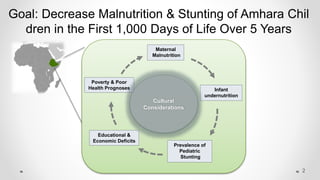
Goal: Decrease Malnutrition & Stunting of Amhara Chil
dren in the First 1,000 Days of Life Over 5 Years
2
Cultural Considerations
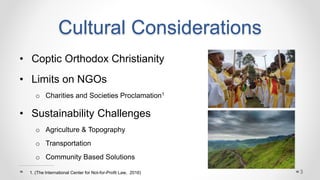
• Coptic Orthodox Christianity
• Limits on NGOs
o Charities and Societies Proclamation1
• Sustainability Challenges
o Agriculture & Topography
o Transportation
o Community Based Solutions
31. (The International Center for Not-for-Profit Law, 2016)
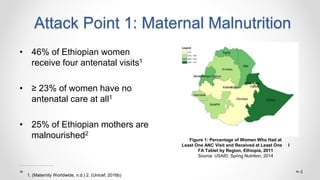
Attack Point 1: Maternal Malnutrition
• 46% of Ethiopian women
receive four antenatal visits1
• ≥ 23% of women have no
antenatal care at all1
• 25% of Ethiopian mothers are
malnourished2
Figure 1: Percentage of Women Who Had at
Least One ANC Visit and Received at Least One I
FA Tablet by Region, Ethiopia, 2011
Source: USAID, Spring Nutrition, 2014
4
1. (Maternity Worldwide, n.d.) 2. (Unicef, 2016b)
Attack Point 1: Maternal Malnutrition
Solution: Build Maternal Homes
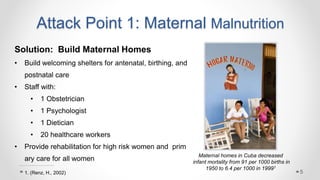
• Build welcoming shelters for antenatal, birthing, and
postnatal care
• Staff with:
• 1 Obstetrician
• 1 Psychologist
• 1 Dietician
• 20 healthcare workers
• Provide rehabilitation for high risk women and prim
ary care for all women
Maternal homes in Cuba decreased
infant mortality from 91 per 1000 births in
1950 to 6.4 per 1000 in 19991
51. (Renz, H., 2002)
Attack Point 1: Maternal Malnutrition
Solution: Build Maternal Homes
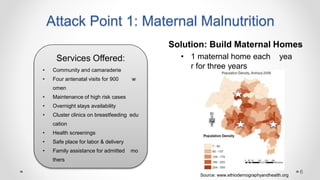
• 1 maternal home each yea
r for three years
Services Offered:
• Community and camaraderie
• Four antenatal visits for 900 w
omen
• Maintenance of high risk cases
• Overnight stays availability
• Cluster clinics on breastfeeding edu
cation
• Health screenings
• Safe place for labor & delivery
• Family assistance for admitted mo
thers
Source: www.ethiodemographyandhealth.org
6
Attack Point 1: Maternal Malnutrition
Goal: Provide complete kcal coverage for
~25% of clients who are malnourished1
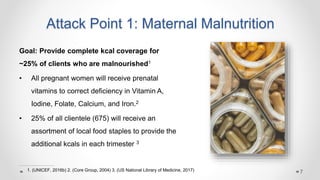
• All pregnant women will receive prenatal
vitamins to correct deficiency in Vitamin A,
Iodine, Folate, Calcium, and Iron.2
• 25% of all clientele (675) will receive an
assortment of local food staples to provide the
additional kcals in each trimester 3
71. (UNICEF, 2016b) 2. (Core Group, 2004) 3. (US National Library of Medicine, 2017)
Attack Point 1: Maternal Malnutrition
Barrier to healthcare access: burden of distance for women in rural areas
Solution: Transportation
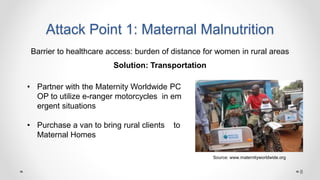
• Partner with the Maternity Worldwide PC
OP to utilize e-ranger motorcycles in em
ergent situations
• Purchase a van to bring rural clients to
Maternal Homes
Source: www.maternityworldwide.org
8
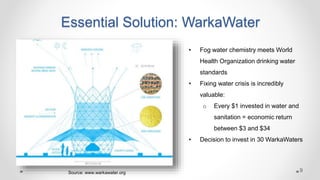
Essential Solution: WarkaWater
• Fog water chemistry meets World
Health Organization drinking water
standards
• Fixing water crisis is incredibly
valuable:
o Every $1 invested in water and
sanitation = economic return
between $3 and $34
• Decision to invest in 30 WarkaWaters
Source: www.warkawater.org 9
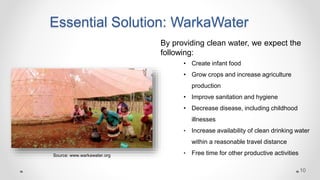
Essential Solution: WarkaWater
By providing clean water, we expect the
following:
• Create infant food
• Grow crops and increase agriculture
production
• Improve sanitation and hygiene
• Decrease disease, including childhood
illnesses
• Increase availability of clean drinking water
within a reasonable travel distance
• Free time for other productive activitiesSource: www.warkawater.org
10
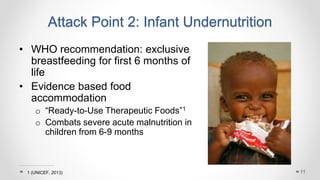
Attack Point 2: Infant Undernutrition
• WHO recommendation: exclusive
breastfeeding for first 6 months of
life
• Evidence based food
accommodation
o “Ready-to-Use Therapeutic Foods”1
o Combats severe acute malnutrition in
children from 6-9 months
111 (UNICEF, 2013)
Attack Point 2: Infant Undernutrition
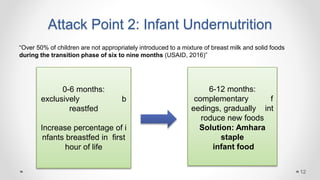
“Over 50% of children are not appropriately introduced to a mixture of breast milk and solid foods
during the transition phase of six to nine months (USAID, 2016)”
0-6 months:
exclusively b
reastfed
Increase percentage of i
nfants breastfed in first
hour of life
6-12 months:
complementary f
eedings, gradually int
roduce new foods
Solution: Amhara
staple
infant food
12
Attack Point 2: Infant Undernutrition
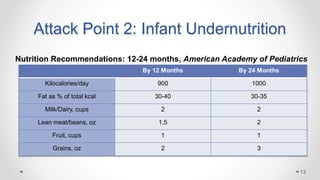
By 12 Months By 24 Months
Kilocalories/day 900 1000
Fat as % of total kcal 30-40 30-35
Milk/Dairy, cups 2 2
Lean meat/beans, oz 1.5 2
Fruit, cups 1 1
Grains, oz 2 3
Nutrition Recommendations: 12-24 months, American Academy of Pediatrics
13
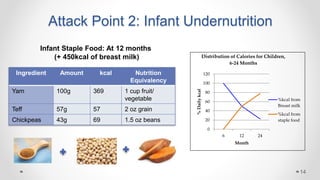
Ingredient Amount kcal Nutrition
Equivalency
Yam 100g 369 1 cup fruit/
vegetable
Teff 57g 57 2 oz grain
Chickpeas 43g 69 1.5 oz beans
Attack Point 2: Infant Undernutrition
Infant Staple Food: At 12 months
(+ 450kcal of breast milk)
14
0
20
40
60
80
100
120
6 12 24
%Dailykcal
Month
Distribution of Calories for Children,
6-24 Months
%kcal from
Breast milk
%kcal from
staple food
Attack Point 2: Infant Undernutrition
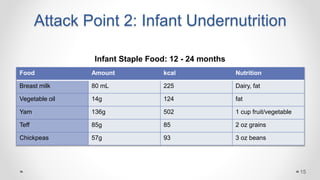
Food Amount kcal Nutrition
Breast milk 80 mL 225 Dairy, fat
Vegetable oil 14g 124 fat
Yam 136g 502 1 cup fruit/vegetable
Teff 85g 85 2 oz grains
Chickpeas 57g 93 3 oz beans
Infant Staple Food: 12 - 24 months
15
Long Term Adaptations
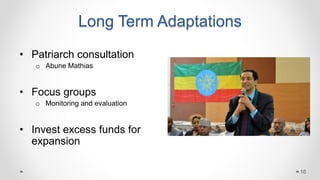
• Patriarch consultation
o Abune Mathias
• Focus groups
o Monitoring and evaluation
• Invest excess funds for
expansion
16
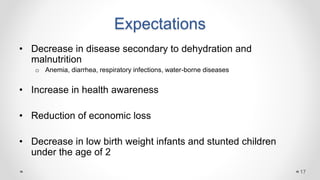
Expectations
• Decrease in disease secondary to dehydration and
malnutrition
o Anemia, diarrhea, respiratory infections, water-borne diseases
• Increase in health awareness
• Reduction of economic loss
• Decrease in low birth weight infants and stunted children
under the age of 2
17
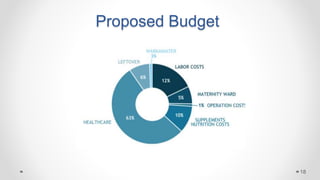
Proposed Budget
18
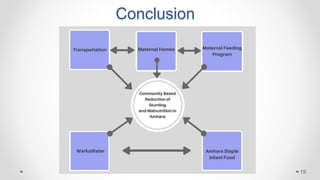
Conclusion
19
Works Cited
20
Core Group (2004). Maternal Nutrition During Pregnancy and Lactation. Retrieved from http://www.coregroup.org/storage/documents/Workingpaper
s/MaternalNutritionDietaryGuide_AED.pdf
International Center for Not-for-Profit Law, 2016. Civic Freedom Monitor: Ethiopia. Collected by ICNL NGO Law Monitor. Retrieved from http://ww
w.icnl.org/research/monitor/ethiopia.html
Ethiopia: Primary Care Outreach Project (PCOP). (n.d.). Retrieved February 23, 2017, from Ethiopia: Primary Care Outreach Project (PCOP). (n.d.).
Retrieved February 23, 2017, from http://www.maternityworldwide.org/what-we-do/primary-care-outreach-project-pcop/
Renz, H. (Spring, 2002). Cuban Maternity Homes. Retrieved from: https://www.midwiferytoday.com/articles/cuban.asp
UNICEF. Position Paper: Ready-to-Use Therapeutic Food for Children with Severe Acute Malnutrition. 2013. Retrieved September 30, 2016 from
http://www.unicef.org/media/files/Position_Paper_Ready-to-use_therapeutic_food_for_children_with_severe_acute_malnutrition__June_2013.pdf
UNICEF (2016b, Dec.) Undernutrition contributes to nearly half of deaths in children under 5 and is widespread in Asia and Africa. Retrieved from https://da
ta.unicef.org/topic/nutrition/malnutrition
US National Library of Medicine. (October 2016) Eating Right During Pregnancy. Retrieved from https://medlineplus.gov/ency/patientinstructions/
000584.htm
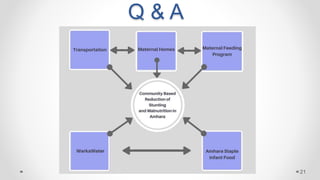
Q & A
21
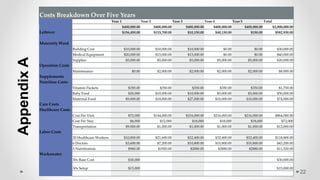
Costs Breakdown Over Five Years
Year 1 Year 2 Year 3 Year 4 Year 5 Total
$400,000.00 $400,000.00 $400,000.00 $400,000.00 $400,000.00 $2,000,000.00
Leftover $156,450.00 $115,700.00 $10,150.00 $40,150.00 $150.00 $582,930.00
Maternity Ward
Building Cost $10,000.00 $10,000.00 $10,000.00 $0.00 $0.00 $30,000.00
Medical Equipment $20,000.00 $15,000.00 $15,000.00 $0.00 $0.00 $40,000.00
Supplies $5,000.00 $5,000.00 $5,000.00 $5,000.00 $5,000.00 $20,000.00
Operation Costs
Maintenance $0.00 $2,000.00 $2,000.00 $2,000.00 $2,000.00 $8,000.00
Supplements
Nutrition Costs
Vitamin Packets $350.00 $350.00 $350.00 $350.00 $350.00 $1,750.00
Baby Food $20,000 $10,000.00 $10,000.00 $5,000.00 $5,000.00 $50,000.00
Maternal Food $9,000.00 $18,000.00 $27,000.00 $10,000.00 $10,000.00 $74,000.00
Care Costs
Healthcare Costs
Cost Per Visit $72,000 $144,000.00 $216,000.00 $216,000.00 $216,000.00 $864,000.00
Cost Per Stay $6,000 $12,000 $18,000 $18,000 $18,000 $72,000
Transportation $9,000.00 $1,000.00 $1,000.00 $1,000.00 $1,000.00 $13,000.00
Labor Costs
30 Healthcare Workers $10,800.00 $21,600.00 $32,400.00 $32,400.00 $32,400.00 $118,800.00
6 Doctors $3,600.00 $7,200.00 $10,800.00 $10,800.00 $10,800.00 $43,200.00
3 Nutritionists $960.00 $1920.00 $2880.00 $2880.00 $2880.00 $11,520.00
Warkawater
30x Base Cost $30,000 $30,000.00
30x Setup $15,000 $15,000.00
AppendixA
22
23
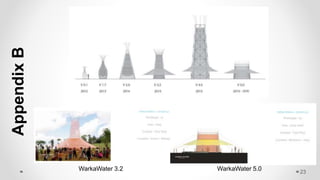
AppendixB
WarkaWater 3.2 WarkaWater 5.0

2017 Statewide Case Competition: Team 10 - Second Place (UA)

  • 1.
    A Community-Based Solutionto Reduce Stunting & Malnutrition in Amhara children 1 AMHARA
  • 2.
    Maternal Malnutrition Infant undernutrition Prevalence of Pediatric Stunting Educational & EconomicDeficits Poverty & Poor Health Prognoses Cultural Considerations Goal: Decrease Malnutrition & Stunting of Amhara Chil dren in the First 1,000 Days of Life Over 5 Years 2
  • 3.
    Cultural Considerations • CopticOrthodox Christianity • Limits on NGOs o Charities and Societies Proclamation1 • Sustainability Challenges o Agriculture & Topography o Transportation o Community Based Solutions 31. (The International Center for Not-for-Profit Law, 2016)
  • 4.
    Attack Point 1:Maternal Malnutrition • 46% of Ethiopian women receive four antenatal visits1 • ≥ 23% of women have no antenatal care at all1 • 25% of Ethiopian mothers are malnourished2 Figure 1: Percentage of Women Who Had at Least One ANC Visit and Received at Least One I FA Tablet by Region, Ethiopia, 2011 Source: USAID, Spring Nutrition, 2014 4 1. (Maternity Worldwide, n.d.) 2. (Unicef, 2016b)
  • 5.
    Attack Point 1:Maternal Malnutrition Solution: Build Maternal Homes • Build welcoming shelters for antenatal, birthing, and postnatal care • Staff with: • 1 Obstetrician • 1 Psychologist • 1 Dietician • 20 healthcare workers • Provide rehabilitation for high risk women and prim ary care for all women Maternal homes in Cuba decreased infant mortality from 91 per 1000 births in 1950 to 6.4 per 1000 in 19991 51. (Renz, H., 2002)
  • 6.
    Attack Point 1:Maternal Malnutrition Solution: Build Maternal Homes • 1 maternal home each yea r for three years Services Offered: • Community and camaraderie • Four antenatal visits for 900 w omen • Maintenance of high risk cases • Overnight stays availability • Cluster clinics on breastfeeding edu cation • Health screenings • Safe place for labor & delivery • Family assistance for admitted mo thers Source: www.ethiodemographyandhealth.org 6
  • 7.
    Attack Point 1:Maternal Malnutrition Goal: Provide complete kcal coverage for ~25% of clients who are malnourished1 • All pregnant women will receive prenatal vitamins to correct deficiency in Vitamin A, Iodine, Folate, Calcium, and Iron.2 • 25% of all clientele (675) will receive an assortment of local food staples to provide the additional kcals in each trimester 3 71. (UNICEF, 2016b) 2. (Core Group, 2004) 3. (US National Library of Medicine, 2017)
  • 8.
    Attack Point 1:Maternal Malnutrition Barrier to healthcare access: burden of distance for women in rural areas Solution: Transportation • Partner with the Maternity Worldwide PC OP to utilize e-ranger motorcycles in em ergent situations • Purchase a van to bring rural clients to Maternal Homes Source: www.maternityworldwide.org 8
  • 9.
    Essential Solution: WarkaWater •Fog water chemistry meets World Health Organization drinking water standards • Fixing water crisis is incredibly valuable: o Every $1 invested in water and sanitation = economic return between $3 and $34 • Decision to invest in 30 WarkaWaters Source: www.warkawater.org 9
  • 10.
    Essential Solution: WarkaWater Byproviding clean water, we expect the following: • Create infant food • Grow crops and increase agriculture production • Improve sanitation and hygiene • Decrease disease, including childhood illnesses • Increase availability of clean drinking water within a reasonable travel distance • Free time for other productive activitiesSource: www.warkawater.org 10
  • 11.
    Attack Point 2:Infant Undernutrition • WHO recommendation: exclusive breastfeeding for first 6 months of life • Evidence based food accommodation o “Ready-to-Use Therapeutic Foods”1 o Combats severe acute malnutrition in children from 6-9 months 111 (UNICEF, 2013)
  • 12.
    Attack Point 2:Infant Undernutrition “Over 50% of children are not appropriately introduced to a mixture of breast milk and solid foods during the transition phase of six to nine months (USAID, 2016)” 0-6 months: exclusively b reastfed Increase percentage of i nfants breastfed in first hour of life 6-12 months: complementary f eedings, gradually int roduce new foods Solution: Amhara staple infant food 12
  • 13.
    Attack Point 2:Infant Undernutrition By 12 Months By 24 Months Kilocalories/day 900 1000 Fat as % of total kcal 30-40 30-35 Milk/Dairy, cups 2 2 Lean meat/beans, oz 1.5 2 Fruit, cups 1 1 Grains, oz 2 3 Nutrition Recommendations: 12-24 months, American Academy of Pediatrics 13
  • 14.
    Ingredient Amount kcalNutrition Equivalency Yam 100g 369 1 cup fruit/ vegetable Teff 57g 57 2 oz grain Chickpeas 43g 69 1.5 oz beans Attack Point 2: Infant Undernutrition Infant Staple Food: At 12 months (+ 450kcal of breast milk) 14 0 20 40 60 80 100 120 6 12 24 %Dailykcal Month Distribution of Calories for Children, 6-24 Months %kcal from Breast milk %kcal from staple food
  • 15.
    Attack Point 2:Infant Undernutrition Food Amount kcal Nutrition Breast milk 80 mL 225 Dairy, fat Vegetable oil 14g 124 fat Yam 136g 502 1 cup fruit/vegetable Teff 85g 85 2 oz grains Chickpeas 57g 93 3 oz beans Infant Staple Food: 12 - 24 months 15
  • 16.
    Long Term Adaptations •Patriarch consultation o Abune Mathias • Focus groups o Monitoring and evaluation • Invest excess funds for expansion 16
  • 17.
    Expectations • Decrease indisease secondary to dehydration and malnutrition o Anemia, diarrhea, respiratory infections, water-borne diseases • Increase in health awareness • Reduction of economic loss • Decrease in low birth weight infants and stunted children under the age of 2 17
  • 18.
  • 19.
  • 20.
    Works Cited 20 Core Group(2004). Maternal Nutrition During Pregnancy and Lactation. Retrieved from http://www.coregroup.org/storage/documents/Workingpaper s/MaternalNutritionDietaryGuide_AED.pdf International Center for Not-for-Profit Law, 2016. Civic Freedom Monitor: Ethiopia. Collected by ICNL NGO Law Monitor. Retrieved from http://ww w.icnl.org/research/monitor/ethiopia.html Ethiopia: Primary Care Outreach Project (PCOP). (n.d.). Retrieved February 23, 2017, from Ethiopia: Primary Care Outreach Project (PCOP). (n.d.). Retrieved February 23, 2017, from http://www.maternityworldwide.org/what-we-do/primary-care-outreach-project-pcop/ Renz, H. (Spring, 2002). Cuban Maternity Homes. Retrieved from: https://www.midwiferytoday.com/articles/cuban.asp UNICEF. Position Paper: Ready-to-Use Therapeutic Food for Children with Severe Acute Malnutrition. 2013. Retrieved September 30, 2016 from http://www.unicef.org/media/files/Position_Paper_Ready-to-use_therapeutic_food_for_children_with_severe_acute_malnutrition__June_2013.pdf UNICEF (2016b, Dec.) Undernutrition contributes to nearly half of deaths in children under 5 and is widespread in Asia and Africa. Retrieved from https://da ta.unicef.org/topic/nutrition/malnutrition US National Library of Medicine. (October 2016) Eating Right During Pregnancy. Retrieved from https://medlineplus.gov/ency/patientinstructions/ 000584.htm
  • 21.
  • 22.
    Costs Breakdown OverFive Years Year 1 Year 2 Year 3 Year 4 Year 5 Total $400,000.00 $400,000.00 $400,000.00 $400,000.00 $400,000.00 $2,000,000.00 Leftover $156,450.00 $115,700.00 $10,150.00 $40,150.00 $150.00 $582,930.00 Maternity Ward Building Cost $10,000.00 $10,000.00 $10,000.00 $0.00 $0.00 $30,000.00 Medical Equipment $20,000.00 $15,000.00 $15,000.00 $0.00 $0.00 $40,000.00 Supplies $5,000.00 $5,000.00 $5,000.00 $5,000.00 $5,000.00 $20,000.00 Operation Costs Maintenance $0.00 $2,000.00 $2,000.00 $2,000.00 $2,000.00 $8,000.00 Supplements Nutrition Costs Vitamin Packets $350.00 $350.00 $350.00 $350.00 $350.00 $1,750.00 Baby Food $20,000 $10,000.00 $10,000.00 $5,000.00 $5,000.00 $50,000.00 Maternal Food $9,000.00 $18,000.00 $27,000.00 $10,000.00 $10,000.00 $74,000.00 Care Costs Healthcare Costs Cost Per Visit $72,000 $144,000.00 $216,000.00 $216,000.00 $216,000.00 $864,000.00 Cost Per Stay $6,000 $12,000 $18,000 $18,000 $18,000 $72,000 Transportation $9,000.00 $1,000.00 $1,000.00 $1,000.00 $1,000.00 $13,000.00 Labor Costs 30 Healthcare Workers $10,800.00 $21,600.00 $32,400.00 $32,400.00 $32,400.00 $118,800.00 6 Doctors $3,600.00 $7,200.00 $10,800.00 $10,800.00 $10,800.00 $43,200.00 3 Nutritionists $960.00 $1920.00 $2880.00 $2880.00 $2880.00 $11,520.00 Warkawater 30x Base Cost $30,000 $30,000.00 30x Setup $15,000 $15,000.00 AppendixA 22
  • 23.

Editor's Notes

  • #2 Thank you unicef for consulting us
  • #3 Based on previous research and analysis of the situation at hand, this is the problematic cycle that we have diagnosed to Amhara. We are aware of the current works of the National Nutrition Programme, the Maternity Worldwide Primary Care Outreach Project, and the Global Alliance for Improved Nutrition. These hardworking NGOs have broken a lot of ground for scaling up nutrition in this area, and we will be honing in on pregnant women and children in their first 1000 days to directly combat stunting and malnutrition in this pivotal developmental period..
  • #4 Fix citation Cite the type of region It is more effective to be community based than treating acute malnutrition in
  • #5 Mention here that the first 270 days in utero are vital to health of baby and also the mother through this laborious process of birth. We want to ensure that women are able to support a health pregnancy as well as be According to The world Health organization, a minimum of 4 antenatal visits is recommended for a pregnant woman. We know that, according to the maternity worldwide primary care outreach project on 46% of women receive this. Statistic of no antental care at all is higher in rural areas, and likely Amhara.
  • #6 A system has been implemented in Cuba over the last 50 years Emphasize that this is a primary care place UNLESS the mother is not doing well HOW HAVE WE SENSITISED THIS TO ETHIOPIA We want to use this, and implement it with cultural senstively High risk includes HIV+, pre-ecclampsia, tuberculosis, gestational diabetes, ETC *Employing local healthcare workers and physicians at an acceptable and competitive rate, we want locals to work in these clinics for cultural sensitivity, do not want to introduce americans here for language and cultural barriers = increased amount of women interested in the clinics
  • #7 Haley call them maternal homes State why we are building one each year Explain services offered are to specificically address the low rates of women receiving antental care and the fact that studies show women are desiring more health resources in ethiopia Explain the purpose of overnight clinics Cluster clinics
  • #8 Maternal malnutrition during pregnancy might result in a low birthweight infant, congenital anomalies, delayed cognitive and physical development of a child, stunted offspring, and increased child mortality (UNICEF, 2016b). To avoid malnutrition and adverse birth outcomes, pregnant women are advised to nutritionally supplement vitamin A, iodine, folate, calcium, and iron (Core Group, 2004). Supplementation will decrease the likelihood of anemia, increase energy and decrease infections 1800kcal first trimester, 2200 second, 2400 third trimester, then the excess 500 kcal a day for women who are breastfeeding.
  • #9 Safety safety safety! PCOP: primary care outreach project
  • #10 Mention the transition between attack points 1 and 2 THEY ARE GOING TO ASK HOW THIS WORKS https://thewaterproject.org/why-water/poverty http://www.smithsonianmag.com/innovation/this-tower-pulls-drinking-water-out-of-thin-air-180950399/ Costs $1000 plus $500 setup. Has already been launched in Haiti and other countries. Can use to mix with protein and supplements to form paste that is RUTF on the spot. (possible rival?) FogQuest has been approached by the Mt. Zuquala Monastery (Ethiopian Orthodox Church) to provide a fog-water supply for the monastery. It is located on the rim an extinct volcano south of Addis Ababa. There are about 700 monks and nuns living at the monastery and many additional farmers living nearby. We have a potential sponsor for the project in Germany but need to first demonstrate that there is adequate fog water in the dry season at the monastery. To this end, we have sent mesh from Chile to Ethiopia to allow for the construction the small Standard Fog Collectors (SFCs) that we use in the evaluation process. Mesfin Shenkut, a FogQuest member in Addis Ababa and consultant on water projects, will assist the NGO supporting the monastery with the SFC measurements
  • #12 RUTF based , people have done this to correct nutrition, but initiatives died because of funding and requires sending food, but this is sustainable and commnity project. ADD CITATION
  • #13 At 6 months, infants need energy and nutrients exceed what is provided by breast milk,
  • #14 Citations; why we believe this At this point, we can use seed/vegetable oil to ween off of breast milk in the event that it has become more difficult , etc.
  • #15 Discuss how to make this: water as emulsifier until 12 months, when seed oils or vegetable oils can replace lipids in breast milk gradually
  • #17 And scale appropriately
  • #18 How will we monitor and evaluate our project? Since we know that stunting takes away _____% of stuff
  • #20 What impact will this implementation have at the individual, family, community, and national level?
  • #21 https://medlineplus.gov/ency/patientinstructions/000584.htm https://www.midwiferytoday.com/articles/cuban.asp https://www.spring-nutrition.org/sites/default/files/publications/briefs/spring_ifa_brief_ethiopia.pdf
  • #22 What impact will this implementation have at the individual, family, community, and national level?