LEVERAGING THE INFORMATIONAL
INTERVIEW: A KEY NETWORKING TOOL
OUTLINE
1. The importance of networking
2. How to request informational interviews
3. How to perform an informational interview
4. How to network at consulting firm information
sessions
IMPORTANCE OF NETWORKING
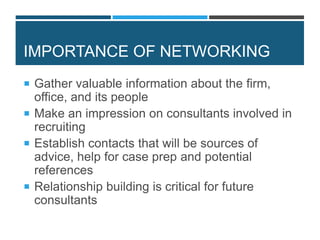
 Gather valuable information about the firm,
office, and its people
 Make an impression on consultants involved in
recruiting
 Establish contacts that will be sources of
advice, help for case prep and potential
references
 Relationship building is critical for future
consultants
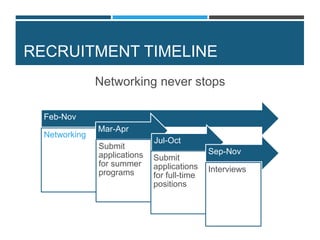
RECRUITMENT TIMELINE
Feb-Nov
Networking
Mar-Apr
Submit
applications
for summer
programs
Jul-Oct
Submit
applications
for full-time
positions
Sep-Nov
Interviews
Networking never stops
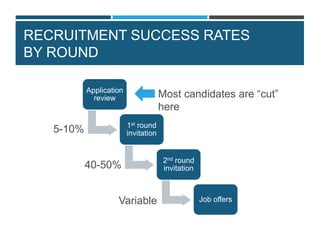
RECRUITMENT SUCCESS RATES
BY ROUND
Application
review
1st round
invitation
2nd round
invitation
Job offers
5-10%
40-50%
Variable
Most candidates are “cut”
here
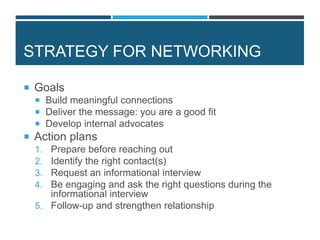
STRATEGY FOR NETWORKING
 Goals
 Build meaningful connections
 Deliver the message: you are a good fit
 Develop internal advocates
 Action plans
1. Prepare before reaching out
2. Identify the right contact(s)
3. Request an informational interview
4. Be engaging and ask the right questions during the
informational interview
5. Follow-up and strengthen relationship
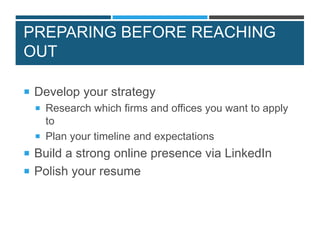
PREPARING BEFORE REACHING
OUT
 Develop your strategy
 Research which firms and offices you want to apply
to
 Plan your timeline and expectations
 Build a strong online presence via LinkedIn
 Polish your resume
BUILDING A STRONG LINKEDIN
PROFILE
 Professional headshot is ideal
 Well-worded and direct executive summary
 List of accomplishments, positions, awards
 Remember take-home points from Resume
Workshop
 Less limited on word count and number of positions
IDENTIFYING THE RIGHT PEOPLE
TO NETWORK WITH
 Consultants and managers (1-4 years)
 Should be your target
 Likely involved in recruitment
 May be your future co-workers
 Partners and principals
 Contact only if you have strong personal connections
or references
 May guarantee you an interview invitation
 Generally not helpful in passing interviews
HOW TO IDENTIFY INDIVIDUALS
 Ask friends, family, co-workers
 Are they consultants?
 Do they know consultants?
 Check with your career development and alumni
offices
 Attend informational sessions and coffee chats
hosted by consulting firms
 Search LinkedIn
 Focused searches: “Baylor College of Medicine” and “McKinsey” | “T Cell” and “ZS
Associates”
 Browse local office websites
DRAFTING AN EMAIL OR A
LINKEDIN MESSAGE
 Subject: short and clear
 Content
 Thank them for their time
 Introduce yourself: name and current position
 Highlight your shared experiences (if any) such as
education, work, community service, etc.
 Express your intentions: ask for a call or coffee-chat
SAMPLE MESSAGE OR EMAIL
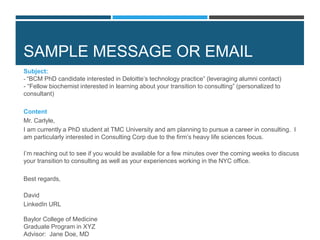
Subject:
- “BCM PhD candidate interested in Deloitte’s technology practice” (leveraging alumni contact)
- “Fellow biochemist interested in learning about your transition to consulting” (personalized to
consultant)
Content
Mr. Carlyle,
I am currently a PhD student at TMC University and am planning to pursue a career in consulting. I
am particularly interested in Consulting Corp due to the firm’s heavy life sciences focus.
I’m reaching out to see if you would be available for a few minutes over the coming weeks to discuss
your transition to consulting as well as your experiences working in the NYC office.
Best regards,
David
LinkedIn URL
Baylor College of Medicine
Graduate Program in XYZ
Advisor: Jane Doe, MD
HOW TO CONDUCT
INFORMATIONAL INTERVIEWS
BEST OUTCOMES OF AN
INFORMATIONAL INTERVIEW
 The consultant/interviewee passes your
resume to the top of the pile!
 Resume and cover letter editing
 Name-dropping in the cover letter with specific
reasons for “why consulting” and “why this firm”
BEFORE THE INFORMATIONAL
INTERVIEW
 Do your homework
 Know the ins and outs of consulting and the application
process
 Prepare your resume
 Search for news about the firm to use as conversation
starters
 Prepare questions
 Find a quiet room with a good phone signal
 Confirm phone numbers and time zone
 Be flexible and expect reschedules
RESOURCES FOR LEARNING
ABOUT CONSULTING
 YouTube videos
 Victor Cheng
 Managementconsulted
 Consulting prep websites
 www.vault.com
 www.caseinterview.com
 www.managementconsulted.com
 Firm websites
 Case interview prep books
BE PREPARED TO ANSWER
 Tell me about your background.
 Why do you want to leave [medicine, research,
academia, etc.]?
 Why are you interested in consulting?
 How did you find out about our firm?
DURING THE INTERVIEW
 Verify how much time the interviewee has
 Speak slowly and clearly
 Refer to your question list
 Take notes
 Have a conversation instead of Q&A
 Try to make the consultant your advisor
TYPES OF QUESTIONS
1. About the consultant
2. About the firm and office
3. About the application process
SAMPLE QUESTIONS FOR
THE CONSULTANT
 What is your background?
 How did you transition into consulting?
 How did you select this firm? This office?
 What do you enjoy most about working here? What
type of projects have you gravitated towards?
 Do you serve a particular industry or practice?
 What is the most difficult aspect of being a consultant?
 Were there any parts of being a consultant that came
to you as a surprise?
 How do you envision your career as a consultant
evolving?
SAMPLE QUESTIONS ABOUT
THE FIRM AND OFFICE
 What is the career progression?
 How does staffing work?
 Where are most of the engagements?
 How much travel is expected?
 Is there a mentoring program?
 Is there a formal business training program?
 How many consultants are in your firm with a PhD
or MD background?
 What is culture like at the firm or office?
ASSESS THE FIRM AND OFFICE
 Firm culture
 Teambuilding events, happy hours
 Meritocracy, mentorship
 Apprenticeship, formal training
 Enhancement initiatives (e.g. diversity and inclusion)
 Office size and culture
 Large office - diversity
 Small office - closer interactions
 Staffing model
 Local, regional or national
 Often determines the amount of travel
SAMPLE QUESTIONS ABOUT
THE APPLICATION
 Do you have suggestions for writing my resume and cover
letter?
 Could you review my resume?
 What is the round structure? How many cases in each
round?
 Who did you interview with?
 What did you find more challenging: the fit or case
interview?
 When are the interviews held? Are any of them over the
phone?
 How did you prepare for case interviews?
 If extended an offer, when are we expected to start?
INFORMATIONAL INTERVIEW
ROLE PLAY
AFTER THE INTERVIEW
 Send a follow-up email the next day
 Thank them for their time
 Mention one or two topics you discussed but avoid being
robotic
 Express your willingness to stay in touch
 Include your full name and contact information in the signature
 If you feel comfortable, ask for referrals to other consultants,
i.e., more senior ones or individuals with a background similar
to yours
 Why the follow-up email is important
 Shows that you are familiar with business etiquette
 Reminds them about you
SAMPLE FOLLOW-UP EMAIL
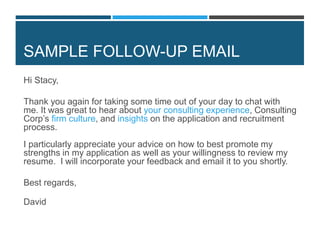
Hi Stacy,
Thank you again for taking some time out of your day to chat with
me. It was great to hear about your consulting experience, Consulting
Corp’s firm culture, and insights on the application and recruitment
process.
I particularly appreciate your advice on how to best promote my
strengths in my application as well as your willingness to review my
resume. I will incorporate your feedback and email it to you shortly.
Best regards,
David
PHONE VS. IN-PERSON
INTERVIEWS
 Most informational interviews will be over the
phone
 Some may be local such as coffee chats
 Wear business casual
 Offer to buy them coffee
 Be aware of your posture, body language and hand
gestures
 Arrive at least 10 minutes early
 Scout the location beforehand, if possible
CONSULTING FIRM
INFORMATIONAL SESSIONS
HOW TO NETWORK AT INFORMATIONAL
SESSIONS OR OFFICE VISITS
 Before entering the room, plan your strategy
 During the session, execute your plan
 After the session, follow up with contacts
PLAN YOUR STRATEGY
 Identify your goal
 Leave a great impression
 Gather information about the firm to use in your cover
letter
 Establish contacts at the firm
 Dress appropriately (usually business casual)
 Research the people in that office (website or
LinkedIn)
 Identify the ones that share similar experiences
(education, experiences, social work, etc.)
 Prepare several engaging and open-ended
questions
EXECUTE YOUR PLAN
 Focus on getting to know both the consultants
and the recruiters
 Hone in on your targeted ones
 Introduce yourself with your full name, make
eye contact and provide a strong handshake
(practice many times beforehand)
 Be courteous to other candidates—don’t hog
the conversation
 Shake hands at the end and exchange
business cards
FOLLOW-UP WITH CONTACTS
Always follow-up!
 Send a brief but customized email the next day
thanking them for their time
 Keep the window of communication open
COMMON MISTAKES WHILE
NETWORKING
 Demonstrating an incomplete understanding about consulting or
business
 Badmouthing prior colleagues and/or overly negative
conversations about prior experience or training
 Asking for facts instead of experiences (do not ask questions that
can easily be answered via Google)
 Dominating the conversation
 Asking questions with yes or no answers
 Begging for an interview or internal referral
 Not following-up or having too many follow-ups
 Inability to carry a conversation
 Lack of appreciation and coming off as you’re just using the
contact
SEEK OPPORTUNITIES TO MAINTAIN
CONTACT
 New resume building experiences or
publications
 Personalized experiences addressed during
informational interview (e.g. travel, sports,
conferences, etc.)
 Resume review, interview coaching, etc.

2017 Networking Workshop

  • 1.
  • 2.
    OUTLINE 1. The importanceof networking 2. How to request informational interviews 3. How to perform an informational interview 4. How to network at consulting firm information sessions
  • 3.
    IMPORTANCE OF NETWORKING Gather valuable information about the firm, office, and its people  Make an impression on consultants involved in recruiting  Establish contacts that will be sources of advice, help for case prep and potential references  Relationship building is critical for future consultants
  • 4.
  • 5.
    RECRUITMENT SUCCESS RATES BYROUND Application review 1st round invitation 2nd round invitation Job offers 5-10% 40-50% Variable Most candidates are “cut” here
  • 6.
    STRATEGY FOR NETWORKING Goals  Build meaningful connections  Deliver the message: you are a good fit  Develop internal advocates  Action plans 1. Prepare before reaching out 2. Identify the right contact(s) 3. Request an informational interview 4. Be engaging and ask the right questions during the informational interview 5. Follow-up and strengthen relationship
  • 7.
    PREPARING BEFORE REACHING OUT Develop your strategy  Research which firms and offices you want to apply to  Plan your timeline and expectations  Build a strong online presence via LinkedIn  Polish your resume
  • 8.
    BUILDING A STRONGLINKEDIN PROFILE  Professional headshot is ideal  Well-worded and direct executive summary  List of accomplishments, positions, awards  Remember take-home points from Resume Workshop  Less limited on word count and number of positions
  • 9.
    IDENTIFYING THE RIGHTPEOPLE TO NETWORK WITH  Consultants and managers (1-4 years)  Should be your target  Likely involved in recruitment  May be your future co-workers  Partners and principals  Contact only if you have strong personal connections or references  May guarantee you an interview invitation  Generally not helpful in passing interviews
  • 10.
    HOW TO IDENTIFYINDIVIDUALS  Ask friends, family, co-workers  Are they consultants?  Do they know consultants?  Check with your career development and alumni offices  Attend informational sessions and coffee chats hosted by consulting firms  Search LinkedIn  Focused searches: “Baylor College of Medicine” and “McKinsey” | “T Cell” and “ZS Associates”  Browse local office websites
  • 11.
    DRAFTING AN EMAILOR A LINKEDIN MESSAGE  Subject: short and clear  Content  Thank them for their time  Introduce yourself: name and current position  Highlight your shared experiences (if any) such as education, work, community service, etc.  Express your intentions: ask for a call or coffee-chat
  • 12.
    SAMPLE MESSAGE OREMAIL Subject: - “BCM PhD candidate interested in Deloitte’s technology practice” (leveraging alumni contact) - “Fellow biochemist interested in learning about your transition to consulting” (personalized to consultant) Content Mr. Carlyle, I am currently a PhD student at TMC University and am planning to pursue a career in consulting. I am particularly interested in Consulting Corp due to the firm’s heavy life sciences focus. I’m reaching out to see if you would be available for a few minutes over the coming weeks to discuss your transition to consulting as well as your experiences working in the NYC office. Best regards, David LinkedIn URL Baylor College of Medicine Graduate Program in XYZ Advisor: Jane Doe, MD
  • 13.
  • 14.
    BEST OUTCOMES OFAN INFORMATIONAL INTERVIEW  The consultant/interviewee passes your resume to the top of the pile!  Resume and cover letter editing  Name-dropping in the cover letter with specific reasons for “why consulting” and “why this firm”
  • 15.
    BEFORE THE INFORMATIONAL INTERVIEW Do your homework  Know the ins and outs of consulting and the application process  Prepare your resume  Search for news about the firm to use as conversation starters  Prepare questions  Find a quiet room with a good phone signal  Confirm phone numbers and time zone  Be flexible and expect reschedules
  • 16.
    RESOURCES FOR LEARNING ABOUTCONSULTING  YouTube videos  Victor Cheng  Managementconsulted  Consulting prep websites  www.vault.com  www.caseinterview.com  www.managementconsulted.com  Firm websites  Case interview prep books
  • 17.
    BE PREPARED TOANSWER  Tell me about your background.  Why do you want to leave [medicine, research, academia, etc.]?  Why are you interested in consulting?  How did you find out about our firm?
  • 18.
    DURING THE INTERVIEW Verify how much time the interviewee has  Speak slowly and clearly  Refer to your question list  Take notes  Have a conversation instead of Q&A  Try to make the consultant your advisor
  • 19.
    TYPES OF QUESTIONS 1.About the consultant 2. About the firm and office 3. About the application process
  • 20.
    SAMPLE QUESTIONS FOR THECONSULTANT  What is your background?  How did you transition into consulting?  How did you select this firm? This office?  What do you enjoy most about working here? What type of projects have you gravitated towards?  Do you serve a particular industry or practice?  What is the most difficult aspect of being a consultant?  Were there any parts of being a consultant that came to you as a surprise?  How do you envision your career as a consultant evolving?
  • 21.
    SAMPLE QUESTIONS ABOUT THEFIRM AND OFFICE  What is the career progression?  How does staffing work?  Where are most of the engagements?  How much travel is expected?  Is there a mentoring program?  Is there a formal business training program?  How many consultants are in your firm with a PhD or MD background?  What is culture like at the firm or office?
  • 22.
    ASSESS THE FIRMAND OFFICE  Firm culture  Teambuilding events, happy hours  Meritocracy, mentorship  Apprenticeship, formal training  Enhancement initiatives (e.g. diversity and inclusion)  Office size and culture  Large office - diversity  Small office - closer interactions  Staffing model  Local, regional or national  Often determines the amount of travel
  • 23.
    SAMPLE QUESTIONS ABOUT THEAPPLICATION  Do you have suggestions for writing my resume and cover letter?  Could you review my resume?  What is the round structure? How many cases in each round?  Who did you interview with?  What did you find more challenging: the fit or case interview?  When are the interviews held? Are any of them over the phone?  How did you prepare for case interviews?  If extended an offer, when are we expected to start?
  • 24.
  • 25.
    AFTER THE INTERVIEW Send a follow-up email the next day  Thank them for their time  Mention one or two topics you discussed but avoid being robotic  Express your willingness to stay in touch  Include your full name and contact information in the signature  If you feel comfortable, ask for referrals to other consultants, i.e., more senior ones or individuals with a background similar to yours  Why the follow-up email is important  Shows that you are familiar with business etiquette  Reminds them about you
  • 26.
    SAMPLE FOLLOW-UP EMAIL HiStacy, Thank you again for taking some time out of your day to chat with me. It was great to hear about your consulting experience, Consulting Corp’s firm culture, and insights on the application and recruitment process. I particularly appreciate your advice on how to best promote my strengths in my application as well as your willingness to review my resume. I will incorporate your feedback and email it to you shortly. Best regards, David
  • 27.
    PHONE VS. IN-PERSON INTERVIEWS Most informational interviews will be over the phone  Some may be local such as coffee chats  Wear business casual  Offer to buy them coffee  Be aware of your posture, body language and hand gestures  Arrive at least 10 minutes early  Scout the location beforehand, if possible
  • 28.
  • 29.
    HOW TO NETWORKAT INFORMATIONAL SESSIONS OR OFFICE VISITS  Before entering the room, plan your strategy  During the session, execute your plan  After the session, follow up with contacts
  • 30.
    PLAN YOUR STRATEGY Identify your goal  Leave a great impression  Gather information about the firm to use in your cover letter  Establish contacts at the firm  Dress appropriately (usually business casual)  Research the people in that office (website or LinkedIn)  Identify the ones that share similar experiences (education, experiences, social work, etc.)  Prepare several engaging and open-ended questions
  • 31.
    EXECUTE YOUR PLAN Focus on getting to know both the consultants and the recruiters  Hone in on your targeted ones  Introduce yourself with your full name, make eye contact and provide a strong handshake (practice many times beforehand)  Be courteous to other candidates—don’t hog the conversation  Shake hands at the end and exchange business cards
  • 32.
    FOLLOW-UP WITH CONTACTS Alwaysfollow-up!  Send a brief but customized email the next day thanking them for their time  Keep the window of communication open
  • 33.
    COMMON MISTAKES WHILE NETWORKING Demonstrating an incomplete understanding about consulting or business  Badmouthing prior colleagues and/or overly negative conversations about prior experience or training  Asking for facts instead of experiences (do not ask questions that can easily be answered via Google)  Dominating the conversation  Asking questions with yes or no answers  Begging for an interview or internal referral  Not following-up or having too many follow-ups  Inability to carry a conversation  Lack of appreciation and coming off as you’re just using the contact
  • 34.
    SEEK OPPORTUNITIES TOMAINTAIN CONTACT  New resume building experiences or publications  Personalized experiences addressed during informational interview (e.g. travel, sports, conferences, etc.)  Resume review, interview coaching, etc.