Literacy and Lifelong Learning
for Women’s Empowerment?
Prepared for the Alumniportal Deutschland webinar
“Empowering Girls and Women through Literacy
and Secondary Education” (29 June 2016)
Rika Yorozu
r.yorozu@unesco.org 1
Mission:
To promote the recognition of
and create the conditions for
the exercise of the right to
education and learning
Mandate:
Lifelong learning with a focus
on adult and continuing
education, literacy and non-
formal basic education
Activities: uil.unesco.org
2
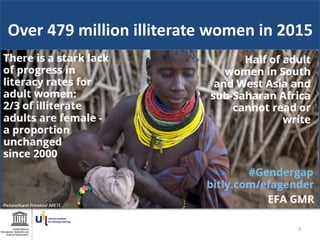
Over 479 million illiterate women in 2015
3
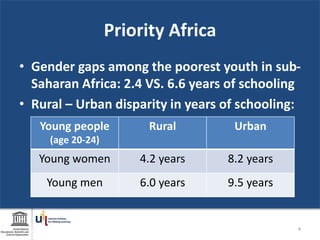
Priority Africa
• Gender gaps among the poorest youth in sub-
Saharan Africa: 2.4 VS. 6.6 years of schooling
• Rural – Urban disparity in years of schooling:
Young people
(age 20-24)
Rural Urban
Young women 4.2 years 8.2 years
Young men 6.0 years 9.5 years
4
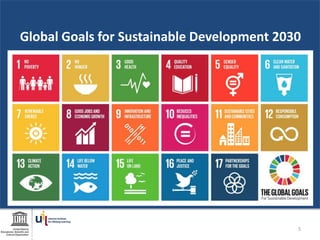
Global Goals for Sustainable Development 2030
5
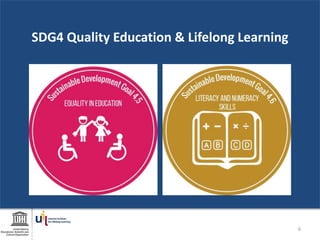
SDG4 Quality Education & Lifelong Learning
6
7
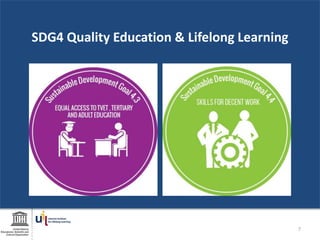
SDG4 Quality Education & Lifelong Learning
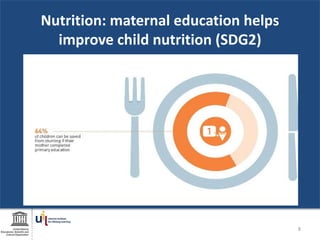
Nutrition: maternal education helps
improve child nutrition (SDG2)
8
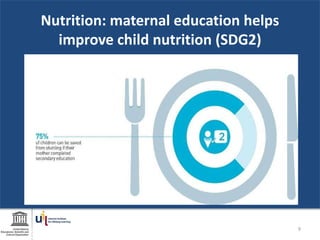
Nutrition: maternal education helps
improve child nutrition (SDG2)
9
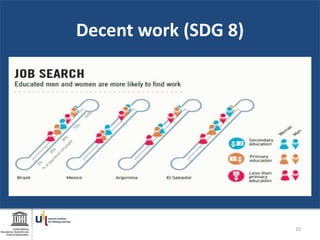
Decent work (SDG 8)
10
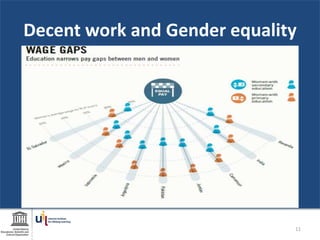
Decent work and Gender equality
11
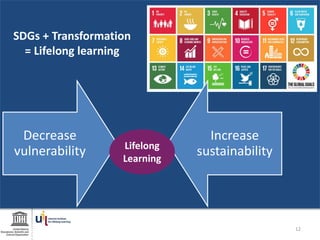
SDGs + Transformation
= Lifelong learning
Decrease
vulnerability
Increase
sustainabilityLifelong
Learning
12
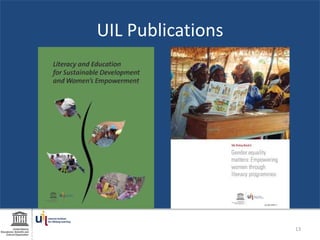
UIL Publications
13
Good practice in adult literacy programmes for women‘s
empowerment and sustainable development
1. Moving from functional literacy to transformative literacy for gender
empowerment
2. Empowerment means different things for women in different
situations (as journey not a destination)
3. Situated literacy practices
4. “21st century skills” (e.g. language, ICT, problem solving skills, critical
thinking, etc.)
5. Integrated, embedded and holistic approaches to literacy and skill
development
 economic growth,
 social equality,
 environmental sustainability
14
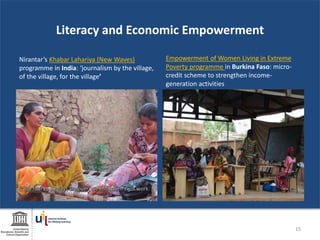
Literacy and Economic Empowerment
Nirantar’s Khabar Lahariya (New Waves)
programme in India: ‘journalism by the village,
of the village, for the village’
Empowerment of Women Living in Extreme
Poverty programme in Burkina Faso: micro-
credit scheme to strengthen income-
generation activities
15
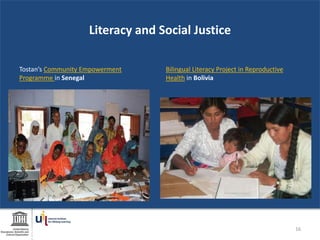
Literacy and Social Justice
Tostan’s Community Empowerment
Programme in Senegal
Bilingual Literacy Project in Reproductive
Health in Bolivia
16
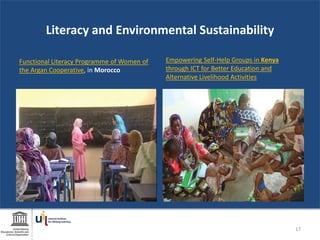
Literacy and Environmental Sustainability
Functional Literacy Programme of Women of
the Argan Cooperative, in Morocco
Empowering Self-Help Groups in Kenya
through ICT for Better Education and
Alternative Livelihood Activities
17
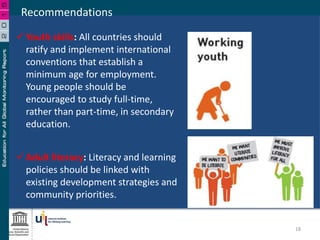
Recommendations
 Adult literacy: Literacy and learning
policies should be linked with
existing development strategies and
community priorities.
 Youth skills: All countries should
ratify and implement international
conventions that establish a
minimum age for employment.
Young people should be
encouraged to study full-time,
rather than part-time, in secondary
education.
18
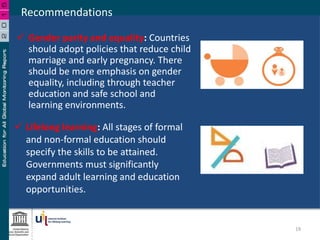
 Gender parity and equality: Countries
should adopt policies that reduce child
marriage and early pregnancy. There
should be more emphasis on gender
equality, including through teacher
education and safe school and
learning environments.
Recommendations
 Lifelong learning: All stages of formal
and non-formal education should
specify the skills to be attained.
Governments must significantly
expand adult learning and education
opportunities.
19
References
• From access to equality: empowering girls and women through literacy and
secondary education (UNESCO 2012)
• Gender equality matters: empowering women through literacy programmes
(UIL 2014)
• Gender and EFA 2000-2015: Achievements and Challenges
(UNESCO 2015)
• Literacy and education for sustainable development and women's
empowerment (UIL 2014)
• Narrowing the gender gap: empowering women through literacy programmes:
case studies from the UNESCO Effective Literacy and Numeracy Practices
Database (LitBase) (UIL 2015)
• Sustainable development begins with education (UNESCO 2014)
21
22

2016.06womenLit_Webinar_Revised160628

  • 1.
    Literacy and LifelongLearning for Women’s Empowerment? Prepared for the Alumniportal Deutschland webinar “Empowering Girls and Women through Literacy and Secondary Education” (29 June 2016) Rika Yorozu r.yorozu@unesco.org 1
  • 2.
    Mission: To promote therecognition of and create the conditions for the exercise of the right to education and learning Mandate: Lifelong learning with a focus on adult and continuing education, literacy and non- formal basic education Activities: uil.unesco.org 2
  • 3.
    Over 479 millionilliterate women in 2015 3
  • 4.
    Priority Africa • Gendergaps among the poorest youth in sub- Saharan Africa: 2.4 VS. 6.6 years of schooling • Rural – Urban disparity in years of schooling: Young people (age 20-24) Rural Urban Young women 4.2 years 8.2 years Young men 6.0 years 9.5 years 4
  • 5.
    Global Goals forSustainable Development 2030 5
  • 6.
    SDG4 Quality Education& Lifelong Learning 6
  • 7.
    7 SDG4 Quality Education& Lifelong Learning
  • 8.
    Nutrition: maternal educationhelps improve child nutrition (SDG2) 8
  • 9.
    Nutrition: maternal educationhelps improve child nutrition (SDG2) 9
  • 10.
  • 11.
    Decent work andGender equality 11
  • 12.
    SDGs + Transformation =Lifelong learning Decrease vulnerability Increase sustainabilityLifelong Learning 12
  • 13.
  • 14.
    Good practice inadult literacy programmes for women‘s empowerment and sustainable development 1. Moving from functional literacy to transformative literacy for gender empowerment 2. Empowerment means different things for women in different situations (as journey not a destination) 3. Situated literacy practices 4. “21st century skills” (e.g. language, ICT, problem solving skills, critical thinking, etc.) 5. Integrated, embedded and holistic approaches to literacy and skill development  economic growth,  social equality,  environmental sustainability 14
  • 15.
    Literacy and EconomicEmpowerment Nirantar’s Khabar Lahariya (New Waves) programme in India: ‘journalism by the village, of the village, for the village’ Empowerment of Women Living in Extreme Poverty programme in Burkina Faso: micro- credit scheme to strengthen income- generation activities 15
  • 16.
    Literacy and SocialJustice Tostan’s Community Empowerment Programme in Senegal Bilingual Literacy Project in Reproductive Health in Bolivia 16
  • 17.
    Literacy and EnvironmentalSustainability Functional Literacy Programme of Women of the Argan Cooperative, in Morocco Empowering Self-Help Groups in Kenya through ICT for Better Education and Alternative Livelihood Activities 17
  • 18.
    Recommendations  Adult literacy:Literacy and learning policies should be linked with existing development strategies and community priorities.  Youth skills: All countries should ratify and implement international conventions that establish a minimum age for employment. Young people should be encouraged to study full-time, rather than part-time, in secondary education. 18
  • 19.
     Gender parityand equality: Countries should adopt policies that reduce child marriage and early pregnancy. There should be more emphasis on gender equality, including through teacher education and safe school and learning environments. Recommendations  Lifelong learning: All stages of formal and non-formal education should specify the skills to be attained. Governments must significantly expand adult learning and education opportunities. 19
  • 20.
    References • From accessto equality: empowering girls and women through literacy and secondary education (UNESCO 2012) • Gender equality matters: empowering women through literacy programmes (UIL 2014) • Gender and EFA 2000-2015: Achievements and Challenges (UNESCO 2015) • Literacy and education for sustainable development and women's empowerment (UIL 2014) • Narrowing the gender gap: empowering women through literacy programmes: case studies from the UNESCO Effective Literacy and Numeracy Practices Database (LitBase) (UIL 2015) • Sustainable development begins with education (UNESCO 2014) 21
  • 21.

Editor's Notes

  • #3 The mission of UNESCO Institute for Lifelong Learning (UIL), established in Hamburg, Germany in 1951, is to promote the recognition of and create the conditions for the exercise of the right to education and learning. As one of UNESCO’s seven education institutes, UIL undertakes research, capacity-building, networking and produces publications on lifelong learning with a focus on adult and continuing education, literacy and non-formal basic education. To support the follow-up and monitoring at the international level of the Belém Framework for Action: Harnessing the power and potential of adult learning and education for a viable future (2009), UIL is advocating for the realization of the vision of a learning family, learning communities, learning cities, learning countries and learning planet.
  • #4 Unable to read a simple sentence. If we consider people with low literacy skills, even more! Sample testing in Germany in 2010 revealed that 20% of adult population have very low to low literacy skills.
  • #5 On average, young people aged 20-24 years have spent 6.6 years in formal education. The poorest young women in the region, however, have spent less than half that. As a legacy of poor education systems, half of all female adults in the region are now unable to read and write.
  • #9 If all mothers had primary education, 1.7 million children could be saved from stunting. If secondary education, 12.2 million children.
  • #10 If all mothers had primary education, 1.7 million children could be saved from stunting. If secondary education, 12.2 million children.
  • #13 Decrease vulnerability 1, 2, 3, 4, 5, 6, 7, 10, 16 Increase sustainability 8, 9, 11,12, 13, 14, 15, 17
  • #19   [Click] Youth Skills All countries should ratify and implement Convention 138 of the International Labour Organization, which sets a minimum age for admission to employment. Students should be encouraged to attend secondary education programmes full time. Policy-makers should identify and prioritize the types and levels of skills to be acquired by the end of each stage of formal schooling.   [click] Adult Literacy Countries and international partners should take steps to ensure that the right to literacy is not forgotten Literacy policies and strategies should be linked to existing development priorities in areas such as health, community development, agricultural innovation and active citizenship. The use of mobile phones and other ICT platforms for literacy retention and skill acquisition should be supported. [click]  
  • #20 [click] Gender parity and equality: Incidences of child marriage and early pregnancy need to be addressed directly in policy. Gender disparities at all levels of education should be eliminated To address gender equality, schools need to be safe and gender-friendly. Governments need to ensure that teacher training covers gender strategies. These programmes must be carefully designed according to local contexts. Curricula should be gender sensitive and address issues such as sexual and reproductive health   [click] Lifelong learning: Countries should significantly expand learning and education opportunities for youth and adults. All stages of formal and non formal education should specify the skills and other leaning outcomes to be attained Governments should develop the means to measure and monitor programme participation and outcomes.