Volume 15 − 2016
ABSTRACT
This work presents a proposal of study
on the technological experience of distance
tutors, also known as technological fluency,
founded by experts of Distance Education
in current context. Its aim is to identify,
analyze and understand the basic knowledge
of distance tutors, focusing on technological
fluency, which includes technical, practical
and emancipatory fluencies. For that, a case
study in a private educational institution has
been done, in which an online questionnai-
re was applied to 24 tutors of a distance gra-
duation course. According to the results, the
respondent tutors have technological expe-
rience (technical, practical and emancipatory
fluencies), however, regarding the emanci-
patory fluency, it was seen that they do not
have autonomy in decision-making and they
do not have another way of communication
with students beyond the platform itself and
e-mail. Concerning suggestions and criticis-
ms, it was verified that tutors are concerned
about spreading their knowledge about new
technologies, since technology is constantly
changing. In that way, it is necessary a perma-
nent training of online tutors so they can use
these new technologies with authority in the
practice of the distance tutorial.
Keywords: Distance tutorial. Challenge.
Training. Technical fluency.
RESUMEN
Este trabajo presenta una propuesta de
estudio acerca de la experiencia tecnológica
de los tutores a distancia, denominada
también fluidez tecnológica, fundamentada
por estudiosos de la Educación a Distancia en
el contexto actual.
Tiene por objetivo identificar, analizar
y comprender las competencias básicas de
los tutores a distancia, centrándose en la
fluidez tecnológica que abarca la fluidez
técnica, la práctica y la emancipatoria. Para
ello, se ha realizado un estudio testigo en
una institución de enseñanza privada, donde
se aplicó un cuestionario “on line” dirigido
a 24 tutores de un curso de graduación a
distancia. De acuerdo al resultado, los tutores
encuestados poseen experiencia tecnológica
(fluidez técnica, práctica y emancipatoria),
sin embargo, en lo que atañe a la fluidez
emancipatoria, se observó que ellos no poseen
autonomía en la toma de decisiones y además
no tienen otra forma de comunicación con los
alumnos más allá de la misma plataforma o del
2Article
Technological fluency in the vision of tutors
and its challenges
Maria das Graças Freitas dos Santos1
Samira Pirola Santos Mantilla2
1
Universidade Federal Fluminense. E-mail: freitas_santos@yahoo.com.br
2
 Universidade Federal Fluminense. E-mail: samiramantilla@yahoo.com.br
AssociaçãoBrasileiradeEducaçãoaDistância
2
RBAAD – Technological fluency in the vision of tutors and its challenges
e-mail. En relación a las sugerencias y críticas,
se verificó que los tutores, están preocupados
en la difusión de conocimientos sobre las
novedades tecnológicas, ya que estas están en
permanente transformación. De ese modo, se
hace necesaria una capacitación constante de
los tutores “on line” para que puedan utilizar
con autoridad dichas nuevas tecnologías en la
práctica de la tutoría a distancia.
Palabras clave: Tutoría a distancia.
Desafío. Capacitación. Fluidez técnica.
RESUMO
Este trabalho apresenta uma proposta
de estudo sobre a competência tecnológica
dos tutores a distância, também denominada
de fluência tecnológica, fundamentada
em estudiosos da Educação a Distância no
contexto atual. Visa identificar, analisar e
compreender as competências essenciais
dos tutores a distância, com foco na fluência
tecnológica que engloba as fluências técnica,
práticaeemancipatória.Paraisso,foirealizado
um estudo de caso em uma instituição de
ensino particular, onde foi aplicado um
questionário on-line para 24 tutores de um
curso de graduação a distância. De acordo
com os resultados, os tutores respondentes
possuem domínio tecnológico (fluência
técnica, prática e emancipatória), entretanto,
no que tange à fluência emancipatória,
observou-se que eles não possuem autonomia
na tomada de decisões e não mantêm outros
meios de comunicação com os estudantes,
além da plataforma e do e-mail. Em relação
às sugestões e críticas, verificou-se que os
tutores estão preocupados com a difusão
do conhecimento sobre as novidades
tecnológicas, na medida em que as tecnologias
estão em constante transformação. Assim, faz-
se necessária uma capacitação constante dos
tutores on-line para que eles possam utilizar
com autoridade essas novas tecnologias na
prática da tutoria a distância.
Palavras-chave:: Tutoria a distância.
Desafios. Capacitação. Fluência técnica.
INTRODUCTION
The Distance Education (DE) is a
type of education mediated over the use of
Digital Technologies of Information and
Communication (TDIC), in which the tutor
has the role of online teaching, mediating
the process of teaching students' learning.
This mode is expanding and can facilitate the
access to quality education, as long as those
responsible are involved and directed in the
planning and development of teaching strate-
gies adapted to the virtual environment.
Among those responsible for the tea-
ching-learning process, there is a professional
of great importance: the virtual tutor. It acts
as moderator and facilitator of the process,
encouraging and instigating students to deve-
lop autonomy in studies and enjoy the best as
possible, the content covered during the dis-
tance studying process.
According to Cunha (2009), the dis-
tance tutor must develop the following core
competencies: social-affective, self evaluated,
managerial, technological and pedagogical,
in order to contribute to learning, according
to the cognitive and practical models. They
impact the teaching-learning process, becau-
se they are able to align the knowledge, skills
and attitudes.
Regarding technological competence,
Schneider (2012, p. 84) ranks the techni-
cal, practical and emancipatory fluencies.
This competence requires the tutor time and
dedication in each stage, in which it must
consider all aspects that impact the tea-
ching-learning process.
Rosas and Behar (2015, p. 89) argue that
with the "advent of free software, broadened
the possibilities of use" of these teaching re-
sources in all educational modalities, from
face-to-face, semi or even fully distance
Volume 15 − 2016
AssociaçãoBrasileiradeEducaçãoaDistância
3
education. In this context, the use of digital
technology impacts the performance of the
tutorial function, since it is directed accor-
ding to the needs of each student.
So, for that mediation is effective, the tu-
tor must have in their professional practice te-
chnological expertise, demonstrating skill in
the use of Information and Communication
Digital Technologies in order to crea-
te an interactive and collaborative virtual
learning environment.
In this context, the objective of this stu-
dy was to analyze the essential technological
skills of the tutor and propose solutions to the
challenges faced by tutors that it reaches ex-
cellence in their duties.
1.  TECHNOLOGICAL
COMPETENCES OF DISTANCE
LEARNING TUTOR
The role of the distance learning tutor
is no different and much less lower than the
classroom courses teachers. In distance edu-
cation, the tutor acts as a guiding agent of the
construction of the student's knowledge and
even their self-learning, which is important
for the graduation.
This professional virtually guides the stu-
dent and the program content of the course,
accompanying him throughout the process of
teaching and learning (SANTOS, 2015). The
tutors selection announcements characterize
them "as an expert in the area of knowledge
that will actuate" as well as someone who will
"monitor the development of the activities
and identify the difficulties and the progress
of students" (SANTOS, 2015, p. 39).
A good tutor must create proposals for
activities for reflection, suggest alternative
sources of information, explanations, facilita-
te understanding processes; that is, to guide,
oversee, promote the realization of activities,
provide new sources of information and to
promote understanding. Many students drop
distance courses because they don't see in
their tutors the necessary help to continue
the course.
The professional of distance education
assumes many responsibilities and functions
in distance education, getting highlighted the
educational mediation, as this professional
has direct contact with students (SANTOS,
2015, p. 37).
It is understood professional profile as a
set of core competencies for the develo-
pment of a job. In the case of tutor, it is
essential that it has a range of skills and
abilities, among them the use of new te-
chnologies of information and interac-
tion. However, the ability is not limited to
use, but extends to the way it will resour-
ce utilization. The tutor should be skilled
in placing the words that will mediate be-
tween student and learning through tech-
nology and know tools to distinguish the
appropriate resource, as well as the ide-
al time for each type of communication
(SANTOS, 2015, p. 48).
When it comes to technological fluency
in online tutoring, stands the theme Virtual
Learning Environment (VLE), which is the
virtual space where happen exchanges of
experience and sharing study material of an
online course. In addition, the VLE, there are
interactions between students and tutors and
between students and students, through di-
fferent synchronous and asynchronous tools,
which are of paramount importance to deve-
lop the relationship student / tutor and evoke
the feeling of belonging to the group.
VLEs should be planned taking into con-
sideration that students need to be encoura-
ged to interact and collaborate to establish
more complex levels of essential cognitive
flexibility in the construction of knowledge
(MALLMANN et. al., 2012).
AssociaçãoBrasileiradeEducaçãoaDistância
4
RBAAD – Technological fluency in the vision of tutors and its challenges
For this purpose the environment must
possess technological resources to enable
such interaction and cooperation. However,
not enough to have an environment equipped
with technologies, the tutor know not explore
thetoolsavailableinit.AccordingtoRosasand
Behar (2015, p. 89), the technological compe-
tence should be explored because the advent
of software entails the expansion of educatio-
nal resources in all educational modalities.
In this context, the technological com-
petence requires the tutelary action the
field of Digital Technologies of Information
and Communication (TDIC), as well as
use and instruct students in the basics, if
not, direct to the relevant department for
appropriate action.
Tractemberg and Filatro (2013) consider
examples of technological skills in the men-
toring context: use masterfully the different
tools available in the virtual environment;
employ different technologies to support the
participation of learners and guide them cle-
arly and objectively about the proper use of
the virtual learning environment.
The primary technological skills accor-
ding to Behar (2013, p 57) are:
a) Computer literacy, which refers to the
criticality of information and the use of
digital technologies;
b) Cooperation enhanced by social interac-
tion that occurs mainly in VLE;
c) Social presence in the way the individual
of distance education is perceived immer-
sed in virtuality;
d) Autonomy in decision-making;
e)Organizationofspaceandcommunication
or ways of expression through technology.
Thus, the digital literacy is related to
the use and critique of filtered information.
The enhanced cooperation relates to the in-
teraction in the virtual environment. Thus,
social presence is the perception of the in-
dividual in the "virtuality", making it auto-
nomous when making decisions; providing
management and organization of time and
increased communication.
Technological fluency permeates the te-
chnical influences, practical and emancipa-
tory (SCHNEIDER, 2012, p. 84). The tecnical
fluency refers to the knowledge of the tools,
while the digital practice requires skill. The
emancipatory refers from attitudes and sha-
ring knowledge and technological skills.
Schneider (2012) listed the skills requi-
red by tutors to achieve technological fluency.
According to the author, technical fluency
is related to the ability to use the computer,
learn new ways to use the computer and use
multiple programs and tools. Since the prac-
tical fluency involves developing the ability to
create and solve activities with the computer,
to understand all that can be created with a
given tool and create activities based on their
own ideas. On the other hand, the emancipa-
tory fluency includes the ability to use tech-
nology to contribute to the community on the
Internet, modify and extend study activities
created by others, use the concepts learned in
the activities in other educational contexts.
Thus the exploitation of technological
resources, by the tutor, enhances the interac-
tion, collaboration and interactivity on the
steps of the construction of knowledge.
2.  Methodology
The methodological procedure consisted
of a case study to verify the perception of vir-
tual tutors of technological challenges in the
tutorial action. Applied to an online questio-
nnaire to 24 tutors, of both sexes, specialists
and master's or, in the morning and evening
Volume 15 − 2016
AssociaçãoBrasileiradeEducaçãoaDistância
5
periods of a private higher education institu-
tion, located in the city of Santos, São Paulo.
The degree in Accounting was analyzed,
which consists of eight semesters, distribu-
ted and made available in 48 subjects in vir-
tual classrooms, with the average class size
is 1,098, that is, about 366 students for each
tutor. Course books are divided weekly, 16 vi-
deo lessons, 32 lessons-text and materials and
complementary links. The main tool to aid
the teaching-learning process is the evalua-
tion and not evaluative forum, while the ques-
tionnaire is used for verification of learning
and interdisciplinary activity. The evaluation
is carried out in two stages: one distance and
one in person.
As a method, this work was carried out
through indirect observation, because we
used a questionnaire drawn up in Google
Drive. The questionnaire contained 35 ques-
tions, which are: 31 closed questions with
multiple choice answers, two open questions
and a field for suggestions and criticism. We
used a Likert response scale of five points,
ranging from totally agree (5) strongly disa-
gree (1), which allowed a quantitative analysis
of the responses. Data were converted into
graphs and compared.
3.  RESULTS and discussion
About tutoring profile and working con-
ditions, to analyze the results obtained in
the research, it was found that the majority
(68.4%) of the course tutors have 1-2 years
experience in tutoring time area on- line and
63.2% of them are female.
For occupational characteristics, 57.9%
meet the working day in the institution itself
and not at home, 89.5% are employed full
time and 10.5% are hourly. As for working
hours, 52.6% work about 30 hours per week,
10.5% work less than 20 hours per week and
the rest works 20 or 40 hours per week.
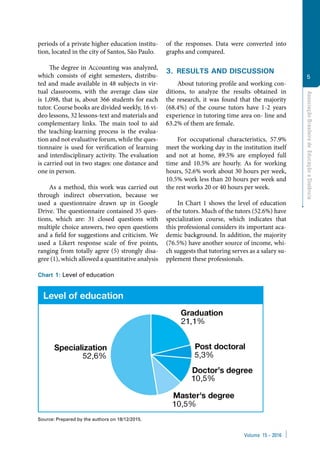
In Chart 1 shows the level of education
of the tutors. Much of the tutors (52.6%) have
specialization course, which indicates that
this professional considers its important aca-
demic background. In addition, the majority
(76.5%) have another source of income, whi-
ch suggests that tutoring serves as a salary su-
pplement these professionals.
Chart 1: Level of education
Source: Prepared by the authors on 18/12/2015.
AssociaçãoBrasileiradeEducaçãoaDistância
6
RBAAD – Technological fluency in the vision of tutors and its challenges
The following charts are related to the
perception of the tutor of the activity that it
develops in tutoring.
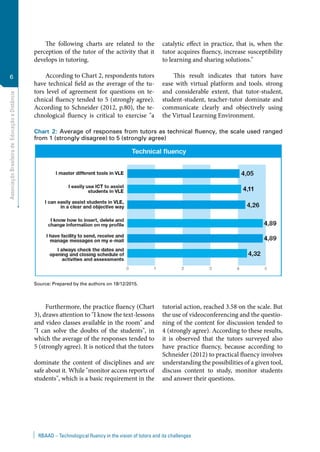
According to Chart 2, respondents tutors
have technical field as the average of the tu-
tors level of agreement for questions on te-
chnical fluency tended to 5 (strongly agree).
According to Schneider (2012, p.80), the te-
chnological fluency is critical to exercise "a
catalytic effect in practice, that is, when the
tutor acquires fluency, increase susceptibility
to learning and sharing solutions."
This result indicates that tutors have
ease with virtual platform and tools. strong
and considerable extent, that tutor-student,
student-student, teacher-tutor dominate and
communicate clearly and objectively using
the Virtual Learning Environment.
Chart 2: Average of responses from tutors as technical fluency, the scale used ranged
from 1 (strongly disagree) to 5 (strongly agree)
Source: Prepared by the authors on 18/12/2015.
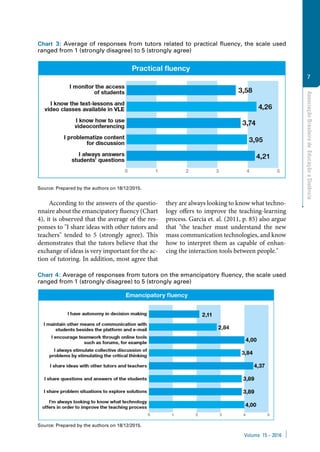
Furthermore, the practice fluency (Chart
3), draws attention to "I know the text-lessons
and video classes available in the room" and
"I can solve the doubts of the students", in
which the average of the responses tended to
5 (strongly agree). It is noticed that the tutors
dominate the content of disciplines and are
safe about it. While "monitor access reports of
students", which is a basic requirement in the
tutorial action, reached 3.58 on the scale. But
the use of videoconferencing and the questio-
ning of the content for discussion tended to
4 (strongly agree). According to these results,
it is observed that the tutors surveyed also
have practice fluency, because according to
Schneider (2012) to practical fluency involves
understanding the possibilities of a given tool,
discuss content to study, monitor students
and answer their questions.
Volume 15 − 2016
AssociaçãoBrasileiradeEducaçãoaDistância
7
Chart 3: Average of responses from tutors related to practical fluency, the scale used
ranged from 1 (strongly disagree) to 5 (strongly agree)
Source: Prepared by the authors on 18/12/2015.
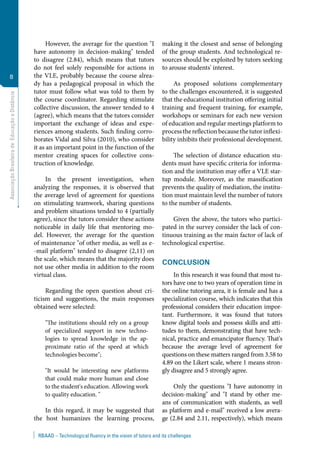
According to the answers of the questio-
nnaire about the emancipatory fluency (Chart
4), it is observed that the average of the res-
ponses to "I share ideas with other tutors and
teachers" tended to 5 (strongly agree). This
demonstrates that the tutors believe that the
exchange of ideas is very important for the ac-
tion of tutoring. In addition, most agree that
they are always looking to know what techno-
logy offers to improve the teaching-learning
process. Garcia et. al. (2011, p. 85) also argue
that "the teacher must understand the new
mass communication technologies, and know
how to interpret them as capable of enhan-
cing the interaction tools between people."
Chart 4: Average of responses from tutors on the emancipatory fluency, the scale used
ranged from 1 (strongly disagree) to 5 (strongly agree)
Source: Prepared by the authors on 18/12/2015.
AssociaçãoBrasileiradeEducaçãoaDistância
8
RBAAD – Technological fluency in the vision of tutors and its challenges
However, the average for the question "I
have autonomy in decision-making" tended
to disagree (2.84), which means that tutors
do not feel solely responsible for actions in
the VLE, probably because the course alrea-
dy has a pedagogical proposal in which the
tutor must follow what was told to them by
the course coordinator. Regarding stimulate
collective discussion, the answer tended to 4
(agree), which means that the tutors consider
important the exchange of ideas and expe-
riences among students. Such finding corro-
borates Vidal and Silva (2010), who consider
it as an important point in the function of the
mentor creating spaces for collective cons-
truction of knowledge.
In the present investigation, when
analyzing the responses, it is observed that
the average level of agreement for questions
on stimulating teamwork, sharing questions
and problem situations tended to 4 (partially
agree), since the tutors consider these actions
noticeable in daily life that mentoring mo-
del. However, the average for the question
of maintenance "of other media, as well as e-
-mail platform" tended to disagree (2,11) on
the scale, which means that the majority does
not use other media in addition to the room
virtual class.
Regarding the open question about cri-
ticism and suggestions, the main responses
obtained were selected:
"The institutions should rely on a group
of specialized support in new techno-
logies to spread knowledge in the ap-
proximate ratio of the speed at which
technologies become";
"It would be interesting new platforms
that could make more human and close
to the student's education. Allowing work
to quality education. "
In this regard, it may be suggested that
the host humanizes the learning process,
making it the closest and sense of belonging
of the group students. And technological re-
sources should be exploited by tutors seeking
to arouse students' interest.
As proposed solutions complementary
to the challenges encountered, it is suggested
that the educational institution offering initial
training and frequent training, for example,
workshops or seminars for each new version
of education and regular meetings platform to
processthereflectionbecausethetutorinflexi-
bility inhibits their professional development.
The selection of distance education stu-
dents must have specific criteria for informa-
tion and the institution may offer a VLE star-
tup module. Moreover, as the massification
prevents the quality of mediation, the institu-
tion must maintain level the number of tutors
to the number of students.
Given the above, the tutors who partici-
pated in the survey consider the lack of con-
tinuous training as the main factor of lack of
technological expertise.
CONCLUSION
In this research it was found that most tu-
tors have one to two years of operation time in
the online tutoring area, it is female and has a
specialization course, which indicates that this
professional considers their education impor-
tant. Furthermore, it was found that tutors
know digital tools and possess skills and atti-
tudes to them, demonstrating that have tech-
nical, practice and emancipator fluency. That's
because the average level of agreement for
questions on these matters ranged from 3.58 to
4.89 on the Likert scale, where 1 means stron-
gly disagree and 5 strongly agree.
Only the questions "I have autonomy in
decision-making" and "I stand by other me-
ans of communication with students, as well
as platform and e-mail" received a low avera-
ge (2.84 and 2.11, respectively), which means
Volume 15 − 2016
AssociaçãoBrasileiradeEducaçãoaDistância
9
tutors miss for greater autonomy in the course
and restricted to virtual and e-mail platform,
without stimulating the use of social networks,
for example.
According to the tutors who participated
in the survey, the lack of training is the main
blocking agent of technical fluencies, practi-
cal and emancipatory because the time delay
is notorious (instantaneous) in updates of the
versions of the software, specifically in the
Virtual Learning Environment.
This result may be related to the tutoring
management policies and factors such as the
lack of investment by the educational institu-
tion in technological training of tutors, or the
provision of a group of specialized support
in new technologies to spread knowledge in
proportion approximate the speed at whi-
ch they turn. Since the tutors have interests
about updates.
As a solution to this major challenge faced
by survey participants on technological skills,
it is proposed the implementation of a conti-
nuous training program for online teachers.
The training of professionals is the ne-
cessary tool to contribute to an efficient and
effective tutoring, and to the attainment of ex-
cellence in developed activity. Added to this,
the tutor must use the technological resources
geared to the needs of students, encouraging
them to interact with the group to achieve the
educational effectiveness.
The matters discussed herein may be in-
vestigated in further studies, because they cre-
ate opportunities for further work applied to
other private or public institutions, especially
those with the tutoring system of distance.
ReferENCES
BEHAR, P. A. Competências em educa-
ção a distância. Porto Alegre: Penso, 2013.
Disponível em: <https://books.google.com.
br>. Acesso em: 15 ago. 2015. 312 p.
BELLONI, M. L. Educação a distân-
cia. Campinas: Autores Associados, 2009.
Disponível em: <https://books.google.com.
br>. Acesso em: 4 abr. 2015. 115 p.
CUNHA, F. O.; SILVA, J. M. C. Análise das di-
mensões afetivas do tutor em turmas de EaD
no ambiente virtual Moodle. In: SIMPÓSIO
BRASILEIRO DE INFORMÁTICA NA
EDUCAÇÃO, 20., 2009, Itajaí. Anais eletrô-
nicos... Itajaí: Universidade do Vale do Itajaí,
2009. Disponível em: <http://www.niee.ufr-
gs.br/eventos/SBIE/2009/conteudo/artigos/
completos/61986_1.pdf>. Acesso em: 28 mar.
2015.
GARCIA, M. F.; RABELO, D. F.; SILVA, D.;
AMARAL, S. F. Novas competências docen-
tes frente às tecnologias digitais interativas,
2011. Revista Teoria e Prática da Educação,
Maringá, v. 14, n. 1, p. 79-87, jan.-abr. 2011.
Disponível em: <http://eduem.uem.br/ojs/in-
dex.php/TeorPratEduc/article/view/16108>.
Acesso em: 6 jul. 2015.
MALMANN, E. M.; TEIXEIRA, T. G.;
SCHNEIDER, D. R.; TOEBE, I. C. D.;
PEREIRA,G.S.F.Fluênciatecnológicanaprá-
tica de tutores no Moodle. In: CONGRESSO
INTERNACIONAL DE EDUCAÇÃO A
DISTÂNCIA, 18., 2012, São Luiz. Anais ele-
trônicos... São Luiz, ABED, 2012. Disponível
em: <http://www.abed.org.br/congresso2012/
anais/46c.pdf>. Acesso: 18 ago. 2015.
ROSAS, F. W.; BEHAR, P. A. Competência
para o contexto tecnológico-musical edu-
cacional: um foco na formação de profes-
sores. Revista e-Curriculum, v.13, n. 1, p.
87-108, 2015. Disponível em: <http://revis-
tas.pucsp.br/index.php/curriculum/article/
view/13676/16386>. Acesso em: 23 mai. 2015.
SANTOS, D. D. P. O tutor no ensino a
distância: considerações sobre o elemen-
to humano da mediação educativa com
AssociaçãoBrasileiradeEducaçãoaDistância
10
RBAAD – Technological fluency in the vision of tutors and its challenges
tecnologia,2015.134f.Dissertação(Mestrado)
- Universidade Estadual Paulista Júlio de
Mesquita Filho, Faculdade de Ciências
e Letras (Campus de Araraquara), 2015.
Disponível em: <http://repositorio.unesp.br/
bitstream/handle/11449/123163/000823930.
pdf?sequence=1&isAllowed=y>. Acesso em:
4 jun. 2015.
SCHNEIDER, D. R. Práticas diálogo-pro-
blematizadora dos tutores na UAB/UFSM:
fluência tecnológica no Moodle, 2012. 204
f. Dissertação (Mestrado) – Universidade
Federal de Santa Maria, Centro de Educação,
Programa de Pós-Graduação em Educação,
RS, 2012. Disponível em: <http://cas-
cavel.ufsm.br/tede/tde_busca/arquivo.
php?codArquivo=4538>. Acesso em: 18 ago.
2015.
VIDAL, O. F.; SILVA, M. M. O tutor na educa-
çãoadistância:contribuiçãodamotivaçãopara
a aprendizagem online. In: II CONGRESSO
INTERNACIONAL IGLU: XI COLÓQUIO
INTERNACIONAL SOBRE GESTÃO
UNIVERSITÁRIA NA AMÉRICA DO SUL,
2011, Florianópolis. Anais eletrônicos...
Florianópolis:IGLU,2011.Disponívelem:<ht-
tps://repositorio.ufsc.br/bitstream/handle/
123456789/26006/3.6.pdf?sequence=1>.
Acesso em: 24 ago. 2015.
TRACTEMBERG, L.; FILATRO, A. C.
Tutoria on-line em organizações públi-
cas, 2013. Disponível em: <http://reposito-
rio.enap.gov.br/bitstream/handle/1/1350/
TutoriaOnLine_modulo_1_aprovacao_.
pdf?sequence=1&isAllowed=y>. Acesso: 23
ago. 2015. MORAN, José Manuel. O que é
educação a distância, out. 2005. Disponível
em: <http://umbu.ied.dcc.ufmg.br/moo-
dle/file.php/117/ Nivel_0/Conteudo/O_
que_educao_a_distancia.pdf>. Acesso em:
12/08/2014.

2016 technological fluency

  • 1.
    Volume 15 −2016 ABSTRACT This work presents a proposal of study on the technological experience of distance tutors, also known as technological fluency, founded by experts of Distance Education in current context. Its aim is to identify, analyze and understand the basic knowledge of distance tutors, focusing on technological fluency, which includes technical, practical and emancipatory fluencies. For that, a case study in a private educational institution has been done, in which an online questionnai- re was applied to 24 tutors of a distance gra- duation course. According to the results, the respondent tutors have technological expe- rience (technical, practical and emancipatory fluencies), however, regarding the emanci- patory fluency, it was seen that they do not have autonomy in decision-making and they do not have another way of communication with students beyond the platform itself and e-mail. Concerning suggestions and criticis- ms, it was verified that tutors are concerned about spreading their knowledge about new technologies, since technology is constantly changing. In that way, it is necessary a perma- nent training of online tutors so they can use these new technologies with authority in the practice of the distance tutorial. Keywords: Distance tutorial. Challenge. Training. Technical fluency. RESUMEN Este trabajo presenta una propuesta de estudio acerca de la experiencia tecnológica de los tutores a distancia, denominada también fluidez tecnológica, fundamentada por estudiosos de la Educación a Distancia en el contexto actual. Tiene por objetivo identificar, analizar y comprender las competencias básicas de los tutores a distancia, centrándose en la fluidez tecnológica que abarca la fluidez técnica, la práctica y la emancipatoria. Para ello, se ha realizado un estudio testigo en una institución de enseñanza privada, donde se aplicó un cuestionario “on line” dirigido a 24 tutores de un curso de graduación a distancia. De acuerdo al resultado, los tutores encuestados poseen experiencia tecnológica (fluidez técnica, práctica y emancipatoria), sin embargo, en lo que atañe a la fluidez emancipatoria, se observó que ellos no poseen autonomía en la toma de decisiones y además no tienen otra forma de comunicación con los alumnos más allá de la misma plataforma o del 2Article Technological fluency in the vision of tutors and its challenges Maria das Graças Freitas dos Santos1 Samira Pirola Santos Mantilla2 1 Universidade Federal Fluminense. E-mail: freitas_santos@yahoo.com.br 2  Universidade Federal Fluminense. E-mail: samiramantilla@yahoo.com.br
  • 2.
    AssociaçãoBrasileiradeEducaçãoaDistância 2 RBAAD – Technologicalfluency in the vision of tutors and its challenges e-mail. En relación a las sugerencias y críticas, se verificó que los tutores, están preocupados en la difusión de conocimientos sobre las novedades tecnológicas, ya que estas están en permanente transformación. De ese modo, se hace necesaria una capacitación constante de los tutores “on line” para que puedan utilizar con autoridad dichas nuevas tecnologías en la práctica de la tutoría a distancia. Palabras clave: Tutoría a distancia. Desafío. Capacitación. Fluidez técnica. RESUMO Este trabalho apresenta uma proposta de estudo sobre a competência tecnológica dos tutores a distância, também denominada de fluência tecnológica, fundamentada em estudiosos da Educação a Distância no contexto atual. Visa identificar, analisar e compreender as competências essenciais dos tutores a distância, com foco na fluência tecnológica que engloba as fluências técnica, práticaeemancipatória.Paraisso,foirealizado um estudo de caso em uma instituição de ensino particular, onde foi aplicado um questionário on-line para 24 tutores de um curso de graduação a distância. De acordo com os resultados, os tutores respondentes possuem domínio tecnológico (fluência técnica, prática e emancipatória), entretanto, no que tange à fluência emancipatória, observou-se que eles não possuem autonomia na tomada de decisões e não mantêm outros meios de comunicação com os estudantes, além da plataforma e do e-mail. Em relação às sugestões e críticas, verificou-se que os tutores estão preocupados com a difusão do conhecimento sobre as novidades tecnológicas, na medida em que as tecnologias estão em constante transformação. Assim, faz- se necessária uma capacitação constante dos tutores on-line para que eles possam utilizar com autoridade essas novas tecnologias na prática da tutoria a distância. Palavras-chave:: Tutoria a distância. Desafios. Capacitação. Fluência técnica. INTRODUCTION The Distance Education (DE) is a type of education mediated over the use of Digital Technologies of Information and Communication (TDIC), in which the tutor has the role of online teaching, mediating the process of teaching students' learning. This mode is expanding and can facilitate the access to quality education, as long as those responsible are involved and directed in the planning and development of teaching strate- gies adapted to the virtual environment. Among those responsible for the tea- ching-learning process, there is a professional of great importance: the virtual tutor. It acts as moderator and facilitator of the process, encouraging and instigating students to deve- lop autonomy in studies and enjoy the best as possible, the content covered during the dis- tance studying process. According to Cunha (2009), the dis- tance tutor must develop the following core competencies: social-affective, self evaluated, managerial, technological and pedagogical, in order to contribute to learning, according to the cognitive and practical models. They impact the teaching-learning process, becau- se they are able to align the knowledge, skills and attitudes. Regarding technological competence, Schneider (2012, p. 84) ranks the techni- cal, practical and emancipatory fluencies. This competence requires the tutor time and dedication in each stage, in which it must consider all aspects that impact the tea- ching-learning process. Rosas and Behar (2015, p. 89) argue that with the "advent of free software, broadened the possibilities of use" of these teaching re- sources in all educational modalities, from face-to-face, semi or even fully distance
  • 3.
    Volume 15 −2016 AssociaçãoBrasileiradeEducaçãoaDistância 3 education. In this context, the use of digital technology impacts the performance of the tutorial function, since it is directed accor- ding to the needs of each student. So, for that mediation is effective, the tu- tor must have in their professional practice te- chnological expertise, demonstrating skill in the use of Information and Communication Digital Technologies in order to crea- te an interactive and collaborative virtual learning environment. In this context, the objective of this stu- dy was to analyze the essential technological skills of the tutor and propose solutions to the challenges faced by tutors that it reaches ex- cellence in their duties. 1.  TECHNOLOGICAL COMPETENCES OF DISTANCE LEARNING TUTOR The role of the distance learning tutor is no different and much less lower than the classroom courses teachers. In distance edu- cation, the tutor acts as a guiding agent of the construction of the student's knowledge and even their self-learning, which is important for the graduation. This professional virtually guides the stu- dent and the program content of the course, accompanying him throughout the process of teaching and learning (SANTOS, 2015). The tutors selection announcements characterize them "as an expert in the area of knowledge that will actuate" as well as someone who will "monitor the development of the activities and identify the difficulties and the progress of students" (SANTOS, 2015, p. 39). A good tutor must create proposals for activities for reflection, suggest alternative sources of information, explanations, facilita- te understanding processes; that is, to guide, oversee, promote the realization of activities, provide new sources of information and to promote understanding. Many students drop distance courses because they don't see in their tutors the necessary help to continue the course. The professional of distance education assumes many responsibilities and functions in distance education, getting highlighted the educational mediation, as this professional has direct contact with students (SANTOS, 2015, p. 37). It is understood professional profile as a set of core competencies for the develo- pment of a job. In the case of tutor, it is essential that it has a range of skills and abilities, among them the use of new te- chnologies of information and interac- tion. However, the ability is not limited to use, but extends to the way it will resour- ce utilization. The tutor should be skilled in placing the words that will mediate be- tween student and learning through tech- nology and know tools to distinguish the appropriate resource, as well as the ide- al time for each type of communication (SANTOS, 2015, p. 48). When it comes to technological fluency in online tutoring, stands the theme Virtual Learning Environment (VLE), which is the virtual space where happen exchanges of experience and sharing study material of an online course. In addition, the VLE, there are interactions between students and tutors and between students and students, through di- fferent synchronous and asynchronous tools, which are of paramount importance to deve- lop the relationship student / tutor and evoke the feeling of belonging to the group. VLEs should be planned taking into con- sideration that students need to be encoura- ged to interact and collaborate to establish more complex levels of essential cognitive flexibility in the construction of knowledge (MALLMANN et. al., 2012).
  • 4.
    AssociaçãoBrasileiradeEducaçãoaDistância 4 RBAAD – Technologicalfluency in the vision of tutors and its challenges For this purpose the environment must possess technological resources to enable such interaction and cooperation. However, not enough to have an environment equipped with technologies, the tutor know not explore thetoolsavailableinit.AccordingtoRosasand Behar (2015, p. 89), the technological compe- tence should be explored because the advent of software entails the expansion of educatio- nal resources in all educational modalities. In this context, the technological com- petence requires the tutelary action the field of Digital Technologies of Information and Communication (TDIC), as well as use and instruct students in the basics, if not, direct to the relevant department for appropriate action. Tractemberg and Filatro (2013) consider examples of technological skills in the men- toring context: use masterfully the different tools available in the virtual environment; employ different technologies to support the participation of learners and guide them cle- arly and objectively about the proper use of the virtual learning environment. The primary technological skills accor- ding to Behar (2013, p 57) are: a) Computer literacy, which refers to the criticality of information and the use of digital technologies; b) Cooperation enhanced by social interac- tion that occurs mainly in VLE; c) Social presence in the way the individual of distance education is perceived immer- sed in virtuality; d) Autonomy in decision-making; e)Organizationofspaceandcommunication or ways of expression through technology. Thus, the digital literacy is related to the use and critique of filtered information. The enhanced cooperation relates to the in- teraction in the virtual environment. Thus, social presence is the perception of the in- dividual in the "virtuality", making it auto- nomous when making decisions; providing management and organization of time and increased communication. Technological fluency permeates the te- chnical influences, practical and emancipa- tory (SCHNEIDER, 2012, p. 84). The tecnical fluency refers to the knowledge of the tools, while the digital practice requires skill. The emancipatory refers from attitudes and sha- ring knowledge and technological skills. Schneider (2012) listed the skills requi- red by tutors to achieve technological fluency. According to the author, technical fluency is related to the ability to use the computer, learn new ways to use the computer and use multiple programs and tools. Since the prac- tical fluency involves developing the ability to create and solve activities with the computer, to understand all that can be created with a given tool and create activities based on their own ideas. On the other hand, the emancipa- tory fluency includes the ability to use tech- nology to contribute to the community on the Internet, modify and extend study activities created by others, use the concepts learned in the activities in other educational contexts. Thus the exploitation of technological resources, by the tutor, enhances the interac- tion, collaboration and interactivity on the steps of the construction of knowledge. 2.  Methodology The methodological procedure consisted of a case study to verify the perception of vir- tual tutors of technological challenges in the tutorial action. Applied to an online questio- nnaire to 24 tutors, of both sexes, specialists and master's or, in the morning and evening
  • 5.
    Volume 15 −2016 AssociaçãoBrasileiradeEducaçãoaDistância 5 periods of a private higher education institu- tion, located in the city of Santos, São Paulo. The degree in Accounting was analyzed, which consists of eight semesters, distribu- ted and made available in 48 subjects in vir- tual classrooms, with the average class size is 1,098, that is, about 366 students for each tutor. Course books are divided weekly, 16 vi- deo lessons, 32 lessons-text and materials and complementary links. The main tool to aid the teaching-learning process is the evalua- tion and not evaluative forum, while the ques- tionnaire is used for verification of learning and interdisciplinary activity. The evaluation is carried out in two stages: one distance and one in person. As a method, this work was carried out through indirect observation, because we used a questionnaire drawn up in Google Drive. The questionnaire contained 35 ques- tions, which are: 31 closed questions with multiple choice answers, two open questions and a field for suggestions and criticism. We used a Likert response scale of five points, ranging from totally agree (5) strongly disa- gree (1), which allowed a quantitative analysis of the responses. Data were converted into graphs and compared. 3.  RESULTS and discussion About tutoring profile and working con- ditions, to analyze the results obtained in the research, it was found that the majority (68.4%) of the course tutors have 1-2 years experience in tutoring time area on- line and 63.2% of them are female. For occupational characteristics, 57.9% meet the working day in the institution itself and not at home, 89.5% are employed full time and 10.5% are hourly. As for working hours, 52.6% work about 30 hours per week, 10.5% work less than 20 hours per week and the rest works 20 or 40 hours per week. In Chart 1 shows the level of education of the tutors. Much of the tutors (52.6%) have specialization course, which indicates that this professional considers its important aca- demic background. In addition, the majority (76.5%) have another source of income, whi- ch suggests that tutoring serves as a salary su- pplement these professionals. Chart 1: Level of education Source: Prepared by the authors on 18/12/2015.
  • 6.
    AssociaçãoBrasileiradeEducaçãoaDistância 6 RBAAD – Technologicalfluency in the vision of tutors and its challenges The following charts are related to the perception of the tutor of the activity that it develops in tutoring. According to Chart 2, respondents tutors have technical field as the average of the tu- tors level of agreement for questions on te- chnical fluency tended to 5 (strongly agree). According to Schneider (2012, p.80), the te- chnological fluency is critical to exercise "a catalytic effect in practice, that is, when the tutor acquires fluency, increase susceptibility to learning and sharing solutions." This result indicates that tutors have ease with virtual platform and tools. strong and considerable extent, that tutor-student, student-student, teacher-tutor dominate and communicate clearly and objectively using the Virtual Learning Environment. Chart 2: Average of responses from tutors as technical fluency, the scale used ranged from 1 (strongly disagree) to 5 (strongly agree) Source: Prepared by the authors on 18/12/2015. Furthermore, the practice fluency (Chart 3), draws attention to "I know the text-lessons and video classes available in the room" and "I can solve the doubts of the students", in which the average of the responses tended to 5 (strongly agree). It is noticed that the tutors dominate the content of disciplines and are safe about it. While "monitor access reports of students", which is a basic requirement in the tutorial action, reached 3.58 on the scale. But the use of videoconferencing and the questio- ning of the content for discussion tended to 4 (strongly agree). According to these results, it is observed that the tutors surveyed also have practice fluency, because according to Schneider (2012) to practical fluency involves understanding the possibilities of a given tool, discuss content to study, monitor students and answer their questions.
  • 7.
    Volume 15 −2016 AssociaçãoBrasileiradeEducaçãoaDistância 7 Chart 3: Average of responses from tutors related to practical fluency, the scale used ranged from 1 (strongly disagree) to 5 (strongly agree) Source: Prepared by the authors on 18/12/2015. According to the answers of the questio- nnaire about the emancipatory fluency (Chart 4), it is observed that the average of the res- ponses to "I share ideas with other tutors and teachers" tended to 5 (strongly agree). This demonstrates that the tutors believe that the exchange of ideas is very important for the ac- tion of tutoring. In addition, most agree that they are always looking to know what techno- logy offers to improve the teaching-learning process. Garcia et. al. (2011, p. 85) also argue that "the teacher must understand the new mass communication technologies, and know how to interpret them as capable of enhan- cing the interaction tools between people." Chart 4: Average of responses from tutors on the emancipatory fluency, the scale used ranged from 1 (strongly disagree) to 5 (strongly agree) Source: Prepared by the authors on 18/12/2015.
  • 8.
    AssociaçãoBrasileiradeEducaçãoaDistância 8 RBAAD – Technologicalfluency in the vision of tutors and its challenges However, the average for the question "I have autonomy in decision-making" tended to disagree (2.84), which means that tutors do not feel solely responsible for actions in the VLE, probably because the course alrea- dy has a pedagogical proposal in which the tutor must follow what was told to them by the course coordinator. Regarding stimulate collective discussion, the answer tended to 4 (agree), which means that the tutors consider important the exchange of ideas and expe- riences among students. Such finding corro- borates Vidal and Silva (2010), who consider it as an important point in the function of the mentor creating spaces for collective cons- truction of knowledge. In the present investigation, when analyzing the responses, it is observed that the average level of agreement for questions on stimulating teamwork, sharing questions and problem situations tended to 4 (partially agree), since the tutors consider these actions noticeable in daily life that mentoring mo- del. However, the average for the question of maintenance "of other media, as well as e- -mail platform" tended to disagree (2,11) on the scale, which means that the majority does not use other media in addition to the room virtual class. Regarding the open question about cri- ticism and suggestions, the main responses obtained were selected: "The institutions should rely on a group of specialized support in new techno- logies to spread knowledge in the ap- proximate ratio of the speed at which technologies become"; "It would be interesting new platforms that could make more human and close to the student's education. Allowing work to quality education. " In this regard, it may be suggested that the host humanizes the learning process, making it the closest and sense of belonging of the group students. And technological re- sources should be exploited by tutors seeking to arouse students' interest. As proposed solutions complementary to the challenges encountered, it is suggested that the educational institution offering initial training and frequent training, for example, workshops or seminars for each new version of education and regular meetings platform to processthereflectionbecausethetutorinflexi- bility inhibits their professional development. The selection of distance education stu- dents must have specific criteria for informa- tion and the institution may offer a VLE star- tup module. Moreover, as the massification prevents the quality of mediation, the institu- tion must maintain level the number of tutors to the number of students. Given the above, the tutors who partici- pated in the survey consider the lack of con- tinuous training as the main factor of lack of technological expertise. CONCLUSION In this research it was found that most tu- tors have one to two years of operation time in the online tutoring area, it is female and has a specialization course, which indicates that this professional considers their education impor- tant. Furthermore, it was found that tutors know digital tools and possess skills and atti- tudes to them, demonstrating that have tech- nical, practice and emancipator fluency. That's because the average level of agreement for questions on these matters ranged from 3.58 to 4.89 on the Likert scale, where 1 means stron- gly disagree and 5 strongly agree. Only the questions "I have autonomy in decision-making" and "I stand by other me- ans of communication with students, as well as platform and e-mail" received a low avera- ge (2.84 and 2.11, respectively), which means
  • 9.
    Volume 15 −2016 AssociaçãoBrasileiradeEducaçãoaDistância 9 tutors miss for greater autonomy in the course and restricted to virtual and e-mail platform, without stimulating the use of social networks, for example. According to the tutors who participated in the survey, the lack of training is the main blocking agent of technical fluencies, practi- cal and emancipatory because the time delay is notorious (instantaneous) in updates of the versions of the software, specifically in the Virtual Learning Environment. This result may be related to the tutoring management policies and factors such as the lack of investment by the educational institu- tion in technological training of tutors, or the provision of a group of specialized support in new technologies to spread knowledge in proportion approximate the speed at whi- ch they turn. Since the tutors have interests about updates. As a solution to this major challenge faced by survey participants on technological skills, it is proposed the implementation of a conti- nuous training program for online teachers. The training of professionals is the ne- cessary tool to contribute to an efficient and effective tutoring, and to the attainment of ex- cellence in developed activity. Added to this, the tutor must use the technological resources geared to the needs of students, encouraging them to interact with the group to achieve the educational effectiveness. The matters discussed herein may be in- vestigated in further studies, because they cre- ate opportunities for further work applied to other private or public institutions, especially those with the tutoring system of distance. ReferENCES BEHAR, P. A. Competências em educa- ção a distância. Porto Alegre: Penso, 2013. Disponível em: <https://books.google.com. br>. Acesso em: 15 ago. 2015. 312 p. BELLONI, M. L. Educação a distân- cia. Campinas: Autores Associados, 2009. Disponível em: <https://books.google.com. br>. Acesso em: 4 abr. 2015. 115 p. CUNHA, F. O.; SILVA, J. M. C. Análise das di- mensões afetivas do tutor em turmas de EaD no ambiente virtual Moodle. In: SIMPÓSIO BRASILEIRO DE INFORMÁTICA NA EDUCAÇÃO, 20., 2009, Itajaí. Anais eletrô- nicos... Itajaí: Universidade do Vale do Itajaí, 2009. Disponível em: <http://www.niee.ufr- gs.br/eventos/SBIE/2009/conteudo/artigos/ completos/61986_1.pdf>. Acesso em: 28 mar. 2015. GARCIA, M. F.; RABELO, D. F.; SILVA, D.; AMARAL, S. F. Novas competências docen- tes frente às tecnologias digitais interativas, 2011. Revista Teoria e Prática da Educação, Maringá, v. 14, n. 1, p. 79-87, jan.-abr. 2011. Disponível em: <http://eduem.uem.br/ojs/in- dex.php/TeorPratEduc/article/view/16108>. Acesso em: 6 jul. 2015. MALMANN, E. M.; TEIXEIRA, T. G.; SCHNEIDER, D. R.; TOEBE, I. C. D.; PEREIRA,G.S.F.Fluênciatecnológicanaprá- tica de tutores no Moodle. In: CONGRESSO INTERNACIONAL DE EDUCAÇÃO A DISTÂNCIA, 18., 2012, São Luiz. Anais ele- trônicos... São Luiz, ABED, 2012. Disponível em: <http://www.abed.org.br/congresso2012/ anais/46c.pdf>. Acesso: 18 ago. 2015. ROSAS, F. W.; BEHAR, P. A. Competência para o contexto tecnológico-musical edu- cacional: um foco na formação de profes- sores. Revista e-Curriculum, v.13, n. 1, p. 87-108, 2015. Disponível em: <http://revis- tas.pucsp.br/index.php/curriculum/article/ view/13676/16386>. Acesso em: 23 mai. 2015. SANTOS, D. D. P. O tutor no ensino a distância: considerações sobre o elemen- to humano da mediação educativa com
  • 10.
    AssociaçãoBrasileiradeEducaçãoaDistância 10 RBAAD – Technologicalfluency in the vision of tutors and its challenges tecnologia,2015.134f.Dissertação(Mestrado) - Universidade Estadual Paulista Júlio de Mesquita Filho, Faculdade de Ciências e Letras (Campus de Araraquara), 2015. Disponível em: <http://repositorio.unesp.br/ bitstream/handle/11449/123163/000823930. pdf?sequence=1&isAllowed=y>. Acesso em: 4 jun. 2015. SCHNEIDER, D. R. Práticas diálogo-pro- blematizadora dos tutores na UAB/UFSM: fluência tecnológica no Moodle, 2012. 204 f. Dissertação (Mestrado) – Universidade Federal de Santa Maria, Centro de Educação, Programa de Pós-Graduação em Educação, RS, 2012. Disponível em: <http://cas- cavel.ufsm.br/tede/tde_busca/arquivo. php?codArquivo=4538>. Acesso em: 18 ago. 2015. VIDAL, O. F.; SILVA, M. M. O tutor na educa- çãoadistância:contribuiçãodamotivaçãopara a aprendizagem online. In: II CONGRESSO INTERNACIONAL IGLU: XI COLÓQUIO INTERNACIONAL SOBRE GESTÃO UNIVERSITÁRIA NA AMÉRICA DO SUL, 2011, Florianópolis. Anais eletrônicos... Florianópolis:IGLU,2011.Disponívelem:<ht- tps://repositorio.ufsc.br/bitstream/handle/ 123456789/26006/3.6.pdf?sequence=1>. Acesso em: 24 ago. 2015. TRACTEMBERG, L.; FILATRO, A. C. Tutoria on-line em organizações públi- cas, 2013. Disponível em: <http://reposito- rio.enap.gov.br/bitstream/handle/1/1350/ TutoriaOnLine_modulo_1_aprovacao_. pdf?sequence=1&isAllowed=y>. Acesso: 23 ago. 2015. MORAN, José Manuel. O que é educação a distância, out. 2005. Disponível em: <http://umbu.ied.dcc.ufmg.br/moo- dle/file.php/117/ Nivel_0/Conteudo/O_ que_educao_a_distancia.pdf>. Acesso em: 12/08/2014.