APPLICATION
0F THE
THINK ALOUD METHOD
IN
USE, USER AND USABILITY RESEARCH
IN
CARTOGRAPHY & GEOGRAPHIC
INFORMATION SCIENCE
CORNÉ VAN ELZAKKER
WORKSHOP DESIGNING & CONDUCTING USER STUDIES
6TH ICC & GIS, ALBENA, BULGARIA, 15 JUNE 2016
2
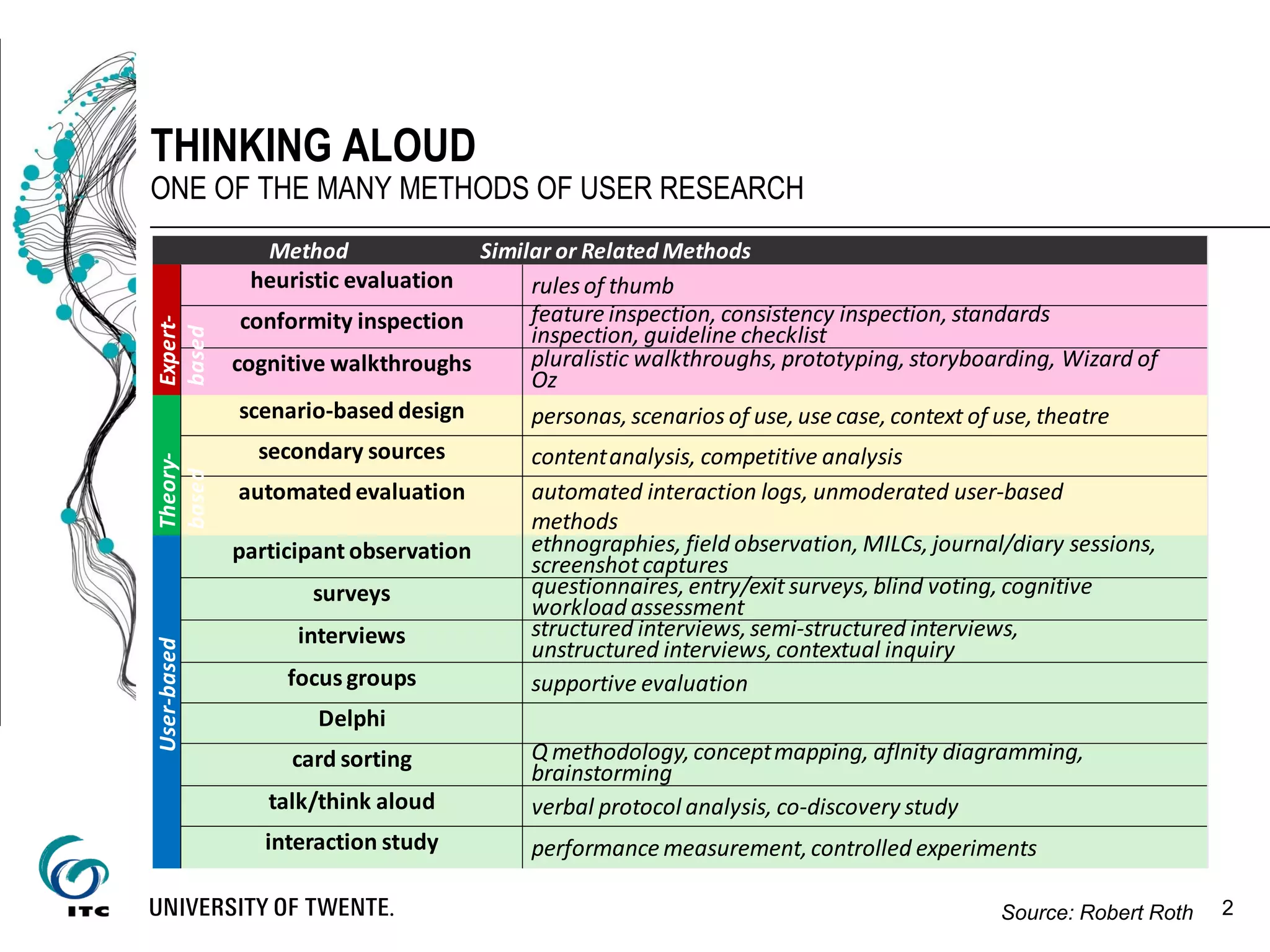
THINKING ALOUD
ONE OF THE MANY METHODS OF USER RESEARCH
Method Similar or Related Methods
Expert-
based
heuristic evaluation rulesof thumb
conformity inspection feature inspection, consistency inspection, standards
inspection, guideline checklist
cognitive walkthroughs pluralistic walkthroughs, prototyping, storyboarding, Wizard of
Oz
Theory-
based
scenario-based design personas, scenarios of use, use case, context of use, theatre
secondary sources contentanalysis, competitive analysis
automated evaluation automated interaction logs, unmoderated user-based
methods
User-based
participant observation ethnographies, field observation, MILCs, journal/diary sessions,
screenshot captures
surveys questionnaires, entry/exit surveys, blind voting, cognitive
workload assessment
interviews structured interviews, semi-structured interviews,
unstructured interviews, contextual inquiry
focus groups supportive evaluation
Delphi
card sorting Q methodology, conceptmapping, aflnity diagramming,
brainstorming
talk/think aloud verbal protocol analysis, co-discovery study
interaction study performance measurement,controlled experiments
Source: Robert Roth
3
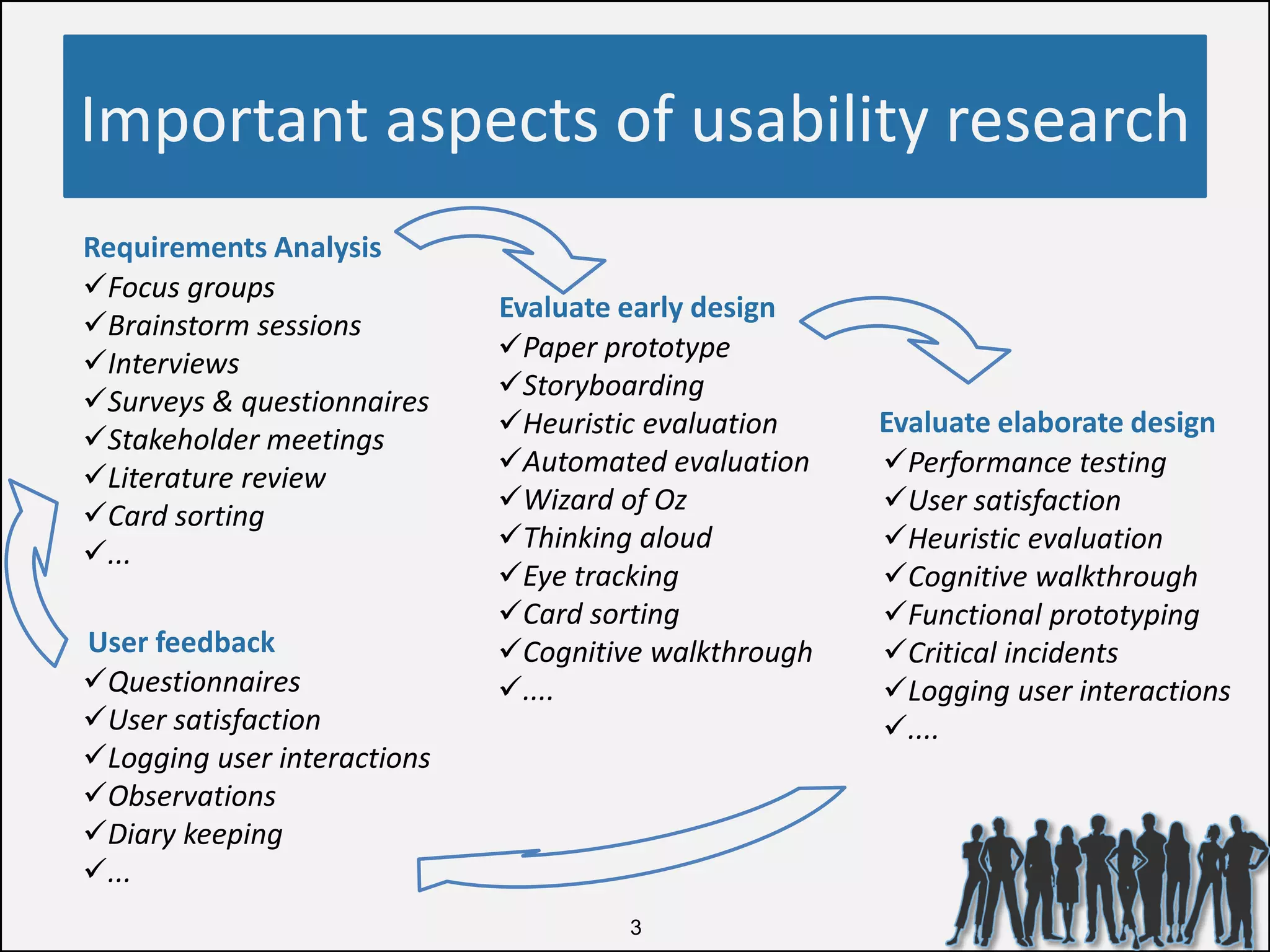
Important aspects of usability research
Requirements Analysis
Evaluate early design
Evaluate elaborate design
User feedback
Focus groups
Brainstorm sessions
Interviews
Surveys & questionnaires
Stakeholder meetings
Literature review
Card sorting
...
Paper prototype
Storyboarding
Heuristic evaluation
Automated evaluation
Wizard of Oz
Thinking aloud
Eye tracking
Card sorting
Cognitive walkthrough
....
Performance testing
User satisfaction
Heuristic evaluation
Cognitive walkthrough
Functional prototyping
Critical incidents
Logging user interactions
....
Questionnaires
User satisfaction
Logging user interactions
Observations
Diary keeping
...
Analyse
Requirements
Produce Design
Solutions
Conceptual
Design
& Prototype
Final Design
& Prototype
Interim
Designs &
Prototypes
Identify the
need for
user-centred
design
Design
satisfies
requirements
Evaluate Designs
Testing with
representative
users
input
Business
User
StakeholderOrganisational
Characteristics Preferences
Use contexts Tasks
4
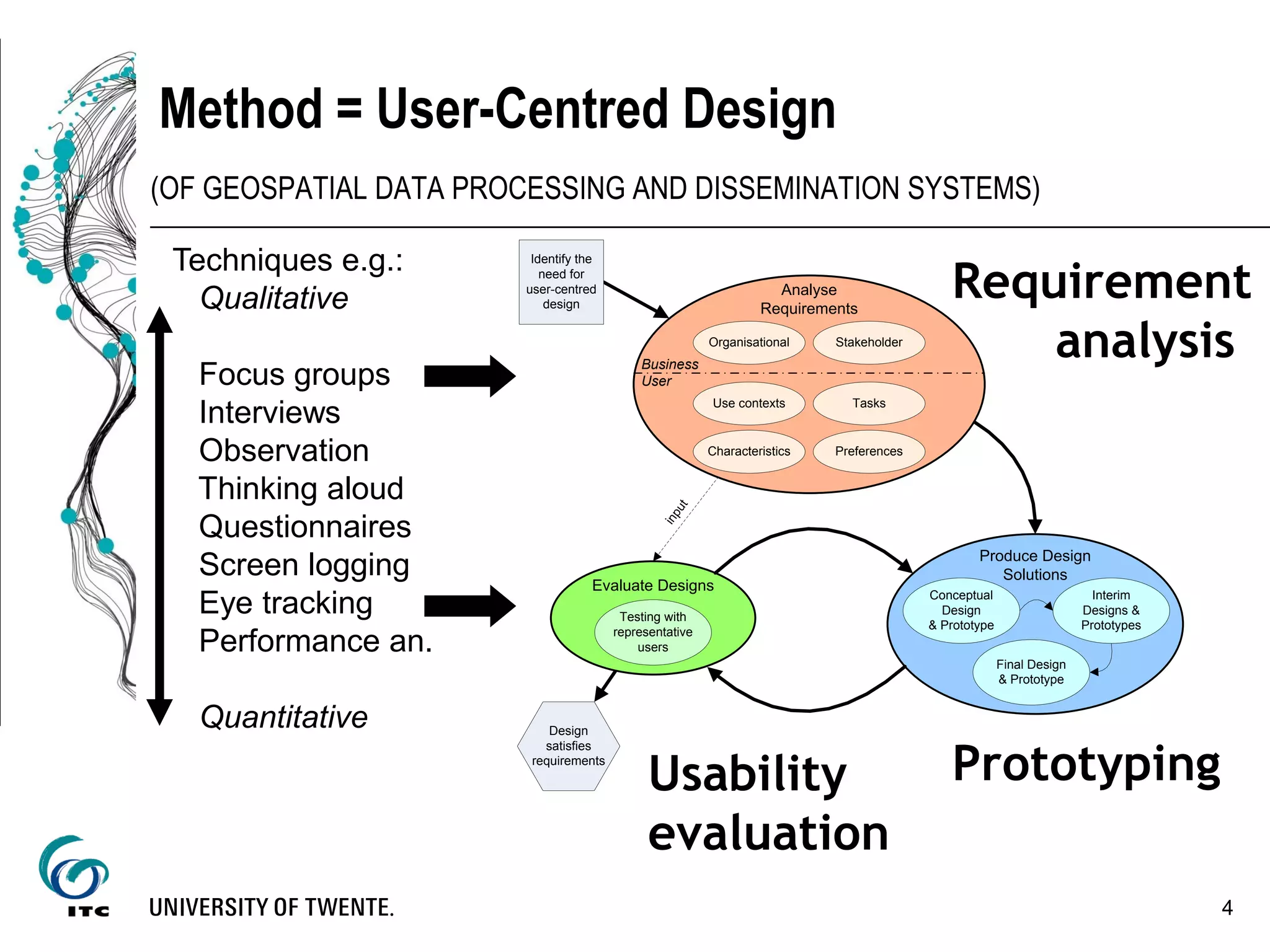
(OF GEOSPATIAL DATA PROCESSING AND DISSEMINATION SYSTEMS)
Method = User-Centred Design
Prototyping
Requirement
analysis
Usability
evaluation
Techniques e.g.:
Qualitative
Focus groups
Interviews
Observation
Thinking aloud
Questionnaires
Screen logging
Eye tracking
Performance an.
Quantitative
 Distinction between qualitative and quantitative research
 Working with experts or with (representatives of) “real” end-users
 Doing research in the proper context (field-based vs. laboratory based
research)
 Distinction between methods & techniques of data collection and data
analysis
5
IMPORTANT ASPECTS OF UUU RESEARCH
 Interviews / Focus Groups
 Surveys / Questionnaires
 Product analysis
 Card sorting
 Interaction study
 Observation …
COLLECTING USE, USER & USABILITY DATA
ANOTHER LOOK AT CATEGORIES OF TOOLS
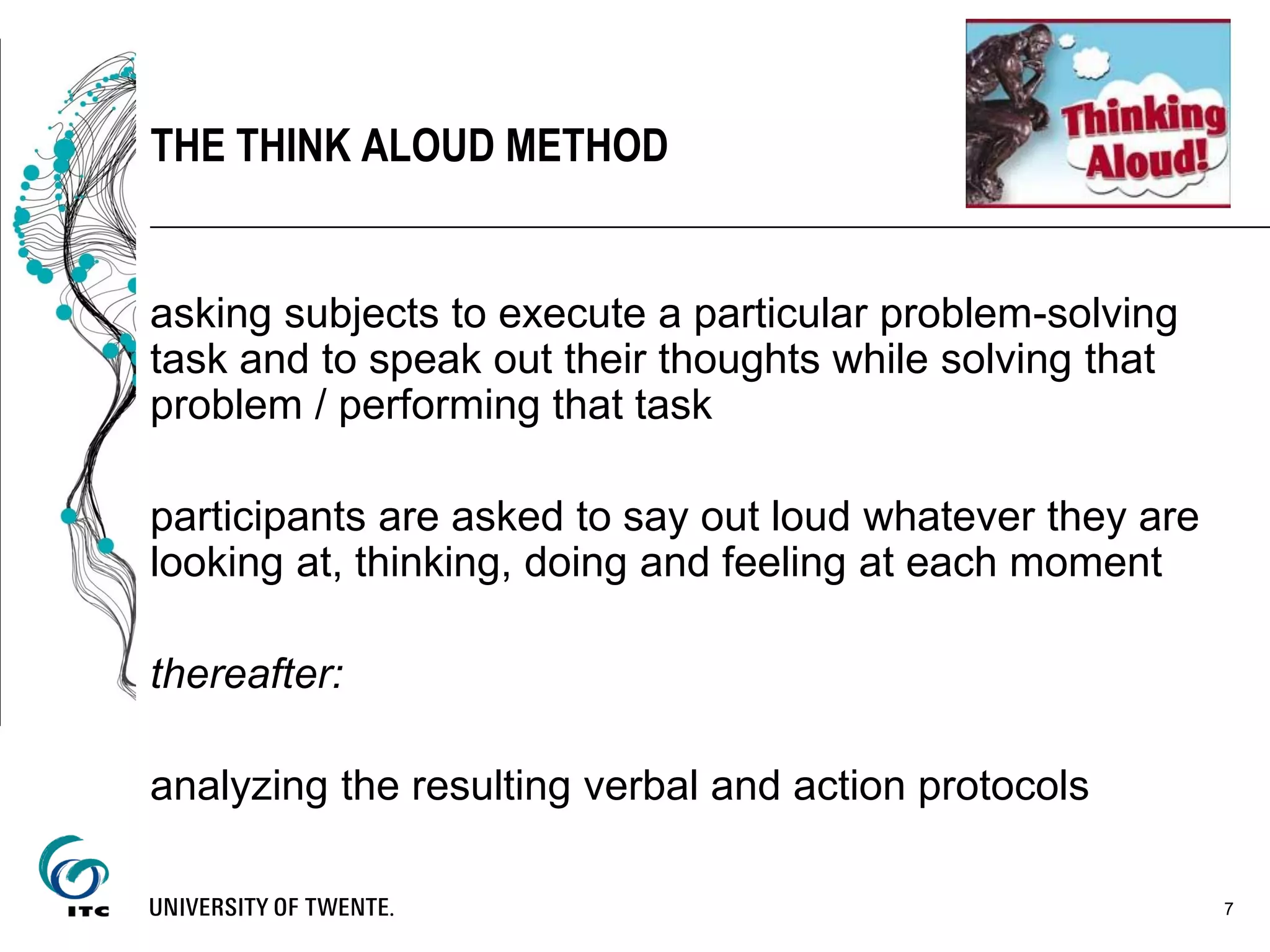
asking subjects to execute a particular problem-solving
task and to speak out their thoughts while solving that
problem / performing that task
participants are asked to say out loud whatever they are
looking at, thinking, doing and feeling at each moment
thereafter:
analyzing the resulting verbal and action protocols
7
THE THINK ALOUD METHOD
Some investigations into knowledge acquisition from existing (static) maps:
 Thorndyke & Stasz (1980)
 Kinnear & Wood a.o. (1987/1988)
 Kulhavy, Pridemore & Stock (1992)
 Crampton (1992)
 Heidmann & Johann (1997)
 Board (1997)
 Ungar, Blades & Spencer (1997)
EARLIER APPLICATIONS OF THE THINK ALOUD METHOD
IN MAP USE RESEARCH
Investigations into the use of cartographic visualization systems for
geographical data exploration:
 McGuinness, van Wersch, Stringer (1993)
 MacEachren, Boscoe, Haug, Pickle (1998)
 See online bibliography ICA Commission on UUUI for more examples of
case studies!
EARLIER APPLICATIONS OF THE THINK ALOUD METHOD
IN MAP USE RESEARCH
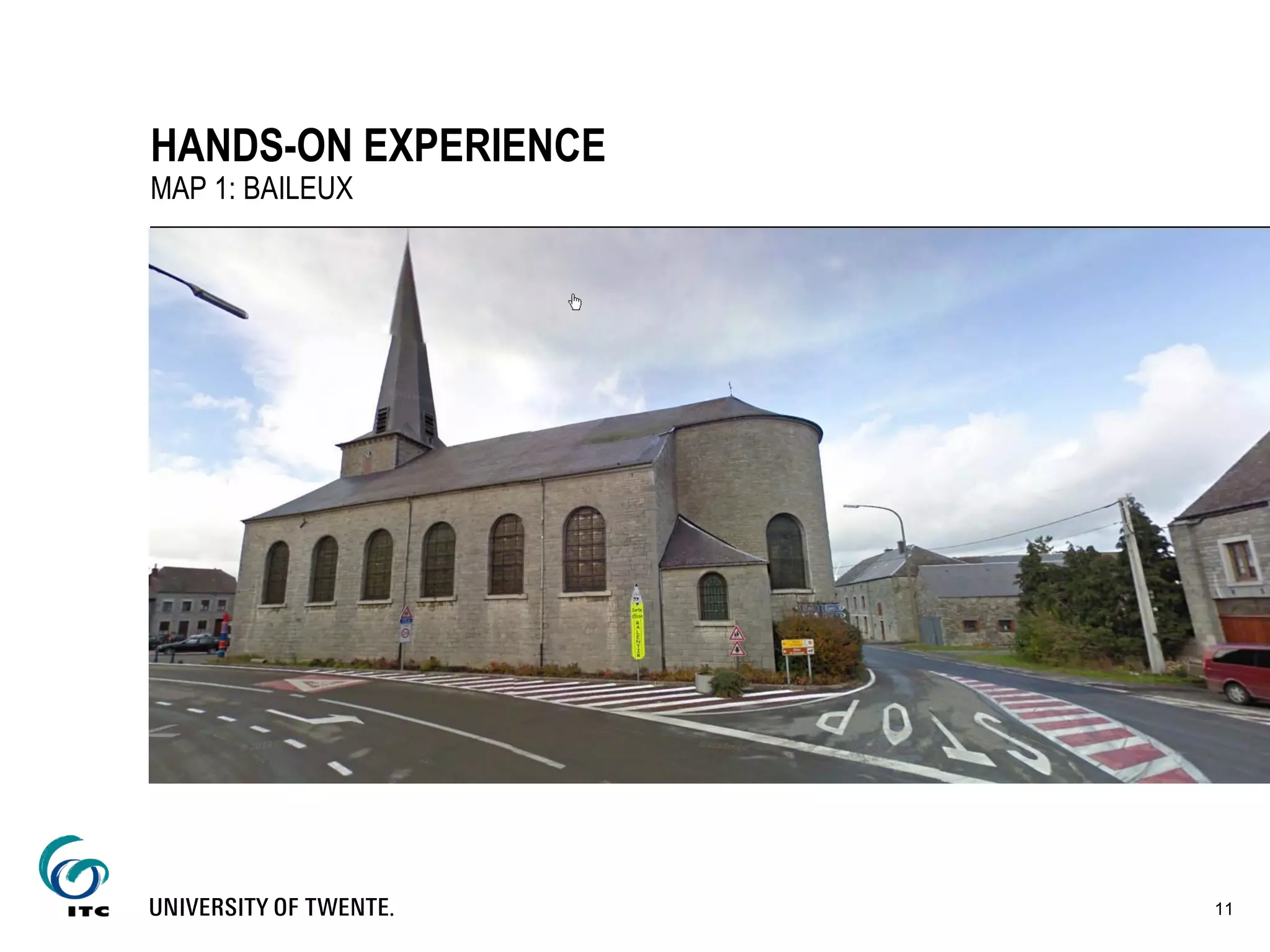
 Form pairs
 Execute map reading activity:
Locate the Google StreetView image on the map fragment provided while
thinking aloud
 Observer takes notes or records the thinking aloud
 Switch roles with Map 2
 After this, we will discuss your experiences
10
HANDS-ON EXPERIENCE
MAP READING ACTIVITY IN PAIRS
11
HANDS-ON EXPERIENCE
MAP 1: BAILEUX
12
HANDS-ON EXPERIENCE
MAP 2: FORGES
 What are your experiences with applying the think aloud method?
 What are the potential advantages?
 What are the disadvantages? What could be the problems?
 Questions?
HANDS-ON EXPERIENCE WITH THINKING ALOUD
MAP READING ACTIVITY IN PAIRS
13
 Leads to valid, unique, direct and the most complete data on cognitive
processes
 Least disturbance of the thought process
 No memory errors
 No interpretation, rationalization or explanation of thoughts by subjects
 No need to bring thoughts in predefined form
ADVANTAGES
THINK ALOUD METHOD
 Very time-consuming and tedious
 Protocol analysis difficult and subject to interpretation by researcher
 Protocols may be incomplete
 Verbalization problems
 Situation may be unnatural for test participant
DISADVANTAGES
THINK ALOUD METHOD
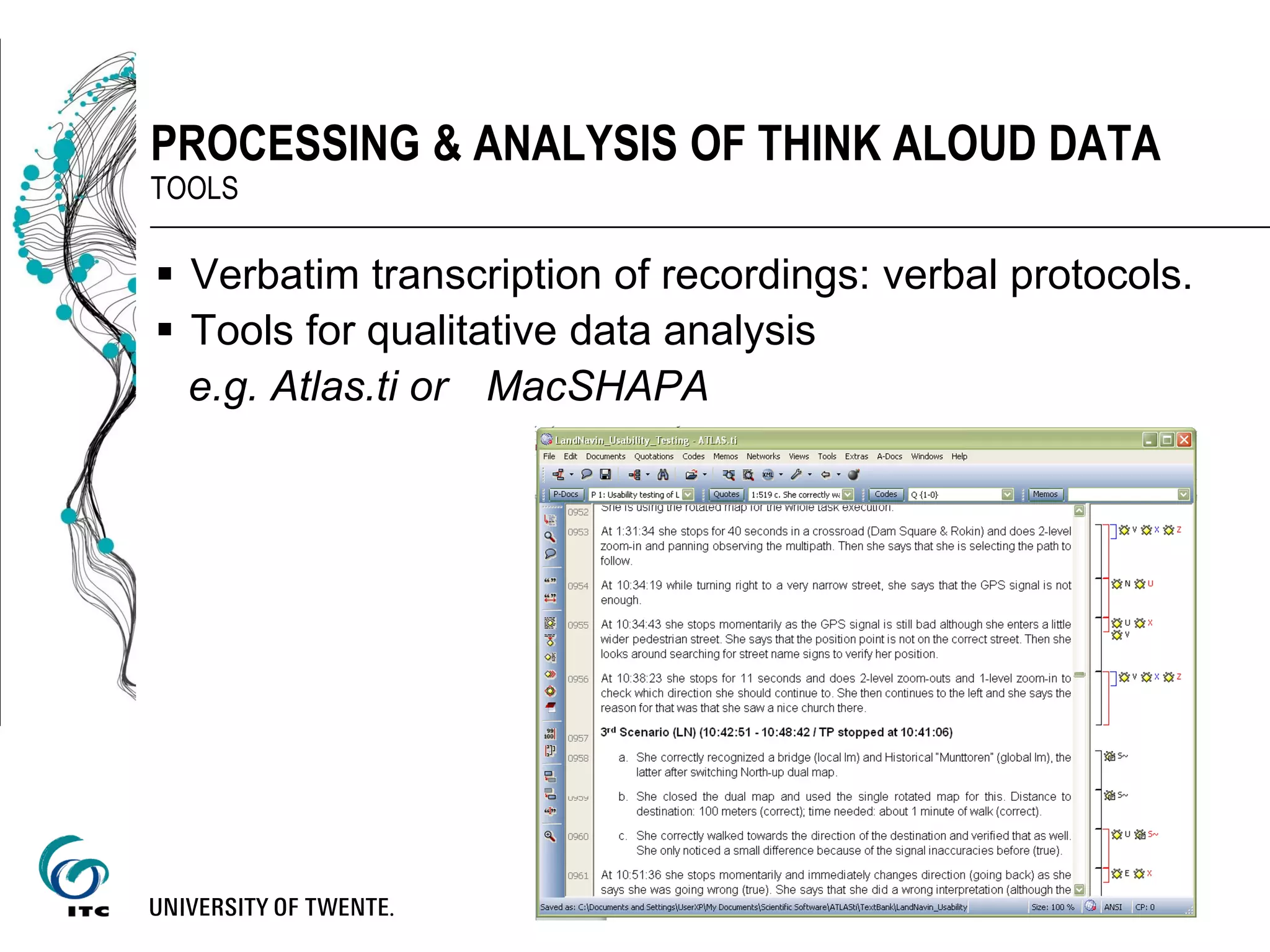
 Verbatim transcription of recordings: verbal protocols.
 Tools for qualitative data analysis
e.g. Atlas.ti or MacSHAPA
PROCESSING & ANALYSIS OF THINK ALOUD DATA
TOOLS
Keep your research questions in mind!
(but leave room to discover the unexpected ….)
PROCESSING & ANALYSIS OF THINK ALOUD DATA
ANALYSIS
18
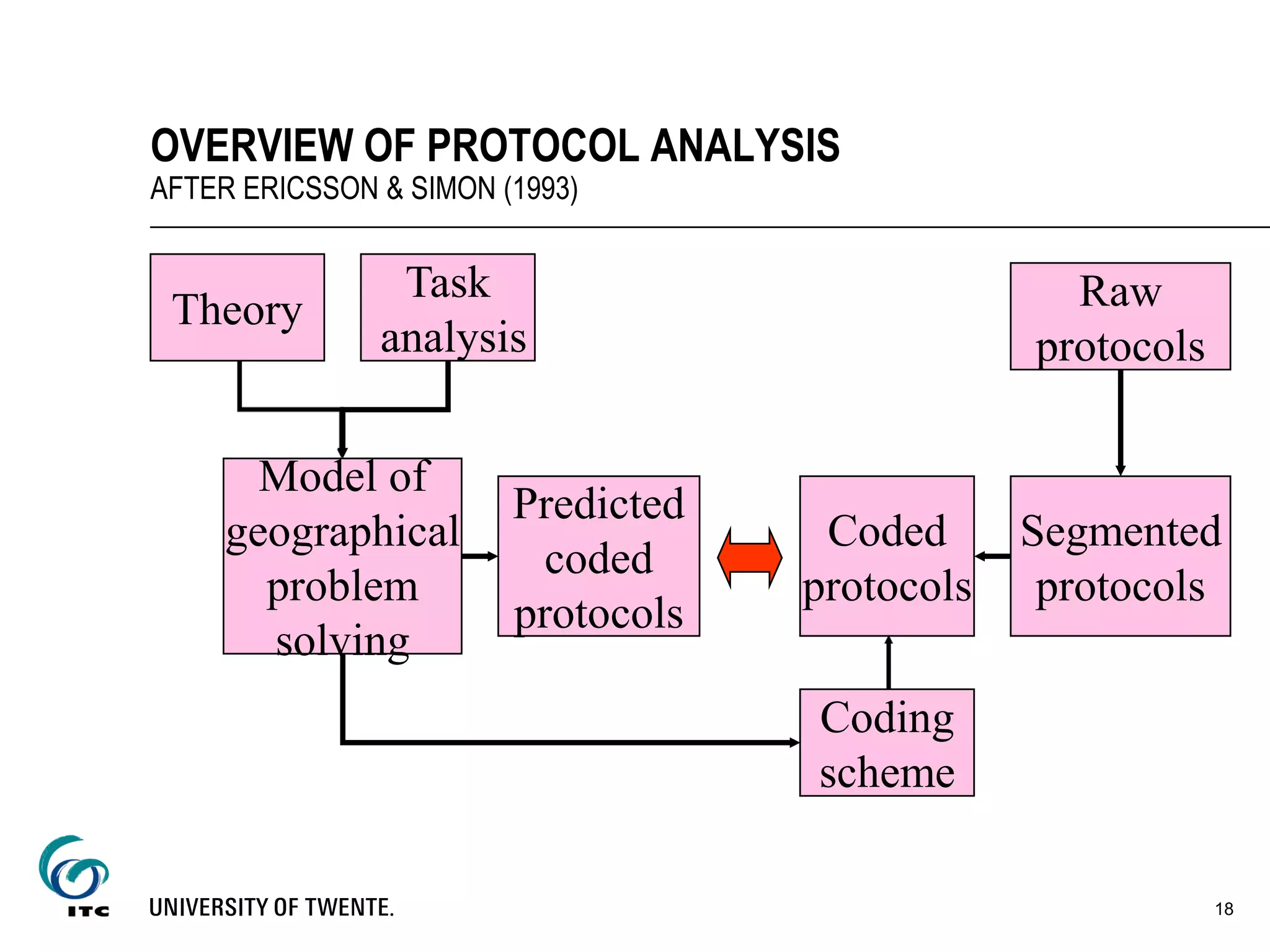
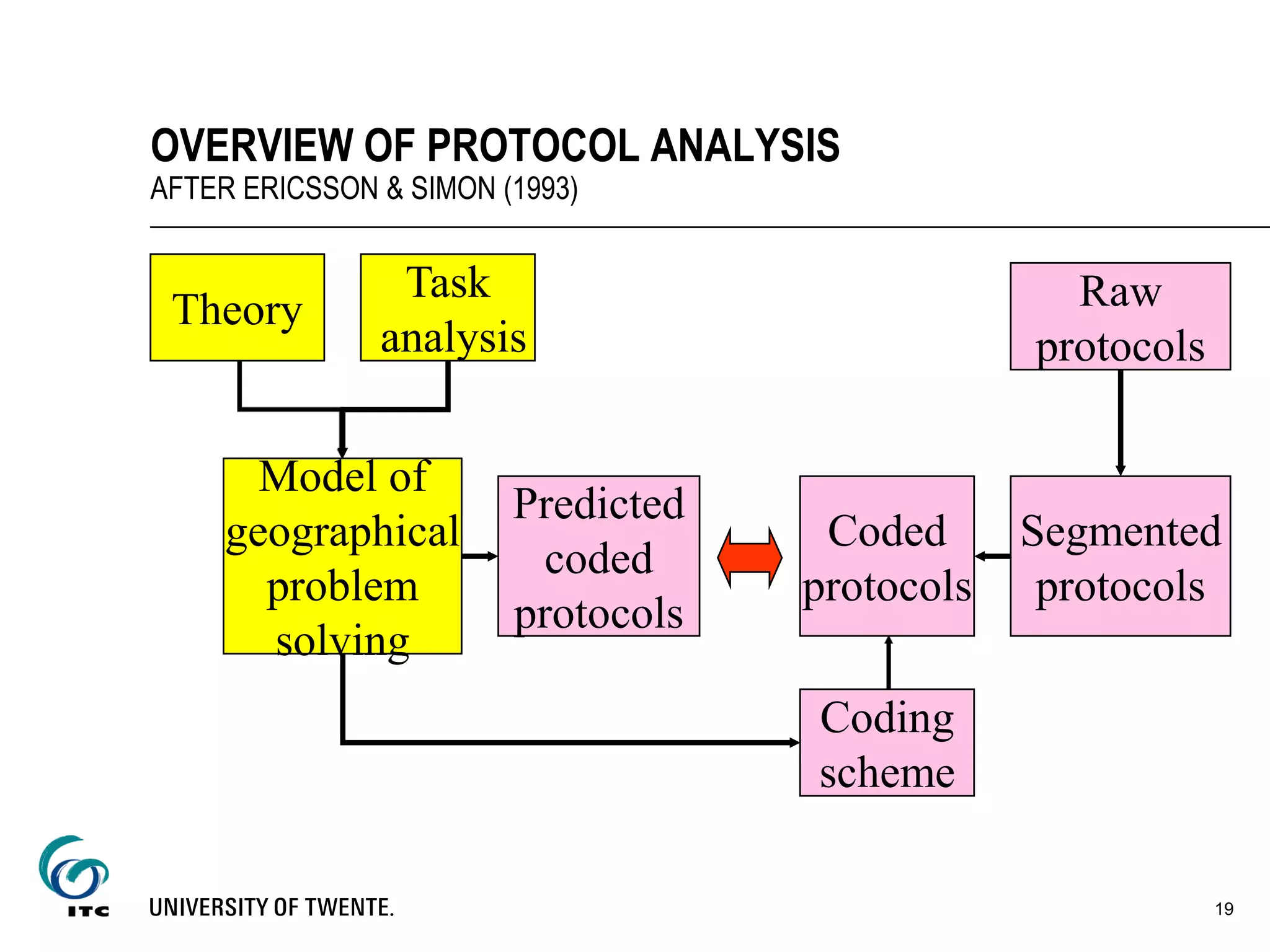
OVERVIEW OF PROTOCOL ANALYSIS
AFTER ERICSSON & SIMON (1993)
Theory
Coding
scheme
Task
analysis
Model of
geographical
problem
solving
Predicted
coded
protocols
Raw
protocols
Coded
protocols
Segmented
protocols
19
OVERVIEW OF PROTOCOL ANALYSIS
AFTER ERICSSON & SIMON (1993)
Theory
Coding
scheme
Task
analysis
Model of
geographical
problem
solving
Predicted
coded
protocols
Raw
protocols
Coded
protocols
Segmented
protocols
20
OVERVIEW OF PROTOCOL ANALYSIS
AFTER ERICSSON & SIMON (1993)
Theory
Coding
scheme
Task
analysis
Model of
geographical
problem
solving
Predicted
coded
protocols
Raw
protocols
Coded
protocols
Segmented
protocols
21
OVERVIEW OF PROTOCOL ANALYSIS
AFTER ERICSSON & SIMON (1993)
Theory
Coding
scheme
Task
analysis
Model of
geographical
problem
solving
Predicted
coded
protocols
Raw
protocols
Coded
protocols
Segmented
protocols
22
OVERVIEW OF PROTOCOL ANALYSIS
AFTER ERICSSON & SIMON (1993)
Theory
Coding
scheme
Task
analysis
Model of
geographical
problem
solving
Predicted
coded
protocols
Raw
protocols
Coded
protocols
Segmented
protocols
INTERNATIONAL INSTITUTE FOR GEO-INFORMATION SCIENCE AND EARTH OBSERVATION
Corné van Elzakker
The Use of Maps
in the
Exploration of Geographic
Data
24
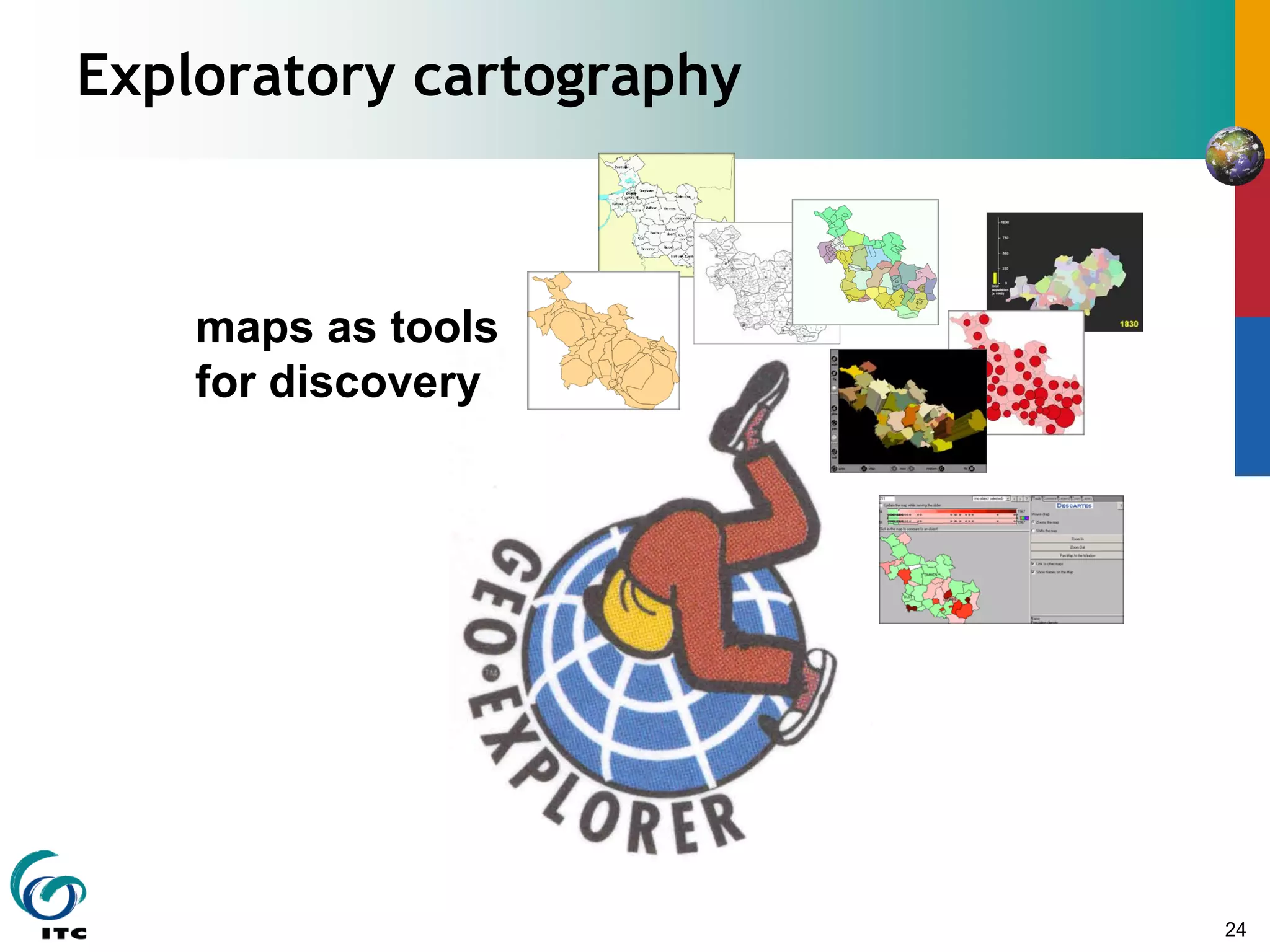
Exploratory cartography
maps as tools
for discovery
25
Exploration of geographic data
This research project >
investigation into the use of maps:
the actual use of an existing
cartographic display
plus
the cognitive process of finding,
selecting, retrieving, adjusting or
generating 'private' map displays
26
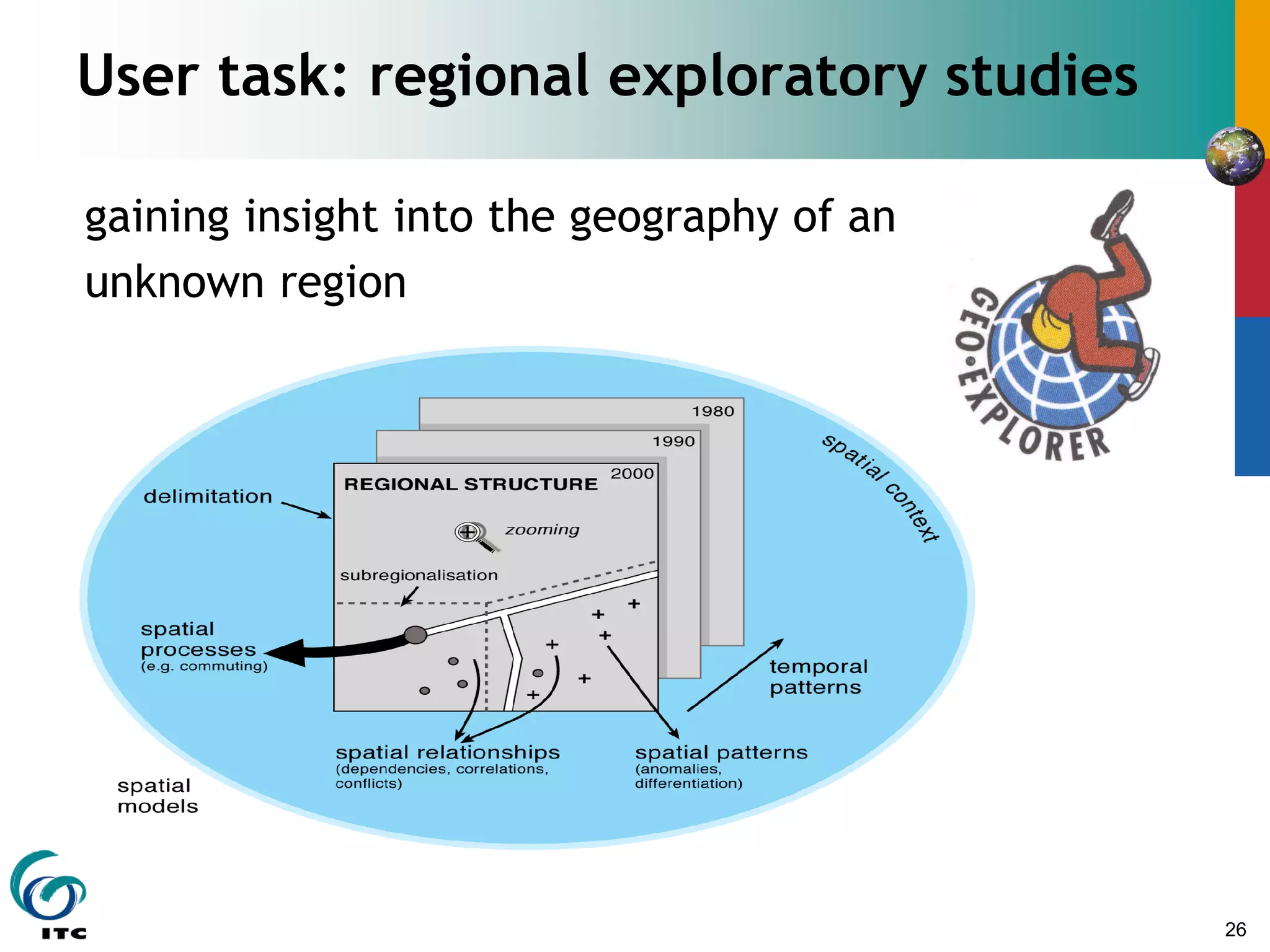
User task: regional exploratory studies
gaining insight into the geography of an
unknown region
27
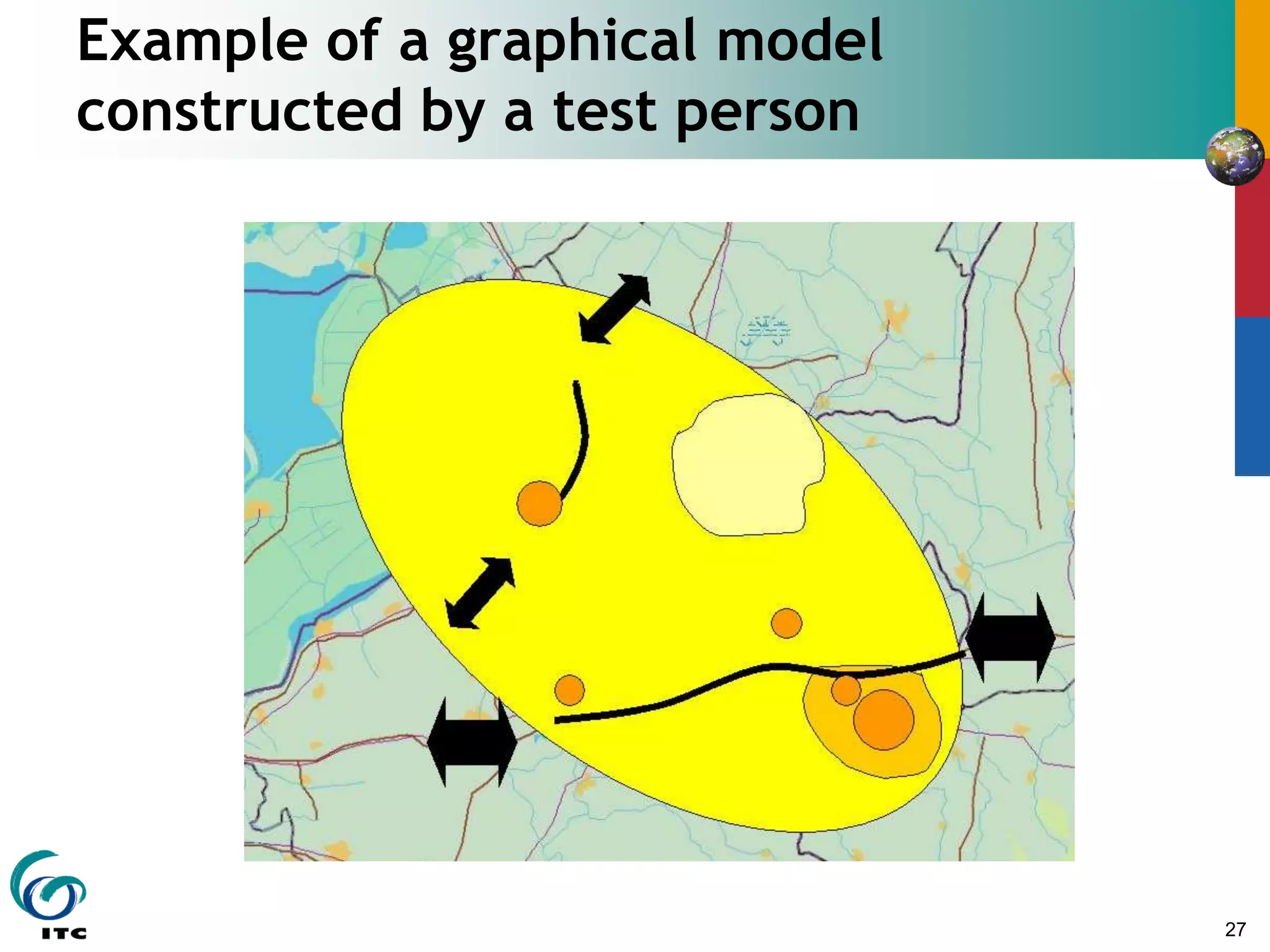
Example of a graphical model
constructed by a test person
28
Database of the Overijssel region
Available to the test persons:
 digital geographic (attribute and base map)
data, to visualize within the ArcGIS
environment
 existing paper maps and atlases
 existing digital maps (static, interactive or
dynamic maps in different formats, ArcGIS
‘map documents’, maps on CD-ROM or on
diskette and Web maps
29
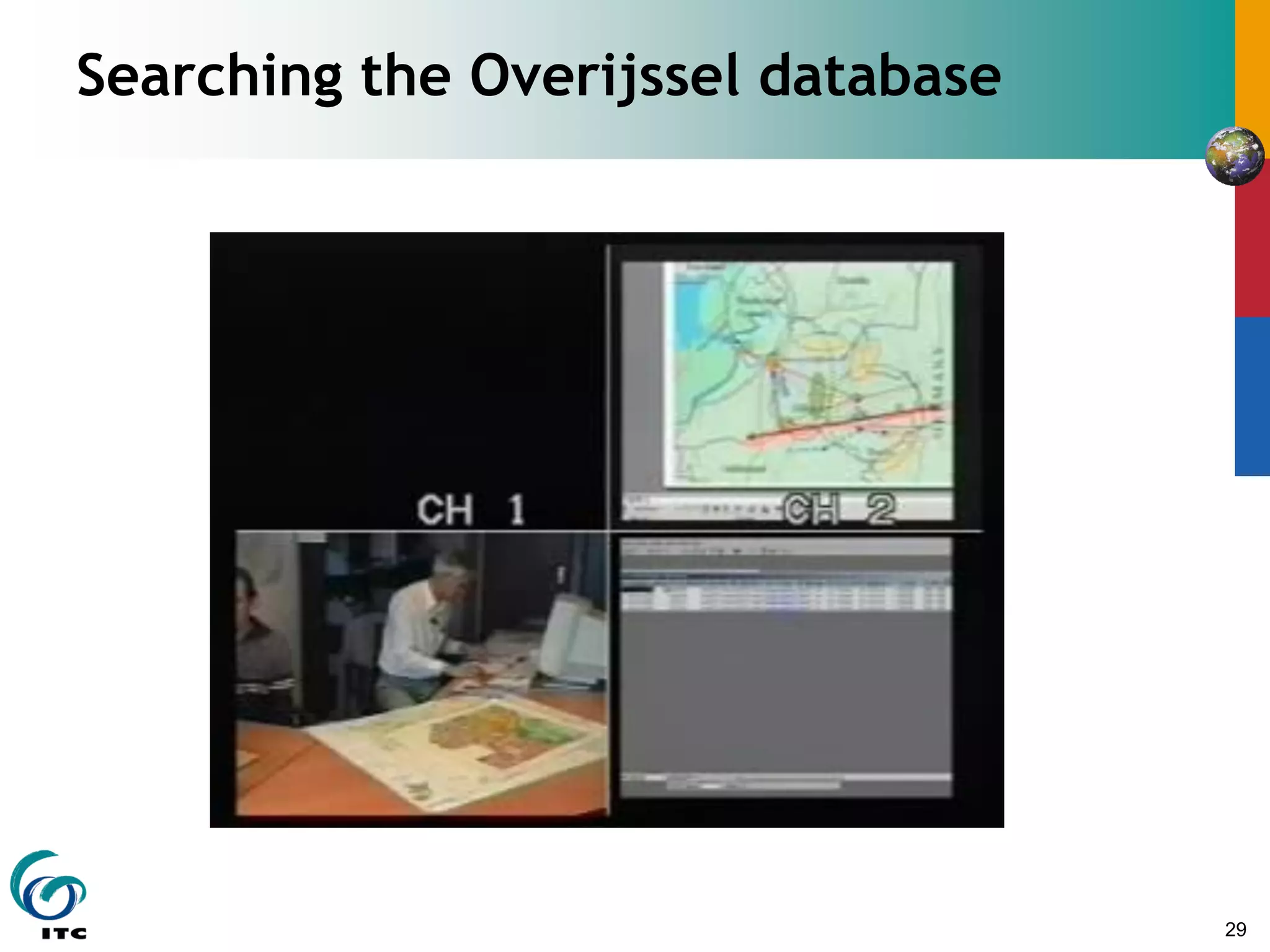
Searching the Overijssel database
30
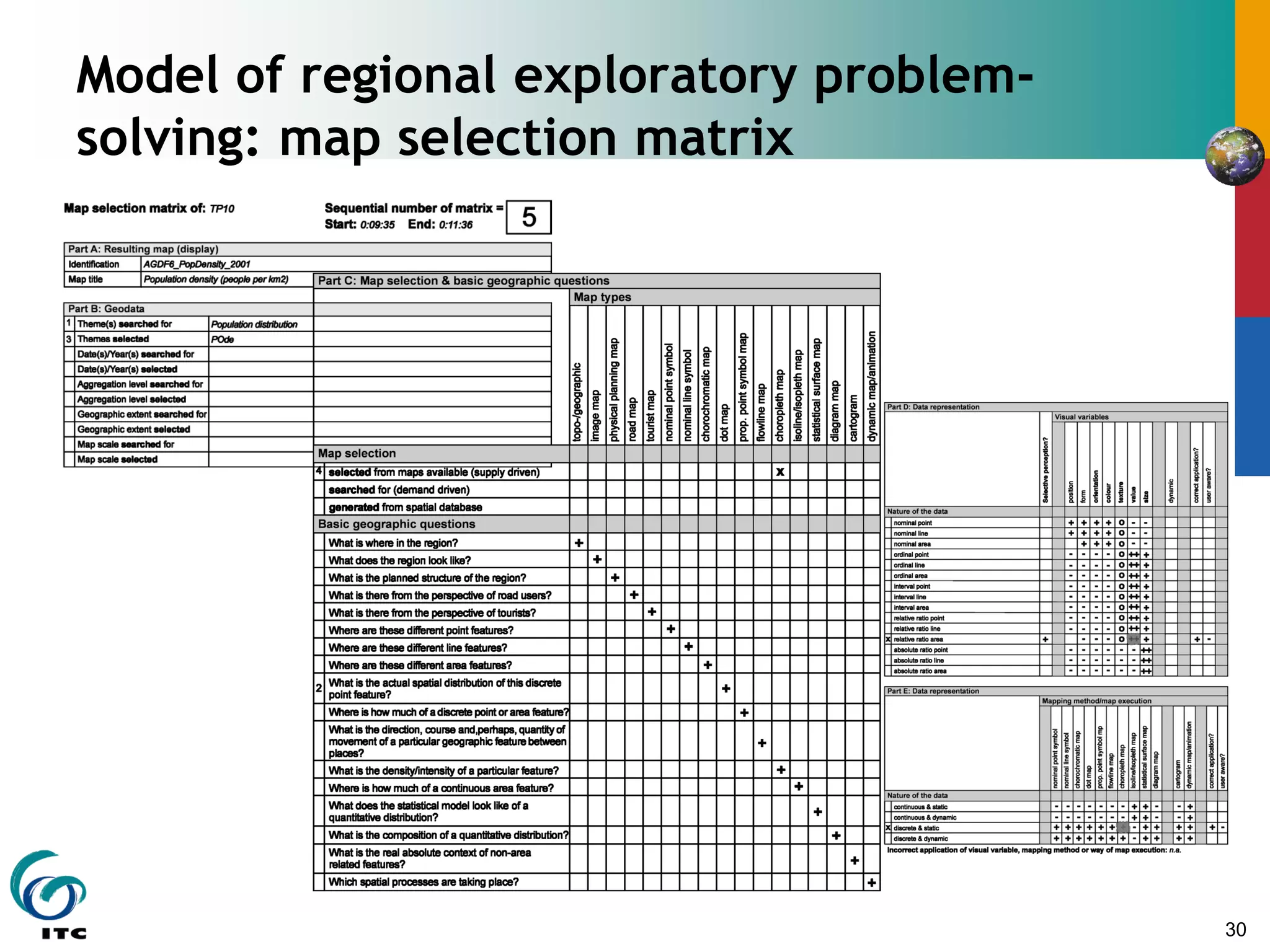
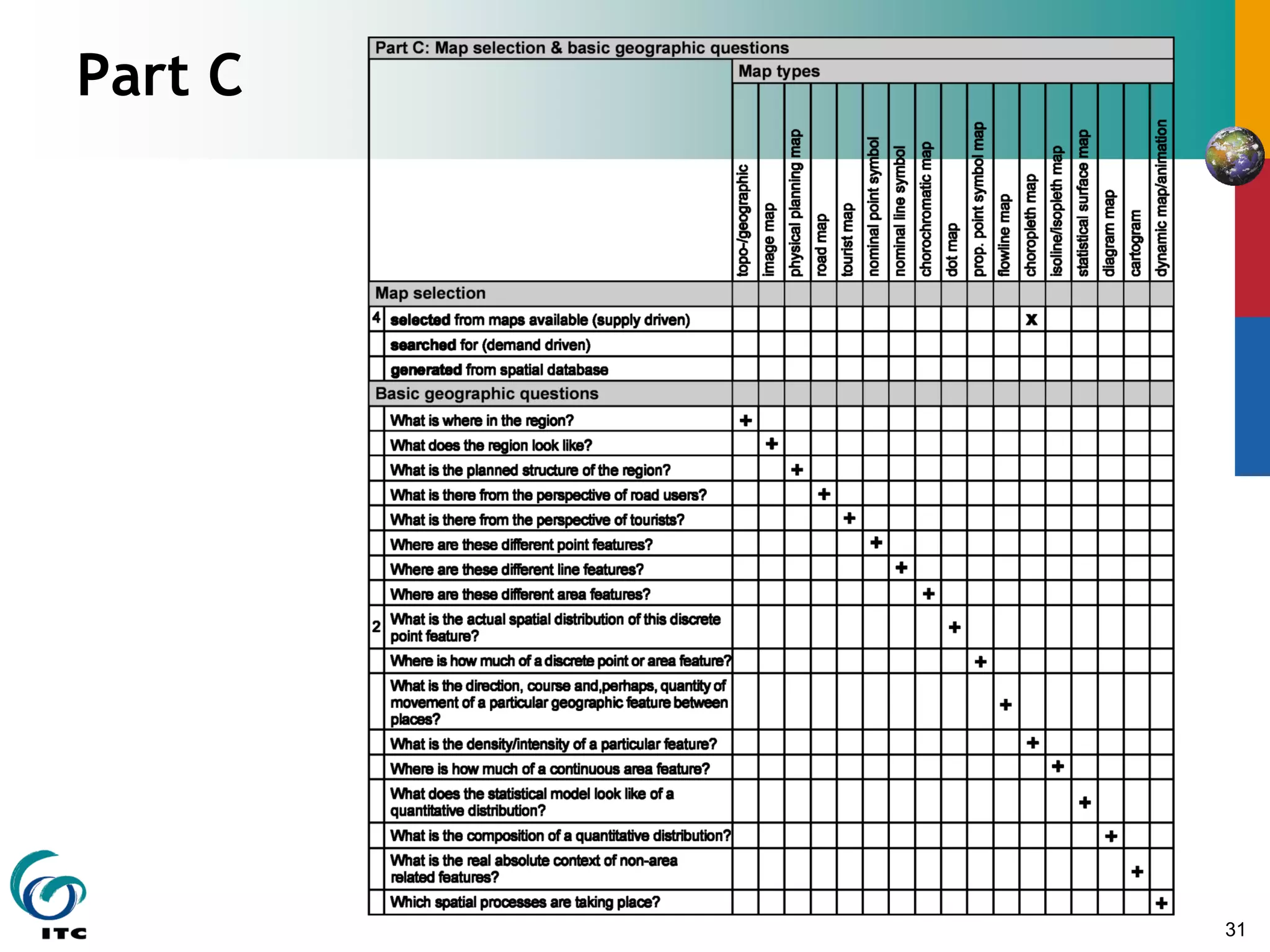
Model of regional exploratory problem-
solving: map selection matrix
31
Part C
32
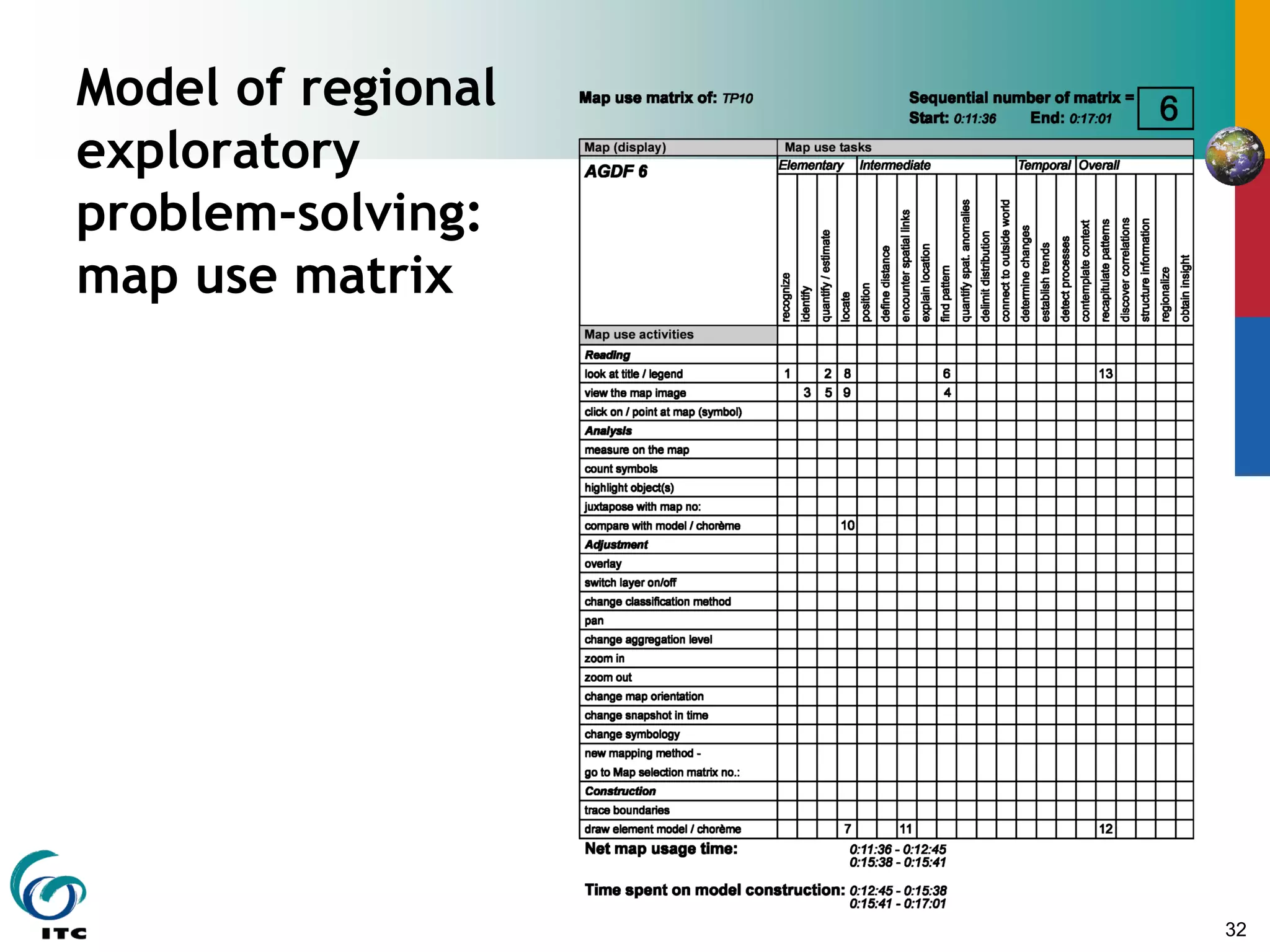
Model of regional
exploratory
problem-solving:
map use matrix
33
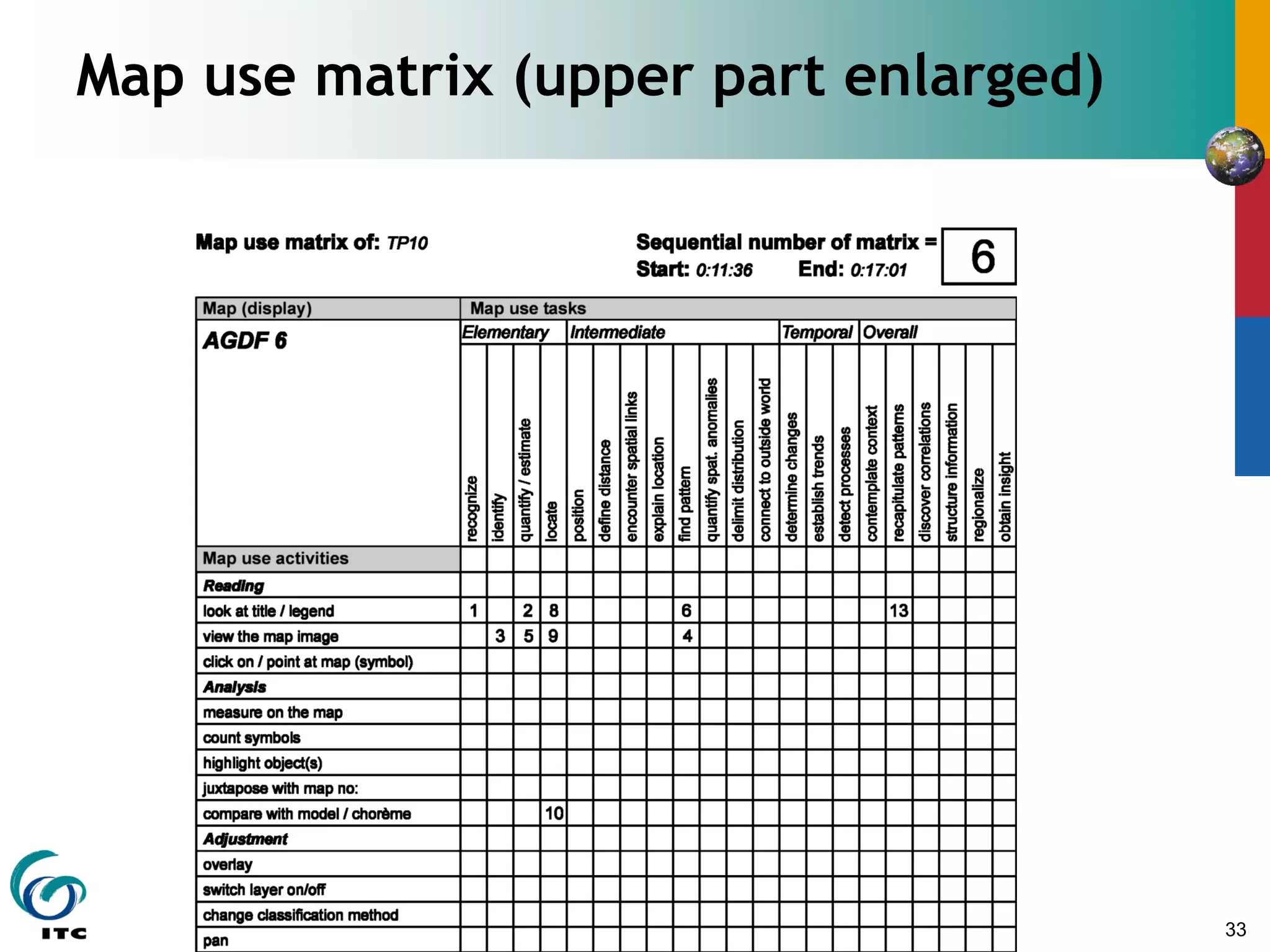
Map use matrix (upper part enlarged)
34
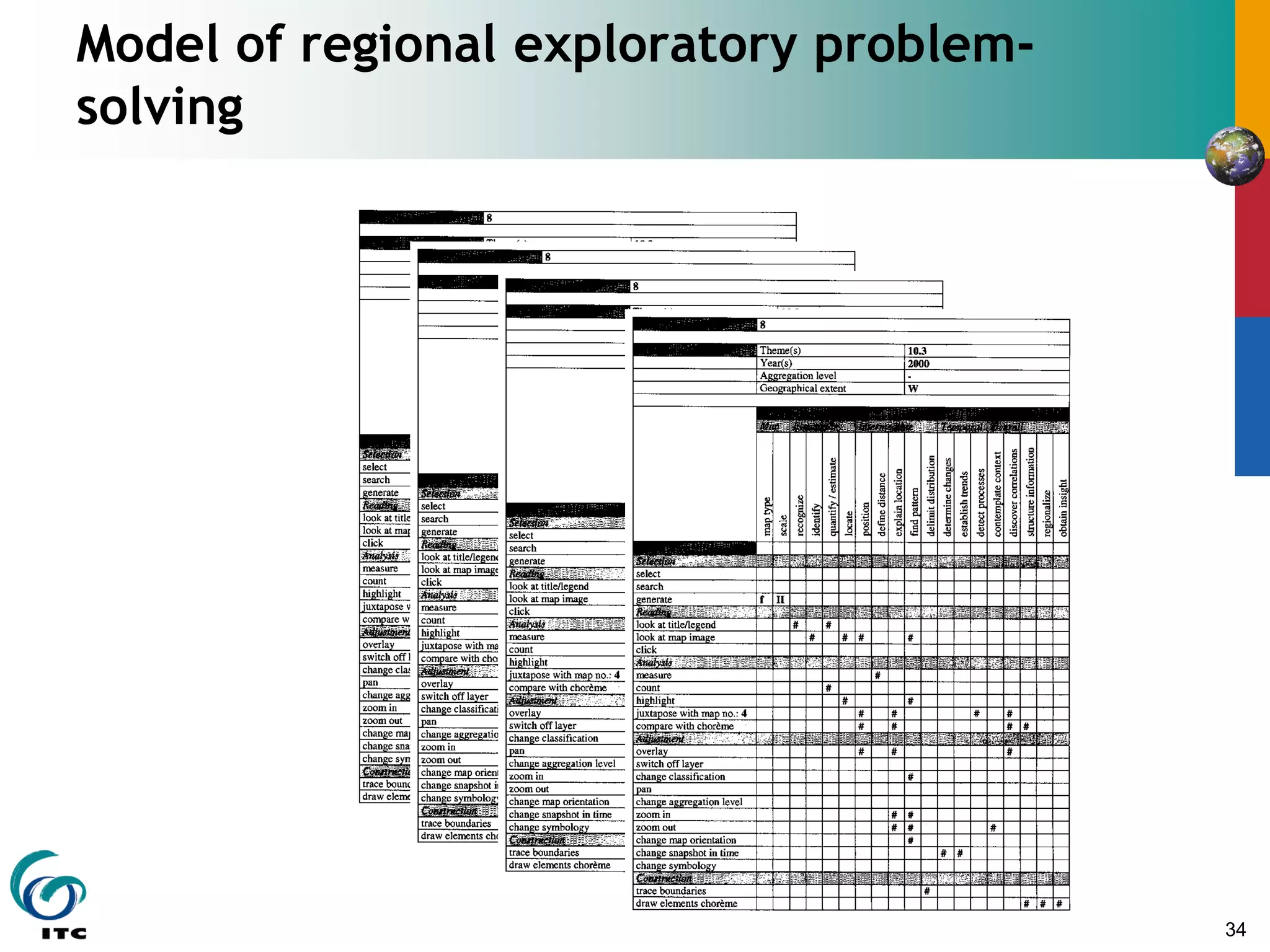
Model of regional exploratory problem-
solving
35
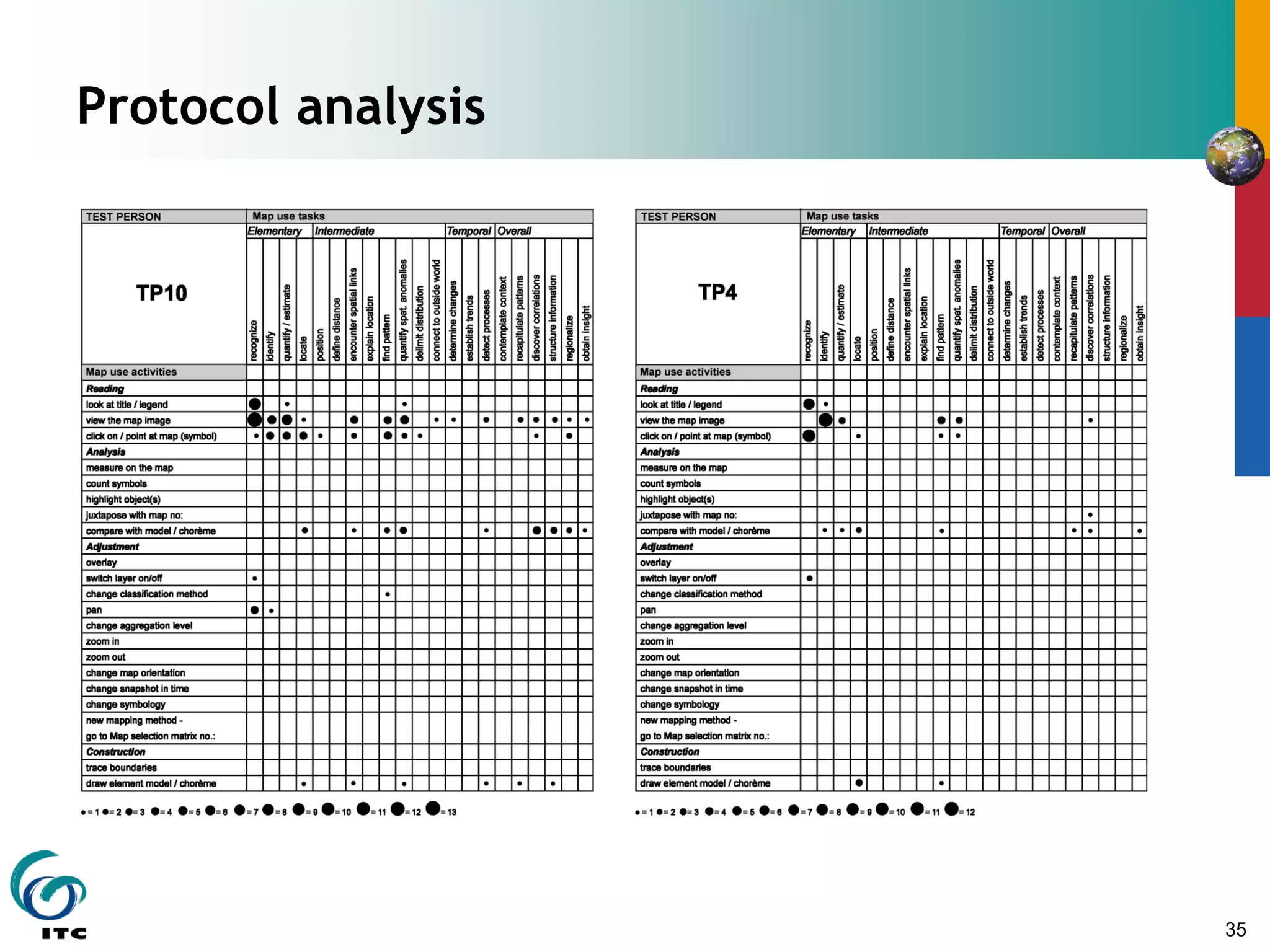
Protocol analysis
36
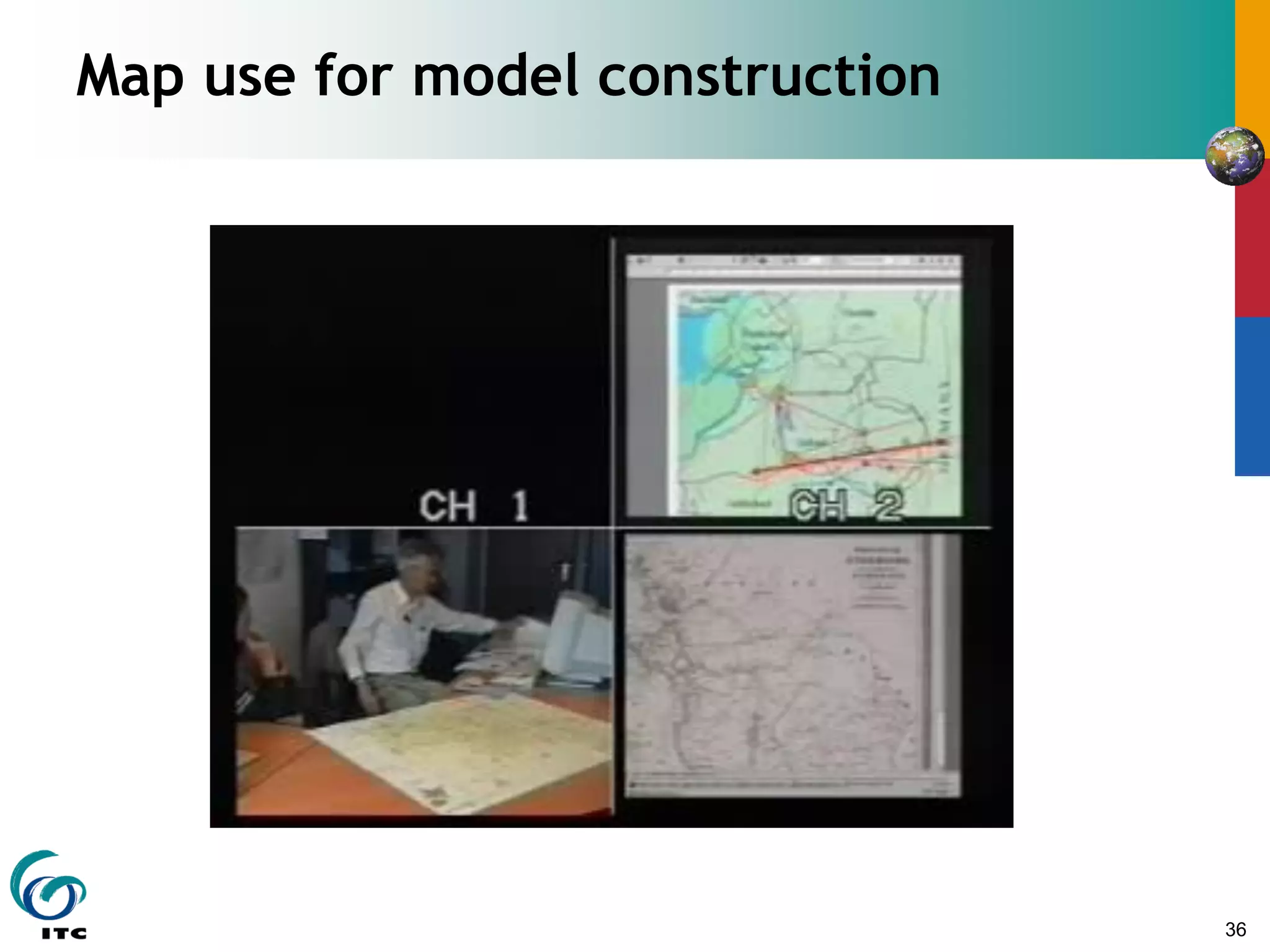
Map use for model construction
37
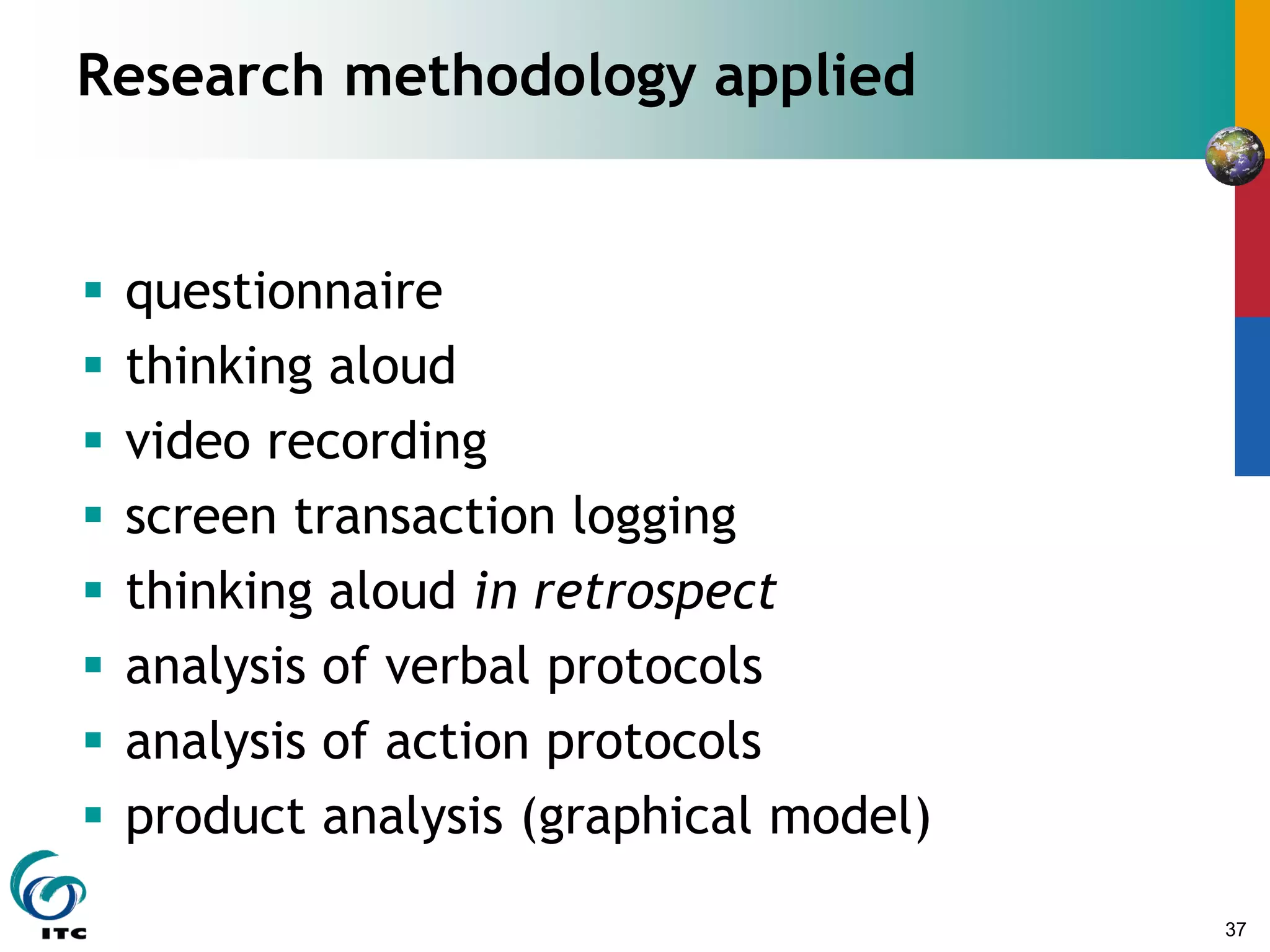
Research methodology applied
 questionnaire
 thinking aloud
 video recording
 screen transaction logging
 thinking aloud in retrospect
 analysis of verbal protocols
 analysis of action protocols
 product analysis (graphical model)
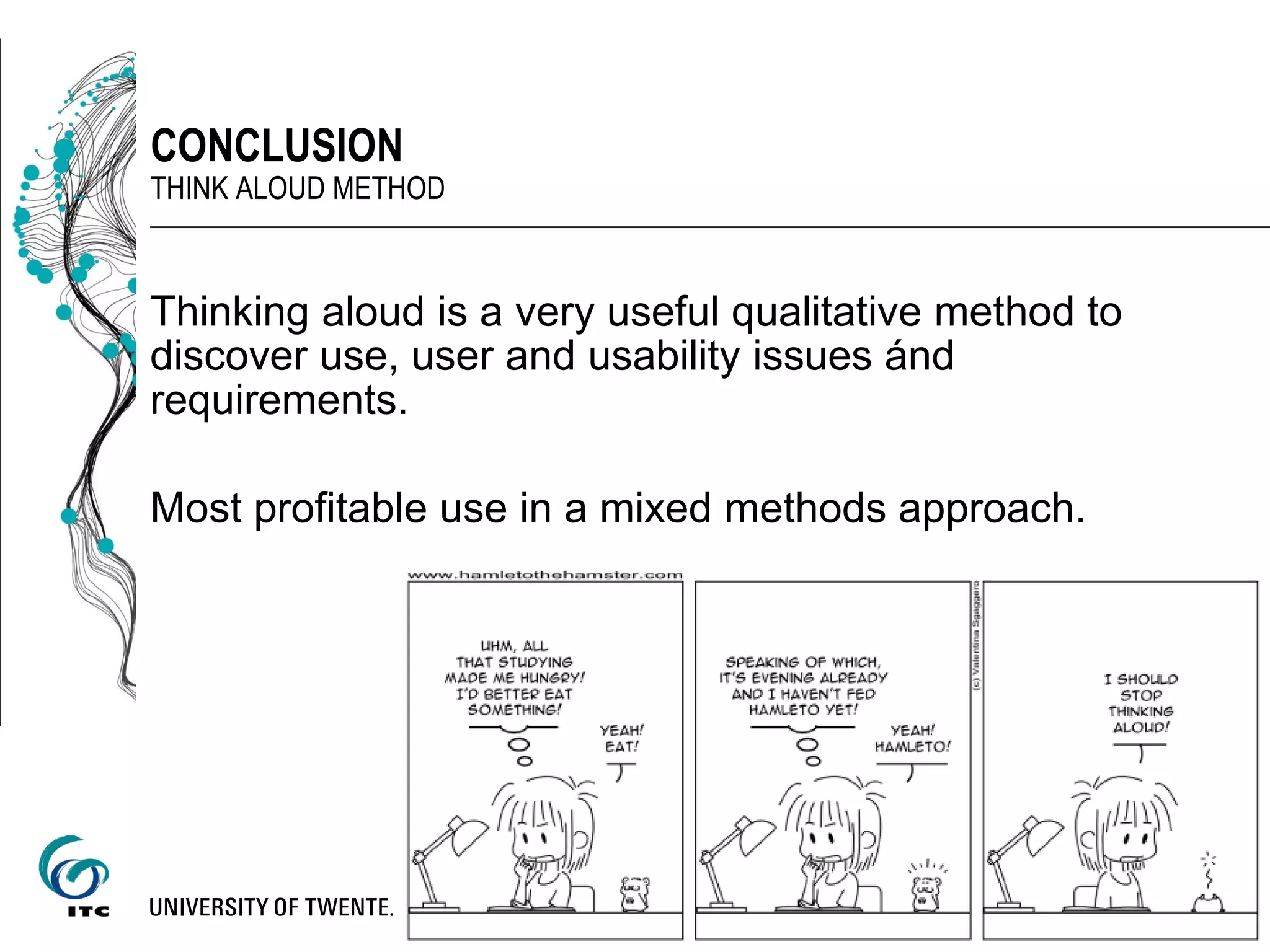
Thinking aloud is a very useful qualitative method to
discover use, user and usability issues ánd
requirements.
Most profitable use in a mixed methods approach (e.g.
including video observation, survey to establish
participants’ backgrounds, screen / action logging, etc.)
Combining Eye-Tracking and Thinking Aloud: demonstration Kristien Ooms
38
CONCLUSION
INCORPORATE THINK ALOUD IN MIXED METHODS APPROACH
39
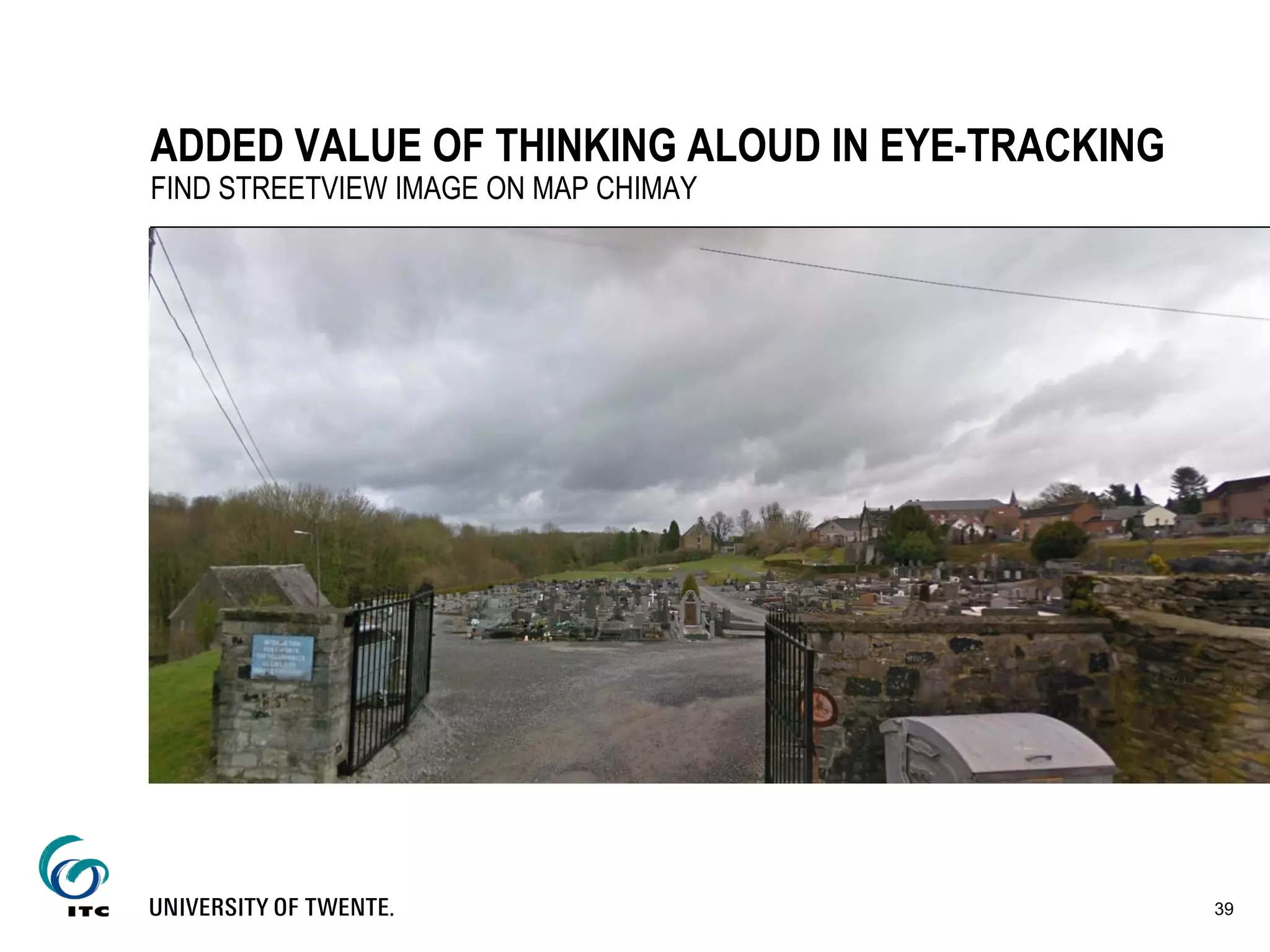
ADDED VALUE OF THINKING ALOUD IN EYE-TRACKING
FIND STREETVIEW IMAGE ON MAP CHIMAY
40
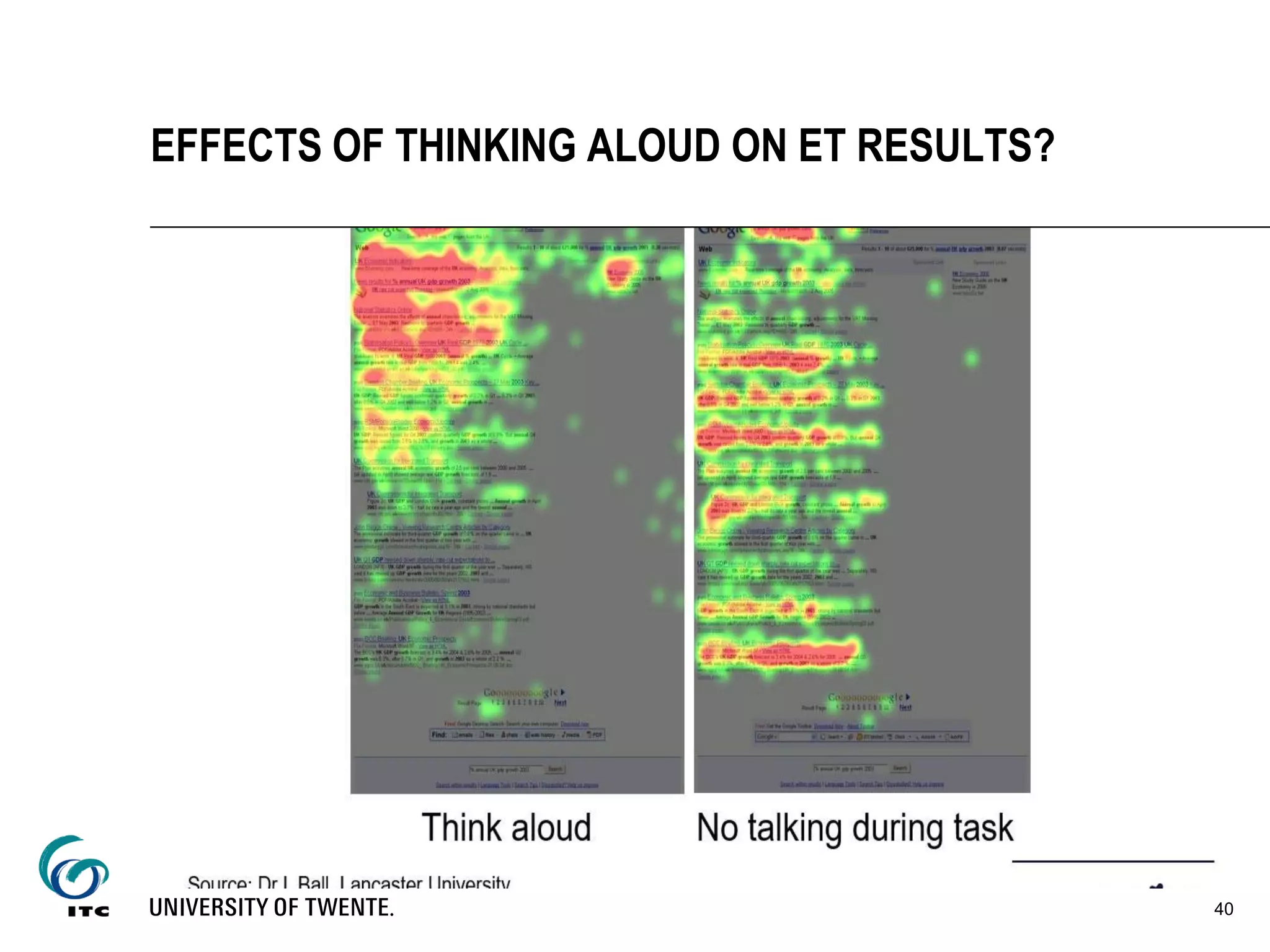
EFFECTS OF THINKING ALOUD ON ET RESULTS?
 Synchronization of recordings to facilitate analysis ...
Further practical hints will be provided by Kristien Ooms.
For now...
41
IMPLEMENTATION ISSUES
THINKING ALOUD IN MIXED METHODS APPROACHES
Thinking aloud is a very useful qualitative method to
discover use, user and usability issues ánd
requirements.
Most profitable use in a mixed methods approach.
42
CONCLUSION
THINK ALOUD METHOD
APPLICATION
0F THE
THINK ALOUD METHOD
IN
USE, USER AND USABILITY RESEARCH
IN
CARTOGRAPHY & GEOGRAPHIC
INFORMATION SCIENCE
c.vanelzakker@utwente.nl
WORKSHOP DESIGNING & CONDUCTING USER STUDIES
6TH ICC & GIS, ALBENA, BULGARIA, 15 JUNE 2016

2016 iccgis module4_thinking_aloud

  • 1.
    APPLICATION 0F THE THINK ALOUDMETHOD IN USE, USER AND USABILITY RESEARCH IN CARTOGRAPHY & GEOGRAPHIC INFORMATION SCIENCE CORNÉ VAN ELZAKKER WORKSHOP DESIGNING & CONDUCTING USER STUDIES 6TH ICC & GIS, ALBENA, BULGARIA, 15 JUNE 2016
  • 2.
    2 THINKING ALOUD ONE OFTHE MANY METHODS OF USER RESEARCH Method Similar or Related Methods Expert- based heuristic evaluation rulesof thumb conformity inspection feature inspection, consistency inspection, standards inspection, guideline checklist cognitive walkthroughs pluralistic walkthroughs, prototyping, storyboarding, Wizard of Oz Theory- based scenario-based design personas, scenarios of use, use case, context of use, theatre secondary sources contentanalysis, competitive analysis automated evaluation automated interaction logs, unmoderated user-based methods User-based participant observation ethnographies, field observation, MILCs, journal/diary sessions, screenshot captures surveys questionnaires, entry/exit surveys, blind voting, cognitive workload assessment interviews structured interviews, semi-structured interviews, unstructured interviews, contextual inquiry focus groups supportive evaluation Delphi card sorting Q methodology, conceptmapping, aflnity diagramming, brainstorming talk/think aloud verbal protocol analysis, co-discovery study interaction study performance measurement,controlled experiments Source: Robert Roth
  • 3.
    3 Important aspects ofusability research Requirements Analysis Evaluate early design Evaluate elaborate design User feedback Focus groups Brainstorm sessions Interviews Surveys & questionnaires Stakeholder meetings Literature review Card sorting ... Paper prototype Storyboarding Heuristic evaluation Automated evaluation Wizard of Oz Thinking aloud Eye tracking Card sorting Cognitive walkthrough .... Performance testing User satisfaction Heuristic evaluation Cognitive walkthrough Functional prototyping Critical incidents Logging user interactions .... Questionnaires User satisfaction Logging user interactions Observations Diary keeping ...
  • 4.
    Analyse Requirements Produce Design Solutions Conceptual Design & Prototype FinalDesign & Prototype Interim Designs & Prototypes Identify the need for user-centred design Design satisfies requirements Evaluate Designs Testing with representative users input Business User StakeholderOrganisational Characteristics Preferences Use contexts Tasks 4 (OF GEOSPATIAL DATA PROCESSING AND DISSEMINATION SYSTEMS) Method = User-Centred Design Prototyping Requirement analysis Usability evaluation Techniques e.g.: Qualitative Focus groups Interviews Observation Thinking aloud Questionnaires Screen logging Eye tracking Performance an. Quantitative
  • 5.
     Distinction betweenqualitative and quantitative research  Working with experts or with (representatives of) “real” end-users  Doing research in the proper context (field-based vs. laboratory based research)  Distinction between methods & techniques of data collection and data analysis 5 IMPORTANT ASPECTS OF UUU RESEARCH
  • 6.
     Interviews /Focus Groups  Surveys / Questionnaires  Product analysis  Card sorting  Interaction study  Observation … COLLECTING USE, USER & USABILITY DATA ANOTHER LOOK AT CATEGORIES OF TOOLS
  • 7.
    asking subjects toexecute a particular problem-solving task and to speak out their thoughts while solving that problem / performing that task participants are asked to say out loud whatever they are looking at, thinking, doing and feeling at each moment thereafter: analyzing the resulting verbal and action protocols 7 THE THINK ALOUD METHOD
  • 8.
    Some investigations intoknowledge acquisition from existing (static) maps:  Thorndyke & Stasz (1980)  Kinnear & Wood a.o. (1987/1988)  Kulhavy, Pridemore & Stock (1992)  Crampton (1992)  Heidmann & Johann (1997)  Board (1997)  Ungar, Blades & Spencer (1997) EARLIER APPLICATIONS OF THE THINK ALOUD METHOD IN MAP USE RESEARCH
  • 9.
    Investigations into theuse of cartographic visualization systems for geographical data exploration:  McGuinness, van Wersch, Stringer (1993)  MacEachren, Boscoe, Haug, Pickle (1998)  See online bibliography ICA Commission on UUUI for more examples of case studies! EARLIER APPLICATIONS OF THE THINK ALOUD METHOD IN MAP USE RESEARCH
  • 10.
     Form pairs Execute map reading activity: Locate the Google StreetView image on the map fragment provided while thinking aloud  Observer takes notes or records the thinking aloud  Switch roles with Map 2  After this, we will discuss your experiences 10 HANDS-ON EXPERIENCE MAP READING ACTIVITY IN PAIRS
  • 11.
  • 12.
  • 13.
     What areyour experiences with applying the think aloud method?  What are the potential advantages?  What are the disadvantages? What could be the problems?  Questions? HANDS-ON EXPERIENCE WITH THINKING ALOUD MAP READING ACTIVITY IN PAIRS 13
  • 14.
     Leads tovalid, unique, direct and the most complete data on cognitive processes  Least disturbance of the thought process  No memory errors  No interpretation, rationalization or explanation of thoughts by subjects  No need to bring thoughts in predefined form ADVANTAGES THINK ALOUD METHOD
  • 15.
     Very time-consumingand tedious  Protocol analysis difficult and subject to interpretation by researcher  Protocols may be incomplete  Verbalization problems  Situation may be unnatural for test participant DISADVANTAGES THINK ALOUD METHOD
  • 16.
     Verbatim transcriptionof recordings: verbal protocols.  Tools for qualitative data analysis e.g. Atlas.ti or MacSHAPA PROCESSING & ANALYSIS OF THINK ALOUD DATA TOOLS
  • 17.
    Keep your researchquestions in mind! (but leave room to discover the unexpected ….) PROCESSING & ANALYSIS OF THINK ALOUD DATA ANALYSIS
  • 18.
    18 OVERVIEW OF PROTOCOLANALYSIS AFTER ERICSSON & SIMON (1993) Theory Coding scheme Task analysis Model of geographical problem solving Predicted coded protocols Raw protocols Coded protocols Segmented protocols
  • 19.
    19 OVERVIEW OF PROTOCOLANALYSIS AFTER ERICSSON & SIMON (1993) Theory Coding scheme Task analysis Model of geographical problem solving Predicted coded protocols Raw protocols Coded protocols Segmented protocols
  • 20.
    20 OVERVIEW OF PROTOCOLANALYSIS AFTER ERICSSON & SIMON (1993) Theory Coding scheme Task analysis Model of geographical problem solving Predicted coded protocols Raw protocols Coded protocols Segmented protocols
  • 21.
    21 OVERVIEW OF PROTOCOLANALYSIS AFTER ERICSSON & SIMON (1993) Theory Coding scheme Task analysis Model of geographical problem solving Predicted coded protocols Raw protocols Coded protocols Segmented protocols
  • 22.
    22 OVERVIEW OF PROTOCOLANALYSIS AFTER ERICSSON & SIMON (1993) Theory Coding scheme Task analysis Model of geographical problem solving Predicted coded protocols Raw protocols Coded protocols Segmented protocols
  • 23.
    INTERNATIONAL INSTITUTE FORGEO-INFORMATION SCIENCE AND EARTH OBSERVATION Corné van Elzakker The Use of Maps in the Exploration of Geographic Data
  • 24.
  • 25.
    25 Exploration of geographicdata This research project > investigation into the use of maps: the actual use of an existing cartographic display plus the cognitive process of finding, selecting, retrieving, adjusting or generating 'private' map displays
  • 26.
    26 User task: regionalexploratory studies gaining insight into the geography of an unknown region
  • 27.
    27 Example of agraphical model constructed by a test person
  • 28.
    28 Database of theOverijssel region Available to the test persons:  digital geographic (attribute and base map) data, to visualize within the ArcGIS environment  existing paper maps and atlases  existing digital maps (static, interactive or dynamic maps in different formats, ArcGIS ‘map documents’, maps on CD-ROM or on diskette and Web maps
  • 29.
  • 30.
    30 Model of regionalexploratory problem- solving: map selection matrix
  • 31.
  • 32.
  • 33.
    33 Map use matrix(upper part enlarged)
  • 34.
    34 Model of regionalexploratory problem- solving
  • 35.
  • 36.
    36 Map use formodel construction
  • 37.
    37 Research methodology applied questionnaire  thinking aloud  video recording  screen transaction logging  thinking aloud in retrospect  analysis of verbal protocols  analysis of action protocols  product analysis (graphical model)
  • 38.
    Thinking aloud isa very useful qualitative method to discover use, user and usability issues ánd requirements. Most profitable use in a mixed methods approach (e.g. including video observation, survey to establish participants’ backgrounds, screen / action logging, etc.) Combining Eye-Tracking and Thinking Aloud: demonstration Kristien Ooms 38 CONCLUSION INCORPORATE THINK ALOUD IN MIXED METHODS APPROACH
  • 39.
    39 ADDED VALUE OFTHINKING ALOUD IN EYE-TRACKING FIND STREETVIEW IMAGE ON MAP CHIMAY
  • 40.
    40 EFFECTS OF THINKINGALOUD ON ET RESULTS?
  • 41.
     Synchronization ofrecordings to facilitate analysis ... Further practical hints will be provided by Kristien Ooms. For now... 41 IMPLEMENTATION ISSUES THINKING ALOUD IN MIXED METHODS APPROACHES
  • 42.
    Thinking aloud isa very useful qualitative method to discover use, user and usability issues ánd requirements. Most profitable use in a mixed methods approach. 42 CONCLUSION THINK ALOUD METHOD
  • 43.
    APPLICATION 0F THE THINK ALOUDMETHOD IN USE, USER AND USABILITY RESEARCH IN CARTOGRAPHY & GEOGRAPHIC INFORMATION SCIENCE c.vanelzakker@utwente.nl WORKSHOP DESIGNING & CONDUCTING USER STUDIES 6TH ICC & GIS, ALBENA, BULGARIA, 15 JUNE 2016