Rakudo 楽土
Polyglot Programming DC 2014
Brock Wilcox
awwaiid@thelackthereof.org
bwilcox@optoro.com
Big language. Lots of stuff.
Object Oriented (Ruby, CLOS)
Data/Function Oriented (Haskell, Clojure)
Operator Oriented (APL, J)
Sigil Oriented (Ruby, Perl)
Optional Static Typing (Common Lisp)
Multi Dispatch (Clojure, Haskell)
Normal Stuff
Fancy Stuff
Insane Stuff
Normal Stuff
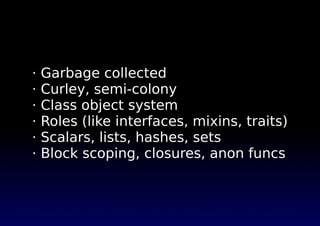
· Garbage collected
· Curley, semi-colony
· Class object system
· Roles (like interfaces, mixins, traits)
· Scalars, lists, hashes, sets
· Block scoping, closures, anon funcs
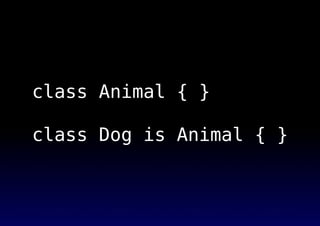
class Animal { }
class Dog is Animal { }
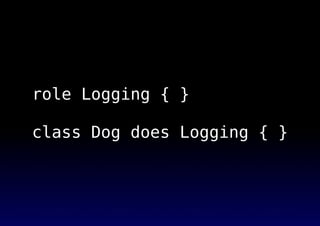
role Logging { }
class Dog does Logging { }
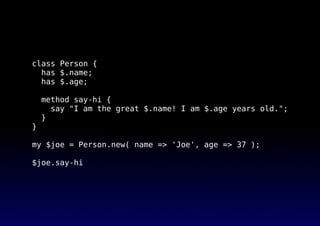
class Person {
has $.name;
has $.age;
method say-hi {
say "I am the great $.name! I am $.age years old.";
}
}
my $joe = Person.new( name => 'Joe', age => 37 );
$joe.say-hi
Sigils / Twigls
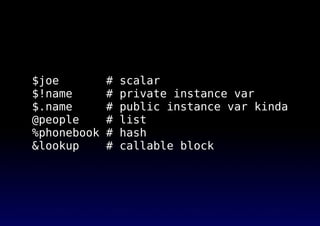
$joe # scalar
$!name # private instance var
$.name # public instance var kinda
@people # list
%phonebook # hash
&lookup # callable block
Scalars, Lists, Hashes
my @names = ('Casey', 'Dakota', 'Jaiden', 'Jordan', 'Peyton');
my @names = <Casey Dakota Jaiden Jordan Peyton>;
say "Third: @names[2]"
say @names.join(", ");
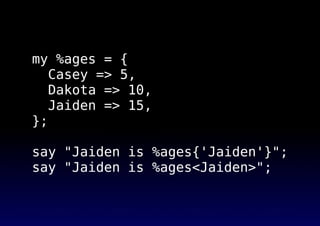
my %ages = {
Casey => 5,
Dakota => 10,
Jaiden => 15,
};
say "Jaiden is %ages{'Jaiden'}";
say "Jaiden is %ages<Jaiden>";
Ruby-style DSL blocks
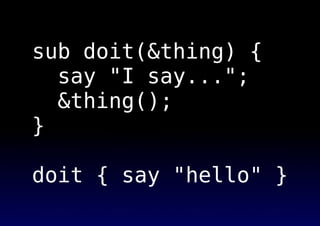
sub doit(&thing) {
say "I say...";
&thing();
}
doit { say "hello" }
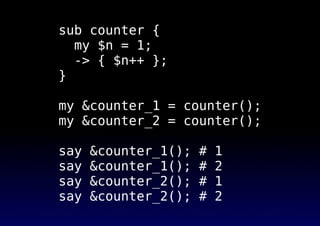
Closures / Lambdas
sub counter {
my $n = 1;
-> { $n++ };
}
my &counter_1 = counter();
my &counter_2 = counter();
say &counter_1(); # 1
say &counter_1(); # 2
say &counter_2(); # 1
say &counter_2(); # 2
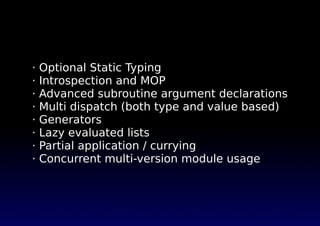
Fancy Stuff
· Optional Static Typing
· Introspection and MOP
· Advanced subroutine argument declarations
· Multi dispatch (both type and value based)
· Generators
· Lazy evaluated lists
· Partial application / currying
· Concurrent multi-version module usage
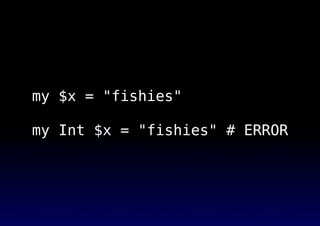
my $x = "fishies"
my Int $x = "fishies" # ERROR
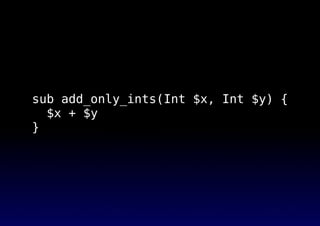
sub add_only_ints(Int $x, Int $y) {
$x + $y
}
Multi-dispatch
(pattern matching)
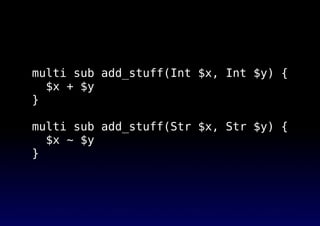
multi sub add_stuff(Int $x, Int $y) {
$x + $y
}
multi sub add_stuff(Str $x, Str $y) {
$x ~ $y
}
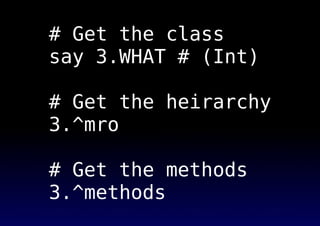
Meta Programming / Introspection
# Get the class
say 3.WHAT # (Int)
# Get the heirarchy
3.^mro
# Get the methods
3.^methods
Insane(ly awesome) Stuff
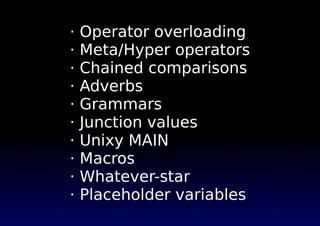
· Operator overloading
· Meta/Hyper operators
· Chained comparisons
· Adverbs
· Grammars
· Junction values
· Unixy MAIN
· Macros
· Whatever-star
· Placeholder variables
Operator-Oriented
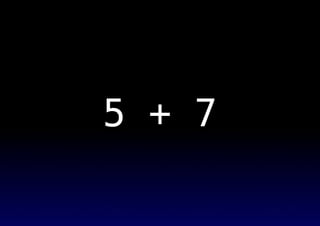
5 + 7
Meta/Hyper Operators
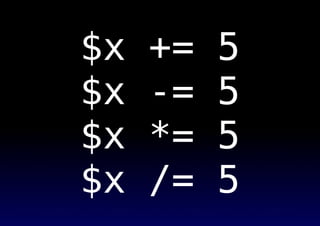
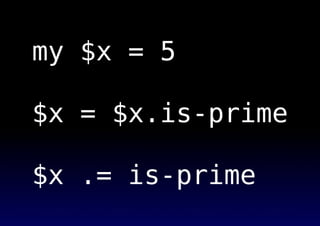
$x += 5
$x -= 5
$x *= 5
$x /= 5
my $x = 5
$x = $x.is-prime
$x .= is-prime
[+] <5 7 23 21 32>
# 88
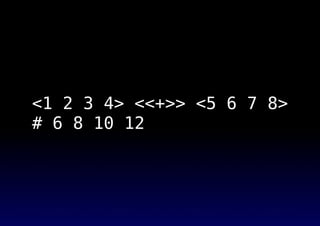
<1 2 3 4> <<+>> <5 6 7 8>
# 6 8 10 12
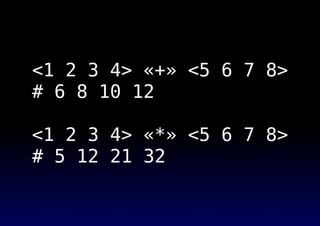
<1 2 3 4> «+» <5 6 7 8>
# 6 8 10 12
<1 2 3 4> «*» <5 6 7 8>
# 5 12 21 32
User-defined operators
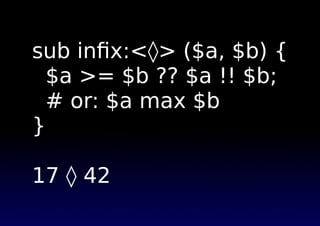
sub infix:<⋄> ($a, $b) {
$a >= $b ?? $a !! $b;
# or: $a max $b
}
17 ⋄ 42
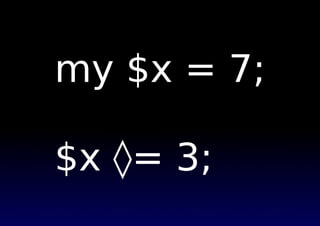
my $x = 7;
$x ⋄= 3;
sub postfix:<!>($n) {
[*] 2..$n;
}
6! # 720
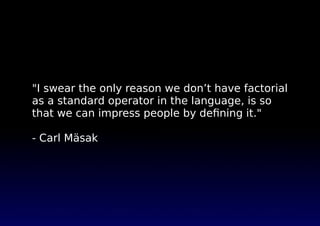
"I swear the only reason we don’t have factorial
as a standard operator in the language, is so
that we can impress people by defining it."
- Carl Mäsak
type position syntax
====== ========== ========
prefix before a term !X
infix between two terms X ! Y
postfix after a term X!
circumfix around [X]
postcircumfix after & around X[Y]
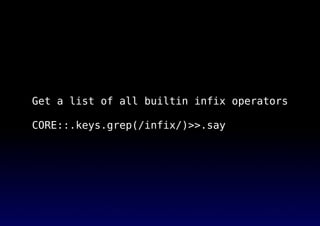
Get a list of all builtin infix operators
CORE::.keys.grep(/infix/)>>.say
Show all the multi dispatches for '+'
&[+].candidates>>.say
Random Stuff
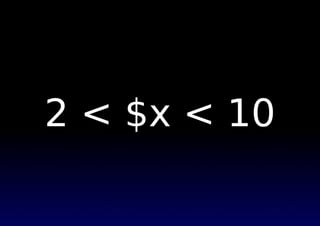
2 < $x < 10
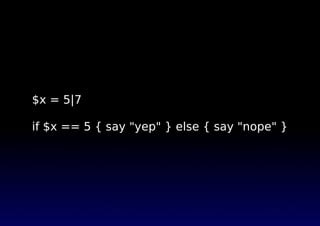
$x = 5|7
if $x == 5 { say "yep" } else { say "nope" }
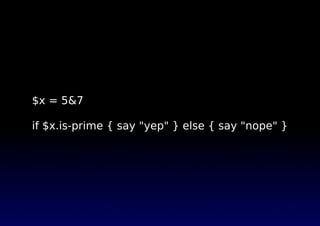
$x = 5&7
if $x.is-prime { say "yep" } else { say "nope" }
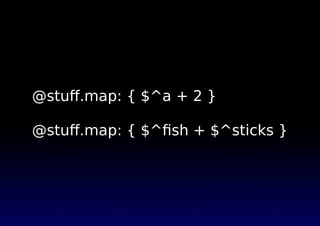
@stuff.map: { $^a + 2 }
@stuff.map: { $^fish + $^sticks }
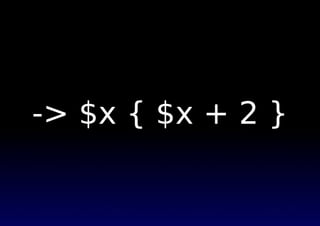
-> $x { $x + 2 }
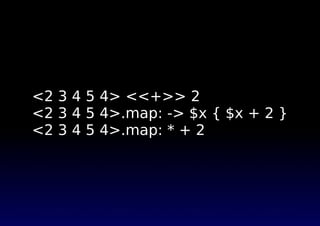
<2 3 4 5 4> <<+>> 2
<2 3 4 5 4>.map: -> $x { $x + 2 }
<2 3 4 5 4>.map: * + 2
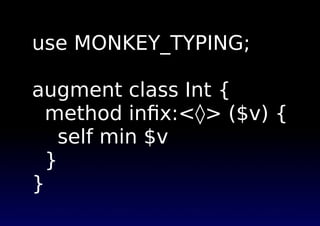
use MONKEY_TYPING;
augment class Int {
method infix:<⋄> ($v) {
self min $v
}
}
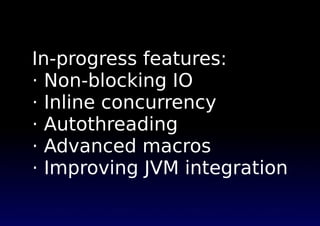
In-progress features:
· Non-blocking IO
· Inline concurrency
· Autothreading
· Advanced macros
· Improving JVM integration
THE END
Oh yeah. Almost forgot.
Rakudo is an implementation of Perl6

Rakudo