An Evaluation of Success Factors on
European National Tourism
Organisations‘ Destination Websites
Stefanie Gallob
IMC FH KremsIMC FH Krems
www.tourism-student-conference.com
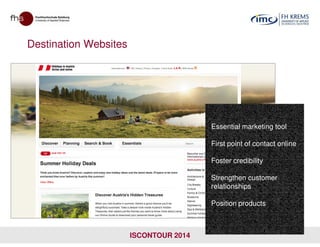
Destination Websites
Essential marketing tool
ISCONTOUR 2014
Essential marketing tool
First point of contact online
Foster credibility
Strengthen customer
relationships
Position products
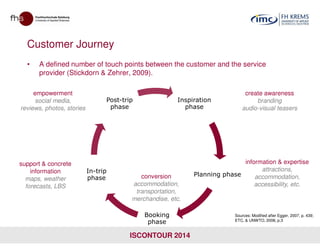
Customer Journey
• A defined number of touch points between the customer and the service
provider (Stickdorn & Zehrer, 2009).
Inspiration
phase
Post-trip
phase
create awareness
branding
audio-visual teasers
empowerment
social media,
reviews, photos, stories
ISCONTOUR 2014
Planning phase
Booking
phase
In-trip
phase
information & expertise
attractions,
accommodation,
accessibility, etc.
conversion
accommodation,
transportation,
merchandise, etc.
support & concrete
information
maps, weather
forecasts, LBS
Sources: Modified after Egger, 2007, p. 439;
ETC, & UNWTO, 2008, p.3
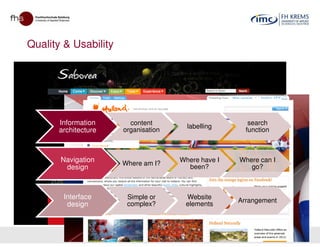
Quality & Usability
Information content
labelling
search
ISCONTOUR 2014
Information
architecture
content
organisation
labelling
search
function
Navigation
design
Where am I?
Where have I
been?
Where can I
go?
Interface
design
Simple or
complex?
Website
elements
Arrangement
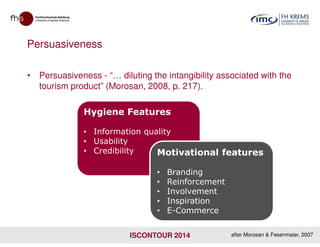
Persuasiveness
• Persuasiveness - “… diluting the intangibility associated with the
tourism product” (Morosan, 2008, p. 217).
Hygiene Features
ISCONTOUR 2014
• Information quality
• Usability
• Credibility Motivational features
• Branding
• Reinforcement
• Involvement
• Inspiration
• E-Commerce
after Morosan & Fesenmaier, 2007
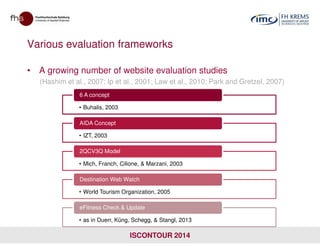
Various evaluation frameworks
• A growing number of website evaluation studies
(Hashim et al., 2007; Ip et al., 2001; Law et al., 2010; Park and Gretzel, 2007)
• Buhalis, 2003
6 A concept
AIDA Concept
ISCONTOUR 2014
• IZT, 2003
AIDA Concept
• Mich, Franch, Cilione, & Marzani, 2003
2QCV3Q Model
• World Tourism Organization, 2005
Destination Web Watch
• as in Duerr, Küng, Schegg, & Stangl, 2013
eFitness Check & Update
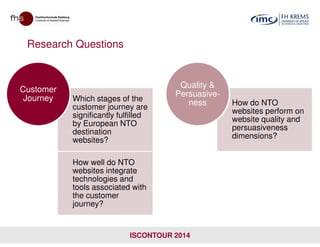
Which stages of the
customer journey are
significantly fulfilled
by European NTO
Customer
Journey
How do NTO
websites perform on
website quality and
persuasiveness
Quality &
Persuasive-
ness
Research Questions
by European NTO
destination
websites?
How well do NTO
websites integrate
technologies and
tools associated with
the customer
journey?
website quality and
persuasiveness
dimensions?
ISCONTOUR 2014
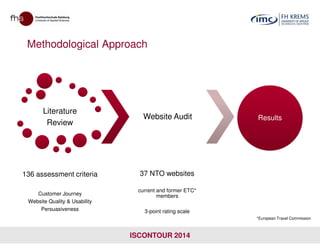
Methodological Approach
Literature
Review
Website Audit ResultsResults
ISCONTOUR 2014
Review
136 assessment criteria
Customer Journey
Website Quality & Usability
Persuasiveness
37 NTO websites
current and former ETC*
members
3-point rating scale
*European Travel Commission
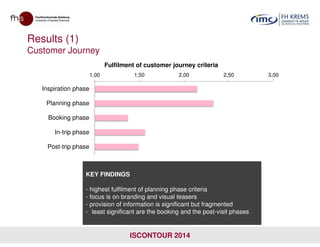
Results (1)
Customer Journey
1,00 1,50 2,00 2,50 3,00
Inspiration phase
Planning phase
Booking phase
Fulfilment of customer journey criteria
ISCONTOUR 2014
In-trip phase
Post-trip phase
KEY FINDINGS
- highest fulfilment of planning phase criteria
- focus is on branding and visual teasers
- provision of information is significant but fragmented
- least significant are the booking and the post-visit phases
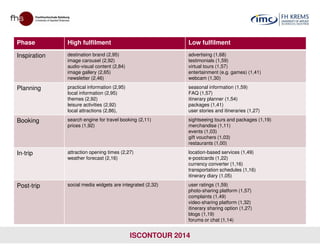
Phase High fulfilment Low fulfilment
Inspiration destination brand (2,95)
image carousel (2,92)
audio-visual content (2,84)
image gallery (2,65)
newsletter (2,46)
advertising (1,68)
testimonials (1,59)
virtual tours (1,57)
entertainment (e.g. games) (1,41)
webcam (1,30)
Planning practical information (2,95)
local information (2,95)
themes (2,92)
leisure activities (2,92)
local attractions (2,86),
seasonal information (1,59)
FAQ (1,57)
itinerary planner (1,54)
packages (1,41)
user stories and itineraries (1,27)
Booking search engine for travel booking (2,11)
prices (1,92)
sightseeing tours and packages (1,19)
merchandise (1,11)
ISCONTOUR 2014
Booking
prices (1,92) merchandise (1,11)
events (1,03)
gift vouchers (1,03)
restaurants (1,00)
In-trip attraction opening times (2,27)
weather forecast (2,16)
location-based services (1,49)
e-postcards (1,22)
currency converter (1,16)
transportation schedules (1,16)
itinerary diary (1,05)
Post-trip social media widgets are integrated (2,32) user ratings (1,59)
photo-sharing platform (1,57)
complaints (1,49)
video-sharing platform (1,32)
itinerary sharing option (1,27)
blogs (1,19)
forums or chat (1,14)
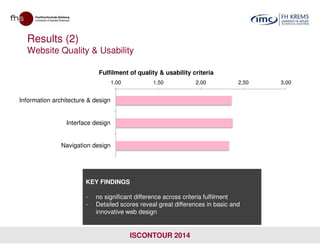
Results (2)
Website Quality & Usability
1,00 1,50 2,00 2,50 3,00
Information architecture & design
Interface design
Fulfilment of quality & usability criteria
ISCONTOUR 2014
Interface design
Navigation design
KEY FINDINGS
- no significant difference across criteria fulfilment
- Detailed scores reveal great differences in basic and
innovative web design
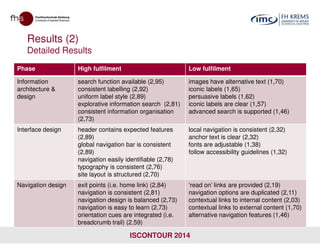
Results (2)
Detailed Results
Phase High fulfilment Low fulfilment
Information
architecture &
design
search function available (2,95)
consistent labelling (2,92)
uniform label style (2,89)
explorative information search (2,81)
consistent information organisation
(2,73)
images have alternative text (1,70)
iconic labels (1,65)
persuasive labels (1,62)
iconic labels are clear (1,57)
advanced search is supported (1,46)
ISCONTOUR 2014
Interface design header contains expected features
(2,89)
global navigation bar is consistent
(2,89)
navigation easily identifiable (2,78)
typography is consistent (2,76)
site layout is structured (2,70)
local navigation is consistent (2,32)
anchor text is clear (2,32)
fonts are adjustable (1,38)
follow accessibility guidelines (1,32)
Navigation design exit points (i.e. home link) (2,84)
navigation is consistent (2,81)
navigation design is balanced (2,73)
navigation is easy to learn (2,73)
orientation cues are integrated (i.e.
breadcrumb trail) (2,59)
‘read on’ links are provided (2,19)
navigation options are duplicated (2,11)
contextual links to internal content (2,03)
contextual links to external content (1,70)
alternative navigation features (1,46)
Results (3)
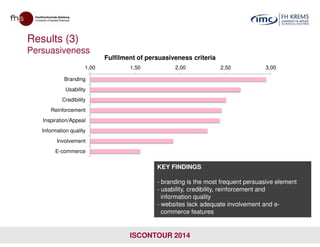
Persuasiveness
1,00 1,50 2,00 2,50 3,00
Branding
Usability
Credibility
Reinforcement
Inspiration/Appeal
Fulfilment of persuasiveness criteria
ISCONTOUR 2014
Information quality
Involvement
E-commerce
KEY FINDINGS
- branding is the most frequent persuasive element
- usability, credibility, reinforcement and
information quality
- websites lack adequate involvement and e-
commerce features
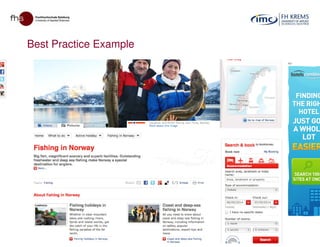
Best Practice Example
ISCONTOUR 2014
Key Conclusions
• Fragmented fulfilment of customer journey trip phases
• Strong emphasis on inspirational and planning phase
• Booking and post-visit phase are particularly neglected
• Few truly interactive components
• Low number of engagement and personalisation tools
• Majority of NTOs do not capitalise on UGC
• Quality and persuasiveness gap
• Focus on conventional design criteria
• Lack of consideration of motivational factors
ISCONTOUR 2014
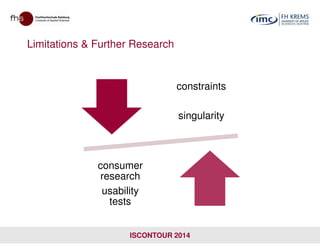
Limitations & Further Research
constraints
singularity
ISCONTOUR 2014
consumer
research
usability
tests
Thank you very much!
Stefanie Gallob
IMC FH KremsIMC FH Krems
www.tourism-student-conference.com

2014_iscontour_gallob_stefanie

  • 1.
    An Evaluation ofSuccess Factors on European National Tourism Organisations‘ Destination Websites Stefanie Gallob IMC FH KremsIMC FH Krems www.tourism-student-conference.com
  • 2.
    Destination Websites Essential marketingtool ISCONTOUR 2014 Essential marketing tool First point of contact online Foster credibility Strengthen customer relationships Position products
  • 3.
    Customer Journey • Adefined number of touch points between the customer and the service provider (Stickdorn & Zehrer, 2009). Inspiration phase Post-trip phase create awareness branding audio-visual teasers empowerment social media, reviews, photos, stories ISCONTOUR 2014 Planning phase Booking phase In-trip phase information & expertise attractions, accommodation, accessibility, etc. conversion accommodation, transportation, merchandise, etc. support & concrete information maps, weather forecasts, LBS Sources: Modified after Egger, 2007, p. 439; ETC, & UNWTO, 2008, p.3
  • 4.
    Quality & Usability Informationcontent labelling search ISCONTOUR 2014 Information architecture content organisation labelling search function Navigation design Where am I? Where have I been? Where can I go? Interface design Simple or complex? Website elements Arrangement
  • 5.
    Persuasiveness • Persuasiveness -“… diluting the intangibility associated with the tourism product” (Morosan, 2008, p. 217). Hygiene Features ISCONTOUR 2014 • Information quality • Usability • Credibility Motivational features • Branding • Reinforcement • Involvement • Inspiration • E-Commerce after Morosan & Fesenmaier, 2007
  • 6.
    Various evaluation frameworks •A growing number of website evaluation studies (Hashim et al., 2007; Ip et al., 2001; Law et al., 2010; Park and Gretzel, 2007) • Buhalis, 2003 6 A concept AIDA Concept ISCONTOUR 2014 • IZT, 2003 AIDA Concept • Mich, Franch, Cilione, & Marzani, 2003 2QCV3Q Model • World Tourism Organization, 2005 Destination Web Watch • as in Duerr, Küng, Schegg, & Stangl, 2013 eFitness Check & Update
  • 7.
    Which stages ofthe customer journey are significantly fulfilled by European NTO Customer Journey How do NTO websites perform on website quality and persuasiveness Quality & Persuasive- ness Research Questions by European NTO destination websites? How well do NTO websites integrate technologies and tools associated with the customer journey? website quality and persuasiveness dimensions? ISCONTOUR 2014
  • 8.
    Methodological Approach Literature Review Website AuditResultsResults ISCONTOUR 2014 Review 136 assessment criteria Customer Journey Website Quality & Usability Persuasiveness 37 NTO websites current and former ETC* members 3-point rating scale *European Travel Commission
  • 9.
    Results (1) Customer Journey 1,001,50 2,00 2,50 3,00 Inspiration phase Planning phase Booking phase Fulfilment of customer journey criteria ISCONTOUR 2014 In-trip phase Post-trip phase KEY FINDINGS - highest fulfilment of planning phase criteria - focus is on branding and visual teasers - provision of information is significant but fragmented - least significant are the booking and the post-visit phases
  • 10.
    Phase High fulfilmentLow fulfilment Inspiration destination brand (2,95) image carousel (2,92) audio-visual content (2,84) image gallery (2,65) newsletter (2,46) advertising (1,68) testimonials (1,59) virtual tours (1,57) entertainment (e.g. games) (1,41) webcam (1,30) Planning practical information (2,95) local information (2,95) themes (2,92) leisure activities (2,92) local attractions (2,86), seasonal information (1,59) FAQ (1,57) itinerary planner (1,54) packages (1,41) user stories and itineraries (1,27) Booking search engine for travel booking (2,11) prices (1,92) sightseeing tours and packages (1,19) merchandise (1,11) ISCONTOUR 2014 Booking prices (1,92) merchandise (1,11) events (1,03) gift vouchers (1,03) restaurants (1,00) In-trip attraction opening times (2,27) weather forecast (2,16) location-based services (1,49) e-postcards (1,22) currency converter (1,16) transportation schedules (1,16) itinerary diary (1,05) Post-trip social media widgets are integrated (2,32) user ratings (1,59) photo-sharing platform (1,57) complaints (1,49) video-sharing platform (1,32) itinerary sharing option (1,27) blogs (1,19) forums or chat (1,14)
  • 11.
    Results (2) Website Quality& Usability 1,00 1,50 2,00 2,50 3,00 Information architecture & design Interface design Fulfilment of quality & usability criteria ISCONTOUR 2014 Interface design Navigation design KEY FINDINGS - no significant difference across criteria fulfilment - Detailed scores reveal great differences in basic and innovative web design
  • 12.
    Results (2) Detailed Results PhaseHigh fulfilment Low fulfilment Information architecture & design search function available (2,95) consistent labelling (2,92) uniform label style (2,89) explorative information search (2,81) consistent information organisation (2,73) images have alternative text (1,70) iconic labels (1,65) persuasive labels (1,62) iconic labels are clear (1,57) advanced search is supported (1,46) ISCONTOUR 2014 Interface design header contains expected features (2,89) global navigation bar is consistent (2,89) navigation easily identifiable (2,78) typography is consistent (2,76) site layout is structured (2,70) local navigation is consistent (2,32) anchor text is clear (2,32) fonts are adjustable (1,38) follow accessibility guidelines (1,32) Navigation design exit points (i.e. home link) (2,84) navigation is consistent (2,81) navigation design is balanced (2,73) navigation is easy to learn (2,73) orientation cues are integrated (i.e. breadcrumb trail) (2,59) ‘read on’ links are provided (2,19) navigation options are duplicated (2,11) contextual links to internal content (2,03) contextual links to external content (1,70) alternative navigation features (1,46)
  • 13.
    Results (3) Persuasiveness 1,00 1,502,00 2,50 3,00 Branding Usability Credibility Reinforcement Inspiration/Appeal Fulfilment of persuasiveness criteria ISCONTOUR 2014 Information quality Involvement E-commerce KEY FINDINGS - branding is the most frequent persuasive element - usability, credibility, reinforcement and information quality - websites lack adequate involvement and e- commerce features
  • 14.
  • 15.
    Key Conclusions • Fragmentedfulfilment of customer journey trip phases • Strong emphasis on inspirational and planning phase • Booking and post-visit phase are particularly neglected • Few truly interactive components • Low number of engagement and personalisation tools • Majority of NTOs do not capitalise on UGC • Quality and persuasiveness gap • Focus on conventional design criteria • Lack of consideration of motivational factors ISCONTOUR 2014
  • 16.
    Limitations & FurtherResearch constraints singularity ISCONTOUR 2014 consumer research usability tests
  • 17.
    Thank you verymuch! Stefanie Gallob IMC FH KremsIMC FH Krems www.tourism-student-conference.com