INNOVATION WEEK ON R.E.S.1
ENTREPRENEURSHIP CHALLENGES & PERSPECTIVES FOR
DEVELOPMENT & EMPLOYMENT
…ENERGY TO BE INDEPENDENT
2
DIRECTIONS
• Reducing the use of energy resources
(Energy Saving)
• Increasing energy efficiency
(Improving the Efficiency of Energy
Conversion)
• «Decarbonisation» of power
(Promotion of Renewable Energy Sources)
EUROPEAN ENERGY POLICY
3
MAIN TARGETS
The main strategic energy objective of the
EU is to reduce their greenhouse gas
emissions by 20% by 2020 compared with
1990 levels.
To achieve the main strategic goal, the
European Commission proposes parallel to
achieve three related goals for 2020
 improving energy efficiency by 20%
 increase the rate of penetration of renewables
in the energy mix to 20% level
 and increasing the share of biofuels in transport
to 10%
E U R O P E A N E N E R G Y P O L I C Y
4 N A T I O N A L TA R G E T F O R R E S PA R T I C I PAT I O N
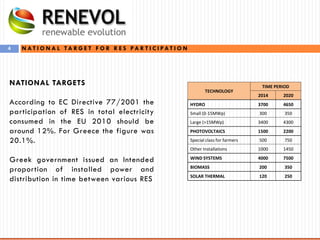
NATIONAL TARGETS
According to EC Directive 77/2001 the
participation of RES in total electricity
consumed in the EU 2010 should be
around 12%. For Greece the figure was
20.1%.
Greek government issued an Intended
proportion of installed power and
distribution in time between various RES
TECHNOLOGY
TIME PERIOD
2014 2020
HYDRO 3700 4650
Small (0-15MWp) 300 350
Large (>15MWp) 3400 4300
PHOTOVOLTAICS 1500 2200
Special class for farmers 500 750
Other Installations 1000 1450
WIND SYSTEMS 4000 7500
BIOMASS 200 350
SOLAR THERMAL 120 250
5 G R E E K P V M A R K E T 2 0 0 7 - 2 0 1 3
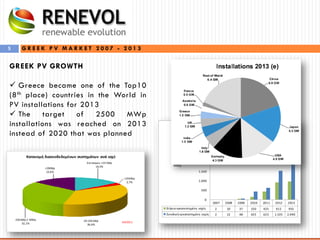
GREEK PV GROWTH
 Greece became one of the Top10
(8th place) countries in the World in
PV installations for 2013
 The target of 2500 MWp
installations was reached on 2013
instead of 2020 that was planned
6 T H E G R E E K I N C O R R E C T H A N D L I N G
WHAT CAUSED THE OVERHEAT OF PV
GROWTH
 Delay in reducing the Feed-In-Tarrif
accordingly with the decrease of PV systems
cost
 Change of Feed-In-Tarrif 3 times in less
than a year
 Anti-dumping law in the Chinese PV modules
 Reached the target of 2500 MWp in 2013
instead of 2020
 Change of European Energy Targets from
RES to cheap energy
 Lack of political will and support
7
WHAT’S NEXT FOR PV?
 Sustainable growth without Government support
 Increasing of retail electricity prices can make again PV
systems competitive
 Further decline of solar module price
 Technology gains will continue to boost productivity
 Balance of system costs will continue to decline
 New regulatory and institutional framework
W H A T ’ S N E X T F O R P V ?
8
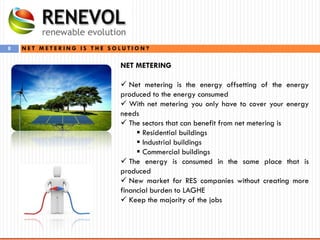
NET METERING
 Net metering is the energy offsetting of the energy
produced to the energy consumed
 With net metering you only have to cover your energy
needs
 The sectors that can benefit from net metering is
 Residential buildings
 Industrial buildings
 Commercial buildings
 The energy is consumed in the same place that is
produced
 New market for RES companies without creating more
financial burden to LAGHE
 Keep the majority of the jobs
N E T M E T E R I N G I S T H E S O L U T I O N ?
9
SINGLE HOUSE EXAMPLE
 Assume a family of 4
 In a house of 150 m2
 That consumes 4.500 kWh of
electricity a year
 And pays 750€ per year
N E T M E T E R I N G E X A M P L E
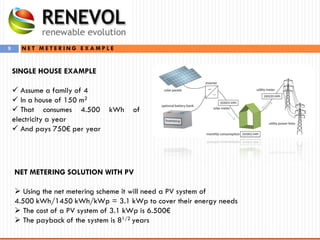
NET METERING SOLUTION WITH PV
 Using the net metering scheme it will need a PV system of
4.500 kWh/1450 kWh/kWp = 3.1 kWp to cover their energy needs
 The cost of a PV system of 3.1 kWp is 6.500€
 The payback of the system is 81/2 years
10
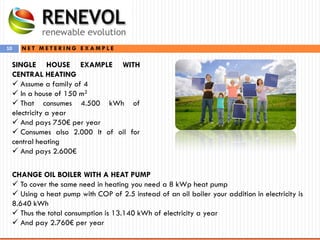
SINGLE HOUSE EXAMPLE WITH
CENTRAL HEATING
 Assume a family of 4
 In a house of 150 m2
 That consumes 4.500 kWh of
electricity a year
 And pays 750€ per year
 Consumes also 2.000 lt of oil for
central heating
 And pays 2.600€
N E T M E T E R I N G E X A M P L E
CHANGE OIL BOILER WITH A HEAT PUMP
 To cover the same need in heating you need a 8 kWp heat pump
 Using a heat pump with COP of 2.5 instead of an oil boiler your addition in electricity is
8.640 kWh
 Thus the total consumption is 13.140 kWh of electricity a year
 And pay 2.760€ per year
11 N E T M E T E R I N G E X A M P L E
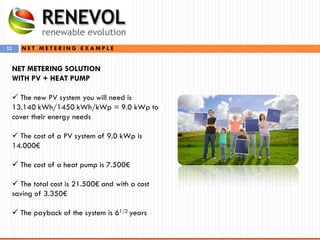
NET METERING SOLUTION
WITH PV + HEAT PUMP
 The new PV system you will need is
13.140 kWh/1450 kWh/kWp = 9.0 kWp to
cover their energy needs
 The cost of a PV system of 9.0 kWp is
14.000€
 The cost of a heat pump is 7.500€
 The total cost is 21.500€ and with a cost
saving of 3.350€
 The payback of the system is 61/2 years
12 N E T M E T E R I N G E X A M P L E
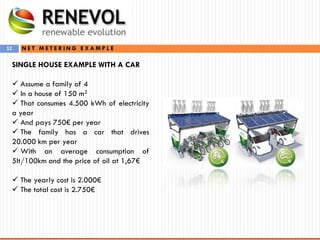
SINGLE HOUSE EXAMPLE WITH A CAR
 Assume a family of 4
 In a house of 150 m2
 That consumes 4.500 kWh of electricity
a year
 And pays 750€ per year
 The family has a car that drives
20.000 km per year
 With an average consumption of
5lt/100km and the price of oil at 1,67€
 The yearly cost is 2.000€
 The total cost is 2.750€
13 N E T M E T E R I N G E X A M P L E
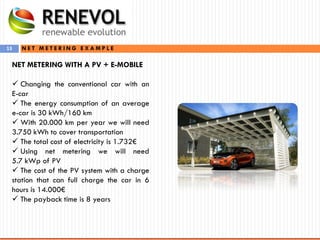
NET METERING WITH A PV + E-MOBILE
 Changing the conventional car with an
E-car
 The energy consumption of an average
e-car is 30 kWh/160 km
 With 20.000 km per year we will need
3.750 kWh to cover transportation
 The total cost of electricity is 1.732€
 Using net metering we will need
5.7 kWp of PV
 The cost of the PV system with a charge
station that can full charge the car in 6
hours is 14.000€
 The payback time is 8 years
14 N E W M A R K E T S
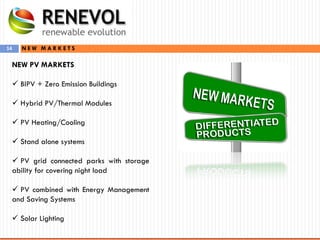
NEW PV MARKETS
 BIPV + Zero Emission Buildings
 Hybrid PV/Thermal Modules
 PV Heating/Cooling
 Stand alone systems
 PV grid connected parks with storage
ability for covering night load
 PV combined with Energy Management
and Saving Systems
 Solar Lighting
15 P V & I N N O VAT I O N
16
THANK YOU FOR YOUR ATTENTION
HQ
4-6 Gounari str.
GR 18 531, Piraeus, Greece
Tel.: + 30 210 412 2759
E-mail: info@renevol.gr
Web page: http://www.renevol.gr
Skype: renevol.com
Dr Asterios Bouzoukas, MSc, MBA
General Project Manager, RENEVOL company
E-mail: abouzoukas@renevol.gr
Tel.: + 30 694 833 5596

BOUZOUKAS_A. _INNOVATION WEEK ON RES_PRESENTATION_2013_EN_FINAL

  • 1.
    INNOVATION WEEK ONR.E.S.1 ENTREPRENEURSHIP CHALLENGES & PERSPECTIVES FOR DEVELOPMENT & EMPLOYMENT …ENERGY TO BE INDEPENDENT
  • 2.
    2 DIRECTIONS • Reducing theuse of energy resources (Energy Saving) • Increasing energy efficiency (Improving the Efficiency of Energy Conversion) • «Decarbonisation» of power (Promotion of Renewable Energy Sources) EUROPEAN ENERGY POLICY
  • 3.
    3 MAIN TARGETS The mainstrategic energy objective of the EU is to reduce their greenhouse gas emissions by 20% by 2020 compared with 1990 levels. To achieve the main strategic goal, the European Commission proposes parallel to achieve three related goals for 2020  improving energy efficiency by 20%  increase the rate of penetration of renewables in the energy mix to 20% level  and increasing the share of biofuels in transport to 10% E U R O P E A N E N E R G Y P O L I C Y
  • 4.
    4 N AT I O N A L TA R G E T F O R R E S PA R T I C I PAT I O N NATIONAL TARGETS According to EC Directive 77/2001 the participation of RES in total electricity consumed in the EU 2010 should be around 12%. For Greece the figure was 20.1%. Greek government issued an Intended proportion of installed power and distribution in time between various RES TECHNOLOGY TIME PERIOD 2014 2020 HYDRO 3700 4650 Small (0-15MWp) 300 350 Large (>15MWp) 3400 4300 PHOTOVOLTAICS 1500 2200 Special class for farmers 500 750 Other Installations 1000 1450 WIND SYSTEMS 4000 7500 BIOMASS 200 350 SOLAR THERMAL 120 250
  • 5.
    5 G RE E K P V M A R K E T 2 0 0 7 - 2 0 1 3 GREEK PV GROWTH  Greece became one of the Top10 (8th place) countries in the World in PV installations for 2013  The target of 2500 MWp installations was reached on 2013 instead of 2020 that was planned
  • 6.
    6 T HE G R E E K I N C O R R E C T H A N D L I N G WHAT CAUSED THE OVERHEAT OF PV GROWTH  Delay in reducing the Feed-In-Tarrif accordingly with the decrease of PV systems cost  Change of Feed-In-Tarrif 3 times in less than a year  Anti-dumping law in the Chinese PV modules  Reached the target of 2500 MWp in 2013 instead of 2020  Change of European Energy Targets from RES to cheap energy  Lack of political will and support
  • 7.
    7 WHAT’S NEXT FORPV?  Sustainable growth without Government support  Increasing of retail electricity prices can make again PV systems competitive  Further decline of solar module price  Technology gains will continue to boost productivity  Balance of system costs will continue to decline  New regulatory and institutional framework W H A T ’ S N E X T F O R P V ?
  • 8.
    8 NET METERING  Netmetering is the energy offsetting of the energy produced to the energy consumed  With net metering you only have to cover your energy needs  The sectors that can benefit from net metering is  Residential buildings  Industrial buildings  Commercial buildings  The energy is consumed in the same place that is produced  New market for RES companies without creating more financial burden to LAGHE  Keep the majority of the jobs N E T M E T E R I N G I S T H E S O L U T I O N ?
  • 9.
    9 SINGLE HOUSE EXAMPLE Assume a family of 4  In a house of 150 m2  That consumes 4.500 kWh of electricity a year  And pays 750€ per year N E T M E T E R I N G E X A M P L E NET METERING SOLUTION WITH PV  Using the net metering scheme it will need a PV system of 4.500 kWh/1450 kWh/kWp = 3.1 kWp to cover their energy needs  The cost of a PV system of 3.1 kWp is 6.500€  The payback of the system is 81/2 years
  • 10.
    10 SINGLE HOUSE EXAMPLEWITH CENTRAL HEATING  Assume a family of 4  In a house of 150 m2  That consumes 4.500 kWh of electricity a year  And pays 750€ per year  Consumes also 2.000 lt of oil for central heating  And pays 2.600€ N E T M E T E R I N G E X A M P L E CHANGE OIL BOILER WITH A HEAT PUMP  To cover the same need in heating you need a 8 kWp heat pump  Using a heat pump with COP of 2.5 instead of an oil boiler your addition in electricity is 8.640 kWh  Thus the total consumption is 13.140 kWh of electricity a year  And pay 2.760€ per year
  • 11.
    11 N ET M E T E R I N G E X A M P L E NET METERING SOLUTION WITH PV + HEAT PUMP  The new PV system you will need is 13.140 kWh/1450 kWh/kWp = 9.0 kWp to cover their energy needs  The cost of a PV system of 9.0 kWp is 14.000€  The cost of a heat pump is 7.500€  The total cost is 21.500€ and with a cost saving of 3.350€  The payback of the system is 61/2 years
  • 12.
    12 N ET M E T E R I N G E X A M P L E SINGLE HOUSE EXAMPLE WITH A CAR  Assume a family of 4  In a house of 150 m2  That consumes 4.500 kWh of electricity a year  And pays 750€ per year  The family has a car that drives 20.000 km per year  With an average consumption of 5lt/100km and the price of oil at 1,67€  The yearly cost is 2.000€  The total cost is 2.750€
  • 13.
    13 N ET M E T E R I N G E X A M P L E NET METERING WITH A PV + E-MOBILE  Changing the conventional car with an E-car  The energy consumption of an average e-car is 30 kWh/160 km  With 20.000 km per year we will need 3.750 kWh to cover transportation  The total cost of electricity is 1.732€  Using net metering we will need 5.7 kWp of PV  The cost of the PV system with a charge station that can full charge the car in 6 hours is 14.000€  The payback time is 8 years
  • 14.
    14 N EW M A R K E T S NEW PV MARKETS  BIPV + Zero Emission Buildings  Hybrid PV/Thermal Modules  PV Heating/Cooling  Stand alone systems  PV grid connected parks with storage ability for covering night load  PV combined with Energy Management and Saving Systems  Solar Lighting
  • 15.
    15 P V& I N N O VAT I O N
  • 16.
    16 THANK YOU FORYOUR ATTENTION HQ 4-6 Gounari str. GR 18 531, Piraeus, Greece Tel.: + 30 210 412 2759 E-mail: info@renevol.gr Web page: http://www.renevol.gr Skype: renevol.com Dr Asterios Bouzoukas, MSc, MBA General Project Manager, RENEVOL company E-mail: abouzoukas@renevol.gr Tel.: + 30 694 833 5596