



EXECUTIVE SUMMARY   TABLE of contents   GLOSSARY


                              WE TESTED,
                              WE ANALYZED,
2013 GLOBAL SECURITY REPORT   WE DISCOVERED
EXECUTIVE SUMMARY        TABLE of contents   GLOSSARY


                                                   This clickable report will make it easy to navigate between
                                                   sections and subsections. Look for callouts in the next
                                                   several pages that will help you navigate, or use the bar at
                                                   the top of each page to click to each main section.


Dear REader
The past year brought another reality check to IT and security professionals.
We thought we’d officially experienced the “year of the breach” in 2011.
But in 2012, as we continued to transform our businesses—embracing
mobility, moving to the cloud, expanding social collaboration and creating
and sharing extraordinary volumes of data—cybercriminals likewise
continued to transform and escalate.
Today’s reality is this: No matter what business you are in, no matter where
in the world you are—if you’ve got data, then your business is at constant
risk. From the outside in, to the inside out, threats are increasing as quickly
as you can implement measures against them, and in spite of tremendous
technology investment, many organizations are still ill-prepared for attacks.
This is why we’re pleased to share the results of our 2013 Trustwave
Global Security Report with you. In this report, we’ve analyzed the results
of hundreds of incident response investigations, thousands of penetration
tests, millions of website and Web application attacks and tens of billions
of events. We’ve also included detailed contributions from law enforcement
agencies and experts from around the world. All in an effort to provide you
with perspectives on the latest threats and vulnerabilities facing organizations
just like yours, along with actionable recommendations you can begin
implementing immediately to strengthen your security program.
We hope you find the 2013 Trustwave Global Security Report to be a
valuable resource for your business, helping you defend better, act faster
and prepare for what’s ahead in the upcoming year and beyond.


Best wishes,


Robert J. McCullen
Chairman, CEO and President
Trustwave
EXECUTIVE SUMMARY          TABLE of contents       GLOSSARY

                                                                                                              Click on each icon to go straight to the data.


Executive                                                                                Key Discoveries
                                                                                                          Retail businesses and their sensitive data


summary
                                                                                                          are back in the crosshairs. For the first time
                                                                                                          in three years, the retail industry made up the
                                                                                                          highest percentage of investigations at 45%.


                                                                                                          Web applications have now emerged
                                                                                                          as the most popular attack vector.
                                                                                                          E-commerce sites were the No. 1 targeted
                                                                                                          asset, accounting for 48% of all investigations.


During 2012, nearly every                                                                                 Mobile malware explodes by 400%. As
                                                                                                          organizations embrace mobility, mobile
                                                                                                          malware continues to be a problem for


industry, country and
                                                                                                          Android, with the number of samples in
                                                                                                          Trustwave’s collection growing 400% in 2012.


type of data was involved                                                                                 Businesses are embracing an outsourced
                                                                                                          IT operations model. In 63% of incident
                                                                                                          response investigations, a major component

in a breach of some kind.                                                                                 of IT support was outsourced to a third
                                                                                                          party. Outsourcing can help businesses gain
                                                                                                          effective, cost-friendly IT services; however,
                                                                                                          businesses need to understand the risk their
                                                                                                          vendors may introduce and proactively work
Cybersecurity threats are increasing as quickly                                                           to decrease that risk.
as businesses can implement measures against
them. At the same time, businesses must                                                                   Businesses are slow to “self-detect”
embrace virtualization and cloud, user mobility                                                           breach activity. The average time from initial
                                                                                                          breach to detection was 210 days, more than
and heterogeneous platforms and devices.                                                                  35 days longer than in 2011. Most victim
They also have to find ways to handle and                                                                 organizations (64%) took over 90 days to
protect exploding volumes of sensitive data. The                                                          detect the intrusion, while 5% took three or
                                                                                                          more years to identify the criminal activity.
combination of business and IT transformation,
compliance and governance demands and the                                                                 More responsibility falls onto security
onslaught of security threats continues to make                                                           staff to stay on top of zero-day attacks.
the job of safeguarding data assets a serious                                                             Software developers vary greatly in their ability
                                                                                                          to respond and patch zero-day vulnerabilities.
challenge for organizations of all types—from                                                             In this study, the Linux platform had the worst
multinational corporations to independent                                                                 response time, with almost three years on
                                                                                                          average from initial vulnerability to patch.
merchants to government entities.
                                                                                                          Spam volume declines, but impact on
Today, organizations need not only to understand                                                          the business doesn’t. Spam volume
current trends in security threats but also be able                                                       shrank in 2012 to a level lower than it was
                                                                                                          in 2007 but spam still represents 75.2% of
to identify inherent vulnerabilities within existing                                                      a typical organization’s inbound email. Most
systems. In the 2013 Global Security Report,                                                              importantly, new malware research conducted
                                                                                                          by Trustwave found nearly 10% of spam
Trustwave tested, analyzed and discovered the                                                             messages to be malicious.
top vulnerabilities and threats that have the most
potential to negatively impact organizations.                                                             Basic security measures are still not in
Read on for the key discoveries of 2012 and                                                               place. “Password1” is still the most common
                                                                                                          password used by global businesses. Of three
trends to watch in 2013 and beyond.                                                                       million user passwords analyzed, 50% of
                                                                                                          users are using the bare minimum.


                                  02 | EXECUTIVE SUMMARY | 2013 Trustwave Global Security Report | home
EXECUTIVE SUMMARY        TABLE of contents      GLOSSARY


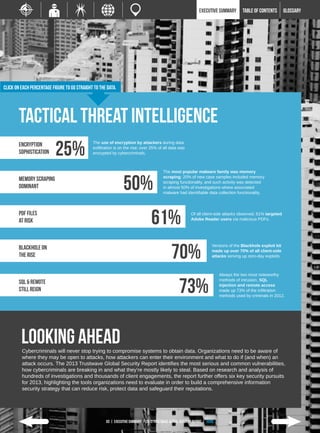
Click on each percentage figure to go straight to the data.


       Tactical Threat Intelligence
                           25%
                                              The use of encryption by attackers during data
        encryption                            exfiltration is on the rise; over 25% of all data was
        sophistication                        encrypted by cybercriminals.


                                                                                         The most popular malware family was memory


                                                                50%
                                                                                         scraping; 20% of new case samples included memory
        memory scraping                                                                  scraping functionality, and such activity was detected
        dominant                                                                         in almost 50% of investigations where associated
                                                                                         malware had identifiable data collection functionality.


        pdf files
        at risk                                                                  61%                       Of all client-side attacks observed, 61% targeted
                                                                                                           Adobe Reader users via malicious PDFs.


                                                                                              70%
                                                                                                                        Versions of the Blackhole exploit kit
        Blackhole on                                                                                                    made up over 70% of all client-side
        the rise                                                                                                        attacks serving up zero-day exploits.


                                                                                                                             Always the two most noteworthy


                                                                                                   73%
                                                                                                                             methods of intrusion, SQL
        sql & remotE                                                                                                         injection and remote access
        still reign                                                                                                          made up 73% of the infiltration
                                                                                                                             methods used by criminals in 2012.


         Looking ahead
         Cybercriminals will never stop trying to compromise systems to obtain data. Organizations need to be aware of
         where they may be open to attacks, how attackers can enter their environment and what to do if (and when) an
         attack occurs. The 2013 Trustwave Global Security Report identifies the most serious and common vulnerabilities,
         how cybercriminals are breaking in and what they’re mostly likely to steal. Based on research and analysis of
         hundreds of investigations and thousands of client engagements, the report further offers six key security pursuits
         for 2013, highlighting the tools organizations need to evaluate in order to build a comprehensive information
         security strategy that can reduce risk, protect data and safeguard their reputations.


                                                     03 | EXECUTIVE SUMMARY | 2013 Trustwave Global Security Report | home
EXECUTIVE SUMMARY   TABLE of contents    GLOSSARY


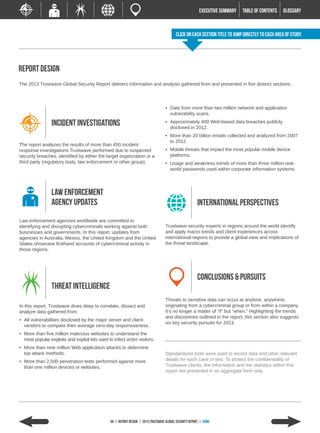
                                                                                           Click on each section title to jump directly to each area of study.


Report Design
The 2013 Trustwave Global Security Report delivers information and analysis gathered from and presented in five distinct sections:


                                                                                     •	 Data from more than two million network and application
                                                                                        vulnerability scans.

                 Incident Investigations                                             •	 Approximately 400 Web-based data breaches publicly
                                                                                        disclosed in 2012.
                                                                                     •	 More than 20 billion emails collected and analyzed from 2007
                                                                                        to 2012.
The report analyzes the results of more than 450 incident
response investigations Trustwave performed due to suspected                         •	 Mobile threats that impact the most popular mobile device
security breaches, identified by either the target organization or a                    platforms.
third party (regulatory body, law enforcement or other group).                       •	 Usage and weakness trends of more than three million real-
                                                                                        world passwords used within corporate information systems.


                 LAW ENFORCEMENT
                 AGENCY UPDATES                                                                          INTERNATIONAL PERSPECTIVES
Law enforcement agencies worldwide are committed to
identifying and disrupting cybercriminals working against both                       Trustwave security experts in regions around the world identify
businesses and governments. In this report, updates from                             and apply macro trends and client experiences across
agencies in Australia, Mexico, the United Kingdom and the United                     international regions to provide a global view and implications of
States showcase firsthand accounts of cybercriminal activity in                      the threat landscape.
those regions.


                                                                                                         CONCLUSIONS & PURSUITS
                 THREAT INTELLIGENCE
                                                                                     Threats to sensitive data can occur at anytime, anywhere,
In this report, Trustwave dives deep to correlate, dissect and                       originating from a cybercriminal group or from within a company.
analyze data gathered from:                                                          It’s no longer a matter of “if” but “when.” Highlighting the trends
                                                                                     and discoveries outlined in the report, this section also suggests
•	 All vulnerabilities disclosed by the major server and client
                                                                                     six key security pursuits for 2013.
   vendors to compare their average zero-day responsiveness.
•	 More than five million malicious websites to understand the
   most popular exploits and exploit kits used to infect victim visitors.
•	 More than nine million Web application attacks to determine
   top attack methods.                                                               Standardized tools were used to record data and other relevant
•	 More than 2,500 penetration tests performed against more                          details for each case or test. To protect the confidentiality of
   than one million devices or websites.                                             Trustwave clients, the information and the statistics within this
                                                                                     report are presented in an aggregate form only.


                                                 04 | Report design | 2013 Trustwave Global Security Report | home
EXECUTIVE SUMMARY    TABLE of contents     GLOSSARY


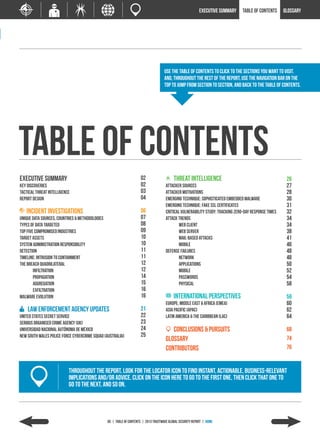
                                                                                      Use the table of contents to click to the sections you want to visit.
                                                                                      And, throughout the rest of the report, use the navigation bar on the
                                                                                      top to jump from section to section, and back to the table of contents.


TABLE OF CONTEnts
Executive Summary                                                     02                    threat intelligence                                          26
Key DISCOVERIES                                                       02               Attacker sources                                                  27
Tactical Threat Intelligence                                          03               Attacker Motivations                                              28
Report DESIGN                                                         04               Emerging technique: sophisticated embedded malware                30
                                                                                       Emerging technique: fake ssl certificates                         31
   Incident Investigations                                            06               Critical vulnerability study: tracking zero-day response times    32
Unique Data Sources, Countries & Methodologies                        07               Attack trends                                                     34
Types of Data Targeted                                                08               	       Web client                                                34
TOP FIVE COMPROMISED INDUSTRIES                                       09               	       Web server                                                38
Target Assets                                                         10               	       Mail-based attacks                                        41
System administration responsibility                                  10               	Mobile                                                           46
Detection                                                             11               Defense failures                                                  48
Timeline: INTRUSION to containment                                    11               	Network                                                          48
The Breach Quadrilateral                                              12               	ApplicationS                                                     50
	Infiltration                                                         12               	Mobile                                                           52
	Propagation                                                          14               	Passwords                                                        54
	Aggregation                                                          15               	Physical                                                         58
	Exfiltration                                                         16
Malware evolution                                                     16                    International perspectives                                   59
                                                                                       Europe, middle east & Africa (emea)                               60
    Law enforcement agency updates                                    21               Asia pacific (apac)                                               62
United States Secret Service                                          22               Latin America & the Caribbean (lac)                               64
Serious Organised Crime Agency (UK)                                   23
Universidad Nacional Autónoma de México                               24                  Conclusions & pursuits                                         68
New South Wales Police Force Cybercrime Squad (Australia)             25
                                                                                       Glossary                                                          74
                                                                                       Contributors                                                      76


                           Throughout the report, look for the locator icon to find instant, actionable, business-relevant
                           implications and/or advice. Click on the icon here to go to the first one, then click that one to
                           go to the next, and so on.


                                                 05 | TABLE OF CONTENTS | 2013 Trustwave Global Security Report | HOME
Incident
Investigations                                                                  EXECUTIVE SUMMARY   TABLE of contents   GLOSSARY


                                            Incident
                                            Investigations


                 06 | INCIDENT INVESTIGATIONS | 2013 Trustwave Global Security Report | home
Incident
           Investigations                                                                                                       EXECUTIVE SUMMARY    TABLE of contents   GLOSSARY


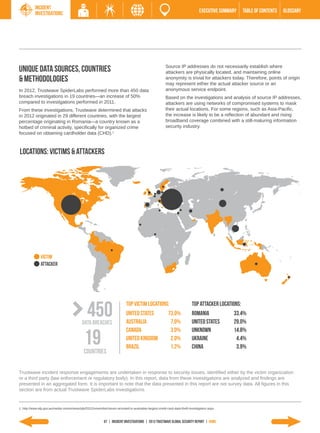
                                                                                                        Source IP addresses do not necessarily establish where
Unique Data Sources, Countries                                                                          attackers are physically located, and maintaining online
& Methodologies                                                                                         anonymity is trivial for attackers today. Therefore, points of origin
                                                                                                        may represent either the actual attacker source or an
In 2012, Trustwave SpiderLabs performed more than 450 data                                              anonymous service endpoint.
breach investigations in 19 countries—an increase of 50%                                                Based on the investigations and analysis of source IP addresses,
compared to investigations performed in 2011.                                                           attackers are using networks of compromised systems to mask
From these investigations, Trustwave determined that attacks                                            their actual locations. For some regions, such as Asia-Pacific,
in 2012 originated in 29 different countries, with the largest                                          the increase is likely to be a reflection of abundant and rising
percentage originating in Romania—a country known as a                                                  broadband coverage combined with a still-maturing information
hotbed of criminal activity, specifically for organized crime                                           security industry.
focused on obtaining cardholder data (CHD).1


Locations: Victims & Attackers


               VICTIM
               ATTACKER


                                              450
                                            Data breaches
                                                                            top victim locations:
                                                                            United States
                                                                            Australia
                                                                                                          73.0%
                                                                                                           7.0%
                                                                                                                           top attacker locations:
                                                                                                                           Romania
                                                                                                                           United States
                                                                                                                                               33.4%
                                                                                                                                               29.0%


                                              19
                                                                            Canada                         3.0%            Unknown             14.8%
                                                                            United KingdoM                 2.0%            Ukraine              4.4%
                                                                            BRazil                         1.2%            China                3.9%
                                              COUNTRIES

Trustwave incident response engagements are undertaken in response to security issues, identified either by the victim organization
or a third party (law enforcement or regulatory body). In this report, data from these investigations are analyzed and findings are
presented in an aggregated form. It is important to note that the data presented in this report are not survey data. All figures in this
section are from actual Trustwave SpiderLabs investigations.


1. http://www.afp.gov.au/media-centre/news/afp/2012/november/seven-arrested-in-australias-largest-credit-card-data-theft-investigation.aspx


                                                            07 | INCIDENT INVESTIGATIONS | 2013 Trustwave Global SECURITY Report | HOME
Incident
        Investigations                                                                                    EXECUTIVE SUMMARY         TABLE of contents   GLOSSARY


Types of Data Targeted
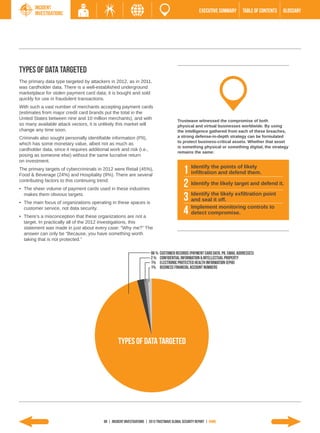
The primary data type targeted by attackers in 2012, as in 2011,
was cardholder data. There is a well-established underground
marketplace for stolen payment card data; it is bought and sold
quickly for use in fraudulent transactions.
With such a vast number of merchants accepting payment cards
(estimates from major credit card brands put the total in the
United States between nine and 10 million merchants), and with                              Trustwave witnessed the compromise of both
so many available attack vectors, it is unlikely this market will                           physical and virtual businesses worldwide. By using
change any time soon.                                                                       the intelligence gathered from each of these breaches,
Criminals also sought personally identifiable information (PII),                            a strong defense-in-depth strategy can be formulated
                                                                                            to protect business-critical assets. Whether that asset
which has some monetary value, albeit not as much as
                                                                                            is something physical or something digital, the strategy
cardholder data, since it requires additional work and risk (i.e.,
                                                                                            remains the same:
posing as someone else) without the same lucrative return
on investment.
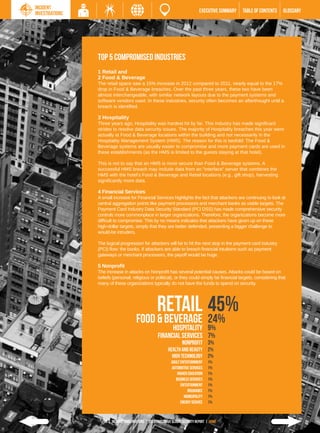
The primary targets of cybercriminals in 2012 were Retail (45%),
Food & Beverage (24%) and Hospitality (9%). There are several
                                                                                                1 Identify theand defendlikely
                                                                                                  infiltration
                                                                                                               points of
                                                                                                                           them.
contributing factors to this continuing trend:
•	 The sheer volume of payment cards used in these industries
                                                                                                2 Identify the likely target and defend it.
   makes them obvious targets.
•	 The main focus of organizations operating in these spaces is
                                                                                                3 Identify theoff. exfiltration point
                                                                                                  and seal it
                                                                                                               likely

   customer service, not data security.
•	 There’s a misconception that these organizations are not a
                                                                                                4 Implement monitoring controls to
                                                                                                  detect compromise.
   target. In practically all of the 2012 investigations, this
   statement was made in just about every case: “Why me?” The
   answer can only be “Because, you have something worth
                              TYPES OF DATA TARGETED
   taking that is not protected.”

                                                                          96 %   Customer Records (Payment Card Data, PII, Email Addresses)
                                                                          2%     Confidential Information & Intellectual Property
                                                                          1%     Electronic Protected Health Information (ePHI)
                                                                          1%     Business Financial Account Numbers


                                                    TYPES OF DATA TARGETED


                                           08 | INCIDENT INVESTIGATIONS | 2013 Trustwave Global Security Report | HOME
Incident
Investigations                                                                     EXECUTIVE SUMMARY   TABLE of contents   GLOSSARY


                 Top 5 Compromised Industries
                 1 Retail and
                 2 Food & Beverage
                 The retail space saw a 15% increase in 2012 compared to 2011, nearly equal to the 17%
                 drop in Food & Beverage breaches. Over the past three years, these two have been
                 almost interchangeable, with similar network layouts due to the payment systems and
                 software vendors used. In these industries, security often becomes an afterthought until a
                 breach is identified.

                 3 Hospitality
                 Three years ago, Hospitality was hardest hit by far. This industry has made significant
                 strides to resolve data security issues. The majority of Hospitality breaches this year were
                 actually at Food & Beverage locations within the building and not necessarily in the
                 Hospitality Management System (HMS). The reason for this is twofold: The Food &
                 Beverage systems are usually easier to compromise and more payment cards are used in
                 these establishments (as the HMS is limited to the guests staying at that hotel).

                 This is not to say that an HMS is more secure than Food & Beverage systems. A
                 successful HMS breach may include data from an “interface” server that combines the
                 HMS with the hotel’s Food & Beverage and Retail locations (e.g., gift shop), harvesting
                 significantly more data.

                 4 Financial Services
                 A small increase for Financial Services highlights the fact that attackers are continuing to look at
                 central aggregation points like payment processors and merchant banks as viable targets. The
                 Payment Card Industry Data Security Standard (PCI DSS) has made comprehensive security
                 controls more commonplace in larger organizations. Therefore, the organizations become more
                 difficult to compromise. This by no means indicates that attackers have given up on these
                 high-dollar targets, simply that they are better defended, presenting a bigger challenge to
                 would-be intruders.

                 The logical progression for attackers will be to hit the next stop in the payment card industry
                 (PCI) flow: the banks. If attackers are able to breach financial intuitions such as payment
                 gateways or merchant processors, the payoff would be huge.

                 5 Nonprofit
                 The increase in attacks on Nonprofit has several potential causes. Attacks could be based on
                 beliefs (personal, religious or political), or they could simply be financial targets, considering that
                 many of these organizations typically do not have the funds to spend on security.


                                                       Retail 45%
                                         Food & Beverage 24%
                                                                  Hospitality 9%
                                                        Financial Services 7%
                                                                        NonProfit 3%
                                                              Health and Beauty 2%
                                                                High Technology 2%
                                                                 Adult Entertainment     1%
                                                                 Automotive Services     1%
                                                                     Higher Education    1%
                                                                    Business Services    1%
                                                                       Entertainment     1%
                                                                           Insurance     1%
                                                                         Municipality    1%
                                                                       Energy Service    1%


                    09 | INCIDENT INVESTIGATIONS | 2013 Trustwave Global SECURITY Report | HOME
Incident
        Investigations                                                                                    EXECUTIVE SUMMARY    TABLE of contents    GLOSSARY


                                                                                    abide. In some instances, victims were unaware that the third
                                                                                    party was responsible only for a subset of security controls,
                                                                                    leaving these systems open to attack.


                                                                                    System administration responsibility
                                                                                    Top challenges for organizations that suffered these
                                                                                    third-party breaches include:
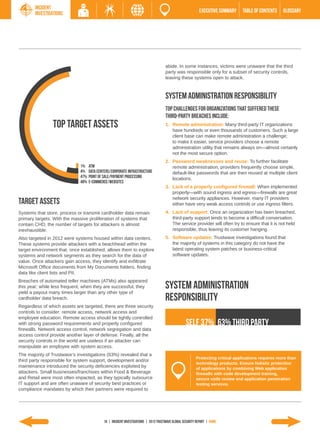
                TOP TARGET ASSETS                                                   1.	 Remote administration: Many third-party IT organizations
                                                                                        have hundreds or even thousands of customers. Such a large
                                                                                        client base can make remote administration a challenge;
                                                                                        to make it easier, service providers choose a remote
                                                                                        administration utility that remains always on—almost certainly
                                                                                        not the most secure option.
                                                                                    2.	 Password weaknesses and reuse: To further facilitate
                             1%    ATM                                                  remote administration, providers frequently choose simple,
                             4%    Data Centers/Corporate Infrastructure                default-like passwords that are then reused at multiple client
                             47%   Point of Sale/Payment Processing                     locations.
                             48%   E-Commerce/Websites
                                                                                    3.	 Lack of a properly configured firewall: When implemented
                                                                                        properly—with sound ingress and egress—firewalls are great
                                                                                        network security appliances. However, many IT providers
Target Assets                                                                           either have very weak access controls or use ingress filters.
Systems that store, process or transmit cardholder data remain                      4.	 Lack of support: Once an organization has been breached,
primary targets. With the massive proliferation of systems that                         third-party support tends to become a difficult conversation.
contain CHD, the number of targets for attackers is almost                              The service provider will often try to ensure that it is not held
inexhaustible.                                                                          responsible, thus leaving its customer hanging.
Also targeted in 2012 were systems housed within data centers.                      5.	 Software updates: Trustwave investigations found that
These systems provide attackers with a beachhead within the                             the majority of systems in this category do not have the
target environment that, once established, allows them to explore                       latest operating system patches or business-critical
systems and network segments as they search for the data of                             software updates.
value. Once attackers gain access, they identify and exfiltrate
Microsoft Office documents from My Documents folders, finding
data like client lists and PII.
Breaches of automated teller machines (ATMs) also appeared
this year; while less frequent, when they are successful, they
yield a payout many times larger than any other type of
                                                                                    system administration
cardholder data breach.                                                             responsibility
Regardless of which assets are targeted, there are three security
controls to consider: remote access, network access and
employee education. Remote access should be tightly controlled
with strong password requirements and properly configured                                        self 37% 63% third party
firewalls. Network access control, network segregation and data
access control provide another layer of defense. Finally, all the
security controls in the world are useless if an attacker can
manipulate an employee with system access.
The majority of Trustwave’s investigations (63%) revealed that a
                                                                                                        Protecting critical applications requires more than
third party responsible for system support, development and/or
                                                                                                        technology products. Ensure holistic protection
maintenance introduced the security deficiencies exploited by                                           of applications by combining Web application
attackers. Small businesses/franchises within Food & Beverage                                           firewalls with code development training,
and Retail were most often impacted, as they typically outsource                                        secure code review and application penetration
IT support and are often unaware of security best practices or                                          testing services.
compliance mandates by which their partners were required to


                                           10 | INCIDENT INVESTIGATIONS | 2013 Trustwave Global Security Report | HOME
Incident
      Investigations                                                                                   EXECUTIVE SUMMARY           TABLE of contents      GLOSSARY


                                                                                Detection
                                                                                In the past two years, attacks have grown significantly in
                                                                                complexity, rendering the majority of “off the shelf” detection
                                                                                solutions, such as commercial antivirus programs, ineffective. In
                                                                                addition, due to advanced subterfuge techniques, malware often
                                                                                goes unnoticed by systems administrators despite being clearly
                                                                                visible to investigators.
                                                                                During the course of every breach investigation, Trustwave
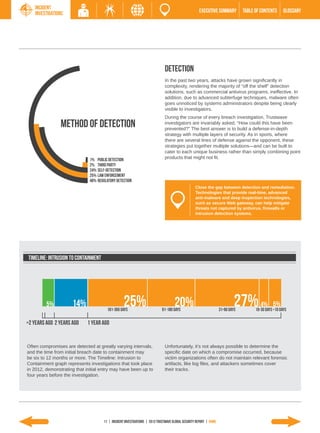
                  Method of detection                                           investigators are invariably asked, “How could this have been
                                                                                prevented?” The best answer is to build a defense-in-depth
                                                                                strategy with multiple layers of security. As in sports, where
                                                                                there are several lines of defense against the opponent, these
                                                                                strategies put together multiple solutions—and can be built to
                                                                                cater to each unique business rather than simply combining point
                                1% Public Detection                             products that might not fit.
                                2% Third Party
                                24% Self-Detection
                                25% Law Enforcement
                                48% Regulatory Detection
                                                                                                     Close the gap between detection and remediation.
                                                                                                     Technologies that provide real-time, advanced
                                                                                                     anti-malware and deep inspection technologies,
                                                                                                     such as secure Web gateway, can help mitigate
                                                                                                     threats not captured by antivirus, firewalls or
                                                                                                     intrusion detection systems.


   Timeline: Intrusion to Containment
Timeline: Intrustion to Containment


           5%           14%                          25%
                                          181-365 days
                                                                                       20%
                                                                              91-180 days
                                                                                                                               27%
                                                                                                                      31-90 Days
                                                                                                                                            4% 5%
                                                                                                                                         10-30 days <10 Days

  >2 years ago 2 years ago     1 year ago


  Often compromises are detected at greatly varying intervals,                  Unfortunately, it’s not always possible to determine the
  and the time from initial breach date to containment may                      specific date on which a compromise occurred, because
  be six to 12 months or more. The Timeline: Intrusion to                       victim organizations often do not maintain relevant forensic
  Containment graph represents investigations that took place                   artifacts, like log files, and attackers sometimes cover
  in 2012, demonstrating that initial entry may have been up to                 their tracks.
  four years before the investigation.


                                        11 | INCIDENT INVESTIGATIONS | 2013 Trustwave Global SECURITY Report | HOME
Incident
        Investigations                                                                                    EXECUTIVE SUMMARY   TABLE of contents   GLOSSARY


                                                                                      PROPAGATION


                                                                      on


                                                                                                                                  AGGREGAT
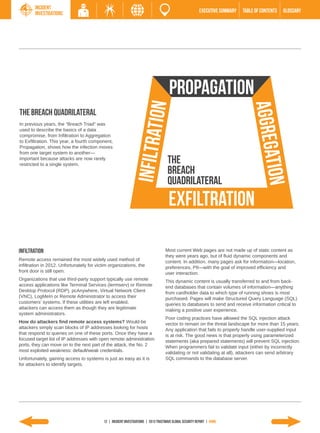
The Breach Quadrilateral


                                                               Infiltrati
In previous years, the “Breach Triad” was
used to describe the basics of a data
compromise, from Infiltration to Aggregation
to Exfiltration. This year, a fourth component,
Propagation, shows how the infection moves
from one target system to another—
important because attacks are now rarely
restricted to a single system.
                                                                                     The
                                                                                     Breach


                                                                                                                                           IO
                                                                                     quadrilateral


                                                                                                                                         N
                                                                                      Exfiltration

Infiltration                                                                        Most current Web pages are not made up of static content as
                                                                                    they were years ago, but of fluid dynamic components and
Remote access remained the most widely used method of                               content. In addition, many pages ask for information—location,
infiltration in 2012. Unfortunately for victim organizations, the                   preferences, PII—with the goal of improved efficiency and
front door is still open.                                                           user interaction.
Organizations that use third-party support typically use remote                     This dynamic content is usually transferred to and from back-
access applications like Terminal Services (termserv) or Remote                     end databases that contain volumes of information—anything
Desktop Protocol (RDP), pcAnywhere, Virtual Network Client                          from cardholder data to which type of running shoes is most
(VNC), LogMeIn or Remote Administrator to access their                              purchased. Pages will make Structured Query Language (SQL)
customers’ systems. If these utilities are left enabled,                            queries to databases to send and receive information critical to
attackers can access them as though they are legitimate                             making a positive user experience.
system administrators.
                                                                                    Poor coding practices have allowed the SQL injection attack
How do attackers find remote access systems? Would-be                               vector to remain on the threat landscape for more than 15 years.
attackers simply scan blocks of IP addresses looking for hosts                      Any application that fails to properly handle user-supplied input
that respond to queries on one of these ports. Once they have a                     is at risk. The good news is that properly using parameterized
focused target list of IP addresses with open remote administration                 statements (aka prepared statements) will prevent SQL injection.
ports, they can move on to the next part of the attack, the No. 2                   When programmers fail to validate input (either by incorrectly
most exploited weakness: default/weak credentials.                                  validating or not validating at all), attackers can send arbitrary
Unfortunately, gaining access to systems is just as easy as it is                   SQL commands to the database server.
for attackers to identify targets.


                                           12 | INCIDENT INVESTIGATIONS | 2013 Trustwave Global Security Report | HOME
Incident
       Investigations                                                                                  EXECUTIVE SUMMARY   TABLE of contents   GLOSSARY


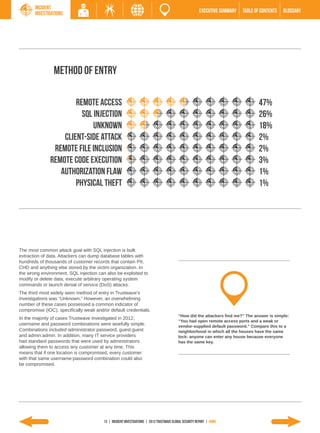
                METHOD of entry

                      Remote Access                                                                                                47%
                        SQL Injection                                                                                              26%
                            Unknown                                                                                                18%
                  Client-Side Attack                                                                                               2%
               Remote File Inclusion                                                                                               2%
              Remote Code Execution                                                                                                3%
                 Authorization Flaw                                                                                                1%
                      Physical Theft                                                                                               1%


The most common attack goal with SQL injection is bulk
extraction of data. Attackers can dump database tables with
hundreds of thousands of customer records that contain PII,
CHD and anything else stored by the victim organization. In
the wrong environment, SQL injection can also be exploited to
modify or delete data, execute arbitrary operating system
commands or launch denial of service (DoS) attacks.
The third most widely seen method of entry in Trustwave’s
investigations was “Unknown.” However, an overwhelming
number of these cases possessed a common indicator of
compromise (IOC), specifically weak and/or default credentials.
                                                                                         “How did the attackers find me?” The answer is simple:
In the majority of cases Trustwave investigated in 2012,
                                                                                         “You had open remote access ports and a weak or
username and password combinations were woefully simple.                                 vendor-supplied default password.” Compare this to a
Combinations included administrator:password, guest:guest                                neighborhood in which all the houses have the same
and admin:admin. In addition, many IT service providers                                  lock: anyone can enter any house because everyone
had standard passwords that were used by administrators                                  has the same key.
allowing them to access any customer at any time. This
means that if one location is compromised, every customer
with that same username:password combination could also
be compromised.


                                        13 | INCIDENT INVESTIGATIONS | 2013 Trustwave Global SECURITY Report | HOME
Incident
            Investigations                                                                                                 EXECUTIVE SUMMARY    TABLE of contents   GLOSSARY


Propagation                                                                                          Internally-facing remote administration utilities are frequently set
                                                                                                     up even less securely than externally-facing versions (since it is
In many of Trustwave’s 2012 investigations, the initial point of                                     assumed that if a user is accessing the system with one of these
entry was not the ultimate target; additional reconnaissance                                         tools, he is already “inside,” and therefore trusted). Many have
and movement were needed to identify the location of valuable                                        abysmally weak username:password combinations—and
data (commonly called “establishing a beachhead”). Once                                              sometimes require no credentials at all. Some even retain
a beachhead was formed, attackers conducted network                                                  historical data. All an attacker has to do is initiate the program
scanning to determine what other systems were either on the                                          to see the number of systems available and their status. Once
same network segment or communicating with the compromised                                           access is gained, they can quickly transfer files to and from
host. This information was then used to penetrate deeper into the                                    the target.
target’s infrastructure and find valuable data.
                                                                                                     Finally, command line remote administration utilities is a third
While propagation method varied by case, compromising                                                method of propagation. Once an attacker has established a
additional systems used the same weaknesses that allowed                                             beachhead, he will often bring a number of tools with him to
the initial compromise, usually weak and/or vendor-supplied                                          perform various stages of the hack.
passwords. The top three methods of internal propagation
methods were:                                                                                        Among the most popular of these tools are psexec2 and winexe.3
                                                                                                     These command line tools do not require installation and provide
                                                                                                     the attacker with the ability to transfer files to and from the target
                                                                                                     and remotely execute commands. Attackers can then automate

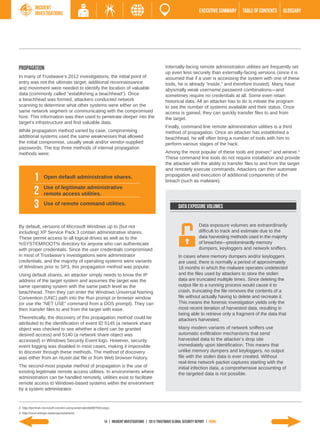
           1      Open default administrative shares.                                                propagation and execution of additional components of the
                                                                                                     breach (such as malware).

           2      Use of legitimate administrative
                  remote access utilities.

           3      Use of remote command utilities.
                                                                                                             Data exposure volumes


By default, versions of Microsoft Windows up to (but not                                                                   Data exposure volumes are extraordinarily
including) XP Service Pack 3 contain administrative shares.                                                                difficult to track and estimate due to the
These permit access to all logical drives as well as to the                                                                data harvesting methods used in the majority
%SYSTEMROOT% directory for anyone who can authenticate                                                                     of breaches—predominantly memory
with proper credentials. Since the user credentials compromised                                                            dumpers, keyloggers and network sniffers.
in most of Trustwave’s investigations were administrator                                                     In cases where memory dumpers and/or keyloggers
credentials, and the majority of operating systems were variants                                             are used, there is normally a period of approximately
of Windows prior to SP3, this propagation method was popular.                                                18 months in which the malware operates undetected
Using default shares, an attacker simply needs to know the IP                                                and the files used by attackers to store the stolen
address of the target system and assumes the target was the                                                  data are truncated multiple times. Since deleting the
same operating system with the same patch level as the                                                       output file to a running process would cause it to
beachhead. Then they can enter the Windows Universal Naming                                                  crash, truncating the file removes the contents of a
Convention (UNC) path into the Run prompt or browser window                                                  file without actually having to delete and recreate it.
(or use the “NET USE” command from a DOS prompt). They can                                                   This means the forensic investigation yields only the
then transfer files to and from the target with ease.                                                        most recent iteration of harvested data, resulting in
                                                                                                             being able to retrieve only a fragment of the data that
Theoretically, the discovery of this propagation method could be                                             attackers harvested.
attributed to the identification of event ID 5145 (a network share
object was checked to see whether a client can be granted                                                    Many modern variants of network sniffers use
desired access) and 5140 (a network share object was                                                         automatic exfiltration mechanisms that send
accessed) in Windows Security Event logs. However, security                                                  harvested data to the attacker’s drop site
event logging was disabled in most cases, making it impossible                                               immediately upon identification. This means that
to discover through these methods. The method of discovery                                                   unlike memory dumpers and keyloggers, no output
was either from an ntuser.dat file or from Web browser history.                                              file with the stolen data is ever created. Without
                                                                                                             real-time network packet captures starting with the
The second-most popular method of propagation is the use of                                                  initial infection data, a comprehensive accounting of
existing legitimate remote access utilities. In environments where                                           the targeted data is not possible.
administration can be handled remotely, utilities exist to facilitate
remote access to Windows-based systems within the environment
by a system administrator.


2. http://technet.microsoft.com/en-us/sysinternals/bb897553.aspx
3. http://sourceforge.net/projects/winexe

                                                            14 | INCIDENT INVESTIGATIONS | 2013 Trustwave Global Security Report | HOME
Incident
        Investigations                                                                                     EXECUTIVE SUMMARY   TABLE of contents   GLOSSARY


Aggregation
When Trustwave investigated cases in which vast quantities of
stored data were compromised, it was usually the result of weak                              FRANCHISES
administrative credentials, SQL injection or remote file inclusion
(RFI).
In many such cases, attackers used RFI (and sometimes SQL                                             Over the past year, Trustwave has
injection) to upload Web shells to the target Web server, which                                       investigated multiple breaches involving
ran under the same user account as the Web instance. Once in                                          hundreds of franchise locations. Franchise
place, an attacker can navigate to the Web shell location to                                          investigations are unique in that the location
access the newly uploaded tool. These Web shells provide                                              initially investigated is not necessarily the
attackers with a user interface that allows them to dump hashes,                                      first location to be compromised. In fact,
upload/download files, create/remove user accounts and                                                in 2012, only about a third of the franchise
remove the utility altogether.                                                               locations were the original point of compromise.

Attackers were more successful at maintaining persistence and                                In several of these cases, the original entry point
harvesting data in transit than they were at attacking stored                                was never identified because the corporate entity
data. They became much more adept at hiding their malware in                                 had little control over the actions of individual
plain sight, known as malware subterfuge—the use of legitimate                               franchisees. This makes franchise breaches
process names or injection of malware into legitimate Windows                                extremely difficult to manage, since the investigation
binaries. This means that an attacker’s malware could live on a                              has to involve all franchise owners, who often have
target system undetected for as long as four years, and all data                             incomplete data.
processed during that timeframe may be compromised.                                          What’s more, the infiltration method may not be
                                                                                             immediately apparent from the investigation of a
                                                                                             single/small subset of locations. This is especially
                                                                                             true if there is interconnectivity between locations or
                                                                                             from franchises to headquarters. However, once the
                                                                                             first few investigations have been completed and the
                                                                                             IOCs have been identified, other franchise locations
                                                                                             can be quickly checked.
                                                                                             Like single location breach investigations, franchise
                                                                                             breaches have the same basic components of the
                                                                                             Breach Quadrilateral. Once these components
                                                                                             are identified, the investigations are no different,
                                                                                             provided IOCs remain consistent. If IOCs are not
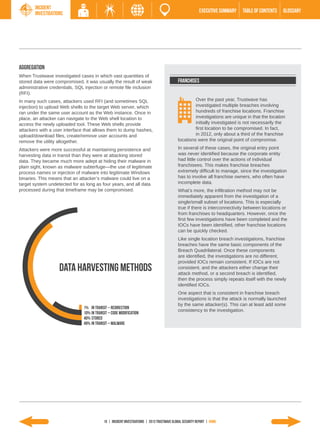
                    Data Harvesting Methods                                                  consistent, and the attackers either change their
                                                                                             attack method, or a second breach is identified,
                                                                                             then the process simply repeats itself with the newly
                                                                                             identified IOCs.
                                                                                             One aspect that is consistent in franchise breach
                                                                                             investigations is that the attack is normally launched
                                                                                             by the same attacker(s). This can at least add some
                                1% In Transit – Redirection
                                                                                             consistency to the investigation.
                                10% In Transit – Code Modification
                                40% Stored
                                49% In Transit – Malware


                                            15 | INCIDENT INVESTIGATIONS | 2013 Trustwave Global SECURITY Report | HOME
Incident
           Investigations                                                                                                EXECUTIVE SUMMARY   TABLE of contents   GLOSSARY


                                                                                                  Exfiltration
                                                                                                  Exfiltration is often referred to as “the getaway.” In 2012, as in
                                                                                                  previous years, the primary data exfiltration enabler was either
                                                                                                  the lack of a firewall or a firewall without egress filters.
                                                                                                  Ingress filtering monitors and inspects traffic as it enters the
                                                                                                  protected network. Egress filtering is the opposite; it examines
                                                                                                  and restricts network traffic as it flows from the protected
                                                                                                  segment to make sure that data is headed for the proper
                                                                                                  location, over the proper port, using an authorized protocol.
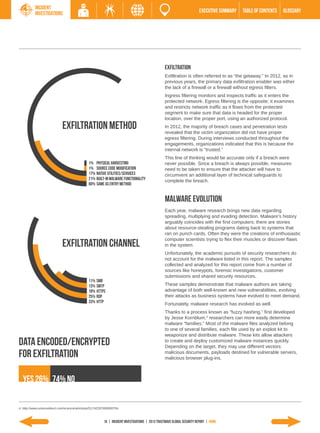
                              Exfiltration Method                                                 In 2012, the majority of breach cases and penetration tests
                                                                                                  revealed that the victim organization did not have proper
                                                                                                  egress filtering. During interviews conducted throughout the
                                                                                                  engagements, organizations indicated that this is because the
                                                                                                  internal network is “trusted.”
                                                                                                  This line of thinking would be accurate only if a breach were
                                                1% Physical Harvesting                            never possible. Since a breach is always possible, measures
                                                1% Source Code Modification                       need to be taken to ensure that the attacker will have to
                                                17% Native Utilities/Services                     circumvent an additional layer of technical safeguards to
                                                21% Built-in Malware Functionality                complete the breach.
                                                60% Same as Entry Method


                                                                                                  Malware Evolution
                                                                                                  Each year, malware research brings new data regarding
                                                                                                  spreading, multiplying and evading detection. Malware’s history
                                                                                                  arguably coincides with the first computers; there are stories
                                                                                                  about resource-stealing programs dating back to systems that
                                                                                                  ran on punch cards. Often they were the creations of enthusiastic
                                                                                                  computer scientists trying to flex their muscles or discover flaws
                              Exfiltration Channel                                                in the system.
                                                                                                  Unfortunately, the academic pursuits of security researchers do
                                                                                                  not account for the malware listed in this report. The samples
                                                                                                  collected and analyzed for this report come from a number of
                                                                                                  sources like honeypots, forensic investigations, customer
                                                                                                  submissions and shared security resources.
                                                11% SMB
                                                13% SMTP                                          These samples demonstrate that malware authors are taking
                                                18% HTTPS                                         advantage of both well-known and new vulnerabilities, evolving
                                                25% RDP                                           their attacks as business systems have evolved to meet demand.
                                                33% HTTP                                          Fortunately, malware research has evolved as well.
                                                                                                  Thanks to a process known as “fuzzy hashing,” first developed
                                                                                                  by Jesse Kornblum,4 researchers can more easily determine
                                                                                                  malware “families.” Most of the malware files analyzed belong
                                                                                                  to one of several families, each file used by an exploit kit to
                                                                                                  weaponize and distribute malware. These kits allow attackers
Data Encoded/Encrypted                                                                            to create and deploy customized malware instances quickly.
                                                                                                  Depending on the target, they may use different vectors:
for Exfiltration                                                                                  malicious documents, payloads destined for vulnerable servers,
                                                                                                  malicious browser plug-ins.


  YES 26% 74% NO

4. http://www.sciencedirect.com/science/article/pii/S1742287606000764


                                                          16 | INCIDENT INVESTIGATIONS | 2013 Trustwave Global Security Report | HOME
Incident
        Investigations                                                                                   EXECUTIVE SUMMARY    TABLE of contents     GLOSSARY


The exploit kits revealed that there is a mature malware
economy comprising those who supply malware (the “arms
dealers”) and those who spread it. Understanding this
relationship brings the security community as a whole much
closer to understanding how and why malware is created and
how it proliferates. It also encourages continued efforts to create
software solidly founded on security.
The malware cases Trustwave analyzes are often part of
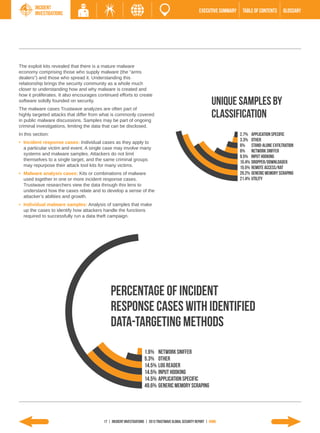
                                                                                                                 Unique Samples by
highly targeted attacks that differ from what is commonly covered
in public malware discussions. Samples may be part of ongoing
                                                                                                                 Classification
criminal investigations, limiting the data that can be disclosed.
In this section:                                                                                                             2.7% Application Specific
•	 Incident response cases: Individual cases as they apply to
                                                                                                                             3.3% Other
                                                                                                                             6% Stand-alone Exfiltration
   a particular victim and event. A single case may involve many
                                                                                                                             6% Network Sniffer
   systems and malware samples. Attackers do not limit
                                                                                                                             9.5% Input Hooking
   themselves to a single target, and the same criminal groups
                                                                                                                             15.4% Dropper/Downloader
   may repurpose their attack tool kits for many victims.                                                                    15.5% Remote Access/RAT
•	 Malware analysis cases: Kits or combinations of malware                                                                   20.2% Generic Memory Scraping
   used together in one or more incident response cases.                                                                     21.4% Utility
   Trustwave researchers view the data through this lens to
   understand how the cases relate and to develop a sense of the
   attacker’s abilities and growth.
•	 Individual malware samples: Analysis of samples that make
   up the cases to identify how attackers handle the functions
   required to successfully run a data theft campaign.


                                              Percentage of Incident
                                              Response Cases with Identified
                                              Data-Targeting Methods
                                                                     1.6% Network Sniffer
                                                                     5.3% Other
                                                                     14.5% Log Reader
                                                                     14.5% Input Hooking
                                                                     14.5% Application Specific
                                                                     49.6% Generic Memory Scraping


                                          17 | INCIDENT INVESTIGATIONS | 2013 Trustwave Global SECURITY Report | HOME
Incident
        Investigations                                                                                     EXECUTIVE SUMMARY   TABLE of contents   GLOSSARY


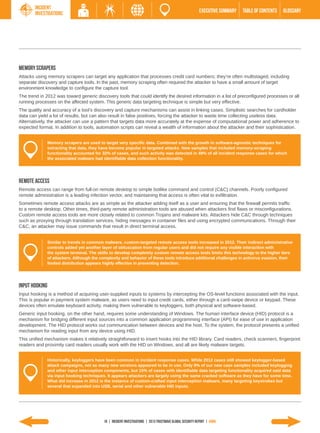
Memory Scrapers
Attacks using memory scrapers can target any application that processes credit card numbers; they’re often multistaged, including
separate discovery and capture tools. In the past, memory scraping often required the attacker to have a small amount of target
environment knowledge to configure the capture tool.
The trend in 2012 was toward generic discovery tools that could identify the desired information in a list of preconfigured processes or all
running processes on the affected system. This generic data targeting technique is simple but very effective.
The quality and accuracy of a tool’s discovery and capture mechanisms can assist in linking cases. Simplistic searches for cardholder
data can yield a lot of results, but can also result in false positives, forcing the attacker to waste time collecting useless data.
Alternatively, the attacker can use a pattern that targets data more accurately at the expense of computational power and adherence to
expected format. In addition to tools, automation scripts can reveal a wealth of information about the attacker and their sophistication.


                Memory scrapers are used to target very specific data. Combined with the growth in software-agnostic techniques for
                extracting that data, they have become popular in targeted attacks. New samples that included memory-scraping
                functionality accounted for 32% of cases, and such activity was detected in 49% of all incident response cases for which
                the associated malware had identifiable data collection functionality.


Remote Access
Remote access can range from full-on remote desktop to simple botlike command and control (C&C) channels. Poorly configured
remote administration is a leading infection vector, and maintaining that access is often vital to exfiltration.
Sometimes remote access attacks are as simple as the attacker adding itself as a user and ensuring that the firewall permits traffic
to a remote desktop. Other times, third-party remote administration tools are abused when attackers find flaws or misconfigurations.
Custom remote access tools are more closely related to common Trojans and malware kits. Attackers hide C&C through techniques
such as proxying through translation services, hiding messages in container files and using encrypted communications. Through their
C&C, an attacker may issue commands that result in direct terminal access.


                Similar to trends in common malware, custom-targeted remote access tools increased in 2012. Their indirect administrative
                controls added yet another layer of obfuscation from regular users and did not require any visible interaction with
                the system terminal. The skills to develop completely custom remote access tools limits this technology to the higher tiers
                of attackers. Although the complexity and behavior of these tools introduce additional challenges in antivirus evasion, their
                limited distribution appears highly effective in preventing detection.


Input Hooking
Input hooking is a method of acquiring user-supplied inputs to systems by intercepting the OS-level functions associated with the input.
This is popular in payment system malware, as users need to input credit cards, either through a card-swipe device or keypad. These
devices often emulate keyboard activity, making them vulnerable to keyloggers, both physical and software-based.
Generic input hooking, on the other hand, requires some understanding of Windows. The human interface device (HID) protocol is a
mechanism for bridging different input sources into a common application programming interface (API) for ease of use in application
development. The HID protocol works out communication between devices and the host. To the system, the protocol presents a unified
mechanism for reading input from any device using HID.
This unified mechanism makes it relatively straightforward to insert hooks into the HID library. Card readers, check scanners, fingerprint
readers and proximity card readers usually work with the HID on Windows, and all are likely malware targets.


                Historically, keyloggers have been common in incident response cases. While 2012 cases still showed keylogger-based
                attack campaigns, not as many new versions appeared to be in use. Only 9% of our new case samples included keylogging
                and other input interception components, but 15% of cases with identifiable data targeting functionality acquired said data
                via input hooking techniques. It appears attackers are largely using the same cracked software as they have for some time.
                What did increase in 2012 is the instance of custom-crafted input interception malware, many targeting keystrokes but
                several that expanded into USB, serial and other vulnerable HID inputs.


                                            18 | INCIDENT INVESTIGATIONS | 2013 Trustwave Global Security Report | HOME
Incident
        Investigations                                                                                   EXECUTIVE SUMMARY     TABLE of contents           GLOSSARY


Malware: Exfiltration                                                             Sometimes the malicious malware is itself a script. Because
                                                                                  scripts are plain text, it is easier to see their evolution as
The methods and tools an attacker uses for exfiltration can be                    malware is developed. They often contain configuration data
used to link cases and roughly estimate their sophistication. In                  including encryption keys, exfiltration targets, and other
fully automated attacks, the end result is usually a capture-store-               information that can link cases to each other and, one hopes,
exfiltrate loop, wherein malware saves logs of captured data until                back to the attacker that created them.
a triggering event causes the log to be transferred and deleted
and a new round of logging begins. Triggering events are usually                  While only 4% of unique, executable samples processed by
time- or size-based. Less sophisticated samples may skip the                      Trustwave’s malware analysis team fall into this category, 17% of
storage step, ensuring quick turnaround on data collection but                    incident response cases for 2012 included such functionality.
producing a consistent stream of outbound connections that may                    This is indicative of a growing trend. Along with additional
result in detection.                                                              evidence, many of these cases have been identified as related
                                                                                  due to the similarities of the script-based components (along with
                                                                                  additional evidence).


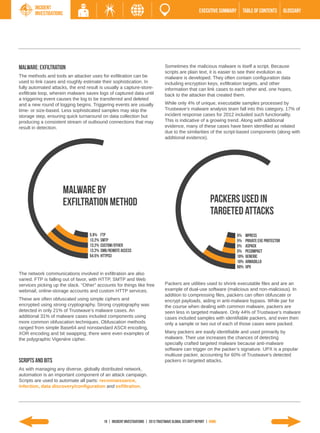
                         Malware by
                         Exfiltration Method                                                                     Packers Used in
                                                                                                                 Targeted Attacks

                                   5.9% FTP                                                                                  5%    Mpress
                                   13.2% SMTP                                                                                5%    Private EXE Protector
                                   13.2% Custom/Other                                                                        5%    ASPack
                                   13.2% SMB/Remote Access                                                                   5%    Pecompact
                                   54.5% HTTP(S)                                                                             10%   Generic
                                                                                                                             10%   Armadillo
                                                                                                                             60%   UPX
The network communications involved in exfiltration are also
varied. FTP is falling out of favor, with HTTP, SMTP and Web
services picking up the slack. “Other” accounts for things like free              Packers are utilities used to shrink executable files and are an
webmail, online-storage accounts and custom HTTP services.                        example of dual-use software (malicious and non-malicious). In
                                                                                  addition to compressing files, packers can often obfuscate or
These are often obfuscated using simple ciphers and                               encrypt payloads, aiding in anti-malware bypass. While par for
encrypted using strong cryptography. Strong cryptography was                      the course when dealing with common malware, packers are
detected in only 21% of Trustwave’s malware cases. An                             seen less in targeted malware. Only 44% of Trustwave’s malware
additional 31% of malware cases included components using                         cases included samples with identifiable packers, and even then
more common obfuscation techniques. Obfuscation methods                           only a sample or two out of each of those cases were packed.
ranged from simple Base64 and nonstandard ASCII encoding,
XOR encoding and bit swapping; there were even examples of                        Many packers are easily identifiable and used primarily by
the polygraphic Vigenère cipher.                                                  malware. Their use increases the chances of detecting
                                                                                  specially crafted targeted malware because anti-malware
                                                                                  software can trigger on the packer’s signature. UPX is a popular
                                                                                  multiuse packer, accounting for 60% of Trustwave’s detected
Scripts and Bits                                                                  packers in targeted attacks.
As with managing any diverse, globally distributed network,
automation is an important component of an attack campaign.
Scripts are used to automate all parts: reconnaissance,
infection, data discovery/configuration and exfiltration.


                                          19 | INCIDENT INVESTIGATIONS | 2013 Trustwave Global SECURITY Report | HOME
Incident
  Investigations                                                                                  EXECUTIVE SUMMARY   TABLE of contents   GLOSSARY


MALWARE INVESTIGATION

Targeted malware has become a norm in Trustwave’s                         Attackers combine these tools in different ways for any given
forensic investigations, especially in credit card breaches.              victim, using reconnaissance to determine which type will
Point-of-sale (POS) software continues to get better security             offer the best results. Each criminal group also uses
architecture and encryption, meaning attackers can no                     different malware types for infiltration, aggregation and
longer rely on simply exporting databases and reading                     exfiltration. From the 40 unique types of malware, Trustwave
plain text credit card data. In 2012, almost all POS breach               can attribute them to six distinct criminal groups. This is after
investigations involved targeted malware.                                 filtering the outlier script kiddies using off-the-shelf tools and
                                                                          some advanced malware used to target critical government
From the time the first memory scraper was witnessed by
                                                                          agencies.
Trustwave in 2008, this targeted malware space has been
on the watch list. To that end, Trustwave collects and tracks             After a deeper comparison of the malware attributed to the
malware fingerprints, including infection vector, data                    six groups, additional similarities were found, seemingly
aggregation mechanisms, regular expressions, exfiltration                 indicating there are only three criminal teams that cause
IPs, exfiltration channels, encryption techniques, compilers,             the majority of the POS credit card breaches in the United
packing mechanisms, SMTP servers used, destination email                  States, Canada, APAC and EMEA.
addresses and more.                                                       As far as geographical disbursement of attackers goes,
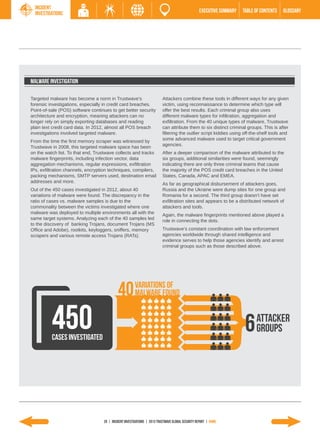
Out of the 450 cases investigated in 2012, about 40                       Russia and the Ukraine were dump sites for one group and
variations of malware were found. The discrepancy in the                  Romania for a second. The third group doesn’t have set
ratio of cases vs. malware samples is due to the                          exfiltration sites and appears to be a distributed network of
commonality between the victims investigated where one                    attackers and tools.
malware was deployed to multiple environments all with the                Again, the malware fingerprints mentioned above played a
same target systems. Analyzing each of the 40 samples led                 role in connecting the dots.
to the discovery of banking Trojans, document Trojans (MS
Office and Adobe), rootkits, keyloggers, sniffers, memory                 Trustwave’s constant coordination with law enforcement
scrapers and various remote access Trojans (RATs).                        agencies worldwide through shared intelligence and
                                                                          evidence serves to help those agencies identify and arrest
                                                                          criminal groups such as those described above.


          450
          Cases investigated
                                                                                                                            ATTACKER
                                                                                                                            Groups


                                   20 | INCIDENT INVESTIGATIONS | 2013 Trustwave Global Security Report | HOME
LAW ENFORCEMENT
AGENCY UPDATES                                                                      EXECUTIVE SUMMARY   TABLE of contents   GLOSSARY


    LAW ENFORCEMENT
    AGENCY UPDATES


                  21 | LAW ENFORCEMENT AGENCY UPDATES | 2013 Trustwave Global SECURITY Report | HOME
LAW ENFORCEMENT
             AGENCY UPDATES                                                                      EXECUTIVE SUMMARY   TABLE of contents   GLOSSARY


                                                                           U.S. Secret Service
                                                                           Seattle Electronic Crimes Task Force
                                                                           Robert Kierstead, Assistant Special Agent in Charge,
                                                                           Seattle Field Office
                                                                           In its continuing effort to combat cybercrimes, the U.S. Secret
                                                                           Service has an effective weapon with its successful Electronic
                                                                           Crimes Task Force (ECTF), created in New York in 1995. In
                                                                           2001, the USA PATRIOT Act mandated that the Secret Service
                                                                           establish a nationwide network of task forces to “prevent, detect
                                                                           and investigate various forms of electronic crimes, including
                                                                           potential terrorist attacks against critical infrastructures and
                                                                           financial payment systems.”
                                                                           To this end, the Secret Service today has 31 ECTFs—located
                                                                           throughout the United States as well as London and Rome—that
                                                                           leverage the combined resources of academia, the private
                                                                           sector, and local, state and federal law enforcement in a
                                                                           coordinated effort. The partnerships allow ECTFs to identify
                                                                           and address potential cyber vulnerabilities before the criminal
                                                                           element exploits them. This proactive approach has successfully
                                                                           prevented cyber attacks that otherwise would have resulted in
                                                                           large-scale financial losses to U.S.-based companies or
                                                                           disruptions of critical infrastructure.
Through Trustwave’s global reach in                                        A recent case, investigated by the Secret Service’s Seattle
performing investigations into data                                        ECTF, demonstrates how established partnerships employ both
                                                                           proactive and responsive investigative tactics targeting
breaches, partnerships with various law                                    vulnerabilities utilized in the cybercrime underworld.
                                                                           In the summer of 2011, the owner of a restaurant in Seattle
enforcement and Computer Emergency                                         contacted the Seattle Police Department when several
Response Teams (CERTs) around the                                          customers complained fraudulent charges appeared on their
                                                                           credit card accounts shortly after they dined at the restaurant.
world have formed. Each agency in this                                     Customers believed an employee had compromised their credit
                                                                           card information. However, many of the fraudulent transactions
section has provided firsthand insight into                                occurred in locations more than 1,000 miles from Seattle just
                                                                           minutes after victims made their purchases at the local eatery.
the cybercrime problems facing its                                         Seattle Police Department notified the Seattle ECTF
particular jurisdiction.                                                   investigators, who interviewed the restaurant’s employees and


                               22 | LAW ENFORCEMENT AGENCY UPDATES | 2013 Trustwave Global SECURITY Report | HOME
LAW ENFORCEMENT
                     AGENCY UPDATES                                                                      EXECUTIVE SUMMARY   TABLE of contents   GLOSSARY


conducted a forensic examination of the restaurant’s computer                      evolving. They impact our daily lives, our economy, and our
servers. The agents determined unknown suspects used malicious                     personal and national security. We will use every means to
software and remotely hacked the establishment’s payment system                    detect, disrupt and defend against this growing problem,”
and stole voluminous amounts of credit card data.                                  explained Ms. Durkan, who serves as the chair of the
                                                                                   Department of Justice Committee on Cybercrime and Intellectual
Agents conducted additional forensic analysis of the restaurant
                                                                                   Property Enforcement. “Fortunately, we are bringing the right
servers and determined the perpetrators transmitted the
                                                                                   people with better tools to the fight. To confront cyber threats we
compromised account information to a computer server located
                                                                                   need to ensure that law enforcement, private industry and our
in Kansas. Working with the Secret Service office in Kansas
                                                                                   international partners are sharing information, working together
City, agents discovered the server was linked to the debit card
                                                                                   and coordinating responses,” added Ms. Durkan.
account of a potential suspect in Keedysville, Maryland. A task
force investigator discovered information linking this suspect                     Since its inception in 1865, the Secret Service has taken a lead
and other co-conspirators with network intrusions at numerous                      role in mitigating the threat of financial crimes. As technology
restaurant and retail businesses in over 20 states.                                has evolved, the scope of the agency’s mission has expanded
                                                                                   from its original counterfeit currency investigations to also include
Seattle ECTF agents discovered a significant number of
                                                                                   emerging financial crimes. As a component agency within the
U.S.-based businesses experienced payment system intrusions
                                                                                   U.S. Department of Homeland Security, the Secret Service has
similar to the restaurant’s. Shortly after many of these incidents,
                                                                                   established successful partnerships in both the law enforcement
suspects posted customers’ credit card information for sale on
                                                                                   and business communities—across the country and around the
illegal Internet carding sites. Online brokers purchased the
                                                                                   world—to effectively combat financial crimes.
stolen account numbers and distributed the data to smaller,
loosely organized fraud rings nationwide. Members of these
criminal networks re-encoded the stolen card numbers onto
counterfeit credit cards and distributed the bogus cards to
accomplices before issuing banks shut down the accounts.
In October 2011, agents from the Secret Service’s Baltimore field
office executed a search warrant on the suspect’s residence and
seized a laptop computer and other electronic storage media,
which were sent to the Seattle field office for forensic examination.
The forensic examiners discovered more than 86,000 stolen credit
card numbers on the laptop.
The suspect and his co-conspirators were subsequently
identified and charged with conspiracy, bank fraud, access
device fraud and aggravated identity theft.
The suspect confessed his role in numerous network intrusions,
including the Seattle restaurant. He told agents he worked in
collusion with a European suspect to exchange information
regarding techniques and methods in computer hacking. The
two individuals created online carding websites for criminals to
purchase stolen credit card information in large quantities and to
                                                                                   Serious Organised Crime Agency (SOCA)
exchange hacking procedures.                                                       The Cyber department within the U.K.’s Serious Organised
A total of 180,000 credit card numbers were stolen in this case,                   Crime Agency has a strong history of bringing online criminals to
exposing the banking and credit card industry to a potential loss                  justice globally through direct prosecution and innovating new
of $90 million. The actual loss in this case is still being compiled               intervention solutions.
and is believed to be approximately $20 million.                                   The fight to contain organized crime is rightly recognized as
This investigation exemplifies the Secret Service’s ECTF model,                    one of the threats to national security. The U.K. government has
which seeks to cultivate and leverage working relationships                        invested in providing SOCA with the skills and resources
across transnational boundaries to relentlessly pursue                             necessary to respond to the unique threats that include an
cybercriminals in partnership with the private sector, law                         explicit acknowledgement of the challenges now presented to
enforcement and prosecutors’ offices.                                              law enforcement by cybercrime.
In October 2012, U.S. Attorney Jenny A. Durkan of the                              This support will extend through to 2013 and beyond when
Western District of Washington hosted a cybercrime conference                      SOCA becomes part of the new National Crime Agency. The
in Seattle. This event focused on security, privacy and                            NCA will incorporate the National Cybercrime Unit, which will be
cooperation between law enforcement, the private sector and                        dedicated to tackling the national and international complexities
academia in combating cybercrimes. “Cyber threats are rapidly                      of this facet of criminality. As technology becomes more


                                       23 | LAW ENFORCEMENT AGENCY UPDATES | 2013 Trustwave Global SECURITY Report | HOME
LAW ENFORCEMENT
                     AGENCY UPDATES                                                                      EXECUTIVE SUMMARY   TABLE of contents   GLOSSARY


accessible it will also address the increasing use of cyber-                       they are protected by an efficient and well-trained group of
enabled crime by other criminals, whether they are using the                       officers who both understand and can respond to the many
Internet to commit fraud, cover financial trails, or attempt to                    threats posed by online criminality.
conceal activity such as drug or human trafficking.
The chair of SOCA, Sir Ian Andrews, noted during a presentation
to industry that: “…law enforcement can never expect to arrest
its way to a cybercrime solution.”
Not only are there the issue of international jurisdiction and the
problems of transnational boundaries, but there is also a simple
one of even prosecuting and jailing every individual who might
be guilty of an offense online. Even if both criminal and victim are
located within the U.K., the advent of cloud computing makes
the legal and technical identification of responsibility for data
complex and involved. Where traditional techniques of investiga-
tion and detection used to be obvious, the global paper chase of
linking online crime to online criminal is increasingly involved and
labor intensive.
As a result, SOCA manages a robust process of investigation,
arrest and prosecution. Where this isn’t feasible, the extensive
international network SOCA has established supports our
efforts to shut down criminal websites, facilities and accounts,
denying them access at the source. Partner agencies and law
enforcement globally support the intelligence gathering function
and ensure that where arrests can’t be made by U.K. officers,                      Universidad Nacional Autónoma de México
they can be made by local police instead. The effectiveness of
this approach has already been demonstrated in joint activity                      CERT (UNAM-CERT)
with the FBI, European partners and other global agencies in
                                                                                   UNAM-CERT is a team of information security professionals
coordinated activity made against automatic vending cart sites
                                                                                   whose primary responsibility is to provide incident detection and
(AVC) catering to the online criminal community.
                                                                                   response capabilities at the Universidad Nacional Autónoma
By shutting down criminal domains, using the intelligence                          de México (National Autonomous University of Mexico), better
gathered to generate further activity and identifying users within                 known as “UNAM” in México and Latin America. The initiative
the U.K. who can be cautioned or arrested, depending on the                        started in 1993 when the Computer Security Team was created
severity of the abuse of the criminal site, a comprehensive                        as part of UNAM’s Supercomputing Department.
approach to tackling a global issue can be generated.
                                                                                   In 1999 a formal Computer Security Department was created
It’s not enough to simply shut down a site; those users who                        due to the rising need for highly specialized personnel and
believe they have anonymity due to the nature of the Internet                      professional services to protect the university’s IT assets. In
need to be identified and warned they are not able to escape                       2001 UNAM-CERT was established, thenceforth being
legal action, even when online. Where SOCA has conducted                           internationally recognized as a member of FIRST (Forum of
visits or made arrests, word has spread quickly that we have the                   Incident Response and Security Teams) and the only member
capacity to identify and contain threats to U.K. citizens.                         in Mexico until 2010.
This approach is both cost-effective and resource-light, allowing                  Since 2010, UNAM-CERT had their incident response process
the heavy work of identifying key criminals that actually create                   certified under the ISO/IEC 27001:2005 ­ Information Security
                                                                                                                             –
and manage hacking tools to be freed up.                                           Management System (ISMS) Standard as part of their continual
This approach­ ­­
               —when applied in conjunction with specialists                       improvement process. UNAM-CERT also provides other
from the private sector, encouraging simple steps to increase                      information security services, including penetration tests,
security, reduce risks and expand awareness of the threat of                       security audits, implementation of best practices, specialized
cybercrime—­­ provides an extensive solution to the varied                         training, and content generation promoting both awareness
problems it presents.                                                              and a culture for “online safety” in general. These services are
                                                                                   primarily aimed at UNAM’s schools, colleges, institutes and
While law enforcement cannot sit in isolation in addressing such                   administrative areas, composed of 361,163 students and
a complex and involved issue, it’s important that organizations                    academic and administrative personnel.
such as SOCA take a lead in managing the response. It’s also
crucial that government bodies demonstrate to the public that


                                       24 | LAW ENFORCEMENT AGENCY UPDATES | 2013 Trustwave Global SECURITY Report | HOME
LAW ENFORCEMENT
                     AGENCY UPDATES                                                                      EXECUTIVE SUMMARY   TABLE of contents   GLOSSARY


UNAM-CERT keeps track of nearly 66,000 computers physically
distributed on different campuses and facilities across the whole
of Mexico. UNAM’s primary network is composed of two Class-B
networks on the Internet, connecting specialized academic and
private networks in addition to providing Internet access to the
entire infrastructure. UNAM’s network is essentially open and
highly diverse in terms of the type of services provided, existing
applications and their use. Perimeter restrictions are minimal;
therefore, it is essential to detect incidents based on alerts,
enabling timely response and appropriate actions.


Incident Detection and Response
The framework for threat, pattern and trend detection has been
improved in the last 12 months by analyzing potentially malicious
network traffic captured from a recently implemented “Darknet”
composed of more of 20,000 unassigned IP addresses. In the
same period, close to 1,060 low-interaction honeypots were
deployed to identify new threats and obtain malware samples.
                                                                                   New South Wales (NSW) Police Force
UNAM-CERT devised an initiative called “Sensors for Malicious                      Cybercrime Squad
Traffic” (or PSTM in Spanish) that involves the implementation
of collaborating sensors composed of intrusion detection systems,                  The New South Wales Police Force Cybercrime Squad launched
traffic flow analysis and honeypots distributed throughout UNAM’s                  in November 2011 to protect Australia’s most populous state.
network and other colleges and universities in Mexico.                             Since its inception, it has worked aggressively to identify and
                                                                                   apprehend individuals participating in organized crime,
                                                                                   cybercrime and technology-enabled crime.
Malware Analysis
                                                                                   Technology-enabled crime is fast-moving and complex.
A specialized team within UNAM-CERT focuses on research and                        There are many challenges facing investigators, including
analysis of malware behavior. Each week, almost 2,500 malware                      cross-jurisdictional issues as well as the relentless pace of
samples are captured from honeypots, or by propagation of new                      innovation shown by perpetrators.
threat vectors through the network or obtained from user reports.
An average of 15 new samples are recorded weekly.                                  Carding forums continue to be a major facilitator of credit card
                                                                                   fraud in Australia. In these forums, data from compromised
Dynamic and static analyses of malware are performed to                            websites, in particular those of e-commerce merchants, are
determine the potential impact and risk, and test results are                      used by local criminals to go on shopping sprees and generate
published on the www.malware.unam.mx website.                                      substantial profits.
                                                                                   In 2012, a member of several of these carding forums was
Contribution to the LAC Region and beyond                                          identified by the NSW Police Force Cybercrime Squad’s
Since 2007, UNAM-CERT has participated as “UNAM-Chapter”                           ongoing Strike Force Werewolf. Using the stolen credit card data
within the International Honeynet Project in an effort to stay                     purchased on the forums, he arranged for expensive items, in
at the cutting edge in monitoring attacks and threats against                      particular iPhones and other electronics, to be delivered to a
Mexico’s national infrastructure. The creation of incident                         network of addresses occupied temporarily by his accomplices
response teams is highly encouraged by working on projects                         and to virtual offices.
like AMPARO, sponsored by LACNIC, which aims to strengthen                         His carding activity also included flights and holiday rentals,
regional capacity attention to security incidents in Latin America                 Black Label scotch and somewhat less than gallantly, flowers
and the Caribbean.                                                                 for a girlfriend.
To promote prevention and information security awareness to                        A search warrant was executed on his temporary accommodation,
the general public, UNAM-CERT in collaboration with the SANS                       and substantial evidence of his crimes was recovered, including
Institute actively translates and distributes the monthly                          cash and electronic goods.
newsletter OUCH! Also, UNAM-CERT works nationwide with
                                                                                   A financial analysis of his family showed unexplained deposits to
banks, ISPs, universities and other organizations by sharing
                                                                                   the family home mortgage, and confiscation proceedings were
relevant information about security incidents targeting their
                                                                                   commenced to recover around 900,000 Australian dollars.
networks or their customers.
                                                                                   He was charged with 58 offenses, including recruiting children
                                                                                   to carry out these profitable crimes, and is currently awaiting
                                                                                   sentence.


                                       25 | LAW ENFORCEMENT AGENCY UPDATES | 2013 Trustwave Global SECURITY Report | HOME
THREAT
 INTELLIGENCE                                                          EXECUTIVE SUMMARY   TABLE of contents   GLOSSARY


threat intelligence
          26 | THREAT INTELLIGENCE | 2013 Trustwave Global Security Report | HOME
THREAT
                                  INTELLIGENCE                                                          EXECUTIVE SUMMARY           TABLE of contents   GLOSSARY


Presented in this section is data from Trustwave client                           Network Attacks
engagements and security telemetry from Trustwave products
and services.                                                                     A network attack is any connection that is used to perform an
                                                                                  attack on a network-based protocol. Such examples include but
                                                                                  are not limited to brute force attacks (against FTP, SSH, Telnet,
Attacker Sources                                                                  etc.), exploit attempts on network-based services (SMB, FTP, RDP,
                                                                                  etc.) and Web-based attacks (SQL injection, XSS, CSRF, etc.).
Over the past 12 months, a large data set pertaining to global                    As in previous years, the two most active countries with respect
attacker origins has been acquired and built. These attackers are                 to origin were the United States and Russia, at 37.8% and
responsible for a number of malicious activities including (but not               12.3% of attacks, respectively. This is likely due to network
limited to) malware hosting, brute force and exploit attempts.                    infrastructure speeds and reliability, high resource availability and
Through the use of geographically diverse network-based                           current legislation.
honeypots as well as Trustwave’s worldwide security operation
centers (SOCs), a picture of the threat landscape as it relates
                                                                                  Malware Hosting
to source IP addresses of attackers emerges. In addition,
Trustwave logged and analyzed more than 100 million attacks in                    In this particular context, malware is defined as some malicious
the wild. While source IP addresses do not always establish the                   binary file being served on a Web server. Some examples
attacker’s true location, they do help pinpoint the general location              include PE executables, PDF documents, ZIP files and Microsoft
of a specific attack.                                                             Word documents.
Attackers may also proxy, adding another layer of abstraction                     Russia and the United States are still the largest contributors when
between the perceived location and the true origin. Trustwave has                 it comes to malicious activity, making up 39.4% and 19.7% of
also been constantly aggregating a large number of malicious                      hosted malware, respectively. Notably, while the top 10 countries
binaries from various Internet sources. As such, geographic data                  account for roughly 79% of network-based attacks, this statistic
has been acquired as it relates to the location of malicious files.               rises to more than 90% when looking at malware origin.
Using this information can help determine—with a fair amount of
certainty—where attacks and malware originate.


   The top 10 countries                                                      United States 37.8%
   account for roughly 79%                                                                                     GERMANY 2.0%

   of network-based attacks                                                                                     ITALY 3.5%              RUSSIA 12.3%
                                                                                                                     ROMANIA 2.6%
                                                                                                                                          CHiNA 4.3%


                                                                                          BRAZIL 3.4%                                       TAIWAN 8.8%
                     79%                                                                                              UKRAINE 2.1%
                                                                                                                     BULGARIA 2.4%


                                           27 | THREAT INTELLIGENCE | 2013 Trustwave Global SECURITY Report | HOME
THREAT
                                   INTELLIGENCE                                                           EXECUTIVE SUMMARY   TABLE of contents   GLOSSARY


There are a number of reasons an attacker chooses a specific                        Of course, these activities rely on various bits of infrastructure:
geographic location to launch a network-based attack or                             botnets, drive-by malware installs, DoS attack services,
host malware:                                                                       anonymous money laundering, and even hosting criminal
                                                                                    websites are all part of the underground economy that allows
1.	 Availability: Compromised machines and cheap hosted
                                                                                    larger crimes to happen.
    devices are very easy to acquire in countries that rank high on
    Trustwave’s list of hosted malware.
2.	 Access control lists: More and more system and network                          Espionage
    administrators are placing restrictions against entire blocks of                Espionage cases are often conducted by government-sponsored
    IP addresses for one or more countries or geographic regions.                   groups; currently, the most commonly accused is China, though
    In order to thwart these restrictions, attackers are originating                Iran and Russia have had serious allegations levied against them
    attacks from countries that are not blocked.                                    as well.
3.	 Target environments: A majority of online services are                          In espionage cases, the initial attack vector is often a direct
    provided in a relatively small number of countries around the                   phishing attempt in which a PDF or Word document is emailed to
    world. Therefore, attackers are often launching attacks in those                a known contact within an organization. When opened, it triggers
    same countries to avoid suspicion by the targeted entity.                       a previously unknown or zero-day exploit to compromise the
4.	 Legislation and law enforcement: A country’s extradition                        machine. The attacker can then use this foothold to get deeper
    laws (or lack thereof) may entice an attacker to originate his or               into the network and complete the breach.
    her attacks from a specific geographic location.                                This year, Trustwave discovered espionage malware including
                                                                                    Flame, Mahdi and Gauss, which are closely related to Stuxnet
                                                                                    and Duqu found in previous years—there really is no way to
Attacker Motivations                                                                contain them.

Financially Motivated Attacks                                                       Hacktivism
Cybercriminals can monetize activity using traditional credit                       The most effective tool in the hacktivist toolbox is the DoS attack.
card fraud and advertising banner click fraud or newer                              Since many sites are hosted along with hundreds or thousands
techniques such as fake electronic funds transfers (EFTs) and                       of other sites, a single DoS attack can have wide-reaching
secret premium-rate SMS messages on smartphones. Criminal                           effects to disable other sites that just happen to be hosted on the
gangs in Eastern Europe have traditionally dominated these                          same server.
activities, turning them into million-dollar enterprises.
                                                                                    Hacktivists have more specific targets than financially motivated
Credit card fraud usually involves compromising a card                              attackers (who can target virtually anyone), and are therefore
processing vendor or transaction clearing center to get access to                   willing to exhaust other methods to make their presence known.
the card data. Once card data is acquired, it’s usually sold in bulk                Anonymous, arguably the largest and most well-known hacktivist
on underground forums for pennies per card. Buyers can then                         group, has become increasingly fragmented, with factions
monetize the card data by creating counterfeit cards or                             sometimes take opposing viewpoints on the same topic.
processing online transactions.
Advertising banner click fraud is now completely automated
by malware and botnets. The returns are low, as rates for clicks
have dropped significantly in recent years, but the volume of
clicks that can be generated and the relatively low overhead
make this an attractive option for otherwise idle botnets.
EFTs are slightly more complicated than traditional click fraud,
but the rewards can be much higher. The entire process can take
just a few hours or even minutes, after which the money is gone
and cannot be recovered. Often thefts like this are not covered
by a bank’s insurance, leaving the victims to suffer the financial
consequences.
Premium-rate SMS messages are currently the most prolific
on Android devices. These attacks start as malware (such as
Loozfoon or FinFisher) that can send SMS messages to
premium-rate SMS services. Users have no idea anything has
happened until they get their bills.


                                             28 | THREAT INTELLIGENCE | 2013 Trustwave Global Security Report | HOME
THREAT
                                      INTELLIGENCE                                                           EXECUTIVE SUMMARY      TABLE of contents    GLOSSARY


MALWARE-ENABLING EFT TRANSFERS


                        The attack starts                                               The system is then
                        when a user clicks a                                            infected with malware
                        link in a malicious email                                       such as the Zeus Trojan


                                                  Once the criminal unlocks                                          Using keyloggers, fake bank login
                                                  the account, he can start                                          pages, the attacker captures the
                                                  making EFT transfers                                               user’s account info*


           The EFT transfers go to
           mules, who then wire the
                                                                                                                 Money IS Fraudulently
           money TO criminals overseas                                                                           Transferred from
                                                                                                                 User’s Account
 * Advanced banking malware can even defeat security features such as IP checking by the bank
   or two-factor authentication mechanisms used to detect fraudulent logins.


                                                29 | THREAT INTELLIGENCE | 2013 Trustwave Global SECURITY Report | HOME
THREAT
                                  INTELLIGENCE                                                           EXECUTIVE SUMMARY   TABLE of contents    GLOSSARY


                                                                                   By abusing the way embedded files are managed within Adobe’s
Emerging Technique: Sophisticated,                                                 Acrobat Reader, they referenced the embedded MP4 file directly
Embedded Malware                                                                   and locally from within the embedded SWF file (which was
                                                                                   loaded by the wrapper PDF).
Embedded malware is not a new concept. Malware authors have
been embedding files within one another for a couple of years
now. But the technique has grown more complex. Now, analyzing
Web-based attacks feels a lot like opening Russian nesting dolls:
every time you open an attachment, there’s another one hiding
inside ... it’s quite exhausting. In looking at a recent attack known
as CVE-2012-4969, this complexity is clearly evident.
For instance, CVE-2012-4969 dealt with a zero-day vulnerability
in Internet Explorer. Attackers chose to use an SWF file as part of
the attack, encrypting it using a commercial tool called “doSWF.”
                                                                                           The use of embedded files not only makes it extremely
The tool essentially embeds the desired SWF as data within
                                                                                           difficult for security products to detect malicious files
another SWF file and dynamically loads this inner SWF file during
                                                                                           but also exploits the functionality of each file format.
execution. Unwrapping the bundle reveals JIT spraying code and                             It’s becoming difficult for system administrators to
writes an iFrame back to the original HTML page from which the                             control what can and cannot be executed. Flash Player
first SWF file was loaded.                                                                 does not need to be installed for a Flash file to be
In another example, attackers used embedded malware to exploit                             loaded within a PDF, MP4s can be loaded directly from
                                                                                           within Flash Player, and most PDF readers will execute
the vulnerability CVE-2012-0754. The vulnerability was related
                                                                                           JavaScript code out of the box. Attackers make good
to the way in which Adobe Flash Player parses MP4 files—this
                                                                                           use of these facts.
requires a SWF file that will load an MP4 file. The attackers
embedded both a SWF and an MP4 file within a single PDF.


EMBEDDED MALWARE IS LIKE NESTING DOLLS:
FILES INSIDE FILES INSIDE FILES INSIDE FILES dolls:
           Embedded malware is like nesting
           files inside files inside files inside files
                      HTML
                      SWF
                      DOSWF ENCRYPTION
                      INNER SWF
                      IFRAME HTML


                                            30 | THREAT INTELLIGENCE | 2013 Trustwave Global Security Report | HOME
THREAT
                                  INTELLIGENCE                                                          EXECUTIVE SUMMARY    TABLE of contents   GLOSSARY


Emerging Technique: Fake SSL Certificates
Digital certificates are core to the trust between users and software companies—as well as between clients who surf the Web and sites
that deal with sensitive data. Code signed with a trusted digital certificate is treated by the OS as legitimate and is installed, bypassing
protective barriers and alerts. The same goes for sites connected securely over SSL: if the site is using a trusted digital certificate, the
browsers connect without alerting the client.


              Some companies have taken steps to lower the risk of falling for fraudulent certificates; for example, Microsoft recently
              updated Windows to ban the use of digital certificates signed with RSA keys lower than 1024 bits, since they are relatively
              easy to brute force by attackers.


NOTABLE fake SSL CERTIFICATES IN 2012
      MARCH                               APRIL                                           JUNE                                    September


A Trojan called Mediyes was          Evidences of a malware                       Microsoft released an urgent              One of Adobe’s servers used
discovered on more than              campaign against NGOs and                    security advisory dealing                 for signing Adobe software
5,000 computers, mainly in           human rights activists began                 with the revocation of two                was attacked and then used
Western Europe. It was               to spread among the security                 intermediate certificates. The            for signing malware. While
signed with a fake Symantec          community. A Chinese gang                    malware, famously known                   Adobe responded with the
VeriSign digital certificate         was allegedly installing                     as Flame (aka Flamer or                   revocation of the misused
issued to Conpavi AG, which          digitally signed RAT malware                 sKyWIper), signed code with               certificate a few days later,
is known to work with Swiss          using the CVE-2012-0158                      a fraudulent Microsoft digital            the attackers still had time
government agencies.                 exploit, including a digitally               certificate and took                      to distribute the signed
                                     signed certificate issued by                 advantage of a design flaw in             malware until the certificates
                                     Quanzhou Xiegao Microwave                    Microsoft’s Terminal Services             were revoked.
                                     Electronic Co. Ltd.                          Licensing service that
                                                                                  allowed them to sign their
                                                                                  malware as if it originated
                                                                                  from Microsoft and thus was
                                                                                  recognized by the OS
                                                                                  vendors as legitimate
                                                                                  software.*

                                                                                  *Microsoft Security
                                                                                  Advisory 2718704:
                                                                                  http://technet.microsoft.com/en-
                                                                                  us/security/advisory/2718704


                                           31 | THREAT INTELLIGENCE | 2013 Trustwave Global SECURITY Report | HOME
THREAT
                                   INTELLIGENCE                                                           EXECUTIVE SUMMARY   TABLE of contents   GLOSSARY


                                                                                                                 THREAT LEVEL
  Disclosure timelines
  TIMELINE | RESPONSIBLE DISCLOSURE                                                                              HIGH                 NORMAL 0

                                                                                              Vendor Releases                    USERS
      BEFORE ISSUE      Researcher                  Researcher & vendor                       Patch & Researcher                 gradually
      DISCOVERY         reports THREAT              collaborate on patch                      Issues Advisory                    APPLY PATCH


                        MONTH-long protected vulnerability                                    FOLLOWING PATCH RELEASE (AND BEYOND … )
                        Only the researcher & vendor know about the vulnerability

  TIMELINE | ZERO-DAY

                        vulnerability                       Vendor                 SOME USERS APPLY PATCH
      BEFORE ISSUE      details become                                                    MORE USERS APPLY PATCH
                                                            Releases
      DISCOVERY         publicly known                                                             A FEW MORE USERS APPLY PATCH
                                                            patch


                        ZERO-DAY                            MONTH FOLLOWING PATCH RELEASE (AND BEYOND … )
                                                            Attackers can still exploit the vulnerability on those who haven’t patched


                                                                                    Not all flaws are publicly disclosed in this way. Many security
Critical Vulnerability Study: Tracking                                              researchers, Trustwave included, believe in responsible
Zero-Day Response Times                                                             disclosure: understanding and fixing certain flaws before
                                                                                    publicizing them. During this time, the vulnerability is technically
Malware is usually successful because of programming flaws                          the same as a zero-day, but only the vendor and security
in popular applications. Vendors have a crucial role in                             researcher are aware—it is not being abused in the wild. In the
protecting systems from attack. A vendor-supplied patch is the                      end, the vendor and researcher release details consistently and
only response that can truly fix vulnerability and help bridge the                  simultaneously.
gap between a discovered attack and a vendor-supplied patch.
                                                                                    Tracking Vulnerabilities
Zero-Day, Defined                                                                   In the United States, these paths result in the creation of a
The gap between attack observation (or proof-of-concept code                        common vulnerabilities and exposures (CVE) identifier. Each
release) and patch availability is commonly referred to as “zero-                   CVE assigned is catalogued in detail in the National Vulnerability
day” (though it usually lasts more than a single day). Zero-day                     Database (NVD),5 which the nonprofit research organization
vulnerabilities represent a limited period of opportunity (lapse                    MITRE references and uses as the de facto source of CVE data.
in protection) during which hackers can hastily put together                        Each CVE also contains a score that represents the vulnerability’s
campaigns. Discovery of zero-day periods can vary, but the first                    severity, a product of the Common Vulnerability Scoring System
one to disclose the issue usually receives credit (and sometimes                    (CVSS). The current version of this standard, CVSSv2, includes
public notoriety).                                                                  contextual information such as time and environment
                                                                                    considerations.


5. nvd.nist.gov


                                             32 | THREAT INTELLIGENCE | 2013 Trustwave Global Security Report | HOME
THREAT
                                     INTELLIGENCE                                                            EXECUTIVE SUMMARY   TABLE of contents   GLOSSARY


This permanent record helps highlight turnaround times                                •	 Fingerprinting results were reviewed to find top platforms seen
associated with the patching process. Using the platforms most                           in the wild, based on one million Trustwave TrustKeeper users.
frequently encountered by Trustwave’s scanning and client                             •	 Similarly, Trustwave Secure Web Gateway technology was
security platforms as a baseline, this report offers an interesting                      used to obtain a list of the most prominent client platforms
look at how different vendors prioritize and fix vulnerabilities once                    encountered.
they are discovered.
                                                                                      •	 For each server platform, CVE information was filtered for
                                                                                         vulnerabilities that posed a significant threat, denoted as a
Details of the Study                                                                     CVSSv2 score of 7.0 or higher.
This study focuses on determining time from discovery to patch                        •	 Client platforms were also chosen based on size of installed
release across a number of major vendors. It is non-exhaustive                           base and vulnerabilities observed.
due to the sheer number of vendors and vulnerabilities, but it
attempts to detect trends and uncover a better understanding                          For each platform in the list with vulnerabilities that met the
than is currently available.                                                          severity criteria, corresponding vulnerabilities and research were
                                                                                      scrutinized to determine:
The report identifies these platforms through several methods:
                                                                                      •	 Whether the vulnerability was zero-day.
•	 Trustwave TrustKeeper vulnerability scanner was used
   to assess the security posture of each network, using                              •	 Whether the vulnerability was discovered in-house or by a
   fingerprinting logic to see which type of platform is utilized                        third party.
   on each server.                                                                    •	 The delta between the date the vulnerability disclosure and the
                                                                                         patch release.


    Product               Critical     Third-          Number           Average         Average Zero-Day Response
    Name                  CVEs         Party           of Zero-         CVSS
                                       Reported        Days             Score

    2012 Server Vulnerabilities
    Linux Kernel               9            4                2              7.68                                                                     857 days
    Microsoft Windows         34           34                2              8.41                                                                     375 days
    Cisco IOS                 77           21                1              8.15                                                                     113 days
    PHP                        8            6                5              8.13                                                                      90 days
    Wordpress                  3            3                1              9.17                                                                      39 days
    OpenSSL                    3            3                1              8.10                                                                       5 days
    ISC BIND                   4            2                1              7.98                                                                       4 days
    phpMyAdmin                 1            1                1              7.50                                                                       3 days
    Oracle MySQL               3            2                0              8.33                                                                         n/a
    Microsoft .NET             6            5                0              9.30                                                                         n/a
    Joomla CMS                 1            1                0              7.50                                                                         n/a
    2012 Client Vulnerabilities
    Microsoft IE              31           31                2              9.25                                                                      16 Days
    Adobe Flash               58           56                2              9.92                                                                       9 Days
    Oracle Java JRE           32           32                1              9.44                                                                       4 Days


Note: Time delta information is difficult to obtain due to the fact that Trustwave can discover only the date the information is received
by the security community. While these dates cannot be 100% accurate, they are more reliable on the server side than on the client
side, where there is less reliable instrumentation for the detection of threats. Threats such as Stuxnet, for example, have the potential to
remain undetected for a long period of time.


                                                33 | THREAT INTELLIGENCE | 2013 Trustwave Global SECURITY Report | HOME
THREAT
                                         INTELLIGENCE                                                          EXECUTIVE SUMMARY   TABLE of contents   GLOSSARY


                                                                                         outcry from information security journalists. Compare this to
                                                                                         CVE-2012-2386, a 403-day open flaw in a PHP core module that
           PHPMYADMIN                                                                    received almost no attention.
                                                                                         The ratio of released patches to reported vulnerabilities suggests
           While most zero-day flaws stem from a                                         that there could be a zero-day likelihood associated with a
           programming error on the part of the developer, in                            certain platform. In other words, the data suggests that
           this case phpMyAdmin code was compromised                                     researchers are more likely to publicly disclose findings on some
           outside the organization. A server belonging to                               platforms than on others.
           Sourceforge was compromised in September,                                     Take, for example, PHP, which would certainly be among the
           affecting phpMyAdmin, whose code was modified                                 platforms most likely to disclose findings, possibly because of the
           to include a backdoor into infected systems after                             importance the PHP team places on these vulnerabilities. PHP is
           installation.                                                                 also open source, making it easier for independent researchers
           The first indication of this situation was discovered                         to find and test flaws. That being said, a majority of platforms in
           on Sept. 25, at which time phpMyAdmin published                               the study are open source; code availability does not necessarily
           an advisory. Forensic records indicate that the                               equate with disclosure of vulnerabilities.
           breach occurred on Sept. 22, three days earlier, and                          Even though Trustwave makes distinctions between “social” and
           was isolated to a single server. This is disturbing                           “technical” penetration tests, most penetration testers will agree
           considering the number of phpMyAdmin downloads                                that every test is ultimately focused on people—those who
           that occur daily, but the situation could have been                           create the code, configure the firewalls, disclose vulnerabilities
           much worse. This serves as a reminder that code                               and patch the systems. This study also shows that businesses
           contamination is a real threat. While open source                             and open-source projects have adopted very different ways of
           mirrors are a likely target, Trustwave also                                   analyzing and responding to vulnerabilities.
           witnessed this activity in the commercial software
           world when malicious insiders add their own
           backdoors to production code. Unlike those
           situations, however, there is nothing phpMyAdmin
                                                                                         Attack Trends
           could do to prevent this; the mirroring system placed
           this issue completely out of their hands.                                     Web Client
                                                                                         A Web client is much more than a browser; it’s a full-blown
                                                                                         platform, with infrastructure, utilities and extensibility via plug-ins.
                                                                                         This extensibility is what poses the most vulnerability, as
                                                                                         malware authors disguise exploit kits as browser plug-ins. Since
The items above are not recorded consistently by NVD (or any                             cybercriminals aim to exploit as many client machines as
other database), so each CVE was researched in depth. Several                            possible, they put a lot of effort into updating and improving
cases were found to have missing details. Using search                                   exploit kits. For years, malware authors have been obfuscating
engines and security mailing lists such as Bugtraq6 and Full                             their code to avoid AV signature detection, and this process is
Disclosure,7 each of these advisories was fact-checked to                                now automated (polymorphic JavaScript obfuscators are
ensure accuracy.                                                                         common in exploit kits, for example).

These numbers paint an interesting picture of the security                               With the shift from HTML/JavaScript-centric browser attacks
landscape. Open source projects usually uphold constant code                             to browser plug-in attacks, it was only a matter of time before
scrutiny, but some issues can fall through the cracks until                              malware authors would adopt the same techniques. This means
someone digs them up years later. Commercial vendors, despite                            Java and ActionScript (the programming language used in
their secrecy, deal with this in their own way, encouraging proper                       Flash) now use automated obfuscation tools. And with these two
disclosure but sometimes missing a public exploit until a                                languages, it seems malware authors have gone a step further,
researcher calls attention to it.                                                        choosing to use commercial obfuscation tools.

Also interesting is the difference between server and client-side                        The same exploit kit developers recognized a new opportunity
zero-day response times. In the server space, there are a                                this year and began distributing OS X malware as well. It was an
number of examples where a public exploit is not addressed                               expected move, since exploit kits are a proven malware
for months—or even more than a year. Client zero-day                                     delivery method. In other words, since the browser is the
vulnerabilities are patched quickly, usually within days, and                            platform, malware authors couldn’t care less about the
garner a large amount of media coverage. The 49-day delay                                underlying OS; they can achieve higher exploitation rates while
between the CVE-2012-0507 Java advisory and Apple’s                                      reducing their R&D costs.
distribution of the fix was an unusual exception and caused


6. http://seclists.org/bugtraq/
7. http://seclists.org/fulldisclosure/


                                                  34 | THREAT INTELLIGENCE | 2013 Trustwave Global Security Report | HOME
THREAT
                                   INTELLIGENCE                                                           EXECUTIVE SUMMARY     TABLE of contents   GLOSSARY


 Most Observed Web Exploits Used
                                                                                                                                                Used in
                                                                                      Percentage of CVE-Based                         Month     a Zero-
 CVE                  Name
                                                                                      Detections                                      Disclosed Day
                                                                                                                                                Attack?
                      Adobe Reader GetIcon JavaScript Method Buffer
 CVE-2009-0927
                      Overflow Vulnerability
                                                                                                                              32.4%    Mar-09       Yes
                      Adobe Acrobat and Reader CVE-2010-0188
 CVE-2010-0188
                      Remote Code Execution Vulnerability (libTiff)                                                           21.4%     Feb-10      Yes
                      Microsoft MSXML ActiveX Remote Code Execution
 CVE-2012-1889
                      Vulnerability                                                                                           16.1%     Jun-12      Yes
                      Microsoft Internet Explorer Self-Executing HTML
 CVE-2004-0549
                      Arbitrary Code Execution Vulnerability                                                                  13.4%     Jun-04      Yes
                      Adobe Acrobat and Adobe Reader CollectEmailInfo
 CVE-2007-5659
                      JavaScript Method Buffer Overflow Vulnerability
                                                                                                                              3.6%      Oct-07      Yes
                      Microsoft Windows Help and Support Center
 CVE-2010-1885
                      Protocol Handler Vulnerability                                                                          3.6%      Jun-10      Yes
                      Microsoft Internet Explorer Cloned DOM Object
 CVE-2009-0075
                      Malformed Reference Vulnerability                                                                       2.7%      Jan-09       No
                      Adobe Reader util.printf() JavaScript Function Stack
 CVE-2008-2992
                      Overflow Exploit
                                                                                                                              1.7%      Jan-08       No
                      Microsoft Internet Explorer RDS ActiveX
 CVE-2006-0003
                      Vulnerability                                                                                           1.1%     Apr-06        No
                      Oracle Java Applet java.util.concurrent Type
 CVE-2012-0507
                      Confusion Remote Code Execution Vulnerability                                                           1.1%      Feb-12       No
                      Adobe Flash Player CVE-2011-0611 SWF File
 CVE-2011-0611
                      Remote Memory Corruption Vulnerability                                                                  1.1%     Apr-11       Yes


Analyzing more than 5 million malicious URLs passing through                       •	 Some vendors, such as Apple, are usually late in rewrapping
Trustwave Secure Web Gateway, Trustwave found that the                                Java patches, making the zero-day last longer.
popular exploits targeted products like Internet Explorer (IE),                    The most prevalent exploits targeted Adobe products, mostly
Adobe Acrobat Reader, Adobe Flash Player, Oracle Java and                          Acrobat. Adobe recently added an auto-updating mechanism
Microsoft Office. While some exploits were new in 2012, others                     (which initially requires user approval), with the aim of helping
were patched years ago. This issue repeats itself year after year;                 reduce such widespread vulnerability.
users and organizations alike often use unpatched software or
patch their software late.                                                         Two IE zero-day vulnerabilities were actively exploited in 2012,
                                                                                   causing Microsoft to release out-of-band security updates. One of
Interestingly, there was a significant increase in zero-day                        those, CVE-2012-1889 (Remote Code Execution Vulnerability in
vulnerabilities detected in Java in 2012, particularly those                       Microsoft XML Core Services), became so popular that it was the
exploited via the browser plug-in. These vulnerabilities were                      third-most prevalent exploit in 2012, quickly replacing the aging
quickly adopted by malware authors such as in the Blackhole                        CVE-2010-0188 (Remote Code Execution Vulnerability in Adobe
exploit kit. Java is successfully exploited because:                               Acrobat Reader). (See graph on next page.)
•	 Its browser plug-in is widespread, even though most users                       Last, old vulnerabilities are still popular. Most exploit kits keep
   don’t need it.                                                                  fallback exploitation code for target organizations still using
•	 Java is cross-platform, making it a great research target for                   older software.
   malware authors.


                                             35 | THREAT INTELLIGENCE | 2013 Trustwave Global SECURITY Report | HOME
THREAT
                                    INTELLIGENCE                                                           EXECUTIVE SUMMARY         TABLE of contents   GLOSSARY


            cve-2012-1889 overtakes cve-2010-0188 in popularity in 2012                                                        cve-2010-0188
                                                                                                                               cve-2012-1889
            100%
             90%
             80%
             70%
             60%
             50%
             40%
             30%
             20%
             10%
              0%
                      JAN     feb       mar        apr        may         jun         jul        aug         sep         oct       nov    dec


Exploit Kits                                                                         performs the decompression. This means that there’s a new Flash
                                                                                     file, with new ActionScript code, that has to unpack the original
Exploit kits are well-established in the cybercrime market. The
                                                                                     file before it can be executed. Multilevel obfuscation like this
exploits generated by the latest kits are heavily obfuscated in
                                                                                     raises the bar for researchers and automated analysis tools.
order to avoid antivirus detection, and some even abuse
differences in browser behavior to mislead automatic
deobfuscators, such as JSunpack and Wepawet, which usually
emulate behavior of only one browser.                                                  Most Observed Commercial Obfuscators Used in 2012
Low-sophistication evasion techniques to avoid automatic exploit
kit scanners and security engine detection include randomizing                         Obfuscator typE                  Obfuscator name
exploit page file names, hiding the malicious content inside
comments and use of legitimate packers for malicious purposes.                                                          Allatori
Rather than quantity over quality, attackers are now looking for
                                                                                                                        KlassMaster
reliability in their exploits. They want packs with a few reliable
exploits in them, which helps ensure that the target machine is
vulnerable to the specific exploit before executing it.                                                                 Kindi SecureSWF

Commercial Obfuscators                                                                                                  DoSWF
Attackers are using commercial obfuscators—but whether they
actually buy licenses or simply crack legitimate software is not
confirmed. The fact remains: Anti-malware products and security                      Malware for Mac
researchers alike are increasingly combating malicious code
hidden with commercial products.                                                     This year was a roller coaster of uncertainty for Mac users, most
                                                                                     notably from the unexpected Flashback virus. Surprisingly, the
Java malware makes use of commercial obfuscators like                                infection method relied mostly on unpatched Java vulnerabilities,
Allatori and DoSWF. The most advanced obfuscators don’t need                         where the exploit payload will execute regardless of underlying
to change the Java source at all; instead, they obfuscate                            OS (i.e., if the payload is “download and execute,” it will in fact
bytecode (the compilation result of Java code). Obfuscation at                       download and execute no matter what the OS).
the bytecode level greatly increases the difficulty of analyzing
malicious Java; such modification can make it impossible to                          Flashback distributors relied on three different Java
accurately decompile the code for research purposes.                                 vulnerabilities: the trusted JList chaining vulnerability (CVE-2010-
                                                                                     0840), the infamous Rhino (CVE-2011-3544) and the
ActionScript has also seen its fair share of obfuscation advances.                   AtomicReferenceArray (CVE-2012-0507).
Simple obfuscation means changing variable names and making
modifications to the code flow. Sophisticated obfuscation involves
compressing the Flash file and wrapping it in a second file that


                                              36 | THREAT INTELLIGENCE | 2013 Trustwave Global Security Report | HOME
THREAT
                                 INTELLIGENCE                                                          EXECUTIVE SUMMARY   TABLE of contents            GLOSSARY


Flashback’s permeation was a direct result of Java being
enabled by default. At the time, Apple updated Java on the OS
X platform about one to two months behind schedule. At this
time, Apple has disabled the Java plug-in by default. Disabling
or removing unused software can effectively minimize the attack
surface.


Most Prevalent Exploit Kits Seen in 2012                                                                   Most Prevalent
Several new tool kits were found this year, while others were
“updated.” Blackhole remained the most prevalent by far.                                                   Exploit Kits Seen in 2012
Several kits that were popular in 2011, such as Eleonore and
Spack, have gone off the charts. And exploit kits like Phoenix
have been deprecated (i.e., no versions were released recently).
                                                                                                                             0.70%     Incognito
Exploit kits continue to draw industry attention time and again.                                                             0.80%     Serenity Exploit Pack
Financially motivated developers keep creating new and better                                                                1.11%     Blackhole 1.1.X
versions, building a marketplace for exploit kits. Development of                                                            1.33%     SAKURA Exploit Kit 1.X
deobfuscator tools may also be on the rise for 2013.                                                                         1.50%     Nuclear Exploit Pack
                                                                                                                             1.85%     CritxPack
                                                                                                                             3.01%     Nuclear Pack v2.0
                                                                                                                             3.23%     Bleeding Life 2
                                                                                                                             5.70%     Phoenix
                                                                                                                             8.05%     Blackhole 1.0.X
                                                                                                                             8.10%     Cool Exploit Kit
                                                                                                                             9.64%     Red Private Kit
                                                                                                                             13.80%    Blackhole 2.0.1
                                                                                                                             41.18%    Blackhole 1.2.x


2012 Exploit kit instances by month
  2012 EXPLOIT KIT INSTANCES BY MONTH
300
                                                                                                                                      CritxPack
                                                                                                                                      Serenity Exploit Pack
250                                                                                                                                   Nuclear Exploit Pack
                                                                                                                                      Spack
                                                                                                                                      SAKURA Exploit Kit 1.X
200
                                                                                                                                      Red Private Kit
                                                                                                                                      Phoenix
150                                                                                                                                   Nuclear Pack v2.0
                                                                                                                                      Incognito
                                                                                                                                      Cool Exploit Kit
100
                                                                                                                                      Bleeding Life 2
                                                                                                                                      Blackhole 2.0.1
 50                                                                                                                                   Blackhole 1.2.x
                                                                                                                                      Blackhole 1.1.X
                                                                                                                                      Blackhole 1.0.X
  0
       Jan      Feb     Mar     Apr      May       Jun         Jul        Aug        Sep         Oct        Nov     Dec
                                 Note that all shades of green iNdicate various Blackhole
                                          exploits, showing its overwhelming prevalence


                                          37 | THREAT INTELLIGENCE | 2013 Trustwave Global SECURITY Report | HOME
THREAT
                                                  INTELLIGENCE                                                                      EXECUTIVE SUMMARY               TABLE of contents             GLOSSARY


Web Server                                                                                                 such as Anonymous, primarily used DoS attacks to knock target
                                                                                                           websites offline for extended periods of time.
Websites are a valuable target for cybercriminals. Target
selection falls into two categories:                                                                       Monetary loss, occurring in 5% of incidents, is largely the result
                                                                                                           of criminals utilizing various methods to fraudulently transfer
•	 Targeted attacks: Chosen specifically for monetary gain,                                                funds from online bank accounts using client-side banking
   hacktivist or political motivations. Once the target is selected,                                       Trojans like Zeus and SpyEye. Banking Trojans pose a major
   attackers must identify some type of vulnerability to exploit in                                        problem not just for the end users that become infected but
   order to achieve their goals.                                                                           also for financial Web applications. Better fraud detection
•	 Random opportunistic attacks: Specific known vulnerabilities                                            capabilities are needed to identify abnormal behaviors when
   are chosen rather than specific target organizations. These                                             malicious programs attempt to transfer funds out of the
   types of attacks are largely automated, and success is                                                  victim’s accounts.
   measured by the quantity of compromised sites.
                                                                                                           Attack Methods
Targeted Attacks                                                                                           The top attack category is Unknown, meaning 46% of the
                                                                                                           incidents reported did not specify a specific attack method. This
Here the focus is on real-world Web application breaches in                                                is likely attributable to:
which victim sites are targeted for financial gain or political
or hacktivist reasons. Data is sourced from the the Web                                                    1.	 Insufficient/nonexistent logging: Organizations have not
Application Security Consortium (WASC) Web Hacking Incident                                                    properly configured their Web application infrastructure to
Database (WHID) project.8 WHID is dedicated to maintaining                                                     provide adequate monitoring and logging mechanisms,
a list of publicly disclosed Web application-related security                                                  sometimes a simple logic flaw. If proper monitoring
incidents, to raise awareness and rate risk level, as well as focus                                            mechanisms are not in place, attacks and successful
on the attack’s impact.                                                                                        compromises may go unnoticed for extended periods of time.
                                                                                                               The longer the intrusion lasts, the more severe the aftermath.
To be included in the WHID, an incident must be publicly                                                       Visibility into HTTP traffic is one of the major reasons why
reported, be associated with Web application vulnerabilities and                                               organizations often deploy a Web application firewall (WAF).
have an identified outcome.
                                                                                                           2.	 Public disclosure resistance: Most organizations are
The number of incidents reported in 2012 is approximately                                                      reluctant to publicly disclose compromise details for fear of
400, compared to 289 in 2011. Since this sample includes only                                                  public perception and possible impact on customer confidence
publicly disclosed compromises, analysis is based on relative                                                  or competitive advantage.
percentage.
                                                                                                           After Unknown, DoS is the No. 1 attack method because it
Hacktivists narrowed in on disrupting normal business                                                      results in downtime. Attackers constantly create tools to facilitate
operations; downtime (32%) and defacement (24%) were two                                                   DoS attacks—such as WHID 2012-372, in which Chase and the
goals toward that end. During 2012, political and activist groups,                                         NYSE were targeted, or WHID 2012-368, in which GoDaddy was
                                                                                                           stopped by a massive DoS attack.
       top 10 whid outcomes
TOP 10 WHID OUTCOMES


                                       2011                                                                                                2012
                                                                                                                                                               % Change
                                                     2%       Session Hijacking                                                                          1%       -1        Session Hijacking
                                                     1%       Fraud                                                                                      1%        0        Fraud
                                                     2%       Spam                                                                                       1%       -1        Spam
                                                     4%       Account Takeover                                                                           3%       -1        Account Takeover
                                                     8%       Planting of Malware                                                                        4%       -4        Planting of Malware
                                                     6%       Disinformation                                                                             4%       -2        Disinformation
                                                     7%       Monetary Loss                                                                              5%       -2        Monetary Loss
                                                     10%      Defacement                                                                                 24%      +14       Defacement
                                                     33%      Leakage of Information                                                                     24%      -9        Leakage of Information
                                                     23%      Downtime                                                                                   32%      +9        Downtime


8.	Trustwave SpiderLabs is the WHID project sponsor. For further information about the WHID, refer to http://projects. webappsec.org/Web-Hacking- Incident-Database. For a list of all active projects, visit 		
	 Trustwave’s website at https://www.trustwave.com/spiderLabs-projects.php.

                                                                38 | THREAT INTELLIGENCE | 2013 Trustwave Global Security Report | HOME
THREAT
                                INTELLIGENCE                                                            EXECUTIVE SUMMARY             TABLE of contents       GLOSSARY


top 10 whid attack methods
TOP 10 WHID ATTACK METHODS


                         2011                                                                             2012
                                                                                                                           % CHANGE
                              2%    Cross-site Request Forgery (CSRF)                                                1%      -1         Cross-site Request Forgery (CSRF)
                              1%    DNS Hijacking                                                                    1%       0         DNS Hijacking
                              2%    Predictable Resource Location                                                    1%      -1         Predictable Resource Location
                              1%    Cross-site Scripting (XSS)                                                       1%       0         Cross-site Scripting (XSS)
                              3%    Banking Trojan                                                                   2%      -1         Banking Trojan
                              3%    Brute Force                                                                      3%       0         Brute Force
                              2%    Stolen Credentials                                                               3%      +1         Stolen Credentials
                              23%   SQL Injection                                                                    11%     -12        SQL Injection
                              20%   Denial of Service                                                                29%     +9         Denial of Service
                              34%   Unknown                                                                          46%     +12        Unknown


                                                                                  Random Opportunistic Attacks
  Top web attack method by vertical market
  2012                                                                            To gain insight into opportunistic attacks, Trustwave analyzed
                                                                                  more than 9 million Web application attacks during 2012 from:
                                                                                  •	 Web honeypot sensors: Roughly 100 Web servers

                              denial
               government
                                                                                     distributed in Austria, Canada, France, Germany, Hungary,
                   finance                                                           Italy, Japan, Korea, Macedonia, Netherlands, Poland, Russia,


                              of service
         hosting providers                                                           Turkey, the U.K. and the U.S.

                     media                                                        •	 Web application firewall (WAF) alerts from hosting providers:
                                                                                     Through a strategic opt-in partnership with some commercial
                   politics                                                          hosting providers using the open source.
            entertainment                                                         Using Trustwave WAF technology, Trustwave identified 205,660

                               sql injection
                     retail                                                       unique Web domains that were attacked.

               technology                                                         Two main threat agents were identified in 2012:

                 education                                                        •	 Botnet owners looking to recruit sites into their control.

                     social                                                       •	 Malware proprietors whose goal is to infect the clients with
                               brute force                                           exploit kits such as Blackhole.
                                                                                  In both cases, threat agents want to control as many websites
                                                                                  as possible through whatever means necessary. This is typically
                                                                                  achieved by executing RFI or similar attacks that trick the Web
                                                                                  application into downloading malicious code from an attack-
                                                                                  controlled website.


                                           39 | THREAT INTELLIGENCE | 2013 Trustwave Global SECURITY Report | HOME
THREAT
                              INTELLIGENCE                                                           EXECUTIVE SUMMARY           TABLE of contents       GLOSSARY


  The Life cycle of Web Server Botnet Recruitment


                                                                       2


                                       1                                                             3
                                                  Botnet zombies
                    Botnet operator                                                                                       Target
                                                                                                                          websites
                                                                                5            New zombie

                                                 Attacker-owned site
                                                                                      4
The Life Cycle of Web Server Botnet Recruitment
Trustwave was able to capture vast amounts of data within Web honeypots to accurately illustrate how botnet owners
compromise websites and make them part of their army. The data in this section shows examples of code snippets and log
file entries from real captured attacks.
Step 1: IRC botnet instructs zombies to
search for targets
First, attackers identify potential target
sites. While it is possible to methodically
scan network ranges looking for targets,
it is more efficient to use data already
collected by legitimate search sites (e.g.,
Google, Bing, Yahoo). By using their
built-in search capabilities, botnet
operators can instruct zombies (previously
compromised websites or home computer                                      Top Web Vulnerabilities
systems) to send custom search queries.
Step 2: IRC botnet zombies conduct
                                                                           Targeted By BOTNET Owners
search engine queries
Zombie clients receive their search
commands from the operator and use
                                                                                             0.92%       74,419      e107 CMS Arbitrary Code Execution
code to send requests to the various
                                                                                             1.4%        112,922     osCommerce Arbitrary File Inclusion
search engines. The results are then                                                         1.77%       142,810     SQL Injection (SQLi)
parsed to identify target websites that                                                      2.58%       208,375     Remote File Inclusion (RFI)
match the vulnerability search data.                                                         7.99%       644,968     PHP-CGI Attack
Step 3: IRC botnet instructs zombie to                                                       25.93%      2,092,832   Local File Inclusion (LFI)
                                                                                             59.41%      4,796,012   Timthumb WordPress Plugin PHP Code Injection
scan targets for vulnerabilities
Next, zombies verify the existence of the                                                    TOTAL       8,072,338
vulnerabilities in the target websites.


                                       40 | THREAT INTELLIGENCE | 2013 Trustwave Global Security Report | HOME
THREAT
                                             INTELLIGENCE                                                              EXECUTIVE SUMMARY   TABLE of contents   GLOSSARY


                                                                                                        Mail-Based Attacks
                                                                                                        According to a recent report by The Radicati Group Inc., there
                                                                                                        were more than 2 billion email users worldwide and more than
                                                                                                        140 billion emails sent daily in 2012.9 Not surprisingly, email
     Step 4: IRC botnet instructs zombie to exploit                                                     remains an extremely popular conduit for cybercriminals to
     vulnerability & install botnet client code                                                         distribute attacks, whether through mass spam attacks or
     These malicious requests attempt to trick the Web                                                  targeted attacks.
     application into downloading the code (hosted on a
     remote, attacker-owned site). If the Web application is
     vulnerable, it attempts to download the code. In most


                                                                                                        Mail-based
     cases, simply downloading the code is enough, since the
     attacker can access the file by Web browser.
     During 2012, Trustwave identified 2,546 attacker-controlled


                                                                                                        trends from 2012
     websites that were being used as RFI payload distribution
     points. Trustwave also captured 3,788 malicious RFI code
     samples, grouped into the following categories:


                                                                                                        Large reduction in spam volume to a level
     malicious RFI code samples
                                Basic File Uploader 1,033
                                                                                                        lower than in 2007
                                R57Shell Backdoor Webshell 889
                                IRC Botnet Client Scripts 597
                                                                                                                    But spam still represents        75.2% of
                                C99Shell Backdoor Webshell 284                                                      a typical organization’s Inbound email
       3,788                    Custom Webshell 285
                                Basic RFI Vulnerability Testing 241
                                                                                                        10% of spam messages are malicious
     Step 5: Compromised site joins the IRC botnet army
     The final step is for the compromised website to join the
     botnet as a zombie client. The exploit files installed have all                                            Nearly 7% of spam contains a
     the proper IRC channel and authentication credentials. Once
     logged in, the botnet operator can then control the website
                                                                                                                           link to a malicious website
     and use it as part of ongoing exploitation. Once the server
     has been compromised, the botnet owner can use it to:
     •	 Search, scan and exploit other Web servers.
     •	 Modify site content to conduct drive-by downloads for


                                                                                                                80%
        browser exploit kits.
     •	 Participate in DoS attack campaigns.                                                            Over         of malicious spam originated
                                                                                                        from one botnet, Cutwail

                                                                                                        Phishing remained low at           0.17% of spam

9. http://www.radicati.com/wp/wp-content/uploads/2012/10/Email-Market-2012-2016-Executive-Summary.pdf


                                                          41 | THREAT INTELLIGENCE | 2013 Trustwave Global SECURITY Report | HOME
THREAT
                                                 INTELLIGENCE                                                                 EXECUTIVE SUMMARY      TABLE of contents       GLOSSARY


 Spam Volume Declines                                                                            spam as a percentage of inbound email
 Trustwave measures spam output through a proxy, called Spam
 Volume Index (SVI), which tracks changes in the weekly volume                                                               88.5%   92.6%   88.1%       84.9%     77.0%     75.2%
                                                                                                                     100%
 of spam received by a representative bundle of domains. The
 index is linear, so a 50% drop in the index reflects a 50% drop in                                                  90%
 spam volumes.                                                                                                       80%
 In 2012, the average SVI value was just 755, less than half of
                                                                                                                     70%
 what it was in 2011 and even less than when Trustwave started


                                                                                                PERCENTAGE SPAM
 the index in 2007.                                                                                                  60%
 The boom years for spammers occurred between 2008 and                                                               50%
 2010, with several large botnets and programs operating largely
 unhindered during that time.                                                                                        40%
 The decline, from 2010 to present, reflects a number of complex,                                                    30%
 interrelated factors:                                                                                               20%
 •	 Disruption of major spamming botnets (Rustock, Mega-D,
                                                                                                                     10%
    Cutwail, Festi, Lethic and Grum) by law enforcement or
    researchers. In some cases, the effects have been temporary                                                       0%
    as operators have simply shifted control servers and built                                                               2007    2008    2009        2010      2011      2012
    botnets again.
                                                                                                                                                  YEAR
 •	 Closure of spam affiliate programs, notably Spamit.com in late
    2010, and the police apprehension of other program operators.
                                                                                                 Though volume has dropped, malicious spam has increased,
                                                                                                 demonstrated by the inbound messages with executable
                                                                                                 attachments—.85% of spam in 2011 and .74% in 2012.
 trustwave spam volume index
 average index value by year
 each email icon = 500
                                                          4063                                   percentage of executable attachments
                                          3964   3964                                            each attachment icon = 0.50%
                            4500
Index (1 Jan 2007 = 1000)


                            4000                                                                                     0.90%
                                                                                                                                                                     0.85%
                            3500
                            3000                                                                                     0.80%
                                                                                                                                                                                 0.74%
                            2500
                                                                    1695                                             0.70%
                            2000
                                   1303
                                                                                                % of inbound email


                            1500                                                                                     0.60%
                            1000                                               755
                            500                                                                                      0.50%
                                                                                                                                                           0.46%
                              0
                                                                                                                     0.40%
                                   2007   2008   2009     2010      2011       2012
                                                   YEAR                                                              0.30%
                                                                                                                                              0.23%
                                                                                                                             0.20%
 The decline in spam means email systems and administrators                                                          0.20%
 no longer have to struggle with unmanageable volumes of spam
                                                                                                                                     0.09%
 from large and out-of-control botnets. However, the spam                                                        0.10%
 that’s left is still enough to constitute 65% to 75% of a typical
 organization’s inbound email.                                                                                  0.00%
                                                                                                                             2007    2008     2009         2010       2011      2012
                                                                                                                                                  YEAR


                                                          42 | THREAT INTELLIGENCE | 2013 Trustwave Global Security Report | HOME
THREAT
                                                    INTELLIGENCE                                                                         EXECUTIVE SUMMARY             TABLE of contents            GLOSSARY


Spam Botnets: Under Pressure
The most active spamming botnets are measured by filtering spam arriving at Trustwave’s spam traps according to bot traits. Most
prevalent in 2012 were Lethic, Grum and several Cutwail variants. The top seven botnets were responsible for more than 85% of all
spam, consistent with findings from previous years. The chart Top Spam Botnets 2012 should be considered a snapshot in time
because, in practice, spamming botnets are constantly in flux; they morph, become obsolete, are replaced or are upgraded in response
to market forces, competition and law enforcement.10

                        top spam botnets 2012
                        as a % of total spam
                            = Versions of CUTWAIL
                            = OTher
                        maazben            0.3%
                         kelihos           0.3%
                       cutwail 2             0.7%
                           gheg                1.2%
                           festi                             4.6%
                       cutwail 4                              5.1%                                                                versions of cutwail made up 28.3%,
                         donbot                                                8.4%                                               slightly less than lethic at 29.1%
                       cutwail 5                                                 9.1%
                          other                                                                   12.2%
                       cutwail 1                                                                      13.4%
                           grum                                                                                   15.7%
                          lethic                                                                                                                                           29.1%


                                      0                  200,000               400,000                600,000              800,000            1,000,000             1,200,000           1,400,000

Spam Categories: Mass Malicious Campaigns a Big Threat
This year, for the first time, Trustwave separated messages with malicious attachments and those with links leading to malicious sites.
Malicious links were found in an average of 6.8% of spam, while malicious attachments made up an average of 3.3%. In other words,
roughly one in 10 spam messages was found to be malicious.

                        spam by category 2012
                         100%                                                                  malicious links
                                                                                             accounted for 6.8%
                          90%                                                                of spaM on average
                          80%
                                                             malicious attachments
                          70%                                accounted for 3.3% of                                                                                                 pharma
                                                               spam on average
                          60%                                                                                                                                                     replicas

                          50%             this means roughly one in 10                                                                                                             dating

                          40%              spam messages is malicious                                                                                                     malware links

                          30%                                                                                                                                      malware attachments

                          20%                                                                                                                                                    diplomas
                          10%                                                                                                                                                   all others

                           0%
                             jan-12       feb-12    mar-12     apr-12      may-12        jun-12    jul-12       aug-12   sep-12      oct-12   nov-12      dec-12


10. For an up-to-date view of spam statistics, visit https://www.trustwave.com/support/labs/spam_statistics.asp.


                                                                   43 | THREAT INTELLIGENCE | 2013 Trustwave Global SECURITY Report | HOME
THREAT
                                               INTELLIGENCE                                                                EXECUTIVE SUMMARY   TABLE of contents   GLOSSARY


Mass-Spammed Links to Blackhole
Spam packaged in realistic-looking templates and often
mimicking major brands was a major issue in 2012. This spam
mostly originated from Cutwail bots, with links leading to
installations of the Blackhole exploit kit, which then seeks to
install malware. Such spam campaigns are ongoing, widespread
and change templates daily, and the list of impersonated brands
includes most major companies in business today.
These campaigns work. One Blackhole server had a 10% exploit                                              Treat every message with suspicion and carefully check
rate after people clicked the link in the spam message.11 The                                             URLs by hovering over links. Virtually all the exploits
messages are carefully crafted to be convincing, so much so that                                          targeted by Blackhole are public and patches are
Trustwave receives daily feedback from end users seeking to                                               available, and ensuring that software is up to date can
recategorize malicious links that are blacklisted as a result of                                          further provide protection. Mail filtering to reduce
                                                                                                          inbound spam and a secure Web gateway to prevent
these campaigns.
                                                                                                          users from accessing bad links may also
                                                                                                          be necessary.

Mass-Spammed Links to Blackhole


                                            ACME

Malicious Spam mimicking legitimate company email with bogus links leads to Blackhole Exploit Kit


Spammed Malware Attachments With a Twist
Spam with malicious attachments is still a time-honored tradition among cybercriminals. As noted, 3.3% of spam in 2012 carried a
malicious attachment. Most of these were standard win32 executable files, but a significant number were HTML files that when opened
directed to Blackhole. And, like the messages with malicious links, these attachments also originated from Cutwail bots. In fact, Cutwail
   Spammed Malware Attachments with a Twist
operators simply alternate between executables—HTML file attachments and malicious links—from day to day.


                                                                       function factorial(n) {
                                                                         if (n == 0) {
                                                                            return 1;
                                                                         }
                                                                         return n * factorial(n - 1);
                                                                       }


   HTML Email attachment with malicious JavaScript will redirect to the Blackhole Exploit Kit

11. Visit The Trustwave SpiderLabs blog for message examples: http://blog.spiderlabs.com/2012/07/wham-bam-the-cutwailblackhole-combo.html.


                                                           44 | THREAT INTELLIGENCE | 2013 Trustwave Global Security Report | HOME
THREAT
                                                 INTELLIGENCE                                                                  EXECUTIVE SUMMARY              TABLE of contents            GLOSSARY


Phishing Remained Constant
Levels of traditional phishing, in which users are lured to                                            Email is an easy way for cybercriminals to distribute malware.
websites and asked to enter personal data, are relatively low. In                                      With the rise of mobile computing and email on-the-go, email will
2012, around 0.17% of spam was phishing, the same as in 2011.                                          continue to be important to individuals and businesses alike.
Like malicious spam, there has also been a trend to using HTML
attachments, where users are encouraged to enter data into an
attached form.


Targeted Attacks Often Start With Email
Concern over targeted attacks is increasing. In previous years
and in 2012, the initial attack is frequently carried out by email,
and this situation showed no sign of abating during 2012.
Targeted attacks are often thought to be ultrasophisticated                                                     To protect against the impact of email attacks,
and cutting-edge, using clever zero-days and custom malware.                                                    organizations should consider multiple protective
In fact, they are usually mundane, with messages taking                                                         layers, including:
advantage of:
                                                                                                                •	 Email gateways with good spam filters, antivirus and 	
•	 Social engineering: Common email themes are conferences,                                                     	 content filtering capability.
   internal communications, employee reviews, surveys, meeting                                                  • 	Filtering or flagging suspicious attachments,
   invitations and security updates.                                                                            	 including executables, HTML files and password-	
•	 Context: The email makes sense to an employee of that                                                        	 protected archives.
   organization.                                                                                                • 	Keeping client machines fully patched.
•	 Homework: Attackers do their research, collect employee                                                      • 	Web security gateways for checking clicked links and 	
   email addresses, and the “From” field is changed so it appears                                               	 landing pages.
   to come from someone known to the organization.                                                              • 	Antivirus software on client machines.
•	 Attachments/links: There is typically a malicious attachment                                                 • 	User education on the nature of email attacks.
   (.doc, .xls, .pdf) that contains exploit code. Executable file
   attachments and links are also used.


A few public examples from the last year:
•	 About 20 individuals from a defense industry firm were subject
   to an attack that featured a loaded PDF file that purported to
   be an Employee Satisfaction Survey.12 The PDF file exploited
   a zero-day flaw (CVE-2011-2462), which installed Sykipot,
   known malware associated with targeted attacks for the past
   two years.
•	 Another defense contractor was targeted by an email attack
   involving a malicious Word file, which exploited a vulnerability
   in Windows Common Controls (CVE-2012-0158). The installed
   malware was a backdoor Trojan known as “PittyTiger.”13
•	 A journalist at a press freedom organization was targeted by an
   email that was carefully crafted to appear to be from a
   colleague at a sister organization, with a subject of “Fw:
   Journalists arrested in Gambia.” The email contained a
   password-protected zip file with an executable file disguised as
   an image.14
•	 Attacks using malicious Word documents were used against a
   range of organizations with the PlugX Remote Access
   Tool (RAT). PlugX and its cousin Poison Ivy are examples of
   malware that appear to be custom-made for such targeted
   attacks.15


12. For more about this, check: https://threatpost.com/en_us/blogs/adobe-reader-zero-day-attacks-reused-code-2009-extremely-targeted-attacks-011112. 13. http://nakedsecurity.sophos.com/2012/08/03/
poisoned-doc-targeted-malware-attack 14. https://www.cpj.org/internet/2012/08/dear-cpj-some-malware-from-your-friend.php 15. http://blog.trendmicro.com/trendlabs-security-intelligence/plugx-new-tool-
for-a-not-so-new-campaign

                                                             45 | THREAT INTELLIGENCE | 2013 Trustwave Global SECURITY Report | HOME
THREAT
                                    INTELLIGENCE                                                           EXECUTIVE SUMMARY    TABLE of contents   GLOSSARY


Mobile
The improvements made to mobile devices, while exciting for users, have created security headaches for individuals and businesses
alike. The endpoint of a network can be anywhere, as these devices routinely connect to unknown networks every day. Mobile devices
not only connect back to corporate networks but also contain valuable personal information, making them attractive targets for
cybercriminals.


 Date         Platform                    Threat                            Details

                                                                            Applications with certain permissions send usernames and passwords to a
 2012.02.01   Android/HTC                 WiFi Credential Theft
                                                                            remote server

 2012.02.03   Android                     Premium-rate SMS                  First malware known to use polymorphism to evade detection

                                                                            First known use of a token generator masquerading as an official bank-issued
 2012.03.15   Android                     Banking Trojans
                                                                            app
                                                                            An address-spoofing vulnerability in iOS's Safari that allows an attacker to
 2012.03.21   iOS 5.1                     Address Spoofing
                                                                            manipulate the address bar in the browser
                                                                            LeNa Trojan can hide inside a JPEG and comes with its own copy of
 2012.04.04   Android 2.3.4 and earlier   Trojan/Auto Root
                                                                            GingerBreak to auto root devices

 2012.04.12   Android                     Malware via SMS                   UpdtBot spreads via SMS by advertising a fake system update

                                                                            DroidKungFu adds itself to the boot sequence to bypass possible security
 2012.04.16   Android                     Malware on Boot
                                                                            protections

 2012.05.18   iOS                         Access to iCloud Backup           Attacker can access iCloud backups

              ZTE Score M Android
 2012.05.21   Phone
                                          Backdoor                          The Score M shipped via MetroPCS contains a backdoor


 2012.05.30   iOS 5.1.1                   DOS                               A DOS vulnerability exists in Safari on iOS 5.1.1


 2012.06.06   LinkedIn App on iOS         Information Leakage               User calendar information leaked to LinkedIn servers via mobile app

              Cisco Anyconnect on
                                                                            Several vulnerabilities in the Cisco AnyConnect Secure Mobility Client could
 2012.06.20   iOS, Android + Win          Remote Code Execution
                                                                            result in RCE
              Mobile

 2012.06.21   Android                     Information Leakage               An Android App can read data from NFC cards


 2012.07.05   iOS + Android               Information Leakage               App can upload contact lists to remote server for later spam via SMS


 2012.07.16   iOS                         Fraudulent Purchases              Custom DNS server could intercept In-App purchase authorizations


 2012.07.24   iOS                         Windows Malware                   Apps in iTunes store found to contain Windows malware


 2012.08.08   BlackBerry                  Malware                           Variants of Zeus banking malware found to target BlackBerry devices


 2012.08.17   iOS                         SMS Spoofing                      Improper handling of the User Data Handler could allow SMS spoofing


 2012.09.19   Android/Samsung             Factory Reset                     A bug in Samsung handsets could allow remote factory resets, wiping all info


 2012.11.13   Android/Samsung             Cleartext Passwords               Samsung S-Memo app store Google Drive password in the clear


 2012.11.19   Android                     Fake Apps                         Fake versions of Apple apps found on official Google play store


                                              46 | THREAT INTELLIGENCE | 2013 Trustwave Global Security Report | HOME
THREAT
                                   INTELLIGENCE                                                         EXECUTIVE SUMMARY       TABLE of contents   GLOSSARY


Insecure Applications                                                             In an effort to combat the exponentially growing problem of
                                                                                  Android malware, Google introduced Bouncer in the first quarter
Several recent research projects have pointed out the
                                                                                  of 2012. Bouncer automatically scans applications in the Google
common issue of incorrectly implementing SSL and TLS
                                                                                  Play store (formerly Android Marketplace) for the presence of
encryption. Certificates used in applications often fail verification
                                                                                  malware or malicious behavior. Shortly after its release, however,
and use self-signed or expired certificates, leaving the device and
                                                                                  Trustwave’s researchers discovered ways applications might be
the user unable to trust the application. These issues have plagued
                                                                                  able to bypass Bouncer and get listed anyway.
desktop applications for years, but given the number of external
networks a mobile device can contact, these issues are even more                  Bouncer also has no effect on third-party app stores, which is
important in today’s environment.                                                 where a majority of malware is distributed.
                                                                                  In addition, SMS is quickly evolving into a primary attack tool on
Malware                                                                           Android. One method of attack is through the use of premium-
The Android platform continues to be the focus of malware. In                     rate SMS messages or SMS reverse billing. Another uses hidden
2012, Trustwave’s malware collection for Android grew 400%,                       SMS messages as the command and control function of malware
from 50,000 to over 200,000 samples.                                              already on a device. An increase in mobile banking malware is
                                                                                  also apparent as attackers start to use SpyEye and Tatanga,
                                                                                  traditional desktop banking malware, in the mobile space.


        Two common mobile malware scenarios

               1                                          2                                                               3


              User downloads                                 Game makes hidden                                          User receives bill
              malicious game                                 SMS messages


          1                              2                                   3                                           4


        User downloads game              game installs                   phone receives                                malware reacts & phone
                                         malware                         hidden sms                                    becomes part of botnet


                                             47 | THREAT INTELLIGENCE | 2013 Trustwave Global SECURITY Report | HOME
THREAT
                                  INTELLIGENCE                                                          EXECUTIVE SUMMARY   TABLE of contents   GLOSSARY


Android malware leverages numerous new techniques for                             With the release of the Google Phone and Android 4.2 (Key Lime
distribution and monetization. Some examples include:                             Pie), Google is hoping to be able to issue OS updates directly
                                                                                  without needing to wait for a carrier. If Google is successful with
•	 The LeNa Trojan no longer requires a device to be rooted and
                                                                                  this plan, it will be of great benefit to users of future Android
   can hide itself in a .jpeg image.
                                                                                  phones but will do nothing to help the millions with the phones
•	 Two pieces of malware recently posed as System Updates                         already in existence.
   Malware dubbed as ‘UpdtBot.’ The first used an SMS message
                                                                                  As Apple is the sole device manufacturer for iPhone, they have a
   to disguise itself as a system update, and the second used a
                                                                                  bit more control over leaving users orphaned on older OSs, but
   Wordpress-infected iFrame to automatically initiate the
                                                                                  it is still an issue. For example, iPhone 3G users are limited to
   download of a fake system update to infect a device.
                                                                                  running iOS 4.2.1, making them vulnerable to anything patched
•	 A new variant of the DroidKungFu family piggybacks onto                        in version 5 or 6.
   a legitimate app that is likely to be granted root access; the
                                                                                  Despite being the sole manufacturer for BlackBerry, RIM has a
   malware uses this root access to add itself as part of the boot
                                                                                  similar issue. Its latest OS is often available only for the latest
   sequence.
                                                                                  devices and dependent on the carrier to roll them out.
•	 DDSpy poses as a Gmail application and uses secret SMS
   messages to communicate with its command and control
   server. This malware has the ability to email recordings of
   all telephone conversations, SMSs and call logs. These new
                                                                                  Defense Failures
   features show an ever-increasing level of sophistication on the                Defending every remove attack vector available today is no easy
   part of malware authors.                                                       task for security professionals. As in previous years, there were
While most malware takes advantage of Android, some malware                       some truly innovative attack techniques.
appeared in the Apple iTunes Store this year. All the malware                     But the most effective vectors that led to successful
discovered there was quickly removed, the most notable being                      compromises were not necessarily the newest or most
Find and Call. This malware would upload a copy of the user’s                     innovative techniques. Many times, successful attacks took
address book and send SMS spam to all contacts.                                   advantage of the oldest, most proven methods. Year after year,
iOS suffered from other security concerns, such as address bar                    legacy issues appear to be causing the most problems. Rather
spoofing in Safari. While Apple quickly patches issues, users with                than the distractions of new techniques, new patches and
older phones running earlier versions of iOS will need to remain                  products, and news reports, the security industry needs to
vigilant for threats against their devices.                                       support and promote sound, in-depth security strategy.
It’s a common misconception that BlackBerry is immune to
malware. Several new variants of the Zeus family target                           Network
BlackBerry devices, primarily in Germany, Italy and Spain. Most                   2012 Network Vulnerability Trends
mobile Zeus variants tend to masquerade as security applications
in an effort to circumvent out-of-band authentication systems.                    Trends in 2012 skewed toward legacy issues such as
RIM has a very large installed base, which is attractive to any                   password security, ineffectual security controls, and legacy
malware author.                                                                   devices, protocols and attacks.

Windows 8 for mobile was released in late October 2012, and,
so far, not much has been seen in the way of malware or exploits                  Man-in-the-Middle Attacks Are Alive, Well and
directed specifically at this mobile operating system. This may                   Quite Dangerous
change quickly as the operating system gains market acceptance.                   One new, much-talked-about technique for 2012 is weaponization
                                                                                  of man-in-the-middle (MitM) techniques. Across all our penetration
Outdated Operating Systems                                                        tests, MitM is the most popular and common exploit vector.
All major vendors routinely issue OS updates, but device                          The methods for traffic interception are many, including simple
manufacturers are often not motivated to roll out those updates                   Address Resolution Protocol (ARP) cache poisoning, name
to users. This leaves users vulnerable to exploits that may                       resolution poisoning, wireless attacks (like Karma), DHCP
have patches—but those patches are useful only if the OS is up                    attacks and more. The subsequent attack methods include
to date.                                                                          snooping, injection of browser-hijacking frameworks, false
                                                                                  authentication services and others.
This issue is most prevalent with Android; device carriers are
reluctant to make new versions of the OS available to users
of older devices. Some estimates indicate that at least 90% of
Android owners are vulnerable to known flaws because they can’t
update their OS.


                                           48 | THREAT INTELLIGENCE | 2013 Trustwave Global Security Report | HOME
THREAT
                                   INTELLIGENCE                                                           EXECUTIVE SUMMARY   TABLE of contents   GLOSSARY


Passwords Can Still Hurt You                                                       MitM attacks remain high impact because they enable
                                                                                   everything from credential theft to session theft to direct
Analysis still shows a pervasive, well-documented issue of
                                                                                   data theft.
devices (routers, network switches, firewalls, etc.) and services
(including administrative interfaces for those services) configured             •	 Unencrypted protocols: Protocols that transmit sensitive
with weak or easily guessable default passwords.                                   information in the clear remain an issue even though more
                                                                                   secure replacements exist. These protocols are known to be
While the impact of this category varies, devices like routers or
                                                                                   vulnerable to passive and active attacks from simple
databases often give attackers a very easy path to escalate their
                                                                                   eavesdropping to session theft.
privileges or access data.
                                                                                •	 Legacy protocols: Surprisingly, protocols such as Unix “r”
Placing the emphasis on password complexity over length
                                                                                   services are still found in abundance in multiple environments.
may not be enough. Accordingly, secure password guides are
                                                                                   These protocols have been well-documented for years to be
starting to be rewritten to encourage longer, easier-to-remember
                                                                                   rife with authentication bypass and other attack vectors.
passphrases over special characters and mixed cases.
                                                                                •	 Misconfigured network access rules: Network access
Legacy Attacks                                                                     control devices like packet filtering routers and firewalls are
                                                                                   often implemented and configured incorrectly. Trustwave’s
Many networks and systems fell victim to legacy attack vectors                     analysis showed an overwhelming number of cases in which
(some more than 10 years old) in 2012. The most abundant                           organizations implemented the wrong type of device for cost
were:                                                                              savings, opening themselves up to easy DoS attacks. They
•	 Layer 2: Attacks like ARP spoofing/ARP cache poisoning and                      also implemented devices in ways contrary to best practices.
   other vectors at lower layers that allow for passive and active


 Top 10 Network Vulnerabilities
                                                                                   CVSS v2 Percentage of Networks Containing
 RANK*       Name
                                                                                   Score   Vulnerability
 1           Weak or Blank System Admin Password                                        6.7                                                          89%
 2           Sensitive Information Transmitted Unencrypted                              6.7                                                          88%
 3           Weak or Blank Database Password                                            4.7                                                          86%
 4           ARP Chase Poisoning                                                         10                                                          83%
 5           NetBIOS Name Service Poisoning                                             6.5                                                          79%
 6           Wireless WEP in Use                                                          8                                                          43%
 7           LM Response for NTML Authentication                                        4.7                                                          67%
 8           Misconfigured Firewall Allows Internal Access                              4.7                                                          22%
 9           Accessible Sensitive Data Stores/Systems                                   3.3                                                          80%
 10          Bluetooth for Sensitive Data Transmission                                  4.5                                                          16%


                                             49 | THREAT INTELLIGENCE | 2013 Trustwave Global SECURITY Report | HOME
THREAT
                                       INTELLIGENCE                                                          EXECUTIVE SUMMARY   TABLE of contents   GLOSSARY


Applications                                                                           Top 10 Application Vulnerabilities
                                                                                       The top 10 application vulnerabilities were determined by
2012 Application Security Trends
                                                                                       combining vulnerability risk with frequency of observation.
Cloud-based application deployments continue to grow in                                In addition to ranking top vulnerabilities, percentages of
popularity but introduce no fundamentally new application                              applications that contain at least one instance of the
challenges. Rather, the security difficulties are policy- and                          vulnerability are also documented. In the end, an application
procedure-driven, not technical. In a traditional application                          needs to have only a single instance of a significant flaw to result
architecture, security roles and responsibilities are typically                        in a full compromise.
well-understood, but many organizations fail to document those
                                                                                       These results are based on a sample of applications that
responsibilities when transitioning to a cloud environment. As a
                                                                                       underwent penetration tests conducted by Trustwave
result, internal stakeholders may incorrectly assume that security
                                                                                       SpiderLabs.
roles are covered. This is even more pronounced when the cloud
is managed by an external provider.


 Top 10 Application Vulnerabilities
                                                                                         Percentage of Applications
 RANK*         Finding
                                                                                         Containing Vulnerability
 1             SQL Injection                                                                                                                            15%
 2             Miscellaneous Logic Flaws                                                                                                                14%
 3             Insecure Direct Object Reference                                                                                                         28%
 4             Cross-Site Scripting (XSS)                                                                                                               82%
 5             Failure to Restrict URL Access                                                                                                           16%
 6             Cross-Site Request Forgery                                                                                                               72%
 7             Other Injection                                                                                                                           7%
 8             Insecure File Uploads                                                                                                                    10%
 9             Insecure Redirects                                                                                                                       24%
 10            Various Denial of Service                                                                                                                11%


Attack Scenarios
Two general approaches to exploiting weak application security are attack the server directly (SQL injection, logic flaws, IDOR, etc.) or
send attacks through the user (XSS, CSRF, etc.). Attacking the application server directly is by far the most common scenario because
it allows for bulk data extraction and simultaneous compromise of many accounts.
Some user-oriented vulnerabilities, chiefly persistent XSS, can allow for a single attack to be launched simultaneously against many
users. If the users have access to sufficiently valuable data, this can also be a viable scenario.
New technologies (or new ways of using old technologies) are always likely to bring in a new wave of vulnerabilities, though. For
example, various NoSQL solutions have been increasing in popularity as more applications start to handle massive amounts of data.
Also, HTML5 has potential to impact application security, both on the client and server sides. Web applications have historically been
modeled on thin clients with data/logic on the server and superficial presentation performed in the browser. That began to change when
rich Internet applications (RIAs) introduced more complex presentation logic to the browser. HTML5 applications that use local storage
APIs must contend with a variety of security issues far more complex than those presented by the comparatively simple browser
cache directives.


                                                50 | THREAT INTELLIGENCE | 2013 Trustwave Global Security Report | HOME
THREAT
                           INTELLIGENCE                                                           EXECUTIVE SUMMARY   TABLE of contents   GLOSSARY


Attack Scenarios


Scenario 1                                                                 trust services division website, which is not considered
                                                                           a critical system, is built on a popular (and famously
A Fortune 1000 retailer makes national headlines after a                   insecure) application framework.
lost laptop results in employee data being potentially
stolen. State disclosure laws make it obvious the retailer                 After downloading and installing a local evaluation copy of
didn’t have great internal security controls in place. After               the framework, Attacker Y sees several extra default files,
reading the news, Attacker X decides to take a look at the                 a few of which are vulnerable to reflected XSS. He checks
retailer’s online security.                                                back on the bank’s website and, sure enough, the
                                                                           vulnerable files are there, too. No vulnerability scanner
Visiting their corporate site, the attacker discovers their                would have found these files, so the bank has no idea
online affiliate program. The affiliate website was last                   they’re vulnerable.
updated four years ago, but he signs up. Once he has
a login to the affiliate site, he finds a SQL injection                    Because the vulnerable site’s hostname begins with “trust”
vulnerability and pulls down the entire database overnight.                (trust services division), Attacker Y realizes this could be
The user credentials are stored securely, so he can’t get                  perfect for a phishing attack. He signs up for a simple
direct access to other accounts, but he deduces the                        checking account and now has internal access to the
affiliate link tracking mechanism from a table named                       online banking application, so he starts crafting an email
Affilliate_Keys.                                                           template using the same language and format as the
                                                                           bank. He then finds an XSS vulnerability that allows for a
Attacker X is clever, so he doesn’t want to blow his                       relatively short payload in the URL, further reducing
position right away by doing anything that will make                       suspicion. The payload points at an Attacker Y-controlled
affiliates complain and alert the company. He searches and                 server and will run JavaScript that reformats an error page
finds another SQL injection vulnerability that allows him                  into the bank’s full login page.
to issue update commands. He then writes a tool that will
cycle through other affiliates and swap keys with top                      The only hard part is identifying targets. Fortunately, the
referrers for short periods of time. The script starts                     bank recently started a social media push, so he writes
stealing affiliate revenue slowly, increasing pace over the                several scripts to grab names and emails of social media
next several months. By the end of the year, he is the                     followers. He also creates dummy accounts to send
retailer’s top affiliate.                                                  automated connection requests to bank customers.
                                                                           Once he has a sizeable email list, Attacker Y starts
                                                                           phishing. Bank customers who have posted negative
                                                                           comments, for instance, are sent fake apology emails and
Scenario 2                                                                 are asked to click the link for resolution purposes. Attacker
Attacker Y decides to target the Bank of the United States                 Y sits back north of the border and waits for requests
(not a real bank since 1930). Its online banking website                   to start flowing to his server. Out of more than 50,000
is reasonably secure: Application penetration tests are                    phishing emails, 300 actually click on the link. Of those,
performed annually, developers are well-trained, and it’s                  150 actually log in (Attacker Y has set up attack scripts to
even behind a well-configured firewall. Attacker Y is                      generate errors and redirect to the real login page so they
unlikely to successfully launch direct attacks against it.                 aren’t suspicious). Once he has someone’s credentials,
                                                                           he immediately logs in and initiates online transfers
Attacker Y is persistent, so he looks within the bank’s                    to accounts he has created. Within two weeks, he
domain. After some reconnaissance, he notices the bank’s                   nets $80,000.


                                     51 | THREAT INTELLIGENCE | 2013 Trustwave Global SECURITY Report | HOME
THREAT
                                             INTELLIGENCE                                                             EXECUTIVE SUMMARY   TABLE of contents   GLOSSARY


Mobile                                                                                          Most findings were related to some kind of information
                                                                                                disclosure, and 87.5% of applications tested had one or more
In this section, findings from mobile application penetration tests                             flaws. This includes caching sensitive data on the device or
are analyzed, with the methodology and findings closely tracked                                 transmitting sensitive data, often unbeknownst to the developer
to the new OWASP Mobile Top 10.16 Trustwave conducted two                                       due to default caching by an included library or framework.
related but slightly different kinds of tests:                                                  Replay attacks, where attackers repeatedly send transactions to
1.	 Application tests: Testing individual applications, whether                                 the backend, allowing access to sensitive server-side data or the
    installed on a mobile device or in an emulator/simulator.                                   integrity of that data, accounted for 29% of all tests.
2.	 Platform tests: Testing resiliency of various platforms and                                 Nearly all the individual mobile applications tested in 2012 were
    Mobile Device Manager (MDM) solutions used to protect data                                  created on top of WebKit- or webview-based frameworks (like
    on devices.                                                                                 Phonegap or Kony) or a customized screen-scraping code.
                                                                                                As a result, 90% of vulnerabilities common in desktop Web
Most tests were conducted on either iOS or Android platforms
                                                                                                application tests were also present in mobile tests for both
and included parallel testing of these platforms; that is, most tests
                                                                                                Android and iOS. Applications are still susceptible to code or
were of an Android and iOS version of the same application. In
                                                                                                content injection attacks because they do not do proper input
the case of platform and MDM testing, this also meant testing
                                                                                                validation or output encoding on the client.
both platform security and MDM effectiveness in parallel.


             mobile security types of apps tested
            each phone = 10%


              42%                                                           25%                                 17%                 8%     8%
              FINANCE/                                                      Platform                            social media        GAMING ONLINE
              BANKING                                                       security/mdm                                                   PURCHASING


16. https://www.owasp.org/index.php/OWASP_Mobile_Security_Project


                                                         52 | THREAT INTELLIGENCE | 2013 Trustwave Global Security Report | HOME
THREAT
                                    INTELLIGENCE                                                           EXECUTIVE SUMMARY   TABLE of contents   GLOSSARY


             Top 10 Mobile Vulnerabilities
                                                                                               Percentage of Mobile Applications
             RANK*        Finding
                                                                                               Containing Vulnerability
              1                                                                                                                        21%
              2           Replay Attack on Sensitive Transactions                                                                      21%
              3           XSS and Code/Content Injection                                                                                8%
              4           MDM/Platform Security Bypass                                                                                  8%
              5           Sensitive Information in a Server Response                                                                   17%
              6           Insecure Password Policy                                                                                      8%
              7           Username Enumeration                                                                                          8%
              8           Sensitive Data in Application Cache                                                                           8%
              9           Secure Cookie Options Not Used                                                                                8%
              10          Verbose Error Messages                                                                                        8%


Possible Attacks                                                                    3.	 Code injection: Similar to a cross-site scripting vulnerability,
                                                                                        this attack is based on applications that use thinly wrapped
Attacks perpetrated against mobile applications are not very
                                                                                        webviews for data displays. Again, an attacker with MitM
different from those launched against the Web. Attacks can vary
                                                                                        position can inject JavaScript code in a server response.
depending on platform and application purpose (see Mobile
                                                                                        Because the client application does not do input validation, the
Malware). With Web-based applications, client applications and
                                                                                        JavaScript will fire. This can be used to steal sessions or, in
the server endpoint are the usual targets.
                                                                                        an extreme example, inject and exploit via a heap spray in the
Typical attack vectors in mobile are:                                                   WebKit component and install malware on a device.
1.	 Insufficient cache controls: Attackers get temporary,                           With the integration of social media and other external
    physical access to a device. They jailbreak or root the device                  applications for data sharing or authentication on the rise, it is
    and use a terminal emulation program to log in to the file                      likely, especially in Android, that tokens and credentials will
    system as the root user. They use this access to obtain                         become attack targets. More may need to be done at the
    sensitive information from application caches. Further,                         developer level to help ensure the security of the underlying
    attackers can surreptitiously plant malware and spyware to be                   platforms and frameworks. Most information leakage
    used when the device is returned to the owner. It should be                     vulnerabilities encountered in the past year are the result of
    noted that this kind of attack can be conducted remotely                        developers using cut-and-paste sample code or failing to realize
    on Android.                                                                     that some frameworks cache by default.
2.	 Replay attack: In this case, attackers are able to get MitM                     As more Web endpoints for mobile applications become
    position during a transaction (either through social                            protected by WAFs, it is likely that mobile device attacks will shift
    engineering or misconfigured SSL/TLS in the app) and                            to malware-driven attacks, physical attacks and logic flaw
    intercept a transaction. They can then replay this transaction                  exploitation, particularly for applications with widespread use.
    or alter its logic without having to go through the initial steps of
    authentication and authorization.


                                              53 | THREAT INTELLIGENCE | 2013 Trustwave Global SECURITY Report | HOME
THREAT
                                 INTELLIGENCE                                                          EXECUTIVE SUMMARY   TABLE of contents    GLOSSARY


Passwords
Encrypted passwords were obtained from thousands of network penetration tests performed throughout 2012, mainly from Active
Directory servers. The most exciting part of statistical analysis this year begins with the sheer number of samples: Trustwave’s sample
size contained nearly 3.1 million passwords. Of those, there was a marked improvement of recovery; over 95.52% were recovered in
this rigorous testing regimen, and approximately 1 million (just over 33%) were unique.

Top 25 Passwords by Count
In this year’s study, it’s important to take into account not only the most common passwords but also their presence across samples.
    Top 25 Passwords
By sheer count, the most common password for 2012 was “Welcome1.”
    by count

                                                   Welcome1 30,465                                                             123456
                                                                                                                            summer11
                                                                                                                                               2,972
                                                                                                                                               2,610
                                                            STORE123 21,362                                                  Welcome01
                                                                                                                            Welcome123
                                                                                                                                               2,512
                                                                                                                                               2,438
                                                            Password1 15,383                                                Changeme1
                                                                                                                               job12345
                                                                                                                                               2,336
                                                                                                                                               2,317
                                                                 password 9,466                                               Welcome4
                                                                                                                             Password2
                                                                                                                                               2,183
                                                                                                                                               2,056
                                                                      Hello123 9,400                                         password1         2,053
                                                                                                                              Welcome3         2,047
                                                                      12345678 7,008                                         Welcome22         2,029
                                                                           training 5,281                                      Spring10        1,907
                                                                                                                              abcd1234         1,849
                                                                      Welcome2                   4,181                     Password123         1,714
       By Count                                                               holiday
                                                                          Happy123
                                                                                                 3,063
                                                                                                 2,987
                                                                                                                             Summer11          1,473


Percentage of Unique Active Directory Samples Containing Password
However, Password1 is still widely used. By reviewing the number of samples (unique files of a single Active Directory environment) in
    Top 25 Passwords
which a particular password is found, Password1 is being used in more environments than Welcome1.
    by percentage

                                                 Password1 38.7%                                                              12345678
                                                                                                                             Welcome2
                                                                                                                                               9.2%
                                                                                                                                               7.6%
                                                               password 34.5%                                               Spring2012
                                                                                                                           Summer2012
                                                                                                                                               6.7%
                                                                                                                                               6.7%
                                                               Welcome1 16.0%                                                Password3
                                                                                                                               Hello123
                                                                                                                                               6.7%
                                                                                                                                               5.9%
                                                                          123456 12.6%                                        Welcome3
                                                                                                                               Fall2012
                                                                                                                                               5.9%
                                                                                                                                               5.9%
                                                                 P@ssw0rd 11.8%                                                Spring12        5.9%
                                                                                                                              pa$$w0rd         5.9%
                                                                     Passw0rd 10.9%                                          p@ssw0rd          5.9%
                                                              Password123                         10.9%                      p@ssword          5.0%
                                                                                                                            p@ssword1          5.0%
                                                                     Password2                    10.1%                      Summer11
     By Percent
                                                                                                                                               5.0%
                                                                        Summer12                  10.1%                      password9         5.0%
                                                                         password1                10.1%


                                          54 | THREAT INTELLIGENCE | 2013 Trustwave Global Security Report | HOME
THREAT
                                               INTELLIGENCE                                                             EXECUTIVE SUMMARY   TABLE of contents        GLOSSARY


Password Length
                             Password Length
Most samples from 2012 are from an environment where eight-character passwords are typically mandated by policy. Eight-character
passwords are the most popular, however, as users continue abiding by this minimum.


           2,000,000
                                                                                   noticeable peak at EIGHT characters
           1,500,000                                                               because that's normally the default minimum in Active Directory
           1,000,000

             500,000

                     0
                             1 2 3 4 5 6 7 8 9 10 11 12 13 14 15 16 17 18 19 20 21 22 23 24 25 26


                                                           password composition
Passwords continue to consist of upper/lower/number combinations, as these may be easier for users to remember. Over 88% of
passwords did NOT contain a special character. = 100,000 passwords
                                         1 lock
                                                           XX.XX% = Percentage of passwords analyzed

                                                  L Only              132,161 (4.54%)
                                More complex


                                                  N Only          77,744 (2.67%)

                                                  S Only 50 (0%)

                                                  U Only 6,394 (0.22%)

                                                    L+N                                                                  922,250 (31.66%)

                                                    L + S 7,083 (0.24%)
Password                                            N + S 285 (0.01%)
                                                                                                                                                 L = LOWERCASE
composition                                         U + L 7,734 (0.27%)                                                                          u = Uppercase letter
1 lock = 100,000 Passwords                                                                                                                       N = number
                                                    U+N         47,096 (1.62%)
xx.xx% = percentage of                                                                                                                           s = special character
passwords analyzed
                                                    U + S 199 (0.01%)

                                                 L+N+S               121,707 (4.18%)

                                                 U+L+N                                                                                          1,370,589 (47.04%)

                                                               18,817 (0.65%)
                                                 U+L+S

                                                 U + N + S 8,218 (0.28%)

                                               U+L+N+S                   191,287 (6.57%)

                                                           0       200,000         400,000      600,000      800,000 1,000,000 1,200,000 1,400,000 1,600,000


                                                           55 | THREAT INTELLIGENCE | 2013 Trustwave Global SECURITY Report | HOME
THREAT
                                    INTELLIGENCE                                                            EXECUTIVE SUMMARY            TABLE of contents       GLOSSARY


  Password makeup
  1 lock = 10,000 passwords
  XX.XX% = Percentage of passwords analyzed

  llllllNN                                                                                                                                         310,040 (10.65%)
  ulllllNN                                                         130, 817 (4.49%)
  ullllllN                                           112,069 (3.85%)                                                                         common passwords
 llllNNNN                                        94,150 (3.24%)                                                                              like “summer12”
                                                                                                                                             fit this makeup
  lllllNNN                                    92,150 (3.16%)
 ulllllllN                             72,136 (2.48%)
 ullllllNN                            71,743 (2.46%)                        llllll                 34,164
  ullllNNN                          67,671 (2.32%)                          NNNNllll               32,418
                                                                            ulllllN                27,672                L = Lowercase
 ulllNNNN                     51,910 (1.78%)
                                                                            ulllNlll               27,563                u = uppercase
   NNNNNN                     50,995 (1.75%)                                ullllllllN             25,957                N = Number
ulllllllNN                    50,593 (1.74%)                                ulllllNNN              25,950                S = Special Character;
                                                                            lllllllNN              23,811                Note, S doesn’t appear until #26 on the list
  llllllll                  44,444 (1.53%)
                                                                            uuuuuNNN               22,418
ullllNNNN               36,487 (1.25%)
                                                                            llllllllN              21,516
ulllllNNNN              35,108 (1.21%)                                      NNNNNNNN               21,308
  lllllllN              34,866 (1.20%)

             0           50,000               100,000                 150,000                200,000                 250,000                 300,000              350,000


Implications for Passwords                                                           An easily guessable password such as “Welcome1” or
                                                                                     “Password1,” based on the requirements of Active Directory, is
Users often conform only to the absolute minimum requirements
                                                                                     no different than the password “J*1jaw)2” even though one
of complexity policies enforced by IT administrators. The default
                                                                                     password is obviously far harder to guess than the other. This is
“use complexity” policy in Active Directory outlines the following
                                                                                     the result of Active Directory only examining the password as
requirements:
                                                                                     a whole to determine whether it follows the rules instead of
•	 The password is a minimum of six characters long (although it                     comparing it to dictionary words or slight variations like
   can be altered to increase or decrease character count).                          Linux does.
•	 The password contains characters from at least three of the                       Passwords once thought to be complex enough to make
   following five categories:                                                        cracking improbable are now able to be reversed in hours or
     •	 English lowercase characters (a-z).                                          days. This requires users and administrators to rethink how they
                                                                                     create passwords and how users are educated about password
     •	 English uppercase characters (A-Z).                                          security.
     •	 Numeric characters (0-9).                                                    Unfortunately, there is still no easy way for administrators to
     •	 Special non-alphanumeric characters (For example, !,                         combat password incrementing or similar password choices
        @, $, # or %).                                                               within Active Directory. Measures can be instituted to prevent
                                                                                     identical passwords from being used if administrators enable
     •	 Unicode characters (For example, ½, © or ±).
                                                                                     password histories, but this does not keep users from
•	 The password cannot contain three or more characters from                         incrementing their passwords numerically or utilizing character
   the user’s account name.                                                          substitution. Thus, Password2 or P@ssword1 will be accepted as
                                                                                     a valid password to replace the original Password1.


                                               56 | THREAT INTELLIGENCE | 2013 Trustwave Global Security Report | HOME
THREAT
                                  INTELLIGENCE                                                           EXECUTIVE SUMMARY    TABLE of contents   GLOSSARY


Keyword Usage in Passwords
1 icon = 20,000 passwords
XX.XX% = Percentage of passwords analyzed
                                                                                                                                          603,033 (20.70%)
           Top 100 baby Boy names
                   Top 100 Dog names                                                                                                     487,412 (16.73%)

           Top 100 Baby Girl names                                                                                    353,050 (12.12%)

                                 US States                                                      129,900 (4.46%)

      100 MOST POPULOUS US Cities                                                   90,805 (3.12%)

                               MLB Teams                                  76,705 (2.63%)

                                NFL Teams                                59,972 (2.06%)

100 most populous World cities                                     45,987 (1.58%)

                               NHL Teams                        37,140 (1.27%)


                             Password Recommendations
                             The days of passwords are gone. Even a completely random eight-character password that utilizes all four
                             character types, such as J*1jaw)2, is far easier to crack than a 25-character passphrase with upper and
                             lower case letters, such as HereIsMyPassphraseGuessIt.
                             A passphrase is also easier to remember and doesn’t need to be written down. Not only do long
                             passphrases make brute force attacks impractical for an attacker, they also combat rainbow table-based
                             attacks given their large disk space requirements.
                             Implementing a policy like this requires a significant amount of user education (mostly by giving examples).
                             Employees may become more receptive when they discover the personal and corporate benefits of
                             complying with new policies.
                             Eliminating weaker, legacy and insecure encryption methods for storing passwords is absolutely necessary
                             as well. Within Windows environments, especially where Active Directory is in use, LAN Manager password
                             storage needs to end. While companies are slowly migrating to Windows Vista/Server 2008 or higher,
                             organizations still hanging onto their Windows XP/Server 2003 based environments still see this
                             problem persisting.
                             Techniques to slow down or eliminate password-cracking techniques would also be beneficial. Utilizing a
                             random salt for each password like in Unix-based systems eliminates the possibility of using rainbow tables
                             and significantly slows down dictionary-based attacks. This can become an important countermeasure,
                             especially in Web applications.


                                            57 | THREAT INTELLIGENCE | 2013 Trustwave Global SECURITY Report | HOME
THREAT
                                    INTELLIGENCE                                                          EXECUTIVE SUMMARY   TABLE of contents   GLOSSARY


Physical                                                                                               Incorrect Physical Security Device Usage
                                                                                                       Cameras, locking doors and motion sensors,
                                                                                                       while commonplace in most business facilities, are
                Exposure of Security Information via                                                   frequently too weak, installed improperly or too
                Social Media                                                                           numerous to properly monitor.
                 Employees, through social media, expose data                       Cameras are usually installed correctly when initially put in place.
                 in ways that might not appear to be insecure.                      Over time, though, everyday things can alter effectiveness—
                 Posting one’s place of work on Facebook might                      mostly bumps and vibrations from traffic, weather, air conditioning
not seem dangerous, but when combined with co-worker                                and other factors—moving the camera enough so it no longer
connections on LinkedIn, pictures of office parties from Flickr and                 sees what it needs to see.
check-ins on Foursquare, an attacker can create a very detailed
picture of the internal workings of a company without ever setting                  Using an unwieldy number of cameras is also just as common.
foot inside. From social media, he now knows what ID badges                         Cameras covering every conceivable angle may seem
look like, what names to drop if questioned while on-site and                       necessary, but they aren’t practical. During client engagements,
what restaurants or bars to go to eavesdrop or steal laptops.                       Trustwave SpiderLabs testers noticed that even though they had
                                                                                    crossed coverage of multiple cameras during the course of a
Third parties also share seemingly harmless client information via                  test, no security guard was alerted to their presence. With
social media; legal, architecture and server room design firms are                  the large number of cameras in use, it took too much time for
excellent sources of photographic information and other details.                    security guards to view all the cameras as they rotated across
In one case, a client was particularly difficult to research, but their             the screen or screens. Trustwave’s testers spent hours
architecture firm, found through a simple Google search, had                        undetected after closing time in office buildings, gathering
recently redesigned the client’s headquarters and posted case                       sensitive information and important corporate assets.
studies, including blueprints, online. The consultant then knew
where security details would be and the types of servers he                         Cheap locks are another problem; they’re generally installed
would encounter, since the firm also posted photos of the newly                     during the construction of a building or room and not replaced
designed server room.                                                               later. Cheap locks may be good enough when an area in a
                                                                                    building is used as a break room or a noncritical storage room.
Physical attacks that leverage social media are the most common                     But with changes in floor plans or when a new company moves
to occur, the most difficult to correct and the most likely to                      in, that same area may become a server room. Increasing the
continue to grow. Businesses must build and uphold strong                           risk here is the growing popularity of lock picking­ and
                                                                                                                                       —
policies when it comes to social media usage by employees and                       demonstrations online and at security conferences have made
third parties.                                                                       lock picking easy to learn.
                                                                                    Regular reviews of camera coverage, motion detector software
              Insecure Configuration of Security                                    on cameras and evaluating security whenever a room’s purpose
              Management Systems                                                    changes are just some recommendations to help remediate
                                                                                    these problems. Regular physical security assessments are
             Over the last several years, the idea of security
                                                                                    another way for companies to ensure that adequate measures
             convergence has taken hold across a growing
                                                                                    are in place throughout a facility.
             number of companies. This term refers to physical
             security and information security merging into one
coherent program. While this may be an easier, better way to
manage physical security devices, policies and procedures, it can
also create a large security gap if not properly configured.
Rarely, though, are management systems properly secured out of
the box, and documentation is not provided to instruct
administrators on how to harden the system. In fact, the
Trustwave SpiderLabs team found some management system
documentation in 2012 that almost seemed to encourage
improper and insecure usage. For instance, one organization
discouraged changing default passwords and insisted that no                                No matter where a corporate asset, physical or
patching ever needed to occur.                                                             logical, exists, appropriate protection measures must
                                                                                           be implemented to protect it according to its value
Security convergence needs proper planning. Thorough                                       to the business. Only through proper assessments
evaluation, including documentation and penetration testing,                               and testing can a company be truly aware of how its
should occur before purchase and installation of systems                                   security policies, procedures and devices will perform
supporting a security convergence program.                                                 during an attack.


                                             58 | THREAT INTELLIGENCE | 2013 Trustwave Global Security Report | HOME
INTERNATIONAL
           PERSPECTIVES                                           EXECUTIVE SUMMARY   TABLE of contents   GLOSSARY


INTERNATIONAL
PERSPECTIVES


 59 | INTERNATIONAL PERSPECTIVEs | 2013 Trustwave Global SECURITY Report | HOME
INTERNATIONAL
                                                  PERSPECTIVES                                          EXECUTIVE SUMMARY   TABLE of contents   GLOSSARY


                                                                                  institutions (banks and service providers). These compromises
Europe, Middle East & Africa (EMEA)                                               did not differ greatly in terms of vulnerabilities exploited,
                                                                                  but attackers were required to perform more detailed
                                                                                  reconnaissance post-compromise in order to access data
                                                                                  because of the increased size and complexity of the
                                                                                  compromised entity’s IT environment. In these organizations,
                                                                                  the impact was far greater given the volume of data records
                                                                                  compromised.
                                                                                  A small number of incident response cases in EMEA were the
                                                                                  result of employee misuse of systems rather than external
                                                                                  attackers. Data compromised in these cases typically included
                                                                                  customer records or intellectual property.
                                                                                  Of course, when an incident investigation is required, either
                                                                                  independently or by a third party, it should be thorough. In one
                                                                                  of several cases Trustwave witnessed over the years, a website
                                                                                  was compromised via SQL injection. System administrators noted
                                                                                  that weak passwords were the problem and wrongly concluded
                                                                                  that strengthening them would solve the problem. This clearly
                                                                                  had no effect on the SQL injection actually used to perpetrate
                                                                                  the attack. As unauthorized data access continued, the company
                                                                                  then decided to call in outside assistance. Unfortunately,
Payment card compromises account for a large number of EMEA                       the delay unnecessarily exacerbated the overall impact of
investigations. Most of these compromises target “card not                        the incident.
present” transactions processed through websites largely due to
the successful rollouts of Europay, MasterCard, Visa (EMV) or                     Defensive Strategies for EMEA
“chip and PIN” for “card present” environments within Europe.
Europe’s regulatory framework strongly encourages merchants to                    Large Enterprises, Looking Inward
use EMV; if a merchant elects to process a magstripe transaction                  Defensive strategies observed within larger enterprises,
and it turns out to be fraudulent, the merchant will be liable.                   specifically financial institutions, trend toward the correlation of
EMV has vastly reduced the value of data available to attackers                   activities and events taking place within the IT environment. In
compromising POS systems. For almost all cards issued in the                      part, this is in response to the “low and slow” attacks that such
region, it is not possible to produce a valid magstripe using                     organizations are not always able to prevent. The focus for these
EMV data. The net effect is that the small number of POS                          organizations is on improving detective and monitoring controls
compromises in EMEA are heavily concentrated on merchants                         in order to increase the likelihood of detection.
who process more magstripe transactions, typically hotels and                     Most organizations, however, are typically still dependent upon
premium retailers that attract international cardholders with                     third parties, customers, law enforcement or a regulatory body to
non-EMV cards.                                                                    notify the victim organization a breach has occurred, which is a
                                                                                  worldwide security problem.
Data Compromise Trends in EMEA                                                    Another significant issue is that the payment card industry
Attackers that target businesses in EMEA are more likely to go                    designed a process in which cardholder data is secured but
after card-not-present transactions and small e-commerce                          the merchant website is not. Merchant websites are not
merchants because these merchants have little security                            necessarily any more secure after the projects than before.
awareness. Attackers will scan large numbers of merchants                         Therefore, an attacker may still have access to perform malicious
looking for well-known vulnerabilities in the e-commerce site or                  acts. Merchants should manage information security risk across
in the software components used—such as off-the-shelf shopping                    their entire business and not solely for cardholder data.
cart software. Typical vulnerabilities exploited here are SQL
injections or vulnerabilities in file-upload functionality.                       Application Security Programs No Longer Unique to
On finding a vulnerability, attackers typically run prepackaged                   Financial Institutions
exploits to gain access to the backend database (where a                          Strategic application security programs are often used by large
business may be storing sensitive card data) or modify the                        financial institutions, particularly banks with more than 100 Web
payment page to siphon off a copy of credit card data on a                        applications. These programs vary but consist of assurance
per-transaction basis.                                                            activities based on the risk each Web application presents to the
Within EMEA, specifically outside Western Europe, it’s worth                      business and may include a combination of automated
noting that there were a handful of large compromises of financial


                                        60 | INTERNATIONAL PERSPECTIVES | 2013 Trustwave Global Security Report | HOME
INTERNATIONAL
                                                                     PERSPECTIVES                                         EXECUTIVE SUMMARY    TABLE of contents       GLOSSARY


application scanning, application penetration testing, source
code review and Web application firewall technology.
Over the course of 2012, a number of medium-sized,
non-banking organizations in EMEA sought to develop and
implement these types of programs, albeit on a smaller scale.
This demonstrates a growing awareness of the risks insecure
Web applications pose, much of which is a result of the industry
repeatedly highlighting breaches that were a result of an
insecure Web application. Expect this trend to continue as
businesses look to protect more than just their flagship websites.


Notable Events from 2012
Data Breach Disclosure
Globally, there is a trend toward data breach disclosure laws. In
Europe, the General Data Protection Regulation is a key piece of
regulation that has been proposed. Its current draft, if adopted,
will require organizations that process personal data to notify
the relevant authorities without delay following a breach.
Noncompliant organizations will face fines of up to 2% of global
turnover. A large development from this legislation is an
increasing interest in cybersecurity insurance products; currently,
interest is primarily supply-side with demand yet to follow.
If the public and the regulators are aware of information security
breaches, there will be a greater pressure for specialists in the                                             Although the U.K. government’s overall cybersecurity
form of independent investigation, reactive security remediation,                                             strategy has drawn criticism for being complex and
public relations and legal assistance. As publicity around data                                               bureaucratic, businesses should still welcome activity
compromises increases, specialist cyber insurance may become                                                  aimed at raising awareness of key information security
the norm even for businesses with a modest Web presence.                                                      risks at the C-level and board level. Their message to
                                                                                                              U.K. businesses was unusually direct:
CESG, the U.K. government’s national technical authority for
information assurance, as part of the U.K.’s wider cybersecurity
strategy, has made a push to improve high-level awareness
                                                                                                              VALUE, REVENUE AND CREDIBILITY ARE AT
of security issues in order to encourage improved security                                                    STAKE. DON’T LET CYBERSECURITY BECOME
governance within U.K. industry. This involved an executive
briefing paper aimed at U.K. enterprises, encouraging focus on:                                               THE AGENDA—PUT IT ON THE AGENDA.17
•	 Home and mobile working.
•	 User education and awareness.
•	 Incident management.
•	 Information risk management regime.
•	 Managing user privileges.
•	 Removable media controls.
•	 Monitoring.
•	 Secure configuration.
•	 Malware protection.
•	 Network security.


17. http://www.bis.gov.uk/assets/biscore/business-sectors/docs/0-9/12-1120-10-steps-to-cyber-security-executive


                                                          61 | INTERNATIONAL PERSPECTIVES | 2013 Trustwave Global SECURITY Report | HOME
INTERNATIONAL
                                                  PERSPECTIVES                                          EXECUTIVE SUMMARY   TABLE of contents   GLOSSARY


                                                                                  system security and ensure that even if a merchant’s system is
Asia Pacific (APAC)                                                               compromised, payment card data is not put at risk. How? By
                                                                                  using hardware point-to-point encryption.
                                                                                  In this model, tamper-resilient payment card terminals encrypt
                                                                                  sensitive information prior to sending it over the network to the
                                                                                  acquiring bank; only the terminal and the bank possess the
                                                                                  encryption/decryption keys. Most banks in Australia and New
                                                                                  Zealand now use this model though other parts of APAC have
                                                                                  not yet adopted it. Without point-to-point encryption, payment
                                                                                  card data security is dependent on the merchant’s network
                                                                                  security (which is frequently substandard). If the merchant
                                                                                  allows its IT service provider to remotely access its systems,
                                                                                  attackers can also gain access.
                                                                                  It is easy to be complacent and assume that these attacks will
                                                                                  not occur. But if the experience in Australia and New Zealand
                                                                                  teaches anything, it is that acquirers should assume
                                                                                  these attacks will at some point occur and that they should
                                                                                  plan accordingly.


                                                                                  Economics of Compromise
                                                                                  Most compromised e-commerce merchants investigated this
Most of Trustwave’s incident response work still focuses on
                                                                                  year share several characteristics: They processed a relatively
payment card data compromises primarily in Australia and New
                                                                                  low number of transactions (< 5,000), relied on third-party
Zealand. Media reports and industry networking demonstrate
                                                                                  service providers to run their sites, used an open-source (low-
that compromises outside the payment card space are
                                                                                  cost, off-the-shelf) e-commerce package to run the online store
occurring, but it is Trustwave’s experience within APAC that few
                                                                                  and invested few resources into the upkeep of said store.
organizations are seeking outside expertise. For most
organizations, the first imperative is ensuring that compromise                   Most of these merchants figured they were unattractive targets,
details are kept confidential, usually for public image reasons.                  asking, for instance, “Why would a hacker bother to break into
                                                                                  my site?” or even “My customers struggle to find my site; how did
APAC has a wide range of information security maturity levels.
                                                                                  a hacker find it?!”
Australia, Hong Kong, Japan, Korea, New Zealand and
Singapore tend to have more maturity with respect to                              These questions are based on a common misunderstanding of
information security. Large organizations in these countries                      how financially motivated cybercriminals operate. The merchant
usually have internal teams dedicated to proactive information                    believes attackers identify an interesting target and then use all
security and incident response. In China, India and parts of                      available methods to compromise it; he also believes criminals
Southeast Asia, organizations are generally still in the infancy of               wouldn’t waste time and effort attacking a small e-commerce
information security evolution.                                                   merchant. These assumptions are fundamentally flawed
                                                                                  because:
In non-payment card data cases in APAC, Trustwave works with
organizations that have started but not finished their information                1.	 Due to automation, the time it takes for an attacker to
security evolution. They have the capability to detect potential                      compromise a site and identify sensitive data within it is a lot
compromises but no in-house expertise to adequately contain                           shorter than assumed.
and respond to them. As organizations throughout APAC evolve                      2.	 Attackers rarely test a particular site to exhaustion. Instead,
their security programs, enlisting security providers such as                         they focus on a small number of security flaws they
Trustwave will become increasingly relevant.                                          understand, check each site for these flaws, and simply give
                                                                                      up and move on if they are unsuccessful.
Data Compromise Trends in APAC                                                    3.	 The value of the data contained within the merchant’s system
Trustwave APAC conducted roughly 50 investigations in 2012,                           is actually very high, as each card number or email address
most related to payment card fraud. In 2011, POS systems in                           can be monetized on the black market.
Australia and New Zealand had been the primary target,
surprising in a region where attackers traditionally focused on                   Attacker Motives
e-commerce merchants.
                                                                                  While financially motivated attackers are a threat, attacks
This year, that trend reversed to again favor e-commerce sites.                   initiated under ideological or strategic factors are also a problem
This is primarily due to hard work on the part of financial                       for organizations. In APAC, less is known about the prevalence
institutions; these organizations are helping merchants improve                   of these nonfinancial motivations.


                                        62 | INTERNATIONAL PERSPECTIVES | 2013 Trustwave Global Security Report | HOME
INTERNATIONAL
                                                   PERSPECTIVES                                           EXECUTIVE SUMMARY   TABLE of contents   GLOSSARY


However, knowledge sharing with large private and government                       This strategy would likely include an element of patch
organizations in APAC yields more insight into these attacks.                      management and antivirus, but other layers must be included to
The methods are largely the same, but the potential victim base                    assist with mitigating zero-day vulnerability and targeted malware
is smaller. As a result, these attackers are more likely to use the                risk. In this respect, secure Web gateway technologies can be
full range of available attack methods. Increasingly, these                        effective in providing a consistent level of protection for
methods include email and social media targeting, and the                          employees when browsing the Web.
attacks focus on browser/browser plug-in vulnerabilities and
gaining a foothold in an environment the attacker can then use
as he pleases.
                                                                                   Notable Events from 2012
                                                                                   Compromises of Cloud-Based Services
Defensive Strategies Used in APAC                                                  In 2012, Trustwave saw the first APAC instances of merchants
                                                                                   compromised by using cloud-based services. Investigating these
Keep It Simple                                                                     compromises proved difficult, due to service provider’s terms
For APAC organizations just beginning to mature their                              of service. Merchants had to rely on internal investigations
information security controls, it is tempting to react to media                    performed by the service provider on their own infrastructure.
coverage about new, blended and advanced threats. It is critical                   In one example, Trustwave worked with a merchant who was
that they first focus on security fundamentals before focusing on                  convinced they had suffered from a credit card-related
new and specific threats.                                                          compromise. The service provider insisted otherwise, leading
                                                                                   to a stalemate.
For most APAC-based private organizations, the main threat is
the financially motivated attacker. Trustwave data has continually                 For this merchant, shifting to an alternate platform would have
shown that none of the methods being used by these attackers                       been complex and costly. If the service provider had been able to
were advanced or complex. In most cases, attackers relied on                       confirm a compromise and resolve it, the merchant would have
easy-to-guess passwords or missing patches.                                        been able to confidently continue operations. Instead, there was
                                                                                   a loss of trust.
Trust, but Verify
                                                                                   Compromises of cloud-based services will become more common
The majority of merchants Trustwave worked with this year relied                   as organizations continue to rely on them. Organizations need
heavily on third parties because they did not have the knowledge                   to ensure that they are satisfied with the service provider’s
required to set up and operate their own systems.                                  information security approach and their contractual terms
In most cases, these merchants completely trusted those service                    regarding incident response.
providers to maintain security. Unfortunately, the service
providers were either naïve about security requirements and                        Compromises of “Out of Scope” Environments
attack methods or they were willfully ignoring them due to cost                    Traditionally, small e-commerce merchants know to protect
or inconvenience.                                                                  themselves from cardholder data theft by taking the data flow
                                                                                   outside their environments. This is usually achieved through the
Small e-commerce merchants should of course choose a service
                                                                                   use of a third-party-hosted, PCI DSS-compliant payment page. In
provider they are comfortable working with, but they should also
                                                                                   practice, though, attackers have started capturing
be looking for third-party verification that these service providers
                                                                                   payment card data in other ways. And this year, Trustwave
are both trustworthy and knowledgeable about security measures.
                                                                                   investigated compromises of merchants who were using
In the payment card space, all service providers should be asked
                                                                                   third-party-hosted payment pages.
to provide assurance of PCI DSS compliance from a Qualified
Security Assessor (QSA).                                                           In these cases, attackers modified the merchants’ sites to send
                                                                                   cardholder data not to the third-party payment gateway but to
Mind the Browser                                                                   an attacker-controlled site. Attackers harvested the data and
Of the nonfinancially motivated compromises in APAC,                               redirected the customer silently onto the third-party gateway to
vulnerabilities in Web browsers or in Web browser plugins were                     ensure that the legitimate purchase completed successfully.
the primary cause of compromise. These attacks were more                           Merchants and acquiring banks should watch this space; more
sophisticated and sometimes included the use of zero-day                           attackers will revert to this methodology as more merchants opt
vulnerabilities.                                                                   to use third-party-hosted payment pages.
Browsers are notoriously difficult to manage. There are many of                    Mitigating these attacks will be difficult and may require
them, they are updated frequently, users often expand their                        merchants to perform security testing in order to show their sites
functionality through plug-ins and they are used for a variety                     are not susceptible to attacks that result in the modification of
of tasks. APAC-based organizations that believe they might                         payment gateway configurations.
become targets of nonfinancially motivated attackers and have
already addressed security fundamentals should review how to
best secure Web browsers and plug-ins.


                                         63 | INTERNATIONAL PERSPECTIVEs | 2013 Trustwave Global SECURITY Report | HOME
INTERNATIONAL
                                                   PERSPECTIVES                                          EXECUTIVE SUMMARY   TABLE of contents   GLOSSARY


Latin America & the Caribbean (LAC)                                                Data Compromise Trends in LAC
                                                                                   The common attack techniques used in LAC to expose sensitive/
                                                                                   confidential data are similar to all regions and most often are:
                                                                                   •	 Man-in-the-middle (MitM) attacks (primarily through ARP
                                                                                      poisoning).
                                                                                   •	 Sensitive data/credentials passed in plaintext through internal
                                                                                      Web apps or telnet.
                                                                                   •	 Passwords stored insecurely in files with names such as
                                                                                      “password” (or its Portuguese and Spanish translations,
                                                                                      “senha” and “credenciales”).
                                                                                   •	 Exploiting the use of weak and default passwords within an
                                                                                      environment.

                                                                                   Targeting the Individual
                                                                                   Typically, targeting the individual is a means of gaining indirect
                                                                                   unauthorized access to an organization’s data. Since defensive
                                                                                   strategies have been effective in improving perimeter network
                                                                                   security, cybercriminals have shifted focus to easier routes to
                                                                                   initial intrusion, specifically by targeting employees. Although
                                                                                   some organizations in LAC have security education and
                                                                                   awareness programs in place, it remains challenging for a user
In LAC, 2012 brought a focus on defensive initiatives from large                   to differentiate a legitimate email from a well-crafted fake
enterprises in the private sector and some government agencies                     (malicious) email.
in the public sector. This is likely the result of increased                       Most organizations in LAC understand client-side attacks to be
information security awareness following many publicized attacks                   synonymous with malicious/phishing emails, but there has been
in 2011 and 2012.                                                                  growth in “baiting attacks” in which a malicious USB stick or CD/
These same organizations are proactively looking to defend                         DVD received by mail is used by an unwitting employee; this is
themselves, not only with technology but also with user                            successful, especially if the CD is labeled with something like
awareness programs driven by cybercriminals’ new focus on                          “salary data.”
attacking individual employees through client-side attacks.
                                                                                   The Insider
Another observation was an improved understanding of security
requirements from the buying community. Specifically, Trustwave                    Internal networks are still quite vulnerable, especially when
has seen increased inclusion of information security-related                       the attacker is an employee—disgruntled employees hired by
requirements within RFP-type invitations to vendors.                               outsiders to provide confidential information, recently terminated
                                                                                   employees whose access has not been removed quickly
Not surprisingly, hot topics like bring your own device (BYOD)                     enough or employees who simply do not know they have been
and cloud computing are also high on the agenda, not only for                      compromised.
security implications but also for “tropicalization” for the realities
of LAC markets. Some of this involves jailbroken devices; as                       Phishing and Fake Websites
mobile devices in LAC are very expensive, individuals will buy
cheaper phones from outside the region, jailbreaking the phone in                  Criminals take over vulnerable Web systems and, through
order to use it with their local carrier. However, jailbreaking may                prepackaged scripts, quickly deploy fake websites for services
compromise the security mechanisms of the device and                               like banks or airlines in order to harvest personal data.
consequently expose the corporate information stored on                            Although some banks have implemented two-step
the device.                                                                        authentication for ATM or online transactions, some phishing
From an application security standpoint, organizations with                        websites use sophisticated techniques to obtain one-time
in-house development teams for financial data applications                         passwords from electronic tokens for (almost) real-time
are investing in secure development training to solve recurring                    attacks. Trustwave has also seen instances that harvest
vulnerabilities like XSS and SQL injection often identified in Web                 passwords in the password cards provided by banks. The
application penetration tests.                                                     ultimate goal is to produce fake cards and use them along with
                                                                                   password card data to obtain cash.


                                         64 | INTERNATIONAL PERSPECTIVEs | 2013 Trustwave Global Security Report | HOME
INTERNATIONAL
                                                   PERSPECTIVES                                          EXECUTIVE SUMMARY   TABLE of contents   GLOSSARY


Defensive Strategies Used in LAC                                                      and reach into the network than it should. ATMs should reside
                                                                                      on dedicated network segments with security controls in place
On the defensive side, two primary improvements were
                                                                                      to allow communication only with the authorization switches.
observed:
                                                                                   •	 Physical security flaws: Of course, newer ATM models
1.	 Improved perimeter security: In general, external
                                                                                      (usually deployed in bigger cities) may have better physical
    infrastructures are significantly more resilient to attack than
                                                                                      security protections—but legacy models (complete with legacy
    in the past. This has largely come about as a reaction to the
                                                                                      physical security flaws) are sometimes moved to smaller cities
    many attacks in 2011, mostly distributed denial of service
                                                                                      or less secure locations. For example, an ATM that was
    (DDoS).
                                                                                      originally used inside a shopping mall with staff supervision
2.	 Usage of incident response teams: As information security                         may now sit in an unsupervised gas station parking lot, an
    incidents became more of a certainty than a possibility, a few                    open opportunity for attackers.
    organizations realized the importance of having a prepared
                                                                                   In addition, it is not uncommon for ATMs to be running end-of-
    incident response team. They understood the payoff of not
                                                                                   support or -life operating systems that no longer get patched and/
    having their names on the evening news for having a security
                                                                                   or systems that cannot be upgraded due to hardware limitations.
    breach or leakage.


Notable Events from 2012
Developing and Enforcing Laws
Argentina, Brazil, Colombia, Mexico and Peru are leading
efforts on developing and enforcing specific laws to deal with
personal data-related cybercrime. Protecting personal data is
important to all individuals, but there is a major concern within
the security community on how these laws may impact security
research. But since cybercrime is often a division of each
well-established criminal organization in the region, defining laws
is essential.

Financial Motivation Verus Hacktivism
Cybercrime associated with hacktivism remains relatively
prevalent. Protests happen worldwide, and their motivations
usually focus on personal privacy. In LAC, these usually take the
form of denial of service (DoS) attacks—attacks that temporarily
cripple websites of well-known businesses or government
organizations dealing with financial or personal records (though
in some cases, targets are news sites, celebrity pages, etc.).
While financially motivated criminals and hacktivists use the
same methods, there is one key difference: The financially
motivated shy from the spotlight, while hacktivists want to make
headlines.

ATM-Specific Attacks
ATM network operators (usually banks) are engaging security
providers to help address the issue of ATM fraud. ATM fraud is
not new, and it has several tried-and-true methods, such as
skimmers and cameras. However, ATM threats have gone
beyond card cloning to include physical theft and explosives.
Attacks have focused on ATM networks and maintenance
software. Usually, criminals gain physical access to a single ATM
and then compromise others within its network. In some LAC
countries, the problem grew to necessitate detailed
investigations. The top problems observed were:
•	 Lack of network segmentation: In some investigations, one
   ATM in a network will be found to have more access to data


                                         65 | INTERNATIONAL PERSPECTIVEs | 2013 Trustwave Global SECURITY Report | HOME
INTERNATIONAL
                                             PERSPECTIVES                                          EXECUTIVE SUMMARY   TABLE of contents   GLOSSARY


International Breach Reporting Laws

As demonstrated by the global proliferation of data breaches                  Legislation between countries often proves to be the largest
in 2012, the current environment knows no boundaries when                     barrier for law enforcement officials when attempting to
it comes to cybercrime. Attackers can come from anywhere,                     apprehend criminals. When a computer or device is part of
attack at any time and wreak havoc on organizations of all                    a computer crime located abroad, a mutual legal assistance
sizes. When law enforcement is able to successfully                           treaty (MLAT) is often required before any progress is made.
apprehend criminals, jurisdiction normally falls under the                    An MLAT is a temporary treaty between two countries with
laws of the country from which the attack originated. There                   the intent of gathering or exchanging information regarding
are some exceptions, but they normally involve cooperation                    criminal offenses—and one must be obtained for every proxy
between the victim nation and the originating nation.                         an attacker goes through.
Countries that currently have data breach legislation break                   This step often causes delays or even completely halts
down targeted data elements into three categories:                            investigations, especially because MLATs may be denied for
•	 Personal data: Typically PII.                                              political or legal reasons (e.g., the laws of the two countries
                                                                              don’t coincide, so the party is guilty by one country’s
•	 Sensitive data: Includes more politically-relevent                         standards but not by the other’s). Language barriers and
   information like ethnicity, gender, religious affiliation,                 translation issues also cause delays in properly creating
   political opinions, physical or mental health state, sexual                MLATs, as do misunderstandings by parties who simply
   orientation.                                                               do not know enough about technology to understand the
•	 Judicial data: Information pertaining to criminal activity.                MLAT’s purpose. The latter issue is being corrected as
                                                                              technical proficiency is improving or legislative bodies are
Countries lacking specific legislation to govern                              utilizing third-party experts to assist on these cases.
unauthorized access, misuse or exfiltration of data do not
necessarily require that incidents be reported to law
enforcement. While violation of laws may carry penalties,
there is no impetus for the breached party to report the
crimes. And even in countries where reporting is required,
not everyone conforms.


                                    BONJOUR                                                                              HOLA


                                   66 | INTERNATIONAL PERSPECTIVES | 2013 Trustwave Global Security Report | HOME
INTERNATIONAL
                                                                    PERSPECTIVES                                          EXECUTIVE SUMMARY         TABLE of contents   GLOSSARY


       International Breach Reporting Laws


                                                                1


                                                                                                                                   2


                                                                                                                                   ATTACKER TRAVEL
                                                                                                                                   LAW ENFORCEMENT COLLABORATION


                                    CASE STUDIES


                                    Even with so many difficulties, there are success stories. In July 2012, David Benjamin Schrooten (aka


                   1
                                    Fortezza) and Christopher A. Schroebel were arrested18 for the theft of at least 44,000 credit card
                                    numbers. While Schrooten is Dutch and Schroebel is American, Schrooten was visiting Romania to
                                    commit crimes, thus prompting cooperation between the governments of the United States and
                                    Romania to make the arrest.


                                    During 2011, Trustwave investigated a number of POS compromises at small retailers in Australia.
                                    Trustwave’s analysis indicated that the same Romanian attackers perpetrated many of them. In

                    2               November 2012, the Australian Federal Police announced that in conjunction with the Romanian
                                    National Police they had apprehended 16 gang members in Romania. Trustwave is proud to be a part
                                    of the all-of-industry initiative to provide the Australian Federal Police with the intelligence and evidence
                                    they needed to bring these criminals to justice.


18. http://www.msnbc.msn.com/id/47785726/ns/technology_and_science-security/t/feds-arrest-alleged-credit-card-fraud-kingpin/#.UP9UuCdWyuI


                                                       67 | INTERNATIONAL PERSPECTIVES | 2013 Trustwave Global SECURITY Report | HOME
CONCLUSIONS
                         & PURSUITS                           EXECUTIVE SUMMARY   TABLE of contents   GLOSSARY


                         CONCLUSIONS
                         & Pursuits


68 | Conclusions & Pursuits | 2013 Trustwave Global Security Report | HOME
CONCLUSIONS
                         & PURSUITS                           EXECUTIVE SUMMARY   TABLE of contents         GLOSSARY


                                       CONCLUSIONS
                                       For 2013 and beyond, several key predictions and
                                       recommendations can be made based on the trends of
                                       the past year. While new malware hit the scene and more
                                       devices were affected, major trends were consistent with
                                       previous years:
                                       1.	 Cyber attacks are increasing with little sign of abatement.
                                           As evidenced by media reports and Trustwave’s growing
                                           queue of investigations, especially concerning mobile
                                           devices, cybercriminals continue to have ample
                                           opportunity to locate and steal data.
                                       2.	 Valuable data makes businesses a target. Data is a
                                           viable commodity for cybercriminals—credit card data,
                                           Social Security numbers and intellectual property all
                                           have a price on the black market. And the risk is even
                                           greater for consumer-facing businesses and brand-
                                           name chains.
                                       3.	 Outsourcing IT and business systems saves money only
                                           if there’s no attack. Many third-party vendors leave the
                                           door open for attack, as they don’t necessarily keep
                                           client security interests top of mind.
                                       4.	 Client-side attacks—both targeted and en masse—are
                                           on the rise. These are perpetrated by both Web-based
                                           systems and email, two vectors that are most used but in
                                           many cases least protected.
                                       5.	 Weak and default passwords continue to be a notable
                                           risk. The combination of a properly designed password
                                           storage method and a properly designed methodology/
                                           policy for a user password choice is absolutely critical.
                                           If this first line of defense fails, it leaves an organization
                                           vulnerable to a complete compromise.
                                       6.	 Moreover, employees leave the door open to further
                                           attacks. Whether due to lack of education or policy
                                           enforcement, employees pick weak passwords, click on
                                           phishing links, and share company information on social
                                           and public platforms.
                                       Organizations that remain committed to their security
                                       initiatives, integrating them into the entire business, will be
                                       most resilient to attack. By reducing risk through education,
                                       identification, homogenization, registration, unification
                                       and visualization, organizations will not only protect
                                       sensitive data and their employees, but they’ll also
                                       safeguard their reputation.


69 | Conclusions & Pursuits | 2013 Trustwave Global Security Report | HOME
CONCLUSIONS
                                                                   & PURSUITS                           EXECUTIVE SUMMARY      TABLE of contents   GLOSSARY


Six Security Pursuits for 2013
The best way to approach security initiatives for 2013 is to realize one simple truth: There is no if an attack will happen, only when.
Based on the trends outlined here, the 2013 Trustwave Global Security Report identifies six key pursuits businesses can undertake to
improve their overall security posture.
Building and running an informed, comprehensive security strategy is not easy; acting on a general area like security education takes
time and thought—but the effort will pay off with fewer attacks, more efficient processes and reduced data loss. The following six
pursuits highlight the pieces organizations everywhere can adopt, in part or in whole, to achieve a complete security strategy.


              Visualize events                                                                               Educate employees
              Unify activity logs                                                                                      Identify users
              Register assets                                                                                           Protect data


                                                                     Work to expand security strategy into the areas
                                                                     that are new to your business, and keep in mind
                                                                     that security is continuous and ongoing.


                                          70 | Conclusions & Pursuits | 2013 Trustwave Global Security Report | HOME
CONCLUSIONS
                                                                     & PURSUITS                           EXECUTIVE SUMMARY         TABLE of contents   GLOSSARY


                        Educate Employees                                                                                IDENTIFY USERS

Employees are the first line of defense against physical and                        Every user-initiated action should be tagged to a specific person,
digital attack vectors. A lack of proper training and awareness can                 whether in the physical or digital environment. This may seem a
turn employees from assets into liabilities.                                        lofty goal, but it is achievable in most environments.
Untrained employees may click malicious links and open                              Every year, a significant number of data breaches occur as the
malicious emails—but they also might commit other mistakes,                         result of an attacker obtaining a user account for a system.
ones that seem completely harmless (like posting telling photos                     More often than not, it’s the result of a shared vendor or default
or info on social media and maintaining easily guessable                            account that should have been changed before the application
passwords).                                                                         was placed into production—one that cannot be attributed to
                                                                                    one individual.
These actions can result in loss of intellectual property and
exposure of customer data, leading to incident response                             This level of security is important at the office or facility level as
investigations, costly fines and loss of reputation. But no policy                  well. Employees may wear badges for access control and
enacted will have much impact if employees aren’t on board                          movement within a facility, but as soon as he they forget that
(especially if they don’t truly understand the consequences of                      badge, they only need to request a temporary keycard for the
their actions).                                                                     day, leaving the door open (almost literally) for criminals to
                                                                                    fraudulently gain access.


     Next Steps
                                                                                          Next Steps
     1.	 Conduct security awareness training: Regular staff
         training on both core security techniques and topical                            1.	 Eliminate generic, shared, vendor and default
         issues is important to build a successful security                                   accounts: These types of accounts allow criminals
         foundation. This awareness training must include                                     to get into systems.
         case studies highlighting both obvious pitfalls (clicking                        2.	 Review access management: Periodic analysis of
         on suspicious links) and not-so-obvious ones (posting                                all user and group roles will improve security around
         company photos online in which staff members are                                     access levels and may even identify obsolete
         wearing their security badges).                                                      accounts.
     2.	 Run security awareness campaigns: Repetition is                                  3.	 Enact password-complexity policies: Set
         key; regularly featured security topics will help                                    password policies of high complexity and educate
         maintain staff awareness levels and employee                                         staff on best-practice password techniques, such as
         vigilance. Reward staff for identifying incidents, which                             using passphrases.
         will encourage them to be observant.
                                                                                          4.	 Employ two-factor authentication: This requires
     3.	 Perform attack simulation exercises: Like a fire                                     users to authenticate using both what they know
         drill, attack simulations can help staff understand how                              (password) and what they have (device/certificate).
         a security event may appear and what they should do                                  This should also be applied in the physical world
         in response.                                                                         (e.g., combining a keycard with an access PIN).
                                                                                          5.	 Utilize biometrics: These tactics—like fingerprint or
                                                                                              voice readers—may be necessary for more sensitive
                                                                                              areas, such as data centers and R&D environments.


                                            71 | Conclusions & Pursuits | 2013 Trustwave Global Security Report | HOME
CONCLUSIONS
                                                                    & PURSUITS                           EXECUTIVE SUMMARY         TABLE of contents   GLOSSARY


                           Protect Data                                                                                 REGISTER ASSETS

Regulatory and competitive pressures are driving the need to                       Networked devices are widespread in organizations today. And
understand and protect data across the organization.                               with the increase of BYOD, it is more important than ever to have
Understanding the life cycle of data is paramount to protecting it.                a complete inventory or registry of valid devices.
How data is created, categorized, accessed and stored, how it                      Businesses that adopt a BYOD policy without a registration
relates to business processes and even who can remediate are                       process are opening the door to malicious threats. Take, for
all important aspects in effectively managing data.                                example, the announcement of malware embedded on the
Attacks are more sophisticated than ever, and keeping                              motherboard of a specific laptop model. Users can be asked to
cybercriminals out requires a multifaceted approach.Controls                       check their laptop type, but some won’t report accurately, making
must be set that govern who can send data, where and by what                       a survey of devices unreliable—businesses can never be sure
means (such as social media and instant messaging). Careful                        they’ve ridded the network of vulnerable devices.
consideration must also be given to securing e-commerce                            From desktops to laptops, servers to mobile devices, anything
applications; these applications are critical to business yet have                 that can connect to an organization’s systems is capable of
become the most attacked asset in the company.                                     providing a unique identifier. A unique identifier aids in access
                                                                                   control and can provide an accurate record of what devices have
                                                                                   access to the environment and when that access is initiated.
                                                                                   Security controls also play a strong role here. A device should
                                                                                   never be allowed access to a controlled environment unless it
    Next Steps
                                                                                   is registered and known. In addition, the patch levels and
    1.	 Create a methodology: Institute a “more than                               vulnerabilities should be assessed on a regular basis not only to
        technology” approach to security. For e-commerce                           work to improve the security of those in the environment but also
        Web applications, include team training and                                to understand what risks exist when issues can’t be resolved in
        education, secure code review and periodic                                 the short term.
        penetration and vulnerability testing. For data,
        create a data life cycle methodology that governs
        data from creation to destruction.
    2.	 Layer technologies: Create resiliency in systems
        by layering proven technologies. A powerful secure                                Next Steps
        Web gateway provides deep content inspection                                      1.	 Manage assets: Institute a system to track devices,
        for real-time anti-malware protection and                                             applications and other assets.
        complements existing firewalls, intrusion detection
        systems (IDS) and intrusion prevention systems                                    2.	 Implement network access control (NAC): NAC
        (IPS). A Web application firewall can be deployed                                     can control access to various network environments
        to improve protection and performance of business-                                    based on defined rules. It can also be used to remove
        critical applications with virtual patching capabilities                              devices from the network if and when security issues
        that combat threats in real-time.                                                     are identified.
                                                                                          3.	 Manage patches: When there is an active threat,
                                                                                              understanding patch levels of systems and
                                                                                              applications is critical.
                                                                                          4.	 Scan for vulnerabilities: Even with the above
                                                                                              solutions in place, there will still be instances in which
                                                                                              configurations or combinations of various
                                                                                              services will introduce vulnerability. Regular
                                                                                              scanning of both internal and external systems
                                                                                              should be performed.


                                           72 | Conclusions & Pursuits | 2013 Trustwave Global Security Report | HOME
CONCLUSIONS
                                                                    & PURSUITS                           EXECUTIVE SUMMARY          TABLE of contents   GLOSSARY


                        UNIFY ACTIVITY LOGS                                                                             VISUALize EVENTS

Most businesses today treat physical and information security                      Security event visualization is still rare in most enterprises today.
controls separately. Badge systems, HR records and even loss                       Many security professionals conduct manual log reviews or
prevention are not typically tied to the same team that monitors                   perform “spreadsheet” analysis, and for some, implementation of
firewalls, intrusion detection and other security technology.                      basic SIEM technology is where the path ends. But the ultimate
                                                                                   goal should be to develop an environment in which security
Attacks are becoming more sophisticated, and criminals are
                                                                                   events are discovered innately—by both responsible security
finding out how lax security controls are in most organizations.
                                                                                   professionals or others in the organization. Data aggregation or
Attackers also know that certain activities may not be flagged as
suspicious. An attacker may log in and access email remotely as                    correlation as seen in a SIEM is a precursor to real-time security
                                                                                   event visualization and notification.
a user currently “checked in” at the corporate office, but because
that user travels extensively and badge swipes are not connected                   Security event visualization allows businesses to identify
to logins, no red flags appear.                                                    patterns, emerging vulnerabilities and attacks and to respond
                                                                                   quickly and decisively across the organization when an attack
Combining these two sides of security can also help reduce
                                                                                   does occur. Using the right data sources, advanced SIEM
consoles. Instead of viewing multiple consoles and attempting
                                                                                   analytics and data modeling, security event visualization
to correlate data, you can feed logs of each point solution into a
                                                                                   prepares businesses to effectively mitigate current and
single console. Too often systems are tuned down to reduce the
                                                                                   future threats.
“noise.” Instead, use a tool like security information and event
management (SIEM) technology to take over the processing of                        Not everything can be automated—or monitored by
these logs.                                                                        computers—but when security event visualization is combined
                                                                                   with employees trained to recognize attacks, from phishing
                                                                                   emails to malware, businesses are better equipped to defend
                                                                                   against and respond to security attacks.

     Next Steps
     1.	 Employ SIEM technology: Whether managed by
         you or a third party, SIEM helps achieve log
         normalization, correlation and rules to be applied to                            Next Steps
         trigger security events.                                                         1.	 Interactive and sensory controls: Build or adopt
     2.	 Analyze and tune: Analyze systems to identify                                        tools that visualize abstract data, helping identify
         which systems need to be correlated to maximize the                                  patterns and improve monitoring efficiency.
         events captured. Regularly review and tune systems                               2.	 Threat intelligence: Understanding what the emerg-
         to ensure that proper data capture and review are                                    ing threat landscape looks like and continuously
         taking place.                                                                        tuning systems and processes will help organizations
                                                                                              stay on top of and even ahead of attacks.
                                                                                          3.	 Incident readiness program: Much like a fire drill,
                                                                                              an incident readiness program should include training
                                                                                              for key staff, an incident response plan and an attack
                                                                                              simulation exercise.


                         By learning from the good and bad experiences of others and beginning to apply both tactical and
                         strategic changes outlined in this report, organizations worldwide can build stronger and more proactive
                         security programs in order to protect their businesses, users and customers.


                                           73 | Conclusions & Pursuits | 2013 Trustwave Global Security Report | HOME
EXECUTIVE SUMMARY         TABLE of contents    GLOSSARY


GLOSSARY
         ActionScript The programming language used for                                               CVSS Common Vulnerability Scoring System,
                       Flash                                                                                    a ranking protocol for CVE cases; now
                                                                                                                in its second iteration, CVSSv2
                APAC Asia Pacific
                                                                                               DoS attack Denial of service attack, an attempt to
                  API Application programming interface                                                         make a machine or network resource
                 ARP Address resolution protocol                                                                unavailable to its intended users;
                                                                                                                distributed denial of service (DDoS)
ARP poisoning/spoofing A technique in which an attacker sends                                                   attacks occur when multiple systems
                       fake ARP messages onto a LAN
                                                                                                                flood the bandwidth or resources of a
                 ATM Automated teller machine                                                                   targeted system; sometimes used
                                                                                                                interchangeably with DoS
 Blackhole exploit kit Currently the most common Web threat
                                                                                                       ECTF Electronic Crimes Task Force, a faction
              Botnet A collection of Internet-connected                                                         of the USSS
                       computers whose security defenses
                       have been breached and control ceded                                                EFT Electronic funds transfer
                       to a third party
                                                                                                      EMEA Europe, Middle East and Africa
                BYOD Bring your own device                                                             EMV Europay, MasterCard, Visa
        C&C channels   Command & control
                                                                                               Exploit kit Apart from the exploits themselves, the
                CERT   Computer emergency response team                                                         exploit kit contains a control panel that
                                                                                                                helps the administrator operate
                CESG Communication-Electronics Security                                                         the attack
                       Group, the U.K. government's national
                       technical authority for information as-                                             FTP File transfer protocol
                       surance
                                                                                           Fuzzy hashing A process through which researchers
                 CHD Cardholder data                                                                            can more easily determine malware
                                                                                                                “families”
                CSRF Cross-site request forgery ("sea surf"
                       or XRSF), a type of malicious                                          Hacktivism When the motivation for an attack is
                       exploit whereby unauthorized                                                             political or ideological; accordingly, the
                       commands are transmitted from                                                            term is a portmanteau of "hack" and
                       a user the website trusts                                                                "activism

        CVE identifier Common vulnerabilities and exposure                                                 HID Human interface device
                       identifier, a reference tool by which all
                                                                                                       HMS Hospitality management system
                       vulnerability cases, whether zero-day
                       or responsible disclosure, are recorded                                  Honeypot A trap to help fight unauthorized
                                                                                                                computer access


                                            74 | GLOSSARY | 2013 Trustwave Global Security Report | HOME
EXECUTIVE SUMMARY         TABLE of contents   GLOSSARY


      IDS Intrusion detection systems                                                           RIA Rich Internet application
        IE Internet Explorer, Microsoft's default                                          SOCA Serious Organised Crime Agency,
             Web browser                                                                            a national police unit in the United
                                                                                                    Kingdom
      IOC Indicator of compromise
                                                                                           SOCs Security operation centers, global
      iOS Apple's mobile operating system                                                           locations out of which Trustwave
      IPS Intrusion prevention systems                                                              operates

      LAC Latin America & the Caribbean                                                         SQL Structured Query Language
      LM LAN manager                                                                        SQLi SQL injection
Magstripe Magnetic stripe (on a credit card)                                  SSL certificate An electronic document that uses
                                                                                                    a digital signature to bind a public
     MDM Mobile device manager                                                                      key with an identity
    MitM Man-in-the-middle attack, a form of                                                    SVI Trustwave's Spam Volume Index
             active eavesdropping in which the
             attacker makes independent                                              Termserv Terminal services, a remote access
                                                                                                    application
             connections with the victims and relays
             messages between them                                                     Trojans A kind of malware
    MLAT Mutual legal assistance treaty, a                                    Tropicalization Adjusting devices for the realities of
             document required in order for                                                         LAC markets
             countries to collaborate on prosecuting
             international crimes                                                  UNAM-CERT A CERT from the Universidad Nacional
                                                                                                    Autónoma de México
     NSW     New South Wales; in this context, the
             NSW Police Force Cybercrime Squad                                              UNC Uniform naming convention
    NTLM NT LAN manager                                                                    USSS United States Secret Service
     NVD National Vulnerability Database, where                              Vigenère cipher A method of encrypting alphabetic text
             all CVE data are stored                                                        VNC Virtual network client
       OS    Operating system
                                                                                            WAF Web application firewall
     OS X    Apple's desktop operating system; "X"
             = 10
                                                                                    WASC WHID Web Application Security Consortium
                                                                                                    Web Hacking Incident Database,
      PCI Payment card industry                                                                     dedicated to maintaining a list of
                                                                                                    publicly disclosed Web application-
   PCI DSS Payment Card Industry Data Security                                                      related security incidents
             Standard
                                                                                        WebKit A layout engine software designed to
      PFI PCI forensic investigator                                                                 allow Web browsers to render Web
  PFI Lite   A truncated version of PFI, becoming                                                   pages; used by Apple Safari and
             popular for smaller vendors in EMEA                                                    Google Chrome
       PII Personally identifiable information                                              XOR Shorthand for "exclusive or," a method
                                                                                                    used in encryption
      PIN Personal identification number
                                                                                            XSS Cross-site scripting, a vulnerability in
      POS Point of sale                                                                             Web applications that attackers may
                                                                                                    exploit to steal users' information
      QSA Qualified security assessor
                                                                                      Zero-day The gap between attack observation
      RAT Remote-access Trojan                                                                      (or proof-of-concept code release) and
      RDP Remote desktop protocol, a remote                                                         patch availability
             access application developed by
                                                                                        Zombie A computer accessed by a hacker
             Microsoft                                                                              without the owner's knowledge and
      RFI Remote file inclusion                                                                     used for purposes such as sending
                                                                                                    spam


                                 75 | GLOSSARY | 2013 Trustwave Global Security Report | HOME
EXECUTIVE SUMMARY   TABLE of contents   GLOSSARY


Contributors
Lead Author
Nicholas J. Percoco

Authors
Ryan Barnett
Moshe Basanchig
Joshua Brashars
David Byrne
Daniel Chechik
Marc Bown
Anat Davidi
Josh Grunzweig
Charles Henderson
Jibran Ilyas
Phil Hay
Rob Havelt
Ryan Jones
Mike Kelly
Rami Kogan
Arseny Levin
Ziv Mador
John Miller
Ryan Merritt
Steve Ocepek
Mike Park
Garrett Picchioni
Chris Pogue
Luiz Eduardo Dos Santos
Cris Thomas
Barrett Weisshaar
John Yeo


Managing Editor
Sarah B. Brown


Organization Contributors
United States Secret Service
Serious Organised Crime Agency
Universidad Nacional Autónoma de México
New South Wales Police Force Cybercrime Squad


                                       76 | Contributors | 2013 Trustwave Global Security Report | HOME
EXECUTIVE SUMMARY   TABLE of contents   GLOSSARY


Focusing on research & development,	                                                           analysis &
testing                     And incident response,	                                                        teams
at trustwave and trustwave spiderlabs Deliver threat
intelligence,	            compliance managemenT                                                                And
integrated security technologies,                                                       available on
demand, Around the world	                                         and in the cloud.

for more information visit www.trustwave.com


                            77 | 2013 Trustwave Global Security Report | HOME
EXECUTIVE SUMMARY              TABLE of contents             GLOSSARY


Corporate Headquarters   EMEA Headquarters                               APAC Headquarters                                      LAC Headquarters
70 West Madison St.      Westminster Tower                               Suite 3, Level 7 100 Walker St.                        Rua Cincinato Braga, 340 nº 71
Suite 1050               3 Albert Embankment                             North Sydney NSW 2060                                  Edificio Delta Plaza
Chicago, IL 60602        London SE1 7SP                                  Australia                                              Bairro Bela Vista - São Paulo - SP
P: 312 873 7500          P: +44 (0) 845 456 9611                         P: +61 0 2 9466 5800                                   CEP: 01333-010 - BRASIL
F: 312 443 8028          F: +44 (0) 845 456 9612                         F: +61 0 2 9466 5899                                   P: +55 (11) 4064-6101


                                   Copyright © 2013 Trustwave Holdings Inc.

                                   All rights reserved. This document is protected by copyright and any distribution, reproduction, copying or decompilation is strictly
                                   prohibited without the prior written consent of Trustwave. No part of this document may be reproduced in any form or by any means
                                   without the prior written consent of Trustwave. While every precaution has been taken in the preparation of this document, Trustwave
                                   assumes no responsibility for errors or omissions. Trustwave and Trustwave’s SpiderLabs names and logos are trademarks of
                                   Trustwave. Such trademarks may not be used, copied or disseminated in any manner without the prior written permission of Trustwave.


                                                2013 Trustwave Global Security Report | HOME

2013 global security report

  • 1.
    EXECUTIVE SUMMARY TABLE of contents GLOSSARY WE TESTED, WE ANALYZED, 2013 GLOBAL SECURITY REPORT WE DISCOVERED
  • 2.
    EXECUTIVE SUMMARY TABLE of contents GLOSSARY This clickable report will make it easy to navigate between sections and subsections. Look for callouts in the next several pages that will help you navigate, or use the bar at the top of each page to click to each main section. Dear REader The past year brought another reality check to IT and security professionals. We thought we’d officially experienced the “year of the breach” in 2011. But in 2012, as we continued to transform our businesses—embracing mobility, moving to the cloud, expanding social collaboration and creating and sharing extraordinary volumes of data—cybercriminals likewise continued to transform and escalate. Today’s reality is this: No matter what business you are in, no matter where in the world you are—if you’ve got data, then your business is at constant risk. From the outside in, to the inside out, threats are increasing as quickly as you can implement measures against them, and in spite of tremendous technology investment, many organizations are still ill-prepared for attacks. This is why we’re pleased to share the results of our 2013 Trustwave Global Security Report with you. In this report, we’ve analyzed the results of hundreds of incident response investigations, thousands of penetration tests, millions of website and Web application attacks and tens of billions of events. We’ve also included detailed contributions from law enforcement agencies and experts from around the world. All in an effort to provide you with perspectives on the latest threats and vulnerabilities facing organizations just like yours, along with actionable recommendations you can begin implementing immediately to strengthen your security program. We hope you find the 2013 Trustwave Global Security Report to be a valuable resource for your business, helping you defend better, act faster and prepare for what’s ahead in the upcoming year and beyond. Best wishes, Robert J. McCullen Chairman, CEO and President Trustwave
  • 3.
    EXECUTIVE SUMMARY TABLE of contents GLOSSARY Click on each icon to go straight to the data. Executive Key Discoveries Retail businesses and their sensitive data summary are back in the crosshairs. For the first time in three years, the retail industry made up the highest percentage of investigations at 45%. Web applications have now emerged as the most popular attack vector. E-commerce sites were the No. 1 targeted asset, accounting for 48% of all investigations. During 2012, nearly every Mobile malware explodes by 400%. As organizations embrace mobility, mobile malware continues to be a problem for industry, country and Android, with the number of samples in Trustwave’s collection growing 400% in 2012. type of data was involved Businesses are embracing an outsourced IT operations model. In 63% of incident response investigations, a major component in a breach of some kind. of IT support was outsourced to a third party. Outsourcing can help businesses gain effective, cost-friendly IT services; however, businesses need to understand the risk their vendors may introduce and proactively work Cybersecurity threats are increasing as quickly to decrease that risk. as businesses can implement measures against them. At the same time, businesses must Businesses are slow to “self-detect” embrace virtualization and cloud, user mobility breach activity. The average time from initial breach to detection was 210 days, more than and heterogeneous platforms and devices. 35 days longer than in 2011. Most victim They also have to find ways to handle and organizations (64%) took over 90 days to protect exploding volumes of sensitive data. The detect the intrusion, while 5% took three or more years to identify the criminal activity. combination of business and IT transformation, compliance and governance demands and the More responsibility falls onto security onslaught of security threats continues to make staff to stay on top of zero-day attacks. the job of safeguarding data assets a serious Software developers vary greatly in their ability to respond and patch zero-day vulnerabilities. challenge for organizations of all types—from In this study, the Linux platform had the worst multinational corporations to independent response time, with almost three years on average from initial vulnerability to patch. merchants to government entities. Spam volume declines, but impact on Today, organizations need not only to understand the business doesn’t. Spam volume current trends in security threats but also be able shrank in 2012 to a level lower than it was in 2007 but spam still represents 75.2% of to identify inherent vulnerabilities within existing a typical organization’s inbound email. Most systems. In the 2013 Global Security Report, importantly, new malware research conducted by Trustwave found nearly 10% of spam Trustwave tested, analyzed and discovered the messages to be malicious. top vulnerabilities and threats that have the most potential to negatively impact organizations. Basic security measures are still not in Read on for the key discoveries of 2012 and place. “Password1” is still the most common password used by global businesses. Of three trends to watch in 2013 and beyond. million user passwords analyzed, 50% of users are using the bare minimum. 02 | EXECUTIVE SUMMARY | 2013 Trustwave Global Security Report | home
  • 4.
    EXECUTIVE SUMMARY TABLE of contents GLOSSARY Click on each percentage figure to go straight to the data. Tactical Threat Intelligence 25% The use of encryption by attackers during data encryption exfiltration is on the rise; over 25% of all data was sophistication encrypted by cybercriminals. The most popular malware family was memory 50% scraping; 20% of new case samples included memory memory scraping scraping functionality, and such activity was detected dominant in almost 50% of investigations where associated malware had identifiable data collection functionality. pdf files at risk 61% Of all client-side attacks observed, 61% targeted Adobe Reader users via malicious PDFs. 70% Versions of the Blackhole exploit kit Blackhole on made up over 70% of all client-side the rise attacks serving up zero-day exploits. Always the two most noteworthy 73% methods of intrusion, SQL sql & remotE injection and remote access still reign made up 73% of the infiltration methods used by criminals in 2012. Looking ahead Cybercriminals will never stop trying to compromise systems to obtain data. Organizations need to be aware of where they may be open to attacks, how attackers can enter their environment and what to do if (and when) an attack occurs. The 2013 Trustwave Global Security Report identifies the most serious and common vulnerabilities, how cybercriminals are breaking in and what they’re mostly likely to steal. Based on research and analysis of hundreds of investigations and thousands of client engagements, the report further offers six key security pursuits for 2013, highlighting the tools organizations need to evaluate in order to build a comprehensive information security strategy that can reduce risk, protect data and safeguard their reputations. 03 | EXECUTIVE SUMMARY | 2013 Trustwave Global Security Report | home
  • 5.
    EXECUTIVE SUMMARY TABLE of contents GLOSSARY Click on each section title to jump directly to each area of study. Report Design The 2013 Trustwave Global Security Report delivers information and analysis gathered from and presented in five distinct sections: • Data from more than two million network and application vulnerability scans. Incident Investigations • Approximately 400 Web-based data breaches publicly disclosed in 2012. • More than 20 billion emails collected and analyzed from 2007 to 2012. The report analyzes the results of more than 450 incident response investigations Trustwave performed due to suspected • Mobile threats that impact the most popular mobile device security breaches, identified by either the target organization or a platforms. third party (regulatory body, law enforcement or other group). • Usage and weakness trends of more than three million real- world passwords used within corporate information systems. LAW ENFORCEMENT AGENCY UPDATES INTERNATIONAL PERSPECTIVES Law enforcement agencies worldwide are committed to identifying and disrupting cybercriminals working against both Trustwave security experts in regions around the world identify businesses and governments. In this report, updates from and apply macro trends and client experiences across agencies in Australia, Mexico, the United Kingdom and the United international regions to provide a global view and implications of States showcase firsthand accounts of cybercriminal activity in the threat landscape. those regions. CONCLUSIONS & PURSUITS THREAT INTELLIGENCE Threats to sensitive data can occur at anytime, anywhere, In this report, Trustwave dives deep to correlate, dissect and originating from a cybercriminal group or from within a company. analyze data gathered from: It’s no longer a matter of “if” but “when.” Highlighting the trends and discoveries outlined in the report, this section also suggests • All vulnerabilities disclosed by the major server and client six key security pursuits for 2013. vendors to compare their average zero-day responsiveness. • More than five million malicious websites to understand the most popular exploits and exploit kits used to infect victim visitors. • More than nine million Web application attacks to determine top attack methods. Standardized tools were used to record data and other relevant • More than 2,500 penetration tests performed against more details for each case or test. To protect the confidentiality of than one million devices or websites. Trustwave clients, the information and the statistics within this report are presented in an aggregate form only. 04 | Report design | 2013 Trustwave Global Security Report | home
  • 6.
    EXECUTIVE SUMMARY TABLE of contents GLOSSARY Use the table of contents to click to the sections you want to visit. And, throughout the rest of the report, use the navigation bar on the top to jump from section to section, and back to the table of contents. TABLE OF CONTEnts Executive Summary 02 threat intelligence 26 Key DISCOVERIES 02 Attacker sources 27 Tactical Threat Intelligence 03 Attacker Motivations 28 Report DESIGN 04 Emerging technique: sophisticated embedded malware 30 Emerging technique: fake ssl certificates 31 Incident Investigations 06 Critical vulnerability study: tracking zero-day response times 32 Unique Data Sources, Countries & Methodologies 07 Attack trends 34 Types of Data Targeted 08 Web client 34 TOP FIVE COMPROMISED INDUSTRIES 09 Web server 38 Target Assets 10 Mail-based attacks 41 System administration responsibility 10 Mobile 46 Detection 11 Defense failures 48 Timeline: INTRUSION to containment 11 Network 48 The Breach Quadrilateral 12 ApplicationS 50 Infiltration 12 Mobile 52 Propagation 14 Passwords 54 Aggregation 15 Physical 58 Exfiltration 16 Malware evolution 16 International perspectives 59 Europe, middle east & Africa (emea) 60 Law enforcement agency updates 21 Asia pacific (apac) 62 United States Secret Service 22 Latin America & the Caribbean (lac) 64 Serious Organised Crime Agency (UK) 23 Universidad Nacional Autónoma de México 24 Conclusions & pursuits 68 New South Wales Police Force Cybercrime Squad (Australia) 25 Glossary 74 Contributors 76 Throughout the report, look for the locator icon to find instant, actionable, business-relevant implications and/or advice. Click on the icon here to go to the first one, then click that one to go to the next, and so on. 05 | TABLE OF CONTENTS | 2013 Trustwave Global Security Report | HOME
  • 7.
    Incident Investigations EXECUTIVE SUMMARY TABLE of contents GLOSSARY Incident Investigations 06 | INCIDENT INVESTIGATIONS | 2013 Trustwave Global Security Report | home
  • 8.
    Incident Investigations EXECUTIVE SUMMARY TABLE of contents GLOSSARY Source IP addresses do not necessarily establish where Unique Data Sources, Countries attackers are physically located, and maintaining online & Methodologies anonymity is trivial for attackers today. Therefore, points of origin may represent either the actual attacker source or an In 2012, Trustwave SpiderLabs performed more than 450 data anonymous service endpoint. breach investigations in 19 countries—an increase of 50% Based on the investigations and analysis of source IP addresses, compared to investigations performed in 2011. attackers are using networks of compromised systems to mask From these investigations, Trustwave determined that attacks their actual locations. For some regions, such as Asia-Pacific, in 2012 originated in 29 different countries, with the largest the increase is likely to be a reflection of abundant and rising percentage originating in Romania—a country known as a broadband coverage combined with a still-maturing information hotbed of criminal activity, specifically for organized crime security industry. focused on obtaining cardholder data (CHD).1 Locations: Victims & Attackers VICTIM ATTACKER 450 Data breaches top victim locations: United States Australia 73.0% 7.0% top attacker locations: Romania United States 33.4% 29.0% 19 Canada 3.0% Unknown 14.8% United KingdoM 2.0% Ukraine 4.4% BRazil 1.2% China 3.9% COUNTRIES Trustwave incident response engagements are undertaken in response to security issues, identified either by the victim organization or a third party (law enforcement or regulatory body). In this report, data from these investigations are analyzed and findings are presented in an aggregated form. It is important to note that the data presented in this report are not survey data. All figures in this section are from actual Trustwave SpiderLabs investigations. 1. http://www.afp.gov.au/media-centre/news/afp/2012/november/seven-arrested-in-australias-largest-credit-card-data-theft-investigation.aspx 07 | INCIDENT INVESTIGATIONS | 2013 Trustwave Global SECURITY Report | HOME
  • 9.
    Incident Investigations EXECUTIVE SUMMARY TABLE of contents GLOSSARY Types of Data Targeted The primary data type targeted by attackers in 2012, as in 2011, was cardholder data. There is a well-established underground marketplace for stolen payment card data; it is bought and sold quickly for use in fraudulent transactions. With such a vast number of merchants accepting payment cards (estimates from major credit card brands put the total in the United States between nine and 10 million merchants), and with Trustwave witnessed the compromise of both so many available attack vectors, it is unlikely this market will physical and virtual businesses worldwide. By using change any time soon. the intelligence gathered from each of these breaches, Criminals also sought personally identifiable information (PII), a strong defense-in-depth strategy can be formulated to protect business-critical assets. Whether that asset which has some monetary value, albeit not as much as is something physical or something digital, the strategy cardholder data, since it requires additional work and risk (i.e., remains the same: posing as someone else) without the same lucrative return on investment. The primary targets of cybercriminals in 2012 were Retail (45%), Food & Beverage (24%) and Hospitality (9%). There are several 1 Identify theand defendlikely infiltration points of them. contributing factors to this continuing trend: • The sheer volume of payment cards used in these industries 2 Identify the likely target and defend it. makes them obvious targets. • The main focus of organizations operating in these spaces is 3 Identify theoff. exfiltration point and seal it likely customer service, not data security. • There’s a misconception that these organizations are not a 4 Implement monitoring controls to detect compromise. target. In practically all of the 2012 investigations, this statement was made in just about every case: “Why me?” The answer can only be “Because, you have something worth TYPES OF DATA TARGETED taking that is not protected.” 96 % Customer Records (Payment Card Data, PII, Email Addresses) 2% Confidential Information & Intellectual Property 1% Electronic Protected Health Information (ePHI) 1% Business Financial Account Numbers TYPES OF DATA TARGETED 08 | INCIDENT INVESTIGATIONS | 2013 Trustwave Global Security Report | HOME
  • 10.
    Incident Investigations EXECUTIVE SUMMARY TABLE of contents GLOSSARY Top 5 Compromised Industries 1 Retail and 2 Food & Beverage The retail space saw a 15% increase in 2012 compared to 2011, nearly equal to the 17% drop in Food & Beverage breaches. Over the past three years, these two have been almost interchangeable, with similar network layouts due to the payment systems and software vendors used. In these industries, security often becomes an afterthought until a breach is identified. 3 Hospitality Three years ago, Hospitality was hardest hit by far. This industry has made significant strides to resolve data security issues. The majority of Hospitality breaches this year were actually at Food & Beverage locations within the building and not necessarily in the Hospitality Management System (HMS). The reason for this is twofold: The Food & Beverage systems are usually easier to compromise and more payment cards are used in these establishments (as the HMS is limited to the guests staying at that hotel). This is not to say that an HMS is more secure than Food & Beverage systems. A successful HMS breach may include data from an “interface” server that combines the HMS with the hotel’s Food & Beverage and Retail locations (e.g., gift shop), harvesting significantly more data. 4 Financial Services A small increase for Financial Services highlights the fact that attackers are continuing to look at central aggregation points like payment processors and merchant banks as viable targets. The Payment Card Industry Data Security Standard (PCI DSS) has made comprehensive security controls more commonplace in larger organizations. Therefore, the organizations become more difficult to compromise. This by no means indicates that attackers have given up on these high-dollar targets, simply that they are better defended, presenting a bigger challenge to would-be intruders. The logical progression for attackers will be to hit the next stop in the payment card industry (PCI) flow: the banks. If attackers are able to breach financial intuitions such as payment gateways or merchant processors, the payoff would be huge. 5 Nonprofit The increase in attacks on Nonprofit has several potential causes. Attacks could be based on beliefs (personal, religious or political), or they could simply be financial targets, considering that many of these organizations typically do not have the funds to spend on security. Retail 45% Food & Beverage 24% Hospitality 9% Financial Services 7% NonProfit 3% Health and Beauty 2% High Technology 2% Adult Entertainment 1% Automotive Services 1% Higher Education 1% Business Services 1% Entertainment 1% Insurance 1% Municipality 1% Energy Service 1% 09 | INCIDENT INVESTIGATIONS | 2013 Trustwave Global SECURITY Report | HOME
  • 11.
    Incident Investigations EXECUTIVE SUMMARY TABLE of contents GLOSSARY abide. In some instances, victims were unaware that the third party was responsible only for a subset of security controls, leaving these systems open to attack. System administration responsibility Top challenges for organizations that suffered these third-party breaches include: TOP TARGET ASSETS 1. Remote administration: Many third-party IT organizations have hundreds or even thousands of customers. Such a large client base can make remote administration a challenge; to make it easier, service providers choose a remote administration utility that remains always on—almost certainly not the most secure option. 2. Password weaknesses and reuse: To further facilitate 1% ATM remote administration, providers frequently choose simple, 4% Data Centers/Corporate Infrastructure default-like passwords that are then reused at multiple client 47% Point of Sale/Payment Processing locations. 48% E-Commerce/Websites 3. Lack of a properly configured firewall: When implemented properly—with sound ingress and egress—firewalls are great network security appliances. However, many IT providers Target Assets either have very weak access controls or use ingress filters. Systems that store, process or transmit cardholder data remain 4. Lack of support: Once an organization has been breached, primary targets. With the massive proliferation of systems that third-party support tends to become a difficult conversation. contain CHD, the number of targets for attackers is almost The service provider will often try to ensure that it is not held inexhaustible. responsible, thus leaving its customer hanging. Also targeted in 2012 were systems housed within data centers. 5. Software updates: Trustwave investigations found that These systems provide attackers with a beachhead within the the majority of systems in this category do not have the target environment that, once established, allows them to explore latest operating system patches or business-critical systems and network segments as they search for the data of software updates. value. Once attackers gain access, they identify and exfiltrate Microsoft Office documents from My Documents folders, finding data like client lists and PII. Breaches of automated teller machines (ATMs) also appeared this year; while less frequent, when they are successful, they yield a payout many times larger than any other type of system administration cardholder data breach. responsibility Regardless of which assets are targeted, there are three security controls to consider: remote access, network access and employee education. Remote access should be tightly controlled with strong password requirements and properly configured self 37% 63% third party firewalls. Network access control, network segregation and data access control provide another layer of defense. Finally, all the security controls in the world are useless if an attacker can manipulate an employee with system access. The majority of Trustwave’s investigations (63%) revealed that a Protecting critical applications requires more than third party responsible for system support, development and/or technology products. Ensure holistic protection maintenance introduced the security deficiencies exploited by of applications by combining Web application attackers. Small businesses/franchises within Food & Beverage firewalls with code development training, and Retail were most often impacted, as they typically outsource secure code review and application penetration IT support and are often unaware of security best practices or testing services. compliance mandates by which their partners were required to 10 | INCIDENT INVESTIGATIONS | 2013 Trustwave Global Security Report | HOME
  • 12.
    Incident Investigations EXECUTIVE SUMMARY TABLE of contents GLOSSARY Detection In the past two years, attacks have grown significantly in complexity, rendering the majority of “off the shelf” detection solutions, such as commercial antivirus programs, ineffective. In addition, due to advanced subterfuge techniques, malware often goes unnoticed by systems administrators despite being clearly visible to investigators. During the course of every breach investigation, Trustwave Method of detection investigators are invariably asked, “How could this have been prevented?” The best answer is to build a defense-in-depth strategy with multiple layers of security. As in sports, where there are several lines of defense against the opponent, these strategies put together multiple solutions—and can be built to cater to each unique business rather than simply combining point 1% Public Detection products that might not fit. 2% Third Party 24% Self-Detection 25% Law Enforcement 48% Regulatory Detection Close the gap between detection and remediation. Technologies that provide real-time, advanced anti-malware and deep inspection technologies, such as secure Web gateway, can help mitigate threats not captured by antivirus, firewalls or intrusion detection systems. Timeline: Intrusion to Containment Timeline: Intrustion to Containment 5% 14% 25% 181-365 days 20% 91-180 days 27% 31-90 Days 4% 5% 10-30 days <10 Days >2 years ago 2 years ago 1 year ago Often compromises are detected at greatly varying intervals, Unfortunately, it’s not always possible to determine the and the time from initial breach date to containment may specific date on which a compromise occurred, because be six to 12 months or more. The Timeline: Intrusion to victim organizations often do not maintain relevant forensic Containment graph represents investigations that took place artifacts, like log files, and attackers sometimes cover in 2012, demonstrating that initial entry may have been up to their tracks. four years before the investigation. 11 | INCIDENT INVESTIGATIONS | 2013 Trustwave Global SECURITY Report | HOME
  • 13.
    Incident Investigations EXECUTIVE SUMMARY TABLE of contents GLOSSARY PROPAGATION on AGGREGAT The Breach Quadrilateral Infiltrati In previous years, the “Breach Triad” was used to describe the basics of a data compromise, from Infiltration to Aggregation to Exfiltration. This year, a fourth component, Propagation, shows how the infection moves from one target system to another— important because attacks are now rarely restricted to a single system. The Breach IO quadrilateral N Exfiltration Infiltration Most current Web pages are not made up of static content as they were years ago, but of fluid dynamic components and Remote access remained the most widely used method of content. In addition, many pages ask for information—location, infiltration in 2012. Unfortunately for victim organizations, the preferences, PII—with the goal of improved efficiency and front door is still open. user interaction. Organizations that use third-party support typically use remote This dynamic content is usually transferred to and from back- access applications like Terminal Services (termserv) or Remote end databases that contain volumes of information—anything Desktop Protocol (RDP), pcAnywhere, Virtual Network Client from cardholder data to which type of running shoes is most (VNC), LogMeIn or Remote Administrator to access their purchased. Pages will make Structured Query Language (SQL) customers’ systems. If these utilities are left enabled, queries to databases to send and receive information critical to attackers can access them as though they are legitimate making a positive user experience. system administrators. Poor coding practices have allowed the SQL injection attack How do attackers find remote access systems? Would-be vector to remain on the threat landscape for more than 15 years. attackers simply scan blocks of IP addresses looking for hosts Any application that fails to properly handle user-supplied input that respond to queries on one of these ports. Once they have a is at risk. The good news is that properly using parameterized focused target list of IP addresses with open remote administration statements (aka prepared statements) will prevent SQL injection. ports, they can move on to the next part of the attack, the No. 2 When programmers fail to validate input (either by incorrectly most exploited weakness: default/weak credentials. validating or not validating at all), attackers can send arbitrary Unfortunately, gaining access to systems is just as easy as it is SQL commands to the database server. for attackers to identify targets. 12 | INCIDENT INVESTIGATIONS | 2013 Trustwave Global Security Report | HOME
  • 14.
    Incident Investigations EXECUTIVE SUMMARY TABLE of contents GLOSSARY METHOD of entry Remote Access 47% SQL Injection 26% Unknown 18% Client-Side Attack 2% Remote File Inclusion 2% Remote Code Execution 3% Authorization Flaw 1% Physical Theft 1% The most common attack goal with SQL injection is bulk extraction of data. Attackers can dump database tables with hundreds of thousands of customer records that contain PII, CHD and anything else stored by the victim organization. In the wrong environment, SQL injection can also be exploited to modify or delete data, execute arbitrary operating system commands or launch denial of service (DoS) attacks. The third most widely seen method of entry in Trustwave’s investigations was “Unknown.” However, an overwhelming number of these cases possessed a common indicator of compromise (IOC), specifically weak and/or default credentials. “How did the attackers find me?” The answer is simple: In the majority of cases Trustwave investigated in 2012, “You had open remote access ports and a weak or username and password combinations were woefully simple. vendor-supplied default password.” Compare this to a Combinations included administrator:password, guest:guest neighborhood in which all the houses have the same and admin:admin. In addition, many IT service providers lock: anyone can enter any house because everyone had standard passwords that were used by administrators has the same key. allowing them to access any customer at any time. This means that if one location is compromised, every customer with that same username:password combination could also be compromised. 13 | INCIDENT INVESTIGATIONS | 2013 Trustwave Global SECURITY Report | HOME
  • 15.
    Incident Investigations EXECUTIVE SUMMARY TABLE of contents GLOSSARY Propagation Internally-facing remote administration utilities are frequently set up even less securely than externally-facing versions (since it is In many of Trustwave’s 2012 investigations, the initial point of assumed that if a user is accessing the system with one of these entry was not the ultimate target; additional reconnaissance tools, he is already “inside,” and therefore trusted). Many have and movement were needed to identify the location of valuable abysmally weak username:password combinations—and data (commonly called “establishing a beachhead”). Once sometimes require no credentials at all. Some even retain a beachhead was formed, attackers conducted network historical data. All an attacker has to do is initiate the program scanning to determine what other systems were either on the to see the number of systems available and their status. Once same network segment or communicating with the compromised access is gained, they can quickly transfer files to and from host. This information was then used to penetrate deeper into the the target. target’s infrastructure and find valuable data. Finally, command line remote administration utilities is a third While propagation method varied by case, compromising method of propagation. Once an attacker has established a additional systems used the same weaknesses that allowed beachhead, he will often bring a number of tools with him to the initial compromise, usually weak and/or vendor-supplied perform various stages of the hack. passwords. The top three methods of internal propagation methods were: Among the most popular of these tools are psexec2 and winexe.3 These command line tools do not require installation and provide the attacker with the ability to transfer files to and from the target and remotely execute commands. Attackers can then automate 1 Open default administrative shares. propagation and execution of additional components of the breach (such as malware). 2 Use of legitimate administrative remote access utilities. 3 Use of remote command utilities. Data exposure volumes By default, versions of Microsoft Windows up to (but not Data exposure volumes are extraordinarily including) XP Service Pack 3 contain administrative shares. difficult to track and estimate due to the These permit access to all logical drives as well as to the data harvesting methods used in the majority %SYSTEMROOT% directory for anyone who can authenticate of breaches—predominantly memory with proper credentials. Since the user credentials compromised dumpers, keyloggers and network sniffers. in most of Trustwave’s investigations were administrator In cases where memory dumpers and/or keyloggers credentials, and the majority of operating systems were variants are used, there is normally a period of approximately of Windows prior to SP3, this propagation method was popular. 18 months in which the malware operates undetected Using default shares, an attacker simply needs to know the IP and the files used by attackers to store the stolen address of the target system and assumes the target was the data are truncated multiple times. Since deleting the same operating system with the same patch level as the output file to a running process would cause it to beachhead. Then they can enter the Windows Universal Naming crash, truncating the file removes the contents of a Convention (UNC) path into the Run prompt or browser window file without actually having to delete and recreate it. (or use the “NET USE” command from a DOS prompt). They can This means the forensic investigation yields only the then transfer files to and from the target with ease. most recent iteration of harvested data, resulting in being able to retrieve only a fragment of the data that Theoretically, the discovery of this propagation method could be attackers harvested. attributed to the identification of event ID 5145 (a network share object was checked to see whether a client can be granted Many modern variants of network sniffers use desired access) and 5140 (a network share object was automatic exfiltration mechanisms that send accessed) in Windows Security Event logs. However, security harvested data to the attacker’s drop site event logging was disabled in most cases, making it impossible immediately upon identification. This means that to discover through these methods. The method of discovery unlike memory dumpers and keyloggers, no output was either from an ntuser.dat file or from Web browser history. file with the stolen data is ever created. Without real-time network packet captures starting with the The second-most popular method of propagation is the use of initial infection data, a comprehensive accounting of existing legitimate remote access utilities. In environments where the targeted data is not possible. administration can be handled remotely, utilities exist to facilitate remote access to Windows-based systems within the environment by a system administrator. 2. http://technet.microsoft.com/en-us/sysinternals/bb897553.aspx 3. http://sourceforge.net/projects/winexe 14 | INCIDENT INVESTIGATIONS | 2013 Trustwave Global Security Report | HOME
  • 16.
    Incident Investigations EXECUTIVE SUMMARY TABLE of contents GLOSSARY Aggregation When Trustwave investigated cases in which vast quantities of stored data were compromised, it was usually the result of weak FRANCHISES administrative credentials, SQL injection or remote file inclusion (RFI). In many such cases, attackers used RFI (and sometimes SQL Over the past year, Trustwave has injection) to upload Web shells to the target Web server, which investigated multiple breaches involving ran under the same user account as the Web instance. Once in hundreds of franchise locations. Franchise place, an attacker can navigate to the Web shell location to investigations are unique in that the location access the newly uploaded tool. These Web shells provide initially investigated is not necessarily the attackers with a user interface that allows them to dump hashes, first location to be compromised. In fact, upload/download files, create/remove user accounts and in 2012, only about a third of the franchise remove the utility altogether. locations were the original point of compromise. Attackers were more successful at maintaining persistence and In several of these cases, the original entry point harvesting data in transit than they were at attacking stored was never identified because the corporate entity data. They became much more adept at hiding their malware in had little control over the actions of individual plain sight, known as malware subterfuge—the use of legitimate franchisees. This makes franchise breaches process names or injection of malware into legitimate Windows extremely difficult to manage, since the investigation binaries. This means that an attacker’s malware could live on a has to involve all franchise owners, who often have target system undetected for as long as four years, and all data incomplete data. processed during that timeframe may be compromised. What’s more, the infiltration method may not be immediately apparent from the investigation of a single/small subset of locations. This is especially true if there is interconnectivity between locations or from franchises to headquarters. However, once the first few investigations have been completed and the IOCs have been identified, other franchise locations can be quickly checked. Like single location breach investigations, franchise breaches have the same basic components of the Breach Quadrilateral. Once these components are identified, the investigations are no different, provided IOCs remain consistent. If IOCs are not Data Harvesting Methods consistent, and the attackers either change their attack method, or a second breach is identified, then the process simply repeats itself with the newly identified IOCs. One aspect that is consistent in franchise breach investigations is that the attack is normally launched by the same attacker(s). This can at least add some 1% In Transit – Redirection consistency to the investigation. 10% In Transit – Code Modification 40% Stored 49% In Transit – Malware 15 | INCIDENT INVESTIGATIONS | 2013 Trustwave Global SECURITY Report | HOME
  • 17.
    Incident Investigations EXECUTIVE SUMMARY TABLE of contents GLOSSARY Exfiltration Exfiltration is often referred to as “the getaway.” In 2012, as in previous years, the primary data exfiltration enabler was either the lack of a firewall or a firewall without egress filters. Ingress filtering monitors and inspects traffic as it enters the protected network. Egress filtering is the opposite; it examines and restricts network traffic as it flows from the protected segment to make sure that data is headed for the proper location, over the proper port, using an authorized protocol. Exfiltration Method In 2012, the majority of breach cases and penetration tests revealed that the victim organization did not have proper egress filtering. During interviews conducted throughout the engagements, organizations indicated that this is because the internal network is “trusted.” This line of thinking would be accurate only if a breach were 1% Physical Harvesting never possible. Since a breach is always possible, measures 1% Source Code Modification need to be taken to ensure that the attacker will have to 17% Native Utilities/Services circumvent an additional layer of technical safeguards to 21% Built-in Malware Functionality complete the breach. 60% Same as Entry Method Malware Evolution Each year, malware research brings new data regarding spreading, multiplying and evading detection. Malware’s history arguably coincides with the first computers; there are stories about resource-stealing programs dating back to systems that ran on punch cards. Often they were the creations of enthusiastic computer scientists trying to flex their muscles or discover flaws Exfiltration Channel in the system. Unfortunately, the academic pursuits of security researchers do not account for the malware listed in this report. The samples collected and analyzed for this report come from a number of sources like honeypots, forensic investigations, customer submissions and shared security resources. 11% SMB 13% SMTP These samples demonstrate that malware authors are taking 18% HTTPS advantage of both well-known and new vulnerabilities, evolving 25% RDP their attacks as business systems have evolved to meet demand. 33% HTTP Fortunately, malware research has evolved as well. Thanks to a process known as “fuzzy hashing,” first developed by Jesse Kornblum,4 researchers can more easily determine malware “families.” Most of the malware files analyzed belong to one of several families, each file used by an exploit kit to weaponize and distribute malware. These kits allow attackers Data Encoded/Encrypted to create and deploy customized malware instances quickly. Depending on the target, they may use different vectors: for Exfiltration malicious documents, payloads destined for vulnerable servers, malicious browser plug-ins. YES 26% 74% NO 4. http://www.sciencedirect.com/science/article/pii/S1742287606000764 16 | INCIDENT INVESTIGATIONS | 2013 Trustwave Global Security Report | HOME
  • 18.
    Incident Investigations EXECUTIVE SUMMARY TABLE of contents GLOSSARY The exploit kits revealed that there is a mature malware economy comprising those who supply malware (the “arms dealers”) and those who spread it. Understanding this relationship brings the security community as a whole much closer to understanding how and why malware is created and how it proliferates. It also encourages continued efforts to create software solidly founded on security. The malware cases Trustwave analyzes are often part of Unique Samples by highly targeted attacks that differ from what is commonly covered in public malware discussions. Samples may be part of ongoing Classification criminal investigations, limiting the data that can be disclosed. In this section: 2.7% Application Specific • Incident response cases: Individual cases as they apply to 3.3% Other 6% Stand-alone Exfiltration a particular victim and event. A single case may involve many 6% Network Sniffer systems and malware samples. Attackers do not limit 9.5% Input Hooking themselves to a single target, and the same criminal groups 15.4% Dropper/Downloader may repurpose their attack tool kits for many victims. 15.5% Remote Access/RAT • Malware analysis cases: Kits or combinations of malware 20.2% Generic Memory Scraping used together in one or more incident response cases. 21.4% Utility Trustwave researchers view the data through this lens to understand how the cases relate and to develop a sense of the attacker’s abilities and growth. • Individual malware samples: Analysis of samples that make up the cases to identify how attackers handle the functions required to successfully run a data theft campaign. Percentage of Incident Response Cases with Identified Data-Targeting Methods 1.6% Network Sniffer 5.3% Other 14.5% Log Reader 14.5% Input Hooking 14.5% Application Specific 49.6% Generic Memory Scraping 17 | INCIDENT INVESTIGATIONS | 2013 Trustwave Global SECURITY Report | HOME
  • 19.
    Incident Investigations EXECUTIVE SUMMARY TABLE of contents GLOSSARY Memory Scrapers Attacks using memory scrapers can target any application that processes credit card numbers; they’re often multistaged, including separate discovery and capture tools. In the past, memory scraping often required the attacker to have a small amount of target environment knowledge to configure the capture tool. The trend in 2012 was toward generic discovery tools that could identify the desired information in a list of preconfigured processes or all running processes on the affected system. This generic data targeting technique is simple but very effective. The quality and accuracy of a tool’s discovery and capture mechanisms can assist in linking cases. Simplistic searches for cardholder data can yield a lot of results, but can also result in false positives, forcing the attacker to waste time collecting useless data. Alternatively, the attacker can use a pattern that targets data more accurately at the expense of computational power and adherence to expected format. In addition to tools, automation scripts can reveal a wealth of information about the attacker and their sophistication. Memory scrapers are used to target very specific data. Combined with the growth in software-agnostic techniques for extracting that data, they have become popular in targeted attacks. New samples that included memory-scraping functionality accounted for 32% of cases, and such activity was detected in 49% of all incident response cases for which the associated malware had identifiable data collection functionality. Remote Access Remote access can range from full-on remote desktop to simple botlike command and control (C&C) channels. Poorly configured remote administration is a leading infection vector, and maintaining that access is often vital to exfiltration. Sometimes remote access attacks are as simple as the attacker adding itself as a user and ensuring that the firewall permits traffic to a remote desktop. Other times, third-party remote administration tools are abused when attackers find flaws or misconfigurations. Custom remote access tools are more closely related to common Trojans and malware kits. Attackers hide C&C through techniques such as proxying through translation services, hiding messages in container files and using encrypted communications. Through their C&C, an attacker may issue commands that result in direct terminal access. Similar to trends in common malware, custom-targeted remote access tools increased in 2012. Their indirect administrative controls added yet another layer of obfuscation from regular users and did not require any visible interaction with the system terminal. The skills to develop completely custom remote access tools limits this technology to the higher tiers of attackers. Although the complexity and behavior of these tools introduce additional challenges in antivirus evasion, their limited distribution appears highly effective in preventing detection. Input Hooking Input hooking is a method of acquiring user-supplied inputs to systems by intercepting the OS-level functions associated with the input. This is popular in payment system malware, as users need to input credit cards, either through a card-swipe device or keypad. These devices often emulate keyboard activity, making them vulnerable to keyloggers, both physical and software-based. Generic input hooking, on the other hand, requires some understanding of Windows. The human interface device (HID) protocol is a mechanism for bridging different input sources into a common application programming interface (API) for ease of use in application development. The HID protocol works out communication between devices and the host. To the system, the protocol presents a unified mechanism for reading input from any device using HID. This unified mechanism makes it relatively straightforward to insert hooks into the HID library. Card readers, check scanners, fingerprint readers and proximity card readers usually work with the HID on Windows, and all are likely malware targets. Historically, keyloggers have been common in incident response cases. While 2012 cases still showed keylogger-based attack campaigns, not as many new versions appeared to be in use. Only 9% of our new case samples included keylogging and other input interception components, but 15% of cases with identifiable data targeting functionality acquired said data via input hooking techniques. It appears attackers are largely using the same cracked software as they have for some time. What did increase in 2012 is the instance of custom-crafted input interception malware, many targeting keystrokes but several that expanded into USB, serial and other vulnerable HID inputs. 18 | INCIDENT INVESTIGATIONS | 2013 Trustwave Global Security Report | HOME
  • 20.
    Incident Investigations EXECUTIVE SUMMARY TABLE of contents GLOSSARY Malware: Exfiltration Sometimes the malicious malware is itself a script. Because scripts are plain text, it is easier to see their evolution as The methods and tools an attacker uses for exfiltration can be malware is developed. They often contain configuration data used to link cases and roughly estimate their sophistication. In including encryption keys, exfiltration targets, and other fully automated attacks, the end result is usually a capture-store- information that can link cases to each other and, one hopes, exfiltrate loop, wherein malware saves logs of captured data until back to the attacker that created them. a triggering event causes the log to be transferred and deleted and a new round of logging begins. Triggering events are usually While only 4% of unique, executable samples processed by time- or size-based. Less sophisticated samples may skip the Trustwave’s malware analysis team fall into this category, 17% of storage step, ensuring quick turnaround on data collection but incident response cases for 2012 included such functionality. producing a consistent stream of outbound connections that may This is indicative of a growing trend. Along with additional result in detection. evidence, many of these cases have been identified as related due to the similarities of the script-based components (along with additional evidence). Malware by Exfiltration Method Packers Used in Targeted Attacks 5.9% FTP 5% Mpress 13.2% SMTP 5% Private EXE Protector 13.2% Custom/Other 5% ASPack 13.2% SMB/Remote Access 5% Pecompact 54.5% HTTP(S) 10% Generic 10% Armadillo 60% UPX The network communications involved in exfiltration are also varied. FTP is falling out of favor, with HTTP, SMTP and Web services picking up the slack. “Other” accounts for things like free Packers are utilities used to shrink executable files and are an webmail, online-storage accounts and custom HTTP services. example of dual-use software (malicious and non-malicious). In addition to compressing files, packers can often obfuscate or These are often obfuscated using simple ciphers and encrypt payloads, aiding in anti-malware bypass. While par for encrypted using strong cryptography. Strong cryptography was the course when dealing with common malware, packers are detected in only 21% of Trustwave’s malware cases. An seen less in targeted malware. Only 44% of Trustwave’s malware additional 31% of malware cases included components using cases included samples with identifiable packers, and even then more common obfuscation techniques. Obfuscation methods only a sample or two out of each of those cases were packed. ranged from simple Base64 and nonstandard ASCII encoding, XOR encoding and bit swapping; there were even examples of Many packers are easily identifiable and used primarily by the polygraphic Vigenère cipher. malware. Their use increases the chances of detecting specially crafted targeted malware because anti-malware software can trigger on the packer’s signature. UPX is a popular multiuse packer, accounting for 60% of Trustwave’s detected Scripts and Bits packers in targeted attacks. As with managing any diverse, globally distributed network, automation is an important component of an attack campaign. Scripts are used to automate all parts: reconnaissance, infection, data discovery/configuration and exfiltration. 19 | INCIDENT INVESTIGATIONS | 2013 Trustwave Global SECURITY Report | HOME
  • 21.
    Incident Investigations EXECUTIVE SUMMARY TABLE of contents GLOSSARY MALWARE INVESTIGATION Targeted malware has become a norm in Trustwave’s Attackers combine these tools in different ways for any given forensic investigations, especially in credit card breaches. victim, using reconnaissance to determine which type will Point-of-sale (POS) software continues to get better security offer the best results. Each criminal group also uses architecture and encryption, meaning attackers can no different malware types for infiltration, aggregation and longer rely on simply exporting databases and reading exfiltration. From the 40 unique types of malware, Trustwave plain text credit card data. In 2012, almost all POS breach can attribute them to six distinct criminal groups. This is after investigations involved targeted malware. filtering the outlier script kiddies using off-the-shelf tools and some advanced malware used to target critical government From the time the first memory scraper was witnessed by agencies. Trustwave in 2008, this targeted malware space has been on the watch list. To that end, Trustwave collects and tracks After a deeper comparison of the malware attributed to the malware fingerprints, including infection vector, data six groups, additional similarities were found, seemingly aggregation mechanisms, regular expressions, exfiltration indicating there are only three criminal teams that cause IPs, exfiltration channels, encryption techniques, compilers, the majority of the POS credit card breaches in the United packing mechanisms, SMTP servers used, destination email States, Canada, APAC and EMEA. addresses and more. As far as geographical disbursement of attackers goes, Out of the 450 cases investigated in 2012, about 40 Russia and the Ukraine were dump sites for one group and variations of malware were found. The discrepancy in the Romania for a second. The third group doesn’t have set ratio of cases vs. malware samples is due to the exfiltration sites and appears to be a distributed network of commonality between the victims investigated where one attackers and tools. malware was deployed to multiple environments all with the Again, the malware fingerprints mentioned above played a same target systems. Analyzing each of the 40 samples led role in connecting the dots. to the discovery of banking Trojans, document Trojans (MS Office and Adobe), rootkits, keyloggers, sniffers, memory Trustwave’s constant coordination with law enforcement scrapers and various remote access Trojans (RATs). agencies worldwide through shared intelligence and evidence serves to help those agencies identify and arrest criminal groups such as those described above. 450 Cases investigated ATTACKER Groups 20 | INCIDENT INVESTIGATIONS | 2013 Trustwave Global Security Report | HOME
  • 22.
    LAW ENFORCEMENT AGENCY UPDATES EXECUTIVE SUMMARY TABLE of contents GLOSSARY LAW ENFORCEMENT AGENCY UPDATES 21 | LAW ENFORCEMENT AGENCY UPDATES | 2013 Trustwave Global SECURITY Report | HOME
  • 23.
    LAW ENFORCEMENT AGENCY UPDATES EXECUTIVE SUMMARY TABLE of contents GLOSSARY U.S. Secret Service Seattle Electronic Crimes Task Force Robert Kierstead, Assistant Special Agent in Charge, Seattle Field Office In its continuing effort to combat cybercrimes, the U.S. Secret Service has an effective weapon with its successful Electronic Crimes Task Force (ECTF), created in New York in 1995. In 2001, the USA PATRIOT Act mandated that the Secret Service establish a nationwide network of task forces to “prevent, detect and investigate various forms of electronic crimes, including potential terrorist attacks against critical infrastructures and financial payment systems.” To this end, the Secret Service today has 31 ECTFs—located throughout the United States as well as London and Rome—that leverage the combined resources of academia, the private sector, and local, state and federal law enforcement in a coordinated effort. The partnerships allow ECTFs to identify and address potential cyber vulnerabilities before the criminal element exploits them. This proactive approach has successfully prevented cyber attacks that otherwise would have resulted in large-scale financial losses to U.S.-based companies or disruptions of critical infrastructure. Through Trustwave’s global reach in A recent case, investigated by the Secret Service’s Seattle performing investigations into data ECTF, demonstrates how established partnerships employ both proactive and responsive investigative tactics targeting breaches, partnerships with various law vulnerabilities utilized in the cybercrime underworld. In the summer of 2011, the owner of a restaurant in Seattle enforcement and Computer Emergency contacted the Seattle Police Department when several Response Teams (CERTs) around the customers complained fraudulent charges appeared on their credit card accounts shortly after they dined at the restaurant. world have formed. Each agency in this Customers believed an employee had compromised their credit card information. However, many of the fraudulent transactions section has provided firsthand insight into occurred in locations more than 1,000 miles from Seattle just minutes after victims made their purchases at the local eatery. the cybercrime problems facing its Seattle Police Department notified the Seattle ECTF particular jurisdiction. investigators, who interviewed the restaurant’s employees and 22 | LAW ENFORCEMENT AGENCY UPDATES | 2013 Trustwave Global SECURITY Report | HOME
  • 24.
    LAW ENFORCEMENT AGENCY UPDATES EXECUTIVE SUMMARY TABLE of contents GLOSSARY conducted a forensic examination of the restaurant’s computer evolving. They impact our daily lives, our economy, and our servers. The agents determined unknown suspects used malicious personal and national security. We will use every means to software and remotely hacked the establishment’s payment system detect, disrupt and defend against this growing problem,” and stole voluminous amounts of credit card data. explained Ms. Durkan, who serves as the chair of the Department of Justice Committee on Cybercrime and Intellectual Agents conducted additional forensic analysis of the restaurant Property Enforcement. “Fortunately, we are bringing the right servers and determined the perpetrators transmitted the people with better tools to the fight. To confront cyber threats we compromised account information to a computer server located need to ensure that law enforcement, private industry and our in Kansas. Working with the Secret Service office in Kansas international partners are sharing information, working together City, agents discovered the server was linked to the debit card and coordinating responses,” added Ms. Durkan. account of a potential suspect in Keedysville, Maryland. A task force investigator discovered information linking this suspect Since its inception in 1865, the Secret Service has taken a lead and other co-conspirators with network intrusions at numerous role in mitigating the threat of financial crimes. As technology restaurant and retail businesses in over 20 states. has evolved, the scope of the agency’s mission has expanded from its original counterfeit currency investigations to also include Seattle ECTF agents discovered a significant number of emerging financial crimes. As a component agency within the U.S.-based businesses experienced payment system intrusions U.S. Department of Homeland Security, the Secret Service has similar to the restaurant’s. Shortly after many of these incidents, established successful partnerships in both the law enforcement suspects posted customers’ credit card information for sale on and business communities—across the country and around the illegal Internet carding sites. Online brokers purchased the world—to effectively combat financial crimes. stolen account numbers and distributed the data to smaller, loosely organized fraud rings nationwide. Members of these criminal networks re-encoded the stolen card numbers onto counterfeit credit cards and distributed the bogus cards to accomplices before issuing banks shut down the accounts. In October 2011, agents from the Secret Service’s Baltimore field office executed a search warrant on the suspect’s residence and seized a laptop computer and other electronic storage media, which were sent to the Seattle field office for forensic examination. The forensic examiners discovered more than 86,000 stolen credit card numbers on the laptop. The suspect and his co-conspirators were subsequently identified and charged with conspiracy, bank fraud, access device fraud and aggravated identity theft. The suspect confessed his role in numerous network intrusions, including the Seattle restaurant. He told agents he worked in collusion with a European suspect to exchange information regarding techniques and methods in computer hacking. The two individuals created online carding websites for criminals to purchase stolen credit card information in large quantities and to Serious Organised Crime Agency (SOCA) exchange hacking procedures. The Cyber department within the U.K.’s Serious Organised A total of 180,000 credit card numbers were stolen in this case, Crime Agency has a strong history of bringing online criminals to exposing the banking and credit card industry to a potential loss justice globally through direct prosecution and innovating new of $90 million. The actual loss in this case is still being compiled intervention solutions. and is believed to be approximately $20 million. The fight to contain organized crime is rightly recognized as This investigation exemplifies the Secret Service’s ECTF model, one of the threats to national security. The U.K. government has which seeks to cultivate and leverage working relationships invested in providing SOCA with the skills and resources across transnational boundaries to relentlessly pursue necessary to respond to the unique threats that include an cybercriminals in partnership with the private sector, law explicit acknowledgement of the challenges now presented to enforcement and prosecutors’ offices. law enforcement by cybercrime. In October 2012, U.S. Attorney Jenny A. Durkan of the This support will extend through to 2013 and beyond when Western District of Washington hosted a cybercrime conference SOCA becomes part of the new National Crime Agency. The in Seattle. This event focused on security, privacy and NCA will incorporate the National Cybercrime Unit, which will be cooperation between law enforcement, the private sector and dedicated to tackling the national and international complexities academia in combating cybercrimes. “Cyber threats are rapidly of this facet of criminality. As technology becomes more 23 | LAW ENFORCEMENT AGENCY UPDATES | 2013 Trustwave Global SECURITY Report | HOME
  • 25.
    LAW ENFORCEMENT AGENCY UPDATES EXECUTIVE SUMMARY TABLE of contents GLOSSARY accessible it will also address the increasing use of cyber- they are protected by an efficient and well-trained group of enabled crime by other criminals, whether they are using the officers who both understand and can respond to the many Internet to commit fraud, cover financial trails, or attempt to threats posed by online criminality. conceal activity such as drug or human trafficking. The chair of SOCA, Sir Ian Andrews, noted during a presentation to industry that: “…law enforcement can never expect to arrest its way to a cybercrime solution.” Not only are there the issue of international jurisdiction and the problems of transnational boundaries, but there is also a simple one of even prosecuting and jailing every individual who might be guilty of an offense online. Even if both criminal and victim are located within the U.K., the advent of cloud computing makes the legal and technical identification of responsibility for data complex and involved. Where traditional techniques of investiga- tion and detection used to be obvious, the global paper chase of linking online crime to online criminal is increasingly involved and labor intensive. As a result, SOCA manages a robust process of investigation, arrest and prosecution. Where this isn’t feasible, the extensive international network SOCA has established supports our efforts to shut down criminal websites, facilities and accounts, denying them access at the source. Partner agencies and law enforcement globally support the intelligence gathering function and ensure that where arrests can’t be made by U.K. officers, Universidad Nacional Autónoma de México they can be made by local police instead. The effectiveness of this approach has already been demonstrated in joint activity CERT (UNAM-CERT) with the FBI, European partners and other global agencies in UNAM-CERT is a team of information security professionals coordinated activity made against automatic vending cart sites whose primary responsibility is to provide incident detection and (AVC) catering to the online criminal community. response capabilities at the Universidad Nacional Autónoma By shutting down criminal domains, using the intelligence de México (National Autonomous University of Mexico), better gathered to generate further activity and identifying users within known as “UNAM” in México and Latin America. The initiative the U.K. who can be cautioned or arrested, depending on the started in 1993 when the Computer Security Team was created severity of the abuse of the criminal site, a comprehensive as part of UNAM’s Supercomputing Department. approach to tackling a global issue can be generated. In 1999 a formal Computer Security Department was created It’s not enough to simply shut down a site; those users who due to the rising need for highly specialized personnel and believe they have anonymity due to the nature of the Internet professional services to protect the university’s IT assets. In need to be identified and warned they are not able to escape 2001 UNAM-CERT was established, thenceforth being legal action, even when online. Where SOCA has conducted internationally recognized as a member of FIRST (Forum of visits or made arrests, word has spread quickly that we have the Incident Response and Security Teams) and the only member capacity to identify and contain threats to U.K. citizens. in Mexico until 2010. This approach is both cost-effective and resource-light, allowing Since 2010, UNAM-CERT had their incident response process the heavy work of identifying key criminals that actually create certified under the ISO/IEC 27001:2005 ­ Information Security – and manage hacking tools to be freed up. Management System (ISMS) Standard as part of their continual This approach­ ­­ —when applied in conjunction with specialists improvement process. UNAM-CERT also provides other from the private sector, encouraging simple steps to increase information security services, including penetration tests, security, reduce risks and expand awareness of the threat of security audits, implementation of best practices, specialized cybercrime—­­ provides an extensive solution to the varied training, and content generation promoting both awareness problems it presents. and a culture for “online safety” in general. These services are primarily aimed at UNAM’s schools, colleges, institutes and While law enforcement cannot sit in isolation in addressing such administrative areas, composed of 361,163 students and a complex and involved issue, it’s important that organizations academic and administrative personnel. such as SOCA take a lead in managing the response. It’s also crucial that government bodies demonstrate to the public that 24 | LAW ENFORCEMENT AGENCY UPDATES | 2013 Trustwave Global SECURITY Report | HOME
  • 26.
    LAW ENFORCEMENT AGENCY UPDATES EXECUTIVE SUMMARY TABLE of contents GLOSSARY UNAM-CERT keeps track of nearly 66,000 computers physically distributed on different campuses and facilities across the whole of Mexico. UNAM’s primary network is composed of two Class-B networks on the Internet, connecting specialized academic and private networks in addition to providing Internet access to the entire infrastructure. UNAM’s network is essentially open and highly diverse in terms of the type of services provided, existing applications and their use. Perimeter restrictions are minimal; therefore, it is essential to detect incidents based on alerts, enabling timely response and appropriate actions. Incident Detection and Response The framework for threat, pattern and trend detection has been improved in the last 12 months by analyzing potentially malicious network traffic captured from a recently implemented “Darknet” composed of more of 20,000 unassigned IP addresses. In the same period, close to 1,060 low-interaction honeypots were deployed to identify new threats and obtain malware samples. New South Wales (NSW) Police Force UNAM-CERT devised an initiative called “Sensors for Malicious Cybercrime Squad Traffic” (or PSTM in Spanish) that involves the implementation of collaborating sensors composed of intrusion detection systems, The New South Wales Police Force Cybercrime Squad launched traffic flow analysis and honeypots distributed throughout UNAM’s in November 2011 to protect Australia’s most populous state. network and other colleges and universities in Mexico. Since its inception, it has worked aggressively to identify and apprehend individuals participating in organized crime, cybercrime and technology-enabled crime. Malware Analysis Technology-enabled crime is fast-moving and complex. A specialized team within UNAM-CERT focuses on research and There are many challenges facing investigators, including analysis of malware behavior. Each week, almost 2,500 malware cross-jurisdictional issues as well as the relentless pace of samples are captured from honeypots, or by propagation of new innovation shown by perpetrators. threat vectors through the network or obtained from user reports. An average of 15 new samples are recorded weekly. Carding forums continue to be a major facilitator of credit card fraud in Australia. In these forums, data from compromised Dynamic and static analyses of malware are performed to websites, in particular those of e-commerce merchants, are determine the potential impact and risk, and test results are used by local criminals to go on shopping sprees and generate published on the www.malware.unam.mx website. substantial profits. In 2012, a member of several of these carding forums was Contribution to the LAC Region and beyond identified by the NSW Police Force Cybercrime Squad’s Since 2007, UNAM-CERT has participated as “UNAM-Chapter” ongoing Strike Force Werewolf. Using the stolen credit card data within the International Honeynet Project in an effort to stay purchased on the forums, he arranged for expensive items, in at the cutting edge in monitoring attacks and threats against particular iPhones and other electronics, to be delivered to a Mexico’s national infrastructure. The creation of incident network of addresses occupied temporarily by his accomplices response teams is highly encouraged by working on projects and to virtual offices. like AMPARO, sponsored by LACNIC, which aims to strengthen His carding activity also included flights and holiday rentals, regional capacity attention to security incidents in Latin America Black Label scotch and somewhat less than gallantly, flowers and the Caribbean. for a girlfriend. To promote prevention and information security awareness to A search warrant was executed on his temporary accommodation, the general public, UNAM-CERT in collaboration with the SANS and substantial evidence of his crimes was recovered, including Institute actively translates and distributes the monthly cash and electronic goods. newsletter OUCH! Also, UNAM-CERT works nationwide with A financial analysis of his family showed unexplained deposits to banks, ISPs, universities and other organizations by sharing the family home mortgage, and confiscation proceedings were relevant information about security incidents targeting their commenced to recover around 900,000 Australian dollars. networks or their customers. He was charged with 58 offenses, including recruiting children to carry out these profitable crimes, and is currently awaiting sentence. 25 | LAW ENFORCEMENT AGENCY UPDATES | 2013 Trustwave Global SECURITY Report | HOME
  • 27.
    THREAT INTELLIGENCE EXECUTIVE SUMMARY TABLE of contents GLOSSARY threat intelligence 26 | THREAT INTELLIGENCE | 2013 Trustwave Global Security Report | HOME
  • 28.
    THREAT INTELLIGENCE EXECUTIVE SUMMARY TABLE of contents GLOSSARY Presented in this section is data from Trustwave client Network Attacks engagements and security telemetry from Trustwave products and services. A network attack is any connection that is used to perform an attack on a network-based protocol. Such examples include but are not limited to brute force attacks (against FTP, SSH, Telnet, Attacker Sources etc.), exploit attempts on network-based services (SMB, FTP, RDP, etc.) and Web-based attacks (SQL injection, XSS, CSRF, etc.). Over the past 12 months, a large data set pertaining to global As in previous years, the two most active countries with respect attacker origins has been acquired and built. These attackers are to origin were the United States and Russia, at 37.8% and responsible for a number of malicious activities including (but not 12.3% of attacks, respectively. This is likely due to network limited to) malware hosting, brute force and exploit attempts. infrastructure speeds and reliability, high resource availability and Through the use of geographically diverse network-based current legislation. honeypots as well as Trustwave’s worldwide security operation centers (SOCs), a picture of the threat landscape as it relates Malware Hosting to source IP addresses of attackers emerges. In addition, Trustwave logged and analyzed more than 100 million attacks in In this particular context, malware is defined as some malicious the wild. While source IP addresses do not always establish the binary file being served on a Web server. Some examples attacker’s true location, they do help pinpoint the general location include PE executables, PDF documents, ZIP files and Microsoft of a specific attack. Word documents. Attackers may also proxy, adding another layer of abstraction Russia and the United States are still the largest contributors when between the perceived location and the true origin. Trustwave has it comes to malicious activity, making up 39.4% and 19.7% of also been constantly aggregating a large number of malicious hosted malware, respectively. Notably, while the top 10 countries binaries from various Internet sources. As such, geographic data account for roughly 79% of network-based attacks, this statistic has been acquired as it relates to the location of malicious files. rises to more than 90% when looking at malware origin. Using this information can help determine—with a fair amount of certainty—where attacks and malware originate. The top 10 countries United States 37.8% account for roughly 79% GERMANY 2.0% of network-based attacks ITALY 3.5% RUSSIA 12.3% ROMANIA 2.6% CHiNA 4.3% BRAZIL 3.4% TAIWAN 8.8% 79% UKRAINE 2.1% BULGARIA 2.4% 27 | THREAT INTELLIGENCE | 2013 Trustwave Global SECURITY Report | HOME
  • 29.
    THREAT INTELLIGENCE EXECUTIVE SUMMARY TABLE of contents GLOSSARY There are a number of reasons an attacker chooses a specific Of course, these activities rely on various bits of infrastructure: geographic location to launch a network-based attack or botnets, drive-by malware installs, DoS attack services, host malware: anonymous money laundering, and even hosting criminal websites are all part of the underground economy that allows 1. Availability: Compromised machines and cheap hosted larger crimes to happen. devices are very easy to acquire in countries that rank high on Trustwave’s list of hosted malware. 2. Access control lists: More and more system and network Espionage administrators are placing restrictions against entire blocks of Espionage cases are often conducted by government-sponsored IP addresses for one or more countries or geographic regions. groups; currently, the most commonly accused is China, though In order to thwart these restrictions, attackers are originating Iran and Russia have had serious allegations levied against them attacks from countries that are not blocked. as well. 3. Target environments: A majority of online services are In espionage cases, the initial attack vector is often a direct provided in a relatively small number of countries around the phishing attempt in which a PDF or Word document is emailed to world. Therefore, attackers are often launching attacks in those a known contact within an organization. When opened, it triggers same countries to avoid suspicion by the targeted entity. a previously unknown or zero-day exploit to compromise the 4. Legislation and law enforcement: A country’s extradition machine. The attacker can then use this foothold to get deeper laws (or lack thereof) may entice an attacker to originate his or into the network and complete the breach. her attacks from a specific geographic location. This year, Trustwave discovered espionage malware including Flame, Mahdi and Gauss, which are closely related to Stuxnet and Duqu found in previous years—there really is no way to Attacker Motivations contain them. Financially Motivated Attacks Hacktivism Cybercriminals can monetize activity using traditional credit The most effective tool in the hacktivist toolbox is the DoS attack. card fraud and advertising banner click fraud or newer Since many sites are hosted along with hundreds or thousands techniques such as fake electronic funds transfers (EFTs) and of other sites, a single DoS attack can have wide-reaching secret premium-rate SMS messages on smartphones. Criminal effects to disable other sites that just happen to be hosted on the gangs in Eastern Europe have traditionally dominated these same server. activities, turning them into million-dollar enterprises. Hacktivists have more specific targets than financially motivated Credit card fraud usually involves compromising a card attackers (who can target virtually anyone), and are therefore processing vendor or transaction clearing center to get access to willing to exhaust other methods to make their presence known. the card data. Once card data is acquired, it’s usually sold in bulk Anonymous, arguably the largest and most well-known hacktivist on underground forums for pennies per card. Buyers can then group, has become increasingly fragmented, with factions monetize the card data by creating counterfeit cards or sometimes take opposing viewpoints on the same topic. processing online transactions. Advertising banner click fraud is now completely automated by malware and botnets. The returns are low, as rates for clicks have dropped significantly in recent years, but the volume of clicks that can be generated and the relatively low overhead make this an attractive option for otherwise idle botnets. EFTs are slightly more complicated than traditional click fraud, but the rewards can be much higher. The entire process can take just a few hours or even minutes, after which the money is gone and cannot be recovered. Often thefts like this are not covered by a bank’s insurance, leaving the victims to suffer the financial consequences. Premium-rate SMS messages are currently the most prolific on Android devices. These attacks start as malware (such as Loozfoon or FinFisher) that can send SMS messages to premium-rate SMS services. Users have no idea anything has happened until they get their bills. 28 | THREAT INTELLIGENCE | 2013 Trustwave Global Security Report | HOME
  • 30.
    THREAT INTELLIGENCE EXECUTIVE SUMMARY TABLE of contents GLOSSARY MALWARE-ENABLING EFT TRANSFERS The attack starts The system is then when a user clicks a infected with malware link in a malicious email such as the Zeus Trojan Once the criminal unlocks Using keyloggers, fake bank login the account, he can start pages, the attacker captures the making EFT transfers user’s account info* The EFT transfers go to mules, who then wire the Money IS Fraudulently money TO criminals overseas Transferred from User’s Account * Advanced banking malware can even defeat security features such as IP checking by the bank or two-factor authentication mechanisms used to detect fraudulent logins. 29 | THREAT INTELLIGENCE | 2013 Trustwave Global SECURITY Report | HOME
  • 31.
    THREAT INTELLIGENCE EXECUTIVE SUMMARY TABLE of contents GLOSSARY By abusing the way embedded files are managed within Adobe’s Emerging Technique: Sophisticated, Acrobat Reader, they referenced the embedded MP4 file directly Embedded Malware and locally from within the embedded SWF file (which was loaded by the wrapper PDF). Embedded malware is not a new concept. Malware authors have been embedding files within one another for a couple of years now. But the technique has grown more complex. Now, analyzing Web-based attacks feels a lot like opening Russian nesting dolls: every time you open an attachment, there’s another one hiding inside ... it’s quite exhausting. In looking at a recent attack known as CVE-2012-4969, this complexity is clearly evident. For instance, CVE-2012-4969 dealt with a zero-day vulnerability in Internet Explorer. Attackers chose to use an SWF file as part of the attack, encrypting it using a commercial tool called “doSWF.” The use of embedded files not only makes it extremely The tool essentially embeds the desired SWF as data within difficult for security products to detect malicious files another SWF file and dynamically loads this inner SWF file during but also exploits the functionality of each file format. execution. Unwrapping the bundle reveals JIT spraying code and It’s becoming difficult for system administrators to writes an iFrame back to the original HTML page from which the control what can and cannot be executed. Flash Player first SWF file was loaded. does not need to be installed for a Flash file to be In another example, attackers used embedded malware to exploit loaded within a PDF, MP4s can be loaded directly from within Flash Player, and most PDF readers will execute the vulnerability CVE-2012-0754. The vulnerability was related JavaScript code out of the box. Attackers make good to the way in which Adobe Flash Player parses MP4 files—this use of these facts. requires a SWF file that will load an MP4 file. The attackers embedded both a SWF and an MP4 file within a single PDF. EMBEDDED MALWARE IS LIKE NESTING DOLLS: FILES INSIDE FILES INSIDE FILES INSIDE FILES dolls: Embedded malware is like nesting files inside files inside files inside files HTML SWF DOSWF ENCRYPTION INNER SWF IFRAME HTML 30 | THREAT INTELLIGENCE | 2013 Trustwave Global Security Report | HOME
  • 32.
    THREAT INTELLIGENCE EXECUTIVE SUMMARY TABLE of contents GLOSSARY Emerging Technique: Fake SSL Certificates Digital certificates are core to the trust between users and software companies—as well as between clients who surf the Web and sites that deal with sensitive data. Code signed with a trusted digital certificate is treated by the OS as legitimate and is installed, bypassing protective barriers and alerts. The same goes for sites connected securely over SSL: if the site is using a trusted digital certificate, the browsers connect without alerting the client. Some companies have taken steps to lower the risk of falling for fraudulent certificates; for example, Microsoft recently updated Windows to ban the use of digital certificates signed with RSA keys lower than 1024 bits, since they are relatively easy to brute force by attackers. NOTABLE fake SSL CERTIFICATES IN 2012 MARCH APRIL JUNE September A Trojan called Mediyes was Evidences of a malware Microsoft released an urgent One of Adobe’s servers used discovered on more than campaign against NGOs and security advisory dealing for signing Adobe software 5,000 computers, mainly in human rights activists began with the revocation of two was attacked and then used Western Europe. It was to spread among the security intermediate certificates. The for signing malware. While signed with a fake Symantec community. A Chinese gang malware, famously known Adobe responded with the VeriSign digital certificate was allegedly installing as Flame (aka Flamer or revocation of the misused issued to Conpavi AG, which digitally signed RAT malware sKyWIper), signed code with certificate a few days later, is known to work with Swiss using the CVE-2012-0158 a fraudulent Microsoft digital the attackers still had time government agencies. exploit, including a digitally certificate and took to distribute the signed signed certificate issued by advantage of a design flaw in malware until the certificates Quanzhou Xiegao Microwave Microsoft’s Terminal Services were revoked. Electronic Co. Ltd. Licensing service that allowed them to sign their malware as if it originated from Microsoft and thus was recognized by the OS vendors as legitimate software.* *Microsoft Security Advisory 2718704: http://technet.microsoft.com/en- us/security/advisory/2718704 31 | THREAT INTELLIGENCE | 2013 Trustwave Global SECURITY Report | HOME
  • 33.
    THREAT INTELLIGENCE EXECUTIVE SUMMARY TABLE of contents GLOSSARY THREAT LEVEL Disclosure timelines TIMELINE | RESPONSIBLE DISCLOSURE HIGH NORMAL 0 Vendor Releases USERS BEFORE ISSUE Researcher Researcher & vendor Patch & Researcher gradually DISCOVERY reports THREAT collaborate on patch Issues Advisory APPLY PATCH MONTH-long protected vulnerability FOLLOWING PATCH RELEASE (AND BEYOND … ) Only the researcher & vendor know about the vulnerability TIMELINE | ZERO-DAY vulnerability Vendor SOME USERS APPLY PATCH BEFORE ISSUE details become MORE USERS APPLY PATCH Releases DISCOVERY publicly known A FEW MORE USERS APPLY PATCH patch ZERO-DAY MONTH FOLLOWING PATCH RELEASE (AND BEYOND … ) Attackers can still exploit the vulnerability on those who haven’t patched Not all flaws are publicly disclosed in this way. Many security Critical Vulnerability Study: Tracking researchers, Trustwave included, believe in responsible Zero-Day Response Times disclosure: understanding and fixing certain flaws before publicizing them. During this time, the vulnerability is technically Malware is usually successful because of programming flaws the same as a zero-day, but only the vendor and security in popular applications. Vendors have a crucial role in researcher are aware—it is not being abused in the wild. In the protecting systems from attack. A vendor-supplied patch is the end, the vendor and researcher release details consistently and only response that can truly fix vulnerability and help bridge the simultaneously. gap between a discovered attack and a vendor-supplied patch. Tracking Vulnerabilities Zero-Day, Defined In the United States, these paths result in the creation of a The gap between attack observation (or proof-of-concept code common vulnerabilities and exposures (CVE) identifier. Each release) and patch availability is commonly referred to as “zero- CVE assigned is catalogued in detail in the National Vulnerability day” (though it usually lasts more than a single day). Zero-day Database (NVD),5 which the nonprofit research organization vulnerabilities represent a limited period of opportunity (lapse MITRE references and uses as the de facto source of CVE data. in protection) during which hackers can hastily put together Each CVE also contains a score that represents the vulnerability’s campaigns. Discovery of zero-day periods can vary, but the first severity, a product of the Common Vulnerability Scoring System one to disclose the issue usually receives credit (and sometimes (CVSS). The current version of this standard, CVSSv2, includes public notoriety). contextual information such as time and environment considerations. 5. nvd.nist.gov 32 | THREAT INTELLIGENCE | 2013 Trustwave Global Security Report | HOME
  • 34.
    THREAT INTELLIGENCE EXECUTIVE SUMMARY TABLE of contents GLOSSARY This permanent record helps highlight turnaround times • Fingerprinting results were reviewed to find top platforms seen associated with the patching process. Using the platforms most in the wild, based on one million Trustwave TrustKeeper users. frequently encountered by Trustwave’s scanning and client • Similarly, Trustwave Secure Web Gateway technology was security platforms as a baseline, this report offers an interesting used to obtain a list of the most prominent client platforms look at how different vendors prioritize and fix vulnerabilities once encountered. they are discovered. • For each server platform, CVE information was filtered for vulnerabilities that posed a significant threat, denoted as a Details of the Study CVSSv2 score of 7.0 or higher. This study focuses on determining time from discovery to patch • Client platforms were also chosen based on size of installed release across a number of major vendors. It is non-exhaustive base and vulnerabilities observed. due to the sheer number of vendors and vulnerabilities, but it attempts to detect trends and uncover a better understanding For each platform in the list with vulnerabilities that met the than is currently available. severity criteria, corresponding vulnerabilities and research were scrutinized to determine: The report identifies these platforms through several methods: • Whether the vulnerability was zero-day. • Trustwave TrustKeeper vulnerability scanner was used to assess the security posture of each network, using • Whether the vulnerability was discovered in-house or by a fingerprinting logic to see which type of platform is utilized third party. on each server. • The delta between the date the vulnerability disclosure and the patch release. Product Critical Third- Number Average Average Zero-Day Response Name CVEs Party of Zero- CVSS Reported Days Score 2012 Server Vulnerabilities Linux Kernel 9 4 2 7.68 857 days Microsoft Windows 34 34 2 8.41 375 days Cisco IOS 77 21 1 8.15 113 days PHP 8 6 5 8.13 90 days Wordpress 3 3 1 9.17 39 days OpenSSL 3 3 1 8.10 5 days ISC BIND 4 2 1 7.98 4 days phpMyAdmin 1 1 1 7.50 3 days Oracle MySQL 3 2 0 8.33 n/a Microsoft .NET 6 5 0 9.30 n/a Joomla CMS 1 1 0 7.50 n/a 2012 Client Vulnerabilities Microsoft IE 31 31 2 9.25 16 Days Adobe Flash 58 56 2 9.92 9 Days Oracle Java JRE 32 32 1 9.44 4 Days Note: Time delta information is difficult to obtain due to the fact that Trustwave can discover only the date the information is received by the security community. While these dates cannot be 100% accurate, they are more reliable on the server side than on the client side, where there is less reliable instrumentation for the detection of threats. Threats such as Stuxnet, for example, have the potential to remain undetected for a long period of time. 33 | THREAT INTELLIGENCE | 2013 Trustwave Global SECURITY Report | HOME
  • 35.
    THREAT INTELLIGENCE EXECUTIVE SUMMARY TABLE of contents GLOSSARY outcry from information security journalists. Compare this to CVE-2012-2386, a 403-day open flaw in a PHP core module that PHPMYADMIN received almost no attention. The ratio of released patches to reported vulnerabilities suggests While most zero-day flaws stem from a that there could be a zero-day likelihood associated with a programming error on the part of the developer, in certain platform. In other words, the data suggests that this case phpMyAdmin code was compromised researchers are more likely to publicly disclose findings on some outside the organization. A server belonging to platforms than on others. Sourceforge was compromised in September, Take, for example, PHP, which would certainly be among the affecting phpMyAdmin, whose code was modified platforms most likely to disclose findings, possibly because of the to include a backdoor into infected systems after importance the PHP team places on these vulnerabilities. PHP is installation. also open source, making it easier for independent researchers The first indication of this situation was discovered to find and test flaws. That being said, a majority of platforms in on Sept. 25, at which time phpMyAdmin published the study are open source; code availability does not necessarily an advisory. Forensic records indicate that the equate with disclosure of vulnerabilities. breach occurred on Sept. 22, three days earlier, and Even though Trustwave makes distinctions between “social” and was isolated to a single server. This is disturbing “technical” penetration tests, most penetration testers will agree considering the number of phpMyAdmin downloads that every test is ultimately focused on people—those who that occur daily, but the situation could have been create the code, configure the firewalls, disclose vulnerabilities much worse. This serves as a reminder that code and patch the systems. This study also shows that businesses contamination is a real threat. While open source and open-source projects have adopted very different ways of mirrors are a likely target, Trustwave also analyzing and responding to vulnerabilities. witnessed this activity in the commercial software world when malicious insiders add their own backdoors to production code. Unlike those situations, however, there is nothing phpMyAdmin Attack Trends could do to prevent this; the mirroring system placed this issue completely out of their hands. Web Client A Web client is much more than a browser; it’s a full-blown platform, with infrastructure, utilities and extensibility via plug-ins. This extensibility is what poses the most vulnerability, as malware authors disguise exploit kits as browser plug-ins. Since The items above are not recorded consistently by NVD (or any cybercriminals aim to exploit as many client machines as other database), so each CVE was researched in depth. Several possible, they put a lot of effort into updating and improving cases were found to have missing details. Using search exploit kits. For years, malware authors have been obfuscating engines and security mailing lists such as Bugtraq6 and Full their code to avoid AV signature detection, and this process is Disclosure,7 each of these advisories was fact-checked to now automated (polymorphic JavaScript obfuscators are ensure accuracy. common in exploit kits, for example). These numbers paint an interesting picture of the security With the shift from HTML/JavaScript-centric browser attacks landscape. Open source projects usually uphold constant code to browser plug-in attacks, it was only a matter of time before scrutiny, but some issues can fall through the cracks until malware authors would adopt the same techniques. This means someone digs them up years later. Commercial vendors, despite Java and ActionScript (the programming language used in their secrecy, deal with this in their own way, encouraging proper Flash) now use automated obfuscation tools. And with these two disclosure but sometimes missing a public exploit until a languages, it seems malware authors have gone a step further, researcher calls attention to it. choosing to use commercial obfuscation tools. Also interesting is the difference between server and client-side The same exploit kit developers recognized a new opportunity zero-day response times. In the server space, there are a this year and began distributing OS X malware as well. It was an number of examples where a public exploit is not addressed expected move, since exploit kits are a proven malware for months—or even more than a year. Client zero-day delivery method. In other words, since the browser is the vulnerabilities are patched quickly, usually within days, and platform, malware authors couldn’t care less about the garner a large amount of media coverage. The 49-day delay underlying OS; they can achieve higher exploitation rates while between the CVE-2012-0507 Java advisory and Apple’s reducing their R&D costs. distribution of the fix was an unusual exception and caused 6. http://seclists.org/bugtraq/ 7. http://seclists.org/fulldisclosure/ 34 | THREAT INTELLIGENCE | 2013 Trustwave Global Security Report | HOME
  • 36.
    THREAT INTELLIGENCE EXECUTIVE SUMMARY TABLE of contents GLOSSARY Most Observed Web Exploits Used Used in Percentage of CVE-Based Month a Zero- CVE Name Detections Disclosed Day Attack? Adobe Reader GetIcon JavaScript Method Buffer CVE-2009-0927 Overflow Vulnerability 32.4% Mar-09 Yes Adobe Acrobat and Reader CVE-2010-0188 CVE-2010-0188 Remote Code Execution Vulnerability (libTiff) 21.4% Feb-10 Yes Microsoft MSXML ActiveX Remote Code Execution CVE-2012-1889 Vulnerability 16.1% Jun-12 Yes Microsoft Internet Explorer Self-Executing HTML CVE-2004-0549 Arbitrary Code Execution Vulnerability 13.4% Jun-04 Yes Adobe Acrobat and Adobe Reader CollectEmailInfo CVE-2007-5659 JavaScript Method Buffer Overflow Vulnerability 3.6% Oct-07 Yes Microsoft Windows Help and Support Center CVE-2010-1885 Protocol Handler Vulnerability 3.6% Jun-10 Yes Microsoft Internet Explorer Cloned DOM Object CVE-2009-0075 Malformed Reference Vulnerability 2.7% Jan-09 No Adobe Reader util.printf() JavaScript Function Stack CVE-2008-2992 Overflow Exploit 1.7% Jan-08 No Microsoft Internet Explorer RDS ActiveX CVE-2006-0003 Vulnerability 1.1% Apr-06 No Oracle Java Applet java.util.concurrent Type CVE-2012-0507 Confusion Remote Code Execution Vulnerability 1.1% Feb-12 No Adobe Flash Player CVE-2011-0611 SWF File CVE-2011-0611 Remote Memory Corruption Vulnerability 1.1% Apr-11 Yes Analyzing more than 5 million malicious URLs passing through • Some vendors, such as Apple, are usually late in rewrapping Trustwave Secure Web Gateway, Trustwave found that the Java patches, making the zero-day last longer. popular exploits targeted products like Internet Explorer (IE), The most prevalent exploits targeted Adobe products, mostly Adobe Acrobat Reader, Adobe Flash Player, Oracle Java and Acrobat. Adobe recently added an auto-updating mechanism Microsoft Office. While some exploits were new in 2012, others (which initially requires user approval), with the aim of helping were patched years ago. This issue repeats itself year after year; reduce such widespread vulnerability. users and organizations alike often use unpatched software or patch their software late. Two IE zero-day vulnerabilities were actively exploited in 2012, causing Microsoft to release out-of-band security updates. One of Interestingly, there was a significant increase in zero-day those, CVE-2012-1889 (Remote Code Execution Vulnerability in vulnerabilities detected in Java in 2012, particularly those Microsoft XML Core Services), became so popular that it was the exploited via the browser plug-in. These vulnerabilities were third-most prevalent exploit in 2012, quickly replacing the aging quickly adopted by malware authors such as in the Blackhole CVE-2010-0188 (Remote Code Execution Vulnerability in Adobe exploit kit. Java is successfully exploited because: Acrobat Reader). (See graph on next page.) • Its browser plug-in is widespread, even though most users Last, old vulnerabilities are still popular. Most exploit kits keep don’t need it. fallback exploitation code for target organizations still using • Java is cross-platform, making it a great research target for older software. malware authors. 35 | THREAT INTELLIGENCE | 2013 Trustwave Global SECURITY Report | HOME
  • 37.
    THREAT INTELLIGENCE EXECUTIVE SUMMARY TABLE of contents GLOSSARY cve-2012-1889 overtakes cve-2010-0188 in popularity in 2012 cve-2010-0188 cve-2012-1889 100% 90% 80% 70% 60% 50% 40% 30% 20% 10% 0% JAN feb mar apr may jun jul aug sep oct nov dec Exploit Kits performs the decompression. This means that there’s a new Flash file, with new ActionScript code, that has to unpack the original Exploit kits are well-established in the cybercrime market. The file before it can be executed. Multilevel obfuscation like this exploits generated by the latest kits are heavily obfuscated in raises the bar for researchers and automated analysis tools. order to avoid antivirus detection, and some even abuse differences in browser behavior to mislead automatic deobfuscators, such as JSunpack and Wepawet, which usually emulate behavior of only one browser. Most Observed Commercial Obfuscators Used in 2012 Low-sophistication evasion techniques to avoid automatic exploit kit scanners and security engine detection include randomizing Obfuscator typE Obfuscator name exploit page file names, hiding the malicious content inside comments and use of legitimate packers for malicious purposes. Allatori Rather than quantity over quality, attackers are now looking for KlassMaster reliability in their exploits. They want packs with a few reliable exploits in them, which helps ensure that the target machine is vulnerable to the specific exploit before executing it. Kindi SecureSWF Commercial Obfuscators DoSWF Attackers are using commercial obfuscators—but whether they actually buy licenses or simply crack legitimate software is not confirmed. The fact remains: Anti-malware products and security Malware for Mac researchers alike are increasingly combating malicious code hidden with commercial products. This year was a roller coaster of uncertainty for Mac users, most notably from the unexpected Flashback virus. Surprisingly, the Java malware makes use of commercial obfuscators like infection method relied mostly on unpatched Java vulnerabilities, Allatori and DoSWF. The most advanced obfuscators don’t need where the exploit payload will execute regardless of underlying to change the Java source at all; instead, they obfuscate OS (i.e., if the payload is “download and execute,” it will in fact bytecode (the compilation result of Java code). Obfuscation at download and execute no matter what the OS). the bytecode level greatly increases the difficulty of analyzing malicious Java; such modification can make it impossible to Flashback distributors relied on three different Java accurately decompile the code for research purposes. vulnerabilities: the trusted JList chaining vulnerability (CVE-2010- 0840), the infamous Rhino (CVE-2011-3544) and the ActionScript has also seen its fair share of obfuscation advances. AtomicReferenceArray (CVE-2012-0507). Simple obfuscation means changing variable names and making modifications to the code flow. Sophisticated obfuscation involves compressing the Flash file and wrapping it in a second file that 36 | THREAT INTELLIGENCE | 2013 Trustwave Global Security Report | HOME
  • 38.
    THREAT INTELLIGENCE EXECUTIVE SUMMARY TABLE of contents GLOSSARY Flashback’s permeation was a direct result of Java being enabled by default. At the time, Apple updated Java on the OS X platform about one to two months behind schedule. At this time, Apple has disabled the Java plug-in by default. Disabling or removing unused software can effectively minimize the attack surface. Most Prevalent Exploit Kits Seen in 2012 Most Prevalent Several new tool kits were found this year, while others were “updated.” Blackhole remained the most prevalent by far. Exploit Kits Seen in 2012 Several kits that were popular in 2011, such as Eleonore and Spack, have gone off the charts. And exploit kits like Phoenix have been deprecated (i.e., no versions were released recently). 0.70% Incognito Exploit kits continue to draw industry attention time and again. 0.80% Serenity Exploit Pack Financially motivated developers keep creating new and better 1.11% Blackhole 1.1.X versions, building a marketplace for exploit kits. Development of 1.33% SAKURA Exploit Kit 1.X deobfuscator tools may also be on the rise for 2013. 1.50% Nuclear Exploit Pack 1.85% CritxPack 3.01% Nuclear Pack v2.0 3.23% Bleeding Life 2 5.70% Phoenix 8.05% Blackhole 1.0.X 8.10% Cool Exploit Kit 9.64% Red Private Kit 13.80% Blackhole 2.0.1 41.18% Blackhole 1.2.x 2012 Exploit kit instances by month 2012 EXPLOIT KIT INSTANCES BY MONTH 300 CritxPack Serenity Exploit Pack 250 Nuclear Exploit Pack Spack SAKURA Exploit Kit 1.X 200 Red Private Kit Phoenix 150 Nuclear Pack v2.0 Incognito Cool Exploit Kit 100 Bleeding Life 2 Blackhole 2.0.1 50 Blackhole 1.2.x Blackhole 1.1.X Blackhole 1.0.X 0 Jan Feb Mar Apr May Jun Jul Aug Sep Oct Nov Dec Note that all shades of green iNdicate various Blackhole exploits, showing its overwhelming prevalence 37 | THREAT INTELLIGENCE | 2013 Trustwave Global SECURITY Report | HOME
  • 39.
    THREAT INTELLIGENCE EXECUTIVE SUMMARY TABLE of contents GLOSSARY Web Server such as Anonymous, primarily used DoS attacks to knock target websites offline for extended periods of time. Websites are a valuable target for cybercriminals. Target selection falls into two categories: Monetary loss, occurring in 5% of incidents, is largely the result of criminals utilizing various methods to fraudulently transfer • Targeted attacks: Chosen specifically for monetary gain, funds from online bank accounts using client-side banking hacktivist or political motivations. Once the target is selected, Trojans like Zeus and SpyEye. Banking Trojans pose a major attackers must identify some type of vulnerability to exploit in problem not just for the end users that become infected but order to achieve their goals. also for financial Web applications. Better fraud detection • Random opportunistic attacks: Specific known vulnerabilities capabilities are needed to identify abnormal behaviors when are chosen rather than specific target organizations. These malicious programs attempt to transfer funds out of the types of attacks are largely automated, and success is victim’s accounts. measured by the quantity of compromised sites. Attack Methods Targeted Attacks The top attack category is Unknown, meaning 46% of the incidents reported did not specify a specific attack method. This Here the focus is on real-world Web application breaches in is likely attributable to: which victim sites are targeted for financial gain or political or hacktivist reasons. Data is sourced from the the Web 1. Insufficient/nonexistent logging: Organizations have not Application Security Consortium (WASC) Web Hacking Incident properly configured their Web application infrastructure to Database (WHID) project.8 WHID is dedicated to maintaining provide adequate monitoring and logging mechanisms, a list of publicly disclosed Web application-related security sometimes a simple logic flaw. If proper monitoring incidents, to raise awareness and rate risk level, as well as focus mechanisms are not in place, attacks and successful on the attack’s impact. compromises may go unnoticed for extended periods of time. The longer the intrusion lasts, the more severe the aftermath. To be included in the WHID, an incident must be publicly Visibility into HTTP traffic is one of the major reasons why reported, be associated with Web application vulnerabilities and organizations often deploy a Web application firewall (WAF). have an identified outcome. 2. Public disclosure resistance: Most organizations are The number of incidents reported in 2012 is approximately reluctant to publicly disclose compromise details for fear of 400, compared to 289 in 2011. Since this sample includes only public perception and possible impact on customer confidence publicly disclosed compromises, analysis is based on relative or competitive advantage. percentage. After Unknown, DoS is the No. 1 attack method because it Hacktivists narrowed in on disrupting normal business results in downtime. Attackers constantly create tools to facilitate operations; downtime (32%) and defacement (24%) were two DoS attacks—such as WHID 2012-372, in which Chase and the goals toward that end. During 2012, political and activist groups, NYSE were targeted, or WHID 2012-368, in which GoDaddy was stopped by a massive DoS attack. top 10 whid outcomes TOP 10 WHID OUTCOMES 2011 2012 % Change 2% Session Hijacking 1% -1 Session Hijacking 1% Fraud 1% 0 Fraud 2% Spam 1% -1 Spam 4% Account Takeover 3% -1 Account Takeover 8% Planting of Malware 4% -4 Planting of Malware 6% Disinformation 4% -2 Disinformation 7% Monetary Loss 5% -2 Monetary Loss 10% Defacement 24% +14 Defacement 33% Leakage of Information 24% -9 Leakage of Information 23% Downtime 32% +9 Downtime 8. Trustwave SpiderLabs is the WHID project sponsor. For further information about the WHID, refer to http://projects. webappsec.org/Web-Hacking- Incident-Database. For a list of all active projects, visit Trustwave’s website at https://www.trustwave.com/spiderLabs-projects.php. 38 | THREAT INTELLIGENCE | 2013 Trustwave Global Security Report | HOME
  • 40.
    THREAT INTELLIGENCE EXECUTIVE SUMMARY TABLE of contents GLOSSARY top 10 whid attack methods TOP 10 WHID ATTACK METHODS 2011 2012 % CHANGE 2% Cross-site Request Forgery (CSRF) 1% -1 Cross-site Request Forgery (CSRF) 1% DNS Hijacking 1% 0 DNS Hijacking 2% Predictable Resource Location 1% -1 Predictable Resource Location 1% Cross-site Scripting (XSS) 1% 0 Cross-site Scripting (XSS) 3% Banking Trojan 2% -1 Banking Trojan 3% Brute Force 3% 0 Brute Force 2% Stolen Credentials 3% +1 Stolen Credentials 23% SQL Injection 11% -12 SQL Injection 20% Denial of Service 29% +9 Denial of Service 34% Unknown 46% +12 Unknown Random Opportunistic Attacks Top web attack method by vertical market 2012 To gain insight into opportunistic attacks, Trustwave analyzed more than 9 million Web application attacks during 2012 from: • Web honeypot sensors: Roughly 100 Web servers denial government distributed in Austria, Canada, France, Germany, Hungary, finance Italy, Japan, Korea, Macedonia, Netherlands, Poland, Russia, of service hosting providers Turkey, the U.K. and the U.S. media • Web application firewall (WAF) alerts from hosting providers: Through a strategic opt-in partnership with some commercial politics hosting providers using the open source. entertainment Using Trustwave WAF technology, Trustwave identified 205,660 sql injection retail unique Web domains that were attacked. technology Two main threat agents were identified in 2012: education • Botnet owners looking to recruit sites into their control. social • Malware proprietors whose goal is to infect the clients with brute force exploit kits such as Blackhole. In both cases, threat agents want to control as many websites as possible through whatever means necessary. This is typically achieved by executing RFI or similar attacks that trick the Web application into downloading malicious code from an attack- controlled website. 39 | THREAT INTELLIGENCE | 2013 Trustwave Global SECURITY Report | HOME
  • 41.
    THREAT INTELLIGENCE EXECUTIVE SUMMARY TABLE of contents GLOSSARY The Life cycle of Web Server Botnet Recruitment 2 1 3 Botnet zombies Botnet operator Target websites 5 New zombie Attacker-owned site 4 The Life Cycle of Web Server Botnet Recruitment Trustwave was able to capture vast amounts of data within Web honeypots to accurately illustrate how botnet owners compromise websites and make them part of their army. The data in this section shows examples of code snippets and log file entries from real captured attacks. Step 1: IRC botnet instructs zombies to search for targets First, attackers identify potential target sites. While it is possible to methodically scan network ranges looking for targets, it is more efficient to use data already collected by legitimate search sites (e.g., Google, Bing, Yahoo). By using their built-in search capabilities, botnet operators can instruct zombies (previously compromised websites or home computer Top Web Vulnerabilities systems) to send custom search queries. Step 2: IRC botnet zombies conduct Targeted By BOTNET Owners search engine queries Zombie clients receive their search commands from the operator and use 0.92% 74,419 e107 CMS Arbitrary Code Execution code to send requests to the various 1.4% 112,922 osCommerce Arbitrary File Inclusion search engines. The results are then 1.77% 142,810 SQL Injection (SQLi) parsed to identify target websites that 2.58% 208,375 Remote File Inclusion (RFI) match the vulnerability search data. 7.99% 644,968 PHP-CGI Attack Step 3: IRC botnet instructs zombie to 25.93% 2,092,832 Local File Inclusion (LFI) 59.41% 4,796,012 Timthumb WordPress Plugin PHP Code Injection scan targets for vulnerabilities Next, zombies verify the existence of the TOTAL 8,072,338 vulnerabilities in the target websites. 40 | THREAT INTELLIGENCE | 2013 Trustwave Global Security Report | HOME
  • 42.
    THREAT INTELLIGENCE EXECUTIVE SUMMARY TABLE of contents GLOSSARY Mail-Based Attacks According to a recent report by The Radicati Group Inc., there were more than 2 billion email users worldwide and more than 140 billion emails sent daily in 2012.9 Not surprisingly, email Step 4: IRC botnet instructs zombie to exploit remains an extremely popular conduit for cybercriminals to vulnerability & install botnet client code distribute attacks, whether through mass spam attacks or These malicious requests attempt to trick the Web targeted attacks. application into downloading the code (hosted on a remote, attacker-owned site). If the Web application is vulnerable, it attempts to download the code. In most Mail-based cases, simply downloading the code is enough, since the attacker can access the file by Web browser. During 2012, Trustwave identified 2,546 attacker-controlled trends from 2012 websites that were being used as RFI payload distribution points. Trustwave also captured 3,788 malicious RFI code samples, grouped into the following categories: Large reduction in spam volume to a level malicious RFI code samples Basic File Uploader 1,033 lower than in 2007 R57Shell Backdoor Webshell 889 IRC Botnet Client Scripts 597 But spam still represents 75.2% of C99Shell Backdoor Webshell 284 a typical organization’s Inbound email 3,788 Custom Webshell 285 Basic RFI Vulnerability Testing 241 10% of spam messages are malicious Step 5: Compromised site joins the IRC botnet army The final step is for the compromised website to join the botnet as a zombie client. The exploit files installed have all Nearly 7% of spam contains a the proper IRC channel and authentication credentials. Once logged in, the botnet operator can then control the website link to a malicious website and use it as part of ongoing exploitation. Once the server has been compromised, the botnet owner can use it to: • Search, scan and exploit other Web servers. • Modify site content to conduct drive-by downloads for 80% browser exploit kits. • Participate in DoS attack campaigns. Over of malicious spam originated from one botnet, Cutwail Phishing remained low at 0.17% of spam 9. http://www.radicati.com/wp/wp-content/uploads/2012/10/Email-Market-2012-2016-Executive-Summary.pdf 41 | THREAT INTELLIGENCE | 2013 Trustwave Global SECURITY Report | HOME
  • 43.
    THREAT INTELLIGENCE EXECUTIVE SUMMARY TABLE of contents GLOSSARY Spam Volume Declines spam as a percentage of inbound email Trustwave measures spam output through a proxy, called Spam Volume Index (SVI), which tracks changes in the weekly volume 88.5% 92.6% 88.1% 84.9% 77.0% 75.2% 100% of spam received by a representative bundle of domains. The index is linear, so a 50% drop in the index reflects a 50% drop in 90% spam volumes. 80% In 2012, the average SVI value was just 755, less than half of 70% what it was in 2011 and even less than when Trustwave started PERCENTAGE SPAM the index in 2007. 60% The boom years for spammers occurred between 2008 and 50% 2010, with several large botnets and programs operating largely unhindered during that time. 40% The decline, from 2010 to present, reflects a number of complex, 30% interrelated factors: 20% • Disruption of major spamming botnets (Rustock, Mega-D, 10% Cutwail, Festi, Lethic and Grum) by law enforcement or researchers. In some cases, the effects have been temporary 0% as operators have simply shifted control servers and built 2007 2008 2009 2010 2011 2012 botnets again. YEAR • Closure of spam affiliate programs, notably Spamit.com in late 2010, and the police apprehension of other program operators. Though volume has dropped, malicious spam has increased, demonstrated by the inbound messages with executable attachments—.85% of spam in 2011 and .74% in 2012. trustwave spam volume index average index value by year each email icon = 500 4063 percentage of executable attachments 3964 3964 each attachment icon = 0.50% 4500 Index (1 Jan 2007 = 1000) 4000 0.90% 0.85% 3500 3000 0.80% 0.74% 2500 1695 0.70% 2000 1303 % of inbound email 1500 0.60% 1000 755 500 0.50% 0.46% 0 0.40% 2007 2008 2009 2010 2011 2012 YEAR 0.30% 0.23% 0.20% The decline in spam means email systems and administrators 0.20% no longer have to struggle with unmanageable volumes of spam 0.09% from large and out-of-control botnets. However, the spam 0.10% that’s left is still enough to constitute 65% to 75% of a typical organization’s inbound email. 0.00% 2007 2008 2009 2010 2011 2012 YEAR 42 | THREAT INTELLIGENCE | 2013 Trustwave Global Security Report | HOME
  • 44.
    THREAT INTELLIGENCE EXECUTIVE SUMMARY TABLE of contents GLOSSARY Spam Botnets: Under Pressure The most active spamming botnets are measured by filtering spam arriving at Trustwave’s spam traps according to bot traits. Most prevalent in 2012 were Lethic, Grum and several Cutwail variants. The top seven botnets were responsible for more than 85% of all spam, consistent with findings from previous years. The chart Top Spam Botnets 2012 should be considered a snapshot in time because, in practice, spamming botnets are constantly in flux; they morph, become obsolete, are replaced or are upgraded in response to market forces, competition and law enforcement.10 top spam botnets 2012 as a % of total spam = Versions of CUTWAIL = OTher maazben 0.3% kelihos 0.3% cutwail 2 0.7% gheg 1.2% festi 4.6% cutwail 4 5.1% versions of cutwail made up 28.3%, donbot 8.4% slightly less than lethic at 29.1% cutwail 5 9.1% other 12.2% cutwail 1 13.4% grum 15.7% lethic 29.1% 0 200,000 400,000 600,000 800,000 1,000,000 1,200,000 1,400,000 Spam Categories: Mass Malicious Campaigns a Big Threat This year, for the first time, Trustwave separated messages with malicious attachments and those with links leading to malicious sites. Malicious links were found in an average of 6.8% of spam, while malicious attachments made up an average of 3.3%. In other words, roughly one in 10 spam messages was found to be malicious. spam by category 2012 100% malicious links accounted for 6.8% 90% of spaM on average 80% malicious attachments 70% accounted for 3.3% of pharma spam on average 60% replicas 50% this means roughly one in 10 dating 40% spam messages is malicious malware links 30% malware attachments 20% diplomas 10% all others 0% jan-12 feb-12 mar-12 apr-12 may-12 jun-12 jul-12 aug-12 sep-12 oct-12 nov-12 dec-12 10. For an up-to-date view of spam statistics, visit https://www.trustwave.com/support/labs/spam_statistics.asp. 43 | THREAT INTELLIGENCE | 2013 Trustwave Global SECURITY Report | HOME
  • 45.
    THREAT INTELLIGENCE EXECUTIVE SUMMARY TABLE of contents GLOSSARY Mass-Spammed Links to Blackhole Spam packaged in realistic-looking templates and often mimicking major brands was a major issue in 2012. This spam mostly originated from Cutwail bots, with links leading to installations of the Blackhole exploit kit, which then seeks to install malware. Such spam campaigns are ongoing, widespread and change templates daily, and the list of impersonated brands includes most major companies in business today. These campaigns work. One Blackhole server had a 10% exploit Treat every message with suspicion and carefully check rate after people clicked the link in the spam message.11 The URLs by hovering over links. Virtually all the exploits messages are carefully crafted to be convincing, so much so that targeted by Blackhole are public and patches are Trustwave receives daily feedback from end users seeking to available, and ensuring that software is up to date can recategorize malicious links that are blacklisted as a result of further provide protection. Mail filtering to reduce inbound spam and a secure Web gateway to prevent these campaigns. users from accessing bad links may also be necessary. Mass-Spammed Links to Blackhole ACME Malicious Spam mimicking legitimate company email with bogus links leads to Blackhole Exploit Kit Spammed Malware Attachments With a Twist Spam with malicious attachments is still a time-honored tradition among cybercriminals. As noted, 3.3% of spam in 2012 carried a malicious attachment. Most of these were standard win32 executable files, but a significant number were HTML files that when opened directed to Blackhole. And, like the messages with malicious links, these attachments also originated from Cutwail bots. In fact, Cutwail Spammed Malware Attachments with a Twist operators simply alternate between executables—HTML file attachments and malicious links—from day to day. function factorial(n) { if (n == 0) { return 1; } return n * factorial(n - 1); } HTML Email attachment with malicious JavaScript will redirect to the Blackhole Exploit Kit 11. Visit The Trustwave SpiderLabs blog for message examples: http://blog.spiderlabs.com/2012/07/wham-bam-the-cutwailblackhole-combo.html. 44 | THREAT INTELLIGENCE | 2013 Trustwave Global Security Report | HOME
  • 46.
    THREAT INTELLIGENCE EXECUTIVE SUMMARY TABLE of contents GLOSSARY Phishing Remained Constant Levels of traditional phishing, in which users are lured to Email is an easy way for cybercriminals to distribute malware. websites and asked to enter personal data, are relatively low. In With the rise of mobile computing and email on-the-go, email will 2012, around 0.17% of spam was phishing, the same as in 2011. continue to be important to individuals and businesses alike. Like malicious spam, there has also been a trend to using HTML attachments, where users are encouraged to enter data into an attached form. Targeted Attacks Often Start With Email Concern over targeted attacks is increasing. In previous years and in 2012, the initial attack is frequently carried out by email, and this situation showed no sign of abating during 2012. Targeted attacks are often thought to be ultrasophisticated To protect against the impact of email attacks, and cutting-edge, using clever zero-days and custom malware. organizations should consider multiple protective In fact, they are usually mundane, with messages taking layers, including: advantage of: • Email gateways with good spam filters, antivirus and • Social engineering: Common email themes are conferences, content filtering capability. internal communications, employee reviews, surveys, meeting • Filtering or flagging suspicious attachments, invitations and security updates. including executables, HTML files and password- • Context: The email makes sense to an employee of that protected archives. organization. • Keeping client machines fully patched. • Homework: Attackers do their research, collect employee • Web security gateways for checking clicked links and email addresses, and the “From” field is changed so it appears landing pages. to come from someone known to the organization. • Antivirus software on client machines. • Attachments/links: There is typically a malicious attachment • User education on the nature of email attacks. (.doc, .xls, .pdf) that contains exploit code. Executable file attachments and links are also used. A few public examples from the last year: • About 20 individuals from a defense industry firm were subject to an attack that featured a loaded PDF file that purported to be an Employee Satisfaction Survey.12 The PDF file exploited a zero-day flaw (CVE-2011-2462), which installed Sykipot, known malware associated with targeted attacks for the past two years. • Another defense contractor was targeted by an email attack involving a malicious Word file, which exploited a vulnerability in Windows Common Controls (CVE-2012-0158). The installed malware was a backdoor Trojan known as “PittyTiger.”13 • A journalist at a press freedom organization was targeted by an email that was carefully crafted to appear to be from a colleague at a sister organization, with a subject of “Fw: Journalists arrested in Gambia.” The email contained a password-protected zip file with an executable file disguised as an image.14 • Attacks using malicious Word documents were used against a range of organizations with the PlugX Remote Access Tool (RAT). PlugX and its cousin Poison Ivy are examples of malware that appear to be custom-made for such targeted attacks.15 12. For more about this, check: https://threatpost.com/en_us/blogs/adobe-reader-zero-day-attacks-reused-code-2009-extremely-targeted-attacks-011112. 13. http://nakedsecurity.sophos.com/2012/08/03/ poisoned-doc-targeted-malware-attack 14. https://www.cpj.org/internet/2012/08/dear-cpj-some-malware-from-your-friend.php 15. http://blog.trendmicro.com/trendlabs-security-intelligence/plugx-new-tool- for-a-not-so-new-campaign 45 | THREAT INTELLIGENCE | 2013 Trustwave Global SECURITY Report | HOME
  • 47.
    THREAT INTELLIGENCE EXECUTIVE SUMMARY TABLE of contents GLOSSARY Mobile The improvements made to mobile devices, while exciting for users, have created security headaches for individuals and businesses alike. The endpoint of a network can be anywhere, as these devices routinely connect to unknown networks every day. Mobile devices not only connect back to corporate networks but also contain valuable personal information, making them attractive targets for cybercriminals. Date Platform Threat Details Applications with certain permissions send usernames and passwords to a 2012.02.01 Android/HTC WiFi Credential Theft remote server 2012.02.03 Android Premium-rate SMS First malware known to use polymorphism to evade detection First known use of a token generator masquerading as an official bank-issued 2012.03.15 Android Banking Trojans app An address-spoofing vulnerability in iOS's Safari that allows an attacker to 2012.03.21 iOS 5.1 Address Spoofing manipulate the address bar in the browser LeNa Trojan can hide inside a JPEG and comes with its own copy of 2012.04.04 Android 2.3.4 and earlier Trojan/Auto Root GingerBreak to auto root devices 2012.04.12 Android Malware via SMS UpdtBot spreads via SMS by advertising a fake system update DroidKungFu adds itself to the boot sequence to bypass possible security 2012.04.16 Android Malware on Boot protections 2012.05.18 iOS Access to iCloud Backup Attacker can access iCloud backups ZTE Score M Android 2012.05.21 Phone Backdoor The Score M shipped via MetroPCS contains a backdoor 2012.05.30 iOS 5.1.1 DOS A DOS vulnerability exists in Safari on iOS 5.1.1 2012.06.06 LinkedIn App on iOS Information Leakage User calendar information leaked to LinkedIn servers via mobile app Cisco Anyconnect on Several vulnerabilities in the Cisco AnyConnect Secure Mobility Client could 2012.06.20 iOS, Android + Win Remote Code Execution result in RCE Mobile 2012.06.21 Android Information Leakage An Android App can read data from NFC cards 2012.07.05 iOS + Android Information Leakage App can upload contact lists to remote server for later spam via SMS 2012.07.16 iOS Fraudulent Purchases Custom DNS server could intercept In-App purchase authorizations 2012.07.24 iOS Windows Malware Apps in iTunes store found to contain Windows malware 2012.08.08 BlackBerry Malware Variants of Zeus banking malware found to target BlackBerry devices 2012.08.17 iOS SMS Spoofing Improper handling of the User Data Handler could allow SMS spoofing 2012.09.19 Android/Samsung Factory Reset A bug in Samsung handsets could allow remote factory resets, wiping all info 2012.11.13 Android/Samsung Cleartext Passwords Samsung S-Memo app store Google Drive password in the clear 2012.11.19 Android Fake Apps Fake versions of Apple apps found on official Google play store 46 | THREAT INTELLIGENCE | 2013 Trustwave Global Security Report | HOME
  • 48.
    THREAT INTELLIGENCE EXECUTIVE SUMMARY TABLE of contents GLOSSARY Insecure Applications In an effort to combat the exponentially growing problem of Android malware, Google introduced Bouncer in the first quarter Several recent research projects have pointed out the of 2012. Bouncer automatically scans applications in the Google common issue of incorrectly implementing SSL and TLS Play store (formerly Android Marketplace) for the presence of encryption. Certificates used in applications often fail verification malware or malicious behavior. Shortly after its release, however, and use self-signed or expired certificates, leaving the device and Trustwave’s researchers discovered ways applications might be the user unable to trust the application. These issues have plagued able to bypass Bouncer and get listed anyway. desktop applications for years, but given the number of external networks a mobile device can contact, these issues are even more Bouncer also has no effect on third-party app stores, which is important in today’s environment. where a majority of malware is distributed. In addition, SMS is quickly evolving into a primary attack tool on Malware Android. One method of attack is through the use of premium- The Android platform continues to be the focus of malware. In rate SMS messages or SMS reverse billing. Another uses hidden 2012, Trustwave’s malware collection for Android grew 400%, SMS messages as the command and control function of malware from 50,000 to over 200,000 samples. already on a device. An increase in mobile banking malware is also apparent as attackers start to use SpyEye and Tatanga, traditional desktop banking malware, in the mobile space. Two common mobile malware scenarios 1 2 3 User downloads Game makes hidden User receives bill malicious game SMS messages 1 2 3 4 User downloads game game installs phone receives malware reacts & phone malware hidden sms becomes part of botnet 47 | THREAT INTELLIGENCE | 2013 Trustwave Global SECURITY Report | HOME
  • 49.
    THREAT INTELLIGENCE EXECUTIVE SUMMARY TABLE of contents GLOSSARY Android malware leverages numerous new techniques for With the release of the Google Phone and Android 4.2 (Key Lime distribution and monetization. Some examples include: Pie), Google is hoping to be able to issue OS updates directly without needing to wait for a carrier. If Google is successful with • The LeNa Trojan no longer requires a device to be rooted and this plan, it will be of great benefit to users of future Android can hide itself in a .jpeg image. phones but will do nothing to help the millions with the phones • Two pieces of malware recently posed as System Updates already in existence. Malware dubbed as ‘UpdtBot.’ The first used an SMS message As Apple is the sole device manufacturer for iPhone, they have a to disguise itself as a system update, and the second used a bit more control over leaving users orphaned on older OSs, but Wordpress-infected iFrame to automatically initiate the it is still an issue. For example, iPhone 3G users are limited to download of a fake system update to infect a device. running iOS 4.2.1, making them vulnerable to anything patched • A new variant of the DroidKungFu family piggybacks onto in version 5 or 6. a legitimate app that is likely to be granted root access; the Despite being the sole manufacturer for BlackBerry, RIM has a malware uses this root access to add itself as part of the boot similar issue. Its latest OS is often available only for the latest sequence. devices and dependent on the carrier to roll them out. • DDSpy poses as a Gmail application and uses secret SMS messages to communicate with its command and control server. This malware has the ability to email recordings of all telephone conversations, SMSs and call logs. These new Defense Failures features show an ever-increasing level of sophistication on the Defending every remove attack vector available today is no easy part of malware authors. task for security professionals. As in previous years, there were While most malware takes advantage of Android, some malware some truly innovative attack techniques. appeared in the Apple iTunes Store this year. All the malware But the most effective vectors that led to successful discovered there was quickly removed, the most notable being compromises were not necessarily the newest or most Find and Call. This malware would upload a copy of the user’s innovative techniques. Many times, successful attacks took address book and send SMS spam to all contacts. advantage of the oldest, most proven methods. Year after year, iOS suffered from other security concerns, such as address bar legacy issues appear to be causing the most problems. Rather spoofing in Safari. While Apple quickly patches issues, users with than the distractions of new techniques, new patches and older phones running earlier versions of iOS will need to remain products, and news reports, the security industry needs to vigilant for threats against their devices. support and promote sound, in-depth security strategy. It’s a common misconception that BlackBerry is immune to malware. Several new variants of the Zeus family target Network BlackBerry devices, primarily in Germany, Italy and Spain. Most 2012 Network Vulnerability Trends mobile Zeus variants tend to masquerade as security applications in an effort to circumvent out-of-band authentication systems. Trends in 2012 skewed toward legacy issues such as RIM has a very large installed base, which is attractive to any password security, ineffectual security controls, and legacy malware author. devices, protocols and attacks. Windows 8 for mobile was released in late October 2012, and, so far, not much has been seen in the way of malware or exploits Man-in-the-Middle Attacks Are Alive, Well and directed specifically at this mobile operating system. This may Quite Dangerous change quickly as the operating system gains market acceptance. One new, much-talked-about technique for 2012 is weaponization of man-in-the-middle (MitM) techniques. Across all our penetration Outdated Operating Systems tests, MitM is the most popular and common exploit vector. All major vendors routinely issue OS updates, but device The methods for traffic interception are many, including simple manufacturers are often not motivated to roll out those updates Address Resolution Protocol (ARP) cache poisoning, name to users. This leaves users vulnerable to exploits that may resolution poisoning, wireless attacks (like Karma), DHCP have patches—but those patches are useful only if the OS is up attacks and more. The subsequent attack methods include to date. snooping, injection of browser-hijacking frameworks, false authentication services and others. This issue is most prevalent with Android; device carriers are reluctant to make new versions of the OS available to users of older devices. Some estimates indicate that at least 90% of Android owners are vulnerable to known flaws because they can’t update their OS. 48 | THREAT INTELLIGENCE | 2013 Trustwave Global Security Report | HOME
  • 50.
    THREAT INTELLIGENCE EXECUTIVE SUMMARY TABLE of contents GLOSSARY Passwords Can Still Hurt You MitM attacks remain high impact because they enable everything from credential theft to session theft to direct Analysis still shows a pervasive, well-documented issue of data theft. devices (routers, network switches, firewalls, etc.) and services (including administrative interfaces for those services) configured • Unencrypted protocols: Protocols that transmit sensitive with weak or easily guessable default passwords. information in the clear remain an issue even though more secure replacements exist. These protocols are known to be While the impact of this category varies, devices like routers or vulnerable to passive and active attacks from simple databases often give attackers a very easy path to escalate their eavesdropping to session theft. privileges or access data. • Legacy protocols: Surprisingly, protocols such as Unix “r” Placing the emphasis on password complexity over length services are still found in abundance in multiple environments. may not be enough. Accordingly, secure password guides are These protocols have been well-documented for years to be starting to be rewritten to encourage longer, easier-to-remember rife with authentication bypass and other attack vectors. passphrases over special characters and mixed cases. • Misconfigured network access rules: Network access Legacy Attacks control devices like packet filtering routers and firewalls are often implemented and configured incorrectly. Trustwave’s Many networks and systems fell victim to legacy attack vectors analysis showed an overwhelming number of cases in which (some more than 10 years old) in 2012. The most abundant organizations implemented the wrong type of device for cost were: savings, opening themselves up to easy DoS attacks. They • Layer 2: Attacks like ARP spoofing/ARP cache poisoning and also implemented devices in ways contrary to best practices. other vectors at lower layers that allow for passive and active Top 10 Network Vulnerabilities CVSS v2 Percentage of Networks Containing RANK* Name Score Vulnerability 1 Weak or Blank System Admin Password 6.7 89% 2 Sensitive Information Transmitted Unencrypted 6.7 88% 3 Weak or Blank Database Password 4.7 86% 4 ARP Chase Poisoning 10 83% 5 NetBIOS Name Service Poisoning 6.5 79% 6 Wireless WEP in Use 8 43% 7 LM Response for NTML Authentication 4.7 67% 8 Misconfigured Firewall Allows Internal Access 4.7 22% 9 Accessible Sensitive Data Stores/Systems 3.3 80% 10 Bluetooth for Sensitive Data Transmission 4.5 16% 49 | THREAT INTELLIGENCE | 2013 Trustwave Global SECURITY Report | HOME
  • 51.
    THREAT INTELLIGENCE EXECUTIVE SUMMARY TABLE of contents GLOSSARY Applications Top 10 Application Vulnerabilities The top 10 application vulnerabilities were determined by 2012 Application Security Trends combining vulnerability risk with frequency of observation. Cloud-based application deployments continue to grow in In addition to ranking top vulnerabilities, percentages of popularity but introduce no fundamentally new application applications that contain at least one instance of the challenges. Rather, the security difficulties are policy- and vulnerability are also documented. In the end, an application procedure-driven, not technical. In a traditional application needs to have only a single instance of a significant flaw to result architecture, security roles and responsibilities are typically in a full compromise. well-understood, but many organizations fail to document those These results are based on a sample of applications that responsibilities when transitioning to a cloud environment. As a underwent penetration tests conducted by Trustwave result, internal stakeholders may incorrectly assume that security SpiderLabs. roles are covered. This is even more pronounced when the cloud is managed by an external provider. Top 10 Application Vulnerabilities Percentage of Applications RANK* Finding Containing Vulnerability 1 SQL Injection 15% 2 Miscellaneous Logic Flaws 14% 3 Insecure Direct Object Reference 28% 4 Cross-Site Scripting (XSS) 82% 5 Failure to Restrict URL Access 16% 6 Cross-Site Request Forgery 72% 7 Other Injection 7% 8 Insecure File Uploads 10% 9 Insecure Redirects 24% 10 Various Denial of Service 11% Attack Scenarios Two general approaches to exploiting weak application security are attack the server directly (SQL injection, logic flaws, IDOR, etc.) or send attacks through the user (XSS, CSRF, etc.). Attacking the application server directly is by far the most common scenario because it allows for bulk data extraction and simultaneous compromise of many accounts. Some user-oriented vulnerabilities, chiefly persistent XSS, can allow for a single attack to be launched simultaneously against many users. If the users have access to sufficiently valuable data, this can also be a viable scenario. New technologies (or new ways of using old technologies) are always likely to bring in a new wave of vulnerabilities, though. For example, various NoSQL solutions have been increasing in popularity as more applications start to handle massive amounts of data. Also, HTML5 has potential to impact application security, both on the client and server sides. Web applications have historically been modeled on thin clients with data/logic on the server and superficial presentation performed in the browser. That began to change when rich Internet applications (RIAs) introduced more complex presentation logic to the browser. HTML5 applications that use local storage APIs must contend with a variety of security issues far more complex than those presented by the comparatively simple browser cache directives. 50 | THREAT INTELLIGENCE | 2013 Trustwave Global Security Report | HOME
  • 52.
    THREAT INTELLIGENCE EXECUTIVE SUMMARY TABLE of contents GLOSSARY Attack Scenarios Scenario 1 trust services division website, which is not considered a critical system, is built on a popular (and famously A Fortune 1000 retailer makes national headlines after a insecure) application framework. lost laptop results in employee data being potentially stolen. State disclosure laws make it obvious the retailer After downloading and installing a local evaluation copy of didn’t have great internal security controls in place. After the framework, Attacker Y sees several extra default files, reading the news, Attacker X decides to take a look at the a few of which are vulnerable to reflected XSS. He checks retailer’s online security. back on the bank’s website and, sure enough, the vulnerable files are there, too. No vulnerability scanner Visiting their corporate site, the attacker discovers their would have found these files, so the bank has no idea online affiliate program. The affiliate website was last they’re vulnerable. updated four years ago, but he signs up. Once he has a login to the affiliate site, he finds a SQL injection Because the vulnerable site’s hostname begins with “trust” vulnerability and pulls down the entire database overnight. (trust services division), Attacker Y realizes this could be The user credentials are stored securely, so he can’t get perfect for a phishing attack. He signs up for a simple direct access to other accounts, but he deduces the checking account and now has internal access to the affiliate link tracking mechanism from a table named online banking application, so he starts crafting an email Affilliate_Keys. template using the same language and format as the bank. He then finds an XSS vulnerability that allows for a Attacker X is clever, so he doesn’t want to blow his relatively short payload in the URL, further reducing position right away by doing anything that will make suspicion. The payload points at an Attacker Y-controlled affiliates complain and alert the company. He searches and server and will run JavaScript that reformats an error page finds another SQL injection vulnerability that allows him into the bank’s full login page. to issue update commands. He then writes a tool that will cycle through other affiliates and swap keys with top The only hard part is identifying targets. Fortunately, the referrers for short periods of time. The script starts bank recently started a social media push, so he writes stealing affiliate revenue slowly, increasing pace over the several scripts to grab names and emails of social media next several months. By the end of the year, he is the followers. He also creates dummy accounts to send retailer’s top affiliate. automated connection requests to bank customers. Once he has a sizeable email list, Attacker Y starts phishing. Bank customers who have posted negative comments, for instance, are sent fake apology emails and Scenario 2 are asked to click the link for resolution purposes. Attacker Attacker Y decides to target the Bank of the United States Y sits back north of the border and waits for requests (not a real bank since 1930). Its online banking website to start flowing to his server. Out of more than 50,000 is reasonably secure: Application penetration tests are phishing emails, 300 actually click on the link. Of those, performed annually, developers are well-trained, and it’s 150 actually log in (Attacker Y has set up attack scripts to even behind a well-configured firewall. Attacker Y is generate errors and redirect to the real login page so they unlikely to successfully launch direct attacks against it. aren’t suspicious). Once he has someone’s credentials, he immediately logs in and initiates online transfers Attacker Y is persistent, so he looks within the bank’s to accounts he has created. Within two weeks, he domain. After some reconnaissance, he notices the bank’s nets $80,000. 51 | THREAT INTELLIGENCE | 2013 Trustwave Global SECURITY Report | HOME
  • 53.
    THREAT INTELLIGENCE EXECUTIVE SUMMARY TABLE of contents GLOSSARY Mobile Most findings were related to some kind of information disclosure, and 87.5% of applications tested had one or more In this section, findings from mobile application penetration tests flaws. This includes caching sensitive data on the device or are analyzed, with the methodology and findings closely tracked transmitting sensitive data, often unbeknownst to the developer to the new OWASP Mobile Top 10.16 Trustwave conducted two due to default caching by an included library or framework. related but slightly different kinds of tests: Replay attacks, where attackers repeatedly send transactions to 1. Application tests: Testing individual applications, whether the backend, allowing access to sensitive server-side data or the installed on a mobile device or in an emulator/simulator. integrity of that data, accounted for 29% of all tests. 2. Platform tests: Testing resiliency of various platforms and Nearly all the individual mobile applications tested in 2012 were Mobile Device Manager (MDM) solutions used to protect data created on top of WebKit- or webview-based frameworks (like on devices. Phonegap or Kony) or a customized screen-scraping code. As a result, 90% of vulnerabilities common in desktop Web Most tests were conducted on either iOS or Android platforms application tests were also present in mobile tests for both and included parallel testing of these platforms; that is, most tests Android and iOS. Applications are still susceptible to code or were of an Android and iOS version of the same application. In content injection attacks because they do not do proper input the case of platform and MDM testing, this also meant testing validation or output encoding on the client. both platform security and MDM effectiveness in parallel. mobile security types of apps tested each phone = 10% 42% 25% 17% 8% 8% FINANCE/ Platform social media GAMING ONLINE BANKING security/mdm PURCHASING 16. https://www.owasp.org/index.php/OWASP_Mobile_Security_Project 52 | THREAT INTELLIGENCE | 2013 Trustwave Global Security Report | HOME
  • 54.
    THREAT INTELLIGENCE EXECUTIVE SUMMARY TABLE of contents GLOSSARY Top 10 Mobile Vulnerabilities Percentage of Mobile Applications RANK* Finding Containing Vulnerability 1 21% 2 Replay Attack on Sensitive Transactions 21% 3 XSS and Code/Content Injection 8% 4 MDM/Platform Security Bypass 8% 5 Sensitive Information in a Server Response 17% 6 Insecure Password Policy 8% 7 Username Enumeration 8% 8 Sensitive Data in Application Cache 8% 9 Secure Cookie Options Not Used 8% 10 Verbose Error Messages 8% Possible Attacks 3. Code injection: Similar to a cross-site scripting vulnerability, this attack is based on applications that use thinly wrapped Attacks perpetrated against mobile applications are not very webviews for data displays. Again, an attacker with MitM different from those launched against the Web. Attacks can vary position can inject JavaScript code in a server response. depending on platform and application purpose (see Mobile Because the client application does not do input validation, the Malware). With Web-based applications, client applications and JavaScript will fire. This can be used to steal sessions or, in the server endpoint are the usual targets. an extreme example, inject and exploit via a heap spray in the Typical attack vectors in mobile are: WebKit component and install malware on a device. 1. Insufficient cache controls: Attackers get temporary, With the integration of social media and other external physical access to a device. They jailbreak or root the device applications for data sharing or authentication on the rise, it is and use a terminal emulation program to log in to the file likely, especially in Android, that tokens and credentials will system as the root user. They use this access to obtain become attack targets. More may need to be done at the sensitive information from application caches. Further, developer level to help ensure the security of the underlying attackers can surreptitiously plant malware and spyware to be platforms and frameworks. Most information leakage used when the device is returned to the owner. It should be vulnerabilities encountered in the past year are the result of noted that this kind of attack can be conducted remotely developers using cut-and-paste sample code or failing to realize on Android. that some frameworks cache by default. 2. Replay attack: In this case, attackers are able to get MitM As more Web endpoints for mobile applications become position during a transaction (either through social protected by WAFs, it is likely that mobile device attacks will shift engineering or misconfigured SSL/TLS in the app) and to malware-driven attacks, physical attacks and logic flaw intercept a transaction. They can then replay this transaction exploitation, particularly for applications with widespread use. or alter its logic without having to go through the initial steps of authentication and authorization. 53 | THREAT INTELLIGENCE | 2013 Trustwave Global SECURITY Report | HOME
  • 55.
    THREAT INTELLIGENCE EXECUTIVE SUMMARY TABLE of contents GLOSSARY Passwords Encrypted passwords were obtained from thousands of network penetration tests performed throughout 2012, mainly from Active Directory servers. The most exciting part of statistical analysis this year begins with the sheer number of samples: Trustwave’s sample size contained nearly 3.1 million passwords. Of those, there was a marked improvement of recovery; over 95.52% were recovered in this rigorous testing regimen, and approximately 1 million (just over 33%) were unique. Top 25 Passwords by Count In this year’s study, it’s important to take into account not only the most common passwords but also their presence across samples. Top 25 Passwords By sheer count, the most common password for 2012 was “Welcome1.” by count Welcome1 30,465 123456 summer11 2,972 2,610 STORE123 21,362 Welcome01 Welcome123 2,512 2,438 Password1 15,383 Changeme1 job12345 2,336 2,317 password 9,466 Welcome4 Password2 2,183 2,056 Hello123 9,400 password1 2,053 Welcome3 2,047 12345678 7,008 Welcome22 2,029 training 5,281 Spring10 1,907 abcd1234 1,849 Welcome2 4,181 Password123 1,714 By Count holiday Happy123 3,063 2,987 Summer11 1,473 Percentage of Unique Active Directory Samples Containing Password However, Password1 is still widely used. By reviewing the number of samples (unique files of a single Active Directory environment) in Top 25 Passwords which a particular password is found, Password1 is being used in more environments than Welcome1. by percentage Password1 38.7% 12345678 Welcome2 9.2% 7.6% password 34.5% Spring2012 Summer2012 6.7% 6.7% Welcome1 16.0% Password3 Hello123 6.7% 5.9% 123456 12.6% Welcome3 Fall2012 5.9% 5.9% P@ssw0rd 11.8% Spring12 5.9% pa$$w0rd 5.9% Passw0rd 10.9% p@ssw0rd 5.9% Password123 10.9% p@ssword 5.0% p@ssword1 5.0% Password2 10.1% Summer11 By Percent 5.0% Summer12 10.1% password9 5.0% password1 10.1% 54 | THREAT INTELLIGENCE | 2013 Trustwave Global Security Report | HOME
  • 56.
    THREAT INTELLIGENCE EXECUTIVE SUMMARY TABLE of contents GLOSSARY Password Length Password Length Most samples from 2012 are from an environment where eight-character passwords are typically mandated by policy. Eight-character passwords are the most popular, however, as users continue abiding by this minimum. 2,000,000 noticeable peak at EIGHT characters 1,500,000 because that's normally the default minimum in Active Directory 1,000,000 500,000 0 1 2 3 4 5 6 7 8 9 10 11 12 13 14 15 16 17 18 19 20 21 22 23 24 25 26 password composition Passwords continue to consist of upper/lower/number combinations, as these may be easier for users to remember. Over 88% of passwords did NOT contain a special character. = 100,000 passwords 1 lock XX.XX% = Percentage of passwords analyzed L Only 132,161 (4.54%) More complex N Only 77,744 (2.67%) S Only 50 (0%) U Only 6,394 (0.22%) L+N 922,250 (31.66%) L + S 7,083 (0.24%) Password N + S 285 (0.01%) L = LOWERCASE composition U + L 7,734 (0.27%) u = Uppercase letter 1 lock = 100,000 Passwords N = number U+N 47,096 (1.62%) xx.xx% = percentage of s = special character passwords analyzed U + S 199 (0.01%) L+N+S 121,707 (4.18%) U+L+N 1,370,589 (47.04%) 18,817 (0.65%) U+L+S U + N + S 8,218 (0.28%) U+L+N+S 191,287 (6.57%) 0 200,000 400,000 600,000 800,000 1,000,000 1,200,000 1,400,000 1,600,000 55 | THREAT INTELLIGENCE | 2013 Trustwave Global SECURITY Report | HOME
  • 57.
    THREAT INTELLIGENCE EXECUTIVE SUMMARY TABLE of contents GLOSSARY Password makeup 1 lock = 10,000 passwords XX.XX% = Percentage of passwords analyzed llllllNN 310,040 (10.65%) ulllllNN 130, 817 (4.49%) ullllllN 112,069 (3.85%) common passwords llllNNNN 94,150 (3.24%) like “summer12” fit this makeup lllllNNN 92,150 (3.16%) ulllllllN 72,136 (2.48%) ullllllNN 71,743 (2.46%) llllll 34,164 ullllNNN 67,671 (2.32%) NNNNllll 32,418 ulllllN 27,672 L = Lowercase ulllNNNN 51,910 (1.78%) ulllNlll 27,563 u = uppercase NNNNNN 50,995 (1.75%) ullllllllN 25,957 N = Number ulllllllNN 50,593 (1.74%) ulllllNNN 25,950 S = Special Character; lllllllNN 23,811 Note, S doesn’t appear until #26 on the list llllllll 44,444 (1.53%) uuuuuNNN 22,418 ullllNNNN 36,487 (1.25%) llllllllN 21,516 ulllllNNNN 35,108 (1.21%) NNNNNNNN 21,308 lllllllN 34,866 (1.20%) 0 50,000 100,000 150,000 200,000 250,000 300,000 350,000 Implications for Passwords An easily guessable password such as “Welcome1” or “Password1,” based on the requirements of Active Directory, is Users often conform only to the absolute minimum requirements no different than the password “J*1jaw)2” even though one of complexity policies enforced by IT administrators. The default password is obviously far harder to guess than the other. This is “use complexity” policy in Active Directory outlines the following the result of Active Directory only examining the password as requirements: a whole to determine whether it follows the rules instead of • The password is a minimum of six characters long (although it comparing it to dictionary words or slight variations like can be altered to increase or decrease character count). Linux does. • The password contains characters from at least three of the Passwords once thought to be complex enough to make following five categories: cracking improbable are now able to be reversed in hours or • English lowercase characters (a-z). days. This requires users and administrators to rethink how they create passwords and how users are educated about password • English uppercase characters (A-Z). security. • Numeric characters (0-9). Unfortunately, there is still no easy way for administrators to • Special non-alphanumeric characters (For example, !, combat password incrementing or similar password choices @, $, # or %). within Active Directory. Measures can be instituted to prevent identical passwords from being used if administrators enable • Unicode characters (For example, ½, © or ±). password histories, but this does not keep users from • The password cannot contain three or more characters from incrementing their passwords numerically or utilizing character the user’s account name. substitution. Thus, Password2 or P@ssword1 will be accepted as a valid password to replace the original Password1. 56 | THREAT INTELLIGENCE | 2013 Trustwave Global Security Report | HOME
  • 58.
    THREAT INTELLIGENCE EXECUTIVE SUMMARY TABLE of contents GLOSSARY Keyword Usage in Passwords 1 icon = 20,000 passwords XX.XX% = Percentage of passwords analyzed 603,033 (20.70%) Top 100 baby Boy names Top 100 Dog names 487,412 (16.73%) Top 100 Baby Girl names 353,050 (12.12%) US States 129,900 (4.46%) 100 MOST POPULOUS US Cities 90,805 (3.12%) MLB Teams 76,705 (2.63%) NFL Teams 59,972 (2.06%) 100 most populous World cities 45,987 (1.58%) NHL Teams 37,140 (1.27%) Password Recommendations The days of passwords are gone. Even a completely random eight-character password that utilizes all four character types, such as J*1jaw)2, is far easier to crack than a 25-character passphrase with upper and lower case letters, such as HereIsMyPassphraseGuessIt. A passphrase is also easier to remember and doesn’t need to be written down. Not only do long passphrases make brute force attacks impractical for an attacker, they also combat rainbow table-based attacks given their large disk space requirements. Implementing a policy like this requires a significant amount of user education (mostly by giving examples). Employees may become more receptive when they discover the personal and corporate benefits of complying with new policies. Eliminating weaker, legacy and insecure encryption methods for storing passwords is absolutely necessary as well. Within Windows environments, especially where Active Directory is in use, LAN Manager password storage needs to end. While companies are slowly migrating to Windows Vista/Server 2008 or higher, organizations still hanging onto their Windows XP/Server 2003 based environments still see this problem persisting. Techniques to slow down or eliminate password-cracking techniques would also be beneficial. Utilizing a random salt for each password like in Unix-based systems eliminates the possibility of using rainbow tables and significantly slows down dictionary-based attacks. This can become an important countermeasure, especially in Web applications. 57 | THREAT INTELLIGENCE | 2013 Trustwave Global SECURITY Report | HOME
  • 59.
    THREAT INTELLIGENCE EXECUTIVE SUMMARY TABLE of contents GLOSSARY Physical Incorrect Physical Security Device Usage Cameras, locking doors and motion sensors, while commonplace in most business facilities, are Exposure of Security Information via frequently too weak, installed improperly or too Social Media numerous to properly monitor. Employees, through social media, expose data Cameras are usually installed correctly when initially put in place. in ways that might not appear to be insecure. Over time, though, everyday things can alter effectiveness— Posting one’s place of work on Facebook might mostly bumps and vibrations from traffic, weather, air conditioning not seem dangerous, but when combined with co-worker and other factors—moving the camera enough so it no longer connections on LinkedIn, pictures of office parties from Flickr and sees what it needs to see. check-ins on Foursquare, an attacker can create a very detailed picture of the internal workings of a company without ever setting Using an unwieldy number of cameras is also just as common. foot inside. From social media, he now knows what ID badges Cameras covering every conceivable angle may seem look like, what names to drop if questioned while on-site and necessary, but they aren’t practical. During client engagements, what restaurants or bars to go to eavesdrop or steal laptops. Trustwave SpiderLabs testers noticed that even though they had crossed coverage of multiple cameras during the course of a Third parties also share seemingly harmless client information via test, no security guard was alerted to their presence. With social media; legal, architecture and server room design firms are the large number of cameras in use, it took too much time for excellent sources of photographic information and other details. security guards to view all the cameras as they rotated across In one case, a client was particularly difficult to research, but their the screen or screens. Trustwave’s testers spent hours architecture firm, found through a simple Google search, had undetected after closing time in office buildings, gathering recently redesigned the client’s headquarters and posted case sensitive information and important corporate assets. studies, including blueprints, online. The consultant then knew where security details would be and the types of servers he Cheap locks are another problem; they’re generally installed would encounter, since the firm also posted photos of the newly during the construction of a building or room and not replaced designed server room. later. Cheap locks may be good enough when an area in a building is used as a break room or a noncritical storage room. Physical attacks that leverage social media are the most common But with changes in floor plans or when a new company moves to occur, the most difficult to correct and the most likely to in, that same area may become a server room. Increasing the continue to grow. Businesses must build and uphold strong risk here is the growing popularity of lock picking­ and — policies when it comes to social media usage by employees and demonstrations online and at security conferences have made third parties. lock picking easy to learn. Regular reviews of camera coverage, motion detector software Insecure Configuration of Security on cameras and evaluating security whenever a room’s purpose Management Systems changes are just some recommendations to help remediate these problems. Regular physical security assessments are Over the last several years, the idea of security another way for companies to ensure that adequate measures convergence has taken hold across a growing are in place throughout a facility. number of companies. This term refers to physical security and information security merging into one coherent program. While this may be an easier, better way to manage physical security devices, policies and procedures, it can also create a large security gap if not properly configured. Rarely, though, are management systems properly secured out of the box, and documentation is not provided to instruct administrators on how to harden the system. In fact, the Trustwave SpiderLabs team found some management system documentation in 2012 that almost seemed to encourage improper and insecure usage. For instance, one organization discouraged changing default passwords and insisted that no No matter where a corporate asset, physical or patching ever needed to occur. logical, exists, appropriate protection measures must be implemented to protect it according to its value Security convergence needs proper planning. Thorough to the business. Only through proper assessments evaluation, including documentation and penetration testing, and testing can a company be truly aware of how its should occur before purchase and installation of systems security policies, procedures and devices will perform supporting a security convergence program. during an attack. 58 | THREAT INTELLIGENCE | 2013 Trustwave Global Security Report | HOME
  • 60.
    INTERNATIONAL PERSPECTIVES EXECUTIVE SUMMARY TABLE of contents GLOSSARY INTERNATIONAL PERSPECTIVES 59 | INTERNATIONAL PERSPECTIVEs | 2013 Trustwave Global SECURITY Report | HOME
  • 61.
    INTERNATIONAL PERSPECTIVES EXECUTIVE SUMMARY TABLE of contents GLOSSARY institutions (banks and service providers). These compromises Europe, Middle East & Africa (EMEA) did not differ greatly in terms of vulnerabilities exploited, but attackers were required to perform more detailed reconnaissance post-compromise in order to access data because of the increased size and complexity of the compromised entity’s IT environment. In these organizations, the impact was far greater given the volume of data records compromised. A small number of incident response cases in EMEA were the result of employee misuse of systems rather than external attackers. Data compromised in these cases typically included customer records or intellectual property. Of course, when an incident investigation is required, either independently or by a third party, it should be thorough. In one of several cases Trustwave witnessed over the years, a website was compromised via SQL injection. System administrators noted that weak passwords were the problem and wrongly concluded that strengthening them would solve the problem. This clearly had no effect on the SQL injection actually used to perpetrate the attack. As unauthorized data access continued, the company then decided to call in outside assistance. Unfortunately, Payment card compromises account for a large number of EMEA the delay unnecessarily exacerbated the overall impact of investigations. Most of these compromises target “card not the incident. present” transactions processed through websites largely due to the successful rollouts of Europay, MasterCard, Visa (EMV) or Defensive Strategies for EMEA “chip and PIN” for “card present” environments within Europe. Europe’s regulatory framework strongly encourages merchants to Large Enterprises, Looking Inward use EMV; if a merchant elects to process a magstripe transaction Defensive strategies observed within larger enterprises, and it turns out to be fraudulent, the merchant will be liable. specifically financial institutions, trend toward the correlation of EMV has vastly reduced the value of data available to attackers activities and events taking place within the IT environment. In compromising POS systems. For almost all cards issued in the part, this is in response to the “low and slow” attacks that such region, it is not possible to produce a valid magstripe using organizations are not always able to prevent. The focus for these EMV data. The net effect is that the small number of POS organizations is on improving detective and monitoring controls compromises in EMEA are heavily concentrated on merchants in order to increase the likelihood of detection. who process more magstripe transactions, typically hotels and Most organizations, however, are typically still dependent upon premium retailers that attract international cardholders with third parties, customers, law enforcement or a regulatory body to non-EMV cards. notify the victim organization a breach has occurred, which is a worldwide security problem. Data Compromise Trends in EMEA Another significant issue is that the payment card industry Attackers that target businesses in EMEA are more likely to go designed a process in which cardholder data is secured but after card-not-present transactions and small e-commerce the merchant website is not. Merchant websites are not merchants because these merchants have little security necessarily any more secure after the projects than before. awareness. Attackers will scan large numbers of merchants Therefore, an attacker may still have access to perform malicious looking for well-known vulnerabilities in the e-commerce site or acts. Merchants should manage information security risk across in the software components used—such as off-the-shelf shopping their entire business and not solely for cardholder data. cart software. Typical vulnerabilities exploited here are SQL injections or vulnerabilities in file-upload functionality. Application Security Programs No Longer Unique to On finding a vulnerability, attackers typically run prepackaged Financial Institutions exploits to gain access to the backend database (where a Strategic application security programs are often used by large business may be storing sensitive card data) or modify the financial institutions, particularly banks with more than 100 Web payment page to siphon off a copy of credit card data on a applications. These programs vary but consist of assurance per-transaction basis. activities based on the risk each Web application presents to the Within EMEA, specifically outside Western Europe, it’s worth business and may include a combination of automated noting that there were a handful of large compromises of financial 60 | INTERNATIONAL PERSPECTIVES | 2013 Trustwave Global Security Report | HOME
  • 62.
    INTERNATIONAL PERSPECTIVES EXECUTIVE SUMMARY TABLE of contents GLOSSARY application scanning, application penetration testing, source code review and Web application firewall technology. Over the course of 2012, a number of medium-sized, non-banking organizations in EMEA sought to develop and implement these types of programs, albeit on a smaller scale. This demonstrates a growing awareness of the risks insecure Web applications pose, much of which is a result of the industry repeatedly highlighting breaches that were a result of an insecure Web application. Expect this trend to continue as businesses look to protect more than just their flagship websites. Notable Events from 2012 Data Breach Disclosure Globally, there is a trend toward data breach disclosure laws. In Europe, the General Data Protection Regulation is a key piece of regulation that has been proposed. Its current draft, if adopted, will require organizations that process personal data to notify the relevant authorities without delay following a breach. Noncompliant organizations will face fines of up to 2% of global turnover. A large development from this legislation is an increasing interest in cybersecurity insurance products; currently, interest is primarily supply-side with demand yet to follow. If the public and the regulators are aware of information security breaches, there will be a greater pressure for specialists in the Although the U.K. government’s overall cybersecurity form of independent investigation, reactive security remediation, strategy has drawn criticism for being complex and public relations and legal assistance. As publicity around data bureaucratic, businesses should still welcome activity compromises increases, specialist cyber insurance may become aimed at raising awareness of key information security the norm even for businesses with a modest Web presence. risks at the C-level and board level. Their message to U.K. businesses was unusually direct: CESG, the U.K. government’s national technical authority for information assurance, as part of the U.K.’s wider cybersecurity strategy, has made a push to improve high-level awareness VALUE, REVENUE AND CREDIBILITY ARE AT of security issues in order to encourage improved security STAKE. DON’T LET CYBERSECURITY BECOME governance within U.K. industry. This involved an executive briefing paper aimed at U.K. enterprises, encouraging focus on: THE AGENDA—PUT IT ON THE AGENDA.17 • Home and mobile working. • User education and awareness. • Incident management. • Information risk management regime. • Managing user privileges. • Removable media controls. • Monitoring. • Secure configuration. • Malware protection. • Network security. 17. http://www.bis.gov.uk/assets/biscore/business-sectors/docs/0-9/12-1120-10-steps-to-cyber-security-executive 61 | INTERNATIONAL PERSPECTIVES | 2013 Trustwave Global SECURITY Report | HOME
  • 63.
    INTERNATIONAL PERSPECTIVES EXECUTIVE SUMMARY TABLE of contents GLOSSARY system security and ensure that even if a merchant’s system is Asia Pacific (APAC) compromised, payment card data is not put at risk. How? By using hardware point-to-point encryption. In this model, tamper-resilient payment card terminals encrypt sensitive information prior to sending it over the network to the acquiring bank; only the terminal and the bank possess the encryption/decryption keys. Most banks in Australia and New Zealand now use this model though other parts of APAC have not yet adopted it. Without point-to-point encryption, payment card data security is dependent on the merchant’s network security (which is frequently substandard). If the merchant allows its IT service provider to remotely access its systems, attackers can also gain access. It is easy to be complacent and assume that these attacks will not occur. But if the experience in Australia and New Zealand teaches anything, it is that acquirers should assume these attacks will at some point occur and that they should plan accordingly. Economics of Compromise Most compromised e-commerce merchants investigated this Most of Trustwave’s incident response work still focuses on year share several characteristics: They processed a relatively payment card data compromises primarily in Australia and New low number of transactions (< 5,000), relied on third-party Zealand. Media reports and industry networking demonstrate service providers to run their sites, used an open-source (low- that compromises outside the payment card space are cost, off-the-shelf) e-commerce package to run the online store occurring, but it is Trustwave’s experience within APAC that few and invested few resources into the upkeep of said store. organizations are seeking outside expertise. For most organizations, the first imperative is ensuring that compromise Most of these merchants figured they were unattractive targets, details are kept confidential, usually for public image reasons. asking, for instance, “Why would a hacker bother to break into my site?” or even “My customers struggle to find my site; how did APAC has a wide range of information security maturity levels. a hacker find it?!” Australia, Hong Kong, Japan, Korea, New Zealand and Singapore tend to have more maturity with respect to These questions are based on a common misunderstanding of information security. Large organizations in these countries how financially motivated cybercriminals operate. The merchant usually have internal teams dedicated to proactive information believes attackers identify an interesting target and then use all security and incident response. In China, India and parts of available methods to compromise it; he also believes criminals Southeast Asia, organizations are generally still in the infancy of wouldn’t waste time and effort attacking a small e-commerce information security evolution. merchant. These assumptions are fundamentally flawed because: In non-payment card data cases in APAC, Trustwave works with organizations that have started but not finished their information 1. Due to automation, the time it takes for an attacker to security evolution. They have the capability to detect potential compromise a site and identify sensitive data within it is a lot compromises but no in-house expertise to adequately contain shorter than assumed. and respond to them. As organizations throughout APAC evolve 2. Attackers rarely test a particular site to exhaustion. Instead, their security programs, enlisting security providers such as they focus on a small number of security flaws they Trustwave will become increasingly relevant. understand, check each site for these flaws, and simply give up and move on if they are unsuccessful. Data Compromise Trends in APAC 3. The value of the data contained within the merchant’s system Trustwave APAC conducted roughly 50 investigations in 2012, is actually very high, as each card number or email address most related to payment card fraud. In 2011, POS systems in can be monetized on the black market. Australia and New Zealand had been the primary target, surprising in a region where attackers traditionally focused on Attacker Motives e-commerce merchants. While financially motivated attackers are a threat, attacks This year, that trend reversed to again favor e-commerce sites. initiated under ideological or strategic factors are also a problem This is primarily due to hard work on the part of financial for organizations. In APAC, less is known about the prevalence institutions; these organizations are helping merchants improve of these nonfinancial motivations. 62 | INTERNATIONAL PERSPECTIVES | 2013 Trustwave Global Security Report | HOME
  • 64.
    INTERNATIONAL PERSPECTIVES EXECUTIVE SUMMARY TABLE of contents GLOSSARY However, knowledge sharing with large private and government This strategy would likely include an element of patch organizations in APAC yields more insight into these attacks. management and antivirus, but other layers must be included to The methods are largely the same, but the potential victim base assist with mitigating zero-day vulnerability and targeted malware is smaller. As a result, these attackers are more likely to use the risk. In this respect, secure Web gateway technologies can be full range of available attack methods. Increasingly, these effective in providing a consistent level of protection for methods include email and social media targeting, and the employees when browsing the Web. attacks focus on browser/browser plug-in vulnerabilities and gaining a foothold in an environment the attacker can then use as he pleases. Notable Events from 2012 Compromises of Cloud-Based Services Defensive Strategies Used in APAC In 2012, Trustwave saw the first APAC instances of merchants compromised by using cloud-based services. Investigating these Keep It Simple compromises proved difficult, due to service provider’s terms For APAC organizations just beginning to mature their of service. Merchants had to rely on internal investigations information security controls, it is tempting to react to media performed by the service provider on their own infrastructure. coverage about new, blended and advanced threats. It is critical In one example, Trustwave worked with a merchant who was that they first focus on security fundamentals before focusing on convinced they had suffered from a credit card-related new and specific threats. compromise. The service provider insisted otherwise, leading to a stalemate. For most APAC-based private organizations, the main threat is the financially motivated attacker. Trustwave data has continually For this merchant, shifting to an alternate platform would have shown that none of the methods being used by these attackers been complex and costly. If the service provider had been able to were advanced or complex. In most cases, attackers relied on confirm a compromise and resolve it, the merchant would have easy-to-guess passwords or missing patches. been able to confidently continue operations. Instead, there was a loss of trust. Trust, but Verify Compromises of cloud-based services will become more common The majority of merchants Trustwave worked with this year relied as organizations continue to rely on them. Organizations need heavily on third parties because they did not have the knowledge to ensure that they are satisfied with the service provider’s required to set up and operate their own systems. information security approach and their contractual terms In most cases, these merchants completely trusted those service regarding incident response. providers to maintain security. Unfortunately, the service providers were either naïve about security requirements and Compromises of “Out of Scope” Environments attack methods or they were willfully ignoring them due to cost Traditionally, small e-commerce merchants know to protect or inconvenience. themselves from cardholder data theft by taking the data flow outside their environments. This is usually achieved through the Small e-commerce merchants should of course choose a service use of a third-party-hosted, PCI DSS-compliant payment page. In provider they are comfortable working with, but they should also practice, though, attackers have started capturing be looking for third-party verification that these service providers payment card data in other ways. And this year, Trustwave are both trustworthy and knowledgeable about security measures. investigated compromises of merchants who were using In the payment card space, all service providers should be asked third-party-hosted payment pages. to provide assurance of PCI DSS compliance from a Qualified Security Assessor (QSA). In these cases, attackers modified the merchants’ sites to send cardholder data not to the third-party payment gateway but to Mind the Browser an attacker-controlled site. Attackers harvested the data and Of the nonfinancially motivated compromises in APAC, redirected the customer silently onto the third-party gateway to vulnerabilities in Web browsers or in Web browser plugins were ensure that the legitimate purchase completed successfully. the primary cause of compromise. These attacks were more Merchants and acquiring banks should watch this space; more sophisticated and sometimes included the use of zero-day attackers will revert to this methodology as more merchants opt vulnerabilities. to use third-party-hosted payment pages. Browsers are notoriously difficult to manage. There are many of Mitigating these attacks will be difficult and may require them, they are updated frequently, users often expand their merchants to perform security testing in order to show their sites functionality through plug-ins and they are used for a variety are not susceptible to attacks that result in the modification of of tasks. APAC-based organizations that believe they might payment gateway configurations. become targets of nonfinancially motivated attackers and have already addressed security fundamentals should review how to best secure Web browsers and plug-ins. 63 | INTERNATIONAL PERSPECTIVEs | 2013 Trustwave Global SECURITY Report | HOME
  • 65.
    INTERNATIONAL PERSPECTIVES EXECUTIVE SUMMARY TABLE of contents GLOSSARY Latin America & the Caribbean (LAC) Data Compromise Trends in LAC The common attack techniques used in LAC to expose sensitive/ confidential data are similar to all regions and most often are: • Man-in-the-middle (MitM) attacks (primarily through ARP poisoning). • Sensitive data/credentials passed in plaintext through internal Web apps or telnet. • Passwords stored insecurely in files with names such as “password” (or its Portuguese and Spanish translations, “senha” and “credenciales”). • Exploiting the use of weak and default passwords within an environment. Targeting the Individual Typically, targeting the individual is a means of gaining indirect unauthorized access to an organization’s data. Since defensive strategies have been effective in improving perimeter network security, cybercriminals have shifted focus to easier routes to initial intrusion, specifically by targeting employees. Although some organizations in LAC have security education and awareness programs in place, it remains challenging for a user In LAC, 2012 brought a focus on defensive initiatives from large to differentiate a legitimate email from a well-crafted fake enterprises in the private sector and some government agencies (malicious) email. in the public sector. This is likely the result of increased Most organizations in LAC understand client-side attacks to be information security awareness following many publicized attacks synonymous with malicious/phishing emails, but there has been in 2011 and 2012. growth in “baiting attacks” in which a malicious USB stick or CD/ These same organizations are proactively looking to defend DVD received by mail is used by an unwitting employee; this is themselves, not only with technology but also with user successful, especially if the CD is labeled with something like awareness programs driven by cybercriminals’ new focus on “salary data.” attacking individual employees through client-side attacks. The Insider Another observation was an improved understanding of security requirements from the buying community. Specifically, Trustwave Internal networks are still quite vulnerable, especially when has seen increased inclusion of information security-related the attacker is an employee—disgruntled employees hired by requirements within RFP-type invitations to vendors. outsiders to provide confidential information, recently terminated employees whose access has not been removed quickly Not surprisingly, hot topics like bring your own device (BYOD) enough or employees who simply do not know they have been and cloud computing are also high on the agenda, not only for compromised. security implications but also for “tropicalization” for the realities of LAC markets. Some of this involves jailbroken devices; as Phishing and Fake Websites mobile devices in LAC are very expensive, individuals will buy cheaper phones from outside the region, jailbreaking the phone in Criminals take over vulnerable Web systems and, through order to use it with their local carrier. However, jailbreaking may prepackaged scripts, quickly deploy fake websites for services compromise the security mechanisms of the device and like banks or airlines in order to harvest personal data. consequently expose the corporate information stored on Although some banks have implemented two-step the device. authentication for ATM or online transactions, some phishing From an application security standpoint, organizations with websites use sophisticated techniques to obtain one-time in-house development teams for financial data applications passwords from electronic tokens for (almost) real-time are investing in secure development training to solve recurring attacks. Trustwave has also seen instances that harvest vulnerabilities like XSS and SQL injection often identified in Web passwords in the password cards provided by banks. The application penetration tests. ultimate goal is to produce fake cards and use them along with password card data to obtain cash. 64 | INTERNATIONAL PERSPECTIVEs | 2013 Trustwave Global Security Report | HOME
  • 66.
    INTERNATIONAL PERSPECTIVES EXECUTIVE SUMMARY TABLE of contents GLOSSARY Defensive Strategies Used in LAC and reach into the network than it should. ATMs should reside on dedicated network segments with security controls in place On the defensive side, two primary improvements were to allow communication only with the authorization switches. observed: • Physical security flaws: Of course, newer ATM models 1. Improved perimeter security: In general, external (usually deployed in bigger cities) may have better physical infrastructures are significantly more resilient to attack than security protections—but legacy models (complete with legacy in the past. This has largely come about as a reaction to the physical security flaws) are sometimes moved to smaller cities many attacks in 2011, mostly distributed denial of service or less secure locations. For example, an ATM that was (DDoS). originally used inside a shopping mall with staff supervision 2. Usage of incident response teams: As information security may now sit in an unsupervised gas station parking lot, an incidents became more of a certainty than a possibility, a few open opportunity for attackers. organizations realized the importance of having a prepared In addition, it is not uncommon for ATMs to be running end-of- incident response team. They understood the payoff of not support or -life operating systems that no longer get patched and/ having their names on the evening news for having a security or systems that cannot be upgraded due to hardware limitations. breach or leakage. Notable Events from 2012 Developing and Enforcing Laws Argentina, Brazil, Colombia, Mexico and Peru are leading efforts on developing and enforcing specific laws to deal with personal data-related cybercrime. Protecting personal data is important to all individuals, but there is a major concern within the security community on how these laws may impact security research. But since cybercrime is often a division of each well-established criminal organization in the region, defining laws is essential. Financial Motivation Verus Hacktivism Cybercrime associated with hacktivism remains relatively prevalent. Protests happen worldwide, and their motivations usually focus on personal privacy. In LAC, these usually take the form of denial of service (DoS) attacks—attacks that temporarily cripple websites of well-known businesses or government organizations dealing with financial or personal records (though in some cases, targets are news sites, celebrity pages, etc.). While financially motivated criminals and hacktivists use the same methods, there is one key difference: The financially motivated shy from the spotlight, while hacktivists want to make headlines. ATM-Specific Attacks ATM network operators (usually banks) are engaging security providers to help address the issue of ATM fraud. ATM fraud is not new, and it has several tried-and-true methods, such as skimmers and cameras. However, ATM threats have gone beyond card cloning to include physical theft and explosives. Attacks have focused on ATM networks and maintenance software. Usually, criminals gain physical access to a single ATM and then compromise others within its network. In some LAC countries, the problem grew to necessitate detailed investigations. The top problems observed were: • Lack of network segmentation: In some investigations, one ATM in a network will be found to have more access to data 65 | INTERNATIONAL PERSPECTIVEs | 2013 Trustwave Global SECURITY Report | HOME
  • 67.
    INTERNATIONAL PERSPECTIVES EXECUTIVE SUMMARY TABLE of contents GLOSSARY International Breach Reporting Laws As demonstrated by the global proliferation of data breaches Legislation between countries often proves to be the largest in 2012, the current environment knows no boundaries when barrier for law enforcement officials when attempting to it comes to cybercrime. Attackers can come from anywhere, apprehend criminals. When a computer or device is part of attack at any time and wreak havoc on organizations of all a computer crime located abroad, a mutual legal assistance sizes. When law enforcement is able to successfully treaty (MLAT) is often required before any progress is made. apprehend criminals, jurisdiction normally falls under the An MLAT is a temporary treaty between two countries with laws of the country from which the attack originated. There the intent of gathering or exchanging information regarding are some exceptions, but they normally involve cooperation criminal offenses—and one must be obtained for every proxy between the victim nation and the originating nation. an attacker goes through. Countries that currently have data breach legislation break This step often causes delays or even completely halts down targeted data elements into three categories: investigations, especially because MLATs may be denied for • Personal data: Typically PII. political or legal reasons (e.g., the laws of the two countries don’t coincide, so the party is guilty by one country’s • Sensitive data: Includes more politically-relevent standards but not by the other’s). Language barriers and information like ethnicity, gender, religious affiliation, translation issues also cause delays in properly creating political opinions, physical or mental health state, sexual MLATs, as do misunderstandings by parties who simply orientation. do not know enough about technology to understand the • Judicial data: Information pertaining to criminal activity. MLAT’s purpose. The latter issue is being corrected as technical proficiency is improving or legislative bodies are Countries lacking specific legislation to govern utilizing third-party experts to assist on these cases. unauthorized access, misuse or exfiltration of data do not necessarily require that incidents be reported to law enforcement. While violation of laws may carry penalties, there is no impetus for the breached party to report the crimes. And even in countries where reporting is required, not everyone conforms. BONJOUR HOLA 66 | INTERNATIONAL PERSPECTIVES | 2013 Trustwave Global Security Report | HOME
  • 68.
    INTERNATIONAL PERSPECTIVES EXECUTIVE SUMMARY TABLE of contents GLOSSARY International Breach Reporting Laws 1 2 ATTACKER TRAVEL LAW ENFORCEMENT COLLABORATION CASE STUDIES Even with so many difficulties, there are success stories. In July 2012, David Benjamin Schrooten (aka 1 Fortezza) and Christopher A. Schroebel were arrested18 for the theft of at least 44,000 credit card numbers. While Schrooten is Dutch and Schroebel is American, Schrooten was visiting Romania to commit crimes, thus prompting cooperation between the governments of the United States and Romania to make the arrest. During 2011, Trustwave investigated a number of POS compromises at small retailers in Australia. Trustwave’s analysis indicated that the same Romanian attackers perpetrated many of them. In 2 November 2012, the Australian Federal Police announced that in conjunction with the Romanian National Police they had apprehended 16 gang members in Romania. Trustwave is proud to be a part of the all-of-industry initiative to provide the Australian Federal Police with the intelligence and evidence they needed to bring these criminals to justice. 18. http://www.msnbc.msn.com/id/47785726/ns/technology_and_science-security/t/feds-arrest-alleged-credit-card-fraud-kingpin/#.UP9UuCdWyuI 67 | INTERNATIONAL PERSPECTIVES | 2013 Trustwave Global SECURITY Report | HOME
  • 69.
    CONCLUSIONS & PURSUITS EXECUTIVE SUMMARY TABLE of contents GLOSSARY CONCLUSIONS & Pursuits 68 | Conclusions & Pursuits | 2013 Trustwave Global Security Report | HOME
  • 70.
    CONCLUSIONS & PURSUITS EXECUTIVE SUMMARY TABLE of contents GLOSSARY CONCLUSIONS For 2013 and beyond, several key predictions and recommendations can be made based on the trends of the past year. While new malware hit the scene and more devices were affected, major trends were consistent with previous years: 1. Cyber attacks are increasing with little sign of abatement. As evidenced by media reports and Trustwave’s growing queue of investigations, especially concerning mobile devices, cybercriminals continue to have ample opportunity to locate and steal data. 2. Valuable data makes businesses a target. Data is a viable commodity for cybercriminals—credit card data, Social Security numbers and intellectual property all have a price on the black market. And the risk is even greater for consumer-facing businesses and brand- name chains. 3. Outsourcing IT and business systems saves money only if there’s no attack. Many third-party vendors leave the door open for attack, as they don’t necessarily keep client security interests top of mind. 4. Client-side attacks—both targeted and en masse—are on the rise. These are perpetrated by both Web-based systems and email, two vectors that are most used but in many cases least protected. 5. Weak and default passwords continue to be a notable risk. The combination of a properly designed password storage method and a properly designed methodology/ policy for a user password choice is absolutely critical. If this first line of defense fails, it leaves an organization vulnerable to a complete compromise. 6. Moreover, employees leave the door open to further attacks. Whether due to lack of education or policy enforcement, employees pick weak passwords, click on phishing links, and share company information on social and public platforms. Organizations that remain committed to their security initiatives, integrating them into the entire business, will be most resilient to attack. By reducing risk through education, identification, homogenization, registration, unification and visualization, organizations will not only protect sensitive data and their employees, but they’ll also safeguard their reputation. 69 | Conclusions & Pursuits | 2013 Trustwave Global Security Report | HOME
  • 71.
    CONCLUSIONS & PURSUITS EXECUTIVE SUMMARY TABLE of contents GLOSSARY Six Security Pursuits for 2013 The best way to approach security initiatives for 2013 is to realize one simple truth: There is no if an attack will happen, only when. Based on the trends outlined here, the 2013 Trustwave Global Security Report identifies six key pursuits businesses can undertake to improve their overall security posture. Building and running an informed, comprehensive security strategy is not easy; acting on a general area like security education takes time and thought—but the effort will pay off with fewer attacks, more efficient processes and reduced data loss. The following six pursuits highlight the pieces organizations everywhere can adopt, in part or in whole, to achieve a complete security strategy. Visualize events Educate employees Unify activity logs Identify users Register assets Protect data Work to expand security strategy into the areas that are new to your business, and keep in mind that security is continuous and ongoing. 70 | Conclusions & Pursuits | 2013 Trustwave Global Security Report | HOME
  • 72.
    CONCLUSIONS & PURSUITS EXECUTIVE SUMMARY TABLE of contents GLOSSARY Educate Employees IDENTIFY USERS Employees are the first line of defense against physical and Every user-initiated action should be tagged to a specific person, digital attack vectors. A lack of proper training and awareness can whether in the physical or digital environment. This may seem a turn employees from assets into liabilities. lofty goal, but it is achievable in most environments. Untrained employees may click malicious links and open Every year, a significant number of data breaches occur as the malicious emails—but they also might commit other mistakes, result of an attacker obtaining a user account for a system. ones that seem completely harmless (like posting telling photos More often than not, it’s the result of a shared vendor or default or info on social media and maintaining easily guessable account that should have been changed before the application passwords). was placed into production—one that cannot be attributed to one individual. These actions can result in loss of intellectual property and exposure of customer data, leading to incident response This level of security is important at the office or facility level as investigations, costly fines and loss of reputation. But no policy well. Employees may wear badges for access control and enacted will have much impact if employees aren’t on board movement within a facility, but as soon as he they forget that (especially if they don’t truly understand the consequences of badge, they only need to request a temporary keycard for the their actions). day, leaving the door open (almost literally) for criminals to fraudulently gain access. Next Steps Next Steps 1. Conduct security awareness training: Regular staff training on both core security techniques and topical 1. Eliminate generic, shared, vendor and default issues is important to build a successful security accounts: These types of accounts allow criminals foundation. This awareness training must include to get into systems. case studies highlighting both obvious pitfalls (clicking 2. Review access management: Periodic analysis of on suspicious links) and not-so-obvious ones (posting all user and group roles will improve security around company photos online in which staff members are access levels and may even identify obsolete wearing their security badges). accounts. 2. Run security awareness campaigns: Repetition is 3. Enact password-complexity policies: Set key; regularly featured security topics will help password policies of high complexity and educate maintain staff awareness levels and employee staff on best-practice password techniques, such as vigilance. Reward staff for identifying incidents, which using passphrases. will encourage them to be observant. 4. Employ two-factor authentication: This requires 3. Perform attack simulation exercises: Like a fire users to authenticate using both what they know drill, attack simulations can help staff understand how (password) and what they have (device/certificate). a security event may appear and what they should do This should also be applied in the physical world in response. (e.g., combining a keycard with an access PIN). 5. Utilize biometrics: These tactics—like fingerprint or voice readers—may be necessary for more sensitive areas, such as data centers and R&D environments. 71 | Conclusions & Pursuits | 2013 Trustwave Global Security Report | HOME
  • 73.
    CONCLUSIONS & PURSUITS EXECUTIVE SUMMARY TABLE of contents GLOSSARY Protect Data REGISTER ASSETS Regulatory and competitive pressures are driving the need to Networked devices are widespread in organizations today. And understand and protect data across the organization. with the increase of BYOD, it is more important than ever to have Understanding the life cycle of data is paramount to protecting it. a complete inventory or registry of valid devices. How data is created, categorized, accessed and stored, how it Businesses that adopt a BYOD policy without a registration relates to business processes and even who can remediate are process are opening the door to malicious threats. Take, for all important aspects in effectively managing data. example, the announcement of malware embedded on the Attacks are more sophisticated than ever, and keeping motherboard of a specific laptop model. Users can be asked to cybercriminals out requires a multifaceted approach.Controls check their laptop type, but some won’t report accurately, making must be set that govern who can send data, where and by what a survey of devices unreliable—businesses can never be sure means (such as social media and instant messaging). Careful they’ve ridded the network of vulnerable devices. consideration must also be given to securing e-commerce From desktops to laptops, servers to mobile devices, anything applications; these applications are critical to business yet have that can connect to an organization’s systems is capable of become the most attacked asset in the company. providing a unique identifier. A unique identifier aids in access control and can provide an accurate record of what devices have access to the environment and when that access is initiated. Security controls also play a strong role here. A device should never be allowed access to a controlled environment unless it Next Steps is registered and known. In addition, the patch levels and 1. Create a methodology: Institute a “more than vulnerabilities should be assessed on a regular basis not only to technology” approach to security. For e-commerce work to improve the security of those in the environment but also Web applications, include team training and to understand what risks exist when issues can’t be resolved in education, secure code review and periodic the short term. penetration and vulnerability testing. For data, create a data life cycle methodology that governs data from creation to destruction. 2. Layer technologies: Create resiliency in systems by layering proven technologies. A powerful secure Next Steps Web gateway provides deep content inspection 1. Manage assets: Institute a system to track devices, for real-time anti-malware protection and applications and other assets. complements existing firewalls, intrusion detection systems (IDS) and intrusion prevention systems 2. Implement network access control (NAC): NAC (IPS). A Web application firewall can be deployed can control access to various network environments to improve protection and performance of business- based on defined rules. It can also be used to remove critical applications with virtual patching capabilities devices from the network if and when security issues that combat threats in real-time. are identified. 3. Manage patches: When there is an active threat, understanding patch levels of systems and applications is critical. 4. Scan for vulnerabilities: Even with the above solutions in place, there will still be instances in which configurations or combinations of various services will introduce vulnerability. Regular scanning of both internal and external systems should be performed. 72 | Conclusions & Pursuits | 2013 Trustwave Global Security Report | HOME
  • 74.
    CONCLUSIONS & PURSUITS EXECUTIVE SUMMARY TABLE of contents GLOSSARY UNIFY ACTIVITY LOGS VISUALize EVENTS Most businesses today treat physical and information security Security event visualization is still rare in most enterprises today. controls separately. Badge systems, HR records and even loss Many security professionals conduct manual log reviews or prevention are not typically tied to the same team that monitors perform “spreadsheet” analysis, and for some, implementation of firewalls, intrusion detection and other security technology. basic SIEM technology is where the path ends. But the ultimate goal should be to develop an environment in which security Attacks are becoming more sophisticated, and criminals are events are discovered innately—by both responsible security finding out how lax security controls are in most organizations. professionals or others in the organization. Data aggregation or Attackers also know that certain activities may not be flagged as suspicious. An attacker may log in and access email remotely as correlation as seen in a SIEM is a precursor to real-time security event visualization and notification. a user currently “checked in” at the corporate office, but because that user travels extensively and badge swipes are not connected Security event visualization allows businesses to identify to logins, no red flags appear. patterns, emerging vulnerabilities and attacks and to respond quickly and decisively across the organization when an attack Combining these two sides of security can also help reduce does occur. Using the right data sources, advanced SIEM consoles. Instead of viewing multiple consoles and attempting analytics and data modeling, security event visualization to correlate data, you can feed logs of each point solution into a prepares businesses to effectively mitigate current and single console. Too often systems are tuned down to reduce the future threats. “noise.” Instead, use a tool like security information and event management (SIEM) technology to take over the processing of Not everything can be automated—or monitored by these logs. computers—but when security event visualization is combined with employees trained to recognize attacks, from phishing emails to malware, businesses are better equipped to defend against and respond to security attacks. Next Steps 1. Employ SIEM technology: Whether managed by you or a third party, SIEM helps achieve log normalization, correlation and rules to be applied to Next Steps trigger security events. 1. Interactive and sensory controls: Build or adopt 2. Analyze and tune: Analyze systems to identify tools that visualize abstract data, helping identify which systems need to be correlated to maximize the patterns and improve monitoring efficiency. events captured. Regularly review and tune systems 2. Threat intelligence: Understanding what the emerg- to ensure that proper data capture and review are ing threat landscape looks like and continuously taking place. tuning systems and processes will help organizations stay on top of and even ahead of attacks. 3. Incident readiness program: Much like a fire drill, an incident readiness program should include training for key staff, an incident response plan and an attack simulation exercise. By learning from the good and bad experiences of others and beginning to apply both tactical and strategic changes outlined in this report, organizations worldwide can build stronger and more proactive security programs in order to protect their businesses, users and customers. 73 | Conclusions & Pursuits | 2013 Trustwave Global Security Report | HOME
  • 75.
    EXECUTIVE SUMMARY TABLE of contents GLOSSARY GLOSSARY ActionScript The programming language used for CVSS Common Vulnerability Scoring System, Flash a ranking protocol for CVE cases; now in its second iteration, CVSSv2 APAC Asia Pacific DoS attack Denial of service attack, an attempt to API Application programming interface make a machine or network resource ARP Address resolution protocol unavailable to its intended users; distributed denial of service (DDoS) ARP poisoning/spoofing A technique in which an attacker sends attacks occur when multiple systems fake ARP messages onto a LAN flood the bandwidth or resources of a ATM Automated teller machine targeted system; sometimes used interchangeably with DoS Blackhole exploit kit Currently the most common Web threat ECTF Electronic Crimes Task Force, a faction Botnet A collection of Internet-connected of the USSS computers whose security defenses have been breached and control ceded EFT Electronic funds transfer to a third party EMEA Europe, Middle East and Africa BYOD Bring your own device EMV Europay, MasterCard, Visa C&C channels Command & control Exploit kit Apart from the exploits themselves, the CERT Computer emergency response team exploit kit contains a control panel that helps the administrator operate CESG Communication-Electronics Security the attack Group, the U.K. government's national technical authority for information as- FTP File transfer protocol surance Fuzzy hashing A process through which researchers CHD Cardholder data can more easily determine malware “families” CSRF Cross-site request forgery ("sea surf" or XRSF), a type of malicious Hacktivism When the motivation for an attack is exploit whereby unauthorized political or ideological; accordingly, the commands are transmitted from term is a portmanteau of "hack" and a user the website trusts "activism CVE identifier Common vulnerabilities and exposure HID Human interface device identifier, a reference tool by which all HMS Hospitality management system vulnerability cases, whether zero-day or responsible disclosure, are recorded Honeypot A trap to help fight unauthorized computer access 74 | GLOSSARY | 2013 Trustwave Global Security Report | HOME
  • 76.
    EXECUTIVE SUMMARY TABLE of contents GLOSSARY IDS Intrusion detection systems RIA Rich Internet application IE Internet Explorer, Microsoft's default SOCA Serious Organised Crime Agency, Web browser a national police unit in the United Kingdom IOC Indicator of compromise SOCs Security operation centers, global iOS Apple's mobile operating system locations out of which Trustwave IPS Intrusion prevention systems operates LAC Latin America & the Caribbean SQL Structured Query Language LM LAN manager SQLi SQL injection Magstripe Magnetic stripe (on a credit card) SSL certificate An electronic document that uses a digital signature to bind a public MDM Mobile device manager key with an identity MitM Man-in-the-middle attack, a form of SVI Trustwave's Spam Volume Index active eavesdropping in which the attacker makes independent Termserv Terminal services, a remote access application connections with the victims and relays messages between them Trojans A kind of malware MLAT Mutual legal assistance treaty, a Tropicalization Adjusting devices for the realities of document required in order for LAC markets countries to collaborate on prosecuting international crimes UNAM-CERT A CERT from the Universidad Nacional Autónoma de México NSW New South Wales; in this context, the NSW Police Force Cybercrime Squad UNC Uniform naming convention NTLM NT LAN manager USSS United States Secret Service NVD National Vulnerability Database, where Vigenère cipher A method of encrypting alphabetic text all CVE data are stored VNC Virtual network client OS Operating system WAF Web application firewall OS X Apple's desktop operating system; "X" = 10 WASC WHID Web Application Security Consortium Web Hacking Incident Database, PCI Payment card industry dedicated to maintaining a list of publicly disclosed Web application- PCI DSS Payment Card Industry Data Security related security incidents Standard WebKit A layout engine software designed to PFI PCI forensic investigator allow Web browsers to render Web PFI Lite A truncated version of PFI, becoming pages; used by Apple Safari and popular for smaller vendors in EMEA Google Chrome PII Personally identifiable information XOR Shorthand for "exclusive or," a method used in encryption PIN Personal identification number XSS Cross-site scripting, a vulnerability in POS Point of sale Web applications that attackers may exploit to steal users' information QSA Qualified security assessor Zero-day The gap between attack observation RAT Remote-access Trojan (or proof-of-concept code release) and RDP Remote desktop protocol, a remote patch availability access application developed by Zombie A computer accessed by a hacker Microsoft without the owner's knowledge and RFI Remote file inclusion used for purposes such as sending spam 75 | GLOSSARY | 2013 Trustwave Global Security Report | HOME
  • 77.
    EXECUTIVE SUMMARY TABLE of contents GLOSSARY Contributors Lead Author Nicholas J. Percoco Authors Ryan Barnett Moshe Basanchig Joshua Brashars David Byrne Daniel Chechik Marc Bown Anat Davidi Josh Grunzweig Charles Henderson Jibran Ilyas Phil Hay Rob Havelt Ryan Jones Mike Kelly Rami Kogan Arseny Levin Ziv Mador John Miller Ryan Merritt Steve Ocepek Mike Park Garrett Picchioni Chris Pogue Luiz Eduardo Dos Santos Cris Thomas Barrett Weisshaar John Yeo Managing Editor Sarah B. Brown Organization Contributors United States Secret Service Serious Organised Crime Agency Universidad Nacional Autónoma de México New South Wales Police Force Cybercrime Squad 76 | Contributors | 2013 Trustwave Global Security Report | HOME
  • 78.
    EXECUTIVE SUMMARY TABLE of contents GLOSSARY Focusing on research & development, analysis & testing And incident response, teams at trustwave and trustwave spiderlabs Deliver threat intelligence, compliance managemenT And integrated security technologies, available on demand, Around the world and in the cloud. for more information visit www.trustwave.com 77 | 2013 Trustwave Global Security Report | HOME
  • 79.
    EXECUTIVE SUMMARY TABLE of contents GLOSSARY Corporate Headquarters EMEA Headquarters APAC Headquarters LAC Headquarters 70 West Madison St. Westminster Tower Suite 3, Level 7 100 Walker St. Rua Cincinato Braga, 340 nº 71 Suite 1050 3 Albert Embankment North Sydney NSW 2060 Edificio Delta Plaza Chicago, IL 60602 London SE1 7SP Australia Bairro Bela Vista - São Paulo - SP P: 312 873 7500 P: +44 (0) 845 456 9611 P: +61 0 2 9466 5800 CEP: 01333-010 - BRASIL F: 312 443 8028 F: +44 (0) 845 456 9612 F: +61 0 2 9466 5899 P: +55 (11) 4064-6101 Copyright © 2013 Trustwave Holdings Inc. All rights reserved. This document is protected by copyright and any distribution, reproduction, copying or decompilation is strictly prohibited without the prior written consent of Trustwave. No part of this document may be reproduced in any form or by any means without the prior written consent of Trustwave. While every precaution has been taken in the preparation of this document, Trustwave assumes no responsibility for errors or omissions. Trustwave and Trustwave’s SpiderLabs names and logos are trademarks of Trustwave. Such trademarks may not be used, copied or disseminated in any manner without the prior written permission of Trustwave. 2013 Trustwave Global Security Report | HOME