With your host…
Gene Wunderlich
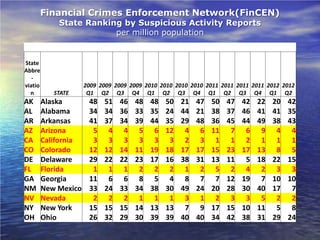
Financial Crimes Enforcement Network(FinCEN)
             State Ranking by Suspicious Activity Reports
                         per million population


State
Abbre
   -
viatio                2009 2009 2009 2009 2010 2010 2010 2010 2011 2011 2011 2011 2012 2012
  n         STATE      Q1 Q2 Q3 Q4 Q1 Q2 Q3 Q4 Q1 Q2 Q3 Q4 Q1 Q2
AK       Alaska        48   51   46   48   48   50   21   47   50   47   42   22   20   42
AL       Alabama       34   34   36   33   35   24   44   21   38   37   46   41   41   35
AR       Arkansas      41   37   34   39   44   35   29   48   36   45   44   49   38   43
AZ       Arizona        5    4    4    5    6   12    4    6   11    7    6    9    4    4
CA       California     3    3    3    3    3    3    2    3    1    1    2    1    1    1
CO       Colorado      12   12   14   11   19   18   17   17   15   23   17   13    8    5
DE       Delaware      29   22   22   23   17   16   38   31   13   11    5   18   22   15
FL       Florida        1    1    1    2    2    2    1    2    5    2    4    2    3    3
GA       Georgia       11    6    6    8    5    4    8    7    7   12   19    7   10   10
NM       New Mexico    33   24   33   34   38   30   49   24   20   28   30   40   17    7
NV       Nevada         2    2    2    1    1    1    3    1    2    3    3    5    2    2
NY       New York      15   15   15   14   13   13    7    9   17   15   10   11    5    8
OH       Ohio          26   32   29   30   39   39   40   40   34   42   38   31   29   24
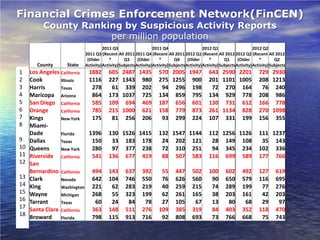
Financial Crimes Enforcement Network(FinCEN)
          County Ranking by Suspicious Activity Reports
                      per million population
                                     2011 Q3                      2011 Q4                      2012 Q1                      2012 Q2
                           2011 Q3 (Recent All 2011 2011 Q4 (Recent All 2011 2012 Q1 (Recent All 2012 2012 Q2 (Recent All 2012
                            (Older      *        Q3      (Older      *        Q4      (Older      *        Q1      (Older      *        Q2
       County      State   Activity) Activity) Subjects Activity) Activity) Subjects Activity) Activity) Subjects Activity) Activity) Subjects
1    Los Angeles California 1882        605     2487 1435            570 2005 1947                643 2590 2201               729 2930
2    Cook        Illinois   1116        227     1343 980             275 1255 900                 201 1101 1005               208 1213
3    Harris      Texas       278         61      339 202              94 296 198                   72 270 164                  76 240
4    Maricopa Arizona        864        173     1037 725             134 859 795                  134 929 778                 208 986
5    San Diego California    585        109      694 469             187 656 601                  130 731 612                 166 778
6    Orange      California  785        215     1000 621             158 779 873                  261 1134 828                270 1098
7    Kings       New York    175         81      256 206              93 299 224                  107 331 199                 156 355
8    Miami-
     Dade        Florida    1396        130 1526 1415                132 1547 1144                112 1256 1126               111 1237
9    Dallas      Texas       150         33 183 178                   24 202 121                   28 149 108                  35 143
10   Queens      New York    280         97 377 238                   72 310 251                   94 345 234                 102 336
11   Riverside California    541        136 677 419                   88 507 583                  116 699 589                 177 766
12   San
     Bernardino California   494        143       637      392        55      447       502       100      602       492      127       619
13   Clark       Nevada      642        104       746      550        76      626       560        90      650       579      116       695
14   King        Washington  221         62       283      219        40      259       215        74      289       199       77       276
15   Wayne       Michigan    268         55       323      199        62      261       165        38      203       161       42       203
16   Tarrant     Texas        60         24        84       78        27      105        67        13       80        68       29        97
17   Santa Clara California  363        148       511      276       109      385       319        84      403       352      118       470
18   Broward Florida         798        115       913      716        92      808       693        73      766       668       75       743
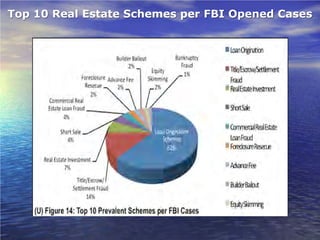
Top 10 Real Estate Schemes per FBI Opened Cases
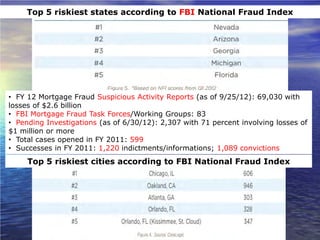
Top 5 riskiest states according to FBI National Fraud Index


• FY 12 Mortgage Fraud Suspicious Activity Reports (as of 9/25/12): 69,030 with
losses of $2.6 billion
• FBI Mortgage Fraud Task Forces/Working Groups: 83
• Pending Investigations (as of 6/30/12): 2,307 with 71 percent involving losses of
$1 million or more
• Total cases opened in FY 2011: 599
• Successes in FY 2011: 1,220 indictments/informations; 1,089 convictions
     Top 5 riskiest cities according to FBI National Fraud Index
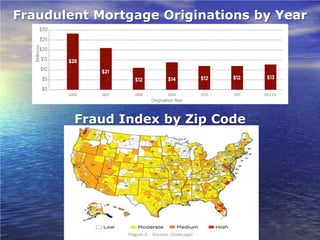
Fraudulent Mortgage Originations by Year


        Fraud Index by Zip Code
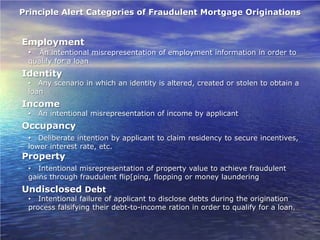
Principle Alert Categories of Fraudulent Mortgage Originations


Employment
 •  An intentional misrepresentation of employment information in order to
 qualify for a loan
Identity
 • Any scenario in which an identity is altered, created or stolen to obtain a
 loan
Income
 •   An intentional misrepresentation of income by applicant
Occupancy
 • Deliberate intention by applicant to claim residency to secure incentives,
 lower interest rate, etc.
Property
 • Intentional misrepresentation of property value to achieve fraudulent
 gains through fraudulent flip[ping, flopping or money laundering
Undisclosed Debt
 • Intentional failure of applicant to disclose debts during the origination
 process falsifying their debt-to-income ration in order to qualify for a loan.
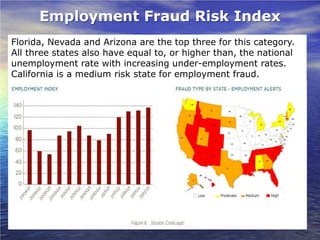
Employment Fraud Risk Index
Florida, Nevada and Arizona are the top three for this category.
All three states also have equal to, or higher than, the national
unemployment rate with increasing under-employment rates.
California is a medium risk state for employment fraud.
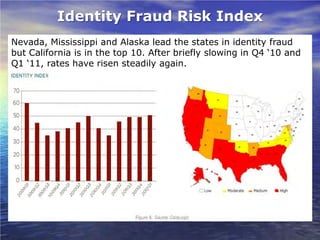
Identity Fraud Risk Index
Nevada, Mississippi and Alaska lead the states in identity fraud
but California is in the top 10. After briefly slowing in Q4 ‘10 and
Q1 ‘11, rates have risen steadily again.
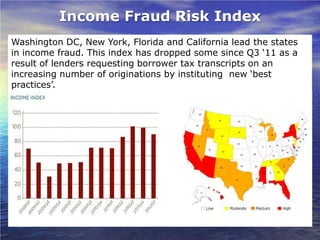
Income Fraud Risk Index
Washington DC, New York, Florida and California lead the states
in income fraud. This index has dropped some since Q3 ‘11 as a
result of lenders requesting borrower tax transcripts on an
increasing number of originations by instituting new ‘best
practices’.
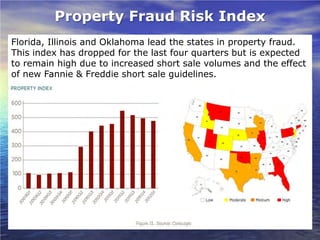
Property Fraud Risk Index
Florida, Illinois and Oklahoma lead the states in property fraud.
This index has dropped for the last four quarters but is expected
to remain high due to increased short sale volumes and the effect
of new Fannie & Freddie short sale guidelines.
What’s in YOUR market?
• Short sale fraud is still most prevalent
   Unlicensed negotiators
   Outside of escrow payments
   DRE is investigating transactions where listing
   brokers are indicating preferential treatment
• Loan modification fraud
• Bail-out Specialists / Home Rescue Schemes
• Squatters
   Grow Houses
   Adverse possession
• Rental Fraud / Craig’s List Scams
• House Stealing (Identity Theft / Mortgage fraud)
• Reverse Mortgage Fraud (Elder Abuse)
   Forgery
   Diminished Capacity
   Undue Influence
   Fraud
• Real property crime can take many forms, but most often involves grand theft, forgery, and a
    relatively recent scheme, identity theft
•   Fraudulent real estate investment schemes, typically involving the sale of trust deeds. Trust deeds
    may be unsecured, or inadequately secured.
•   Use of forged escrow instructions to steal escrow deposits.
•   Fraud in private sales of property, such as failure to disclose all liens against the property.
•   Fraud in installments land sales contracts. The seller may accept payments from the buyer, but fail
    to pay the underlying mortgage, causing the property to be foreclosed.
•   Forgery of grant deeds.
•   Forgery or alteration of a trust deed or grant deed before recording. For example, the loan amount
    on a trust deed may be altered to look like the borrower owes much more.
•   Undisclosed addenda that are not submitted to short sale lenders with the original purchase
    contract.
•   Another variation on the theme of short sale negotiator payments is seen in agreements wherein
    sellers are crediting buyers with so-called non-recurring closing costs.
•   DRE is investigating transactions where listing brokers are indicating in their advertisements that
    only offers where buyers request a non-recurring closing cost credit from the seller to pay for the
    short sale negotiator fee will be submitted to the short sale lender.
•   The Department has also learned of several occurrences in which buyers and/or sellers are
    receiving undisclosed monies and credits outside of escrow.
•   Foreclosure Bailout
•   Home Equity and Home Renovation Fraud
•   Deceptive Timeshares
•   Forensic Loan Audits
•   Home Mortgage Relief Thru Litigation
•   False & Misleading designation or claims
Short Sale Flipping/Flopping
One of the major and recurring schemes is short sale
flopping, where real estate agents and brokers have
defrauded a short sale lender with respect to the value of a
property and purchase offers received, and then, in turn,
resold the property for a much higher price.

These types of scenarios usually involve a false appraisal or
broker price opinion (BPO) that was provided by the listing
broker to the short sale lender with the intent of under
pricing and falsely stating the value of property.

Sometimes, the listing broker will withhold offers from the
short sale lender and will only submit one offer from a buyer,
or straw buyer, that they have personally secured for the
purchase of the property at an artificially low price.

Without the knowledge of the short sale lender, the listing
broker will then resell the property for a profit, sometimes
immediately
Short Sales Involving LLC’s
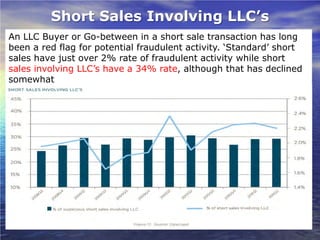
An LLC Buyer or Go-between in a short sale transaction has long
been a red flag for potential fraudulent activity. ‘Standard’ short
sales have just over 2% rate of fraudulent activity while short
sales involving LLC’s have a 34% rate, although that has declined
somewhat
Short Sales and Resale Age
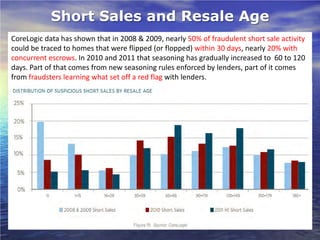
CoreLogic data has shown that in 2008 & 2009, nearly 50% of fraudulent short sale activity
could be traced to homes that were flipped (or flopped) within 30 days, nearly 20% with
concurrent escrows. In 2010 and 2011 that seasoning has gradually increased to 60 to 120
days. Part of that comes from new seasoning rules enforced by lenders, part of it comes
from fraudsters learning what set off a red flag with lenders.
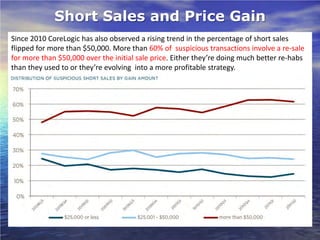
Short Sales and Price Gain
Since 2010 CoreLogic has also observed a rising trend in the percentage of short sales
flipped for more than $50,000. More than 60% of suspicious transactions involve a re-sale
for more than $50,000 over the initial sale price. Either they’re doing much better re-habs
than they used to or they’re evolving into a more profitable strategy.
What do you get when you combine
   two popular rackets these days
identity theft and mortgage fraud?
    A totally new kind of crime: HOUSE STEALING.
             Here’s how it generally works:

 …The con artists start by picking out a house to steal—
                       say, YOURS.
  …Next, they assume your identity—getting a hold of
 your name and personal information (easy enough to
 do off the Internet) and using that to create fake IDs,
                social security cards, etc.
 …Then, they go to an office supply store and purchase
              forms that transfer property.
 …After forging your signature and using the fake IDs,
they file these deeds with the proper authorities, and lo
         and behold, your house is now THEIRS.*
Potential Red Flags

 Are you being asked to pay ‘up-front fees’
 Are you being asked to pay for something in cash?
 Are you being asked to pay for something ‘outside of escrow’ ‘on the side’ or ‘after
closing’
 Are you being asked to pay the real estate agent directly
 Are you dealing with unlicensed agents, brokerage companies or short sale
negotiators
 Are you being asked to transfer your title to a 3rd party
 Are you being encouraged to make payments to a 3rd party
 Are you being told not to contact your lender yourself
 Are you being asked to ‘not show that to the bank’
 Are they offering a ‘forensic loan audit’
 Are you dealing with an ‘attorney backed business’ or out of state attorneys
 Is the buyer an LLC representing an investor
 Is there a concurrent escrow
 Does the program or organization claim to represent a Federal or State program
without backup
 Does the sales pitch have obvious holes, inconsistencies or blue-sky’ assumptions
 Are you being provided the mandatory state and federal disclosures early in the transaction
 Refuses to met in an actual office, lack of actual office or refuses to meet in person.
• Effective with your next transaction certain document fees go from $3 to $10.
• The fees are imposed whenever an individual or business records a deed of trust, a
notice of default, notice of trustee sale, affidavit, lien, lease or quitclaim deed, as well as
other documents filed with the Office of the Assessor-Clerk-Recorder.
• Revenue generated from the fees is deposited into the Real Estate Prosecution Trust
Fund, from which the D.A.'s office withdraws money as needed - - restricted for
investigations and prosecutions of mortgage and foreclosure- related scams.
• The assessor's office receives a relatively small portion of the money to cover costs
associated with mailing "courtesy notices" that alert homeowners whenever a
document has been filed that impacts his or her property.
• DA’s office received more than 2,400 referrals for real estate fraud investigation in
fiscal 2011-12, up more than 500 from the previous fiscal year.
• The expanded office would create regional teams in the southwest county and Indio
to investigate fraud allegations in those areas. The Riverside office’s staff of four
investigators would grow to seven, and a forensic accountant, a real estate fraud
document examiner and a forensic computer analyst would be among the other staff
additions.
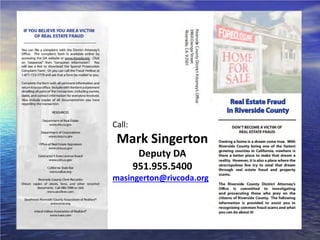
Call:
 Mark Singerton
         Deputy DA
        951.955.5400
masingerton@rivcoda.org
http://www.slideshare.net/genewunderlich


                   Stonewood

                   SolCo

2013 fraud presentation

  • 1.
  • 2.
    Financial Crimes EnforcementNetwork(FinCEN) State Ranking by Suspicious Activity Reports per million population State Abbre - viatio 2009 2009 2009 2009 2010 2010 2010 2010 2011 2011 2011 2011 2012 2012 n STATE Q1 Q2 Q3 Q4 Q1 Q2 Q3 Q4 Q1 Q2 Q3 Q4 Q1 Q2 AK Alaska 48 51 46 48 48 50 21 47 50 47 42 22 20 42 AL Alabama 34 34 36 33 35 24 44 21 38 37 46 41 41 35 AR Arkansas 41 37 34 39 44 35 29 48 36 45 44 49 38 43 AZ Arizona 5 4 4 5 6 12 4 6 11 7 6 9 4 4 CA California 3 3 3 3 3 3 2 3 1 1 2 1 1 1 CO Colorado 12 12 14 11 19 18 17 17 15 23 17 13 8 5 DE Delaware 29 22 22 23 17 16 38 31 13 11 5 18 22 15 FL Florida 1 1 1 2 2 2 1 2 5 2 4 2 3 3 GA Georgia 11 6 6 8 5 4 8 7 7 12 19 7 10 10 NM New Mexico 33 24 33 34 38 30 49 24 20 28 30 40 17 7 NV Nevada 2 2 2 1 1 1 3 1 2 3 3 5 2 2 NY New York 15 15 15 14 13 13 7 9 17 15 10 11 5 8 OH Ohio 26 32 29 30 39 39 40 40 34 42 38 31 29 24
  • 3.
    Financial Crimes EnforcementNetwork(FinCEN) County Ranking by Suspicious Activity Reports per million population 2011 Q3 2011 Q4 2012 Q1 2012 Q2 2011 Q3 (Recent All 2011 2011 Q4 (Recent All 2011 2012 Q1 (Recent All 2012 2012 Q2 (Recent All 2012 (Older * Q3 (Older * Q4 (Older * Q1 (Older * Q2 County State Activity) Activity) Subjects Activity) Activity) Subjects Activity) Activity) Subjects Activity) Activity) Subjects 1 Los Angeles California 1882 605 2487 1435 570 2005 1947 643 2590 2201 729 2930 2 Cook Illinois 1116 227 1343 980 275 1255 900 201 1101 1005 208 1213 3 Harris Texas 278 61 339 202 94 296 198 72 270 164 76 240 4 Maricopa Arizona 864 173 1037 725 134 859 795 134 929 778 208 986 5 San Diego California 585 109 694 469 187 656 601 130 731 612 166 778 6 Orange California 785 215 1000 621 158 779 873 261 1134 828 270 1098 7 Kings New York 175 81 256 206 93 299 224 107 331 199 156 355 8 Miami- Dade Florida 1396 130 1526 1415 132 1547 1144 112 1256 1126 111 1237 9 Dallas Texas 150 33 183 178 24 202 121 28 149 108 35 143 10 Queens New York 280 97 377 238 72 310 251 94 345 234 102 336 11 Riverside California 541 136 677 419 88 507 583 116 699 589 177 766 12 San Bernardino California 494 143 637 392 55 447 502 100 602 492 127 619 13 Clark Nevada 642 104 746 550 76 626 560 90 650 579 116 695 14 King Washington 221 62 283 219 40 259 215 74 289 199 77 276 15 Wayne Michigan 268 55 323 199 62 261 165 38 203 161 42 203 16 Tarrant Texas 60 24 84 78 27 105 67 13 80 68 29 97 17 Santa Clara California 363 148 511 276 109 385 319 84 403 352 118 470 18 Broward Florida 798 115 913 716 92 808 693 73 766 668 75 743
  • 4.
    Top 10 RealEstate Schemes per FBI Opened Cases
  • 5.
    Top 5 riskieststates according to FBI National Fraud Index • FY 12 Mortgage Fraud Suspicious Activity Reports (as of 9/25/12): 69,030 with losses of $2.6 billion • FBI Mortgage Fraud Task Forces/Working Groups: 83 • Pending Investigations (as of 6/30/12): 2,307 with 71 percent involving losses of $1 million or more • Total cases opened in FY 2011: 599 • Successes in FY 2011: 1,220 indictments/informations; 1,089 convictions Top 5 riskiest cities according to FBI National Fraud Index
  • 6.
    Fraudulent Mortgage Originationsby Year Fraud Index by Zip Code
  • 7.
    Principle Alert Categoriesof Fraudulent Mortgage Originations Employment • An intentional misrepresentation of employment information in order to qualify for a loan Identity • Any scenario in which an identity is altered, created or stolen to obtain a loan Income • An intentional misrepresentation of income by applicant Occupancy • Deliberate intention by applicant to claim residency to secure incentives, lower interest rate, etc. Property • Intentional misrepresentation of property value to achieve fraudulent gains through fraudulent flip[ping, flopping or money laundering Undisclosed Debt • Intentional failure of applicant to disclose debts during the origination process falsifying their debt-to-income ration in order to qualify for a loan.
  • 8.
    Employment Fraud RiskIndex Florida, Nevada and Arizona are the top three for this category. All three states also have equal to, or higher than, the national unemployment rate with increasing under-employment rates. California is a medium risk state for employment fraud.
  • 9.
    Identity Fraud RiskIndex Nevada, Mississippi and Alaska lead the states in identity fraud but California is in the top 10. After briefly slowing in Q4 ‘10 and Q1 ‘11, rates have risen steadily again.
  • 10.
    Income Fraud RiskIndex Washington DC, New York, Florida and California lead the states in income fraud. This index has dropped some since Q3 ‘11 as a result of lenders requesting borrower tax transcripts on an increasing number of originations by instituting new ‘best practices’.
  • 11.
    Property Fraud RiskIndex Florida, Illinois and Oklahoma lead the states in property fraud. This index has dropped for the last four quarters but is expected to remain high due to increased short sale volumes and the effect of new Fannie & Freddie short sale guidelines.
  • 12.
    What’s in YOURmarket? • Short sale fraud is still most prevalent Unlicensed negotiators Outside of escrow payments DRE is investigating transactions where listing brokers are indicating preferential treatment • Loan modification fraud • Bail-out Specialists / Home Rescue Schemes • Squatters Grow Houses Adverse possession • Rental Fraud / Craig’s List Scams • House Stealing (Identity Theft / Mortgage fraud) • Reverse Mortgage Fraud (Elder Abuse) Forgery Diminished Capacity Undue Influence Fraud
  • 13.
    • Real propertycrime can take many forms, but most often involves grand theft, forgery, and a relatively recent scheme, identity theft • Fraudulent real estate investment schemes, typically involving the sale of trust deeds. Trust deeds may be unsecured, or inadequately secured. • Use of forged escrow instructions to steal escrow deposits. • Fraud in private sales of property, such as failure to disclose all liens against the property. • Fraud in installments land sales contracts. The seller may accept payments from the buyer, but fail to pay the underlying mortgage, causing the property to be foreclosed. • Forgery of grant deeds. • Forgery or alteration of a trust deed or grant deed before recording. For example, the loan amount on a trust deed may be altered to look like the borrower owes much more. • Undisclosed addenda that are not submitted to short sale lenders with the original purchase contract. • Another variation on the theme of short sale negotiator payments is seen in agreements wherein sellers are crediting buyers with so-called non-recurring closing costs. • DRE is investigating transactions where listing brokers are indicating in their advertisements that only offers where buyers request a non-recurring closing cost credit from the seller to pay for the short sale negotiator fee will be submitted to the short sale lender. • The Department has also learned of several occurrences in which buyers and/or sellers are receiving undisclosed monies and credits outside of escrow. • Foreclosure Bailout • Home Equity and Home Renovation Fraud • Deceptive Timeshares • Forensic Loan Audits • Home Mortgage Relief Thru Litigation • False & Misleading designation or claims
  • 14.
    Short Sale Flipping/Flopping Oneof the major and recurring schemes is short sale flopping, where real estate agents and brokers have defrauded a short sale lender with respect to the value of a property and purchase offers received, and then, in turn, resold the property for a much higher price. These types of scenarios usually involve a false appraisal or broker price opinion (BPO) that was provided by the listing broker to the short sale lender with the intent of under pricing and falsely stating the value of property. Sometimes, the listing broker will withhold offers from the short sale lender and will only submit one offer from a buyer, or straw buyer, that they have personally secured for the purchase of the property at an artificially low price. Without the knowledge of the short sale lender, the listing broker will then resell the property for a profit, sometimes immediately
  • 15.
    Short Sales InvolvingLLC’s An LLC Buyer or Go-between in a short sale transaction has long been a red flag for potential fraudulent activity. ‘Standard’ short sales have just over 2% rate of fraudulent activity while short sales involving LLC’s have a 34% rate, although that has declined somewhat
  • 16.
    Short Sales andResale Age CoreLogic data has shown that in 2008 & 2009, nearly 50% of fraudulent short sale activity could be traced to homes that were flipped (or flopped) within 30 days, nearly 20% with concurrent escrows. In 2010 and 2011 that seasoning has gradually increased to 60 to 120 days. Part of that comes from new seasoning rules enforced by lenders, part of it comes from fraudsters learning what set off a red flag with lenders.
  • 17.
    Short Sales andPrice Gain Since 2010 CoreLogic has also observed a rising trend in the percentage of short sales flipped for more than $50,000. More than 60% of suspicious transactions involve a re-sale for more than $50,000 over the initial sale price. Either they’re doing much better re-habs than they used to or they’re evolving into a more profitable strategy.
  • 18.
    What do youget when you combine two popular rackets these days identity theft and mortgage fraud? A totally new kind of crime: HOUSE STEALING. Here’s how it generally works: …The con artists start by picking out a house to steal— say, YOURS. …Next, they assume your identity—getting a hold of your name and personal information (easy enough to do off the Internet) and using that to create fake IDs, social security cards, etc. …Then, they go to an office supply store and purchase forms that transfer property. …After forging your signature and using the fake IDs, they file these deeds with the proper authorities, and lo and behold, your house is now THEIRS.*
  • 19.
    Potential Red Flags Are you being asked to pay ‘up-front fees’  Are you being asked to pay for something in cash?  Are you being asked to pay for something ‘outside of escrow’ ‘on the side’ or ‘after closing’  Are you being asked to pay the real estate agent directly  Are you dealing with unlicensed agents, brokerage companies or short sale negotiators  Are you being asked to transfer your title to a 3rd party  Are you being encouraged to make payments to a 3rd party  Are you being told not to contact your lender yourself  Are you being asked to ‘not show that to the bank’  Are they offering a ‘forensic loan audit’  Are you dealing with an ‘attorney backed business’ or out of state attorneys  Is the buyer an LLC representing an investor  Is there a concurrent escrow  Does the program or organization claim to represent a Federal or State program without backup  Does the sales pitch have obvious holes, inconsistencies or blue-sky’ assumptions  Are you being provided the mandatory state and federal disclosures early in the transaction  Refuses to met in an actual office, lack of actual office or refuses to meet in person.
  • 20.
    • Effective withyour next transaction certain document fees go from $3 to $10. • The fees are imposed whenever an individual or business records a deed of trust, a notice of default, notice of trustee sale, affidavit, lien, lease or quitclaim deed, as well as other documents filed with the Office of the Assessor-Clerk-Recorder. • Revenue generated from the fees is deposited into the Real Estate Prosecution Trust Fund, from which the D.A.'s office withdraws money as needed - - restricted for investigations and prosecutions of mortgage and foreclosure- related scams. • The assessor's office receives a relatively small portion of the money to cover costs associated with mailing "courtesy notices" that alert homeowners whenever a document has been filed that impacts his or her property. • DA’s office received more than 2,400 referrals for real estate fraud investigation in fiscal 2011-12, up more than 500 from the previous fiscal year. • The expanded office would create regional teams in the southwest county and Indio to investigate fraud allegations in those areas. The Riverside office’s staff of four investigators would grow to seven, and a forensic accountant, a real estate fraud document examiner and a forensic computer analyst would be among the other staff additions.
  • 22.
    Call: Mark Singerton Deputy DA 951.955.5400 masingerton@rivcoda.org
  • 23.