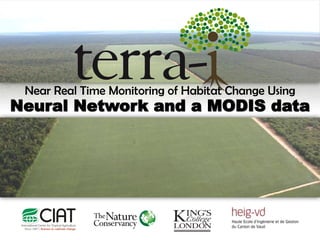
Near Real Time Monitoring of Habitat Change Using
Neural Network and a MODIS data
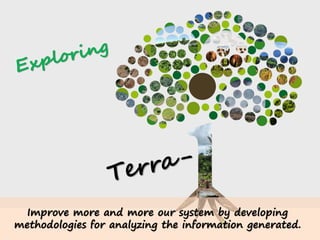
What is Terra-

Terra-i is a system of habitat changes monitoring that uses different
mathematical models that combine vegetation data (MODIS NDVI) and
precipitation data (TRMM) to detect deviations from the natural cycle of
the vegetation over time and thus antrophogenic impacts on natural
ecosystems.


       It has maps of habitat loss every 16 days at the
          continental level with 250 meters of spatial
                            resolution.
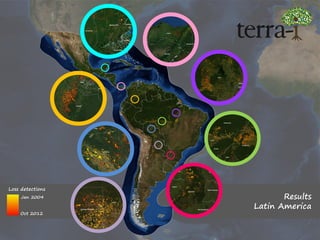
Loss detections
     Jan 2004            Results
                  Latin America
    Oct 2012
OVERVIEW: SL BRAZIL-PERU-BOLIVIA

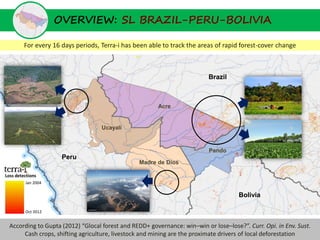
         For every 16 days periods, Terra-i has been able to track the areas of rapid forest-cover change


                                                                           Brazil


                                                        Acre


                                    Ucayali


                                                                           Pando
                      Peru
                                                 Madre de Dios

Loss detections
         Jan 2004

                                                                                      Bolivia

         Oct 2012


  According to Gupta (2012) “Glocal forest and REDD+ governance: win–win or lose–lose?”. Curr. Opi. in Env. Sust.
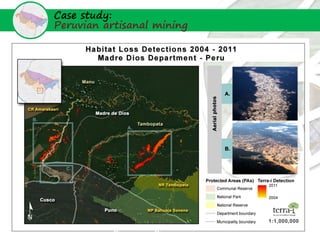
       Cash crops, shifting agriculture, livestock and mining are the proximate drivers of local deforestation
Case study:
Peruvian artisanal mining
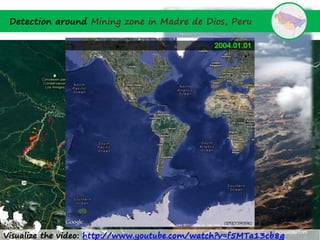
Detection around Mining zone in Madre de Dios, Peru


Visualize the video: http://www.youtube.com/watch?v=f5MTa13cb8g
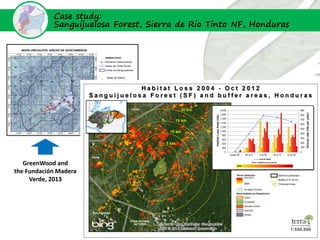
Case study:
            Sanguijuelosa Forest, Sierra de Rio Tinto NF, Honduras


   GreenWood and
the Fundación Madera
     Verde, 2013
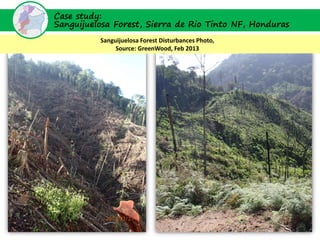
Case study:
Sanguijuelosa Forest, Sierra de Rio Tinto NF, Honduras
          Sanguijuelosa Forest Disturbances Photo,
               Source: GreenWood, Feb 2013
Improve more and more our system by developing
methodologies for analyzing the information generated.
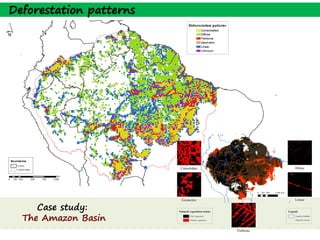
Deforestation patterns


     Case study:
  The Amazon Basin
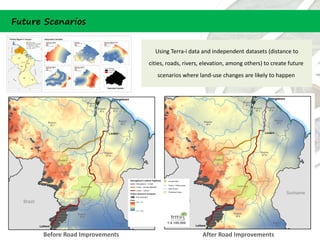
Future Scenarios


                                   Using Terra-i data and independent datasets (distance to
                                 cities, roads, rivers, elevation, among others) to create future
                                    scenarios where land-use changes are likely to happen


      Before Road Improvements                         After Road Improvements
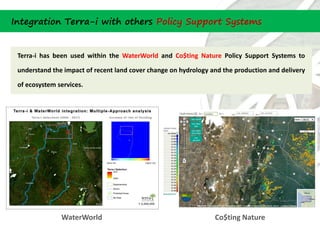
Integration Terra-i with others Policy Support Systems


 Terra-i has been used within the WaterWorld and Co$ting Nature Policy Support Systems to

 understand the impact of recent land cover change on hydrology and the production and delivery

 of ecosystem services.


               WaterWorld                                        Co$ting Nature
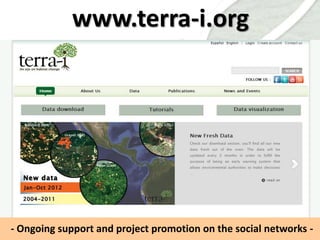
www.terra-i.org


- Ongoing support and project promotion on the social networks -
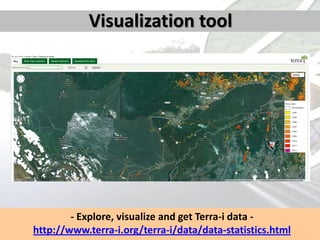
Visualization tool


        - Explore, visualize and get Terra-i data -
http://www.terra-i.org/terra-i/data/data-statistics.html
Contact us:
terra.i.ciat@gmail.com

2013 3 terrai_ifd_ciat_slideshare

  • 1.
    Near Real TimeMonitoring of Habitat Change Using Neural Network and a MODIS data
  • 2.
    What is Terra- Terra-iis a system of habitat changes monitoring that uses different mathematical models that combine vegetation data (MODIS NDVI) and precipitation data (TRMM) to detect deviations from the natural cycle of the vegetation over time and thus antrophogenic impacts on natural ecosystems. It has maps of habitat loss every 16 days at the continental level with 250 meters of spatial resolution.
  • 3.
    Loss detections Jan 2004 Results Latin America Oct 2012
  • 4.
    OVERVIEW: SL BRAZIL-PERU-BOLIVIA For every 16 days periods, Terra-i has been able to track the areas of rapid forest-cover change Brazil Acre Ucayali Pando Peru Madre de Dios Loss detections Jan 2004 Bolivia Oct 2012 According to Gupta (2012) “Glocal forest and REDD+ governance: win–win or lose–lose?”. Curr. Opi. in Env. Sust. Cash crops, shifting agriculture, livestock and mining are the proximate drivers of local deforestation
  • 5.
  • 6.
    Detection around Miningzone in Madre de Dios, Peru Visualize the video: http://www.youtube.com/watch?v=f5MTa13cb8g
  • 7.
    Case study: Sanguijuelosa Forest, Sierra de Rio Tinto NF, Honduras GreenWood and the Fundación Madera Verde, 2013
  • 8.
    Case study: Sanguijuelosa Forest,Sierra de Rio Tinto NF, Honduras Sanguijuelosa Forest Disturbances Photo, Source: GreenWood, Feb 2013
  • 9.
    Improve more andmore our system by developing methodologies for analyzing the information generated.
  • 10.
    Deforestation patterns Case study: The Amazon Basin
  • 11.
    Future Scenarios Using Terra-i data and independent datasets (distance to cities, roads, rivers, elevation, among others) to create future scenarios where land-use changes are likely to happen Before Road Improvements After Road Improvements
  • 12.
    Integration Terra-i withothers Policy Support Systems Terra-i has been used within the WaterWorld and Co$ting Nature Policy Support Systems to understand the impact of recent land cover change on hydrology and the production and delivery of ecosystem services. WaterWorld Co$ting Nature
  • 13.
    www.terra-i.org - Ongoing supportand project promotion on the social networks -
  • 14.
    Visualization tool - Explore, visualize and get Terra-i data - http://www.terra-i.org/terra-i/data/data-statistics.html
  • 15.