By 2025, one quarter of the watersheds
important for drinking water, irrigation and
hydropower in Colombia, Ecuador, Perú and
Bolivia are protected
Thus will be achieved through creation of:
–Local Water Funds
–New Protected “Water Sanctuaries”
–Reciprocal Watershed Agreements (RWA)
People who produce
water, share it,
people who benefit
from water, share
the benefits
Patricio Roque
Patricio Roque
Francisco Gordillo
Technical Secretary, Regional Water
Fund (FORAGUA), Ecuador
FORAGUA
• A financing mechanism
(water fund) for
municipalities
• Financed by citizens
for the conservation of
water sources of
Ecuador’s cities and
towns
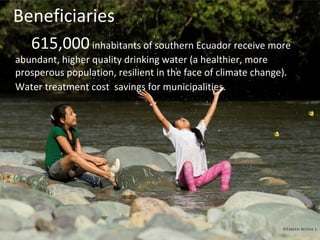
615,000inhabitants of southern Ecuador receive more
abundant, higher quality drinking water (a healthier, more
prosperous population, resilient in the face of climate change).
Water treatment cost savings for municipalities.
Beneficiaries
Technical and financial support to the
watersheds and biodiversity conservation
programs of the municipalities
REGIONAL WATER FUND
Local enterprises
(hydroenergy, banks,
irrigation)
National and International
Corporations/donors
Municipal funds from
water fees
DIRECTORS
5 members selected by board
TECHNICAL
SECRETARY
TRUST BOARD
Municipialities NGOs, Corporations
ANNUAL
INVESTMENT
PLAN
TRUST
10%
90%
Environmental fee
• 93,729 water users
pay $1 per month
(20% of water bill).
• $1,445,000 generated
per year
• This local investment
leverages additional
conservation resouces
217,000 hectares of municipal
reserves created, protecting
fragile, biodiverse ecosystems
28% of Ecuador’s
Municipalities
Renzo Paladines
Director, Naturaleza y Cultura, Ecuador and Peru
Quiroz Water Fund
Financed by the 22,000
irrigators in the San Lorenzo
and Chira Valleys (northern
Perú) to conserve sources of
the Macará, Quiroz and
Chipillico Rivers,
compensating 850 property
owning families in the upper
watersheds of Ayabaca
Province
29,000 hectares of páramo
(moorland) and cloud forest
conserved
Environmental Fee
• Annual support from irrigators: $28,200 USD/year
• Municipality support: $34,000 USD
• Cooperation: $42,000 USD to create the fund
Adolfo Leon Correa
Coordinator, Protected Areas Group,
CORANTIOQUIA, Colombia
• Autonomous Regional
Corporation of Central
Antioquia
• State entity for the
administration of natural
resources and
environmental authority
• 80 municipalities, and 60%
of the Departament of
Antioquia
Protected Areas, Jurisdiction of Corantioquia
10 Natural landscapes to protect the supply of
environmental goods and services
152,000 hectares of new reserves created
DMI del Sistema de
Páramos y Bosques Alto
andinos del Noroccidente
Medio Antioqueño
DMI Cuchilla Jardín –
Támesis
RFPR Farallones Citará PNR Corredor de Las
Alegrías
DMI Cañón río Alicante
DMI Divisoria valle de
Aburrá Río Cauca
DMI Nubes Trocha Capota RFPR Cerro Bravo DMI Ríos Barroso – San Juan DMI Cerro Plateado Alto
San José
Proposed New Water Sanctuaries
Recategorizar el páramo Santa Inés como
Parque Natural Regional
Formular Plan de Manejo para el PNR
Corredor de Las Alegrías
Reserva Forestal Protectora Farallones del
Citará
170,000 hectares in the declaration process
After Protected Area declaration….
Participatory Formulation of a Management Plan
Implementation of Plan
Administration of area to maximise water provision
Social work: reconversion from traditional unsustainable
farming systems to cleaner, more sustainable alternatives
Ecological Restoration of Degraded Paramos
1. DMI Cañón del Río Alicante
2. DMI del SPBANMA
3. DMI de la DVARC
4. DMI CP-ASJ
5. DMI Ríos B-SJ
6. DMI Nubes-Trocha-Capota
7. DMI Cuchilla J-T
8. RFP Farallones del Citará
9. RFP Cerro Bravo
10. PNR Corredor de Las Alegrías
----------------------------------
11. RFP Nare
12. Reserva Bajo Cauca – Nechí*
13. Alto Anorí (Cacica Noría)*
24. Complejo Cenagoso Barbacoas*
25. Alto San Miguel*
26. Recategorización a PNR (Santa Inés)*
----------------------------------
17. PNN Nudo del Paramillo
18. PNN Las Orquídeas1
2
3
4
5
6
7
8
9
10
11
12
13
14
15
16
17
18
Connection of
protected areas
around Medellin
the second city
of Colombia
Maria Teresa Vargas
Director, Fundación Natura, Bolivia
Dorotea Arteaga,
Samaipata, Bolivia
Fecal coliforms in
Dorotea Arteaga’s
water
Her water
source is dirty
Reciprocal Watershed Agreement
Dorotea is protecting 11 ha of her forest in exchange for...
600 metres de plastic tubing, 2 bags of cement, 2
rolls of barbed wire, 76 fruit tree seedlings, and….
A water supply
like thisNot like this
Total cost:
$ 300
Fecal coliforms in the
water before the
agreement
NO fecal coliformes after
the agreement
Now Dorotea Arteaga has
water and food
security, and is voluntarily
protecting water, forest,
carbon and wildlife in one
of the most biodiverse
areas of the planet
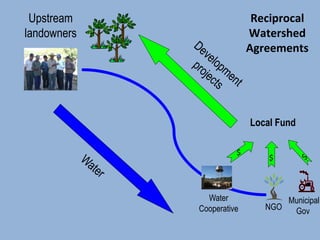
Reciprocity in action
Local Fund
Water
Development
projects
$ $
Water
Cooperative
Municipal
Gov
$
Upstream
landowners
NGO
Reciprocal
Watershed
Agreements
226,435 water
users
3,147 forest
guardians
Today in Bolivia, there are 31 municipal
water funds, financed by 226,435 downstream
water users, supporting 3,147 upstream
families with bee boxes, fruit tree seedlings,
plastic pipes etc. in exchange for the
conservation of 178,448 ha of biodiverse
forest, which is returning 500,000 m3 of water
to the aquifer and storing 290,000 tons of
carbon
Rafa Calderon
Senior Director, Latin America, Rare
Rare inspires change so people and
nature thrive
Downstream
Users
Landowners working the
land
Upstream
Area to
be
Protected
ARA Concept
The Key Ingredient: “Pride of Place”
~$300,000
local water
funds
~8,000 ha
protected
Over 27,000
ha Improved
Mangement
Adoption Trends
The Star Institutional Team
Adrian Oliva
Governor, Department of Tarija, Bolivia
People who produce
water, share it,
people who benefit
from water, share
the benefits
Adolfo Leon, acorrea@corantioquia.gov.co
Francisco Gordillo, fpgordillo@gmail.com
Maria Teresa Vargas, mteresavargas@naturabolivia.org
Adrian Oliva, waldemarpm@gmail.com
Renzo Paladines, rpaladip@naturalezaycultura.org
Rafael Calderon, rcalderon@rare.org
Ecuador: 615,000 water users generate $1,445,000 in local funds. Inhabitants
receive more abundant, and higher quality drinking water because of the protection
of 74,000 ha.
Peru: 22,000 downstream irrigators annually pay $62,000 to 850 upstream
landowners for watershed conservation in Piura
Bolivia: 226,435 downstream water users support 3,147 upstream families in
exchange for the conservation of 178,448 ha of biodiverse forest. Departmental and
municipal governments have created 928,700 of new protected areas
Colombia: 73,086 of new protected areas in Antioquia, and more than 10,000
ha under Reciprocal Watershed Agreements
By 2025, one quarter of the watersheds
important for drinking water, irrigation and
hydropower in Colombia, Ecuador, Perú and
Bolivia are protected
Thus will be achieved through creation of:
–Municipal Water Funds
–New Protected “Water Sanctuaries”
–Reciprocal Watershed Agreements (RWA)
• Goal 6 target: “protect water-related ecosystems
including mountains, forests (and) rivers”; and
“strengthen participation of local communities in water
management”
• Goal 13 target: “strengthen … adaptive capacity to
climate-related hazards…”
• Goal 15 target: “…ensure the conservation and …
sustainable use of terrestrial and inland freshwater
ecosystems and their services, in particular forests (and)
mountains”, and “promote … sustainable management of
all types of forests, halt deforestation, restore degraded
forests and substantially increase … reforestation”.
Watershared directly supports SDG

Water shared

  • 3.
    By 2025, onequarter of the watersheds important for drinking water, irrigation and hydropower in Colombia, Ecuador, Perú and Bolivia are protected Thus will be achieved through creation of: –Local Water Funds –New Protected “Water Sanctuaries” –Reciprocal Watershed Agreements (RWA)
  • 4.
    People who produce water,share it, people who benefit from water, share the benefits
  • 5.
  • 7.
  • 8.
    Francisco Gordillo Technical Secretary,Regional Water Fund (FORAGUA), Ecuador
  • 9.
    FORAGUA • A financingmechanism (water fund) for municipalities • Financed by citizens for the conservation of water sources of Ecuador’s cities and towns
  • 10.
    615,000inhabitants of southernEcuador receive more abundant, higher quality drinking water (a healthier, more prosperous population, resilient in the face of climate change). Water treatment cost savings for municipalities. Beneficiaries
  • 11.
    Technical and financialsupport to the watersheds and biodiversity conservation programs of the municipalities REGIONAL WATER FUND Local enterprises (hydroenergy, banks, irrigation) National and International Corporations/donors Municipal funds from water fees DIRECTORS 5 members selected by board TECHNICAL SECRETARY TRUST BOARD Municipialities NGOs, Corporations ANNUAL INVESTMENT PLAN TRUST 10% 90%
  • 12.
    Environmental fee • 93,729water users pay $1 per month (20% of water bill). • $1,445,000 generated per year • This local investment leverages additional conservation resouces
  • 13.
    217,000 hectares ofmunicipal reserves created, protecting fragile, biodiverse ecosystems
  • 14.
  • 15.
    Renzo Paladines Director, Naturalezay Cultura, Ecuador and Peru
  • 16.
    Quiroz Water Fund Financedby the 22,000 irrigators in the San Lorenzo and Chira Valleys (northern Perú) to conserve sources of the Macará, Quiroz and Chipillico Rivers, compensating 850 property owning families in the upper watersheds of Ayabaca Province
  • 17.
    29,000 hectares ofpáramo (moorland) and cloud forest conserved
  • 18.
    Environmental Fee • Annualsupport from irrigators: $28,200 USD/year • Municipality support: $34,000 USD • Cooperation: $42,000 USD to create the fund
  • 19.
    Adolfo Leon Correa Coordinator,Protected Areas Group, CORANTIOQUIA, Colombia
  • 20.
    • Autonomous Regional Corporationof Central Antioquia • State entity for the administration of natural resources and environmental authority • 80 municipalities, and 60% of the Departament of Antioquia Protected Areas, Jurisdiction of Corantioquia
  • 21.
    10 Natural landscapesto protect the supply of environmental goods and services 152,000 hectares of new reserves created DMI del Sistema de Páramos y Bosques Alto andinos del Noroccidente Medio Antioqueño DMI Cuchilla Jardín – Támesis RFPR Farallones Citará PNR Corredor de Las Alegrías DMI Cañón río Alicante DMI Divisoria valle de Aburrá Río Cauca DMI Nubes Trocha Capota RFPR Cerro Bravo DMI Ríos Barroso – San Juan DMI Cerro Plateado Alto San José
  • 22.
    Proposed New WaterSanctuaries Recategorizar el páramo Santa Inés como Parque Natural Regional Formular Plan de Manejo para el PNR Corredor de Las Alegrías Reserva Forestal Protectora Farallones del Citará 170,000 hectares in the declaration process
  • 23.
    After Protected Areadeclaration…. Participatory Formulation of a Management Plan Implementation of Plan Administration of area to maximise water provision
  • 24.
    Social work: reconversionfrom traditional unsustainable farming systems to cleaner, more sustainable alternatives Ecological Restoration of Degraded Paramos
  • 25.
    1. DMI Cañóndel Río Alicante 2. DMI del SPBANMA 3. DMI de la DVARC 4. DMI CP-ASJ 5. DMI Ríos B-SJ 6. DMI Nubes-Trocha-Capota 7. DMI Cuchilla J-T 8. RFP Farallones del Citará 9. RFP Cerro Bravo 10. PNR Corredor de Las Alegrías ---------------------------------- 11. RFP Nare 12. Reserva Bajo Cauca – Nechí* 13. Alto Anorí (Cacica Noría)* 24. Complejo Cenagoso Barbacoas* 25. Alto San Miguel* 26. Recategorización a PNR (Santa Inés)* ---------------------------------- 17. PNN Nudo del Paramillo 18. PNN Las Orquídeas1 2 3 4 5 6 7 8 9 10 11 12 13 14 15 16 17 18 Connection of protected areas around Medellin the second city of Colombia
  • 26.
    Maria Teresa Vargas Director,Fundación Natura, Bolivia
  • 27.
  • 28.
    Fecal coliforms in DoroteaArteaga’s water Her water source is dirty
  • 29.
    Reciprocal Watershed Agreement Doroteais protecting 11 ha of her forest in exchange for... 600 metres de plastic tubing, 2 bags of cement, 2 rolls of barbed wire, 76 fruit tree seedlings, and….
  • 30.
    A water supply likethisNot like this Total cost: $ 300
  • 31.
    Fecal coliforms inthe water before the agreement
  • 32.
    NO fecal coliformesafter the agreement Now Dorotea Arteaga has water and food security, and is voluntarily protecting water, forest, carbon and wildlife in one of the most biodiverse areas of the planet
  • 33.
  • 34.
  • 35.
  • 36.
  • 37.
    Today in Bolivia,there are 31 municipal water funds, financed by 226,435 downstream water users, supporting 3,147 upstream families with bee boxes, fruit tree seedlings, plastic pipes etc. in exchange for the conservation of 178,448 ha of biodiverse forest, which is returning 500,000 m3 of water to the aquifer and storing 290,000 tons of carbon
  • 38.
    Rafa Calderon Senior Director,Latin America, Rare
  • 39.
    Rare inspires changeso people and nature thrive
  • 40.
  • 41.
    The Key Ingredient:“Pride of Place”
  • 42.
  • 43.
  • 44.
  • 45.
  • 46.
    People who produce water,share it, people who benefit from water, share the benefits
  • 47.
    Adolfo Leon, acorrea@corantioquia.gov.co FranciscoGordillo, fpgordillo@gmail.com Maria Teresa Vargas, mteresavargas@naturabolivia.org Adrian Oliva, waldemarpm@gmail.com Renzo Paladines, rpaladip@naturalezaycultura.org Rafael Calderon, rcalderon@rare.org
  • 48.
    Ecuador: 615,000 waterusers generate $1,445,000 in local funds. Inhabitants receive more abundant, and higher quality drinking water because of the protection of 74,000 ha. Peru: 22,000 downstream irrigators annually pay $62,000 to 850 upstream landowners for watershed conservation in Piura Bolivia: 226,435 downstream water users support 3,147 upstream families in exchange for the conservation of 178,448 ha of biodiverse forest. Departmental and municipal governments have created 928,700 of new protected areas Colombia: 73,086 of new protected areas in Antioquia, and more than 10,000 ha under Reciprocal Watershed Agreements
  • 49.
    By 2025, onequarter of the watersheds important for drinking water, irrigation and hydropower in Colombia, Ecuador, Perú and Bolivia are protected Thus will be achieved through creation of: –Municipal Water Funds –New Protected “Water Sanctuaries” –Reciprocal Watershed Agreements (RWA)
  • 50.
    • Goal 6target: “protect water-related ecosystems including mountains, forests (and) rivers”; and “strengthen participation of local communities in water management” • Goal 13 target: “strengthen … adaptive capacity to climate-related hazards…” • Goal 15 target: “…ensure the conservation and … sustainable use of terrestrial and inland freshwater ecosystems and their services, in particular forests (and) mountains”, and “promote … sustainable management of all types of forests, halt deforestation, restore degraded forests and substantially increase … reforestation”. Watershared directly supports SDG

Editor's Notes

  • #9 <number>
  • #16 <number>
  • #20 <number>
  • #27 <number>
  • #35 <number> The Water Fund works like this: The development NGO, the Municipal Government and the Water Cooperative each invest in--and play a decision-making role in--the Water Fund. The three-institution board decides annually how money will be spent: in annual payments, in-kind support, land purchases, or whatever else. These compensation payments are paid to upstream landowners, who in turn sign contracts to guarantee land use, and (supposedly) provision of the water service.
  • #39 <number>
  • #40 Conservation’s greatest challenge might be human behavior. People act both on reason and emotion. Rare brings together logic with the powerful emotion of pride — pride of place, pride in community, pride in tradition. Rare’s signature Pride campaigns inspire pride around unique natural assets and create a clear path for local change. Rare disseminates messages to evoke the desired behavior just like the private sector has done for years. Our mission statement is: Rare inspires change so people and nature thrive. Quiza el reto mas grande la conservacion es el cambio de comportamiento. Las personas actuan tanto usando la razon como la emocion. Rare trae estos dos temas, logica y una de las mas grandes emociones – el orgullo de lugar, communidad y tradicion. El enfoque Pride de Rare inspira el orgullo alrededor de activos naturales unicos y crea un camino claro para el cambio a nivel local. Rare disemina mensajes que evocan el comportamiento deseado asi como lo ha hecho el sector privado por muchas decadas. Nuestra mision es: Rare inspira el cambio para la gente y la naturaleza prosperen. <number>
  • #41 Entonces con estos elementos conformamos el esquema ARA (explicar brevemente desde la perspectiva de reciprocidad) Usuarios y autoridades contribuyen a un fondo el cual se usa para ofrecer incentivos que impulsan acciones concretas en las partes altas de las cuencas <number>
  • #42 Cómo lograr que estos cambios sucedan? El esquema ARA que he mostrado requiere de lograr voluntad, articulación, compromiso y la adopción de prácticas diferentes a las que las personas están acostumbradas Todos estos cambios de comportamiento requieren de una estrategia específica que permita lograrlos. Rare sabe que la mayoría de nuestras decisiones están gobernadas por las emociones más que por la razón. Tradicionalmente el tema de conservación se ha basado en pensamientos racionales, información científica, capacidad técnica pero se ha dejado de lado el tema emocional. Nuestra tecnología de cambio de comportamiento trabaja en ambos frentes cambiando conocimientos, actitudes y comportamientos <number>
  • #43 The campaigns’ social benefits – which include clean sustainable water, biodiversity benefits, and communities resilient to climate change – are accumulating, too. In a recent study of ARA participants – funded through the generosity of CDKN – we found that the money from the ARA agreements goes to farms to invest in improvements in land production and alternative sources of income, which impact the social well-being of families upstream. Downstream, the social benefits go to the water users who have a cleaner supply of water. ARA model provides viable alternatives to upstream producers whose current land-use practices threaten highly vulnerable watershed ecosystems critical to biodiversity, water regulation and other ecosystem services, including clean air, carbon sequestration, flood and erosion control, and regulation of local rainfall. In-kind compensation, as opposed to cash payments, can help transition farmers toward less rainfall-dependent perennial agriculture and more diversified livelihoods, through the provision of training and technical support, which tend to be included as part of the ARA incentives package. By improving the health of locally managed natural resources and ecosystems through voluntary action, they have the potential to increase the resilience of the natural system and its ability to better adapt to unpredictable changes. Also, Rare’s focus on behavior change and the role of the engagement process in getting mayors to take action and to reduce conflict between water agencies and upstream communities <number>
  • #45 <number>
  • #46 <number>