CERTITUDE
                 Automatic evaluation of Excel and
                    Word productions in Moodle


Canada Moodle Moot, Vancouver, 2013

Robert Gérin-Lajoie, Gilles-Philippe Leblanc, Université de
Montréal


February 2013
Why computer and information literacy?
• Today’s college students need technological skills to search
  for, process and present information. In order to perform tasks
  related to research, projects and other work, students use ICT
  (information and communication technology) to collaborate at a
  distance and communicate their results.

• Extract from the Quebec ICT profile, see http://reptic.qc.ca
CERTITUDE PROJECT INITIAL GOALS
 o Increase synergy
   o between levels of colleges and universities to jointly develop
     a national standard for information literacy
 o Develop a series of tests
   o online assessment of students' skills Quebec college network
     intending to university
 o Aim for certification
   o for graduates of the college system in Quebec, and
     information technology skills, considered necessary for the
     pursuit of academic
 o Allow universities to use tools
   o ICT skills assessment for online training and technological
     upgrading informational for students who have not
     acquired the skills associated with certification
CHALLENGE
 o Assess skills in real situations (in situ)
   oAvoid as much as possible too theoretical
    assessments tend to measure knowledge
    rather than skills (In ICT, knowledge that
    worth?)
 o Ensure an automated correction
   oThe Challenge of challenges: ensuring an
    automated correction while raising two
    other challenges
PROJECT STEPS
 o Refine competency profile

 o Develop a platform for quiz production compose
   tests and assessments (diagnostic, formative or for
   certified)

 o Produce a library of questions and tests
   o mainly in situ

 o Validate the question bank
   o Recognized by statistical tests
HOW TO EVALUATE SKILLS
• Multiple-choice questions (MCQs) increased by
  multimedia
• Simulations with flash
• Treasure hunts
  ▫ Find a specific document in a school library
• “In situ” achievements
  ▫ Excel
  ▫ Word
In situ achievements in Excel
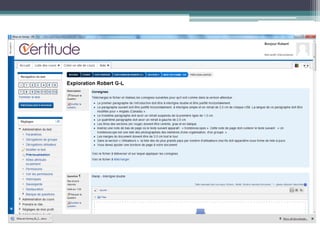
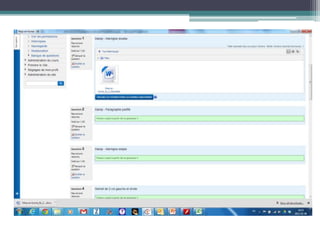
• New type of Moodle question
  ▫ A variant of description called « Saisies multiples »
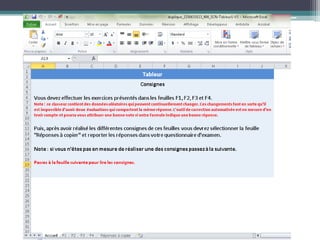
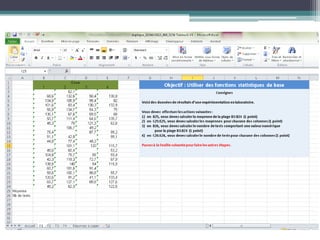
• The professor workbench generate an Excel file containing the work
  to be done.
• The professor workbench generate a list of expected tokens, one for
  each question.
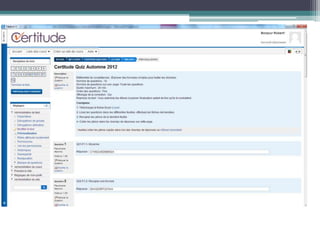
• The questions are constructed in Moodle.
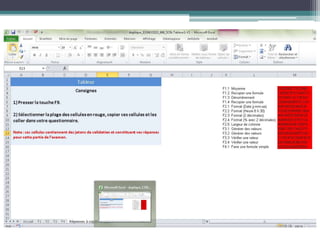
• The student do the assignment in Excel. Excel formulas generate
  tokens encoding the student work, one for each question.
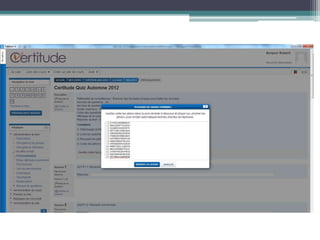
• The student send back the tokens in Moodle. Each one is compared
  against the expected token.
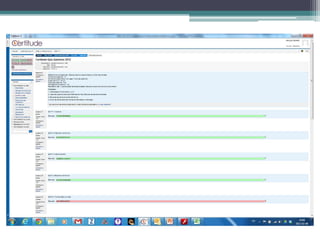
Evaluating Word results
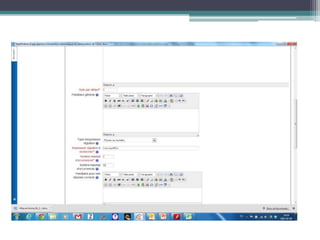
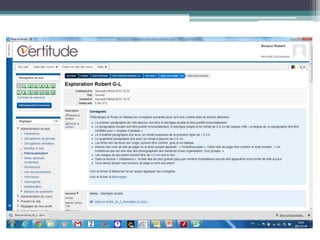
• New type of Moodle question
  ▫ « Manipulation de fichier Word »
• Each question of this type test a regular expression onto the
  document.xml file inside a docx.
• Each question can test the number of occurrence: more or equal
  than the minimum and less or equal than the maximum stated.
• Thanks to
 ▫ Technical experts
    Gilles-Philippe Leblanc, Université de Montréal
    Mathieu Petit-Clair, Moodle developper
 ▫ Educational experts
    Jean Allard and Michel R Pronovost, Collège Jean-de-
     Brébeuf
 ▫ Direction committee
      Robert Gérin-Lajoie, Université de Montréal
      Richard Guay, Collège Jean-de-Brébeuf
      Françoise Marceau, CEGEP@Distance
      Jacques Raynauld, HEC-Montreal, MATI-Montréal

Automatic evaluation of Excel and Word productions in Moodle

  • 1.
    CERTITUDE Automatic evaluation of Excel and Word productions in Moodle Canada Moodle Moot, Vancouver, 2013 Robert Gérin-Lajoie, Gilles-Philippe Leblanc, Université de Montréal February 2013
  • 2.
    Why computer andinformation literacy? • Today’s college students need technological skills to search for, process and present information. In order to perform tasks related to research, projects and other work, students use ICT (information and communication technology) to collaborate at a distance and communicate their results. • Extract from the Quebec ICT profile, see http://reptic.qc.ca
  • 3.
    CERTITUDE PROJECT INITIALGOALS o Increase synergy o between levels of colleges and universities to jointly develop a national standard for information literacy o Develop a series of tests o online assessment of students' skills Quebec college network intending to university o Aim for certification o for graduates of the college system in Quebec, and information technology skills, considered necessary for the pursuit of academic o Allow universities to use tools o ICT skills assessment for online training and technological upgrading informational for students who have not acquired the skills associated with certification
  • 4.
    CHALLENGE o Assessskills in real situations (in situ) oAvoid as much as possible too theoretical assessments tend to measure knowledge rather than skills (In ICT, knowledge that worth?) o Ensure an automated correction oThe Challenge of challenges: ensuring an automated correction while raising two other challenges
  • 5.
    PROJECT STEPS oRefine competency profile o Develop a platform for quiz production compose tests and assessments (diagnostic, formative or for certified) o Produce a library of questions and tests o mainly in situ o Validate the question bank o Recognized by statistical tests
  • 6.
    HOW TO EVALUATESKILLS • Multiple-choice questions (MCQs) increased by multimedia • Simulations with flash • Treasure hunts ▫ Find a specific document in a school library • “In situ” achievements ▫ Excel ▫ Word
  • 7.
    In situ achievementsin Excel • New type of Moodle question ▫ A variant of description called « Saisies multiples » • The professor workbench generate an Excel file containing the work to be done. • The professor workbench generate a list of expected tokens, one for each question. • The questions are constructed in Moodle. • The student do the assignment in Excel. Excel formulas generate tokens encoding the student work, one for each question. • The student send back the tokens in Moodle. Each one is compared against the expected token.
  • 14.
    Evaluating Word results •New type of Moodle question ▫ « Manipulation de fichier Word » • Each question of this type test a regular expression onto the document.xml file inside a docx. • Each question can test the number of occurrence: more or equal than the minimum and less or equal than the maximum stated.
  • 19.
    • Thanks to ▫ Technical experts  Gilles-Philippe Leblanc, Université de Montréal  Mathieu Petit-Clair, Moodle developper ▫ Educational experts  Jean Allard and Michel R Pronovost, Collège Jean-de- Brébeuf ▫ Direction committee  Robert Gérin-Lajoie, Université de Montréal  Richard Guay, Collège Jean-de-Brébeuf  Françoise Marceau, CEGEP@Distance  Jacques Raynauld, HEC-Montreal, MATI-Montréal